


Abstract
In polarization-modulated laser ranging systems, noise-induced waveform distortion and shifts in extremum position severely limit ranging accuracy. To address the difficulty of conventional filters in balancing noise suppression against preservation of extremum features, this paper proposes a local structure- and noise-aware spatially adaptive Stein’s Unbiased Risk Estimate (SURE) wavelet denoising method. Within the SURE minimum-mean-square-error framework, a local second-derivative structural feature and local noise are introduced to construct a spatially adaptive threshold-adjustment mechanism at individual wavelet coefficients. This mechanism reduces the shrinkage strength in extremum neighborhoods characterized by strong local second-order variation to protect key structural features, while enhancing shrinkage in relatively flat and noisy regions to improve denoising performance. Experimental results show that, relative to mean filtering, Savitzky–Golay (SG) filtering, and standard SURE wavelet denoising, the proposed method markedly improves the stability of extremum positions while maintaining the signal-to-noise ratio (SNR), and reduces the ranging root-mean-square error (RMSE) by 27.3 μm, 21.5 μm, and 4.0 μm on average across all tested distances, respectively. Extremum stability and ranging error exhibit a significant positive correlation (r = 0.863, = 0.745, p < 0.001), confirming the critical influence of extremum structural stability on ranging accuracy. This study is of value for extending precision measurement systems based on feature extraction.
1. Introduction
Laser ranging offers high accuracy and non-contact operation, and has been widely applied in precision manufacturing, industrial inspection, and spatial metrology [1]. Among its implementations, polarization-modulated laser ranging modulates the polarization state of the optical signal to establish a mapping between changes in polarization parameters and the distance to be measured, thereby enabling high-precision extraction of distance information [2]. In practical measurements, environmental disturbances and system noise cause the ranging signal to be superimposed with multiple noise components, leading to waveform distortion and shifts in key features [3]. For polarization-modulated laser ranging systems, distance information is typically obtained indirectly from the extremum position or phase parameter of the signal [2]. Noise therefore not only causes fluctuations in signal amplitude (longitudinal), but also, through nonlinear propagation mechanisms, induces shifts in the extremum position (lateral) and phase distortion, thereby degrading ranging accuracy [4]. It follows that suppressing noise while preserving the key structural features of the signal is an important research question for improving ranging accuracy.
To meet the noise-suppression requirements of ranging signals, conventional approaches such as mean filtering and Savitzky–Golay (SG) filtering have been widely applied [5]. Mean filtering smooths the signal through local averaging and effectively suppresses random noise, but tends to cause loss of detail and displacement of extremum positions; SG filtering preserves the overall signal shape through local polynomial fitting, but its performance depends heavily on the choice of window length and fitting order, making adaptive optimization difficult in complex or dynamic noise environments [6]. These methods therefore still exhibit a clear trade-off between noise-suppression capability and the ability to preserve structural features.
The wavelet transform, owing to its excellent time–frequency localization and multiscale analysis capability, can separate signal and noise components across different frequency bands, and has become an important tool for non-stationary signal processing [7]. Conventional wavelet denoising typically shrinks the wavelet detail coefficients using a fixed or empirically determined threshold [8]. However, such methods generally rely on prior knowledge of the noise, whereas the noise intensity and statistical properties in practical measurement environments often vary dynamically with temperature, mechanical vibration, and the state of the optical system, making it difficult for fixed-threshold methods to maintain stable performance [9]. Stein’s Unbiased Risk Estimate (SURE) criterion constructs an unbiased risk function and minimizes the estimated mean-square error, enabling adaptive threshold selection without prior noise information and providing a theoretical basis for data-driven wavelet denoising [10]. Compared with empirical threshold methods, SURE can determine the threshold automatically from the observed data, and has therefore been widely adopted in signal denoising [8].
However, the standard SURE method still fundamentally applies a uniform shrinkage threshold within each decomposition level, with its optimization objective focused mainly on minimizing the overall mean-square error, without explicitly accounting for the importance of local structural features [11]. When a signal contains both regions with strong local second-order variation and strong-noise regions, a uniform threshold often cannot simultaneously preserve structure and suppress noise: a larger threshold reduces residual noise but tends to weaken important structural information near extrema, whereas a smaller threshold preserves local features but may leave noise insufficiently suppressed [12].
To address this problem, this paper proposes a local structure- and noise-aware spatially adaptive SURE (LSN-SA SURE) wavelet denoising method. Building on the conventional SURE mean-square-error minimization framework, a local second-derivative structural feature and local noise are introduced to achieve spatially adaptive adjustment of the shrinkage strength of wavelet coefficients at different spatial locations.
The main contributions of this paper are as follows:
- (1)
- A local structure- and noise-aware spatially adaptive SURE wavelet denoising method is proposed, advancing conventional layer-wise uniform threshold shrinkage to spatially varying coefficient-wise threshold adjustment.
- (2)
- A structure-preserving threshold-adjustment mechanism based on a local second-derivative structural feature and local noise is constructed, achieving an adaptive balance between noise suppression and structure preservation.
- (3)
- A three-tier signal–structure–application evaluation framework is established, systematically assessing algorithm performance in terms of signal quality, extremum stability, and ranging accuracy, and revealing the transfer relationship from local structural preservation to improved ranging accuracy.
2. Principle of Polarization—Modulated Laser Ranging
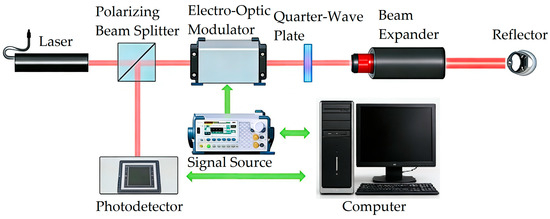
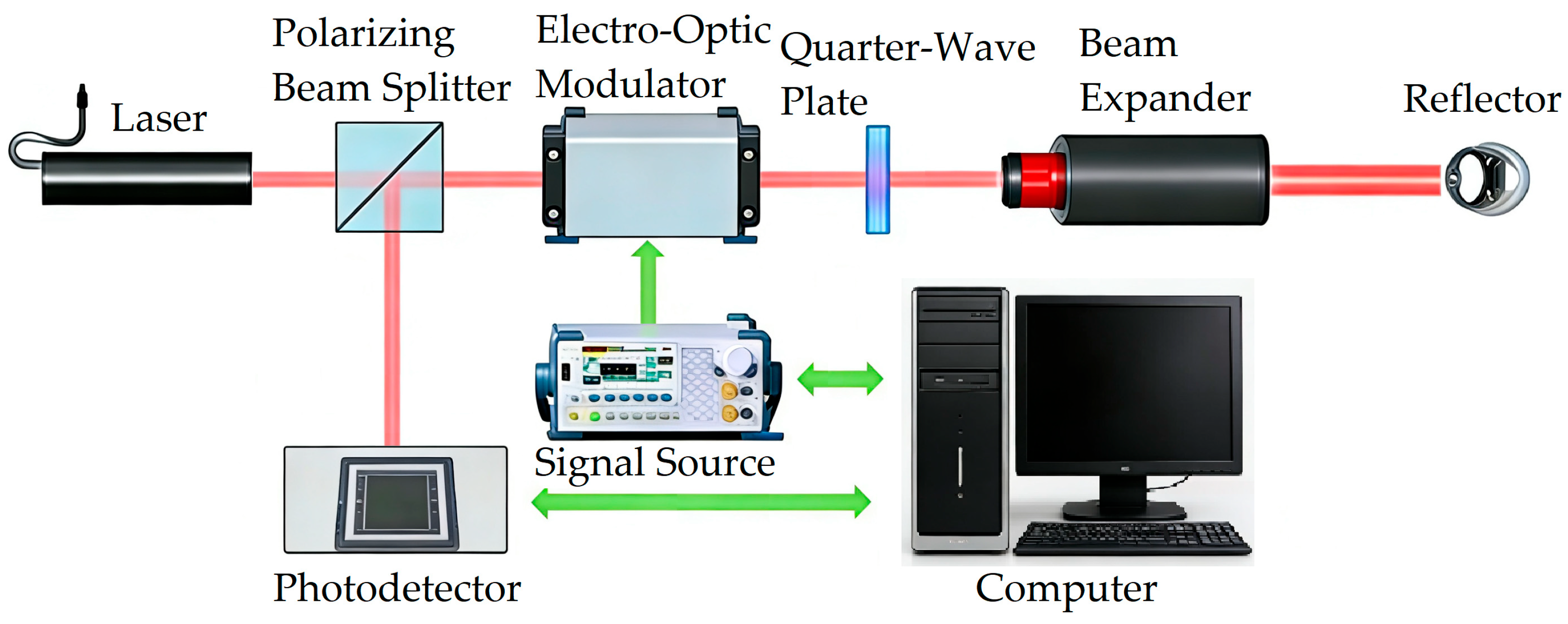
Polarization-modulated laser ranging periodically modulates the polarization state of the optical signal, mapping optical-path information onto phase information to achieve high-precision distance measurement. The system configuration is shown schematically in Figure 1.
Figure 1.
Schematic diagram of the polarization-modulated laser ranging system.
The system operates as follows: linearly polarized light emitted by the laser passes through an electro-optic modulator, which introduces a polarization phase modulation on the orthogonal components; the modulated signal, after reflection from the target, re-enters the modulation system and is finally received by a photodetector and converted into an electrical signal. Because the round-trip time of flight of the optical signal is directly related to distance, the phase variation of the detected signal reflects the target distance. After photoelectric conversion, the detected signal intensity I can be approximately expressed as:
where , determined by the phase delay of the modulation signal induced by the time of flight, M is the modulation depth of the electro-optic modulator, c is the speed of light, and f is the modulation frequency [2]. The distance to be measured L and the modulation frequency f satisfy the relation:
where is the modulation wavelength. During linear frequency sweeping of the modulation frequency f, the phase difference φ varies linearly with frequency, causing the detected signal I to exhibit a periodic cosine variation [2]. When the condition is satisfied (N being an integer), the detected signal I reaches a local minimum. From Equations (1) and (2), measuring the distance L can therefore be converted into precisely extracting the position of the minimum of the intensity curve (corresponding to the modulation frequency f).
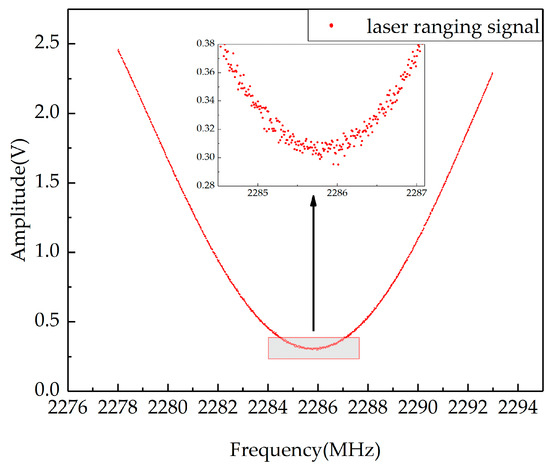
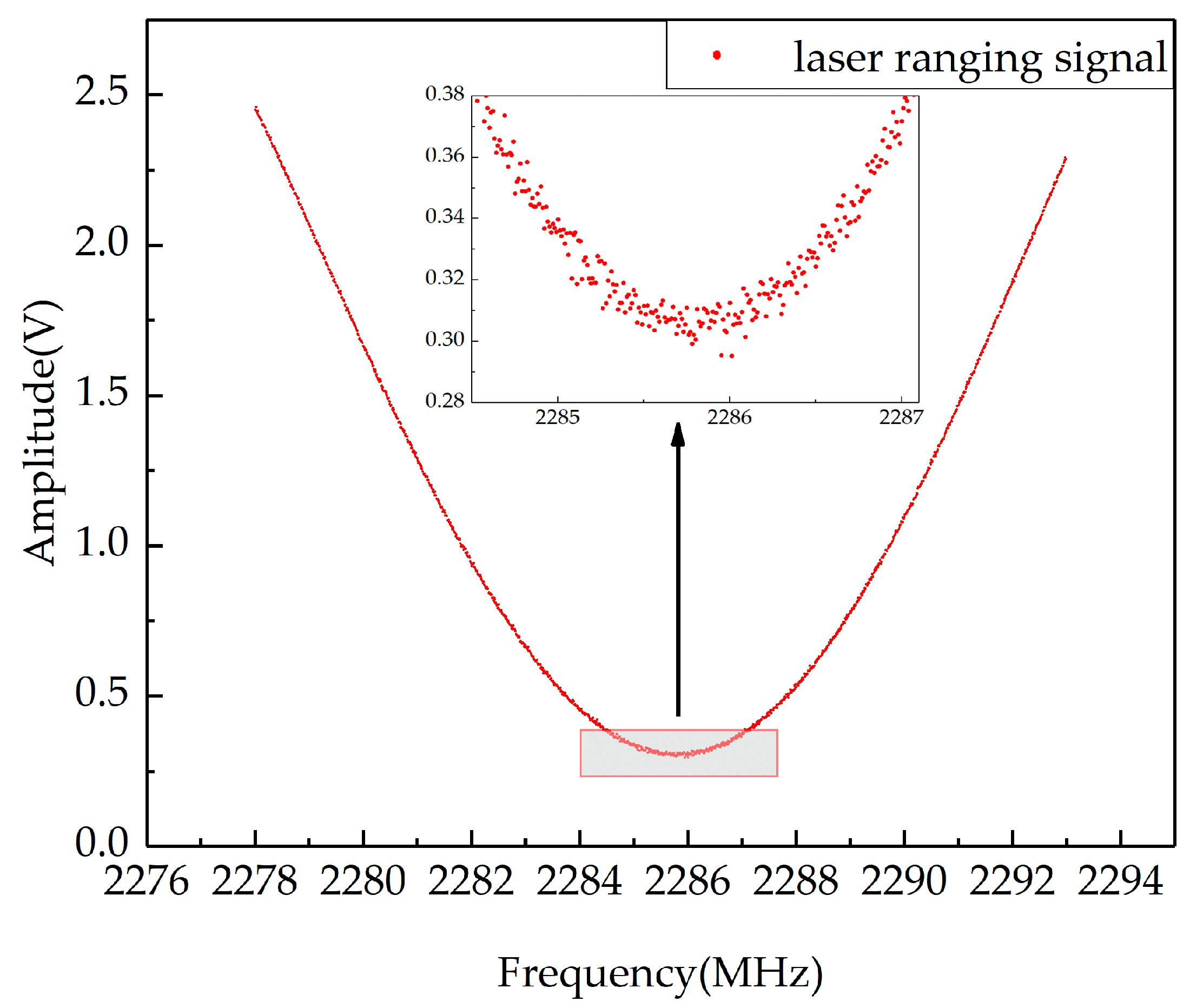
In practical measurements, however, noise perturbs the waveform in the neighborhood of the minimum (as shown in Figure 2), causing the minimum position to shift or even introducing spurious minima, which directly affects the accuracy of modulation-frequency extraction and the reliability of the ranging result.
Figure 2.
Echo signal of the polarization-modulated laser ranging system.
Effectively suppressing noise while maintaining the structural stability of the neighborhood around the minimum is therefore of critical importance for signal processing in polarization-modulated laser ranging.
3. Local Structure- and Noise-Aware Spatially Adaptive SURE Wavelet Denoising Method
Given that polarization-modulated ranging signals are inherently ‘structure-sensitive’, this paper introduces a local structure- and noise-aware spatially adaptive SURE (LSN-SA SURE) wavelet denoising method that aims to balance denoising with structure preservation.
3.1. Discrete Wavelet Transform and Classical Threshold Denoising
The discrete wavelet transform (DWT) decomposes a signal into low-frequency approximation components and high-frequency detail components at different scales [13]. For a noisy signal , where s(t) is the true underlying signal and n(t) is the noise, the discrete wavelet decomposition can be expressed as:
where are the approximation coefficients, reflecting the overall trend of the signal, and are the detail coefficients, which mainly contain high-frequency information and noise [14]. Polarization-modulated ranging signals are dominated by low-frequency content, while noise is concentrated at high frequencies; denoising can therefore be achieved by thresholding the detail coefficients [15]. Threshold functions generally take one of two forms: hard thresholding and soft thresholding .
The choice of threshold directly determines the denoising performance [16]. A fixed threshold cannot adapt to dynamic noise: an excessively large threshold tends to weaken extremum structures, whereas an excessively small threshold leaves residual noise and produces spurious extrema [17]. A data-driven adaptive threshold-selection mechanism is therefore required.
3.2. Construction of the SURE Risk Function
To achieve adaptive threshold optimization, the SURE criterion is introduced. Under the assumption of additive white Gaussian noise, the detected signal model is , where [18]. Here, σ denotes the standard deviation of additive white Gaussian noise and is the noise variance. For an estimator , the mean-square error is [19]. Since the true signal s is generally unavailable, SURE provides an unbiased estimate that depends only on the observed data y:
where is the indicator function, equal to 1 when the condition holds and 0 otherwise; λ is the threshold parameter [20]. Applying this criterion to the detail coefficients at each scale in the wavelet domain yields the optimal threshold for each level:
where is the optimal threshold of the j-th decomposition level, denotes the value of λ minimizing the corresponding function, and denotes the SURE risk function with threshold λ at the j-th level [21]. The introduction of the SURE criterion shifts threshold selection from empirically driven to data-driven, which strives to achieve an optimal mean-square error estimate in the denoising process [22]. It should be noted that the derivation of the SURE risk function relies on the additive white Gaussian noise (AWGN) assumption. Practical polarization-modulated laser-ranging systems contain mixed noise originating from detectors, electronics, optical fluctuations and mechanical disturbances, leading to mild deviations from ideal AWGN. Performance degradation of the algorithm may occur in scenarios dominated by strong non-Gaussian or heavily colored noise.
3.3. Local Structure- and Noise-Aware Spatially Adaptive Threshold-Adjustment Mechanism
The conventional SURE method applies a uniform threshold within the same decomposition level, ignoring differences in the local characteristics of the signal. The neighborhood of the minimum, characterized by strong local second-order variation and therefore prone to structural distortion, and the relatively flat region differ in their sensitivity to the threshold. To address this, a local second-derivative structural feature and local noise characteristics of the signal are combined to construct a spatially adaptive threshold-adjustment mechanism.
3.3.1. Local Structural Feature Extraction and Robust Normalization
For an arbitrary sampling point of the signal, a quadratic polynomial is fitted within a local window. The window length n is chosen as an odd number so that the sampling point is located at the center of the window. The fitted local waveform is expressed as , where , , are the polynomial coefficients, and the local structural-feature at this point, , is defined as:
The magnitude of the local second derivative reflects the degree of local second-order structural variation in the signal. It is generally larger in sharp extremum regions and smaller in relatively flat regions. This feature is therefore used to characterize the local structural sensitivity of the waveform and to regulate the shrinkage strength near structurally important extrema [23]. The window length n is determined via exhaustive search for the minimum extremum position stability index (introduced later) using preliminary test data obtained prior to formal experiments, and all quantitative results in this manuscript are calculated from newly collected independent experimental data, unused for parameter tuning. A sliding window is used to fit the local waveform with a quadratic polynomial. For interior sampling points, a symmetric window centered at the current point is adopted. For samples near the beginning and end boundaries, where a complete symmetric neighborhood cannot be obtained, signal padding is applied to construct the local fitting window.
To characterize dynamic local disturbance variations, the residual between the observed signal and the local quadratic polynomial approximation is calculated as , where represents the observed signal and denotes the locally fitted quadratic approximation. Although the residual may contain a small component caused by local waveform–model mismatch, it provides an effective measure of local disturbance intensity for adaptive threshold adjustment [24]. The median absolute deviation (MAD) is used to robustly estimate the local dynamic noise intensity at the sampling point as:
To eliminate the influence of physical units, this paper adopts a robust percentile-based normalization method [25]. The 5th percentile () and 95th percentile () of each feature across the full sequence are taken as robust lower and upper bounds, linearly mapping the local structural-feature and local noise intensity onto the interval [0, 1] to obtain, at each sampling point , the normalized local structural-feature and normalized local noise , respectively:
Compared with conventional normalization approaches, percentile-based normalization is less sensitive to isolated extreme values and therefore provides more stable feature scaling for adaptive threshold adjustment. For numerical stability, a small positive constant ε is introduced when approaches zero. In addition, the normalized feature is clipped to the range of [0, 1].
3.3.2. Dynamic Adjustment Coefficient and Spatially Adaptive Shrinkage
Combining the local structural feature and local noise characteristics, a point-wise adaptive threshold-adjustment gain is constructed:
This gain coefficient is designed to respond adaptively to the local signal state. When the local noise level rises, increases and β increases accordingly, raising the threshold shrinkage strength and thereby enhancing noise suppression; conversely, when the signal lies within an extremum neighborhood characterized by strong local second-order variation, increases and β decreases accordingly, reducing the shrinkage strength and limiting damage to the extremum structure. The function thus strengthens denoising in flat, noise-dominated regions while relaxing shrinkage near structurally important features.
Two properties of this construction are worth noting. When the local noise and structural-feature both lie at the lower bound of the normalized range ( = 0, = 0), β reduces to 1 and the algorithm collapses to the standard SURE threshold, so the proposed method can be regarded as a natural extension of the conventional SURE framework rather than an unrelated ad hoc construction. In addition, β varies monotonically with both and —increasing with the former and decreasing with the latter—a behavior that follows directly from the analytical form of Equation (11) and is consistent with the noise-suppression and structure-preservation logic described above. This type of adaptive weighting, in which a gain function with well-defined boundary and monotonicity properties is constructed and subsequently validated experimentally, is consistent with common practice in the adaptive-thresholding literature [26].
Because the number of time-domain samples is generally different from the number of detail coefficients at each wavelet decomposition level, a direct one-to-one correspondence between a time-domain sampling point and an individual wavelet coefficient does not exist. Therefore, the time-domain adaptive factor is transferred to the wavelet domain by normalized-index linear interpolation. Let N denote the number of time-domain samples and nj denote the number of detail coefficients at decomposition level j. The normalized positions of the time-domain samples and the detail coefficients are defined as , and . The adaptive factor corresponding to the k-th detail coefficient at level j is then obtained by linear interpolation:
The interpolated adaptive factor is then used to modulate the layer-wise SURE threshold, yielding a spatially varying threshold for individual detail coefficients:
where is the layer-wise optimal threshold obtained by minimizing the SURE risk at decomposition level j and is the adaptive factor obtained by linear interpolation at the position of the k-th detail coefficient.
3.4. Algorithm Procedure
- (1)
- Noise estimation: the noise standard deviation is robustly estimated from the median of the first-level detail coefficients as:
- (2)
- Wavelet decomposition: the signal is decomposed through J levels of the discrete wavelet transform:where is the approximation coefficient at level J, and is the detail coefficient at level j (j = 1, 2, …, J).
- (3)
- Solving for the layer-wise optimal threshold: the SURE risk function is constructed for the detail coefficients at each level, and the layer-wise optimal threshold is solved for.
- (4)
- Local structural-feature extraction: the local second-derivative structural feature and local noise are computed point by point and subjected to robust percentile normalization.
- (5)
- Spatial threshold adjustment: the adjustment factor β is generated from the local structural feature and local noise, linearly interpolated to the coefficient positions at each decomposition level, and combined with the layer-wise SURE threshold to perform spatially adaptive soft thresholding.
- (6)
- Signal reconstruction: the processed detail coefficients are passed through the inverse discrete wavelet transform to obtain the denoised signal:
4. Experimental Design and Results Analysis
4.1. Experimental System
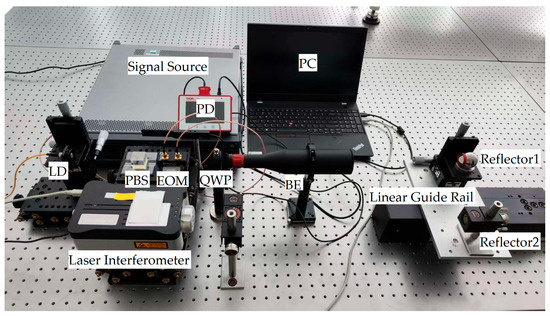
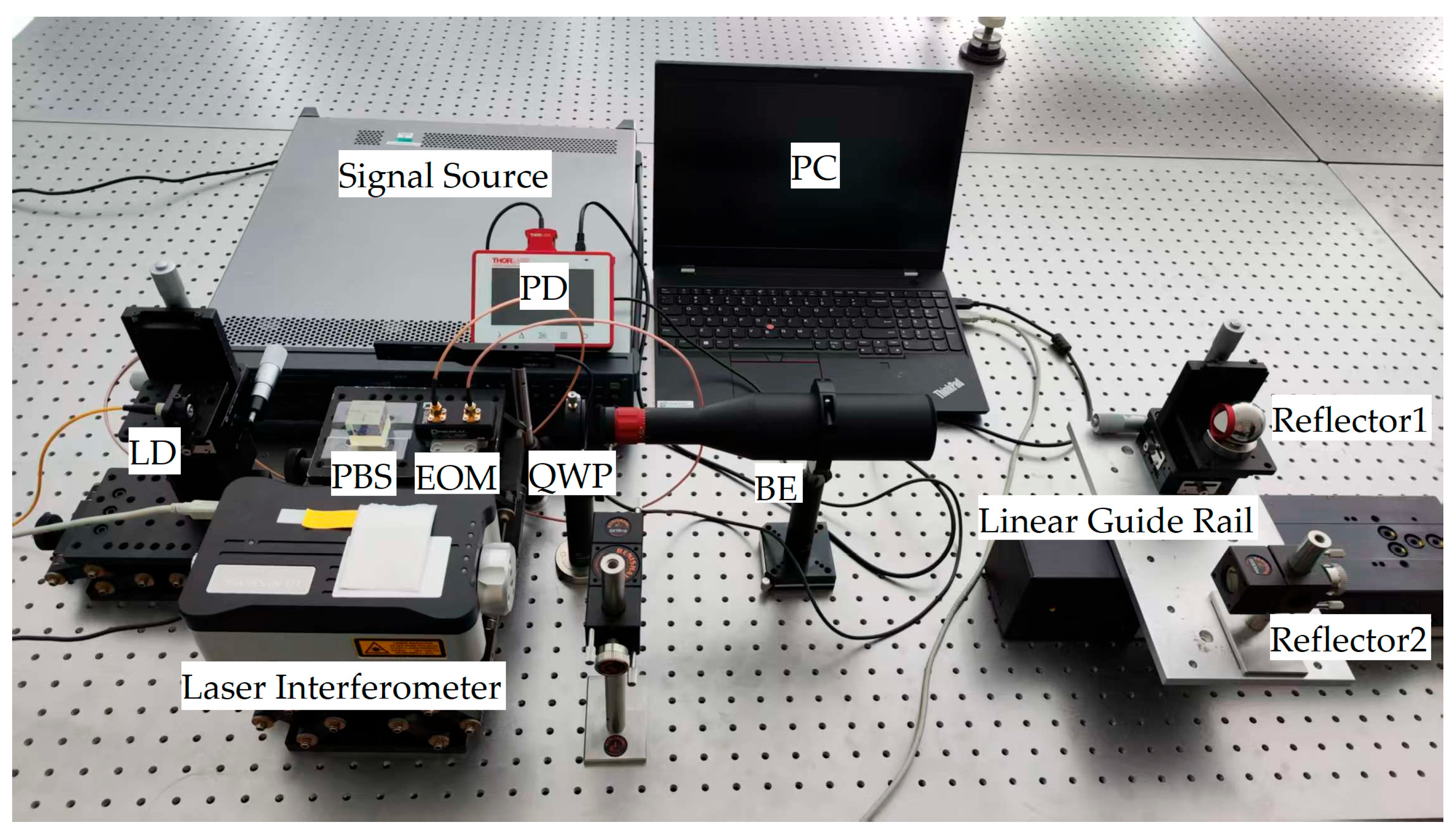
To validate the effectiveness of the LSN-SA SURE method, the experimental system shown in Figure 3 was established. The entire platform consists of a polarization-modulated laser ranging system (including a laser, an electro-optic modulator, a reflective target, a photodetection module, a frequency-sweep signal source, and other auxiliary components), a Renishaw XL-80 (Renishaw plc, Wotton-under-Edge, UK) laser interferometer serving as the reference standard, and a displacement unit composed of a linear guide rail and fixtures. The Renishaw XL-80 interferometer provides a nominal measurement accuracy of approximately ±0.5 ppm under specified operating conditions, ensuring the reliability of the reference distance measurements.
Figure 3.
Schematic diagram of the polarization-modulated laser ranging experiment. LD: laser diode; PBS: polarizing beam splitter; EOM: electro-optic modulator; QWP: quarter wave plate; PD: photodetector; BE: beam expander.
The reflective targets of the polarization-modulated laser ranging system and the laser interferometer were both driven by the same linear guide rail for displacement control. The nominal displacements in the experiment were set to L = {3.0, 3.5, 4.0, 4.5, 5.0, 5.5, 6.0} m. At each ranging position, measurements were repeated 16 times to reduce random error and improve statistical reliability.
4.2. Comparison Methods and Evaluation Framework
Mean filtering, SG filtering, and standard SURE-Wavelet denoising were selected as comparison methods. All parameters were optimized under a unified validation framework. These baselines cover classical spatial-domain smoothing approaches and the direct SURE-wavelet baseline from which our method is derived. This paper focuses on denoising for polarization-modulated laser-ranging signals, where preserving extremum-related local waveform features is the primary target, rather than constructing a general-purpose wavelet shrinkage algorithm for broad-scope signal scenarios.
This paper evaluates the performance of the proposed method comprehensively at three levels: the signal level, the structural level, and the application level.
- (1)
- Signal-level metrics: the signal-to-noise ratio (SNR) and reconstruction error (reconstruction RMSE) are used to evaluate the denoising performance. SNR measures the proportion of energy in the effective signal component relative to the noise component, while the reconstruction RMSE describes the amplitude deviation between the denoised signal and the original observed signal [27]. Since the signal is acquired as a photodetector voltage (in V), the unit of the signal-level RMSE is likewise V [28].
- (2)
- Structural-level metric: at the structural level, extremum position stability index is used as the metric, defined as the standard deviation of the extremum position across repeated measurements, reflecting the fidelity of the extremum structure.where is the extremum position extracted from the i-th measurement and is the mean.
- (3)
- Application-level metrics: at the application level, the mean absolute error (MAE) and root-mean-square error (RMSE) are used as ranging-accuracy metrics. The mean absolute error (MAE) is defined as the average of the absolute differences between the estimated and reference distances; because positive and negative errors do not cancel one another, MAE provides an intuitive measure of the overall error level of the ranging system [29]. The RMSE measures the degree of deviation between the ranging result and the true distance, and is more sensitive to large errors [30].
To avoid confusion among the evaluation metrics at different levels, the RMSE at the signal level and at the application level are defined separately: the signal-level (in V or mV) characterizes the signal reconstruction error, while the ranging-level (in mm or μm) characterizes the ranging error; the two are independent in both physical meaning and evaluation objective.
4.3. Experimental Results and Analysis
- (1)
- Signal-level analysis
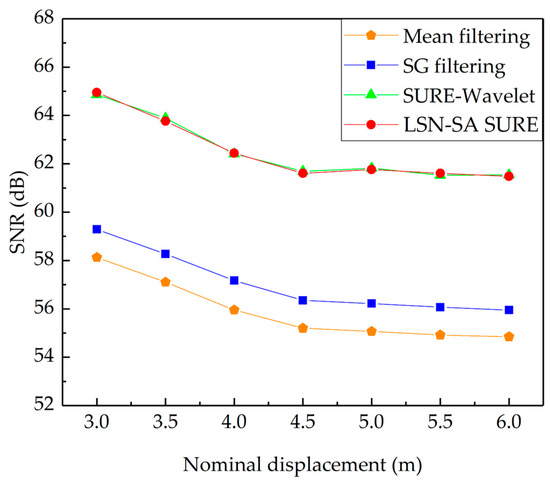
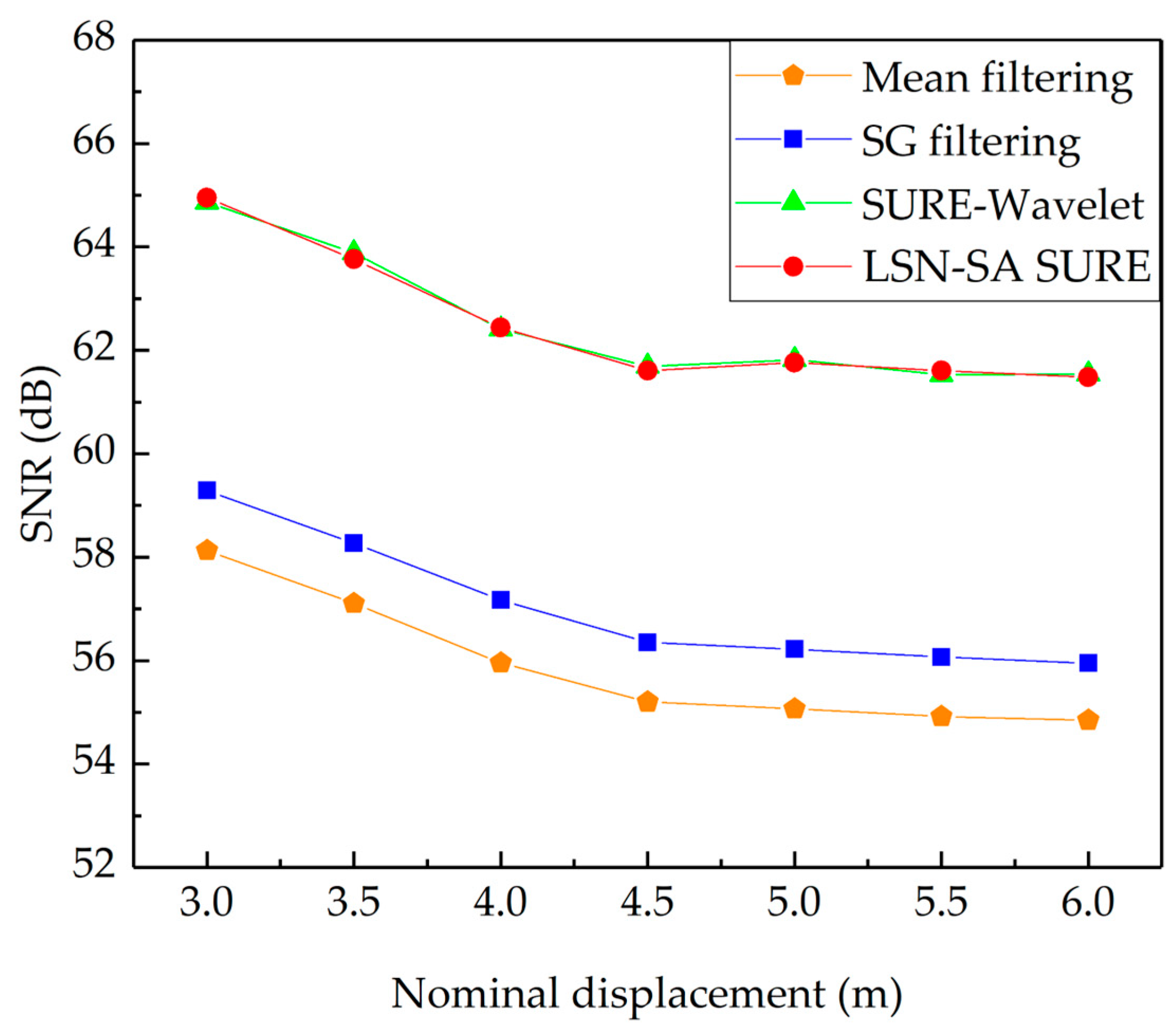
As shown in Table 1 and Figure 4, the SNR of all methods generally decreases with increasing distance, mainly owing to energy attenuation of the optical signal during propagation and the relative increase in noise. The average SNR of the LSN-SA SURE method reaches 62.52 dB, an improvement of approximately 6.62 dB, 5.47 dB over mean filtering, SG filtering, respectively, and is essentially on par with standard SURE wavelet denoising (marginally lower by 0.02 dB, attributable to the structure-preserving strategy).
Table 1.
Comparison of SNR after filtering.
Figure 4.
Comparison of SNR after filtering.
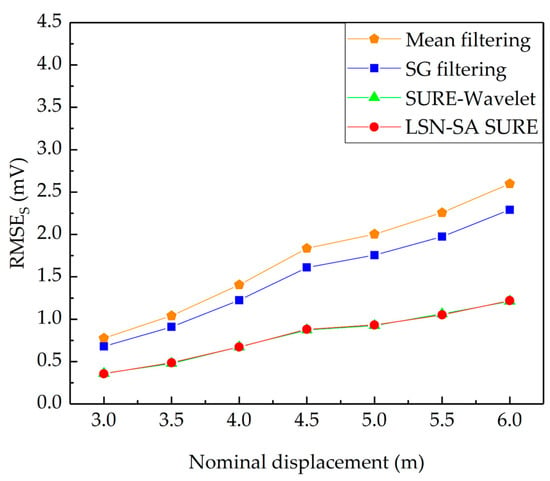
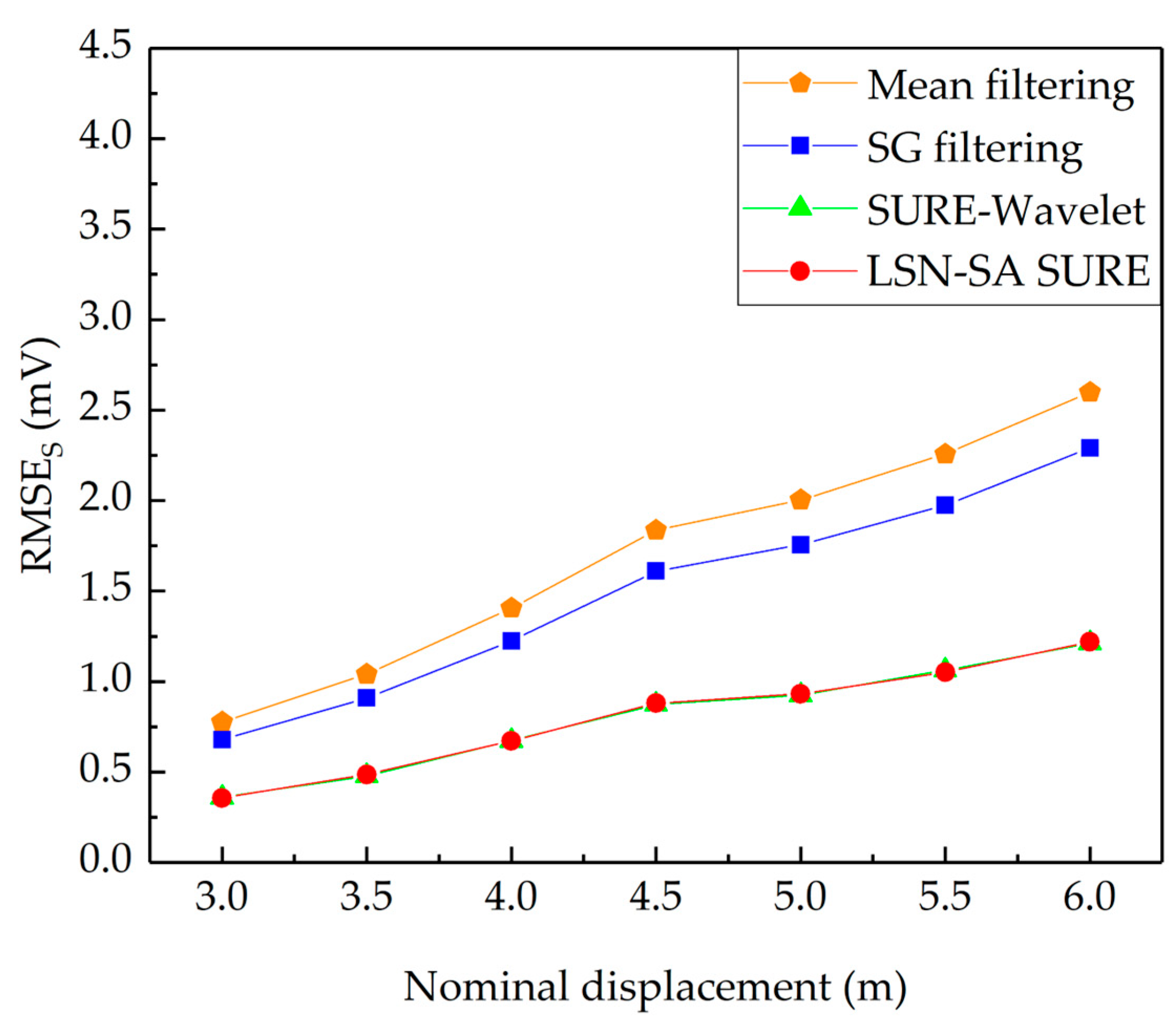
Turning to the reconstruction-error results (Table 2 and Figure 5), the average reconstruction error (signal-level ) of the LSN-SA SURE method is 0.800 mV, a reduction of approximately 0.903 mV, 0.693 mV relative to mean filtering, SG filtering, respectively, and is close to the level of standard SURE wavelet denoising (marginally higher by 0.001 mV).
Table 2.
Comparison of reconstruction error after filtering.
Figure 5.
Comparison of reconstruction error after filtering.
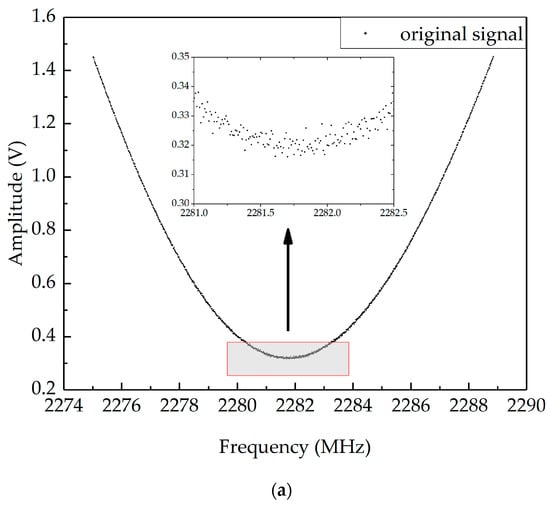
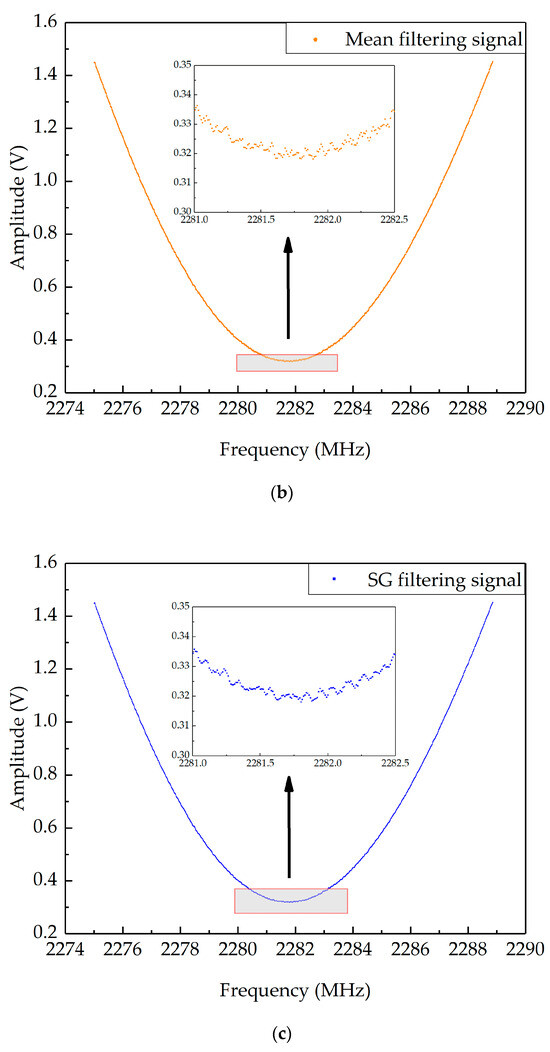
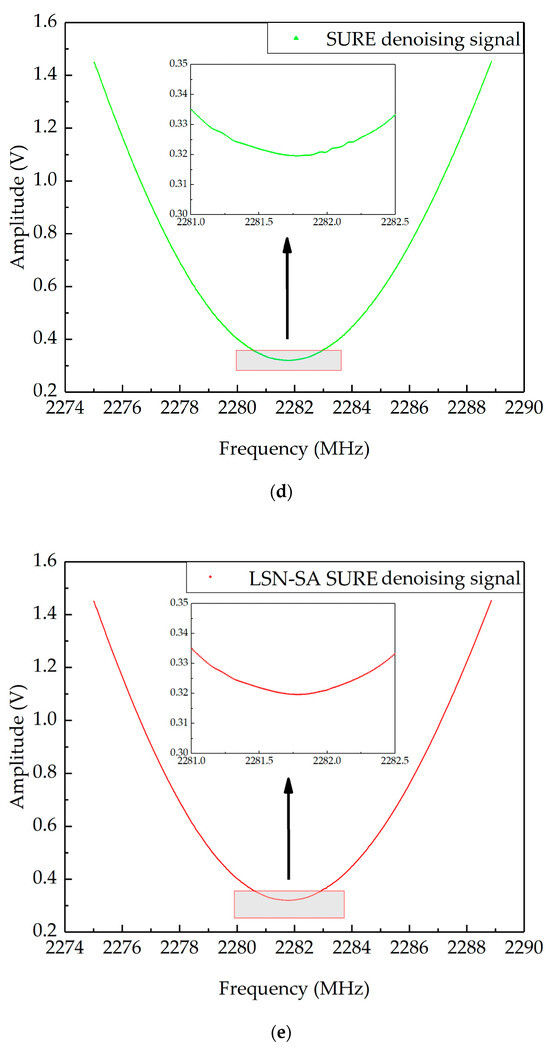
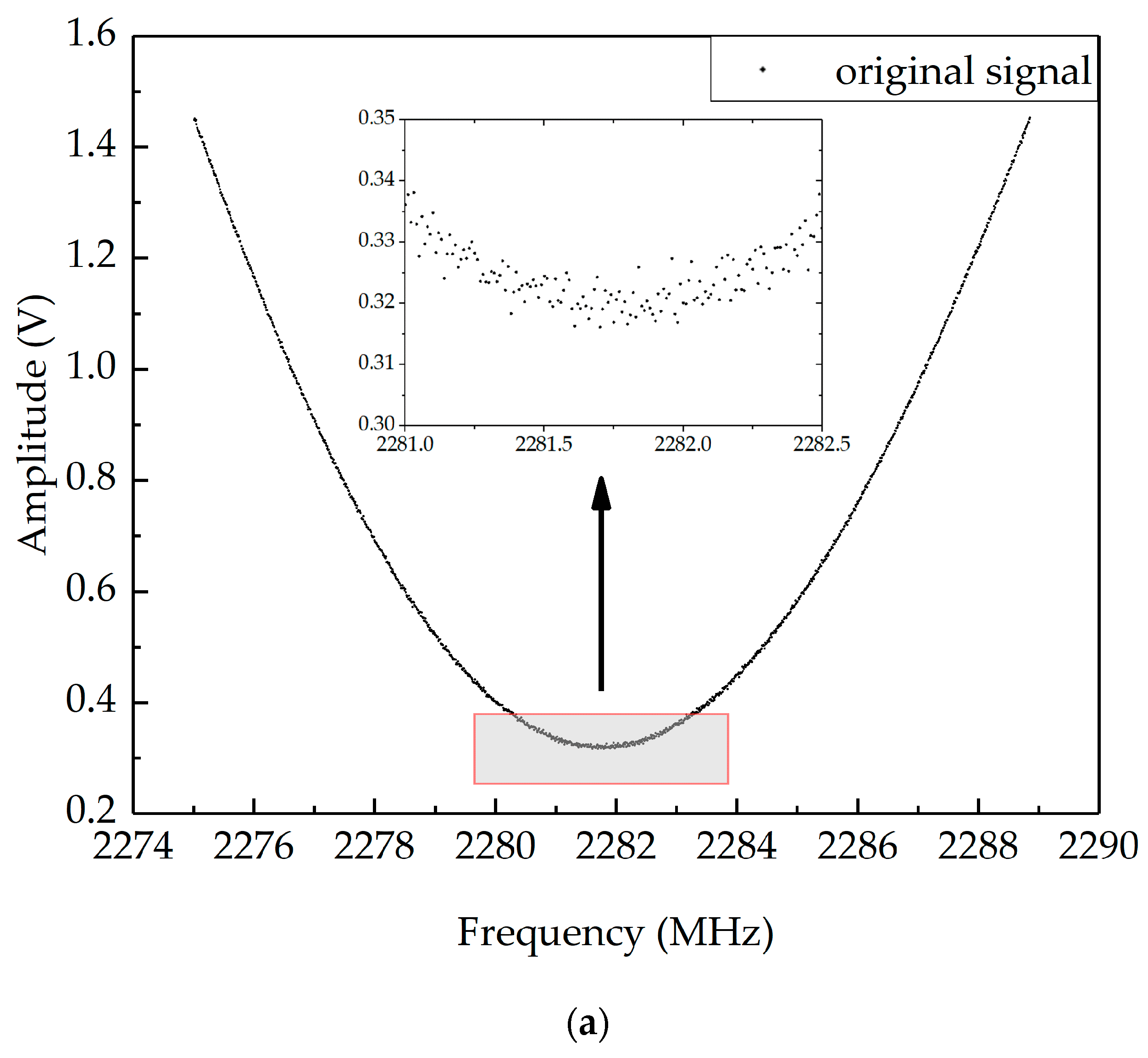
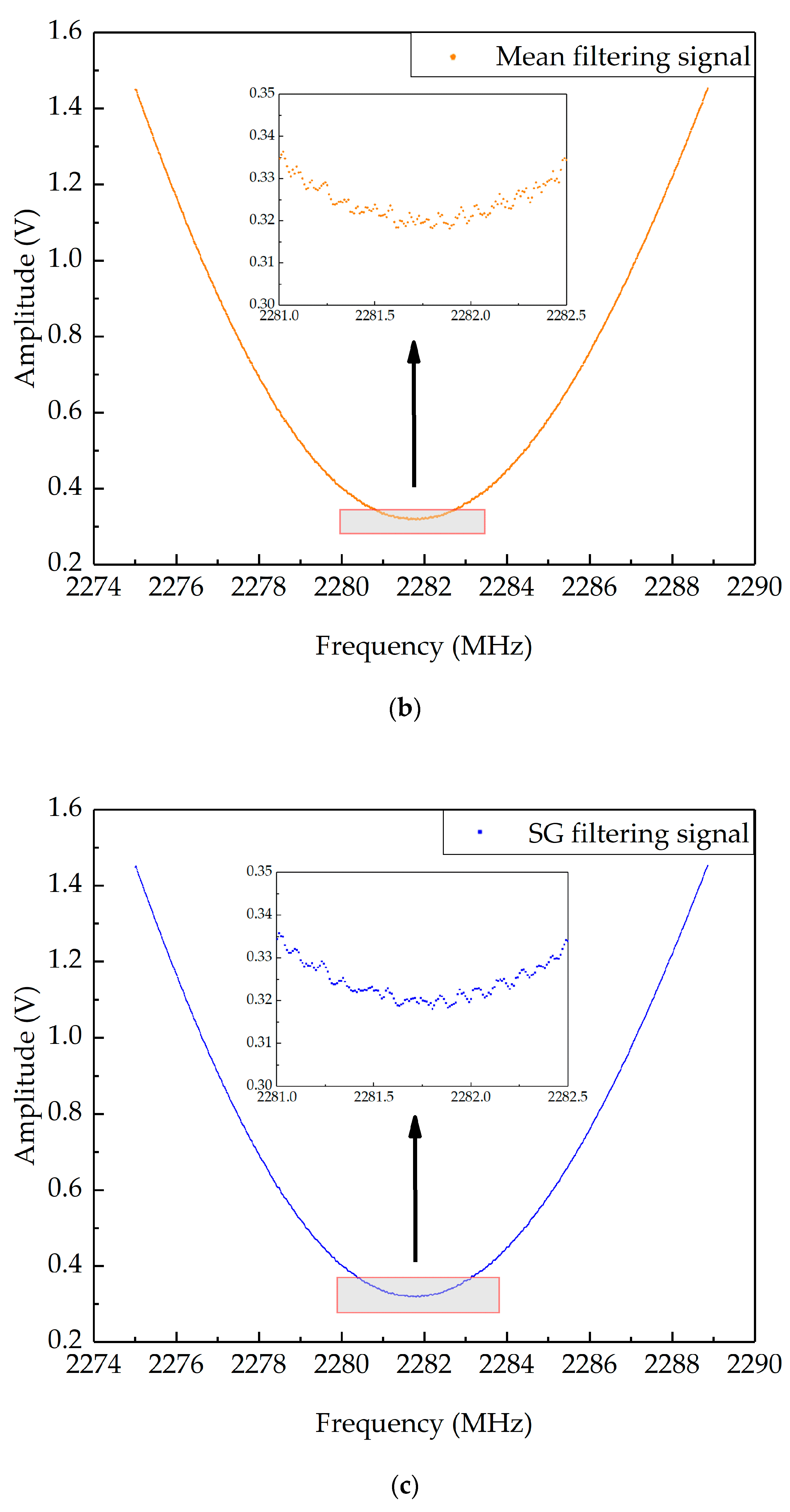
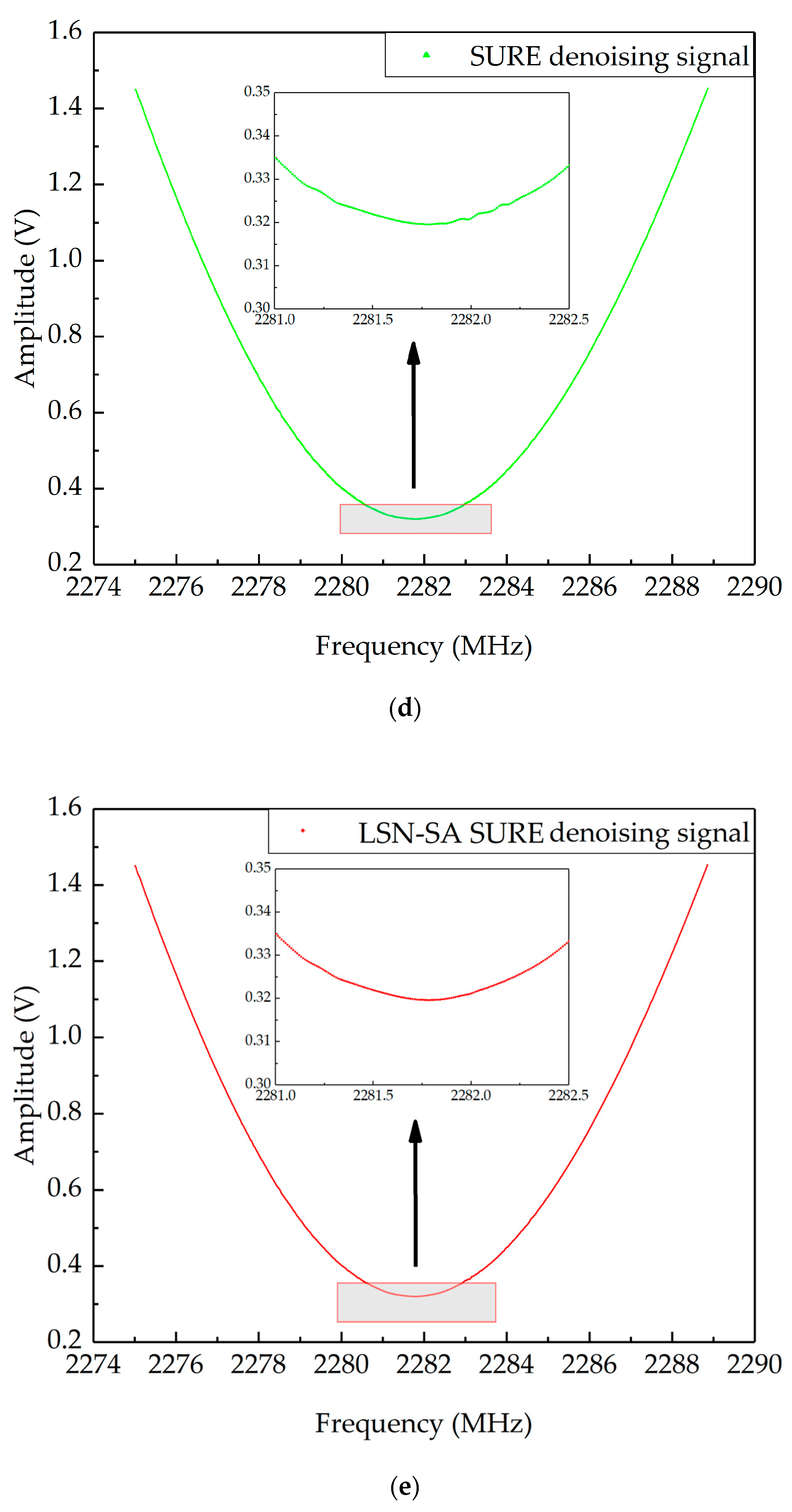
The SNR and signal-reconstruction RMSE described above are quantitative evaluation metrics that reflect only the global statistical error and cannot directly illustrate each algorithm’s ability to preserve the local waveform near the minimum. A single noisy echo signal at a representative ranging point of 4.0 m was therefore selected, and the waveforms of the original signal and of each algorithm after denoising were plotted for comparison, as shown in Figure 6.
Figure 6.
Comparison between the original noisy signal and the waveforms denoised by different filtering algorithms. (a) Original signal; (b) mean filtering signal; (c) SG filtering signal; (d) SURE denoising signal; (e) LSN-SA SURE denoising signal.
As can be observed from the waveforms, mean filtering and SG filtering fail to eliminate noise effectively, accompanied by prominent distortion within the neighborhoods of local minima. Although the standard SURE wavelet method achieves favorable noise suppression performance, mild amplitude shrinkage distortion still emerges around local minima. By contrast, the proposed LSN-SA SURE algorithm in this work can efficiently remove high-frequency random noise while effectively preserving the local structural characteristics of the minimum regions without obvious waveform distortion.
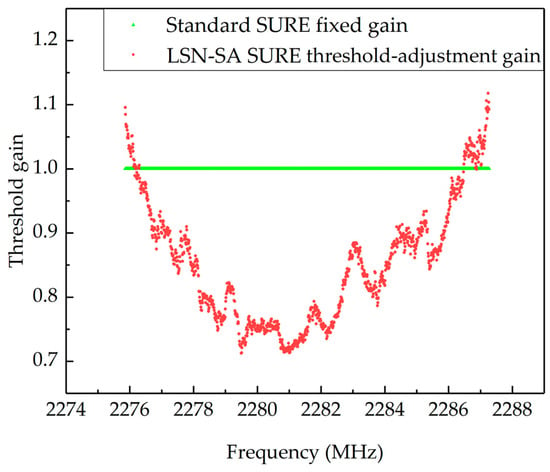
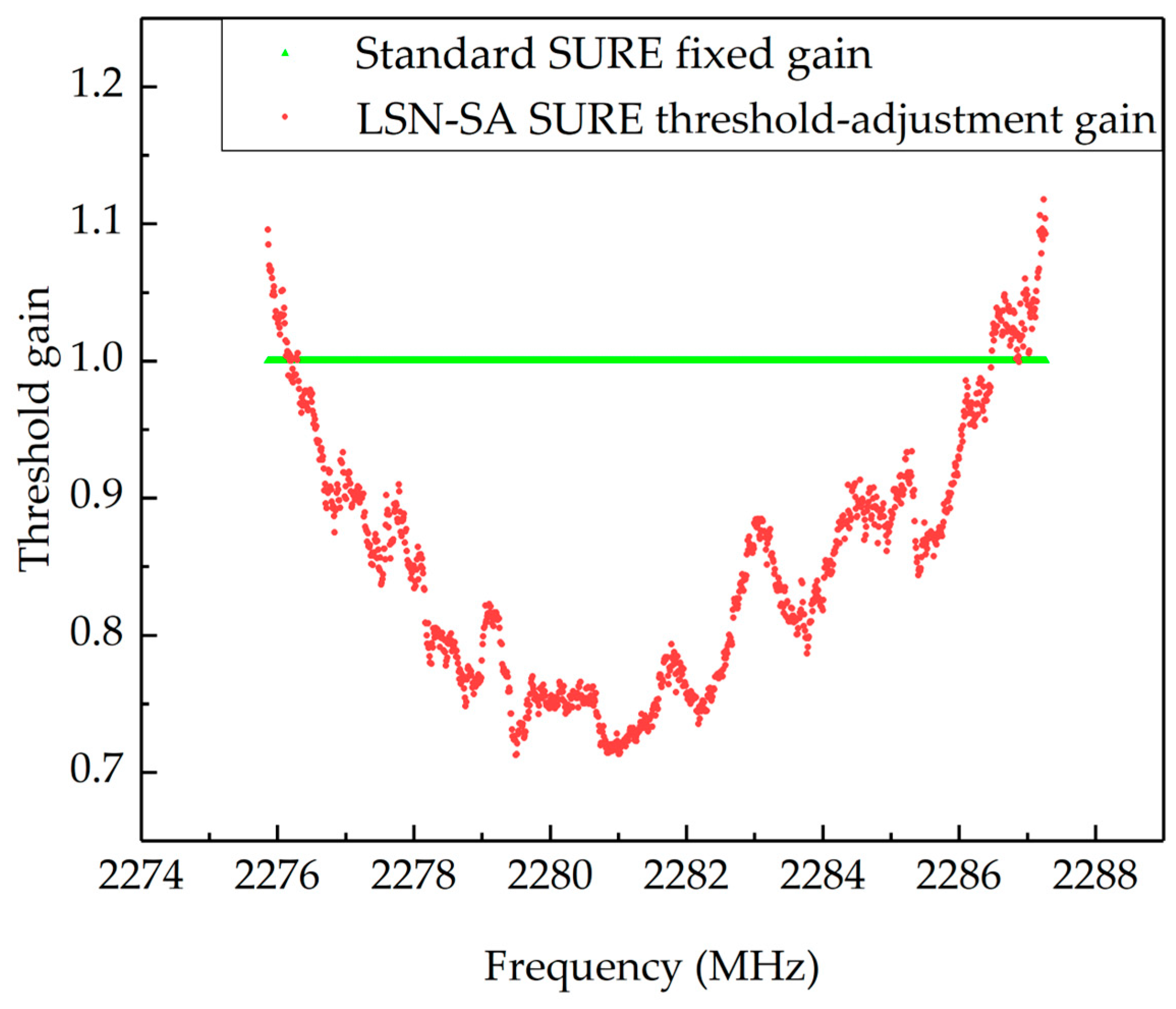
To explain the underlying mechanism behind the extremum-fidelity advantage of the proposed algorithm, the distribution of the threshold-adjustment gain after wavelet decomposition of the same set of signals was extracted and compared with the globally uniform threshold gain of the standard SURE method; the results are shown in Figure 7.
Figure 7.
Comparison between the fixed threshold gain of standard SURE and the spatially adaptive threshold gain distribution of LSN-SA SURE.
The threshold-distribution pattern shows that the standard SURE wavelet method applies a constant threshold throughout, unable to distinguish differences in local signal structure; in contrast, the proposed adaptive threshold varies dynamically with local noise and the local structural feature: it automatically rises in flat, high-noise regions to strengthen noise suppression, and decreases markedly in the interval characterized by strong local second-order variation around the minimum to avoid excessive shrinkage of the extremum waveform. This behavior is fully consistent with the theoretical threshold-adjustment model, mechanistically explaining the proposed algorithm’s core advantage of balancing denoising with the preservation of structural features.
- (2)
- Structural-level analysis
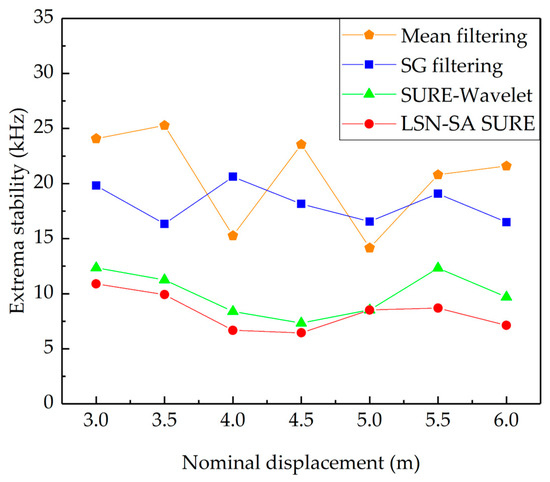
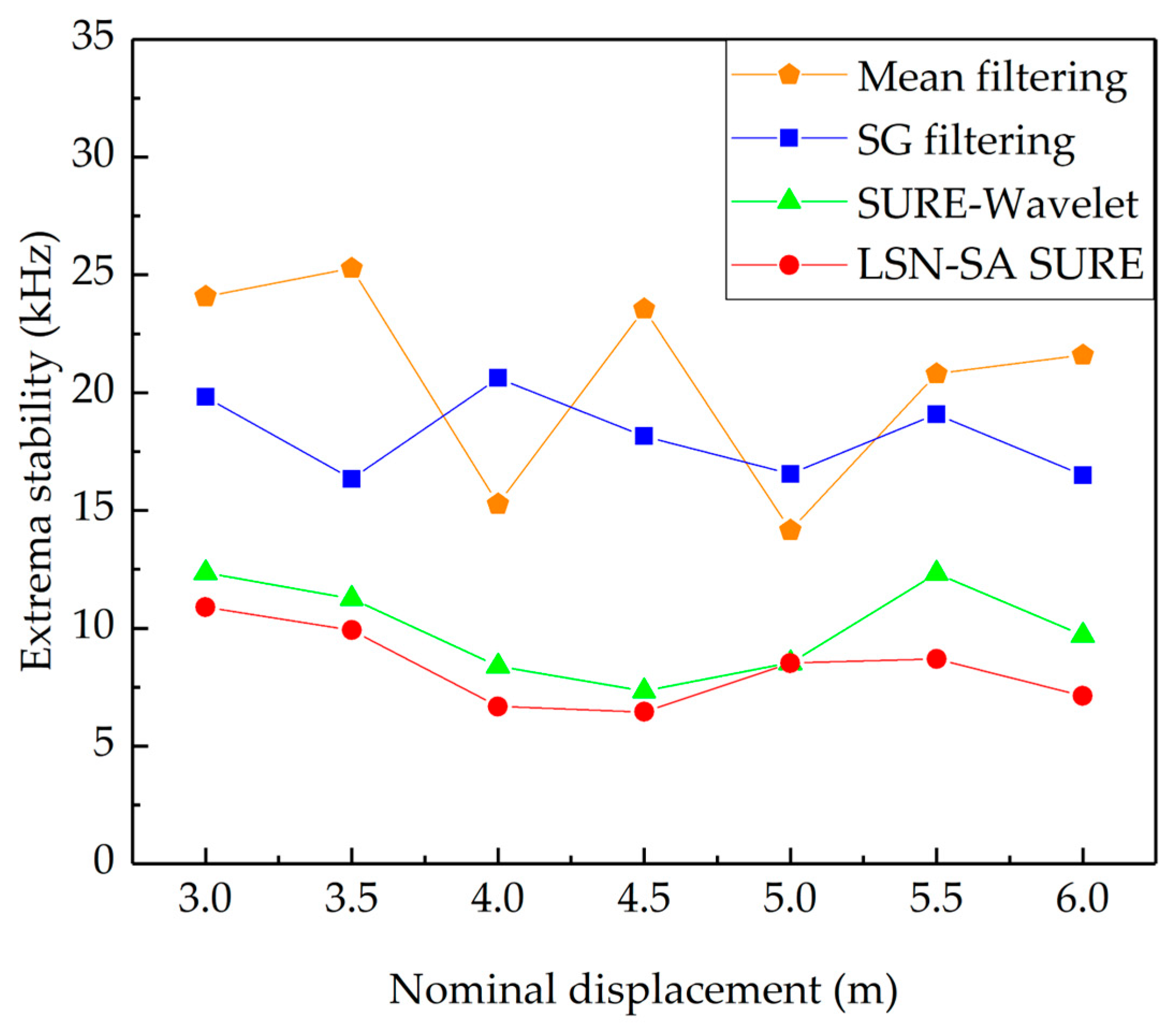
Table 3 and Figure 8 present the results for extremum position stability (). Across the entire ranging range, the standard deviation is reduced, on average, by 12.354 kHz, 9.828 kHz, and 1.657 kHz relative to mean, SG, and standard SURE filtering, respectively. This result indicates that the LSN-SA SURE method, while suppressing noise, effectively preserves the stability of the extremum position of the signal (i.e., the local structural feature).
Table 3.
Comparison of extremum-position stability after filtering.
Figure 8.
Comparison of extremum-position stability after filtering.
- (3)
- Application-level analysis
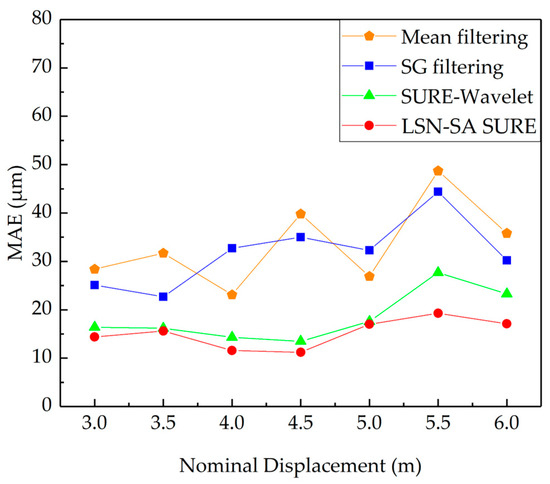
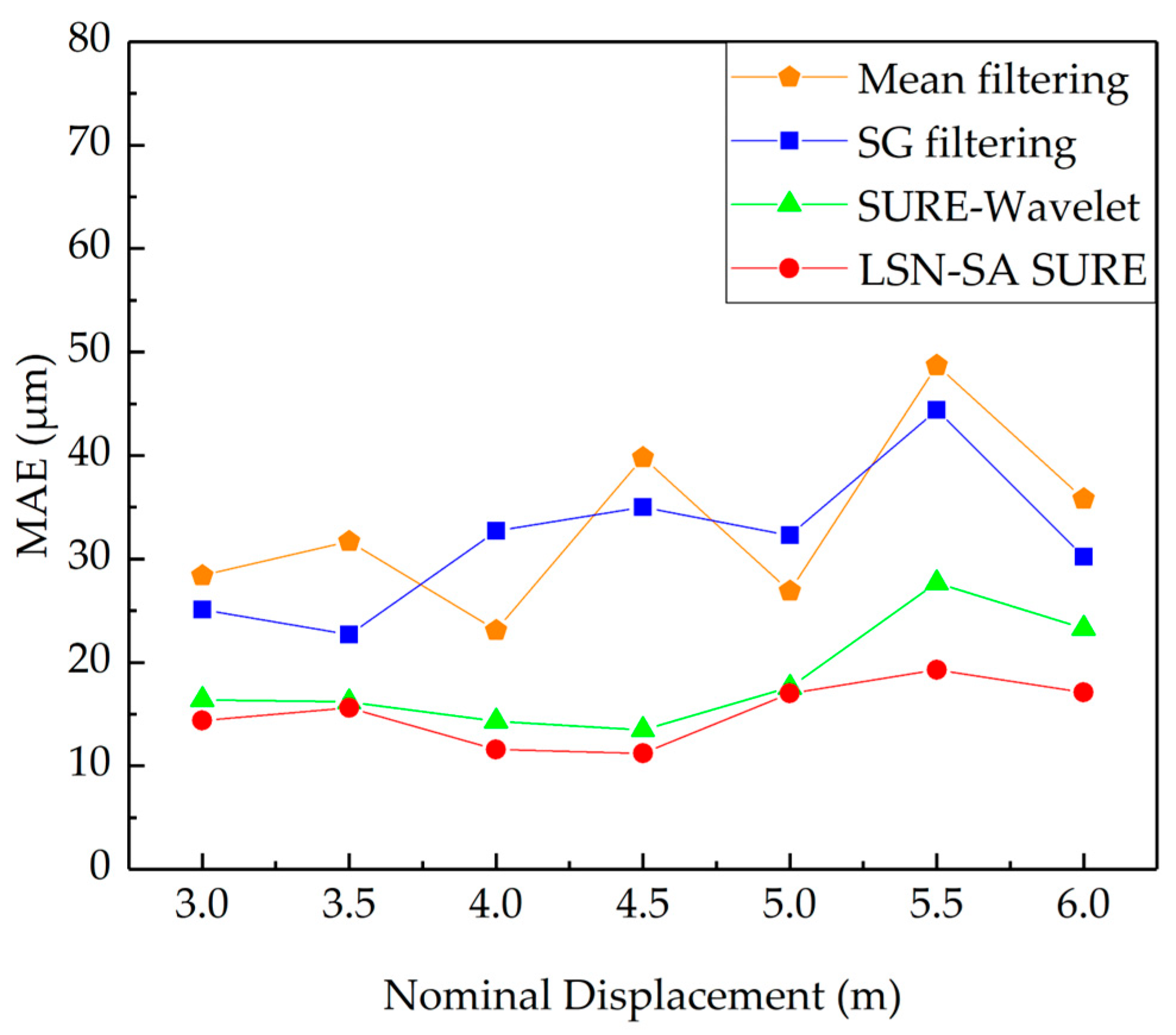
The MAE results (Table 4 and Figure 9) show that the LSN-SA SURE method overall achieves a smaller ranging error. Specifically, the average MAE of the LSN-SA SURE method is 15.2 μm, a reduction of 18.3 μm, 16.6 μm, and 3.3 μm relative to mean filtering, SG filtering, and standard SURE wavelet denoising, respectively.
Table 4.
Comparison of MAE after filtering.
Figure 9.
Comparison of MAE after filtering.
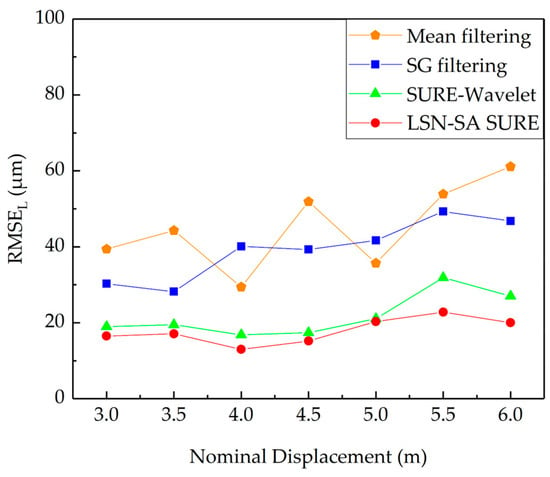
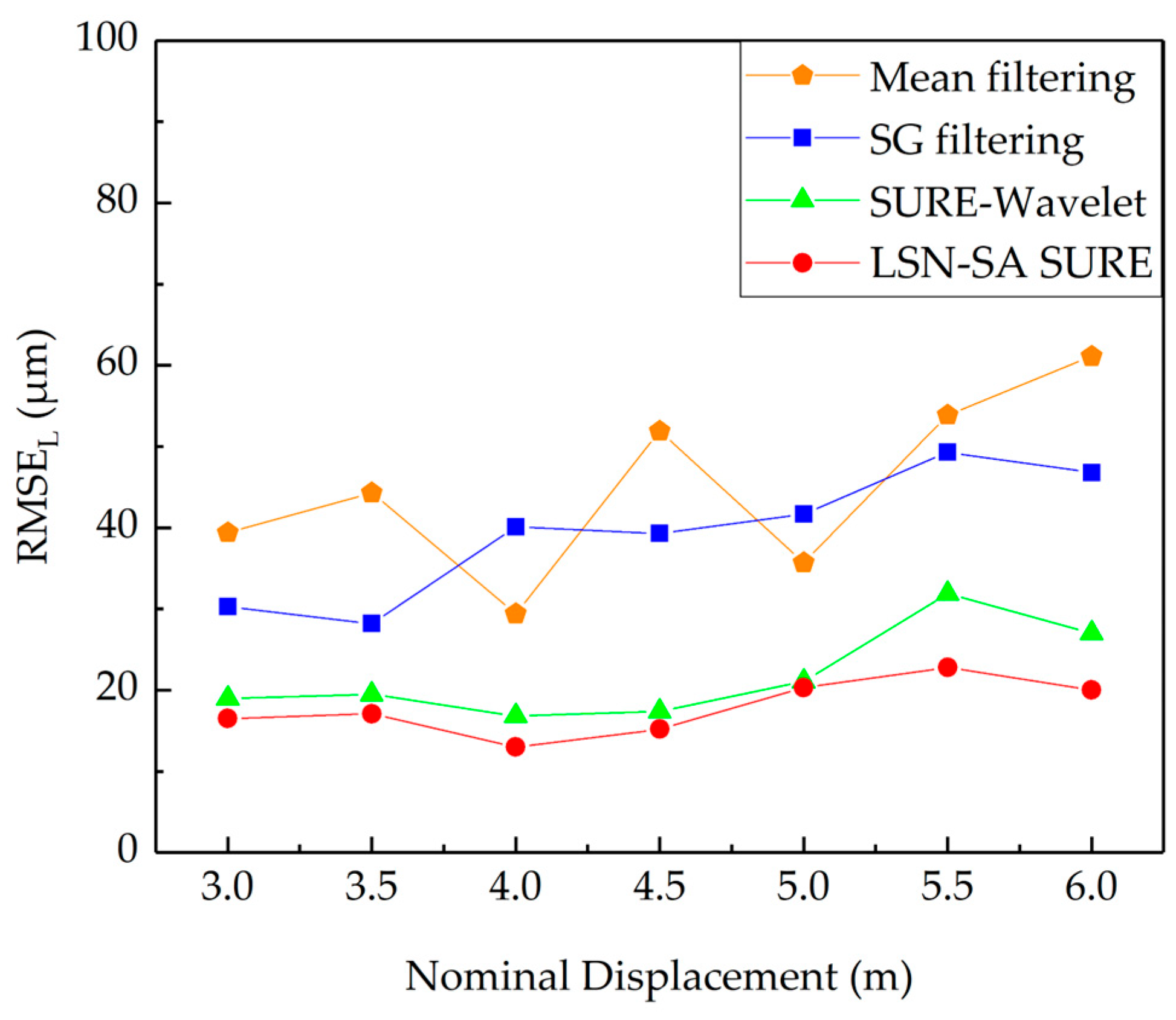
The ranging-level results (Table 5 and Figure 10) further corroborate the above conclusions. The ranging-level of the LSN-SA SURE method is 17.8 μm, corresponding to average reductions of 27.3 μm, 21.5 μm, and 4.0 μm relative to the other methods.
Table 5.
Comparison of ranging-level RMSE after filtering.
Figure 10.
Comparison of ranging-level RMSE after filtering.
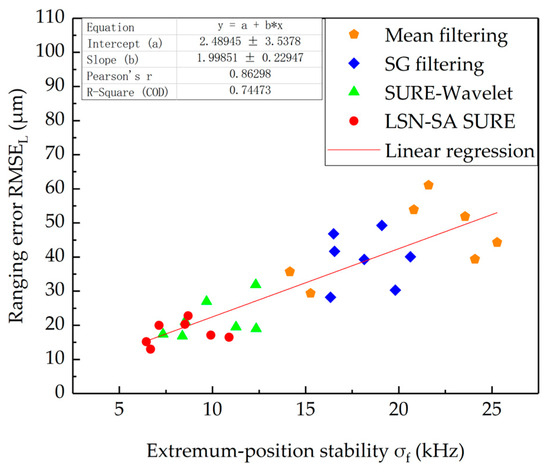
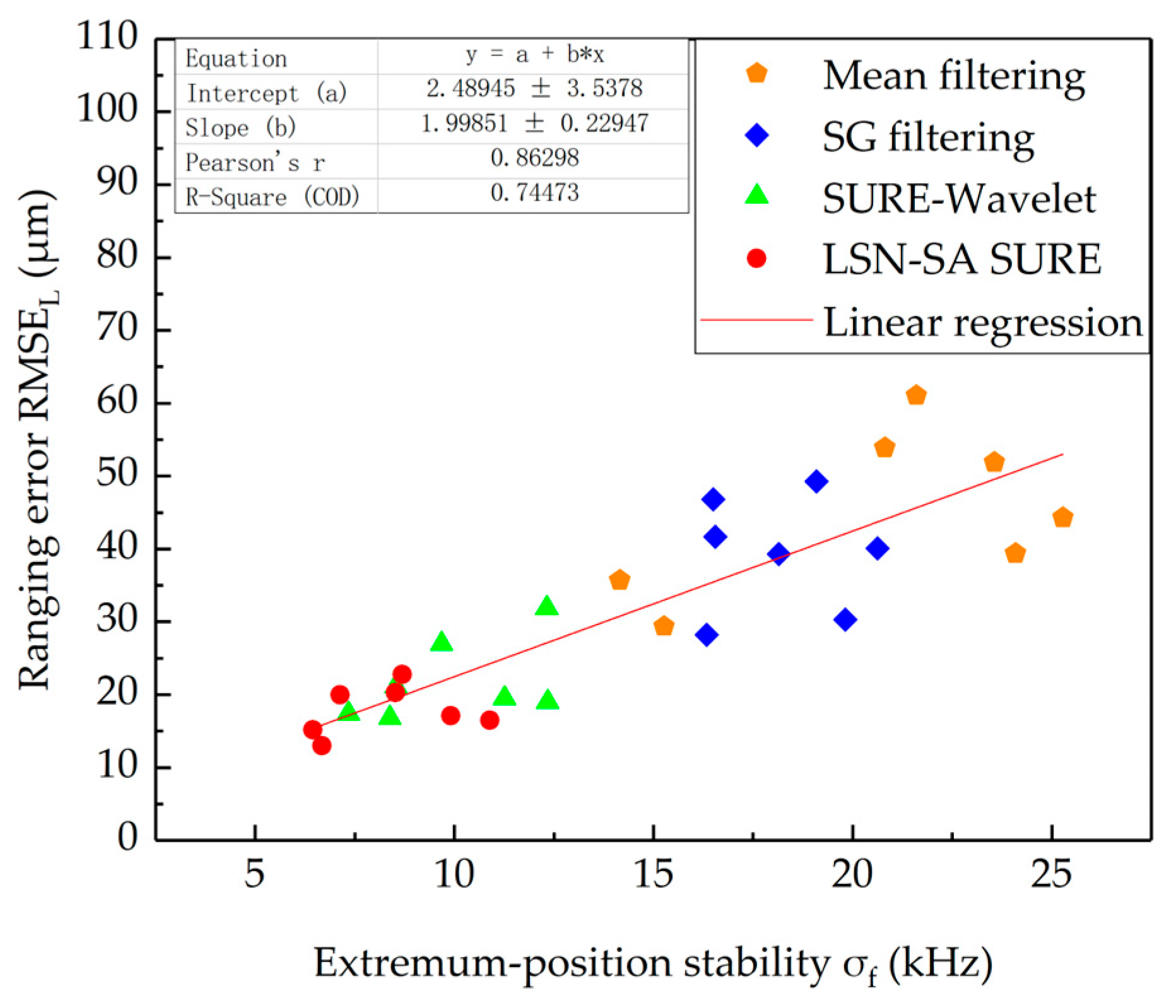
Further analysis reveals a significant correlation between extremum-position deviation and ranging error (Pearson correlation coefficient r = 0.863, coefficient of determination = 0.745, p < 0.001), as shown in Figure 11. This result indicates that extremum-position deviation is closely associated with the final ranging accuracy, and smaller extremum fluctuations generally correspond to lower ranging errors. According to the frequency-to-distance conversion relationship described in Equation (2), the uncertainty of the extracted frequency-related parameter directly affects the ranging result. Therefore, preserving the stability of the waveform extremum is an important factor for improving ranging accuracy. The correlation analysis provides quantitative support for the proposed structure-preserving denoising strategy, rather than direct evidence of a causal relationship.
Figure 11.
Fitted relationship between ranging error and extremum stability .
Statistical analysis based on the seven displacement-position datasets further confirms the consistency of the performance improvements achieved by the proposed method.
- (4)
- Ablation analysis of the adaptive gain mechanism
To investigate the individual contributions of the local noise and structural information in the proposed adaptive gain mechanism, an ablation study was conducted. Specifically, the noise-only configuration considers only the local noise information , while the structure-only configuration considers only the local structural information . These two configurations were compared with the standard SURE method and the proposed LSN-SA SURE method to evaluate the respective contributions of noise adaptation and structural preservation. The results are summarized in Table 6.
Table 6.
Ablation analysis of the local noise and structural-feature terms.
As shown in Table 6, the noise-only configuration achieves the highest SNR and the lowest reconstruction RMSE, indicating that increasing the threshold adaptation according to local noise intensity can effectively enhance noise suppression. However, its extremum stability and ranging accuracy are inferior to those of the other configurations. This result indicates that noise suppression alone is insufficient for polarization-modulated laser ranging, because excessive shrinkage in noise-sensitive regions may also affect waveform features associated with the ranging extrema.
In contrast, the structure-only configuration achieves improved extremum stability and ranging accuracy compared with standard SURE, with the ranging RMSE reduced from 21.8 μm to 20.2 μm. This demonstrates that incorporating local structural information can effectively alleviate distortion of ranging-related waveform features.
The proposed LSN-SA SURE method combines the advantages of both components. By increasing shrinkage in locally noise-dominated regions while reducing shrinkage around structurally important regions, the proposed adaptive gain mechanism achieves a better balance between noise attenuation and structural preservation. Consequently, the proposed method obtains the lowest extremum instability (8.324 kHz) and the lowest ranging RMSE (17.8 μm), demonstrating the necessity of jointly considering local noise intensity and structural variation for high-precision laser ranging.
Paired statistical analysis across the seven displacement-position datasets shows that LSN-SA SURE yields statistically significant improvements in extremum-position deviation and ranging accuracy metrics relative to standard SURE, whereas no statistically distinguishable difference is observed for SNR and reconstruction RMSE. Additional simulations were performed under different noise intensity levels. The proposed LSN-SA SURE method achieved better performance than the standard SURE method, indicating its effectiveness under varying noise conditions.
5. Discussion
The experimental results demonstrate that the proposed LSN-SA SURE framework improves the denoising performance of polarization-modulated laser ranging signals by jointly considering local noise intensity and structural variation. Unlike conventional wavelet thresholding strategies that mainly rely on global or scale-dependent noise characteristics, the proposed method introduces local structural information into the threshold adjustment process, enabling spatially adaptive control of wavelet coefficient shrinkage.
The results from the signal-level analysis indicate that stronger noise suppression does not necessarily lead to improved ranging accuracy. In particular, the noise-only adaptation achieves a relatively high SNR and low reconstruction error, demonstrating its effectiveness in reducing signal fluctuations. However, its degraded extremum stability and ranging performance reveal that excessive shrinkage may also remove weak structural variations near the ranging-related extrema. This observation highlights an important characteristic of polarization-modulated laser ranging signals: the quality of the denoised waveform should not be evaluated solely by amplitude-based indicators, but should also consider the preservation of local structures that determine the accuracy of extremum localization.
The structural-level analysis further verifies the importance of incorporating local structural information into the denoising process. The local second-derivative structural descriptor used in this work does not represent the geometric curvature of the waveform, but rather quantifies the local second-order variation associated with waveform shape changes. This feature provides an effective measure for identifying regions where excessive wavelet shrinkage may affect the extremum morphology. By reducing the shrinkage intensity in structurally important regions, the proposed method preserves the waveform characteristics required for accurate extremum localization.
The ablation analysis provides further insight into the complementary roles of the two adaptive components. The noise-aware term enhances suppression in locally noise-dominated regions, whereas the structure-aware term prevents excessive distortion of important waveform features. The proposed gain formulation integrates these two mechanisms into a unified adaptive threshold strategy, achieving a balance between noise attenuation and structural preservation. Therefore, the improvement in ranging accuracy is not attributed to stronger denoising alone, but to the coordinated regulation of shrinkage strength according to local signal characteristics.
It should be noted that the proposed method is designed for polarization-modulated laser ranging signals where the ranging information is encoded in the position and stability of waveform extrema. Therefore, the effectiveness of the method is closely related to applications in which local structural features play a critical role in parameter estimation. For signals where the desired information is mainly contained in global amplitude characteristics rather than local waveform structures, the advantages of the proposed structure-aware strategy may become less significant.
Overall, the discussion above indicates that high-precision laser ranging requires a denoising strategy that simultaneously addresses noise suppression and structural preservation. The proposed LSN-SA SURE framework provides a physically interpretable and adaptive solution by incorporating local noise and structural information into the wavelet thresholding process, thereby improving the reliability of extremum localization and the final ranging accuracy.
6. Conclusions
This paper has proposed a local structure- and noise-aware spatially adaptive SURE wavelet denoising method for polarization-modulated laser ranging signals. By dynamically extracting the local second-derivative structural feature and local noise, the method overcomes the limitation of the uniform, layer-wide threshold used in conventional wavelet denoising and achieves spatially adaptive coefficient-wise thresholding. Experiments show that the method markedly improves extremum-position stability while preserving signal quality, thereby effectively reducing the ranging error. Statistical correlation analysis reveals the critical influence of extremum stability on ranging accuracy, confirming the transfer mechanism from local structural preservation to improved global measurement accuracy. The proposed method is applicable not only to polarization-modulated laser ranging but can also be extended to other precision-measurement scenarios that rely on feature extraction. Future work will focus on improving the algorithm for complex non-Gaussian noise environments, exploring hardware acceleration for better real-time performance, and conducting broader benchmark comparisons with other adaptive wavelet denoising methods on simulated and measured ranging echo datasets.
Author Contributions
Conceptualization, P.Z. and C.G.; methodology, L.Y.; software, P.Z.; validation, C.Z., D.D. and W.Z.; formal analysis, L.Y.; investigation, P.Z.; resources, C.Z.; data curation, C.G.; writing—original draft preparation, P.Z.; writing—review and editing, C.Z.; visualization, L.Y.; supervision, C.Z. and W.Z.; project administration, D.D.; funding acquisition, P.Z. All authors have read and agreed to the published version of the manuscript.
Funding
This research was funded by Zhejiang Provincial Science and Technology Program under Grant 2024C01174 and the National Natural Science Foundation of China (Grant No. 52105541).
Institutional Review Board Statement
Not applicable.
Informed Consent Statement
Not applicable.
Data Availability Statement
The raw data and code that support the findings of this study are available from the authors upon reasonable request.
Conflicts of Interest
The authors declare no conflicts of interest.
References
- Han, J.; Xin, D.; Pang, J.; Zhao, L.; Sun, D.; Zheng, Y.; Liu, X.; Zhao, Z.; Zhang, X.; Sun, Q.; et al. Laser-Assisted Manufacturing for Sensors. Int. J. Extreme Manuf. 2025, 7, 042008. [Google Scholar] [CrossRef] [Scilit]
- Gao, S.; Wang, Y.; Chen, S.; Ma, Y.; Gao, C. Frequency Acquisition Approach in Polarization-Modulated Ranging Based on Lock-in Analysis. Photonics 2023, 10, 1347. [Google Scholar] [CrossRef] [Scilit]
- Liu, Y.; Liu, J.; Kennel, R. Frequency Measurement Method of Signals with Low Signal-to-Noise-Ratio Using Cross-Correlation. Machines 2021, 9, 123. [Google Scholar] [CrossRef] [Scilit]
- Huang, M.; Zhang, Z.; Xie, J.; Li, J.; Zhao, Y. An Entropy-Based Anti-Noise Method for Reducing Ranging Error in Photon Counting Lidar. Entropy 2021, 23, 1499. [Google Scholar] [CrossRef] [Scilit] [PubMed]
- Srisomboon, K.; Sa-Ing, V.; Lee, W. Automated Elastic Regularized Savitzky–Golay Filter for Speckle Noise Reduction in Ultrasound Images. IEEE Access 2025, 13, 159400–159411. [Google Scholar] [CrossRef] [Scilit]
- John, A.; Sadasivan, J.; Seelamantula, C.S. Adaptive Savitzky-Golay Filtering in Non-Gaussian Noise. IEEE Trans. Signal Process. 2021, 69, 5021–5036. [Google Scholar] [CrossRef] [Scilit]
- Natale, T.; Bossi Núñez, P.; Dindelli, L.; Dell’Olio, F. Gyroscope Real-Time Denoising by an Adaptive Threshold Wavelet Algorithm: Achieving Over 12 dB SNR Improvement. IEEE Trans. Instrum. Meas. 2025, 74, 9535311. [Google Scholar] [CrossRef] [Scilit]
- Halidou, A.; Mohamadou, Y.; Ari, A.A.A.; Zacko, E.J.G. Review of Wavelet Denoising Algorithms. Multimed. Tools Appl. 2023, 82, 41539–41569. [Google Scholar] [CrossRef] [Scilit]
- Sahoo, G.R.; Freed, J.H.; Srivastava, M. Optimal Wavelet Selection for Signal Denoising. IEEE Access 2024, 12, 45369–45380. [Google Scholar] [CrossRef] [Scilit] [PubMed]
- Karamikabir, H.; Karamikabir, N.; Khajeian, M.A.; Afshari, M. Bayesian Wavelet Stein’s Unbiased Risk Estimation of Multivariate Normal Distribution Under Reflected Normal Loss: Bayesian Wavelet Stein’s Unbiased Risk Estimation. Methodol. Comput. Appl. Probab. 2023, 25, 23. [Google Scholar] [CrossRef] [Scilit]
- Zheng, D.; Qu, T.; Hu, C.; Lu, S.; Li, Z.; Yang, G.; Yang, X. An Adaptive Continuous Threshold Wavelet Denoising Method for LiDAR Echo Signal. Nanotechnol. Precis. Eng. 2025, 8, 023006. [Google Scholar] [CrossRef] [Scilit]
- Jiang, S.; Zhang, H.; Lu, Y.; Han, R.; Gao, Y.; Wang, Y.; Jin, B. SNR Enhancement for Raman Distributed Temperature Sensors Using Intrinsic Modal Functions with Improved Adaptive Wavelet Threshold Denoising. Opt. Lasers Eng. 2025, 189, 108949. [Google Scholar] [CrossRef] [Scilit]
- Kashyap, V.K.; Sharma, R.R.; Pachori, R.B. Complex Flexible Analytic Wavelet Transform for UAV State Identification Using RF Signal. IEEE Trans. Aerosp. Electron. Syst. 2024, 60, 1471–1481. [Google Scholar] [CrossRef] [Scilit]
- Gómez-Luna, E.; Cuadros-Orta, D.E.; Candelo-Becerra, J.E.; Vasquez, J.C. The Development of a Novel Transient Signal Analysis: A Wavelet Transform Approach. Computation 2024, 12, 178. [Google Scholar] [CrossRef] [Scilit]
- Nakonechnyi, A.; Mozola, D.; Musii, R. Evaluation of Noise Signals in Wavelet Domain. In Proceedings of the 2021 IEEE XVIIth International Conference on the Perspective Technologies and Methods in MEMS Design (MEMSTECH), Polyana (Zakarpattya), Ukraine, 12–16 May 2021; pp. 82–85. [Google Scholar]
- Yang, D.; Song, K.; Yi, R.; Xiong, H.; Yang, X. Denoising of Partial Discharge Signal in Stator Using Wavelet Transform with Improved Thresholding Function. Appl. Sci. 2025, 15, 10509. [Google Scholar] [CrossRef] [Scilit]
- Li, P.; Yuan, J.; Hu, J.; Wu, Z.; Sun, Y.; Wei, M.; Bisnath, S. Toward Lane-Level Navigation With Adaptive Cycle Slip Detection Thresholds in Smartphone RTK. IEEE Internet Things J. 2026, 13, 13753–13765. [Google Scholar] [CrossRef] [Scilit]
- Qiao, G.-R.; Bai, B.; Weng, Z.-X.; Wu, J.-Y.; Nie, Y.-Q.; Zhang, J. White Gaussian Noise Generation With a Vacuum State Quantum Entropy Source Chip. IEEE J. Sel. Top. Quantum Electron. 2025, 31, 9200108. [Google Scholar] [CrossRef] [Scilit]
- Weißer, F.; Utschick, W. On the Asymptotic MSE-Optimality of Parametric Bayesian Channel Estimation in mmWave Systems. IEEE Signal Process. Lett. 2026, 33, 653–657. [Google Scholar] [CrossRef] [Scilit]
- Karamikabir, H.; Afshari, M.; Lak, F. Wavelet Threshold Based on Stein’s Unbiased Risk Estimators of Restricted Location Parameter in Multivariate Normal. J. Appl. Stat. 2021, 48, 1712–1729. [Google Scholar] [CrossRef] [Scilit] [PubMed]
- Zhang, C.; Yen, K.S. Adaptive Unsupervised Deep Learning Denoising for Medical Imaging with Unbiased Estimation and Hessian-Based Regularization. Appl. Intell. 2025, 55, 718. [Google Scholar] [CrossRef] [Scilit]
- Karamikabir, H.; Asghari, A.N.; Salimi, A. Soft Thresholding Wavelet Shrinkage Estimation for Mean Matrix of Matrix-Variate Normal Distribution: Low and High Dimensional. Soft Comput. 2023, 27, 13527–13542. [Google Scholar] [CrossRef] [Scilit]
- Wang, C.; Wang, W.; Pan, S.; Zhao, F. A Local Curvature Based Adaptive Particle Level Set Method. J. Sci. Comput. 2022, 91, 3. [Google Scholar] [CrossRef] [Scilit]
- Wei, J.; Liu, Z.; Sun, Y.; Wang, X. An Active Learning Method for Structural Reliability Combining Response Surface Model with Gaussian Process of Residual Fitting and Reliability-Based Sequential Sampling Design. Eksploat. Niezawodn.–Maint. Reliab. 2024, 27, 193443. [Google Scholar] [CrossRef] [Scilit]
- DeVore, G.R. A Simple Method to Compute the Standard Deviation from Tabular Data Containing the 5th, 50th, and 95th Percentiles to Be Used for Creating a Z-Score Calculator. J. Ultrasound Med. 2025, 44, 2171–2176. [Google Scholar] [CrossRef] [Scilit] [PubMed]
- Zheng, K.; Tian, L.; Cui, J.; Liu, J.; Li, H.; Zhou, J.; Zhang, J. An Adaptive Thresholding Method for Facial Skin Detection in HSV Color Space. IEEE Sens. J. 2025, 25, 3098–3109. [Google Scholar] [CrossRef] [Scilit]
- Hodson, T.O. Root-Mean-Square Error (RMSE) or Mean Absolute Error (MAE): When to Use Them or Not. Geosci. Model Dev. 2022, 15, 5481–5487. [Google Scholar] [CrossRef] [Scilit]
- Krajewski, M. Constructing an Uncertainty Budget for Voltage RMS Measurement with a Sampling Voltmeter. Metrologia 2018, 55, 95–105. [Google Scholar] [CrossRef] [Scilit]
- Robeson, S.M.; Willmott, C.J. Decomposition of the Mean Absolute Error (MAE) into Systematic and Unsystematic Components. PLoS ONE 2023, 18, e0279774. [Google Scholar] [CrossRef] [Scilit] [PubMed]
- Abdelsattar, M.; A. Ismeil, M.; Menoufi, K.; AbdelMoety, A.; Emad-Eldeen, A. Evaluating Machine Learning and Deep Learning Models for Predicting Wind Turbine Power Output from Environmental Factors. PLoS ONE 2025, 20, e0317619. [Google Scholar] [CrossRef] [Scilit] [PubMed]

Disclaimer/Publisher’s Note: The statements, opinions and data contained in all publications are solely those of the individual author(s) and contributor(s) and not of MDPI and/or the editor(s). MDPI and/or the editor(s) disclaim responsibility for any injury to people or property resulting from any ideas, methods, instructions or products referred to in the content. |
© 2026 by the authors. Licensee MDPI, Basel, Switzerland. This article is an open access article distributed under the terms and conditions of the Creative Commons Attribution (CC BY) license.