


Abstract
Game Theory provides a foundation for multi-agent systems, reinforcement learning, mechanism design, and adversarial learning within AI and ML. Nevertheless, few comprehensive studies map the structure and branches of this cross-disciplinary field. The current research attempts to fill this gap by providing a combined bibliometric and semantic study of 6974 records obtained from Scopus and Web of Science during the years 1972 to 2025. This research is among the first to implement traditional bibliometrics integrated with LDA (Latent Dirichlet Allocation) topic modeling through R (version 4.5.1) to map research networks and surface latent research themes across domains such as multi-agent reinforcement learning and adversarial learning. The major contribution is the development of an evolutionary model that identifies the Game Theory’s paradigmatic evolution in the context of AI and ML from 1972 to 2025. This research also provided the characteristics that describe the shift from the rational equilibrium paradigms to intelligent systems that learn, collaborate, and devise strategies autonomously.
1. Introduction
Artificial Intelligence (AI) and Machine Learning (ML) have transformed the design of complex decision-making systems, enabling machines to learn, adapt, and interact in dynamic and uncertain environments. Many of the most challenging problems in modern AI—such as multi-agent coordination, competition, negotiation, and resource allocation—inherently involve strategic interactions among multiple decision-makers. In this context, Game Theory has emerged as a fundamental mathematical and computational framework for modelling, analyzing, and solving such problems [1,2,3,4,5].
Game theory, and more specifically the understanding of strategic interactions, is crucial across many branches of AI and ML, ranging from multi-agent reinforcement learning and mechanism design to evolutionary learning and adversarial machine learning [6,7,8,9,10]. The rationality, incentives, cooperation, and competition aspects portrayed by game theory provide the foundation for the design of intelligent systems. The coupling of learning algorithms and game theory has opened many niches and approaches such as learning to acquire in games, finding approximate equilibria via deep learning, and the use of learning to build mechanisms [3,4,11].
The intersection of Game Theory, AI, and ML is becoming increasingly important, and the rapid increase in the scientific literature pertaining to this field indicates as much. The truth is that the earlier literature primarily dealt with foundational and theoretical issues such as equilibria, repeated games, and evolutionary dynamics [12]. Certainly, the focus has gradually expanded in the directions of computational and applied issues, motivated by the development of reinforcement learning, along with deep learning. Frequently, in addition to these, large-scale systems of multi-agents [13,14,15]. Game Theory is now being applied in numerous fields including robotics, smart grids, traffic systems, cyber security, financial markets, language models, and distributed control systems [16,17,18].
Although there has been considerable growth in review studies, they typically focus on aspects of this research, like multi-agent reinforcement learning, mechanism design, or adversarial learning [19,20]. Because of this, there is no comprehensive review available that details this research area using advanced metrics. Most surveys are qualitative, and as such, they fail to capture the research structure of the field, the collaboration patterns, or the evolving, latent structures of the research themes.
Focusing on quantitative methods, bibliometric analyses address these challenges by mapping the architecture of scientific knowledge, revealing significant authors, institutions, and journals, and analyzing the structures of collaboration and citation [21,22]. When paired with semantic methods, like Latent Dirichlet Allocation (LDA), bibliometrics can identify the concealed thematic structures and the dimensions of a research domain, including the development and the interrelationship of research topics over time [23,24].
Recent studies successfully applied integrated bibliometric and topic modeling approaches in fields such as healthcare artificial intelligence, agroforestry, materials science, and energy systems [19,25]. These studies exemplify the capability of this approach in documenting both the intellectual and conceptual framework of intricate research fields. To the best of our knowledge, no study, however, has comprehensively documented, in bibliometric and semantic mapping terms, the Game Theory applications in AI and ML.
In this respect, this paper attempts to address the knowledge gap by providing a comprehensive analysis using all available studies that are indexed in Scopus or Web of Science, covering the years 1972 to 2025. Beyond mapping the bibliometric and semantic structure of the field, this study proposes an evolutionary framework that accounts for the conceptual, methodological, and technological transformations of Game Theory within AI and ML across five decades. The central thesis is that the field has undergone a fundamental paradigmatic transition: from classical models grounded in rationality, equilibrium, and strategic formalism, toward systems capable of adaptive learning, autonomous coordination, distributed incentive design, and emergent strategic behavior. The main objective of the study is to identify the trends of Game Theory research in AI and ML, and the focus is to answer the following questions:
- RQ1: Which institutions and countries are the main drivers of research in Game Theory in AI and ML?
- RQ2: Which journals and publication venues play a central role in the dissemination of this research?
- RQ3: What are the main research themes in this field?
- RQ4: How have the trends in the themes changed in the various time periods?
- RQ5: What are the differences concerning the presence of these themes across countries and in the various scientific journals?
- RQ6: What evolutionary framework best characterizes the paradigmatic transformation of Game Theory within AI and ML from 1972 to 2025, and what are the main conceptual, methodological, and technological changes underlying this evolution?
This research examines Game Theory in the context of AI and ML to provide a detailed mapping of its intellectual and conceptual domain. This study addresses the gaps in this area and provides research directions and recommendations for future studies and multidisciplinary approaches.
2. Materials and Methods
2.1. Study Design
This research relies on a framework of bibliometric and semantic analysis and pursues a quantitative, descriptive, and exploratory model. Its primary aim is to systematically chart the cognitive framework, the structural arrangement of the literature, and the topic advancement regarding scholarly work on game theory within artificial intelligence and machine learning. Therefore, this methodology integrates reliable bibliometric methods with network-based skill mapping and probabilistic topic modeling, thus enabling the analysis of the constructs of intellectual and social frameworks within a unified system.
2.2. Data Collection and Search Strategy
The data collection conveyed the systematic reappraisal procedures to enforce transparency, repeatability, and methodological precision. Meta-analytical PRISMA guidelines helped ensure evidence collection rigor [26]. Two major bibliographic databases were Scopus and the Web of Science (WoS) Core Collection. As a further benefit, their combined use provides comprehensive coverage and decreases the likelihood of bias attributed to a specific database [27]. The search was conducted on 10 March 2026, targeting peer-reviewed journal articles and reviews written in English. Conference papers, editorials, notes, and non-peer-reviewed documents were excluded to ensure the scientific consistency of the corpus.
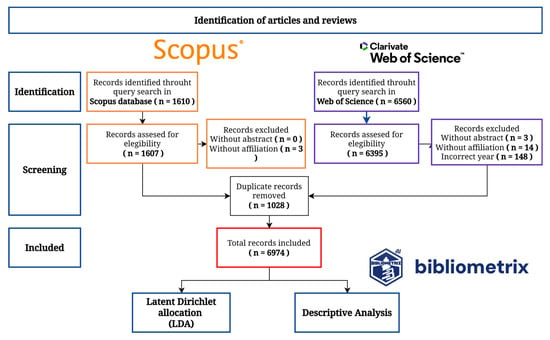
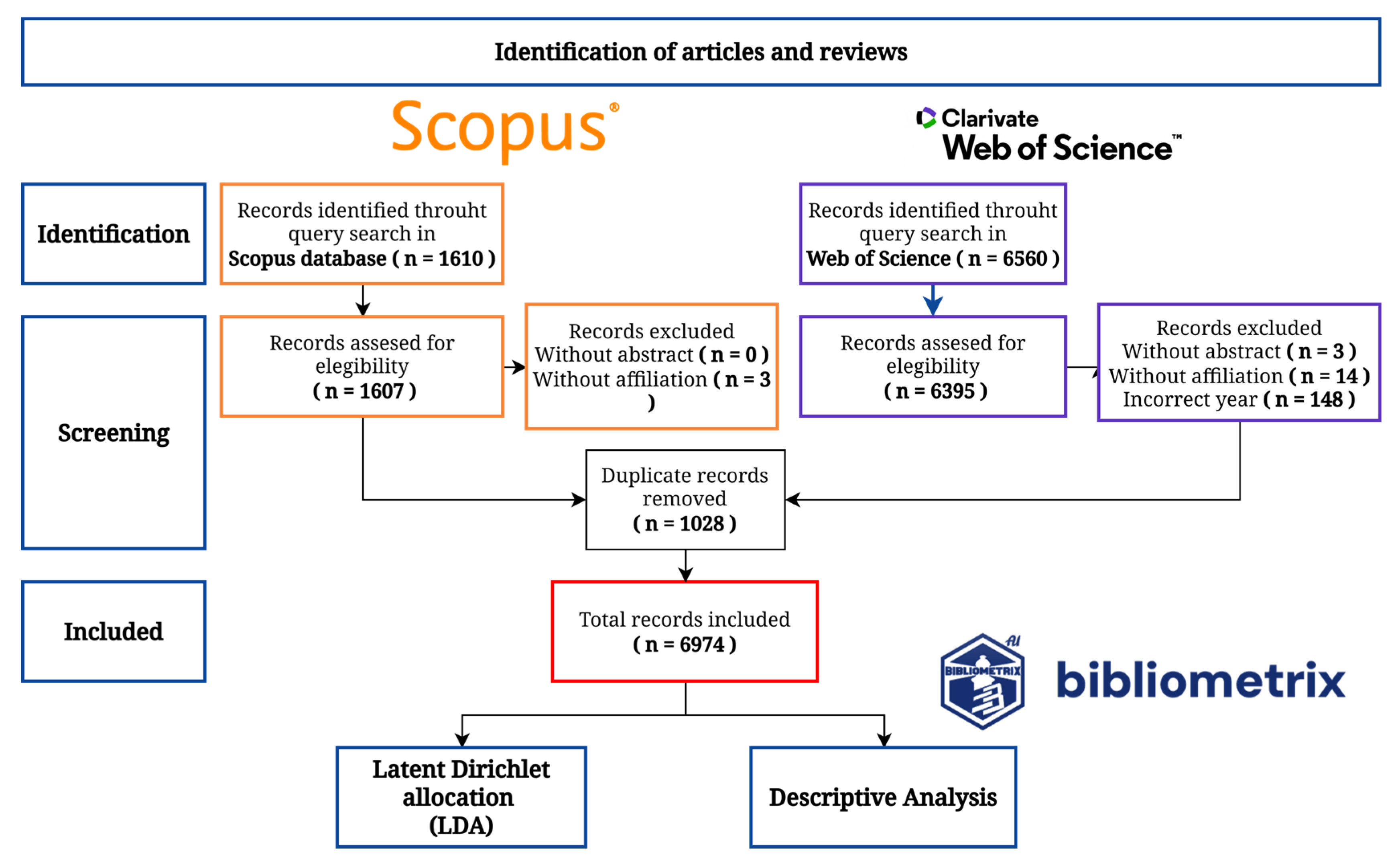
The search strategy integrates keywords pertaining to game theory, AI, and ML, as well as keywords describing strategic interaction, multi-agent systems, reinforcement learning, mechanism design, and adversarial learning. After merging, the two databases were combined using the bibliometrix package in R. In Scopus, these concept blocks were combined so that game theory, AI, and ML had to co-occur; in Web of Science, a logically equivalent query returned too few records to sustain a comparable corpus, so the AI and ML terms were grouped into a single broader block to obtain adequate recall in that database. This asymmetry is therefore a deliberate, recall-oriented decision rather than an oversight, and it is acknowledged as a limitation of the search strategy [21]. The removal of duplicated entries was followed by the removal of documents that lacked abstracts and of documents that contained inadequate bibliographic information. The final curated dataset was composed of 6974 documents published from 1972 to 2025. The search strings and search results are provided in Table 1, and the complete identification, screening, and selection process is summarized in the PRISMA flow diagram (Figure 1).
Table 1.
Bibliographic databases and search strings used in data collection.
Figure 1.
PRISMA diagram illustrating the identification, screening, and selection of studies.
2.2.1. Bibliometric Analysis Methodology
Bibliometric analysis provides quantitative techniques for evaluating the evolution, structure, and impact of scientific research [21,22]. In this study, bibliometric methods were applied at three complementary levels: source, author/institution, and document. Productivity indicators (publications per year, author, journal, country), impact indicators (total citations, average citations per document, h-index), and collaboration patterns (co-authorship networks at author, institution, and country levels) were computed. Network analysis represented entities as nodes and collaborative or citation relationships as edges; clustering algorithms identified communities corresponding to research groups or schools of thought, while betweenness centrality identified key bridging actors.
2.2.2. Topic Modeling
Topic modelling is a family of unsupervised text-mining techniques designed to discover latent thematic structures in large document collections [23]. These models assume that each document is a mixture of latent topics, each characterized by a probability distribution over the vocabulary [28]. In this study, topic modelling complements classical bibliometrics by uncovering the semantic dimension of the literature, enabling a more comprehensive mapping of the field [24,25].
2.2.3. Identifying Research Topics
Research topics are identified from the combined textual information contained in titles, abstracts, and author keywords, which together provide a concise but representative summary of each document’s intellectual content. The identification process combines quantitative modelling with qualitative interpretation: while the algorithm determines the latent topic structure in a data-driven manner, the resulting topics are subsequently interpreted in light of the domain knowledge of Game Theory, AI, and ML, ensuring that they correspond to recognizable research areas within the field.
2.2.4. Preprocessing of Textual Data
Before applying topic modeling, a preprocessing pipeline was designed to improve the corpus quality and minimize noise. Building upon this, the textual data were constructed by concatenating the document titles, abstracts, and author keywords. Data were built following the pipeline, which transformed textual data to lowercase, removed punctuation, numbers, special characters, and stopwords, and lemmatized inflected words to their canonical forms, reducing vocabulary sparsity. The data shows that each paper was tokenized using bigrams (groups of two consecutive unigrams) to provide better topic cohesion [13]. Terms that had very low and very high frequencies were also filtered out. The result was a document-term matrix that was normalized and cleaned, ready to be analyzed using the LDA model.
2.2.5. Construction of the Latent Dirichlet Allocation Model
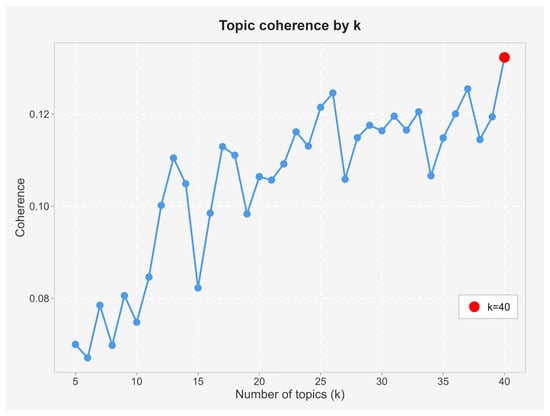
LDA is a three-tiered, hierarchical Bayesian theory in which a finite-level mixture is used to portray each document as incorporating an underlying set of subjects, whilst each topic is defined by a probability distribution over a given vocabulary [23]. The LDA model was executed in R (version 4.5.1) using the LDAShiny package [24], and latent variables were estimated through Gibbs sampling [29] using 500 iterations. This is important because each of the Model selection is based on the mean probabilistic coherence as a function of K over the range 5–40, shown in the coherence-by-K figure; mean probabilistic coherence attains its highest value within the range examined, 0.132, at K = 40; the full coherence-by-K series is reported in Appendix A (Table A2). Estimation used textmineR collapsed Gibbs sampling with a burn-in of 50; the topic-word prior beta was set from the corpus (proportional to the term frequencies) and the document-topic prior was initialized at alpha = 50/K and optimized during fitting. Model selection over K = 5 to 40 (step 1) used the mean probabilistic coherence, and K = 40 attained the highest value; the per-model log-likelihood was also computed. For full reproducibility, a fixed random seed should be set, and topic stability reported across independent runs, since the current script does not fix one.5 to 40 candidate models were built, and model selection was based on a blend of topic coherence [30] and perplexity, as well as a qualitative assessment of semantic consistency. The ultimate model, interestingly, was established as having K = 40 topics. Although LDA is a mixture model in which every document has a probability distribution over all 40 topics, for the article counts reported in Table 4, each document is assigned to its highest-probability (dominant) topic. Model quality was assessed with textmineR probabilistic coherence, which, for each topic, averages over its top terms the difference between the co-occurrence probability of term pairs and the product of their marginal probabilities, so that a higher value denotes a more internally consistent topic. Models were fitted for K = 5 to 40 in steps of one, and K = 40 attained the highest mean coherence within that range. Since coherence was still increasing at the upper bound of the interval examined, it cannot be ruled out that larger values of K would yield a further increase; K = 40 was retained because it maximized coherence within the range explored and produced topics that could be labeled unambiguously. The restriction of the search to K = 40 is acknowledged as a limitation of the model-selection procedure, and the complete coherence-by-K series is reported in Appendix A (Table A2). This is discussed further in the following paragraph. The final estimation resulted in the construction of the document–subject distribution matrix (Θ ∈ RM × K) and topic–word dispersion matrix (Φ ∈ RK × V).
2.2.6. Topic Interpretation and Labeling
For each topic, the highest probability terms from the topic-word distribution were identified, and the documents with the highest topic proportions were analyzed for the most relevant meaning [31]. The authors manually labeled the criteria for each topic in an iterative and consensus-driven manner, commenting on the assigned labels. This step of qualitative validation preferred meaning over statistics. Guarantees that the allocated maps correspond to familiar themes in the area of interest. Each topic was labeled independently by more than one author from its highest-probability terms and a sample of representative documents, and disagreements were reconciled by consensus; the labels corrected in the revised Table 4 were re-validated by the same inter-rater procedure.
2.2.7. Quantitative Indices Used to Analyze the Trend of Topics
The large number of publications and accompanying high-dimensional text data make it exceedingly difficult to understand the trends and dispersion of research topics in Game Theory as they relate to Artificial Intelligence and Machine Learning. This study seeks to address this difficulty by developing a new set of quantitative metrics inspired by earlier research on the bibliometric analysis of topic evolution [25,32]. These metrics employ distributions of document-topics and topic-words from the LDA [23,31]. The new metrics described in this paper quantitatively capture the evolution of research trends and topics in an unprecedented manner.
First, the concept of the relative importance of a research topic is defined to account for its significance in each year. Let denote the set of documents published in year , let denote the extent of topic in document set , and let denote the number of documents published in year . The distribution of topic in year is given as:
This indicator encapsulates the annual average research output attributed to each topic and permits the detection of trends in research (e.g., emerging, stable, and waning research themes) over time. Besides the temporal dimension, the variety of topics in different journals is analyzed as well in order to distinguish the degree of thematic specialization of different journals. This relative-importance indicator is a normalized average of the document-topic probabilities, so it is bounded, comparable across years and journals, and its ranking of topics is stable under re-normalization; it complements, rather than replaces, the raw prevalence measure [24]. Let be the collection of papers published in journal , and let be the total number of papers published in that journal. The distribution of topic in journal is formulated as:
This metric quantifies the prominence of topic k in the journals surveyed. It helps to determine whether particular journals emphasize the theoretical foundations of game theory, learning frameworks, multi-agent systems, or the differing application-based approaches to AI and ML.
Analyzing the evolution of the research within this field can now be better understood in combination with the framework provided by these quantitative indices. Moreover, the structural distribution of research topics in the literature on Game Theory in Artificial Intelligence and Machine Learning can now be analyzed.
2.3. HJ-Biplot
The HJ-Biplot method [33] was utilized to achieve a multivariate graphical display of relations among themes and years. The HJ Biplot is a multivariate statistical method that can offer excellent, simultaneous high-quality representations of both rows (countries) and columns (topics) of a data matrix within the same factorial plane, with a precision of data evaluation compared to conventional biplots. Traditionally, the Θ matrix comes from LDA, which consists of probability values describing the distribution. In this study, the HJ-Biplot was computed on the country x topic matrix, obtained by aggregating and normalizing the document-topic (Theta) distributions by country, so that countries (rows) and topics (columns) are represented on the same factorial plane. Columns were centered and scaled prior to the singular value decomposition, and country groupings were obtained with an explicit clustering criterion. The displayed plane accounts for 46.6% of the total inertia; consequently, the interpretation of country clusters is treated with caution. The topics across years were used.
3. Results
3.1. Descriptive Analysis
The final dataset comprises 6974 documents, reflecting more than 50 years of research at the confluence of Game Theory, AI, and ML. These documents are all published sources and peer-reviewed between 1972 and 2025. Table 2 summarizes the central descriptive corpus statistics.
Table 2.
Main information about bibliometric analysis of Game Theory in Artificial Intelligence and Machine Learning.
The parallel growth of the number of publications and citation dynamics indicates a gradual increase in the field’s quantitative expansion and the growing impact of citation and professional activity in the field. The distribution of documents across publications shows the interdisciplinary nature of the field, and documents are published in domains such as research publications related to AI, ML, OR, Economics, and Complex Systems.
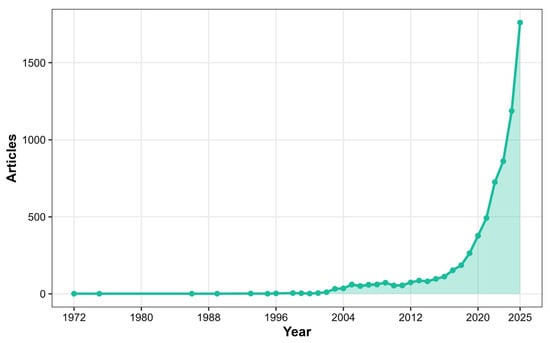
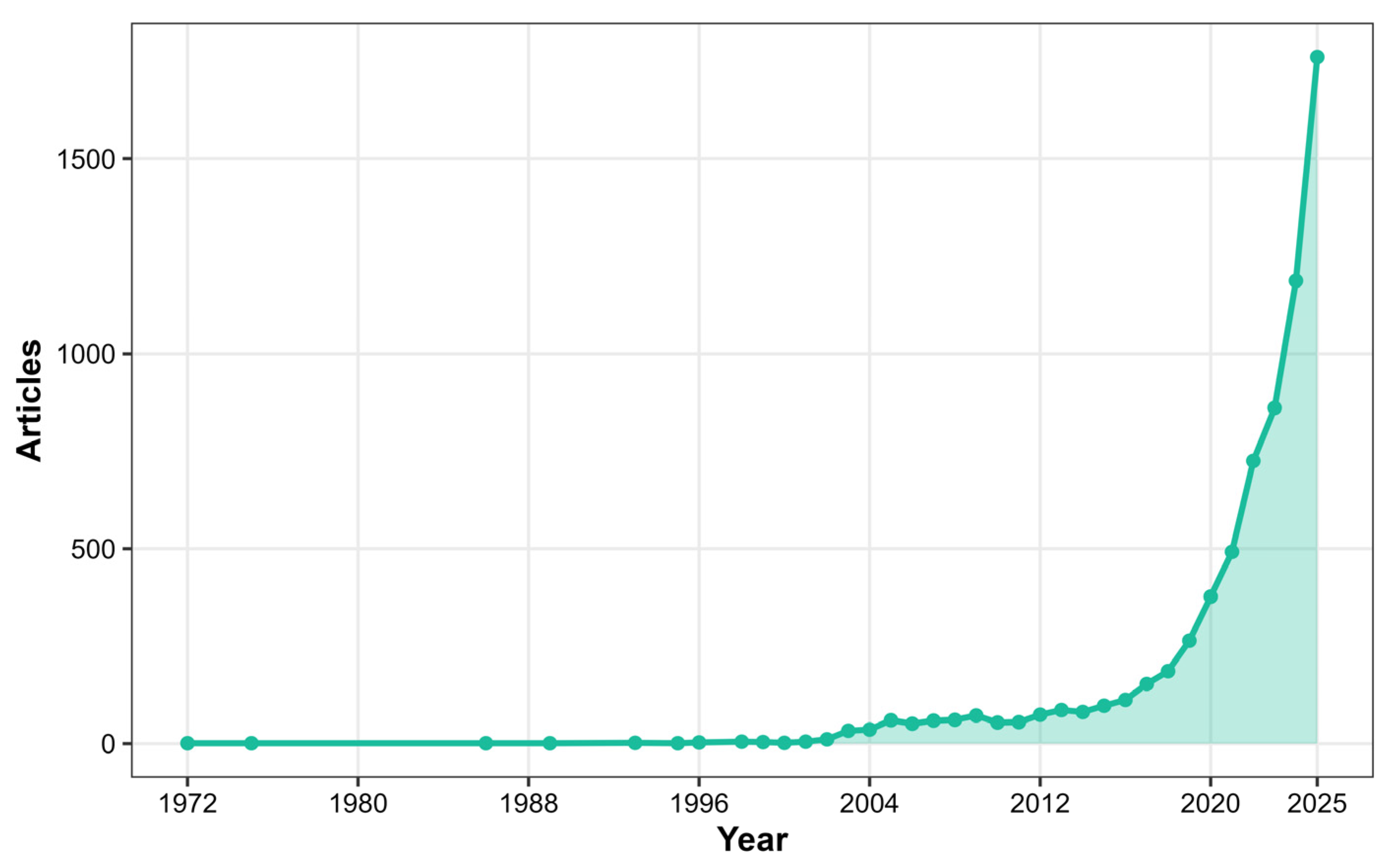
Referring to annual document output depicted in Figure 2, we summarize the increasing trends from 1972 (nearing 0 documents) through to 2025 (1761 documents). For the 1970s through the 2000s, document production remained low, with totals of 2 documents for the year 2000 and 36 documents for the year 2004. The most startling trends began to emerge in the mid-2010s, with document output averaging 97 for the year 2015 and increasing to reach a total of 1761 for the year 2025, representing a robust, positive, and rapidly escalating trend for recent years. The most evident of the trends began in the year 2020 with 377 documents, with documentary output for subsequent years, 2021 to 2025, exceeding a 360% increase, while encompassing an accelerated focus on exploratory research in the field and resulting in an increased level of scholarly activity.
Figure 2.
Annual evolution of scientific publications on Game Theory in Artificial Intelligence and Machine Learning (1972–2025).
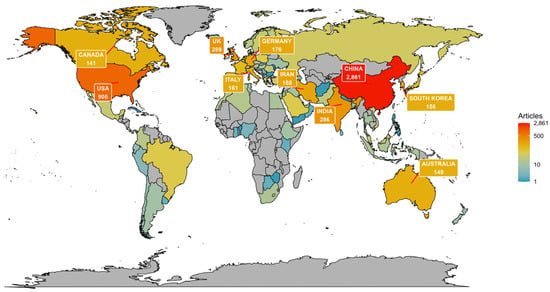
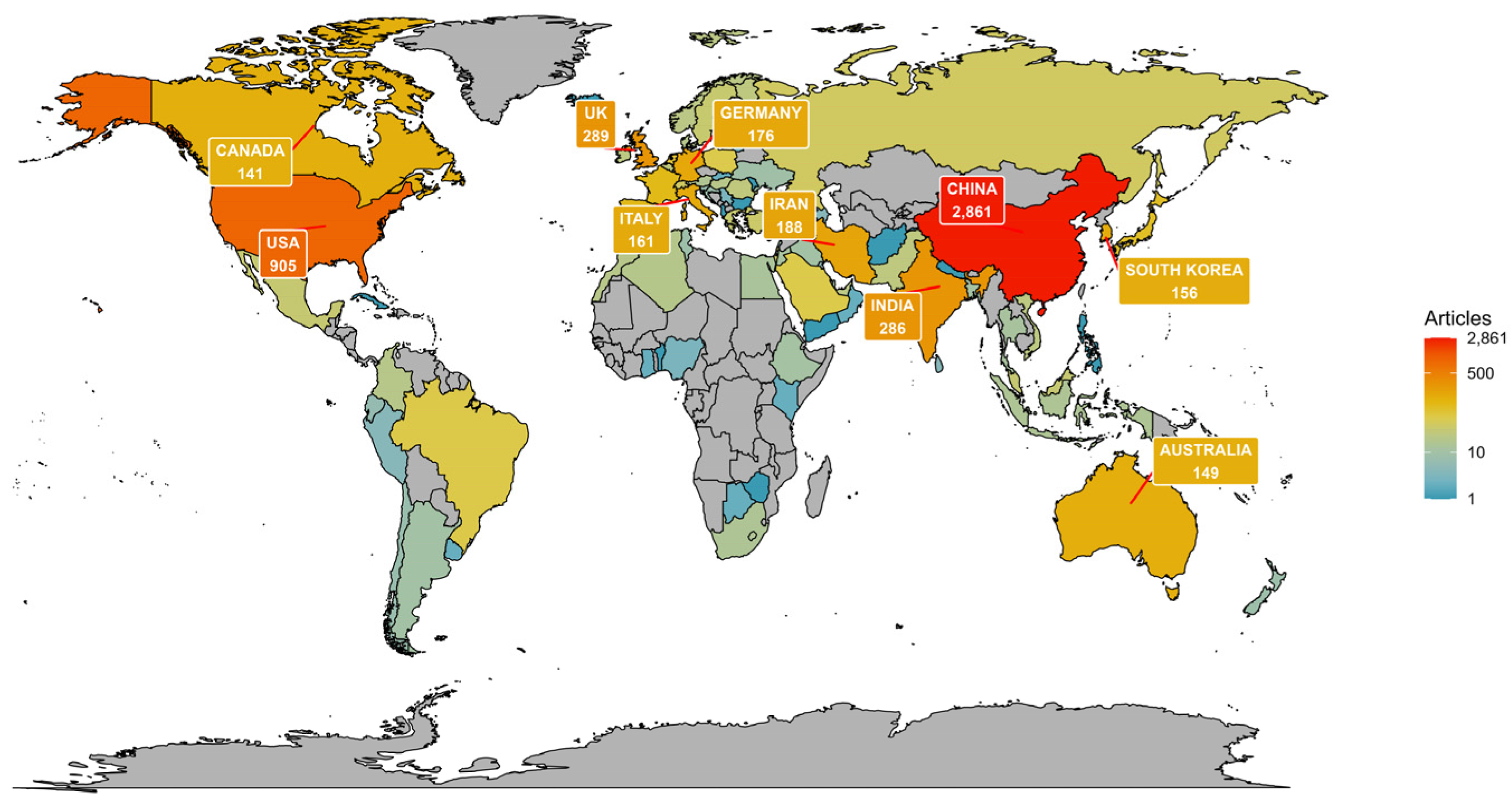
Figure 3 illustrates a fragment of the global geographical distribution of scientific production, showing a concentrated and asymmetrical research landscape. China’s position stands unrivaled, as, with 2861 articles, any other country’s output is less than China’s. The United States is ranked second and published only 905 articles, which accounts for around one-third of China’s output. The United Kingdom (289 articles) and India (286 articles) are ranked third and fourth. The most notable nations, in descending order, are Iran (188), Germany (176), Italy (161), South Korea (156), Australia (149), and Canada (141). This uneven distribution represents an apparent predominance of the Asian, North American, and European countries that are most active in the research of this field. Countries are derived from the author-affiliation field (C1) of each record, and the country x topic values analyzed are the mean document-topic proportions aggregated by that field. Each publication is attributed to a single country, that of the corresponding author’s affiliation; records are therefore counted once and are not split across the countries of all co-authoring institutions. This pattern may be associated with differences in research funding, infrastructure, and national research and development policies; these factors were not directly measured here and are offered as hypotheses.
Figure 3.
Geographical distribution of scientific production on Game Theory in AI and ML (1972–2025).
3.2. Leading Sources
Table 3 ranks the top 30 journals. The study of origin productivity shows strong connectivity and a core set of journals across a variety of disciplines. These disciplines include artificial intelligence, transportation, operations research, economics, and complex systems, demonstrating the interdisciplinary nature of the field. There are 227 publications in IEEE Access, followed by the IEEE Internet of Things Journal with 111, and the IEEE Transactions on Neural Networks and Learning Systems with 94. These 30 sources account for only a minority of the 6974 documents; the remainder are dispersed across a long tail of journals with few relevant articles each, consistent with a Bradford-type scattering of the literature.
Table 3.
Top 30 scientific journals for research on Game Theory in Artificial Intelligence and Machine Learning. NP = number of publications, TC = total citations, h_index = h-index, and PY_start = year of publication start. The table is organized in descending order by NP.
3.3. Keyword Co-Occurrence and Thematic Structure
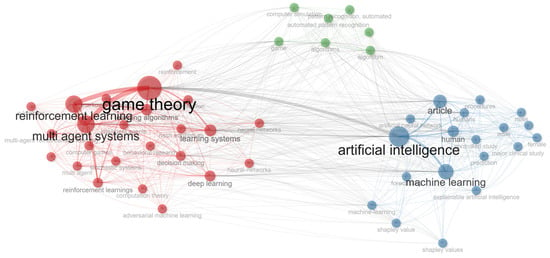
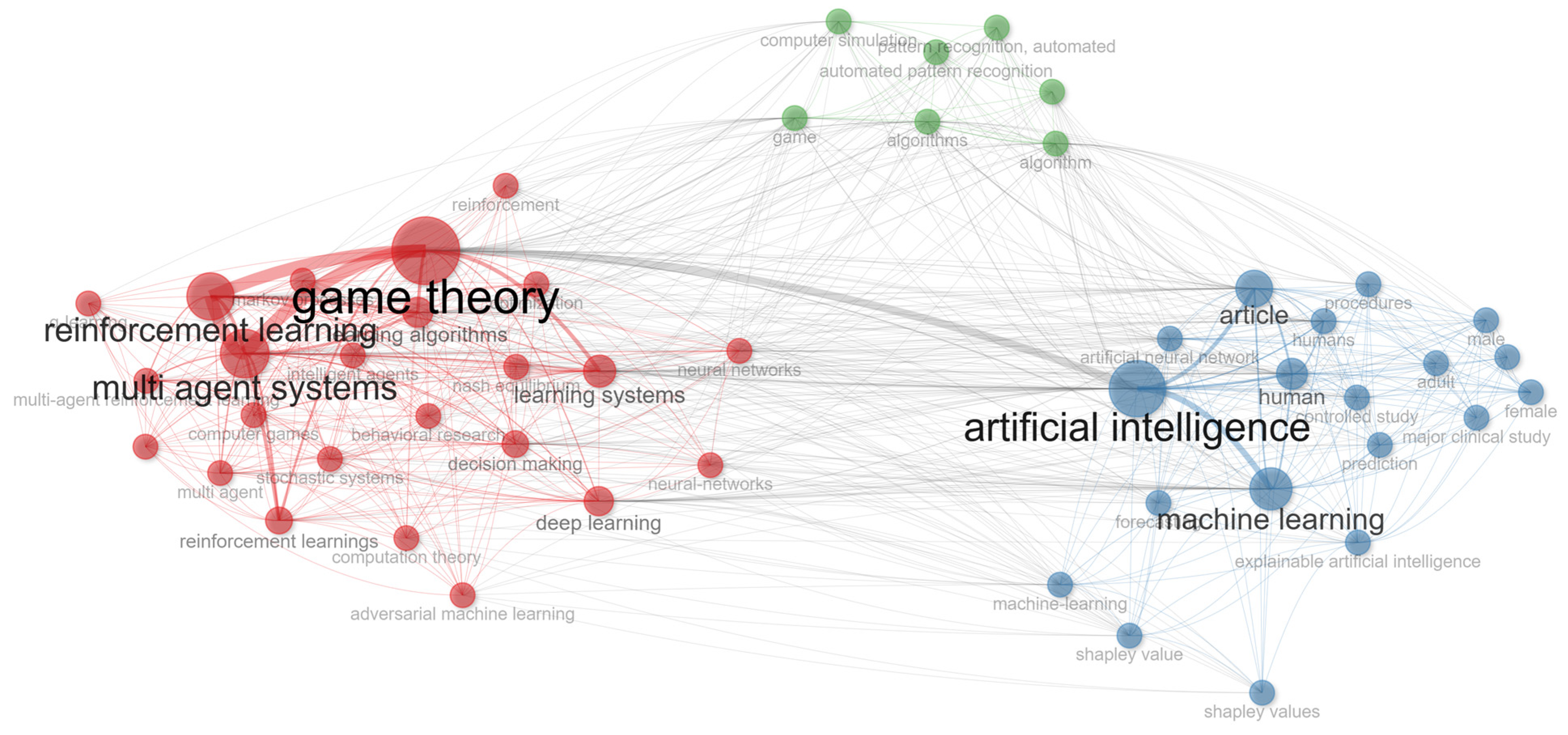
The keyword co-occurrence network (Figure 4) displays three well-connected thematic clusters. The red cluster, focused on “game possibility,” represents the core concept of the field, connecting with artificial intelligence, optimization, algorithms, decision-making, and fundamental strategic interactions. The blue cluster, from the perspective of this work, represents the intersection of machine learning and computational intelligence, indicating the melding of machine learning-based approaches and elements of strategic reasoning. The green cluster, which is small in size and deals with multi-agent systems and cooperative systems, focuses on the strategies and interactions of agents and the distributed intelligence of those systems. In general, the network maintains a strong level of interdisciplinarity, with considerable ties between the clusters of game theory and machine learning. The current configuration of the clusters indicates that the domain is shifting from largely theoretical constructs toward a hybrid model. Combine the game-theoretic model, the learning algorithms, and the multi-agent systems. The observations presented here do point to the fact that “game theory” is the central and most important theory in this respect, and there are strong connections with machine learning and cooperative systems. This reflects the growing importance of adaptive, data-based, and distributed AI systems.
Figure 4.
Keyword Co-occurrence network.
3.4. Topic Modeling Results
The analysis based on LDA identified 40 different topics, demonstrating the broad range of themes covered by the field. Examples of different topics include the more established areas of study such as classical non-cooperative games, evolutionary game dynamics, and mechanism design. On the other hand, multi-agent reinforcement learning, adversarial learning, and game-theoretic interactions in networks are newer topics. These examples are taken from references [19] and [14], respectively. The complete set of 40 topics, together with their most representative terms, interpretive labels, and prevalence, is presented in Table 4.
Table 4.
Topics discovered from 6974 articles on Game Theory in Artificial Intelligence and Machine Learning published between 1972 and 2025.
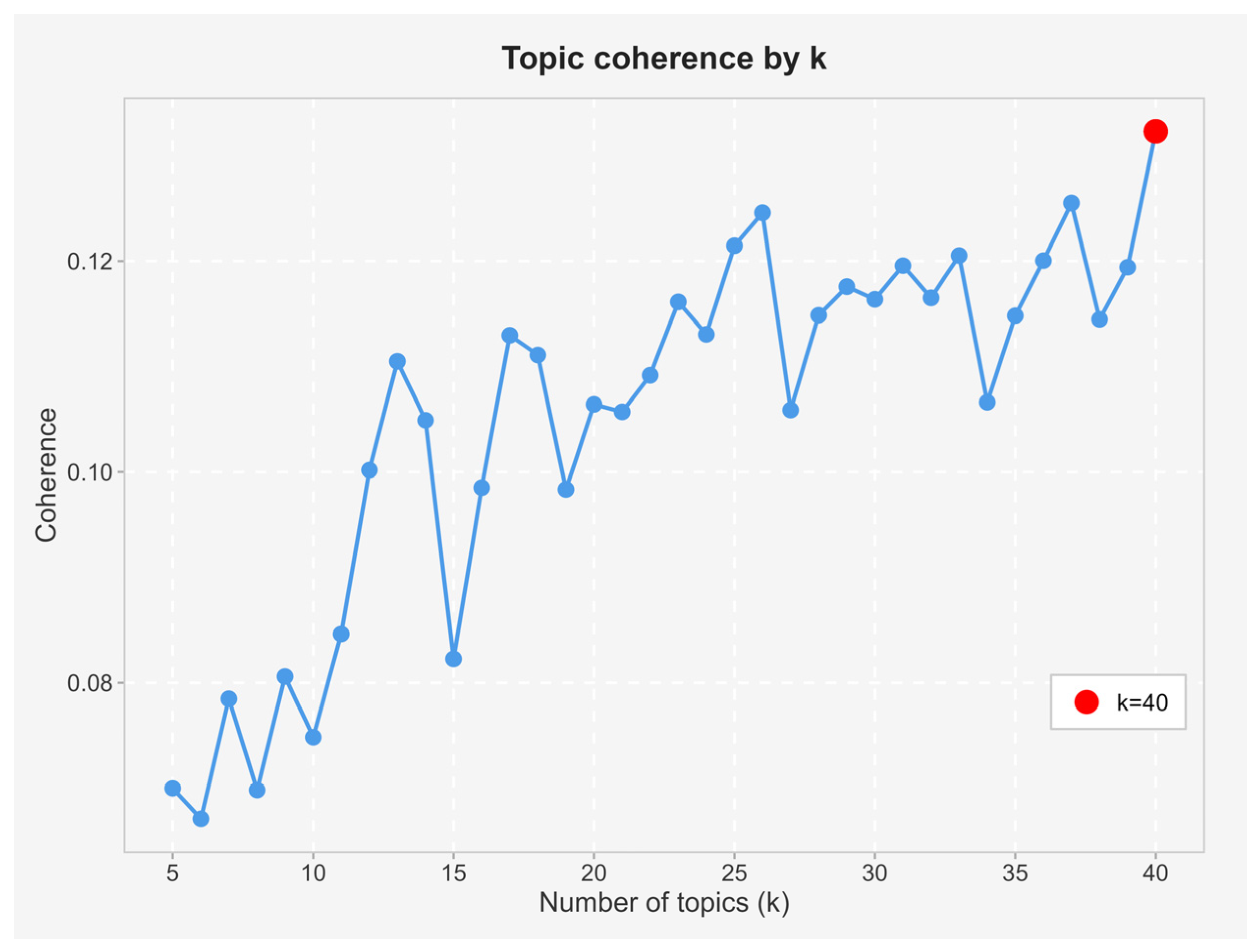
The coherence scores shown in Figure 5 reflect a fluctuating path. Reaching a highest point of approximately 0.13 at k = 40, the LDA model with 40 topics was therefore defined as the best fit.
Figure 5.
Coherence.
3.5. Topic Trends
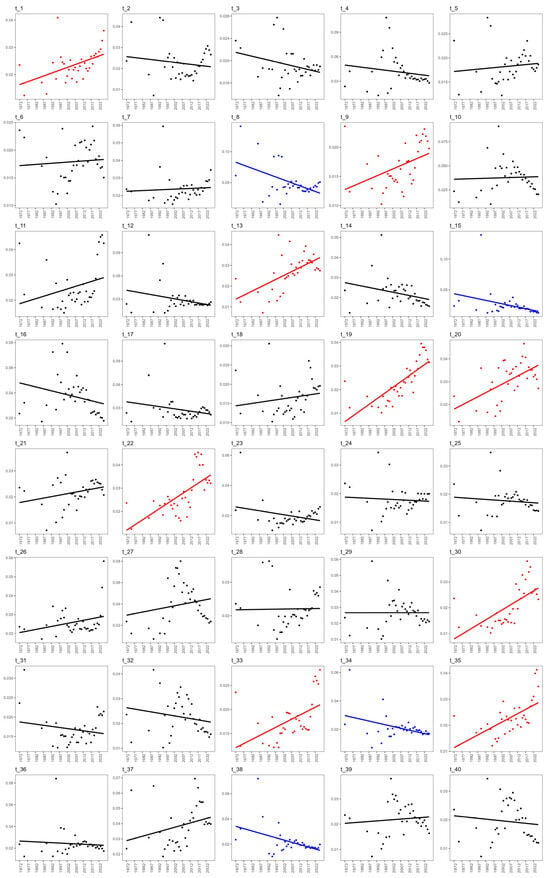
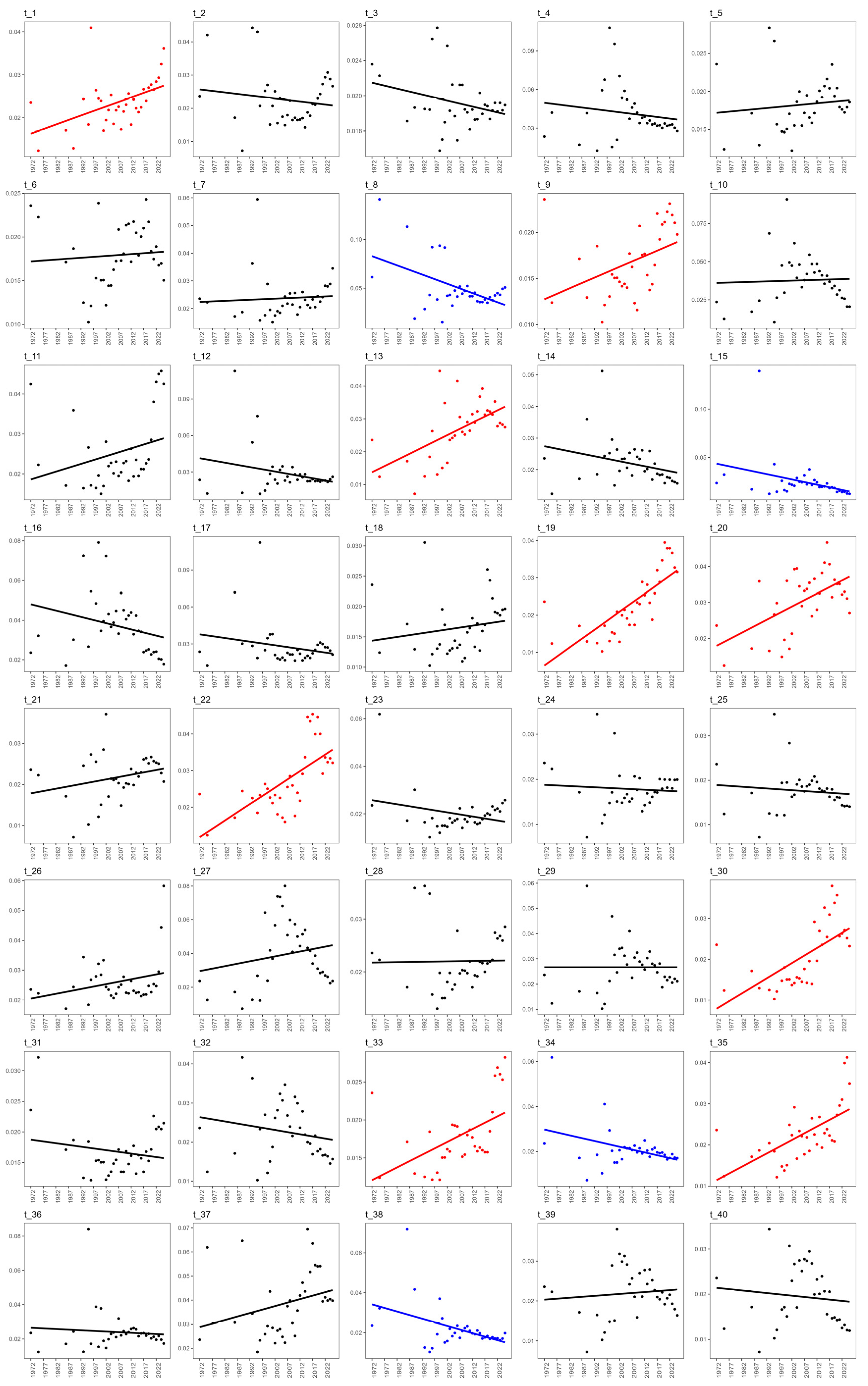
In addition, topics with no statistically significant trend are shown in black in Figure 6. Annual topic proportions were computed as the mean document-topic probability per year and regressed on the publication year by ordinary least squares (one regression per topic); a topic was classified as increasing or decreasing when its slope was significantly positive or negative at the 0.05 level, and as fluctuating otherwise. Each slope is reported with its 95% confidence interval and coefficient of determination. At the 0.05 level, the regressions classify 9 topics as increasing, 4 as decreasing, and 27 as fluctuating. Topics with a statistically significant increasing trend are t_1 (General AI Methods & Performance Improvement), t_9 (Data Analytics, Clustering & Data-Driven Methods), t_13 (Energy Systems, Smart Grids & Resource Management), t_19 (Resource Allocation & Optimization), t_20 (Nash Equilibrium Computation & Convergence), t_22 (Adaptive Control & Neural-Network Stability), t_30 (Wireless Communications, UAV & Spectrum Access), t_33 (Clinical Risk Prediction & Healthcare Outcomes), and t_35 (Federated Learning, Privacy & Incentive Mechanisms). These themes span the computational, learning-based, and applied dimensions of game theory in AI and ML [8,17], including work on privacy and incentive design [16]. The topics with a statistically significant decreasing trend are t_8 (Artificial Intelligence Applications & Reviews), t_15 (Fuzzy Logic & Biologically Inspired Decision Systems), t_34 (Pursuit-Evasion Games & Competitive Strategies), and t_38 (Real-Time Adaptive Systems & Dynamic Environments); this indicates a relative shift of attention away from broad, foundational, and static formulations. The remaining topics, including t_7 (Digital Platforms & Socioeconomic Effects) and t_11 (Model Interpretability & Shapley Value Explanation), show no statistically significant trend and are classified as fluctuating.
Figure 6.
Trends of research topics. In each panel the horizontal axis is the publication year and the vertical axis is the annual mean topic proportion; the colour of the fitted line encodes the trend (red, increasing; blue, decreasing; black, no significant trend), classified from the sign and significance of the ordinary least squares slope.
3.6. An Evolutionary Framework of Game Theory in Artificial Intelligence (1972–2025)
The temporal and semantic patterns identified through bibliometric analysis, LDA topic modeling, and HJ-Biplot visualization collectively reveal that the relationship between Game Theory and Artificial Intelligence has not evolved linearly, but rather through a sequence of paradigmatic transitions that reflect broader conceptual, methodological, and technological ruptures in the field. Drawing on the evidence documented in Section 3.1, Section 3.2, Section 3.3, Section 3.4 and Section 3.5, this section proposes an evolutionary framework organized into four paradigmatic phases, each characterized by a distinct epistemic orientation, a dominant set of research methods, and a corresponding cluster of LDA topics.
Between 1972 and 1990, classical Game Theory began being incorporated into early AI research, and imports of the theory began being published. During this period, the number of publications was low (less than five per year), signifying the early development of the fields. The predominant theory stemmed from the very early work of rationality [1] and equilibrium [2]. These concepts, along with dominant strategies and zero-sum competition, had an early influence on the planning of AI systems and on the formulation of search algorithms within the context of adversarial (and in particular, minimax) game playing, as well as the design of early expert systems for strategic choice. Bibliometric data supports the claim: t_10 (Game Theory Foundations & Equilibrium Analysis) and t_39 (Game Theory Methods & Mathematical Modeling) show the most significant increase during these years, as evidenced in the temporal heat map (Figure 8). During this period, the belief in the rational maximization of an agent’s payoff function was the driving theory behind Game Theory. Within AI, Game Theory operated as an external prescriptive theory of rationality, and not as an adaptive computational theory. Strategic formalism captures its epistemic core. Within this framework, rationality is taken as a given, equilibria are computed, and agents are modeled as deductive reasoners.
The rise of Algorithmic Game Theory in the 1990s and 2000s marks the beginning of a second paradigmatic transition. Output skyrocketed during this phase, resulting in approximately 36 publications by 2004 and signaling the establishment of the AI–Game Theory nexus in the computer science domain. This phase included the first serious questions regarding the equilibrium computation and tractability. Researchers began moving away from the assumption that agents compute Nash equilibria and began addressing the PPAD-hardness of equilibrium computation by proposing polynomial-time approximations for specific types of games [6]. With the emergence of the Multi-Agent Systems (MAS) Paradigm, new computational frameworks and formal constructs were developed for building distributed intelligent systems. MAS also provided a formal construct for agents and inspired models of interaction, negotiation, and coalition formation. The heatmap analysis indicates that t_27 (Multi-Agent Systems & Cooperative Coordination), t_32 (Coalition Formation & Multi-Robot Task Allocation), and t_20 (Nash Equilibrium Computation & Convergence) have a high concentration and are well represented in Cluster 3 (1993–2014). Mechanism design took center stage, and the linking of the design of AI systems to economic theory became a primary focus of research. In Phase II, equilibrium rationality is no longer assumed. Agents, designers, and researchers are not all-knowing and are instead rational.
The third paradigmatic transition characterizes the coherent synthesis of machine learning and game-theoretic reasoning, resulting in the formulation of adaptive strategic agents. Publication output noticeably increased (expected to be about 97 by 2015) and indicated the utilization of hybrid learning-game structures within other disciplines, especially in engineering and computer science. Reinforcement Learning (RL), taught in the framework of the Markov Decision Process by Sutton and Barto [7], offered a straightforward formalism for the case of single-agent sequential decision problems. Its generalization to the Multi-Agent context—Multi-Agent Reinforcement Learning (MARL)—incorporated game-theoretic equilibrium as convergence criteria for learning dynamics, and simultaneously discarded the postulate of rational deduction, substituting it with trial-and-error learning [4]. The analysis of the temporal trend reveals that, for t_4 (Reinforcement Learning & Multi-Agent RL), a statistically significant positive trend has emerged in that period. At the same time, in the domain of evolutionary game theory and in the context of Maynard Smith’s replicator dynamics, there has been a sustained research interest in t_29 (Evolutionary Game Theory & Replicator Dynamics) and in the computational modeling of population-level and emergent social norm adaptations to distributed systems. No-regret learning, on-line learning in games, and fictitious play ensured convergence to correlated and coarse correlated equilibria with weaker conjectured rationality than the Nash equilibrium [4]. For Phase III, the inductive learning paradigm replaces the need for deductive reasoning. Instead of solving games, agents learn equilibria, which, in turn, become learning attractors.
The fourth and present phase initiates a period of relatively short duration, with rapid increases in the number of publications (over 1.700% from 2015 to 2025—from 97 to 1761) and with the beginning of a close architectural integration of large-scale deep learning with game-theoretic reasoning. At least three major changes to the architecture are associated with the current phase. The first of these transformations was the introduction of adversarial learning, especially Generative Adversarial Networks (GANs) [13], which view unsupervised generative modeling as a game and Neural Networks as a pairing of a generator and a discriminator that are to be trained in a two-player minimax game with zero-sum dynamics. The t_17 (Deep Learning & Adversarial Neural Networks) statistical data analysis confirms the existence of the associated trend. The second such transformation—federated learning systems—dealt with game-theoretic incentive design and proved architecturally indispensable. When data is distributed among a number of participants who may act in a self-interested manner and who may be untruthful or defect, the design of a mechanism along with Shapley-based contribution. Attribution is required to ensure truthful participation. Comparable neural-architecture design through neuroevolution has been explored in related computational work [34,35].
The most powerful increasing trend in the whole dataset is captured by t_35 (Federated Learning, Privacy & Incentive Mechanisms). The integration of distributed AI with incentive engineering is best captured by this trend. The emergence of large language models made a significant qualitative change in the nature of strategic reasoning. LLMs have the capacity to participate in natural language negotiations, argument formation, and game-theoretic reasoning. Thus, language-based game theory is becoming popular [16,36]. On the other hand, Shapley values [31,37,38] are being used in cooperative game theory as a method of interpretability, and connect rational coalitional fairness with explainable AI. In Phase IV, the epistemic crystallization points to the appearance of autonomous strategic agency. It is not merely the case that systems can learn equilibria and rationalize them, but that systems can design strategies to pursue equilibria and rationalize them as autonomous social agents within the web of a sociotechnical complex. These terms are used here in a precise, operational sense: “strategic intelligence” denotes the capacity of an artificial agent to represent other agents’ objectives and to select actions that are best responses given that representation, whereas “autonomous strategic agency” denotes an agent that jointly learns strategies, shapes the incentive structure (mechanism), and reasons about its own strategic position, without an external designer fixing the game. This usage is consistent with the rational-agent conception of artificial intelligence [39] and extends it to multi-agent, mechanism-shaping settings.
Combining all four phases demonstrates a clear evolutionary movement from strategic formalism to strategic intelligence. Considered conceptually, this represents the transformation from exogenous rationality (where equilibrium is viewed as a normative standard) to endogenous adaptability (where equilibrium is viewed as an outcome of learning, and thus is emergent). Considered methodologically, this transformation moves from analytical derivation to approximation to inference, with the latter being drawn from the data. Considered technologically, this represents the evolution from the first generation of AI (symbolic systems) to the next, which are distributed systems of neural architectures, and which possess the capability of autonomous, strategic reasoning. This evolutionary framework is not simply descriptive, but has the potential to be predictive. In this respect, the evolutionary framework outlines the problems of the next frontier, which is the self-alignment of strategic actions in extensive, multi-agent systems that operate under the conditions of partial observability, non-stationarity, and divergent (or heterogeneous) incentive structures. These are the very problems that are currently the most pressing in the Game Theory, AI, and ML literature [3,4,16,36].
3.7. Distribution of Research Topics Across Journals and Years
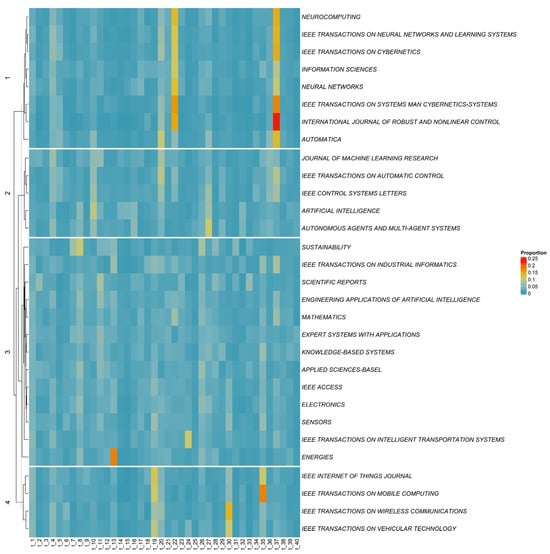
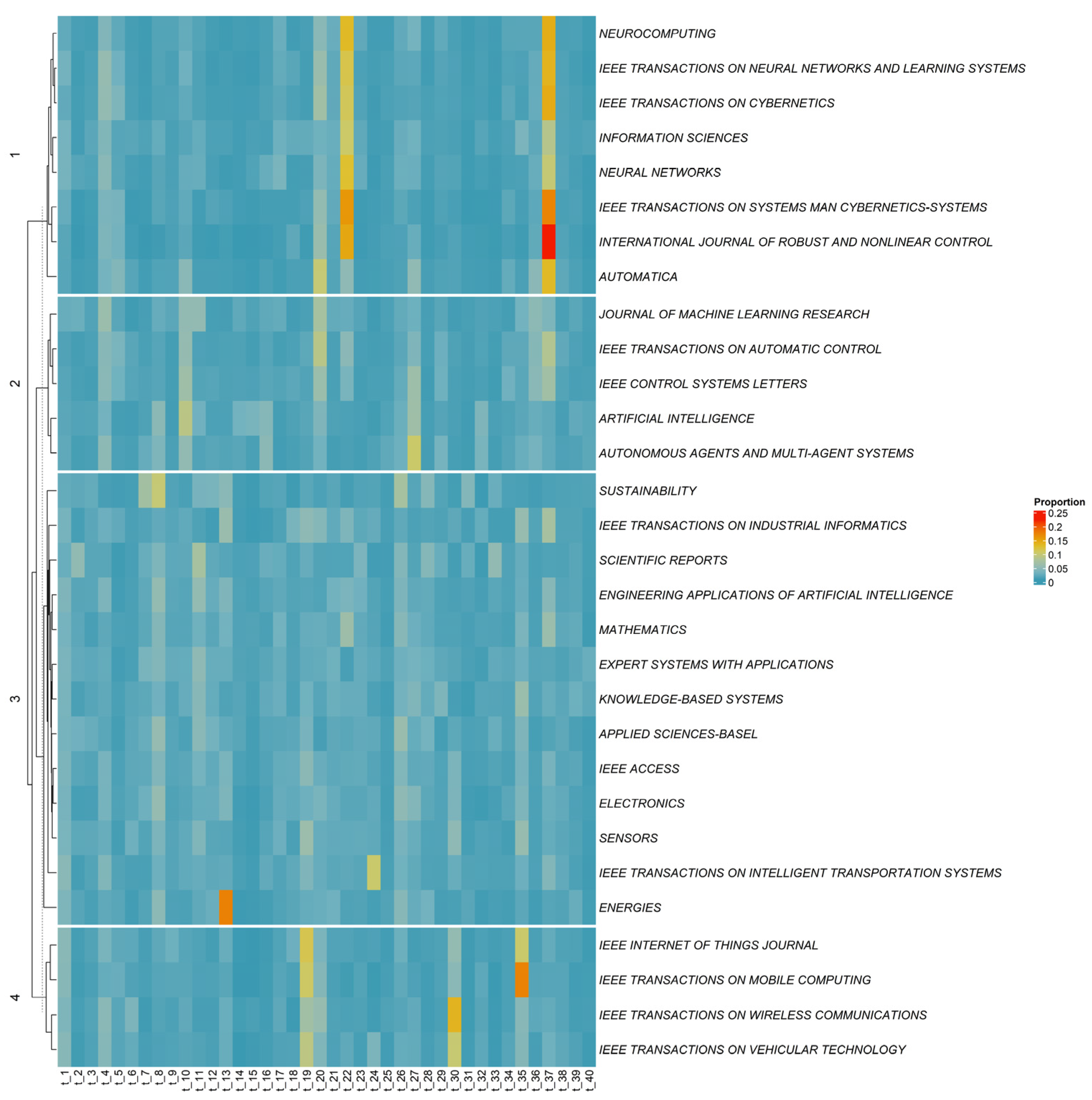
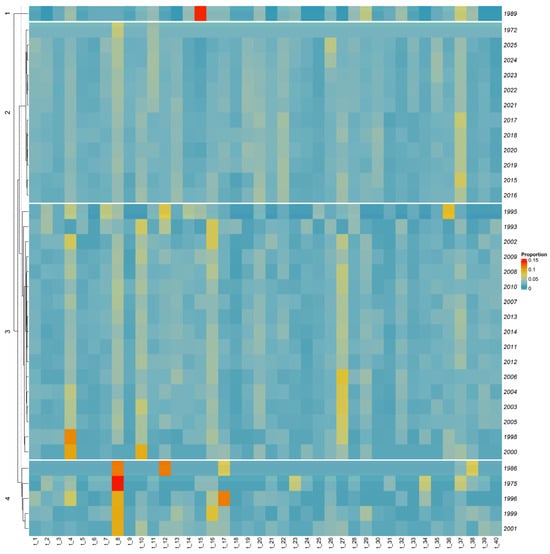
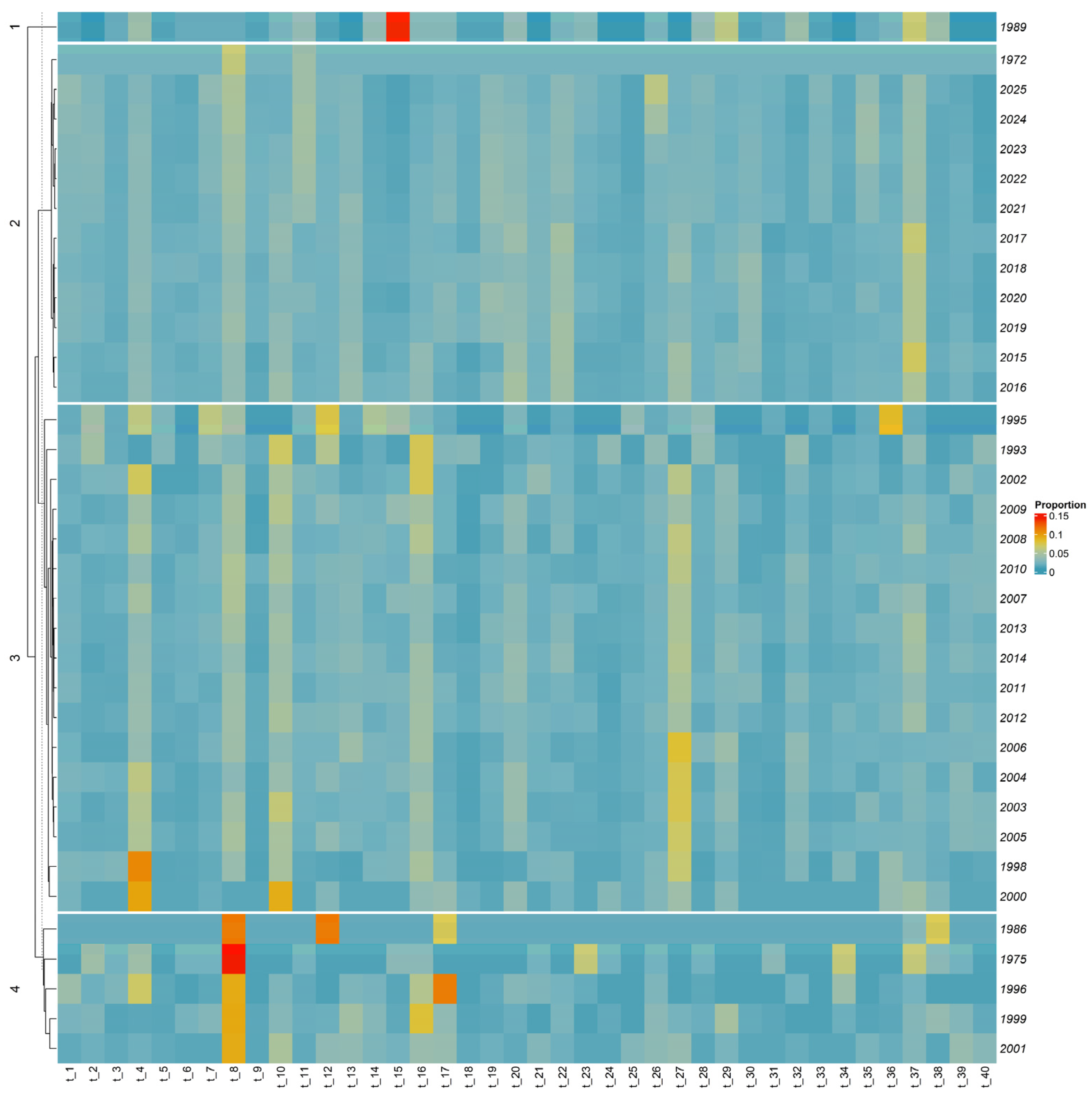
Figure 7 illustrates the relationship between the top 30 journals and the 40 LDA topics, and Figure 8 illustrates the relationship between the years and the 40 LDA topics. The colour gradient indicates topic proportion within each journal, where warmer colors (red/orange) represent higher thematic relevance. In this heatmap, the rows are the publication years and the columns are the 40 topics; warmer colors indicate a higher mean topic proportion in a given year, so vertical bands identify topics that rise or fade over time.
Figure 7.
Heatmap of research topic distribution across the top 30 scientific journals. Warmer colors indicate higher topic prevalence in a given journal. Rows correspond to the journals and columns to the 40 topics, and the dendrogram groups journals by the similarity of their topic profiles using hierarchical clustering on Euclidean distances.
Figure 8.
Heatmap of research topic distribution by Years.
IEEE Access, the IEEE Internet of Things Journal, and IEEE Transactions on Vehicular Technology show high concentrations of topics related to resource allocation, wireless networks, and UAV communications (t_6, t_19, t_30). In contrast, Artificial Intelligence and Autonomous Agents and Multi-Agent Systems are more closely associated with foundational game-theoretic topics (t_10, t_20, t_27) and behavioral decision-making (t_16, t_40). The Journal of Machine Learning Research shows a strong presence of statistical estimation and probabilistic methods (t_36), consistent with its theoretical orientation.
Cluster 1 consists solely of 1989, characterized by a high prevalence of topic t_15 (Fuzzy Logic & Biological Decision Systems). Cluster 2 groups the most recent years (2015–2025) along with 1972, showing a generally diversified distribution with slight peaks in t_22 (Adaptive Control & Neural Network Stability) and t_37 (Optimal Control & Dynamic Systems).
Cluster 3 includes the years 1993–2014. In this range, t_27 (Multi-Agent Systems & Cooperative Coordination), t_36 (Statistical Estimation & Probabilistic Analysis), and t_4 (Reinforcement Learning & Multi-Agent RL) have relevance, especially in the mid-2000s. In Cluster 4, the years 1975, 1986, 1996, 1999, and 2001 have a strong presence of t_8 (Artificial Intelligence application & Reviews), t_12 (Strategic Decision Support & Management), and t_17 (Deep Learning & Adversarial Neural Networks). The heatmap shows an evolving trend over the years: the early years relate to the application of general AI and Strategic Decision Support; in the 2000s, the focus was on Multi-Agent Systems and Game Theory, and in the more recent years, the focus is on a more varied and broad research spectrum.
3.8. HJ Biplot
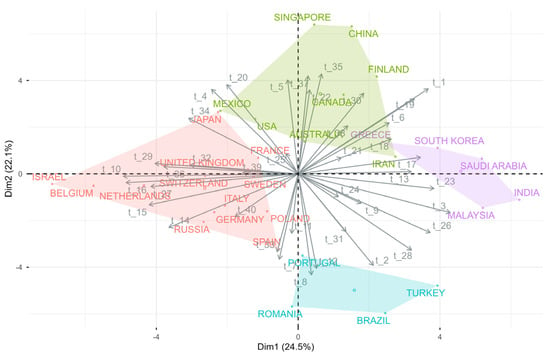
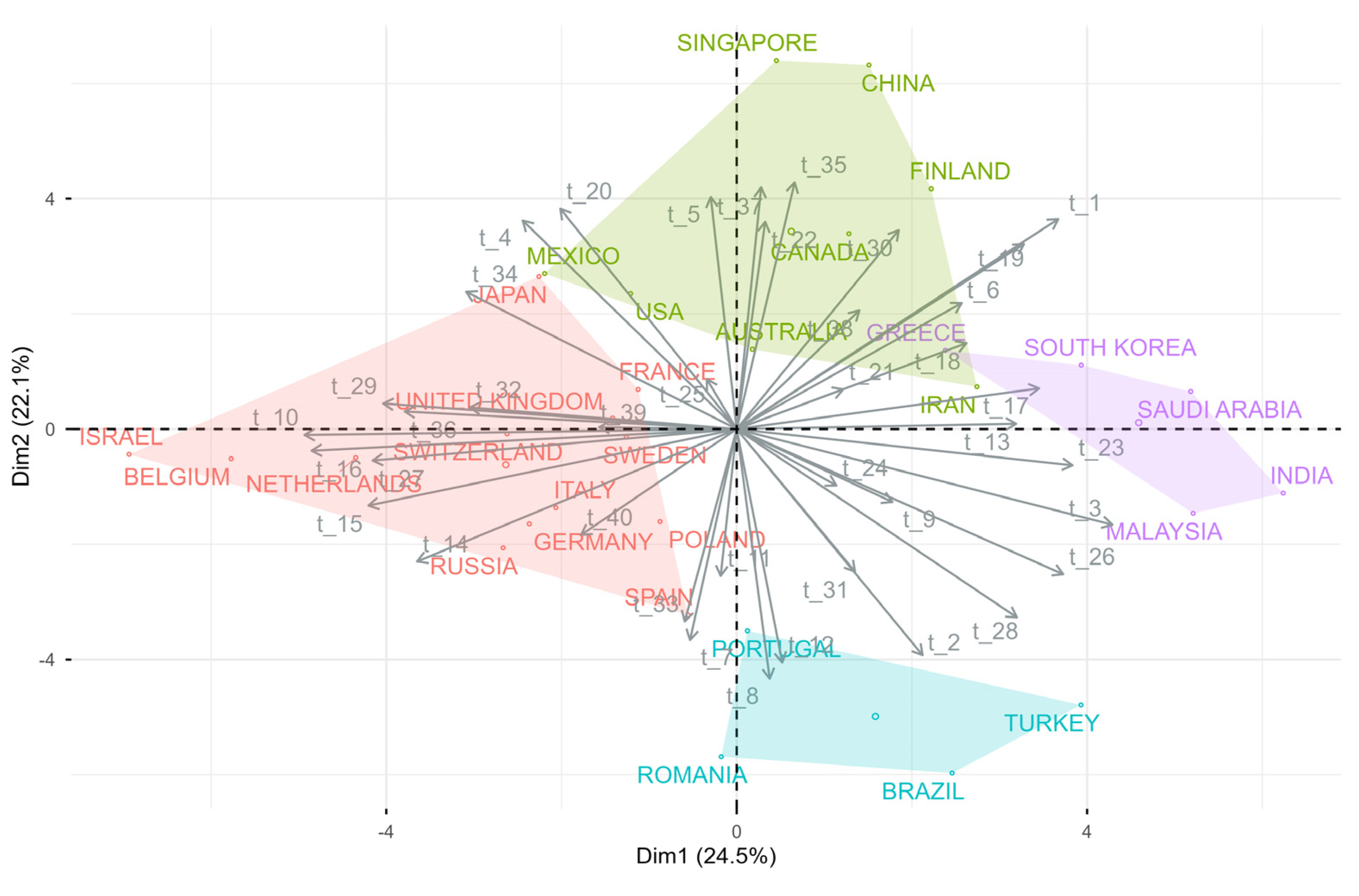
Using the Θ matrix of the LDA results, the HJ-Biplot was applied. The HJ-Biplot in Figure 9 shows the link between topics and countries and accounts for partial data of global total inertia at 46.6%. It identifies thematic and regional specialization with distinct groups in four clusters. The clustering distinguishes groups of countries by thematic specialization—one oriented toward computational and learning-based topics, another toward classical/foundational topics, and a set of highly productive countries (e.g., China, United States) with broad, cross-cutting coverage.
Figure 9.
Association between topics by country using the HJ-Biplot method.
Broadly, HJ-Biplot divides the world into four large thematic and geographic clusters based on the distribution of countries and research topics. Cluster 1 combines mainly European countries: United Kingdom, Germany, France, and the Netherlands. Cluster 1 is strongly related to t_10 (Game Theory Foundations & Equilibrium analysis), t_29 (Evolutionary Game Theory & Replicator Dynamics), t_32 (Coalition Formation & Multi-Robot Task Allocation), and t_15 (Fuzzy Logic & Biological Decision Systems). This cluster expresses a sustained interest in classical and economic theories. Cluster 2 includes the major research centers of the world: China, the United States, Singapore, and Canada. Cluster 2 is related to t_35 (Federated Learning, Privacy & Incentive Mechanisms), t_4 (Reinforcement Learning & Multi-Agent RL), t_5 (Distributed Optimization & Stackelberg Games), and t_20 (Nash Equilibrium Computation & Convergence), and outlines the leadership of those countries in the new, data-oriented, and decentralized approaches of AI. Cluster 3 denotes the countries of Asia and the Middle East: South Korea, Saudi Arabia, and India. Cluster 3 is strongly related to t_6 (Communication Networks & Wireless Systems), t_17 (Deep Learning & Adversarial Neural Networks), and t_24 (Traffic, Mobility & Transportation Systems), and is focused on the application of network optimization and intelligent systems.
Cluster 4 groups a small number of states such as Turkey, Brazil, and Portugal, as contributing to emerging inquiries. These states associate with t_8 (Artificial Intelligence Applications & Reviews), t_13 (Energy Systems, Smart Grids & Resource Management), and t_31 (Environmental Modeling & Spatial Analysis) and may indicate a new focus of inquiry around applied systems and sustainability, and resource management [3,16,17].
4. Discussion
The findings of this research present an integrated view of the intersection of Game Theory with Artificial Intelligence and Machine Learning. Analyzing regional distribution tells us that China has the most publications and the most publications relating to engineering fields, while the U.S. has the most impactful citations and the most influential theory-related publications. Hence, there is consistent asymmetry between the quantity and quality of publications. This has also been found in other domains of research and, as such, should be taken into account in science policies. The leading role of IEEE journals shows that engineering is dominating contemporary game-theoretic AI. Game Theory has moved from the mathematical and economics-oriented venues to engineering and Applied Computer Science. This may also be related to the research funding available in countries with a strong technology sector. This is also in agreement with the temporal trend analysis, which shows a clear shift away from traditional game theory towards a data- and computation-theory-driven game theory [4,19].
The evolutionary framework proposed in Section 3.6 provides the overarching interpretive lens for integrating these findings into a coherent scientific narrative. The four paradigmatic phases identified—classical strategic formalism, computational rationality, learning-theoretic integration, and autonomous strategic intelligence—are not merely convenient historical periodizations but reflect genuine ruptures in the epistemological assumptions, methodological repertoires, and technological capabilities of the field. Each transition corresponds to a relaxation of a foundational assumption of classical Game Theory: Phase II relaxed analytical tractability (rationality without computational cost); Phase III relaxed the assumption of perfect rationality in favor of bounded, adaptive rationality; and Phase IV dissolved the boundary between the game designer, the mechanism, and the agent, producing systems that simultaneously learn strategies, design incentives, and reason about their own strategic position. This framework addresses RQ6 and represents the principal theoretical contribution of this study, complementing the bibliometric architecture documented in Section 3.1, Section 3.2, Section 3.3, Section 3.4 and Section 3.5. The LDA analysis outlines 40 coherent research themes within the bounds of the field. The most common theme, AI Applications & Reviews (t_8, 4.55%), shows the prominence of game theory as a cross-cutting meta-framework in a plurality of AI subfields. Next, in order of prevalence, are Optimal Control & Dynamic Systems (t_37, 4.23%) and Model Interpretability & Shapley-Based Explanation (t_11, 3.77%), the latter suggesting the increasing role of cooperative game theory in explainable AI To state the contribution explicitly and to distinguish it from prior, largely qualitative reviews such as Shoham and Leyton-Brown [6], it can be summarized on three levels. Empirically, the study provides a comprehensive quantitative mapping of the global research landscape (6974 records, 1972–2025) rather than a narrative synthesis. Methodologically, it introduces the joint use of bibliometrics, LDA topic modeling, and the HJ-Biplot, together with the annual topic-prevalence indicators of Section 2.2.7, to characterize the intellectual and semantic structure of the field. Theoretically, it proposes the four-phase evolutionary framework whose phase boundaries are not imposed a priori but anchored empirically in the topic-trend analysis (Figure 6)—where statistically significant positive trends for learning-related topics (e.g., t_4, t_17) and the relative decline of purely standard topics mark each transition—and corroborated by the country × topic structure of the HJ-Biplot (Figure 9); the temporal boundaries are further supported by an objective change-point/temporal-clustering analysis of the annual topic proportions [37,38,40,41]. The analysis of temporal trends showed rapid AI development related to federated learning and incentive mechanisms (t_35), deep learning and adversarial networks (t_17) [11,35], and multi-agent reinforcement learning (t_4), in line with the growing application of learning-based methods in game theory [8,17]. Furthermore, the development of language-based game theory is a new field of study integrating large language models and strategic game theory, and is an area of research with the possibility to disrupt the current environment [16,36].
HJ-Biplot analysis takes the structure of LDA output and organizes it spatially on the map to strengthen the LDA spatial results. This way, we can think more about the way that the research is being done in specific countries and how they collaborate, and which countries act similarly to other countries and which countries act alone. Some countries are more focused on computational methods. Some countries focus on the foundations of AI. Still, some countries put a focus on multi-agent systems. From the LDA output, we can see how research in AI and Game Theory shows that countries have research that is converging on the areas of Game Theory and AI. However, some countries have a lot of specialized research in Game Theory and AI that is converging. Some of that research is going to have to cross borders for that research to be done, and the information about research in the Game Theory and AI areas shows that there are complementary and differing fields of research across the borders of countries [3,14].
The results corroborate Hanley [15], who discussed the significance of applying game theory for defense and security of AI, and Oladayo and Kenneth [19], who pointed out the collaboration of ML, AI and game theory, and how it impacts and assists complex decision-making, and Mene et al. [8], who discussed how the collaboration of ML, AI, game theory, and other fields impacts and assists the advancement of decision-making. Furthermore, Jain et al. [20] contributed a systematic review in which game theory is discussed in relation to other fields and shows that game theory has importance for improving reinforcement learning in many areas, such as autonomous vehicles and cyber-physical systems. A few limitations must be stated. First, limiting this to studies published in English most likely omits many valuable studies from other languages. Second, the inclusion of only Scopus and WoS provides a partial view of the world of academia, especially with regard to conference publications. Third, the LDA model is quite flexible, and its qualitative labeling is subjective. Finally, the HJ-Biplot is based on aggregated data, which most likely smooths out many small, interesting fluctuations. These choices—English-only sources, journal-indexed databases, and the exclusion of conference proceedings such as NeurIPS and AAAI—most plausibly produce a conservative under-representation of the very recent, fast-moving learning-based literature; accordingly, the magnitude of the trends reported for those topics should be read as a lower bound rather than a precise estimate, even though the overall structure and direction of the findings are unlikely to change.
5. Conclusions
With a focus on 6974 publications from Scopus and Web of Science published from 1972 to 2025, this article provides one of the first broad-level bibliometric and semantic mapping studies concerning the integration of Game Theory into AI and ML. We present the following key findings. First, the integration of game-theoretic constructs with deep learning, multi-agent reinforcement learning, and federated systems has resulted in rapid expansion of the field, with an Average Annual Growth Rate (AAGR) of 15.14%. Second, China, the USA, the UK, and India have been the most active countries. The USA and Western Europe have the highest citation impact.
Third, considering the engineering orientation of research in the modern context, the dominance of IEEE-affiliated journals reflects the publication landscape. Fourth, LDA analysis shows 40 coherent research themes, from classical game-theoretic foundations to new computational paradigms. Fifth, a temporal trend analysis indicated a gradual progression from theoretical methodologies to more data-driven and contextually applied research. Sixth, the HJ-Biplot analysis interprets topics and years into four temporal clusters for a dynamic perspective of the field’s theoretical progression. Seventh, and most importantly, the study proposes an evolutionary framework that characterizes the transformation of Game Theory in AI and ML across four paradigmatic phases: classical strategic formalism (1972–1990), computational rationality and multi-agent design (1990–2005), learning-theoretic integration (2005–2015), and autonomous strategic intelligence (2015–2025). This framework demonstrates that the field has undergone a fundamental transition from models grounded in equilibrium and deductive rationality toward intelligent systems capable of adaptive learning, distributed incentive design, and autonomous strategic reasoning—a transition documented empirically at this scale by the present study using a combination of bibliometric indicators, LDA topic modeling, and HJ-Biplot multivariate analysis.
Methodologically, this paper shows that the integration of bibliometric indicators, LDA topic modeling, and HJ-Biplot multivariate analysis provides literature mapping systematization that offers a synergistic articulation of the social, intellectual, and semantic mapping of a field of research [21,24,25].
Subsequent trends in research are the combination of game theory with explainability and fairness of AI, mechanism design of privacy-preserving computation, game theory related to large language model alignment as well as multi-agent coordination [16,36], and the theoretical scaffolding of the learning process in non-stationary and adversarial situations [3,4].
Author Contributions
Conceptualization, R.A.-V., J.D.L.H.-M. and J.R.-B.; methodology, R.A.-V. and J.D.L.H.-M.; software, J.D.L.H.-M.; validation, R.A.-V., J.D.L.H.-M. and J.R.-B.; formal analysis, R.A.-V.; investigation, R.A.-V., J.D.L.H.-M. and J.R.-B.; data curation, J.D.L.H.-M.; writing—original draft preparation, R.A.-V.; writing—review and editing, R.A.-V., J.D.L.H.-M. and J.R.-B.; visualization, J.D.L.H.-M.; supervision, R.A.-V. All authors have read and agreed to the published version of the manuscript.
Funding
This research received no external funding.
Data Availability Statement
The analysis code (R script), the stopword list, the fitted LDA model object (model.rds), and the curated bibliographic dataset used in this study are openly available in the GitHub repository https://github.com/juanDReales/Latent-Dirichlet-Allocation-LDA- (accessed on 10 August 2026). The search strings are reported in Table 1, and the full model configuration (software packages and versions, priors, number of iterations, and the coherence criterion) is described in Section 2.2, so that the topic model and the reported results can be reproduced end to end.
Conflicts of Interest
The authors declare no conflicts of interest.
Abbreviations
The following abbreviations are used in this manuscript:
| LDA | Latent Dirichlet Allocation |
| AI | Artificial Intelligence |
| ML | Machine learning |
Appendix A
Appendix A.1
Table A1 indicates ordinary-least-squares regression of the annual mean topic proportion on the publication year, one regression per topic (t_1–t_40). Slopes and 95% confidence intervals are shown in units of 10−4 per year. R2 is the coefficient of determination; p is the two-sided p-value for the slope. A topic is classified as increasing or decreasing when its slope is significantly positive or negative at the 0.05 level, and as fluctuating otherwise. Topic labels are given in Table 4.
Table A1.
Temporal trend statistics per topic. At the 0.05 level, 9 topics are increasing, 4 decreasing, and 27 fluctuating. Topic t_10 shows a small, non-significant positive slope (p = 0.816) and is therefore fluctuating.
Appendix A.2
In Table A2, coherence rises overall across the range examined but not monotonically: local maxima occur at K = 25–26, 33 and 37, and the lowest value is obtained at K = 6 (0.0671). The highest value within the range, 0.1323, is attained at K = 40, which is the upper bound of the interval explored; a further increase for larger K therefore cannot be ruled out, and this is acknowledged as a limitation of the model-selection procedure.
Table A2.
Mean probabilistic coherence of the fitted LDA models for each candidate number of topics K, over the range K = 5 to 40 in steps of one. Each value is the mean coherence across the K topics of the corresponding model. The highest value within the range examined is marked with an asterisk.
References
- Von Neumann, J.; Morgenstern, O. Theory of Games and Economic Behavior; Princeton University Press: Princeton, NJ, USA, 1944. [Google Scholar]
- Nash, J.F. Equilibrium points in n-person games. Proc. Natl. Acad. Sci. USA 1950, 36, 48–49. [Google Scholar] [CrossRef] [Scilit] [PubMed]
- Wang, L.; Fu, F.; Chen, X. Mathematics of multi-agent learning systems at the interface of game theory and artificial intelligence. Sci. China Inf. Sci. 2024, 67, 112101. [Google Scholar] [CrossRef] [Scilit]
- Qin, R.; Yu, Y. Learning in games: A systematic review. Sci. China Inf. Sci. 2024, 67, 112103. [Google Scholar] [CrossRef] [Scilit]
- Nisan, N.; Roughgarden, T.; Tardos, É.; Vazirani, V.V. (Eds.) Algorithmic Game Theory; Cambridge University Press: Cambridge, UK, 2007. [Google Scholar] [CrossRef] [Scilit]
- Shoham, Y.; Leyton-Brown, K. Multiagent Systems: Algorithmic, Game-Theoretic, and Logical Foundations; Cambridge University Press: Cambridge, UK, 2008. [Google Scholar]
- Sutton, R.S.; Barto, A.G. Reinforcement Learning: An Introduction, 2nd ed.; MIT Press: Cambridge, MA, USA, 2018. [Google Scholar]
- Mene, S.; Mene, R.; Mene, S. Strategic synergies: Integrating game theory with artificial intelligence for decision-making excellence. Int. J. Multidiscip. Res. 2025, 7, 55481. [Google Scholar] [CrossRef]
- Rekha, J.; Chatrapati, K.S.; Babu, A.V. Game theory and its applications in machine learning. In Advances in Intelligent Systems and Computing; Springer: Berlin/Heidelberg, Germany, 2016; Volume 435, pp. 195–207. [Google Scholar] [CrossRef] [Scilit]
- Littman, M.L. Markov games as a framework for multi-agent reinforcement learning. In Machine Learning Proceedings 1994; Morgan Kaufmann: San Francisco, CA, USA, 1994; pp. 157–163. [Google Scholar] [CrossRef] [Scilit]
- Tembine, H. Deep learning meets game theory: Bregman-based algorithms for interactive deep generative adversarial networks. IEEE Trans. Cybern. 2020, 50, 1132–1145. [Google Scholar] [CrossRef] [PubMed]
- Maynard Smith, J. Evolution and the Theory of Games; Cambridge University Press: Cambridge, UK, 1982. [Google Scholar]
- Goodfellow, I.; Bengio, Y.; Courville, A. Deep Learning; MIT Press: Cambridge, MA, USA, 2016. [Google Scholar]
- Yuan, C. Multi-agent game theory applied in artificial intelligence. Trans. Comput. Sci. Intell. Syst. Res. 2025, 8, e7hser67. [Google Scholar] [CrossRef] [Scilit]
- Hanley, J. GAMES, game theory and artificial intelligence. J. Def. Anal. Logist. 2021, 5, 119–138. [Google Scholar] [CrossRef] [Scilit]
- Capraro, V.; Di Paolo, R.; Perc, M.; Pizziol, V. Language-based game theory in the age of artificial intelligence. J. R. Soc. Interface 2024, 21, 20230720. [Google Scholar] [CrossRef] [Scilit] [PubMed]
- Yang, Y.; Du, H.; Sun, G.; Xiong, Z.; Niyato, D.; Han, Z. Exploring equilibrium strategies in network games with generative AI. IEEE Netw. 2024, 39, 191–200. [Google Scholar] [CrossRef] [Scilit]
- Schelble, B.G.; Flathmann, C.; Canonico, L.; McNeese, N.J. Understanding human-AI cooperation through game-theory and reinforcement learning models. In Proceedings of the 54th Hawaii International Conference on System Sciences (HICSS 2021), Virtual, 5–8 January 2021; pp. 1–10. [Google Scholar] [CrossRef] [Scilit]
- Oladayo, O.-H.E.; Kenneth, O. Synergies between machine learning, artificial intelligence, and game theory for complex decision-making. Asian Res. J. Math. 2024, 20, 108–121. [Google Scholar] [CrossRef] [Scilit]
- Jain, G.; Kumar, A.; Bhat, S. Recent developments of game theory and reinforcement learning approaches: A systematic review. IEEE Access 2024, 12, 9999–10011. [Google Scholar] [CrossRef] [Scilit]
- Aria, M.; Cuccurullo, C. bibliometrix: An R-tool for comprehensive science mapping analysis. J. Informetr. 2017, 11, 959–975. [Google Scholar] [CrossRef] [Scilit]
- Donthu, N.; Kumar, S.; Mukherjee, D.; Pandey, N.; Lim, W.M. How to conduct a bibliometric analysis: An overview and guidelines. J. Bus. Res. 2021, 133, 285–296. [Google Scholar] [CrossRef] [Scilit]
- Blei, D.M.; Ng, A.Y.; Jordan, M.I. Latent Dirichlet allocation. J. Mach. Learn. Res. 2003, 3, 993–1022. [Google Scholar]
- De la Hoz-M, J.; Fernández-Gómez, M.J.; Mendes, S. LDAShiny: An R package for exploratory review of scientific literature based on a Bayesian probabilistic model and machine learning tools. Mathematics 2021, 9, 1671. [Google Scholar] [CrossRef] [Scilit]
- Montes-Escobar, K.; De la Hoz-M, J.; Barreiro-Linzán, M.D.; Fonseca-Restrepo, C.; Lapo-Palacios, M.Á.; Verduga-Alcívar, D.A.; Salas-Macias, C.A. Trends in agroforestry research from 1993 to 2022: A topic model using Latent Dirichlet Allocation and HJ-Biplot. Mathematics 2023, 11, 2250. [Google Scholar] [CrossRef] [Scilit]
- Page, M.J.; McKenzie, J.E.; Bossuyt, P.M.; Boutron, I.; Hoffmann, T.C.; Mulrow, C.D.; Shamseer, L.; Tetzlaff, J.M.; Akl, E.A.; Brennan, S.E.; et al. The PRISMA 2020 statement: An updated guideline for reporting systematic reviews. BMJ 2021, 372, n71. [Google Scholar] [CrossRef] [Scilit] [PubMed]
- Harzing, A.-W.; Alakangas, S. Google Scholar, Scopus and theWeb of Science: A longitudinal and cross-disciplinary comparison. Scientometrics 2016, 106, 787–804. [Google Scholar] [CrossRef] [Scilit]
- Blei, D.M.; Lafferty, J.D. A correlated topic model of Science. Ann. Appl. Stat. 2007, 1, 17–35. [Google Scholar] [CrossRef] [Scilit]
- Geman, S.; Geman, D. Stochastic relaxation, Gibbs distributions, and the Bayesian restoration of images. IEEE Trans. Pattern Anal. Mach. Intell. 1984, PAMI-6, 721–741. [Google Scholar] [CrossRef] [Scilit] [PubMed]
- Röder, M.; Both, A.; Hinneburg, A. Exploring the space of topic coherence measures. In Proceedings of the 8th ACM International Conference on Web Search and Data Mining (WSDM 2015); ACM: New York, NY, USA, 2015; pp. 399–408. [Google Scholar] [CrossRef] [Scilit]
- Griffiths, T.L.; Steyvers, M. Finding scientific topics. Proc. Natl. Acad. Sci. USA 2004, 101, 5228–5235. [Google Scholar] [CrossRef] [Scilit] [PubMed]
- Xiong, H.; Cheng, Y.; Zhao, W.; Liu, J. Analyzing scientific research topics in manufacturing field using a topic model. Comput. Ind. Eng. 2019, 135, 333–347. [Google Scholar] [CrossRef] [Scilit]
- Galindo-Villardón, M.P. Una alternativa de representación simultánea: HJ-Biplot. Qüestiió Quad. d’Estadística I Investig. Oper. 1986, 10, 13–23. [Google Scholar]
- Llaguno-Roque, J.-L.; Barrientos-Martínez, R.-E.; Acosta-Mesa, H.-G.; Romo-González, T.; Mezura-Montes, E. Neuroevolution of convolutional neural networks for breast cancer diagnosis using Western Blot strips. Math. Comput. Appl. 2023, 28, 72. [Google Scholar] [CrossRef] [Scilit]
- Phyu, A.; Aung, P.; Wang, X.; Wang, R.; Chan, H.; An, B.; Li, X. Double oracle neural architecture search for game theoretic deep learning models. IEEE Trans. Image Process. 2024, 34, 2463–2472. [Google Scholar] [CrossRef] [Scilit] [PubMed]
- Hua, W.; Liu, O.; Li, L.; Amayuelas, A.; Chen, J.; Jiang, L.; Jin, M.; Fan, L.; Sun, F.; Wang, W.; et al. Game-theoretic LLM: Agent workflow for negotiation games. arXiv 2024, arXiv:2411.05990. [Google Scholar] [CrossRef] [Scilit]
- Heuillet, A.; Couthouis, F.; Rodríguez, N.D. Collective eXplainable AI: Explaining cooperative strategies and agent contribution in multiagent reinforcement learning with Shapley values. IEEE Comput. Intell. Mag. 2021, 17, 59–71. [Google Scholar] [CrossRef] [Scilit]
- Li, M.; Sun, H.; Huang, Y.; Chen, H. Shapley value: From cooperative game to explainable artificial intelligence. Auton. Intell. Syst. 2024, 4, 9. [Google Scholar] [CrossRef] [Scilit]
- Russell, S.J.; Norvig, P. Artificial Intelligence: A Modern Approach, 4th ed.; Pearson: Upper Saddle River, NJ, USA, 2021. [Google Scholar]
- Li, Z. GeoShapley: A game theory approach to measuring spatial effects in machine learning models. Ann. Am. Assoc. Geogr. 2024, 114, 1365–1385. [Google Scholar] [CrossRef] [Scilit]
- Lundberg, S.M.; Lee, S.-I. A unified approach to interpreting model predictions. In Advances in Neural Information Processing Systems; Curran Associates: New York, NY, USA, 2017; Volume 30, pp. 4765–4774. [Google Scholar]

Disclaimer/Publisher’s Note: The statements, opinions and data contained in all publications are solely those of the individual author(s) and contributor(s) and not of MDPI and/or the editor(s). MDPI and/or the editor(s) disclaim responsibility for any injury to people or property resulting from any ideas, methods, instructions or products referred to in the content. |
© 2026 by the authors. Licensee MDPI, Basel, Switzerland. This article is an open access article distributed under the terms and conditions of the Creative Commons Attribution (CC BY) license.