


Abstract
Limpet teeth contain a desirable combination of material properties: they are auxetic (i.e., they have a negative Poisson’s ratio) and have high stiffness and strength. In contrast, synthetic auxetic structures presented in the literature to date are typically accompanied by low stiffness. Hence, limpet teeth microstructures are an attractive candidate for bio-inspired synthetic structures that have both auxeticity and high stiffness. The microstructure consists of iron oxide hydroxide crystal nanorods embedded in an amorphous hydrated silica matrix. Moreover, a portion of the nanorods are arranged into oriented bundles which are surrounded by a chiral arrangement of the remaining nanorods. Many synthetic structures achieve auxeticity by means of a similar chiral arrangement of rods. However, such structures are typically continuous, whereas the limpet teeth structures are not. In this work, a mechanistic description of such microstructural arrangements is provided by means of a computational parametric study of idealized microstructures comprising bimodal particle reinforcements with chiral confinement. The influence of microstructural geometry on the effective mechanical properties is investigated by varying parameters such as particle shape, bundle design, rod orientation, and others. It is shown that chiral rods that impinge on the central bundle are crucial for auxeticity and high material stiffness.
1. Introduction
Limpets, a type of sea snail, have attracted attention in the literature due to their tough teeth that are used for scraping algae off of rocks. The teeth consist of goethite, a naturally occurring mineral, and are incredibly strong and durable, making them ideal for withstanding the harsh conditions of the natural habitat of the limpet, the intertidal zone. This combination of properties makes them an attractive candidate for a model system to understand the mechanical properties of biomineralized materials and for developing new materials with improved toughness and strength and counterintuitive properties such as auxeticity (i.e., a negative Poisson’s ratio).
Mechanisms leading to auxeticity are controlled by the geometry of the composite constituents rather than their properties. In this regard, nested reentrant honeycombs or lattices with missing ribs, buckling modes, or chiral elements typically lead to auxeticity. Auxetic structures existing in the literature are either porous, e.g., [1,2,3,4,5,6,7], or composites based on a continuous lattice in which the lattice is the driving force for the auxeticity, see, e.g., [8,9,10,11,12,13,14,15,16,17,18]. Some porous auxetic structures are based on interconnected chiral arrangements [19,20,21,22]—chirality being the geometrical property of an object that it cannot be superimposed to its mirror image by any combination of rotations and translations.
The relationship between stiffness and auxeticity is typically inversely correlated [17,23], which can be attributed in part to the fact that many auxetic materials adopt a cellular metamaterial configuration characterized by a lower density. Such configurations tend to have increased compliance but diminished load-bearing capability in comparison to traditional structures. In the context of cellular materials as ligament networks, structures dominated by stretching mechanisms exhibit superior stiffness compared to those governed by bending [24]. The transition from stretching to bending can be induced through architectural transformation, e.g., [25]. In a parallel manner, buckled random fiber networks can be incorporated for inducing auxetic responses [26]. In the realm of periodic lattices, auxetic cellular materials can be designed based on eigenmode analysis [27], and those structures, in comparison to their foundational lattice, are anticipated to exhibit higher compliance due to the presence of a bending mode, as contrasted with the axial mode. In the study of periodic structures, the role of buckling in fostering auxeticity is highlighted [28]. The drive to enhance stiffness in auxetic configurations is an area of escalating research focus, as documented in [29,30]. Auxetic composites have a variety of potential applications, such as energy absorption materials [11], nails [31], dielectric materials for highly stretchable capacitive-type strain sensors [13], and medical sutures or smart bandages [32].
Although limpet teeth have attracted attention due to their exceptional combination of strength, stiffness, and auxetic behavior, a predictive and mechanistic understanding that translates their microstructural features into engineering design principles remains limited. In particular, existing auxetic material concepts are predominantly based on porous architectures or continuous lattice networks, and therefore do not capture the fundamentally different mechanism observed in limpet teeth, where discontinuous nanorods govern the mechanical response. Consequently, the role of microstructural kinematics—such as rod rotation, reorientation, and interaction—in generating auxeticity, while simultaneously preserving high stiffness and strength, is still not fully resolved. Moreover, it remains unclear how these mechanisms can be systematically parameterized to enable the design of synthetic materials with tunable properties, especially in light of the typical trade-off between auxeticity and stiffness in conventional systems.
To address this gap, the present study develops a mechanistically grounded modelling framework inspired by the microstructure of limpet teeth. By employing a parameterized representation, we isolate the fundamental geometric and kinematic drivers of auxetic behavior and demonstrate how microstructural features such as rod orientation, chirality, and inclusion density control the effective mechanical response. In doing so, we establish an alternative design paradigm for auxetic materials that does not rely on lattice-based architectures, and we show that this approach enables the realization of structures with simultaneously high stiffness and tunable auxeticity. This provides both new insight into the structure–property relationships of limpet teeth and a scalable route toward the design of high-performance mechanical metamaterials.
2. Limpet Teeth: Microstructure and Mechanical Properties
Mature, fully mineralized limpet teeth consist of iron oxide hydroxide (-FeOOH, goethite, space group Pbnm) crystal nanorods embedded in an amorphous hydrated silica (SiO2·nH2O) matrix [33,34,35,36]. The microstructure is functionally graded, with an essential difference between the leading and the trailing part to optimize the overall mechanical performance. In this work, the leading part is of interest, as, in contrast to the trailing part, it has a rare and desirable combination of mechanical properties: high strength, stiffness, and auxeticity [36].
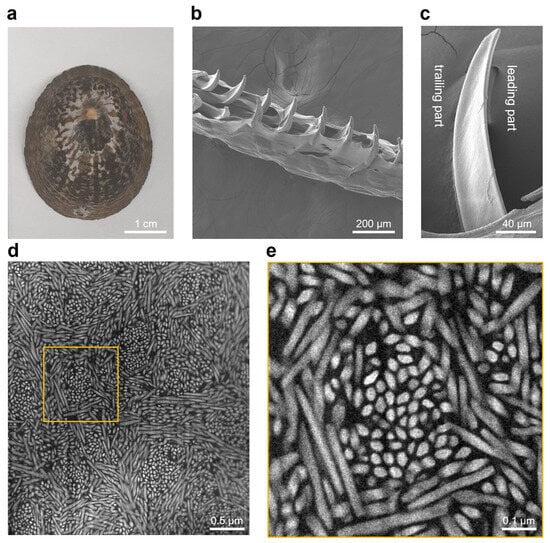
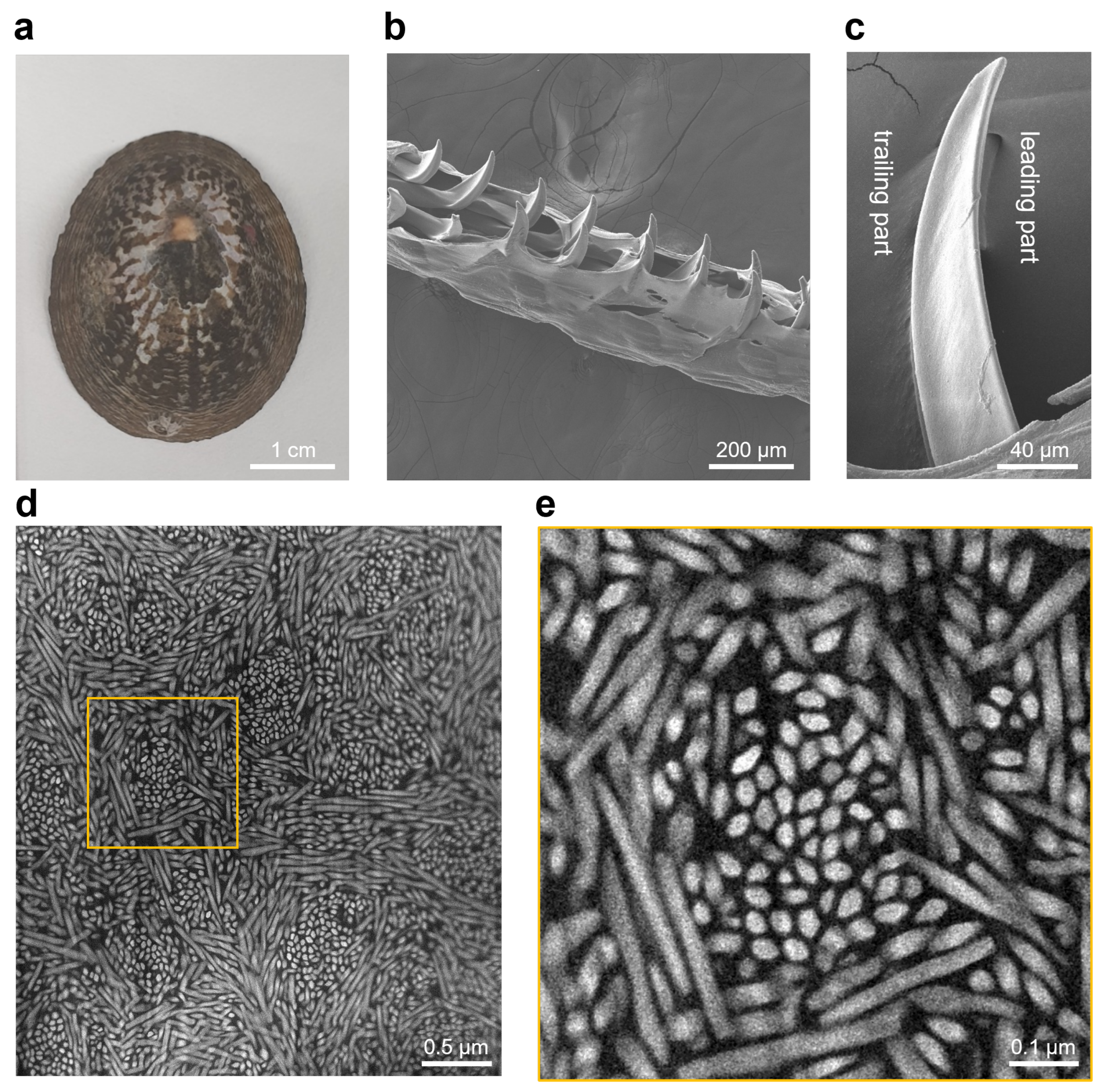
In the leading part, nanorods are arranged in a pseudo-cholesteric pattern with predominantly horizontally aligned nanorods weaving around bundles of vertically aligned nanorods (Figure 1). The vertically aligned nanorod bundles have a diameter of approximately 500–1000 nm, and the average spacing between the bundles is approximately 500–1000 nm. The horizontal and vertical nanorods, consisting of single-crystalline goethite without defects, are of the same kind: they have an average length of 279.0 ± 18.4 nm and a rhomboidal cross-section with a width of 32.1 ± 0.4 nm [36]. Their long axes are aligned parallel to the [001] direction [37]. The volume fraction of the nanorods is about 51.5 ± 1.8% [36].
Figure 1.
Limpet, Cellana toreuma. (a) Shell of Limpet. (b) SEM image of dissected radular. (c) Individual teeth attached to the radular: The side scraping the algae is referred to as the leading part and the opposite side as trailing part. (d) STEM-HAADF image showing the microstructure of the leading part. Vertically aligned nanorods are surrounded by horizontally arranged nanorods, repeating cholesteric microstructure. Nanorod bundles are embedded in the matrix, where the region appeared in black, which consists of amorphous hydrated silica (SiO2·nH2O). (e) Magnified STEM-HAADF image of the yellow boxed region in (d).
Using in situ micromechanical testing, tensile strengths have been measured from 3.0 to 6.5 GPa. To date, its strength is the highest ever measured for a natural material. An elastic modulus of 120 ± 30 GPa was measured in small volumes with essentially probed aligned fiber bundles [38]. Micropillar compression tests on larger samples with representative bulk behavior showed a compressive failure strength of 3.59 ± 0.29 GPa, an elastic modulus of 38.4 ± 6.2 GPa, and a negative Poisson’s ratio [36,39]. Those specimen contained chiral confinements, i.e., off-axis oriented reinforcement fibers, resulting in lower, yet representative, strength and modulus.
Limpet teeth show pronounced linear elastic behaviour until failure, without any noticeable plastic behavior [36,38].
3. Theory
In the computational studies that follow, we investigate idealized composite microstructures of bimodal particle reinforcements with chiral confinements, inspired by the limpet teeth microstructure. To this end, computational asymptotic homogenization (see Appendix A) and the finite element method are utilized to determine the effective elastic properties of the composite. The commercial finite element analysis software Abaqus is used with linear triangle and reduced integration bilinear quadrilateral plane stress elements (CPS3 and CP4R). Periodic boundary conditions are applied by means of multi-point constraints.
The successful application of periodic boundary conditions is verified by checking that the volume averaged strain is equivalent to the macroscopic strain prescribed in the periodic boundary conditions. Since, generally, the behavior is anisotropic, the complete set of planar elasticity moduli are computed. Focus is placed on the macroscopic Young’s modulus , and Poisson’s ratio . The planar Young’s modulus along the direction of (see Appendix A for the definition of the directions), and the planar Poisson’s ratio when stretched along and probed along are obtained from the components of the elastic compliance tensor (see Appendix A for its definition), see, e.g., [40]
For planar anisotropic materials, the apparent Young’s modulus and Poisson’s ratio depend on the loading orientation and are obtained by rotating the compliance matrix accordingly (see Appendix A for details).
In many biological materials, the matrix is made of a protein-based phase. In natural limpet teeth, however, the nanofibers are embedded in a hydrated silica-based matrix containing minor organic constituents. In the present model, this matrix is idealized as a homogeneous continuum to focus on the role of the structural arrangement of reinforcing elements as we aim for bio-inspired materials.
4. Computational Investigations: Role of Microstructural Configuration on Mechanical Properties
The outstanding properties of natural materials have long led to the development of biomimetic tailor-made high-performance materials. Aiming at design guidelines for auxetic, strong, and stiff materials mimicking the microstructure of the limpet teeth, we idealize the structure reflecting the salient features and consider periodic unit cells. The influence of percolation of the hard phase, the packing/density of the bundle, and the orientation and volume fraction of the surrounding nanorods is investigated.
4.1. Role of the Bundle
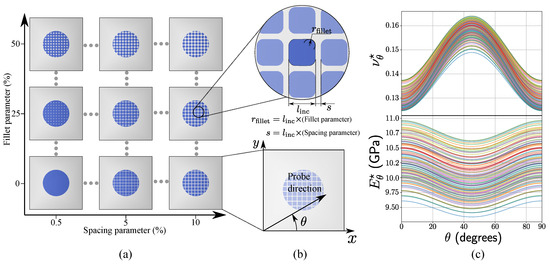
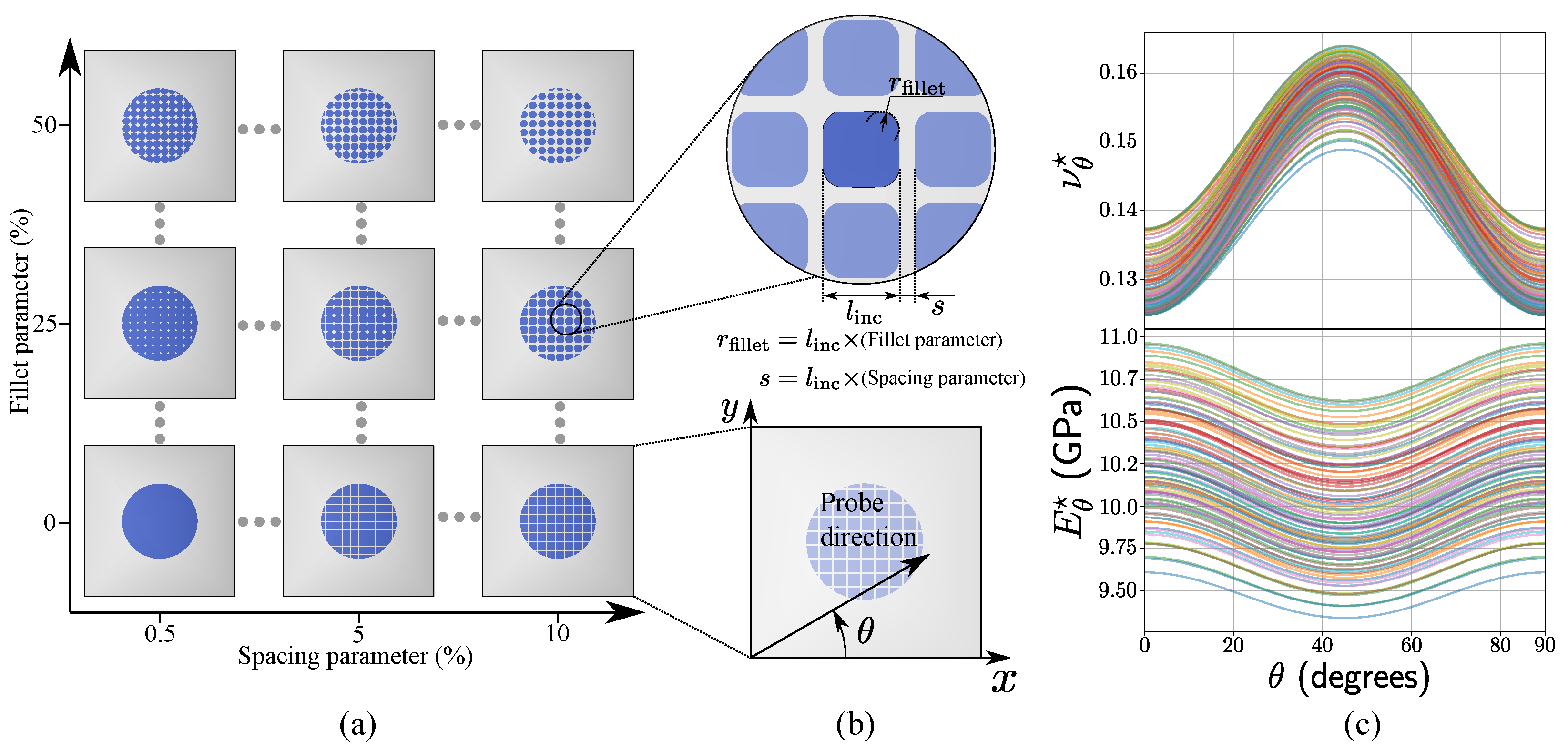
As a starting point, 100 structures containing the bundle are studied (Figure 2a). For all simulations, meshes are generated with a target element edge length that is the edge length of the representative volume element (RVE [41]). This leads to a target total number of elements of = 40,000. However, due to the complex geometry of the RVE, the finite element meshes obtained from the builtin Abaqus meshing module have significantly more than 40,000 elements; the obtained meshes are in the range of 49,721–51,204 elements, depending on the geometry.The chosen mesh resolution is sufficient to accurately resolve the geometric features of the microstructure. In particular, a target element edge length of 1/200 of the representative volume element (RVE) size ensures that even the smallest characteristic dimension of the nanorods, the diameter, is discretized by at least 10 elements across its thickness.
Figure 2.
Models and some results for structures with a bundle only: (a) subset of 9 out of the 100 models. The bundle has a radius that is 25% of the width of the unit cell, as this has a light resemblance with the bundle size of limpet teeth (Figure 1e). (b) The structure in the bundle consists of linearly patterned inclusions, which are squares with filleted vertices, approximating the non-round cross-sections of limpet teeth inclusions. The radius of the fillet and spacing of the inclusions are parameterized. The fillet parameter was varied linearly from 0% to 50% with 10 values, and the spacing parameter was varied linearly from 0.5% to 10% with 10 values, making for a total of 100 models. (c) The effective Poisson’s ratio, (top), and Young’s modulus, (bottom), of the structures plotted with respect to loading orientation, . Changing the geometry of the bundle only vertically scales and translates the effective Poisson’s ratio and Young’s modulus with respect to loading orientation.
For all computational experiments that follow, we use a tie constraint between the matrix and inclusions. This is motivated by the fact that the nanorods nucleate directly on pre-existing chitin fibres in the matrix [42]—as opposed to being later inserted in the matrix—which leads to a strong chemical bond between the two phases. Hence, particularly at the small strains considered here, displacement continuity between the phases is a reasonable assumption. The Young’s modulus E and Poisson’s ratio , respectively, are
as these are the approximate values for hydrated silica (matrix) [43] and iron oxide hydroxide (inclusions) [36]. The Young’s modulus and Poisson’s ratio are varied in subsequent investigations presented in Section 4.3.
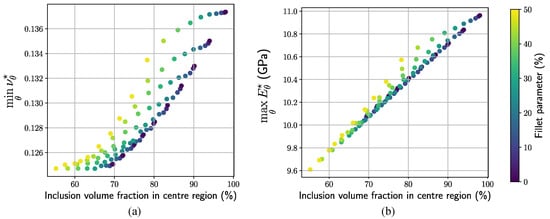
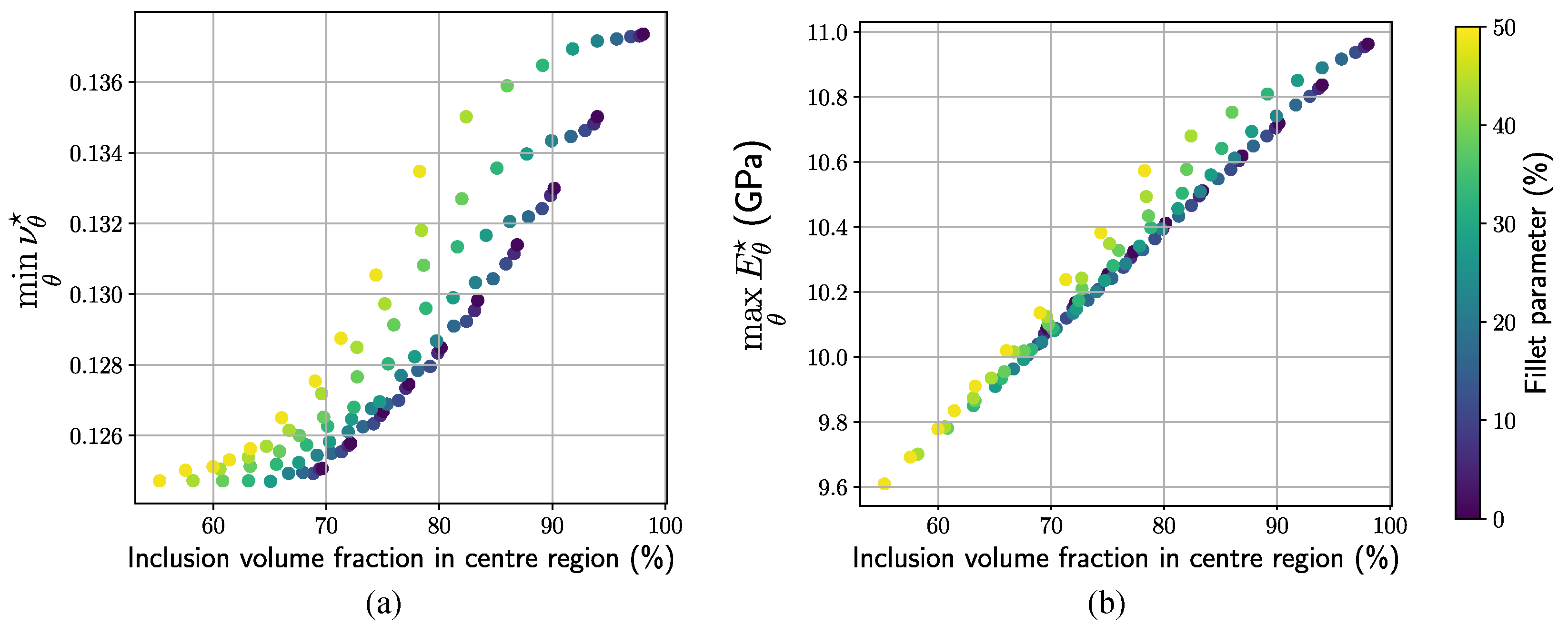
The mechanical behaviour (Figure 2c and Figure 3) is primarily driven by the volume fraction of inclusions, suggesting that the effect of the interaction between inclusions is minimal. Auxeticity is not observed, verifying that a bundle of inclusions alone is not sufficient to obtain auxeticity. Altering the fillet and spacing only translates and scales the Young’s modulus and Poisson’s ratio curves vertically (Figure 2c). Hence, mechanical behaviour can be tailored by altering the bundle structure, but this tailoring is somewhat limited.
Figure 3.
Structures with a bundle only. Effective material behaviour plotted against inclusion volume fraction in the centre region and coloured by the fillet parameter: (a) Poisson’s ratio at the orientation of minimum Poisson’s ratio; (b) Young’s modulus at the orientation of maximum Young’s modulus. The small range for a given volume fraction (less than 3% for both Young’s modulus and Poisson’s ratio) suggests that the behaviour primarily depends on volume fraction.
The primary driving factor, the inclusion volume fraction, is affected by the inclusion shape due to possible packing density. For example, circles packed in a square pattern have a maximum packing density of approximately 78.5%, and, in a hexagonal packing pattern (the optimal packing pattern for circles), the packing density is approximately 90.7%. Rhomboids, on the other hand, can be packed with 100% packing density. Thus, rods with a rhomboidal-like cross-section like in limpet teeth (as opposed to a circular cross-section that is more typical of natural fibres) achieve a higher packing density. However, as will be seen in the next two sections, the arrangements of the surrounding rods outweighs the influence of the cross-section shape in the bundle.
4.2. Significance of the Local Microstructure: Impinging Rods as a Requirement for Auxeticity
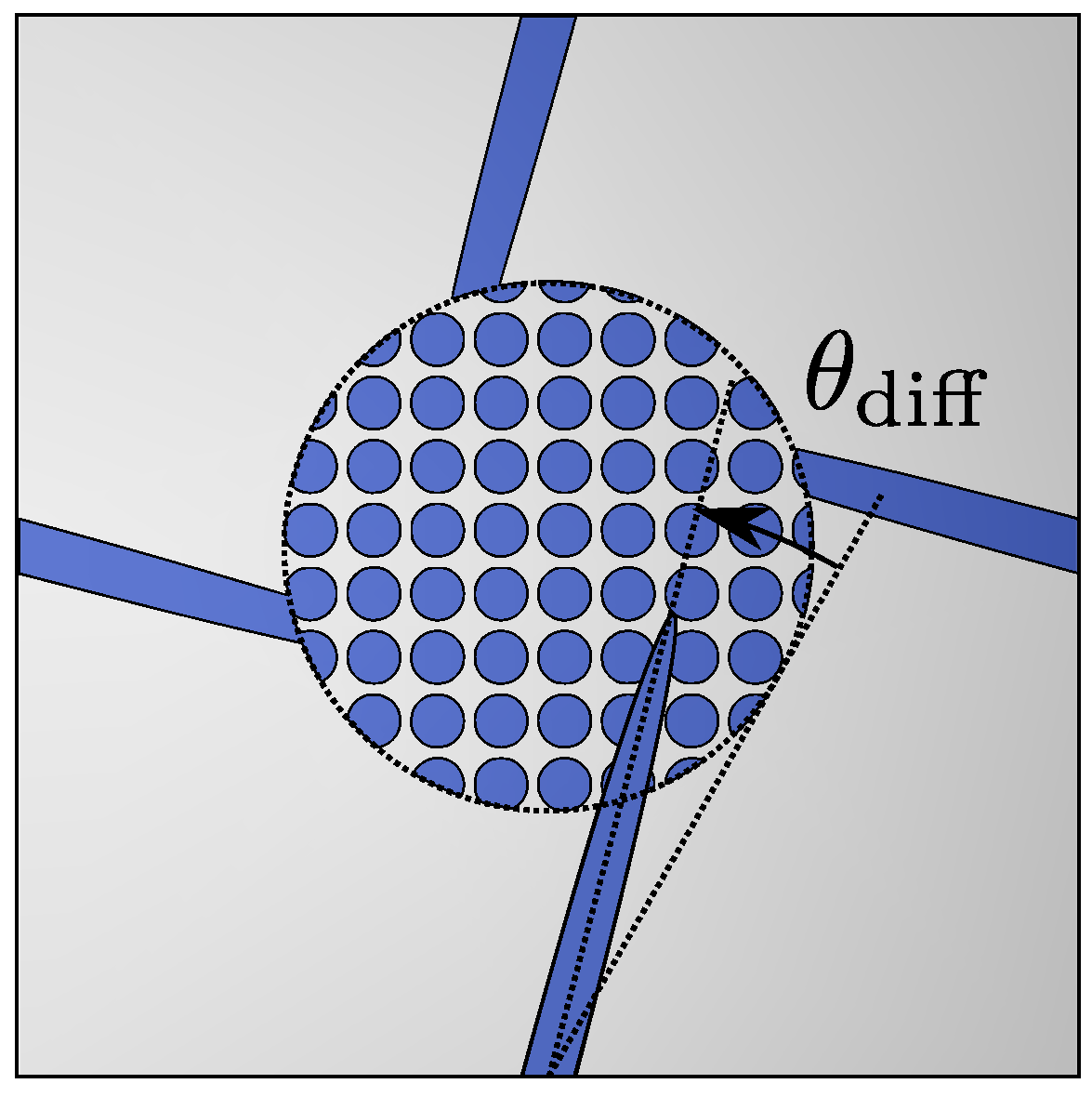
Oh et al. [36] hypothesized that the chiral rods surrounding the bundles in limpet teeth (Figure 1d,e) are a key component for the observed auxeticity. In this section, structures with four chiral rods (Figure 4) are investigated. All models utilize the values for the matrix and inclusion of Young’s modulus and Poisson’s ratio as given in Equation (2). There are 325 structural models generated in the section by variation of the following:
Figure 4.
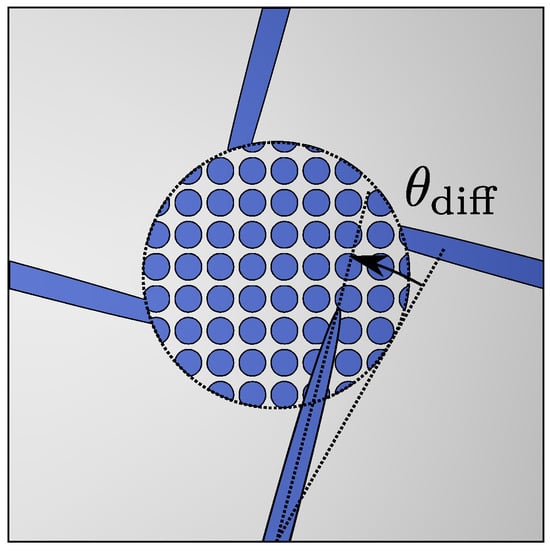
The rods are idealized as ellipses with major and minor radii that are 45% and 2.5% of the width of the unit cell, respectively, to lightly resemble those in limpet teeth (Figure 1e). Vertically aligned nanorods are surrounded by horizontally arranged nanorods. The rod angle structural parameter is the counter-clockwise angle between the major axis of the elliptical rod and the tangent of the bundle at the point where the major axis intersects the bundle.
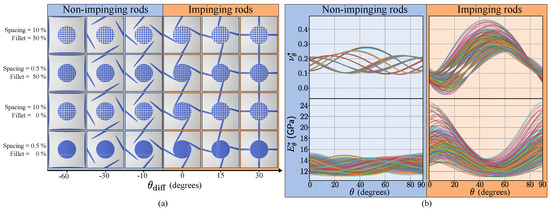
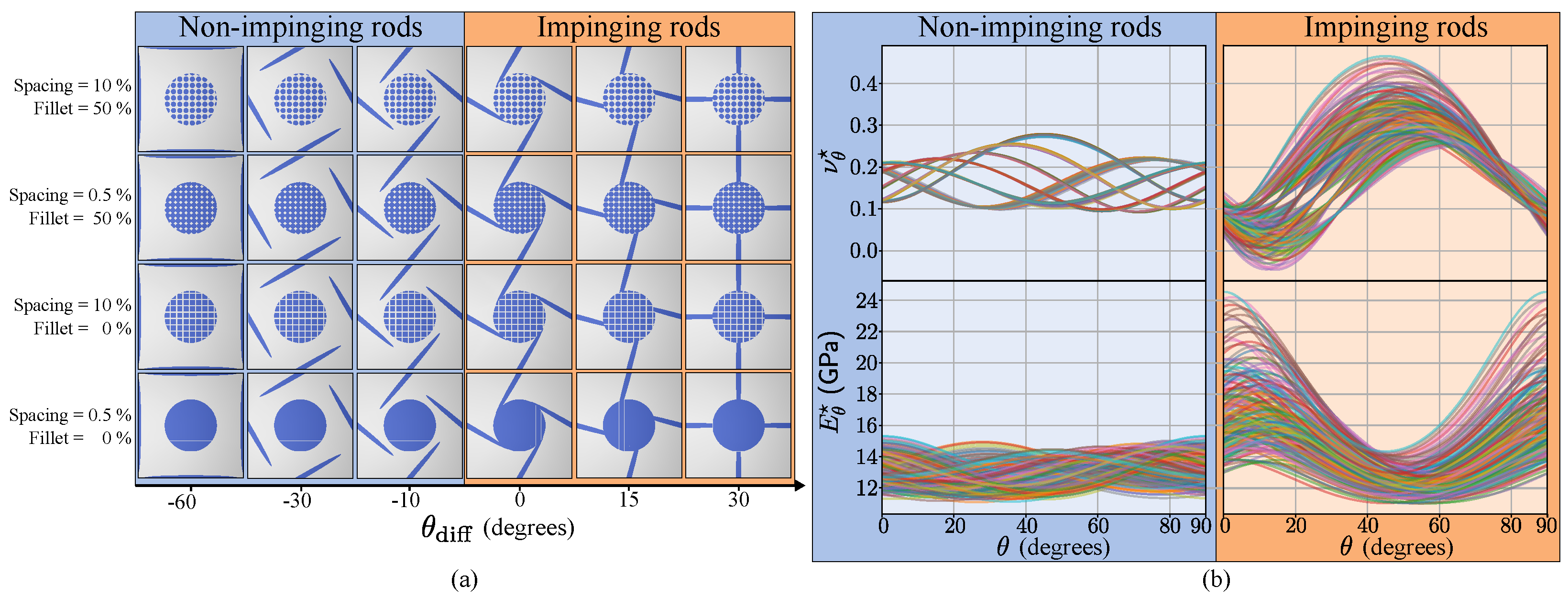
Structures where the surrounding rods impinge on the bundle result in drastically different behaviour than structures where the rods do not impinge on the bundle (Figure 5). guarantees impingement for the structures investigated in this section, but not in general as impingement also depends on the radius of the bundle as well as the length and position of the surrounding rods. Along the stiffest loading orientation, impinging structures are up to twice as stiff as non-impinging structures. Further, they result in a lower minimum Poisson’s ratio than non-impinging structures, and some impinging structures enter the auxetic regime.
Figure 5.
Some models and results for structures with a bundle and four surrounding rods: (a) 24 out of 325 models with different combinations of bundle fillet and spacing parameters on each row and rod angle increasing from left to right and (b) the resulting effective material parameters as a function of loading orientation. Structures with impinging chiral rods (right hand side of (b)) display a higher degree of anisotropy than the non-impinging counter parts (left hand side of (b)). Additionally, some structures with impinging rods obtain auxeticity, whereas structures with non-impinging rods do not.
The auxetic loading orientation for impinging structures (ca. 5–25° rotation relative to the chosen basis) approximately aligns with the stiffest loading orientation (ca. 0–15° rotation relative to the chosen basis) (Figure 5b). This attribute is particularly attractive as auxeticity is typically associated with compliant structures.
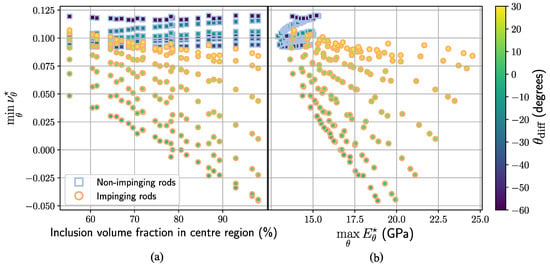
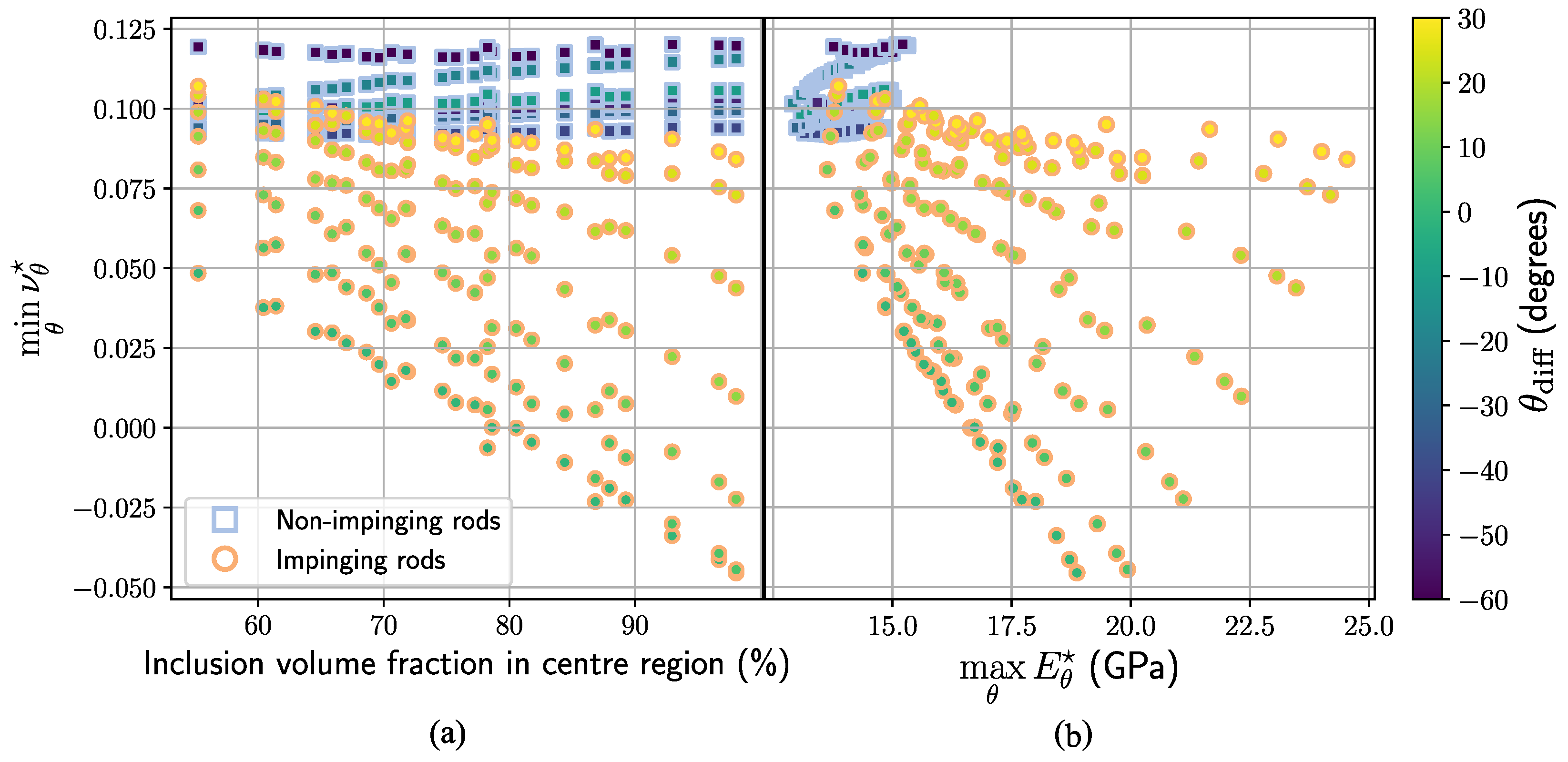
The minimum Poisson’s ratio of structures with impinging chiral rods decreases significantly with volume fraction of inclusions in the bundle (Figure 6a). This contrasts structures without chiral rods wherein an increase in Poisson’s ratio is observed with volume fraction (Figure 3a). Auxeticity increases with a decreasing chiral rod angle —the most auxetic structures are those with impinging chiral rods and ; that is, of the structures studied here, those where the rods impinge the bundle tangentially result in the greatest auxeticity.
Figure 6.
Minimum Poison’s ratio against (a) volume fraction of inclusion in the centre region and (b) maximum Young’s modulus. The effect of volume fraction is far more significant for structures with impinging chiral rods. Structures with impinging chiral rods also demonstrate increasing stiffness with increasing auxeticity for a given rod angle . Structures with non-impinging rods are denoted by square markers with blue boarders, whereas structures with impinging rods are denoted by circular markers with orange boarders.
The converse is true for structures with non-impinging chiral rods—minimum Poisson’s ratio increases with inclusion volume fraction (Figure 6a). Furthermore, the sensitivity to inclusion volume fraction is significantly less for structures with non-impinging chiral rods than the impinging counterparts.
Structures with impinging chiral rods have increasing stiffness with increasing auxeticity for a fixed value of (Figure 6b). As previously observed, this facilitates the design of auxetic structures with enhanced stiffness.
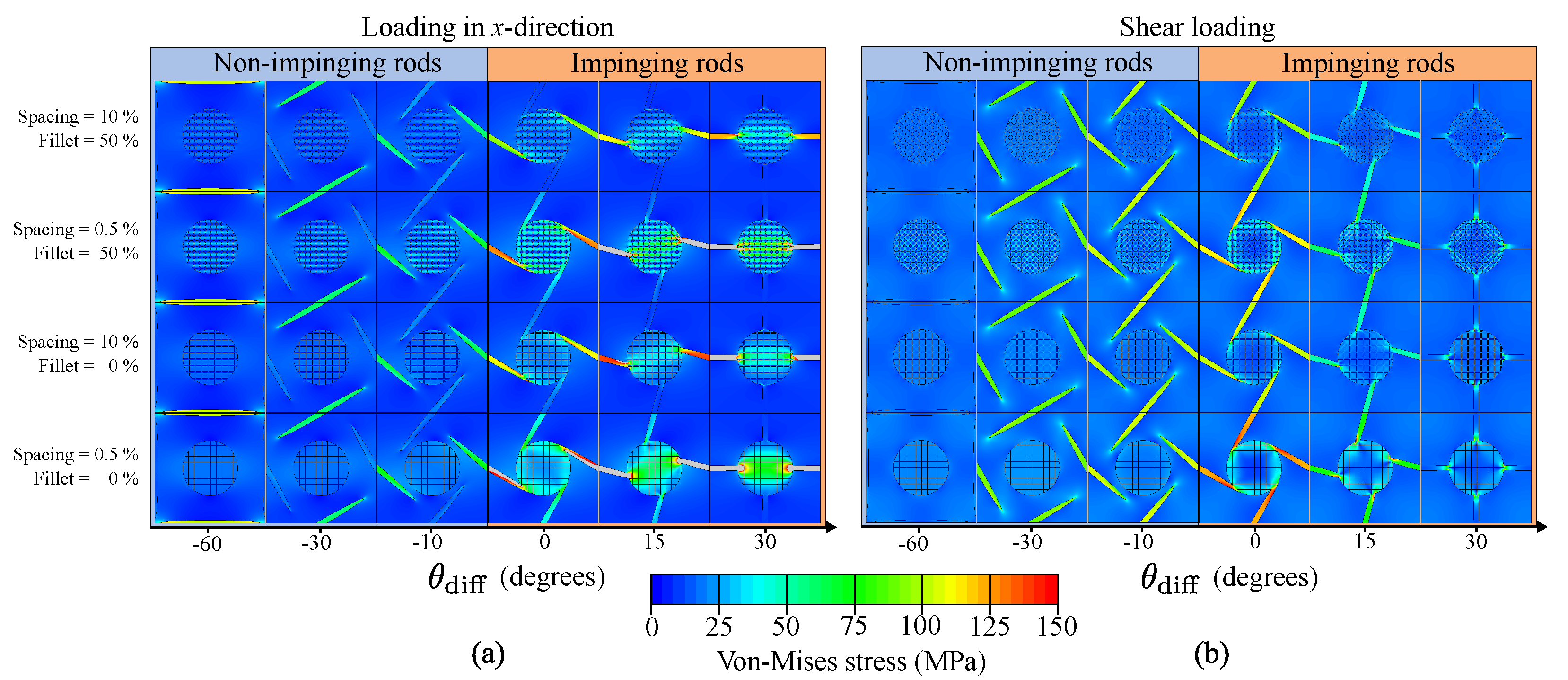
Structures with impinging chiral rods display larger stresses in the bundle and chiral rods (Figure 7), transferring load between unit cells through the bundle–rod structure. In contrast, structures with non-impinging chiral rods have comparatively low stresses in the rods and bundle, losing the effectivity of the load carrying path. The hypothesis of load transfer driving auxeticity is further motivated by the fact that the structure with , , and possesses the greatest auxeticity (Figure 6a) and the greatest stresses (Figure 7). From a mechanics perspective, in the case of large inclusion volume fractions in the bundle, the bundle acts similar to an effective medium due to the dense packing and drives the Poisson’s ratio. If the density in the bundle decreases, the bundle becomes more compliant as an effective medium, and load transfer is thus reduced.
Figure 7.
Von-Mises stress contours while applying (a) loading in the x-direction (which corresponds to the -direction) and (b) shear loading. The stress in the bundle is larger in structures with ‘impinging’ chiral rods, suggesting that the bundle acts as a medium through which load is transferred between adjacent unit cells. Larger stresses are also observed in more densely packed bundles (bottom row) than sparsely pack ones (top row); that is, structures with ‘impinging’ chiral rods and large inclusion volume fraction in the bundle display greater auxeticity (Figure 6a), stiffness (Figure 6c), and stress in the bundle.
Remark: Structures with impinging rods possess at least one rod surrounding the bundle which impinges the bundle area (i.e., the circular area marked with a dotted line in Figure 4) with a portion of its length. This structural feature is also found in the limpet teeth microstructure (see, e.g., Figure 1e, right area of the bundle, where the left end of one of the nanorods reaches into the circular area of the bundle). From a mechanical point of view, the bundle acts similar to a medium through which load is transferred in a more effective way in case at least one of the surrounding rods impinges this ‘medium’ (i.e., the bundle area). From a geometrical point of view, the structure is disconnected: rods do not make physical contact. In our parametrization, if a surrounding rod is in contact with a rod from the bundle, the latter automatically becomes part of the surrounding rod. This assumption holds true in 2D, but is not straightforwardly transferable to 3D parametrizations.
4.3. Resembling the Microstructure of Limpet Teeth: Bundle with Multiple Surrounding Chiral Rods
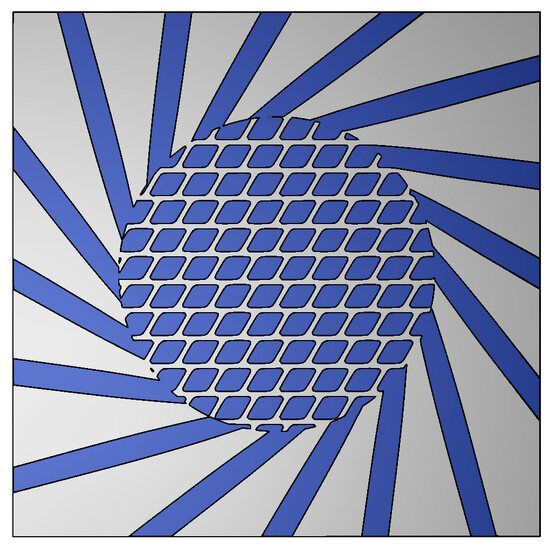
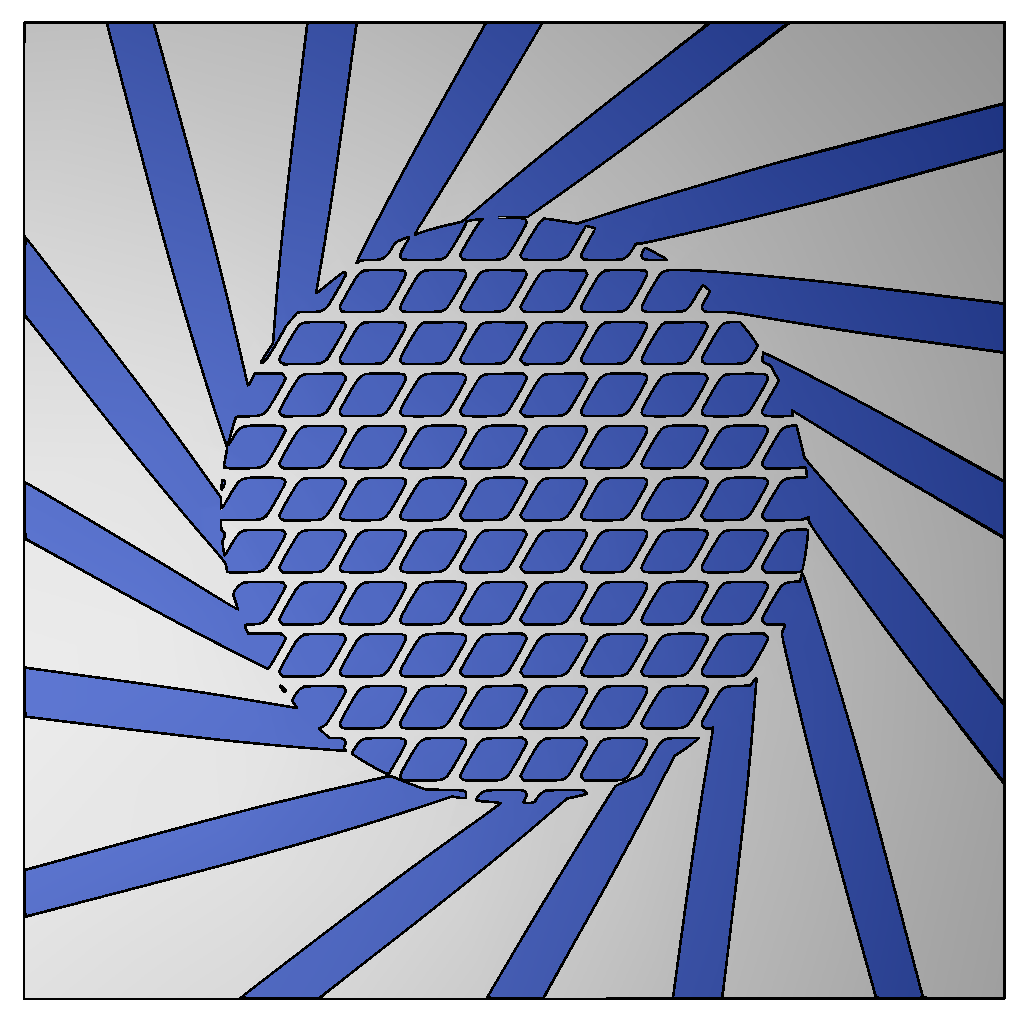
To study microstructures that more closely resemble that of limpet teeth, parameterized microstructural models were constructed that contained rhomboidal inclusions in the bundle and several surrounding rods (Figure 8).
Figure 8.
A typical microstructural model used in the investigation: Vertically aligned nanorods are surrounded by horizontally arranged nanorods.
Details of the geometric and constituent material parameters are given in Appendix B. The parameter space was searched using a Latin Hypercube design-of-experiments approach. In total, 29,232 structures were simulated.
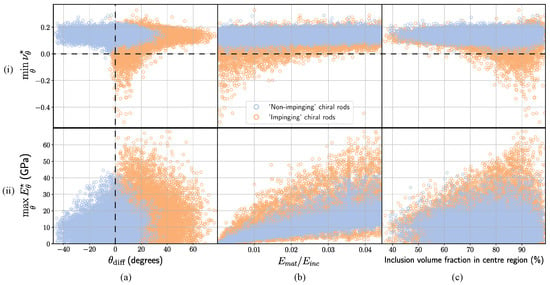
The hypothesis that impinging chiral rods are required for auxeticity is further supported by Figure 9i(a–c), as all auxetic structures (except one) contain impinging chiral rods.
Figure 9.
(i) Minimum Poisson’s ratio and (ii) maximum Young’s modulus plotted against (a) the impingement angle of the chiral rods, (b) the ratio of matrix to inclusion Young’s modulus, and (c) the inclusion volume fraction in the bundle.
Additionally, the importance of a densely packed bundle is re-emphasized by Figure 9i(c) as the vast majority of auxetic structures have an inclusion volume fraction that is greater than 65% and auxeticity tends to increase with increasing inclusion volume fraction. A densely packed bundle also leads to a stiffer structure (Figure 9ii(c)).
The angle at which the chiral rods impinges the bundle is crucial for auxeticity. In particular, the angle relative to the tangent of the bundle (Figure 8b) is a key indicator for auxeticity. Structures where chiral rods impinge the bundle tangentially () tend to be the most auxetic (Figure 9a). Auxeticity decreases rapidly as the angle of impingement increases and all auxetic structures have chiral rods impinging at less than . Auxeticity is lost at a faster rate as decreases from , as this leads to non-impinging structures. The rod angle also significantly affects the stiffness of the structure. In particular, peak stiffness is typically achieved when (Figure 9ii(a)).
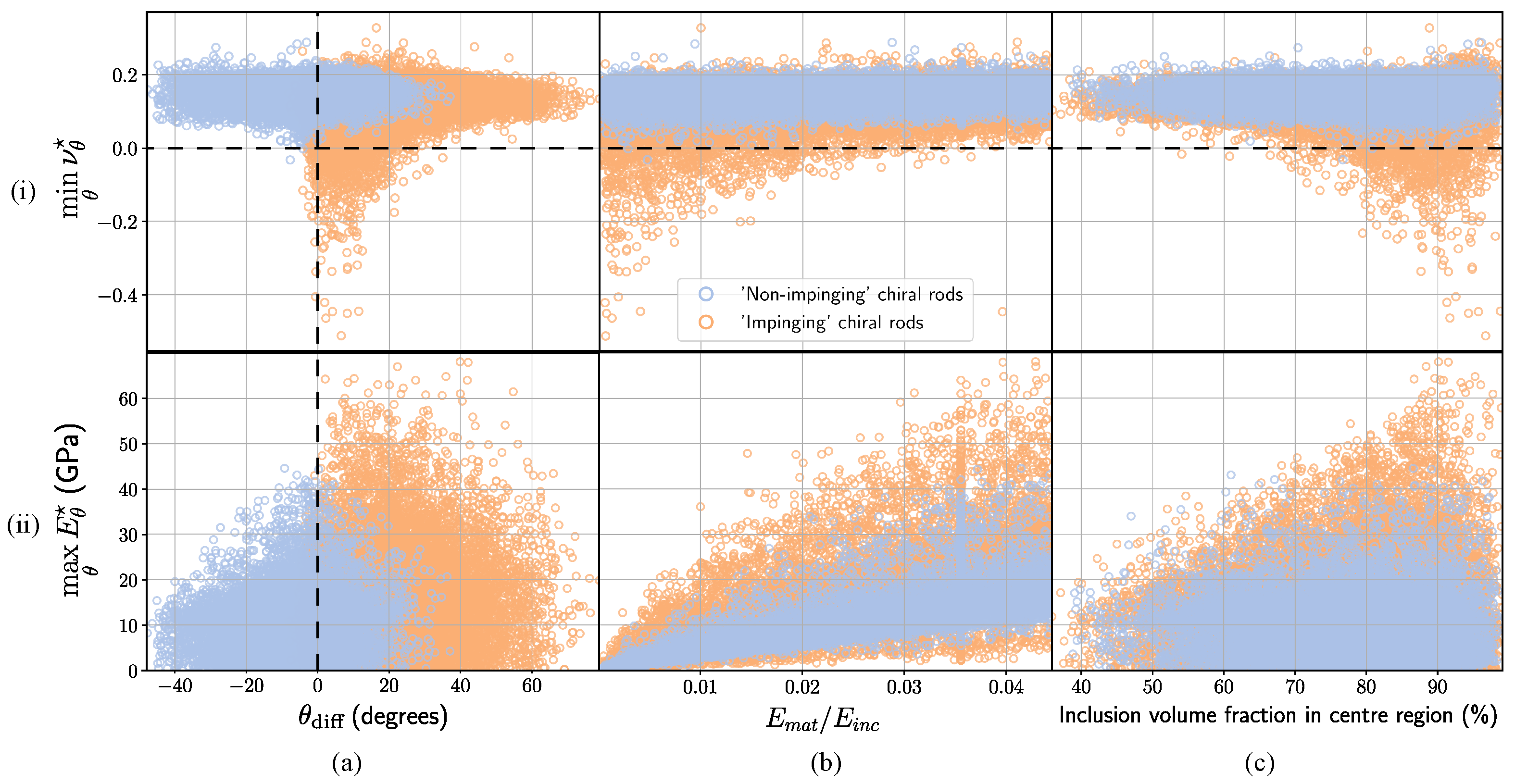
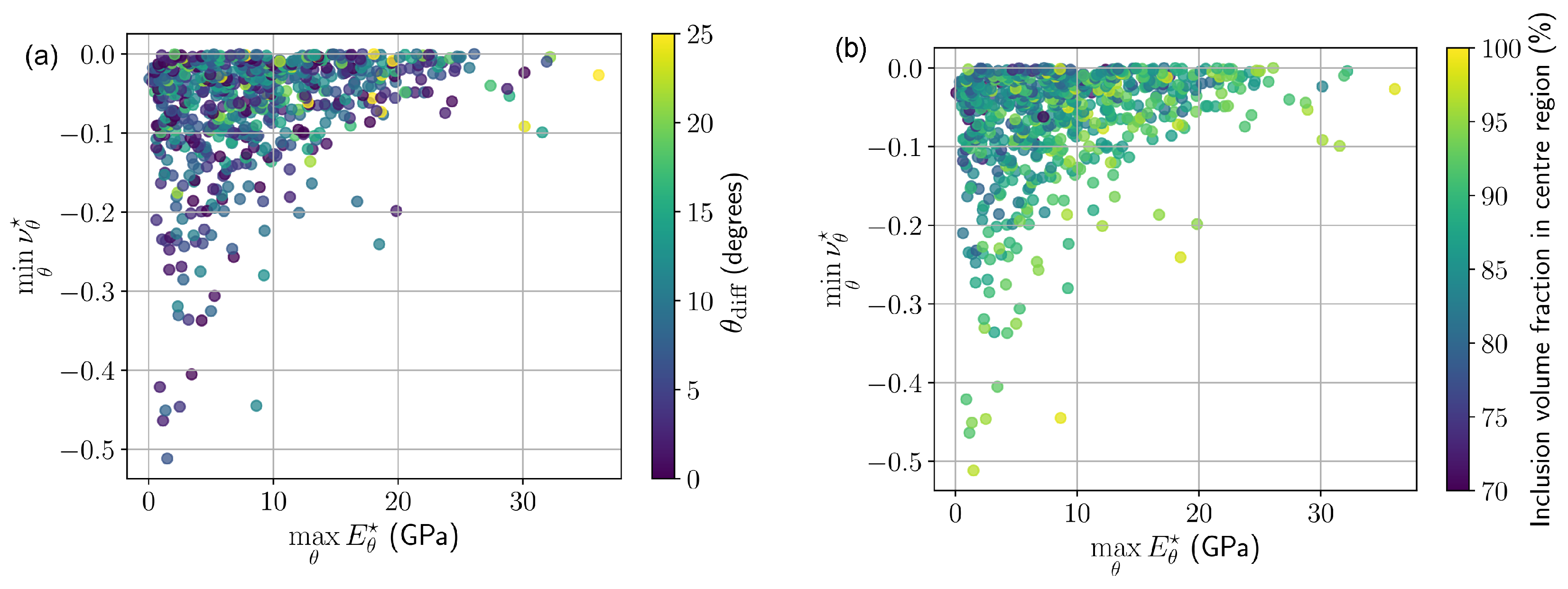
The behavioural response to a change in Young’s modulus ratio has a key contrast to the response to a change in impingement angle or volume fraction in the bundle. Specifically, the optimal values in impingement angle and bundle volume fraction for maximum auxeticity roughly correlate with the optimal values for maximum stiffness (Figure 9i,ii(a,c)), whereas the ratio of Young’s moduli corresponding to maximum auxeticity corresponds to minimum stiffness (Figure 9i,ii(b)). Hence, the ratio of Young’s moduli results in a trade-off between auxeticity and stiffness: more auxetic structures are typically more compliant (Figure 10). However, for a given level of auxeticity, the stiffness of a structure can be increased by using tangential chiral rods (, Figure 10a) and a greater inclusion volume fraction in the bundle (Figure 10b).
Figure 10.
Auxeticity plotted against stiffness for the auxetic models (650 models out of a total of 29,232) coloured by (a) the relative impingement angle () and (b) the inclusion volume fraction in the bundle. Auxeticity correlates with lower stiffness. However, a higher auxeticity to stiffness ratio is achievable with (a) chiral rods that impinge approximately tangentially () and (b) a greater inclusion volume fraction in the bundle. Due to the overlap of datasets in certain regions of the parameter space, some data points may be partially obscured by others. This does not affect the overall interpretation of the figure.
5. Conclusions
Our auxetic materials do not fit into the existing classes of auxetic structures—they are not porous, nor do they consist of a continuous lattice. Hence, they provide an alternative route for designing and manufacturing auxetic materials that may not suffer from the difficulties associated with manufacturing materials that have a specific porous or continuous lattice microstructure.
The observed auxetic behavior originates primarily from the kinematic response of the microstructure. Under axial loading, the nanorods undergo rotation and reorientation, which induces a transverse expansion instead of contraction. This mechanism is further influenced by interactions between rods, such as hinging or contact, depending on the specific configuration. As a result, the effective Poisson’s ratio is governed by the combined effects of geometry, orientation, and deformation constraints, rather than by the intrinsic material properties alone.
Furthermore, our parameterized structures allow one to tailor material behaviour. In particular, one can increase the stiffness to auxeticity ratio by including chiral rods that impinge the bundle tangentially and by increasing the volume fraction of inclusions in the bundle. This is particularly attractive as auxetic structures typically suffer from low stiffness.
Achieving these attributes is primarily owed to the inspiration of the microstructure of limpet teeth: they are a remarkable example of the way that organisms evolve to adapt to their environment. Despite there only being a small window of microstructural arrangements leading to the extraordinary combination of auxeticity, extreme strength, and high stiffness, nature is repeatedly achieving this millions of times per day. The reason lies in nature’s choice of the nanometer size of the nanorods: at the nanoscale, materials become insensitive to flaws, ensuring integrity and optimized strength [44].
Whereas the nanoscale seems to be of importance in the biological material of limpet teeth, this is not the case for its man-made counterpart. Our simulations are scale-independent, so the results hold true at whatever scale is aimed for. The geometric and mechanical complexity of the full three-dimensional system makes it challenging to isolate and interpret the influence of individual parameters. Thus, we choose a 2D representation as a first step, which allows us to systematically investigate the fundamental mechanisms in a controlled and interpretable manner.
In summary, the unique combination of auxeticity, extreme strength, and high stiffness of limpet teeth is due to the arrangement of the dense, tightly packed structure of goethite. As opposed to typically connected auxetic structures, in the limpet teeth disconnected chiral nanorods are the driving force of the auxeticity in the material. The fibers are layered in a way that allows for the efficient transfer of stress from one layer to the next, enhancing the strength of the tooth. The distinctive structural and chemical enhancements that foster a pseudo-cholesteric arrangement of nanorods, along with their robust integration within the matrix, enable efficient nanorod movement and rotation. This, in turn, promotes optimal stress distribution, resulting in auxetic properties while concurrently upholding one of the greatest strengths observed in natural materials.
Our study provides valuable insights into the mechanical behavior of limpet teeth and their synthetic counterparts, helping to understand the structure–property relationships of these materials and to promote the development of tailor-made high-performance materials.
Our results demonstrate the potential of the proposed structural concepts for the design of mechanical metamaterials with tailored auxetic and stiffness properties. Such characteristics may be of interest in applications requiring enhanced energy absorption, deformability, or tunable mechanical response.
Future work will focus on extending the present analysis to fully three-dimensional structures, where additional geometric complexity may lead to further functionalities. Moreover, a more detailed exploration of the parameter space, as well as experimental validation of the proposed concepts, would provide valuable insight into their practical applicability.
Author Contributions
Conceptualization, B.A., S.B., C.S.; methodology, B.A., S.B., C.S.; software, B.A.; validation, B.A. (simulations), J.K. (imaging); formal analysis, B.A., S.B., C.S., J.K., S.H.O.; investigation, B.A., J.K.; resources, S.H.O.; writing—original draft preparation, B.A., S.B.; writing—review and editing, B.A., S.B., C.S., S.H.O.; visualization, B.A., J.K.; supervision, S.B., S.H.O.; project administration, S.B.; funding acquisition, S.B., S.H.O. All authors have read and agreed to the published version of the manuscript.
Funding
This research was funded by Deutsche Forschungsgemeinschaft (DFG, German Research Foundation), grant number 529221905. SHO acknowledges support provided by the Technology Innovation Program (RS-2024-00418991) funded by the Ministry of Trade, Industry & Energy (MOTIE, Korea) and the Korea Institute of Energy Technology Evaluation and Planning (KETEP) grant funded by the Korea government (MOTIE) (RS-2025-02483053). SHO further acknowledges support by Basic Science Research Program through the National Research Foundation of Korea (NRF) funded by the Ministry of Education, Science and Technology (RS-2026-25486986).
Data Availability Statement
Data is contained within the article.
Acknowledgments
Part of this research was done while SB visited the University of Cape Town, whose hospitality is greatly acknowledged. Computations were performed using facilities provided by the University of Cape Town ICTS High Performance Computing team: https://ucthpc.uct.ac.za/, accessed on 1 May 2026. The TEM work at Korea Institute of Energy Technology (KENTECH) was supported by the Center for Shared Research Facilities.
Conflicts of Interest
The authors declare no conflicts of interest.
Appendix A. Theory: Effective Planar Elastic Moduli
In the determination of effective elastic moduli, we apply computational homogenization, see, e.g., [7,45]. To this end, we define the homogenized (macro) continuum as . A point represents a microstructure, which is composed of a unit cell domain with a boundary . Considering linear and infinitesimal planar elasticity and assuming that each constituent material is elastically isotropic at the microscopic (unit cell) level, the stress tensor corresponding to a strain tensor can be calculated using Hooke’s law:
The elastic constitutive tensor in plane stress is given by , where i, j, k, and l range from 1 to 2. The components read , where the planar Lamé constants (in the state of plane stress, planar Young’s modulus E and Poisson’s ratio ) are equivalent to their 3D counterparts and , i.e., and [46]. These parameters can be expressed in terms of planar Lamé constants as and , which are denoted by and , and the Kronecker delta equals 1 if and 0 otherwise. At the macroscopic level, a generalized Hooke’s law
is applied. and respectively denote the macroscopic strain and stress tensors, which are computed by volume averaging of their microscopic counterparts over the unit cell domain
In general, . To compute the components of the effective elasticity tensor , load cases with appropriate boundary conditions must be applied to the unit cell to satisfy the Hill–Mandel condition [47], which ensures that the microscopic energies that are averaged out are equivalent to the corresponding macroscopic energies, i.e., . In the current work, two in-plane plane strain tension cases and one in-plane shear loading case under periodic boundary conditions are considered to this end, see, e.g., [7,45].
There are nine effective constitutive constants for , but only six of them, namely , , , and , are linearly independent. This is due to the symmetry property that the constituent elasticity tensors possess, which is also present at the macroscale. By using the relationship , we express Equation (A2) in matrix form as using Voigt notation:
By inverting Equation (A2), we obtain , where is the elastic compliance tensor, for . In matrix form, the inverse relation using Voigt notation reads
The planar Young’s modulus along the direction of and the planar Poisson’s ratio when stretched along and probed along are obtained from the components of the elastic compliance tensor, see, e.g., [40] as follows:
In order to obtain the effective Young’s modulus and Poisson’s ratio for a loading direction at an angle of relative to the reference basis, the compliance tensor is rotated in accordance with [48], and Equation (A6) is applied to the resulting rotated compliance tensor.
Appendix B. Parametrization of Models
Structural models were parameterized with respect to three material parameters, and eight geometric parameters as presented in Table A1 and Figure A1.
Figure A1.
Illustration of a typical microstructural model used for investigations presented in Section 4.3 with annotations for various structural parameters.
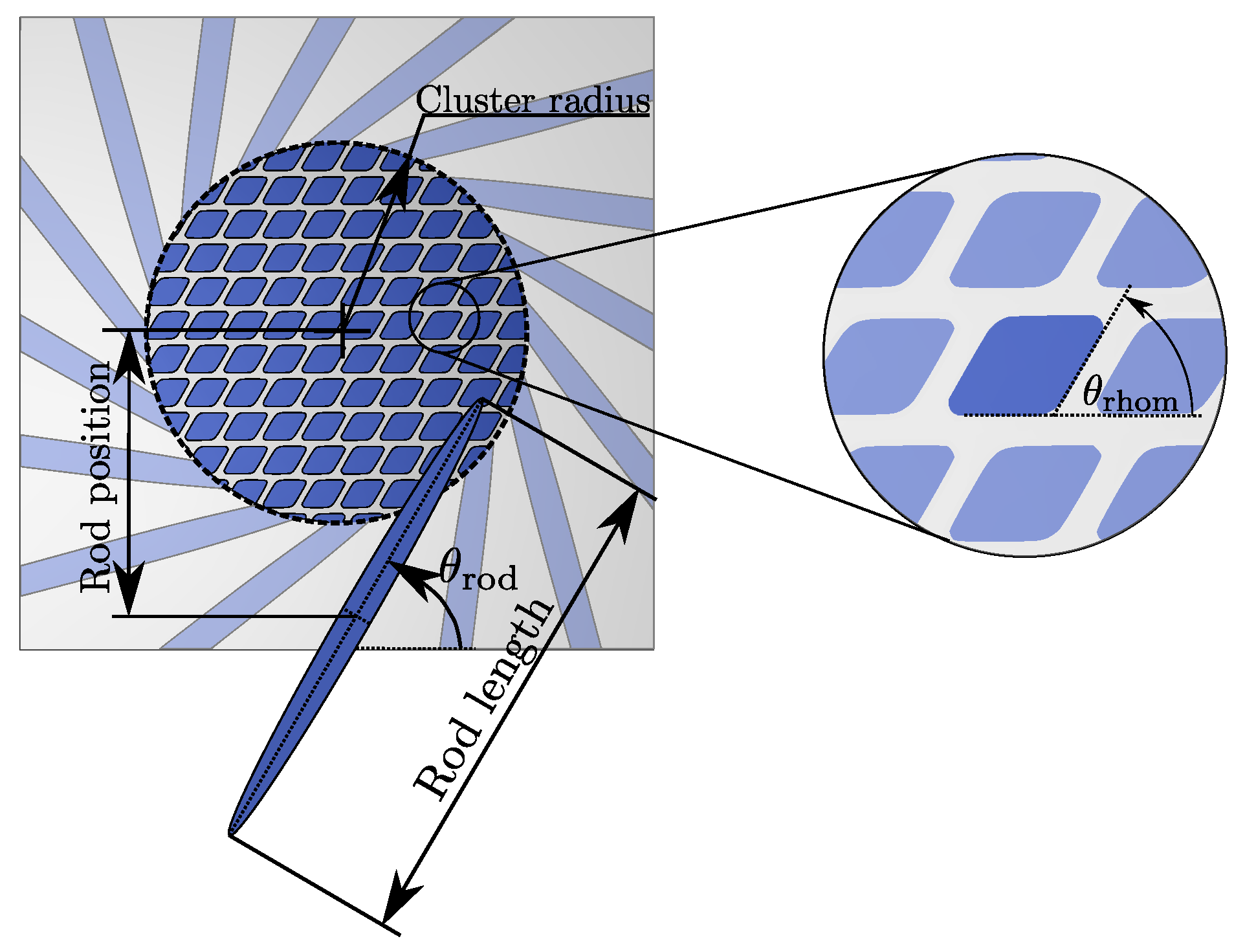
Table A1.
Details of bounds for material and structural parameters for each Latin Hypercube search iteration (units of ‘(%*)’ denote the percentage of a length or radius relative to the width of the unit cell).
The parameter space was searched in a ‘brute force’ manner by selecting parameter combinations according to a Latin Hyper Cube algorithm (see [49] for details). The space was searched over three iterations where the bounds (maximum and minimum values for each parameter) for each iteration were adjusted to more closely surround the auxetic domain of the parameter space. The three iterations consisted of 4685, 12,382, and 12,192 structures, respectively (making for a total of 29,232 structures), and the associated bounds are presented in Table A1.
References
- Lakes, R. Foam structures with a negative Poisson’s ratio. Science 1987, 235, 1038–1040. [Google Scholar] [CrossRef] [Scilit]
- Evans, K.E.; Alderson, A. Auxetic materials: Functional materials and structures from lateral thinking! Adv. Mater. 2000, 12, 617–628. [Google Scholar] [CrossRef] [Scilit]
- Xu, H.; Pasini, D. Structurally efficient three-dimensional metamaterials with controllable thermal expansion. Sci. Rep. 2016, 6, 34924. [Google Scholar] [CrossRef] [Scilit]
- Grima, J.N.; Jackson, R.; Alderson, A.; Evans, K.E. Do zeolites have negative Poisson’s ratios? Adv. Mater. 2000, 12, 1912–1918. [Google Scholar] [CrossRef] [Scilit]
- Bertoldi, K.; Vitelli, V.; Christensen, J.; Van Hecke, M. Flexible mechanical metamaterials. Nat. Rev. Mater. 2017, 2, 17066. [Google Scholar] [CrossRef] [Scilit]
- Choi, J.; Lakes, R. Fracture toughness of re-entrant foam materials with a negative Poisson’s ratio: Experiment and analysis. Int. J. Fract. 1996, 80, 73–83. [Google Scholar] [CrossRef] [Scilit]
- Soyarslan, C.; Blümer, V.; Bargmann, S. Tunable auxeticity and elastomechanical symmetry in a class of very low density core-shell cubic crystals. Acta Mater. 2019, 177, 280–292. [Google Scholar] [CrossRef] [Scilit]
- Kochmann, D.M.; Venturini, G.N. Homogenized mechanical properties of auxetic composite materials in finite-strain elasticity. Smart Mater. Struct. 2013, 22, 084004. [Google Scholar] [CrossRef] [Scilit]
- Pozniak, A.; Wojciechowski, K.; Grima, J.; Mizzi, L. Planar auxeticity from elliptic inclusions. Compos. Part B Eng. 2016, 94, 379–388. [Google Scholar] [CrossRef] [Scilit]
- Fíla, T.; Zlámal, P.; Jiroušek, O.; Falta, J.; Koudelka, P.; Kytỳř, D.; Doktor, T.; Valach, J. Impact testing of polymer-filled auxetics using split Hopkinson pressure bar. Adv. Eng. Mater. 2017, 19, 1700076. [Google Scholar] [CrossRef] [Scilit]
- Li, T.; Chen, Y.; Hu, X.; Li, Y.; Wang, L. Exploiting negative Poisson’s ratio to design 3D-printed composites with enhanced mechanical properties. Mater. Des. 2018, 142, 247–258. [Google Scholar] [CrossRef] [Scilit]
- Xue, Y.; Wang, W.; Han, F. Enhanced compressive mechanical properties of aluminum based auxetic lattice structures filled with polymers. Compos. Part B Eng. 2019, 171, 183–191. [Google Scholar] [CrossRef] [Scilit]
- Lee, Y.J.; Lim, S.M.; Yi, S.M.; Lee, J.H.; Gyu Kang, S.; Choi, G.M.; Han, H.N.; Sun, J.Y.; Choi, I.S.; Joo, Y.C. Auxetic elastomers: Mechanically programmable meta-elastomers with an unusual Poisson’s ratio overcome the gauge limit of a capacitive type strain sensor. Extrem. Mech. Lett. 2019, 31, 100516. [Google Scholar] [CrossRef] [Scilit]
- Peng, X.L.; Soyarslan, C.; Bargmann, S. Phase contrast mediated switch of auxetic mechanism in composites of infilled re-entrant honeycomb microstructures. Extrem. Mech. Lett. 2020, 35, 100641. [Google Scholar] [CrossRef] [Scilit]
- Peng, X.L.; Bargmann, S. Tunable auxeticity and isotropic negative thermal expansion in three-dimensional lattice structures of cubic symmetry. Extrem. Mech. Lett. 2021, 43, 101201. [Google Scholar] [CrossRef] [Scilit]
- Peng, X.L.; Bargmann, S. Tunable tension-compression asymmetry and auxeticity in lattice structures by harnessing unilateral contact. Compos. Struct. 2021, 278, 114708. [Google Scholar] [CrossRef] [Scilit]
- Zhang, X.G.; Ren, X.; Jiang, W.; Zhang, X.Y.; Luo, C.; Zhang, Y.; Xie, Y.M. A novel auxetic chiral lattice composite: Experimental and numerical study. Compos. Struct. 2022, 282, 115043. [Google Scholar] [CrossRef] [Scilit]
- Peng, X.L.; Bargmann, S. A design method for metamaterials: 3D transversely isotropic lattice structures with tunable auxeticity. Smart Mater. Struct. 2021, 31, 025011. [Google Scholar] [CrossRef] [Scilit]
- Tee, K.; Spadoni, A.; Scarpa, F.; Ruzzene, M. Wave propagation in auxetic tetrachiral honeycombs. J. Vib. Acoust. 2010, 132, 031007. [Google Scholar] [CrossRef] [Scilit]
- Alderson, A.; Alderson, K.L.; Attard, D.; Evans, K.E.; Gatt, R.; Grima, J.N.; Miller, W.; Ravirala, N.; Smith, C.; Zied, K. Elastic constants of 3-, 4-and 6-connected chiral and anti-chiral honeycombs subject to uniaxial in-plane loading. Compos. Sci. Technol. 2010, 70, 1042–1048. [Google Scholar] [CrossRef] [Scilit]
- Frenzel, T.; Kadic, M.; Wegener, M. Three-dimensional mechanical metamaterials with a twist. Science 2017, 358, 1072–1074. [Google Scholar] [CrossRef] [Scilit]
- Zhang, C.; Ba, S.; Zhao, Z.; Li, L.; Tang, H.; Wang, X. Energy absorption characteristics of novel bio-inspired hierarchical anti-tetrachiral structures. Compos. Struct. 2023, 313, 116860. [Google Scholar] [CrossRef] [Scilit]
- Peng, X.L.; Bargmann, S. A novel hybrid-honeycomb structure: Enhanced stiffness, tunable auxeticity and negative thermal expansion. Int. J. Mech. Sci. 2021, 190, 106021. [Google Scholar] [CrossRef] [Scilit]
- Gibson, L.J.; Ashby, M.F. Cellular Solids: Structure and Properties (Cambridge Solid State Science Series), 2nd ed.; Cambridge University Press: Cambridge, UK, 1999. [Google Scholar]
- Friis, E.A.; Lakes, R.S.; Park, J.B. Negative Poisson’s ratio polymeric and metallic foams. J. Mater. Sci. 1988, 23, 4406–4414. [Google Scholar] [CrossRef] [Scilit]
- Domaschke, S.; Morel, A.; Fortunato, G.; Ehret, A.E. Random auxetics from buckling fibre networks. Nat. Commun. 2019, 10, 4863. [Google Scholar] [CrossRef] [Scilit]
- Koerner, C.; Liebold-Ribeiro, Y. A systematic approach to identify cellular auxetic materials. Smart Mater. Struct. 2014, 24, 025013. [Google Scholar] [CrossRef] [Scilit]
- Zhang, X.Y.; Ren, X. A Simple Methodology to Generate Metamaterials and Structures with Negative Poisson’s Ratio. Phys. Status Solidi 2020, 257, 2000439. [Google Scholar] [CrossRef] [Scilit]
- Lu, Z.X.; Li, X.; Yang, Z.Y.; Xie, F. Novel structure with negative Poisson’s ratio and enhanced Young’s modulus. Compos. Struct. 2016, 138, 243–252. [Google Scholar] [CrossRef] [Scilit]
- Li, X.; Wang, Q.; Yang, Z.; Lu, Z. Novel auxetic structures with enhanced mechanical properties. Extrem. Mech. Lett. 2019, 27, 59–65. [Google Scholar] [CrossRef] [Scilit]
- Ren, X.; Shen, J.; Tran, P.; Ngo, T.D.; Xie, Y.M. Auxetic nail: Design and experimental study. Compos. Struct. 2018, 184, 288–298. [Google Scholar] [CrossRef] [Scilit]
- Alderson, A.; Alderson, K. Expanding materials and applications: Exploiting auxetic textiles. Tech. Text. Int. 2005, 777, 29–34. [Google Scholar]
- Lowenstam, H.A. Opal precipitation by marine gastropods (Mollusca). Science 1971, 171, 487–490. [Google Scholar] [CrossRef] [Scilit]
- van der Wal, P. Structural and material design of mature mineralized radula teeth of Patella vulgata (gastropoda). J. Ultrastruct. Mol. Struct. Res. 1989, 102, 147–161. [Google Scholar] [CrossRef] [Scilit]
- Sone, E.D.; Weiner, S.; Addadi, L. Morphology of Goethite Crystals in Developing Limpet Teeth: Assessing Biological Control over Mineral Formation. Cryst. Growth Des. 2005, 5, 2131–2138. [Google Scholar] [CrossRef] [Scilit]
- Oh, S.H.; Kim, J.K.; Liu, Y.; Wurmshuber, M.; Peng, X.L.; Seo, J.; Jeong, J.; Wang, Z.; Wilmers, J.; Soyarslan, C.; et al. Limpet teeth microstructure unites auxeticity with extreme strength and high stiffness. Sci. Adv. 2022, 8, eadd4644. [Google Scholar] [CrossRef] [Scilit]
- Mann, S.; Perry, C.C.; Webb, J.; Luke, B.; Williams, R.J.P. Structure, morphology, composition and organization of biogenic minerals in limpet teeth. Proc. R. Soc. London Ser. B Biol. Sci. 1986, 227, 179–190. [Google Scholar] [CrossRef] [Scilit]
- Barber, A.; Lu, D.; Pugno, N. Extreme strength observed in limpet teeth. J. R. Soc. Interface/R. Soc. 2015, 12, 20141326. [Google Scholar] [CrossRef] [Scilit]
- Wurmshuber, M.; Wilmers, J.; Kim, J.; Oh, S.H.; Bargmann, S.; Kiener, D. Lower hardness than strength: The auxetic composite microstructure of limpet tooth. Acta Biomater. 2023, 166, 447–453. [Google Scholar] [CrossRef] [Scilit]
- Jones, R.M. Mechanics of Composite Materials; Taylor & Francis: Philadelphia, PA, USA, 1999. [Google Scholar]
- Bargmann, S.; Klusemann, B.; Markmann, J.; Schnabel, J.E.; Schneider, K.; Soyarslan, C.; Wilmers, J. Generation of 3D representative volume elements for heterogeneous materials: A review. Prog. Mater. Sci. 2018, 96, 322–384. [Google Scholar] [CrossRef] [Scilit]
- Sone, E.D.; Weiner, S.; Addadi, L. Biomineralization of limpet teeth: A cryo-TEM study of the organic matrix and the onset of mineral deposition. J. Struct. Biol. 2007, 158, 428–444. [Google Scholar] [CrossRef] [Scilit]
- Rinkevich, A.B.; Perov, D.V.; Samoilovich, M.I.; Kleshcheva, S.M. Elastic properties and heat capacity of opal matrices and related 3D-nanocomposite materials. Solid State Phys. 2010, 52, 2570–2576. [Google Scholar] [CrossRef] [Scilit]
- Gao, H.; Ji, B.; Jäger, I.L.; Arzt, E.; Fratzl, P. Materials become insensitive to flaws at nanoscale: Lessons from nature. Proc. Natl. Acad. Sci. USA 2003, 100, 5597–5600. [Google Scholar] [CrossRef] [Scilit]
- Soyarslan, C.; Argeso, H.; Bargmann, S. Skeletonization-based beam finite element models for stochastic bicontinuous materials: Application to simulations of nanoporous gold. J. Mater. Res. 2018, 33, 3371–3382. [Google Scholar] [CrossRef] [Scilit]
- Ostoja-Starzewski, M. Lattice models in micromechanics. Appl. Mech. Rev. 2002, 55, 35–60. [Google Scholar] [CrossRef] [Scilit]
- Hill, R. Elastic properties of reinforced solids: Some theoretical principles. J. Mech. Phys. Solids 1963, 11, 357–372. [Google Scholar] [CrossRef] [Scilit]
- Nettles, A.T. Basic Mechanics of Laminated Composite Plates; Technical report; NASA: Washington, DC, USA, 1994.
- Virtanen, P.; Gommers, R.; Oliphant, T.E.; Haberland, M.; Reddy, T.; Cournapeau, D.; Burovski, E.; Peterson, P.; Weckesser, W.; Bright, J.; et al. SciPy 1.0: Fundamental Algorithms for Scientific Computing in Python. Nat. Methods 2020, 17, 261–272. [Google Scholar] [CrossRef] [Scilit]
Disclaimer/Publisher’s Note: The statements, opinions and data contained in all publications are solely those of the individual author(s) and contributor(s) and not of MDPI and/or the editor(s). MDPI and/or the editor(s) disclaim responsibility for any injury to people or property resulting from any ideas, methods, instructions or products referred to in the content. |
© 2026 by the authors. Licensee MDPI, Basel, Switzerland. This article is an open access article distributed under the terms and conditions of the Creative Commons Attribution (CC BY) license.