


Abstract
Reversed-phase chromatography stationary phases (such as C18) are widely used in commercial high-performance liquid chromatography (HPLC). However, when dealing with complex mixtures, they often exhibit limited separation capabilities and peak tailing phenomena. To address this problem, two novel HPLC stationary phases based on polyamine macrocycles were developed. A trianglamine macrocyclic stationary phase (TRI-Sil) was first prepared using chlorinated silica gel as the support, which can effectively separate a variety of aromatic compounds, but with limited selectivity for positional isomers such as phenylenediamine. To further improve the separation selectivity, a polyamine-silica macrocyclic stationary phase (CPAM-Sil) was synthesized by introducing a branched-chain-containing monomer. Under optimized conditions, CPAM-Sil achieved baseline separation of phenylenediamine and phenylenediol positional isomers and improved the separation of terphenyl isomers, with favorable asymmetry factors and high column efficiency compared with the commercial C18 column. Molecular docking confirmed multiple interactions such as electrostatic interactions and hydrogen bonding between the polyamine macrocycle (CPAM) and analytes. The CPAM-Sil column also exhibited good reproducibility and stability, showing promising potential for industrial application in chromatographic separation.
1. Introduction
Organic macrocycles are a class of organic molecules characterized by their cyclic structures and cavities, such as crown ethers, cyclodextrins, calixarenes, cucurbiturils, and pillararenes [1,2,3,4,5,6,7]. Due to their unique structures and self-assembly properties, they play a significant role in supramolecular chemistry and materials science. Over the past few decades, organic macrocycles have garnered extensive research interest for their potential applications in molecular recognition and separation, sensing, and as organic ligands, among other fields. In the field of chromatographic separation, organic macrocycles like crown ethers and cyclodextrins have demonstrated excellent separation performance. Some new types of organic macrocycles have been studied as chromatographic stationary phases and have shown good separation capabilities.
Schiaparelli polyimine macrocycles are formed by the condensation of aldehydes and amines through multiple imine linkages and are useful precursors for reduced polyamine macrocycles. They can be synthesized in high yields with fewer by-products via a one-step thermodynamically controlled reversible reaction, whereas most macrocyclic compounds require multi-step syntheses with lower yields. Additionally, polyimine macrocycles have greater rigidity, with a more persistent and stable cavity shape, and they are soluble in organic solvents, making them excellent alternatives to some water-soluble macrocycles. In recent years, widespread attention has been attracted by polyimine macrocycles due to their potential applications in molecular recognition, separation, catalysis, as organic ligands, and molecular building blocks.
In chromatographic separation applications, the separation of aromatic compounds, including their positional isomers, is a challenging topic [2,8]. These compounds are widely present in pharmaceuticals, environmental pollutants, and industrial intermediates, and their high structural similarity places stringent demands on separation selectivity. Polyamine macrocyclic stationary phases derived from reduced polyimine precursors can provide unique structural features and multiple potential interaction modes, such as pi–pi interactions, electrostatic interactions, and hydrogen bonding, and therefore offer a promising approach for addressing the insufficient selectivity and peak tailing sometimes observed on commercial C18 columns.
However, traditional polyimine stationary phases are mostly prepared by reacting the active functional groups (hydroxyl groups) within the molecules with haloalkenes to form unsaturated intermediates with terminal alkenes [9], and then coupling the polyimine macrocycle to thiol-modified silica surfaces through a thiol-ene click reaction. The entire reaction cycle suffers from an extended duration, and the stability of these unsaturated intermediates is poor due to the presence of double bonds.
To address the drawbacks of long reaction cycles and unstable intermediates in the conventional synthesis of polyimine macrocycles [10,11], the prepared polyimine macrocycles were directly subjected to selective reduction, and the resultant saturated polyamine macrocycles were then grafted onto silane coupling agent-modified chlorinated silica [12,13] to prepare a new class of novel polyamine macrocyclic stationary phase. Specifically, two stationary phases were prepared. The first was synthesized via the condensation of (R,R)-1,2-diaminocyclohexane with terephthalaldehyde to form a polyimine macrocycle, followed by selective reduction with sodium borohydride to yield the trianglamine (TRI) macrocycle, which was further immobilized onto chlorinated silica to obtain the trianglamine macrocyclic stationary phase (TRI-Sil). For the second, 2,6-diformyl-4-tert-butylphenol was used instead of terephthalaldehyde to introduce tert-butyl- and phenolic-group-containing branches into the resulting polyamine macrocycle (CPAM). These additional structural features were expected to tune the interaction sites of CPAM-Sil and improve its selectivity for selected aromatic compounds.
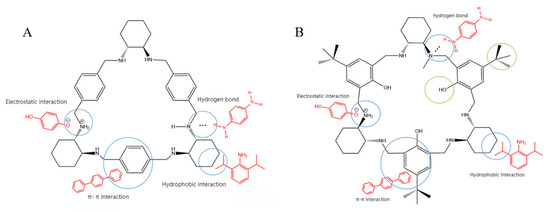
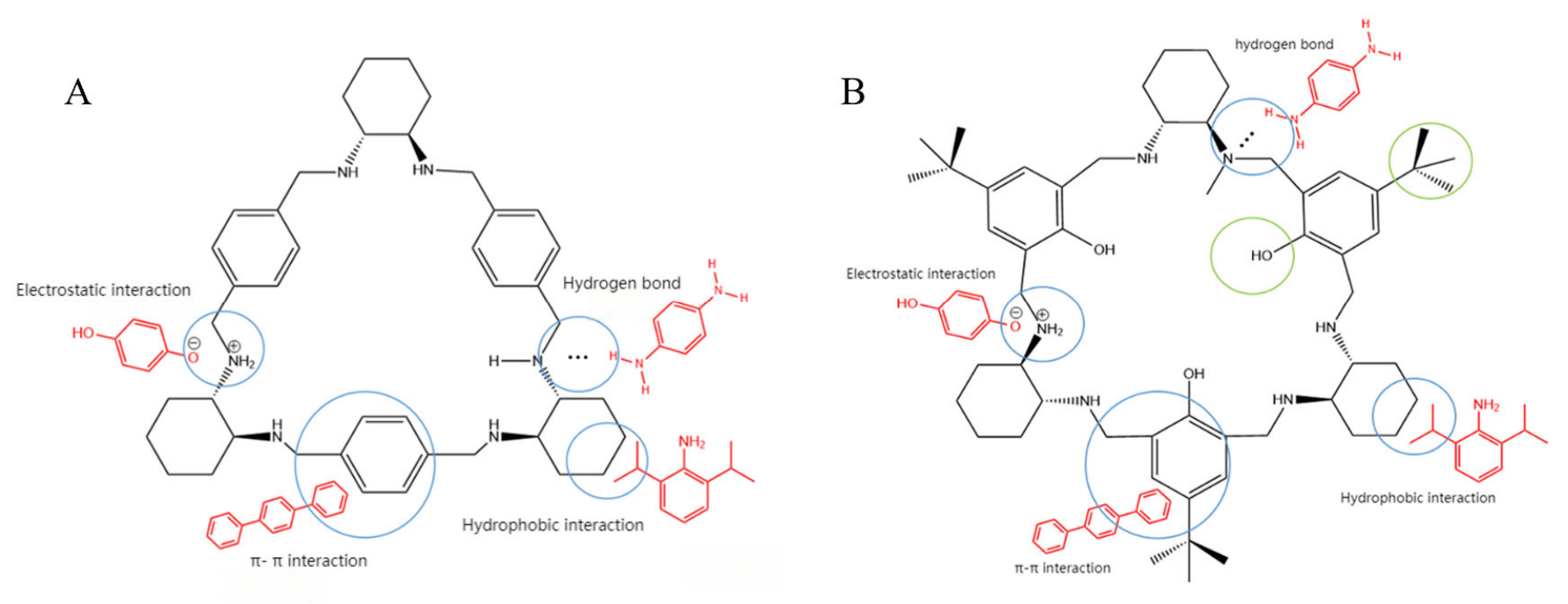
As shown in Figure 1, multiple intermolecular interactions exist between the macrocycle and aromatic compounds, demonstrating their promising potential as a core material for high-performance chromatographic stationary phases [8]. On this basis, the macrocycle was covalently immobilized onto chlorinated silica to prepare the stationary phase, and its chromatographic separation performance was systematically investigated using a commercial C18 column as the benchmark. The C18 column was selected because it is the most widely used reversed-phase reference column for aromatic compounds; C4 and C8 columns were not evaluated in the present study.
Figure 1.
The interactions between the polyamine macrocycle and aromatic compounds. (A) TRI-Sil; (B) CPAM-Sil (the blue circle represents the interactions between the analyte and macrocycle, and the green circle represents the two newly introduced side-chain groups).
2. Materials and Methods
2.1. Chemicals and Materials
3-Chloropropyltrimethoxysilane, (R,R)-1,2-diaminocyclohexane, p-phenylenediamine, m-phenylenediamine, aniline, 2-nitroaniline, 3-nitroaniline, 2,6-diisopropylaniline, 1-naphthylamine, o-terphenyl, m-terphenyl, fluorene, anthracene, triphenylene, p-phenylenediol, m-phenylenediol, o-phenylenediol, 2,6-diformyl-4-tert-butylphenol (Shanghai Aladdin Biochemical Technology Co., Ltd., Shanghai, China), hydrochloric acid, toluene, methanol (Shanghai Xingke High Purity Solvents Co., Ltd., Shanghai, China), triethylamine, sodium borohydride (Nanjing Chemical Reagent Co., Ltd., Nanjing, China), sodium carbonate (Shanghai yuanye Bio-Technology Co., Ltd., Shanghai, China), dichloromethane, n-butanol (Nanjing Chemical Reagent Co., Ltd., Nanjing, China), and redistilled water were used throughout the experiments.
2.2. Instrumentation and Conditions
Ultraviolet–visible spectrophotometer (UV-1800, Shimadzu Corporation, Kyoto, Japan), electronic balance (PX 125 DZH, OHAUS Corporation, Parsippany, NJ, USA), desktop high-speed centrifuge (TG 16-WS, Hunan Xiangyi Laboratory Instruments Development Co., Ltd., Changsha, China), Dongsen ultrasonic cleaner (DS-060 S, Shenzhen Pinhuang Technology Co., Ltd., Shenzhen, China), digital display constant temperature water bath (BHS-2, Changzhou Guohua Electric Appliance Co., Ltd., Changzhou, Jiangsu, China), electric heat convection drying oven (101 A-OS, Nanjing Jiudong Machinery Equipment Co., Ltd., Nanjing, China), 98-3 digital magnetic stirrer (Gongyi Yuhua Instruments Co., Ltd., Gongyi, China), rotary evaporator (WB-2000, Zhengzhou Great Wall Science and Technology Industry and Trade Co., Ltd., Zhengzhou, China), High-performance liquid chromatography(HPLC) system (LC-20, Shimadzu Corporation, Kyoto, Japan), Fourier transform infrared(FT-IR) spectrometer,(Shimadzu 8400, Shimadzu Corporation, Kyoto, Japan), PHS-25 precision pH meter (Shanghai Precision Instrument Co., Ltd., Shanghai, China), vacuum drying oven (Shanghai Boxun Industrial Co., Ltd. Medical Equipment Factory, Shanghai, China), and an elemental analyzer (PE 2400 Series II, PerkinElmer, Waltham, MA, USA).
2.3. Optimized Final Methods
2.3.1. Preparation of Macrocycle Stationary Phase
The Preparation of Chlorinated Silica
The commercial spherical silica was dispersed in a 10% hydrochloric acid solution and heated under reflux at 80 °C for 10 h to obtain the activated silica. A total of 3.0 g of the activated silica was dispersed in 50 mL of toluene. Then, 5 mL of 3-chloropropyltrimethoxysilane was added, and the mixed solution was stirred under a nitrogen atmosphere, heated under reflux at 100 °C for 24 h, then cooled to room temperature, washed three times with methanol, and dried overnight to ultimately obtain chlorinated silica.
Synthesis of Macrocycle Ligands
TRI: The TRI was synthesized according to a previously reported method [9,14,15,16,17,18,19,20,21]. A mixture of (R,R)-1,2-diaminocyclohexane (2.28 g, 20 mmol), terephthalaldehyde (2.68 g, 20 mmol), methanol (200 mL), and triethylamine (7.0 mL, 50 mmol) was stirred at room temperature overnight. The mixture was cooled in an ice bath for 1 h, followed by the addition of sodium borohydride (2.28 g, 60 mmol). After stirring at room temperature for 3 h, the solvent was removed under vacuum. The residue was dissolved in dichloromethane (100 mL), washed with aqueous sodium carbonate solution (5%), and extracted. The organic solvent was evaporated under reduced pressure, and after drying overnight, a viscous yellow solid TRI was obtained.
CPAM: The synthesis of CPAM, as reported in the literature, was modified and improved. The mixture of (R,R)-1,2-diaminocyclohexane (0.57 g, 5 mmol), 2,6-diformyl-4-tert-butylphenol (1.03 g, 5 mmol), acetonitrile (150 mL), and triethylamine (1.75 mL, 12 mmol) was heated and stirred at a constant temperature of 50 °C overnight. After the mixture was cooled in an ice bath for 1 h, sodium borohydride (0.57 g, 15 mmol) was added. After stirring at room temperature for 3 h, the solvent was removed under vacuum. The residue was dissolved in dichloromethane (100 mL), washed with a 5% sodium carbonate aqueous solution, extracted, and the organic solvent was evaporated. The product was then dried overnight to obtain a gray-white solid CPAM.
Immobilization of Macrocycles onto Chlorinated Silica
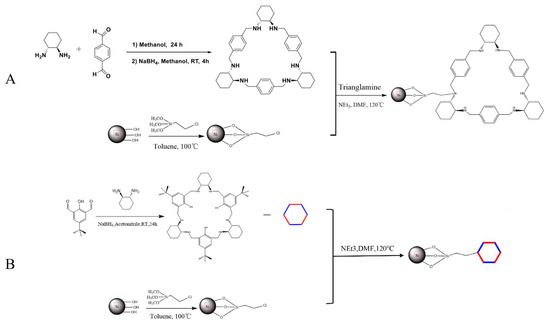
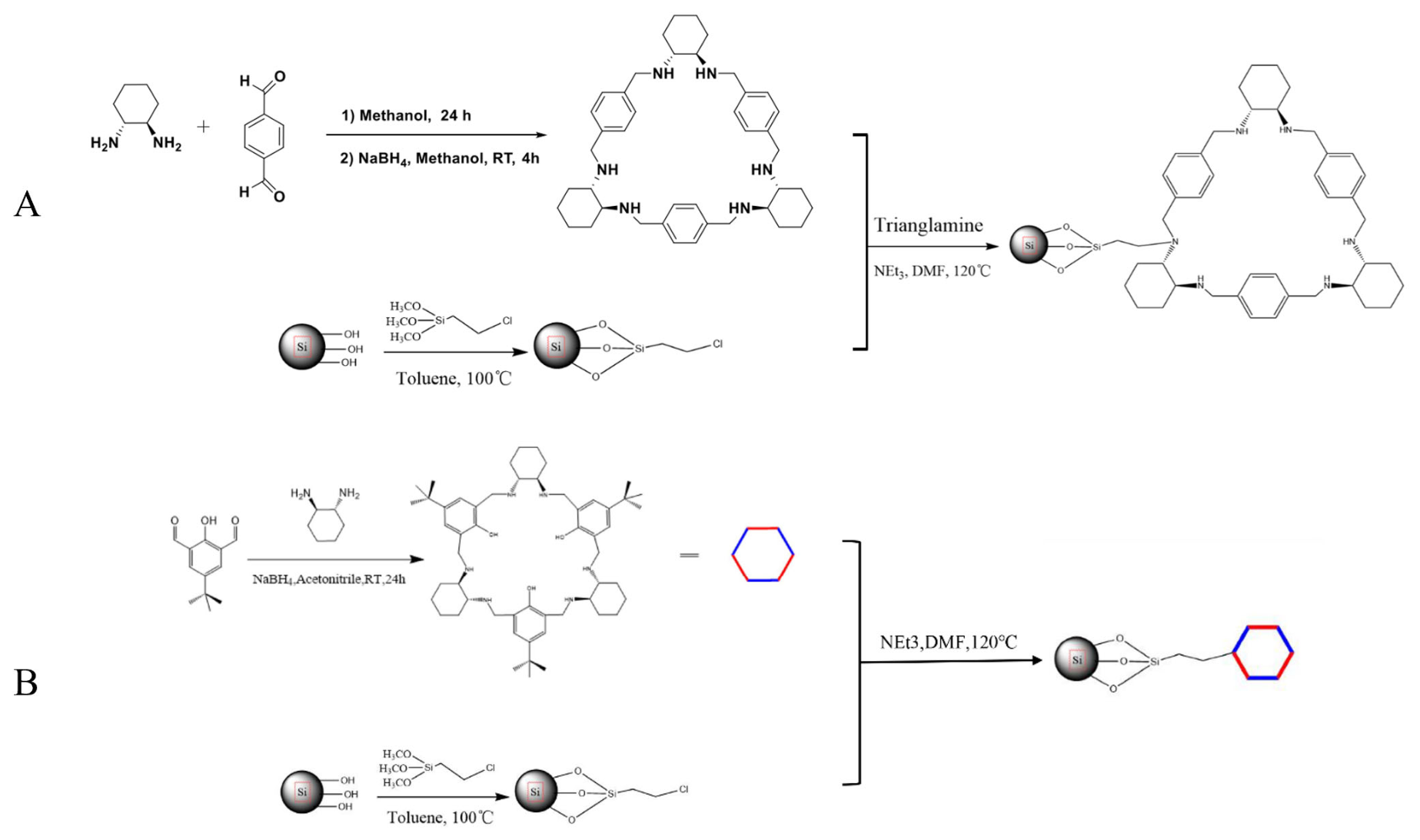
Both TRI-Sil and CPAM-Sil were prepared via nucleophilic substitution between the chlorinated silica and the corresponding macrocycle ligand. Chlorinated silica (0.76 g) was dispersed in 50 mL of N,N-dimethylformamide (DMF), followed by the addition of the macrocycle (0.23 g for TRI or 0.42 g for CPAM) and 5 drops of triethylamine. The mixture was mechanically stirred under a nitrogen atmosphere at 120 °C for 24 h. After reaction, the product was washed with ethanol and dried overnight to obtain the macrocycle-functionalized silica stationary phase. The synthesis of the two stationary phases is shown in Figure 2.
Figure 2.
Synthesis diagram of the polyamine macrocycle stationary phase. (A) TRI-Sil; (B) CPAM-Sil.
Packing of Chromatographic Columns
Both columns were prepared using the slurry wet packing method. Specifically, 2.95 g of TRI-Sil and 1.85 g of CPAM-Sil were each dispersed in 23 mL of isopropanol by ultrasonication to form slurry mixtures. The resulting slurries were then packed into stainless steel HPLC columns (250 mm × 2.0 mm I.D. for TRI-Sil and 150 mm × 2.0 mm I.D. for CPAM-Sil) using an Alltech column packer at a pressure of 30 MPa, with isopropanol serving as the propulsion solvent. Because the two columns had different lengths, the column efficiencies reported in the following sections are expressed as theoretical plates per meter.
2.3.2. Calculation of Bonded Amount
The surface bonded amount (Γ) of the macrocycles on the silica support was calculated based on the carbon mass fraction using the standard Berendsen equation [22]:
where C% is the increase in carbon content of CPAM-Sil compared to the carrier SiO2-Cl, NC is the number of carbon atoms in the CPAM, Mr is the molecular weight of the actual bonded organic moiety (g·mol−1), and S is the specific surface area of the bare silica (300 m2·g−1). The constant 12.01 (g·mol−1) is the standard atomic weight of carbon, and 100 is the percentage conversion factor.
3. Results
3.1. Characterization of the Synthesized Polyamine Macrocycle Material
3.1.1. Nuclear Magnetic Resonance (NMR) Characterization
The 1H NMR spectra of the two macrocycles (in CDCl3, 300 MHz) are shown in Figure S1 and displayed the following peaks:
TRI: δ 1.03 (m, 2H; CH2), 1.24 (m, 2H; CH2), 1.74 (m, 2H; CH2), 1.86 (brs,2H; NH), 2.25 (m, 4H; CH2), 3.62 (d, 3J (H, H) = 12.9 Hz, 2H; ArCH2), 3.92 (d, 3J (H, H) = 12.9 Hz, 2H; ArCH2), 7.29 ppm (s, 4H; Ar).
CPAM: δ 6.94 (s, Ar-H, 6H), 3.86–3.76 (m, Ar-CH2-N, 12H), 2.37–2.28 (m, cyclohexyl-N-CH, 6H), 2.14–2.07 (m, NH, 6H), 1.24 (s, tert-butyl C(CH3)3, 27H), 1.74–1.66 (m, cyclohexyl-CH2, 6H), 1.29–1.25 (m, cyclohexyl-CH2, 3H), 1.23–1.21 (m, cyclohexyl-CH2, 3H), 1.21–1.03 (m, cyclohexyl-CH2, 12H).
Together with the FTIR and elemental analysis results, these spectra support the formation of the target macrocycle ligands prior to immobilization.
3.1.2. The Infrared (IR) Spectroscopy Characterization
The IR spectra of the two macrocycles are shown in Figure S2.
TRI: The strong, sharp absorption peak at 1456 cm−1 is assigned mainly to CH2 bending and aromatic skeletal vibrations. The absorption band at 3296 cm−1 is attributed to the stretching vibration of the N-H group in TRI. The absorption bands at 2922 and 2850 cm−1 correspond to the stretching vibrations of the -CH2- and -CH- groups. These characteristic infrared peaks further confirm that the TRI material has been successfully synthesized.
CPAM: A strong, sharp absorption peak at 1637 cm−1 is assigned to the aromatic C=C skeletal vibrations of the phenolic rings, which are enhanced by the electron-donating phenolic hydroxyl and amine groups. The absorption broad band at 3424 cm−1 is attributed to hydroxyl and N-H stretching vibrations. Bands at 2932 and 2859 cm−1 correspond to C-H stretching vibrations of the -CH3, -CH2-, and -C-H- groups. Peaks at 1598 and 1461 cm−1 are characteristic of phenyl ring skeletal vibrations.
These features are consistent with the formation of the reduced polyamine macrocycle materials.
3.1.3. Elemental Analysis
As shown in Table 1, compared to SiO2-Cl, the contents of carbon (C), nitrogen (N), and hydrogen (H) in both stationary phases significantly increased, confirming the successful ligand immobilization. According to Formula (1), the surface bonding amounts of TRI-Siland CPAM-Sil were calculated to be 0.42 μmol·m−2 and 0.46 μmol·m−2, respectively.
Table 1.
Elemental analysis results for C, H, and N in chlorinated silica, CPAM, and TRI material.
A sample calculation for CPAM-Sil is provided as follows: the carbon content increase was determined to be C% = 8.85% − 0.76% = 8.09%, with S = 300 m2·g−1, NC = 54, and Mr = 864 g·mol−1. Substituting these values into Formula (1) yields a bonded amount of 0.46 μmol m−2.
3.1.4. Scanning Electron Microscopy (SEM) Characterization
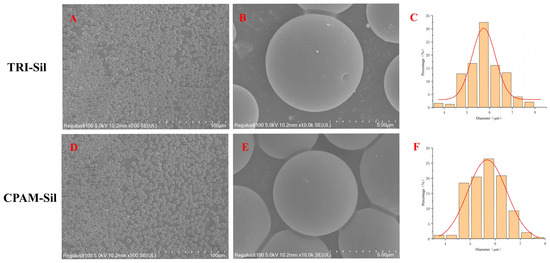
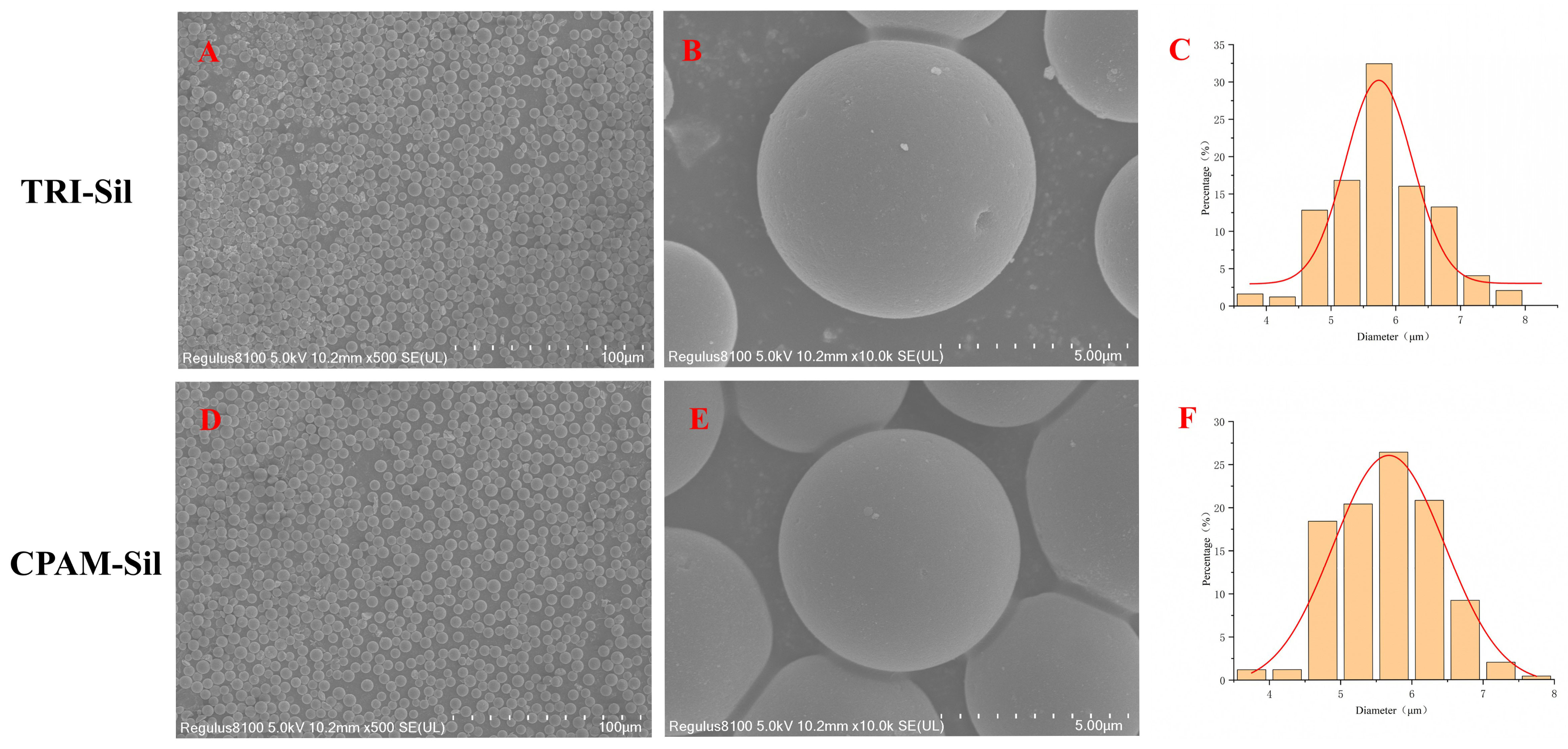
Scanning electron microscopy (SEM) characterization was conducted on two macrocycles. The images are shown in Figure 3 at scales of 100 μm (A) and 5 μm (B). The particle sizes of the microspheres were statistically analyzed from SEM images using ImageJ (version 1.54p). The TRI-Sil microspheres were mainly distributed in the 5–6 μm range, with an average diameter of 5.80 ± 0.76 μm (mean ± SD, n = 250), whereas the CPAM-Sil microspheres had an average diameter of 5.65 ± 0.72 μm (mean ± SD, n = 250), indicating relatively concentrated particle size distributions for both samples. The SEM image of CPAM-Sil at 100 μm magnification exhibited fewer fragmented particles overall.
Figure 3.
SEM images and particle size distribution histograms of the TRI-Sil and CPAM-Sil microspheres. (A) 100 μm of TRI-Sil; (B) 5 μm of TRI-Sil; (C) size distribution of TRI-Sil; (D) 100 μm of CPAM-Sil; (E) 5 μm of CPAM-Sil; (F) size distribution of CPAM-Sil.
3.2. Chromatographic Evaluation of Columns
3.2.1. Separation of Aromatic Amine Compounds
Commercial C18 columns may have residual silanol groups on the surface of the stationary phase. When separating basic compounds, these exposed silanol groups can interact strongly with the basic compounds through electrostatic forces, leading to severe tailing phenomena. A common solution is to add an appropriate amount of tailing suppressor (such as triethylamine) to the mobile phase, which improves peak shape by shielding the silanol groups. Polyamine macrocycle structures, like triethylamine, contain many amino groups that have the potential to compete with basic samples for silanol groups, thus serving the purpose of tailing suppression. For this reason, an aromatic amine mixture was specifically selected to evaluate the separation performance of the columns, especially the CPAM-Sil column. In this experiment, six samples of aromatic amine compounds were selected for separation, and their molecular structures are shown in Figure S3.
A total of 2 mg of each of the following standards (p-phenylenediamine, m-phenylenediamine, aniline, 2-nitroaniline, 3-nitroaniline, and 1-naphthylamine) were precisely weighed into a 10 mL volumetric flask. The mixture was sonicated for 10 min and then diluted to volume with methanol to obtain a stock solution with a concentration of 0.2 mg/mL. Then, 1 mL of each of the six stock solutions was transferred into a 50 mL volumetric flask, mixed, and made up to volume with methanol. The mixture was ultrasonicated for 5 min to obtain a mixed standard reserve solution with a concentration of 4 μg/mL. The solution was stored in a refrigerator at 5 °C for later use and was allowed to return to room temperature before use.
To determine suitable liquid chromatographic conditions for the separation of six aromatic amine compounds in the CPAM-Sil column, multiple experiments were conducted with different mobile phase ratios for single injections of the six aromatic amines. The retention times with methanol/water (25:75 v/v) and methanol/water (55:45 v/v) are listed in Table S1. Under a mobile phase of methanol/water (55:45 v/v), baseline resolution for all six aromatic amine compounds was expected to be achieved using the CPAM-Sil column. Therefore, this mobile phase ratio was selected for subsequent experiments as the liquid chromatographic condition for separating the six aromatic amine compounds with the CPAM-Sil column.
To evaluate the chromatographic performance, we compared a commercial C18 column, the TRI-Sil column, and the CPAM-Sil column using a mixture of six aromatic amine compounds. This comparison was used to identify the relative advantages and limitations of the two macrocycle-based stationary phases after monomer modification.
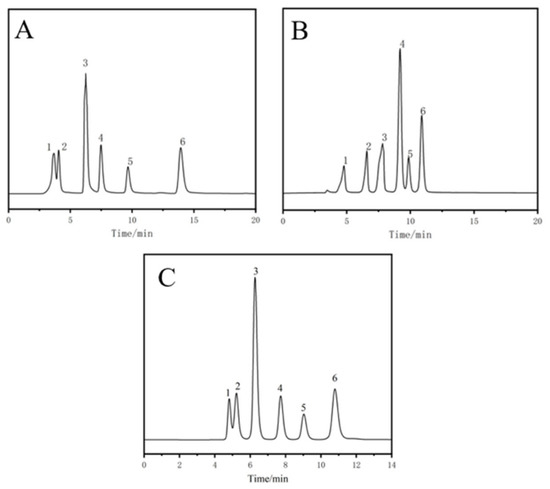
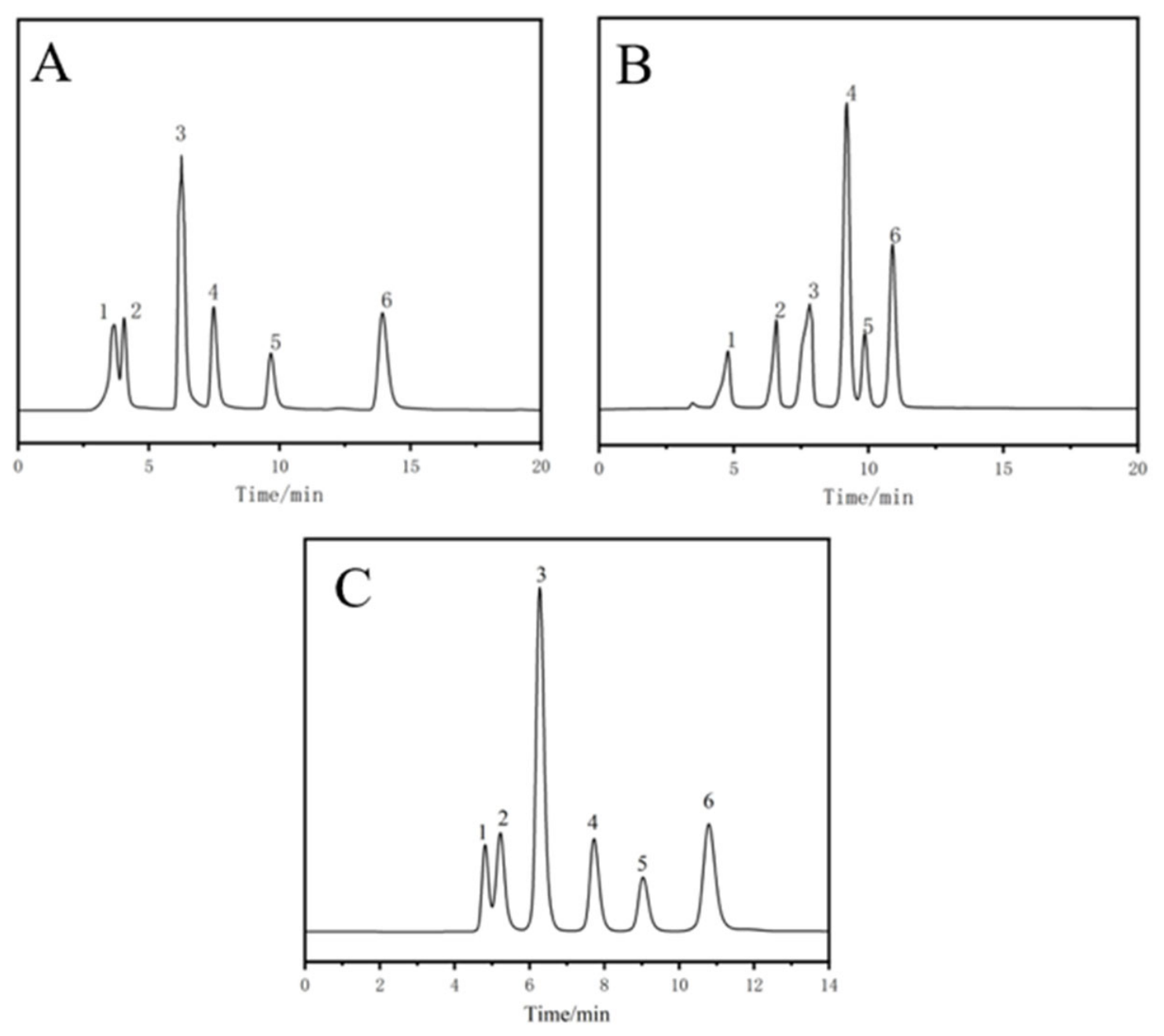
The mobile phase composition consisted of methanol/water (55:45 v/v), with a flow rate of 1 mL/min, an injection volume of 10 μL, a column temperature of 25 °C, and a detection wavelength of 254 nm. The chromatograms of the six mixed aromatic amine compounds in the commercial C18 column, the TRI-Sil column, and the CPAM-Sil column are shown in Figure 4, respectively: (1) m-phenylenediamine, (2) p-phenylenediamine, (3) aniline, (4) 3-nitroaniline, (5) 2-nitroaniline, (6) 1-naphthylamine. Table 2, Tables S2 and S3 list the separation data for the six mixed aromatic amines separated by the commercial C18 column, the TRI-Sil column, and the CPAM-Sil column.
Figure 4.
Liquid chromatograms of the separation of six aromatic compounds by the polyamine macrocycle stationary phase with a mobile phase composition of methanol/water (55:45 v/v). (A) commercial C18 column; (B) TRI-Sil column; (C) CPAM-Sil column.
Table 2.
Separation data for six aromatic amines on the CPAM-Sil column with a mobile phase composition of methanol/water (55:45 v/v).
Based on the separation data from the three chromatographic columns, the following observations can be made:
1. With a mobile phase ratio of methanol/water (55:45 v/v), the TRI-Sil column was capable of achieving baseline separation for the six aromatic amines, whereas the CPAM-Sil column and commercial C18 column could not achieve baseline separation for m-phenylenediamine and p-phenylenediamine. Although the CPAM macrocycle possesses a more branched structure and additional interaction sites, it failed to baseline-resolve small positional isomers like m-phenylenediamine and p-phenylenediamine under the 55:45 methanol–water condition. This phenomenon can be attributed to the introduction of bulky tert-butyl groups on the CPAM macrocycle, which creates significant steric hindrance. This steric hindrance restricts these small isomers from penetrating deeply into the macrocyclic cavity, leading to a weaker recognition capability and poorer resolution compared to the unhindered TRI-Sil column.
2. For the six aromatic amine compounds, the asymmetry factors of the commercial C18 column were all above 1.38, while the asymmetry factors for the TRI-Sil column ranged from 0.61 to 1.02, and the asymmetry factors for the CPAM-Sil column ranged from 1.12 to 1.20. The slight peak fronting (As < 1.0) is primarily attributed to two factors: (1) localized site saturation, where limited macrocyclic cavity capacity causes partial overloading at the peak apex (Langmuir-type behavior); and (2) steric hindrance, where bulky tert-butyl groups restrict deep cavity penetration for certain isomers, leading to weaker interactions and faster elution at the leading edge. Overall, the two polyamine macrocycle stationary phases improved peak shape compared with the commercial C18 column for these basic aromatic compounds.
3.2.2. Separation of Positional Isomers of Aromatic Amines
From the previous stage of the experiment, it was observed that with a mobile phase ratio of methanol/water (55:45 v/v), the TRI-Sil column could achieve baseline separation of the six aromatic amines, whereas the CPAM-Sil column and the commercial C18 column could not achieve baseline separation for m-phenylenediamine and p-phenylenediamine. This behavior suggests that the additional CPAM interaction sites do not automatically improve selectivity for every analyte pair and that the mobile-phase composition strongly affects the recognition of phenylenediamine positional isomers. Therefore, to further evaluate CPAM-Sil for phenylenediamine isomers, additional experiments with lower organic-phase ratios were conducted, and methanol/water (25:75 v/v) was determined as the optimal condition for the three phenylenediamine positional isomers.
The liquid chromatograms of the separation of the three positional isomers of phenylenediamine by the commercial C18 column, the TRI-Sil column, and the CPAM-Sil column are shown in Figure S4. Table 3, Tables S4 and S5 provide the corresponding specific liquid chromatographic data.
Table 3.
Separation data for the positional isomers of phenylenediamine on the CPAM-Sil column with a mobile phase ratio of methanol/water (25:75 v/v).
From the separation data obtained from the three chromatographic columns, it can be concluded that under the separation condition of a 25% organic phase ratio, the three positional isomers of phenylenediamine can achieve baseline separation on both the CPAM-Sil column and the commercial C18 column. Moreover, the normalized column efficiency of the CPAM-Sil column was significantly higher than that of the commercial C18 column.
3.2.3. Separation of Polycyclic Aromatic Hydrocarbon Compounds (Terphenyl Positional Isomers)
Compared to the stationary phase of commercial C18 columns, the polyamine macrocyclic stationary phase, with its unique cavity size and rigid structure, can separate planar compounds with similar molecular weights, showing better separation effects when separating polycyclic aromatic hydrocarbon compounds such as anthracene and fluorene.
In this separation experiment of polycyclic aromatic hydrocarbon compounds, the focus was on the analysis of the three positional isomers of terphenyl. A total of 1 mg of each standard (o-, m-, and p-terphenyl) was accurately weighed into a 10 mL volumetric flask, dissolved with ultrasonication for 10 min, and made up to volume with methanol to obtain a stock solution with a concentration of 0.1 mg/mL. Then, 1 mL of each of the three standard stock solutions was transferred into a 50 mL volumetric flask, mixed, and made up to volume with methanol. After ultrasonic mixing for 5 min, a mixed standard reserve solution was obtained with a concentration of 2 μg/mL. The solution was stored in a refrigerator at 5 °C for later use and was allowed to return to room temperature before use.
After evaluating the column efficiency with the CPAM-Sil column, the commercial C18 column was selected for comparative experiments. A systematic screening of mobile phase ratios was conducted using a descending gradient of organic solvent, with all other chromatographic conditions held constant. This process identified methanol/water (75:25 v/v) as the optimal mobile phase, which was subsequently applied to both columns. The liquid chromatograms of the separation of the three positional isomers of terphenyl by the CPAM-Sil column and the commercial C18 column are shown in Figure S5, respectively.
As shown in Table 4, the results indicated that under the optimal mobile phase ratio conditions, the theoretical plate numbers for the three positional isomers of terphenyl in the CPAM-Sil column could all reach above 23,000 plates·m−1, with p-terphenyl even approaching 30,000 plates·m−1. This suggests that the CPAM-Sil column provides high column efficiency for polycyclic aromatic hydrocarbon compounds. The three positional isomers of terphenyl could not achieve baseline separation in the commercial C18 column. In contrast, although the CPAM-Sil column could not achieve baseline separation for p-terphenyl and m-terphenyl, it could separate o-terphenyl from the other two positional isomers, with a asymmetry factor of 1.212, indicating a better peak shape. This suggests that the CPAM-Sil column can address, to some extent, the tailing issues present in commercial C18 columns.
Table 4.
Separation data for the positional isomers of terphenyl on the CPAM-Sil column with a mobile phase ratio of methanol/water (75:25 v/v).
3.2.4. Separation of Phenolic Compounds
After evaluating the aromatic amines and polycyclic aromatic hydrocarbons, to further explore the separation efficiency of the CPAM-Sil column for other types of aromatic compounds, phenolic compounds were selected for separation in the subsequent experiments. The liquid chromatograms of the separation of the three positional isomers of phenylenediol by the commercial C18 column, the TRI-Sil column, and the CPAM-Sil column are shown in Figure S6, respectively. Table 5, Tables S6 and S7 provide the corresponding specific liquid chromatographic data.
Table 5.
Separation data for the positional isomers of phenylenediol on the CPAM-Sil column with a mobile phase ratio of methanol/water (35:65 v/v).
The experimental data results indicate that under the same mobile phase ratio conditions, the TRI-Sil chromatographic column could only separate o-phenylenediol from the other two positional isomers, while m-phenylenediol and p-phenylenediol could not achieve baseline separation. In contrast, on both the CPAM-Sil column and the commercial C18 column, the three positional isomers of phenylenediol could achieve baseline separation. The separation selectivity of the CPAM-Sil column was superior to that of the TRI-Sil column, suggesting that by modifying the internal structure of the polyamine macrocycle and introducing new branches or groups, the polyamine macrocycle stationary phase can have more active sites, thereby further enhancing its selectivity. The commercial C18 column exhibited a serious tailing issue, with asymmetry factors all greater than 2.2. In comparison, the asymmetry factors of the CPAM-Sil column were between 1.1 and 1.2, with better peak shapes, indicating that the CPAM-Sil has, to some extent, resolved the tailing issues associated with commercialized C18 chromatographic columns.
3.3. The Influence of the Amount of Analyte Injected on Separation
Within the injection volume range of 3–20 μL, both columns exhibited satisfactory chromatographic separation performance. As shown in Figure S7, for the complex multicomponent system on the TRI-Sil column, the peak responses of all components increased regularly with increasing injection volume, while the overall resolution and peak shapes remained stable. For the CPAM-Sil column, the peak shapes, resolution, and retention times of the three target analytes (p-, m-, and o-phenylenediamine) were also not significantly affected by changes in injection volume, and the linear relationship between peak height and injection volume was more consistent. In comparison, CPAM-Sil showed stable peak symmetry and baseline behavior at higher injection volumes, together with a shorter analysis time.
3.4. Chromatographic Column Stability and Reproducibility
Within the investigated concentration ranges (5–200 μg/mL for TRI-Sil and 10–400 μg/mL for CPAM-Sil), as shown in Figure S8, both columns exhibited satisfactory stability and reproducibility. For the complex multicomponent system on the TRI-Sil column, as the concentration increased, the peak responses of all components rose regularly, while retention times and peak shapes remained generally stable with no significant signs of column efficiency deterioration. For the CPAM-Sil column, the peak heights of the three target analytes (p-, m-, and o-phenylenediamine) showed a regular linear increase with increasing concentration. The relative standard deviation (RSD) values (n = 5) for the retention time and resolution of the analytes were less than 0.93% and 0.60%, respectively. The retention times, resolution, and peak symmetry of all components remained satisfactory, with no obvious baseline drift or peak broadening. These repeated-injection results indicate that no appreciable loss of chromatographic performance occurred under the tested conditions and provide indirect evidence that severe leaching of the bonded functional groups did not occur during the evaluation.
3.5. Computer Simulation Analysis
To investigate the separation mechanisms of the TRI and CPAM macrocycles toward aromatic compounds, conformational optimizations were first performed for the receptor molecules TRI and CPAM (shown in Figure S9A and E, respectively). Subsequently, molecular docking simulations between the two receptors and three aromatic compounds (p-phenylenediamine, hydroquinone, and p-terphenyl) were conducted using AutoDock Vina 1.2.0. The results (shown in Figure S9B–D,F–H) demonstrated that p-phenylenediamine (docking energies of −5.316 kcal/mol and −4.380 kcal/mol for TRI and CPAM, respectively), hydroquinone (docking energies of −5.440 kcal/mol and −4.929 kcal/mol, respectively), and p-terphenyl (docking energies of −5.308 kcal/mol and −4.415 kcal/mol, respectively) were all stably localized within the cavities of TRI and CPAM without any dissociation, confirming that both receptors can form stable inclusion complexes with these three types of aromatic compounds.
To further clarify the types of interactions involved, precise CDOCKER docking analyses were performed using Discovery Studio 2019. As shown in Table 6, all complexes exhibited negative electrostatic (−2.89 to −6.15 kcal/mol) and hydrogen-bond (−1.49 to −3.56 kcal/mol) energies, both stabilizing, while the reported −CDOCKER interaction energies of 5.70–7.32 kcal/mol corresponded to interaction energies of −5.70 to −7.32 kcal/mol, confirming favorable complexation. Binding is therefore governed by the combined action of electrostatic interactions, hydrogen bonding, π–π stacking, and hydrophobic contacts within the macrocyclic cavity, and the consistently larger interaction energies for CPAM relative to TRI accord with the stronger retention and improved isomer selectivity observed on the CPAM-Sil column.
Table 6.
Docking energy terms of the TRI and CPAM with three aromatic compounds.
4. Conclusions
In conclusion, a polyamine-silica macrocyclic stationary phase (CPAM-Sil) was successfully synthesized. Comparative chromatographic evaluations demonstrated its superior performance over a commercial C18 column, characterized by higher column efficiency, significantly reduced peak tailing, and improved peak shape for aromatic compounds. Compared with TRI-Sil, CPAM-Sil showed improved selectivity for selected positional-isomer systems, such as phenylenediamine under optimized low-organic-phase conditions and phenylenediol, although its performance was analyte- and mobile-phase-dependent. Molecular docking studies revealed that this enhanced performance originates from a mixed-mode separation mechanism, involving electrostatic, hydrogen-bonding, π–π, and hydrophobic interactions. Combined with its excellent stability and reproducibility, the CPAM-Sil column shows great promise for the separation of aromatic compounds.
Supplementary Materials
The following supporting information can be downloaded at: https://www.mdpi.com/article/10.3390/separations13080232/s1, Figure S1: The hydrogen spectrum of the polyamine macrocycle stationary phase. (A) CPAM-Sil; (B) TRI-Sil; Figure S2: Infrared (IR) spectroscopy chart of the polyamine macrocycle stationary phase. (A) CPAM-Sil; (B) TRI-Sil; Figure S3: The molecular structures of the six separated aromatic amines; Figure S4: Liquid chromatograms of the separation of phenylenediamine positional isomers by the polyamine macrocycle stationary phase with a mobile phase ratio of methanol/water (25:75 v/v). (A) commercial C18 column; (B) TRI-Sil column; (C) CPAM-Sil column; Figure S5: Liquid chromatograms of the separation of terphenyl positional isomers by the polyamine macrocycle stationary phase with a mobile phase ratio of methanol/water (75:25 v/v). (A) commercial C18 column; (B) CPAM-Sil column; Figure S6: Liquid chromatograms of the separation of the positional isomers of phenylenediol by the polyamine macrocycle stationary phase with a mobile phase ratio of methanol/water (35:65 v/v). (A) commercial C18 column; (B) TRI-Sil column; (C) CPAM-Sil column; Figure S7: The effect of injection volume on the separation of three positional isomers of phenylenediamine in the polyamine macrocycle stationary phase. (A) TRI-Sil column; (B) CPAM-Sil column; Figure S8: The effect of number of injections on the separation of three positional isomers of phenylenediamine in the polyamine macrocycle stationary phase. (A) TRI-Sil column; (B) CPAM-Sil column; Figure S9: Docking of the polyamine macrocycle with three aromatic compound molecules. (A, B, C, D) TRI; (E, F, G, H) CPAM; Table S1: Under the two organic phase ratio conditions (methanol/water (25:75 v/v) and methanol/water (55:45 v/v)), the retention times of the six aromatic amines in the CPAM-Sil chromatographic column; Table S2: Separation data for six aromatic amines on the commercial C18 column with a mobile phase composition of methanol/water (55:45 v/v); Table S3: Separation data for six aromatic amines on the TRI-Sil column with a mobile phase composition of methanol/water (55%:45% v/v); Table S4: Separation data for the positional isomers of phenylenediamine on the commercial C18 column with a mobile phase ratio of methanol/water (25:75 v/v); Table S5: Separation data for the positional isomers of phenylenediamine on the TRI-Sil chromatographic column with a mobile phase ratio of methanol/water (25:75 v/v); Table S6: Separation data for the positional isomers of phenylenediol on the commercial C18 column with a mobile phase ratio of methanol/water (35:65 v/v); Table S7: Separation data for the positional isomers of phenylenediol on the TRI-Sil column with a mobile phase ratio of methanol/water (35:65 v/v).
Author Contributions
Conceptualization, C.Z., L.D. and D.X.; Methodology, L.D.; Validation, C.Z. and X.W.; Formal analysis, C.Z. and D.X.; Investigation, C.Z., L.D. and X.W.; Resources, D.X.; Data curation, C.Z. and L.D.; Writing—original draft, C.Z. and L.D.; Writing—review & editing, C.Z., X.W., L.Q. and D.X.; Visualization, L.D.; Supervision, L.Q. and D.X.; Project administration, D.X.; Funding acquisition, L.Q. All authors have read and agreed to the published version of the manuscript.
Funding
This research was funded by the National Natural Science Foundation of China (Grant No. 81402899) and the Research Projects of the Jiangsu Provincial Health Commission’s Medical Science (H2023066).
Data Availability Statement
Data is contained within the article or Supplementary Materials.
Conflicts of Interest
The authors declare no conflicts of interest.
References
- Chen, L.; Sheng, X.; Li, G.; Huang, F. Mechanically interlocked polymers based on rotaxanes. Chem. Soc. Rev. 2022, 51, 7046–7065. [Google Scholar] [CrossRef] [Scilit] [PubMed]
- Ding, Y.; Dey, A.; Alimi, L.; Bhatt, P.; Du, J.; Maaliki, C.; Eddaoudi, M.; Jacquemin, J.; Khashab, N. Optimizing Host-Guest Selectivity for Ethylbenzene Capture Toward Superior Styrene Purification. Chem. Mater. 2022, 34, 197–202. [Google Scholar] [CrossRef] [Scilit]
- Li, J.; Yim, D.; Jang, W.; Yoon, J. Recent progress in the design and applications of fluorescence probes containing crown ethers. Chem. Soc. Rev. 2017, 46, 2437–2458. [Google Scholar] [CrossRef] [Scilit] [PubMed]
- Monta-Gonzalez, G.; Sancenon, F.; Martinez-Manez, R.; Marti-Centelles, V. Purely Covalent Molecular Cages and Containers for Guest Encapsulation. Chem. Rev. 2022, 122, 13636–13708. [Google Scholar] [CrossRef] [Scilit] [PubMed]
- Oh, Y.; Jeong, J.; Kim, D.; Lee, S. Nucleophilic Reactions Using Alkali Metal Fluorides Activated by Crown Ethers and Derivatives. Catalysts 2023, 13, 479. [Google Scholar] [CrossRef] [Scilit]
- Tang, J.; Chen, C.; Hong, T.; Zhang, Z.; Xie, C.; Li, S. Regulation of Chiral Phosphoric Acid Catalyzed Asymmetric Reaction through Crown Ether Based Host-Guest Chemistry. Org. Lett. 2022, 24, 7955–7960. [Google Scholar] [CrossRef] [Scilit] [PubMed]
- Zhang, H.; Zou, R.; Zhao, Y. Macrocycle-based metal-organic frameworks. Coord. Chem. Rev. 2015, 292, 74–90. [Google Scholar] [CrossRef] [Scilit]
- Zhao, W.; Liu, L.; Jia, Y.; Yuan, H.; Pan, L.; He, L.; Xiang, G.; Jiang, X.; Zhang, S. Investigation of the retention characteristics of a 26-membered aromatic-aliphatic azamacrocycle bonded silica gel stationary phase for high performance liquid chromatography. New J. Chem. 2018, 42, 1682–1689. [Google Scholar] [CrossRef] [Scilit]
- Zhang, Y.; Xiong, L.; Wang, Y.; Li, K.; Wang, B.; Xie, S.; Zhang, J.; Yuan, L. Preparation of chiral stationary phase based on a 3+3 chiral polyimine macrocycle by thiol-ene click chemistry for enantioseparation in normal-phase and reversed-phase high performance liquid chromatography. J. Chromatogr. A 2022, 1676, 463253. [Google Scholar] [CrossRef] [Scilit] [PubMed]
- Kwit, M.; Grajewski, J.; Skowronek, P.; Zgorzelak, M.; Gawronski, J. One-Step Construction of the Shape Persistent, Chiral But Symmetrical Polyimine Macrocycles. Chem. Rec. 2019, 19, 213–237. [Google Scholar] [CrossRef] [Scilit] [PubMed]
- Nandhini, C.; Kumar, P.; Poongodi, K.; Shanmugapriya, R.; Elango, K. Development of simple imine based probe for selective fluorescent cyanide sensing with red-emission in solid and solution phases. J. Mol. Liq. 2021, 327, 114833. [Google Scholar] [CrossRef] [Scilit]
- Kember, M.; Knight, P.; Reung, P.; Williams, C. Highly Active Dizinc Catalyst for the Copolymerization of Carbon Dioxide and Cyclohexene Oxide at One Atmosphere Pressure. Angew. Chem. Int. Ed. 2009, 48, 931–933. [Google Scholar] [CrossRef] [Scilit] [PubMed]
- Abadi, V.; Habibi, D.; Heydari, S.; Gilan, M. An adenine-based palladium complex: A capable heterogeneous magnetic nano-catalyst for the green synthesis of the ureas in aqueous media. J. Iran. Chem. Soc. 2023, 20, 1985–1996. [Google Scholar] [CrossRef] [Scilit]
- Bereta, T.; Mondal, A.; Slepokura, K.; Peng, Y.; Powell, A.; Lisowski, J. Trinuclear and Hexanuclear Lanthanide(III) Complexes of the Chiral 3+3 Macrocycle: X-ray Crystal Structures and Magnetic Properties. Inorg. Chem. 2019, 58, 4201–4213. [Google Scholar] [CrossRef] [Scilit] [PubMed]
- Dey, A.; Chand, S.; Maity, B.; Bhatt, P.; Ghosh, M.; Cavallo, L.; Eddaoudi, M.; Khashab, N. Adsorptive Molecular Sieving of Styrene over Ethylbenzene by Trianglimine Crystals. J. Am. Chem. Soc. 2021, 143, 4090–4094. [Google Scholar] [CrossRef] [Scilit] [PubMed]
- He, D.; Clowes, R.; Little, M.; Liu, M.; Cooper, A. Creating porosity in a trianglimine macrocycle by heterochiral pairing. Chem. Commun. 2021, 57, 6141–6144. [Google Scholar] [CrossRef] [Scilit] [PubMed]
- He, D.; Zhao, C.; Chen, L.; Little, M.; Chong, S.; Clowes, R.; McKie, K.; Roper, M.; Day, G.; Liu, M.; et al. Inherent Ethyl Acetate Selectivity in a Trianglimine Molecular Solid. Chem.-Eur. J. 2021, 27, 10589–10594. [Google Scholar] [CrossRef] [Scilit] [PubMed]
- Hua, B.; Ding, Y.; Alimi, L.; Moosa, B.; Zhang, G.; Baslyman, W.; Sessler, J.; Khashab, N. Tuning the porosity of triangular supramolecular adsorbents for superior haloalkane isomer separations. Chem. Sci. 2021, 12, 12286–12291. [Google Scholar] [CrossRef] [Scilit] [PubMed]
- Janczak, J.; Prochowicz, D.; Lewinski, J.; Fairen-Jimenez, D.; Bereta, T.; Lisowski, J. Trinuclear Cage-Like ZnII Macrocyclic Complexes: Enantiomeric Recognition and Gas Adsorption Properties. Chem.-Eur. J. 2016, 22, 598–609. [Google Scholar] [CrossRef] [Scilit] [PubMed]
- Wang, Y.; Wu, H.; Stoddart, J. Molecular Triangles: A New Class of Macrocycles. Acc. Chem. Res. 2021, 54, 2027–2039. [Google Scholar] [CrossRef] [Scilit] [PubMed]
- Gawronski, J.; Gawronska, K.; Grajewski, J.; Kwit, M.; Plutecka, A.; Rychlewska, U. Trianglamines—Readily Prepared, Conformationally Flexible Inclusion-Forming Chiral Hexamines. Chem. A Eur. J. 2006, 12, 1807–1817. [Google Scholar] [CrossRef] [Scilit] [PubMed]
- Siles, B.A.; Halsall, B.H.; Dorsey, J.G. Retention and selectivity of flavanones on homopolypeptide bonded stationary phases in both normal- and reversed-phase liquid chromatography. J. Chromatogr. A 1995, 704, 289–305. [Google Scholar] [CrossRef] [Scilit] [PubMed]

Disclaimer/Publisher’s Note: The statements, opinions and data contained in all publications are solely those of the individual author(s) and contributor(s) and not of MDPI and/or the editor(s). MDPI and/or the editor(s) disclaim responsibility for any injury to people or property resulting from any ideas, methods, instructions or products referred to in the content. |
© 2026 by the authors. Licensee MDPI, Basel, Switzerland. This article is an open access article distributed under the terms and conditions of the Creative Commons Attribution (CC BY) license.