


Abstract
This work reports a novel dithiophosphinic acid extractant, bis(isobutylphenyl)dithiophosphinic acid (HL), for the mutual separation of Am(III) and Cm(III) and for the separation of trivalent actinides (An(III)) from lanthanides (Ln(III)). The compound was successfully synthesized and structurally confirmed by 1H and 31P NMR spectroscopy. Focusing specifically on Am(III) and Cm(III), the extraction behavior was systematically investigated as a function of pH, ligand concentration, nitrate concentration, and temperature. Compared with the conventional extractant, bis(2,4,4-trimethylpentyl)dithiophosphinic acid (HL301), HL exhibits stronger extraction efficiency (pH1/2 = 3.39 for Am(III) and 3.64 for Cm(III)) and a notably improved separation factor for Am(III) over Cm(III) (SFAm(III)/Cm(III) = 4.8), while retaining excellent separation ability for An(III) from Ln(III). The extraction proceeds via a cation-exchange mechanism, yielding a 1:3 metal-extractant complex with the release of three protons. Increasing nitrate concentration suppresses extraction due to the competition for metal ion between NO3− in the aqueous phase and the extractant. The extraction reaction is endothermic with negative entropy changes, exhibiting ΔH° values of 24.06 kJ·mol−1 for Am(III) and 27.12 kJ·mol−1 for Cm(III) at 298.15 K, along with ΔS° values of −90.63 J·mol−1·K−1 and −89.11 J·mol−1·K−1, respectively. This work offers a promising extractant for the separation of Am(III) from Cm(III) and An(III) from Ln(III), and mechanistic insights into coordination–selectivity relationships involving soft sulfur donors.
1. Introduction
Minor actinides (Np, Am, Cm) are the major contributors to the long-term radiotoxicity of nuclear waste. The “partitioning-transmutation” strategy has been proposed to reduce radiotoxicity and to minimize the long-term geologic disposal risk. The separation of trivalent actinides (An(III)) from lanthanides (Ln(III)) represents a key challenge. Due to the distinct nuclear properties of Am and Cm, their mutual separation is often considered necessary after the removal of lanthanides, depending on the reactor or accelerator-driven system design. Implementing these separations enables more efficient transmutation, thereby reducing the long-term radiological hazard of waste [1]. Bis(2,4,4-trime/thylpentyl)dithiophosphinic acid (HL301) is the primary active component of the commercial extractant Cyanex 301. With 0.5 M HL301 in kerosene employed to extract An(III) and Ln(III) from nitrate solutions, the system exhibits an exceptional separation performance for An(III) over Ln(III) (SFAm(III)/Eu(III) = 5900) [2,3,4,5,6,7,8,9,10,11], as well as a modest separation factor of 3 for Am(III) over Cm(III) [12]. However, the narrow operational pH range and inadequate chemical stability of the extractant have driven extensive efforts to modify its structure for improved applicability. A series of dithiophosphinic acid extractants with various alkyl substituents (n-octyl, 1-methylheptyl, 2-ethylhexyl, and 2,4,4-trimethylpentyl) were synthesized, and their extraction behavior for An(III) and Ln(III) was comparatively investigated [13,14]. Subsequently, to improve the chemical stability, several alkylbenzene-substituted and halophenyl-substituted dithiophosphinic acids were proposed and investigated for the separation of An(III) and Ln(III) [15,16,17,18,19,20,21,22,23]. And a synergistic mixture of 0.4 M bis(chlorophenyl)dithiophosphinic acid and 0.15 M tris(2-ethylhexyl)phosphate (TEHP) dissolved in 20% isooctane/80% tert-butyl benzene was selected as the extraction system for the LUCA process [24]. Although the LUCA process offers efficient separation of An(III) over Ln(III), the release of chloride ions during the radiolytic or acidolytic degradation of its extractant may pose a corrosion hazard to process equipment. Previous work has demonstrated that bis(tert-butylphenyl)dithiophosphinic acid exhibits promising performance for the separation of U(VI) and Th(IV), achieving a separation factor of 10 for U(VI)/Th(IV) at an aqueous pH of 2.37 [23]. A solubility of less than 0.3 M in alkane and aromatic solvents may be a limiting factor for its practical application.
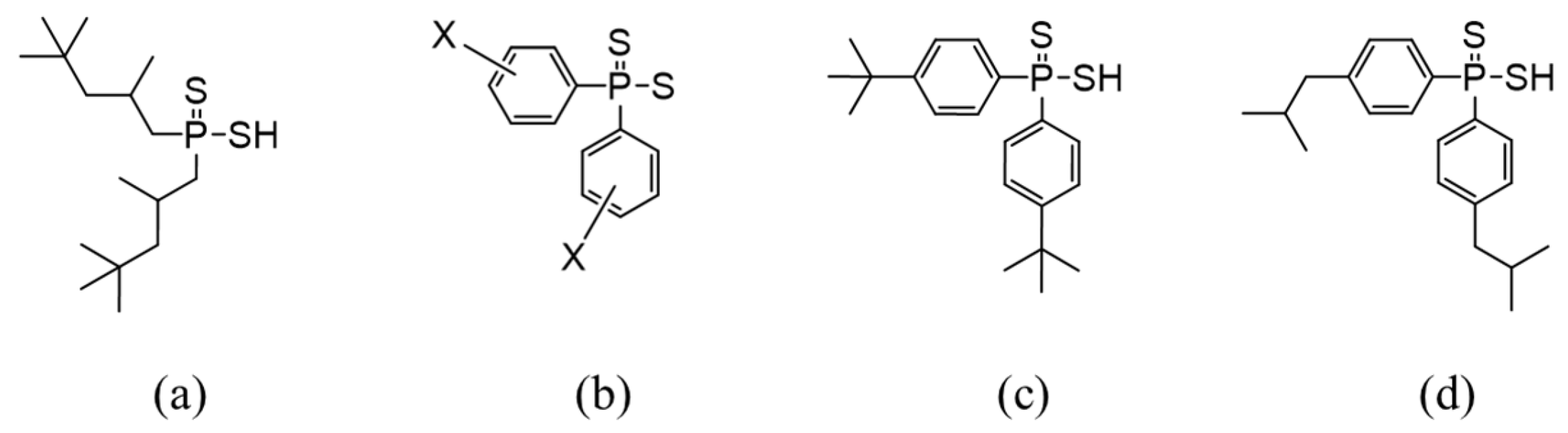
To overcome the solubility limitation while preserving aromatic substitution, a novel extractant, bis(isobutylphenyl)dithiophosphinic acid (HL), was synthesized in the present work. Its extraction behavior toward An(III) and Ln(III) was systematically investigated, with particular emphasis on evaluating its capability for separating Am(III) from Cm(III). The structures of the above-mentioned extractants are shown in Scheme 1.
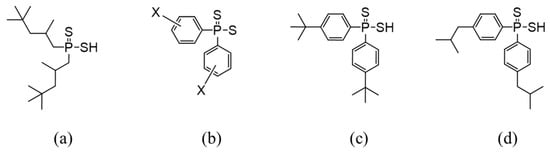
Scheme 1.
The structures of bis(2,4,4-trimethylpentyl)dithiophosphinic acid ((a), HL301), bis(halotolyl)dithiophosphinic acid (b), bis(tert-butylphenyl)dithiophosphinic acid (c), and bis(isobutylphenyl)dithiophosphinic acid ((d), HL).
2. Materials and Methods
2.1. Materials and Equipment
Stock solutions of 241Am(III) and 244Cm(III) (104 Bq/cm3 Am(NO3)3 and Cm(NO3)3 in 0.05 M HNO3) were supplied by the laboratory of China Institute of Atomic Energy. All other reagents of analytical grade were purchased from the China National Pharmaceutical Group Corporation (Shanghai, China) without purification before use. Ultrapure water from Milli-Q IQ 7000 (Merck Millipore Corporation, Burlington, MA, USA) was used to prepare all the aqueous solutions. 1H and 31P NMR spectra were recorded on a Bruker 400 M spectrometer (Billerica, MA, USA), with resonance frequencies of 400 MHz (1H) and 162 MHz (31P), respectively. The pH values were measured using a temperature-compensated pH meter (Pt1000, Metrohm, Herisau, Switzerland). The counting of 241Am(III) and 244Cm(III) in the organic and aqueous phases was performed with a PerkinElmer Tri-Carb 4910TR (Waltham, MA, USA) liquid scintillation analyzer.
2.2. Synthesis and Purification
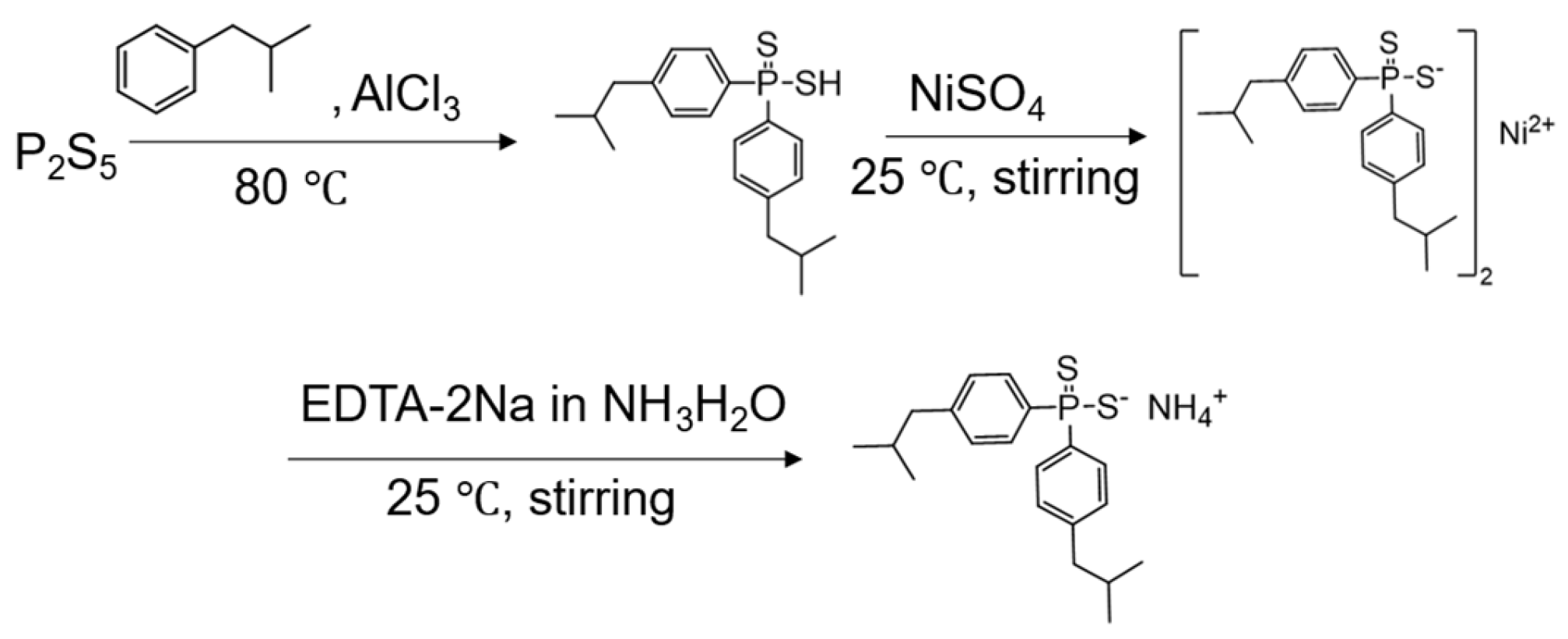
The synthesis route for bis(isobutylphenyl)dithiophosphinic acid is illustrated in Scheme 2. P2S5 (22.2 g, n = 0.1 mol) was reacted with isobutylbenzene (134 g, n = 1 mol) in the presence of AlCl3 (53.4 g, n = 0.4 mol) as catalyst. The reaction was conducted in a round-bottom flask fitted with an air condenser, the upper end of which was connected to a balloon to prevent moisture ingress and accommodate gas evolution. The mixture was heated under continuous stirring until the solid material was fully dissolved (5–6 h), after which heating was stopped and stirring was continued until the reaction mixture cooled to room temperature. The reaction mixture was then slowly poured into crushed ice under vigorous agitation; stirring was ceased upon complete hydrolysis of AlCl3. The organic phase was separated and washed twice with dilute hydrochloric acid to afford a green organic product.
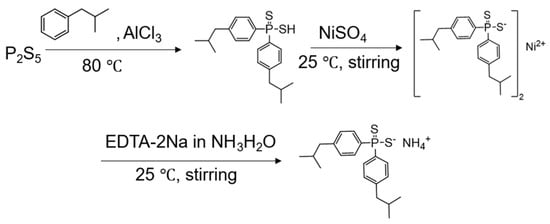
Scheme 2.
Synthesis and purification of bis(isobutylphenyl)dithiophosphinic acid.
An aqueous solution of Ni2SO4 (25% excess relative to the theoretical amount of HL) was added to the product, and the mixture was stirred at ambient temperature to convert the product acid to its nickel salt (NiL2). Absolute ethanol was introduced to alter the system polarity and induce precipitation of the nickel salt, which was collected by filtration. The nickel salt was dissolved in xylene and transferred to a separatory funnel. An aqueous ammoniacal solution of disodium ethylenediaminetetraacetate was added in portions to remove nickel ions and convert the product to its ammonium salt. The xylene was removed by rotary evaporation under reduced pressure. The residue was subsequently cooled to induce crystallization, and then the resulting solid was collected by suction filtration to afford the ammonium salt (NH4L). The product obtained after filtration was then washed with petroleum ether. The product was recrystallized from xylene three times to obtain material of sufficient purity for experimental use.
The average yield of the nickel salt was 51%. The conversion from the nickel salt to the crude ammonium salt was 92% on average. Given the product losses during the conversion process and the three recrystallization steps, the overall average yield was 25% after the sequence of nickel salt formation, ammonium salt formation, and recrystallization of the ammonium salt.
The synthetic procedure for this ligand has been protected under patent: Method for separating trivalent americium and curium using solvent extraction with dithiophosphinic acid, Chinese Patent CN121802205 A, 2026.
2.3. Stock Solution Preparation
A stock solution of organic phase HL in xylene was prepared by dissolving a precisely weighed quantity of ammonium salts (NH4L) in xylene, converted to the acid form (HL) by reacting with 1 M HCl (25% excess) until complete dissolution of the solid, and subsequently washed with deionized water until the aqueous phase reached pH 4–5. The concentration was then determined by titration with a standardized aqueous NaOH solution (0.1 M).
2.4. pH-Dependent Extraction
In general, the extraction with a phase ratio of 1:1 was performed in a thermostatic vortex shaker at 25 ± 1°C for 30 min. Preliminary tests showed that the extraction equilibria for Am(III) and Cm(III) ions could be achieved within 10 min and the extraction of the investigated cations by the diluent only, xylene, could be completely ignored. The initial aqueous phase was a 1 M NaNO3 solution containing 0.5 mM Nd(NO3)3, 0.5 mM Eu(NO3)3, and trace amounts of Am(III) or Cm(III). The pH values of the initial aqueous solution was adjusted to a desired value using 0.05 M HNO3. The pH values of both initial and the equilibrated aqueous phase were monitored by a pH meter. After the extraction, the phase separation was facilitated by centrifugation. The activities of 241Am(III) and 244Cm(III) in both the organic and aqueous phases were determined by liquid scintillation counting. The tracer dosage, aliquot volume, and counting duration were rigorously controlled to ensure that the statistical uncertainty of the sample measurements remained below 5%. The ionic strength of the aqueous phase was maintained constant at 1 M using NaNO3.
The following equations were used for calculating the distribution ratio (D) and the separation factor (SF):
where [M]org. and [M]aq. stand for metal ion concentration in the organic and aqueous phases respectively while M1 and M2 denote different metal ions [25,26].
2.5. Temperature-Dependent Extraction
Aliquots of the aqueous phase, pre-adjusted to the desired pH and spiked with trace amounts of 241Am(III) or 244Cm(III), were contacted with the organic phase at a same 1:1 phase ratio in centrifuge tubes. The tubes were sealed and placed in a thermostatic vortex shaker (temperature control precision: ±1°C). After equilibration by shaking for 30 min, the samples were kept at the same temperature and left to stand for 20 min to allow phase separation, after which the two phases were rapidly separated for subsequent analysis.
3. Results
3.1. Characterization of the Extractant
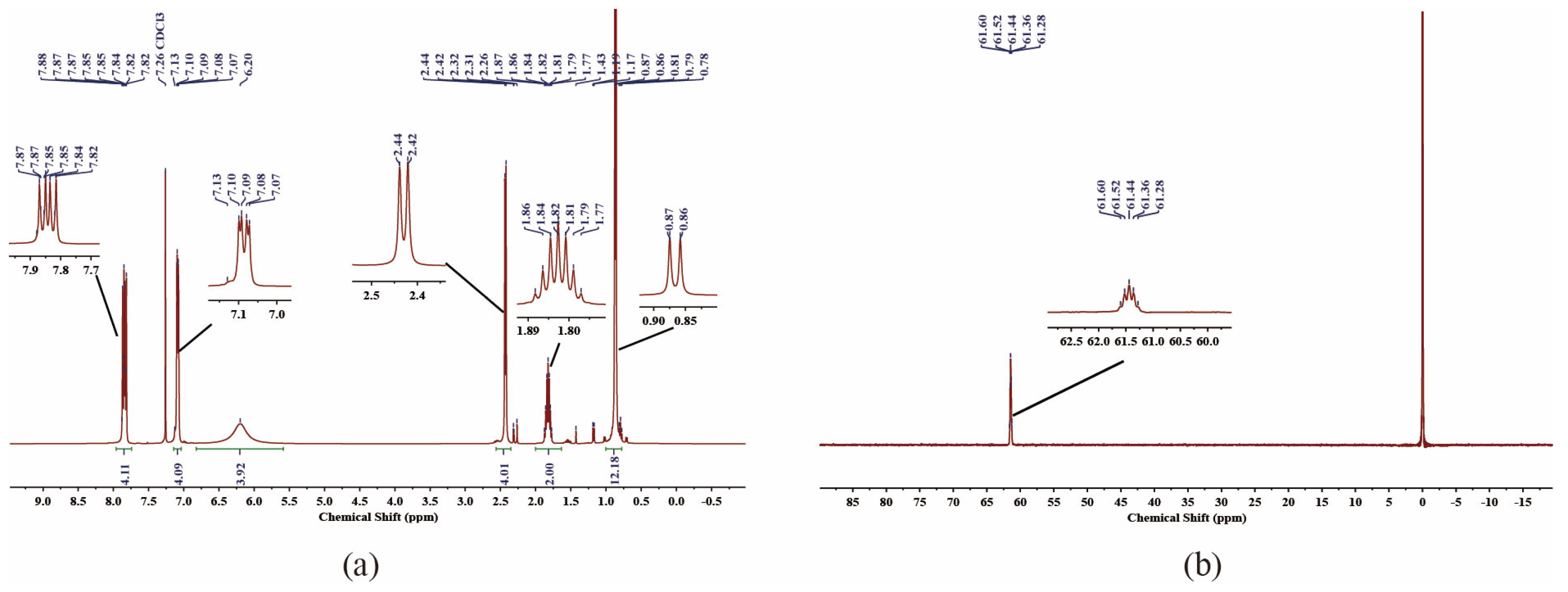
The chemical structure of NH4L was comprehensively characterized using 1H NMR and 31P NMR. The results are presented in Figure 1.
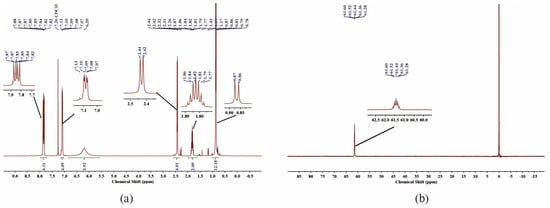
Figure 1.
1H NMR (a) and 31P NMR (b) spectra of NH4L.
1H NMR (400 MHz, CDCl3) δ 7.84 (dd, J = 14.0, 8.0 Hz, 4H, H-a), 7.09 (dd, J = 8.1, 2.9 Hz, 4H, H-b), 6.20 (s, 4H, NH), 2.43 (d, J = 7.2 Hz, 4H, H-c), 1.82 (hept, J = 6.7 Hz, 2H, H-d), 0.87 (d, J = 6.6 Hz, 12H, H-e). 31P NMR (162 MHz, CDCl3) δ 61.44 (p, J = 13.0 Hz, 1P).
The 1H NMR spectrum of this compound exhibits 30 proton signals. In the low-field region, δH 7.84 (dd, J = 14.0, 8.0 Hz, 4H, H-a) and 7.09 (dd, J = 8.1, 2.9 Hz, 4H, H-b) are assigned to the ortho- and meta-phenyl protons adjacent to the phosphorus atom, respectively; δH 6.20 (s, 4H, NH) appears as a broad singlet characteristic of the amino protons. The signals at δH 2.43 (d, J = 7.2 Hz, 4H, H-c), 1.82 (hept, J = 6.7 Hz, 2H, H-d), and 0.87 (d, J = 6.6 Hz, 12H, H-e) correspond to the methylene, methine, and methyl protons of the isobutyl group, respectively. The 31P NMR spectrum displays a single resonance at 61.44 ppm, attributable to the phosphorus atom in the structure. Collectively, these 1H and 31P NMR data confirm the molecular structure as depicted.
The 1H and 31P NMR spectra exhibited no apparent impurity peaks, indicating high purity of the extractant. Meanwhile, given that HL functions as a monoprotic acid, its purity was therefore determined by acid-base titration with a standardized aqueous NaOH solution (0.1 M), affording a purity of 99.5%. The combined results from NMR spectroscopy and titrimetric analysis confirm that the extractant was obtained in a state of purity adequate for subsequent extraction studies. Furthermore, HL exhibits improved solubility in xylene (from <0.3 M to ≈ 0.6 M) compared with its isomeric counterpart bis(tert-butylphenyl)dithiophosphinic acid, which has been verified to have excellent chemical stability [23].
3.2. Stoichiometry of Extracted Am(III) and Cm(III) Complexes
In the NaNO3 aqueous solution, metal ions coordinate with nitrate ions, as described by Equation (3):
For acidic extractants, the extraction of metal ions from dilute acidic solutions typically proceeds via a cation-exchange mechanism, with extraction ability decreasing as acidity increases. This mechanism is represented by the following general equation:
where M3+aq. stands for the Am(III) or Cm(III) metal ion in the aqueous phase, and HLorg. is the extractant concentration in the organic phase, while n is the number of extractant molecules associated with the metal ion and m denotes the number of H+ exchanged.
Based on the definition of the distribution ratio (D), Equation (1) can be rewritten as
In Equation (5), M denotes Am and Cm, and YM represents the complexation degree, YM = 1 + β[NO3−], where β is the first-step stability constant for the complexation of Am and Cm with nitrate. In 1 M NaNO3, YAm = 2.16 [27] and YCm = 1.87 [28].
Then the extraction constant(Kex) based on Equation (4) is defined as
with Equation (5), the logarithmic relation of Equation (6) can be written as
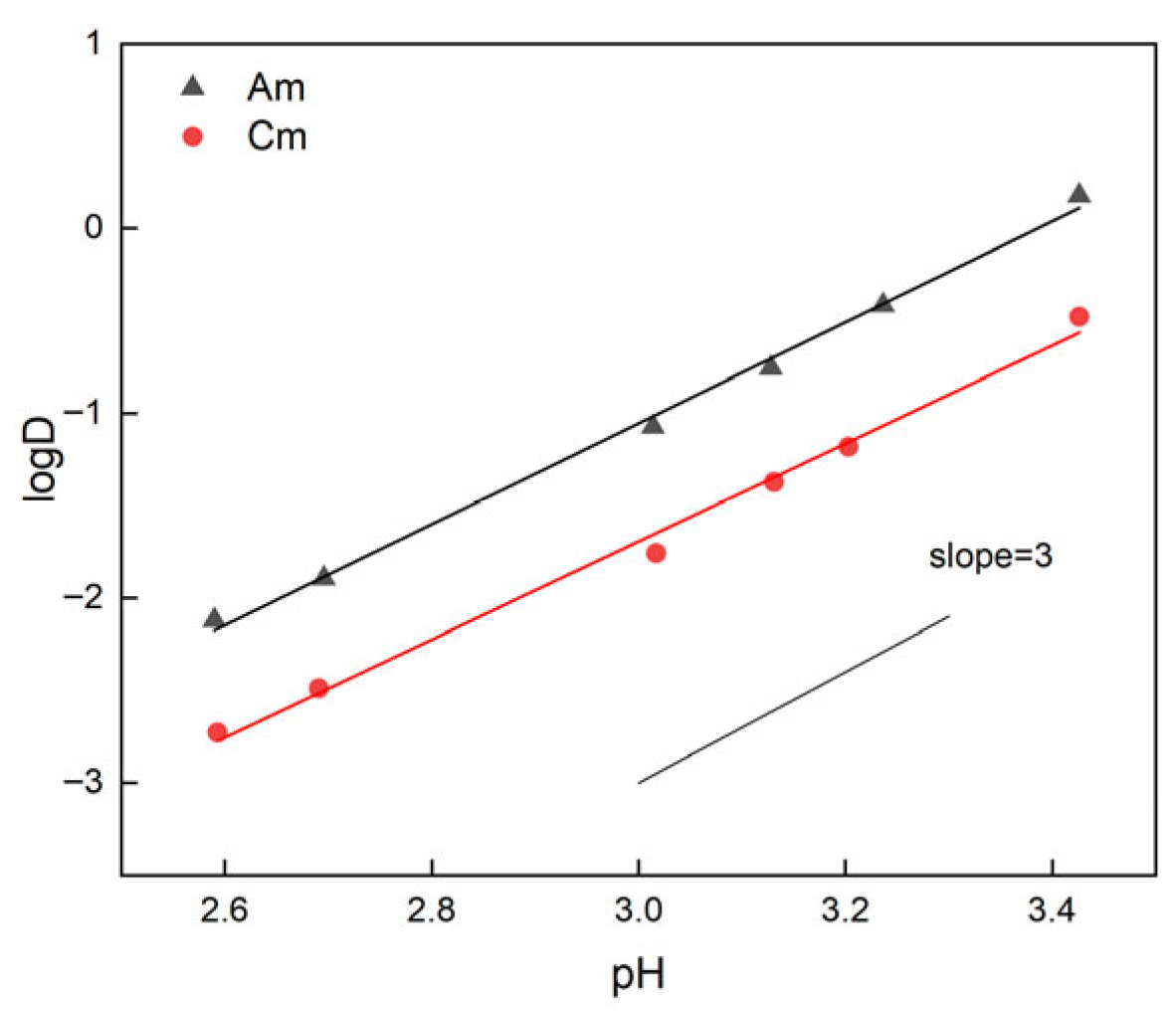
The slope analysis method was employed to elucidate the stoichiometry of the extracted complexes. The dependence of Am(III), Cm(III) extraction on aqueous-phase acidity was investigated at 25 ± 1 °C using an organic phase containing 0.5 M HL. As shown in Figure 2, the distribution ratios of Am(III) and Cm(III) increase with increasing pH of the equilibrated aqueous phase. The logD-pH plots for Am(III) and Cm(III) displayed good linear relationships, each with a slope of approximately 3. As anticipated, the extraction of Am(III) and Cm(III) by HL is governed by the cation-exchange mechanism. During the extraction, one Am(III) or Cm(III) ion is extracted into the organic phase, and spontaneously 3 H+ are released into the corresponding aqueous phase to balance the charge, namely, m = 3 in Equation (4).
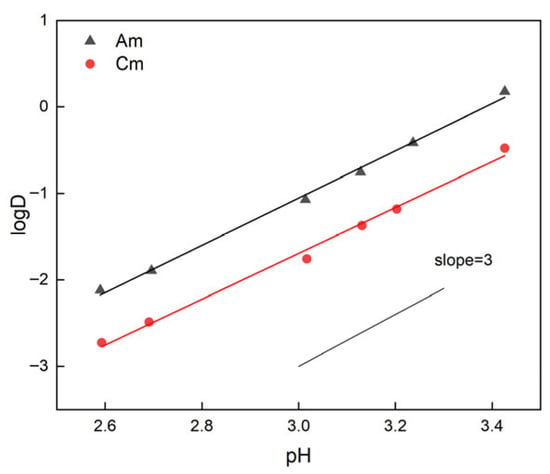
Figure 2.
Effect of pH value of the equilibrated aqueous phase on the Am(III) and Cm(III) extraction. Organic phase: 0.5 M HL in xylene; aqueous phase: trace amounts of Am(III) or Cm(III) in a solution containing 0.5 mM Eu(NO3)3, 0.5 mM Nd(NO3)3 and 1 M NaNO3.
The correlation equations obtained from pH-logD fitting were employed to calculate the pH1/2 values and separation factors SFAm(III)/Cm(III), which are summarized in Table 1. For each of the three replicate experiments, pH1/2 values were determined from the intercept of the respective pH-logD linear fitting equations, and SFAm(III)/Cm(III) at pH 3.5 was calculated individually from the corresponding DAm(III) and D Cm(III) values. The reported values represent the mean ± standard deviation from three independent determinations (n = 3).

Table 1.
The pH1/2 and separation factor for Am(III) and Cm(III) extraction.
As presented in Table 1, the pH1/2 values for Am(III) and Cm(III) are 3.39 ± 0.05 and 3.64 ± 0.04, respectively. Under comparable conditions, the HL301-xylene system gives pH1/2 values of 3.72 for Am(III) and 3.91 for Cm(III) [29], which are higher than those of the present extractant, indicating the latter has stronger extraction capability toward Am(III) and Cm(III). The distribution ratios of Nd(III) and Eu(III) extracted by 0.5 M HL in xylene range from 10−4 to 10−3, indicating negligible extraction of these lanthanides under the studied conditions. Consequently, the SFAm(III)/Eu(III) exceeds 7000 at pH 3.5. Meanwhile, as summarized in Table 2, the separation factor for Am(III) over Cm(III) reaches 4.82 ± 0.06, which is notably higher than that of HL301 (3.61) [29] under the same diluent and concentration conditions, with non-overlapping uncertainty ranges confirming statistical significance. It should be noted, however, that in terms of extraction capability alone, the present extractant is inferior to the chlorophenyl-substituted dithiophosphinic acid [15]. The ability of the extractants to extract metal ions arises from the competition between protons and metal ions for their anionic structures [16]. In the context of the hard/soft acid-base (HSAB) theory, the electron-withdrawing inductive effect of the substituents is expected to diminish the proton affinity of the extractant anion to a greater degree than its affinity for hard metal ions, given that sulfur acts as a soft donor atom. Given the increasing electron-withdrawing ability of substituents in the order of alkyl, alkylphenyl, and chlorophenyl groups, we propose that this sequence is the primary factor responsible for the observed difference in extraction performance.
Table 2.
Comparison of extraction performance of HL, HL301, and bis(o-trifluoromethylphenyl)dithiophosphinic acid.
The effect of extractant concentration on the extraction of Am(III) and Cm(III) was investigated by varying the concentration from 0.2 to 0.5 M while maintaining a constant equilibrium aqueous pH.
According to Equation (7), under constant pH conditions, logD is linearly related to log[HL], and the slope of the line represents the number of extractant molecules participating in the formation of the extracted complex. Given that the metal ion concentration is far lower than the extractant concentration throughout the extraction process, variations in the free extractant concentration can be considered negligible. Furthermore, given the low solubility of the extractant in the aqueous phase, the equilibrium concentration of free extractant in the organic phase can be approximated by its initial concentration.
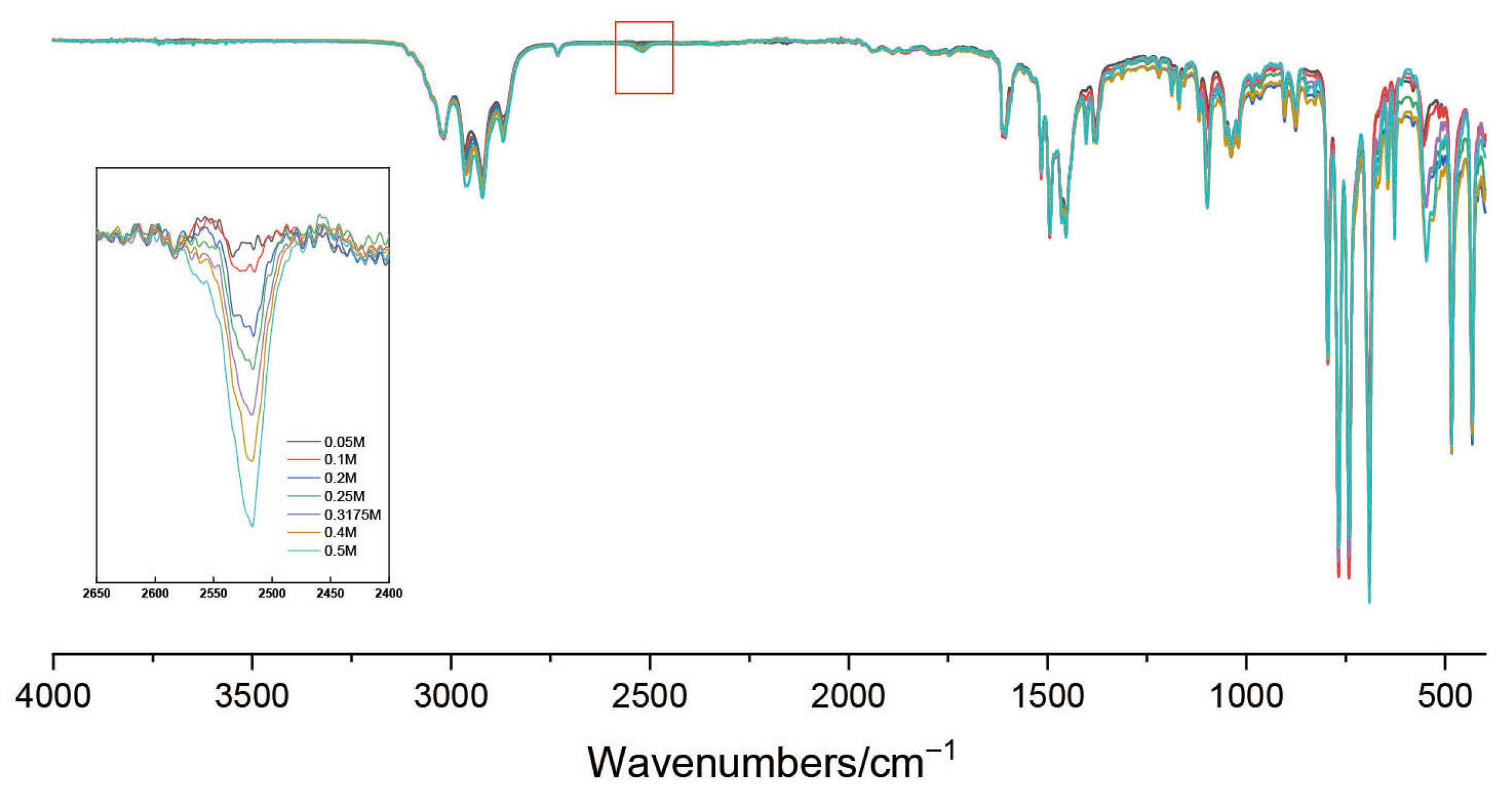
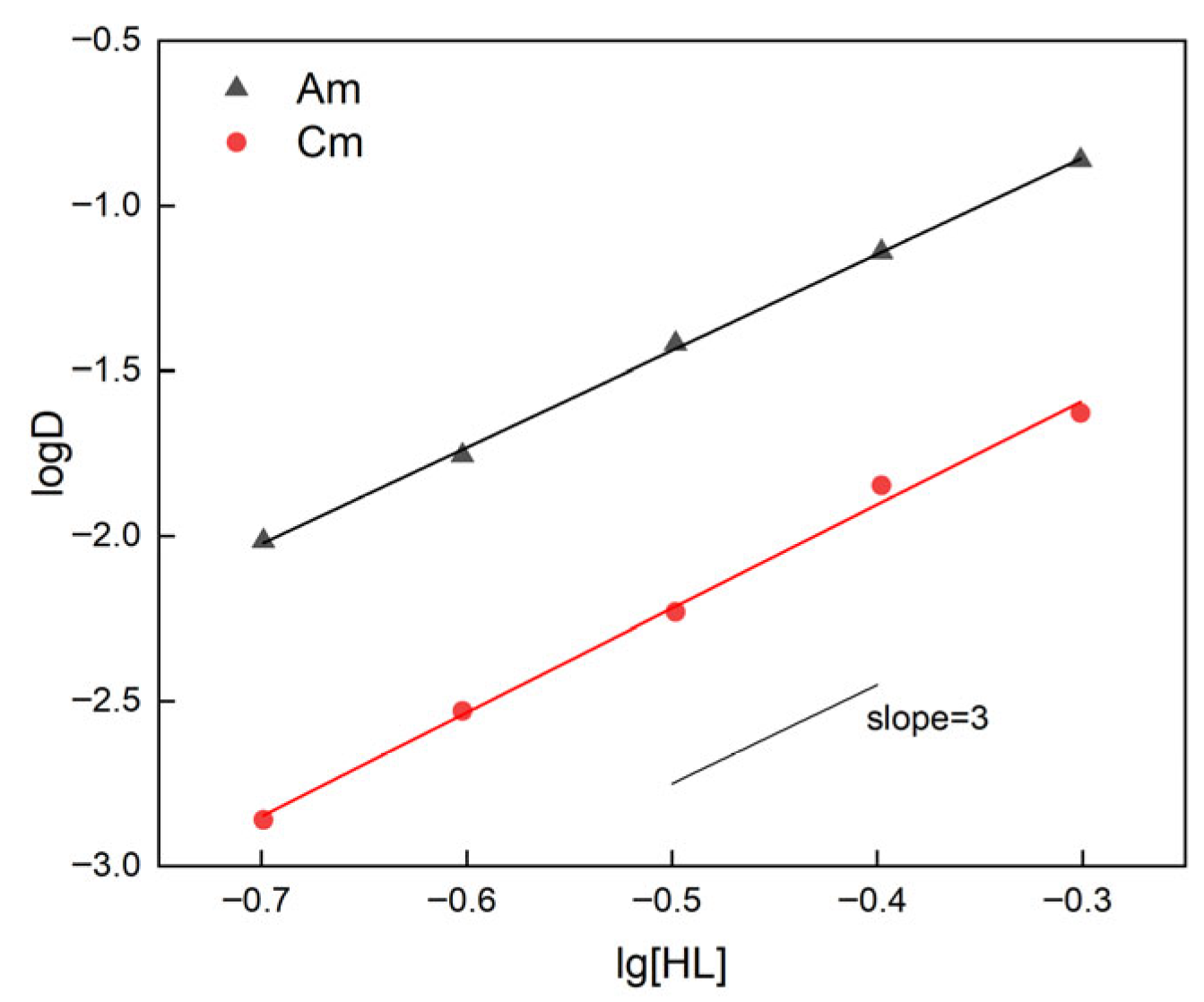
As shown in Figure 3, the slope analysis method was employed to determine the n value in Equation (4). The slopes of the linear lines are 2.92 and 3.14 respectively for Am(III) and Cm(III). Grigorieva et al. [30] investigated the aggregation behavior of HL301 in toluene using IR spectroscopy. The results demonstrated that at HL301 concentrations below 0.4 M, in toluene the extractant existed predominantly in monomeric form, with no observable S–H···S self-association. This was attributed to the formation of S-H···π hydrogen bonds between the S–H group and the aromatic π-electron cloud of toluene, which effectively suppressed the dimer formation. In the context of the present work, it can be reasonably inferred that when the alkyl substituent is replaced by an isobutylphenyl moiety bearing an aromatic ring and the diluent is changed to xylene (a solvent with π-electron density comparable to or even exceeding that of toluene), the S-H···π interaction remains dominant in the 0.2–0.5 M concentration range, thereby effectively inhibiting intermolecular dimerization. The FTIR spectra were recorded for HL in xylene over the concentration range of 0.05–0.5 M. As shown in Figure A1 (Appendix A), the absorption band at approximately 2500 cm−1, assigned to the S–H stretching vibration, exhibited negligible shift. Furthermore, no characteristic band associated with S–H···S interactions appeared in the 2400–2300 cm−1 range over the investigated concentration span. These observations support the deduction. Accordingly, it can be concluded that HL is present mainly as a monomer under the experimental conditions investigated herein, whereas its intermolecular dimerization is negligible. Combined with the slope values approaching 3 as stated above, it is deduced that three molecules of HL participate in the formation of the extracted complexes of Am(III) and Cm(III). Therefore, the extraction mechanism in Equation (4) can be re-written as
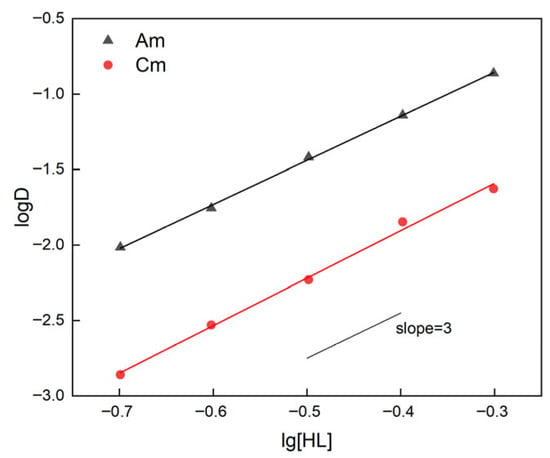
Figure 3.
Effect of extractant concentration on the extraction of Am(III) and Cm(III); [HL] is free ligand concentration; organic phase: 0.2–0.5 M HL in xylene; aqueous phase: trace amounts of Am(III) or Cm(III) in a solution of 0.5 mM Eu(NO3)3, 0.5 mM Nd(NO3)3 and 1 M NaNO3, pH = 3.0.
The extraction of one metal ion consumes three extractant molecules with the release of three H+, forming a 1:3 metal-extractant complex. Despite variations in both substituents and solvent properties, the extraction mechanism identified in this work for HL in xylene is in good agreement with that reported for the extraction of Am(III), Cm(III), and Ln(III) by HL301 in n-dodecane [31]. It is also worth noting that, consistent with the NdL3 (H2O)3 extracted complex identified for Nd(III) extraction by HL301 in kerosene [32], water molecules are expected to be present in the inner coordination sphere of the extracted ML3 complexes reported herein.
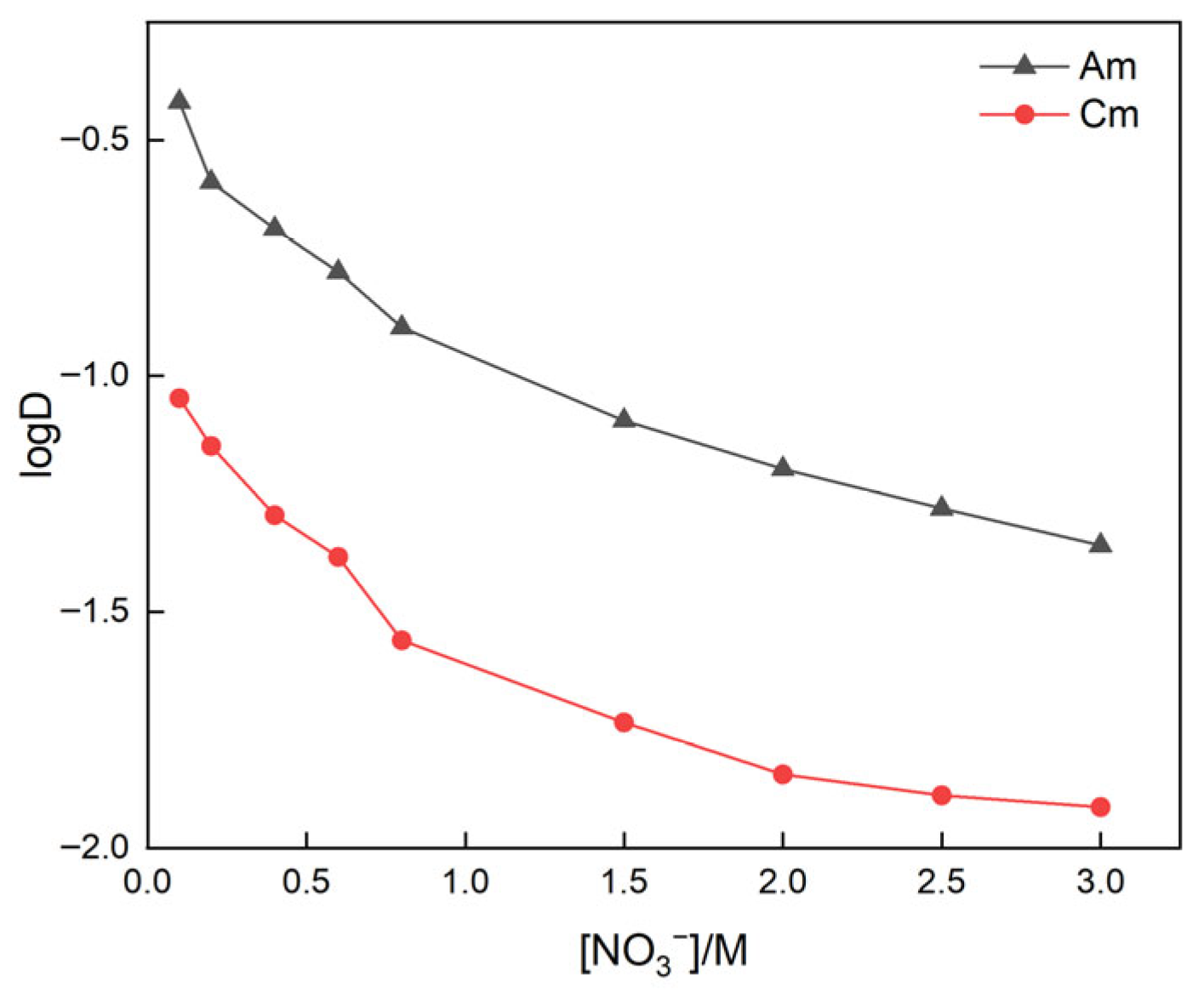
Based on the proposed extraction mechanism, NO3− is not directly involved in the extraction reaction, which proceeds via cation exchange. This is in good agreement with that reported for HL301 in the extraction of Am(III) and Cm(III) [3]. Nevertheless, as actinide and lanthanide separation is predominantly performed in nitrate-containing media, the influence of aqueous nitrate concentration on the extraction of Am(III) and Cm(III) by HL was further examined. As depicted in Figure 4, the distribution ratios for Am(III) and Cm(III) decrease progressively with increasing aqueous nitrate concentration. Previous research on HL301 has revealed that the distribution ratios for Am(III) and Cm(III) extraction diminish as the aqueous NaNO3 concentration increases [30], whereas the substitution of NaNO3 with NaClO4 produces a negligible impact on Cm(III) extraction [33]. The decline in distribution ratios with increasing aqueous NO3− concentration observed herein is primarily ascribed to competitive coordination of NO3− and the extractant toward the metal ions.
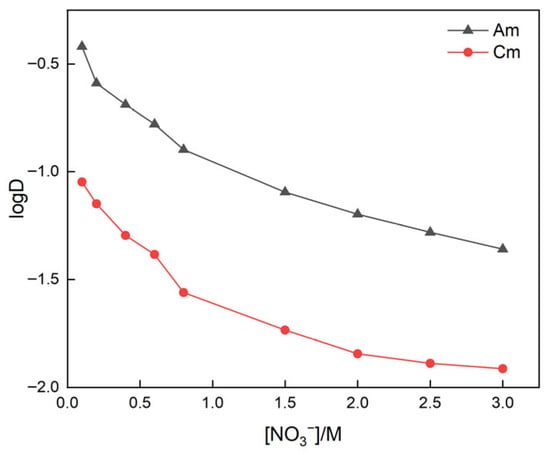
Figure 4.
Effect of aqueous NO3− concentration on the extraction of Am(III) and Cm(III). [NO3−] is free NO3− concentration in aqueous phase; organic phase: 0.5 M HL in xylene; aqueous phase: trace amounts of Am(III) or Cm(III) in a solution of 0.5 mM Eu(NO3)3, 0.5 mM Nd(NO3)3 and 1 M NaNO3, pH = 3.0.
3.3. Effect of Temperature on Am(III) and Cm(III) Extraction
The influence of temperature on the extraction of trivalent actinides was investigated to clarify the thermodynamic parameters governing the extraction process. According to the van Hoff equation, the Gibbs free energy change (ΔG°) for the complexation/extraction reaction is expressed as
with logKex = logD − 3pH − 3log[HL]org. + logYM,
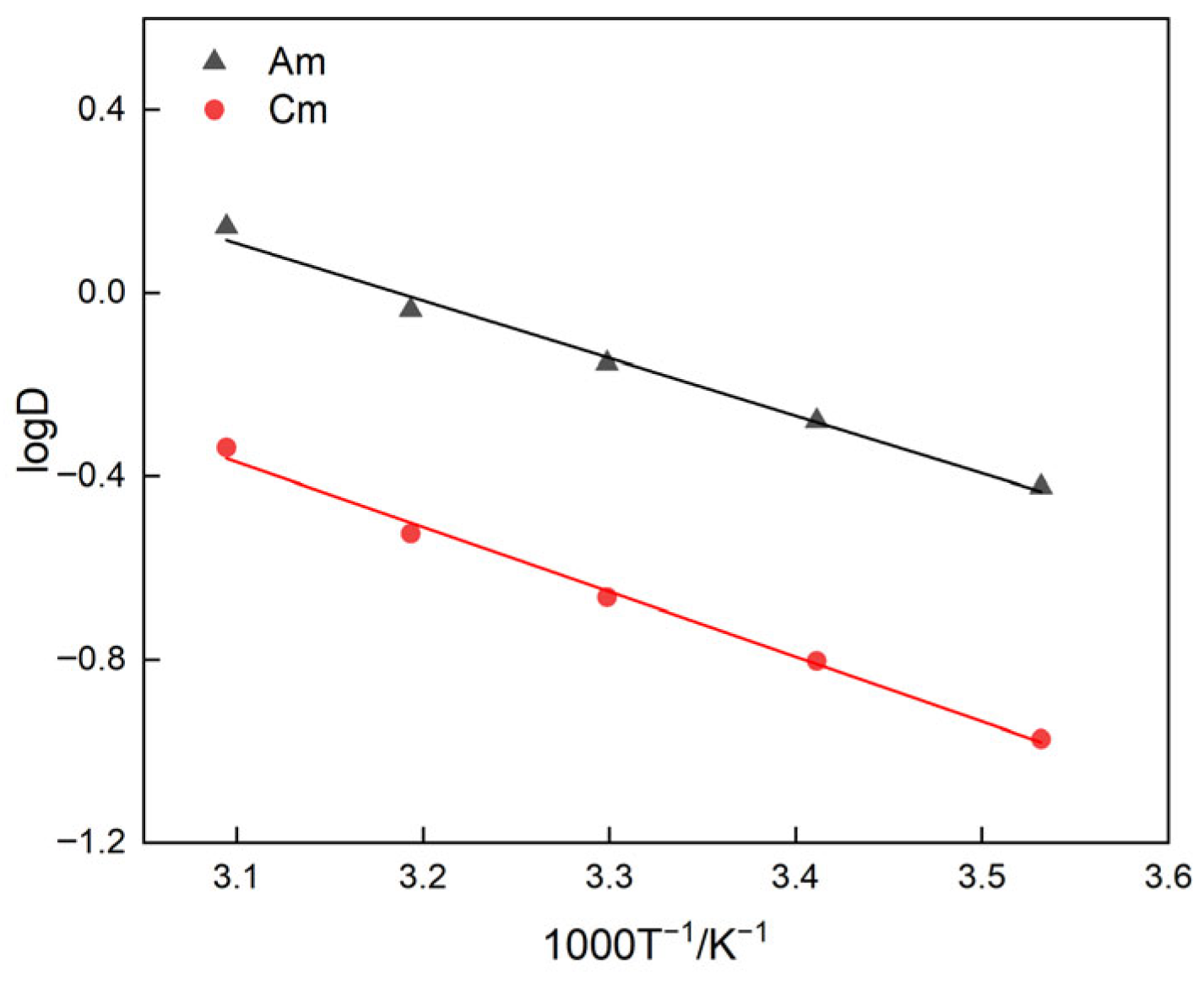
Under identical aqueous-phase pH and organic-phase HL concentrations, C can be regarded as a constant, and a linear relationship is thus observed between log D and 1000/T. As shown in Equation (9), the enthalpy and entropy changes are obtained from the slope and intercept of the linear fit, respectively, which allows for the subsequent calculation of the Gibbs free energy change and log Kex.
The distribution ratios for the extraction of trace amounts of Am(III) and Cm(III) from 1 M NaNO3 solutions containing 0.5 mM Eu(III) and Nd(III) by 0.2 M HL in xylene were determined over the temperature range of 283.15–323.15 K. As illustrated in Figure 5, both plots for Am(III) and Cm(III) exhibit a good linear relationship between logD and 1000/T. The slopes for Am(III) and Cm(III) are −1.26 and −1.42, respectively, with corresponding intercepts of 4.00 and 4.02. The enthalpy change (ΔH°) was calculated from the slope of the linear fit. Subsequently, the Gibbs free energy change (ΔG°), entropy change (ΔS°), and extraction equilibrium constants at 298.15 K were derived from the corresponding thermodynamic equations and summarized in Table 3. The data demonstrate that the extraction reactions for both elements are endothermic (ΔH° > 0) and accompanied by a decrease in entropy (ΔS° < 0). It should be noted that the positive ΔG° values and negative logKex values reflect the standard-state convention where all species including H+ have unit activity (1 M); under actual experimental conditions (pH 2.5–4.0), the extraction proceeds spontaneously with negative ΔG. The logKex for Am(III) is higher than that for Cm(III), with corresponding values of −8.28 and −8.86, respectively, whereas a previous study reported logKex values of −9.91 and −10.48 for the extraction of Am(III) and Cm(III) by HL301 in xylene at 298.15 K and the same ionic strength of 1 M [30]. As also shown in Figure 5, increasing temperature enhances extraction but reduces the separation factor of Am(III) over Cm(III).
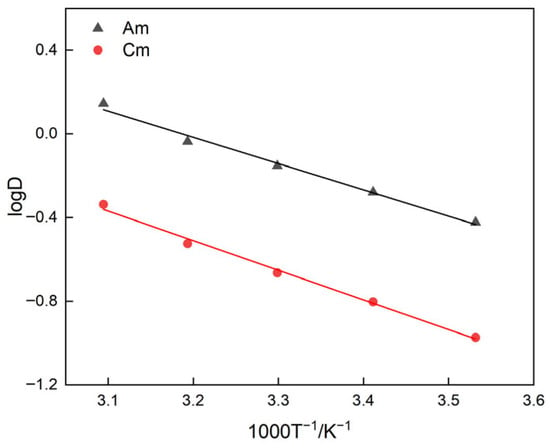
Figure 5.
Extraction behavior of Am(III) and Cm(III) at pH 3.5 in 1 M NaNO3 containing 0.5 mM Eu(NO3)3 and 0.5 mM Nd(NO3)3 with 0.2 M HL in xylene at varying temperature.
Table 3.
Thermodynamic parameters of the extraction reactions of Am(III) and Cm(III) by 0.2 M HL in xylene from 1 M NaNO3 solutions containing 0.5 mM Eu(NO3)3, and 0.5 mM Nd(NO3)3.
4. Conclusions
In this work, a novel extractant, bis(isobutylphenyl)dithiophosphinic acid (HL) of high purity, was successfully prepared, and its extraction behavior toward An(III) and Ln(III) was systematically evaluated. HL exhibits a solubility exceeding 0.5 M in xylene at room temperature, representing improved solubility compared with its isomeric counterpart bis(tert-butylphenyl)dithiophosphinic acid. Compared with conventional HL301, HL displays enhanced extraction ability (lowering the pH1/2 value by approximately 0.3) and improved separation efficiency for Am(III) and Cm(III), achieving a separation factor of 4.8, while maintaining excellent performance in the group separation of An(III) from Ln(III). The extraction of Am(III) and Cm(III) by HL proceeds via a typical cation-exchange mechanism, and no neutral extractant molecules exist in the inner coordination sphere of the extracted complex. The extraction reaction is endothermic with negative entropy changes, whereas increasing the aqueous nitrate concentration suppresses extraction. It should be noted that the radiochemical stability of HL, particularly at the benzylic position, has not been investigated in the present study; this aspect will be addressed as a priority in our future work, given its critical importance for the practical application of actinide separation ligands in spent nuclear fuel reprocessing. Future work should also focus on (1) constructing synergistic extraction systems based on the extractant developed herein, (2) developing processes for specific separation scenarios, and (3) elucidating the complexation mechanism between such soft sulfur-donor ligands and hard actinide/lanthanide ions, particularly from the viewpoints of molecular orbital analysis and chemical bonding.
Author Contributions
Conceptualization, methodology, Q.S. and S.Y.; validation, X.H., J.L., J.Z. and S.Y.; formal analysis, investigation, Q.S.; resources, S.Y.; data curation, Q.S., X.H., J.L. and S.Y.; writing—original draft preparation, Q.S.; writing—review and editing, X.H., J.L., J.Z. and S.Y.; visualization, supervision, project administration, funding acquisition, S.Y. All authors have read and agreed to the published version of the manuscript.
Funding
This research received no external funding.
Data Availability Statement
The original contributions presented in this study are included in the article. Further inquiries can be directed to the corresponding author.
Conflicts of Interest
The authors declare that the research was conducted in the absence of any commercial or financial relationships that could be construed as a potential conflict of interest.
Abbreviations
The following abbreviations are used in this manuscript:
| HL301 | Bis(2,4,4-trimethylpentyl)dithiophosphinic acid |
| HL | Bis(isobutylphenyl)dithiophosphinic acid |
| An(III) | Trivalent actinides |
| Ln(III) | Trivalent lanthanides |
| SF | Separation Factor |
| D | Distribution Ratio |
Appendix A
A series of HL solutions in xylene were prepared at concentrations ranging from 0.05 to 0.5 M. The FTIR spectra were recorded on a Thermo Scientific Nicolet iS50 FT-IR equipped with an attenuated total reflectance (ATR) accessory. For each measurement, a background spectrum of pure xylene was collected and automatically subtracted. The sample compartment was purged with dry nitrogen to minimize interference from atmospheric CO2 and water vapor. Spectra were acquired in the range of 4000–400 cm−1 with a resolution of 4 cm−1 and 32 scans per spectrum. A fresh background was collected prior to each sample measurement. The S–H stretching region (2600–2300 cm−1) was carefully examined for any shifts in peak position or emergence of hydrogen-bonded S–H···S bands indicative of aggregation. All measurements were performed at room temperature (25 ± 1 °C). The results are shown in Figure A1.
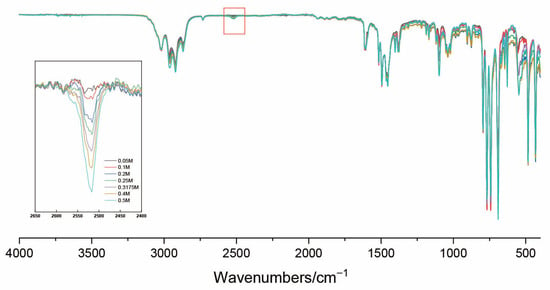
Figure A1.
FTIR spectra of HL in xylene over the concentration range of 0.05–0.5 M.
References
- Croff, A.G.; Blomeke, J.O.; Finney, B.C. Actinide Partitioning-Transmutation Program Final Report. I. Overall Assessment; ORNL-5566; Oak Ridge National Laboratory: Oak Ridge, TN, USA, 1980. [Google Scholar] [CrossRef]
- Chen, J.; Zhu, Y.; Jiao, R. The Separation of Am from Lanthanides by Purified Cyanex 301 Extraction. Sep. Sci. Technol. 1996, 31, 2723–2731. [Google Scholar] [CrossRef]
- Zhu, Y.; Chen, J.; Jiao, R. Extraction of Am(III) and Eu(III) from Nitrate Solution with Purified Cyanex 301. Solvent Extr. Ion. Exch. 1996, 14, 61–68. [Google Scholar] [CrossRef]
- Hill, C.; Madic, C.; Baron, P.; Ozawa, M.; Tanaka, Y. Trivalent Minor Actinides/Lanthanides Separation, Using Organophosphinic Acids. J. Alloys Compd. 1998, 271–273, 159–162. [Google Scholar] [CrossRef]
- Jensen, M.P.; Bond, A.H. Comparison of Covalency in the Complexes of Trivalent Actinide and Lanthanide Cations. J. Am. Chem. Soc. 2001, 124, 9870–9877. [Google Scholar] [CrossRef]
- Zhu, Y.; Chen, J. Separation of Americium from Fission Product Lanthanides Using Cyanex 301 Extraction. Tsinghua Sci. Technol. 2001, 6, 151–155. [Google Scholar]
- Chen, J.; Veltkamp, A.C.; Booij, A.S. Separation of Trivalent Americium and Europium by Purified Cyanex 301 Immobilized in Macro Porous Polymer. J. Radioanal. Nucl. Chem. 2002, 253, 31–34. [Google Scholar] [CrossRef]
- Chen, J.; Tian, G.; Jiao, R.; Zhu, Y. A Hot Test for Separating Americium from Fission Product Lanthanides by Purified Cyanex 301 Extraction in Centrifugal Contactors. J. Nucl. Sci. Technol. 2002, 39, 325–327. [Google Scholar] [CrossRef]
- Cao, X.; Heidelberg, D.; Ciupka, J.; Dolg, M. First-Principles Study of the Separation of AmIII/CmIII from EuIII with Cyanex301. Inorg. Chem. 2010, 49, 10307–10315. [Google Scholar] [CrossRef] [PubMed]
- Bhattacharyya, A.; Ghanty, T.K.; Mohapatra, P.K.; Manchanda, V.K. Selective Americium(III) Complexation by Dithiophosphinates: A Density Functional Theoretical Validation for Covalent Interactions Responsible for Unusual Separation Behavior from Trivalent Lanthanides. Inorg. Chem. 2011, 50, 3913–3921. [Google Scholar] [CrossRef]
- Peng, Y.; Chen, J. Extraction of Am3+ and Eu3+ From Different Aqueous Media by Bis(2,4,4-Trimethyl)DithioPhosphinic Acid. J. Nucl. Radiochem. 2006, 28, 178–182. [Google Scholar]
- Liang, J.; Li, Q. Extraction and Separation Study of Am and Cm by Cyanex 301 Extractant. J. Nucl. Radiochem. 2005, 27, 220–224. [Google Scholar] [CrossRef]
- Tian, G.; Zhu, Y.; Xu, J. Extraction of Am(III) and Ln(III) by Dialkyldithiophosphinic Acid with Different Alkyl Groups. Solvent Extr. Ion. Exch. 2001, 19, 993–1005. [Google Scholar] [CrossRef]
- Tian, G.; Zhu, Y.; Xu, J.; Zhang, P. Investigation of the Extraction Complexes of Light Lanthanides(III) with Bis(2,4,4-Trimethylpentyl)Dithiophosphinic Acid by EXAFS, IR, and MS in Comparison with the Americium(III) Complex. Inorg. Chem. 2003, 42, 735–741. [Google Scholar] [CrossRef]
- Peterman, D.R.; Martin, L.R.; Klaehn, J.R.; Harrup, M.K.; Greenhalgh, M.R.; Luther, T.A. Selective Separation of Minor Actinides and Lanthanides Using Aromatic Dithiophosphinic and Phosphinic Acid Derivatives. J. Radioanal. Nucl. Chem. 2009, 282, 527–531. [Google Scholar] [CrossRef]
- Peterman, D.R.; Greenhalgh, M.R.; Tillotson, R.D.; Klaehn, J.R.; Harrup, M.K.; Luther, T.A.; Law, J.D. Selective Extraction of Minor Actinides from Acidic Media Using Symmetric and Asymmetric Dithiophosphinic Acids. Sep. Sci. Technol. 2010, 45, 1711–1717. [Google Scholar] [CrossRef]
- Klaehn, J.R.; Peterman, D.R.; Harrup, M.K.; Tillotson, R.D.; Luther, T.A.; Law, J.D.; Daniels, L.M. Synthesis of Symmetric Dithiophosphinic Acids for “Minor Actinide” Extraction. Inorg. Chim. Acta 2008, 361, 2522–2532. [Google Scholar] [CrossRef]
- Xu, Q.; Wu, J.; Chang, Y.; Zhang, L.; Yang, Y. Extraction of Am(III) and Lanthanides(III) with Organo Dithiophosphinic Acids. Radiochim. Acta 2008, 96, 771–779. [Google Scholar] [CrossRef]
- Boland, K.S.; Hobart, D.E.; Kozimor, S.A.; MacInnes, M.M.; Scott, B.L. The Coordination Chemistry of Trivalent Lanthanides (Ce, Nd, Sm, Eu, Gd, Dy, Yb) with Diphenyldithiophosphinate Anions. Polyhedron 2014, 67, 540–548. [Google Scholar] [CrossRef]
- Pu, N.; Xu, L.; Sun, T.; Chen, J.; Xu, C. Tremendous Impact of Substituent Group on the Extraction and Selectivity to Am(III) over Eu(III) by Diaryldithiophosphinic Acids: Experimental and DFT Analysis. J. Radioanal. Nucl. Chem. 2019, 320, 219–226. [Google Scholar] [CrossRef]
- Pu, N.; Su, J.; Xu, L.; Sun, T.; Batista, E.R.; Chen, J.; Yang, P.; Shafer, J.C.; Xu, C. “Sweeping” Ortho Substituents Drive Desolvation and Overwhelm Electronic Effects in Nd3+ Chelation: A Case of Three Aryldithiophosphinates. Inorg. Chem. 2020, 59, 161–171. [Google Scholar] [CrossRef]
- Cao, Y.; Liu, Q.; Deng, Q.; Zhang, S.; Hao, X.; Yang, Q.; Yang, S.; Zhang, S.; Tian, G. Revisiting the Selective Extraction/Separation of Trivalent Actinides from Lanthanides Using Di-p-Methylpheneyldithiophosphinic Acid as Extractant and TBP as Synergist. Inorg. Chem. Commun. 2026, 185, 116048. [Google Scholar] [CrossRef]
- Deng, Q.; Cao, Y.; Liu, Q.; Yang, Y.; Yang, S.; Tian, G.; Zhang, S. Extraction of Th(IV) From Nitric Acid-Sodium Nitrate Media With Bis(p-Tert-Butylphenyl)Dithiophosphinic Acid. J. Nucl. Radiochem. 2025, 47, 118–125, (In Chinese with English abstract). [Google Scholar] [CrossRef]
- Modolo, G.; Kluxen, P.; Geist, A. Demonstration of the LUCA Process for the Separation of Americium(III) from Curium(III), Californium(III), and Lanthanides(III) in Acidic Solution Using a Synergistic Mixture of Bis(Chlorophenyl)Dithiophosphinic Acid and Tris(2-Ethylhexyl)Phosphate. Radiochim. Acta 2010, 98, 193–201. [Google Scholar] [CrossRef]
- Shahr El-Din, A.; Rizk, H.; Attallah, M. Purification of Carrier-Free 47Sc of Biomedical Interest: Selective Separation Study from natCa(n,γ). Separations 2022, 10, 8. [Google Scholar] [CrossRef]
- Sun, R.; Li, F.; Xie, Y.; Sui, N.; Li, Y.; Wang, J. Synthesis of Novel γ-Carbon-Substituted Dialkylphosphinic Acids (P355/P227-355): Unraveling Structural Symmetry Effects on Middle Rare Earth Separation and Extraction Mechanism. Separations 2025, 12, 303. [Google Scholar] [CrossRef]
- Tian, G.; Shuh, D.K. A Spectrophotometric Study of Am(III) Complexation with Nitrate in Aqueous Solution at Elevated Temperatures. Dalton Trans. 2014, 43, 14565–14569. [Google Scholar] [CrossRef] [PubMed]
- Rao, L.; Tian, G. The Effect of Temperature on the Complexation of Cm(III) with Nitrate in Aqueous Solutions. Dalton Trans. 2011, 40, 914–918. [Google Scholar] [CrossRef]
- Pu, T.; Yang, Q.; Sui, Q.; Deng, Q.; Zhou, J.; Hao, X.; Zhang, H.; Liu, Q.; Yang, S.; Tian, G. Enhanced Separation of Americium and Curium in Cyanex301 System by Using Formic Acid and Glycolic Acid as Stripping Chelates. Solvent Extr. Ion. Exch. 2024, 42, 381–393. [Google Scholar] [CrossRef]
- Grigorieva, N.A.; Pavlenko, N.I.; Pleshkov, M.A.; Pashkov, G.L.; Fleitlikh, I.Y. Investigation of the State of Bis(2,4,4-Trimethylpentyl)Dithiophosphinic Acid in Nonane and Toluene Solutions. Solvent Extr. Ion. Exch. 2009, 27, 745–760. [Google Scholar] [CrossRef]
- Jensen, M.P.; Bond, A.H. Influence of Aggregation on the Extraction of Trivalent Lanthanide and Actinide Cations by Purified Cyanex 272, Cyanex 301, and Cyanex 302. Radiochim. Acta 2002, 90, 205–209. [Google Scholar] [CrossRef]
- Guo, Q.; Fang, T.; Liu, Q.; Zhu, L.; Yang, S.; Tian, G. Identification of Complexes of Nd(III) with Dithiophosphinic Acids Verifying the Difference in Complexation between Ln(III) and An(III). Dalton Trans. 2022, 51, 7416–7419. [Google Scholar] [CrossRef]
- Li, Q.; Liang, J. Study on Extraction of 244Cm by HBTMPDTP. J. Nucl. Radiochem. 2003, 25, 173–176. [Google Scholar]
Disclaimer/Publisher’s Note: The statements, opinions and data contained in all publications are solely those of the individual author(s) and contributor(s) and not of MDPI and/or the editor(s). MDPI and/or the editor(s) disclaim responsibility for any injury to people or property resulting from any ideas, methods, instructions or products referred to in the content. |
© 2026 by the authors. Licensee MDPI, Basel, Switzerland. This article is an open access article distributed under the terms and conditions of the Creative Commons Attribution (CC BY) license.