


Abstract
Sludge electro-dewatering has emerged as a research hotspot in advanced sludge treatment due to its ability to effectively remove interstitial water that is difficult to separate by mechanical dewatering. This paper systematically reviews the fundamental principles, key influencing factors, evolution of electrode materials, and engineering applications of electro-dewatering technology. Emphasis is placed on analyzing the effects of sludge properties, electric field parameters, and electrochemical reactions on dewatering efficiency. The characteristics and applicable scenarios of three generations of electrode materials—from conventional metal electrodes and carbon-based materials to dimensionally stable anodes (DSA)—are summarized. Current challenges include insufficient electrode stability, the trade-off between energy consumption and efficiency, limited understanding of underlying micro-scale mechanisms, and difficulties in process scale-up. Future efforts should focus on the development of high-performance electrode materials, investigation of multi-field coupling enhancement mechanisms, establishment of machine learning-based intelligent control strategies, and engineering design of continuous electro-dewatering equipment to promote its large-scale application in sludge treatment and disposal.
1. Introduction
The activated sludge process, as one of the major inventions in the field of environmental engineering in the 20th century, plays an irreplaceable role in wastewater treatment worldwide. However, biochemical wastewater treatment inevitably generates substantial amounts of excess sludge. The harmless treatment and safe disposal of sludge have become common technical challenges faced by China’s environmental protection industry. Sludge from municipal wastewater treatment plants not only exhibits high moisture content, susceptibility to decomposition, and strong odor, but also contains significant quantities of pathogens, parasite eggs, heavy metals such as chromium and mercury, as well as refractory toxic and carcinogenic substances including polycyclic aromatic hydrocarbons. Improper disposal of untreated sludge through arbitrary stacking, subjected to rainfall erosion and infiltration, can readily cause secondary contamination of groundwater and soil, thereby posing direct threats to human health. Given the inherent characteristics of sludge, effective treatment and disposal have become imperative requirements for social development [1]. According to incomplete statistics, currently only about 10% of the sludge from municipal wastewater treatment plants nationwide is treated and disposed of through technologies such as composting for land application. Approximately 20% is disposed of by landfilling, while a small portion is treated via incineration or utilized in building materials. The majority of the remaining sludge is arbitrarily transported out, simply landfilled, or stacked without proper treatment, posing significant ecological and environmental risks. Concurrently, with the issuance of the *Water Pollution Prevention and Control Action Plan* by the State Council in 2015, the Chinese government has set clear requirements for promoting sludge treatment and disposal. It mandates that sludge generated from wastewater treatment facilities must undergo stabilization, harmless treatment, and resource utilization. Specifically, existing sludge treatment and disposal facilities were required to complete upgrading to meet standards by the end of 2017. Furthermore, the harmless treatment and disposal rate of sludge in prefecture-level cities and above should reach over 90% by the end of 2020. As a prominent research focus in the current field of environmental engineering, the development of efficient sludge harmless treatment technologies is of great significance for enhancing the sustainability of wastewater treatment [2].
Sludge primarily consists of microbial cells, extracellular polymeric substances (EPS), inorganic minerals, and other pollutants such as heavy metals, along with a substantial amount of water within the sludge matrix [3,4]. The extracellular polymeric substances (EPS) within the sludge matrix form a gel-like network structure that enmeshes microbial cells within flocs, thereby enhancing microbial water retention and resistance to hazardous pollutants. As the primary component of sludge flocs, EPS accounts for 60–80% of the total sludge biomass. It not only influences pollutant removal but also significantly affects the flocculation characteristics, settleability, dewaterability, and stability of activated sludge [5,6,7]. Sludge is a highly hydrophilic and heterogeneous colloid-like system, typically characterized by a high density of negatively charged surface sites, which confer relative dynamic stability in water through electrostatic repulsion. The gel-like structure formed by extracellular polymeric substances (EPS), as the primary constituent, binds water molecules via steric hindrance, thereby endowing sludge with viscoelastic properties that pose significant challenges for mechanical dewatering.
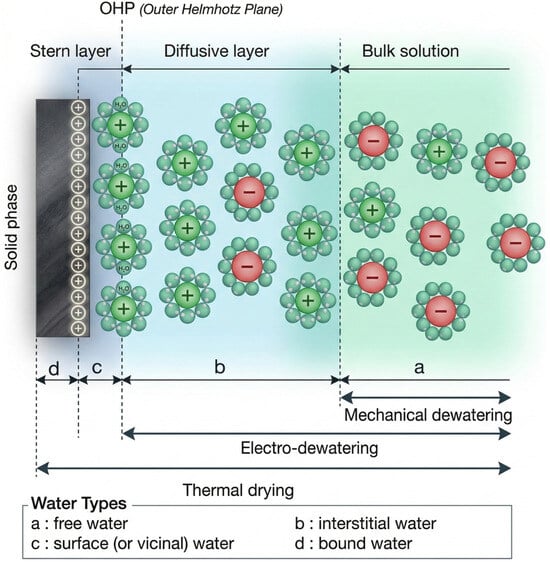
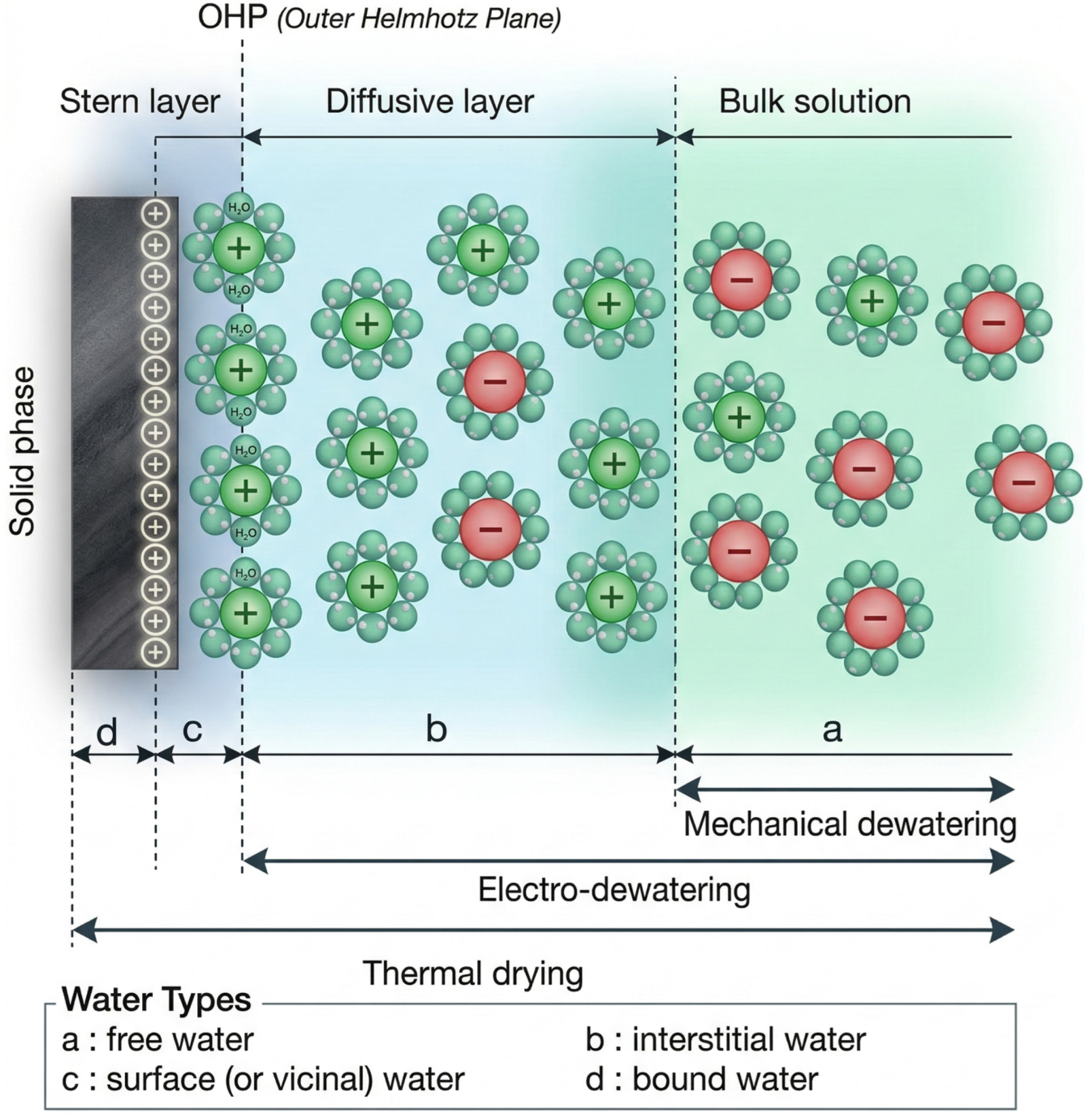
As shown in Figure 1, Vesilind and Robinson et al. proposed a classification for the distribution of water within the sludge matrix [8]. They categorized the water in sludge into four main types: (1) free water, primarily consisting of unbound water not attached to sludge particles (including void water unaffected by capillary forces); (2) interstitial water, which is entrapped within sludge floc structures; (3) surface water, held onto sludge particle surfaces through adsorption and adhesion; and (4) bound water, mainly existing within the cells of microorganisms in the sludge. The spatial distribution of these water fractions dictates the energy input required for their removal. Figure 1 illustrates the regional distribution of each water type within the sludge and the corresponding dewatering technologies applicable for their removal. As depicted in Figure 1, free water in sludge can be removed by mechanical dewatering, interstitial water requires electro-dewatering technology, while thermal drying techniques can remove the entire moisture content, including both surface water and bound water [9]. In practical engineering applications, thermal drying technology has not been widely adopted due to its high energy consumption. In contrast, sludge electro-dewatering technology has emerged as a mainstream approach in the field of sludge dewatering, owing to its high dewatering efficiency and relatively low cost.
Figure 1.
Dewatering methods in relation to water distribution in the materials.
Research on sludge electro-dewatering has a long history. In 1803, Peuce first discovered the electro-osmosis phenomenon, and in 1903, electro-dewatering technology was first applied industrially for solid–liquid separation [10,11]. In 1994, Smollen et al. in South Africa conducted pilot-scale experiments on an electro-dewatering-assisted belt filter press for sludge dewatering at wastewater treatment plants. The study confirmed that electro-dewatering technology exhibits significant advantages in dewatering viscous fine-particle sludge, as it can not only reduce the dosage of chemical conditioning agents but also increase the solid content of the sludge cake [12]. Raats et al. from Eindhoven University of Technology in the Netherlands conducted experimental research on an electro-assisted belt filter press for dewatering sludge from water treatment plants. The results showed that after applying electro-dewatering technology, the solid content of the dewatered sludge cake increased from 17% to 24%. In addition, several pilot-scale studies on sludge electro-assisted belt filter press technology have been conducted in recent years. Regarding the overall dewatering performance, although the application of an electric field improved the dewatering efficiency of the belt filter press, it still fell considerably short of achieving the goal of advanced sludge dewatering [13,14]. Saveyn from Ghent University in Belgium and Lee from Pusan National University in South Korea, among others, conducted pilot-scale experimental research on the dewatering of sludges from different sources using an electro-dewatering assisted filter press. They found that under electric field-assisted conditions, the moisture content of sludge cake obtained from filter pressing after conditioning with polyelectrolyte (without the need for filter aids) could be reduced from approximately 20–25% to below 60% [15,16].
2. Fundamental Principles and Process of Electro-Dewatering
The fundamental principle of electro-dewatering is as follows: sludge flocs are typically negatively charged. Under an applied electric field, these negatively charged sludge flocs migrate toward the anode, thereby driving the permeation of water toward the cathode [17,18]. According to the analysis by Barton et al., the electro-dewatering process mainly consists of the following steps [19]: (1) mechanical expression reduces the pore volume of the sludge and expels water from the sludge flocs; (2) charged particles move freely in the fluid suspension and tend to migrate toward the electrode carrying the opposite charge; (3) once a filter cake is formed, the flocs are locked in place and become immobile, while ion-containing water is transported through molecular interactions; (4) electrochemical reactions at the electrodes are required to restore charge balance, enabling the electro-dewatering process to proceed beyond the transitional stage; (5) when water is no longer the continuous phase within the filter cake, the increase in electrical resistance leads to ohmic heating, and the resulting reduction in viscosity facilitates the removal of some residual water.
3. Factors Influencing Sludge Electro-Dewatering
During the electro-dewatering process, the Helmholtz–Smoluchowski (H-S) equation is commonly used to describe the flow rate of liquid driven by electro-osmosis, as shown in Equation (1):
where: V represents the electro-dewatering rate; D is the dielectric constant of the sludge; μ is the viscosity of the sludge; ζ is the Zeta potential of the sludge; ∇φ is the applied electric field strength. It can be seen from Equation (1) that the electro-dewatering rate of sludge is primarily determined by the intrinsic properties of the sludge itself, such as Zeta potential, dielectric constant, and viscosity, as well as by the parameters of the applied electric field, such as the voltage gradient. The sludge electro-dewatering system essentially functions as an electrochemical cell, where electrochemical reactions occur at both the cathode and anode during the dewatering process. These reactions significantly influence the electro-dewatering performance. The primary reactions at the cathode are represented by Equations (2)–(4), while those at the anode are represented by Equations (5) and (6).
where Mn+ represents heavy metal cations. These chemical reactions are influenced not only by the electrode material but also by the ionic content within the sludge system. The electrochemical reactions affect the sludge electro-dewatering process primarily in the following aspects:
2H2O + 2e− → H2 + 2OH−
2H3O− + 2e− → 2H2O + H2
Mn+ + ne− → M
M → Mn− + ne−
2H2O → O2 + 4H+ + 4e−
(a) Equation (2) generates OH−, while reaction (6) generates H+, which induces a pH gradient effect during the sludge electro-dewatering process. This pH gradient effect can deteriorate the sludge properties [20,21]. Furthermore, according to reports by Aziz et al., the pH gradient effect can influence the state of flocs. For sludge systems, when the pH decreases from 10 to 3, the Zeta potential of the flocs increases from −90 mV to −20 mV, indicating that the sludge flocs have changed from a dispersed state to an aggregated state, thereby affecting the electro-dewatering performance. Studies by Tuan et al. have found that the decrease in pH is associated with a reduction in the absolute value of the Zeta potential, and consequently, the pH reduction in a direct-current electric field influences the electro-osmotic effect [22].
(b) The gases generated by electrochemical reactions, such as O2 and H2, can create numerous voids between the sludge and the electrode plates, forming an insulating layer on the electrode surface and thereby increasing the overall resistance of the sludge system. Additionally, potentially explosive gases may be produced, introducing certain hazards during the electro-dewatering process. According to reports by Weber et al., incorporating ventilation equipment during electro-dewatering can effectively reduce the concentration of explosive gases, thereby mitigating the risks associated with the process [23]. The generation of gases increases the resistance to water flowing out of the pores, thereby affecting the electro-dewatering performance [20].
4. Evolution of Electrode Materials
Electrode materials constitute a core component of sludge electro-dewatering systems, and their physicochemical properties directly determine dewatering efficiency, operational stability, and treatment costs [24]. Under the continuous influence of an electric field, oxidation reactions inevitably occur on the anode surface, which not only leads to the gradual loss of electrode materials and shortens their service life, but may also contaminate the dewatered filter cake and filtrate due to the dissolution of metal ions, thereby increasing the environmental risks and operational burdens associated with subsequent disposal. Therefore, selecting electrode materials that combine good electrical conductivity, corrosion resistance, mechanical strength, and economic viability is a critical prerequisite for the engineering application of electro-dewatering technology [1].
The initial chemical purity of electrode materials is a primary factor determining the energy efficiency, electrochemical stability, and service life of sludge electro-osmotic dewatering systems [25]. At the level of electrochemical kinetics, trace impurities in the material (e.g., inorganic ash in carbonaceous materials or heteroatoms in metal substrates) often alter the charge transfer resistance and the oxygen/hydrogen evolution overpotentials at the electrode surface. High-purity electrode materials (e.g., titanium substrates with purity > 99.9% or high-purity graphite) provide a wider electrochemical stability window, effectively suppressing the parasitic water electrolysis reaction during dewatering [26]. If the material purity is insufficient, impurity sites typically exhibit a low oxygen evolution overpotential, causing a substantial portion of electrical energy to be dissipated as oxygen gas rather than driving electro-osmotic water flow, thereby significantly reducing the effective current efficiency of the system [27,28].
Furthermore, the initial purity is closely related to the long-term operational stability of the electrodes. In the complex chemical environment of sludge (rich in aggressive ions such as Cl− and SO42−), heterogeneous impurities can induce a micro-galvanic effect on the electrode surface, leading to severe localized breakdown of the passive layer [29]. This non-uniform surface chemistry not only accelerates the physical degradation of the electrode material but also causes overheating due to excessive local current density, further deteriorating the dewatering uniformity of the sludge cake.
From the perspective of resource utilization, the application of high-purity electrodes effectively controls the risk of secondary pollution during dewatering. Low-purity metal electrodes, under anodic electrochemical dissolution, may introduce trace heavy metal impurities into the sludge cake, which contradicts the environmental goal of sludge volume reduction and subsequent land application [30]. Therefore, improving the chemical purity of electrode materials is not only a technical measure to reduce kWh/t (specific energy consumption per ton of dewatered sludge) but also a core pathway to ensure the advancement of the electro-osmotic dewatering (EDW) process toward industrialization and standardization.
Traditionally, stainless steel has been used as an electrode material due to its high mechanical strength. However, it is susceptible to electrochemical oxidation in an electric field environment, leading to surface passivation or dissolution, resulting in a limited service life. Graphite materials, while possessing good electrical conductivity and resistance to acid and alkali corrosion at a relatively low cost, suffer from high structural brittleness. Under the coupled action of mechanical pressure and an electric field, they are prone to fracture or interlayer delamination, affecting long-term operational reliability. In contrast, precious metals (e.g., platinum) and metal oxides (e.g., lead dioxide) exhibit excellent oxidation resistance, but their high cost restricts large-scale application in sludge treatment. Research indicates that titanium-based coated electrodes, particularly dimensionally stable anodes (DSA) coated with precious metal oxides such as ruthenium and iridium, can effectively resist corrosion during the electro-dewatering process while offering good structural strength and moderate economic feasibility [31]. Consequently, they have gradually become the mainstream electrode material in the field of sludge electro-dewatering.
4.1. First Generation: Conventional Metal Electrodes (Sacrificial Anodes)
In the early stages of electro-dewatering technology development, researchers predominantly employed low-cost metals such as iron and aluminum as electrode materials. The primary advantage of these materials lies in their extremely low cost and the electro-coagulation effect resulting from the release of ions like Fe2+ and Al3+ during anodic dissolution. This effect can neutralize the negative charge on sludge particle surfaces, promote floc aggregation, and thereby improve sludge dewaterability [32]. However, these “sacrificial anodes” exhibit a rapid consumption rate under an electric field, leading to short electrode lifespans and requiring frequent replacement, which makes them unsuitable for continuous operation requirements. Furthermore, the dissolved heavy metal ions may enter the dewatered products, increasing the environmental risks associated with subsequent sludge resource utilization (e.g., agricultural land application). Therefore, despite certain advantages in small-scale experimental research, the applicability of conventional metal electrodes in engineering applications is significantly limited.
4.2. Second Generation: Carbon-Based Electrodes
To overcome the corrosion issues associated with metal electrodes, researchers gradually shifted towards carbon-based materials with higher chemical stability, such as graphite, carbon plates, and carbon fiber cloth. These materials exhibit good electrical conductivity and resistance to acid and alkali corrosion, with relatively moderate costs [32]. However, the inherent brittleness of pure graphite makes it susceptible to physical fracture or edge chipping during the electro-dewatering process, particularly under the coupled action of mechanical pressure and an electric field. Moreover, under high-voltage electric field conditions, the graphite electrode surface may undergo “delamination peeling,” i.e., separation between graphite layers, leading to increased contact resistance and reduced dewatering efficiency. Consequently, despite the distinct advantages of carbon-based materials in terms of corrosion resistance, their insufficient mechanical properties still limit their widespread application in industrial-scale installations [33].
4.3. Third Generation: Dimensionally Stable Anodes (DSA)
Dimensionally stable anodes represent the most extensively researched electrode type in academia and are preferentially adopted in high-end industrial applications. Typically, they utilize metallic titanium as the substrate, coated with precious metal oxides such as iridium, ruthenium, and tantalum oxides (e.g., IrO2, RuO2, Ta2O5), forming composite electrode materials with excellent electrochemical stability and catalytic activity [34]. These electrodes demonstrate exceptional dimensional stability and corrosion resistance during the electro-dewatering process, effectively withstanding the acidic environment and oxidizing atmosphere in the anode region, thereby significantly extending electrode service life. Addressing the complex composition and high corrosivity of sludge systems, researchers have recently further developed ternary and even multi-component composite coating systems (e.g., Ti/IrO2-RuO2-CeO2) to optimize coating compactness and adhesion, enhancing electrode reliability during long-term operation. Additionally, some studies have explored strategies such as doping with non-precious metal elements or introducing intermediate interlayers, aiming to further reduce costs while maintaining electrode performance. The development of dimensionally stable anodes has provided critical support for transitioning electro-dewatering technology from laboratory research to engineering applications [35].
Table 1 presents the representative materials, advantages, disadvantages, and applicable scenarios of the three generations of electrode materials.
Table 1.
Detailed content of three types of electrode materials.
5. Variation Pattern of Extracellular Polymeric Substances (EPS) During Electro-Osmotic Dewatering
EPS is a major factor affecting sludge dewatering performance. In the study by Cao et al., the solubilization effect of EPS was investigated by analyzing the content and composition of DOM in the filtrate [24]. The study found that different ionic strengths, voltage gradients, and pH levels all affect the regional distribution of EPS at the anode and cathode during sludge electro-osmosis. As the voltage increased, the DOM concentration in the anodic filtrate increased, while the cathodic concentration showed no significant change, and the cathodic electro-osmotic dewatering rate was enhanced. After pH adjustment, the DOM content at both the anode and cathode increased, with the DOM content under alkaline conditions being significantly higher than that under acidic conditions. EPS solubilization increased with increasing ionic strength. As ionic strength increased, the DOM content at the cathode increased because the alkalization effect at the cathode was significantly enhanced under higher ionic strength, thereby promoting solubilization and the release of large amounts of EPS. The study by Cao et al. indicated that the DOM concentration at the anode was not correlated with the anodic electro-osmotic dewatering rate, whereas the DOM concentration at the cathode was negatively correlated with the average cathodic electro-osmotic dewatering rate [24].
6. Migration and Transformation Patterns of Heavy Metals During Sludge Electro-Osmotic Dewatering
The effects of electro-osmotic dewatering on heavy metals are manifested in two aspects: first, corrosion and dissolution of the electrode material itself may lead to an increase in heavy metal content in the sludge; second, under the influence of the electric field, heavy metals in the sludge migrate toward the cathode. Zhao Xian conducted a comparative study on the effects of different anode materials on heavy metals in sludge and found that conventional anode materials undergo severe electrochemical corrosion, resulting in a significant increase in the Cr, Ni, and Cu contents in the sludge. In contrast, when graphite electrodes or iridium-coated titanium electrodes were used, no corrosion occurred, and the heavy metal content in the dewatered sludge cake decreased [1]. Tuan et al. found that the concentrations of metals such as Fe, Ca, Mg, and Cr in the sludge cake at the cathode were significantly higher than those in the anode region [36]. The research of Duan showed that electro-osmotic dewatering has a certain removal effect on heavy metals in sludge, with Zn, Ni, and Cu all decreasing to some extent, and this portion was mainly discharged with the filtrate [37].
It should be noted that the speciation of heavy metals in sludge directly affects their eco-environmental effects. The species include dissolved, exchangeable (carbonate-bound), reducible (Fe-Mn oxide-bound), oxidizable (organic-bound), and residual fractions [38]. The exchangeable and organic-complexed fractions are susceptible to environmental conditions and are more bioavailable, posing greater environmental risks [39]; whereas the residual fraction is relatively stable and less easily utilized by microorganisms [40]. Research on the transformation of heavy metal speciation during electro-osmotic dewatering is relatively scarce. Wang et al. found that the contents of total phosphorus (TP), total nitrogen (TN), and organic matter in sludge showed a significant positive correlation with the exchangeable and reducible heavy metal fractions, while pH showed a negative correlation with them [41]. Previous studies have mostly focused on simply understanding the migration of heavy metals in sludge under an electric field, while neglecting the speciation transformation caused by electrochemical effects, and have rarely considered the differences among various heavy metals.
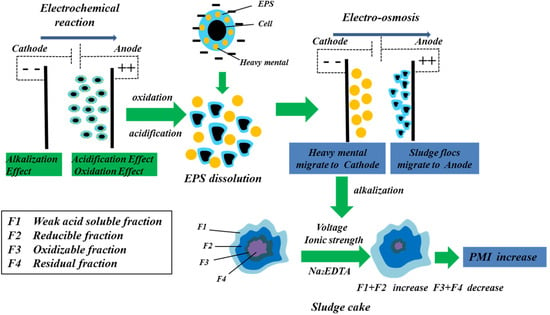
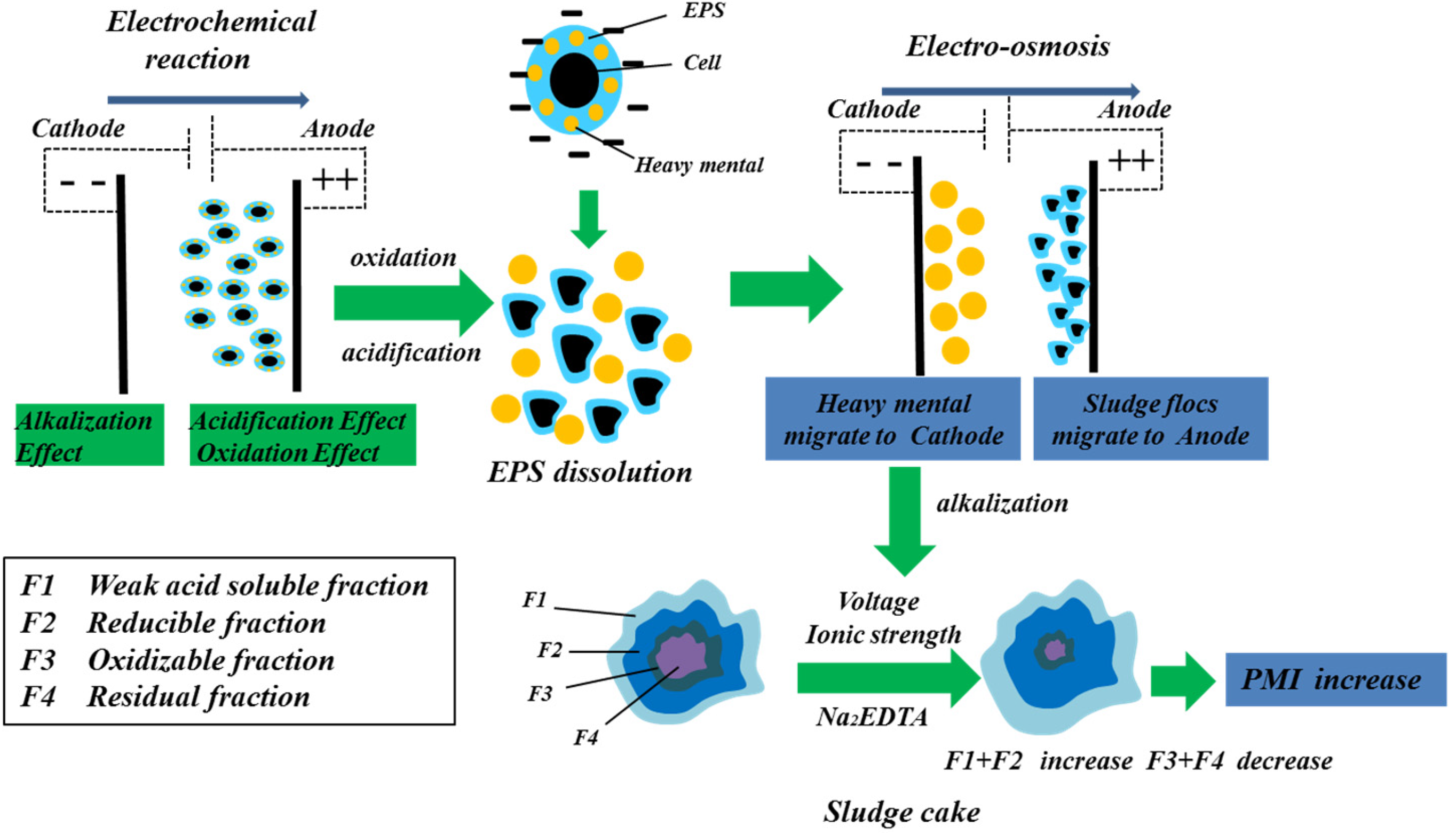
Cao et al. found that during sludge electro-osmotic dewatering, heavy metals are released along with the filtrate, and therefore the operating conditions of electro-osmotic dewatering can be adjusted to achieve heavy metal removal from sludge. The study showed that the potential migration index (PMI) of different heavy metals reached its maximum at a voltage of 55 V, and the stability of heavy metals from strong to weak was Hg > Cu > Pb > Cr > Cd > Ni > Zn [1]. Increasing ionic strength accelerated the electrochemical reactions (anodic oxidation, pH changes) during electro-dewatering, leading to effective EPS solubilization. As ionic strength increased, the heavy metal content in the dissolved fraction of the sludge filtrate further increased, while the PMI first increased and then decreased. When the ionic strength (calculated as Na2SO4) was added at 0.07% g/g TSS, both the sludge electro-dewatering rate and the PMI reached their maxima. For heavy metal elements that are relatively difficult to migrate and transform under an electric field (Cr, Pb, Cu, Hg), their ability to transform from stable to labile forms was enhanced under increased ionic strength. As shown in Figure 2, the use of the chelating agent Na2EDTA can alter the speciation of heavy metals in sludge, converting them from labile to stable forms, thereby reducing their mobility and bioavailability in the environment. Meanwhile, compared to the conditions with different voltages and ionic strengths, the heavy metal content in both the anodic and cathodic filtrates of the chelator-conditioned sludge increased significantly. For some heavy metals that are difficult to migrate and transform in the sludge cake, such as Cu and Hg, which mainly exist in oxidizable and residual fractions, Na2EDTA facilitated their transformation toward labile forms.
Figure 2.
Migration and transformation of heavy metals during sludge electro-dewatering process.
7. Challenges and Future Perspectives
7.1. Challenges
Although electrode materials have evolved from conventional metals to coated electrodes and conductive non-metallic materials, electrode stability remains a critical bottleneck restricting the long-term operation of the technology. Metal anodes inevitably undergo electrochemical oxidation under an electric field, leading to the dissolution of metal ions, which not only shortens electrode lifespan but may also cause secondary pollution. Although coated electrodes exhibit enhanced corrosion resistance, issues such as coating detachment and loss of active components during prolonged operation have not been fundamentally resolved. While composite materials such as EKG (Electrokinetic Geosynthetics) offer both electrical conductivity and corrosion resistance, their electrical conductivity is lower than that of metals, potentially resulting in localized overheating under high-voltage conditions.
Achieving a balance between energy consumption and dewatering efficiency during the electro-dewatering process presents another significant challenge. The energy consumption of electro-dewatering primarily consists of electro-osmotic energy consumption and ohmic heating energy consumption. Research indicates that while increasing the voltage gradient enhances the dewatering rate, energy consumption exhibits a non-linear increase, suggesting the existence of an optimal voltage range. Current studies are predominantly conducted at the laboratory scale, with specific energy consumption ranging from 0.1 to 0.5 kWh/kg-H2O, which remains relatively high compared to mechanical dewatering. Furthermore, seasonal fluctuations in sludge properties (such as pH, electrical conductivity, and EPS content) lead to variations in optimal operating parameters, increasing the complexity of process control.
Moreover, the depth of mechanistic research on sludge electro-dewatering is insufficient. Electro-dewatering involves multidisciplinary intersections encompassing electrochemistry, interfacial electrokinetic phenomena, and fluid mechanics in porous media, yet research on its microscopic mechanisms remains relatively underdeveloped. This is manifested in several aspects: the structural evolution of extracellular polymeric substances under an electric field remains unclear; the transformation mechanism from bound water to free water lacks quantitative description; electrochemical reactions and mass transfer processes at the electrode/sludge interface have not been achieved through in-situ observation; and a moisture migration model under multi-field coupling (electric field-force field-temperature field) has yet to be established.
Finally, successful outcomes at the laboratory scale cannot be directly extrapolated to engineering applications. In bench-scale studies, the sludge layer thickness typically ranges from 5 to 20 mm, whereas in practical treatment, increased sludge layer thickness results in a decreased voltage gradient and prolonged dewatering time. Engineering design aspects of continuous electro-dewatering equipment, such as electrode arrangement, sludge conveyance methods, and electrode plate cleaning mechanisms, lack mature experience. Comprehensive economic evaluations encompassing equipment investment and operation/maintenance costs remain insufficient, thereby limiting the industrial-scale promotion of this technology.
7.2. Future Perspectives
The research and development of electrode materials are primarily advancing toward the goals of “high electrical conductivity, corrosion resistance, long service life, and low cost.” Specific pathways include: (1) developing novel composite coated electrodes, such as graphene-doped precious metal oxide coatings, to enhance electrical conductivity and coating adhesion; (2) exploring the feasibility of applying non-metallic conductive materials such as carbon nanotubes and conductive polymers; (3) researching recyclable and renewable green electrode materials in alignment with the circular economy concept.
Simultaneously, leveraging artificial intelligence technologies such as machine learning to establish correlation models between sludge properties and operational parameters enables intelligent control of the electro-dewatering process. This specifically includes: (1) establishing mapping relationships between key sludge properties (electrical conductivity, Zeta potential, EPS content, etc.) and optimal voltage as well as dewatering time; (2) developing online monitoring systems that provide real-time feedback on parameters such as dewatering current, temperature, and filtrate flow rate to dynamically adjust operational conditions; (3) constructing multi-objective optimization models for energy consumption and dewatering efficiency to guide practical operational decisions.
Furthermore, deepening the understanding of electro-dewatering mechanisms through advanced characterization techniques and theoretical simulations involves: employing in-situ spectroscopic techniques (such as Raman spectroscopy and infrared spectroscopy) for real-time monitoring of chemical changes at the electrode/sludge interface; utilizing microfluidic chips to simulate sludge pore structures and visually investigate water migration pathways under electric fields; establishing molecular dynamics models to elucidate the conformational changes of EPS and the release mechanisms of bound water at the molecular level; developing multi-scale numerical simulation methods that correlate microscopic interfacial phenomena with macroscopic dewatering performance.
Finally, promoting the transition of electro-dewatering technology from laboratory to engineering applications necessitates the following efforts: (1) developing continuous electro-dewatering equipment to address the low efficiency of batch operations; (2) designing modular electrode units to facilitate equipment maintenance and replacement; (3) developing automatic electrode cleaning systems to prevent increased electrical resistance caused by sludge adhesion; (4) establishing optimal matching patterns between electro-dewatering and other sludge treatment units (such as thickening, conditioning, and drying); (5) conducting pilot-scale long-term operational tests to accumulate engineering design parameters and operational experience.
8. Conclusions
After decades of development, sludge electro-dewatering technology has achieved significant progress in areas such as electrode materials and operational condition optimization. However, to realize large-scale engineering applications, multiple challenges including electrode stability, energy consumption efficiency, and mechanistic understanding must still be overcome. Future efforts should focus on high-performance electrode materials and structural innovation, multi-field coupling enhancement, intelligent process control, and synergistic resource recovery. Deepening fundamental research and accelerating engineering translation are essential to promote the greater role of electro-dewatering technology in the field of sludge treatment and disposal. The advancement of this technology not only relies on the interdisciplinary integration of materials science, electrochemistry, environmental engineering, and other disciplines, but also requires collaborative innovation among industry, academia, and research institutes to break through technical bottlenecks and achieve the transition from laboratory to engineering applications.
Author Contributions
S.H.: Resource, Methodology, Writing—original draft; Y.Z.: Formal analysis, Validation, Data curation; B.C.: Funding acquisition, Supervision, Visualization. All authors have read and agreed to the published version of the manuscript.
Funding
This study was financially supported by Scientific Research Project (2025YF(C-1)-004) of Shanghai Investigation, Design & Research Institute Co., Ltd.
Data Availability Statement
No new data were created or analyzed in this study.
Conflicts of Interest
Author Song Huang was employed by the company Shanghai Investigation, Design & Research Institute Co., Ltd. The remaining authors declare that the research was conducted in the absence of any commercial or financial relationships that could be construed as a potential conflict of interest. The authors declare that this study received funding from the Scientific Research Project (2025YF(C-1)-004) of Shanghai Investigation, Design & Research Institute Co., Ltd. The funder was not involved in the study design, collection, analysis, interpretation of data, the writing of this article or the decision to submit it for publication.
References
- Cao, B.; Zhang, T.; Zhang, W.; Wang, D. Enhanced technology based for sewage sludge deep dewatering: A critical review. Water Res. 2021, 189, 116650. [Google Scholar] [CrossRef] [Scilit]
- Yang, X.; Huang, S.; Zhang, Y.; Wu, H.; Ma, Y.; Cao, B. Enhanced Electro-Dewatering of Sludge Through Inorganic Coagulant Pre-Conditioning. Separations 2025, 12, 262. [Google Scholar] [CrossRef] [Scilit]
- Fang, W.; Zhang, X.; Zhang, P.; Wan, J.; Guo, H.; Ghasimi, D.S.; Morera, X.C.; Zhang, T. Overview of key operation factors and strategies for improving fermentative volatile fatty acid production and product regulation from sewage sludge. J. Environ. Sci. 2020, 87, 93–111. [Google Scholar] [CrossRef] [Scilit] [PubMed]
- Nielsen, P.H.; Saunders, A.M.; Hansen, A.A.; Larsen, P.; Nielsen, J.L. Microbial communities involved in enhanced biological phosphorus removal from wastewater—A model system in environmental biotechnology. Curr. Opin. Biotechnol. 2012, 23, 459. [Google Scholar] [CrossRef] [Scilit] [PubMed]
- Adav, S.S.; Lee, D.-J.; Tay, J.-H. Extracellular polymeric substances and structural stability of aerobic granule. Water Res. 2008, 42, 1644–1650. [Google Scholar] [CrossRef] [Scilit] [PubMed]
- Liu, Y.; Fang, H.H.P. Influences of extracellular polymeric substances (EPS) on flocculation, settling, and dewatering of activated sludge. Crit. Rev. Environ. Sci. Technol. 2003, 33, 237–273. [Google Scholar] [CrossRef] [Scilit]
- Sheng, G.-P.; Yu, H.-Q.; Li, X.-Y. Extracellular polymeric substances (EPS) of microbial aggregates in biological wastewater treatment systems: A review. Biotechnol. Adv. 2010, 28, 882–894. [Google Scholar] [CrossRef] [Scilit]
- Vaxelaire, J.; Cézac, P. Moisture distribution in activated sludges: A review. Water Res. 2004, 38, 2214–2229. [Google Scholar] [CrossRef]
- Mujumdar, A.S. Handbook of Industrial Drying; Drying Technology; CRC Press: Boca Raton, FL, USA, 2007; Volume 6, pp. 571–573. [Google Scholar]
- Mahmoud, A.; Olivier, J.; Vaxelaire, J.; Hoadley, A.F. Electrical field: A historical review of its application and contributions in wastewater sludge dewatering. Water Res. 2010, 44, 2381–2407. [Google Scholar] [CrossRef] [Scilit]
- Yan, X. Research on the Coupling of Electro-osmotic Biological Drying and High-Dry Dehydration Process for Sludge. Master’s Thesis, Tianjin University, Tianjin, China, 2017. [Google Scholar]
- Smollen, M.; Kafaar, A. Electroosmotically enhanced sludge dewatering-pilot-plant study. Water Sci. Technol. 1994, 30, 159–168. [Google Scholar] [CrossRef] [Scilit]
- Raats, M.; van Diemen, A.; Lavèn, J.; Stein, H. Full scale electrokinetic dewatering of waste sludge. Colloids Surf. A Physicochem. Eng. Asp. 2002, 210, 231–241. [Google Scholar] [CrossRef] [Scilit]
- Yang, J.G.; Wu, H.; Ma, J.; Zhang, G.X.; Duan, S.Y.; Wang, Q. Sustainable waste management through constructed wetlands: The role of solid waste substrates in pollutant removal. Int. J. Environ. Sci. Technol. 2026, 23, 117. [Google Scholar] [CrossRef] [Scilit]
- Lee, J.E.; Lee, J.K.; Choi, H.K. Filter Press for Electrodewatering of Waterworks Sludge. Dry. Technol. 2007, 25, 1649–1657. [Google Scholar] [CrossRef] [Scilit]
- Saveyn, H.; Van der Meeren, P.; Pauwels, G.; Timmerman, R. Bench- and pilot-scale sludge electrodewatering in a diaphragm filter press. Water Sci. Technol. 2006, 54, 53–60. [Google Scholar] [CrossRef] [Scilit]
- Mahmoud, A.; Olivier, J.; Vaxelaire, J.; Hoadley, A.F. Electro-dewatering of wastewater sludge: Influence of the operating conditions and their interactions effects. Water Res. 2011, 45, 2795–2810. [Google Scholar] [CrossRef] [Scilit]
- Yang, Z.; Peng, X.F.; Lee, D.J. Electroosmotic flow in sludge flocs. Int. J. Heat Mass Transf. 2009, 52, 2992–2999. [Google Scholar] [CrossRef] [Scilit]
- Barton, W.A.; Miller, S.A.; Veal, C.J. The electrodewatering of sewage sludges. Dry. Technol. 1999, 17, 498–522. [Google Scholar] [CrossRef] [Scilit]
- Larue, O.; Vorobiev, E. Sedimentation and water electrolysis effects in electrofiltration of kaolin suspension. Aiche J. 2010, 50, 3120–3133. [Google Scholar] [CrossRef] [Scilit]
- Yuan, C.; Weng, C.H. Sludge dewatering by electrokinetic technique: Effect of processing time and potential gradient. Adv. Environ. Res. 2003, 7, 727–732. [Google Scholar] [CrossRef] [Scilit]
- Tuan, P.A.; Jurate, V.; Mika, S. Electro-dewatering of sludge under pressure and non-pressure conditions. Environ. Technol. 2008, 29, 1075–1084. [Google Scholar] [CrossRef] [Scilit]
- Weber, K.; Stahl, W. Improvement of filtration kinetics by pressure electrofiltration. Sep. Purif. Technol. 2002, 26, 69–80. [Google Scholar] [CrossRef] [Scilit]
- Cao, B.; Zhang, W.; Du, Y.; Wang, R.; Usher, S.; Scales, P.; Wang, D. Compartmentalization of extracellular polymeric substances (EPS) solubilization and cake microstructure in relation to wastewater sludge dewatering behavior assisted by horizontal electric field: Effect of operating conditions. Water Res. 2018, 130, 363–375. [Google Scholar] [CrossRef] [Scilit] [PubMed]
- Mahmoud, A.; Afa, H.; Citeau, M.; Sorbet Olivier, G.; Vaxelaire, J.; Olivier, J. A comparative study of electro-dewatering process performance for activated and digested wastewater sludge. Water Res. 2018, 129, 66–82. [Google Scholar] [CrossRef] [Scilit] [PubMed]
- Comninellis, C.; Chen, G. Electrochemistry for the Environment. J. Appl. Electrochem. 2010, 40, 2203. [Google Scholar] [CrossRef] [Scilit]
- Shao, C.; Zheng, H.; Sobhi, M.; Zhu, F.; Hu, X.; Cui, Y.; Chen, H.; Zou, B.; Zan, X.; Li, G.; et al. Enhancing microalgal biomass production in lab-scale raceway ponds through innovative computational fluid dynamics-based electrode deflectors. Bioresour. Technol. 2024, 394, 130282. [Google Scholar] [CrossRef] [Scilit]
- Deng, Z.; Zhao, B.; Li, S.; Li, Z.; Zhang, S.; Zhang, K.; Zhu, Z. An efficient CuZr-based metallic glasses electrode material for electrocatalytic degradation of azo dyes. J. Environ. Sci. 2024, 136, 537–546. [Google Scholar] [CrossRef] [Scilit]
- Wang, Z.; Xiao, Y.; Zhang, Y.; Wang, Y.; Wang, X.; Wang, F.; He, T. A novel chemical composite strategy for synergistically enhancing the activity and stability of strontium-containing air electrode for protonic ceramic cells. Chem. Eng. J. 2024, 490, 151911. [Google Scholar] [CrossRef] [Scilit]
- Zhang, H.; Liu, W.; Liu, C.; Sun, P.; Zeng, Y.; Gao, Y.; Wang, H.; Zeng, R. Enhancing waste management and nutrient recovery: Preparation of adsorption-type sludge-biochar value-added fertilizer from sewage sludge and Pistia stratiotes. J. Clean. Prod. 2023, 429, 139642. [Google Scholar] [CrossRef] [Scilit]
- Daneshmand, T.; Friedrich, M.; Gachter, M.; Montealegre, M.; Mlambo, L.; Nhiwatiwa, T.; Mosler, H.; Julian, T. Escherichia coli Contamination across Multiple Environmental Compartments (Soil, Hands, Drinking Water, and Handwashing Water) in Urban Harare: Correlations and Risk Factors. Am. J. Trop. Med. Hyg. 2018, 98, 803–813. [Google Scholar] [CrossRef] [Scilit]
- Desabres, J.; Loginov, M.; Vorobiew, E. Model of electrofiltration in a filter press with anode flushing. Dry. Technol. 2017, 35, 1182–1194. [Google Scholar] [CrossRef] [Scilit]
- Visigalli, S.; Turolla, A.; Gronchi, P.; Canziani, R. Performance of electro-osmotic dewatering on different types of sewage sludge. Environ. Res. 2017, 157, 30–36. [Google Scholar] [CrossRef] [Scilit]
- Krstic, V.; Pesovski, B. Reviews the research on some dimensionally stable anodes (DSA) based on titanium. Hydrometallurgy 2019, 185, 71–75. [Google Scholar] [CrossRef] [Scilit]
- Chen, L.; Guo, Y.; Chen, Y.; Zhang, Y.; Gao, M.; Jing, Y.; Pak, Y.; Gao, X.; Han, S.; Bao, L.; et al. Boron-doped diamond electrodes for environmental applications: From structure-property relationships to electrochemical remediation and sensing. Environ. Chem. Eng. 2026, 14, 121837. [Google Scholar] [CrossRef] [Scilit]
- Tuan, P.-A.; Sillanpää, M. Migration of ions and organic matter during electro-dewatering of anaerobic sludge. J. Hazard. Mater. 2010, 173, 54–61. [Google Scholar] [CrossRef] [Scilit]
- Duan, J. Study on the Property Changes of Sludge Dehydrated by Electroosmosis. Master’s Thesis, Tianjin University, Tianjin, China, 2012. [Google Scholar]
- Tessier, A.; Campbell, P.G.; Bisson, M. Sequential extraction procedure for the speciation of particulate trace metals. Anal. Chem. 1979, 51, 844–851. [Google Scholar] [CrossRef] [Scilit]
- Tokalioǧlu, Ş.; Kartal, Ş.; Elci, L. Determination of heavy metals and their speciation in lake sediments by flame atomic absorption spectrometry after a four-stage sequential extraction procedure. Anal. Chim. Acta 2000, 413, 33–40. [Google Scholar] [CrossRef] [Scilit]
- Fuentes, A.; Lloréns, M.; Sáez, J.; Aguilar, M.I.; Ortuño, J.F.; Meseguer, V.F. Comparative study of six different sludges by sequential speciation of heavy metals. Bioresour. Technol. 2008, 99, 517–525. [Google Scholar] [CrossRef] [Scilit]
- Wang, C.; Li, X.-C.; Ma, H.-T.; Qian, J.; Zhai, J.-B. Distribution of extractable fractions of heavy metals in sludge during the wastewater treatment process. J. Hazard. Mater. 2006, 137, 1277–1283. [Google Scholar] [CrossRef] [Scilit]

Disclaimer/Publisher’s Note: The statements, opinions and data contained in all publications are solely those of the individual author(s) and contributor(s) and not of MDPI and/or the editor(s). MDPI and/or the editor(s) disclaim responsibility for any injury to people or property resulting from any ideas, methods, instructions or products referred to in the content. |
© 2026 by the authors. Licensee MDPI, Basel, Switzerland. This article is an open access article distributed under the terms and conditions of the Creative Commons Attribution (CC BY) license.