


Abstract
The extraction of functional organic compounds from natural products has become an important focus of current research. Citrus fruits are among the most widely produced fruits worldwide and have attracted increasing attention because of their pleasant flavor and rich content of bioactive compounds. Hesperidin, the focus of this review, is a representative flavonoid glycoside that is abundant in citrus fruits and their processing by-products. Owing to its unique molecular structure and physicochemical properties, hesperidin frequently coexists with structurally similar flavonoids. This similarity makes its separation and purification particularly challenging. Although many studies have reported different methods for the extraction and purification of hesperidin, most of them concentrate on individual techniques. Systematic analyses of how upstream extraction strategies affect downstream separation efficiency are still limited. In this review, separation strategies for hesperidin are systematically discussed, covering the entire process from extraction to downstream purification. The focus shifts from isolated separation methods to a strategy-oriented design. Special attention is given to how different extraction approaches influence matrix complexity, and, consequently, the difficulty of subsequent separation steps. Downstream separation technologies, including adsorption, liquid–liquid partitioning, crystallization, and chromatography, are compared from the perspectives of separation mechanisms and process integration. Based on a comparative analysis of crystallization, phase partitioning, membrane processing, adsorption, and chromatographic techniques, this review discusses the typical process roles of different separation strategies. Solubility-driven crystallization and membrane-based clarification are identified as more suitable for large-scale processing, whereas adsorption and chromatography are more appropriate as enrichment and polishing steps, respectively. In addition, key control points for green extraction–separation integration are identified, including solvent recyclability, matrix complexity control, and early-stage load reduction. This work aims to provide a practical reference for the sustainable and scalable separation of flavonoid glycosides from citrus by-products.
1. Introduction
In recent years, advances in modern analytical techniques and life sciences have greatly expanded the applications of natural products in drug development, functional foods, and biomaterials [1,2,3,4]. Despite this progress, the sourcing, processing strategies, and quality control of natural products are still under continuous development. Higher standards are increasingly required in terms of safety, efficacy, and large-scale applicability. Against this background, the efficient recovery and utilization of natural bioactive compounds, while ensuring safety and sustainability, have become an important research priorities.
The rapid growth of the global fruit processing industry, particularly the juice sector, has led to the generation of substantial by-products each year [5,6]. Citrus fruits rank among the most widely cultivated fruit tree crops across most regions globally. Their peel, pulp, and seeds are rich in bioactive compounds such as flavonoids, dietary fiber, pectin, and essential oils [7,8,9].
Notably, approximately 30% or more of citrus by-products—especially the peel, which constitutes nearly half of the fruit’s weight—are abundant in flavonoids. The content and antioxidant activity of these compounds are often significantly higher in the by-products than in the edible portions [10]. Consequently, these residues are considered ideal raw materials for obtaining valuable natural ingredients like hesperidin (HES) on an industrial scale, presenting considerable potential for valorization. Conversely, if not properly managed, such by-products not only represent a waste of resources but also contribute to environmental pollution [5].
HES, the compound investigated in this study, was first isolated from citrus peel by the French scholar Lebreton [11,12]. It is one of the most abundant and systematically studied flavanone glycosides among citrus flavonoids, also known as hesperetin 7-O-rutinoside [13]. Hesperidin has garnered extensive attention for its diverse biological activities, including antioxidant, anti-inflammatory, antibacterial, antiviral, neuromodulatory, and metabolic regulatory effects [13,14,15,16]. Hesperidin is widely regarded as one of the most representative flavanone glycosides in citrus fruits. It is abundant in oranges, lemons, mandarins, and citrus processing by-products such as peels and pomace, and is therefore often considered a characteristic marker of citrus-derived functional ingredients [17]. However, hesperidin is not exclusive to citrus plants. Available reviews and natural product databases indicate that it can also be detected in certain non-citrus species, such as peppermint (Mentha piperita), St. John’s wort (Hypericum perforatum), and sage (Salvia officinalis) [18]. However, these non-citrus sources are mainly reported as trace occurrences, and are generally not competitive with citrus by-products in terms of feedstock availability and scale. Accordingly, from the perspective of industrial recovery and high-value utilization, citrus processing by-products remain the most practical and sustainable natural feedstock for hesperidin production.
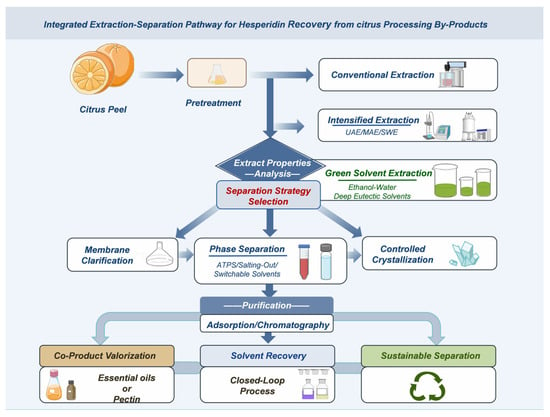
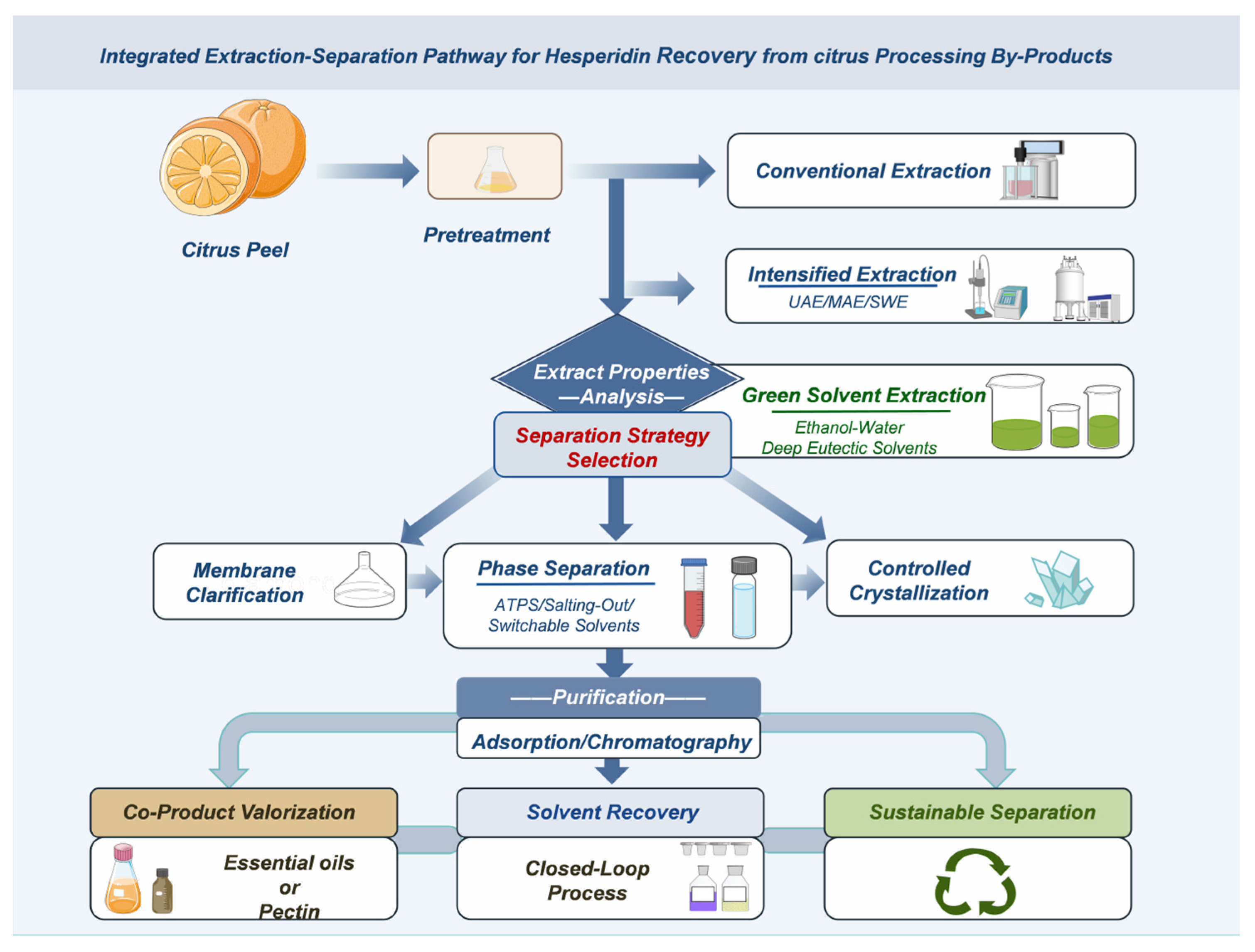
Current research on hesperidin primarily focuses on summarizing extraction methods, evaluating biological activity, and developing applications [17], while systematic reviews examining the relationship between extraction processes and downstream separation pathways remain limited. Particularly at the levels of industrial feasibility and separation strategy design, there is a lack of comprehensive analysis from a holistic process perspective. Therefore, this review systematically outlines the extraction-to-separation pathway of hesperidin as a representative model compound from the perspective of efficient separation strategies (Figure 1). It aims to provide a more comprehensive theoretical basis and technical reference for the high-value utilization and sustainable processing of citrus by-products.
Figure 1.
Overview of hesperidin extraction technologies from citrus peel. Conventional extraction methods and emerging green extraction techniques are illustrated. Arrows indicate the process flow between different extraction steps, while different colors represent distinct categories of extraction methods. It illustrates the integration of upstream extraction, controlled crystallization, and mild purification, with solvent recovery and closed-loop operation incorporated to enhance sustainability and industrial applicability.
Unlike existing hesperidin reviews that mainly summarize extraction methods and bioactivities, this review focuses on strategy-oriented separation design across the whole pathway from extraction to downstream purification. We emphasize (i) how extraction conditions shape matrix complexity and thus separation difficulty, (ii) how non-chromatographic separation methods such as crystallization, phase separation, membrane treatment, and adsorption be integrated into load reduction and enrichment units, and (iii) how industrially relevant indicators guide process selection and integration. This approach of evaluating separation strategies from a holistic perspective is crucial for the sustainable and scalable utilization of citrus by-products.
2. Physicochemical Properties of Hesperidin and Their Influence on the Separation Process
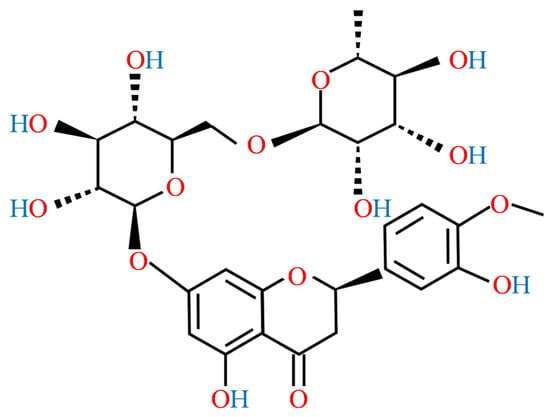
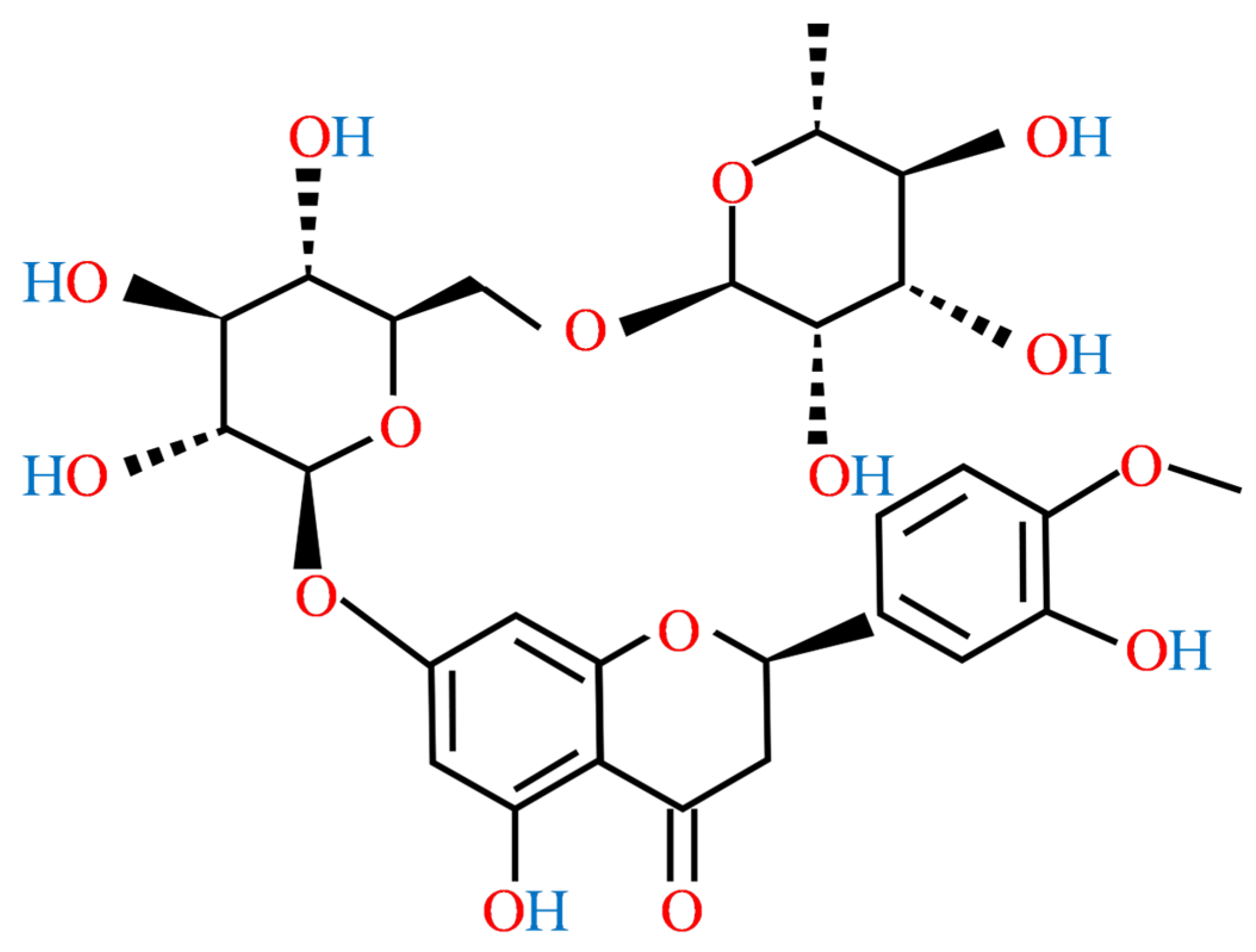
HES is a typical flavonoid glycoside with the molecular formula C28H34O15 and a molecular weight of 610.56. The molecular structure of hesperidin is shown in Figure 2, which helps explain its polarity, hydrogen-bonding capacity, and crystallization tendency. Its structure consists of a 2-phenylchroman backbone linked to a rutinose moiety at the C-7 position through a glycosidic bond [19,20,21]. This configuration results in a relatively complex molecular architecture, in which hydrophobic features of the aglycone coexist with hydrophilic characteristics introduced by multiple phenolic hydroxyl groups and the glycoside unit. The key physicochemical properties of hesperidin are summarized in Figure 1. Compared to non-glycosylated flavonoids, the distribution behavior of hesperidin in solvent systems is more susceptible to solvent polarity and hydrogen-bonding interactions. It typically exhibits low solubility in room-temperature water at only 4.95 μg/mL [20]. However, its solubility significantly increases in systems containing alcohols or other polar organic solvents, for example, it is slightly soluble in methanol and highly soluble in pyridine [22]. This dissolution behavior renders the compound sensitive to solvent composition and temperature variations during extraction and separation. Consequently, while extraction is straightforward, subsequent separation and purification prove challenging. Current conventional purification procedures necessitate hot water washing and the use of soluble solvents for crystallization [23]. Additionally, hesperidin molecules readily form stable intermolecular hydrogen bond networks. Under suitable conditions, they can form more complex crystal structures with other structurally similar glycosides, significantly affecting solubility and physical properties [22]. To some extent, this feature enables the use of non-chromatographic strategies such as crystallization-based separation. However, it also places more stringent requirements on solvent-system design and on the control of operating parameters.
Figure 2.
Molecular structure of HES. Oxygen atoms (O) are highlighted in red, hydrogen atoms (H) are shown in blue. Showing the aglycone and rutinose moieties that determine its polarity, hydrogen-bonding behavior, and separation characteristics.
In practical processing, citrus peel extracts are typically highly complex multicomponent systems. Besides hesperidin, they contain naringin, neohesperidin (molecular weight: 580.52), and other structurally related flavonoids [24,25]. They also contain a varying amounts of polysaccharides, pectin, and pigment impurities [26]. These co-extracted substances differ only slightly from hesperidin in polarity and molecular size, which limits the selectivity of conventional separation methods.
The distinct polarity, limited solubility, and pronounced crystallization behavior of hesperidin together indicate that its separation should not rely solely on high-resolution yet costly chromatographic techniques. In contrast, separation strategies built around solubility differences, phase-behavior regulation, and process intensification show greater potential for balancing separation performance with industrial practicality. Studies on hesperidin separation should integrate its molecular physicochemical properties with process design and optimize the extraction and separation scheme from a whole-process perspective, rather than evaluating the performance of a single separation method in isolation. This perspective provides a basis for the subsequent systematic review and comparative analysis of separation strategies.
Therefore, as shown in Table 1, a deep understanding of the physicochemical properties of HES facilitates the design of separation strategies and highlights the importance of selecting appropriate extraction methods to regulate matrix complexity and create favorable conditions for downstream processing. Next, this article will systematically review and compare current extraction techniques, with a particular focus on their impact on subsequent separation efficiency.
Table 1.
Mapping of HES physicochemical properties to separation implications.
3. Extraction of Hesperidin
From an application-oriented perspective, hesperidin has been widely used as a natural ingredient in functional foods and dietary supplements, and it is also commonly employed as a reference compound in pharmacological studies. In practical applications, large-scale recovery generally relies on hydroalcoholic extraction, followed by one or more downstream units for matrix simplification and enrichment, while chromatographic techniques are mainly used as optional polishing steps when high purity is required. As shown in Table 2, a large body of systematic research has been devoted to hesperidin extraction, with continuous optimization of solvent systems and ongoing development of novel extraction approaches. Current organic-solvent-based extraction methods mainly include maceration, percolation, hydrodistillation, boiling, reflux extraction, continuous reflux, infusion, and Soxhlet extraction [17,28,29]. However, these methods typically require high-purity solvents, often deliver only moderate yields, and are time-intensive, while also raising concerns related to environmental pollution [28]. More advanced techniques include ultrasound-assisted extraction (UAE), supercritical fluid extraction (SFE), microwave-assisted extraction (MAE), solid-phase extraction (SPE), enzyme-assisted extraction, pressurized liquid extraction (PLE), pulsed electric field-assisted extraction (PEF), as well as various hybrid combinations of these methods [30,31,32,33,34,35,36]. These approaches provide more efficient and practical strategies for extracting hesperidin and other flavonoids.
Beyond these emerging techniques, recent research has increasingly focused on green extraction. Several studies have reported high-yield recovery of bioactive flavonoids from natural matrices using deep eutectic solvents (DES). Compared with conventional solvent extraction, this approach is generally more efficient and environmentally friendly, and it can provide a strong starting point for subsequent separation and purification [37]. However, most studies primarily use extraction yield or total flavonoid content as the main evaluation metrics, while paying relatively limited attention to the downstream handling of the extract. Given the complexity of the citrus peel matrix, extraction often co-dissolves multiple structurally similar flavonoid glycosides, along with polysaccharides and pigment-like compounds, resulting in a highly complex multicomponent solution. This complexity may impose a substantial burden on subsequent separation and purification steps.
Table 2.
Comparison of flavonoid extraction methods including HES and their impacts on downstream separation and purification.
4. Efficient Separation Strategies for Hesperidin
4.1. Solubility-Driven Routes
In this route, solvent composition and temperature are treated as design variables to control solubility and nucleation, so that separation is achieved by selective crystallization rather than by high-resolution fractionation. As noted above, hesperidin exhibits pronounced solubility differences in mixed solvents and is highly sensitive to temperature, showing a strong tendency to crystallize under suitable conditions. Therefore, solubility-driven separation is one of the most promising routes for downstream processing of hesperidin. By rationally selecting the solvent system and its composition, hesperidin can be effectively solubilized while the co-solubilization of structurally similar impurities is reduced, thereby providing more favorable starting conditions for subsequent separation steps.
4.1.1. Antisolvent Recrystallization
Existing studies have explicitly applied an antisolvent recrystallization technique, in which hesperidin nanoparticles (HNPs) were prepared using dimethyl sulfoxide (DMSO), ethanol, and deionized water as the solvent and antisolvent system within a double-homogenization setup [49]. In brief, hesperidin is first dissolved in a suitable good-solvent mixture, and an antisolvent is then introduced to reduce its solubility and trigger nucleation and crystal growth, thereby enabling selective precipitation [50]. In 2020, Liu et al. used methanol as the solvent and deionized water as the antisolvent to purify and micronize total flavonoids obtained by ethanol reflux extraction, achieving a flavonoid content of up to 99.81% after purification [51]. Zu et al. also applied this approach to purify Ginkgo biloba leaf extracts, reporting an increase in flavonoid content to 53.85% after treatment [52]. These examples support the industrial feasibility of this route. It enables separation and purification while also producing functional particles with improved solubility, helping address the poor aqueous solubility of flavonoids such as hesperidin and offering new directions for drug development.
4.1.2. Acid Precipitation
The principle of acid precipitation is that hesperidin can form soluble salts and dissolve under alkaline conditions. Subsequent acidification promotes re-lactonization and markedly reduces its solubility, allowing the precipitate to be recovered from the extract for separation and purification. In a recent study, Figueira O et al. first carried out alkaline extraction using ethanol, then neutralized the filtrate to pH 6–7 with 0.25 N HCl. Precipitation was subsequently induced immediately during ethanol recovery, thereby completing the separation [40]. In many process routes, acid precipitation is considered a viable option for recovering hesperidin from the extract [53]. A key advantage of this approach is that it can be operated in a continuous mode and, when combined with fractional precipitation [54], it can be used to recover multiple components from citrus peel. If the upstream process is designed to target both hesperidin and other by-products through stepwise recovery, factors such as solvent composition, pH, and temperature can be tuned to enable a multistep scheme in which other by-products are recovered first, followed by hesperidin precipitation or crystallization, thereby improving overall separation efficiency.
Separation strategies based on solubility and crystallization behavior take advantage of the pronounced solubility changes and crystallization tendency of hesperidin in response to variations in solvent composition, temperature, and pH. This gives them a practical edge in downstream processing, where selective enrichment can be achieved through straightforward physicochemical driving forces. The required equipment is relatively simple, the energy demand per unit operation is generally manageable, and the process can be readily integrated with solvent recovery, which makes it closer to industrial implementation. The main limitation is that performance is strongly influenced by the complexity of the extract.
More complex extracts are more prone to co-precipitation and entrainment, or may require multiple recrystallization steps to reach the desired purity. During scale-up, key challenges include solvent recovery, process continuity, and robustness against compositional variability among different batches of citrus by-products, and parameters such as temperature gradients and mixing intensity should be evaluated at an early stage. A practical approach is to position this strategy as a front-end unit following an “enrich first, purify later” concept [54]. Coupling it with adsorption or membrane-based methods can significantly reduce the downstream separation burden. This approach is also compatible with the multiproduct valorization of citrus peel, facilitating the construction of staged recovery schemes and thereby improving industrial feasibility.
4.2. Phase Partitioning Routes
The core idea of phase-behavior-based separation is to treat the solid–liquid equilibrium and liquid–liquid equilibrium of hesperidin in different systems as controllable phases, thereby replacing more complex chromatographic purification and enabling rapid enrichment and recovery from the extract. A representative example is the one-pot extraction–crystallization approach. Inoue et al. performed microwave-assisted extraction in 70% (v/v) ethanol–water and leveraged the relatively low solubility of hesperidin in this medium and its tendency to reach supersaturation as temperature decreases. After extraction, simple low-temperature storage was sufficient to induce direct crystallization of hesperidin, illustrating process integration driven by its solubility profile [30].
Effective implementation of phase-behavior strategies relies on fundamental phase-equilibrium data. Xu et al. systematically measured the solubility of hesperidin in ethanol, isopropanol, propylene glycol, and n-propanol–water cosolvent systems and established correlated models, providing a calculable basis for defining a high-solubilization region, a controllable supersaturation region, and a crystallization recovery region [55]. In addition, Jouyban and Martínez interpreted solubility and precipitation tendencies in mixed solvents from the perspective of solution thermodynamics and preferential solvation, offering theoretical support for optimizing solvent composition [56].
Along the liquid–liquid phase-behavior route, aqueous two-phase systems and salting-out-induced phase separation can effectively partition hesperidin away from coexisting impurities and by-products. This is particularly attractive for integrated, multi-product processing of citrus peel. For example, Wen et al. established an acetone–water–ammonium sulfate aqueous two-phase system to purify crude hesperidin obtained from sodium carbonate aqueous extraction, and optimized factors such as salt dosage and pH to achieve improved partitioning and recovery [57]. Zheng et al. further coupled mixed-solvent extraction with multiphase salting-out extraction, enabling phase separation and stepwise recovery of essential oil and hesperidin from citrus peel. This fits well with process designs that recover by-products first and then enrich hesperidin [58].
More recently, switchable phase-separation solvents have opened up new possibilities for green and recyclable processing. A CO2-responsive deep eutectic solvent (DES) reported in Food Chemistry can undergo reversible phase separation under CO2 and N2, thereby promoting hesperidin enrichment while facilitating solvent recycling [43]. On the data and modeling side, solubility measurements of hesperidin in various acidic choline chloride-based DES–water systems have been reported and correlated with fitted models [44]. These efforts have notably improved the separation efficiency for flavonoids such as hesperidin while also meeting the requirements of green extraction.
Phase-behavior-based separation routes can also be positioned as coarse separation steps. Their main advantage lies in achieving phase separation and enrichment in a single operation, whereas their limitations include salt residues and increased complexity in solvent recovery, challenges that are similar to those encountered in solubility-driven separation strategies. From an industrial perspective, a more rational process design is to follow phase-based enrichment with crystallization or adsorption columns for final purification, thereby forming a multistage strategy chain of phase separation, enrichment, and polishing. Such an integrated approach helps avoid product quality instability during large-scale production.
4.3. Process Intensification for Load Reduction
In addition to the above strategies that leverage the physicochemical properties of hesperidin, process-intensification approaches such as adsorption and membrane separation have also become major research focuses. Membrane-based strategies are better suited as a downstream load-reduction step for hesperidin. Their value does not lie in producing a high-purity product in a single step. Instead, they exploit differences in molecular size and colloidal behavior to first remove pectin, suspended solids, and part of the high-molecular-weight impurities that complicate subsequent separation, while also providing a certain degree of concentration.
Early studies have shown that ultrafiltration (UF) can serve as a mild pretreatment to improve solution quality and promote subsequent crystallization-based purification. For example, UF of citrus peel extracts using polyacrylonitrile membranes, with optimized transmembrane pressure, flow rate, and concentration factor, enabled the production of hesperidin crystals with relatively high purity [57]. Later work increasingly integrated UF, nanofiltration (NF), and final concentration into an overall process. In studies using by-product streams such as citrus press liquor, UF was applied for clarification, while NF was used for preconcentration and partial removal of sugars and salts. The NF permeate and retentate were then linked with low-temperature concentration methods such as osmotic distillation, improving the recovery and enrichment of flavonoids under milder conditions [59]. The more recent literature further emphasizes the suitability of pore-size gradients and membrane cascades for complex systems. Ceramic membranes combined with UF and NF membranes of different molecular weight cutoffs have been used to achieve stepwise fractionation and restructuring of pectin, sugars, and flavonoids, offering process-level guidance for continuous scale-up [60]. Other studies propose UF pretreatment to mitigate pectin interference, followed by gentle concentration of polyphenols and flavonoids via forward osmosis, highlighting the advantages of membrane processes in preserving bioactivity and simplifying complex matrices under low thermal load [61].
The main bottlenecks of membrane-based separation include flux decline caused by pectin-rich extracts, as well as the trade-off between permeate quality and throughput. Therefore, membrane design should prioritize stable clarification and preconcentration rather than attempting single-step purification.
4.4. Selective Enrichment
Adsorption strategies rely on differences in affinity between hesperidin and impurities toward specific materials, enabling selective enrichment or removal of interfering components. Unlike membrane separation, which is closer to physical sieving, adsorption separation achieves stronger selectivity through interactions such as hydrogen bonding, hydrophobic effects, and π–π interactions. It is therefore better positioned to serve as a purification and enrichment step. A recent industrial hotspot is microporous adsorption resins, which follow this principle. Studies using citrus peel as an example have presented and compared process schemes employing different resins for citrus flavonoid recovery, supporting their feasibility in green processing and scale-up scenarios [62]. This selective adsorption technology is also being refined. Newly developed molecularly imprinted polymers (MIPs) move adsorption from “class selectivity” toward molecular recognition. Recently reported hesperidin-imprinted materials maintain good selectivity and capacity even in the presence of structurally similar compounds, and they have demonstrated reusability and purification performance in real extract systems. This suggests strong potential for direct enrichment from complex matrices [63]. In addition, porous materials with high specific surface area such as metal–organic frameworks (MOFs) have been applied in solid-phase extraction and purification of hesperidin. By optimizing pH, adsorbent dosage, and elution conditions, efficient extraction and purification have been achieved, providing new material options for adsorption steps that aim for low solvent consumption and rapid cleanup [64].
4.5. Chromatography as Polishing
Based on the summary and discussion of several common methods, chromatographic strategies essentially amplify subtle differences between hesperidin and structurally similar flavonoids such as homologous glycosides and isomers through controlled phase behavior. As a result, high-purity products can still be obtained from complex matrices. Chromatography is therefore widely used for laboratory preparation of reference standards, fine purification of bioactive components, and quality-related studies. For example, high-speed counter-current chromatography (HSCCC), a representative liquid–liquid partition chromatography technique, has been used to isolate flavonoid glycosides including hesperidin from Taraxacum mongolicum, offering advantages in both purity and recovery [65]. Reviews on HSCCC instrumentation and methodology also emphasize that it is more suitable for heat-sensitive and adsorption-prone compounds. During scale-up, predictable partition control can be achieved through solvent system selection and operating conditions [66]. Nevertheless, the limitations of chromatographic routes are also clear. They involve higher equipment and consumables costs and impose stricter requirements on upstream extraction and pretreatment. Better outcomes are typically achieved only when chromatography is well integrated with upstream load-reduction steps.
In contrast, non-chromatographic strategies emphasize the use of hesperidin physicochemical properties such as solubility-driven crystallization and acid–base precipitation, as well as engineered unit operations such as membrane separation and adsorption resins, to build an “enrich first, polish later” process. These strategies are closer to industrial implementation in terms of high-throughput processing and solvent recycling. For instance, microwave-assisted extraction followed by direct crystallization driven by solubility differences can integrate extraction and enrichment within a single system, thereby shortening the separation pathway [30]. In more integrated multi-product designs, a two-step process in which pectin is recovered first via acid treatment and hesperidin is then precipitated through rapid pH switching during recovery has demonstrated the process value of non-chromatographic approaches for stepwise recovery and valorization [40]. For complex extracts, membrane processes are often used to remove suspended solids and high-molecular-weight colloids and to gently preconcentrate flavonoids, substantially reducing the burden for subsequent crystallization or adsorption polishing [59]. Adsorption resins can then achieve selective enrichment and elution with relatively low equipment requirements, forming scalable and greener workflows [62].
Overall, chromatography functions more like a highly selective terminal polishing tool, while non-chromatographic approaches act more like scale-oriented process intensification and pathway integration tools. They are not mutually exclusive. In practice, a common solution is to use non-chromatographic steps for enrichment and clarification first, followed by chromatographic methods for fine purification, thereby improving purity and yield while lowering cost.
4.6. Decision Logic Summary
Overall, the separation of HES from citrus by-product extracts should be approached as a strategy-integrated pathway, rather than a comparison of isolated methods (Figure 1). Given the high matrix complexity and the frequent co-existence of structurally similar flavonoid glycosides, early-stage operations should focus on matrix clarification and load reduction. Membrane-based processes are particularly effective at this stage, as they remove pectin-rich macromolecules and suspended solids, thereby improving process stability and throughput. When solvent composition and temperature are properly controlled, solubility-driven precipitation or crystallization can also function as practical enrichment units.
To further enhance selectivity, adsorption-based enrichment can reduce the downstream burden and improve the efficiency of subsequent crystallization or purification. Chromatography remains the most effective option for achieving very high purity, but its industrial relevance is maximized only when it is applied selectively as a polishing step and supported by upstream load-reduction and enrichment units. This “enrich first, polish later” logic aligns with the industrial indicators summarized in Table 3, where crystallization-, membrane-, and adsorption-based strategies offer advantages in processing capacity and scalability, while chromatographic methods are mainly limited by cost and throughput. Consequently, selecting and integrating separation strategies according to process stage and industrial constraints is critical for the sustainable and scalable utilization of citrus processing by-products.
Table 3.
Comparison of Industrial Performance Indicators of Different Separation Strategies for HES and Related Flavonoid Glycosides.
5. Synergistic Design with Green Extraction
5.1. Impacts of Green Extraction Strategies on Downstream Separation
With the growing emphasis on sustainability, green extraction has become an important consideration in natural product research. Compared with traditional organic solvent extraction, green extraction strategies typically aim to reduce solvent toxicity, lower energy input, and improve resource-use efficiency. However, for high-polarity natural products such as hesperidin, a greener extraction step does not necessarily translate into simpler downstream separation. In practice, some green extraction conditions can improve hesperidin extraction efficiency while simultaneously promoting co-extraction of multiple polar impurities, thereby increasing downstream complexity.
Subcritical water extraction (SWE) is one example. This approach replaces organic solvents with water and provides high process intensity. Yet once temperature increases into certain ranges, extraction can shift toward hydrolysis, leading to changes in the product profile and the formation of hydrothermal hydrolysis products of flavonoid glycosides such as hesperidin, including monoglycosides and aglycones [46]. This means downstream processing must handle more structurally similar by-products. Similarly, coupling pulsed electric field (PEF) with SWE may improve extraction of hesperidin and accompanying flavonoids, but it can also increase the release of impurities while enhancing hesperidin recovery, thereby further increasing the difficulty of separation and purification [45].
For deep eutectic solvents (DES), which have become highly popular as green solvents, the advantages are clear. Their green attributes are prominent, and they can greatly enhance hesperidin solubility, making extraction easier. However, DES typically have high viscosity and low volatility. Excessive solubilization can weaken the effectiveness of conventional antisolvent crystallization. Recovery may then require viscosity reduction by water addition and activity adjustment, antisolvent precipitation, or solvent switching to induce phase separation [44].
Therefore, evaluating green extraction strategies solely by extraction yield or solvent environmental friendliness is insufficient to fully capture their advantages and limitations in an overall process context. For compounds like hesperidin with clear structural features yet high separation difficulty, it is necessary to reassess the practical value of green extraction from a separation-oriented perspective.
5.2. Separation-Oriented Design Principles for Green Extraction
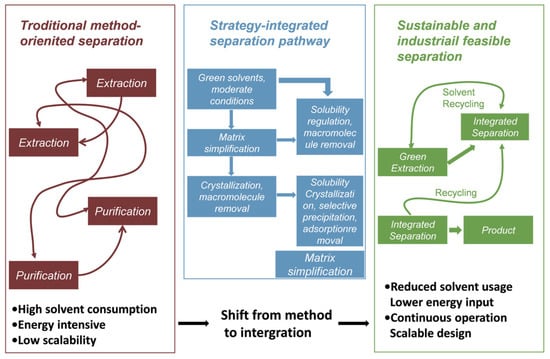
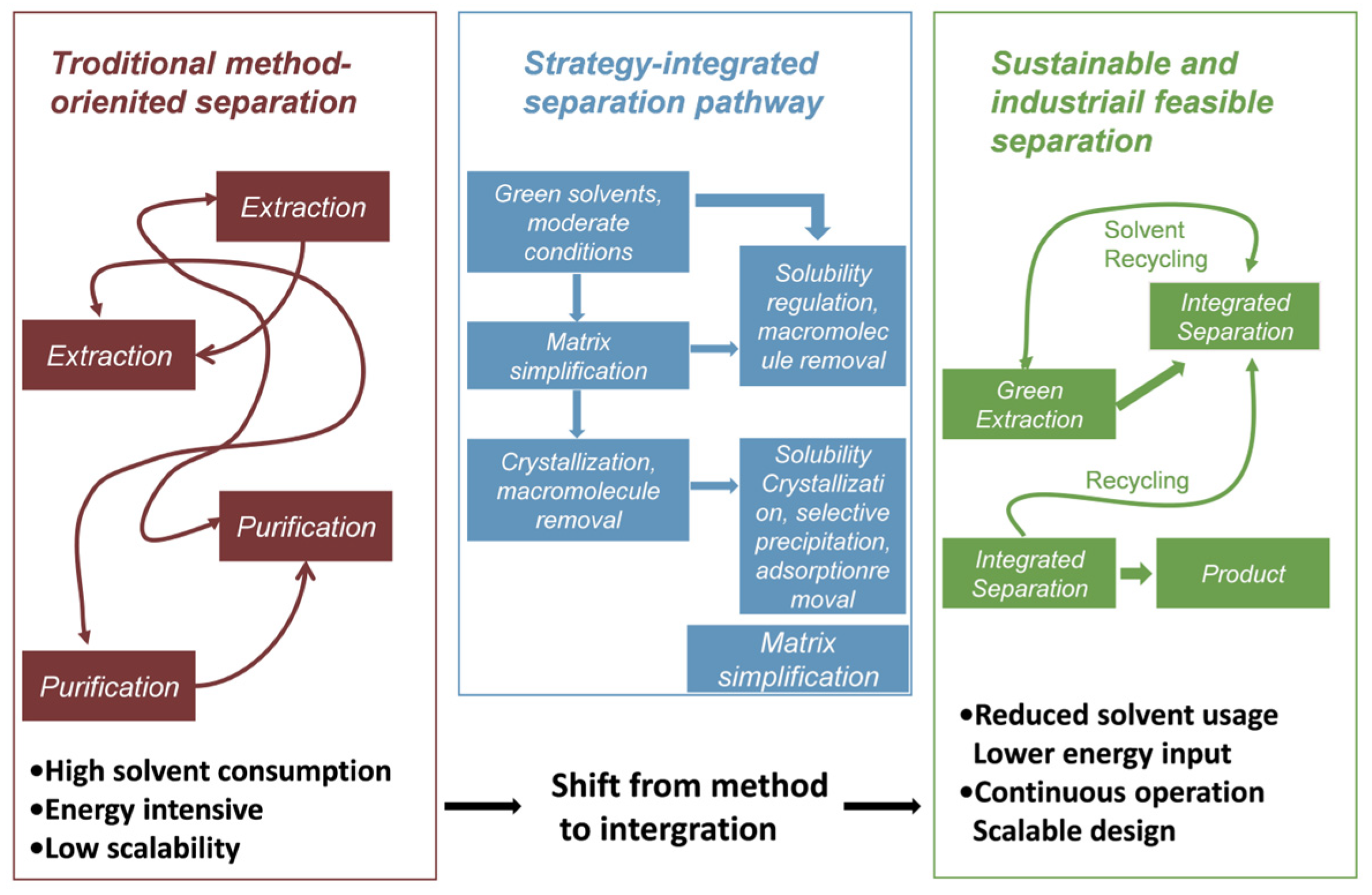
This review highlights a design concept in which downstream separation requirements are considered already at the extraction stage (Figure 3). By tuning the solvent system, extraction conditions, and material state, the extract can be shaped to create favorable conditions for subsequent separation steps. Hesperidin extraction, separation, and solvent recovery should be designed as an integrated whole, rather than simply selecting the single method that performs best in isolation. Upstream design should not only pursue high extraction efficiency, but also ensure that the extract composition, phase behavior, and recyclability are compatible with downstream unit operations, thereby reducing the number of separation steps and lowering energy and material consumption. This aligns with principles of green engineering [67,68].
Figure 3.
Comparison of hesperidin separation strategies, including traditional method-oriented separation, strategy-integrated separation pathways, and sustainable industrially feasible separation. Arrows indicate the direction and sequence of the processing steps and illustrate the relationships between extraction, purification, and integrated separation processes. Instead of relying on single high-resolution methods, the strategy-oriented approach emphasizes matrix simplification, physicochemical-property-driven separation, and process integration to improve sustainability and scalability.
For hesperidin separation, this concept is particularly important. Citrus peel extracts contain pectin, polysaccharides, pigments, and other impurities. If upstream processing focuses only on maximizing extraction, downstream problems such as co-precipitation and entrainment, membrane fouling, and rapid blockage of adsorption beds can become more severe. In such cases, the use of green solvents may paradoxically require more post-treatment to remove the additional co-extracted burdens.
Practically, three points should be followed in green-solvent extraction design. First, solvent selection should prioritize systems that can solubilize hesperidin while limiting the dissolution of certain structurally similar impurities. Second, operating conditions should avoid excessive intensification to reduce impurity loading. Third, material pretreatment should be used when appropriate to reduce interference from high-molecular-weight impurities during downstream separation. This extraction-driven, rather than reaction-driven, design logic can maintain green attributes while improving the overall separation efficiency and process robustness.
5.3. Synergistic Potential Between Green Solvent Systems and Separation Strategies
Green solvent systems offer distinctive synergies in hesperidin separation. On one hand, solvent polarity and hydrogen-bond donor and acceptor characteristics can strongly influence hesperidin solubility behavior and phase-equilibrium features. On the other hand, these characteristics can be actively used to tune crystallization, precipitation, and adsorption processes.
With rational process design, green solvent systems can function not only as extraction media but also as participants in downstream separation steps, thereby reducing solvent switching and overall process complexity. Such a strategy of “stacking solvent functions” can lower solvent consumption and energy input while enhancing process sustainability and economic performance.
5.4. Solvent Recovery Technology Realizes Green Extraction and Separation Closed-Loop Design
In process schemes aimed at recovering hesperidin from citrus processing by-products, solvent recovery represents a critical element for achieving both a closed green processing loop and industrial feasibility. Existing studies indicate that, regardless of whether hydroalcoholic extraction, adsorption–desorption enrichment, or multiphase and switchable solvent systems are employed, solvent recyclability and recovery strategies have a direct impact on overall operational burden, environmental emissions, and the stability and economics of scale-up.
For conventional solvent systems based on ethanol and water, solvent recovery is typically achieved through well-established unit operations such as vacuum evaporation or distillation–condensation. These steps can be readily coupled with extract concentration, precipitation, or crystallization, forming an integrated and engineering-friendly loop of “extraction–concentration–precipitation–recovery” [40]. In adsorption-based enrichment strategies, the focus of solvent recovery shifts from the extraction stage to the desorption stage. Resin desorption commonly relies on high-concentration ethanol [62], and solvent consumption and recycling efficiency directly determine the operational load and long-term economic viability of this unit. Accordingly, many studies recommend integrating desorption solvent recovery into a centralized solvent management system to reduce marginal costs under repeated or continuous operation.
More recently, switchable or recyclable solvent systems, such as CO2-responsive deep eutectic solvents, have been proposed as alternative approaches by introducing reversible phase-behavior control. In these systems, solvent recovery is effectively transformed into an in-process phase-transition step, offering new design concepts for constructing green process loops [43]. However, the industrial scalability of such systems still requires comprehensive evaluation, particularly with respect to solvent cycling stability, the operational complexity associated with gas switching, and the overall energy demand of the integrated process.
Overall, from a separation-oriented process design perspective, solvent recovery should not be treated as an auxiliary operation but should be systematically considered at the early stage of extraction–separation strategy selection. Prioritizing solvent systems with simple composition, high recoverability, and compatibility with downstream units, together with membrane-based load reduction or staged enrichment, is a key prerequisite for achieving green, efficient, and scalable separation of hesperidin.
6. Coordinated Considerations from Laboratory Optimization to Industrial Scale-Up
Although synergistic design of green extraction and separation has shown advantages at laboratory scale, industrial scale-up still faces multiple challenges. Under scale-up conditions, solvent recovery efficiency, operational continuity, equipment compatibility, and cost control often become key determinants of feasibility.
To better evaluate the industrial relevance of different separation strategies, Table 3 summarizes key process performance indicators beyond separation efficiency. These indicators include operating cost, energy consumption, processing capacity, and scalability, which are critical considerations for industrial implementation.
Accordingly, green extraction strategies should be evaluated within the overall process framework rather than by isolated unit performance. Introducing scale-up-oriented considerations at the experimental stage, such as simplifying operating steps, reducing the number of unit operations, and improving process stability, can help lay the groundwork for practical implementation of integrated green extraction and separation. This coordinated perspective that bridges laboratory research and industrial feasibility is also likely to be an important direction for future natural product separation studies.
7. Conclusions
Citrus is widely produced, broadly consumed, and rich in functional components. Its processing by-products provide abundant and sustainable feedstocks for flavonoids such as hesperidin [26,47,69], offering strong research significance and application potential. At the same time, matrices rich in functional substances often pose difficulties in extraction, especially for flavonoids.
This review analyzed the reasons behind the challenging extraction of flavonoids represented by hesperidin. It discussed the applicability and selection considerations of chromatographic and non-chromatographic strategies from an integrated perspective covering extraction, separation, and purification. From the viewpoint of green processing and sustainable development, it further examined the synergy between green extraction strategies and downstream separation. Evidence from existing experimental studies indicates that green extraction is not inherently equivalent to separation-friendly processing, and its practical value should be assessed within an overall process framework. Separation-oriented green extraction design can reduce system complexity at the source and provide more favorable operating conditions for subsequent separation and purification.
Looking forward, if future research can translate the pathway logic of “green solvent selection, phase-behavior control, load reduction through process intensification, and terminal polishing” into verifiable and scalable engineering combinations, the extraction and application of flavonoids such as hesperidin may progress beyond laboratory-scale process assembly toward truly continuous industrial production and high-value utilization of citrus by-products.
Author Contributions
Writing—draft, L.S.; writing—review and editing, Y.Z. and M.L.; supervision, M.L. All authors have read and agreed to the published version of the manuscript.
Funding
This research was funded by the National Natural Science Foundation of China (grant no. 32273074, grant no. 31972746, grant no. 31772809).
Data Availability Statement
No new data were created or analyzed in this study.
Conflicts of Interest
The authors declare no conflicts of interest.
References
- Atanasov, A.G.; Waltenberger, B.; Pferschy-Wenzig, E.M.; Linder, T.; Wawrosch, C.; Uhrin, P.; Temml, V.; Wang, L.; Schwaiger, S.; Heiss, E.H.; et al. Discovery and resupply of pharmacologically active plant-derived natural products: A review. Biotechnol. Adv. 2015, 33, 1582–1614. [Google Scholar] [CrossRef] [Scilit]
- Guo, X.; Luo, W.; Wu, L.; Zhang, L.; Chen, Y.; Li, T.; Li, H.; Zhang, W.; Liu, Y.; Zheng, J.; et al. Natural Products from Herbal Medicine Self-Assemble into Advanced Bioactive Materials. Adv. Sci. 2024, 11, e2403388. [Google Scholar] [CrossRef] [Scilit] [PubMed]
- Atanasov, A.G.; Zotchev, S.B.; Dirsch, V.M.; Supuran, C.T. Natural products in drug discovery: Advances and opportunities. Nat. Rev. Drug Discov. 2021, 20, 200–216. [Google Scholar] [CrossRef] [Scilit] [PubMed]
- Newman, D.J.; Cragg, G.M. Natural Products as Sources of New Drugs over the Nearly Four Decades from 01/1981 to 09/2019. J. Nat. Prod. 2020, 83, 770–803. [Google Scholar] [CrossRef] [Scilit]
- Kandemir, K.; Piskin, E.; Xiao, J.; Tomas, M.; Capanoglu, E. Fruit Juice Industry Wastes as a Source of Bioactives. J. Agric. Food Chem. 2022, 70, 6805–6832. [Google Scholar] [CrossRef] [Scilit] [PubMed]
- Andrade, M.A.; Barbosa, C.H.; Shah, M.A.; Ahmad, N.; Vilarinho, F.; Khwaldia, K.; Silva, A.S.; Ramos, F. Citrus By-Products: Valuable Source of Bioactive Compounds for Food Applications. Antioxidants 2022, 12, 38. [Google Scholar] [CrossRef] [Scilit]
- Habotta, O.A.; Dawood, M.A.O.; Kari, Z.A.; Tapingkae, W.; Van Doan, H. Antioxidative and immunostimulant potential of fruit derived biomolecules in aquaculture. Fish Shellfish. Immunol. 2022, 130, 317–322. [Google Scholar] [CrossRef] [Scilit]
- Raczkowska, E.; Serek, P. Health-Promoting Properties and the Use of Fruit Pomace in the Food Industry—A Review. Nutrients 2024, 16, 2757. [Google Scholar] [CrossRef] [Scilit]
- Šafranko, S.; Šubarić, D.; Jerković, I.; Jokić, S. Citrus By-Products as a Valuable Source of Biologically Active Compounds with Promising Pharmaceutical, Biological and Biomedical Potential. Pharmaceuticals 2023, 16, 1081. [Google Scholar] [CrossRef] [Scilit]
- Singh, B.; Singh, J.P.; Kaur, A.; Singh, N. Phenolic composition, antioxidant potential and health benefits of citrus peel. Food Res. Int. 2020, 132, 109114. [Google Scholar] [CrossRef] [Scilit]
- Zaidi, S.Y.R.; Ahmed, A.; Sanghvi, G.; Roopashree, R.; Kashyap, A.; Mohammed, N.K.; Niaz, B.; Saeed, F.; Jamil, F.; Akhter, M.N.; et al. Exploring the In Vitro Anti-Inflammatory Effect of Citrus Fruit Hesperidin Supplementation. Food Sci. Nutr. 2025, 13, e70900. [Google Scholar] [CrossRef] [Scilit]
- Roohbakhsh, A.; Parhiz, H.; Soltani, F.; Rezaee, R.; Iranshahi, M. Molecular mechanisms behind the biological effects of hesperidin and hesperetin for the prevention of cancer and cardiovascular diseases. Life Sci. 2015, 124, 64–74. [Google Scholar] [CrossRef] [Scilit]
- Ma, R.; You, H.; Liu, H.; Bao, J.; Zhang, M. Hesperidin: A citrus plant component, plays a role in the central nervous system. Heliyon 2024, 10, e38937. [Google Scholar] [CrossRef] [Scilit] [PubMed]
- Xiong, H.; Wang, J.; Ran, Q.; Lou, G.; Peng, C.; Gan, Q.; Hu, J.; Sun, J.; Yao, R.; Huang, Q. Hesperidin: A Therapeutic Agent For Obesity. Drug Des. Dev. Ther. 2019, 13, 3855–3866. [Google Scholar] [CrossRef] [Scilit] [PubMed]
- Parhiz, H.; Roohbakhsh, A.; Soltani, F.; Rezaee, R.; Iranshahi, M. Antioxidant and anti-inflammatory properties of the citrus flavonoids hesperidin and hesperetin: An updated review of their molecular mechanisms and experimental models. Phytother. Res. 2015, 29, 323–331. [Google Scholar] [CrossRef] [Scilit]
- Kowalczyk, A. Hesperidin, a Potential Antiviral Agent against SARS-CoV-2: The Influence of Citrus Consumption on COVID-19 Incidence and Severity in China. Medicina 2024, 60, 892. [Google Scholar] [CrossRef] [Scilit]
- Pyrzynska, K. Hesperidin: A Review on Extraction Methods, Stability and Biological Activities. Nutrients 2022, 14, 2387. [Google Scholar] [CrossRef] [Scilit]
- Wdowiak, K.; Walkowiak, J.; Pietrzak, R.; Bazan-Woźniak, A.; Cielecka-Piontek, J. Bioavailability of Hesperidin and Its Aglycone Hesperetin-Compounds Found in Citrus Fruits as a Parameter Conditioning the Pro-Health Potential (Neuroprotective and Antidiabetic Activity)-Mini-Review. Nutrients 2022, 14, 2647. [Google Scholar] [CrossRef] [Scilit] [PubMed]
- Han, X.; Zhang, Y.; Zhang, L.; Zhuang, Y.; Wang, Y. Efficacy and molecular mechanisms of hesperidin in mitigating Alzheimer’s disease: A systematic review. Eur. J. Med. Chem. 2025, 283, 117144. [Google Scholar] [CrossRef] [Scilit]
- Hoang, T.P.N.; Timmins, P.; Smith, A.M.; Conway, B.R.; Ghori, M.U. Drug delivery and formulation development of hesperidin: A systematic review. Expert Opin. Drug Deliv. 2025, 23, 363–384. [Google Scholar] [CrossRef] [Scilit]
- Qi, M.; Su, Y. Targeting colorectal cancer with hesperidin and hesperetin: A comprehensive review of antiproliferative activity, chemopreventive, anti-inflammatory, and antioxidant effects. Front. Nutr. 2025, 12, 1647977. [Google Scholar] [CrossRef] [Scilit]
- Sivaslioglu, A.; Goktas, Z. A comprehensive review on the impact of hesperidin and its aglycone hesperetin on metabolic dysfunction-associated steatotic liver disease and other liver disorders. Nutr. Res. Rev. 2025, 38, 558–570. [Google Scholar] [CrossRef] [Scilit]
- Garg, A.; Garg, S.; Zaneveld, L.J.; Singla, A.K. Chemistry and pharmacology of the Citrus bioflavonoid hesperidin. Phytother. Res. 2001, 15, 655–669. [Google Scholar] [CrossRef] [Scilit]
- Li, P.; Yao, X.; Zhou, Q.; Meng, X.; Zhou, T.; Gu, Q. Citrus Peel Flavonoid Extracts: Health-Beneficial Bioactivities and Regulation of Intestinal Microecology in vitro. Front. Nutr. 2022, 9, 888745. [Google Scholar] [CrossRef] [Scilit] [PubMed]
- Munir, H.; Yaqoob, S.; Awan, K.A.; Imtiaz, A.; Naveed, H.; Ahmad, N.; Naeem, M.; Sultan, W.; Ma, Y. Unveiling the Chemistry of Citrus Peel: Insights into Nutraceutical Potential and Therapeutic Applications. Foods 2024, 13, 1681. [Google Scholar] [CrossRef] [Scilit]
- Maqbool, Z.; Khalid, W.; Atiq, H.T.; Koraqi, H.; Javaid, Z.; Alhag, S.K.; Al-Shuraym, L.A.; Bader, D.M.D.; Almarzuq, M.; Afifi, M.; et al. Citrus Waste as Source of Bioactive Compounds: Extraction and Utilization in Health and Food Industry. Molecules 2023, 28, 1636. [Google Scholar] [CrossRef] [Scilit] [PubMed]
- Majumdar, S.; Srirangam, R. Solubility, stability, physicochemical characteristics and in vitro ocular tissue permeability of hesperidin: A natural bioflavonoid. Pharm. Res. 2009, 26, 1217–1225. [Google Scholar] [CrossRef] [Scilit] [PubMed]
- Chaves, J.O.; de Souza, M.C.; da Silva, L.C.; Lachos-Perez, D.; Torres-Mayanga, P.C.; Machado, A.; Forster-Carneiro, T.; Vázquez-Espinosa, M.; González-de-Peredo, A.V.; Barbero, G.F.; et al. Extraction of Flavonoids from Natural Sources Using Modern Techniques. Front. Chem. 2020, 8, 507887. [Google Scholar] [CrossRef] [Scilit]
- Alara, O.R.; Abdurahman, N.H.; Ukaegbu, C.I. Soxhlet extraction of phenolic compounds from Vernonia cinerea leaves and its antioxidant activity. J. Appl. Res. Med. Aromat. Plants 2018, 11, 12–17. [Google Scholar] [CrossRef] [Scilit]
- Inoue, T.; Tsubaki, S.; Ogawa, K.; Onishi, K.; Azuma, J.-I. Isolation of hesperidin from peels of thinned Citrus unshiu fruits by microwave-assisted extraction. Food Chem. 2010, 123, 542–547. [Google Scholar] [CrossRef] [Scilit]
- Yusoff, I.M.; Mat Taher, Z.; Rahmat, Z.; Chua, L.S. A review of ultrasound-assisted extraction for plant bioactive compounds: Phenolics, flavonoids, thymols, saponins and proteins. Food Res. Int. 2022, 157, 111268. [Google Scholar] [CrossRef] [Scilit] [PubMed]
- Dashtian, K.; Kamalabadi, M.; Ghoorchian, A.; Ganjali, M.R.; Rahimi-Nasrabadi, M. Integrated supercritical fluid extraction of essential oils. J. Chromatogr. A 2024, 1733, 465240. [Google Scholar] [CrossRef] [Scilit]
- Liu, H.; Zhang, M.; Guo, Y.; Qiu, H. Solid-phase extraction of flavonoids in honey samples using carbamate-embedded triacontyl-modified silica sorbent. Food Chem. 2016, 204, 56–61. [Google Scholar] [CrossRef] [Scilit]
- Mikšovsky, P.; Kornpointner, C.; Parandeh, Z.; Goessinger, M.; Bica-Schröder, K.; Halbwirth, H. Enzyme-Assisted Supercritical Fluid Extraction of Flavonoids from Apple Pomace (Malus × domestica). ChemSusChem 2024, 17, e202301094. [Google Scholar] [CrossRef] [Scilit]
- Miklavčič Višnjevec, A.; Kozlovič, G.; Fonseca, G.; Zamuner, A.; Barp, L.; Moret, S. Optimization of pressurized liquid extraction of phenolic compounds from green pea (Pisum sativum) flour. Food Chem. 2025, 493, 144997. [Google Scholar] [CrossRef] [Scilit]
- Xu, L.; Zhu, S.; Wan, W.; Yu, M.; Zeng, X.; Deng, Z. Pulsed electric field-assisted extraction of hesperidin from tangerine peel and its technological optimization through response surface methodology. J. Sci. Food Agric. 2024, 104, 6687–6695. [Google Scholar] [CrossRef] [Scilit]
- Khan, J.; Asaf, S.; Lubna; Abdelbacki, A.M.M.; Jan, R.; Kim, K.M. Green Extraction of Antioxidant-Rich Flavonoids from Fagonia cretica Using Deep Eutectic Solvents. Molecules 2025, 30, 813. [Google Scholar] [CrossRef] [Scilit]
- Kim, D.-S.; Lim, S.-B. Extraction of flavanones from immature Citrus unshiu pomace: Process optimization and antioxidant evaluation. Sci. Rep. 2020, 10, 19950. [Google Scholar] [CrossRef] [Scilit]
- Yeddes, W.; Bettaieb Rebey, I.; Yazidi, R.; Ben Abdennebi, A.; Hammami, M.; Ben Farhat, M.; Saidani Tounsi, M. Eco-friendly extraction of hesperidin from citrus peels: A comparative study of Soxhlet, ultrasound-assisted, and microwave-assisted methods for improved yield and antioxidant properties. Int. J. Environ. Health Res. 2025, 35, 3359–3370. [Google Scholar] [CrossRef] [Scilit] [PubMed]
- Figueira, O.; Pereira, V.; Castilho, P.C. A Two-Step Approach to Orange Peel Waste Valorization: Consecutive Extraction of Pectin and Hesperidin. Foods 2023, 12, 3834. [Google Scholar] [CrossRef] [Scilit] [PubMed]
- Ma, Y.; Ye, X.; Hao, Y.; Xu, G.; Xu, G.; Liu, D. Ultrasound-assisted extraction of hesperidin from Penggan (Citrus reticulata) peel. Ultrason. Sonochem. 2008, 15, 227–232. [Google Scholar] [CrossRef] [Scilit]
- Li, G.; Lei, J.; Li, S.; Jiang, Y.; Zhang, F.; Song, C.; Xiao, S.; Fu, S.; Zhou, J.; Wu, F.; et al. Extraction of flavonoids from Citri Reticulatae Pericarpium Viride using a deep eutectic solvent. RSC Adv. 2022, 12, 26975–26988. [Google Scholar] [CrossRef] [Scilit]
- Wang, S.; Lei, T.; Liu, L.; Tan, Z. CO2-responsive deep eutectic solvents for the enhanced extraction of hesperidin from Fertile orange peel. Food Chem. 2024, 432, 137255. [Google Scholar] [CrossRef] [Scilit] [PubMed]
- Shekaari, H.; Zafarani-Moattar, M.T.; Mokhtarpour, M.; Faraji, S. Solubility of hesperidin drug in aqueous biodegradable acidic choline chloride-based deep eutectic solvents. Sci. Rep. 2023, 13, 11276. [Google Scholar] [CrossRef] [Scilit] [PubMed]
- Hwang, H.J.; Kim, H.J.; Ko, M.J.; Chung, M.S. Recovery of hesperidin and narirutin from waste Citrus unshiu peel using subcritical water extraction aided by pulsed electric field treatment. Food Sci. Biotechnol. 2021, 30, 217–226. [Google Scholar] [CrossRef] [Scilit] [PubMed]
- Kim, D.-S.; Lim, S.-B. Semi-continuous subcritical water extraction of flavonoids from Citrus unshiu peel: Their antioxidant and enzyme inhibitory activities. Antioxidants 2020, 9, 360. [Google Scholar] [CrossRef] [Scilit]
- Li, W.; Zhang, X.; Wang, S.; Gao, X.; Zhang, X. Research Progress on Extraction and Detection Technologies of Flavonoid Compounds in Foods. Foods 2024, 13, 628. [Google Scholar] [CrossRef] [Scilit]
- Morales, J.; Medina, A.; Bermejo, A. Sustainable Extraction of Flavonoids from Citrus Waste: A Fast and Simple Approach with UHPLC-PDA ESI-MS Characterization. Sci 2025, 7, 156. [Google Scholar] [CrossRef] [Scilit]
- Zhang, X.; Liu, Z.; Huang, Y.; Niu, Y.; Zhang, L.; Xiong, T.; Zhang, Y.; Zhang, R.; Zhang, H. Preparation and in vitro evaluation of hesperidin nanoparticles by antisolvent recrystallization in a double ho-mogenate system. Food Chem. X 2023, 18, 100639. [Google Scholar] [CrossRef] [Scilit]
- Liu, Z.; Lanier, O.L.; Chauhan, A. Poly (Vinyl Alcohol) Assisted Synthesis and Anti-Solvent Precipitation of Gold Nanoparticles. Nanomaterials 2020, 10, 2359. [Google Scholar] [CrossRef] [Scilit]
- Liu, Y.; Sui, X.; Zhao, X.; Wang, S.; Yang, Q. Antioxidative Activity Evaluation of High Purity and Micronized Tartary Buckwheat Flavonoids Prepared by Antisolvent Recrystallization. Foods 2022, 11, 1346. [Google Scholar] [CrossRef] [Scilit]
- Zu, Y.G.; Wang, L.; Zhao, X.; Li, Y.; Wu, W.; Zu, C.; Huang, Y.; Wu, M.; Feng, Z. Purification of Ginkgo biloba extract by antisolvent recrystallization. Chem. Eng. Technol. 2016, 39, 1301–1308. [Google Scholar] [CrossRef] [Scilit]
- Stanisic, D.; Liu, L.H.B.; dos Santos, R.V.; Costa, A.F.; Durán, N.; Tasic, L. New Sustainable Process for Hesperidin Isolation and Anti-Ageing Effects of Hesperidin Nanocrystals. Molecules 2020, 25, 4534. [Google Scholar] [CrossRef] [Scilit]
- Dikmetas, D.N.; Devecioglu, D.; Karbancioglu-Guler, F.; Kahveci, D. Sequential Extraction and Characterization of Essential Oil, Flavonoids, and Pectin from Industrial Orange Waste. ACS Omega 2024, 9, 14442–14454. [Google Scholar] [CrossRef] [Scilit]
- Xu, R.; Cong, Y.; Zheng, M.; Chen, G.; Chen, J.; Zhao, H. Solubility and modeling of hesperidin in cosolvent mixtures of ethanol, isopropanol, propylene glycol, and n-propanol+ water. J. Chem. Eng. Data 2018, 63, 764–770. [Google Scholar] [CrossRef] [Scilit]
- Jouyban, A.; Martinez, F. Solution thermodynamics and preferential solvation of hesperidin in aqueous cosolvent mixtures of ethanol, isopropanol, propylene glycol, and n-propanol. Phys. Chem. Liq. 2019, 57, 432–444. [Google Scholar] [CrossRef] [Scilit]
- Wen, C.; Zhao, K.; Kang, L.; Wang, L. Aqueous Two-phase Extraction of Hesperidin. Food Sci. 2009, 30, 71–73. [Google Scholar] [CrossRef]
- Zheng, W.; Wu, F.; Luo, X.; Bian, C.; Zhang, Y.; Yin, F.; Liu, H.; Fu, Y. Separation of Citrus Essential Oil and Hesperidin from Citrus Peel Through Combined Mixed-Solvent and Multi-Phase Salting Out Extraction. J. Essent. Oil Bear. Plants 2022, 25, 899–909. [Google Scholar] [CrossRef] [Scilit]
- Cassano, A.; Conidi, C.; Ruby-Figueroa, R. Recovery of Flavonoids from Orange Press Liquor by an Integrated Membrane Process. Membranes 2014, 4, 509–524. [Google Scholar] [CrossRef] [Scilit] [PubMed]
- Hidalgo, A.M.; Macario Legaz, J.A.; Saura-Martínez, J.; Tortosa-Díaz, L.; López-Nicolás, R.; Marín-Iniesta, F. Application of Membrane Technology to Obtain Bioactive Products from Orange Peel Extract. Foods 2025, 14, 4202. [Google Scholar] [CrossRef] [Scilit] [PubMed]
- Alonso-Vázquez, P.; Isola, A.; Sánchez-Arévalo, C.M.; Cuartas-Uribe, B.; Vincent-Vela, M.C.; Álvarez-Blanco, S. Concentration of phenolic compounds from an orange peel waste extract using a combination of ultrafiltration and forward osmosis. Sep. Purif. Technol. 2025, 360, 131228. [Google Scholar] [CrossRef] [Scilit]
- Padilla de la Rosa, J.D.; Ruiz-Palomino, P.; Arriola-Guevara, E.; García-Fajardo, J.; Sandoval, G.; Guatemala-Morales, G.M. A Green Process for the Extraction and Purification of Hesperidin from Mexican Lime Peel (Citrus aurantifolia Swingle) that is Extendible to the Citrus Genus. Processes 2018, 6, 266. [Google Scholar] [CrossRef] [Scilit]
- Zhao, Q.; Yu, X.; Liu, M.; Qin, C.; He, Y.; Wang, S.; Wang, H. Preparation of molecularly imprinted polymers for the selective extraction and purification of hesperidin from orange peels. J. Chromatogr. B 2025, 1263, 124696. [Google Scholar] [CrossRef] [Scilit]
- Nabavi, A.S.; Ghoreishi, S.M.; Tajabadi, F. A simple and economic solid-phase extraction method for purification of hesperidin from orange peel using a metal–organic framework-adsorbent (MIL-101 (Cr)). Anal. Methods 2025, 17, 6397–6404. [Google Scholar] [CrossRef] [Scilit] [PubMed]
- Shi, S.; Huang, K.; Zhang, Y.; Liu, S. Preparative isolation and purification of two flavonoid glycosides from Taraxacum mongolicum by high-speed counter-current chromatography. Sep. Purif. Technol. 2008, 60, 81–85. [Google Scholar] [CrossRef] [Scilit]
- Yao, S.; Cao, Y.; Jia, C.-m.; Wang, Y.; Song, H. Developments of instruments and methods related with high-speed countercurrent chromatography and their applications in research of natural medicines. Cent. Eur. J. Chem. 2012, 10, 417–432. [Google Scholar] [CrossRef] [Scilit]
- McDonough, W.; Braungart, M.; Anastas, P.T.; Zimmerman, J.B. Peer reviewed: Applying the principles of green engineering to cradle-to-cradle design. Environ. Sci. Technol. 2003, 37, 434A–441A. [Google Scholar] [CrossRef] [Scilit]
- Anastas, P.T.; Zimmerman, J.B. Chapter 2 The twelve principles of green engineering as a foundation for sustainability. In Sustainability Science and Engineering; Abraham, M.A., Ed.; Elsevier: Amsterdam, The Netherlands, 2006; Volume 1, pp. 11–32. [Google Scholar]
- Rodrigues, C.V.; Pintado, M. Hesperidin from Orange Peel as a Promising Skincare Bioactive: An Overview. Int. J. Mol. Sci. 2024, 25, 1890. [Google Scholar] [CrossRef] [Scilit] [PubMed]

Disclaimer/Publisher’s Note: The statements, opinions and data contained in all publications are solely those of the individual author(s) and contributor(s) and not of MDPI and/or the editor(s). MDPI and/or the editor(s) disclaim responsibility for any injury to people or property resulting from any ideas, methods, instructions or products referred to in the content. |
© 2026 by the authors. Licensee MDPI, Basel, Switzerland. This article is an open access article distributed under the terms and conditions of the Creative Commons Attribution (CC BY) license.