
Review

Research Progress in Flocculation Treatment of Aggregate Washing Wastewater: Mechanisms, Innovations, and Challenges

1
Hubei Energy Group Luotian Pingtanyuan Pumped Storage Co., Ltd., Huanggang 438616, China
2
POWERCHINA Zhongnan Engineering Corporation Ltd., Changsha 410021, China
3
Changjiang River Scientific Research Institute, Research Center of Water Engineering Safety and Disaster Prevention of Ministry of Water Resources, Wuhan 430010, China
*
Author to whom correspondence should be addressed.
Separations 2026, 13(2), 62; https://doi.org/10.3390/separations13020062
Submission received: 18 December 2025 / Revised: 4 February 2026 / Accepted: 4 February 2026 / Published: 10 February 2026
(This article belongs to the Section Separation Engineering)

Abstract

Rapid growth of water conservancy/hydropower projects has spurred rising demand for sand-gravel aggregates. Under strict water use and zero-waste policies, treating wet-process aggregate washing wastewater is challenging. Flocculants—key chemicals in this process—directly influence treatment efficiency and operational costs via their type, dosage, and efficacy. Further development of the intelligent control system for flocculant dosing can reduce flocculant consumption by 50% to 67%. However, existing studies have an insufficient understanding of the identification of emerging contaminants in aggregate washing wastewater and the migration of flocculants in multi-medium environments, as well as a lack of research on the synergistic effects of multiple flocculants. Another key core challenge lies in the accurate identification of the impact of flocculant residues on concrete performance, along with the problems of high cost and poor adaptability of intelligent systems. Future research directions will focus on precise flocculation, residue control and resource utilization to drive the development of efficient and environmentally friendly treatment technologies.

1. Introduction

Sand and gravel aggregates are the basic materials in the water conservancy construction industry and are in great demand in various engineering constructions [1,2]. During the construction of water conservancy facilities such as dams and channels, the acquisition of sand and gravel aggregates usually follows the principle of local sourcing, that is, excavating mountains and crushing rock masses near the construction site to prepare the required aggregates [3]. The surface of freshly crushed sand and gravel is attached with a large amount of clay powder, so the wet production process is required, and it needs to be fully washed in the screening equipment to meet the construction quality requirements [4]. Although the wet process can effectively improve the cleanliness of aggregates and suppress dust pollution, it will generate a large amount of aggregate washing wastewater containing high-concentration suspended solids (SS) [5]. This kind of wastewater has a high content of fine particles and poor sedimentation performance. These SS are the direct cause of water turbidity, sedimentation, and habitat destruction after being discharged into the natural environment [6]. They are also the main control indicators for the on-site treatment and discharge of aggregate washing wastewater in the current environmental protection standards of the water conservancy construction industry. With the increasingly strict environmental protection regulations, achieving “zero discharge” of aggregate washing wastewater has become a basic requirement for the water conservancy engineering industry [7].
The core of aggregate washing wastewater treatment lies in achieving solid precipitation and solid–liquid separation [8]. At present, wastewater treatment plants supporting major water conservancy construction projects generally adopt processes such as pre-precipitation, flocculation precipitation or multi-stage precipitation to achieve this goal, and combine technologies such as filter-press dewatering to recover sludge [5,9,10]. At the same time, the treated clean water that meets the standards is reused to improve resource utilization. In China, the concentration of SS in the treated wastewater is usually required to be no higher than 70 mg/L to meet the “Integrated Wastewater Discharge Standard” (GB8978-1996) [11]. Currently, the aggregate washing wastewater treatment processes are mainly divided into three categories: the horizontal flow natural precipitation scheme, the radial flow coagulation precipitation scheme, and the high-efficiency cyclone wastewater purifier scheme [12,13]. Among these three processes, horizontal flow natural precipitation requires long retention times (unsuitable for continuous production) and radial flow coagulation precipitation has high infrastructure costs. In contrast, flocculation-sedimentation technology stands out due to its high treatment efficiency and low operational costs, making it the cornerstone of aggregate washing wastewater treatment in most large-scale water conservancy projects.
Flocculation-sedimentation technology has emerged as the cornerstone of aggregate washing wastewater treatment owing to its remarkable efficiency and cost-effectiveness [14,15]. The selection and optimization of flocculants are pivotal, as they directly govern the solid–liquid separation efficiency, operational stability of the treatment system, and overall processing costs [15,16]. Recent years have witnessed substantial advancements made by global researchers in areas including flocculant development, mechanistic insights, process optimization, and residual effect analysis [6,15]. Nevertheless, a comprehensive synthesis of progress in flocculation-based treatment of aggregate washing wastewater remains lacking. Existing review papers in this field either focus on flocculation technologies for general industrial wastewater without targeting the unique physicochemical properties of aggregate washing wastewater (e.g., ultra-high SS concentration, lithology-dependent particle characteristics, and stringent reuse requirements), or only discuss a single aspect, such as flocculant types, while lacking a systematic integration of “wastewater characteristics-treatment challenges-flocculation optimization-residue risk-control strategies” [17,18]. In addition, there is a lack of comprehensive summaries that link cutting-edge technologies such as precise flocculation and intelligent dosing with the practical needs of zero-discharge in water conservancy projects.
To address this gap, this review systematically consolidates existing research findings and provides an up-to-date overview of key developments. Specifically, it examines: (1) the unique characteristics and treatment challenges of aggregate washing wastewater; (2) the classification and functional mechanisms of flocculants; (3) optimization strategies and intelligent control methods for flocculant application; (4) the impacts of flocculant residues on downstream processes. By integrating these perspectives, this work not only constructs a complete technical framework for aggregate washing wastewater treatment, but also provides targeted theoretical guidance and practical solutions for the engineering application of zero-discharge and resource utilization in water conservancy projects.

2. Characteristics and Treatment Challenges of Aggregate Washing Wastewater

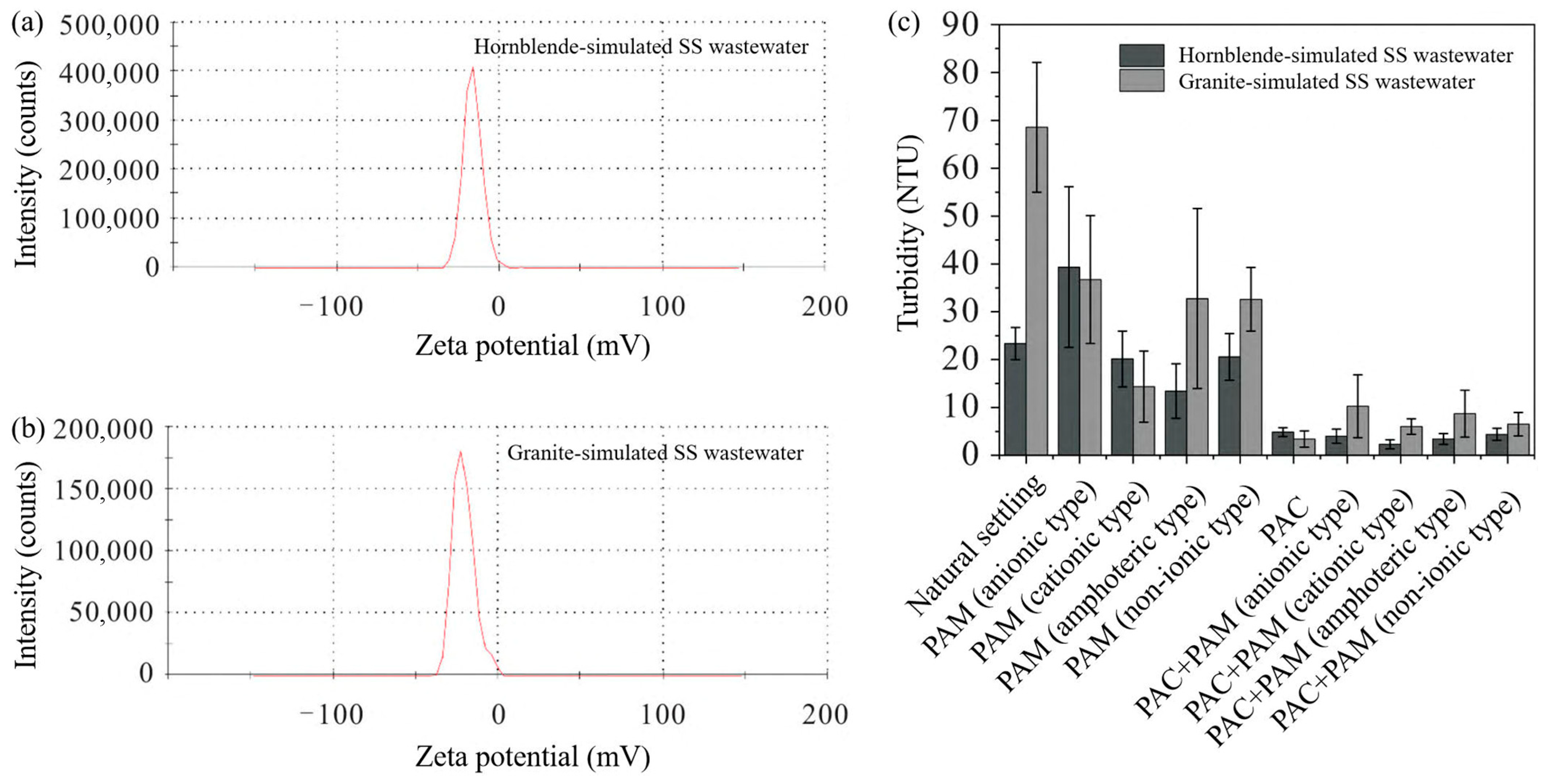
Aggregate washing wastewater primarily originates from washing, screening, and crushing processes in aggregate production. Its physicochemical characteristics are influenced by multiple factors, including parent rock lithology, water consumption patterns during production, and recycling methodologies [19]. The wastewater has two defining features: low organic content and ultra-high concentrations of solid particulates. The SS concentrations typically range from several thousand to tens of thousands of mg/L, posing significant challenges for solid–liquid separation [5]. Daily influent volumes fluctuate drastically depending on concrete project schedules and production cycles, complicating operational stability. In addition, the SS exhibit a broad particle size distribution. For instance, in wastewater from a large mine in Anhui, particles with a size of ≤25 μm accounted for 86.57% of the total SS, among which ultrafine fractions (≤23 μm) constituted 64.69% [20]. These particles predominantly consist of calcite (CaO: 52.73%), with minor SiO2 and MgO components. The high specific surface area and surface energy of ultrafine particles promote stable colloidal systems, drastically reducing natural gravitational sedimentation efficiency. Zeta potentials of SS in such wastewater are typically negative, e.g., −20.8 mV (granite-derived) and −16.4 mV (amphibolite-derived) [21]. This electrostatic repulsion inhibits particle aggregation, necessitating advanced destabilization strategies like electro-neutralization or polymer-assisted flocculation.
Therefore, the treatment of aggregate washing wastewater presents multifaceted technical challenges due to its unique physicochemical characteristics. These difficulties can be systematically categorized as follows (Figure 1):
  • Low sedimentation efficiency: Ultrafine particles exhibit pronounced Brownian motion, resulting in prolonged natural sedimentation times spanning several hours to days—far exceeding the demands of continuous production systems. Furthermore, sedimentation rates of wastewater vary substantially across different lithologies, necessitating the addition of flocculants to enhance settling efficiency [22].
  • Significant water quality fluctuations: Variations in water consumption patterns and aggregate source compositions during production induce marked fluctuations in wastewater quality [23]. Such instability challenges the operational reliability of treatment systems.
  • Substantial variations in wastewater volume: The volume of wastewater fluctuates considerably throughout the construction phase. To accommodate these load variations, stringent requirements are imposed on the design of chemical dosing methods and dosages. Notably, excessive flocculant dosing may trigger floc redispersion or elevate the moisture content of the resulting filter cake [24,25].
  • Pronounced lithological diversity: Wastewater characteristics derived from distinct lithologies (e.g., granite, amphibolite, basalt) differ markedly. Consequently, flocculants with tailored sedimentation kinetics must be selected to optimize performance.
  • Stringent requirements for reuse water quality: Treated effluent is recycled for production purposes, yet residual flocculants pose risks to downstream processes, demanding rigorous quality control.
In recent years, research on aggregate washing wastewater management has prioritized addressing these technical challenges. Among these, the strategic selection and precise control of flocculants emerge as pivotal to overcoming the aforementioned obstacles.

3. Types and Action Mechanism of Flocculant

The flocculants predominantly employed in aggregate washing wastewater treatment encompass three main categories: inorganic flocculants, organic polymeric flocculants, and composite flocculants [26]. These agents destabilize and aggregate suspended particles via three primary mechanisms: charge neutralization, adsorption bridging, and sweep flocculation [27]. Charge neutralization involves the electrostatic interaction between positively charged flocculant species and negatively charged colloidal particle surfaces, thereby reducing the zeta potential and destabilizing the colloidal system [28]. Adsorption bridging entails the adsorption of polymer flocculants onto multiple particles through functional groups, forming a “particle–polymer–particle” bridging network that facilitates floc growth [29]. Sweep flocculation corresponds to the entrapment and removal of suspended particles by hydroxide precipitates generated via hydrolysis of aluminum- or iron-based flocculants during precipitate formation, enabling coprecipitation [15]. Among these, polyaluminum chloride (PAC) and polyacrylamide (PAM) represent the most extensively utilized conventional flocculants [30]. As an inorganic flocculant, PAC primarily compresses the double electric layer through hydrolysis products of high-valent aluminum salts, neutralizing colloidal surface charges to induce particle destabilization and aggregation. As an organic polymeric flocculant, PAM utilizes its long-chain structure to bridge and interconnect particles, forming large-sized flocs that expedite sedimentation. These case studies highlight a key principle: flocculant selection must align with wastewater lithology.
While PAC and PAM dominate industrial applications due to their cost-effectiveness and efficiency, growing concerns about flocculant residues and environmental impacts have spurred interest in biopolymer flocculants. Specifically, biopolymer materials, as another type of flocculant, have been extensively studied. They are environmentally friendly flocculants prepared from natural biological macromolecules. Starch-based flocculants and chitosan are the two most representative types among them. Natural starch molecules contain a large number of hydroxyl groups and mainly flocculate through the adsorption-bridging effect. After modification by cationization, graft copolymerization, etc., positively charged groups (such as quaternary ammonium groups) are introduced into the molecular chain, significantly enhancing the charge neutralization effect and improving the flocculation effect on negatively charged pollutants in printing and dyeing wastewater and papermaking wastewater. Chitosan molecular chains contain a large number of amino groups (-NH2) and hydroxyl groups. Under acidic conditions, the amino groups are protonated to form -NH3+, with extremely strong charge neutralization ability, which can efficiently adsorb negatively charged colloids in water. At the same time, the linear structure of the molecular chain and active groups can also play an adsorption-bridging role, resulting in a fast flocculation rate and dense flocs. However, currently, due to cost and potential unknown subsequent impact risks, there are few actual engineering cases of using biopolymer materials for aggregate washing wastewater. But their environmentally friendly characteristics may safeguard water conservancy projects in ecologically fragile areas, and it is necessary to carry out relevant research on flocculation effects and life-cycle impacts. A comparative analysis of flocculant performance in typical aggregate washing wastewater treatment is presented in Table 1.
Although the flocculation mechanisms of flocculants do not differ much, the flocculation effects of different types of flocculants vary greatly in the actual treatment process. One of the most important reasons is that the lithologies of SS in different aggregate washing wastewater are different. The interaction process between SS and flocculants and the structural morphology of flocs determine the quality of the flocculation effect. Granite, as a widely utilized sand-gravel aggregate in hydropower engineering, exhibits distinct sedimentation behaviors in associated wastewater treatment. Zhai et al. [35] observed that natural sedimentation of granite wastewater for 30 min achieves a SS removal efficiency of 95%. The addition of PAC or PAM flocculants significantly enhances SS sedimentation efficiency. Notably, sole PAM addition yields the fastest sedimentation (5 min), yet the supernatant SS concentration remains above 100 mg/L. In contrast, PAC addition results in a slower sedimentation process (30 min) but achieves a lower minimum SS concentration of 10 mg/L. Flocculant sedimentation efficacy is also markedly influenced by the lithology of sand-gravel aggregates. Li et al. [21] investigated wastewater from two lithologies—granite and amphibolite—at the Xulong Hydropower Station. Given that both granite and amphibolite exhibit negative Zeta potentials, the combination of CPAM and PAC demonstrated optimal performance (Figure 2). Subsequent response surface methodology (RSM) analysis of single-factor experimental parameters revealed that under optimal flocculation conditions (PAM: 6.03 mg/L, PAC: 27.15 mg/L, stirring speed: 90 r/min, time: 60 s), amphibolite wastewater attained an optical transmittance of 97.5%; similarly, granite wastewater reached 96.2% transmittance under its optimal conditions (PAM: 3.75 mg/L, PAC: 154.33 mg/L, stirring speed: 90 r/min, time: 95 s).
In another study on Anhui mine wastewater, APAM (molecular weight: 16 million Da) outperformed non-ionic and cationic counterparts [20]. This superiority stems from the primary composition of ultrafine tailings in the wastewater being calcite: APAM facilitates bridging interactions with positively charged Ca2+ ions, forming compact flocs that enhance sedimentation performance. Hence, for aggregate washing wastewater from diverse projects, tailored analysis of water quality characteristics combined with flocculant adaptability tests is essential to identify optimal agents, thereby ensuring effective treatment outcomes.

4. Advances in Optimization and Control Strategies for Flocculants

The flocculation efficacy of aggregate washing wastewater is governed not only by flocculant type but also significantly influenced by the optimization of key operational parameters, including flocculant dosage, stirring speed, and residence time [36,37]. Systematic optimization of these conditions enhances flocculation efficiency significantly while reducing operational costs. In recent years, notable progress has been made in the optimization of flocculation dosing systems through research and engineering applications. Notably, the rapid advancement of artificial intelligence (AI) and related fields has opened new avenues for the precise regulation of the flocculation dosing process [38,39].
Lu et al. [5] investigated the SS concentrations of the supernatant after 60 min and 120 min natural sedimentation of aggregate washing wastewater from the Yebatan Hydropower Station, and evaluated the effects of different flocculant combinations. The experiments revealed that natural sedimentation had limited SS removal efficiency. With PAC dosages of 10 mg/L and 50 mg/L, SS concentrations decreased to 450 mg/L and 250 mg/L after 60 min, respectively. When 10 mg/L PAM was dosed alone, the suspended turbidity stabilized at 600 mg/L after 60 min. Although the combined use of PAC and PAM improved SS removal, the enhancement was not significant considering comprehensive economic benefits. Zhang et al. [20] analyzed the influences of SS concentration, flocculant molecular weight, and flocculant unit consumption on flocculation efficiency in aggregate washing wastewater from an Anhui mine. Results indicated that flocculant molecular weight and unit consumption had the most significant effects on SS concentration (p < 0.05), while flocculant molecular weight and SS concentration were the primary factors influencing maximum sedimentation velocity. Beyond flocculant parameters, process conditions also critically affected flocculation performance: rapid stirring speed and duration directly governed flocculant-particle mixing efficiency and floc quality. Insufficient stirring led to uneven mixing, whereas excessive stirring disrupted floc structure. Wang [40] adopted a combined “horizontal flow sedimentation + flocculation sedimentation” process for treating wastewater from the Guandi Hydropower Station. With a flocculant regimen of 500 mg/L PAC (5%) and 25 mg/L industrial caustic soda flakes (1%), and optimized hydraulic retention time (60 min) and sludge discharge cycle (2.5 h), the system achieved stable operation, with effluent meeting the first-class standard of the Integrated Wastewater Discharge Standard (GB 8978-1996) [11].
While traditional parameter optimization improves flocculation under static conditions, it fails to adapt to the dynamic variability of aggregate washing wastewater—such as daily fluctuations in SS concentration or changes in lithology from raw material shifts. Fixed dosing regimens often lead to over-dosing or under-dosing. To address this limitation, intelligent flocculant dosing systems—integrating real-time monitoring and AI—have emerged as a solution [41]. These systems employ sensors—such as online turbidimeters and flow meters—to track real-time fluctuations in water quality parameters. By incorporating preset algorithms, these systems dynamically adjust flocculant dosages, thereby ensuring treatment efficacy while minimizing chemical consumption [42]. Equipped with capabilities for real-time monitoring, intelligent analysis, and autonomous decision-making, such systems significantly enhance treatment efficiency and operational stability, reduce manual intervention, and lower operating costs. Particularly in ecologically fragile regions like plateaus and canyons, the deployment of intelligent control systems is pivotal for achieving the “zero discharge” target of aggregate washing wastewater.
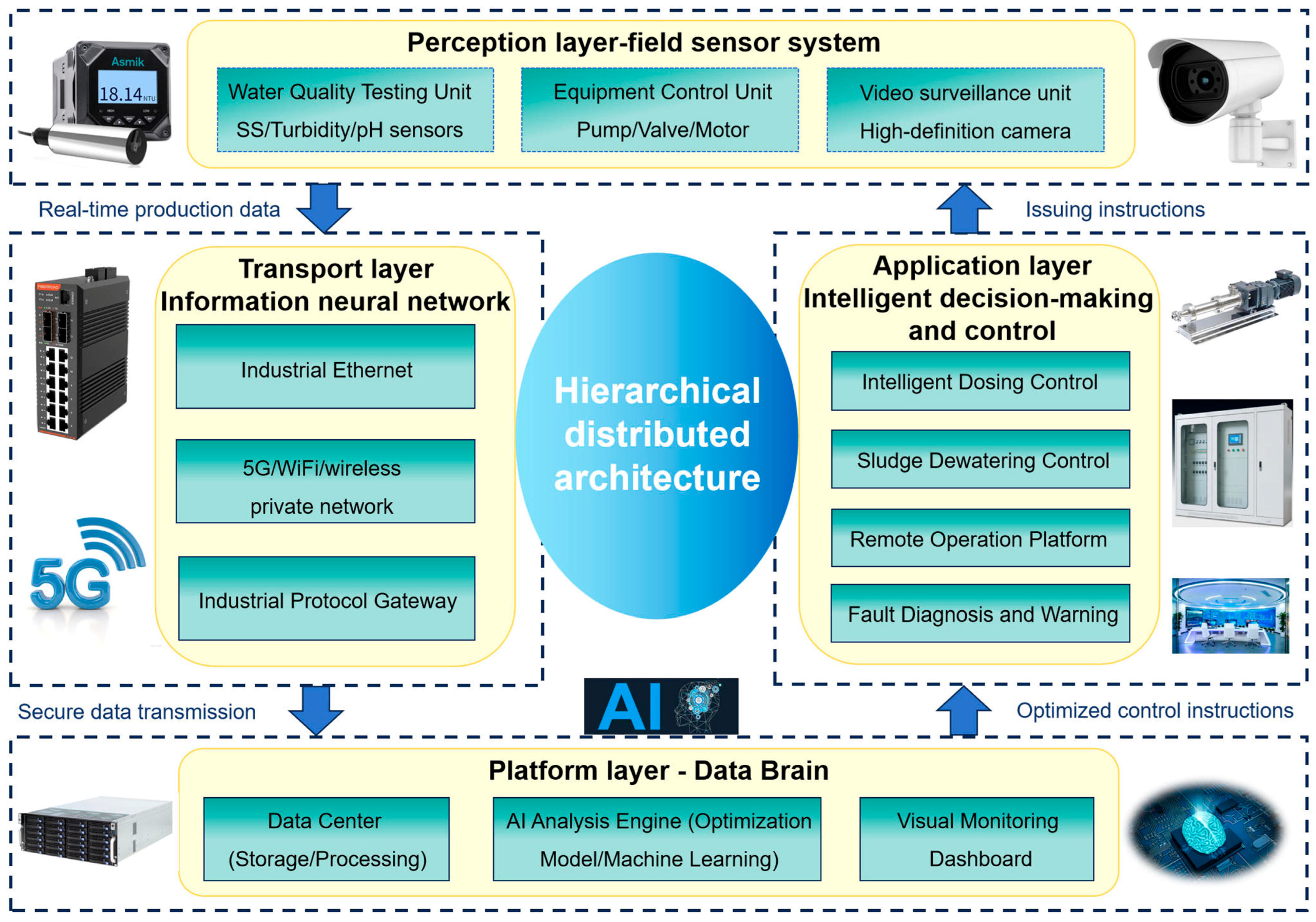
The intelligent control system for aggregate washing wastewater typically adopts a hierarchical distributed architecture, comprising four core layers: the perception layer, transmission layer, platform layer, and application layer (Figure 3) [43]. The perception layer is tasked with collecting diverse parameters during wastewater treatment, including key indicators such as SS concentration, pH value, and flow rate [44]. The transmission layer utilizes communication technologies (e.g., industrial internet, 5G) to upload the collected data to the control center in real time. Serving as the system’s “brain,” the platform layer stores, mines, and analyzes massive datasets to generate decision-making commands. The application layer then translates these commands into specific operations, enabling full-process intelligent control. This architectural design endows the system with state perception, real-time analysis, scientific decision-making, and precise execution capabilities, driving the transition of aggregate washing wastewater treatment from “experience-driven” to “data-driven” paradigms [45].
Among these, intelligent monitoring serves as the cornerstone for achieving precise control. Modern intelligent control systems for aggregate washing wastewater extensively employ advanced sensing devices—including multi-parameter online water quality monitors, ultrasonic flow meters, and particle counters—to enable real-time tracking of key indicators [46,47]. Given the high SS concentration characteristic of hydropower sand-gravel systems, it is essential to equip these systems with detectors capable of online high-SS concentration measurement. Currently, the maximum measurement range of commercially available imported instruments reaches 1–500,000 mg/L. However, such products are costly and unsuitable for most aggregate washing wastewater treatment facilities. Moreover, large-range instruments exhibit a detection accuracy of only ±5%, rendering them inadequate for handling the frequent concentration fluctuations inherent to aggregate washing wastewater. To address this challenge, Fan et al. [48] collaboratively developed a low-cost online rapid detection device for high-SS-concentration aggregate washing wastewater. Through an innovative design of the constant-volume dilution device structure and synchronous coupling of an internal stirring unit with an external mechanical vibrator, the device enhances the mixing efficiency of backwash water and aggregate washing wastewater in the dilution tank. This innovation effectively mitigates issues such as inaccurate measurements caused by SS natural sedimentation and pipeline clogging. The SS concentration meter’s sensor directly obtains the mixed solution concentration, enabling real-time detection of diluted wastewater. Theoretically, it can measure wastewater of any high concentration, resolving the compatibility limitations of existing concentration detectors with aggregate washing wastewater systems.
Dosing represents another critical step in aggregate washing wastewater treatment. The intelligent dosing system achieves precise flocculant dosing through a dosing model-integrated feedback control mechanism. Specifically, based on real-time monitoring data—including influent flow rate and SS concentration—the system dynamically calculates the optimal dosing amount via a built-in algorithm and precisely regulates delivery through a variable-frequency metering pump. By replacing traditional experience-based dosing, intelligent dosing addresses the limitations of “insufficient dosing” or “chemical waste,” reducing flocculant consumption by 2–3 fold [49].

5. Effects of Flocculant Residues on Downstream Processes

In the treatment of aggregate washing wastewater, flocculants predominantly partition into the dewatered sludge. However, in practical engineering applications, to guarantee effluent quality, flocculant dosages frequently exceed the theoretical requirements for flocculation-sedimentation. Presently, the flocculation-treated clear water is typically recycled for the washing of aggregates. Consequently, flocculants gradually accumulate throughout the reuse cycle. These residues can persist in recycled water and on the surfaces of sand and gravel, potentially exerting adverse effects on wastewater treatment efficiency and subsequent concrete production processes [50].
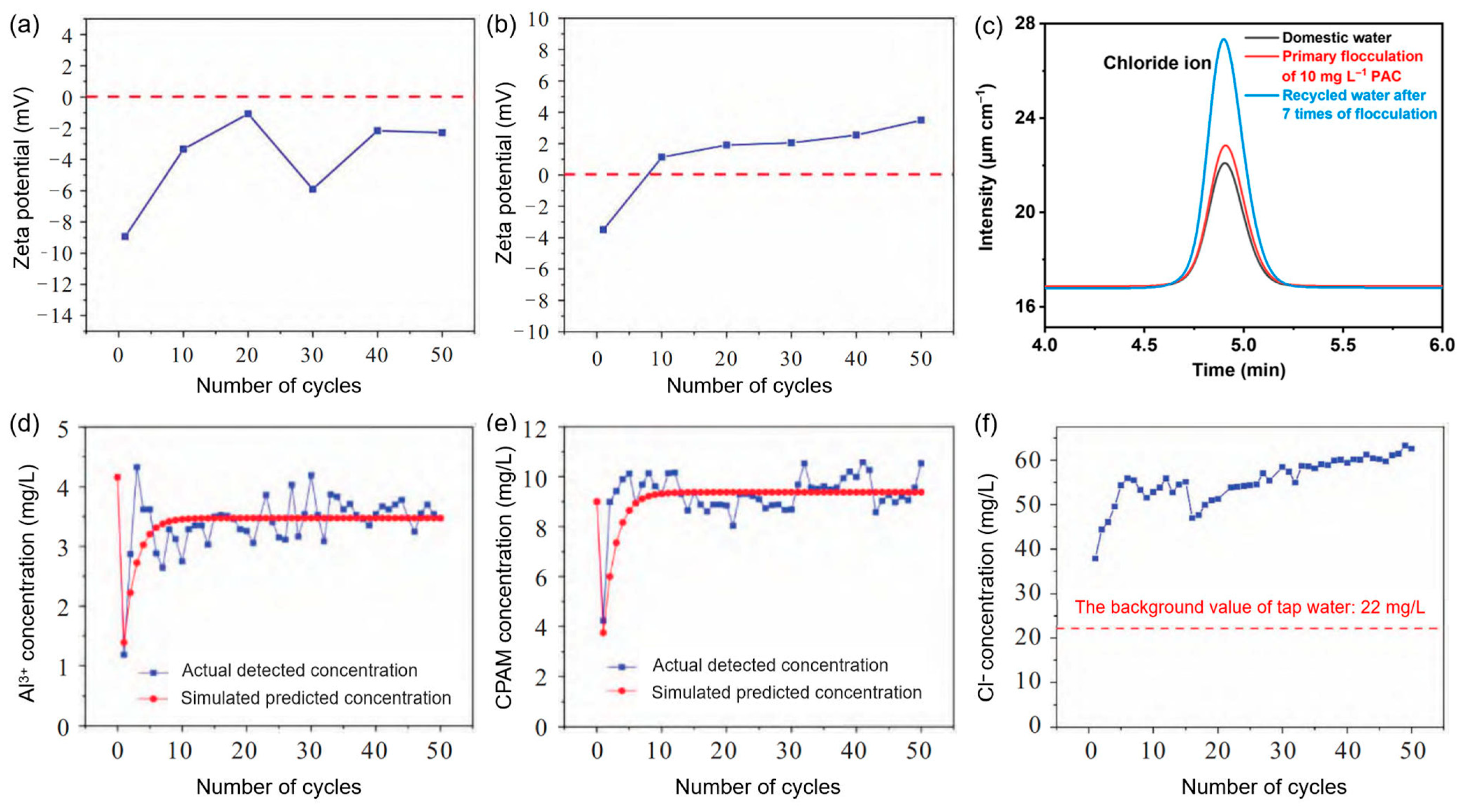
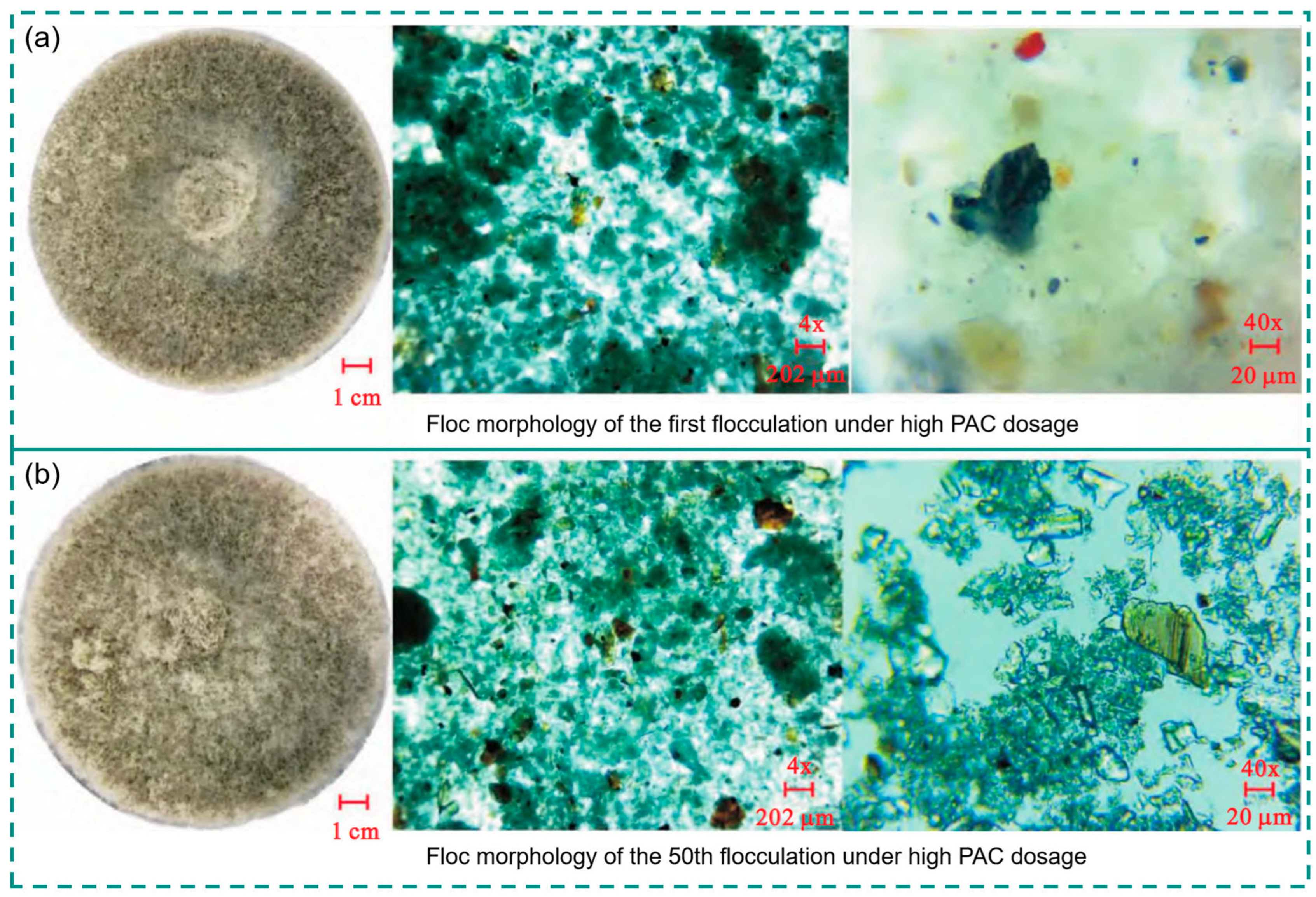
Wu et al. [51] analyzed the accumulation patterns of flocculants during the reuse of flocculation-treated aggregate washing wastewater from the Xulong Hydropower Station. Two dosing scenarios were investigated: high PAC dosage (154.33 mg/L) and low PAC dosage (25.0 mg/L) coupled with high CPAM dosage. Under the high PAC dosage condition, after 50 consecutive reuse cycles, the flocculation performance remained stable. However, cyclic accumulation impeded the bonding of SS flocs into large-sized aggregates, with the floc diameter decreasing from approximately 400 μm to 200 μm (Figure 4). As the number of reuse cycles increased, the supernatant Zeta potential gradually rose from −9 mV and approached 0 (Figure 5a). At this stage, adding CPAM was unfavorable for the formation of voluminous flocs. In contrast, under the low PAC + high CPAM dosage condition, the effluent quality was significantly inferior to that of the high PAC scenario, but the bottom-layer flocs exhibited tighter aggregation. Notably, the formation of large flocs was unaffected by the increasing number of reuse cycles. After 10 cycles, the solution Zeta potential increased from the initial −3.5 mV to 1 mV (Figure 5b). This phenomenon was attributed to CPAM accumulation, which induced excessive residual positive charges in the supernatant. The elevated positive charge hindered floc settling, thereby reducing flocculation efficiency.
Separately, Lu et al. [5] investigated the accumulation of flocculants and chloride ions (Cl) during cyclic reuse and flushing of aggregate washing wastewater. A single flocculation with 10 mg/L PAC resulted in a slight increase in Cl concentration from 16.11 mg/L to 18.41 mg/L. After seven cycles, the recycled water Cl concentration reached 32.19 mg/L (Figure 5c). When PAC dosage was increased to 50 mg/L, the Cl concentration of recycled water increased sharply from 16.44 mg/L to 31.84 mg/L after a single addition, and exceeded the 100 mg/L threshold after seven cycles. According to an examination of chloride ion-related water quality indicators in current standards and specifications for water conservancy and hydropower projects, the chloride ion limits for water use are clearly defined. Specifically, the Standard for Construction Organization Design of Water Conservancy and Hydropower Projects (SL 303-2017) [52] and the Standard for Construction of Hydraulic Concrete (DL/T 5144-2015) [53] stipulate that the chloride ion content in water for concrete mixing shall not exceed 1200 mg/L (for reinforced concrete) and 3500 mg/L (for plain concrete), respectively, while the limit for water used in aggregate flushing is ≤3500 mg/L. In contrast, the chloride ion concentration in reclaimed water after seven reuse cycles of aggregate washing wastewater remains significantly below the strictest limit values (1200 mg/L for reinforced concrete). Thus, the chloride ion concentration of reclaimed water following cyclic dosing complies with the relevant technical specifications for water use in aggregate flushing and concrete mixing. Wu et al. [51] also compared different PAC dosages, revealing that flocculant concentration increased markedly within the first 10 reuse cycles, with the rate of increase gradually decelerating thereafter (Figure 5d,e). Although Cl does not participate in flocculation, its accumulation pattern paralleled those of CPAM and Al3+—key contributors to flocculation (Figure 5f).
During the cyclic reuse of aggregate washing wastewater, repeated addition of PAC and PAM leads to the accumulation of high-concentration Al3+, PAM, and Cl in recycled water. These flocculant residues may enter subsequent concrete production processes, significantly compromising concrete performance. Consequently, the impact of flocculant residues on concrete properties has emerged as a critical research focus. Current studies on flocculant-residue effects on concrete primarily center on PAM [54]. Existing engineering practices and literature indicate that PAM can significantly impair or even completely negate the water-reducing effect of naphthalene-based agents [55]. For instance, naphthalene-based agents are anionic surfactants whose molecular structure features a naphthalene ring backbone with abundant sulfonate anions. These agents function by adsorbing onto cement particles, imparting negative charges to induce mutual repulsion. However, CPAM flocculants—being positively charged—strongly adsorb onto negatively charged cement particle surfaces (or bind with naphthalene-based agent molecules), neutralizing surface charges. This disrupts electrostatic repulsion, causing cement particles to flocculate again and rendering the water-reducing agent ineffective. As a result, concrete rapidly loses fluidity, becoming excessively dry, stiff, and clumpy. Even for APAM, despite sharing a negative charge with naphthalene-based agents, its potent “adsorption-bridging” capability dominates. The long molecular chain of APAM simultaneously adsorbs multiple cement particles dispersed by the naphthalene-based agent, “bundling” them into flocs. This directly counteracts and reverses the dispersing effect, leading to a sharp decline in water reduction. To maintain target fluidity, water demand increases dramatically, or concrete exhibits abnormal viscosity and premature hardening.
PAM also significantly impacts polycarboxylate superplasticizers (PCE) [56]. The primary mechanism involves interactions between PAM and Ca2+ ions, which induce conformational changes in PAM molecules (intramolecular and intermolecular cross-linking). Intramolecular cross-linking causes long-chain PAM to coil and contract, while intermolecular cross-linking promotes PAM aggregation. This encapsulates part of the PCE, reducing its adsorption onto cement particle surfaces. Competitive adsorption between PCE and PAM further exacerbates this effect. Adsorption groups in PAM may interact with cement particle surfaces, altering particle aggregation and affecting hydration. Specifically, carboxyl groups in PAM bind with Ca2+ released during cement hydration, hindering the formation of hydration products and delaying hydration kinetics. Additionally, polar groups in PAM side chains form hydrogen bonds with water molecules, immobilizing free water within the polymer matrix. This inhibits cement particle dissolution and the nucleation/precipitation of early-stage hydration products.
Numerous experimental studies have demonstrated that PAM impairs the fluidity of cementitious materials, and at relatively high dosages (0.003–0.08% of the mass of cementitious materials), it compromises concrete strength [50,57,58]. Wang et al. [59] noted that PAM residues tend to accumulate on the surfaces of circulating water and recycled aggregates, increasing adhesion. They further investigated the effects of varying PAM residue concentrations (0.001–0.5‰) on concrete workability, strength, and durability. Results indicated that as PAM dosage increased, yield stress initially decreased rapidly and then rose slowly (with a maximum reduction of 28.6%), while viscosity gradually increased (e.g., a 2.2% rise in washed sand viscosity), adversely affecting mixing, pumping, and casting processes. Additionally, higher PAM dosages reduced the peak cement hydration heat release rate and prolonged the induction period, delaying cement hardening and potentially slowing construction progress. Mechanistically, PAM had minimal impact on the dynamic elastic modulus and freeze–thaw resistance of mortar but significantly compromised compressive strength: at a PAM dosage of 0.01‰, 3-day compressive strength decreased by 20.7% and 28-day strength by 17.4%. This was primarily attributed to PAM’s thickening and water-retention effects, which reduced the effective water content and thereby impaired strength development.
However, some studies have reported that the concentration of soluble PAM residues in sand and gravel produced via circulating water washing is only 0.0002–0.0020% [60]. When circulating water is not employed in concrete mixing, dosages tested in existing studies are typically 10–100 times higher than actual levels. Meng et al. [60] referenced typical PAM residue concentrations and investigated PAM flocculant residues in limestone manufactured sand within the range of 0.0005–0.0050%. Findings revealed that as PAM residue levels increased, initial concrete mixture fluidity decreased; however, appropriate increases in water-reducing agent dosage restored fluidity to near-reference levels. Additionally, PAM residues increased the air content, enhancing workability and water retention but causing a slight viscosity increase. Notably, within the experimental scope, PAM residue levels had no significant impact on indicators, including the methylene blue (MB) value of sand, hardened concrete mechanical properties, drying shrinkage rate, or 56-day electrical flux. Therefore, in practical applications of aggregate washing wastewater recycling, flocculant residue forms and concentrations should be specifically analyzed and monitored—tailored to specific sand-gravel production and wastewater treatment processes—followed by selection of preventive measures.
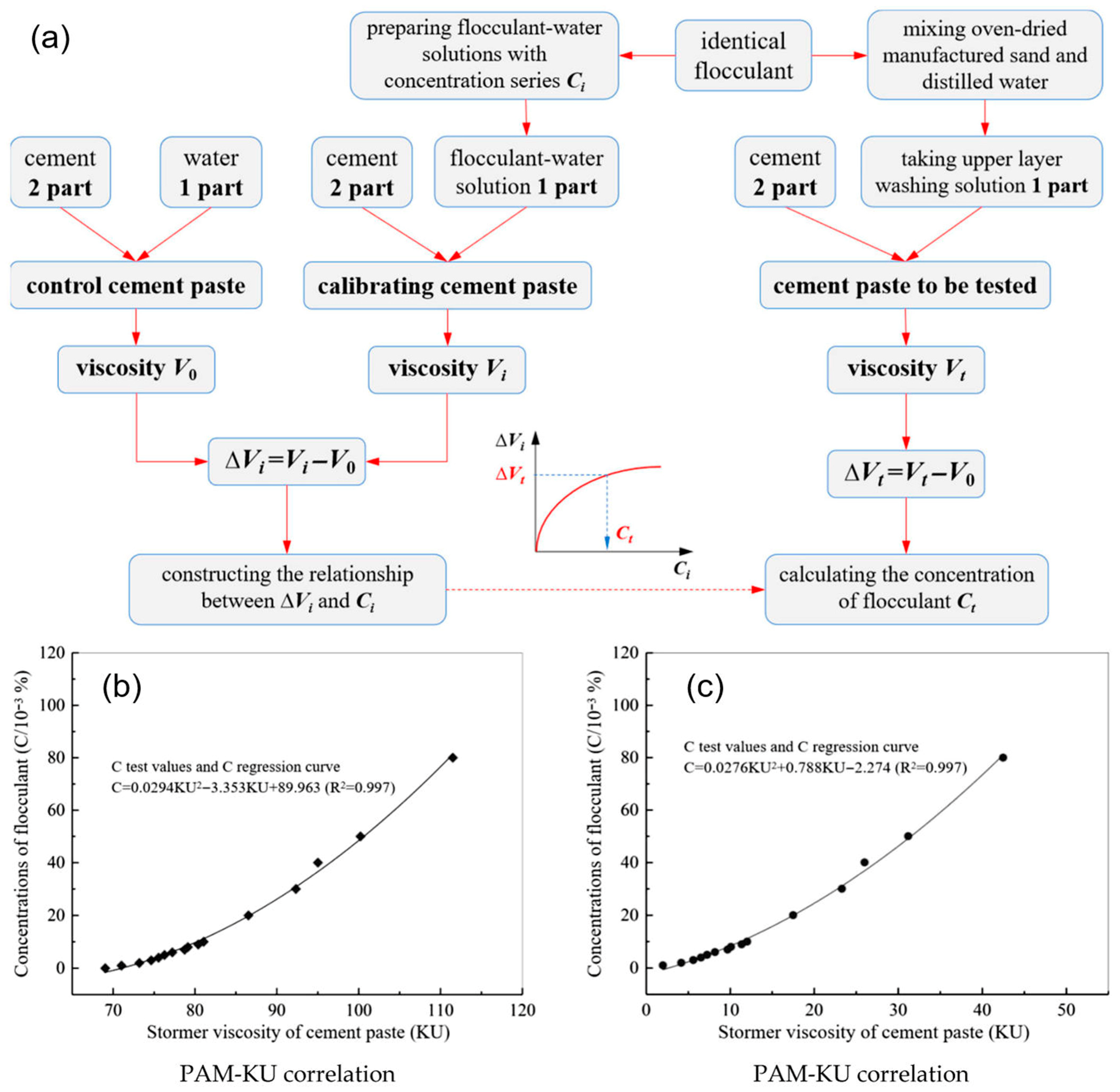
The pronounced impact of flocculant residues has emerged as a potential risk in industrial quality control. However, traditional offline detection methods (e.g., laboratory analysis) are too slow for real-time recycling systems. Developing rapid, direct detection methods for residue quantification is therefore pivotal to mitigating this risk. Jiang et al. [61] developed an innovative rapid detection approach: by pre-calibrating the quantitative correlation between the Stormer viscosity of cement paste and flocculant concentration, the residual flocculant content in manufactured sand leachate can be inversely determined. The flowchart of this rapid detection method is illustrated in Figure 6a. Experimental results demonstrated that the Stormer viscosity of cement paste exhibited a positive correlation with PAM concentration, with the relationship well-described by a quadratic function (R2 > 0.99). Notably, PAM with a higher molecular weight (e.g., 18 million Da) exerted a more pronounced effect on viscosity due to its strong adsorption capacity, which is prone to inducing cement particle flocculation. Via reverse fitting validation, this method accurately quantified low-concentration PAM (e.g., <0.005%) with minimal deviation, thereby validating the feasibility of rapid detection (Figure 6b,c).

6. Key Challenges in Flocculation Treatment of Aggregate Washing Wastewater

While flocculation treatment technology for aggregate washing wastewater has reached a relatively mature stage through years of engineering practice and scientific research—with treated effluent generally complying with relevant regulatory standards—its further advancement currently revolves around two primary challenges: flocculant residue impacts and enhancement of intelligent control technologies.

6.1. Flocculant Residue Challenge

The residual and cumulative impacts of flocculants primarily manifest in two domains: circulating water recycling and concrete production safety. While some studies have explored flocculant accumulation effects, most current investigations remain confined to preliminary quantification of residual concentrations and single-stage assessments of flocculant residues in aqueous phases. A systematic analysis of flocculant migration and transformation behaviors across the entire circulation system is lacking. Further elucidation of flocculant migration pathways and morphological transformation patterns in multi-medium environments is imperative to establish a theoretical foundation for risk impact assessment. Notably, tracing the morphological distribution and ultimate fate of flocculants in the solid–liquid two-phase is critical.
Moreover, existing research predominantly focuses on PAM effects [62], whereas investigations into the synergistic interactions of PAC and its combined application with PAM are comparatively scarce. This limitation hinders the accurate reflection of complex effects under coexisting multi-flocculant conditions in practical engineering, thereby restricting the guiding value of research outcomes for field applications.
It is noteworthy that most flocculants ultimately reside in dewatered sludge cakes. As solid waste, these cakes are commonly disposed of via long-term landfilling or underwater storage. However, during prolonged environmental exposure, the chemical stability, degradation dynamics, and potential ecotoxicological effects of flocculants in such sludge have not been comprehensively evaluated.

6.2. Challenges in Intelligent Control Technology

Despite notable advancements in intelligent control systems for aggregate washing wastewater in recent years, persistent challenges hinder their widespread adoption and application. These challenges are outlined as follows:
(1)
High Initial Investment Burden
Intelligent control systems demand substantial upfront investment in hardware infrastructure (e.g., sensors, actuators) and software development (e.g., algorithms, modeling platforms), imposing significant financial pressures on enterprises, particularly small and medium-sized operators.
(2)
Limited Technological Adaptability
Diverse sand-gravel raw material characteristics result in highly heterogeneous wastewater compositions. Fixed or one-size-fits-all control strategies struggle to accommodate such variability. The current algorithms for the intelligent control of flocculant dosage mainly rely on a single parameter, namely the SS concentration. In fact, there are many factors affecting the flocculation effect, including the characteristics of aggregates themselves, as well as wastewater pH, temperature, residence time (affected by production intensity), flocculant dosing points, dosage ratio and dosing sequence of composite flocculants, etc. Future research needs to develop intelligent systems with integrated recognition and analysis capabilities for multi-factor influences, so as to dynamically respond to fluctuations in wastewater quality.
(3)
Scarcity of Interdisciplinary Professionals
The operation and maintenance of intelligent control systems require interdisciplinary experts proficient in both water treatment processes and information technology (e.g., data analytics, automation). Currently, the civil sand and gravel industry faces a critical shortage of such talent, limiting the effective deployment and optimization of these systems.
(4)
Data Security Concerns
With the trend toward networked operations and cloud-based data storage, sand and gravel production systems—directly linked to project quality and safety—face heightened risks of data leakage and cyber-attacks. Ensuring the integrity and confidentiality of operational data has emerged as a pressing priority.
(5)
Reliability Under Extreme Environmental Conditions
The performance of intelligent control systems in extreme climates (e.g., high-altitude, cold regions) remains to be fully validated. Low temperatures, hypoxia, and other harsh conditions may compromise sensor accuracy, equipment operability, and control system responsiveness. While existing technologies have demonstrated success in achieving zero wastewater discharge and energy-water savings in high-altitude settings, long-term durability and adaptability under broader special operating conditions (e.g., arid, saline, or heavily polluted environments) require further empirical validation and technological refinement.

7. Conclusions and Prospect

This paper systematically reviews the research progress in flocculation treatment of aggregate washing wastewater. Table 2 summarizes the key flocculation parameters, operating conditions, and treatment effects in existing studies. The key conclusions are summarized as follows:
(1)
Aggregate washing wastewater exhibits the typical characteristics of “three highs and one negative”: a high concentration of SS, a high proportion of ultrafine particles, significant fluctuations in water quality and quantity, and a generally negative Zeta potential of the SS. These characteristics result in an extremely low natural sedimentation efficiency of the wastewater, necessitating the use of flocculants to achieve enhanced solid–liquid separation through charge neutralization, adsorption bridging, or sweep flocculation. Furthermore, lithological differences (e.g., calcite, granite, hornblende) further require targeted adaptability experiments for the selection of flocculants for different types of aggregate washing wastewater, thus forming a technical adaptation principle of “one wastewater, one solution”.
(2)
The flocculant system currently adopted for aggregate washing wastewater has formed a synergistic application pattern comprising three categories: inorganic, organic, and composite flocculants. Inorganic flocculants (e.g., PAC) serve as basic chemicals by virtue of their cost advantages and charge neutralization capacity. Organic polymer flocculants (e.g., PAM) enhance adsorption and bridging through their long-chain structures (anionic types are suitable for calcite-containing wastewater, while cationic types are adapted for wastewater with highly negatively charged particles). Bio-based flocculants (e.g., chitosan, modified starch) are environmentally friendly and biodegradable; however, they suffer from poor stability and weak floc sedimentation performance. In addition, due to cost constraints, there are currently a lack of practical engineering application cases for them. Traditional empirical dosing methods have the problems of chemical waste (excessive dosing leads to floc redispersion) and unstable treatment effects (insufficient dosing results in substandard SS removal). In contrast, an intelligent control system based on a four-layer architecture of “Perception-Transmission-Platform-Application” has achieved a breakthrough: it collects real-time parameters through devices such as high-range online SS detectors and dynamically adjusts the dosing amount by combining machine learning algorithms, reducing flocculant consumption by 50% to 67%. This is crucial for achieving “zero discharge” in ecologically fragile areas such as plateaus and canyons.
(3)
In the circulation and reuse of wastewater, flocculant residue exhibits the characteristic of “rapid accumulation in the early stage and a slowdown in the later stage”. The concentrations of Al3+, Cl and PAM increase with the number of reuse cycles, while the particle size of solid flocs decreases from 400 μm to 200 μm; the positive shift in the Zeta potential (from −9 mV towards 0 mV) results in the attenuation of floc sedimentation performance. Residual PAM (at a dosage of 0.01‰) can reduce the 3-day compressive strength of concrete by 20.7% and the 28-day compressive strength by 17.4%, and also prolong the induction period of cement hydration. It should be noted that although the combination of low PAC and high CPAM can mitigate the attenuation of floc particle size, it carries the risk of effluent water quality fluctuation. In practical engineering, however, performance compensation can be achieved by adjusting the dosage of water reducers for PAM residual levels ranging from 0.0002% to 0.0020%, which reflects the complexity and flexibility of risk control.
In response to the key challenges in the flocculation treatment of aggregate washing wastewater, the following research prospects are proposed:
(1)
Deepen the Mechanistic Study of Flocculation for Aggregate Washing Wastewater
Current research on flocculation mechanisms mainly targets general industrial wastewater, while the unique components of aggregate washing wastewater have not been systematically studied. In situ characterization techniques such as dynamic light scattering (DLS) and atomic force microscopy (AFM) can be used to observe the formation and growth process of flocs and explore the interaction mechanism between the flocculant and SS. It is necessary to further clarify the influence of environmental factors on the flocculation efficiency and stability, including the fluctuations in temperature at the construction site and the seasonal changes in the pH of the wastewater, and establish a mechanism model suitable for the actual working conditions of aggregate cleaning.
(2)
Intelligent Computing and Precise Flocculation Technology
The application of intelligent control systems in aggregate washing wastewater treatment remains in its infancy, yet progress has been made in data mining, optimization algorithms, and automated monitoring. For instance, integrating real-time wastewater monitoring with big data analytics enables precise flocculant dosing and dynamic regulation, thereby enhancing treatment efficiency and reducing chemical consumption. This can be achieved by coupling online monitoring (flow rate, turbidity, pH) with adaptive dosing/sludge discharge systems, where machine learning identifies wastewater characteristics to dynamically adjust treatment processes. Future efforts should focus on accumulating basic datasets, developing online models, and advancing equipment automation to promote the large-scale application of intelligent control systems. The ultimate goal is to realize efficient, stable, and low-carbon operation in aggregate washing wastewater treatment.
(3)
Research Prospects on Flocculant Residue Impacts
Studies on flocculant residue accumulation and migration require deeper investigation into their behavior within the entire circulation system. Specifically, revealing migration pathways and morphological transformation rules of flocculants in multi-medium environments is critical. To mitigate the adverse effects of residues, strategies include: (i) minimizing flocculant dosage while ensuring effluent quality; (ii) developing eco-friendly alternatives (e.g., modified sodium alginate flocculants, whose residues show no negative impact on concrete performance and may even enhance it). It is also very necessary to evaluate its long-term environmental impact through Life Cycle Assessment (LCA); (iii) installing filtration or advanced treatment units to reduce residual concentrations in recycled water; and (iv) adjusting admixture dosages (e.g., water reducers) based on recycled water characteristics to offset residue effects.
(4)
Comprehensive Evaluation System of Flocculation Technology for Aggregate Washing Wastewater
Current evaluation of flocculation performance mainly focuses on turbidity removal, while ignoring the removal effect of emerging contaminants (e.g., microplastics, residual chemical admixtures) and long-term environmental risks [63,64]. Future research should further expand the evaluation indicators by incorporating the removal rate of emerging pollutants and the leaching risk of flocculated sludge. A multi-dimensional evaluation system that meets the requirements of “environmental safety + engineering application” should be established. Long-term pilot-scale experiments can be carried out at actual construction sites to verify the stability and economy of flocculation technology in large-scale applications, providing technical parameters and operation guidelines for the industrialization of aggregate washing wastewater treatment.
(5)
Resource Utilization of Aggregate Washing Wastewater
Current resource utilization of aggregate washing wastewater prioritizes water recycling. Future research should explore high-value pathways for flocculated sludge, shifting the solid–liquid treatment paradigm from “end-of-pipe management” to “process control + resource recovery” to achieve synergistic value-added of water and solid waste [65]. This involves breaking away from low-value applications (e.g., traditional building material fillers, subgrade materials, or soil conditioners) and exploring innovative uses of flocculated sludge as precursors for high-performance functional materials. Such advancements will drive aggregate washing wastewater treatment into a new stage of high-quality development, characterized by resource utilization, refinement, and low-carbonization.

Author Contributions

Conceptualization, methodology, investigation, resources, writing—original draft preparation, L.G.; methodology, software, resources, funding acquisition, F.G.; software, formal analysis, J.W.; resources, data curation, J.Z.; formal analysis, methodology, validation, Q.L. and Y.W.; supervision, methodology, X.L.; formal analysis, methodology, supervision, Z.P. and X.Z.; data curation, project administration, X.C.; data curation, project administration, W.H.; Conceptualization, methodology, formal analysis, investigation, data curation, writing—review and editing, funding acquisition, Z.F. All authors have read and agreed to the published version of the manuscript.

Funding

This research was funded by the National Natural Science Foundation of China, grant number 52200143; the Wuhan Natural Science Foundation Exploration Program (Dawn Program), grant number 2024040801020270; the Natural Science Foundation of Hubei Province, grant number 2024AFB546 and the Fundamental Research Funds for Central Public Welfare Research Institutes, grant number CKSF2025533/TG8.

Data Availability Statement

No new data were created or analyzed in this study. Data sharing is not applicable to this article.

Acknowledgments

During the preparation of this manuscript, the authors used Yuanbao, V2.47.0 for the purposes of Grammar check. The authors have reviewed and edited the output and take full responsibility for the content of this publication.

Conflicts of Interest

Author Luogeng Ge and Jiawei Wang were employed by the Hubei Energy Group Luotian Pingtanyuan Pumped Storage Co., Ltd., Huanggang 438616, China. Author Fengsheng Guo and Jing Zhang were employed by the POWERCHINA Zhongnan Engineering Corporation Ltd., Changsha 410021, China. The remaining authors declare that the research was conducted in the absence of any commercial or financial relationships that could be construed as a potential conflict of interest.

Abbreviations

The following abbreviations are used in this manuscript:
SSSuspended solids
MBMethylene blue
PAMPolyacrylamide
PACPolyaluminum chloride
APAMAnionic PAM
CPAMCationic PAM
AIArtificial intelligence
PCEPolycarboxylate superplasticizers
RSMResponse surface methodology
DLSDynamic light scattering
AFMAtomic force microscopy
LCALife Cycle Assessment

References

  1. Bendixen, M.; Iversen, L.L.; Best, J.; Franks, D.M.; Hackney, C.R.; Latrubesse, E.M.; Tusting, L.S. Sand, gravel, and UN Sustainable Development Goals: Conflicts, synergies, and pathways forward. One Earth 2021, 4, 1095–1111. [Google Scholar] [CrossRef]
  2. Přikryl, R. Geomaterials as construction aggregates: A state-of-the-art. Bull. Eng. Geol. Environ. 2021, 80, 8831–8845. [Google Scholar] [CrossRef]
  3. Fernandes, I. Role of granitic aggregates in the deterioration of a concrete dam. Bull. Eng. Geol. Environ. 2015, 74, 195–206. [Google Scholar] [CrossRef]
  4. Petit, A.; Cordoba, G.; Paulo, C.I.; Irassar, E.F. Novel air classification process to sustainable production of manufactured sands for aggregate industry. J. Clean. Prod. 2018, 198, 112–120. [Google Scholar] [CrossRef]
  5. Lu, Q.; Fan, Z.; Zhou, X.; Peng, Z.; Gao, Z.F.; Deng, S.; Han, W.; Jin, Z.; Chen, X. Water-saving optimization design of aggregate processing plant and recycled water utilization for producing concrete. Constr. Build. Mater. 2023, 396, 132381. [Google Scholar] [CrossRef]
  6. Varshney, H.; Khan, R.A.; Khan, I.K. Sustainable use of different wastewater in concrete construction: A review. J. Build. Eng. 2021, 41, 102411. [Google Scholar] [CrossRef]
  7. Bofill, M.Á.; Sánchez-Romero, F.-J.; Zapata-Raboso, F.; Ramos, H.M.; Pérez-Sánchez, M. Integrating Pumped Hydro Storage into Zero Discharge Strategy for Wastewater: The Alicante Case Study. Appl. Sci. 2025, 15, 10953. [Google Scholar] [CrossRef]
  8. de Paula, H.M.; de Oliveira Ilha, M.S.; Andrade, L.S. Concrete plant wastewater treatment process by coagulation combining aluminum sulfate and Moringa oleifera powder. J. Clean. Prod. 2014, 76, 125–130. [Google Scholar] [CrossRef]
  9. Fan, Z.; Zhou, X.; Lu, Q.; Gao, Z.F.; Deng, S.; Peng, Z.; Han, W.; Chen, X. Synthesis of sewage sludge biochar in molten salt environment for advanced wastewater treatment: Performance enhancement, carbon footprint and environmental impact reduction. Water Res. 2024, 250, 121072. [Google Scholar] [CrossRef]
  10. González-Corrochano, B.; Alonso-Azcárate, J.; Rodríguez, L.; Lorenzo, A.P.; Torío, M.F.; Ramos, J.J.T.; Corvinos, M.D.; Muro, C. Valorization of washing aggregate sludge and sewage sludge for lightweight aggregates production. Constr. Build. Mater. 2016, 116, 252–262. [Google Scholar] [CrossRef]
  11. GB8978-1996; Integrated Wastewater Discharge Standard. China Environmental Science Press: Beijing, China, 1996.
  12. Wang, L.K.; Wang, M.-H.S.; Shammas, N.K.; Hahn, H.H. Physicochemical Treatment Consisting of Chemical Coagulation, Precipitation, Sedimentation, and Flotation. In Integrated Natural Resources Research; Wang, L.K., Wang, M.-H.S., Hung, Y.-T., Eds.; Springer International Publishing: Cham, Switzerland, 2021; pp. 265–397. [Google Scholar]
  13. Tsamoutsoglou, K.; Kechagias, A.; Katzourakis, V.E.; Chrysikopoulos, C.V.; Gikas, P. Investigation and efficiency estimation of a hydrocyclone for the treatment of primary municipal wastewater. J. Environ. Manag. 2025, 380, 125134. [Google Scholar] [CrossRef]
  14. Bhagavatula, A.; Rajagopalan, V.; Duncan, B.; Vimalchand, P. Innovative recovered water process implementation: Flocculation-sedimentation-filtration process for addressing water and energy nexus challenges at Kemper IGCC Power Plant. Energy Nexus 2021, 1, 100007. [Google Scholar] [CrossRef]
  15. Teh, C.Y.; Budiman, P.M.; Shak, K.P.Y.; Wu, T.Y. Recent Advancement of Coagulation–Flocculation and Its Application in Wastewater Treatment. Ind. Eng. Chem. Res. 2016, 55, 4363–4389. [Google Scholar] [CrossRef]
  16. Kato, S.; Kansha, Y. Comprehensive review of industrial wastewater treatment techniques. Environ. Sci. Pollut. Res. 2024, 31, 51064–51097. [Google Scholar] [CrossRef]
  17. Badawi, A.K.; Salama, R.S.; Mostafa, M.M.M. Natural-based coagulants/flocculants as sustainable market-valued products for industrial wastewater treatment: A review of recent developments. RSC Adv. 2023, 13, 19335–19355. [Google Scholar] [CrossRef]
  18. Lucas, M.S.; Teixeira, A.R.; Jorge, N.; Peres, J.A. Industrial Wastewater Treatment by Coagulation–Flocculation and Advanced Oxidation Processes: A Review. Water 2025, 17, 1934. [Google Scholar] [CrossRef]
  19. Moreira, V.R.; Guimarães, R.N.; Moser, P.B.; Santos, L.V.S.; de Paula, E.C.; Lebron, Y.A.R.; Silva, A.F.R.; Casella, G.S.; Amaral, M.C.S. Restrictions in water treatment by conventional processes (coagulation, flocculation, and sand-filtration) following scenarios of dam failure. J. Water Process Eng. 2023, 51, 103450. [Google Scholar] [CrossRef]
  20. Zhang, K.; Zhou, H.; Li, J.; Li, Z.; He, Z. Study on Flocculation and Sedimentation Characteristics of Sand Aggregate Washing Wastewater in a Large Mine in Anhui. Mod. Min. 2024, 40, 207–212. [Google Scholar]
  21. Li, F.; Wang, H.; Wang, M.; Zhai, H.; Peng, C.; Yang, Y.; Cul, Y. Flocculants Selection and Application Conditions for Concrete Aggregate Washing Wastewater of Xulong Hydropower Station. Saf. Environ. Eng. 2023, 30, 241–250. [Google Scholar]
  22. Guo, H.; Yu, S.-h.; Chen, W.; Huang, M.-h.; Chen, D. Effect of Rock Type on Dynamie Radial-flow Sedimentation Characteristics of High Concentration Wastewater from Processing Aggregate System of Hydropower Project. J. Chang. River Sci. Res. Inst. 2023, 40, 75–80. [Google Scholar]
  23. Chau, K.W. Investigation on effects of aggregate structure in water and wastewater treatment. Water Sci. Technol. 2004, 50, 119–124. [Google Scholar] [CrossRef]
  24. Jiao, R.; Fabris, R.; Chow, C.W.K.; Drikas, M.; van Leeuwen, J.; Wang, D.; Xu, Z. Influence of coagulation mechanisms and floc formation on filterability. J. Environ. Sci. 2017, 57, 338–345. [Google Scholar] [CrossRef]
  25. Khazaie, A.; Mazarji, M.; Samali, B.; Osborne, D.; Minkina, T.; Sushkova, S.; Mandzhieva, S.; Soldatov, A. A Review on Coagulation/Flocculation in Dewatering of Coal Slurry. Water 2022, 14, 918. [Google Scholar] [CrossRef]
  26. Wang, D.; Di, S.; Wu, L.; Tan, Y.; Tang, Y. Sedimentation Behavior of Organic, Inorganic, and Composite Flocculant-Treated Waste Slurry from Construction Works. J. Mater. Civ. Eng. 2021, 33, 04021134. [Google Scholar] [CrossRef]
  27. Gregory, J.; Barany, S. Adsorption and flocculation by polymers and polymer mixtures. Adv. Colloid Interface Sci. 2011, 169, 1–12. [Google Scholar] [CrossRef]
  28. López-Maldonado, E.A.; Oropeza-Guzman, M.T.; Jurado-Baizaval, J.L.; Ochoa-Terán, A. Coagulation–flocculation mechanisms in wastewater treatment plants through zeta potential measurements. J. Hazard. Mater. 2014, 279, 1–10. [Google Scholar] [CrossRef] [PubMed]
  29. Mittal, H.; Jindal, R.; Kaith, B.S.; Maity, A.; Ray, S.S. Flocculation and adsorption properties of biodegradable gum-ghatti-grafted poly(acrylamide-co-methacrylic acid) hydrogels. Carbohydr. Polym. 2015, 115, 617–628. [Google Scholar] [CrossRef] [PubMed]
  30. Yang, X.; Zeng, M.; Hao, L.; Wang, C. Synergistic function of bentonite, poly-aluminum chloride, and cationic polyacrylamide to realize highly efficient coagulation–flocculation process for leachate treatment. Desalination Water Treat. 2021, 244, 120–130. [Google Scholar] [CrossRef]
  31. Yao, B.; Zhao, D.; Guo, J.; Yan, C.; Zheng, C. Preparation and performance evaluation of hybrid polymer flocculants (PAC-PAM), and comparison experiments with other flocculants. Environ. Prog. Sustain. Energy 2022, 41, e13829. [Google Scholar] [CrossRef]
  32. Liu, C.; Gao, B.; Wang, S.; Guo, K.; Shen, X.; Yue, Q.; Xu, X. Synthesis, characterization and flocculation performance of a novel sodium alginate-based flocculant. Carbohydr. Polym. 2020, 248, 116790. [Google Scholar] [CrossRef]
  33. Mohamed Noor, M.H.; Othman, Q.A.; Ngadi, N.; Anas, M.A.A. Bibliometric survey of starch-based flocculant research for wastewater treatment. Int. J. Biol. Macromol. 2025, 322, 146746. [Google Scholar] [CrossRef]
  34. Saiyad, M.; Shah, N.; Joshipura, M.; Dwivedi, A.; Pillai, S. Chitosan and its derivatives in wastewater treatment application. Mater. Today Proc. 2024, 99, 190–194. [Google Scholar] [CrossRef]
  35. Zhai, H.; Li, F.; He, S.; Wang, M.; Wu, N.; Wang, X. Study on Sedimentation Performance of Wastewater from Sand and Gravel Processing in Hydropower Project. Technol. Water Treat. 2021, 47, 116–119. [Google Scholar]
  36. Rossini, M.; Garrido, J.G.; Galluzzo, M. Optimization of the coagulation–flocculation treatment: Influence of rapid mix parameters. Water Res. 1999, 33, 1817–1826. [Google Scholar] [CrossRef]
  37. Pérez, K.; Toro, N.; Jeldres, M.; Gálvez, E.; Robles, P.; Alvarado, O.; Toledo, P.G.; Jeldres, R.I. Estimating the Shear Resistance of Flocculated Kaolin Aggregates: Effect of Flocculation Time, Flocculant Dose, and Water Quality. Polymers 2022, 14, 1381. [Google Scholar] [CrossRef] [PubMed]
  38. Ding, C.; Shen, L.; Liang, Q.; Li, L. Machine Learning in Flocculant Research and Application: Toward Smart and Sustainable Water Treatment. Separations 2025, 12, 203. [Google Scholar] [CrossRef]
  39. Sumalatha, B.; Babu, D.S.; Sudarsini, B.; Indira, M. Innovative Techniques for Enhancing Water Treatment Efficiency. In Machine Learning in Water Treatment; Wiley: New York, NY, USA, 2025; pp. 265–291. [Google Scholar]
  40. Wang, Q. The Medium-scale Study on the Treatment Process of Horizontal Flow Sedimentation and Flocculation Sedimentation for Wastewater of Hydropower Station Aggregate Processing System. Master’s Thesis, Chongqing University, Chongqing, China, 2011. [Google Scholar]
  41. Jin, J.; Liu, M.; Chen, B.; Wu, X.; Yao, L.; Wang, Y.; Xiong, X.; Wei, L.; Li, J.; Tan, Q.; et al. Artificial Intelligence in Chemical Dosing for Wastewater Purification and Treatment: Current Trends and Future Perspectives. Separations 2025, 12, 237. [Google Scholar] [CrossRef]
  42. Wang, Y.; Cheng, Y.; Liu, H.; Guo, Q.; Dai, C.; Zhao, M.; Liu, D. A Review on Applications of Artificial Intelligence in Wastewater Treatment. Sustainability 2023, 15, 13557. [Google Scholar] [CrossRef]
  43. Capodaglio, A.G.; Callegari, A. Use, Potential, Needs, and Limits of AI in Wastewater Treatment Applications. Water 2025, 17, 170. [Google Scholar] [CrossRef]
  44. Fang, X.; Zhai, Z.; Zang, J.; Zhu, Y. An Intelligent Dosing Algorithm Model for Wastewater Treatment Plant. J. Phys. Conf. Ser. 2022, 2224, 012027. [Google Scholar] [CrossRef]
  45. Xu, Y.; Zeng, X.; Bernard, S.; He, Z. Data-driven prediction of neutralizer pH and valve position towards precise control of chemical dosage in a wastewater treatment plant. J. Clean. Prod. 2022, 348, 131360. [Google Scholar] [CrossRef]
  46. Sharma, S.; Sharma, K.; Grover, S. Real-Time Data Analysis with Smart Sensors. In Application of Artificial Intelligence in Wastewater Treatment; Gulati, S., Ed.; Springer Nature: Cham, Switzerland, 2024; pp. 127–153. [Google Scholar]
  47. Jan, F.; Min-Allah, N.; Düştegör, D. IoT Based Smart Water Quality Monitoring: Recent Techniques, Trends and Challenges for Domestic Applications. Water 2021, 13, 1729. [Google Scholar] [CrossRef]
  48. Fan, X.; Li, J.; Wang, W.; Li, F.; Chen, X.; Zhao, K.; Wang, J.; Zhao, H.; Zhou, X.; Fan, Z.; et al. An Online Rapid Detection Device for SS Concentration in High-Concentration Hydropower Aggregate Washing Wastewater. CN Patent CN215917197U 7, 1 March 2022. [Google Scholar]
  49. Yokoyama, H.; Yamashita, T.; Kojima, Y.; Nakamura, K. Deep learning-based flocculation sensor for automatic control of flocculant dose in sludge dewatering processes during wastewater treatment. Water Res. 2024, 260, 121890. [Google Scholar] [CrossRef]
  50. You, R.; Qiu, Y.; Zhang, P.; Pan, Z. Research on the Influence of Different Flocculants on Concrete Performance. IOP Conf. Ser. Earth Environ. Sci. 2020, 571, 012144. [Google Scholar] [CrossRef]
  51. Wu, S.; Wang, H.; Wang, M.; Zhai, H.; Yang, Y.; He, S.; Cui, Y. Flocculant accumulative effect in SS wastewater recyclingof hydropower station sand processing system. Saf. Environ. Eng. 2024, 31, 251–258, 279. [Google Scholar]
  52. SL 303-2017; Specifications for Construction Planning of Water Resources and Hydropower Projects. Water & Power Press: Beijing, China, 2017.
  53. DL/T 5144-2015; Specifications for Hydraulic Concrete Construction. China Water and Power Press: Beijing, China, 2015.
  54. Yao, H.; Fan, M.; Huang, T.; Yuan, Q.; Xie, Z.; Chen, Z.; Li, Y.; Wang, J. Retardation and bridging effect of anionic polyacrylamide in cement paste and its relationship with early properties. Constr. Build. Mater. 2021, 306, 124822. [Google Scholar] [CrossRef]
  55. Yang, C.H.; Pan, Q.; Zhu, J. Adsorption of Naphthalene-Based Water Reducer on Alkali-Activated Slag Cement. Appl. Mech. Mater. 2012, 226–228, 1747–1750. [Google Scholar] [CrossRef]
  56. Yin, J.; Qian, X.; Hu, C.; Wang, F. Insight into the interaction mechanism of polycarboxylate superplasticizer and polyacrylamide in cementitious materials. Constr. Build. Mater. 2024, 428, 136330. [Google Scholar] [CrossRef]
  57. Li, H.; Yan, N.; Sun, G.; Zheng, H.; Yang, X. Synthesis and Flocculation of Polyacrylamide with Low Water Absorption for Non-dispersible Underwater Concrete. J. Wuhan Univ. Technol.-Mater. Sci. Ed. 2023, 38, 1404–1413. [Google Scholar] [CrossRef]
  58. Chen, Z.; Zhao, G.; Chen, B.; Chen, S.; Li, J.; Nong, Y. Influence of flocculation structure on time-dependent fluidity and rheological property of cement paste: Analytical models based on fractal theory. Constr. Build. Mater. 2024, 455, 139137. [Google Scholar] [CrossRef]
  59. Wang, B.; Sun, W.; Sun, M.; Wang, W.; Fu, G. Residual Characteristics of Flocculants and Their Effects on Concrete Properties. China New Technol. New Prod. 2025, 7, 125–129. [Google Scholar]
  60. Meng, Q.; Mao, Y.; Zhang, J.; Zhou, D.; Yang, Y.; Wang, T. Effect of flocculant in circulating washing crushed sand on concrete performance. New Build. Mater. 2022, 49, 65–68. [Google Scholar]
  61. Jiang, C.; Chen, Z.; Gan, X. A Rapid Detecting Method for Residual Flocculants in Water-Washed Manufactured Sand and Their Influences on Concrete Properties. Constr. Mater. 2025, 5, 71. [Google Scholar] [CrossRef]
  62. Bessaies-Bey, H.; Baumann, R.; Schmitz, M.; Radler, M.; Roussel, N. Effect of polyacrylamide on rheology of fresh cement pastes. Cem. Concr. Res. 2015, 76, 98–106. [Google Scholar] [CrossRef]
  63. Lv, X.; Gao, Z.; Yang, L.; Wang, F. Retardation mechanisms and microstructure evolution of triclinic tricalcium silicate induced by three different organic phosphonic acids. Cem. Concr. Res. 2026, 199, 108041. [Google Scholar] [CrossRef]
  64. Fan, Z.; Lu, Q.; Zhou, X.; Han, W.; Wang, Y.; Gao, Z.F.; Peng, Z.; Chen, X. Pyrolysis of sewage sludge in molten salt environment: Effects on heavy metals distribution and environmental risks in biochar. J. Clean. Prod. 2026, 538, 147303. [Google Scholar] [CrossRef]
  65. Ahmed, S.; Alhoubi, Y.; Elmesalami, N.; Yehia, S.; Abed, F. Effect of recycled aggregates and treated wastewater on concrete subjected to different exposure conditions. Constr. Build. Mater. 2021, 266, 120930. [Google Scholar] [CrossRef]
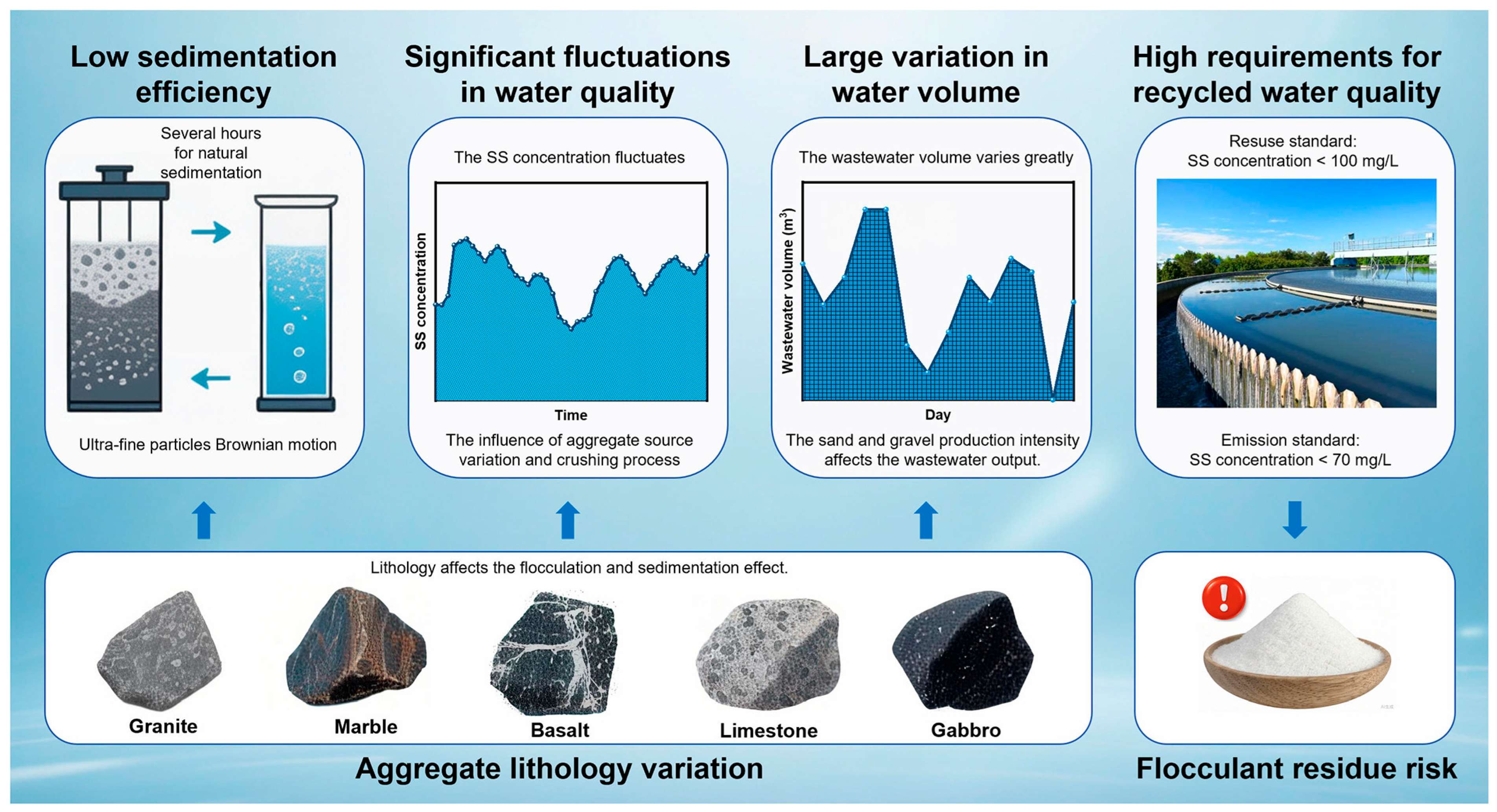
Figure 1. Difficulties in aggregate washing wastewater treatment.
Separations 13 00062 g001
Figure 2. (a) Zeta potential distribution diagrams of (a) amphibolite and (b) granite simulating SS wastewater [21]; (c) Turbidity changes in aggregate washing wastewater in the systems with separate and combined addition of different types of PAM and PAC [21].
Separations 13 00062 g002
Figure 3. Schematic diagram of an intelligent treatment and control system for aggregate washing wastewater. This system addresses the core challenge of wastewater variability (e.g., fluctuations in SS concentration and lithology) by integrating real-time monitoring and adaptive dosing. Its hierarchical architecture enables the transition from traditional ‘experience-driven’ dosing to ‘data-driven’ precise flocculation, which is critical for achieving ‘zero discharge’ in ecologically fragile areas (e.g., plateaus and canyons). Each layer’s function is as follows: (1) Perception layer: Collects key parameters (SS, pH, flow rate) via online sensors to capture real-time wastewater variability; (2) Transmission layer: Transmits data via 5G/industrial Ethernet to ensure timeliness; (3) Platform layer: Uses AI algorithms (e.g., machine learning) to analyze data and generate optimal dosing commands; (4) Application layer: Executes commands (e.g., adjusting metering pumps) to maintain treatment efficiency while minimizing flocculant consumption.
Separations 13 00062 g003
Figure 4. Changes in floc morphology after multiple cycles of flocculation under high PAC dosage [51]. (a) Floc morphology of the first flocculation under high PAC dosage; (b) Floc morphology of the 50th flocculation under high PAC dosage.
Separations 13 00062 g004
Figure 5. (a) Variation in Zeta potential in the supernatant with the number of reuse times at a high PAC dosage [51]; (b) Variation in Zeta potential in the supernatant with the number of reuse times when the PAC dosage is limited [51]; (c) Chromatogram of chloride ions in the recycled water after seven cycles. Reprinted with permission from Ref. [5]. Copyright 2023, Elsevier B.V. All rights reserved. Accumulation of Al3+ (d), CPAM (e), and Cl (f) in the recycled water after 50 consecutive flocculation treatments with a limited PAC dosage [51].
Separations 13 00062 g005
Figure 6. (a) Flowchart of a rapid detection method for residual flocculants in water-washed manufactured sand [61]; (b,c) Correlation between flocculant concentrations in cement paste mixing water and stormer viscosity of cement paste [61].
Separations 13 00062 g006
Table 1. Performance comparison of commonly used flocculants in aggregate washing wastewater treatment.
Flocculant TypeMechanismAdvantagesLimitationsReferences
PACCharge neutralization, sweep flocculationLow cost, wide application rangeResidual ions may affect subsequent processes[23]
Anionic PAM (APAM)Adsorption bridging, charge patchGood effect on carbonate rock wastewater, dense flocsPoor effect on highly negatively charged particles[31]
Cationic PAM (CPAM)Charge neutralization, adsorption bridgingStrong ability to neutralize negatively charged particlesHigh cost, excessive dosage may cause toxicity[31]
Non-ionic PAMHydrogen bond adsorption, bridgingLess affected by pH, wide adaptation rangeSlow flocculation speed[31]
Modified sodium alginateBridging, gel adsorptionEnvironmentally friendly, improves concrete performanceComplex preparation process[32]
Starch-based flocculantsAdsorption bridgingEnvironmentally friendly, biodegradablePoor stability, weak floc sedimentation performance[33]
ChitosanCharge neutralization, adsorption bridgingEnvironmentally friendly, BiodegradablePoor stability, weak floc sedimentation performance[34]
Table 2. Comparative Synthesis of Key Flocculation Studies on Aggregate Washing Wastewater.
Wastewater Source (Lithology)Key FlocculantOperating ConditionsCore Performance IndicatorsLimitations
Yebatan Hydropower Station (Granite) [5]PAC; PAM; PAC + PAMPAC dosage: 10/50 mg/L; PAM dosage: 10 mg/L; Sedimentation time: 60/120 minSS removal: Natural sedimentation (limited); 50 mg/L PAC reduced SS to 250 mg/L (60 min); Cl accumulation: 50 mg/L PAC → 31.84 mg/L (1 cycle), >100 mg/L (7 cycles)PAC + PAM combination showed no significant SS removal enhancement vs. single PAC
Large mine in Anhui (Calcite-dominated) [20]APAM (MW: 16 million Da); Non-ionic PAM; Cationic PAMFloculant molecular weight 16 million, floculant consumption 60 g/tThe flocculation and sedimentation effect of using APAM is better than that of Non-ionic PAM and Cationic PAM: Enhanced sedimentation via Ca2+-bridgingNo analysis of flocculant residue impacts on recycling
Xulong Hydropower Station (Granite; Amphibolite) [21]High PAC; Low PAC + High CPAMOptimal dosages (amphibolite): CPAM 6.03 mg/L, PAC 27.15 mg/L; Optimal dosages (granite): CPAM 3.75 mg/L, PAC 154.33 mg/L; Stirring speed: 90 r/min; Stirring time: 60 s (amphibolite)/95 s (granite)High PAC: Floc diameter 400 → 200 μm (50 cycles); Zeta potential −9 → 0 mV; Low PAC + CPAM: Zeta potential −3.5 → 1 mV (10 cycles); Tighter floc aggregationHigh PAC causes floc shrinkage; Low PAC + CPAM induces excessive positive charge; No ecotoxicological assessment of sludge
Hydropower station sand-gravel processing (Granite) [35]PAC; PAM; Natural sedimentation Sedimentation time: 30 min (natural); 5 min (PAM); 30 min (PAC)SS removal: Natural sedimentation (95%, 30 min); PAM (fastest, but supernatant SS > 100 mg/L); PAC (slow, but SS 10 mg/L)PAM alone fails to meet effluent SS standards; No consideration of lithology variability
Guandi Hydropower Station (Basalt) [40]PAC (5%, 500 mg/L) + Industrial caustic soda (1%, 25 mg/L)Hydraulic retention time: 60 min; Sludge discharge cycle: 2.5 hEffluent quality: Meets GB 8978-1996 [11] (first-class standard, SS ≤ 70 mg/L); System stability: Continuous stable operationHigh PAC dosage may increase residue risks; No analysis of flocculant-concrete interactions
Disclaimer/Publisher’s Note: The statements, opinions and data contained in all publications are solely those of the individual author(s) and contributor(s) and not of MDPI and/or the editor(s). MDPI and/or the editor(s) disclaim responsibility for any injury to people or property resulting from any ideas, methods, instructions or products referred to in the content.