1. Introduction
Heavy metal pollution from industrial activities poses serious threats to both environmental and human health [
1,
2]. Among these contaminants, lead (Pb
2+) is one of the most toxic and persistent metals found in wastewater generated by battery manufacturing, mining operations, electroplating industries, and pigment production [
3,
4]. Even at trace levels, lead exposure can cause severe neurological, renal, cardiovascular, and developmental disorders [
5,
6]. The toxicity of lead is primarily attributed to its ability to generate reactive oxygen species (ROS), deplete antioxidants such as glutathione, and induce oxidative stress, ultimately causing lipid peroxidation, protein oxidation, and DNA damage [
7]. In aquatic environments, Pb
2+ disrupts membrane integrity and central nervous system function in marine organisms. Lead accumulates in fish gills during respiration, contributing to food-chain contamination and posing health risks to humans [
7,
8].
Lead naturally exists in human tissues at minimal levels (10 μg/dL for adults and 1.4 μg/dL for children), but concentrations beyond these limits are associated with significant health concerns, such as reproductive impairment and fetal development disorders [
9,
10]. At high exposure levels, lead can cause serious damage to the nervous system, kidneys, and skeletal tissues [
7]. Regulatory agencies have established strict limits to minimize exposure: the U.S. Environmental Protection Agency (EPA) sets the permissible concentration for Pb
2+ in wastewater at 50 μg/L [
11], while the maximum contaminant level (MCL) for drinking water is 0.03 μM/L [
7]. These constraints highlight the urgent need for efficient, economical, and environmentally safe technologies for lead removal.
Several conventional methods, such as chemical precipitation [
12], ion exchange [
13], membrane filtration [
14], bioremediation [
15], photocatalysis [
16], electrocoagulation [
17], and electrochemical treatments [
18], have been used to remove lead from contaminated water. However, these techniques often suffer from high operational costs, low selectivity, the need for chemical additives, and limited effectiveness at low metal concentrations. In contrast, adsorption has emerged as a highly promising alternative due to its simplicity, cost-effectiveness, environmental compatibility, and ability to efficiently remove metal ions even at low concentrations [
19,
20,
21].
A variety of adsorbents, including activated carbon [
22], clays [
23], algae-based biosorbents [
24], and chitosan [
25], have been studied for Pb
2+ removal. Despite their advantages, many of these materials show limited adsorption capacity, poor regeneration ability, or insufficient selectivity. Recently, nanomaterials have gained significant attention as high-performance adsorbents owing to their large surface area, tunable surface chemistry, and enhanced reactivity. For instance, magnetic nanoparticles [
26], silver nanoparticles [
27], and zinc oxide nanoparticles [
28] have demonstrated exceptional lead removal efficiency and improved reusability. Functionalization of nanomaterials with specific chemical groups can further enhance selectivity in complex water matrices.
Among various nanomaterials, cerium oxide nanoparticles (CeO
2 NPs) have attracted increasing attention due to their unique physicochemical properties, including high oxygen storage capacity, redox activity, thermal stability, and surface reactivity [
29,
30]. These characteristics make CeO
2 a promising material for catalysis, sensing, biomedical applications, and environmental remediation. However, despite growing interest, the use of CeO
2 specifically as an adsorbent for Pb
2+ ions remains relatively underexplored. Reported adsorption capacities vary widely, likely due to differences in synthesis methods and resulting surface properties. For example, CeO
2/CuFe
2O
4 nanofibers achieved a maximum Pb
2+ adsorption of 972.4 mg/g [
31], whereas CeO
2 nanoparticles alone showed a significantly lower capacity of 128.1 mg/g [
32].
Cerium oxide (CeO2) nanoparticles have attracted considerable attention in environmental remediation due to their high chemical stability, strong redox activity associated with the Ce3+/Ce4+ couple, and abundant surface oxygen vacancies. These physicochemical properties promote strong interactions with heavy metal ions, making CeO2 nanoparticles promising adsorbents for wastewater treatment applications. In the present study, pristine CeO2 nanoparticles were intentionally selected as a model material to systematically investigate their adsorption performance toward Pb2+ ions and to establish fundamental structure–adsorption relationships under controlled experimental conditions. The insights gained from this work are expected to provide a reliable reference for the future design of modified or composite CeO2-based materials with enhanced efficiency and environmental safety.
Various Donesynthesis methods have been developed for the preparation of cerium oxide nanoparticles, including hydrothermal and solvothermal processes, sol–gel techniques, combustion synthesis, and precipitation methods. Each route produces CeO2 with distinct structural and surface properties. Hydrothermal and solvothermal methods typically yield highly crystalline nanoparticles but require high temperatures, long processing times, and pressurized equipment. Sol–gel and combustion synthesis allow for compositional control but may lead to residual impurities and broad particle size distributions. In contrast, hydroxide-mediated precipitation is simple, cost-effective, and easily scalable, producing well-dispersed nanoparticles with tunable particle size, high oxygen-vacancy concentrations, and reactive surface sites. These defect-rich surfaces significantly enhance the adsorption affinity toward metal ions such as Pb2+. For these reasons, the precipitation method was selected in the present study to obtain CeO2 nanoparticles optimized for high surface reactivity and efficient heavy-metal removal.
Given these gaps, this study focuses on the synthesis of CeO2 nanoparticles via a simple, low-cost hydroxide-mediated precipitation method capable of producing well-dispersed nanomaterials. The synthesized CeO2 nanoparticles were comprehensively characterized to evaluate their structural, morphological, and physicochemical properties. Their adsorption performance toward Pb2+ ions in aqueous media was systematically investigated under varying operational parameters. Additionally, adsorption kinetics and isotherm models were analyzed to better understand the mechanism and efficiency of lead removal. This work aims to demonstrate the potential of CeO2 nanoparticles as an effective, sustainable adsorbent for treating lead-contaminated water and to provide a foundation for the future development of advanced nanomaterials for environmental remediation.
3. Results and Discussion
3.1. Nanoparticle Characterization
3.1.1. Chemical Structural Investigation
The chemical structure of the synthesized CeO
2 nanoparticles was thoroughly investigated using a variety of analytical techniques, including UV–visible (UV-Vis) spectroscopy, Fourier-transform infrared (FTIR) spectroscopy, and X-ray photoelectron spectroscopy (XPS). In the ultraviolet region, cerium atoms within the CeO
2 lattice are capable of absorbing photons, which excite outer electrons to higher energy states. As a result, the UV-Vis absorption spectrum was examined to probe these electronic transitions.
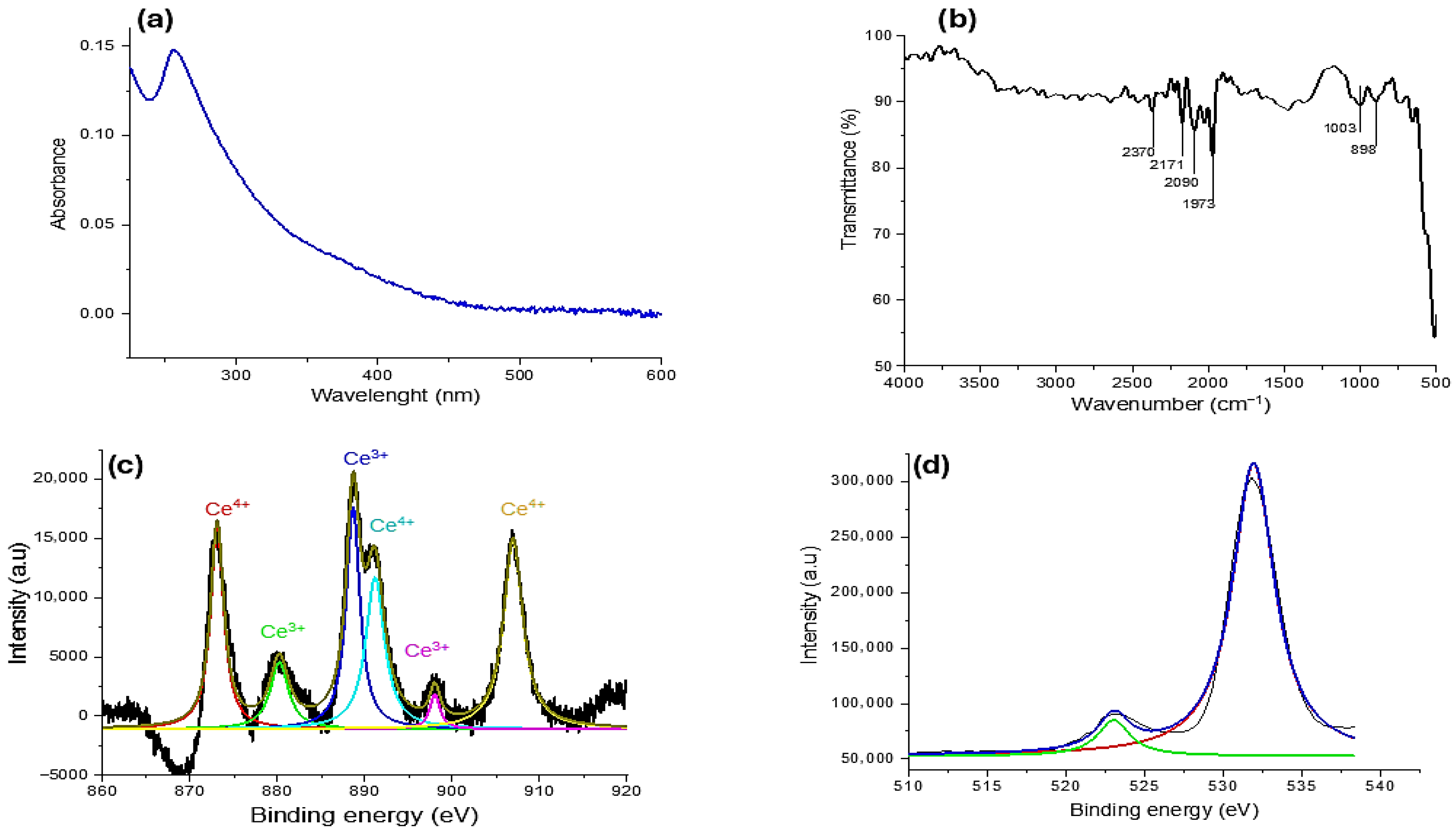
Figure 1a presents the UV–visible optical absorption spectra of the synthesized CeO
2 nanoparticles across the electromagnetic wavelength range from 200 to 600 nm. The UV-Vis spectrum of CeO
2 nanoparticles reveals a distinct absorption band at 269 nm, a feature in line with the standard electrical structure of CeO
2. This absorption profile confirms the successful synthesis of CeO
2 nanoparticles, in agreement with previous reports [
33,
34]. FTIR spectroscopy is a powerful analytical method used to identify the chemical composition and functional groups in organic, polymeric, and occasionally inorganic materials. The FTIR spectrum of the synthesized CeO
2 nanoparticles, shown in
Figure 1b, was captured over the entire range of 400–4000 cm
−1, providing insights into the characteristic chemical bonds and functional arrangements found in the substance. The observed peaks in the FTIR spectrum of the CeO
2 nanoparticles (2370, 2171, 2090, 1973, 1003, 868, and 500 cm
−1) correspond to typical vibrational modes of CeO
2. The peaks at 2370 cm
−1 and 2171 cm
−1 are attributed to surface adsorption of atmospheric CO
2 or residual carbon-containing species, as well as O–H vibrations associated with moisture or surface hydroxyl groups. Such features are standard in nanoparticle samples, which are susceptible to environmental exposure. The 2090 cm
−1 and 1973 cm
−1 peaks are attributed to oxygen vacancies or surface defects, a hallmark characteristic of CeO
2 nanoparticles. These peaks are indicative of the presence of Ce
3+ defects or local vibrational modes associated with oxygen vacancies, which are essential for the catalytic function of CeO
2. The 1003 cm
−1 and 868 cm
−1 peaks correspond to the well-known F2g and T2g vibrational modes of the CeO
2 lattice, reflecting the symmetric stretching of oxygen ions and lattice vibrations, respectively. These are key features of the CeO
2 fluorite structure and confirm the material’s crystallinity. Lastly, the 500 cm
−1 peak is attributed to low-frequency lattice vibrations or defect-related modes, commonly observed in nanoparticles since they are smaller than bulk and have a different surface-to-volume relationship than CeO
2 [
35].
Figure 1c displays the high-quality X-ray photoelectron spectroscopic (XPS) spectrum of cerium (Ce), which clearly reveals the 3d spin-orbit splitting states: 3d
5/
2 and 3d
3/
2. The highest values observed at binding forces (BE) of 906.6 eV and 891.9 eV correspond to the Ce
4+ 3d
3/
2 and Ce
4+ 3d
5/
2 states, respectively. These peaks are characteristic of the Ce
4+ oxidation state in the CeO
2 lattice. Furthermore, the peaks at 897.2 eV and 886.7 eV are ascribed to the Ce
3+ 3d
3/
2 and Ce
3+ 3d
5/
2 states, indicative of Ce
3+ species, which typically arise due to the presence of oxygen vacancies in the material. These findings are consistent with previous reports in the literature [
36,
37,
38], confirming the coexistence of Ce
4+ and Ce
3+ species in CeO
2 nanoparticles. Furthermore, the deconvoluted peaks at 874.0 eV and 880.1 eV are allocated to the ‘shake-up’ remote functionalities of Ce, which are characteristic of the Ce
3+ oxidation state. These satellite peaks are often observed due to strong electron-electron interactions within the cerium 3d orbitals. The presence of these features suggests that the CeO
2 nanoparticles contain a significant number of Ce
3+ species, which can be explained by vacant oxygen spaces in the structure, facilitating the transformation between Ce
3+ and Ce
4+ states.
Figure 1d displays the O 1 s XPS spectrum of the CeO
2 nanoparticles, which was deconvoluted into two distinct peaks. The central peak at 532.5 eV (O
a) is ascribed to lattice oxygen (O
2−), a characteristic feature of the cubic fluorite structure of CeO
2 [
36,
37,
38]. The peaks at 522.5 eV (O
β) and (O
c) are attributed to oxygen vacancies and adsorbed oxygen species on the cerium surface. The presence of these surface oxygen species further supports the idea that oxygen vacancies play an essential part in the transformation of Ce
3+ to Ce
4+ and may influence the material’s catalytic properties. These results are consistent with earlier investigations. [
36,
37,
38], which highlight the significance of oxygen vacancies in the structural and electronic properties of CeO
2 nanoparticles.
3.1.2. Elemental and Structural Analyses
The elemental composition and structural characteristics of the synthesized CeO
2 nanoparticles were thoroughly studied.
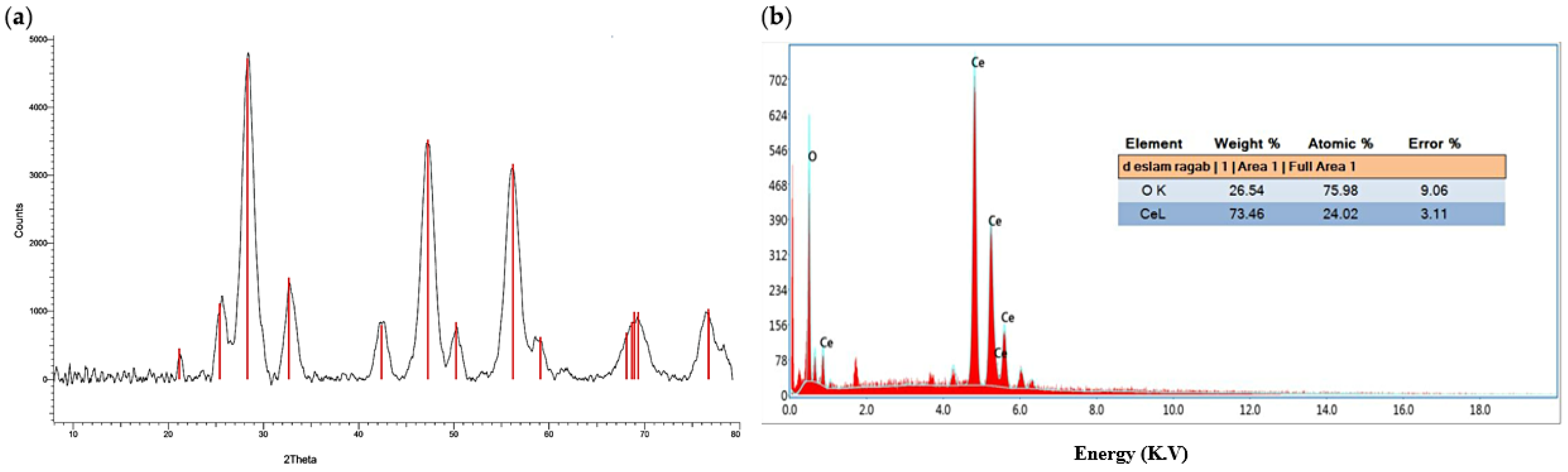
Figure 2a displays the X-ray diffraction pattern of the as- produced CeO
2 nanoparticles. The diffraction peaks observed at 2θ values of 28°, 32.5°, 47°, 56°, 59°, and 69° correspond to the (111), (200), (220), (311), (222), and (400) lattice planes, respectively. These well-defined peaks confirm the crystalline nature of the CeO
2 nanoparticles, indicating that the material adopts a highly ordered structure. The results are consistent with the standard cubic fluorite structure of CeO
2 [
39,
40]. These values align well with the literature-reported data for cerium oxide (JCPDS 43-1002), further validating the crystalline structure of the synthesized nanoparticles. The agreement between the experimental results and the standard references highlights the successful fabrication of crystalline CeO
2 nanoparticles with a well-defined cubic structure.
The energy-dispersive X-ray spectroscopy provides further confirmation of the elemental composition of the synthesized CeO
2 nanoparticles, specifically the presence of cerium (Ce) and oxygen (O).
Figure 2b illustrates the elemental composition of the CeO
2 sample, as established by EDX. The spectrum shows a prominent peak corresponding to the Ce Lα X-ray emission, accompanied by a smaller but distinct peak for O Kα X-ray emission, indicating the successful incorporation of both cerium and oxygen in the material. These findings confirm the presence of Ce and O as the primary constituents of the annealed CeO
2 sample. The observed peaks are consistent with the expected stoichiometric composition of CeO
2, further validating the synthesis process and the elemental purity of the nanoparticles.
3.1.3. Microscopy Techniques
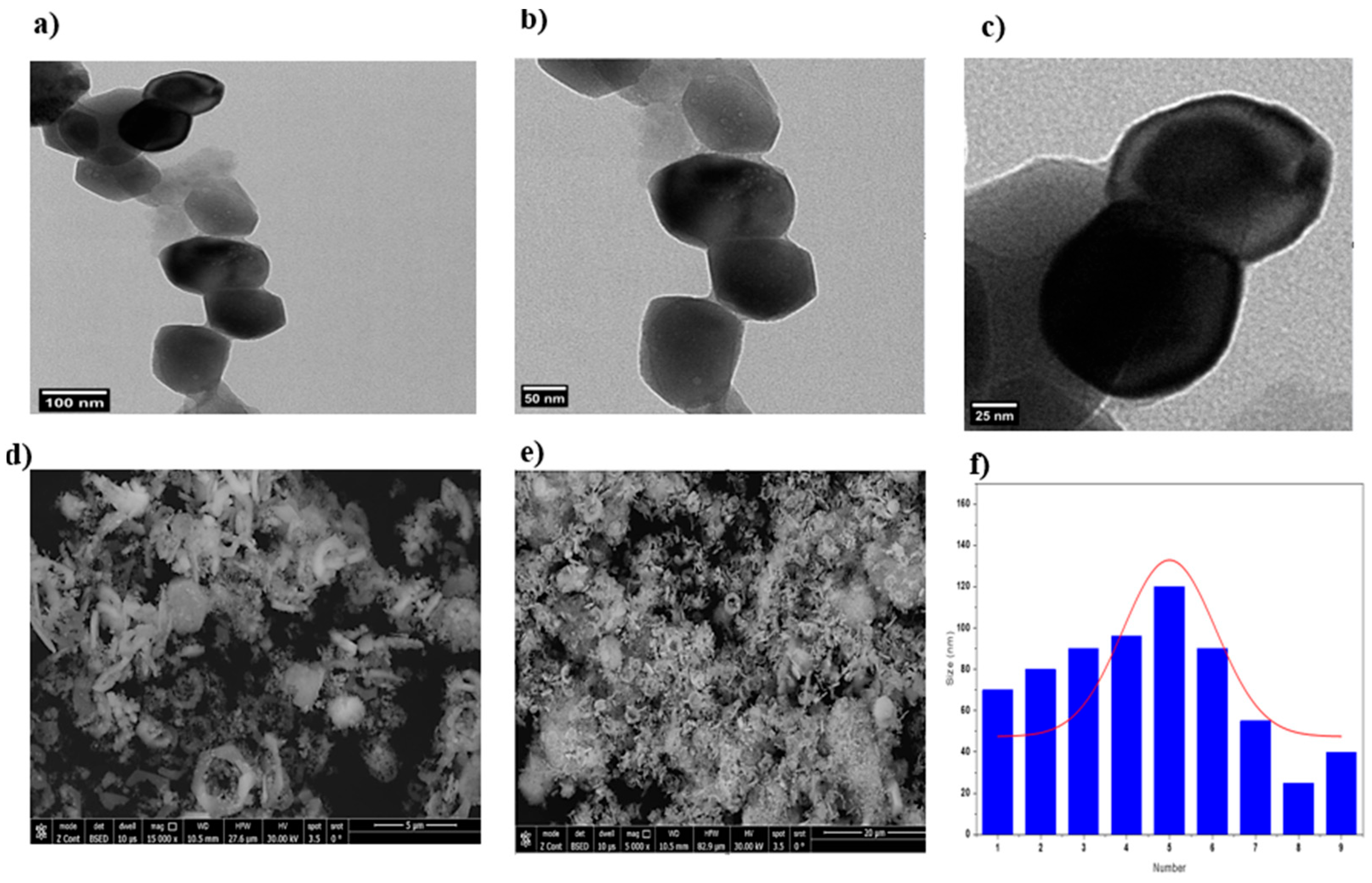
The morphology and structural features of the synthesized CeO
2 nanoparticles were examined using high-resolution TEM (HRTEM) and SEM (
Figure 3). The updated HRTEM images (
Figure 3a–c), recorded at nanometer-scale magnifications (50–100 nm), clearly reveal the crystalline nature of the nanoparticles, with well-defined lattice fringes visible in the magnified insets. These fringes confirm the formation of CeO
2 with distinct interplanar spacing. The nanoparticles appear moderately dispersed with limited agglomeration, which is commonly observed in metal oxide systems.
The high-magnification SEM micrographs (
Figure 3d,e) provide additional visualization of the particle morphology and surface texture. The nanoparticles exhibit a predominantly spherical shape with a noticeably rough surface, which may contribute to enhanced surface reactivity and adsorption capability. The particle size distribution histogram (
Figure 3f) indicates a relatively uniform distribution, with an average particle diameter of approximately 100 nm.
3.1.4. Thermal Assessment
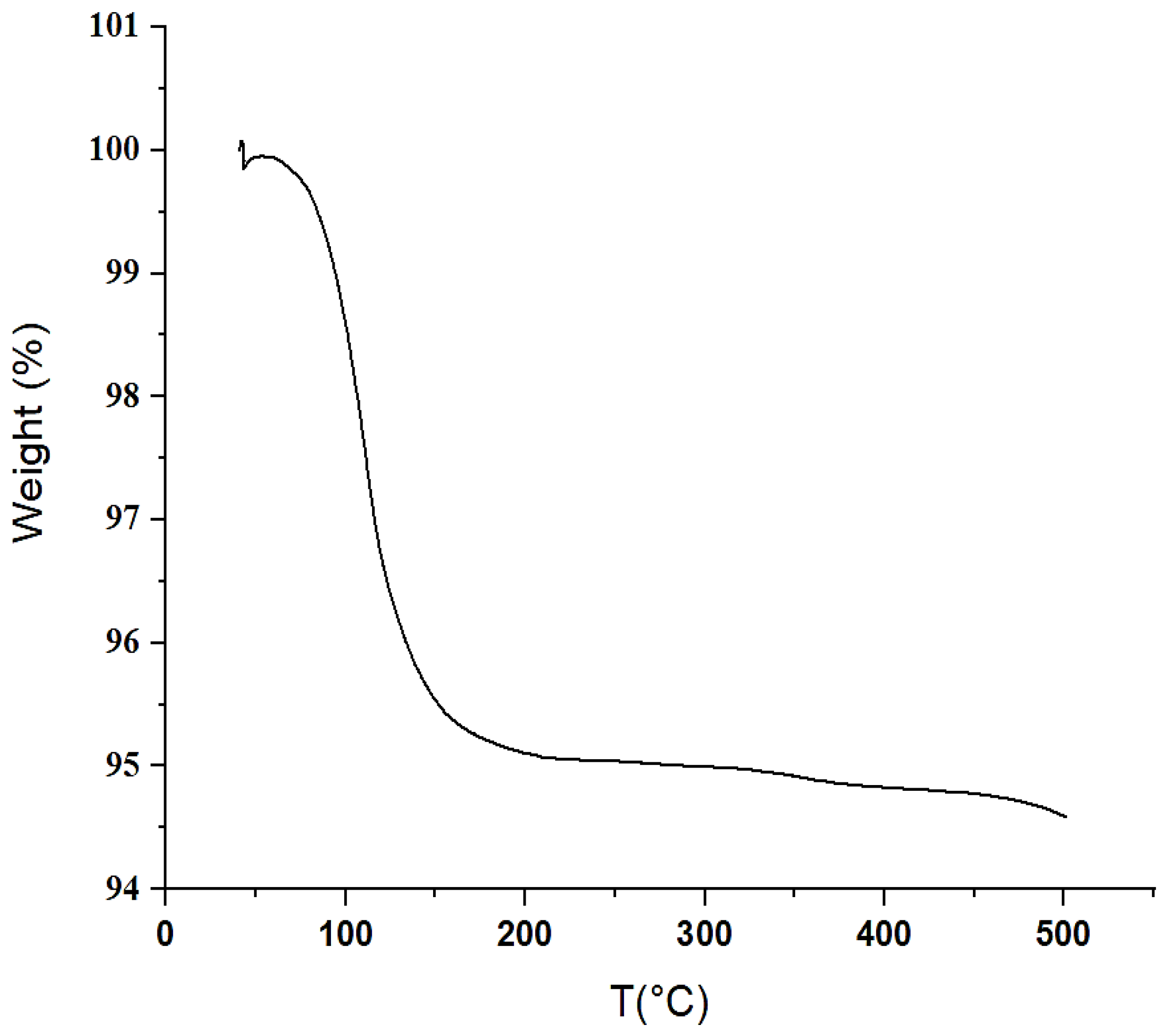
The thermal durability of the produced CeO
2 nanomaterials was evaluated utilizing thermogravimetric analysis, which exhibited distinct weight-loss stages across different temperature regions (
Figure 4). In the low-temperature range, a noticeable endothermic event was observed around 110 °C, accompanied by a mass loss of approximately 1.58%, as evident from the TGA profile. This initial weight reduction is primarily attributed to the dehydration of the nanoparticles, linked to the removal of physically adsorbed and surface-bound water molecules. This mass loss corresponds to the removal of physically adsorbed water and the decomposition of residual hydroxyl groups on the surface of the CeO
2 nanoparticles, consistent with the thermal behavior expected for CeO
2 prepared by hydroxide-mediated precipitation [
41]. A second modest weight-loss area exists between 150 °C and 250 °C, related to the disintegration of residual hydroxyl groups and traces of organic species originating from the precursor or synthesis route. Beyond 250 °C, the TGA curve exhibited negligible weight loss (less than 1%), indicating the formation of a stable CeO
2 crystalline structure. The total weight loss recorded was approximately 5–6% up to 500 °C, confirming the high thermal stability and predominantly inorganic nature of the nanoparticles, which is advantageous for practical applications in water treatment and adsorption processes.
3.1.5. Surface Area and Porosity Analysis
The outcomes of the surface area and porous dimensions assessment of CeO
2 particles particles are summarized in
Table 1. The results indicate that the material possesses a well-developed and accessible surface. The BET method provides a moderate surface area of 118.96 m
2/g, suggesting a significant amount of surface available for adsorption. This is complemented by a pore volume of 0.3962 cc/g, indicating that the material can adsorb and store gases effectively. The Langmuir technique, predicated on the assumption of single-layer adsorption, provides an elevated surface area of 205.62 m
2/g, which suggests that CeO
2 has a highly ordered surface with minimal multilayer adsorption, making it potentially useful in applications requiring high surface interactions, such as catalysis.
The BJH adsorption and desorption methods provide further insights into the material’s pore structure. The surface area obtained by BJH adsorption (85.67 m2/g) and desorption (105.93 m2/g) is somewhat lower than that from the Langmuir method. However, it aligns with the presence of mesopores (pores with diameters between 2 and 50 nm), which is consistent with the pore radius of 2.27 nm in adsorption and 5.69 nm in desorption. This suggests that the material has a mix of small and slightly larger pores, which are beneficial for various catalytic and adsorptive processes. The DFT analysis further supports the porous characteristics of CeO2, revealing a surface area of 118.98 m2/g and a mean porous radius of 6.28 nm, which highlights the material’s well-defined pore structure and large surface area, both of which are crucial for effective interactions in catalytic processes. Additionally, the overall pore volume of 0.4229 cc/g The mean pore dimension is 7.11 nm confirm that CeO2 particles are primarily mesoporous. Overall, the mixture of an extensive surface area, significant pore volume, and a well-defined mesoporous structure makes CeO2 particles highly suitable for lead adsorption and removal.
3.2. Lead Ion Removal
3.2.1. Effect of Initial Pb2+ Concentration on Adsorption Performance
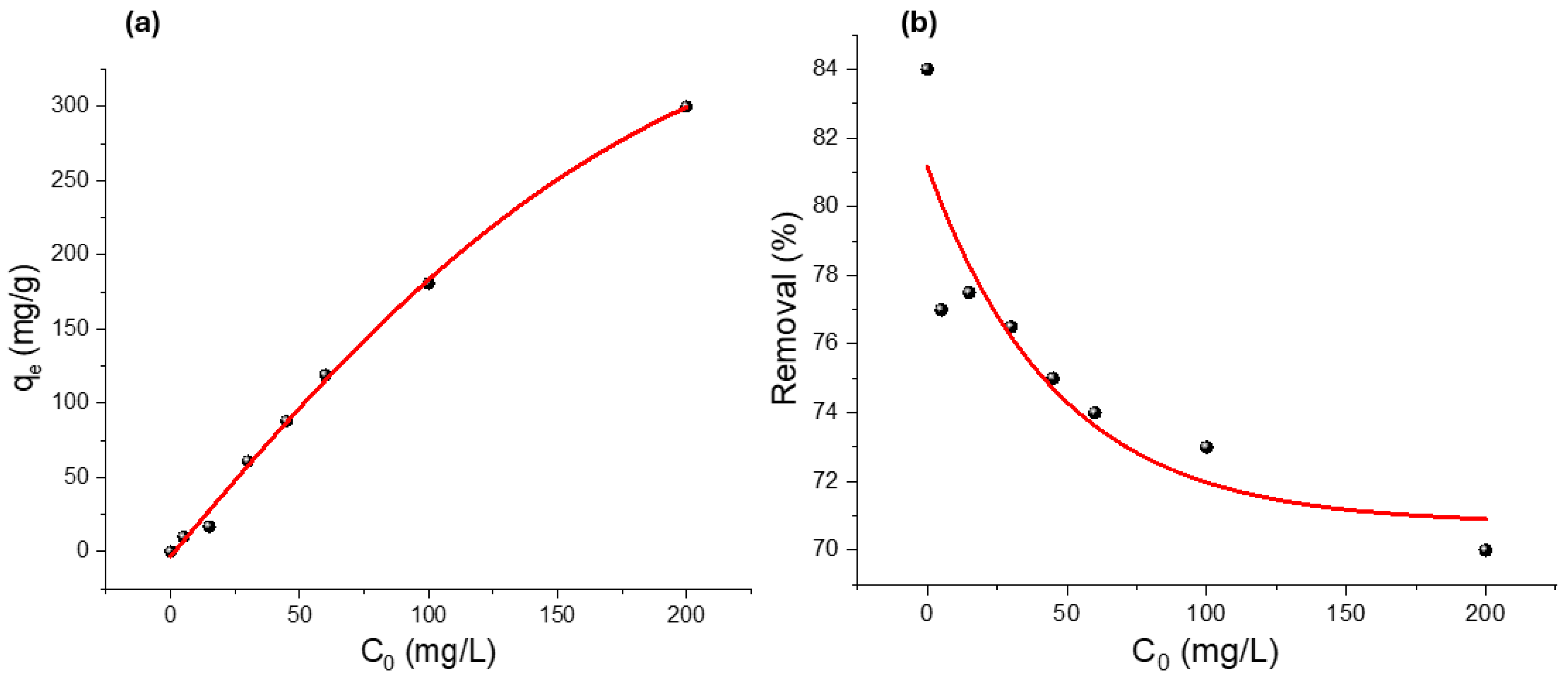
The effect of varying initial Pb
2+ ion concentrations on adsorption performance was examined under consistent experimental conditions, using 0.01 g of CeO
2 added to 50 mL of Pb
2+ solution, an interval of communication of 30 min, and agitation at 150 rpm. A range of initial Pb
2+ concentrations (5, 15, 30, 45, 60, 100, and 200 mg/L) was employed to evaluate changes in both adsorption capacity and removal efficiency. As depicted in
Figure 5a, the adsorption capacity (qe) exhibited a rising trend with increasing initial metal ion concentration, spanning from 10 to 350 mg/g. This behavior is likely due to the intensified concentration gradient at higher Pb
2+ levels, which promotes an intensified impetus for transferring mass, consequently augmenting the interaction between Pb
2+ ions and the active sites available on the CeO
2 surface.
Conversely, the removal efficiency (R%), shown in
Figure 5b, decreased from 84.18% to 70% with increasing initial concentrations. This inverse relationship is commonly observed in adsorption systems and is primarily owing to the depletion of available adsorption sites at higher solute concentrations. Once the adsorbent surface becomes saturated, typically at lower concentrations, further increases in Pb
2+ concentration do not proportionally increase the amount removed from solution.
3.2.2. Influence of Adsorption Time on Pb2+ Removal
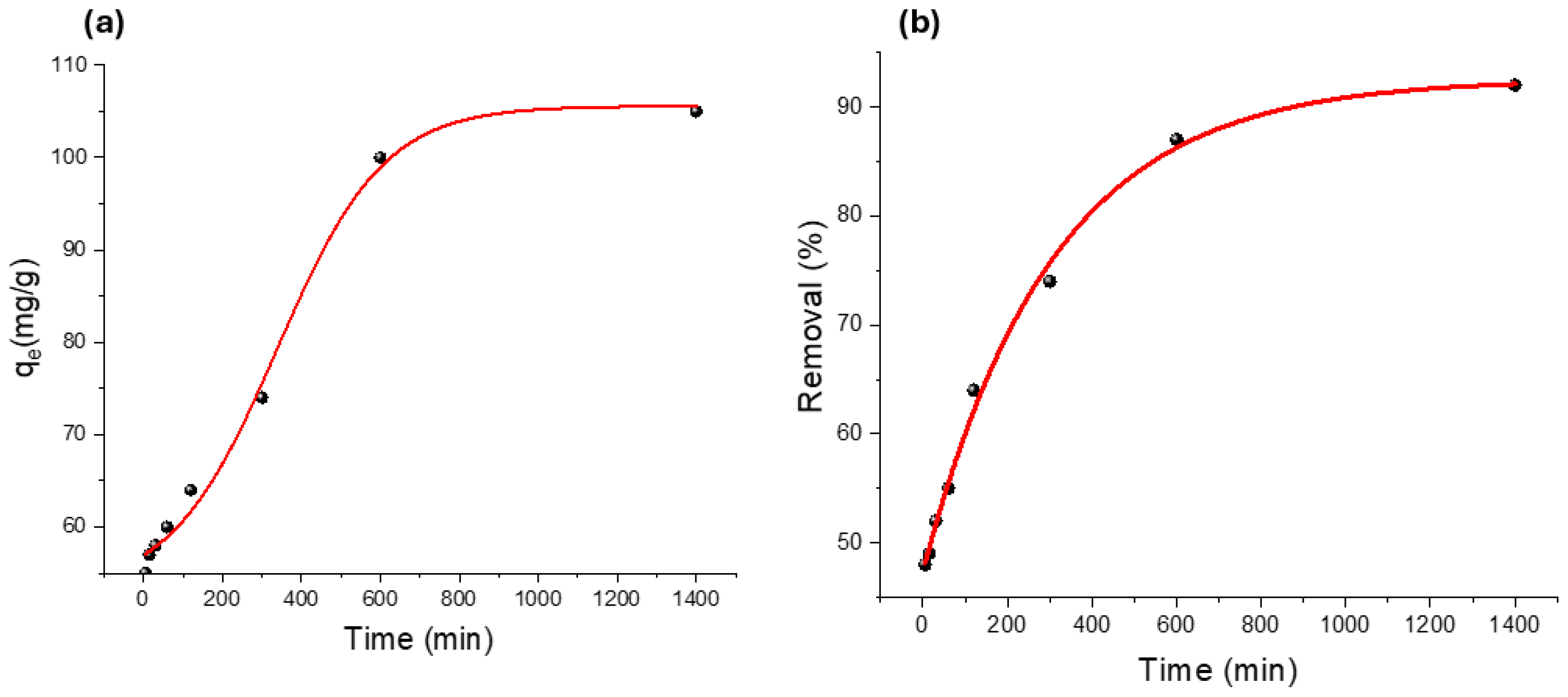
The influence of interface time for elimination efficiency of Pb
2+ ions was examined by altering the adsorption time from 15 to 1440 min at a fixed temperature of 298 K. The experiments were conducted using 0.01 g of CeO
2 and an initial Pb
2+ concentration of 45 mg/L. The effects of contact time on both the adsorption capacity (qe) and removal effectiveness (R%) are presented in
Figure 6a,b. As illustrated in the figures, the adsorption capacity (qe) increased from 58.5 to 107.25 mg/g as the contact time increased. Notably, the removal efficiency (R%) rose sharply during the initial adsorption phase, reaching 52.18% within the first 10 min, and continued to increase more gradually thereafter, stabilizing around 90% by 1440 min. This fast initial adoption can be attributable to the quantity of unoccupied active locations on the CeO
2 surface, which enhances the absorption of Pb
2+ ions. As the adsorption process progressed, these active sites gradually became occupied, and the system approached equilibrium. The observed stabilization of removal efficiency suggests that most accessible binding sites were saturated. The slight increase in qe over time, despite the plateau in the effectiveness of elimination, can be ascribed to the diffusion of Pb
2+ ions into mesopores or microporous regions within the CeO
2 structure, allowing for continued but slower adsorption beyond the external surface.
Equilibrium was effectively achieved around 1400 min, indicating this duration as optimal under the given experimental conditions.
3.3. Influence of Initial pH on Pb2+ Adsorption
The pH is a significant aspect in adsorption investigations, as it influences both the chemical form of the solute and the surface characteristics of the adsorbent. To evaluate its effect on Pb
2+ ion removal, the pH was systematically varied from 1 to 8 at a constant temperature of 298 K. The experiments were conducted using a CeO
2 concentration of 45 mg/L, with an adsorbent mass of 0.01 g and a contact time fixed at 30 min.
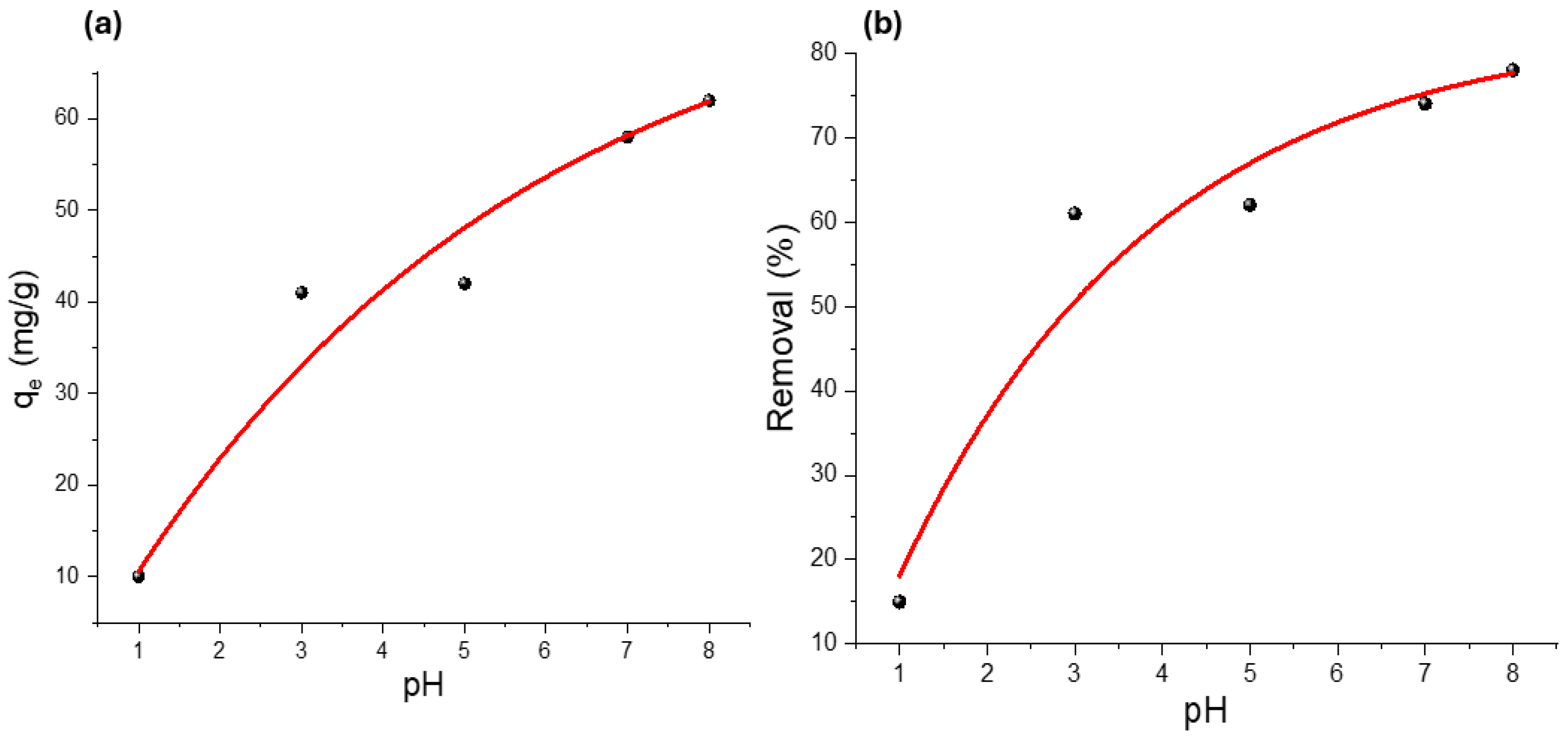
Figure 7a,b illustrate the relationship between pH and both the adsorption capacity (qe) and removal efficiency (R%). Results showed that the quantity of extractable increased from 9.25 mg/g at pH 1 to 60 mg/g at pH 6, while the removal efficiency improved from 12.33% to 80%. These trends underscore the pivotal role of pH in regulating the adsorption process, particularly through its impact on the adsorbent surface charge and Pb
2+ speciation in solution. At low pH levels, the CeO
2 surface becomes heavily protonated, acquiring a positive charge that repels Pb
2+ ions and thus reduces adsorption. As the pH increased, the deprotonation of surface functional groups reduced the positive charge on the CeO
2 surface, possibly resulting in a neutral or even negatively charged surface that enhanced the electrostatic attraction between the adsorbent and Pb
2+ ions. However, the available figures do not show detailed adsorption behavior for pH values above 6, and therefore, the claim that adsorption ‘no longer increases significantly’ beyond this point cannot be confirmed from the presented data and the impact of pH solution on
Figure 7.
Thus, pH 6 represents the highest pH value for which complete experimental data are provided, and under these conditions, the adsorption capacity and removal efficiency reached their maximum observed values in this study.
3.4. Adsorption Isotherm Models
The Langmuir isotherm implies optimal single-layer adsorption onto an evenly distributed surface with a restricted number of similar, energetically comparable sites [
42]. It further presumes that each site accommodates only one adsorbate molecule and that there are no interactions between adsorbed species. This model is often applied to describe systems where surface saturation is attainable. The following equation represents the Langmuir model’s linear equation:
Here, Ce represents the equilibrium concentration of lead ions in solution (mg/L), qe denotes the quantity of Pb
2+ adsorbed per unit mass of CeO
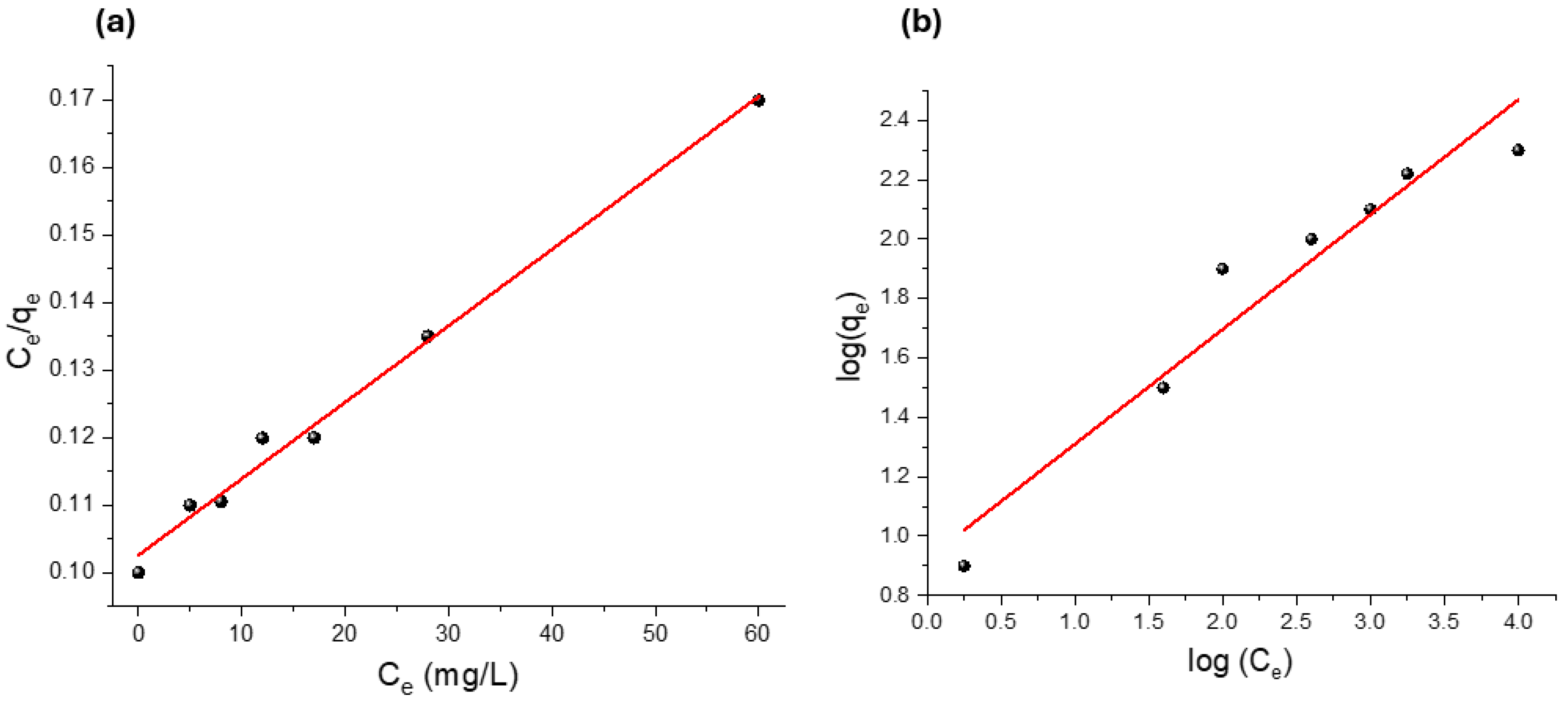
2 at equilibrium (mg/g), the parameter Qm refers to the theoretical maximum adsorption capacity assuming single-layer coverage (mg/g), and b is the Langmuir constant relating to the attraction of binding sites (L/mg). The parameters Qm and b were determined from the linearized Langmuir graph of Ce/qe versus Ce (as shown in
Figure 8a).
The efficiency of the adsorption process was further evaluated by applying the non-dimensional separation factor,
Rs, which was determined utilizing the following formula:
Ci designates the initial concentration of CeO
2 in the solution (mg/L). The dimensionless separation factor, Rs, gives insights into the functioning of the adsorption process. Depending on its value, adsorption can be classified as irrevocable (Rs = 0) and positive (0 < Rs < 1), linear (Rs = 1), or unfavorable (Rs > 1). The parameters b, Qm, and Rs are consolidated in
Table 2. The fact that Rs parameters fall within the range of 0 to 1 confirms that Pb
2+ adsorption onto CeO
2 is favorable under the tested conditions. Among the evaluated models, the Langmuir isotherm demonstrated the greatest fit to the data obtained from experiments, as demonstrated by a higher correlation coefficient (R
2 = 0.97) in contrast to the Freundlich model (R
2 = 0.89). The Langmuir model yielded a theoretical monolayer adsorption capacity of 714.28 mg/g, suggesting a high potential adsorption capability under idealized conditions.
It is important to note that the Qm value is theoretical and derived from model extrapolation; the highest experimentally measured adsorption capacity in this study was qe,exp = 192 mg/g. This discrepancy reflects the ideal assumptions of the Langmuir model compared to real experimental limitations such as incomplete site accessibility, surface heterogeneity, and kinetic constraints.
Overall, the Langmuir model indicates a strong affinity between Pb2+ ions and CeO2 surface sites, while the experimental data provide a more realistic measure of actual adsorption performance.
In contrast, the Freundlich isotherm is an experimental model that is suitable for diverse surfaces, where adsorption sites possess varying affinities and energies. Unlike the Langmuir model, the Freundlich model does not anticipate a point of saturation and is thus applicable to multilayer adsorption processes. The Freundlich equation includes a heterogeneity factor (1/n), which indicates the degree of surface heterogeneity and adsorption intensity; values of 1/n closer to zero reflect more substantial heterogeneity and higher adsorption affinity. Together, these models provide a comprehensive framework for knowing the Adsorption Behavior and capacity of the synthesized nanocomposite under equilibrium conditions. The linear representation of the Freundlich equation is articulated as follows:
where kf is the Freundlich factor proportional to adsorption capacity (mg/g), and nf is the adsorption intensity. These results were calculated using the slope and intercept of the linear relationship between ln qe and ln Ce
Figure 8b.
Table 2 displays the values that were obtained. The Freundlich model demonstrates a heterogeneity factor (1/n) of 0.35 (n = 2.88), indicating moderately favorable adsorption on a heterogeneous surface. The Freundlich constant Kf was calculated to be 4.22, suggesting a reasonable adsorption capacity but less predictive power compared to the Langmuir model. The kinetic results, together with the surface characterization, suggest that Pb
2+ adsorption onto CeO
2 nanoparticles proceeds predominantly through chemisorption. This process may involve several chemical interactions, including electron transfer between Pb
2+ ions and Ce
3+/Ce
4+ redox sites, the formation of inner-sphere surface complexes, and coordination bonding with surface oxygen atoms or hydroxyl groups (–OH) present on CeO
2. Oxygen vacancies and Ce
3+ sites on the nanoparticle surface can serve as active sites where Pb
2+ ions form stable interactions, further supporting the chemisorption nature of the process. To better highlight the novelty of the present work, a comparative analysis of various nanocomposite adsorbents for lead (Pb
2+) removal reveals a broad spectrum of performance efficiencies based on Factors such as adsorbent quantity, pH value, interaction duration, and adsorption capacity (Qm) (
Table 3). Most studies employed slightly acidic to neutral pH conditions (pH 4–8), which are favorable for lead ion adsorption due to minimal competition from hydrogen ions. The adsorption capacities varied considerably, with CeO
2/CuFe
2O
4 (972.4 mg/g) and UiO-66-NH
2 (692.8 mg/g) exhibiting the highest Qm values, although the latter lacked complete operational data. The Langmuir model predicted a theoretical monolayer capacity (Qm) of 714.2 mg/g for the CeO
2 nanocomposite; however, the highest experimentally measured adsorption capacity was 192 mg/g, with a maximum removal efficiency of 80% at pH 6 under the tested conditions. Although the contact time was long (1440 min), the results still indicate a strong affinity of the CeO
2 surface for Pb
2+ ions. Other notable materials include hydroxyapatite nanostructures and silica spheres, which also achieved high adsorption capacities (322.6 and 266.89 mg/g, respectively) at low dosages and short contact times. Low-dosage, high-efficiency materials, such as La
2S
3@MGO and CeO
2 (as identified in previous studies), further highlight the role of material surface chemistry and morphology in performance. Although some materials achieved 100% removal (e.g., magnetite oxide and starch/cellulose-capped MNPs), their adsorption capacities were comparatively lower, indicating possible rapid surface saturation. Overall, the CeO
2 nanocomposite reported in this work compares favorably with existing adsorbents and offers a promising avenue for efficient lead remediation, especially where high adsorption capacity is prioritized.
3.5. Adsorption Kinetics Model
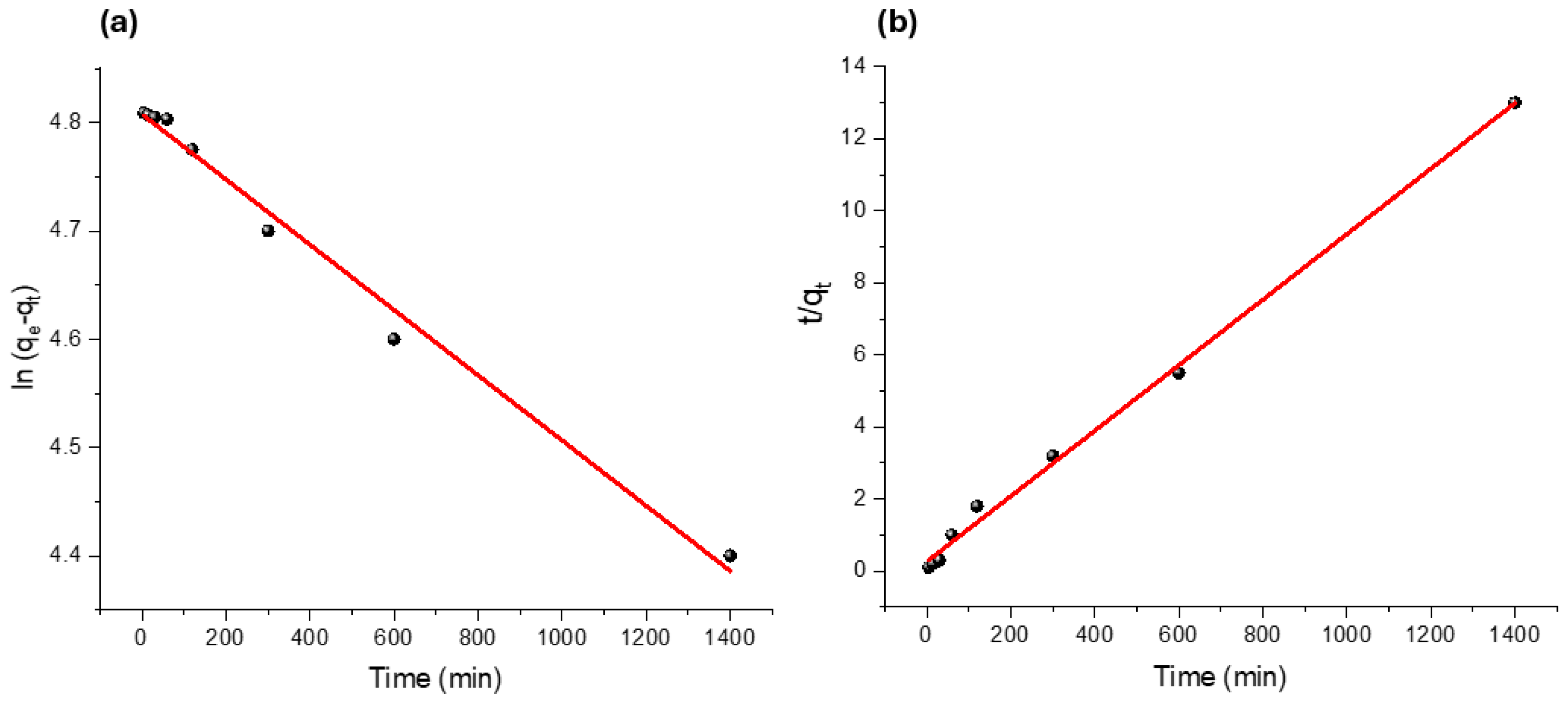
The kinetics of adsorption elucidate the rate and mechanisms by which adsorbate molecules engage with the adsorbent’s surface. Acquiring a comprehensive understanding of these dynamics is crucial for assessing the efficacy and feasibility of adsorption systems, particularly in environmental applications such as the elimination of heavy metals. Commonly applied kinetic models include the pseudo-first-order and pseudo-second-order models, which help elucidate whether physical or chemical interactions govern the process. The pseudo-first order (Lagergren equation) is written as follows:
where q
t, q
e are the quantity adsorbed at time t and at equilibrium (mg.g
−1), respectively. For the adsorption process, t is the time (min), and k
1 is the PFO rate constant (min
−1). PFO rate constants k
1 and q
e were estimated using the slopes and intercepts of the charts between ln (q
e−q
t) against t in
Figure 9a.
Table 4 provides a summary of these values. The lack of fitting alignment between the values of q
e cal and q
e exp is evident from the data, showing that this model is not as suitable for elucidating the adsorption processes. The following is the expression for the pseudo-second order (PSO) kinetics equation:
In this model, k
2 represents the rate constant of the pseudo-second order (PSO) kinetic equation (g.mg
−1·min
−1). The values of k
2 and the theoretical adsorption capacity (qe, cal) were derived from the slope and intercept of the linear plot of t/q
t vs. t (illustrated in
Figure 9b), with corresponding data summarized in
Table 4. The results indicate that the correlation coefficients (R
2) for the PSO model were persistently superior to those for the pseudo-first order (PFO) model.
Although the PSO model exhibited a higher correlation coefficient than the PFO model, the calculated adsorption capacity (qe, cal) differed significantly from the experimental value (qe, exp), indicating that the PSO model captures the kinetic trend but does not precisely predict the absolute adsorption capacity. This suggests that the rate-limiting step may involve chemisorption, characterized by electron transfer or exchange between adsorbent and adsorbate.
The kinetic parameters show that the pseudo-second order (PSO) model provides a better description of Pb2+ adsorption onto CeO2 nanoparticles than the pseudo-first order (PFO) model, as indicated by its higher correlation coefficient (R2 = 0.99). However, the calculated adsorption capacity for the PSO model (qe, cal = 109.69 mg/g) deviates noticeably from the experimental value (qe, exp = 192 mg/g), demonstrating that although the PSO model accurately represents the kinetic trend, it does not precisely predict the equilibrium adsorption capacity. In contrast, the PFO model significantly underestimates adsorption capacity (qe, cal = 4.93 mg/g), further confirming its unsuitability for describing this system. Overall, the kinetic analysis suggests that the adsorption process is likely governed by chemisorption, involving electron transfer or sharing between Pb2+ ions and the CeO2 nanoparticle surface.
3.6. Regeneration and Disposal of Spent Adsorbent
Regeneration of CeO2-based adsorbents is performed using dilute HCl, which efficiently desorbs Pb2+ ions from the nanoparticle surface. After acid treatment, the material is thoroughly rinsed with distilled water and dried to restore its adsorption capability for reuse. In this study, regeneration testing showed that the CeO2 adsorbent retained approximately 95% of its initial adsorption capacity after treatment with dilute HCl, demonstrating that the material maintains its integrity and remains suitable for subsequent adsorption cycles. For disposal, Pb2+-loaded CeO2 nanoparticles must be managed as hazardous waste and immobilized or solidified to prevent secondary contamination. These practices contribute to the safe and sustainable use of CeO2-based materials in water treatment applications.
4. Conclusions
In this study, CeO2 nanoparticles were synthesized through a simple and cost-effective hydroxide-mediated precipitation method. Structural and physicochemical characterization (XRD, SEM, TEM, FTIR, BET, UV–Vis) confirmed well-crystallized, uniformly distributed nanoparticles with an average size of ~100 nm, a high surface area of 118.96 m2/g, and mesoporous features favorable for adsorption.
Adsorption experiments demonstrated effective Pb2+ removal, achieving an experimental capacity of 192 mg/g and 80% removal at pH 6. The process followed pseudo-second-order kinetics, indicating chemisorption, while the Langmuir model provided the best isotherm fit with a theoretical monolayer capacity of 714.2 mg/g. Overall, CeO2 nanoparticles showed strong affinity for Pb2+ and promising performance as a low-cost and sustainable adsorbent for contaminated water. Regeneration with dilute HCl maintained about 95% of the initial adsorption capacity, supporting their potential for reuse. These findings offer a solid basis for developing CeO2-based composites, improving regeneration cycles, and advancing safer disposal strategies for environmentally sustainable water treatment.