Article

Understanding and Mitigating Corona Quenching in ESPs Under High Fly Ash Concentrations in a 660 MW Coal-Fired Unit


1
Zhejiang Feida Environmental Science & Technology Co., Ltd., Zhuji 311800, China
2
College of New Energy, China University of Petroleum (East China), Qingdao 266580, China
3
Fengtai Power Generation Branch, Huaizhe Power Co., Ltd., Huainan 232131, China
*
Author to whom correspondence should be addressed.
Separations 2026, 13(2), 60; https://doi.org/10.3390/separations13020060
Submission received: 12 November 2025 / Revised: 30 December 2025 / Accepted: 12 January 2026 / Published: 8 February 2026
(This article belongs to the Special Issue Numerical Modeling and Computation in Separation and Adsorption)

Abstract

Corona quenching is a major obstacle to the stable and efficient operation of electrostatic precipitators (ESPs) in coal-fired power plants, particularly under high-ash coal combustion. This study evaluates a novel double-V labyrinth pre-collection device as an active strategy to mitigate corona quenching. Field measurements from a 660 MW ultra-supercritical coal-fired unit, combined with computational fluid dynamics (CFD) simulations, demonstrate that the retrofit significantly improved inlet flow uniformity and reduced fly ash concentration before the ESP. Consequently, corona discharge stability was enhanced, overall collection efficiency increased from 99.42% to 99.92%, and outlet fly ash concentration decreased from 81 mg/m3 to 20.5 mg/m3. Although the pressure drop rose modestly (128 Pa to 187.5 Pa), the overall ESP energy demand was reduced due to more stable operation at lower voltages. These results confirm the technical feasibility and engineering applicability of pre-collection technology, providing a cost-effective solution to overcome corona quenching and ensure ultra-low emission compliance in large coal-fired units.

1. Introduction

Electrostatic precipitators (ESPs) are among the most widely used particulate control devices in coal-fired power plants, playing a pivotal role in achieving emission compliance under increasingly stringent environmental regulations [1]. With the implementation of ultra-low emission standards, ESPs are required not only to maintain high collection efficiency, but also to operate stably under fluctuating coal quality and highly variable operating conditions [2,3,4]. Ensuring reliable ESP performance under such circumstances has therefore become one of the central challenges in modern flue gas treatment.
Coal quality exerts a direct and profound influence on ESP performance through its effects on fly ash characteristics [5]. Variations in particle size distribution [6], specific resistivity [7], and chemical composition [3] are well known to alter collection efficiency. High-ash coal combustion, in particular, generates substantially elevated particulate concentrations, which intensify electric field loading and frequently lead to corona quenching [8]. This phenomenon, characterized by current saturation and the inability of current to rise with voltage, suppresses particle charging and reduces migration velocity, often resulting in outlet particulate concentrations above emission limits [9]. Consequently, corona quenching is now recognized as a key bottleneck for improving ESP efficiency in large coal-fired units.
Extensive studies have been conducted to investigate the mechanisms of corona quenching. Early research emphasized the space charge effect, showing that high particle concentrations distort the electric field and prevent current growth. Building on this foundation, subsequent studies examined the influence of charged particles on flow patterns and ESP performance through numerical simulations. For instance, a finite element-based algorithm was developed to predict different electrical conditions of a wire–plate electrostatic precipitator under dust loading conditions [10]. Similarly, numerical simulations of two-dimensional gas flow modified by charged fine particles in a single-wire ESP have been reported [11]. In another approach, the electrostatic field and ionic space charge density caused by corona discharge were computed using a hybrid finite element–flux-corrected transport method, which also considered the effect of particle space charge density on ionic charge distribution [12]. Our group established a comprehensive model that incorporated trajectory-dependent particle space charge. Based on the simulation data, a criterion for performance deterioration under corona quenching conditions was proposed to instruct ESP design [9]. Previous studies on corona quenching mechanisms consistently highlight the strong influence of particle properties, particularly size and concentration. However, most investigations have focused on fine particles, as extremely small diameters can induce severe corona quenching even at low concentrations. For example, in wet electrostatic precipitators treating high-sulfur coal, the small size of sulfuric acid mist droplets causes a marked reduction in current when concentrations fall below 50 mg/m3 [13]. In contrast, dry electrostatic precipitators operate with a broader particle size distribution and much higher concentrations, yet quantitative assessments of how varying fly ash concentrations influence corona quenching remain scarce.
Recognizing these gaps, researchers have increasingly explored technical solutions aimed at alleviating the impact of corona quenching in practical applications. One widely studied approach involves geometric optimization of discharge electrodes. In our earlier work under high-SO3 conditions, novel electrode designs generated stronger discharges and more than doubled SO3 removal efficiency [14]. Moreover, the arrangement of identical electrodes substantially affected corona strength; optimization through simulations and experimental tests improved discharge uniformity [15,16]. Beyond electrode design, efforts have also targeted advanced power supplies to enhance performance across different particle types. Zhao et al., for instance, upgraded pulse power supplies in a 660 MW coal-fired unit. After installation, outlet dust concentrations fell below 5 mg/m3 under high-resistivity dust conditions, while high-voltage power consumption decreased by 24.5% [17]. Similarly, Ding et al. introduced a scheme that combined a direct-current base voltage with superimposed high-voltage pulses to suppress back corona. This method reduced outlet dust concentrations by 73.52% [18]. While these approaches demonstrate significant progress, their practical application also reveals inherent challenges that limit widespread adoption. These strategies are designed under fixed inlet fly ash conditions, reflecting passive adaptation rather than active modification of fly ash properties. As a result, their applicability is constrained. Therefore, to move beyond incremental improvements, future efforts must focus on developing strategies that actively regulate or modify fly ash properties. Such approaches are essential to overcoming corona quenching under complex and high-concentration conditions and to maintaining high dust collection efficiency.
In recent years, pre-collection technology has gained attention as a practical alternative for improving ESP performance. Its principle is to remove a portion of particulates upstream of the ESP, thereby lowering dust concentration and reducing the likelihood of corona quenching. Currently, the most common approach is to divide the ESP into two functional zones: a charging zone and a collection zone. In the charging zone, particles are efficiently charged and partially removed. For example, in our previous work on sulfuric acid mist, we developed a novel pre-charger to enhance wet ESP performance. With its application, the corona current increased by 30%, and the removal efficiency improved from 90.3% to 95.8% [19]. The pre-charger can serve as a pretreatment device. However, when applied to high fly ash concentrations, it essentially functions as an advanced first-stage electric field of the ESP and therefore cannot fundamentally prevent corona quenching. To achieve a pre-collection effect without introducing an additional electric field, cyclone separators based on centrifugal principles are often used [20]. These devices are typically suitable for small-volume industrial flue gas but are not applicable to large-scale ESPs in coal-fired power plants. Thus, there is an urgent need to develop pretreatment technologies capable of handling large flue gas volumes with high fly ash concentrations in coal-fired power plants.
Given these gaps, further research is needed to assess the practical feasibility of pre-collection technologies for modern ESP retrofits. Against this background, the present study investigates the ESP performance of a 660 MW ultra-supercritical coal-fired unit. First, the influence of coal quality variation on fly ash properties and corona quenching is analyzed. Building on this understanding, a novel double-V labyrinth pre-collection device is introduced. Its impact on flow-field distribution and ESP performance is systematically evaluated through both field measurements and computational fluid dynamics (CFD) simulations. The findings aim to provide theoretical insights and practical guidance for optimizing ESP design and retrofits, particularly under high-ash coal conditions where corona quenching poses a persistent challenge.

2. Materials and Methods

2.1. Fly Ash Sampling and Characterization

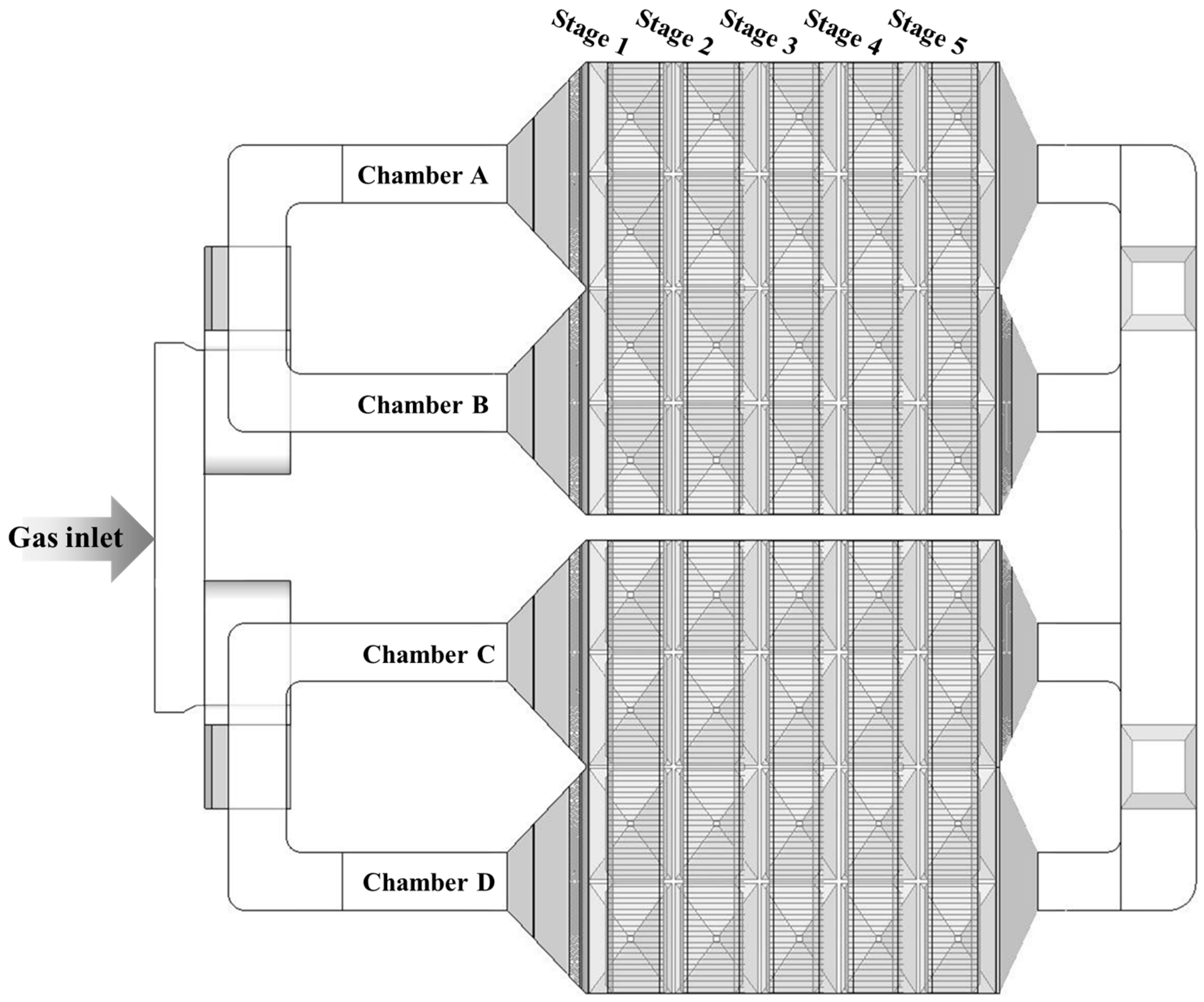
Field experiments and simulations were conducted on a 660 MW ultra-supercritical coal-fired unit at the Fengtai Power Plant in Anhui Province. The flue gas cleaning system consists of selective catalytic reduction (SCR), an electrostatic precipitator (ESP), and a wet flue gas desulfurization (WFGD) unit. The ESP, manufactured by Zhejiang Feida Environmental Science & Technology Co., Ltd. (Zhuji, China), has a four-chamber, five-field configuration (Figure 1). The design coal quality and inlet flue gas parameters for the ESP are listed in Table 1.
Fly ash, the target material for collection, was characterized to understand its impact on ESP performance. Samples were collected isokinetically from the ESP inlet duct during stable unit operation, following the standard method GB/T 16157-1996 [21]. The sampled ash was analyzed for key properties: particle size distribution was determined using a laser diffraction particle size analyzer (Mastersizer 3000, Malvern Panalytical Ltd., Malvern, UK); electrical resistivity was measured in a laboratory cell under simulated flue gas conditions in accordance with the national standard GB/T 16913-2008 [22]; and particle morphology and composition were examined using Scanning Electron Microscopy (SU8010, Hitachi High-Technologies Corporation, Tokyo, Japan). The inlet dust concentration, a critical parameter for ESP design and performance evaluation, was measured using an automatic smoke/dust sampler (Laoying 3012H-D, Qingdao Laoshan Applied Technology Co., Ltd., Qingdao, China) in accordance with the national standard GB/T 16157-1996 [21].

2.2. Field Test

Field investigations employed two complementary approaches to evaluate ESP performance and corona discharge behavior. First, the plant’s distributed control system (DCS) provided continuous online monitoring of ESP operating parameters. The ESP was powered by high-frequency switched-mode negative DC high-voltage power supplies, which convert three-phase AC input into a stable negative DC output through rectification, high-frequency IGBT inversion, and transformer step-up with final rectification. The resulting voltage applied to the discharge electrodes is a smoothed negative DC with minimal high-frequency ripple (typically <5%), and the monitored corona current is a direct current (DC). The DCS recorded secondary voltage, corona current, and power consumption across all fields, enabling statistical analysis of discharge characteristics under variable boiler loads.
Second, dedicated on-site measurement campaigns were conducted under deliberately stabilized operating conditions, with coal type kept constant, to obtain precise performance indicators. These tests, performed in accordance with national standards, included measuring flue gas velocity, temperature, pressure drop across the ESP, and oxygen content at the inlet and outlet. The particle concentration data, obtained from the characterization sampling described in Section 2.1, was utilized alongside continuous measurements of boiler and ESP electrical parameters to calculate key performance metrics. These metrics, including overall collection efficiency, pressure drop, air leakage rate, and specific collection area utilization, formed the basis for evaluating the baseline ESP performance and the effectiveness of any implemented retrofit measures.

2.3. Simulation Methods

To complement the field tests and provide mechanistic understanding, CFD simulations were conducted to analyze the effects of the pre-collection device on corona stability and flow-field distribution. The study focused on the ESP system of the 660 MW unit, which comprises four parallel ESPs. In practice, variations in inlet gas flow and ash properties often lead to performance disparities among individual ESPs. Therefore, a full-scale numerical model was established to capture realistic flow and particle distributions, with particular attention to the influence of the novel double-V labyrinth pre-collection device. All simulations were performed using the commercial software ANSYS Fluent (version 2022 R1).
A 1:1 geometric model was constructed using design drawings of the ESP, flue gas ducting, and pre-collection structures. The computational domain extended from the air preheater outlet to the induced draft fan inlet, fully representing the gas flow path, guide vanes, distribution plates, and hoppers. The inlet cross-section measured 4 m × 4 m, consistent with the actual duct geometry. For the physical model, flue gas was treated as an incompressible Newtonian fluid. The inlet boundary condition was defined as a uniform velocity of 13.76 m/s and a turbulence intensity of 5%, while the outlet was set as a pressure boundary with static pressure fixed at −3 kPa. The gas density was specified as 0.87 kg/m3. Distribution plates were modeled as porous media to represent flow resistance, whereas guide vanes, anode plates, baffles, and hopper walls were explicitly modeled as no-slip solid boundaries. Given that the Reynolds number exceeded 104, the standard k–ε turbulence model was employed to describe turbulent flow, with transport equations solved for both turbulence kinetic energy (k) and its dissipation rate (ε). Numerical discretization employed the finite volume method. The pressure-velocity coupling was solved using the SIMPLE algorithm. Second-order upwind schemes were used for the discretization of momentum equations, and the QUICK scheme was used for the turbulence equations to enhance accuracy.
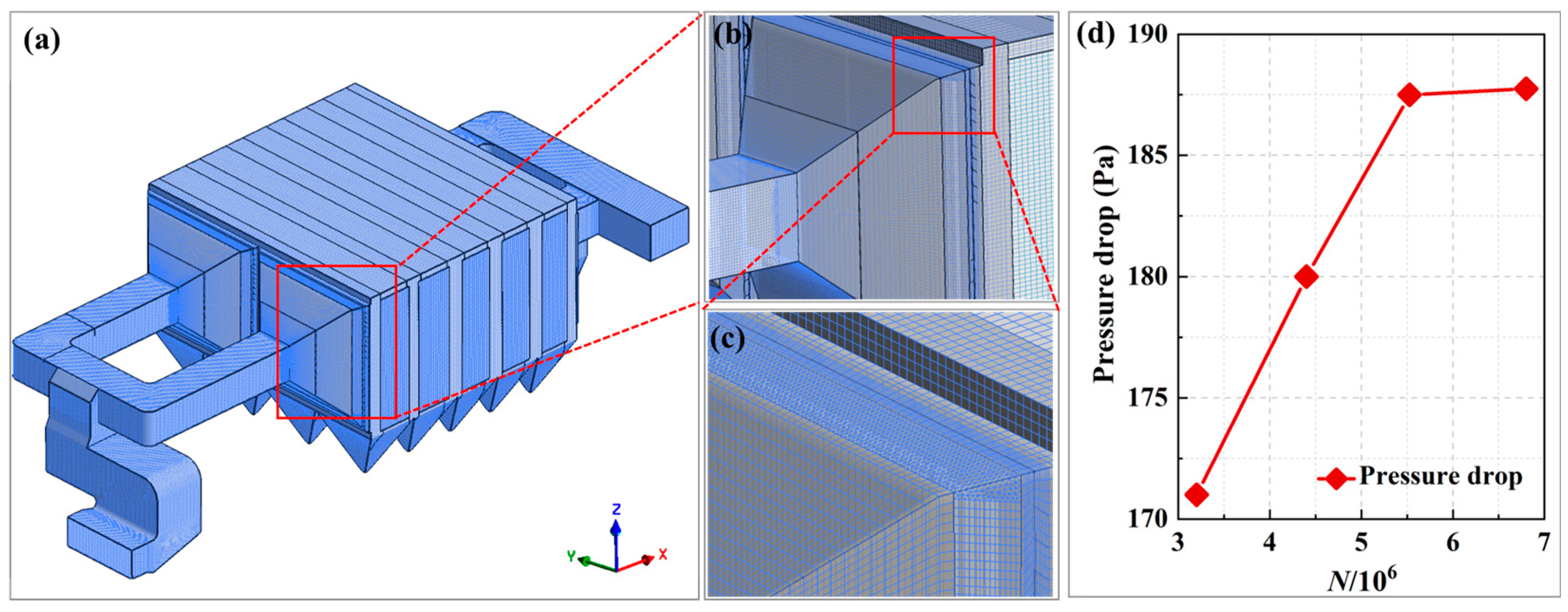
A structured hexahedral mesh was generated across the entire computational domain, with local refinement applied in the ESP electric field region and around flow-guiding structures to capture detailed flow behavior, as illustrated in Figure 2a–c. The base mesh size was approximately 1 mm, resulting in 5,526,896 computational cells. A systematic mesh independence study was performed, as shown in Figure 2d, demonstrating that simulation results became insensitive to further refinement, thereby ensuring numerical stability and reliability. Convergence was considered achieved when normalized residuals for all equations fell below 10−5 and global mass/energy balances closed within 0.1%. It should be noted that the present CFD model focuses on the aerodynamic single-phase flow field. The effects of particle loading, electrostatic forces, and thermal gradients were not considered in this study, as the primary objective was to isolate and evaluate the flow distribution improvement brought by the pre-collection device.
This combined field–numerical approach allowed both validation of simulation results against field data and in-depth exploration of flow patterns and particulate distributions that are difficult to measure experimentally. Such integration ensures that the effects of the pre-collection device on corona quenching and ESP performance can be evaluated both quantitatively and mechanistically.

3. Results and Discussion

3.1. Properties of the Fly Ash

The properties of fly ash play a decisive role in determining the occurrence and severity of corona quenching in ESPs. In particular, particle size distribution and specific resistivity are the two most critical factors influencing particle charging and collection efficiency. To evaluate these effects, representative fly ash samples were collected and tested. Two types of samples were analyzed: Ash I obtained directly from the ESP hopper, and Ash II collected from the ash silo. The operating unit load during sampling was 593 MW, and the proximate analysis of the coal was as follows: total moisture 5.8%, air-dried moisture 1.92%, ash content 31.2%, volatile matter 42.0%, and sulfur content 0.33%.
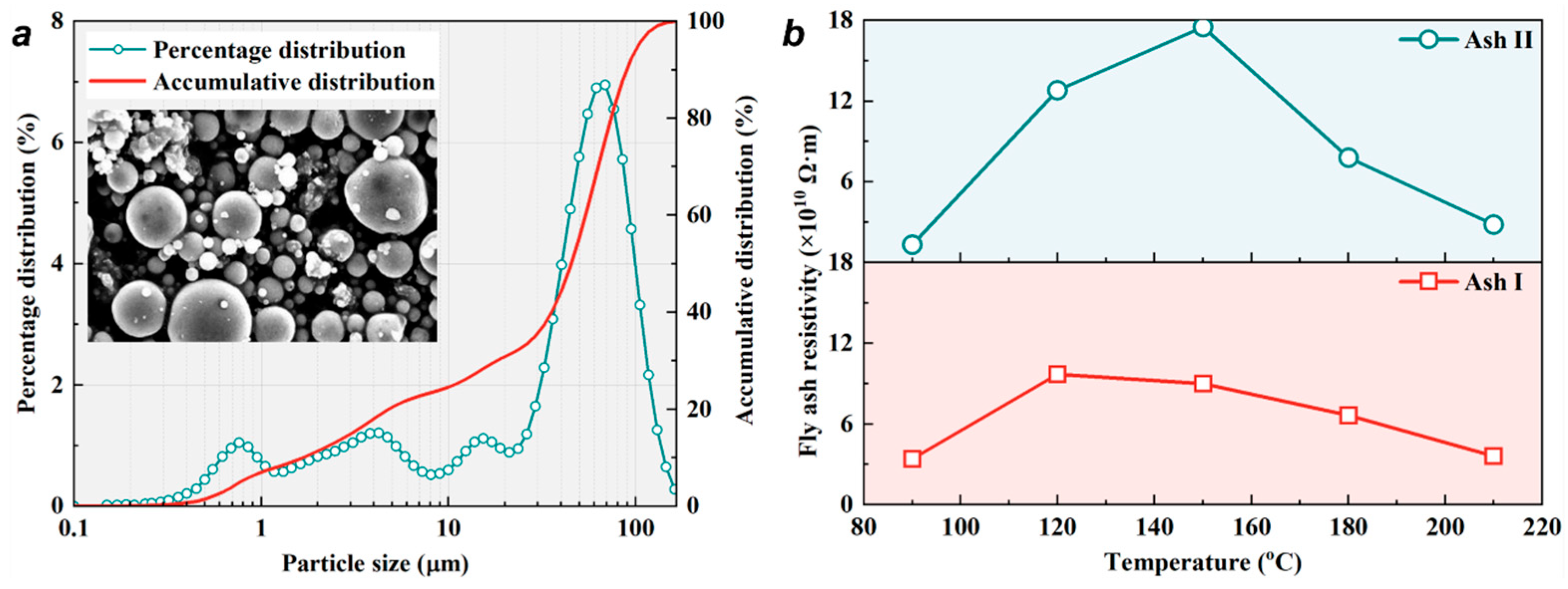
As shown in Figure 3a, the particle size distribution is dominated by particles in the 20–100 μm range, with a distinct peak around this interval. The cumulative distribution curve further indicates that more than 80% of the particles are smaller than 100 μm, underscoring the predominance of fine particles. Such fine particles are known to be difficult to charge efficiently and to migrate under the influence of the electric field, which poses significant challenges to ESP performance.
Figure 3b illustrates the temperature dependence of fly ash resistivity for both samples. Ash I was collected directly from the ESP hoppers (field-precipitated ash), while Ash II was obtained from the plant’s silo (mixed ash). The resistivity was measured in a laboratory test cell following the standard method GB/T 16913-2008 [22]. Both samples exhibited the typical trend of increasing resistivity with temperature up to a peak, followed by a gradual decline. Specifically, Ash I reached its maximum resistivity at approximately 120 °C, after which values decreased, whereas Ash II peaked at around 140 °C before showing a downward trend. Notably, Ash II displayed larger fluctuations in resistivity across the temperature range compared with Ash I, suggesting that the silo-mixed fly ash is more sensitive to thermal variations and thus more likely to induce operational instability. In contrast, Ash I demonstrated a relatively stable resistivity behavior, as evidenced by its narrower range of variation and a less pronounced peak.
The correlation between fly ash resistivity and temperature is of particular engineering significance. Under high-resistivity conditions, charge transfer efficiency decreases, weakening corona discharge and possibly intensifying quenching phenomena. Moreover, high-resistivity ash can cause back corona, further deteriorating ESP performance [23]. The characterization results indicate that the tested fly ash exhibits highly favorable resistivity characteristics, falling squarely within the optimal range of 108 to 1011 Ω·cm for electrostatic precipitation.

3.2. Field Observation of Corona Quenching in the ESP

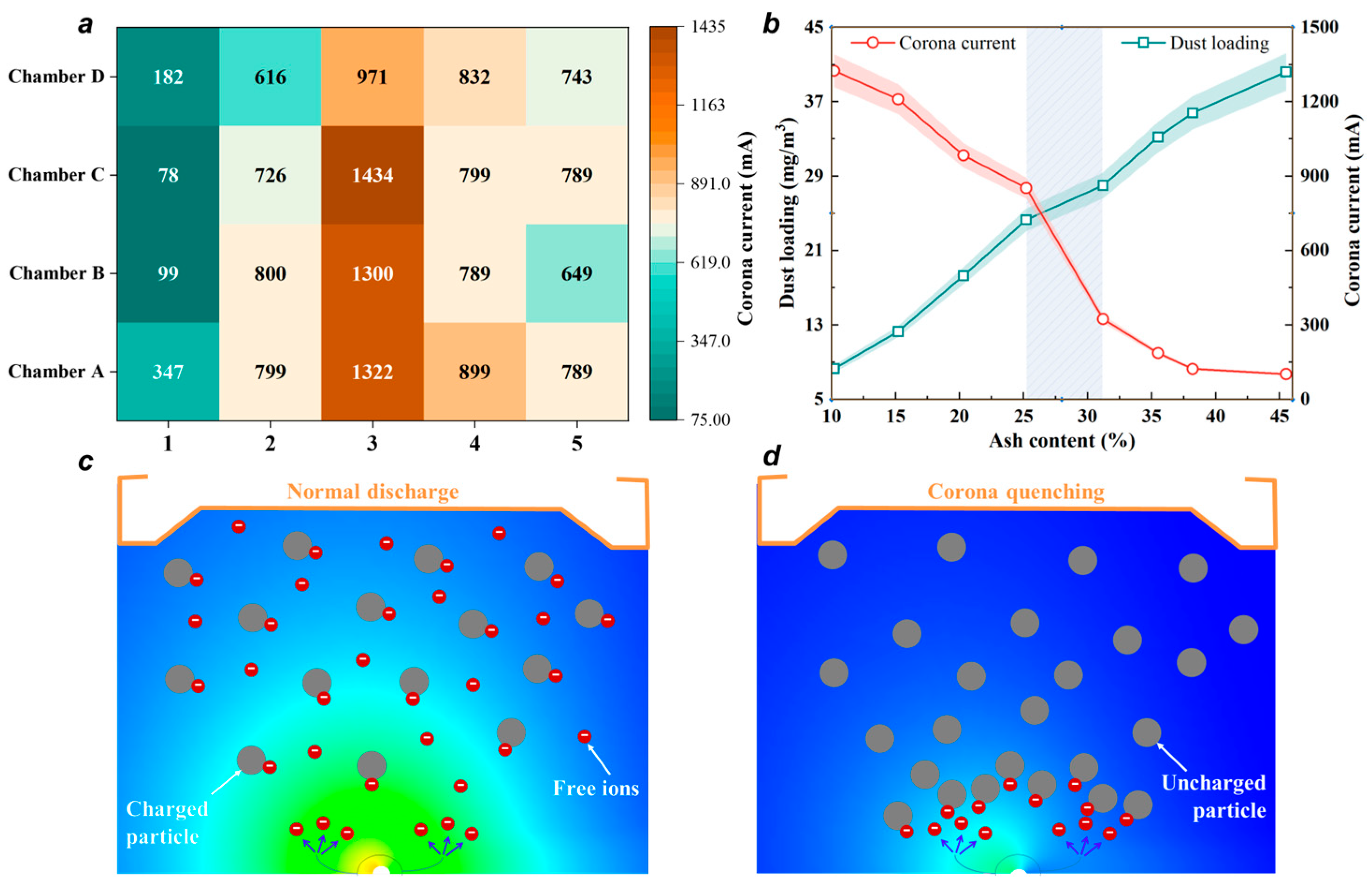
Figure 4a presents the distribution of secondary current across the four ESP chambers (A–D) under different electric field stages (1–5). At the inlet stage (Stage 1), the discharge current is generally low and shows pronounced chamber-to-chamber variations. Notably, chamber C records only 78 mA, substantially lower than the corresponding values in the other chambers. This indicates that the high fly ash concentration at the inlet intensifies space charge effects, leading to severe corona quenching and restricting current release. As the flue gas passes through subsequent fields, particles are progressively removed, reducing fly ash concentration and thereby alleviating quenching. In chamber C, for instance, the current increases to 1434 mA at Stage 3, reflecting stronger discharge intensity. By contrast, the fourth- and fifth-stage currents are much lower than those of the first three fields, primarily because of a different electrode design that maintains high field strength at reduced current levels to achieve energy-efficient operation.
Comparison among chambers reveals further discrepancies. For example, the first-stage current in chamber A is higher than that in chamber C, suggesting non-uniformity in inlet ash loading or flow distribution. Chamber D exhibits consistently lower current levels in downstream stages, most likely due to maldistributed airflow or localized dust accumulation at the inlet. These findings confirm that even under identical electrode configurations, the discharge process is strongly influenced by upstream flow-field characteristics and particle concentration, in agreement with previous studies emphasizing the role of flow uniformity on ESP performance [13,24,25]. Thus, optimizing inlet flow distribution and minimizing inter-chamber non-uniformity are critical for improving ESP stability and reducing corona quenching.
The effect of coal ash content on corona current is shown in Figure 4b. As ash content increases, fly ash concentration rises sharply—from 8.3 g/m3 at 10% ash to 24.3 g/m3 at 25% ash. Correspondingly, corona current decreases markedly, with a rapid decline once ash content exceeds 25%. Beyond 30%, the current nearly vanishes, defining a critical ash concentration threshold for severe corona quenching. This behavior can be attributed to intensified charge shielding at high particle loadings, which limits charge transfer and suppresses corona discharge, ultimately reducing ESP collection efficiency. A similar phenomenon has been observed in a wet ESP when treating high concentrations of sulfuric acid mist, where the corona current nearly approaches zero as the concentration of sulfuric acid mist increases [14].
Figure 4c,d schematically illustrate the discharge process under normal corona operation and under quenching conditions, respectively. In normal discharge (Figure 4c), electrons interact freely with positive ions in the gas stream, sustaining a uniform electric field that ensures efficient particle charging and collection. In contrast, under high particle concentrations (Figure 4d), strong charge shielding drastically reduces corona current and weakens electrostatic forces, causing particles to penetrate the electric field without being captured. This transition from stable corona to quenching underscores the sensitivity of ESP performance to ash loading.
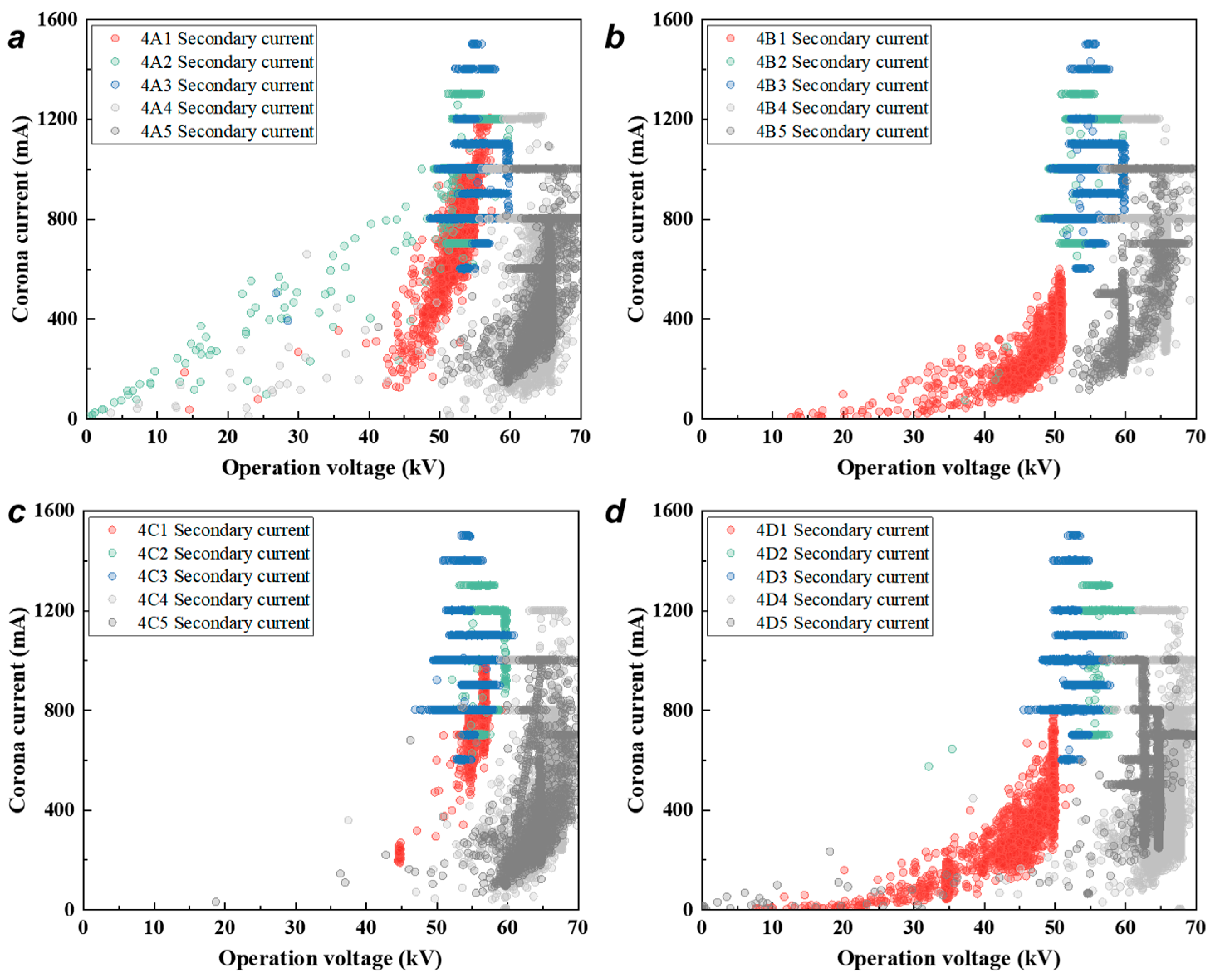
The volt–ampere (V–I) characteristics of the ESP chambers under long-term operation are shown in Figure 5. Stages 1–3, which share the same electrode configuration, generally operate at voltages below 60 kV, whereas stages 4 and 5 typically operate above 60 kV. Despite their higher voltages, the currents in stages 4 and 5 remain far lower than those in the first three fields, underscoring the energy-saving design of the terminal stages. Attention is therefore directed to the first three fields, which are most critical for particle charging. The first-stage field is distinctive: it operates at low current and exhibits wide voltage fluctuations, making it highly sensitive to inlet ash concentration. By contrast, the second- and third-stage fields display current-limiting behavior, where current remains relatively stable despite voltage variations. This pattern visually manifests as the horizontal data bands in the V–I plot, resulting from the constant-current control mode of the power supplies, which automatically adjusts the voltage to maintain a set current level under varying flue gas and dust conditions. This reflects the current-controlled mode commonly applied to intermediate fields, which maintains sufficient discharge intensity for particle charging while limiting energy consumption.
Overall, these observations demonstrate that the first-stage field at the ESP inlet is the most vulnerable to fluctuations in fly ash concentration, and therefore the most critical for corona quenching control. Effective strategies for mitigating quenching must therefore focus on stabilizing inlet ash concentration, for example, through pre-collection.

3.3. Enhanced ESP Performance via Double-V Pre-Collection

3.3.1. Effects on Flow Field Distribution

A well-organized airflow is fundamental to the stable operation of ESPs. Uniform flow distribution minimizes localized dust accumulation that can mitigate corona quenching, reduce pressure losses, and promote efficient particle charging and collection across successive electric fields. To address this, the present study evaluated a novel double-V labyrinth pre-collection device, with particular focus on its influence on flow-field uniformity and system resistance.
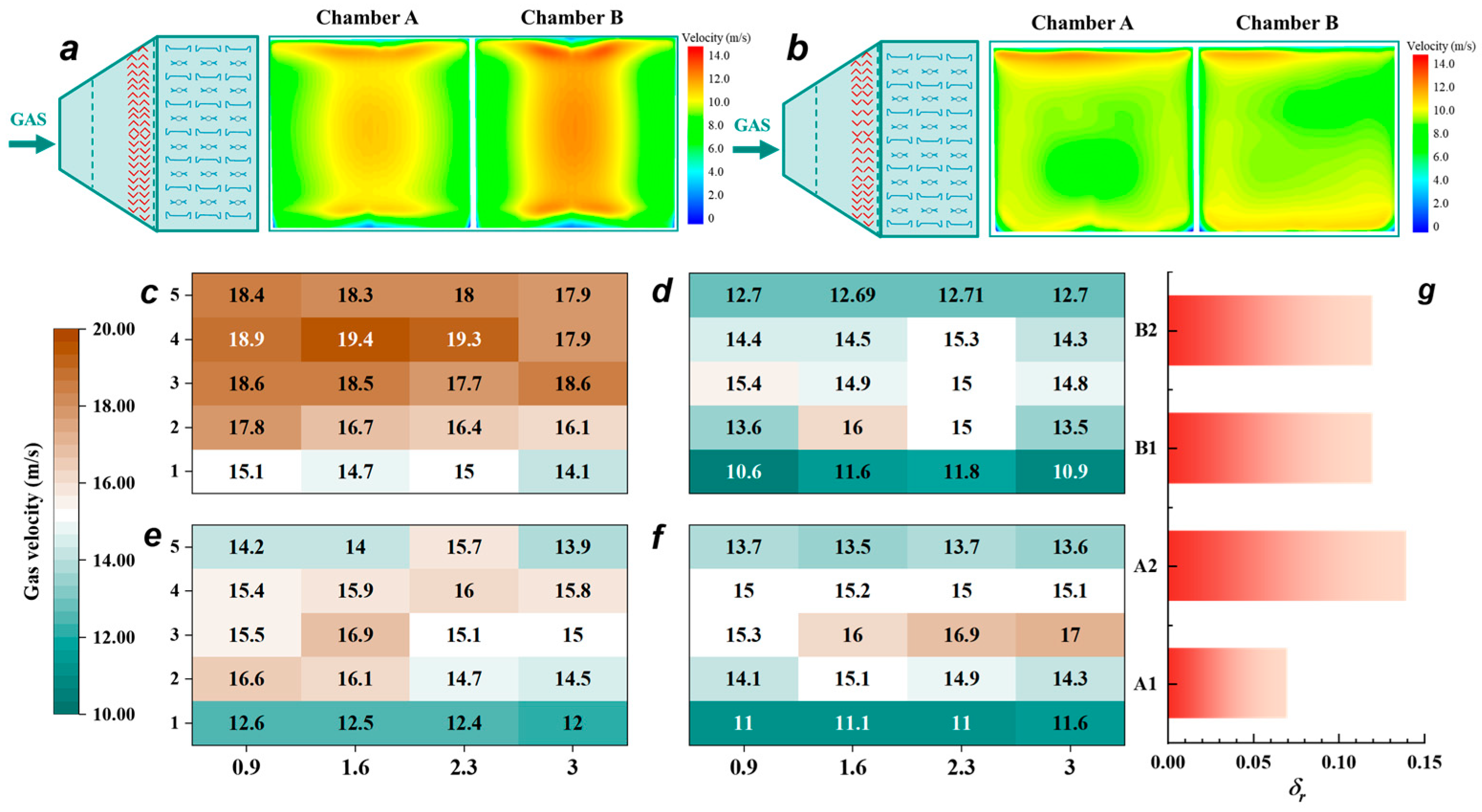
Two different plate configurations were considered, and the flow-field was simulated for chamber A and chamber B. In Scheme I, all plates were arranged with inward convergence, directing airflow toward the central region to mitigate low-velocity zones near the duct edges (Figure 6a). In Scheme II, the design combined inward convergence of side plates with outward divergence of central plates, thereby diffusing flow laterally to avoid excessive central concentration (Figure 6b). Both schemes incorporated additional flow-control elements, including vertical equalization vanes, slot-type distribution plates with double-V collection plates at the outlet header, and hopper baffles to suppress bypass flow and secondary dust re-entrainment.
The CFD simulation results revealed distinct flow patterns between the two schemes. In Scheme I, a pronounced high-velocity core region was observed at the ESP inlet, while peripheral regions exhibited low velocity. This maldistribution yielded a uniformity coefficient of 0.261 and a pressure drop of 235 Pa, indicating not only poor flow uniformity but also increased energy demand on the induced draft fan. Such a configuration risks localized dust overloading, aggravated corona quenching, and accelerated electrode wear. By contrast, Scheme II produced a much more balanced velocity distribution. Both high- and low-velocity regions were effectively eliminated, reducing the uniformity coefficient to 0.147 and the pressure drop to 152 Pa. These improvements highlight Scheme II’s superior performance in achieving a stable and energy-efficient flow field.
Based on these findings, Scheme II was implemented in an on-site retrofit of the ESP system. To validate its effectiveness, airflow uniformity was measured experimentally across all four ESP chambers. A 5 × 5 measurement grid was deployed across the duct cross-section, and flue gas velocities were recorded at each node. As illustrated in Figure 6c–f, the retrofit significantly homogenized airflow distribution across the ESP chambers. Although minor discrepancies between simulation and field data were observed—attributable mainly to variations in chamber-specific flow rates—the overall flow patterns were in strong agreement. Statistical analysis further confirmed the effectiveness of the retrofit: as shown in Figure 6g, the measured inlet uniformity coefficients for chambers A–D were 0.07, 0.14, 0.12, and 0.12, respectively, all well below the engineering threshold of 0.15.
The close agreement between simulation and field results not only validates the modeling approach but also demonstrates the practical feasibility of the double-V labyrinth pre-collection device. By effectively homogenizing airflow while reducing system resistance, Scheme II enables more stable ESP operation, mitigates corona quenching, and lowers fan energy consumption—thereby providing both environmental and economic benefits for ultra-supercritical coal-fired units.

3.3.2. Effects on Corona Discharge

The introduction of the double-V labyrinth pre-collection device not only improved airflow uniformity but also exerted a direct influence on corona discharge behavior in the first-stage field. While airflow homogenization alleviates maldistribution, the inlet fly ash concentration remains the critical factor governing corona quenching at the ESP inlet. After entering the ESP header, the dust-laden flue gas first encounters guide vanes that regulate bulk flow, followed by the pre-collection plates which redirect the gas horizontally. Under centrifugal action, larger fly ash particles impinge on and adhere to the plates, thereby being removed from the stream. As a result, the particle concentration entering the electric field is substantially reduced.
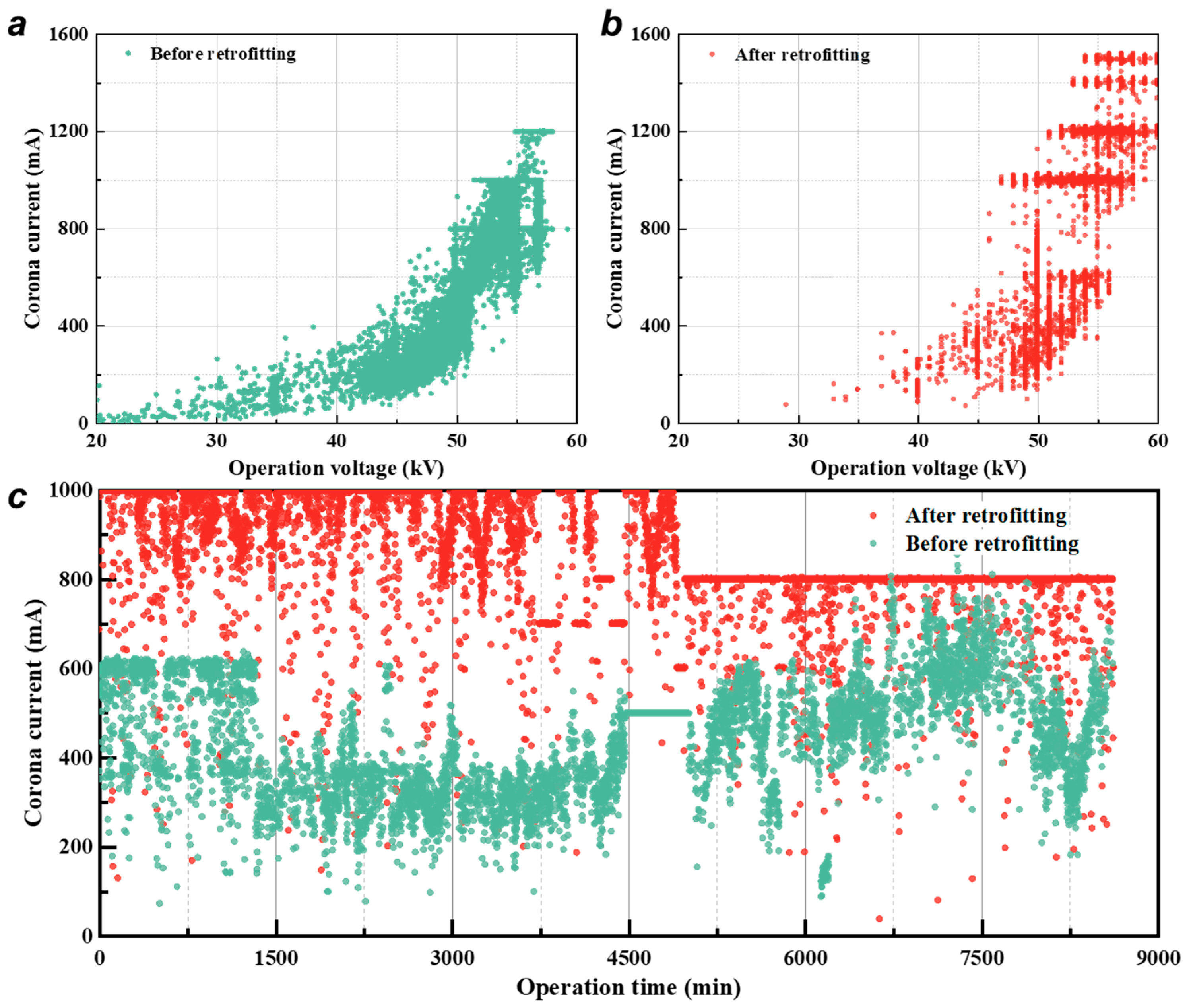
Although the pre-collection efficiency could not be directly quantified due to field constraints, its impact was evaluated indirectly by examining the discharge characteristics of the first-stage field before and after retrofit (Figure 7).
A comparison of the V–I curves in Figure 7a,b highlights the marked improvement. Before the retrofit, the discharge current rarely exceeded 1200 mA, with a broad low-voltage operating range extending down to ~20 kV, reflecting severe corona quenching under high particle load. After the retrofit, the maximum current increased substantially, surpassing 1200 mA, while the operating voltage stabilized within a narrower range of 40–60 kV. This shift demonstrates that the reduced particle concentration achieved by pre-collection alleviated space charge effects, enabling stronger and more stable corona discharge. Notably, the first-stage field became less sensitive to inlet fluctuations, reducing the need for frequent voltage adjustments.
Figure 7c further compares current profiles under continuous operation. Prior to retrofit, currents were consistently lower and characterized by strong fluctuations, symptomatic of unstable discharge. After retrofit, current levels increased significantly and were often subject to current-limiting control to conserve energy. More importantly, current stability improved and fluctuations were greatly suppressed. Taken together, these results confirm that the double-V labyrinth pre-collection retrofit effectively mitigated corona quenching in the first-stage field. By stabilizing the discharge process and reducing current fluctuations, the retrofit not only improved ESP efficiency but also enhanced operational reliability under continuous load conditions. This improvement is particularly significant for ultra-supercritical units burning high-ash coal, where inlet dust concentrations often exceed thresholds for stable corona discharge.

3.3.3. Effects on the ESP Performance

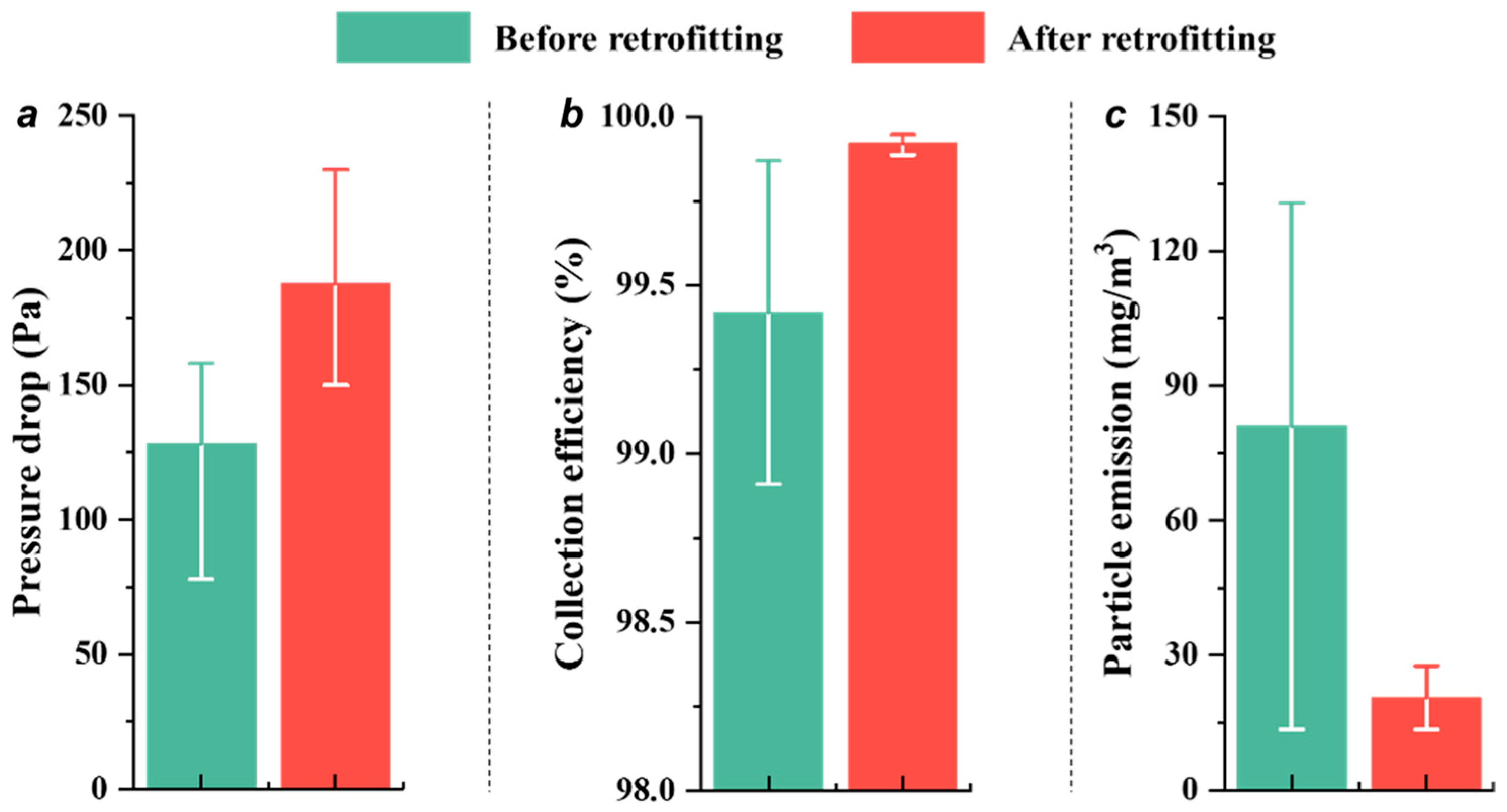
While the double-V labyrinth pre-collection device demonstrated clear benefits in improving flow uniformity and stabilizing corona discharge, the ultimate measure of success lies in the overall ESP performance. Figure 8 compares three key performance indicators—pressure drop, collection efficiency, and outlet fly ash concentration—before and after retrofit. Each test point represents the mean of three independent measurements to ensure statistical reliability.
As shown in Figure 8a, the ESP pressure drop increased from 128 Pa to 187.5 Pa following the retrofit. This increase reflects the additional resistance introduced by the pre-collection device, which inherently intercepts part of the dust-laden flow. Although higher resistance implies a marginal rise in fan energy consumption, the improvement in corona stability allows downstream fields to operate at reduced voltages, thereby lowering overall ESP power demand. More importantly, the pre-collection device substantially reduced inlet dust concentration and enhanced corona discharge stability, leading to marked improvements in collection efficiency. As shown in Figure 8b, efficiency increased from 99.42% to 99.92% after retrofit. Correspondingly, the outlet fly ash concentration decreased dramatically—from 81 mg/m3 to 20.5 mg/m3 (Figure 8c). This reduction not only mitigates particulate emissions but also lowers the risk of re-entrainment and secondary pollution.
When integrated with the deep scrubbing effect of the downstream wet flue gas desulfurization system, the retrofitted ESP consistently achieved ultra-low emission levels. This confirms that the double-V labyrinth pre-collection device provides not only theoretical improvement but also practical operational benefits. The ability to sustain collection efficiency above 99.9% under high-ash coal conditions highlights its potential as a cost-effective and technically robust retrofit solution for large-scale ultra-supercritical power plants.

4. Conclusions

Based on field experiments and simulation analysis, this study systematically investigated the phenomenon of corona quenching induced by high-concentration fly ash and the retrofit effect of a double-V labyrinth pre-collection device in a 660 MW ultra-supercritical unit. The main conclusions are as follows:
(1) The double-V labyrinth pre-collection device was successfully implemented in a large-scale 660 MW unit, and its engineering feasibility was validated through field data. The device significantly improved flow distribution and effectively mitigated corona suppression under high-ash conditions (e.g., ash content > 30%).
(2) While introducing a moderate increase in system resistance (from 128 Pa to 187.5 Pa), the device achieved a remarkable improvement in dust collection efficiency (from 99.42% to 99.92%). This quantified trade-off between performance gain and resistance increase provides an important technical and economic reference for similar retrofit projects.
(3) Compared to pre-collection solutions commonly reported in the literature, the labyrinth-type device demonstrated better suitability in applications with limited space and high flue gas volume, offering a new technical option for compact and efficient retrofits of existing ESPs.
In summary, the double-V labyrinth pre-collection device represents a structurally simple and effective retrofit solution, capable of resolving corona quenching and performance degradation caused by high-ash coal combustion. Future research may focus on its long-term operational reliability and synergy with intelligent control systems.

Author Contributions

Conceptualization, H.Z., H.L. and Z.Y.; data curation, P.L.; visualization, P.L.; funding acquisition, Z.Y.; investigation, H.Z., H.L. and T.L.; writing—original draft, H.Z. and Z.Y.; writing—review and editing, Z.Y., H.L.,T.L. and P.L. All authors have read and agreed to the published version of the manuscript.

Funding

This work was supported by the National Natural Science Foundation of China (52476143, 52500144), National Key Research and Development Plan (2022YFC3701501), Development Plan for Youth Innovation Teams in Higher Education Institutions of Shandong Province (2023KJ064), and Shandong SMEs Innovation Capability Enhancement Project (2025TSGCCZZB0231).

Data Availability Statement

Data are contained within the article.

Conflicts of Interest

Author Haibao Zhao and Hanxiao Liu were employed by Zhejiang Feida Environmental Science & Technology Co., Ltd. The products used in this article were provided by Zhejiang Feida Environmental Science & Technology Co., Ltd. Author Tao Liu was employed by Fengtai Power Generation Branch, Huaizhe Power Co., Ltd. The experimental environment used in this article was provided by Fengtai Power Generation Branch, Huaizhe Power Co., Ltd. The author declares that Zhejiang Feida Environmental Science & Technology Co., Ltd. and Fengtai Power Generation Branch, Huaizhe Power Co., Ltd. did not participate in the design of the research, the collection, analysis, or interpretation of the data, nor did they participate in the writing of this article or the decision on whether to publish it.

References

  1. Jaworek, A.; Marchewicz, A.; Sobczyk, A.T.; Krupa, A.; Czech, T. Two-stage electrostatic precipitators for the reduction of PM2.5 particle emission. Prog. Energy Combust. Sci. 2018, 67, 206–233. [Google Scholar] [CrossRef] [Scilit]
  2. Yang, Z.; Song, J.; Zhang, G.; Sun, X.; Cheng, S.; Zhang, X.; Jiang, Y. Unraveling the promotion for SO2 and H2O resistance of transition metal-doped CeO2-TiO2 catalysts in NH3-SCR reaction: A DFT study. J. Hazard. Mater. 2025, 489, 137563. [Google Scholar] [CrossRef] [Scilit]
  3. Jaroudi, E. Effect of Fly Ash Composition and Flue Gas Conditions on Removal Efficiency of Electrostatic Precipitators in Kraft Recovery Boilers. Ph.D. Thesis, University of Toronto, Toronto, ON, Canada, 2019. [Google Scholar]
  4. Li, P.; Li, Q.; Sun, X.; Zhang, G.; Jiang, Y.; Zheng, C.; Yang, Z. Energy-saving elimination of CO and NOx via self-sustained reaction coupling in layered monolithic catalysts. Sep. Purif. Technol. 2026, 382, 135756. [Google Scholar] [CrossRef] [Scilit]
  5. Li, W.; Bai, L.; Yu, S. Numerical Simulation of Flow Field, Particle Field and Electric Field for ESP. Power Gener. Technol. 2021, 42, 336–342. [Google Scholar]
  6. Clack, H.L. Particle size distribution effects on gas-particle mass transfer within electrostatic precipitators. Environ. Sci. Technol. 2006, 40, 3929–3933. [Google Scholar] [CrossRef] [Scilit]
  7. Zheng, C.H.; Liu, X.T.; Yan, P.; Zhang, Y.X.; Wang, Y.; Qiu, K.Z.; Gao, X. Measurement and prediction of fly ash resistivity over a wide range of temperature. Fuel 2018, 216, 673–680. [Google Scholar] [CrossRef] [Scilit]
  8. Lübbert, C.; Riebel, U. Corona Quenching-Electrostatic Precipitation at High Aerosol Concentration. Chem. Ing. Tech. 2011, 83, 525–534. [Google Scholar] [CrossRef] [Scilit]
  9. Yang, Z.D.; Zheng, C.H.; Liu, S.J.; Guo, Y.S.; Liang, C.S.; Zhang, X.F.; Zhang, Y.X.; Gao, X. Insights into the role of particle space charge effects in particle precipitation processes in electrostatic precipitator. Powder Technol. 2018, 339, 606–614. [Google Scholar] [CrossRef] [Scilit]
  10. Al-Hamouz, Z.; El-Hamouz, A. Analysis of a wire–duct electrostatic precipitator under dust loading conditions. Energy Convers. Manage 2011, 52, 1235–1243. [Google Scholar] [CrossRef] [Scilit]
  11. Adamiak, K.; Atten, P. Numerical simulation of the 2-D gas flow modified by the action of charged fine particles in a single-wire ESP. IEEE Trans. Dielectr. Electr. Insul. 2009, 16, 608–614. [Google Scholar] [CrossRef] [Scilit]
  12. Farnoosh, N.; Adamiak, K.; Castle, G.P. 3-D numerical simulation of particle concentration effect on a single-wire ESP performance for collecting poly-dispersed particles. IEEE Trans. Dielectr. Electr. Insul. 2011, 18, 211–220. [Google Scholar] [CrossRef] [Scilit]
  13. Liu, Z.; Han, J.; Zhao, L.; Wu, Y.-W.; Wang, H.-X.; Pei, X.-Q.; Xu, M.-X.; Lu, Q.; Yang, Y.-P. Effects of Se and SeO2 on the denitrification performance of V2O5-WO3/TiO2 SCR catalyst. Appl. Catal. A 2019, 587, 117263. [Google Scholar] [CrossRef] [Scilit]
  14. Yang, Z.D.; Zheng, C.H.; Zhang, X.F.; Zhou, H.; Silva, A.A.; Liu, C.Y.; Snyder, B.; Wang, Y.; Gao, X. Challenge of SO3 removal by wet electrostatic precipitator under simulated flue gas with high SO3 concentration. Fuel 2018, 217, 597–604. [Google Scholar] [CrossRef] [Scilit]
  15. Wang, Y.; Gao, W.; Zhang, H.; Yang, Z.; Zhao, Z.; Shao, L.; Sun, Z.; Zheng, C.; Gao, X. Significance of ionic wind propulsion on charged particle removal during flue gas purification. Powder Technol. 2022, 410, 117804. [Google Scholar] [CrossRef] [Scilit]
  16. Zheng, C.; Wang, Y.; Zhang, X.; Yang, Z.; Liu, S.; Guo, Y.; Zhang, Y.; Wang, Y.; Gao, X. Current density distribution and optimization of the collection electrodes of a honeycomb wet electrostatic precipitator. RSC Adv. 2018, 8, 30701–30711. [Google Scholar] [CrossRef] [Scilit]
  17. Zhao, H.; He, Y.; Liu, H.; Liang, J. Improvement and Engineering Application on Pulse Power Supply of Electrostatic Precipitator in Coal-Fired Power Plant. Power Gener. Technol. 2025, 46, 154–160. [Google Scholar]
  18. Ding, X.; Wang, Q.; Lang, J.; Wu, J.; Feng, D.; Pan, X. Removal of high specific resistance dust from pulsed power supply technology. Chin. J. Environ. Eng. 2018, 12, 159–163. [Google Scholar]
  19. Yang, Z.; Zheng, C.; Zhang, X.; Chang, Q.; Weng, W.; Wang, Y.; Gao, X. Highly efficient removal of sulfuric acid aerosol by a combined wet electrostatic precipitator. RSC Adv. 2018, 8, 59–66. [Google Scholar] [CrossRef] [Scilit]
  20. Guo, M.; Yang, L.; Son, H.; Le, D.K.; Manickam, S.; Sun, X.; Yoon, J.Y. An overview of novel geometrical modifications and optimizations of gas-particle cyclone separators. Sep. Purif. Technol. 2024, 329, 125136. [Google Scholar] [CrossRef] [Scilit]
  21. GB/T 16157-1996; Determination of Particulates and Sampling Methods of Gaseous Pollutants Emitted from Exhaust Gas of Stationary Source. China Environmental Science Press: Beijing, China, 1996.
  22. GB/T 16913-2008; Methods of Dust Character Test. Standards Press of China: Beijing, China, 2008.
  23. Zheng, C.H.; Zhang, H.; Liu, X.T.; Wang, Y.F.; Gao, W.C.; Zheng, H.; Sun, D.S.; Gao, X. Effect of dust layer in electrostatic precipitators on discharge characteristics and particle removal. Fuel 2020, 278, 118335. [Google Scholar] [CrossRef] [Scilit]
  24. Kim, D.U.; Jeong, S.H.; Kim, J.T.; Lee, S.S. Structure and arrangement of perforated plates for uniform flow distribution in an electrostatic precipitator. J. Air. Waste Manag. 2021, 71, 328–338. [Google Scholar] [CrossRef] [Scilit] [PubMed]
  25. Wang, J.; Huang, C.; Yang, Z.; Geng, W.; Wang, M. Influence of plate shape on flow field and efficiency of electrostatic precipitator. Energy Environ. Prot. 2020, 34, 40–46. [Google Scholar]
Figure 1. Schematic layout of the ESP for the 660 MW unit.
Separations 13 00060 g001
Figure 2. Computational mesh for the electrostatic precipitator model and mesh independence. (a) overall geometry and mesh; (b) detailed view of the inlet head; (c) local mesh refinement of the inlet head; (d) mesh independence test.
Separations 13 00060 g002
Figure 3. Fly ash characteristics: (a) particle size distribution and cumulative distribution; (b) resistivity versus temperature.
Separations 13 00060 g003
Figure 4. Operating characteristics of ESPs: (a) secondary current distribution across chambers; (b) relationship between fly ash concentration and corona current at different coal ash contents; (c) schematic of corona discharge; (d) schematic of corona quenching.
Separations 13 00060 g004
Figure 5. V−I characteristics of different electric fields across ESP chambers. (a) chamber A; (b) chamber B; (c) chamber C; (d) chamber D.
Separations 13 00060 g005
Figure 6. Simulation and experimental results of the double-V labyrinth pre-collection device: (a) Scheme I arrangement and flow-field simulation; (b) Scheme II arrangement and flow-field simulation; (c–f) velocity distribution across ESP chambers; (g) airflow uniformity coefficient for each chamber.
Separations 13 00060 g006
Figure 7. Comparison of discharge characteristics before and after pre-collection retrofit: (a) V–I curve before retrofit; (b) V–I curve after retrofit; (c) current behavior under continuous operation.
Separations 13 00060 g007
Figure 8. Comparison of ESP performance before and after retrofit: (a) pressure drop; (b) collection efficiency; (c) outlet fly ash concentration.
Separations 13 00060 g008
Table 1. Design values of coal quality and inlet flue gas parameters for the ESP.
ItemSymbolUnitDesign Value
Lower heating value (as-received)LHVkJ/kg21,300
Volatile matter (dry ash-free)Vdaf%39
Total moisture (as-received)Mt%7
Moisture (air-dried)Mad%2
Ash (as-received)Aar%26
Carbon (as-received)Car%56.37
Hydrogen (as-received)Har%3.72
Nitrogen (as-received)Nar%1
Oxygen (as-received)Oar%5.54
Sulfur (as-received)Sar%0.37
Inlet flue gas volumeQm3/s446.01
Inlet flue gas temperatureT°C133
Inlet dust concentrationCg/m329.4
Disclaimer/Publisher’s Note: The statements, opinions and data contained in all publications are solely those of the individual author(s) and contributor(s) and not of MDPI and/or the editor(s). MDPI and/or the editor(s) disclaim responsibility for any injury to people or property resulting from any ideas, methods, instructions or products referred to in the content.