


Abstract
Herbicides are widely used agrochemicals and are increasingly recognised as contaminants of emerging concern in aquatic environments due to their extensive application, environmental persistence, and potential ecological and human health impacts. Their determination in water presents significant analytical challenges, as these compounds occur at trace to ultra-trace levels and encompass a wide range of chemical properties, including highly polar and ionic species as well as transformation products. This review provides a critical overview of recent advances in separation technologies for the analysis of herbicides in water, based on peer-reviewed studies published between 2020 and 2025 retrieved from the PubMed and Scopus databases. The discussion focuses on developments in sample preparation, extraction strategies, chromatographic separation, and detection techniques, with particular attention to analytical performance and sustainability. The reviewed studies demonstrate that solid-phase extraction remains central to achieving the lowest detection limits, while miniaturised and greener extraction approaches are increasingly adopted to reduce solvent consumption and simplify workflows. Advances in chromatographic separation and detection, especially liquid chromatography coupled to tandem mass spectrometry, have further enhanced sensitivity and selectivity for a broad range of herbicides. Overall, this review highlights current analytical capabilities and emerging trends, outlining future directions for reliable and sustainable monitoring of herbicides in aquatic environments.
1. Introduction
The widespread application of herbicides in modern agriculture has significantly contributed to improved crop productivity and weed control. However, their intensive and recurrent use has also raised growing concerns regarding environmental contamination, particularly in aquatic systems. A substantial portion of applied herbicides does not reach the intended biological target and is instead dispersed into the environment through processes such as surface runoff, leaching, and atmospheric transport, ultimately contaminating surface waters, groundwater, and, in some cases, drinking water supplies [1,2].
In recent years, herbicides have increasingly been classified as contaminants of emerging concern (CECs) in water environments. This classification reflects not only their frequent detection at trace levels, but also their continuous input into aquatic systems, incomplete removal during conventional water treatment processes, and potential adverse ecological and human health effects [1,2,3]. Ecologically, herbicides may impair photosynthetic organisms, disrupt primary productivity, and alter community structure in aquatic ecosystems by affecting algae, macrophytes, invertebrates, and fish [4,5]. From a human health standpoint, exposure to certain herbicide classes has been associated with endocrine, reproductive, and neurological effects, and some compounds have been linked to potential carcinogenicity depending on exposure levels and duration [6]. These concerns reinforce the need for reliable monitoring tools to support environmental risk assessment and ensure the protection of water resources. Monitoring studies worldwide have reported the presence of multiple herbicide classes in environmental waters, including phenylureas (diuron, isoproturon), triazines (atrazine, simazine), phenoxy acids (2,4-D, MCPA), imidazolinones (imazapyr, imazethapyr), phosphonoglycines (glyphosate, AMPA), dinitroanilines (pendimethalin), sulfonylureas (metsulfuron-methyl), carbamates (chlorpropham), and bipyridyls (diquat, paraquat). These compounds and their transformation products have been repeatedly detected in rivers, lakes, groundwater, and treated waters, reflecting their persistence, mobility, and widespread use in agricultural settings [2,7].
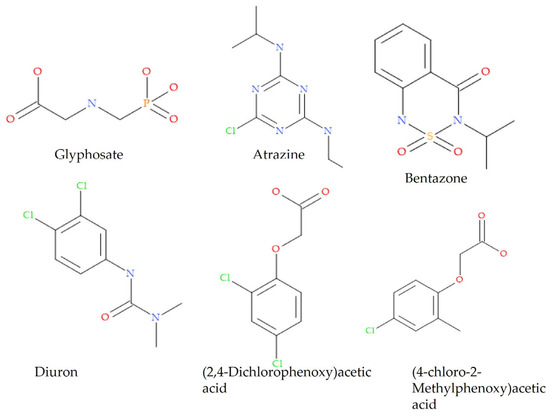
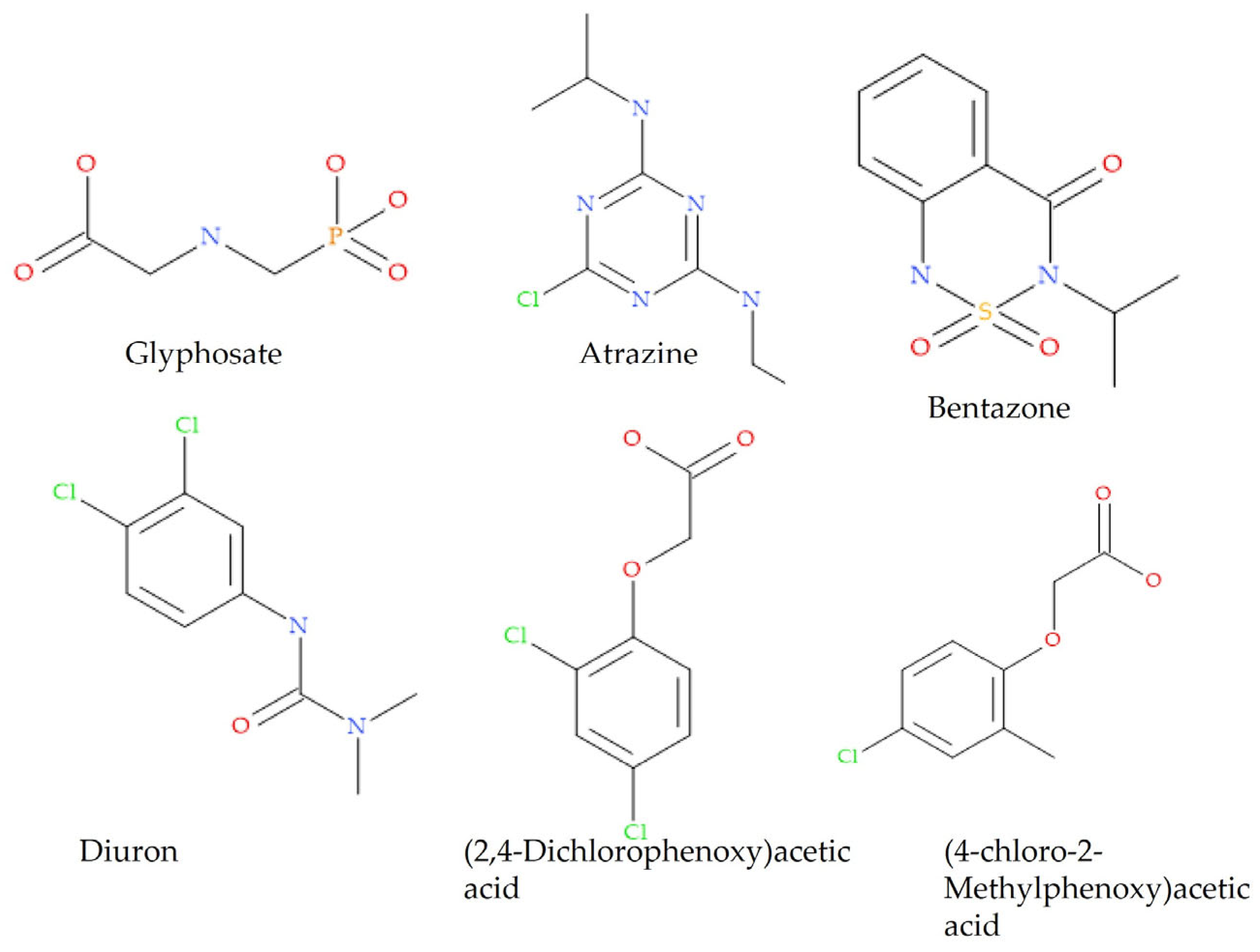
To illustrate the structural diversity of the herbicide classes discussed in this section, Figure 1 presents the chemical structures of representative compounds that are frequently monitored in aquatic environments.
Figure 1.
Chemical structures of representative herbicides discussed in this review and commonly determined in water matrices.
The environmental behaviour of herbicides in water is strongly influenced by their physicochemical properties, including polarity, solubility, and chemical stability. Many commonly used herbicides are highly water-soluble and resistant to degradation, which facilitates their transport over long distances and contributes to their widespread occurrence in aquatic matrices [3,8]. These characteristics, combined with their occurrence at ultra-trace concentration levels, pose significant challenges for the reliable determination and routine monitoring of these compounds.
From an analytical perspective, determining herbicides in water requires methodologies that can achieve high sensitivity, selectivity, and robustness while effectively coping with matrix complexity. The presence of dissolved organic matter, inorganic ions, and other coexisting contaminants can interfere with analyte extraction and detection, particularly when mass-spectrometry-based techniques are employed [9]. Consequently, sample preparation and separation steps play a critical role in ensuring accurate and reproducible quantification.
At the same time, modern analytical chemistry increasingly prioritises sustainability, promoting the development of green analytical approaches that minimise solvent consumption, reduce waste generation, and improve analytical efficiency. These principles have driven significant innovation in separation technologies, including the development of advanced extraction strategies, miniaturised techniques, and high-performance chromatographic systems compatible with sensitive detection methods [10].
In this context, the present review aims to critically summarise recent advances in separation and sample preparation technologies applied to the determination of herbicides in water. Emphasis is placed on extraction strategies, chromatographic and alternative separation techniques, and their integration with state-of-the-art detection systems, highlighting current analytical challenges, methodological progress, and emerging trends in the monitoring of herbicides as aquatic contaminants.
2. Analytical Challenges in Herbicide Determination
The analytical determination of herbicides in water is inherently challenging due to the combination of unfavourable physicochemical properties of the target compounds and the variable composition of environmental water matrices. Many widely used herbicides, such as glyphosate and glufosinate, together with their major metabolite aminomethylphosphonic acid (AMPA), are highly polar, strongly water-soluble, and exhibit low volatility, which severely limits their retention on conventional reversed-phase chromatographic systems and hampers direct detection at trace levels [9,11,12,13].
In addition, the molecular structures of these compounds often lack chromophores or fluorophores, which restricts the applicability of UV or fluorescence detection and frequently necessitates derivatisation to enhance detectability. Derivatisation strategies based on reagents such as FMOC-Cl, chloroformates, or other alkylating agents have been widely employed to enable chromatographic separation and improve sensitivity [9,12,14]. However, pre-column derivatisation introduces additional analytical complexity, including long reaction times, increased sample handling, variable reaction yields at low concentration levels, and potential analyte losses during clean-up, ultimately compromising reproducibility and robustness [9,14]. Matrix effects constitute another major analytical challenge in water analysis. Environmental waters contain varying concentrations of dissolved organic matter, inorganic ions (e.g., Ca2+, Mg2+), and suspended particulates, all of which can interfere with analyte extraction and ionisation processes. In LC–MS/MS workflows, these components may cause significant ion suppression or enhancement, directly affecting sensitivity and quantitative accuracy, particularly at ng L−1 levels [9,11,12,13,15]. Such effects are especially pronounced when analysing highly polar herbicides, where even minor matrix variability can result in false negatives or biased quantification [9,12].
To overcome these limitations and achieve the stringent detection limits required by regulatory frameworks (e.g., ≤0.1 µg L−1 for individual pesticides in drinking water within the European Union), effective sample preparation and separation strategies are essential. Solid-phase extraction (SPE) remains one of the most widely applied approaches, offering analyte preconcentration and partial matrix clean-up [16,17]. Nevertheless, conventional SPE sorbents may show limited affinity for highly polar herbicides, and recovery can vary substantially depending on water composition and sorbent chemistry [9,16,18].
Recent advances have focused on improving extraction selectivity through the use of mixed-mode sorbents, hydrophilic interaction mechanisms, and micro-scale extraction formats. For instance, mixed-mode SPE cartridges and novel sorbent materials have demonstrated improved performance for a broad range of acidic and polar herbicides at nanogram per litre levels [17,18], while micro-solid-phase extraction approaches using metal–organic frameworks have shown promise in enhancing enrichment efficiency while reducing solvent consumption [19].
Alternatively, direct injection strategies combined with advanced chromatographic columns, such as charged-surface or mixed-mode stationary phases, have gained increasing attention. These approaches minimise sample handling, reduce analysis time, and improve throughput, but require careful optimisation to control matrix interference and ensure reliable quantification in complex water matrices [11,12,13].
Finally, achieving adequate analytical accuracy and precision under these challenging conditions relies heavily on appropriate calibration strategies. The use of isotope-labelled internal standards and matrix-matched calibration is now widely regarded as essential to compensate for variable extraction recovery and ionisation effects in LC–MS/MS-based methods [9,12,13,15].
Overall, the determination of herbicides in water is challenged by their high polarity and solubility, the frequent need for derivatisation, pronounced matrix effects, and stringent regulatory detection limits. Addressing these issues has been a key driver for the development of advanced separation technologies, which are discussed in the following sections.
Herbicide transformation products (TPs) represent a significant analytical challenge due to their frequent environmental occurrence and, in many cases, higher mobility or ecotoxicological relevance compared with the parent compounds [20,21,22]. These compounds typically exhibit increased polarity and aqueous solubility, which reduces retention on conventional reversed-phase chromatographic systems and leads to poorer peak shape and reduced sensitivity [23]. Their structural diversity, including hydroxylated, dealkylated, dechlorinated, and conjugated derivatives, adds further complexity to method development and often necessitates alternative separation approaches or the use of mixed-mode stationary phases. A major practical constraint is the limited commercial availability of analytical reference standards, which frequently restricts quantitative determination and hinders full validation [23]. Environmental monitoring studies have demonstrated that TPs can occur at concentrations comparable to or even exceeding those of parent herbicides, substantially influencing risk-assessment outcomes [24,25]. High-resolution mass spectrometry (HRMS) has therefore become a crucial tool for suspect and non-target screening, enabling the identification of unknown or poorly characterised TPs and allowing retrospective data analysis [26,27].
Given the increasing regulatory emphasis on risk-based monitoring, the development of robust and sensitive analytical workflows for determining herbicide transformation products is expected to become an essential component of comprehensive water-quality assessments.
Method validation is a critical component of analytical workflows for the determination of herbicides in water, particularly given the ultra-trace detection limits required for regulatory and environmental monitoring. Despite its importance, validation practices across the reviewed studies remain heterogeneous. To enhance methodological robustness and comparability, internationally recognised guidelines such as EURACHEM (2014) [28] and the EU SANTE/2023 criteria [29] recommend the systematic evaluation of key parameters, including linearity, accuracy (trueness), precision (repeatability and intermediate precision), selectivity, matrix effects, limits of detection (LODs), limits of quantification (LOQs), and method robustness. In studies employing LC–MS/MS, the use of isotopically labelled internal standards (ILIS) and matrix-matched calibration is strongly advised to compensate for variable ionisation efficiency and extraction recovery, particularly for highly polar herbicides such as glyphosate, AMPA, and glufosinate, where matrix-induced suppression is well documented [9,11,12]. According to the SANTE criteria [29], LOQs must be demonstrably fit-for-purpose and generally below the regulatory limit of 0.1 µg L−1 for individual pesticides in drinking water, reinforcing the need for highly sensitive extraction and detection strategies.
When derivatisation is required, most commonly using FMOC-Cl for phosphonic and amino acid-type herbicides, additional sources of variability arise, including incomplete reaction, instability of derivatives, and potential degradation during ionisation [12,14]. Stability testing, both short-term (autosampler stability) and long-term (extract and matrix stability), is also recommended in order to ensure reliable quantification, particularly for unstable herbicides and transformation products [25,30].
Accuracy is generally assessed through spike-recovery experiments across different concentration levels, while robustness testing typically involves deliberate variations in extraction or chromatographic conditions to ensure method stability. EURACHEM and SANTE guidelines also emphasise the importance of defining identification criteria, especially for MS-based methods, including ion-ratio tolerances and retention-time windows, to avoid false positives in complex matrices [28,29]. Furthermore, EURACHEM guidelines highlight the need to estimate measurement uncertainty, particularly for methods operating near regulatory threshold values, as uncertainty may influence the interpretation of compliance for trace-level herbicide monitoring [28].
Incorporating these validation elements is essential not only to ensure trueness and comparability among studies, but also to meet the performance requirements imposed by regulatory frameworks such as the EU Drinking Water Directive and Environmental Quality Standards [31].
3. Advances in Separation Technologies
Building on the analytical challenges discussed in the previous section, recent advances in separation technologies for determining herbicides in water have been primarily driven by the need to achieve enhanced sensitivity, selectivity, and sustainability for compounds occurring at trace to ultra-trace levels across a wide polarity range. The discussion presented in this section is based on a critical analysis of peer-reviewed articles retrieved from the PubMed and Scopus databases, covering the period between 2020 and 2025. These databases were selected due to their extensive coverage of analytical chemistry, environmental monitoring, and toxicology journals, which constitute the core research domains of the present review. Preliminary verification confirmed that the key studies relevant to herbicide determination in water were indexed in these platforms, ensuring comprehensive coverage of the field. Although the search covered this full temporal window, the studies that fulfilled the predefined inclusion criteria and are summarised in Table 1 were published between 2021 and 2025, reflecting the recent and rapidly evolving nature of analytical methodologies for herbicide monitoring in water.
Table 1.
Examples of recent extraction strategies for determining herbicides in water.
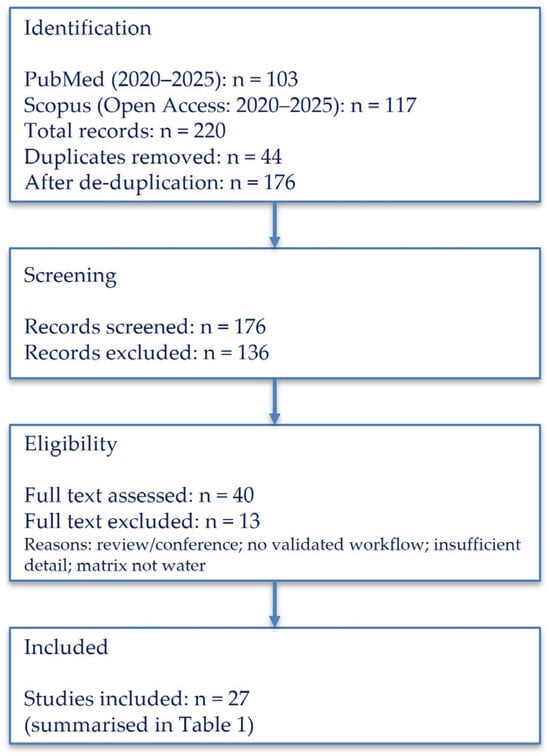
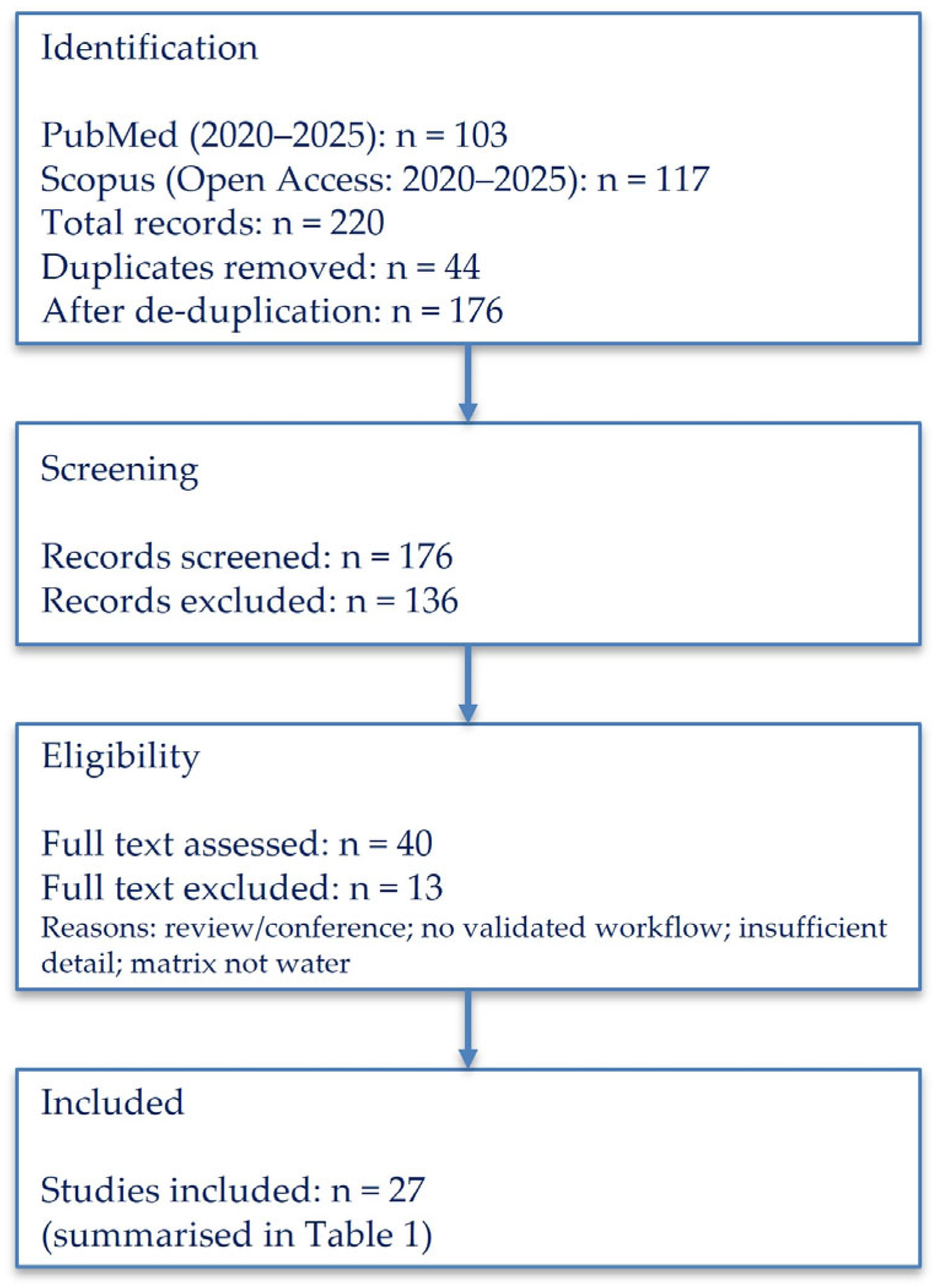
Literature selection was performed using combinations of the keywords water, emerging contaminants, herbicides, extraction, and quantification. Boolean search queries included expressions such as (“herbicides” AND “water” AND “extraction” AND “contaminants”), adapted to the syntax of each database. Only original research articles reporting analytical workflows with sufficient methodological detail to allow meaningful comparison across studies were considered. Insufficient detail included, for example, omission of core analytical information such as the extraction strategy, separation technique, detection system, or performance-related parameters (e.g., LOD/LOQ, recoveries, calibration strategy, or matrix effects). As reporting practices varied among studies, no single performance parameter was required for inclusion, provided that the analytical methodology could be adequately interpreted. The overall search and study selection procedure is summarised in a flowchart (Figure 2).
Figure 2.
Flowchart illustrating the identification, screening, eligibility, and inclusion steps of the literature search.
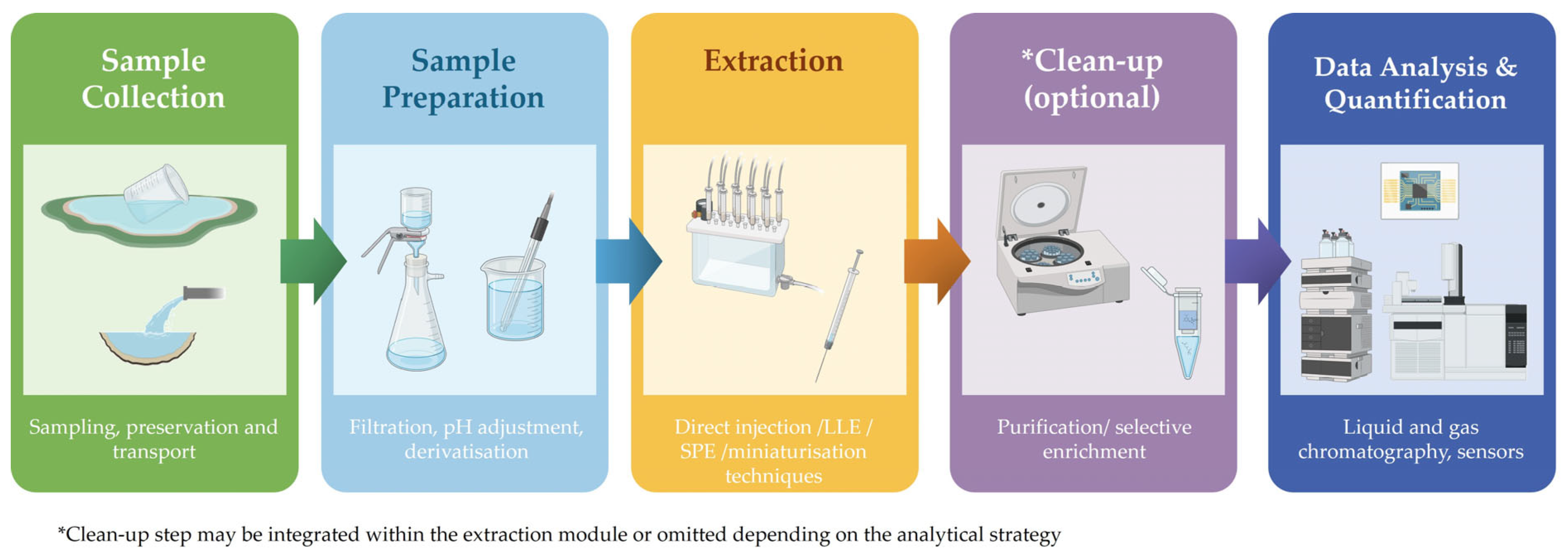
Before detailing the methodologies summarised in Table 1, Figure 3 provides an overview of the general analytical workflow for herbicide determination in water, highlighting the main steps of sample preparation, extraction, clean-up, chromatographic separation, and detection.
Figure 3.
General analytical workflow for the determination of herbicides in water, including key steps from sample preparation to chromatographic analysis and detection.
Recent methodological developments clearly indicate a shift towards optimising the entire analytical workflow rather than addressing individual analytical steps in isolation. Herbicide determination in water still depends heavily on sample preparation, especially when it comes to reaching the low detection thresholds needed for environmental monitoring and regulatory compliance. One of the most popular preconcentration techniques for a variety of herbicide classes is still solid-phase extraction (SPE). Automated SPE workflows targeting phenoxy acids, bentazon, and triazines in surface, groundwater, and treated water typically process sample volumes between 250 and 500 mL and achieve limits of quantification in the range of 0.001–0.010 µg L−1, with corresponding limits of detection often below 0.5 ng L−1 when coupled to LC–MS/MS detection, while maintaining recoveries generally above 85–95% [16,38]. Similarly, SPE-based approaches have enabled the determination of triazine herbicides and their degradation products at sub-µg L−1 levels in drinking water and source waters, demonstrating good precision and robustness across different aquatic matrices [41]. Across the surveyed period, performance improvements were evident for SPE-based workflows. Early studies from 2021 to 2022 typically reported LOQs in the 0.01–0.10 µg L−1 range for phenoxy acids and triazines using 250–500 mL sample volumes, whereas more recent applications (2023–2025) achieved sub-ng L−1 LOQs for the same herbicide classes [16,38], reflecting advances in chromatographic focusing, sub-2 µm UHPLC columns, and MS/MS detection sensitivity. These sensitivity gains were consistently accompanied by high recoveries (>85–95%), reinforcing SPE as a robust extraction strategy under compliance-oriented scenarios.
Despite its versatility, conventional SPE often shows limited efficiency for highly polar herbicides, such as glyphosate, glufosinate, and aminomethylphosphonic acid (AMPA), due to insufficient retention on traditional reversed-phase sorbents. To overcome this limitation, alternative extraction mechanisms tailored to the specific physicochemical properties of these compounds have been developed. Chelation-based strategies employing Fe(III)-loaded resins enable selective binding of phosphonic acid-containing herbicides, allowing the processing of relatively large water volumes (up to 250 mL) and achieving detection limits at the ng L−1 level when combined with UHPLC–MS/MS detection [18]. In parallel, molecularly imprinted solid-phase extraction (MISPE) has been successfully applied to glyphosate, AMPA, and sarcosine, providing enhanced selectivity and effective matrix clean-up, particularly in waters with high inorganic content [39]. Similar selectivity gains have also been reported for imidazolinone herbicides using imprinted polymer-based clean-up before HPLC detection, improving method robustness and reproducibility [44]. In several studies, direct-injection UHPLC–MS/MS was used as an alternative to retention-based strategies for highly polar herbicides [11,32]. These workflows exploited sub-2 µm particle columns and high aqueous mobile phases to enable separation without derivatisation, achieving LOQs in the low-ng L−1 range in drinking and tap waters. The use of sub-2 µm columns further improved chromatographic efficiency and peak shape under near-100% aqueous conditions, but at the expense of higher backpressure and increased susceptibility to clogging when injecting minimally treated environmental waters. However, significant matrix-induced ion suppression was reported due to high ionic loads in real samples, particularly for glyphosate and AMPA, leading to reduced sensitivity and signal variability [11]. In addition, the formation of matrix-related adducts and spray instability under highly aqueous elution conditions further compromised ionisation efficiency, reinforcing the need for isotopically labelled internal standards and matrix-matched calibration to ensure trueness and precision [11,32,34]. Additional ion-source-related limitations have also been reported in recent LC–MS/MS workflows for highly polar herbicides. High concentrations of inorganic ions naturally present in environmental waters (e.g., Ca2+, Mg2+, bicarbonate, and chloride) promote substantial ion suppression, particularly for glyphosate and AMPA [9,11]. In addition, these compounds frequently form matrix- and mobile-phase-dependent adducts such as [M + HCOO]− and [M + Cl]−, which complicate MRM transition selection and may reduce overall method sensitivity [9,13]. When derivatisation strategies such as FMOC-Cl are employed, thermal degradation of FMOC derivatives within the ion source has also been documented, generating unexpected fragment ions and requiring enhanced control of potential interferences [34]. The use of highly aqueous mobile phases—necessary to retain extremely polar herbicides on reversed-phase columns—may further induce spray instability in ESI, impairing ionisation consistency and quantitative reproducibility [10,32]. These observations are consistent with recent discussions in green and sustainable LC–MS/MS method development, which emphasise the vulnerability of very polar analytes to ion-source fluctuations under low-organic conditions [34].
A pronounced trend towards miniaturised extraction techniques is evident in studies published after 2021, reflecting increasing alignment with green analytical chemistry principles and the demand for simplified analytical workflows. Techniques such as stir bar sorptive extraction (SBSE), micro-solid-phase extraction (µSPE), and fabric-phase sorptive extraction (FPSE) significantly reduce solvent consumption and sample volume, typically operating with 5–50 mL of water. SBSE methods employing functionalised coatings have demonstrated effective enrichment of phenylurea herbicides, including diuron, linuron, and isoproturon, achieving limits of detection between 0.025 and 0.070 µg L−1 with recoveries ranging from 80 to 105% [43]. FPSE-based approaches further simplify analytical workflows by enabling direct immersion of the extraction phase into the sample, achieving recoveries of approximately 60–90% for phenylurea herbicides, although typically with slightly higher detection limits (0.3–1.0 µg L−1) when coupled to HPLC with diode array detection (DAD) [49]. Micro-solid-phase extraction using nanofibre-based materials has shown comparable or improved sensitivity relative to FPSE, with reported detection limits below 0.1 µg L−1 and reduced extraction times, representing a balanced compromise between analytical performance and sustainability [40]. A comparison across publication years also indicates progressive gains in analytical performance for miniaturised extraction techniques. Early FPSE and SBSE studies from 2021 to 2022 reported LOQs typically in the low-µg L−1 range, whereas more recent µSPE and ultrasound-assisted DLLME workflows (2024–2025) achieved sub-0.1 µg L−1 performance for triazines and phenylureas [40,53], narrowing the sensitivity gap relative to large-volume SPE and reflecting improvements in sorbent chemistry and phase–analyte interactions.
Dispersive liquid–liquid microextraction strategies represent another important advancement, particularly for moderately polar herbicides. Ultrasound-assisted and deep eutectic solvent-based emulsification liquid–liquid microextraction methods have been successfully applied to triazine herbicides and their degradation products in tap, surface, and wastewater samples. These approaches typically require less than 50 mL of sample and small volumes of green solvents, achieving limits of detection in the range of 0.04–0.18 µg L−1 while maintaining recoveries above 75–90% across different water matrices [53]. Although their sensitivity is generally lower than that achieved by large-volume SPE, such methods offer clear advantages in terms of speed, simplicity, and environmental footprint, and their progressive refinement across the surveyed period reflects ongoing efforts to balance analytical performance and sustainability.
In addition to conventional and miniaturised extraction strategies, several studies compiled in Table 1 highlight the growing relevance of selective sorbent-based approaches relying on molecular recognition mechanisms. Molecularly imprinted polymers have been applied as selective extraction materials for structurally challenging herbicides, including glyphosate, AMPA, sarcosine, and imidazolinone compounds, enhancing selectivity and reducing matrix interferences in complex water matrices [39,44,45]. Although less frequently reported in recent years, matrix solid-phase dispersion (MSPD) has also been applied to the determination of atrazine and its degradation products in water when coupled to GC–MS/MS, offering an integrated extraction and clean-up step at the expense of higher solvent consumption and more laborious sample handling [48]. Moreover, hybrid workflows combining multiple enrichment mechanisms, such as magnetic dispersive micro-solid-phase extraction coupled with dispersive liquid–liquid microextraction or derivatisation-assisted LC–MS/MS approaches, further illustrate current efforts to balance selectivity, sensitivity, and operational simplicity within a single analytical procedure [34,50]. Studies employing molecular recognition strategies frequently adopt isotope-labelled internal standards (ILIS) and matrix-matched calibration to correct for matrix effects, whereas methods relying on optical detection mainly use external calibration, potentially underestimating bias in environmental matrices.
Advances in chromatographic separation have played a critical complementary role in enhancing overall analytical performance. Improvements in stationary-phase chemistry and instrumental sensitivity have enabled simplified analytical workflows for highly polar herbicides, where direct injection or minimal sample conditioning can be successfully combined with tandem mass spectrometric detection. Recent LC–MS/MS and UHPLC–MS/MS methods have demonstrated reliable quantification of glyphosate, AMPA, and glufosinate at low-ng L−1 to sub-µg L−1 levels in drinking, tap, and surface waters while maintaining satisfactory accuracy and precision [11,35]. For less polar herbicides, such as triazines and phenylureas, reversed-phase UHPLC remains highly effective, with optimised gradient elution and modern particle technologies enabling efficient multi-residue separations within short analysis times and acceptable limits of detection when coupled to either mass spectrometric or optical detection systems [16,38]. Hydrophilic interaction liquid chromatography (HILIC)-based separation approaches, which may offer improved retention for highly polar herbicides, were not observed in the surveyed literature despite their theoretical suitability, highlighting a potential methodological gap [56,57,58]. By enabling effective retention of zwitterionic and strongly polar compounds under high-organic mobile-phase conditions, HILIC could potentially reduce the need for prolonged 100% aqueous elution, mitigate ion-source instability and limit the formation of matrix-dependent adducts frequently reported in reversed-phase UHPLC–MS/MS methods [58,59]. The absence of such approaches in recent applications suggests that HILIC remains an underexplored but promising direction for future method development in herbicide determination in environmental waters [57,60]. Overall analytical performance is strongly influenced by the interplay between sample volume, enrichment strategy, and detection technique. Lower limits of detection and quantification are consistently associated with workflows combining effective preconcentration and highly sensitive detection platforms, whereas miniaturised and simplified approaches often trade some sensitivity for reduced solvent consumption and improved analytical throughput.
Regulatory frameworks further shape analytical performance expectations for herbicide monitoring. In the European Union, the Drinking Water Directive establishes maximum admissible concentrations of 0.1 µg L−1 for individual pesticides, including herbicides, and 0.5 µg L−1 for total pesticide content in drinking water [30]. These thresholds effectively require analytical methods to achieve LOQs at or below the low-ng L−1 level for several herbicide classes and help explain the continued dominance of SPE combined with LC–MS/MS in regulatory monitoring programmes. Environmental Quality Standards (EQS) established for selected herbicides in surface waters additionally reinforce the need for reliable quantification and longitudinal surveillance beyond drinking water matrices [30]. To provide a broader regulatory context, it is worth noting that other international agencies define their own guideline values, sometimes differing substantially from EU limits. For example, the U.S. EPA sets Maximum Contaminant Levels (MCLs) for individual herbicides on a compound-specific basis, with thresholds generally higher than those imposed by the EU, reflecting different risk-assessment frameworks. These discrepancies highlight how jurisdictional regulatory philosophies influence analytical performance expectations and the required sensitivity of monitoring methods [30,61]. Moreover, the revised EU Drinking Water Directive (2020/2184) [30] introduces a more risk-based approach to monitoring, strengthening requirements for surveillance of both emerging contaminants and metabolites. Its implementation is expected to increase the demand for analytical methodologies capable of broader screening, higher throughput, and improved selectivity, particularly in complex matrices.
In compliance-driven scenarios, validation requirements are stricter and typically demand the assessment of trueness, precision, linearity, selectivity, matrix effects, and robustness, as well as the use of internal standards for MS-based quantification. These expectations contribute to the observed performance gap between miniaturised or sensor-based methods, which prioritise sustainability and operational simplicity, and SPE-based workflows, which more readily achieve the sensitivity and validation criteria required for environmental regulation. Sensor-based methodologies, predominantly reported in 2024–2025, illustrate ongoing efforts towards operationally simpler detection platforms, although their validation parameters still fall short of those required for full regulatory acceptance [54,55,62,63].
Based on the methodologies compiled in Table 1, liquid chromatography coupled to tandem mass spectrometry (LC–MS/MS or UHPLC–MS/MS) emerges as one of the most frequently employed detection strategies, reflecting its superior sensitivity and selectivity for trace-level and highly polar herbicides [11,16,18,34,35,38]. Nevertheless, chromatographic methods coupled to optical detection, including diode array detection (DAD) and ultraviolet detection (UV), remain equally prevalent for less polar herbicides such as phenylureas and triazines, where detection limits in the low-µg L−1 range are analytically acceptable [18,20,24,26,31,32,33,34,35,36,37]. Gas chromatography coupled to tandem mass spectrometry (GC–MS/MS) is applied less frequently and remains largely restricted to volatile or derivatised herbicides, often requiring more extensive sample preparation steps [48]. Electrochemical sensing strategies employing nanostructured materials have also been reported for atrazine in wastewater and effluents [54,55], offering rapid and low-cost screening capabilities but lacking the multi-residue separation required for routine determination in complex matrices.
In addition to separation-based workflows, a limited number of recent studies, predominantly published between 2024 and 2025, have explored sensor-based approaches for herbicide determination in water. Electrochemical sensors employing nanostructured materials, such as metal oxide nanoparticles or metal–organic framework-based systems, have been proposed mainly for the detection of atrazine in wastewater samples [54,55]. While these approaches offer advantages in terms of simplicity, low cost, and potential for rapid or on-site analysis, they are typically compound-specific and lack the separation capability required to address complex matrices and multi-residue analysis. Consequently, sensor-based methods currently appear as complementary or exploratory tools rather than alternatives to separation-based techniques for routine herbicide monitoring.
A comparison across studies also revealed heterogeneity in validation practices, particularly regarding the treatment of matrix effects, calibration strategy, and the use of isotope-labelled internal standards, which complicates direct inter-study comparison and data harmonisation. Examination of the chronological distribution of studies between 2021 and 2025 reveals a clear evolution from conventional, solvent-intensive extraction workflows towards miniaturised, selective, and simplified approaches, accompanied by increasing exploration of advanced sorbent materials, molecular recognition strategies, and hybrid enrichment concepts. Despite substantial progress, comparison across studies remains challenging due to heterogeneous validation criteria, non-uniform reporting of LOD/LOQ, variable treatment of matrix effects, and inconsistent calibration strategies. These gaps underscore the need for more harmonised validation frameworks that support inter-study comparability and reflect the performance requirements of environmental and regulatory monitoring programmes.
4. Trends and Future Directions
Future developments in the analytical determination of herbicides in water are expected to be driven by the need to reconcile ultra-trace sensitivity with simplified, sustainable, and adaptable analytical workflows. As regulatory requirements become more stringent and the chemical diversity of herbicides and their transformation products increases, analytical strategies are likely to evolve towards more selective materials, reduced sample handling, and integrated methodologies, in line with broader trends in environmental analytical chemistry [10,49].
A major future direction lies in the continued development of advanced extraction materials with enhanced selectivity, including molecularly imprinted polymers, metal–organic frameworks, and hybrid sorbents. These materials have demonstrated strong potential to improve discrimination between structurally related compounds and mitigate matrix effects, particularly for highly polar and ionic herbicides that remain analytically challenging in aqueous matrices [3,39]. Further research is expected to focus on improving sorbent reproducibility, stability, and scalability to facilitate routine laboratory implementation.
Miniaturisation is also anticipated to play an increasingly important role in future analytical workflows. Miniaturised extraction techniques align closely with green analytical chemistry principles by reducing solvent consumption, sample volume, and analysis time, while enabling higher throughput [10]. Ongoing optimisation of extraction kinetics and phase–analyte interactions is expected to further narrow the sensitivity gap between miniaturised approaches and conventional large-volume extraction methods, supporting their broader adoption in routine monitoring and potentially in field-deployable platforms.
From a separation and detection perspective, liquid chromatography coupled to tandem mass spectrometry is expected to remain the cornerstone of herbicide analysis in water due to its sensitivity, selectivity, and compatibility with multi-residue determination [11,12]. Future developments are likely to prioritise workflow simplification through reduced sample preparation, faster separations, and improved matrix tolerance, supported by advances in stationary-phase chemistry and mass spectrometric instrumentation. At the same time, optical detection strategies are expected to retain relevance for cost-effective routine analysis of less polar herbicides, where ultra-low detection limits are not critical [49].
High-resolution mass spectrometry is anticipated to play an increasingly important role in future herbicide monitoring strategies, particularly for suspect and non-target screening of transformation products and emerging compounds. Although not yet fully integrated into routine monitoring, HRMS-based approaches offer clear advantages for comprehensive environmental assessment and retrospective data analysis, which are expected to gain relevance as regulatory frameworks evolve [1,2].
Emerging sensor-based technologies represent a complementary direction for future research. Recent advances in electrochemical sensors based on nanostructured materials demonstrate potential for rapid and low-cost screening of selected herbicides in water, particularly for on-site or preliminary assessment [54,55]. However, limitations related to selectivity, matrix effects, and multi-analyte capability suggest that sensors will likely complement rather than replace separation-based techniques in the near future.
Finally, future progress in herbicide determination will increasingly depend on methodological harmonisation and standardisation. The diversity of extraction strategies, performance metrics, and validation approaches currently employed complicates comparison across studies and limits regulatory uptake. The establishment of clearer guidelines for method validation and reporting is therefore expected to be a key priority to support reliable long-term monitoring and informed environmental decision-making [1].
Overall, future analytical strategies for herbicide determination in water are expected to focus on the balanced integration of sensitivity, sustainability, and practicality. Continued innovation in extraction materials, separation technologies, and detection systems will be essential to address the evolving challenges associated with herbicides as contaminants of emerging concern in aquatic environments.
5. Conclusions
The analytical landscape for herbicide determination in water has evolved towards increasingly selective, efficient, and environmentally conscious methodologies. Recent advances demonstrate a clear movement away from one-size-fits-all approaches, with analytical strategies now being tailored to the physicochemical diversity of herbicides and the complexity of aquatic matrices. While high-performance separation techniques coupled to mass spectrometry remain central to achieving regulatory-level sensitivity, the growing adoption of miniaturised and alternative extraction formats reflects a broader shift towards sustainability and operational simplicity. At the same time, emerging tools such as sensor-based platforms highlight new opportunities for complementary monitoring strategies. Future progress will depend not only on technological innovation but also on improved method harmonisation and critical evaluation of analytical trade-offs, ensuring that advances in separation science translate into robust and meaningful environmental assessment.
Author Contributions
Conceptualisation, E.G.; methodology, J.L.G., L.D. and L.M.R.; formal analysis, J.L.G., L.D. and L.M.R.; investigation, J.L.G., L.D., L.M.R., T.R. and E.G.; writing—original draft preparation, J.L.G., L.D., and L.M.R.; writing—review and editing, J.L.G., L.D., L.M.R., T.R. and E.G.; supervision, T.R. and E.G. All authors have read and agreed to the published version of the manuscript.
Funding
This work was partially supported by CICS-UBI, funded by national funds from the Fundação para a Ciência e a Tecnologia (FCT, Portugal) and by the European Regional Development Fund (FEDER) under the Portugal 2020 framework and the Centro 2020 Operational Programme (project references https://doi.org/10.54499/UIDB/00709/2020 and https://doi.org/10.54499/UIDP/00709/2020). L.M. Rosendo acknowledges FCT for their PhD fellowships (reference 2024.00478.BD).
Data Availability Statement
No new data were created or analyzed in this study. Data sharing is not applicable to this article.
Conflicts of Interest
The authors declare no conflicts of interest.
References
- Sandoval, M.A.; Calzadilla, W.; Vidal, J.; Brillas, E.; Salazar-González, R. Contaminants of emerging concern: Occurrence, analytical techniques, and removal with electrochemical advanced oxidation processes with special emphasis in Latin America. Environ. Pollut. 2024, 345, 123397. [Google Scholar] [CrossRef] [Scilit]
- Nishmitha, P.S.; Akhilghosh, K.A.; Aiswriya, V.P.; Ramesh, A.; Muthuchamy, M.; Muthukumar, A. Understanding emerging contaminants in water and wastewater: A comprehensive review on detection, impacts, and solutions. J. Hazard. Mater. Adv. 2025, 18, 100755. [Google Scholar] [CrossRef] [Scilit]
- Parven, A.; Meftaul, I.M.; Venkateswarlu, K.; Megharaj, M. Herbicides in modern sustainable agriculture: Environmental fate, ecological implications, and human health concerns. Int. J. Environ. Sci. Technol. 2024, 22, 1181–1202. [Google Scholar] [CrossRef] [Scilit]
- Yang, C.; Lim, W.; Song, G. Reproductive toxicity due to herbicide exposure in freshwater organisms. Comp. Biochem. Physiol. C Toxicol. Pharmacol. 2021, 248, 109103. [Google Scholar] [CrossRef] [Scilit] [PubMed]
- Narayanan, M.; Devarayan, K.; Verma, M.; Selvaraj, M.; Ghramh, H.A.; Kandasamy, S. Assessing the ecological impact of pesticides/herbicides on algal communities: A comprehensive review. Aquat. Toxicol. 2024, 268, 106851. [Google Scholar] [CrossRef] [Scilit]
- Ma, J.; Ren, W.; Wang, H.; Song, J.; Jia, J.; Chen, H.; Tan, C.; Teng, Y. Exposure characteristics and human health risk assessment of herbicides in water in a typical region of northeastern China. Expo. Health 2024, 16, 1171–1184. [Google Scholar] [CrossRef] [Scilit]
- Zhang, Y.; Hu, M.; Li, A.; Cortes, V.; Zhang, Y.; Hu, M.; Li, A. Review of the occurrence of herbicides in environmental waters of Taihu Lake Basin and its potential impact on submerged plants. Water 2024, 16, 726. [Google Scholar] [CrossRef] [Scilit]
- Lapworth, D.J.; Baran, N.; Stuart, M.E.; Ward, R.S. Emerging organic contaminants in groundwater: A review of sources, fate and occurrence. Environ. Pollut. 2012, 163, 287–303. [Google Scholar] [CrossRef] [Scilit]
- Dissanayake, T.W.K.; Malavipathirana, S.; Ranasinghe, P.; Mubarak, M.N.A.; Navarathne, A.N. Challenges in direct determination of glyphosate and aminomethylphosphonic acid in water by liquid chromatography–tandem mass spectrometry at modified reverse phase columns: Effect of matrix interferences in fresh and hard water systems. J. Sep. Sci. 2022, 45, 3691–3699. [Google Scholar] [CrossRef] [Scilit]
- Meher, A.K.; Zarouri, A. Green analytical chemistry—Recent innovations. Analytica 2025, 6, 10. [Google Scholar] [CrossRef] [Scilit]
- Brown, A.K.; Farenhorst, A. Quantitation of glyphosate, glufosinate, and AMPA in drinking water and surface waters using direct injection and charged-surface ultra-high performance liquid chromatography-tandem mass spectrometry. Chemosphere 2024, 349, 140924. [Google Scholar] [CrossRef] [Scilit] [PubMed]
- Campanale, C.; Triozzi, M.; Massarelli, C.; Uricchio, V.F. Development of a UHPLC-MS/MS method to enhance the detection of glyphosate, AMPA and glufosinate at sub-microgram/L levels in water samples. J. Chromatogr. A 2022, 1672, 463028. [Google Scholar] [CrossRef] [Scilit] [PubMed]
- Hao, C.; Morse, D.; Morra, F.; Zhao, X.; Yang, P.; Nunn, B. Direct aqueous determination of glyphosate and related compounds by liquid chromatography/tandem mass spectrometry using reversed-phase and weak anion-exchange mixed-mode column. J. Chromatogr. A 2011, 1218, 5638–5643. [Google Scholar] [CrossRef] [Scilit] [PubMed]
- Carretta, L.; Cardinali, A.; Marotta, E.; Zanin, G.; Masin, R. A new rapid procedure for simultaneous determination of glyphosate and AMPA in water at sub µg/L level. J. Chromatogr. A 2019, 1600, 65–72. [Google Scholar] [CrossRef] [Scilit]
- Rocha, B.S.; Ferreira de Faria, V.H.; de Oliveira Almeida, M.; Lima Gonçalves, H.F.; Faria, A.F. Automated SPE and GC-MS/MS for trace-level pesticide analysis in water: Overcoming matrix effects and enhancing sensitivity. Talanta 2026, 296, 128516. [Google Scholar] [CrossRef] [Scilit]
- Tölgyesi, Á.; Korozs, G.; Tóth, E.; Bálint, M.; Ma, X.; Sharma, V.K. Automation in quantifying phenoxy herbicides and bentazon in surface water and groundwater using novel solid phase extraction and liquid chromatography tandem mass spectrometry. Chemosphere 2022, 286, 131927. [Google Scholar] [CrossRef] [Scilit]
- Zhang, P.; Bui, A.; Rose, G.; Allinson, G. Mixed-mode solid-phase extraction coupled with liquid chromatography tandem mass spectrometry to determine phenoxy acid, sulfonylurea, triazine and other selected herbicides at nanogram per litre levels in environmental waters. J. Chromatogr. A 2014, 1325, 56–64. [Google Scholar] [CrossRef] [Scilit]
- Vu, C.T.; Le, P.T.; Chu, D.B.; Bui, V.H.; Phung, T.L.A.; Nguyen Le, H.Y.; Labanowski, J.; Mondamert, L.; Herrmann, M.; Behra, P. One-step purification/extraction method to access glyphosate, glufosinate, and their metabolites in natural waters. J. Chromatogr. A 2021, 1649, 462188. [Google Scholar] [CrossRef] [Scilit]
- Tan, S.C.; Sin Leow, J.W.; Lee, H.K. Emulsification-assisted micro-solid-phase extraction using a metal-organic framework as sorbent for the liquid chromatography-tandem mass spectrometric analysis of polar herbicides from aqueous samples. Talanta 2020, 216, 120962. [Google Scholar] [CrossRef] [Scilit]
- Buttiglieri, G.; Peschka, M.; Frömel, T.; Müller, J.; Malpei, F.; Seel, P.; Knepper, T.P. Environmental occurrence and degradation of the herbicide N-chloridazon. Water Res. 2009, 43, 2865–2873. [Google Scholar] [CrossRef] [Scilit]
- Batt, A.L.; Brunelle, L.D.; Stebel, E.K.; Snow, D.D.; Mutlu, E.; Williams, A.J.; Janesch, G.; Tebes-Stevens, C.; Ferland, T.M.; Bartelt-Hunt, S.; et al. Identification of pesticides and their transformation products in surface water and groundwater surrounding a closed bioethanol production facility using non-targeted analysis. Environ. Pollut. 2025, 386, 127105. [Google Scholar] [CrossRef] [Scilit] [PubMed]
- Sinclair, C.J.; Boxall, A.B.A. Assessing the ecotoxicity of pesticide transformation products. Environ. Sci. Technol. 2003, 37, 4617–4625. [Google Scholar] [CrossRef] [Scilit] [PubMed]
- Fenner, K.; Elsner, M.; Lueders, T.; McLachlan, M.S.; Wackett, L.P.; Zimmermann, M.; Drewes, J.E. Methodological advances to study contaminant biotransformation: New prospects for understanding and reducing environmental persistence? ACS EST Water 2021, 1, 1541–1556. [Google Scholar] [CrossRef] [Scilit] [PubMed]
- Moschet, C.; Wittmer, I.; Simovic, J.; Junghans, M.; Piazzoli, A.; Singer, H.; Stamm, C.; Leu, C.; Hollender, J. How a complete pesticide screening changes the assessment of surface water quality. Environ. Sci. Technol. 2014, 48, 5423–5432. [Google Scholar] [CrossRef] [Scilit]
- Albergamo, V.; Schollée, J.E.; Schymanski, E.L.; Helmus, R.; Timmer, H.; Hollender, J.; De Voogt, P. Nontarget screening reveals time trends of polar micropollutants in a riverbank filtration system. Environ. Sci. Technol. 2019, 53, 7584–7595. [Google Scholar] [CrossRef] [Scilit]
- Roggeman, M.; Belova, L.; Fernández, S.F.; Kim, D.H.; Jeong, Y.; Poma, G.; Remy, S.; Verheyen, V.J.; Schoeters, G.; van Nuijs, A.L.N.; et al. Comprehensive suspect screening for the identification of contaminants of emerging concern in urine of Flemish adolescents by liquid chromatography high-resolution mass spectrometry. Environ. Res. 2022, 214, 114105. [Google Scholar] [CrossRef] [Scilit]
- Gago-Ferrero, P.; Schymanski, E.L.; Bletsou, A.A.; Aalizadeh, R.; Hollender, J.; Thomaidis, N.S. Extended suspect and non-target strategies to characterize emerging polar organic contaminants in raw wastewater with LC-HRMS/MS. Environ. Sci. Technol. 2015, 49, 12333–12341. [Google Scholar] [CrossRef] [Scilit]
- EURACHEM. The Fitness for Purpose of Analytical Methods: A Laboratory Guide to Method Validation and Related Topics, 2nd ed.; EURACHEM: Teddington, UK, 2014. [Google Scholar]
- European Commission. Analytical Quality Control and Method Validation Procedures for Pesticide Residues Analysis in Food and Feed (SANTE/2023/11312); European Commission: Brussels, Belgium, 2026. [Google Scholar]
- European Union. Directive (EU) 2020/2184 of the European Parliament and of the Council of 16 December 2020 on the quality of water intended for human consumption. EUR-Lex. Available online: https://eur-lex.europa.eu/eli/dir/2020/2184/oj/eng (accessed on 11 January 2026).
- European Commission. Drinking Water. Available online: https://environment.ec.europa.eu/topics/water/drinking-water_en (accessed on 21 January 2026).
- Geng, Y.; Jiang, L.; Zhang, D.; Liu, B.; Zhang, J.; Cheng, H.; Wang, L.; Peng, Y.; Wang, Y.; Zhao, Y.; et al. Glyphosate, aminomethylphosphonic acid, and glufosinate ammonium in agricultural groundwater and surface water in China from 2017 to 2018: Occurrence, main drivers, and environmental risk assessment. Sci. Total Environ. 2021, 769, 144396. [Google Scholar] [CrossRef] [Scilit]
- Wageed, M.; Mahdy, H.M.; Kalaba, M.H.; Kelany, M.A.; Soliman, M. Development of LC-MS/MS analytical method for the rapid determination of diquat in water and beverages. Food Chem. 2024, 438, 137869. [Google Scholar] [CrossRef] [Scilit]
- Rakshit, S.; Shekhar, S.; Sahu, S.R.; Ghoshal, S.; Narayanan, N.; Singh, N.; Banerjee, T. Development and validation of rapid technique for trace level quantification of glyphosate and AMPA in water using LC-TQ MS. Sci. Total Environ. 2025, 978, 179421. [Google Scholar] [CrossRef] [Scilit]
- de J. Bastidas-Bastidas, P.; Cabrera, R.; Valenzuela-Quintanar, A.I.; Olmeda-Rubio, C.; González-Mendoza, V.M.; Perea-Domínguez, X.P.; González-Márquez, L.C.; del C. Salvatierra-Stamp, V.; Leyva-Morales, J.B. Validation and application of UPLC-MS/MS method to analysis of glyphosate and its metabolites in water. J. Chromatogr. Sci. 2024, 62, 364–371. [Google Scholar] [CrossRef] [Scilit] [PubMed]
- Boluda, R.; Alejos-Campo, A.; Fernández-Gómez, E.; Gamón, M.; Roca-Pérez, L.; Andreu-Sánchez, O. A comparison of the QUECHERSER mega-method for pesticide determination in loamy-clay soil and the effect of organic amendments on pendimethalin, oxyfluorfen, and trifloxystrobin soil persistence. J. Xenobiotics 2025, 15, 98. [Google Scholar] [CrossRef] [Scilit] [PubMed]
- Jiang, Y.; Qin, Z.; Liang, F.; Li, J.; Sun, Y.; Wang, X.; Ma, P.; Song, D. Vortex-assisted solid-phase extraction based on metal-organic framework/chitosan-functionalized hydrophilic sponge column for determination of triazine herbicides in environmental water by liquid chromatography–tandem mass spectrometry. J. Chromatogr. A 2021, 1638, 461887. [Google Scholar] [CrossRef] [Scilit] [PubMed]
- Geng, H.; Xu, G.; Liu, L.; Wang, X.; Zhao, R. Determination of trace phenoxy carboxylic acid herbicides in environmental water samples by covalent organic frameworks-based solid phase extraction coupled with liquid chromatography–tandem mass spectrometry. J. Chromatogr. A 2022, 1682, 463516. [Google Scholar] [CrossRef] [Scilit]
- Shamsi, Z.; Haderlein, S.B. Rapid and simple method for glyphosate, aminomethylphosphonic acid, and sarcosine pre-concentration and determination in environmental samples after molecularly imprinted solid-phase extraction. Environ. Pollut. 2025, 384, 126967. [Google Scholar] [CrossRef] [Scilit]
- Rui, X.-Y.; Jia, B.-Z.; Wen, P.; Wang, H.; Lei, H.-T.; Luo, L.; Xu, Z.-L. Construction of covalent organic framework electrospun composite nanofiber membranes for the efficient extraction and detection of phenylurea herbicides. Food Chem. 2025, 496, 146787. [Google Scholar] [CrossRef] [Scilit]
- De Caroli Vizioli, B.; Silva da Silva, G.; Ferreira de Medeiros, J.; Montagner, C.C. Atrazine and its degradation products in drinking water source and supply: Risk assessment for environmental and human health in Campinas, Brazil. Chemosphere 2023, 336, 139289. [Google Scholar] [CrossRef] [Scilit]
- Zhao, Z.; Ma, R.; Wang, J.; Zhang, Q.; Jing, M.; Wang, C.; Wu, Q.; Wang, Z. Preparation of boric acid functionalized hyper-crosslinked polymer for efficient extraction of phenylurea herbicides from lake water, green tea drink and tomato samples. J. Chromatogr. A 2025, 1747, 465823. [Google Scholar] [CrossRef] [Scilit]
- Han, J.-H.; Cui, Y.-Y.; He, X.-Q.; Zhang, Y.; Yang, C.-X. Fabrication of carboxyl functionalized microporous organic network coated stir bar for efficient extraction and analysis of phenylurea herbicides in food and water samples. J. Chromatogr. A 2021, 1640, 461947. [Google Scholar] [CrossRef] [Scilit]
- Ricardo Teixeira Tarley, C.; Antonio Cajamarca Suquila, F.; Casarin, J.; Celso Gonçalves Junior, A.; Gava Segatelli, M. Development of selective pre-concentration/clean-up method for imidazolinone herbicides determination in natural water and rice samples by HPLC-PAD using an imazethapyr imprinted poly(vinylimidazole-TRIM). Food Chem. 2021, 334, 127345. [Google Scholar] [CrossRef] [Scilit]
- Nazim, T.; Kubiak, A.; Cegłowski, M. Quantification of 2,4-dichlorophenoxyacetic acid in environmental samples using imprinted polyethyleneimine with enhanced selectivity as a selective adsorbent in ambient plasma mass spectrometry. J. Hazard. Mater. 2024, 467, 133661. [Google Scholar] [CrossRef] [Scilit] [PubMed]
- Wang, H.; Hao, L.; Guo, Y.; Wang, C.; Wu, Q.; Wang, Z. Construction of magnetic recoverable porous electron-rich organic frameworks for efficiently enrichment of phenylurea herbicides from water and milk samples prior to HPLC detection. Food Chem. 2024, 461, 140812. [Google Scholar] [CrossRef] [Scilit] [PubMed]
- Guo, L.; Wang, Q.; Wu, Q.; Wang, C.; Chen, B. β-Cyclodextrin based magnetic hyper-crosslinked polymer: A recyclable adsorbent for effective preconcentration of triazine herbicides in complex sample matrices. Food Chem. 2025, 463, 141219. [Google Scholar] [CrossRef] [Scilit] [PubMed]
- Bhatti, P.; Duhan, A.; Pal, A.; Monika; Beniwal, R.K.; Kumawat, P.; Yadav, D.B. Ultimate fate and possible ecological risks associated with atrazine and its principal metabolites (DIA and DEA) in soil and water environment. Ecotoxicol. Environ. Saf. 2022, 248, 114299. [Google Scholar] [CrossRef] [Scilit]
- Manousi, N.; Tsiasioti, A.; Kabir, A.; Rosenberg, E. Determination of phenylurea herbicides in water samples by magnet-integrated fabric phase sorptive extraction combined with high performance liquid chromatography. Molecules 2025, 30, 3135. [Google Scholar] [CrossRef] [Scilit]
- Zheng, X.; Guo, X.; Zhang, Y.; Han, J.; Jing, X.; Wu, J. Determination of triazine herbicides from water, tea, and juice samples using magnetic dispersive micro-solid phase extraction and magnetic dispersive liquid-liquid microextraction with HPLC. Food Chem. 2025, 468, 142430. [Google Scholar] [CrossRef] [Scilit]
- Zeng, Y.; Peng, J.; Liu, J.; Huang, X. On-site extraction of phenoxycarboxylic acid herbicides in environmental waters utilizing monolith-based in-tip microextraction technique. J. Chromatogr. A 2024, 1736, 465351. [Google Scholar] [CrossRef] [Scilit]
- Chen, S.; Jiang, Y.; Li, J.; You, M.; Zhang, R.; Li, J.; Fu, Z.; Xie, J.; Wang, Z. In situ formation of solidified supramolecular solvent based dispersive liquid-liquid microextraction for the enrichment of phenylurea herbicides in water, fruit juice, and milk. Food Chem. 2024, 450, 139298. [Google Scholar] [CrossRef] [Scilit]
- Legesse, A.; Megersa, N.; Chandravanshi, B.S. Ultrasound-assisted emulsification liquid-liquid microextraction based on deep eutectic solvents for selective enrichment and detection of triazine herbicides and their degradation products in water, fruit and honey samples by HPLC-DAD. Food Chem. 2025, 492, 145514. [Google Scholar] [CrossRef] [Scilit]
- Singh, S.; Pavithra, N.; Varshney, R.; Panchal, A.; Shehata, N.; Khan, N.A.; Singh, J.; Ramamurthy, P.C. Green-synthesized ZnO nanoparticles for efficient atrazine detection: Electrochemical and computational investigations. Nanoscale Adv. 2025, 7, 7273–7284. [Google Scholar] [CrossRef] [Scilit]
- Singh, S.; Pavithra, N.; Varshney, R.; Panchal, A.; Ramamurthy, P.C.; Singh, J.; Shehata, N. Electrochemical detection of atrazine using a zinc methylimidazolate framework with molecular docking insights. Sci. Rep. 2025, 15, 45024. [Google Scholar] [CrossRef] [Scilit]
- Alpert, A.J. Hydrophilic-interaction chromatography for the separation of peptides, nucleic acids and other polar compounds. J. Chromatogr. A 1990, 499, 177–196. [Google Scholar] [CrossRef] [Scilit] [PubMed]
- Hemström, P.; Irgum, K. Hydrophilic interaction chromatography. J. Sep. Sci. 2006, 29, 1784–1821. [Google Scholar] [CrossRef] [Scilit] [PubMed]
- Buszewski, B.; Noga, S. Hydrophilic interaction liquid chromatography (HILIC)—A powerful separation technique. Anal. Bioanal. Chem. 2012, 402, 231–247. [Google Scholar] [CrossRef] [Scilit] [PubMed]
- Gama, M.R.; da Costa Silva, R.G.; Collins, C.H.; Bottoli, C.B.G. Hydrophilic interaction chromatography. TrAC Trends Anal. Chem. 2012, 37, 48–60. [Google Scholar] [CrossRef] [Scilit]
- Jandera, P. Stationary phases for hydrophilic interaction chromatography, their characterization and implementation into multidimensional chromatography concepts. J. Sep. Sci. 2008, 31, 1421–1437. [Google Scholar] [CrossRef] [Scilit]
- United States Environmental Protection Agency. National Primary Drinking Water Regulations. Available online: https://www.epa.gov/ground-water-and-drinking-water/national-primary-drinking-water-regulations (accessed on 21 January 2026).
- Du, H.; Xie, Y.; Wang, J. Nanomaterial-sensors for herbicides detection using electrochemical techniques and prospect applications. TrAC Trends Anal. Chem. 2021, 135, 116178. [Google Scholar] [CrossRef] [Scilit]
- Han, Y.; Zhu, L.; Wen, R.; Liao, J.; Li, B.; Wu, L. Innovative electrochemical sensors for pesticide residue detection: Nanomaterials, miniaturization, and intelligent data analysis. Chem. Rec. 2025, 25, e202500070. [Google Scholar] [CrossRef] [Scilit]

Disclaimer/Publisher’s Note: The statements, opinions and data contained in all publications are solely those of the individual author(s) and contributor(s) and not of MDPI and/or the editor(s). MDPI and/or the editor(s) disclaim responsibility for any injury to people or property resulting from any ideas, methods, instructions or products referred to in the content. |
© 2026 by the authors. Licensee MDPI, Basel, Switzerland. This article is an open access article distributed under the terms and conditions of the Creative Commons Attribution (CC BY) license.