


Abstract
α-Cyclodextrin (α-CD) was evaluated as a selective depressant for chalcopyrite–sphalerite flotation. Single-mineral and artificial mixed-mineral flotation tests were combined with contact angle, zeta potential, Fourier transform infrared spectroscopy (FTIR), and X-ray photoelectron spectroscopy (XPS) analyses. α-CD depressed sphalerite while exerting little effect on chalcopyrite. Without α-CD, the Cu and Zn grades of the concentrate were 17.84% and 30.12%, with corresponding recoveries of 92.37% and 79.65%, respectively. At pH 8, with 30 mg/L sodium butyl xanthate and 500 mg/L α-CD, flotation of a 1:1 artificial mineral mixture produced a concentrate with a Cu grade of 31.45% and recovery of 98.61%; the Zn grade and recovery were 3.52% and 5.64%, respectively. Compared with xanthate treatment alone, α-CD pretreatment lowered the contact angle of sphalerite by 36.1°, versus 3.2° for chalcopyrite. FTIR and XPS analyses indicated an increase in oxygen-containing species on the sphalerite surface, whereas the main Cu 2p and S 2p spectra of chalcopyrite remained largely unchanged after α-CD treatment. These results are consistent with preferential adsorption of α-CD on sphalerite and increased surface hydrophilicity, explaining its selective depression in this mineral system.
1. Introduction
Chalcopyrite is an important copper sulfide mineral and commonly occurs in association with sphalerite and other sulfide minerals [1,2]. Flotation is the primary method for the separation of copper–zinc sulfide ores. However, both chalcopyrite and sphalerite exhibit certain floatability in xanthate collector systems, making their selective separation challenging [3,4]. Therefore, achieving effective depression of sphalerite while maintaining the excellent floatability of chalcopyrite is critical for improving the flotation separation efficiency of copper–zinc sulfide minerals [5,6].
Traditional sphalerite depressants mainly include cyanide, zinc sulfate, sulfite, sulfide, and their combined reagent systems [7,8]. Although cyanide exhibits strong depression ability, its application is restricted due to potential environmental and safety concerns. ZnSO4, sulfite, and their combined systems can achieve a certain degree of sphalerite depression; however, their performance is easily affected by mineral surface properties, reagent conditions, and pulp environments [9,10]. Therefore, the development of potentially environmentally friendly organic depressants with high selectivity and clear action mechanisms has gradually become an important research direction in sulfide mineral flotation [11].
In recent years, natural organic depressants and polysaccharide-based reagents have attracted increasing attention in the flotation separation of sulfide minerals [12]. Natural organic reagents, such as locust bean gum [13], fenugreek gum [14], grape skin extracts [15], and pullulan [16], have been applied in the flotation separation of chalcopyrite and sphalerite. Previous studies have demonstrated that these reagents generally contain abundant hydrophilic groups, including hydroxyl, carboxyl, and ether oxygen groups, which can selectively interact with active sites on mineral surfaces, enhance surface hydrophilicity, and affect the subsequent adsorption of collectors [17]. However, natural gums and some polymeric polysaccharides usually possess complex compositions and molecular structures, and their selective interactions are strongly influenced by molecular characteristics, mineral surface properties, and pulp conditions [18]. Therefore, investigating the selective interaction behavior of structurally well-defined oxygen-containing organic molecules on sulfide mineral surfaces is of great significance for the development of novel depressants with potential environmental benefits.
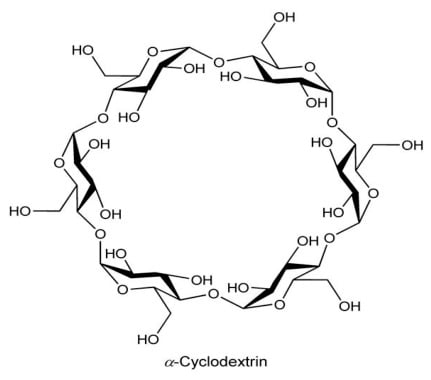
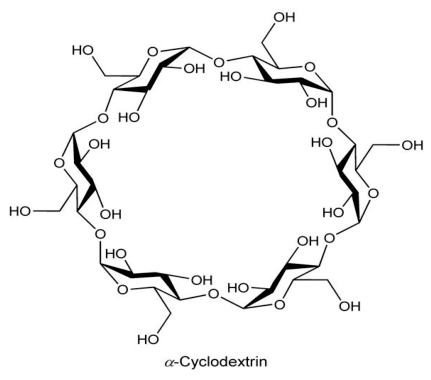
Cyclodextrins are a class of cyclic oligosaccharides containing abundant hydroxyl and ether oxygen groups in their molecular structures [19]. The molecular structure of α-CD is shown in Scheme 1. Yuan et al. used carboxymethyl-β-cyclodextrin to selectively depress pyrite during chalcopyrite–pyrite flotation separation, obtaining a copper concentrate with a Cu grade of 28.06% and a recovery of 73.15% [19]. Li et al. used β-cyclodextrin to depress barite during reverse flotation of high-density waste drilling fluid, achieving a barite recovery of 87.41% in a sodium dodecyl sulfate (SDS) flotation system [20]. However, unlike previous studies using carboxymethyl-β-cyclodextrin to depress pyrite or β-cyclodextrin to depress barite, the selective depression of sphalerite by unmodified α-cyclodextrin (α-CD) in chalcopyrite–sphalerite flotation and its different interfacial interactions with the two minerals remain insufficiently understood. Therefore, in this study, α-CD was employed as a depressant to investigate its effects on the flotation behaviors of chalcopyrite and sphalerite through single-mineral and artificial mixed-mineral flotation experiments. Contact angle measurements, zeta potential analysis, FTIR, and XPS were further conducted to characterize the interfacial interaction behavior of α-CD on mineral surfaces and elucidate the mechanism underlying the selective depression of sphalerite. This study provides theoretical insights into the development of flotation separation strategies for chalcopyrite and sphalerite.
Scheme 1.
Molecular structure of α-cyclodextrin (α-CD).
2. Materials and Methods
2.1. Mineral Samples and Reagents
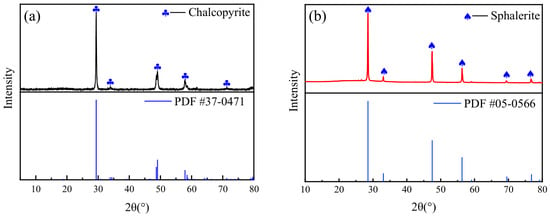
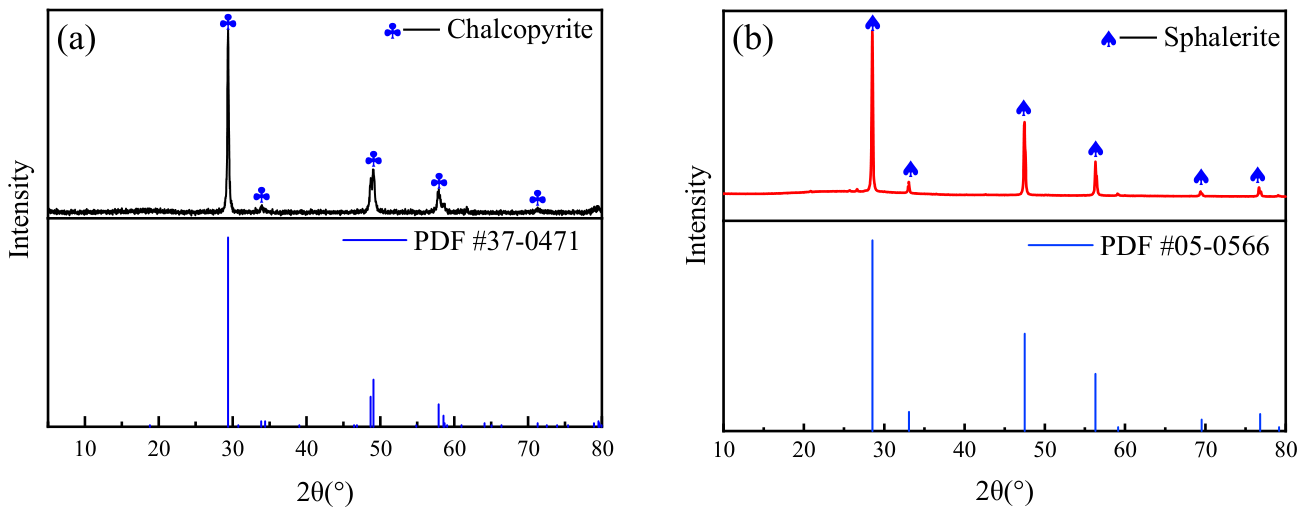
The single-mineral samples of chalcopyrite and sphalerite used in this study were collected from Kunming, Yunnan and Linxiang, Hunan, China, respectively. The raw mineral samples were manually selected, crushed, and dry-ground using a ceramic ball mill (XMCQ-Φ180 × 200, Jiangxi Hengchang Mining Machinery Manufacturing Co., Ltd., Ganzhou, China). Particle size fractions of 38–74 μm were collected as the flotation samples. A portion of the samples was further ground to below 5 μm for zeta potential, FTIR, and XPS analyses. The chemical compositions of the chalcopyrite and sphalerite samples were determined by X-ray fluorescence (XRF) spectroscopy, and the results are summarized in Table 1. The calculated purities of chalcopyrite and sphalerite were both higher than 95%, confirming that the samples were suitable for single-mineral flotation experiments. The X-ray diffraction (XRD) patterns of the mineral samples were recorded using an X-ray diffractometer (D/MAX-2600, Rigaku International Corporation, Tokyo, Japan) with Cu Kα radiation at 40 kV and 20 mA. Jade software (version 6.0) was used to analyze the diffraction patterns, and the results are shown in Figure 1.
Table 1.
Chemical compositions of the chalcopyrite and sphalerite samples (wt.%).
Figure 1.
X-ray diffraction (XRD) patterns of (a) chalcopyrite and (b) sphalerite.
α-Cyclodextrin (α-CD, 98%; Aladdin, Shanghai, China), sodium butyl xanthate (SBX, 95%; Zhuzhou Reagent Factory, Zhuzhou, China), and methyl isobutyl carbinol (MIBC; Shanghai Macklin Biochemical Co., Ltd., Shanghai, China) were used as the depressant, collector, and frother, respectively. Hydrochloric acid (HCl) and sodium hydroxide (NaOH) were purchased from Sinopharm Chemical Reagent Co., Ltd. (Shanghai, China) for pH adjustment. All reagents were of analytical grade. Deionized water (18.2 MΩ·cm) was used throughout.
2.2. Micro-Flotation Experiments
2.2.1. Single-Mineral Flotation Experiments
Single-mineral flotation experiments were conducted using an XFG flotation machine (Jilin Exploration Machinery Plant, Changchun, China) equipped with a 40 mL flotation cell and a four-blade impeller with a diameter of 30 mm. The impeller speed was maintained at 1800 rpm. For each experiment, 2.0 g of mineral sample was added to the flotation cell and mixed with 40 mL of deionized water. Before flotation, the mineral samples were ultrasonically treated for 5 min at a frequency of 35 kHz and a power of 80 W to minimize the influence of surface contaminants and fine particles on the experimental results. The reagent addition procedure was conducted as follows: the pulp pH was adjusted to the desired value before reagent addition and conditioned for 2 min; α-CD was then added and conditioned for 3 min; subsequently, SBX was added and conditioned for 2 min; finally, MIBC (10 mg/L) was introduced and conditioned for 1 min. After reagent conditioning, flotation was performed by manually scraping froth for 3 min. The froth products and tailings were collected separately, filtered, dried, and weighed. Given that both single-mineral samples had purities above 95%, mineral recovery was approximated by the mass recovery of the froth product and calculated using the following equation:
where ε represents the mineral recovery (%), m1 represents the mass of the froth product (g), and m2 represents the mass of the tailing product (g).
2.2.2. Artificial Mixed-Mineral Flotation Experiments
To further evaluate the separation performance of α-CD for chalcopyrite and sphalerite, artificial mixed-mineral samples were prepared by mixing chalcopyrite and sphalerite at a mass ratio of 1:1. The total mineral mass used in each experiment was 2 g. After ultrasonic treatment, the mixed-mineral samples were subjected to flotation using the same XFG flotation machine and impeller configuration as described in Section 2.2.1, following the same conditioning and reagent addition procedures used in the single-mineral flotation experiments. After flotation, the concentrate and tailings were filtered, dried, and weighed. The Cu and Zn grades of the concentrates were determined by chemical titration, whereas those of the tailings were calculated by metal mass balance. The Cu and Zn feed grades were calculated from the measured metal grades of the two single-mineral samples and their 1:1 mass mixing ratio. As the mixed-mineral system contained both minerals, Cu and Zn recoveries were calculated separately using the concentrate mass yield and metal grades:
where ε is the Cu or Zn recovery (%), γ is the concentrate mass yield expressed as a fraction between 0 and 1, β is the Cu or Zn grade in the concentrate (%), and α is the corresponding grade in the feed (%). All flotation experiments were conducted in triplicate, and the results are presented as mean ± standard deviation.
2.3. Contact Angle Measurements
The surface wettability changes in minerals under different reagent conditions were investigated using a JY-82B contact angle analyzer (Chengde Dingsheng Testing Equipment Co., Ltd., Chengde, China). The ground mineral samples were pressed into smooth pellets, washed with deionized water, and dried before measurement. Prior to testing, the samples were sequentially treated according to the designed reagent conditions, including pH adjustment, α-CD treatment, and SBX treatment. The contact angle measurements were conducted at pH 8 using 400 mg/L α-CD and 30 mg/L SBX, consistent with the reagent conditions used in the single-mineral flotation experiments. The treated samples were subsequently washed thoroughly with deionized water and air-dried at room temperature. During measurement, a droplet of deionized water was placed on the sample surface, and the contact angle was recorded after stabilization of the droplet shape. At least three different positions were randomly selected for each sample, and the average value was calculated.
2.4. Zeta Potential Measurements
The zeta potentials of mineral suspensions under different reagent conditions were measured using a Zetasizer Nano ZS90 analyzer (Malvern Instruments, Malvern, UK). Mineral samples with particle sizes below 5 μm were dispersed in deionized water containing 1 × 10⁻³ mol/L KCl as the background electrolyte. The suspension pH was adjusted to the desired value using hydrochloric acid and sodium hydroxide solutions, followed by the addition of α-CD and SBX according to the experimental conditions. The concentrations of α-CD and SBX were 400 mg/L and 30 mg/L, respectively, consistent with those used in the single-mineral flotation experiments. After reagent conditioning, the suspensions were allowed to stand for 5–10 min. The uniformly dispersed upper suspension was collected for zeta potential measurements. The electrokinetic responses to α-CD and SBX treatment were evaluated by comparing the zeta potentials before and after reagent addition. Each measurement was performed three times, and the average value was used.
2.5. FTIR Measurements
FTIR was performed using an FTIR-740 spectrometer (Thermo Nicolet Corporation, Madison, WI, USA) to investigate the interaction of α-CD with mineral surfaces. Untreated and α-CD-treated mineral samples were compared. After conditioning, the samples were filtered, thoroughly washed with deionized water to remove residual reagents, and dried. The treated mineral samples were mixed with spectroscopic-grade KBr at a mass ratio of 1:100 and thoroughly ground. The mixture was then pressed into pellets for FTIR measurements. The spectra were collected in the range of 4000–400 cm−1 with a resolution of 4 cm−1. The interaction of α-CD with chalcopyrite and sphalerite was examined by comparing the characteristic bands before and after α-CD treatment.
2.6. XPS Measurements
XPS was performed using a Thermo Fisher ESCALAB QXI spectrometer (Thermo Fisher Scientific, Waltham, MA, USA) to analyze the elemental composition and chemical states of mineral surfaces. The sphalerite and chalcopyrite samples were conditioned at pH 8 with or without α-CD according to the designed reagent conditions, followed by filtration and thorough washing with deionized water (without pH adjustment) to remove residual reagents that did not interact with the mineral surfaces. The samples were then dried and subjected to XPS analysis. The XPS spectra were fitted using Thermo Scientific Avantage software (version 6.9) with a Smart background, Gaussian–Lorentzian product peak shape, and Powell algorithm. The binding energies were charge-referenced to the C 1s peak at 284.8 eV.
3. Results and Discussion
3.1. Flotation Experiments
3.1.1. Single-Mineral Flotation Behavior
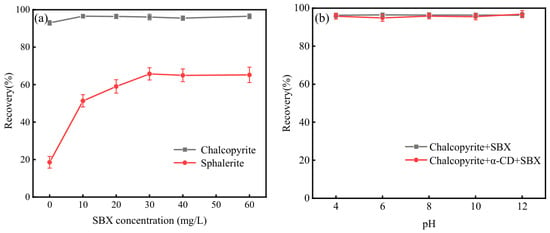
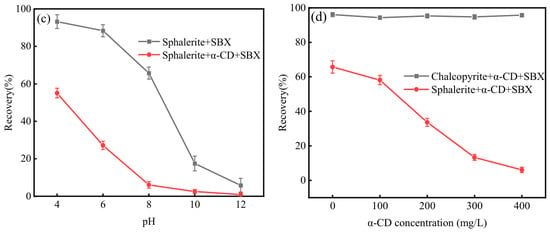
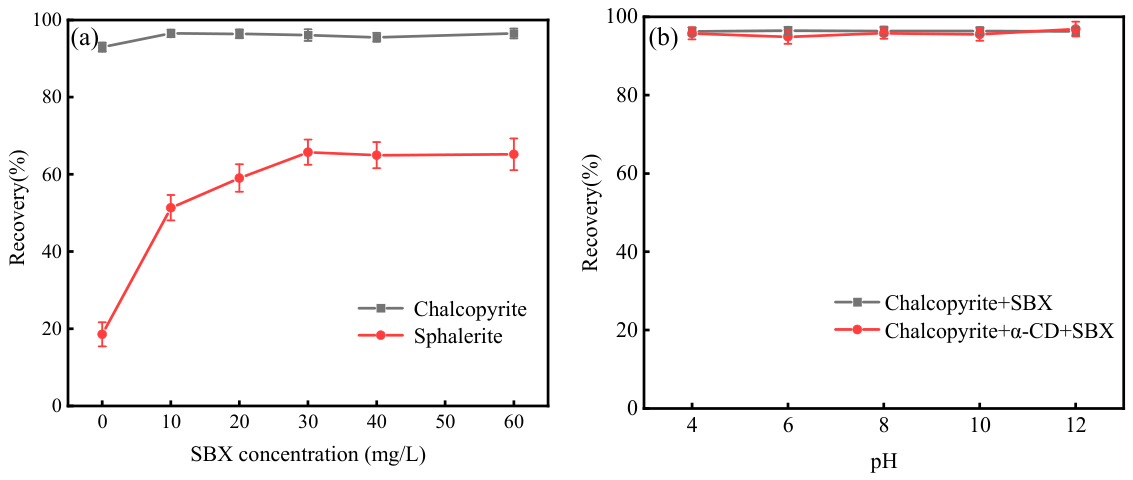
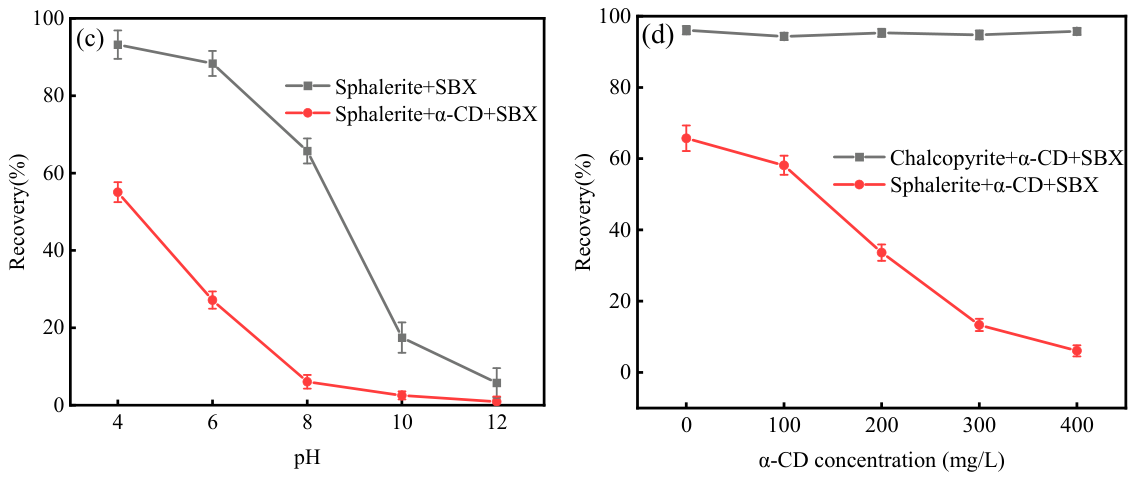
The effects of different flotation conditions on the recoveries of chalcopyrite and sphalerite are shown in Figure 2.
Figure 2.
Effects of reagent dosage and pulp pH on the recoveries of chalcopyrite and sphalerite in single-mineral flotation tests: (a) SBX dosage; (b) pulp pH for chalcopyrite; (c) pulp pH for sphalerite; and (d) α-CD dosage.
As shown in Figure 2a, in the absence of SBX, the recovery of chalcopyrite was approximately 92%, whereas the recovery of sphalerite was below 20%. The high collectorless recovery of chalcopyrite may be associated with its surface properties, as previous studies have shown that surface oxidation can influence its flotation behavior [21]. Moreover, MIBC (10 mg/L) was still present as the frother, facilitating particle recovery. With increasing SBX concentration from 0 to 30 mg/L, chalcopyrite maintained a high recovery, while the recovery of sphalerite increased significantly. Despite the absence of an added Cu2+ activator, sphalerite recovery reached approximately 66% at 30 mg/L SBX. The Fe content of the natural sphalerite sample (1.42 wt.%, Table 1) may have influenced its interaction with xanthate, as reported previously [22]. When the SBX concentration was further increased to 40–60 mg/L, the recovery variation in sphalerite became relatively insignificant, indicating that the collecting effect of SBX was nearly stabilized at 30 mg/L. Therefore, 30 mg/L was selected as the SBX dosage for subsequent experiments.
Here, Figure 2b,c illustrate the effects of pH on the flotation behaviors of chalcopyrite and sphalerite under fixed dosages of 30 mg/L SBX and 400 mg/L α-CD. The results showed that chalcopyrite maintained a relatively stable and high recovery within the investigated pH range. In contrast, the recovery of sphalerite decreased significantly with increasing pH. At pH 8, a distinct difference in flotation behavior between chalcopyrite and sphalerite was observed; therefore, pH 8 was selected as the optimum condition for subsequent experiments.
This is shown in Figure 2d. Here, under the conditions of pH 8 and 30 mg/L SBX, α-CD exhibited different effects on the flotation behaviors of chalcopyrite and sphalerite. With increasing α-CD dosage, the recovery of chalcopyrite remained almost unchanged, whereas the recovery of sphalerite continuously decreased. When the α-CD dosage reached 400 mg/L, the recovery of sphalerite reached the lowest value while chalcopyrite still maintained a high recovery, indicating that effective selective depression of sphalerite was achieved under these conditions. Therefore, the optimal conditions for subsequent single-mineral flotation experiments were determined as follows: pH 8, SBX dosage of 30 mg/L, and α-CD dosage of 400 mg/L.
3.1.2. Separation Performance of Artificial Mixed-Mineral Samples
To further evaluate the separation performance of α-CD for chalcopyrite and sphalerite, flotation experiments were conducted using artificial mixed-mineral samples prepared by mixing chalcopyrite and sphalerite at a mass ratio of 1:1. The results are summarized in Table 2.
Table 2.
Effect of α-CD dosage on the flotation separation of a 1:1 artificial chalcopyrite–sphalerite mixture.
In the absence of α-CD, the Cu and Zn recoveries in the concentrate were 92.37% and 79.65%, respectively. The Cu grade was only 17.84%, while the Zn grade reached 30.12%, indicating that both chalcopyrite and sphalerite exhibited strong flotation responses without depressant addition, resulting in poor separation efficiency. The relatively high Zn recovery may be partly attributed to the unintended activation of sphalerite by dissolved Cu species from chalcopyrite, which can promote xanthate adsorption [23]. Froth entrainment may also have contributed to sphalerite recovery.
After adding 400 mg/L α-CD, the Cu grade of the concentrate increased to 29.75%, while the Zn grade decreased to 7.91%. Meanwhile, the Cu recovery increased to 98.39%, whereas the Zn recovery decreased to 13.36%. These results demonstrate that α-CD effectively reduced the recovery of sphalerite into the concentrate and promoted the selective enrichment of chalcopyrite. When the α-CD dosage was further increased to 500 mg/L, the Cu grade of the concentrate increased to 31.45%, while the Zn grade further decreased to 3.52%. The Cu and Zn recoveries reached 98.61% and 5.64%, respectively. Compared with the condition of 400 mg/L α-CD, increasing the α-CD dosage had little effect on chalcopyrite recovery but further decreased sphalerite recovery, indicating that a higher α-CD dosage contributed to improving the selective separation between chalcopyrite and sphalerite.
The artificial mixed-mineral flotation results were consistent with the single-mineral flotation behavior, demonstrating that α-CD can effectively depress sphalerite flotation while maintaining high chalcopyrite recovery, thereby achieving selective separation of chalcopyrite and sphalerite.
3.2. Wettability Analysis
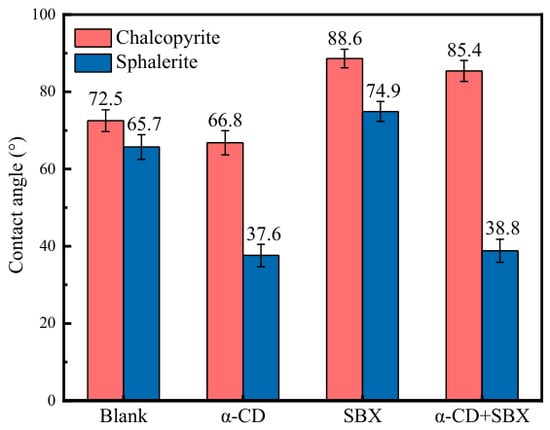
Figure 3 shows the changes in the contact angles of chalcopyrite and sphalerite surfaces under different reagent conditions.
Figure 3.
Contact angles of chalcopyrite and sphalerite following the indicated reagent treatments.
Under the blank condition, the contact angles of chalcopyrite and sphalerite were 72.5° and 65.7°, respectively. After SBX treatment, their contact angles increased to 88.6° and 74.9°, respectively, indicating that SBX enhanced the surface hydrophobicity of both minerals.
The addition of α-CD significantly changed the difference in wettability between chalcopyrite and sphalerite. For chalcopyrite, the contact angle decreased from 72.5° to 66.8° after α-CD treatment alone. After α-CD pretreatment followed by SBX addition, the contact angle remained at 85.4°, which was close to that obtained with SBX treatment alone, indicating that the SBX-induced hydrophobicity of chalcopyrite was largely maintained after α-CD pretreatment.
For sphalerite, the contact angle decreased significantly from 65.7° to 37.6° after α-CD treatment, indicating that the surface hydrophilicity was greatly enhanced. After α-CD pretreatment followed by SBX addition, the contact angle of sphalerite was only 38.8°, which was much lower than that obtained with SBX treatment alone (74.9°). This indicates that α-CD effectively inhibited the hydrophobic modification of sphalerite induced by SBX and maintained the hydrophilic state of the sphalerite surface.
Compared with SBX treatment alone, the contact angle of chalcopyrite decreased by only approximately 3.2° after α-CD pretreatment, whereas that of sphalerite decreased by approximately 36.1°. These results show that α-CD pretreatment weakened the SBX-induced hydrophobicity of sphalerite much more than that of chalcopyrite. The resulting difference in wettability is consistent with the selective depression observed in the flotation tests.
3.3. Zeta Potential Analysis
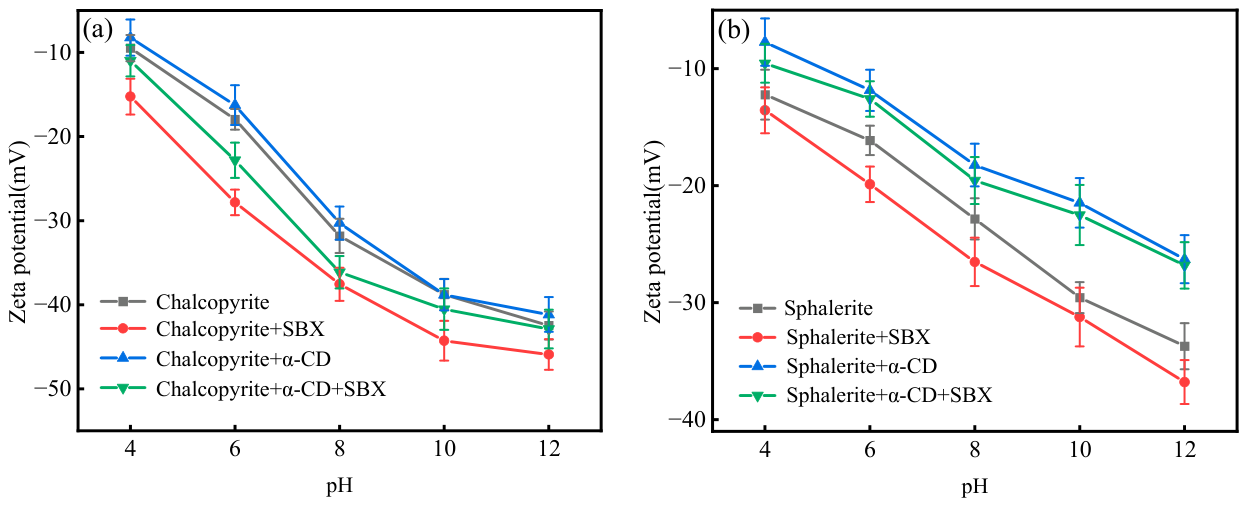
Figure 4 presents the zeta potentials of chalcopyrite and sphalerite under different reagent conditions. Both minerals exhibited negative values over pH 4–12, generally becoming more negative with increasing pH. Zeta potential reflects the potential at the slipping plane and is affected by interfacial ions and adsorbed layers [24].
Figure 4.
Zeta potentials of (a) chalcopyrite and (b) sphalerite under the indicated reagent treatments.
For chalcopyrite, SBX alone shifted the zeta potential from −31.81 to −37.56 mV at pH 8. This negative shift is consistent with the adsorption of anionic xanthate at the mineral interface. Previous studies identified metal xanthate and dixanthogen on chalcopyrite treated with butyl xanthate [25,26], suggesting that reactions involving Cu-related surface sites and xanthate oxidation may contribute to collector adsorption and surface hydrophobization. α-CD alone caused only minor changes in zeta potential. Following α-CD pretreatment, SBX addition shifted the potential to −36.13 mV at pH 8, close to the value obtained with SBX alone. These results suggest that α-CD pretreatment had a limited effect on the interfacial electrical properties of SBX-treated chalcopyrite.
For sphalerite, SBX alone shifted the zeta potential from −22.84 to −26.52 mV at pH 8, corresponding to a negative shift of 3.68 mV. This shift may be associated with the adsorption of anionic SBX. Yu et al. detected metal xanthate on iron-bearing natural sphalerite treated with ethyl xanthate [22], suggesting that SBX may also adsorb on sphalerite through reactions with surface metal sites. α-CD treatment shifted the zeta potential to −18.24 mV, and subsequent SBX addition changed it to −19.56 mV. Since α-CD is predominantly nonionic at pH 8, the less negative potential may be associated with changes in the interfacial environment or slipping-plane position caused by surface coverage. The resulting negative shift of 1.32 mV was smaller than that observed without α-CD pretreatment. This smaller shift may be related to surface coverage by α-CD restricting SBX access to surface sites. In contrast to the largely maintained SBX-related response of chalcopyrite, the reduced response of sphalerite after α-CD pretreatment is consistent with the different wettability changes observed. However, these zeta-potential shifts reflect changes in the interfacial electrokinetic environment and cannot independently confirm reagent adsorption.
3.4. FTIR Analysis
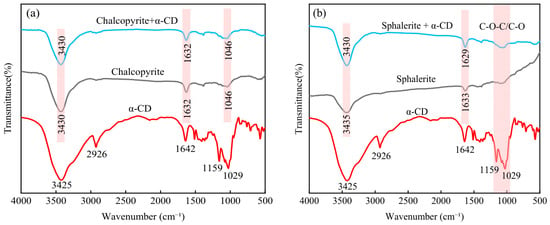
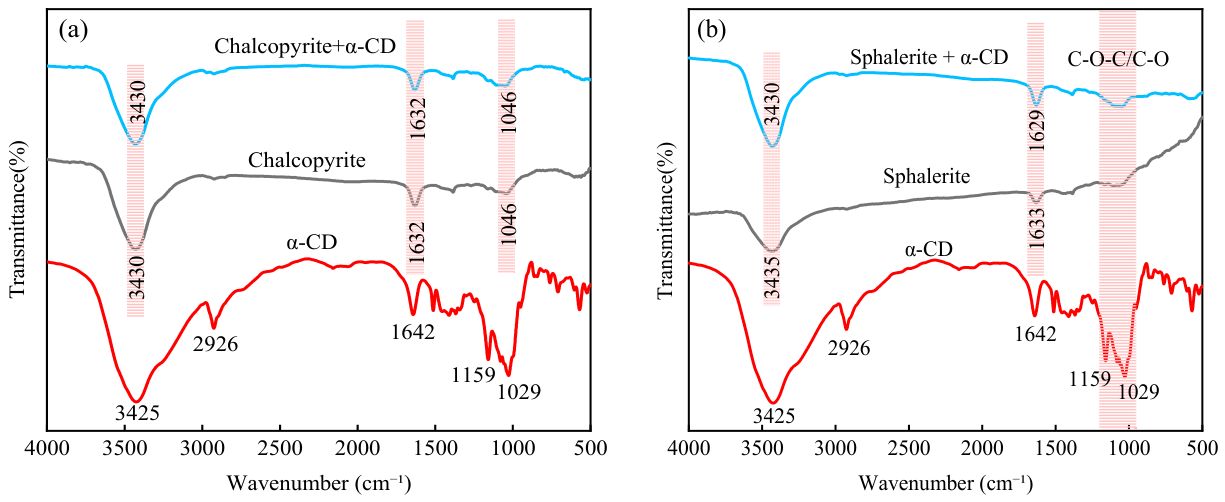
Figure 5 shows the FTIR spectra of α-CD and chalcopyrite and sphalerite before and after α-CD treatment. α-CD exhibited characteristic absorption peaks at 3425, 2926, 1642, 1159, and 1029 cm−1, corresponding to the O–H stretching vibration, C–H stretching vibration, H–O–H bending vibration of adsorbed water, C–O–C stretching vibration of glycosidic bonds, and C–O stretching vibration, respectively [27].
Figure 5.
FTIR spectra of pure α-CD and untreated and α-CD-treated mineral samples: (a) chalcopyrite and (b) sphalerite.
As shown in Figure 5a, untreated chalcopyrite exhibited absorption peaks near 3430 and 1632 cm−1, corresponding to O–H stretching and H–O–H bending vibrations, respectively. The band near 1046 cm−1 may be associated with S–O stretching vibrations of surface sulfate-related species [28]. After α-CD treatment, the positions of these absorption peaks remained essentially unchanged, and no clearly discernible characteristic absorption peaks of α-CD at 2926, 1159, and 1029 cm−1 were observed. The FTIR spectra of chalcopyrite showed no obvious changes after α-CD treatment, consistent with the limited interaction of α-CD with the chalcopyrite surface.
As shown in Figure 5b, untreated sphalerite exhibited two main absorption peaks near 3435 and 1633 cm−1, corresponding to O–H stretching and H–O–H bending vibrations of surface-associated water, respectively [29]. After α-CD treatment, these peaks shifted slightly to 3430 and 1629 cm−1, respectively. Because the vibrations of surface hydroxyl groups, adsorbed water, and α-CD overlap in this region, these slight peak shifts may reflect changes in the local hydrogen-bonding environment. More importantly, the band shape of sphalerite in the region of 1200–950 cm−1 changed after treatment, and a broad absorption band centered at approximately 1050 cm−1 appeared. This region corresponds to the stretching vibration ranges of the C–O–C and C–O groups in α-CD [30]. The characteristic peaks of pure α-CD at 1159 and 1029 cm−1 were weakened, broadened, and overlapped after adsorption, indicating that α-CD-related oxygen-containing groups were present on the treated sphalerite surface. These spectral changes indicate that α-CD can be adsorbed on the sphalerite surface, and its hydroxyl and ether oxygen groups may participate in hydrogen bonding and other surface interactions [31].
3.5. XPS Analysis
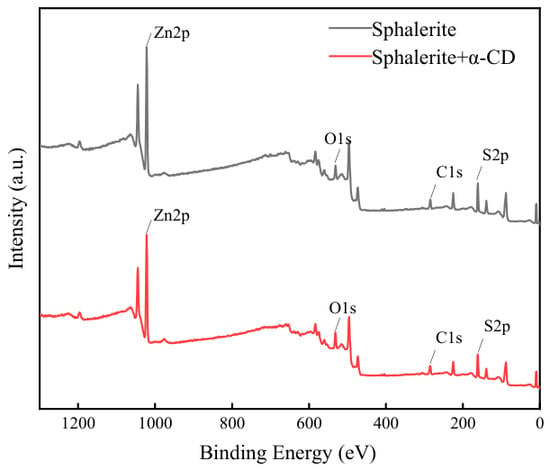
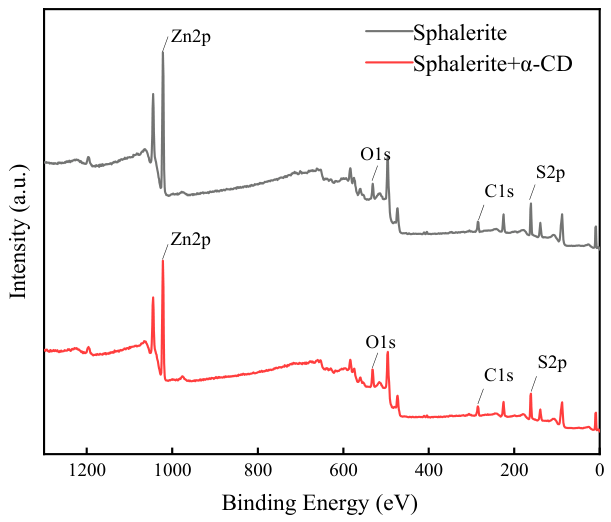
To further analyze the adsorption behavior of α-CD on the chalcopyrite and sphalerite surfaces, XPS measurements were performed on the samples before and after treatment. As shown in the XPS survey spectra of sphalerite in Figure 6, C, O, S, and Zn were detected before and after α-CD treatment. Table 3 shows that, after α-CD treatment, the atomic contents of C and O on the sphalerite surface increased from 21.86% and 12.84% to 24.39% and 17.13%, respectively, while the contents of S and Zn decreased from 29.85% and 35.45% to 27.00% and 31.49%, respectively. The increases in the C and O contents and the weakening of the Zn and S signals indicate that an organic overlayer rich in C and O was formed on the sphalerite surface [32,33].
Figure 6.
XPS survey spectra of sphalerite before and after α-CD treatment.
Table 3.
Relative surface atomic concentrations of sphalerite before and after α-CD treatment.
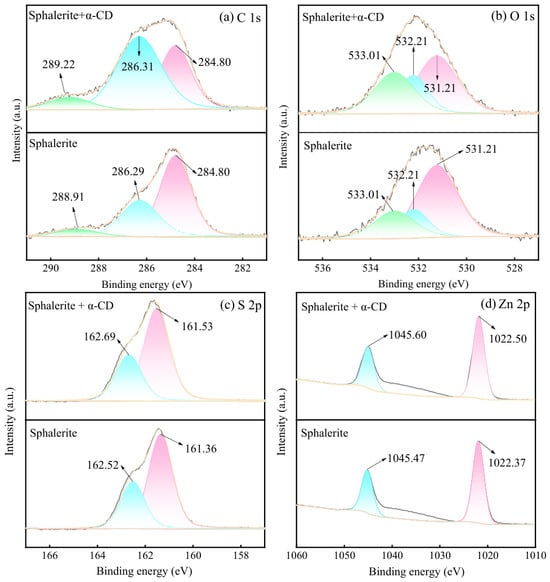
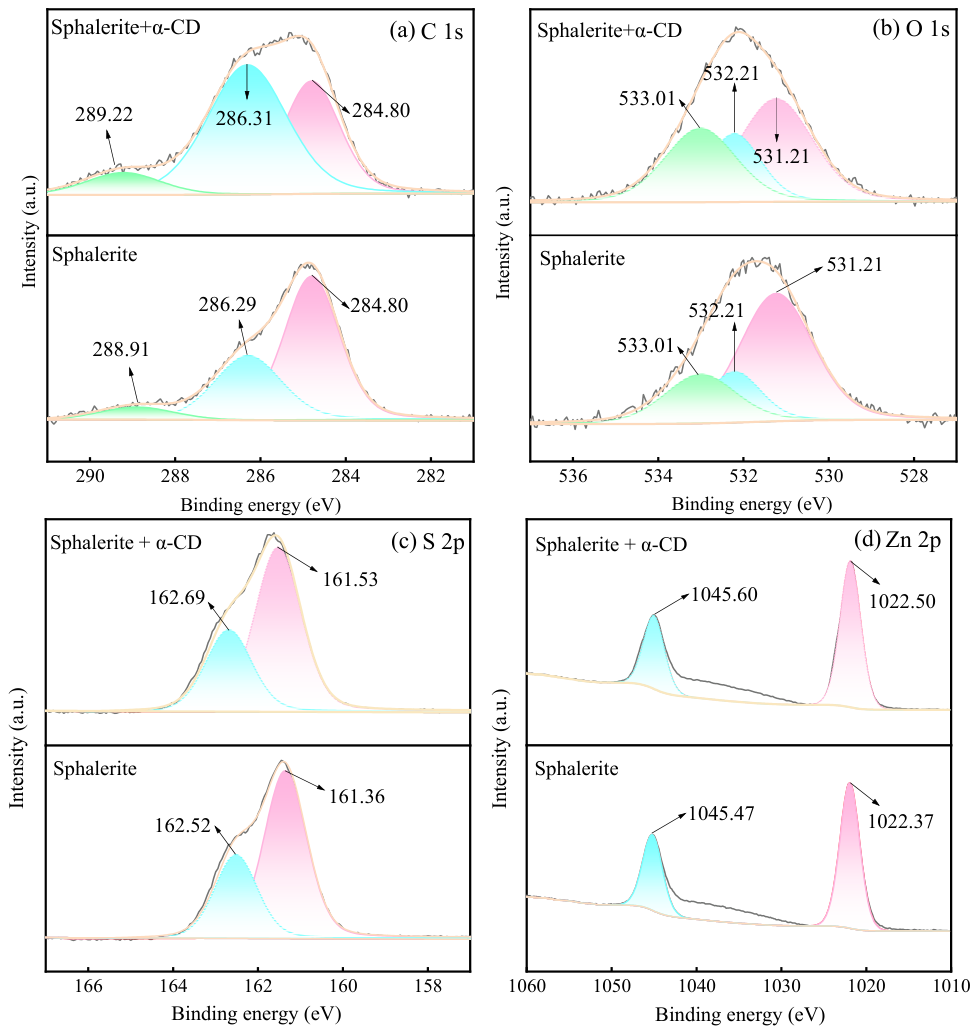
Figure 7a shows the high-resolution C 1s spectra of sphalerite before and after α-CD treatment. The components of untreated sphalerite at 284.80, 286.29, and 288.91 eV were assigned to C–C/C–H, C–O/C–OH, and oxygen-containing carbon species such as O–C=O, respectively [34]. After α-CD treatment, the corresponding components were located at 284.80, 286.31, and 289.22 eV. The total proportion of the oxygen-containing carbon components increased from 40.38% to 65.13%, mainly reflected by the significant enhancement of the C–O/C–OH component. This change corresponds to the oxygen-containing groups associated with the abundant hydroxyl groups, ether bonds, and glycosidic bonds in the α-CD molecule, indicating that organic species derived from α-CD were enriched on the sphalerite surface [35].
Figure 7.
High-resolution XPS spectra and fitted components of untreated and α-CD-treated sphalerite: (a) C 1s, (b) O 1s, (c) S 2p, and (d) Zn 2p.
As can be seen from the high-resolution O 1s spectra in Figure 7b, the component near 531.21 eV was mainly related to oxygen species on the mineral surface, while the components near 532.21 and 533.01 eV could be assigned to oxygen-containing species such as surface hydroxyl groups, C–O, and organic ether oxygen [36]. After α-CD treatment, the total proportion of the high-binding-energy oxygen components at 532.21 and 533.01 eV increased from 39.83% to 54.08%, while their fitted peak positions remained nearly unchanged, indicating an increase in the relative contribution of oxygen-containing species [37]. Because the O 1s signals of different oxygen-containing species overlap to a certain extent, these components were mainly used to reflect the relative changes in the surface oxygen-containing groups before and after treatment.
Figure 7c and Figure 7d show the high-resolution S 2p and Zn 2p spectra, respectively. After α-CD treatment, the S 2p and Zn 2p peaks shifted toward higher binding energies by approximately 0.17 and 0.13 eV, respectively, indicating that the local chemical environment of the sphalerite surface changed [38]. Combined with the significant increase in the oxygen-containing components in the C 1s and O 1s spectra, these results suggest that α-CD-related organic species were enriched on the sphalerite surface, forming a hydrophilic organic overlayer [39]. This overlayer increased the hydrophilicity of the sphalerite surface, thereby decreasing its floatability, which was consistent with the contact angle, zeta potential, and flotation test results.
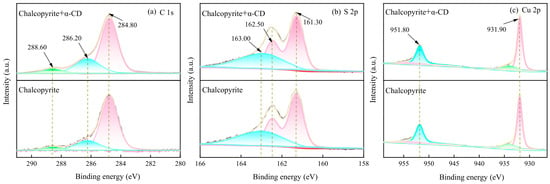
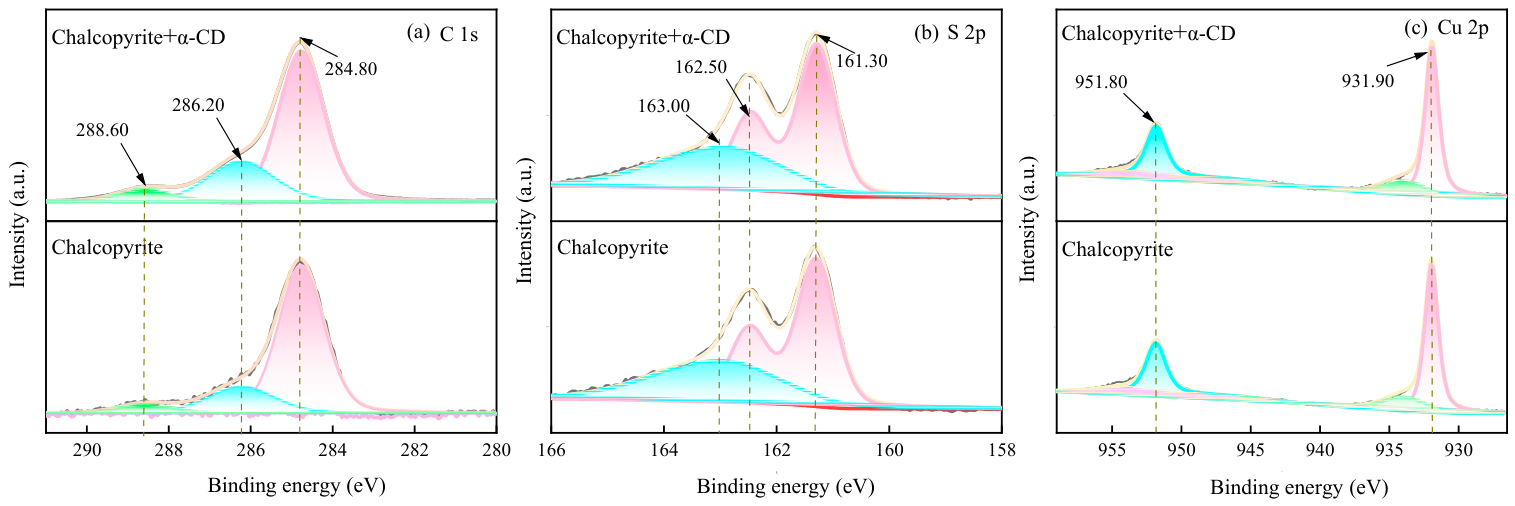
To further evaluate the influence of α-CD on chalcopyrite, the high-resolution C 1s, S 2p, and Cu 2p spectra before and after treatment were compared, as shown in Figure 8. The C 1s spectra exhibited three components at approximately 284.80, 286.20, and 288.60 eV, corresponding to C–C/C–H, C–O/C–OH, and O–C=O species, respectively [40]. After α-CD treatment, the overall C 1s spectral profile remained similar, although the contribution of oxygen-containing carbon components increased slightly. The S 2p peaks at approximately 161.30 and 162.50 eV were assigned to the S 2p3/2 and S 2p1/2 components, respectively [41], while the Cu 2p peaks at approximately 931.90 and 951.80 eV corresponded to Cu 2p3/2 and Cu 2p1/2, respectively [42]. After α-CD treatment, the main S 2p and Cu 2p peaks showed no obvious binding energy shifts or newly resolved components. These results suggest that α-CD had a limited influence on the Cu- and S-related surface chemical states of chalcopyrite. This observation is consistent with the contact angle and flotation results, indicating that α-CD treatment did not substantially impair the hydrophobicity and floatability of chalcopyrite.
Figure 8.
High-resolution XPS spectra of chalcopyrite before and after α-CD treatment: (a) C 1s, (b) S 2p, and (c) Cu 2p.
4. Conclusions
This study evaluated α-CD as a selective depressant for chalcopyrite–sphalerite flotation separation and investigated its depression mechanism. The main conclusions are as follows:
- (1)
- α-CD selectively depressed sphalerite while exerting little influence on chalcopyrite under the optimal single-mineral flotation conditions of pH 8, 30 mg/L SBX, and 400 mg/L α-CD. For the artificial mixed-mineral system with a chalcopyrite/sphalerite mass ratio of 1:1, at an α-CD dosage of 500 mg/L, the Cu grade and recovery of the concentrate reached 31.45% and 98.61%, respectively, whereas the Zn grade and recovery decreased to 3.52% and 5.64%, respectively.
- (2)
- α-CD had distinctly different effects on the surface properties of chalcopyrite and sphalerite. Compared with SBX treatment alone, α-CD pretreatment decreased the contact angle of chalcopyrite by only 3.2°, whereas that of sphalerite decreased by 36.1°. The zeta-potential results further indicated that α-CD had little influence on the interaction between chalcopyrite and SBX but markedly weakened the response of sphalerite to subsequent SBX addition, indicating that α-CD selectively enhanced the surface hydrophilicity of sphalerite.
- (3)
- FTIR and XPS analyses indicated that α-CD adsorbed on the sphalerite surface, as evidenced by the increased surface contents of C and O and the enrichment of oxygen-containing components. In contrast, the main Cu 2p and S 2p peaks of chalcopyrite showed no obvious binding energy shifts after α-CD treatment. These results suggest that the hydroxyl and ether oxygen groups of α-CD participate in surface interactions involving Zn-related sites, forming a hydrophilic organic overlayer and thereby contributing to the selective depression of sphalerite.
These results were obtained using a 1:1 artificial chalcopyrite–sphalerite mixture. Further verification using natural ores is needed, as additional sulfide minerals, gangue phases, and dissolved metal ions may affect flotation performance.
Author Contributions
Conceptualization, T.Q., G.Z. and X.L.; Formal analysis, W.Y. and L.Z.; Investigation, K.C.; Resources, Z.S. and T.Y.; Data curation, K.C., W.Y. and L.Z.; Writing—review & editing, K.C.; Visualization, W.Y. and L.Z.; Supervision, T.Q., G.Z., Z.S., T.Y. and X.L. All authors have read and agreed to the published version of the manuscript.
Funding
This research was supported by the National Key Research and Development Program of China (grant No. 2022YFC2904504) and the Science and Technology Research Project of the Jiangxi Provincial Department of Education (grant No. GJJ2200864).
Data Availability Statement
The raw data supporting the conclusions of this article will be made available by the authors on request.
Conflicts of Interest
Authors Zhongmei Sun and Tao Yue were employed by the company Zijin Mining Group Co., Ltd. The remaining authors declare that the research was conducted in the absence of any commercial or financial relationships that could be construed as a potential conflict of interest.
References
- Aikawa, K.; Ito, M.; Orii, N.; Jeon, S.; Park, I.; Haga, K.; Kamiya, T.; Takahashi, T.; Sunada, K.; Sakakibara, T.; et al. Flotation of Copper Ores with High Cu/Zn Ratio: Effects of Pyrite on Cu/Zn Separation and an Efficient Method to Enhance Sphalerite Depression. Minerals 2022, 12, 1103. [Google Scholar] [CrossRef] [Scilit]
- Zhang, M.; Huang, L.; Lan, Z.; Hu, B.; Sun, X. Research Progress of Chalcopyrite Flotation. Conserv. Util. Miner. Resour. 2022, 42, 172–178. (In Chinese) [Google Scholar]
- Zhou, H.; Geng, L.; Zhang, Y.; Yang, Z.; He, K.; Xie, F. Selective flotation separation of chalcopyrite and sphalerite by thermal pretreatment under air atmosphere. Physicochem. Probl. Miner. Process. 2021, 57, 305–314. [Google Scholar] [CrossRef] [Scilit]
- Feng, B.; Guo, Y.; Wang, T.; Peng, J.; Ning, X.; Wang, H. Effect and mechanism of xanthan gum in the flotation separation of chalcopyrite and sphalerite. Chin. J. Nonferr. Met. 2020, 30, 1202–1208. (In Chinese) [Google Scholar]
- Chen, Y.; Feng, B.; Zhong, C.; Wang, Z. Effect and mechanism of the xanthate/H2O2 addition order on flotation separation of chalcopyrite and sphalerite. Miner. Eng. 2022, 188, 107851. [Google Scholar] [CrossRef] [Scilit]
- Wang, X.; Wen, S.; Han, G.; Liao, R.; Meng, S.; Feng, Q. The Research Development on the Flotation Technology and Reagents of Lead-zinc Sulfide Ore. Conserv. Util. Miner. Resour. 2021, 41, 168–178. (In Chinese) [Google Scholar]
- Chen, H.; Tong, X.; Xie, X.; Xie, R.; Song, Q.; Cui, Y.; Xiao, Y.; Dai, P. Cyanide Depression Mechanism for Sphalerite Flotation Separation Based on Density Functional Theory Calculations and Coordination Chemistry. Minerals 2022, 12, 1271. [Google Scholar] [CrossRef] [Scilit]
- Ao, S. Research progress on beneficiation processes, reagents and equipment for lead–zinc ores. Conserv. Util. Miner. Resour. 2023, 43, 146–162. (In Chinese) [Google Scholar]
- Oulkhir, A.; Lyamlouli, K.; Danouche, M.; Ouazzani, J.; Benhida, R. A critical review on natural surfactants and their potential for sustainable mineral flotation. Rev. Environ. Sci. Biotechnol. 2023, 22, 105–131. [Google Scholar] [CrossRef] [Scilit]
- Liu, C.; Shao, Y.; Li, J.; Li, R.; Chen, H.; Meng, X. Research progress on low-alkalinity flotation reagents for zinc–sulfur separation. Conserv. Util. Miner. Resour. 2024, 44, 38–48. (In Chinese) [Google Scholar]
- Xiong, W.; Zhang, X.; Lu, L.; Zheng, Y.; Wang, Y.; Zhu, Y. Application of organic macromolecular depressants in the flotation separation of polymetallic sulfide ores. Conserv. Util. Miner. Resour. 2021, 41, 65–73. (In Chinese) [Google Scholar]
- Zhang, J.; Wang, J.; Yan, R.; Li, J.; Li, C. Selective depression performance and mechanism of nonionic polysaccharides. Conserv. Util. Miner. Resour. 2025, 45, 110–123. (In Chinese) [Google Scholar]
- Feng, B.; Guo, Y.; Zhang, W.; Peng, J.; Wang, H.; Huang, Z.; Zhou, X. Flotation separation behavior of chalcopyrite and sphalerite in the presence of locust bean gum. Miner. Eng. 2019, 143, 105940. [Google Scholar] [CrossRef] [Scilit]
- Wang, C.; Liu, R.; Wu, M.; Zhai, Q.; Luo, Y.; Jing, N.; Xie, F.; Sun, W. Selective separation of chalcopyrite from sphalerite with a novel depressant fenugreek gum: Flotation and adsorption mechanism. Miner. Eng. 2022, 184, 107653. [Google Scholar] [CrossRef] [Scilit]
- Xu, X.; Zhang, X.; Zhang, Y.; Liu, X.; He, H.; Fang, J.; Shen, P.; Peng, R.; Yu, J.; Chen, X.; et al. A study on the mechanism of flotation separation between chalcopyrite and sphalerite using a novel environmental depressant derived from grape peel extract GPE. Colloids Surf. A Physicochem. Eng. Asp. 2024, 681, 132772. [Google Scholar] [CrossRef] [Scilit]
- Zhai, Q.; Hu, Y.; Liu, R.; Wei, S. Investigation of pullulan polysaccharide as a sphalerite depressant for chalcopyrite separation: Flotation behavior and interfacial adsorption mechanism. Adv. Powder Technol. 2024, 35, 104621. [Google Scholar] [CrossRef] [Scilit]
- Wei, M.; Lv, J.; Kong, L.; Tong, X. Differential depression and mechanism of copper ion-activated sphalerite with wheat starch and rice starch as flotation depressants. Adv. Powder Technol. 2024, 35, 104446. [Google Scholar] [CrossRef] [Scilit]
- Liu, R.; Zhai, Q.; Wen, X.; Wang, C.; Chen, P.; Sun, W.; Tang, H. Effect of the synergistic interaction between dextrin and calcium ions on the flotation separation of sphalerite and pyrite under low-alkalinity conditions. J. Cent. South Univ. Sci. Technol. 2024, 55, 2447–2455. (In Chinese) [Google Scholar]
- Yuan, J.; Li, Y.; Ding, Z.; Yu, A.; Zhang, Y.; Wen, S.; Bai, S. Influence and mechanism of new environmentally friendly depressant carboxymethyl-β-cyclodextrin on the flotation separation of chalcopyrite and pyrite. Colloids Surf. A Physicochem. Eng. Asp. 2024, 699, 134576. [Google Scholar] [CrossRef] [Scilit]
- Li, X.; Xie, S.; Xu, Y.; Xia, Y.; Cheng, Y.; Tang, S.; Wang, D.; Ren, W.; Zhang, M.; Meng, W. Flotation recovery of barite from high-density waste drilling fluid using β-cyclodextrin as a novel depressant and its mechanism. PLoS ONE 2024, 19, e0298626. [Google Scholar] [CrossRef] [Scilit] [PubMed]
- Fairthorne, G.; Fornasiero, D.; Ralston, J. Effect of oxidation on the collectorless flotation of chalcopyrite. Int. J. Miner. Process. 1997, 49, 31–48. [Google Scholar] [CrossRef] [Scilit]
- Yu, J.; Wu, X.; Zhao, Z.; Zhu, Y.; Luo, S. Effect of a Small Amount of Iron Impurity in Sphalerite on Xanthate Adsorption and Flotation Behavior. Minerals 2019, 9, 687. [Google Scholar] [CrossRef] [Scilit]
- Ekmekçi, Z.; Aslan, A.; Hassoy, H. Effects of EDTA on selective flotation of sulphide minerals. Physicochem. Probl. Miner. Process 2004, 38, 79–94. [Google Scholar]
- Delgado, A.V.; González-Caballero, F.; Hunter, R.J.; Koopal, L.K.; Lyklema, J. Measurement and interpretation of electrokinetic phenomena (IUPAC Technical Report). Pure Appl. Chem. 2005, 77, 1753–1805. [Google Scholar] [CrossRef] [Scilit]
- Zhang, Y.; Cao, Z.; Cao, Y.; Sun, C. FTIR studies of xanthate adsorption on chalcopyrite, pentlandite and pyrite surfaces. J. Mol. Struct. 2013, 1048, 434–440. [Google Scholar] [CrossRef] [Scilit]
- Mikhlin, Y.; Karacharov, A.; Tomashevich, Y.; Shchukarev, A. Cryogenic XPS study of fast-frozen sulfide minerals: Flotation-related adsorption of n-butyl xanthate and beyond. J. Electron Spectrosc. Relat. Phenom. 2016, 206, 65–73. [Google Scholar] [CrossRef] [Scilit]
- Debnath, S.; Ghosh, B.; Mondal, M.; Roy, N.; Mallick, K.; Maji, J.; Sahana, S.; Sinha, A.; Dey, S.; Kumar, A.; et al. Investigation of Host–Guest Inclusion Complex of Mephenesin with α-Cyclodextrin for Innovative Application in Biological System. ACS Omega 2024, 9, 36066–36075. [Google Scholar] [CrossRef] [Scilit] [PubMed]
- Sun, D.; Li, M.; Zhang, M.; Cui, R.; Yang, Z.; Yu, L.; Wang, D.; Yao, W. Utilization and Mechanisms of Tannic Acid as a Depressant for Chalcopyrite and Pyrite Separation. ACS Omega 2023, 8, 30474–30482. [Google Scholar] [CrossRef] [Scilit] [PubMed]
- Luo, L.; Yang, M.; Zhang, H.; Yang, L.; Feng, R. The Separation of Sulfide Minerals from Fluorapatite Ore in Acidic De-Magnesium Flotation Process. Materials 2026, 19, 1633. [Google Scholar] [CrossRef] [Scilit] [PubMed]
- Wu, H.; Ao, X.; Liu, J.; Zhu, J.; Bi, J.; Hou, H.; Hao, H.; Zhang, G. A Bioactive Chitosan-Based Film Enriched with Benzyl Isothiocyanate/α-Cyclodextrin Inclusion Complex and Its Application for Beef Preservation. Foods 2022, 11, 2687. [Google Scholar] [CrossRef] [Scilit] [PubMed]
- Cui, Y.; Jiao, F.; Qin, W.; Wang, C.; Li, X. Flotation separation of sphalerite from galena using eco-friendly and efficient depressant pullulan. Sep. Purif. Technol. 2022, 295, 121013. [Google Scholar] [CrossRef] [Scilit]
- Jin, J.; Lai, H.; Xiao, Y.; Lu, X.; Shen, P.; Cai, J.; Wei, X.; Liu, D. Adsorption mechanism of polyepoxysuccinic acid on the sphalerite surface and its effect on flotation separation. J. Taiwan Inst. Chem. Eng. 2026, 181, 106518. [Google Scholar] [CrossRef] [Scilit]
- Wang, C.; Liu, R.; Sun, W.; Jing, N.; Xie, F.; Zhai, Q.; He, D. Selective depressive effect of pectin on sphalerite flotation and its mechanisms of adsorption onto galena and sphalerite surfaces. Miner. Eng. 2021, 170, 106989. [Google Scholar] [CrossRef] [Scilit]
- Zhang, Y.; Zhang, X.; Liu, X.; Chang, T.; Ning, S.; Shen, P.; Liu, R.; Lai, H.; Liu, D.; Yang, X. Carrageenan xanthate as an environmental-friendly depressant in the flotation of Pb–Zn sulfide and its underlying mechanism. Colloids Surf. A Physicochem. Eng. Asp. 2022, 653, 129926. [Google Scholar] [CrossRef] [Scilit]
- Zhu, H.; Yang, B.; Rudolph, M.; Zhang, H.; He, D.; Luo, H. Flotation separation of galena from sphalerite using hyaluronic acid (HA) as an environmental-friendly sphalerite depressant. Miner. Eng. 2022, 187, 107771. [Google Scholar] [CrossRef] [Scilit]
- Jiang, L.; Feng, B.; Liu, J.; Guo, Y.; Corin, K.C.; Mabounda, J. Influence of surface oxidation rate on the flotation of sphalerite and galena inhibited by gum arabic. Process Saf. Environ. Prot. 2024, 192, 998–1007. [Google Scholar] [CrossRef] [Scilit]
- Xue, J.; Li, Y.; Gao, X.; Li, T.; Li, G.; Zhang, C.; Zhang, X.; Ren, J.; Bu, X. Enhancing selectivity in flotation separation of chalcopyrite from copper-activated sphalerite using sodium tartrate and zinc sulfate as combined depressants. Appl. Surf. Sci. 2026, 725, 165846. [Google Scholar] [CrossRef] [Scilit]
- Zhu, H.; Yang, B.; Feng, J.; Jia, F. Evaluation of 1-hydroxyethylidene-1,1-diphosphonic acid as an efficient and low-toxic sphalerite depressant in the selective flotation of galena from sphalerite. J. Clean. Prod. 2021, 329, 129612. [Google Scholar] [CrossRef] [Scilit]
- Piao, Y.; He, F.; Pang, Z.; Shang, Y.; Luo, K.; Zhu, Y.; Gao, X.; Zhang, X. Flotation Mechanism of Sphalerite by Sulfuration–Amine Method. Minerals 2023, 13, 673. [Google Scholar] [CrossRef] [Scilit]
- Lin, Y.; Xu, W.; Jiang, L.; Han, B.; Yang, M. A Novel Chalcopyrite Depressant for Selective Separation of Molybdenite from Cu-Mo Sulfide Ores and Its Interaction Mechanisms. Minerals 2023, 13, 1548. [Google Scholar] [CrossRef] [Scilit]
- Yang, W.; Qiu, T.; Qiu, X.; Yan, H.; Jiao, Q.; Ding, K.; Zhao, G. Pullulan Polysaccharide as an Eco-Friendly Depressant for Flotation Separation of Chalcopyrite and Molybdenite. ACS Omega 2024, 9, 29557–29565. [Google Scholar] [CrossRef] [Scilit] [PubMed]
- Liu, Z.; Dai, S.; Li, P.; Dong, L.; Yang, F.; Luan, J. Effect of Oxidation on the Floatability and Surface Properties of Chalcopyrite. ACS Omega 2025, 10, 44433–44446. [Google Scholar] [CrossRef] [Scilit] [PubMed]

Disclaimer/Publisher’s Note: The statements, opinions and data contained in all publications are solely those of the individual author(s) and contributor(s) and not of MDPI and/or the editor(s). MDPI and/or the editor(s) disclaim responsibility for any injury to people or property resulting from any ideas, methods, instructions or products referred to in the content. |
© 2026 by the authors. Licensee MDPI, Basel, Switzerland. This article is an open access article distributed under the terms and conditions of the Creative Commons Attribution (CC BY) license.