


Summary
Nowadays, healthy individuals are able to undergo genetic testing in order to find out whether or not they will develop defined genetic conditions in the future. Predictive testing, which is commonly performed in cancer genetics, is also available for an increasing number of neurodegenerative disorders. Receiving the news that one will develop a serious and, in the majority of cases, currently nontreatable disease is a life-changing event.The outcome of such predictive testing is therefore full of implications for the individual’s psychological wellbeing and for his or her present and future life. Psychological implications of predictive testing differ with the nature of the result obtained. Independently of the outcome, individuals need time to adjust to the knowledge of their genetic status. Awareness of risk status has a profound impact not only on individuals but also on their families. Members of the family may see their risk change after an individual has had predictive testing. Offspring are among the first concerned by a predictive test outcome. After receiving an unfavourable result, some individuals may ask for predictive testing for their children. However, for an adult onset condition the option to be tested should be left to the children’s own discretion once they are able to make an informed decision. It is the individual’s responsibility to share the outcome of their test with at-risk relatives but not with other third parties such as employers and insurance companies. Professionals should help identifying the at-risk relatives and emphasise the importance of disclosing genetic information to them.The ethical principles of autonomy and confidentiality deserve a particular attention in the field of predictive testing.
A careful forethought before undergoing a genetic test is essential. By providing information and decision-making support, genetic counselling plays an important role in this contemplation process. It is internationally accepted that predictive testing should be performed following structured guidelines.The latter have been inspired from the predictive testing protocol for Huntington’s disease (HD) proposed by the UK HD Consortium. It is recommended that the individual attends several counselling sessions before undergoing the test in order to allow adequate preparation. Follow-up and support should be planned in advance and other counselling sessions should be available if the individual asks for it. A multidisciplinary approach to predictive testing which takes the medical, social and psychological aspects of the diseases into account is essential for good practice.A collaboration with neurologists and psychiatrists is therefore essential. Published reports have shown that individuals have gained from this apparently complex procedure. Individuals who have had extensive pre-test counselling cope better with the test results. Data have shown that pre-test emotional state is a predictor of the individual’s post-test reaction and therefore the test protocol should include a pre-test assessment of the emotional state of the individual. The new Swiss law (Loi sur l’Analyse Génétique Humaine, LAGH) requires that individuals undergoing predictive testing have access to proper genetic counselling.
Introduction
During the past 20 years, genetic research has led to the identification of an increasing number of disease-associated genes. For a number of these disorders genetic testing is now available either to confirm the diagnosis of symptomatic individuals or to assess whether asymptomatic individuals have inherited the mutation responsible for the condition running in their families. Predictive testing provides information about an individual’s future whereas diagnostic testing defines the patient’s current condition [1]. Predictive testing is commonly performed in cancer genetics but it is also available for an increasing number of neurodegenerative disorders. In some situations early determination of an individual’s risk for a disease provides grounds for specific surveillance, adequate follow-up and identification of other at-risk relatives. Receiving the news that one will develop a serious and often non-treatable disease is a life-changing event. However, undergoing predictive testing may also hold benefits in terms of self-knowledge and life planning. In fact, data published on Huntington’s disease (HD) management show that the main motivations for being tested include relief from uncertainty, making reproductive decisions, informing children and, last but not least, planning one’s future [2]. The complexity of neurodegenerative conditions and the issues surrounding predictive testing may result in a wide range of implications. Therefore, a multidisciplinary approach to predictive testing which takes the medical, social and psychological aspects of the diseases into account is essential for good practice [3].
In this article we discuss the implications that may emerge in a predictive testing set-up and show the importance of the role played by genetic counselling in this process. We also describe, as an example, the predictive testing protocol for Huntington’s disease that has been established in collaboration with the Service de Neurologie of the CHUV.
Implications of predictive testing
The unravelling for the genetic aetiology of neurodegenerative diseases progressed considerably in the last decade. These advances stand in sharp contrast with our ability to provide effective treatment for most of these conditions [4].When a genetic test holds little or no clinical benefit, it is essential to explore all implications so that individuals are aware of the multidimensional consequences of these tests and are able to make an informed decision on whether or not to be tested.
Psychological implications
First of all, the request for a predictive test itself can already lead to psychological issues.As a matter of fact, individuals who decide to undergo predictive testing have been considering it for a period of time and might have gathered information about the nature and significance of the test.One needs,however, to make sure that this information is correct and properly understood. Even then, individuals will still have to wait to ensure that their decision is properly matured before the test is done and the results disclosed. They may find it difficult to cope with this waiting and should therefore benefit from professional support. Regardless of the test outcome, individuals may experience psychological difficulties.Whether or not the result is unfavourable, they will need time to adjust to their new reality.On the one hand,most individuals who find out that they are not at risk for the condition feel relief, a higher sense of control and increased self-esteem. They also experience less anxiety, less fear and less worry for their children [5]. It is important to emphasise, because it may be counterintuitive, that they may also feel guilt for being a “survivor” and therefore need support.On the other hand, the disclosure of an increased risk may lead to more intense psychological distress, marital difficulties and feelings of hopelessness for the future [5]. Studies about Huntington’s disease testing have indicated that the test outcome is rarely predictive of distress more than one month after testing. Pre-test emotional state is a stronger predictor of post-test difficulties than the result itself [6]. Moreover, test motivations have a strong predictive value with respect to long-term distress. Data have shown that individuals who decided to undergo predictive testing for specific reasons such as informing their children or family planning were able to take action independently of the test outcome. They experienced less distress after receiving the results than those who sought the test in order to “get rid of the uncertainty” without being able to specify concrete implications for their lives [6].
Implications to relatives
Illness and awareness of risk status have a profound impact not only on the individual carrying a pathogenic mutation, but also on their entire family. Members of the family may see their risk change after an individual undergoes predictive testing.
Genetic testing of children
Some people want to be tested because they hope that a favourable result would relief their own anxiety regarding the risk for their children. Thus after receiving an unfavourable result some individuals may ask for predictive testing for their children. Although this request is understandable, predictive testing in minors deserves a particular attention and should, by consensus, only be performed if it is in the children’s best interest (i.e. when actions to prevent the disease are available or when treatment needs to begin in childhood) [7]. For an adult onset condition the option to be tested should be left to the children’s own discretion once they are able to make an informed decision [8]. Autonomy is essential in those situations. Some parents may encourage their adult children to undergo testing. Some children might express the willingness to do the test as an impulsive result of the outcome of their parent’s test. Moreover, not all concerned relatives react in an identical way, some want the test and others do not. And even among those that undergo testing, some still opt not to seek the result.These situations may create tension within the family. All relatives, especially children, of an individual who had an unfavourable test outcome should discuss with specialised professionals their genetic status and the different options available and the consequences of all outcomes.
Family information
Individuals are encouraged to inform their at-risk relatives, yet this remains their own prerogative and choice. Communication of genetic information within the family should be done by the individuals themselves. The role of the professional is to help identifying the at-risk relatives and to emphasise the importance of disclosing genetic information to them. Intra-familial relationships are not always easy or simple.Families may have more or less open patterns of communication and the disclosure of genetic information may often be interpreted as a condemnation and associated with feelings of guilt. It can be considered as a taboo and may hinder the transmission of genetic information to concerned relatives who might potentially benefit from this knowledge. It seems that there are implicit rules based on social constructions of the family, about who gets informed or not and who is allowed to tell. However, predictive testing studies have shown that one of the main reasons for seeking the test is to be able to inform children about their risk. In general, individuals are aware of their responsibility towards the next generations [9].
Ethical and legal implications
Ethical principles such as autonomy and confidentiality are extremely relevant in the context of predictive testing.Autonomy implies that individuals have the right to have their own reasons for making their decision. The principle of confidentiality states that the test outcome belongs to the individual and should not be disclosed to a third party without the individual’s consent. Legal issues sometimes influence individuals in their decision for seeking predictive testing. In Switzerland the “Loi sur l’Analyse Génétique Humaine”(LAGH), which is to become effective in January 2007, protects individuals who undergo predictive testing against discrimination. Ethical and legal issues are aspects that have to be discussed before undergoing the test. It is important to address questions like “who they are going to share the information with” and “how they will deal with medical and other insurances”.The role of professionals is also to help them to deal with the difficulties they might find in this field. Individuals need to be wellinformed about the potential ethical and legal implications of the test before taking it. They also need to be informed about their rights including the fact that employers and insurance companies are not entitled to have access to predictive testing information (cf. Annexe 1).
Role of genetic counselling
The wide range of implications that may arise from a predictive test emphasises the importance of a careful forethought before deciding to undergo such testing. Genetic counselling plays an essential role in this process by providing information and decision-making support. It has been shown that only 20% of the at-risk individuals for Huntington’s disease seek predictive testing. This is less than what was expected before predictive testing was available [3,10]. Moreover, almost 50% of the individuals who enrol in the protocol withdraw after one or more counselling sessions.
The first priority in dealing with a family history of a genetic condition is to avoid misinformation and confusion. By giving accurate information professionals help in reducing individuals’ level of stress and anxiety. Therefore, information and explanations should be conveyed by professionals with an updated knowledge and who are familiar with the particularity of the specific disorders. Neurologists are the most competent to lead the discussions about clinical features and treatment of neurodegenerative disorders whereas genetic professionals should provide information about the genetic aspects of the disease, the risk for relatives and offspring, and the different options and tests that may be available. They are also trained to collect familial data which are often also helpful for the diagnosis. Some of the scientific information conveyed may be difficult to understand or deal with. One of the roles of genetic counselling is to provide appropriate support and availability in order for the individual to be able to digest and cope with that information [11].These discussions should empower them to make an informed decision. One of the advantages of the genetic consultations is that they allow the considerable time needed to listen and resolve the concerns of those with a family history of a condition [11]. Dialogue is a key concept in genetic counselling.
Evidence from the Huntington’s disease experience show that some factors have an influence on the way individuals respond to receiving the news that they will develop the disease. These factors include their motivations for having the test, their perception of their own risk prior to the test, their experience of the disease, psychological features such as ego strength and ability to develop coping mechanisms as well as their opinion on the quality of support that was available prior and after the test [6]. It is therefore important to explore these aspects during pre-test counselling in order to reduce emotional distress and prevent adverse reaction in the response to the outcome.
Huntington’s disease as an example
Huntington’s disease is a progressive neurodegenerative condition characterised by a late age of onset and an autosomal dominant pattern of inheritance. In 1993 the identification of the specific mutation for Huntington’s disease allowed direct testing [12]. International guidelines for predictive testing for Huntington’s disease have gradually been established and are used by the majority of centres that perform such tests [13]. The Departments of Neurology and Medical Genetics at the CHUV collaborated to implement a protocol for predictive testing for Huntington’s disease that is based on these guidelines.
The inclusion criteria for undergoing predictive testing are a confirmed family history of Huntington’s disease, an age over 18 years and a signed consent form, whereas exclusion criteria include current or previous mental illness, increased risk of suicide and pregnancy [13]. Pregnant women are encouraged to postpone predictive testing until after the child is born unless prenatal testing is the only option for the couple. Nevertheless, these are sensitive situations that should be handled with even greater precaution.
Individuals who present mild symptoms of the condition without being aware of it are asked to enrol in the protocol in order to allow adequate time to prepare for the diagnosis.
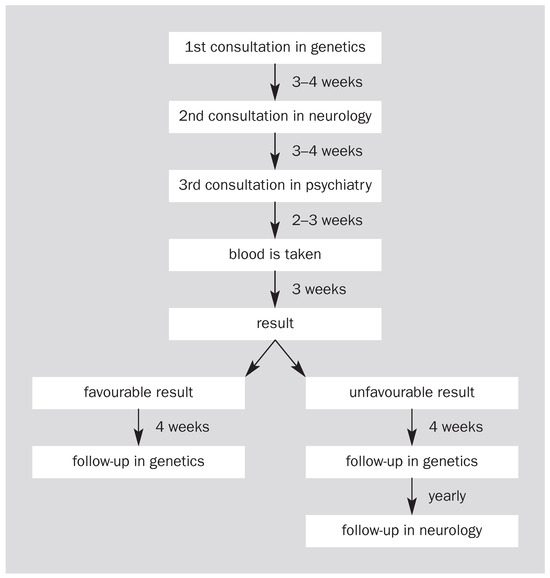
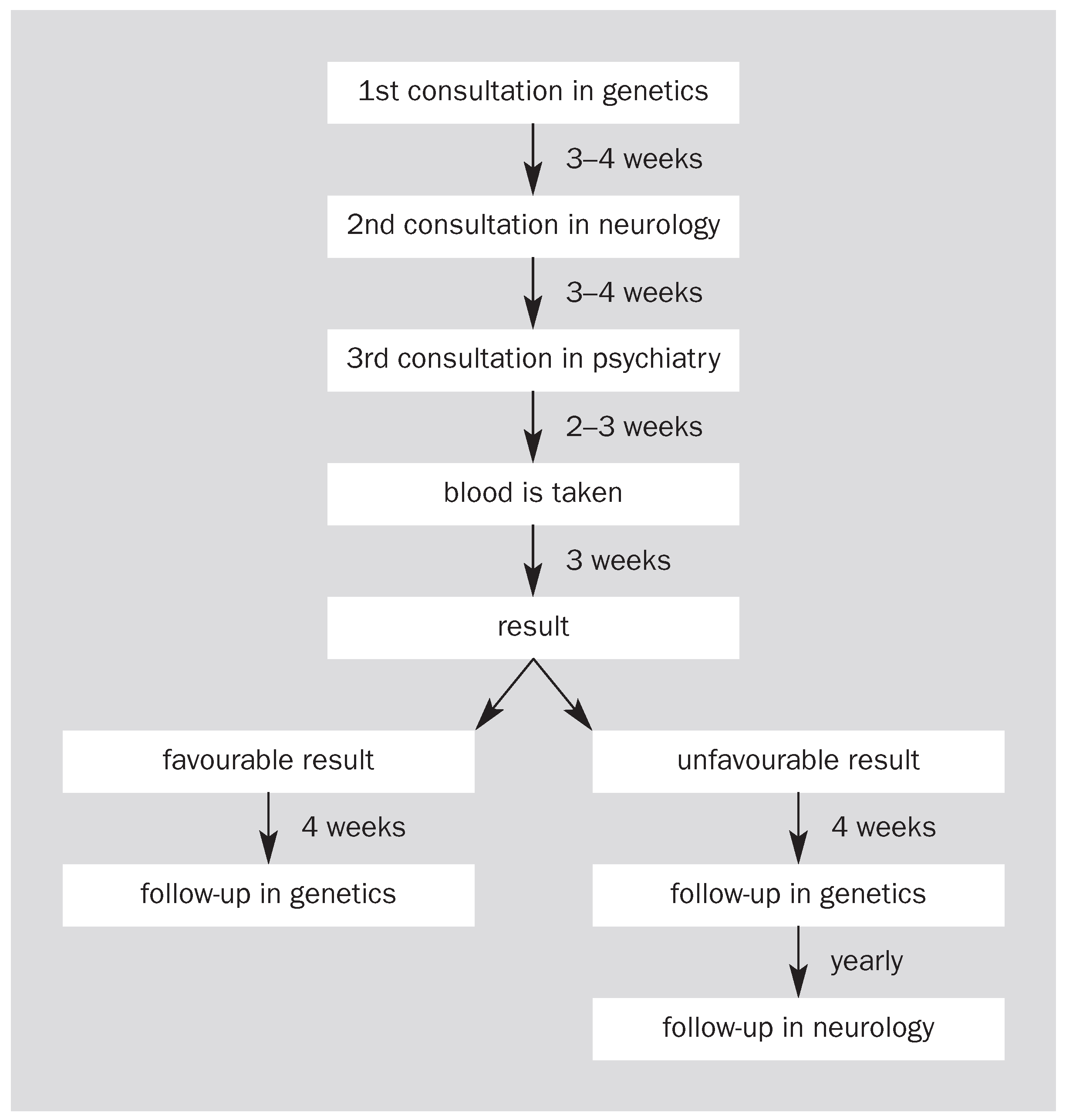
Several consultations spread over several weeks are recommended before testing (fig. 1). Individuals are informed that they can withdraw from the procedure at any time. It is also recommended that they come with a support person. Usually it is a relative and often the spouse.This person will be involved in the predictive testing procedure but might also be involved in the individual’s care once they present symptoms.
Figure 1.
The different steps of the predictive testing protocol for Huntington’s disease.
1st consultation: It is usually led by genetic professionals and includes collection of personal and family history, discussions about the individual’s knowledge of the test, information about the test itself and its limitations, discussions about the individual’s motivations for undergoing the test and coping mechanisms.
2nd consultation: It takes place 3 to 4 weeks after the first consultation and it is an appointment with the neurologists in order to explore the clinical features of the disease and to discuss the individual’s concerns.A clinical examination is proposed.
3rd consultation: Exclusion of a major psychiatric condition. This consultation takes place 3 to 4 weeks after the second one.
4th and 5th consultations: Blood is taken for molecular testing and results are disclosed in a face-to-face session.
Follow-up: Follow-up and support should be planned in advance and other counselling sessions should be available if the individual asks for them.
We recommend at least a follow-up appointment one month after the test independently of its outcome. If the result is unfavourable, the individual is encouraged to regularly have a neurological follow-up. The genetic staff remains available for follow-up either by formal consultations or informally, by telephone calls.
Published reports have shown that individuals have gained from this apparently complex procedure. Individuals who have had extensive pre-test counselling cope better with the test results. As mentioned before, pre-test emotional state is a predictor of the individual’s post-test reaction. Therefore, some authors argue that the test protocol should include a pre-test assessment of the emotional state of the individual [14]. Studies have shown that 2% of carriers and 0.3% of noncarriers experienced a catastrophic event during follow-up [15]. However, of those experiencing a catastrophic event the majority were symptomatic for the disease suggesting that the onset of Huntington’s disease is a contributing factor.A survey indicated that 38% of those who experienced a tragic event after receiving an unfavourable test result had a prior psychiatric history [16]. Patients displaying symptoms of depression should be treated before undergoing predictive testing for Huntington’s disease. It is important to emphasise that predictive testing does not increase distress above levels generally found in those with Huntington’s disease [6]. Data have shown that 5 years after the test individuals do not show evidence of abnormal high level of emotional distress [6].
Conclusion
After the period of adjustment individuals who had the test and know that they are at higher risk for a disease are less distressed than those who chose to live in uncertainty [14]. By following the internationally accepted guidelines, the clinicians are likely to avoid the major pitfalls associated with predictive testing, acting thus to the patient’s benefits. By providing information and decisionmaking support, genetic counselling plays an important role in the process of careful forethought before performing such testing. However, a pluridisciplinary approach is essential in order to address the multiple facets of predictive testing. The test should be practised under a structured and collaborative procedure that has been inspired by the protocol for Huntington’s disease testing proposed by the UK Huntington’s Prediction Consortium. The Departments of Neurology and Medical Genetics at the CHUV apply a protocol for predictive Huntington’s disease testing based on these international guidelines and as recommended, we are working together in order to widen this procedure to other neurodegenerative disorders.
References
- Evans, J.P.; Skrzynia, C.; Burke, W. The complexities of predictive genetic testing. Br. Med. J. 2001, 322, 1052–1056. [Google Scholar] [CrossRef] [Scilit] [PubMed]
- Ball, D.; Tyler, A.; Harper, P. Predictive testing of adults and children. Lessons from Huntington’s disease. In Genetic Counselling: Practice and Principles; Clarke, A., Ed.; Routledge: London, UK, 1994; pp. 63–94. [Google Scholar]
- Durr, A.; Gargiulo, M.; Feingold, J. Predictive testing: presymptomatic diagnosis in neurogenetic disorders. Med. Sci. 2005, 21, 934–939. [Google Scholar]
- Burson, C.M.; Markey, K.R. Genetic counselling issues in predictive testing for familial adult-onset neurologic diseases. Semin. Paediatr. Neurol. 2001, 8, 177–186. [Google Scholar] [CrossRef] [Scilit] [PubMed]
- Taylor, C.A.; Myers, R.H. Long-term impact of Huntington’s disease linkage testing. Am. J. Med. Genet. 1997, 70, 365–370. [Google Scholar] [CrossRef]
- Decruyenaere, M.; Evers-Kiebooms, G.; Cloostermans, T.; Boogaerts, A.; Demyttenaere, K.; Dom, R.; et al. Psychological distress in the 5-year period after predictive testing for Huntington’s disease. Eur. J. Hum. Genet. 2003, 11, 30–38. [Google Scholar] [CrossRef] [Scilit] [PubMed]
- Working Party of the Clinical Genetics Society (UK). The genetic testing of children. J. Med. Genet. 1994, 31, 785–797. [Google Scholar]
- Hogben, S.; Boddington, P. Policy recommendations for carrier testing and predictive testing in childhood: a distinction that makes a real difference. J. Genet. Couns. 2005, 14, 271–281. [Google Scholar] [CrossRef] [PubMed]
- Forrest, K.; Simpsom, S.A.; Wilson, B.J.; van Teijlingen, E.R.; Mc Kee, L.; Haites, N.; et al. To tell or not to tell: barriers and facilitators in family communication about genetic risk. Clin. Genet. 2003, 64, 317–326. [Google Scholar] [CrossRef] [Scilit] [PubMed]
- Harper, P.S.; Lim, C.; Craufurd, D. Ten years of presymptomatic testing for Huntington’s disease: the experience of the UK Huntington’s Disease Prediction Consortium. J. Med. Genet. 2000, 37, 567–571. [Google Scholar] [CrossRef] [Scilit]
- Skirton, H.; Patch, C. Genetics for Healthcare Professionals: a lifestage approach; Bios: Oxford, UK, 2002. [Google Scholar]
- The Huntington’s Disease Collaborative Research Group. A novel gene containing a trinucleotide repeat that is expanded and unstable on Huntington’s disease chromosomes. Cell 1993, 72, 971–983. [Google Scholar] [CrossRef] [Scilit]
- Craufurd, D.; Tyler, A. on behalf of the Huntington’s Prediction Consortium. Predictive testing for Huntington’s disease: protocol of the UK Huntington’s Prediction Consortium. J. Med. Genet. 1992, 29, 915–918. [Google Scholar] [CrossRef] [Scilit] [PubMed]
- Broadstock, M.; Michie, S.; Marteau, T. Psychological consequences of predictive genetic testing: a systematic review. Eur. J. Hum. Genet. 2000, 8, 731–738. [Google Scholar] [CrossRef] [Scilit] [PubMed]
- Bird, T.D. Outrageous fortune: the risk of suicide in genetic testing for Huntington’s disease. Am. J. Hum. Genet. 1999, 64, 1289–1292. [Google Scholar] [CrossRef] [Scilit] [PubMed]
- Almqvist, E.W.; Bloch, M.; Brinkman, R.; Craufurd, D.; Hayden, M.R. A worldwide assessment of the frequency of suicide, suicide attempts, or psychiatric hospitalization after testing for Huntington’s disease. Am. J. Hum. Genet. 1999, 64, 1294–1304. [Google Scholar] [CrossRef] [Scilit]
Annexe 1
Loi sur l’Analyse Génétique Humaine (this law can be found in its full version as well as in its German version in the following websites: http://www.admin.ch/ch/d/ff/2004/5483.pdf and http://www.admin.ch/ch/f/ff/2004/5145.pdf). Some of the relevant articles are shown below.
Section 1 Champ d’application, but et definitions
Art. 2 But
La présente loi a pour but:
- a)
- d’assurer la protection de la dignité humaine et de la personnalité;
- b)
- de prévenir les analyses génétiques abusives et l’utilisation abusive des données génétiques;
- c)
- de garantir la qualité des analyses génétiques et de l’interprétation de leurs résultats.
Section 3 Analyses génétiques dans le domaine medical
Art. 13 Droit de prescrire une analyse génétique
- 1
- Une analyse génétique ne peut être prescrite que par un médecin habilité à exercer à titre indépendant ou sous la surveillance d’un tel médecin.
- 2
- Une analyse génétique présymptomatique, une analyse génétique prénatale ou une analyse visant à établir un planning familial ne peut être prescrite que par un médecin ayant une formation postgrade adéquate ou par un médecin qui, dans le cadre d’une formation postgrade, exerce sous la surveillance d’un médecin ayant une formation postgrade adéquate.
- 3
- Le médecin qui prescrit une analyse génétique selon l’al. 2 vieille à ce que la personne concernée reçoive un conseil génétique.
Art. 14 Conseil génétique en general
- 1
- Une analyse génétique présymptomatique, une analyse génétique prénatale ou une analyse visant à établir un planning familial doit être précédée et suivie d’un conseil génétique non directif donné par une personne qualifiée. L’entretien doit être consigné.
- 2
- Le conseil porte uniquement sur la situation individuelle et familiale de la personne concernée; il ne doit pas prendre en considération l’intérêt général. Il doit tenir compte des répercussions psychiques et sociales des résultats de l’analyse dont elle et sa famille pourraient souffrir.
- 3
- La personne concernée ou, si elle est incapable de discernement, son représentant légal doit notamment être informée sur:
- a)
- le but, le type et la signification de l’analyse ainsi que sur les mesures complémentaires;
- b)
- les risques possibles liés à l’analyse ainsi que la fréquenceet le type des anomalies à détecter;
- c)
- la possibilité de découvrir des résultats inattendus;
- d)
- les répercussions physiques et psychiques possibles de l’analyse;
- e)
- la prise en charge des coûts de l’analyse et des mesures complémentaires;
- f)
- les mesures de soutien possibles en fonction des résultats de l’analyse;
- g)
- l’importance des anomalies qui peuvent être découvertes et les mesure thérapeutiques et prophylactiques envisageables
- 4
- Un temps de réflexion adéquat doit s’écouler entre leconseil et l’exécution de l’analyse.
- 5
- Dans les cas de dépistage, le conseil est adapté aux circonstances.
Art. 18 Droit de la personne concernée à l’autodétermination
- 1
- Après avoir été informée de manière circonstanciée, la personne concernée décide librement:
- a)
- si elle entend se soumettre à une analyse génétique ou à une analyse prénatale et, le cas échéant, à une analyse complémentaire;
- b)
- si elle veut prendre connaissance des résultats de l’analyse;
- c)
- de la suite qu’elle veut donner aux résultats de l’analyse.
- 2
- Le médecin doit communiquer immédiatement les résultats de l’analyse à la personne concernée s’il a constaté un danger physique imminent pour celle-ci, pour l’embryon ou pour le foetus, qui pourrait être écarté.
- 3
- Le consentement à une analyse génétique présymptomatique, à une analyse génétique prénatale ou à une analyse visant à établir un planning familial doit être donné par écrit, sauf s’il s’agit d’un dépistage.
- 4
- Lorsque la personne concernée est incapable de discernement, la décision appartient à son représentant légal.
Art. 19 Communication de données génétiques
- 1
- Le médecin ne peut communiquer les résultats d’une analyse génétique qu’à la personne concernée ou, si elle est incapable de discernement, à son représentant légal.
- 2
- Il peut, avec le consentement exprès de la personne concernée, communiquer les résultats aux membres de sa famille, à son conjoint ou à son partenaire.
- 3
- Si la personne concernée refuse son consentement, le médecin peut demander à l’autorité cantonale compétente d’être délié du secret professionnel, conformément à l’art. 321, ch. 2, du code pénal 6, lorsque la protection d’intérêts prépondérants des membres de la famille, du conjoint ou du partenaire nécessite que ceux-ci soient informés.L’autorité peut solliciter l’avis de la Commission d’experts pour l’analyse génétique humaine.
Section 5 Analyses génétiques dans le domaine de l’assurance
Art. 26 Interdiction d’exiger une analyse Une institution d’assurance ne peut exiger préalablement à l’établissement d’un rapport d’assurance une analyse génétique présymptomatique ou une analyse génétique prénatale.
Art. 27 Interdiction d’exiger ou d’utiliser les résultats d’une analyse déjà effectuée
- 1
- Une institution d’assurance ne peut exiger du preneur d’assurance les résultats d’une analyse génétique présymptomatique, d’une analyse génétique prénatale ou d’une analyse visant à établir un planning familial qui ont déjà été effectuées, ni utiliser les résultats de telles analyses, lorsqu’il s’agit:
- a)
- des assurances entièrement ou partiellement régies par la loi fédérale du 6 octobre 2000 sur la partie générale du droit des assurances sociales 10;
- b)
- de la prévoyance professionnelle dans les domaines obligatoire et surobligatoire;
- c)
- des assurances contractées au titre de l’obligation de verser le salaire en cas de maladie ou de maternité;
- d)
- des assurances sur la vie portant sur une somme d’assurance de 400 000 francs au plus;
- e)
- des assurances-invalidité facultatives allouant une rente annuelle de 40 000 francs au plus.
- 2
- Si une personne conclut plusieurs assurances sur la vie ou plusieurs assurances invalidité, les sommes maximales selon l’al. 1, let. d et e, valent pour la totalité des contrats. Le preneur d’assurance doit donner à l’institution d’assurance les informations afférentes que celle-ci lui demande.
Art. 28 Autorisation d’exiger ou d’utiliser les résultats d’une analyse génétique présymptomatique déjà effectuée
- 1
- Avant la conclusion d’un contrat d’assurance privée qui ne tombe pas sous le coup de l’art. 27, une institution d’assurance ne peut, par l’intermédiaire du médecin qu’elle a mandaté, exiger les résultats d’une analyse génétique présymptomatique déjà effectuée que si:
- a)
- les résultats de l’analyse sont fiables sur les plans de la technique et de la pratique médicale;
- b)
- la valeur scientifique des résultats de l’analyse pour le calcul des primes a été prouvée.
- 2
- Le médecin mandaté communique uniquement à l’institution d’assurance dans quel groupe à risque le preneur d’assurance doit être classé.
- 3
- Le médecin mandaté ne peut conserver les résultats de l’analyse que s’ils sont pertinents pour la conclusion du contrat d’assurance.
- 4
- Les résultats de l’analyse ne peuvent être utilisés qu’aux fins pour lesquelles ils ont été demandés au preneur d’assurance avant la conclusion du contrat.
This is an open-access article distributed under the terms of the Creative Commons Attribution Non-Commercial No Derivatives (CC BY-NC-ND) 4.0 License.