


Summary
It is now clearly established that the FMR1 gene is associated with two distinct pathogenic mechanisms: loss and gain of function. The “loss of function” of the FMR1 gene leads to the absence of FMRP protein (coded by FMR1). This lack of FMRP is responsible for the fragile X syndrome (FXS), which is the most common cause of inherited mental retardation. On the other hand, the toxic “gain of function” of FMR1 is responsible for two late onset disorders: premature ovarian failure and fragile X-associated tremor/ataxia syndrome (FXTAS) which was reported for the first time in 2001. The core clinical features of FXTAS are progressive cerebellar gait ataxia and intention tremor; associated features include neuropsychiatric abnormalities, parkinsonism, autonomic dysfunction and peripheral neuropathy. Cognitive changes range from mild frontal executive and memory deficits to global dementia. Neuroradiological features of FXTAS include prominent white-matter disease in the periventricular, subcortical and middle cerebellar peduncles (MCPs) on T2-weighted MR imaging.The principal neuropathologic characteristic of FXTAS are eosinophilic, ubiquitin-positive inclusions located in the nuclei of neurons and astrocytes in broad distribution throughout the brain and spinal column. There is prominent white-matter involvement with patchy loss of axons, myelin and associated astroglial cells. Recent studies suggest that the penetrance and severity of the neurological disorder is a function of the number of CGG repeats; namely that the penetrance among carriers of larger premutation alleles is greater than among carriers of smaller premutation alleles. Screening for the FMR1 premutation in populations of patients with movement disorders found that the frequency of premutation alleles was 13 times greater (OR = 12.4; 95% CI: 1.6, 93.5) in patients with cerebellar ataxia (16/1049) than expected based on its prevalence in the general population (2%; 16/818 for age-of-onset >50 years of age). As the FMR1- related phenotypes expand, genetic counselling for fragile X families becomes increasingly complex. Clinicians should inform their patients that their relatives are at risk for a variety of disorders including movement disorder and premature ovarian failure. In addition, women of child-bearing age are at risk of having a child with FXS and they should systematically be referred to a geneticist.
Introduction
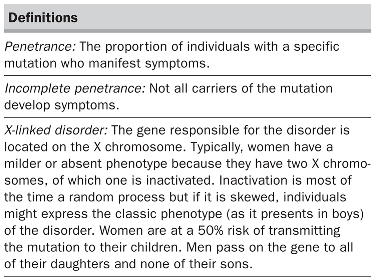
Recent advances in the fragile X field have yielded a broader understanding of the clinical and molecular manifestations of the CGG-repeat expansion mutations in the 5’UTR region FMR1 gene. It is now clearly established that the FMR1 gene is responsible for two distinct pathogenic mechanisms: loss and gain of function.The “loss of function” of the FMR1 gene leads to the absence of FMRP protein (coded by FMR1). This lack of FMRP is responsible for the fragile X syndrome (FXS), which is the most common cause of inherited mental retardation. On the other hand, the toxic “gain of function” of FMR1 is responsible for two late onset disorders: premature ovarian failure and fragile X-associated tremor/ataxia syndrome (FXTAS).
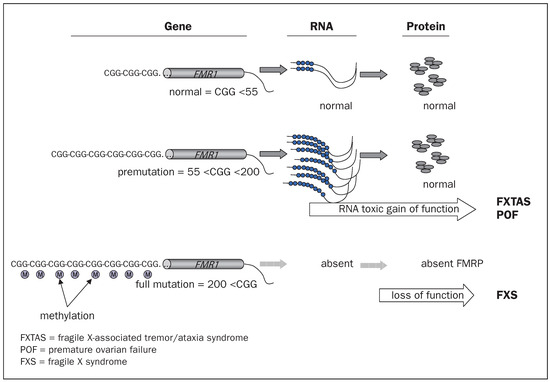
Normal loss or gain of function is governed by the size of the CGG-repeat sequence in the FMR1 gene (fig. 1) [1,2]. This CGG-repeat sequence is stably transmitted in the normal range (5 to 44 repeats). Full mutation alleles (>200 repeats) are associated with gene methylation and transcriptional silencing. The resulting low to absent levels of FMR1protein (FMRP) give rise to fragile X syndrome. Premutation alleles (55 to 200 CGG repeats [3]) are unstable and often expand to full mutation alleles when transmitted maternally. Gray-zone expansions (45 to 54 repeats) are only mildly unstable and require at least two generations before evolving into a full mutation.
Figure 1.
Length of the CGG repeat and associated disorders.
The premutation allele
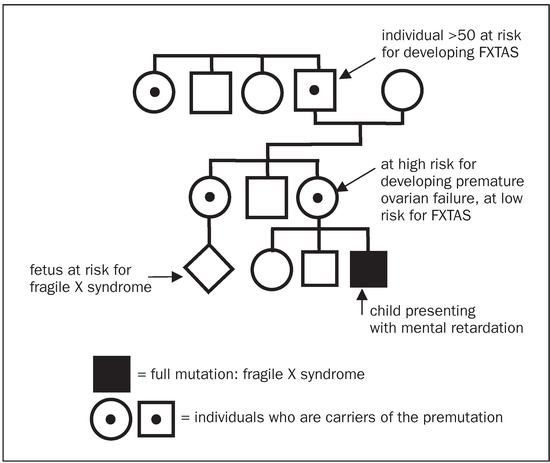
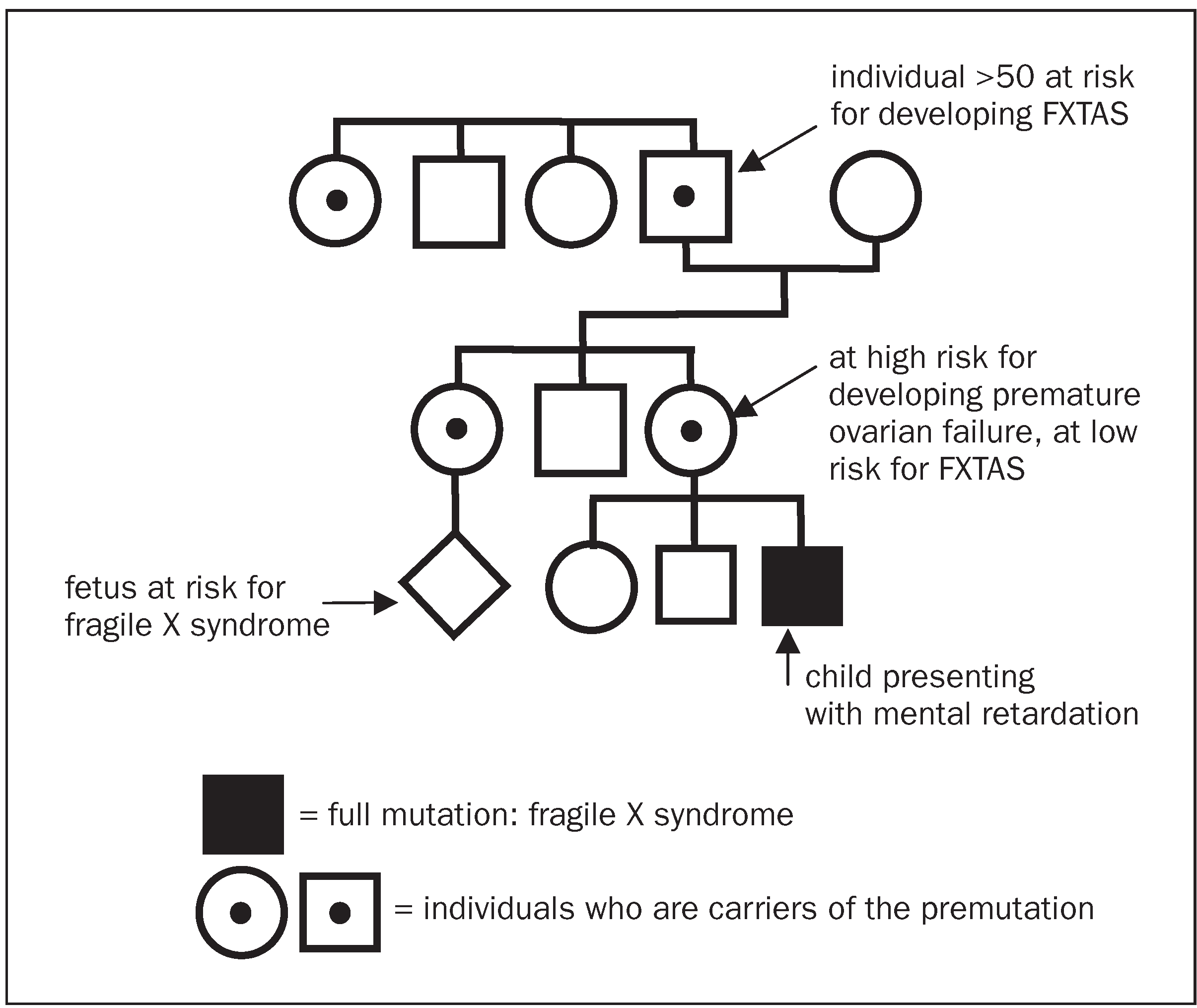
The premutation range (55 to 200 CGG repeats) was defined from the perspective of genetic counselling, not based on the presence or absence of a clinical phenotype (fig. 2). Alleles in the premutation range are unstable upon maternal transmission [4], thus female premutation carriers are at risk of transmitting a full mutation allele and their children are at risk of mental retardation. One could predict, therefore, that the range of allele sizes later found to be associated with clinical pathology, i.e. fragile X-associated tremor/ataxia syndrome and premature ovarian failure (POF), may differ from the originally defined premutation range.
Figure 2.
When an individual is diagnosed with an FMR1 full mutation or premutation, relatives are at risk for different disorders associated with the CGG expansion. It is important that they have access to genetic counselling.
The smallest allele reported to expand, in one generation, to a full mutation is 59 repeats [4]. Alleles between 50 to 58 repeats, however, are also unstable and can give rise to a full mutation in two or more generations [4].We recommend using the boundaries set by the American College of Medical Genetics: 55 to 200 CGG repeats [3]. Based on this definition, the prevalence of the premutation is estimated to be 1/813 in males and 1/259 in females [5,6]. However, prevalence varies among ethnic groups, e.g. lower in Asians [7] and higher in populations of Mediterranean origin (1/157) [8,9].
FXTAS: clinical, radiological and pathological presentation
In the past decade female carriers have been shown to be at risk for premature ovarian failure; more recently, it has become clear that premutation carriers (especially males) are at risk of developing a neurodegenerative disorder: FXTAS [10,11,12]. FXTAS has been described in females but it seems to occur only in rare cases [13]. This disorder is completely distinct from the fragile X syndrome, and these individuals have a normal development before the onset of FXTAS.
The core clinical features of FXTAS are progressive cerebellar gait ataxia and intention tremor; associated features include neuropsychiatric abnormalities, parkinsonism, autonomic dysfunction and peripheral neuropathy [10,11]. Cognitive changes range from mild frontal executive and memory deficits to global dementia [14]. Common psychiatric symptoms include anxiety, agitation, hostility and depression [15,16]. Neuroradiological features of FXTAS include prominent whitematter disease in the periventricular, subcortical and middle cerebellar peduncles (MCPs) on T2- weighted MR imaging [17]. Increased signal intensities of the middle cerebellar peduncles are a distinctive and frequent feature of FXTAS [10,17,18]. Global brain atrophy is most evident in the frontal and parietal regions, as well as in the pons and cerebellum; the degree of brain atrophy is associated with the presence and severity of tremor and ataxia, and CGG-repeat size [17,19,20].
The principal neuropathologic characteristic of FXTAS are eosinophilic, ubiquitin-positive inclusions located in the nuclei of neurons and astrocytes in broad distribution throughout the brain and spinal column [21]. The inclusions are tau- and α-synuclein negative, and contain FMR1 mRNA [22], which is thought to exert a direct toxic gain-of-function effect leading to FXTAS [23]. There is prominent white-matter involvement with patchy loss of axons, myelin and associated astroglial cells. Nearly all cases studied have shown spongiosis of the middle cerebellar peduncles and loss of Purkinje cells [21,24].
Penetrance and prevalence of FXTAS: estimates
A study of the penetrance of tremor and ataxia among adult premutation carriers, ascertained through families with known probands with fragile X syndrome, revealed that over one-third of male carriers over age 50 had both symptoms [11]. Moreover, the penetrance increased with age, exceeding 50% for men in their 70s and 80s. More recent studies suggest that the penetrance and severity of the neurological disorder is a function of the number of CGG repeats; namely that the penetrance among carriers of larger premutation alleles is greater than among carriers of smaller premutation alleles [25]. In addition, there are now several studies reporting correlations between CGG length and FXTAS symptoms. Greco et al. [21] reported a strong correlation between repeat size and frequency of intranuclear inclusions, and an inverse correlation between repeat size and age at death. Finally, post-mortem studies of three carrier males with small CGG-repeat expansions, in the 60–69-repeat range, showed only minimal neuropathologic findings of FXTAS [21].
Taken together, these data suggest that the symptoms of FXTAS are typically, albeit not exclusively, associated with repeat expansions ≥70. There are no data on the upper limit beside the fact that FXTAS has not been described in the full mutation range. Thus, considering that only a portion of the premutation alleles in the general population (~1/800 males) [9,10] are likely to lead to FXTAS, the predicted lifetime cumulated risk of developing FXTAS among men in the general population would be about one in 8000 [25]. This is much less common than Parkinson’s disease or essential tremor and is similar in prevalence to inherited ataxia, progressive supranuclear palsy, multiple system atrophy and amyotrophic lateral sclerosis [26].
Identifying FXTAS patients in neurology clinics
Without a family history of fragile X or mental retardation, the great variation in clinical presentation will make it challenging to diagnose patients with FXTAS (table 1). Its heterogeneous clinical presentation was recorded by Hall et al. [27] who carried out a retrospective analysis of prior diagnoses given to FXTAS patients before the syndrome was delineated. The diagnoses ranged from primary Parkinson’s disease to depression; most were in the categoriesof parkinsonism (24%), tremor (20%), ataxia (17%), dementia (13%) and cerebrovascular disease (10%).
Table 1.
FMR1 screening criteria for adults seen in neurology clinics.
Screening for the FMR1 premutation in populations of patients with movement disorders found that the frequency of premutation alleles was 13 times greater (OR = 12.4; 95% CI: 1.6, 93.5) in patients with cerebellar ataxia (16/1049) than expected based on its prevalence in the general population (2%; 16/818 for age-of-onset >50 years of age) [25]. Five carriers of premutation alleles were also identified among 663 patients with a prior diagnosis of multiple system atrophy; 2–3% of patients diagnosed with the cerebellar subtype of probable multiple system atrophy likely had FXTAS as the cause of their symptoms [28,29,30]. Premutation alleles were absent in the other diagnostic groups studied, e.g. Parkinson’s disease and essential tremor [25].
These screening studies are likely to underestimate the true prevalence of FXTAS as a cause of late-onset ataxia in males. Hall et al. [27] reported that only ~4% of persons with FXTAS were evaluated by movement disorders neurologists; and that only one out of 70 patients with FXTAS underwent spinocerebellar ataxia genetic testing, which was the ascertainment method used by the ataxia screening studies. Patients ascertained through the ataxia screening studies thus represent only a small subgroup of FXTAS patients, those that had cerebellar ataxia as a prominent component of their clinical presentation and were tested (negative) for genetic spinocerebellar ataxia.
Recently, we have diagnosed two patients through a family history of fragile X syndrome (unpublished data). Their medical records show that case 1 had been seen by a movement disorder specialist for intention tremor and case 2 enrolled in a study on dementia. Despite the fact that they reported falling, in no instance was it noted that they presented gait ataxia because this was not a prominent symptom. At present, FXTAS is an underrecognised disorder and its contribution to the morbidity and mortality of the aging population is unclear. However, it may be one of the most common single gene forms of tremor and ataxia in the aging population.
FXTAS: a toxic non-coding RNA
FXTAS is the new member of an expanding group of neurodegenerative disorders caused by noncoding mRNA expansion mutations with a dominant negative effect (myotonic dystrophy, spinocerebellar ataxia type 8 [SCA8], SCA10, SCA12, and Huntington’s disease-like 2) [31]. There is growing support for a model in which alleles in the premutation range can cause FXTAS and premature ovarian failure through an RNA gainof- function mechanism [23,32]. Consistent with this model, expanded CGG repeat-containing mRNA is found in the neuronal and astrocytic intranuclear inclusions obtained from postmortem brains of patients with FXTAS [22].
Further evidence of an RNA-based toxicity comes from studies of Drosophila in which a CGG repeat in the premutation range was expressed as RNA in the context of a reporter gene. The flies developed neurodegeneration (of the eye) as well as the presence of inclusions [33]. Furthermore, knock-in mice with an expanded (~100 CGG repeat) FMR1 gene showed cognitive and behavioural impairment as well as ubiquitin-positive intranuclear inclusions [33,34,35].
Genetic counselling
As the FMR1-related phenotype expands, genetic counselling for fragile X families becomes increasingly complex. Diagnosis of an individual with a full mutation or a premutation has many consequences for family members (fig. 2). Clinicians should inform their patients that relatives are at risk for a variety of disorders including movement disorder and premature ovarian failure. In addition,women of child-bearing age may be at risk of having a child with FXS. Patients are often overwhelmed by the task of informing family members.They should be encouraged and supported through this process and should be systematically referred to a geneticist. Subsequent testing in family members is recommended, particularly for siblings of the proband, relatives who have developmental or emotional problems and women of child-bearing age (fig. 2) [36].
References
- Oberle, I.; Rousseau, F.; Heitz, D.; Kretz, C.; Devys, D.; Hanauer, A.; et al. Instability of a 550-base pair DNA segment and abnormal methylation in fragile X syndrome. Science 1991, 252, 1097–1102. [Google Scholar] [CrossRef] [Scilit]
- Verkerk, A.J.; Pieretti, M.; Sutcliffe, J.S.; Fu, Y.H.; Kuhl, D.P.; Pizzuti, A.; et al. Identification of a gene (FMR-1) containing a CGG repeat coincident with a breakpoint cluster region exhibiting length variation in fragile X syndrome. Cell 1991, 65, 905–914. [Google Scholar] [CrossRef] [Scilit]
- Maddalena, A.; Richards, C.S.; McGinniss, M.J.; Brothman, A.; Desnick, R.J.; Grier, R.E.; et al. Technical standards and guidelines for fragile X: the first of a series of diseasespecific supplements to the Standards and Guidelines for Clinical Genetics Laboratories of the American College of Medical Genetics. Quality Assurance Subcommittee of the Laboratory Practice Committee. Genet. Med. 2001, 3, 200–205. [Google Scholar] [PubMed]
- Nolin, S.L.; Brown, W.T.; Glicksman, A.; Houck, G.E., Jr.; Gargano, A.D.; Sullivan, A.; et al. Expansion of the fragile X CGG repeat in females with premutation or intermediate alleles. Am. J. Hum. Genet. 2003, 72, 454–464. [Google Scholar] [CrossRef] [Scilit] [PubMed]
- Dombrowski, C.; Levesque, S.; Morel, M.L.; Rouillard, P.; Morgan, K.; Rousseau, F. Premutation and intermediatesize FMR1 alleles in 10572 males from the general population: loss of an AGG interruption is a late event in the generation of fragile X syndrome alleles. Hum. Mol. Genet. 2002, 11, 371–378. [Google Scholar] [CrossRef] [Scilit]
- Rousseau, F.; Rouillard, P.; Morel, M.L.; Khandjian, E.W.; Morgan, K. Prevalence of carriers of premutation-size alleles of the FMRI gene – and implications for the population genetics of the fragile X syndrome. Am. J. Hum. Genet. 1995, 57, 1006–1018. [Google Scholar]
- Tzeng, C.C.; Tsai, L.P.; Hwu, W.L.; Lin, S.J.; Chao, M.C.; Jong, Y.J.; et al. Prevalence of the FMR1 mutation in Taiwan assessed by large-scale screening of newborn boys and analysis of DXS548-FRAXAC1 haplotype. Am. J. Med. Genet. A 2005, 133, 37–43. [Google Scholar] [CrossRef] [Scilit] [PubMed]
- Toledano-Alhadef, H.; Basel-Vanagaite, L.; Magal, N.; Davidov, B.; Ehrlich, S.; Drasinover, V.; et al. Fragile-X carrier screening and the prevalence of premutation and fullmutation carriers in Israel. Am. J. Hum. Genet. 2001, 69, 351–360. [Google Scholar] [CrossRef] [Scilit]
- Pesso, R.; Berkenstadt, M.; Cuckle, H.; Gak, E.; Peleg, L.; Frydman, M.; et al. Screening for fragile X syndrome in women of reproductive age. Prenat. Diagn. 2000, 20, 611–614. [Google Scholar] [CrossRef] [Scilit]
- Jacquemont, S.; Hagerman, R.J.; Leehey, M.; Grigsby, J.; Zhang, L.; Brunberg, J.A.; et al. Fragile X premutation tremor/ ataxia syndrome: molecular, clinical, and neuroimaging correlates. Am. J. Hum. Genet. 2003, 72, 869–878. [Google Scholar] [CrossRef] [Scilit]
- Jacquemont, S.; Hagerman, R.J.; Leehey, M.A.; Hall, D.A.; Levine, R.A.; Brunberg, J.A.; et al. Penetrance of the fragile X-associated tremor/ataxia syndrome in a premutation carrier population. Jama 2004, 291, 460–469. [Google Scholar] [CrossRef] [Scilit] [PubMed]
- Hagerman, R.J.; Leehey, M.; Heinrichs, W.; Tassone, F.; Wilson, R.; Hills, J.; et al. Intention tremor, parkinsonism, and generalized brain atrophy in male carriers of fragile X. Neurology 2001, 57, 127–130. [Google Scholar] [CrossRef] [Scilit] [PubMed]
- Hagerman, R.J.; Leavitt, B.R.; Farzin, F.; Jacquemont, S.; Greco, C.M.; Brunberg, J.A.; et al. Fragile-X-associated tremor/ ataxia syndrome (FXTAS) in females with the FMR1 premutation. Am. J. Hum. Genet. 2004, 74, 1051–1056. [Google Scholar] [CrossRef] [Scilit] [PubMed]
- Grigsby, J.; Brega, A.G.; Jacquemont, S.; Loesch, D.Z.; Leehey, M.A.; Goodrich, G.K.; et al. Impairment in the cognitive functioning of men with fragile X-associated tremor/ataxia syndrome (FXTAS). J. Neurol. Sci. 2006. [Google Scholar] [CrossRef] [Scilit] [PubMed]
- Bacalman, S.; Farzin, F.; Bourgeois, J.A.; Cogswell, J.; Goodlin-Jones, B.L.; Gane, L.W.; et al. Psychiatric phenotype of the fragile X-associated tremor/ataxia syndrome (FXTAS) in males: newly described fronto-subcortical dementia. J. Clin. Psychiatry 2006, 67, 87–94. [Google Scholar] [CrossRef] [Scilit] [PubMed]
- Hessl, D.; Tassone, F.; Loesch, D.Z.; Berry-Kravis, E.; Leehey, M.A.; Gane, L.W.; et al. Abnormal elevation of FMR1 mRNA is associated with psychological symptoms in individuals with the fragile X premutation. Am. J. Med. Genet. B Neuropsychiatr. Genet. 2005, 139, 115–121. [Google Scholar] [CrossRef] [Scilit]
- Brunberg, J.A.; Jacquemont, S.; Hagerman, R.J.; Berry-Kravis, E.M.; Grigsby, J.; Leehey, M.A.; et al. Fragile X premutation carriers: characteristic MR imaging findings of adult male patients with progressive cerebellar and cognitive dysfunction. AJNR Am. J. Neuroradiol. 2002, 23, 1757–1766. [Google Scholar]
- Jacquemont, S.; Farzin, F.; Hall, D.; Leehey, M.; Tassone, F.; Gane, L.; et al. Aging in individuals with the FMR1 mutation. Am. J. Ment. Retard. 2004, 109, 154–164. [Google Scholar] [CrossRef] [Scilit] [PubMed]
- Loesch, D.Z.; Churchyard, A.; Brotchie, P.; Marot, M.; Tassone, F. Evidence for, and a spectrum of, neurological involvement in carriers of the fragile X pre-mutation: FXTAS and beyond. Clin. Genet. 2005, 67, 412–417. [Google Scholar] [CrossRef] [Scilit]
- Cohen, S.; Masyn, K.; Adams, J.; Hessl, D.; Rivera, S.; et al. Molecular and imaging correlates of the fragile X-associated tremor ataxia syndrome. Neurology 2006, 67, 1426–1431. [Google Scholar] [CrossRef] [Scilit] [PubMed]
- Greco, C.M.; Berman, R.F.; Martin, R.M.; Tassone, F.; Schwartz, P.H.; Chang, A.; et al. Neuropathology of fragile X-associated tremor/ataxia syndrome (FXTAS). Brain 2006, 129, 243–255. [Google Scholar] [CrossRef] [Scilit] [PubMed]
- Tassone, F.; Hagerman, R.J.; Garcia-Arocena, D.; Khandjian, E.W.; Greco, C.M.; Hagerman, P.J. Intranuclear inclusions in neural cells with premutation alleles in fragile X associated tremor/ataxia syndrome. J. Med. Genet. 2004, 41, e43. [Google Scholar] [CrossRef] [Scilit] [PubMed]
- Hagerman, P.J.; Hagerman, R.J. The fragile-X premutation: a maturing perspective. Am. J. Hum. Genet. 2004, 74, 805–816. [Google Scholar] [CrossRef] [Scilit] [PubMed]
- Greco, C.M.; Hagerman, R.J.; Tassone, F.; Chudley, A.E.; Del Bigio, M.R.; Jacquemont, S.; et al. Neuronal intranuclear inclusions in a new cerebellar tremor/ataxia syndrome among fragile X carriers. Brain 2002, 125, 1760–1771. [Google Scholar] [CrossRef] [Scilit]
- Jacquemont, S.; Leehey, M.A.; Hagerman, R.J.; Beckett, L.A.; Hagerman, P.J. Size bias of fragile X premutation alleles in late-onset movement disorders. J. Med. Genet. 2006. [Google Scholar] [CrossRef] [Scilit] [PubMed]
- Leehey, M.; Hagerman, P. Fragile X-associated Tremor/ Ataxia Syndrome (FXTAS). In Handbook of Clinical Neurology; Subramoney, S., Durr, A., Eds.; Elsevier: Amsterdam, New York, 2006. [Google Scholar]
- Hall, D.A.; Berry-Kravis, E.; Jacquemont, S.; Rice, C.D.; Cogswell, J.; Zhang, L.; et al. Initial diagnoses given to persons with the fragile X associated tremor/ataxia syndrome (FXTAS). Neurology 2005, 65, 299–301. [Google Scholar] [CrossRef] [Scilit]
- Biancalana, V.; Toft, M.; Le Ber, I.; Tison, F.; Scherrer, E.; Thibodeau, S.; et al. FMR1 premutations associated with fragile X-associated tremor/ataxia syndrome in multiple system atrophy. Arch. Neurol. 2005, 62, 962–966. [Google Scholar] [CrossRef] [Scilit] [PubMed]
- Kamm, C.; Healy, D.G.; Quinn, N.P.; Wullner, U.; Moller, J.C.; Schols, L.; et al. The fragile X tremor ataxia syndrome in the differential diagnosis of multiple system atrophy: data from the EMSA Study Group. Brain 2005, 128, 1855–1860. [Google Scholar] [CrossRef] [Scilit] [PubMed]
- Tan, E.K.; Zhao, Y.; Puong, K.Y.; Law, H.Y.; Chan, L.L.; Yew, K.; et al. Fragile X premutation alleles in SCA, ET, and parkinsonism in an Asian cohort. Neurology 2004, 63, 362–363. [Google Scholar] [CrossRef] [Scilit] [PubMed]
- Ranum, L.P.; Cooper, T.A. RNA-mediated neuromuscular disorders. Annu. Rev. Neurosci. 2006, 29, 259–277. [Google Scholar] [CrossRef] [Scilit] [PubMed]
- Willemsen, R.; Oostra, B.A.; Bassell, G.J.; Dictenberg, J. The fragile X syndrome: from molecular genetics to neurobiology. Ment. Retard. Dev. Disabil. Res. Rev. 2004, 10, 60–67. [Google Scholar] [CrossRef] [Scilit] [PubMed]
- Jin, P.; Zarnescu, D.C.; Zhang, F.; Pearson, C.E.; Lucchesi, J.C.; Moses, K.; et al. RNA-mediated neurodegeneration caused by the fragile X premutation rCGG repeats in Drosophila. Neuron 2003, 39, 739–747. [Google Scholar] [CrossRef] [Scilit]
- Willemsen, R.; Hoogeveen-Westerveld, M.; Reis, S.; Holstege, J.; Severijnen, L.A.; Nieuwenhuizen, I.M.; et al. The FMR1 CGG repeat mouse displays ubiquitin-positive intranuclear neuronal inclusions; implications for the cerebellar tremor/ataxia syndrome. Hum. Mol. Genet. 2003, 12, 949–959. [Google Scholar] [CrossRef] [Scilit] [PubMed]
- Van Dam, D.; Errijgers, V.; Kooy, R.F.; Willemsen, R.; Mientjes, E.; Oostra, B.A.; et al. Cognitive decline, neuromotor and behavioural disturbances in a mouse model for fragile-Xassociated tremor/ataxia syndrome (FXTAS). Behav. Brain Res. 2005, 162, 233–239. [Google Scholar] [CrossRef] [Scilit] [PubMed]
- McConkie-Rosell, A.; Finucane, B.; Cronister, A.; Abrams, L.; Bennett, R.L.; Pettersen, B.J. Genetic counseling for fragile X syndrome: updated recommendations of the National Society of Genetic Counselors. J. Genet. Couns. 2005, 14, 249–270. [Google Scholar] [CrossRef] [PubMed]


This is an open-access article distributed under the terms of the Creative Commons Attribution Non-Commercial No Derivatives (CC BY-NC-ND) 4.0 License.