


Summary
Up to 10% of healthy people complain about sleepiness during daytime. The results are reduced productivity and injuries at work or while driving a motor vehicle, which may lead to severe consequences for the afflicted and society in general. According to the official statistical police information in Switzerland only 1.4% of the motor vehicle crashes are attributed to sleepiness. This is in contrast to scientific research data from many industrial countries showing that at least 10 to 30% of all injuries are sleepiness related. In our country only very few preventive measures have been undertaken to educate the public, construct safer highways and provide guidelines on how to deal with drivers at fault. The causes of excessive daytime sleepiness (EDS) are manifold. On the one hand otherwise healthy people suffer from excessive daytime sleepiness due to sleep reduction, shift work or lifestyle-dependent unwise sleep-wake rhythm. On the other hand a number of sleep disorders such as sleep apnoea syndrome, narcolepsy and use of sedative drugs are well-known causes of excessive daytime sleepiness. Since also the risk factors such as driving by night, male sex and young age have been well established and the typical characteristics of EDS-induced motor vehicle crashes elucidated, identification of drivers at fault and appropriate countermeasures could now easily be envisaged. Nobody can fall asleep without preceding signs of sleepiness and a simple possibility to eliminate this sleepiness and prevent injuries is to sleep. Therefore, the most important countermeasure to reduce EDS-induced crashes is information and education! The travelling public must be informed more thoroughly about the potential consequences of sleep deficiency and efficient countermeasures. The traffic police must be trained to recognise crashes caused by excessive daytime sleepiness, and pertinent questions should be included in their report form. Educational programs about the risks of falling asleep while driving are urgently needed for the public and commercial truck drivers. Regulations on driving time checks for professional drivers should be up-dated considering recent scientific knowledge on the circadian sleep propensity factors. In our country the existing law should be applied in order to refer drivers at fault to a sleep specialist. Warning signs along the roads and rumble strips are low-cost measures to reduce motor vehicle crashes. The primary task of the medical doctor is proper diagnosis, therapy and counselling. He or she should make written notes in the patient’s records that the driver has strongly been advised not to continue driving while sleepy. Swiss law allows the attending physician to report a non-conforming driver to the authorities. All drivers with preceding EDS-induced crashes, all professional drivers with excessive daytime sleepiness as well as uncooperative or therapyresistant drivers should be referred to a sleep disorder centre for objective measurements of excessive daytime sleepiness and assessment of driving capability.
Keywords:
sleep; excessive daytime sleepiness; fatigue; driving; accidents; crashes; injuries; prevention Injuries at work and in motor vehicle traffic
According to police reports only 1.4% of the motor vehicle crashes reported in Switzerland were caused by excessive daytime sleepiness (EDS) [1]. In other countries the number of motor vehicle crashes attributed to falling asleep at the steering wheel has been reported at between 0.4 to 30% [2,3,4]. Police statistics usually revealed 1–3%, most
Figure 1.
Time of day distribution of sleepiness-attributed crashes (fatigue) in Switzerland during a 10-year period (y-axis right). For comparison all other motor vehicle crashes are indicated (y-axis left).
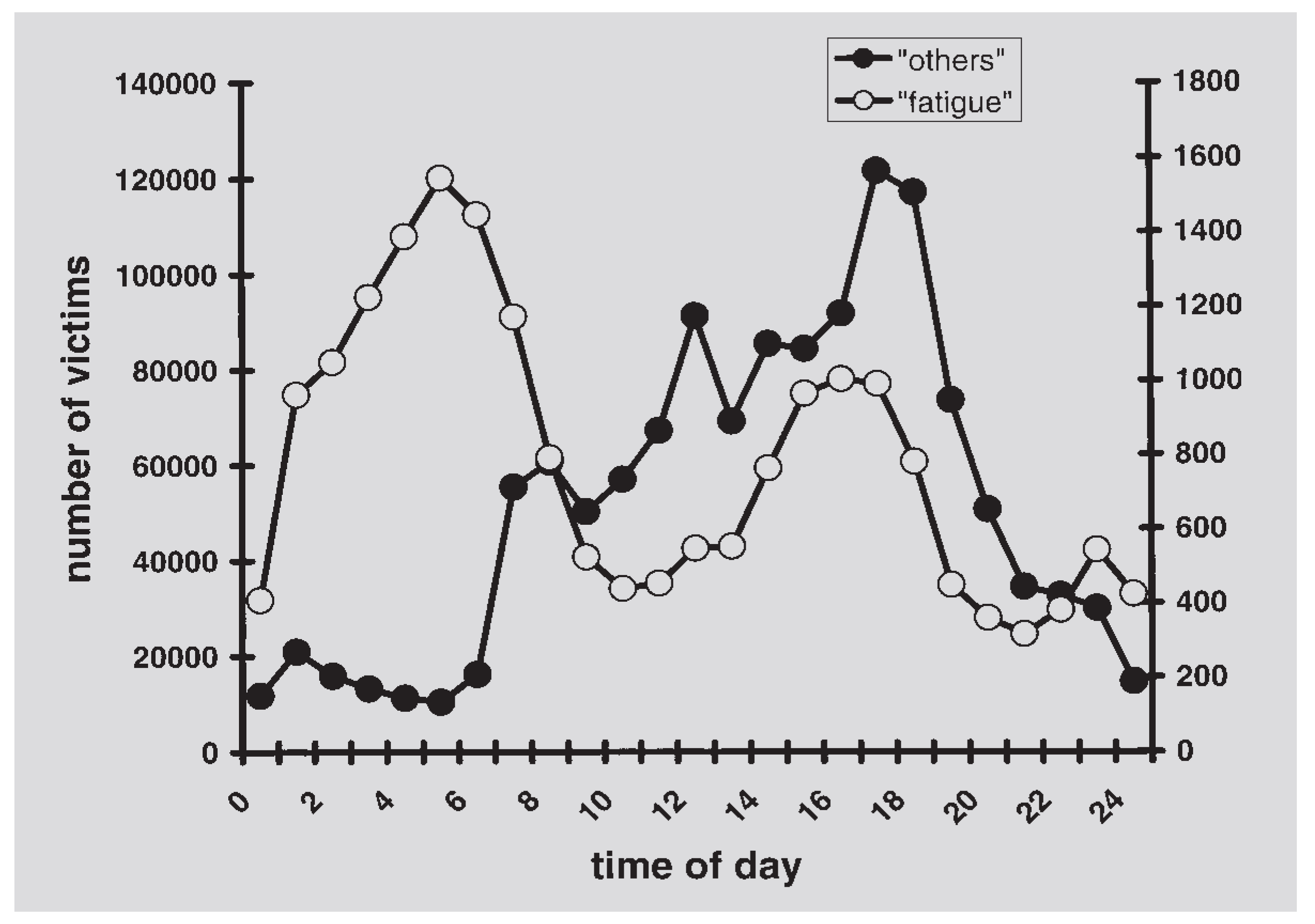
probably underestimating this type of crash [5,6,7] in comparison to scientific studies. A scientific study showed that on the German divided highways 24% of fatal crashes could be attributed to falling asleep at the wheel [8]. 50% of interviewed traffic users admitted that they had driven a motor vehicle while sleepy in the course of one year [9]. A majority of sleepiness-induced motor vehicle and work injuries occur between 02:00 and 06:00 a.m. and 02:00 and 04:00 p.m. [2,5], corresponding to the circadian and semi-circadian nadirs of alertness. The circadian distribution of sleepinessinduced motor vehicle accidents derived from Swiss police statistics in a 10-year period (fig. 1) nicely confirms these data. Philip at al. [10] have recently shown in a real driving environment that the braking reaction time in the afternoon deteriorated after partial sleep restriction but not after a full night sleep. Obviously the second maximum of sleep pressure in the afternoon can be compensated in performance tasks as long as no extra homeostatic sleep pressure is added.
Injuries at the workplace caused by unintentionally falling asleep are poorly investigated. A circadian distribution with a relative maximum in the night hours was also shown for industrial workers [11]. Leger calculated that 52% of all work-related injuries in the US in 1988 were related to sleepiness [12]. Akerstedt et al. [13] have shown that 7% of industrial workers fell asleep during work at least once a month and this risk was greater with disturbed sleep and in shift work. Some evidence also supports the assumption that the disasters in the atomic power reactor at Chernobyl, the chemical accident of Bhopal and the Exxon Valdez Oil Tanker accident were at least partly due to sleepiness [14,15].
Is sleepiness perceived before falling asleep?
Many drivers involved in a crash deny having realised signs of sleepiness before they fell asleep. The expression “sleep lapse” or “Sekundenschlaf” is often understood as such that naps would occur without prior awareness of sleepiness. Adopting this view the High Court of Australia in 1992 in the so-called “Jiminez-defense” has enabled many drivers to escape blame in the case of fall-asleep crashes [16].An excellent overview on this medicolegal issue has been published recently [17].
According to Jim Horne and other modern sleep scientists it is virtually impossible to fall asleep whilst driving without preceding signs of sleepiness [18,19]. This fact has major legal consequences. (1) It is the driver’s responsibility not to drive while sleepy and a driver at fault will be punished similarly as under alcohol influence. (2) It is not necessary to prohibit driving in general to a patient with suspected excessive daytime sleepiness. The fact that it is possible to fall asleep for up to two minutes without being aware of sleeping [20] is no argument against being aware of sleepiness before falling asleep. The reason why sleepy drivers continue to drive is due to their unrealistic interpretation of the risk to fall asleep despite the presence of signs of sleepiness. This improper estimation of performance is more pronounced under real driving conditions than under laboratory conditions [10]. A recent sleep deprivation study [21] has also shown that the subjective feeling of a reduced alertness precedes the objective impairment of alertness by roughly 45 minutes on average.
Instead of stopping and having a nap the drivers rely on simple compensation strategies, such as opening the window, cold air, listening to loud music, chewing gum or smoking. Reyner and Horne have recently shown that cold air and radio listening are only effective for a short period of about 15 minutes [22]. In the following 60 minutes a dangerous imbalance occurs when the subjectively improved alertness contrasts with objectively measured prolonged reaction times. The most effective measure to counteract sleepiness at the steering wheel is to stop driving, consume coffee [23] or an “energy drink” containing at least 200 mg of caffeine [24], followed by a short nap of 15 minutes.This measure may reduce sleepiness for 60–90 minutes. In prevention of sleepiness-induced crashes, the drivers should not only be warned about the danger of driving whilst sleepy but also that the likelihood of falling asleep at the wheel at a given level of sleepiness may be greater than he or she might realise [19]. If a driver has dropped off to sleep once and still continues driving, she or he is very likely to drop off to sleep again [25,26]. It was shown that the arousal following a drop-off has an arousing effect during only 5 to 15 minutes [27].
Warning systems
Car manufacturers developed alarm devices depending on various physiological characteristics of falling asleep such as head dropping, increased
Table 1.
Characteristics of sleepiness-induced motor vehicle crashes [6].
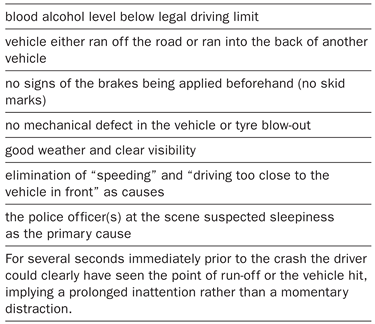
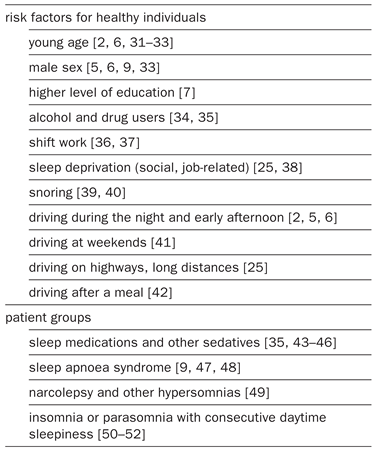
Table 2.
Risk factors for sleepiness-induced motor vehicle crashes.
eyelid blink rate, pupillary diameter variance or electroencephalographic measurements. However, many scientists have questioned the benefit.“What should be the use of alerting a driver who is already aware of the fact that he is sleepy but who still continues to drive?” [27]. Moreover, there is concern that such devices could encourage sleepy drivers to take further risks in continuing to drive, believing that the device will alert them when the situation becomes particularly dangerous [6]. Such systems may rather be useful in future to continuously monitor alertness in truck drivers in addition to the “hours-of-service” tachograph.
Characteristics of sleepiness-induced motor vehicle crashes
The characteristics of sleepiness-induced motor vehicle crashes have carefully been evaluated (table 1) [2,6,7].
The authors [6] underline that most drivers would not admit having fallen asleep. When strictly using the above-mentioned criteria on motor vehicle crashes in the UK, they found a circadian distribution very similar to the one presented in figure 1 for Switzerland with a maximum between 1.00 and 4.00 and a smaller peak between 14.00 and 18.00. They came to the conclusion that sleepiness-induced crashes make up 16% of all motor vehicle accidents.
Causes of daytime sleepiness: lifestyle and sleep disorders
In the last decades, scientific studies have helped to identify a number of risk factors leading to excessive daytime sleepiness (EDS) contributing to a high risk of injuries at the workplace and in motor vehicle traffic. A first distinction has to be made between otherwise healthy individuals who either do not get enough sleep or do not adhere to a healthy sleeping pattern due to shift work or lifestyle and patients who use sedative drugs or suffer from a sleep disorder such as sleep apnoea syndrome or narcolepsy associated with excessive daytime sleepiness (table 2).
Lifestyle and shift work
In healthy individuals the most important risk factors are: young age, male sex, driving at night, insufficient sleep, shift work and some others (table 2). From our own experience, the last half hour before reaching home on a well-known route should be added to this list [28]. The detrimental effect of sleep deprivation is unfortunately too often heavily underestimated. 24 hours without sleep reduces the performance to the same level as consumption of alcohol with a measured blood alcohol content of 0.8‰ [29]. In a recent study on healthy young subjects the same performance level as after total sleep deprivation over 24 hours was also reached with 4-hour night sleep after a period of 7 days and with a 6-hour night sleep after 14 days [30].These studies showed that either complete or partial sleep deprivation over several days reduces working and driving performance.
In Switzerland about one among 4 men and one among 8 women is on shift work and in this working group sleep disturbances are particularly prevalent. In staff members of a psychiatric hospital 20% of the workers on rotating daytime shift complained about difficulties in initiating sleep, compared to 12% in the group on fixed daytime schedule [51]. In police officers on shift work sleep disorders were found in 35% compared to 26% in non-shift workers. The former group had significantly more sleep-ascribed crashes [52]. Excessive daytime sleepiness in shift workers is due to a socially derived shortening of the sleep period, externally disturbed sleep during the day and desynchronisation with the internal circadian clock. There is increasing concern about public health consequences of errors due to excessive daytime sleepiness in health care workers, military and public safety personnel, nuclear power plant operators and commercial truck drivers [14]. It is noteworthy that already the one-hour spring shift during daylight saving significantly increased the motor vehicle accident incidence by 8% for the following day, whereas the autumn shift resulted in a decrease in crashes of the same magnitude [53].
Commercial trucks will be involved in an EDS-induced crash once during the lifetime of the vehicle [33] and damage is more severe due to the larger mass. Driving during circadian low points, obtaining inadequate sleep in a truck sleeper berth prior to driving, working long irregular schedules, economic pressure with inadequate rest facilities are all factors that contribute to excessive daytime sleepiness in truck drivers. Sleep apnoea syndrome is prevalent in truck drivers due to increased body weight possibly resulting from sedentary work [54] and the crash risk in truck drivers with nocturnal breathing abnormalities is twofold increased [55].
Disorders causing excessive daytime sleepiness
Alcohol and sedative drugs
Consumption of alcohol per se is the major risk factor for motor vehicle crashes found in 7% of all 81914 motor vehicle crashes in Switzerland in 1996, whereas illegal drugs were suspected in 0.3% and prescribed drugs in 0.2% [1]. In the US up to 30% of injured motorists referred to an emergency centre had alcohol levels above 1.0‰ [56] and other illegal drugs (e.g. cocaine, cannabis) were found in 20%. Relatively detailed guidelines on how to deal with these drivers exist for police officers and the medical community. In most countries a defined maximal blood alcohol level is considered not to impair the driving capability (in Switzerland = 0.8‰, and 0.5‰ from 1. 1. 2004). However, it is well known that blood concentrations well below this legal limit impair neuropsychological and motor performance and increase the risk of traffic injuries, particularly in day periods of low alertness [57,58]. Moreover, drivers who take the risk of falling asleep at the steering wheel despite signs of sleepiness more often have a history suggestive of alcoholism [32]. Modern lifestyle of young people with long-lasting work or social activity until the next morning possibly combined with low amount of alcohol consumption leads to the most dangerous condition while driving home in the early morning hours, mainly on weekends.
Sedation is a well-known side effect of many prescribed drugs [35] such as beta-blocking agents, antihistamines, antiepileptics, dopaminergic agents, opioid analgesics, tricyclic antidepressants, muscle relaxants, and the related risk while driving should always be addressed. Hypnotics taken to improve sleep onset or sleep maintenance insomnia may be beneficial due to a reduction of sleep deprivation. However, drugs with short half width should be preferred in order to avoid the overhang effect on the following day [43,59]. Benzodiazepines were found in blood samples of about 10% of injured motorists referred to emergency centres in Sweden [60]. Even more important are the falls of elderly people in the night due to the use of benzodiazepines. In elderly patients with hip fracture the blood screening tests were benzodiazepine positive in 40%, although only 18% admitted to take benzodiazepines [61].
Nocturnal doses of sedating antidepressants and morning doses of non-sedating antidepressants did not produce residual driving impairment during the day in a driving simulator test [62]. However, in elderly patients tricyclic antidepressants resulted dose-dependently in an up to 5-fold crash risk (average = 2.2) [63]. The physician should also prefer non-sedating antihistamines in patients who drive [35]. Claims that patients treated with dopaminergic agents are prone to unforewarned sleep attacks [64] should be treated with caution [65,66]. If such incidents really exist they are rare, e.g. ~ 0.5% [45]. As is the case in healthy sleep-deprived persons the problem is rather the misjudgement or the amnesia of prior signs of sleepiness by the affected [67]. Consequently it is generally not necessary to forbid driving to all patients taking dopaminergic agents. Instead, an unambiguous explanation of the signs of sleepiness and the corresponding risks at the steering wheel and instruction of correct countermeasures are needed.
No data exist on secondary excessive daytime sleepiness due to drug-induced sleep disturbances.
Sleep apnoea syndrome (SAS)
A major significance has to be attributed to sleep apnoea syndrome because of its high prevalence particularly in the male population. In older individuals a percentage of up to 3% can be observed and most of these patients suffer from excessive daytime sleepiness.The physician has to realise that all patients with increased body weight, essential hypertension, cardiovascular or cerebrovascular incidences should be screened for sleep apnoea syndrome. The following questions have been proven useful for this screening [68]:
- Does your snoring disturb other persons?
- Do you stop breathing during sleep?
- Are the snoring and the occurrence of apnoeas worse, when lying on your back?
- Are the snoring and the apnoeas worse after alcohol consumption?
- Are you over-weight?
Questionnaire studies have shown a 2–15 times higher crash rate in patients with moderate to severe sleep apnoea syndrome compared to a healthy population [49,55,69,70,71,72] whereas not all studies including our own [73] found an increased risk for mild sleep apnoea syndrome. Similar results are shown in police statistics [74,75,76,77]. With therapy such as continuous positive airway pressure (nCPAP) or after a surgical therapy (uvulopalatopharyngoplasty) [78] a significant reduction of crashes has been observed [73,79,80,81]. In SAS patients alcohol consumption even in small quantities increases the risk of crashes more severely than in otherwise healthy people [82]. Since SAS patients with a low apnoea-hypopnoea-index (<35/h) in our study [73] did not have a greater crash risk when compared to the control population there is as yet no compelling evidence to restrict the driving privileges in apnoea patients provided that no motor vehicle crash did happen before [83]. Driving capability must be determined based on the individual assessment of excessive daytime sleepiness when optimal therapy has been installed.
Narcolepsy and other “primary hypersomnias”
By performing a whole video polysomnography the secondary forms of excessive daytime sleepiness caused by a disturbed night sleep can be excluded. By a prolongation of the night sleep period by 1 to 2 hours with a fixed bedtime over at least a week a (relative) sleep insufficiency syndrome may be detected. Metabolic and hormonal causes of excessive daytime sleepiness such as hypothyroidism should be excluded by laboratory examinations. After exclusion of these secondary forms of excessive daytime sleepiness a group of primary hypersomnias remains where a clear distinction between monosymptomatic narcolepsy, idiopathic hypersomnia, hypersomnolent depression and “EDS of unknown aetiology” is sometimes difficult.
The diagnosis of narcolepsy is not a problem if clear cataplexy is present. However, in some patients atypical, cataplexy-like symptoms do not allow to confirm this diagnosis [84]. The diagnostic value of the human leucocyte antigen (HLA factors) should not be overestimated since the “narcolepsy-typical constellation” can be found in 30% of a normal population. Multiple sleep onset REM periods (SOREM) in the Multiple Sleep Latency Tests do support this diagnosis without being specific. Recently a dramatic reduction of hypocretin in the cerebrospinal fluid has been found in narcoleptics [85]. However, this finding correlated better with the presence of cataplexy and is therefore of little help in diagnosing monosymptomatic narcolepsy.
Narcoleptic patients have a particularly severe sleepiness with impaired compensatory strategies in tasks requiring to stay awake. However, levelheaded patients can realise their sleepiness in time and react appropriately. Therefore, narcoleptic subjects have been described who have driven many kilometres in their life without any crash [86]. Nevertheless, the risk of having EDS-related crashes is increased [49], and the diagnosis is incompatible with professional driving, since these drivers may be under pressure to continue driving despite signs of sleepiness.
Daytime sleepiness due to insomnia
It is a remarkable reality that patients with chronic insomnia seldom complain about severe daytime sleepiness. They rather feel irritable, without energy, they suffer from impaired concentration, have decreased abilities to accomplish daily tasks, decreased enjoyment of interpersonal relationships and decrements in mood and general wellbeing. Multiple sleep latency tests (MSLT) did not reveal significant differences in sleep latency compared to normal subjects in one study [87] or prolonged latencies compared to normals in another study [88]. In this respect insomnia patients should not be compared to healthy individuals after sleep deprivation but rather to healthy individuals who consumed high amounts of coffee, e.g. a state of hyper arousal [88]. In a telephone survey on 1000 individuals 5% of all subjects with chronic insomnia remembered a sleepinessinduced motor vehicle crash compared to 2% in the group without insomnia [50]. Treating insomniacs with benzodiazepines can either reduce excessive daytime sleepiness (prolonged MSLT latencies with drugs of short half-life) or increase excessive daytime sleepiness (drugs with long half-life) [87].
It has not yet been established that increased periodic leg movements in sleep not associated with restless legs syndrome can be related to either insomnia or daytime sleepiness or both, although this causal relationship has been proposed by some investigators [89,90]. Parasomnias typically are not accompanied by excessive daytime sleepiness unless with a very high frequency of attacks.
Countermeasures
In the United States the costs attributed to injuries, caused directly or indirectly by excessive daytime sleepiness, were estimated at $ 50 billion per year [12]. In spite of these alarming statistics there are only limited efforts made in Switzerland and other European countries to prevent this type of injury. There are no guidelines for the police on how to determine EDS-induced crashes and how to decide when the driver at fault should be referred to the medical doctor to evaluate his or her driving ability. Objective measurement of excessive daytime sleepiness is still an unresolved matter.
Every single worker and driver
Considering the expensive consequences of EDSinduced injuries, it is necessary that extensive information campaigns should be started. Every driver has to be aware of the danger when driving at night, of excessive daytime sleepiness caused by sleep restriction or shift work and about the potentiating effect of alcohol and drugs. The effect of simple steps taken while driving for long periods, such as opening the window or listening to loud music, should not be overestimated. The best method to counteract sleepiness is to avoid longdistance driving or to stop the vehicle immediately when feeling sleepy, to consume 2 cups of coffee or a caffeine-containing beverage, followed by a nap of 15 minutes.
The physician’s duty
The physician’s concern is primarily to diagnose daytime sleepiness even though the primary complaints of the patient may have another focus. Daytime sleepiness can be assessed with the aid of the Epworth score [91]. Values between 11 and 15 are considered abnormal but the risk of motor vehicle crashes is unknown, while values above 15 are associated with an increased risk [92,93]. The physician must, however, take into consideration that the patient suffering from chronic sleepiness may consider his or her condition as normal and deny it even though she or he might have fallen asleep in the waiting room [82]. Many patients depend on their vehicles for professional or social reasons and therefore may dismiss their daytime sleepiness. Additional information from persons living in close contact with the patient is most valuable and conversely it is advisable to counsel family members of a driver encountering an increased risk of falling asleep at the steering wheel.
It is the physician’s responsibility to counsel patients with excessive daytime sleepiness or when prescribing potentially sedative drugs concerning the risk while driving and make appropriate notes in the patients’ records. In many countries a driving restriction period of several month is imposed [94] until therapeutic measures are effective or the sedative drug effect can be judged clinically. Regular, e.g. yearly check-ups are recommended. The final responsibility not to drive in a sleepy condition can often be left to the patient’s own judgement, because, before true sleep occurs, sleepiness can be recognised by everyone according to the well-known symptoms, such as yawning, burning eyes, double vision, dropping eye lids or dropping head. For a minority of patients this trivial relationship must be emphasised specifically. A driver who is at fault will be punished in the same manner as a driver under the influence of alcohol and not like someone suffering from an unforeseeable syncope. According to Swiss law a physician is allowed to report uncooperative patients to the authorities. When prior injuries due to excessive daytime sleepiness are reported or trustworthiness is doubtful, the inclination to fall asleep should be measured by objective methods, i.e. maintenance of wakefulness test or driving simulations. For legal reasons these methods should always be applied to assess professional drivers of all kind and if a patient is not cooperating or a therapy not successful.
The physician is also often faced with the question of a patient’s ability to drive while under stimulants. Under this type of medication there is theoretically a risk of reckless driving and tunnel vision that impairs the alertness to observe obstacles on the roadside. Driving simulator studies have shown that the effect of stimulants – given to treat excessive daytime sleepiness – have a positive effect and improve the driving capability [95]. Drivers who are on stimulant therapy should, however, carry a medical certificate and inform themselves about the necessary custom regulations before travelling outside the country.
Traffic police
The individual and public consequences of EDSinduced injuries can only be understood correctly by the authorities when it becomes possible to show how frequent such events are. Therefore, more realistic statistical figures are urgently needed. Scientific studies indicate that 10–20% of all traffic accidents and an even higher percentage of all fatal crashes are due to excessive daytime sleepiness. These figures underline the need for prophylactic measures and override the 1 to 3% of EDS-related crashes in the official statistics in many countries. The first step is that police officers can recognise excessive daytime sleepiness as cause of a given crash (table 1). This type of crash occurs most frequently on divided highways but in our own experience it is not rare within city limits. The result is a collision with a fixed roadside obstacle on the side of the road. When the driver awakens before hitting the obstacle, abrupt steering manoeuvres may induce skidding. Drivers who are involved in this type of crash without preceding sleep restriction should be investigated by a physician for possible sleep disorders. To aid the police officers at the scene of an motor vehicle crash, pertinent questions should be included in the police report questionnaire concerning the duration of sleep during the preceding night and hours of preceding wakefulness.
Employer and commercial truck drivers
Work hours should allow to get sufficient hours of sleep. In shift work and shift rotation the endogenous sleep rhythm should be taken into consideration. Studies have shown that clockwise rotation in shift work resulted in better work performance than shift work rotation counter clockwise, but the workers do not prefer this rotation direction because free compensation days get lost. To insure continued alertness of drivers, ship operators, engine drivers and security workers of industrial equipment, technical measures may be put into place. These technical measures should, however, not introduce a higher stress level for the monitoring personnel. Shift work or night work should be interrupted more frequently by planned naps since these workers always come to work with a sleep deficit which cannot be eliminated otherwise.
Public authorities
Most urgently the subjects at risk should be educated and informed on the great risks of the own misjudgement when driving while sleepy and on the exponential effect of alcohol and other drugs in combination with sleep deprivation.
Apart from increasing the awareness among the public on this issue, construction of warning signs, rumble strips, guard rails or a broader shoulder along the roads are effective countermeasures. Rumble strips along the roads may reduce the drive-off-the-road crashes by 30–50%, which certainly represents a low cost solution with very high benefit-to-cost ratio [2]. By providing sufficient safe and well-maintained roadside rest areas along the motorways drivers should be encouraged to take a break for a nap.
For drivers suffering from excessive daytime sleepiness due to disease such as sleep apnoea syndrome or narcolepsy country wide guidelines concerning the diagnostic requirements, eventual driving restrictions and medical control examination should be established, based on the already existing law.
In contrary to some other European countries there are at present no such regulations in Switzerland. Regulations regarding driving time checks for professional drivers should be updated considering recent scientific knowledge on the circadian sleep propensity factors. Due to circadian variations of sleep propensity more frequent rest and sleep periods should be requested while driving at night compared to driving during the day.
Centres for sleep disorders
Detailed medical guidelines to determine an individual’s ability to drive are requested, extending the general recommendations already available [96]. Simple methods should be developed to objectively measure daytime sleepiness and assess its causes. However, we should be aware that clinical judgement taking into account the cause of excessive daytime sleepiness and the character of the affected will always be required to integrate any type of objective excessive daytime sleepiness measurement. It is well known that the various vigilance tests do not correlate favourably [97,98] and laboratory investigations can only be a rough estimate of driving behaviour in real life. This indicates that for different tasks different types of “waking energies” might be needed. It is therefore more reasonable to search for an optimal “vigilant battery” rather than to search for the best of all vigilance tests. A classification of prescribed drugs based on the impairment of driving capability comparable to the effect of alcohol [99] could help to explain the driving risk under drugs to the patient. More research is needed to understand which neuropsychological and motor abilities are needed for safe driving [100].
References
- Bundesamt für Statistik. Strassenverkehrsunfälle in der Schweiz 1996; BFS: Bern, 1998. [Google Scholar]
- Pack, AI; Pack, AM; Rodgman, E; Cucchiara, A; Dinges, DF; Schwab, CW. Characteristics of crashes attributed to the driver having fallen asleep. Accid Anal Prev 1995, 27, 769–75. [Google Scholar] [CrossRef] [Scilit]
- Parsons, M. Fits and other causes of loss of consciousness while driving. Quart J Med 1986, 227, 296–303. [Google Scholar]
- Garbarino, S; Nobili, L; Beelke, M; De Carli, F; Ferrillo, F. The contributing role of sleepiness in highway vehicle accidents. Sleep 2001, 24, 203–6. [Google Scholar] [CrossRef] [Scilit] [PubMed]
- Horne, JA; Reyner, LA. Sleep-related vehicle accidents. Br Med J 1995, 310, 565–7. [Google Scholar] [CrossRef] [Scilit] [PubMed]
- Horne, JA; Reyner, LA. Driver sleepiness. J Sleep Res 1995, 4, 23–9. [Google Scholar] [CrossRef] [Scilit]
- Sagberg, F. Road accidents caused by drivers falling asleep. Accid Anal Prev 1999, 31, 639–49. [Google Scholar] [CrossRef] [Scilit]
- Zulley, J; Crönlein, T; Hell, W; Langwieder, K. Fatal highway accidents mainly caused by falling asleep. In Work Hours, Sleepiness and Accidents; Akerstedt, T, Kecklund, G, Eds.; Karolinska Institute: Stockholm, 1994; p. 104. [Google Scholar]
- McCartt, AT; Ribner, SA; Pack, AI; Hammer, MC. The scope and nature of the drowsy driving problem in New York state. Accid Anal Prev 1996, 28, 511–7. [Google Scholar] [CrossRef] [Scilit]
- Philip, P; Sagaspe, P; Taillard, J; Moore, N; Guilleminault, C; Sanchez-Ortuno, M; et al. Fatigue, sleep restriction, and performance in automobile drivers: a controlled study in a natural environment. Sleep 2003, 26, 277–80. [Google Scholar] [CrossRef] [Scilit]
- Mitler, MM. Sleepiness and human behavior. Corr Opin Pulm Med 1996, 2, 488–91. [Google Scholar]
- Leger, D. The cost of sleep-related accidents: a report for the national commission on sleep disorders research. Sleep 1994, 17, 84–93. [Google Scholar] [CrossRef] [Scilit]
- Akerstedt, T; Knutsson, A; Westerholm, P; Theorell, T; Alfredsson, L; Kecklund, G. Work organisation and unintentional sleep: results from the WOLF study. Occup Environ Med 2002, 59, 595–600. [Google Scholar] [CrossRef] [Scilit]
- Mitler, MM; Carskadon, MA; Czeisler, CA; Dement, WC; Dinges, DF; Graeber, RC. Catastrophes, sleep, and public policy: Consensus report. Sleep 1988, 11, 100–9. [Google Scholar] [CrossRef] [Scilit] [PubMed]
- Dinges, DF; Carskadon, MA; Czeisler, CA; Dement, WC. Attending to inattention. Science 1989, 245, 342. [Google Scholar] [CrossRef] [Scilit] [PubMed]
- Desai, AV; Ellis, E; Wheatley, JR; Grunstein, RR. Fatal distraction: a case series of fatal fall-asleep road accidents and their medicolegal outcomes. Med J Aust 2003, 178, 396–9. [Google Scholar] [CrossRef] [Scilit] [PubMed]
- Ellis, E; Grunstein, RR. Medico-legal aspects of sleep disorders: sleepiness and civil liability. Sleep Med Rev 2001, 5, 33–46. [Google Scholar] [CrossRef] [Scilit]
- Horne, J; Reyner, L. Vehicle accidents related to sleep: a review. Occup Environ Med 1999, 56, 289–94. [Google Scholar] [CrossRef] [Scilit]
- Reyner, LA; Horne, JA. Falling asleep whilst driving: are drivers aware of prior sleepiness? Int J Legal Med 1998, 111, 120–3. [Google Scholar] [CrossRef] [Scilit]
- Bonnet, MH; Moore, SE. The threshold of sleep: perception of sleep as a function of time asleep and auditory threshold. Sleep 1982, 5, 267–76. [Google Scholar] [CrossRef] [Scilit]
- Leproult, R; Colecchia, EF; Berardi, AM; Stickgold, R; Kosslyn, SM; Van Cauter, E. Individual differences in subjective and objective alertness during sleep deprivation are stable and unrelated. Am J Physiol Regul Integr Comp Physiol 2003, 284, R280–R290. [Google Scholar] [CrossRef] [Scilit]
- Reyner, LA; Horne, JA. Evaluation of ‘in-car’ countermeasures to sleepiness: cold air and radio. Sleep 1998, 21, 46–50. [Google Scholar] [CrossRef] [Scilit]
- Reyner, LA; Horne, JA. Suppression of sleepiness in drivers: combination of caffeine with a short nap. Psychophysiology 1997, 34, 721–5. [Google Scholar] [CrossRef] [Scilit] [PubMed]
- Reyner, LA; Horne, JA. Efficacy of a “functional energy drink” in counteracting driver sleepiness. Physiol Behav 2002, 75, 331–5. [Google Scholar] [CrossRef] [Scilit] [PubMed]
- Cummings, P; Koepsell, TD; Moffat, JM; Rivara, FP. Drowsiness, counter-measures to drowsiness, and the risk of a motor vehicle crash. Inj Prev 2001, 7, 194–9. [Google Scholar] [CrossRef] [Scilit] [PubMed]
- Carter, N; Ulfberg, J; Nyström, B; Edling, C. Sleep debt, sleepiness and accidents among males in the general population and male professional drivers. Accid Anal Prev 2003, 35, 613–7. [Google Scholar] [CrossRef] [Scilit]
- Lisper, HO; Laurell, H; van Loon, J. Relation between time to falling asleep behind the wheel on a closed track and changes in subsidiary reaction time during prolonged driving on a motorway. Ergonomics 1986, 29, 445–53. [Google Scholar] [CrossRef] [Scilit]
- Seeger, R. Sleepiness and driving ability. In Workshop on: Facets on Wakefulness and Sleepiness: Causes, Consequences, and Assessment; Mathis, J, Hess, CW, Baer, W, Tobler, I, Eds.; Monte Verità: Ascona, Switzerland, 2002; p. 36. [Google Scholar]
- Dawson, D; Reid, K. Fatigue, alcohol and performance impairment [letter]. Nature 1997, 388, 235. [Google Scholar] [CrossRef] [Scilit]
- Van Dongen, HP; Maislin, G; Mullington, JM; Dinges, DF. The cumulative cost of additional wakefulness: doseresponse effects on neurobehavioral functions and sleep physiology from chronic sleep restriction and total sleep deprivation. Sleep 2003, 26, 117–26. [Google Scholar] [CrossRef] [Scilit]
- Carskadon, MA. Adolescent sleepiness: increased risk in a high-risk population. Alcohol Drugs and Driving 1989, 5/6, 317–28. [Google Scholar] [CrossRef] [Scilit]
- Gislason, T; Tomasson, K; Reynisdottir, H; Bjornsson, JK; Kristbjarnarson, H. Medical risk factors amongst drivers in single-car accidents. J Intern Med 1997, 241, 213–9. [Google Scholar] [CrossRef] [Scilit]
- Lyznicki, JM; Doege, TC; Davis, RM; Williams, MA. Sleepiness, driving, and motor vehicle crashes. Council on Scientific Affairs, American Medical Association. JAMA 1998, 279, 1908–13. [Google Scholar] [CrossRef] [Scilit]
- Horne, JA; Baumber, CJ. Time-of-day effects of alcohol intake on simulated driving performance in women. Ergonomics 1991, 34, 1377–83. [Google Scholar] [CrossRef] [Scilit] [PubMed]
- Moerike, K; Gleiter, CH. Beeinflussung der Fahrtüchtigkeit durch Arzneimittel. Der Internist 2003, 43, 889–98. [Google Scholar] [CrossRef] [Scilit] [PubMed]
- Folkard, S; Monk, TH. Shiftwork and performance. Hum Factors 1979, 21, 483–92. [Google Scholar] [CrossRef] [Scilit]
- Richardson, GS; Miner, JD; Czeisler, CA. Impaired driving performance in shiftworkers: the role of the circadian system in a multifactorial model. Alcohol Drugs and Driving 1989, 5/6, 265–73. [Google Scholar] [CrossRef] [Scilit]
- Pilcher, JJ; Huffcutt, AI. Effects of sleep deprivation on performance: a meta-analysis. Sleep 1996, 19, 318–26. [Google Scholar] [CrossRef]
- Bartels, EC; Kusakcioglu, O. Narcolepsy: a possible cause of automobile accidents. Lahey Clin Found Bull 1965, 14, 21–6. [Google Scholar]
- Gottlieb, DJ; Yao, Q; Redline, S; Ali, T; Mahowald, MW. Does snoring predict sleepiness independently of apnea and hypopnea frequency? Am J Respir Crit Care Med 2000, 162, 1512–7. [Google Scholar] [CrossRef] [Scilit]
- Philip, P; Vervialle, F; Le Breton, P; Taillard, J; Horne, JA. Fatigue, alcohol, and serious road crashes in France: factorial study of national data. Br Med J 2001, 322, 829–30. [Google Scholar] [CrossRef] [Scilit]
- Wells, AS; Read, NW; Idzikowski, C; Jones, J. Effects of meals on objective and subjective measures of daytime sleepiness. J Appl Physiol 1998, 84, 507–15. [Google Scholar] [CrossRef] [Scilit]
- Hemmelgarn, B; Suissa, S; Huang, A; Boivin, JF; Pinard, G. Benzodiazepine use and the risk of motor vehicle crash in the elderly. JAMA 1997, 278, 27–31. [Google Scholar] [CrossRef] [Scilit]
- Javier, AF; Carmen, DR. Medicinal drugs and driving: from research to clinical practice. Trends Pharmacol Sci 2002, 23, 441–3. [Google Scholar] [CrossRef] [Scilit]
- Hobson, DE; Lang, AE; Martin, WR; Razmy, A; Rivest, J; Fleming, J. Excessive daytime sleepiness and suddenonset sleep in Parkinson’s disease: a survey by the Canadian Movement Disorders Group. JAMA 2002, 287, 455–63. [Google Scholar] [CrossRef] [Scilit]
- Thomas, RE. Benzodiazepine use and motor vehicle accidents. Systematic review of reported association. Can Fam Physician 1998, 44, 799–808. [Google Scholar]
- Martikainen, K; Urponen, H; Partinen, M; Hasan, J; Vuori, I. Daytime sleepiness: a risk factor in community life. Acta Neurol Scand 1992, 86, 337–41. [Google Scholar] [CrossRef] [Scilit]
- Philip, P; Ghorayeb, I; Stoohs, R; Menny, JC; Dabadie, P; Bioulac, B; et al. Determinants of sleepiness in automobile drivers. J Psychosom Res 1996, 41, 279–88. [Google Scholar] [CrossRef] [Scilit] [PubMed]
- Aldrich, MS. Automobile accidents in patients with sleep disorders. Sleep 1989, 12, 487–94. [Google Scholar] [CrossRef] [Scilit] [PubMed]
- Roth, T; Ancoli-Israel, S. Daytime consequences and correlates of insomnia in the United States: results of the 1991 National Sleep Foundation Survey. II. Sleep 1999, 22 (Suppl 2), S354–S358. [Google Scholar] [PubMed]
- Ohayon, MM; Lemoine, P; Arnaud-Briant, V; Dreyfus, M. Prevalence and consequences of sleep disorders in a shift worker population. J Psychosom Res 2002, 53, 577–83. [Google Scholar] [CrossRef] [Scilit]
- Garbarino, S; De Carli, F; Nobili, L; Mascialino, B; Squarcia, S; Penco, MA; et al. Sleepiness and sleep disorders in shift workers: a study on a group of Italian police officers. Sleep 2002, 25, 648–53. [Google Scholar] [CrossRef] [Scilit]
- Coren, S. Daylight savings time and traffic accidents. N Engl J Med 1996, 334, 924. [Google Scholar] [CrossRef] [Scilit]
- Stoohs, RA; Guilleminault, C; Dement, WC. Sleep apnea and hypertension in commercial truck drivers. Sleep 1993, 16, S11–S13. [Google Scholar] [CrossRef] [Scilit] [PubMed]
- Stoohs, RA; Guilleminault, C; Itoi, A; Dement, WC. Traffic accidents in commercial long-haul truck drivers: the influence of sleep-disordered breathing and obesity. Sleep 1994, 17, 619–23. [Google Scholar] [PubMed]
- Orsay, EM; Doan-Wiggins, L; Lewis, R; Lucke, R; Rama-Krishnan, V. The impaired driver: hospital and police detection of alcohol and other drugs of abuse in motor vehicle crashes. Ann Emerg Med 1994, 24, 51–5. [Google Scholar] [CrossRef] [Scilit] [PubMed]
- Horne, JA; Gibbons, H. Effects on vigilance performance and sleepiness of alcohol given in the early afternoon (“post lunch”) vs. early evening. Ergonomics 1991, 34, 67–77. [Google Scholar] [CrossRef] [Scilit]
- Gengo, FM; Gabos, C; Straley, C; Manning, C. The pharmacodynamics of ethanol: effects on performance and judgment. J Clin Pharmacol 1990, 30, 748–54. [Google Scholar] [CrossRef] [Scilit]
- Vermeeren, A; Riedel, WJ; van Boxtel, MP; Darwish, M; Paty, I; Patat, A. Differential residual effects of zaleplon and zopiclone on actual driving: a comparison with a low dose of alcohol. Sleep 2002, 25, 224–31. [Google Scholar] [CrossRef] [Scilit]
- Sjögren, H; Björnstig, U; Eriksson, A; Ohman, U; Solarz, A. Drug and alcohol use among injured motor vehicle drivers in Sweden: prevalence, driver, crash, and injury characteristics. Alcohol Clin Exp Res 1997, 21, 968–73. [Google Scholar] [CrossRef] [Scilit]
- Schwab, M; Roder, F; Ammon, S; Thon, KP; Morike, K. Increased number of hip fractures. Lancet 1999, 353, 2160. [Google Scholar] [CrossRef] [Scilit]
- Ramaekers, JG. Antidepressants and driver impairment: empirical evidence from a standard on-the-road test. J Clin Psychiatry 2003, 64, 20–9. [Google Scholar] [CrossRef] [Scilit]
- Ray, WA; Fought, RL; Decker, MD. Psychoactive drugs and the risk of injurious motor vehicle crashes in elderly drivers. Am J Epidemiol 1992, 136, 873–83. [Google Scholar] [CrossRef] [Scilit]
- Frucht, S; Rogers, JD; Greene, PE; Gordon, MF; Fahn, S. Falling asleep at the wheel: motor vehicle mishaps in persons taking pramipexole and ropinirole. Neurology 1999, 52, 1908–10. [Google Scholar] [CrossRef] [Scilit] [PubMed]
- Homann, CN; Wenzel, K; Suppan, K; Ivanic, G; Kriechbaum, N; Crevenna, R; et al. Sleep attacks in patients taking dopamine agonists: review. Br Med J 2002, 324, 1483–7. [Google Scholar] [CrossRef] [Scilit] [PubMed]
- Olanow, CW; Schapira, AH; Roth, T. Waking up to sleep episodes in Parkinson’s disease. Mov Disord 2000, 15, 212–5. [Google Scholar] [CrossRef] [Scilit] [PubMed]
- Horne, J. Misperceptions exist about sleep attacks when driving. Br Med J 2002, 325, 657. [Google Scholar] [CrossRef] [Scilit]
- Douglass, AB; Bornstein, R; Nino-Murcia, G; Keenan, S; Miles, L; Zarcone, VP, Jr.; et al. The Sleep Disorders Questionnaire. I: Creation and multivariate structure of SDQ. Sleep 1994, 17, 160–7. [Google Scholar] [CrossRef] [Scilit]
- Cassel, W; Ploch, T; Peter, JH; von Wichert, P. Unfallgefahr von Patienten mit nächtlichen Atmungsstörungen. Pneumologie 1991, 45, 271–5. [Google Scholar]
- Wu, H; Yan-Go, F. Self-reported automobile accidents involving patients with obstructive sleep apnea. Neurology 1996, 46, 1254–7. [Google Scholar] [CrossRef] [Scilit]
- Gonzalez-Rothi, RJ; Foresman, GE; Block, AJ. Do patients with sleep apnea die in their sleep? Chest 1988, 94, 531–8. [Google Scholar] [CrossRef] [Scilit]
- Haraldsson, PO; Carenfelt, C; Diederichsen, F; Nygren, A; Tingwall, C. Clinical symptoms of sleep apnea syndrome and automobile accidents. ORL J Otorhinolaryngol Relat Spec 1990, 52, 57–62. [Google Scholar] [CrossRef] [Scilit]
- Horstmann, S; Hess, CW; Bassetti, C; Gugger, M; Mathis, J. Sleepiness-related accidents in sleep apnea patients. Sleep 2000, 23, 383–9. [Google Scholar] [CrossRef] [Scilit]
- George, CF; Nickerson, PW; Hanly, PJ; Millar, TW. Sleep apnea patients have more automobile accidents. Lancet 1987, 1, 447. [Google Scholar] [CrossRef] [Scilit] [PubMed]
- Findley, LJ; Unverzagt, ME; Suratt, M. Automobile accidents involving patients with obstructive sleep apnea. Am Rev Respir Dis 1988, 138, 337–40. [Google Scholar] [CrossRef] [Scilit] [PubMed]
- Findley, LJ; Fabrizio, M; Thommi, G; Suratt, PM. Severity of sleep apnea and automobile crashes. N Engl J Med 1989, 320, 868–9. [Google Scholar] [PubMed]
- Young, T; Blustein, J; Finn, L; Palta, M. Sleep-disordered breathing and motor vehicle accidents in a populationbased sample of employed adults. Sleep 1997, 20, 608–13. [Google Scholar] [CrossRef] [Scilit]
- Haraldsson, PO; Carenfelt, C; Lysdahl, M; Tingvall, C. Does uvulopalatopharyngoplasty inhibit automobile accidents. Laryngoscope 1995, 105, 657–60. [Google Scholar] [CrossRef] [Scilit]
- Suratt, PM; Findley, LJ. Effect of nasal CPAP on auto simulator performance and on self-reported auto accidents in patients with sleep apnea. Am Rev Respir Dis 1992, 145, A169. [Google Scholar]
- Krieger, J; Meslier, N; Lebrun, T; Levy, P; Phillip-Joet, F; Sailly, J-C; et al. Accidents in obstructive sleep apnea patients treated with nasal continuous positive airway pressure. Chest 1997, 112, 1561–6. [Google Scholar] [CrossRef] [Scilit]
- Findley, LJ; Suratt, PM. Serious motor vehicle crashes: the cost of untreated sleep apnoea. Thorax 2001, 56, 505. [Google Scholar] [CrossRef] [Scilit]
- Teran-Santos, J; Jimenez-Gomez, A; Cordero-Guerva, J. The association between sleep apnea and the risk of traffic accidents. N Engl J Med 1999, 340, 847–51. [Google Scholar] [CrossRef] [Scilit]
- American Thoracic Society. Sleep apnea, sleepiness and driving risk. Am J Respir Crit Care Med 1994, 150, 1463–73. [Google Scholar] [CrossRef] [Scilit]
- Bassetti, C; Gugger, M; Bischof, M; Mathis, J; Sturzenegger, C; Werth, E; et al. The narcoleptic borderland: a multimodal diagnostic approach including cerebrospinal fluid levels of hypocretin-1 (orexin A). Sleep Med 2003, 4, 7–12. [Google Scholar] [CrossRef] [Scilit]
- Nishino, S; Ripley, B; Overeem, S; Nevsimalova, S; Lammers, GJ; Vankova, J; et al. Low cerebrospinal fluid hypocretin (Orexin) and altered energy homeostasis in human narcolepsy. Ann Neurol 2001, 50, 381–8. [Google Scholar] [CrossRef] [Scilit]
- Oral communication M. Aldrich.
- Seidel, WF; Dement, WC. Sleepiness in insomnia: evaluation and treatment. Sleep 1982, 5 (Suppl 2), S182–S190. [Google Scholar] [CrossRef] [Scilit]
- Bonnet, MH; Arand, DL. 24-hour metabolic rate in insomniacs and matched normal sleepers. Sleep 1995, 18, 581–8. [Google Scholar] [CrossRef] [Scilit] [PubMed]
- Mendelson, WB. Are periodic leg movements associated with clinical disturbance? Sleep 1997, 19, 219–23. [Google Scholar] [CrossRef] [Scilit] [PubMed]
- Nicolas, A; Lespérance, P; Montplaisir, J. Is excessive daytime sleepiness with periodic leg movements during sleep a specific diagnostic category? Eur Neurol 1998, 40, 22–6. [Google Scholar] [CrossRef] [Scilit] [PubMed]
- Johns, MW. A new method for measuring daytime sleepiness: the Epworth sleepiness scale. Sleep 1991, 14, 540–5. [Google Scholar] [CrossRef] [Scilit]
- Maycock, G. Sleepiness and driving: the experience of U.K. car drivers. J Sleep Res 1996, 5, 229–37. [Google Scholar] [CrossRef] [Scilit]
- Maycock, G. Sleepiness and driving: the experience of U.K. car drivers. Accid Anal Prev 1997, 29, 453–62. [Google Scholar] [CrossRef] [Scilit]
- Pakola, SJ; Dinges, DF; Pack, AI. Driving and sleepiness review of regulations and guidelines for commercial and noncommercial drivers with sleep apnea and narcolepsy. Sleep 1995, 18, 787–96. [Google Scholar] [CrossRef] [Scilit]
- Mills, KC; Spruill, SE; Kanne, RW; Parkman, KM; Zhang, Y. The influence of stimulants, sedatives, and fatigue on tunnel vision: risk factors for driving and piloting. Hum Factors 2001, 43, 310–27. [Google Scholar] [CrossRef] [Scilit]
- Accidents and sleepiness: a consensus statement from international conference on work hours, sleepiness and accidents. J Sleep Res 1994, 3, 195.
- Sangal, RB; Thomas, L; Mitler, MM. Maintenance of wakefulness test and multiple sleep latency test. Measurement of different abilities in patients with sleep disorders. Chest 1992, 101, 898–902. [Google Scholar] [CrossRef] [Scilit]
- Mathis, J. Correlations between vigilance tests. In Workshop on: Facets on Wakefulness and Sleepiness: Causes, Consequences, and Assessment; Mathis, J, Hess, CW, Baer, W, Tobler, I, Eds.; Monte Verità: Ascona, Switzerland, 2002; p. 33. [Google Scholar]
- Menzin, J; Lang, KM; Levy, P; Levy, E. A general model of the effects of sleep medications on the risk and cost of motor vehicle accidents and its application to France. Pharmacoeconomics 2001, 19, 69–78. [Google Scholar] [CrossRef] [Scilit]
- Ranney, TA. Models of driving behavior: a review of their evolution. Accid Anal Prev 1994, 26, 733–50. [Google Scholar] [CrossRef] [Scilit]
This is an open-access article distributed under the terms of the Creative Commons Attribution Non-Commercial No Derivatives (CC BY-NC-ND) 4.0 License.