


Summary
Charcot-Marie-Tooth disease (CMT) is a group of genetic peripheral neuropathies which is associated with a broad variety of clinical and genetic features. Most CMT syndromes are characterised by a combination of progressive muscle weakness and atrophy with a distally pronounced sensory dysfunction. Bone deformities like pes cavus or hammer toes are frequently associated symptoms. However, the muscular impairment is the most prominent clinical sign. The severity of disability varies according to the different subclasses. It is well known that even in the same subclass of CMT syndrome the phenotypic expression of the disease is heterogeneous. Ten different candidate genes have been identified for different CMT syndromes. Electrophysiological and histological findings build the outer frame for the classification while the distinction into several subgroups is made on the basis of the underlying genetic alteration. Although no therapeutic strategies have been developed so far, genetic testing is available for the most frequent forms of Charcot-Marie-Tooth disease.
Zusammenfassung
Die Gruppe der erblichen Neuropathien, die unter den Charcot-Marie-Tooth-Syndromen (CMT) zusammengefasst sind, weist eine grosse klinische und genetische Varianz auf. Die meisten CMTSyndrome sind mit einer fortschreitenden Muskelatrophie, vornehmlich distaler Muskelgruppen, und distal betonten Sensibilitätsstörungen assoziiert. Fussdeformitäten werden häufig in Zusammenhang mit Charcot-Marie-Tooth-Syndromen beobachtet. Das Ausmass der Behinderung ist selbst innerhalb derselben Untergruppen der CMT-Syndrome nicht einheitlich.
Bislang sind zehn verschiedene Kandidatengene für verschiedene CMT-Syndrome identifiziert. Die Klassifikation der Hauptgruppen ist weiterhin gemäss den elektrophysiologischen und histologischen Veränderungen ausgerichtet. Die zugrundeliegenden genetischen Veränderungen bilden dagegen mittlerweile eine solide Basis für die Unterteilung in die verschiedenen Untergruppen. Eine genetische Dignostik ist für die häufigsten Formen von Charcot-Marie-Tooth-Syndromen verfügbar. Es sind jedoch bislang sind keine ursächlichen therapeutischen Verfahren etabliert.
Schlüsselwörter: Charcot-Marie-Tooth-Syndrome; Muskelatrophie; Kandidatengene; PMP22; MPZ; Cx32
Introduction
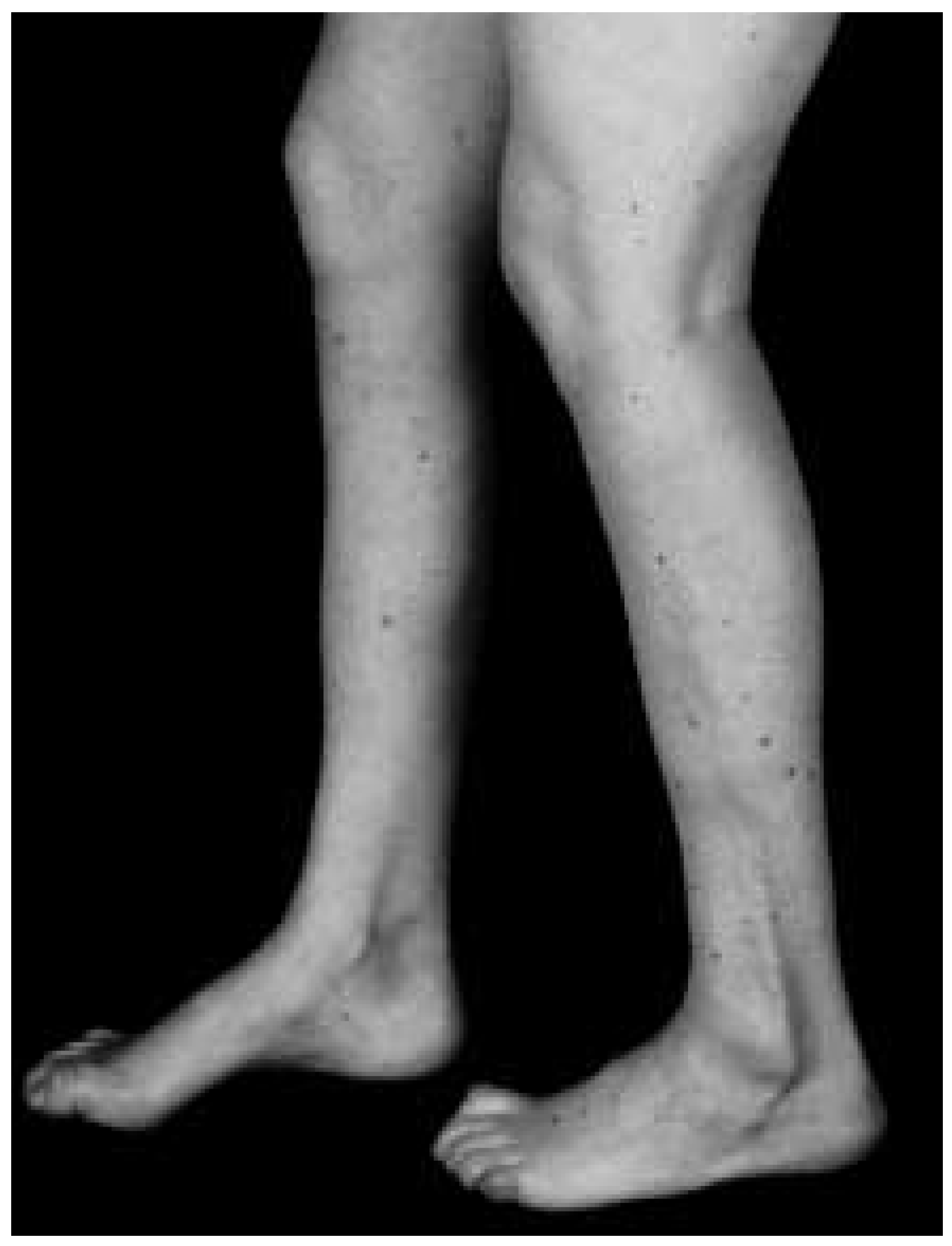
Charcot-Marie-Tooth disease (CMT) is the most common inherited neurological disorder affecting the peripheral nervous system. Its estimated prevalence is 1:2500 [1]. Clinically two predominant groups of CMT syndromes are distinguished: the demyelinating form of CMT1 is the most common one while the axonal forms are dominated by the group of CMT2. Besides these main classes of Charcot-Marie-Tooth disease, more rare forms are also included. All CMT syndromes are manifestations of peripheral nerves dysfunctions due to the misorganised myelin sheath of abnormal Schwann cells and/or axonal deficiencies. Common symptoms are progressive atrophy of peroneal muscles accompanied by a variable degree of paresis and in many cases foot deformities [2] as exemplified in figure 1. Over the last twenty years the understanding of the molecular genetic basis of Charcot-Marie-Tooth disease has developed rapidly. Besides the initially identified myelin genes peripheral myelin protein 22 (PMP22) and myelin protein zero (MPZ), several other genes have been found which cause different variants of Charcot-Marie-Tooth disease. However, there is still a remaining group of CMT syndromes for which either only the chromosomal locus has been identified or no genetic locus has yet been mapped.
Figure 1.
Peroneal atrophy and foot deformities of a CMT1A patient carrying a duplication on chromosome 17p11.2 including PMP22.
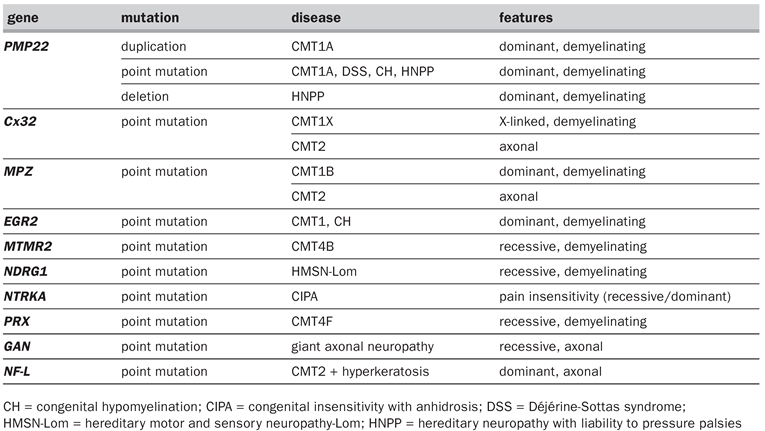
For clinical and diagnostic purposes this overview will focus on the known candidate genes and the corresponding CMT syndromes as summarised in table 1.
Table 1.
Genes associated with CMT syndromes.
Peripheral myelin protein 22 (PMP22)
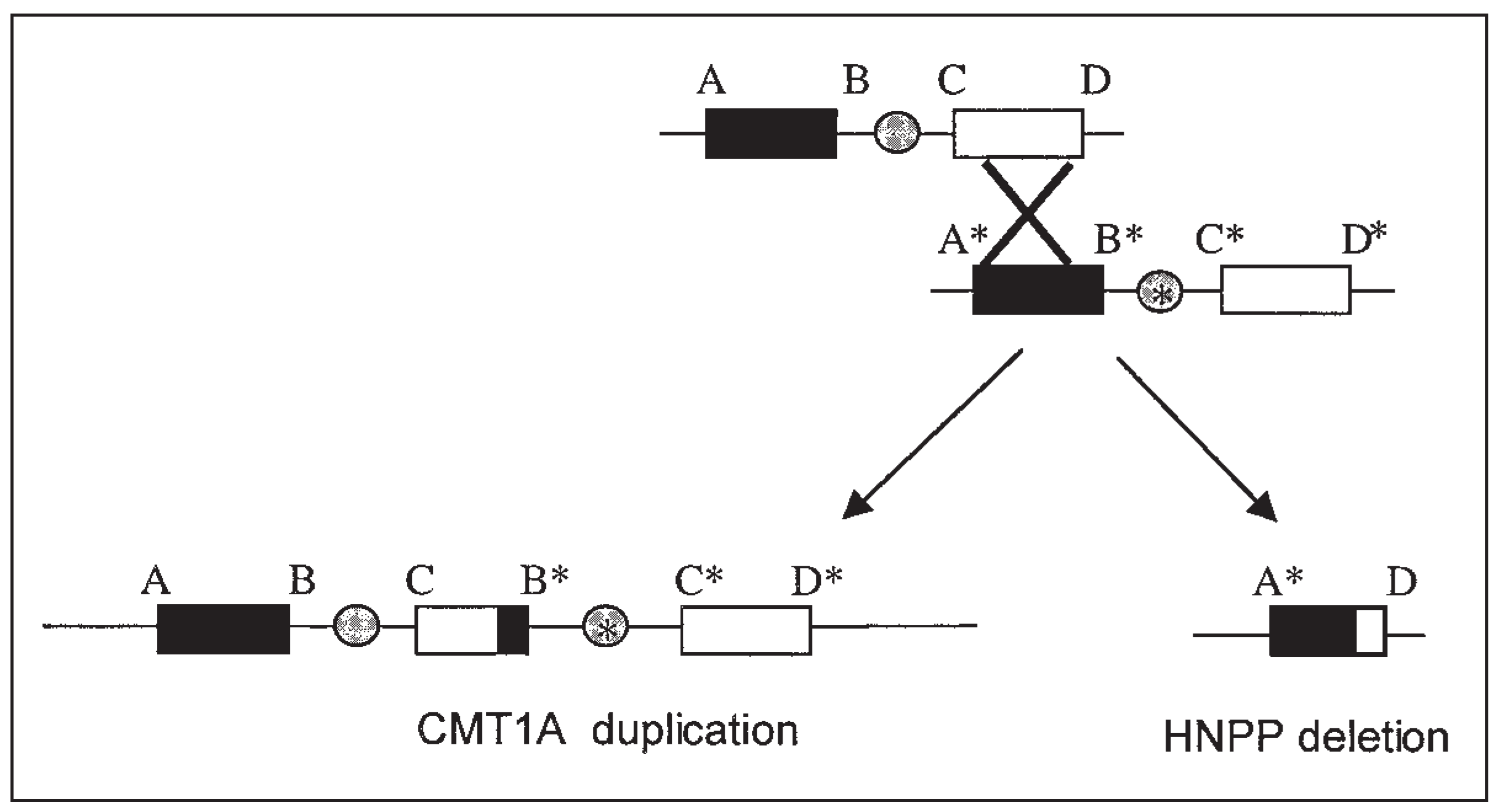
About 80% of all CMT patients show a predominant demyelinating peripheral neuropathy and are summarised into CMT1 [3]. By far the most frequent genetic alteration in this group is the intrachromosomal duplication of a 1.5 megabase DNA fragment on chromosome 17 [4,5] harbouring the gene encoding PMP22 [6,7,8,9] due to unequal crossing over during meiosis (fig. 2). Patients carrying this duplication of the PMP22 are subclassified as CMT1A. In about 20 cases, point mutations in PMP22 are associated with a comparable phenotype as the duplication of PMP22 [10]. It is postulated that point mutations cause a more severe phenotype with regard to the histological changes [11]. They are also classified as CMT1A. In contrast to the duplication of PMP22, a deletion of this gene as part of the same fragment which is duplicated in CMT1A patients (fig. 2) causes a mild variant of peripheral neuropathy, hereditary neuropathy with liability to pressure palsies (HNPP) [12]. This disorder is characterised by the occurrence of temporary recurrent nerve palsies and electrophysiological signs of demyelination at nerve entrapment sites following minimal trauma [13]. In rare cases, HNPP patients who did not carry the deletion of one allele of PMP22 are affected by point mutations of PMP22 apparently representing null alleles [14,15]. Furthermore, some DéjérineSottas (DSS) cases have been associated with PMP22 mutations [16,17].
Figure 2.
Schematic drawing of the intrachromosomal crossing over resulting in the CMT1A duplication and the HNPP deletion. Open rectangles indicate a particular distal repeat sequence (distal CMT1A-REP) which misaligns with its proximal repeat sequence (proximal CMT1A-REP = filled rectangle) during meiosis (indicated by the cross). The characters A, B, C and D represent unique flanking sequences of the CMT1A-REP while characters indicated with an asterix indicate corresponding sequences of the homologue chromosome. Shaded circles represent PMP22 locus.
Myelin protein zero (MPZ)
About 50 different mutations in the gene encoding myelin protein zero (MPZ) cause a demyelinating neuropathy which is classified as CMT1B and is clinically indistinguishable from CMT1A (reviewed by [18]). Some dominant mutations in MPZ were found to be associated with the demyelinating form of Déjérine-Sottas syndrome [19,20] which was formerly defined by autosomal recessive inheritance, onset of symptoms in early childhood and severe progress distal muscle wasting [2]. Besides these dominant mutations in MPZ, two mutations were found in patients who were diagnosed as CMT2 by clinical and electrophysiological means [21,22].
Connexin 32 (Cx32, GJB1)
Besides the two subclasses of CMT1 with autosomal dominant inheritance, an X-linked dominant form can be subclassified among the group of CMT1 syndromes. CMTX is caused by mutations in the connexin 32 gene (Cx32, GJB1) [23]. Cx32 protein is found in non-compacted regions of the myelin sheath [23]. CMTX is characterised mainly by demyelination but in some cases a clear distinction from the axonal form of CMT syndromes, CMT2, is not possible [22]. In general, male patients are more severely affected while female patients exhibit a severe peripheral neuropathy only in rare cases [24]. In the last years it has become evident that mutations in Cx32 are the second most frequent genetic alteration in Charcot-Marie-Tooth disease besides the duplication on chromosome 17p11.2 [3].
Early growth response gene 2 (EGR2, Krox20)
The gene encoding the early growth response protein 2 (EGR2, Krox20) was recently found to be mutated in patients showing either a severe form of CMT1 [25], DSS [26,27] or the most severe form of demyelinating/amyelinating neuropathy, namely congenital hypomyelination (CH). EGR2 encodes a zinc-finger transcription factor which is likely to regulate the expression of myelin genes [28].
Recently identified genes
Very recently another four genes have been identified which are associated with different recessive inherited forms of CMT syndromes or related peripheral neuropathies. The genes for myotubularin related protein 2 (MTMR2) [29], n-myc downstream regulated gene 1 (NDRG1) [30] and periaxin (PRX) [31] were all found in patients suffering from rare demyelinating forms of CharcotMarie-Tooth disease which were characterised by the severe form with early onset, CMT4B (caused by MTMR2 mutations), and in CMT4F (caused by PRX mutations). Apart from a few cases in which a predominant axonal form of Charcot-MarieTooth disease was associated with either a mutation of MPZ [21,22] or Cx32 [22] mutations in the gene encoding the neurofilament light chain (NF-L) were found in a new variant of CMT2 (CMT2 with hyperkeratosis). In addition, a gene named gigaxonin (GAN) that is mutated in giant axon neuropathy was recently identified [32]. Furthermore, mutations in the gene encoding the NGF receptor tyrosine kinase A (NTRK-A) are associated with congenital insensitivity with anhidrosis (CIPA) [33,34], an inherited neuropathy caused by degeneration of small calibre axons. Very recently, a patient with a combination of hypomyelination, chronic intestinal pseudoobstruction and deafness was identified carrying a frame shift mutation in the gene encoding the SRY-related transcription factor SOX10 [35]. Up to now this syndrome is not subclassified as a CMT syndrome due to the known association of mutations in SOX10 with the Waardenburg-Hirschsprung disease [36].
Other CMT syndromes
Besides the above mentioned candidate genes, there are still further CMT syndromes in which no particular candidate genes could be identified so far. Some subgroups of the axonal form of CMT2 have been mapped to different chromosomal loci in family studies [37,38,39] but candidates have not been identified yet. For the pure motor forms of Charcot-Marie-Tooth disease (distal hereditary motor neuropathy) which are also subdivided into several subclasses, two different genetic loci have been described [40,41]. Finally, the syndrome of recurrent hereditary neuralgic amyotrophy (HNA) has also been mapped to a chromosomal locus [42,43].
Conclusions
Several genes responsible for different CMT syndromes have been identified recently. For the most frequent form of CMT1 genetic diagnostic testing is routinely available as for Déjérine-Sottas syndrome, congenital hypomyelination and even for some rare recessive forms of Charcot-Marie-Tooth disease. For CMT2, it should be taken into account that mutations in MPZ and Cx32 can cause an axonal-like phenotype and therefore patients exhibiting CMT2 are recommended to be tested for mutations in these genes.
The revealed genetic alterations in different CMT syndromes combined with careful phenotype-genotype correlations should enable us to generate a molecular defect-based classification of this neurological disease and provide the basis to develop new therapeutic strategies.
Funding
Peter Young is a recipient of a grant from the Deutsche Forschungsgemeinschaft (DFG, YO48/1-1).
References
- Skre, H. Genetic and clinical aspects of Charcot-MarieTooth’s disease. Clin Genet 1974, 6, 98–118. [Google Scholar] [CrossRef] [Scilit]
- Dyck, P.J.; Chance, P.; Lebo, R.; Carney, J.A. Hereditary motor and sensory neuropathies. In Peripheral Neuropathy, 3rd ed; Dyck, P.J., Thomas, P.K., Griffin, J.W., Low, P.A., Poduslo, J.F., Eds.; Saunders: Philadelphia, WB, USA, 1993; pp. 1094–1136. [Google Scholar]
- Nelis, E.; Van Broeckhoven, C.; De Jonghe, P.; Lofgren, A.; Vandenberghe, A.; Latour, P.; et al. Estimation of the mutation frequencies in Charcot-Marie-Tooth disease type 1 and hereditary neuropathy with liability to pressure palsies: a European collaborative study. Eur J Hum Genet 1996, 4, 25–33. [Google Scholar] [CrossRef] [Scilit]
- Lupski, J.R.; de Oca-Luna, R.M.; Slaugenhaupt, S.; Pentao, L.; Guzzetta, V.; Trask, B.J.; et al. DNA duplication associated with Charcot-Marie-Tooth disease type 1A. Cell 1991, 66, 219–232. [Google Scholar] [CrossRef] [Scilit]
- Raeymaekers, P.; Timmerman, V.; Nelis, E.; De Jonghe, P.; Hoogendijk, J.E.; Baas, F.; et al. Duplication in chromosome 17p11.2 in Charcot-Marie-Tooth neuropathy type 1a (CMT 1a). The HMSN Collaborative Research Group. Neuromuscul Disord 1991, 1, 93–97. [Google Scholar] [CrossRef] [Scilit] [PubMed]
- Timmerman, V.; Nelis, E.; Van Hul, W.; Nieuwenhuijsen, B.W.; Chen, K.L.; Wang, S.; et al. The peripheral myelin protein gene PMP-22 is contained within the Charcot-Marie-Tooth disease type 1A duplication [published erratum appears in Nat Genet 1992, 2, 84]. Nat Genet 1992, 1, 171–175. [Google Scholar] [CrossRef] [Scilit] [PubMed]
- Patel, P.I.; Roa, B.B.; Welcher, A.A.; Schoener-Scott, R.; Trask, B.J.; Pentao, L.; Matsunami, N.; Smith, B.; Ballard, L.; Lensch, M.W.; et al. The gene for the peripheral myelin protein PMP-22 is a candidate for Charcot-Marie-Tooth disease type 1A. Nat Genet 1992, 1, 159–165. [Google Scholar] [CrossRef] [Scilit]
- Robertson, M.; Albertsen, H.; et al. Peripheral myelin protein-22 gene maps in the duplication in chromosome 17p11.2 associated with Charcot-Marie-Tooth 1A. Nat Genet 1992, 1, 176–179. [Google Scholar]
- Valentijn, L.J.; Bolhuis, P.A.; Zorn, I.; Hoogendijk, J.E.; van den Bosch, N.; Hensels; et al. The peripheral myelin gene PMP-22/GAS-3 is duplicated in Charcot-Marie-Tooth disease type 1A. Nat Genet 1992, 1, 166–170. [Google Scholar] [CrossRef] [Scilit]
- Lupski, J.R.; Garcia, C.A.; Scriver, C.R.; Beaudet, A.L.; Sly, W.S.; Valle, D. (Eds.) The Metabolic & Molecular Bases of Inherited Disease, 8th ed.; McGraw-Hill: New York, NY, USA, 2001; pp. 5759–5788. [Google Scholar]
- Gabreels-Festen, A.; Wetering, R.V. Human nerve pathology caused by different mutational mechanisms of the PMP22 gene. Ann N Y Acad Sci 1999, 883, 336–343. [Google Scholar] [CrossRef] [Scilit] [PubMed]
- Chance, P.F.; Alderson, M.K.; Leppig, K.A.; Lensch, M.W.; Matsunami, N.; Smith, B.; et al. DNA deletion associated with hereditary neuropathy with liability to pressure palsies. Cell 1993, 72, 143–151. [Google Scholar] [CrossRef] [Scilit]
- Windebank, A.J. Inherited recurrent focal neuropathies. In Peripheral Neuropathy, 3rd ed.; Dyck, P.J., Thomas, P.K., Griffin, J.W., Low, P.A., Poduslo, J.F., Eds.; Saunders: Philadelphia, WB, USA, 1993; pp. 1137–1148. [Google Scholar]
- Nicholson, G.A.; Valentijn, L.J.; Cherryson, A.K.; Kennerson, M.L.; Bragg, T.L.; DeKroon, R.M.; et al. A frame shift mutation in the PMP22 gene in hereditary neuropathy with liability to pressure palsies [published erratum appears in Nat Genet 1994, 7, 113]. Nat Genet 1994, 6, 263–266. [Google Scholar] [CrossRef] [Scilit]
- Young, P.; Wiebusch, H.; Stogbauer, F.; Ringelstein, B.; Assmann, G.; Funke, H. A novel frameshift mutation in PMP22 accounts for hereditary neuropathy with liability to pressure palsies [see comments]. Neurology 1997, 48, 450–452. [Google Scholar] [CrossRef] [Scilit]
- Ionasescu, V.V.; Ionasescu, R.; Searby, C.; Neahring, R. Dejerine-Sottas disease with de novo dominant point mutation of the PMP22 gene. Neurology 1995, 45, 1766–1767. [Google Scholar] [CrossRef] [Scilit] [PubMed]
- Ionasescu, V.V.; Searby, C.C.; Ionasescu, R.; Chatkupt, S.; Patel, N.; Koenigsberger, R. Dejerine-Sottas neuropathy in mother and son with same point mutation of PMP22 gene. Muscle Nerve 1997, 20, 97–99. [Google Scholar] [CrossRef] [Scilit]
- Warner, L.E.; Svaren, J.; Milbrandt, J.; Lupski, J.R. Functional consequences of mutations in the early growth response 2 gene (EGR2) correlate with severity of human myelinopathies. Hum Mol Genet 1999, 8, 1245–1251. [Google Scholar] [CrossRef] [Scilit]
- Hayasaka, K.; Himoro, M.; Sawaishi, Y.; Nanao, K.; Takahashi, T.; Takada, G.; et al. De novo mutation of the myelin P0 gene in Dejerine-Sottas disease (hereditary motor and sensory neuropathy type III). Nat Genet 1993, 5, 266–268. [Google Scholar] [CrossRef] [Scilit]
- Warner, L.E.; Shohat, M.; Shorer, Z.; Lupski, J.R. Multiple de novo MPZ (P0) point mutations in a sporadic DejerineSottas case. Hum Mutat 1997, 10, 21–24. [Google Scholar] [CrossRef]
- De Jonghe, P.; Timmerman, V.; Ceuterick, C.; Nelis, E.; De Vriendt, E.; Lofgren, A.; et al. The Thr124Met mutation in the peripheral myelin protein zero (MPZ) gene is associated with a clinically distinct Charcot-Marie-Tooth phenotype. Brain 1999, 122, 281–290. [Google Scholar] [CrossRef] [Scilit]
- Young, P.; Grote, K.; Kuhlenbäumer, G.; Debus, O.; Kurlemann, G.; Halfter, H.; et al. Mutation analysis in CharcotMarie-Tooth disease type 1: point mutations in the MPZ gene and the GJB1 gene cause comparable phenotypic heterogeneity. J Neurol 2001, 248, 410–415. [Google Scholar] [CrossRef] [Scilit]
- Bergoffen, J.; Scherer, S.S.; Wang, S.; Scott, M.O.; Bone, L.J.; Paul, D.L.; et al. Connexin mutations in X-linked CharcotMarie-Tooth disease. Science 1993, 262, 2039–2042. [Google Scholar] [CrossRef] [Scilit]
- Birouk, N.; LeGuern, E.; Maisonobe, T.; Rouger, H.; Gouider, R.; Tardieu, S.; et al. X-linked Charcot-Marie-Tooth disease with connexin 32 mutations: clinical and electrophysiologic study. Neurology 1998, 50, 1074–1082. [Google Scholar] [PubMed]
- Warner, L.E.; Mancias, P.; Butler, I.J.; McDonald, C.M.; Keppen, L.; Koob, K.G.; et al. Mutations in the early growth response 2 (EGR2) gene are associated with hereditary myelinopathies. Nat Genet 1998, 18, 382–384. [Google Scholar] [PubMed]
- Timmerman, V.; De Jonghe, P.; Ceuterick, C.; De Vriendt, E.; Lofgren, A.; Nelis, E.; et al. Novel missense mutation in the early growth response 2 gene associated with DejerineSottas syndrome phenotype. Neurology 1999, 52, 1827–1832. [Google Scholar] [CrossRef] [Scilit]
- Nelis, E.; Haites, N.; Van Broeckhoven, C. Mutations in the peripheral myelin genes and associated genes in inherited peripheral neuropathies. Hum Mutat 1999, 13, 11–28. [Google Scholar]
- Topilko, P.; Schneider-Maunoury, S.; Levi, G.; Baron-Van Evercooren, A.; Chennoufi, A.B.; Seitanidou, T.; et al. Krox-20 controls myelination in the peripheral nervous system. Nature 1994, 371, 796–799. [Google Scholar] [CrossRef] [Scilit]
- Bolino, A.; Muglia, M.; Conforti, F.L.; LeGuern, E.; Salih, M.A.; Georgiou, D.M.; et al. Charcot-Marie-Tooth type 4B is caused by mutations in the gene encoding myotubularinrelated protein-2. Nat Genet 2000, 25, 17–19. [Google Scholar] [CrossRef] [Scilit]
- Kalaydjieva, L.; Gresham, D.; Gooding, R.; Heather, L.; Baas, F.; de Jonge, R.; et al. N-myc downstream-regulated gene 1 is mutated in hereditary motor and sensory neuropathyLom. Am J Hum Genet 2000, 67, 47–58. [Google Scholar] [CrossRef] [Scilit]
- Boerkoel, C.F.; Takashima, H.; Stankiewicz, P.; Garcia, C.A.; Leber, S.M.; Rhee-Morris, L.; et al. Periaxin mutations cause recessive Dejerine-Sottas neuropathy. Am J Hum Genet 2001, 68, 325–333. [Google Scholar] [CrossRef] [Scilit] [PubMed]
- Bomont, P.; Cavalier, L.; Blondeau, F.; Ben Hamida, C.; Belal, S.; Tazir, M.; et al. The gene encoding gigaxonin, a new member of the cytoskeletal BTB/kelch repeat family, is mutated in giant axonal neuropathy. Nat Genet 2000, 26, 370–374. [Google Scholar]
- Mardy, S.; Miura, Y.; Endo, F.; Matsuda, I.; Sztriha, L.; Frossard, P.; et al. Congenital insensitivity to pain with anhidrosis: novel mutations in the TRKA (NTRK1) gene encoding a high-affinity receptor for nerve growth factor. Am J Hum Genet 1999, 64, 1570–1579. [Google Scholar]
- Mardy, S.; Miura, Y.; Endo, F.; Matsuda, I.; Indo, Y. Congenital insensitivity to pain with anhidrosis (CIPA): effect of TRKA (NTRK1) missense mutations on autophosphorylation of the receptor tyrosine kinase for nerve growth factor. Hum Mol Genet 2001, 10, 179–188. [Google Scholar] [CrossRef] [Scilit]
- Pingault, V.; Bondurand, N.; Kuhlbrodt, K.; Goerich, D.E.; Prehu, M.O.; Puliti, A.; et al. SOX10 mutations in patients with Waardenburg-Hirschsprung disease. Nat Genet 1998, 18, 171–173. [Google Scholar] [CrossRef] [Scilit]
- Herbarth, B.; Pingault, V.; Bondurand, N.; Kuhlbrodt, K.; Hermans-Borgmeyer, I.; Puliti, A.; et al. Mutation of the Sryrelated Sox10 gene in dominant megacolon, a mouse model for human Hirschsprung disease. Proc Natl Acad Sci USA 1998, 95, 5161–5165. [Google Scholar] [CrossRef] [Scilit] [PubMed]
- Gemignani, F.; Marbini, A. Charcot-Marie-Tooth disease (CMT): distinctive phenotypic and genotypic features in CMT type 2. J Neurol Sci 2001, 184, 1–9. [Google Scholar] [CrossRef] [Scilit]
- Timmerman, V.; De Jonghe, P.; Spoelders, P.; Simokovic, S.; Lofgren, A.; Nelis, E.; et al. Linkage and mutation analysis of Charcot-Marie-Tooth neuropathy type 2 families with chromosomes 1p35-p36 and Xq13. Neurology 1996, 46, 1311–1318. [Google Scholar] [CrossRef] [Scilit]
- Ben Othmane, K.; Middleton, L.T.; Loprest, L.J.; Wilkinson, K.M.; Lennon, F.; Rozear, M.P.; et al. Localization of a gene (CMT2A) for autosomal dominant Charcot-Marie-Tooth disease type 2 to chromosome 1p and evidence of genetic heterogeneity. Genomics 1993, 17, 370–375. [Google Scholar]
- Timmerman, V.; Raeymaekers, P.; Nelis, E.; De Jonghe, P.; Muylle, L.; Ceuterick, C.; et al. Linkage analysis of distal hereditary motor neuropathy type II (distal HMN II) in a single pedigree. J Neurol Sci 1992, 109, 41–48. [Google Scholar] [CrossRef] [Scilit]
- Auer-Grumbach, M.; Loscher, W.N.; Wagner, K.; Petek, E.; Korner, E.; Offenbacher, H.; et al. Phenotypic and genotypic heterogeneity in hereditary motor neuronopathy type V: a clinical, electrophysiological and genetic study. Brain 2000, 123, 1612–1623. [Google Scholar] [CrossRef] [Scilit] [PubMed]
- Chance, P.F.; Lensch, M.W.; Lipe, H.; Brown, R.H., Sr.; Brown, R.H., Jr.; Bird, T.D. Hereditary neuralgic amyotrophy and hereditary neuropathy with liability to pressure palsies: two distinct genetic disorders. Neurology 1994, 44, 2253–2257. [Google Scholar] [CrossRef] [Scilit] [PubMed]
- Stogbauer, F.; Young, P.; Kuhlenbaumer, G.; De Jonghe, P.; Timmerman, V. Hereditary recurrent focal neuropathies: clinical and molecular features. Neurology 2000, 54, 546–551. [Google Scholar] [CrossRef] [Scilit]
This is an open-access article distributed under the terms of the Creative Commons Attribution Non-Commercial No Derivatives (CC BY-NC-ND) 4.0 License.