


Abstract
(1) Background: Evidence on factors associated with purpose in life (PIL) among older adults in Taiwan remains limited. This study examined the variation in PIL and its demographic, relational, socioeconomic, health-related, and religious correlates among older adults in the community recruited in two districts of Taiwan (Kaohsiung and Taitung). (2) Methods: A cross-sectional survey was conducted among 294 adults ≥65 years of age recruited by convenience sampling from community day care centers and community centers in Kaohsiung and Taitung; no probability sampling frame was used. Participants completed the 20-item purpose-in-life test and questionnaires on sociodemographic characteristics and perceived health. Univariate and multivariate linear regression analyzes were performed. The multivariate model adjusted for the recruitment district, and the p values for seven predictor domains were adjusted using the Benjamini–Hochberg false discovery rate (FDR) procedure. (3) Results: The mean age was 72.9 years; 56.8% were women. Using conventional PIL categories, 82.0% had low PIL and 18.0% had moderate PIL; none had high PIL. Older age was associated with a lower PIL (adjusted B = <0.28/year, 95% CI: <0.42 to <0.14). Marital status was associated with PIL overall (global p = 0.0066); never-married participants had lower PIL than those with a spouse (adjusted B = 4.74, 95% CI: 8.52 to 0.96). Faith/religious belief was associated with a lower PIL (adjusted B = 3.01, 95% CI 5.25 to 0.78). Age, marital status, and faith/religious belief remained significant after the FDR correction (FDR-adjusted p < 0.001, 0.020, and 0.020, respectively). (4) Conclusions: In this two-district convenience sample, older age, marital status, and faith/religious belief were associated with PIL, and older age was the only correlate consistent across all sensitivity analyzes. Because the design was cross-sectional and the sample was not population-based, these associations should not be interpreted causally or as nationally representative, but they indicate that demographic, relational, and religious contexts warrant attention when purpose in life is studied in later life.
1. Introduction
The ageing of the population is increasing throughout the world. The World Health Organization (WHO) reports that the proportion of the world’s population over 60 years will almost double between 2025 and 2050, from 12% to 22%, and that health and social systems in all countries face major challenges in adapting to this change (World Health Organization, 2024).
In Taiwan, the ageing population is increasing rapidly, with 19.2% of the population aged 65 years and older in 2024 (Taiwan Executive Yuan, n.d.). Taiwan’s government predicts that this proportion will exceed 20% in 2025 and reach approximately 38% by 2050 (National Development Council, 2024). Two main factors underlie this trend. First, life expectancy has increased due to Taiwan’s well-covered medical system, in which 99% of the population is enrolled in National Health Insurance (NHI); this keeps treatment costs low and facilitates access to healthcare professionals, and average life expectancy reached 84.42 years for women and 77.82 years for men in 2024 (National Development Council, 2024). Second, the declining birth rate has accelerated population ageing: in 2023, the birth rate in Taiwan was 8.38 births per 1000 people.
The WHO constitution, which came into effect in 1948, defines health in its preamble as a state of complete physical, mental, and social well-being, and not merely the absence of disease or infirmity (World Health Organization, 1949); this definition remains widely used today. At the 101st meeting of the WHO Executive Board in 1998, a proposal to incorporate “spiritual health” into this definition was discussed for presentation to the 52nd World Health Assembly, reportedly informed by health perspectives rooted in cultural and religious traditions (Nagase, 2012; World Health Organization, 1998). Spiritual well-being is a complex and multidimensional construct that has gained increasing recognition in health-related research, particularly within positive psychology. The National Interfaith Coalition on Ageing (NICA) in the United States defines spiritual well-being as “the affirmation of life in a relationship with God, self, community and environment that nurtures and celebrates wholeness” (National Interfaith Coalition on Aging, 1975). Subsequent research elaborated on this framework, describing spiritual well-being as encompassing four interrelated relational domains: the personal domain (relationship with self), the communal domain (relationships with others), the environmental domain (connection with the surrounding environment), and the transcendental domain (relationship with higher entities) (Fisher, 2011).
Purpose in life (PIL), spiritual well-being, psychological well-being, and religiosity are related but conceptually distinct constructs. Spiritual well-being broadly concerns perceived well-being in relation to oneself, others, the environment, and, for some individuals, a transcendent dimension (Fisher, 2011; National Interfaith Coalition on Aging, 1975). On the contrary, PIL focuses specifically on the perceived meaning, direction, and purpose of an individual in life. Drawing on Viktor Frankl’s view that a sense of personal purpose is fundamental to mental and physical well-being and may evolve throughout life (Frankl, 1963), the Purpose in Life Test was developed to assess individuals’ perceived meaning and purpose in life. The instrument consists of 20 items, each rated on a 7-point Likert scale with item-specific anchors, such as ‘in life I have’ (ranging from no goals to clear goals) and ‘My existence is’ (ranging from meaningless to meaningful) (Crumbaugh, 1968). Therefore, although PIL may be associated with spiritual, psychological, and religious characteristics, it represents a distinct construct and is the primary outcome examined in the present study.
Ageing of the population is particularly relevant to PIL because transitions that commonly occur in later life may directly affect important sources of purpose. Retirement may affect occupational roles, bereavement and changes in social networks may affect relational roles, and declining functional capacity may restrict personally meaningful activities and goals. Sustaining a sense of purpose through these transitions may have important health implications. A higher PIL has been prospectively associated with a lower all-cause mortality among adults over 50 years of age and throughout adulthood (Alimujiang et al., 2019; Hill & Turiano, 2014), as well as with more favorable health outcomes in later life (Musich et al., 2018).
Several studies conducted in Taiwan have examined related but distinct aspects of spiritual well-being, psychological well-being, and PIL in later life. A study found that spiritual well-being mediated the association between depressive symptoms and self-rated health among older adults (Salman & Lee, 2019). Research involving 65-year-old male veterans in southern Taiwan reported that meaning in life was influenced by the quality of relationships with family and friends, while educational attainment and self-perceived health were positively associated with meaning in life (Niu et al., 2016). A study of adults 55 years and older found that chronic illness, unemployment, and financial dependence were negatively related to psychological well-being in men, while satisfaction with the living environment and family relationships was positively associated with psychological well-being in women (Fergus et al., 2024). Furthermore, evidence from individuals aged 50 to 75 years indicated that psychological well-being was more strongly correlated with family relationships than perceived health (Chiang et al., 2013). Collectively, these studies suggest that meaning and well-being in later life may be related to demographic, family, socioeconomic, and health circumstances. However, because spiritual well-being, psychological well-being, meaning in life, and PIL are not interchangeable constructs, the findings of these studies cannot be assumed to apply directly to PIL measured by the Purpose in Life Test.
The Taiwanese evidence base remains limited in several specific areas. First, previous studies have largely assessed psychological or spiritual well-being or meaning in life rather than PIL as operationalised by the Purpose in Life Test. Second, few studies have examined religious belief alongside demographic, relational, socioeconomic, and health-related characteristics with a single adjusted analytical framework. Third, the regional context has rarely been considered when examining these associations in Taiwan. A recent study applies the Purpose in Life test to older adults living in the community of South Korea (M. Chen et al., 2025), providing a relevant regional comparison; however, comparable evidence among older adults living in the community of Taiwan remains limited.
Consequently, the present study aimed to examine the variation in PIL and its association with demographic, relational, socioeconomic, religious, and perceived health characteristics among older adults living in the community in Kaohsiung and Taitung, Taiwan. Based on previous research, we hypothesized that PIL would vary according to age, family and social circumstances, socioeconomic status, religious beliefs, and perceived health.
2. Materials and Methods
2.1. Study Design, Participants and Sample
This cross-sectional study was conducted with a paper questionnaire among older adults living in the community in Kaohsiung and Taitung, Taiwan, between June and August 2024. Participants were recruited from community daycare centers and community centers using convenience sampling.
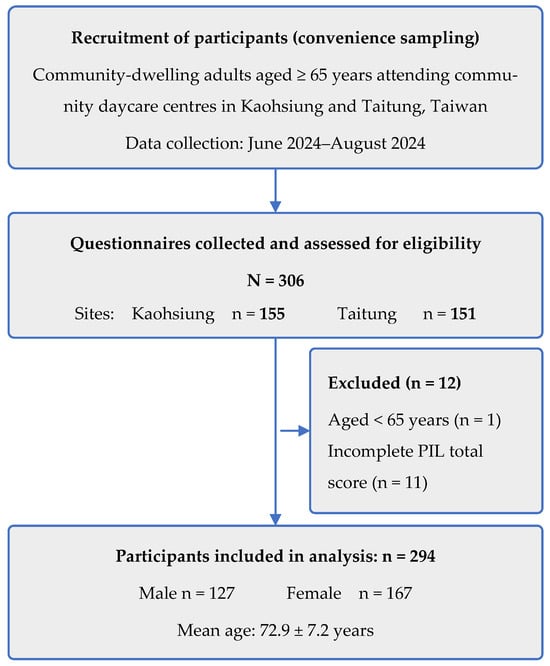
The centers were identified through local collaborating clinicians and institutions in each district and were directly approached by the research team. Within each participating center, attendees present on the survey day were invited to participate. A total of three centers participated in Kaohsiung and one in Taitung. A total of 306 questionnaires were collected, and eligibility was assessed. Of these, 12 were excluded: one because the participant was younger than 65 years and 11 because one or more of the 20 PIL items were incomplete, preventing calculation of the total PIL score. Therefore, the final analytical sample consisted of 294 participants. The participant selection process is shown in Figure 1.
Figure 1.
Flow chart of the data collection process.
The target sample size was estimated using G*Power version 3.1 (Faul et al., 2007) for the test F of a multiple linear regression model (R2 deviation from zero), assuming a small-to-medium effect size of f2 = 0.05, α = 0.05, statistical power 0.80, and seven predictor domains. The resulting minimum required sample size was 295 participants, and 306 questionnaires were collected to allow for exclusions. After eligibility assessment and exclusion of incomplete questionnaires, the final analytical sample consisted of 294 participants.
2.2. Inclusion Criteria
Participants were eligible if they were 65 years or older, were residents of the community of Taiwan, attended a participating community daycare center or community center, and were able to understand Mandarin Chinese and respond to the study questionnaire. Participants completed the questionnaire with the support of data collection staff when needed. The staff facilitated the completion of the questionnaire while ensuring that participants provided their own responses.
2.3. Exclusion Criteria
Participants were excluded if they lived in an institutional setting, reported a previously received diagnosis of dementia, or had incomplete PIL data that prevented the calculation of the total PIL score. Dementia status was determined by self-report or, when a family member or center staff member was present, by proxy report of a prior clinical diagnosis. Medical records were not accessed, and no cognitive screening test was administered.
2.4. Instruments
Sociodemographic information collected included age, sex, educational attainment, marital status, having a child, living arrangement, employment history, income, pension status, caregiving responsibilities, faith or religious belief, specific religious affiliation, and participation in social and volunteer activities. Participants also reported their current self-rated health and their perceived health compared to the previous year.
The Purpose in Life Test (PIL), developed by Crumbaugh and Maholick based on Frankl’s theoretical framework (Crumbaugh, 1968; Frankl, 1963), is a 20-item instrument designed to assess individuals’ perceived sense of meaning and purpose in life. The traditional Chinese version was administered to participants who were able to understand Mandarin Chinese. Each item is rated on a 7-point Likert scale (1 to 7), where a score of 4 represents a neutral position, and higher or lower values indicate stronger endorsement toward either end of the continuum. Total scores range from 20 to 140 and are commonly categorised as low (20 to 91), moderate (92–112), or high (113 to 140) for purpose in life (Davies, 2011); higher scores reflect a stronger perceived sense of meaning and purpose. The PIL has shown good psychometric properties in diverse populations, with reported split-half reliability coefficients of 0.77 to 0.85, test–retest reliability coefficients of 0.68 to 0.83, and Cronbach’s alpha values of 0.86 to 0.90 (Davies, 2011). In the present sample, the PIL demonstrated high internal consistency (Cronbach’s alpha = 0.923). Detailed item-level reliability statistics are presented in Supplementary Table S5. This scoring and categorisation approach has been used in previous studies (Davies, 2011).
2.5. Statistical Analysis
Descriptive statistics were used to summarise the sociodemographic and health-related characteristics of the participants, including age, sex, educational attainment, marital status, having a child, living arrangement, employment status, income, pension status, caregiving responsibility, faith or religious belief, specific religious affiliation, participation in social and volunteer activities, self-rated health, and perceived health compared to the previous year. Associations between categorical variables and PIL category were examined using Pearson’s χ2 test or Fisher’s exact test. Fisher’s exact test was used when expected cell counts were small. These analyzes were considered exploratory because the primary analyzes used the continuous PIL total score as the dependent variable. There were no missing data for the variables included in the primary multivariate analysis among the 294 participants in the analytical sample; therefore, no imputation was performed.
For primary analyzes, the continuous PIL total score was retained as the dependent variable to preserve the complete information and variability of the original scale and to avoid the loss of information associated with categorisation. Univariate linear regression analyzes were initially performed to examine the associations between each potential predictor and the continuous PIL score. Subsequently, multivariate linear regression was performed to estimate the independent associations between the selected predictors and PIL while adjusting for potential confounders. The variables included in the multivariate linear regression model were selected based on theoretical relevance, findings from previous studies, and their potential roles as sociodemographic and psychosocial determinants of PIL, rather than solely on statistical significance in univariate analyzes. To maintain model parsimony and reduce the risk of overfitting, seven predictor domains were included: sex, age, education, marital status, income, faith/religious belief, and self-rated health. Gender, age, and education were included as fundamental sociodemographic characteristics, while marital status and income were selected to represent family/social and socioeconomic contexts, respectively. Faith/religious belief was included due to the conceptual relationship between PIL and spiritual well-being, while self-rated health was included because perceived health has been associated with psychological and spiritual well-being. These variables were retained in the primary model irrespective of their significance in the univariate analyzes.
In the primary multivariate analysis, gender was treated as a binary variable, age as a continuous variable in years, education as lower than high school versus high school or higher, and marital status as a categorical variable, with having a spouse as the reference category. Income was dichotomized at NT$55,000. For regression analyzes, participants reporting ‘very strong’ or ‘somewhat’ faith/religious belief were classified as having faith/religious belief, while those reporting ‘no’ or ‘don’t know’ were classified as having no faith/religious belief. For analyses of specific religious affiliation, participants classified as having no faith/religious belief served as a reference group and were compared with participants who reported Buddhism, Shinto, Christianity, or Taoism. Financial concern was originally assessed using four response categories: no worries; little money but not worried; little money and somewhat worried; and very worried. For the univariate linear regression analysis, the first two categories were combined as having no financial concern, while the latter two categories were combined as having financial concern. Self-rated health (“Health feeling”) was originally assessed using four response categories (very healthy, fairly healthy, not very healthy, and not in good health) and was dichotomized for the linear regression analysis as healthy (very healthy or fairly healthy) versus not healthy (not very healthy or not in good health). Perceived health compared to the previous year (“Health feeling versus last year”) was assessed using three categories: better, no change, and worse. For the linear regression analysis, the better and the no-change were combined as the better/no-change, with the worse as the comparison category. To account for the potential geographic confounder of recruitment across the two study regions, the recruitment district (Kaohsiung or Taitung) was included as an adjustment variable in the multivariate model.
Conceptually overlapping variables were not entered simultaneously into the primary model to minimise redundancy and model instability. Therefore, the living arrangement was examined as an alternative to marital status in a sensitivity analysis, while the specific religious affiliation was examined as an alternative to faith/religious belief. Heteroskedasticity-robust standard errors were used for statistical inference in both univariate and multivariate linear regression analyses. The assumptions of the model and the stability of the primary multivariate model were evaluated using residual diagnostics. Residual distributions and residual versus fitted plots were examined to assess the adequacy of the linear model. The Breusch–Pagan/Cook–Weisberg test indicated heteroskedasticity (χ2 = 9.06, p = 0.0026), supporting the use of robust standard errors. Multicollinearity was assessed using variance inflation factors (VIFs). Potentially influential observations were evaluated using Cook’s distance, with 4/N used as a screening threshold. Observations exceeding this threshold were retained in the primary analysis, and a sensitivity analysis was performed excluding these observations to evaluate the stability of the estimates. To account for multiple tests, the p values for the seven predictor domains in the primary multivariate model were adjusted using the Benjamini–Hochberg false discovery rate (FDR) procedure. Marital status was treated as a single predictor domain using its global Wald test. The recruitment district was included as an adjustment variable to account for potential geographic confounders and was not included in the FDR correction. Statistical significance was defined as a two-sided p < 0.05. All statistical analyzes were performed with Stata version 18 (StataCorp LLC, College Station, TX, USA).
3. Results
A total of 294 older adults participated in this study. The mean age of the participants was 72.9 ± 7.2 years, and 167 participants (56.8%) were female. High school education or above was reported by 84 participants (28.6%). Regarding the family situation, 164 participants (55.8%) had a spouse or partner and 272 (92.5%) had at least one living child. In the whole sample, 59 participants (20.1%) had children living with them only, 122 (41.5%) had children living separately only, and 91 (31.0%) reported both co-resident and non-co-resident children or another arrangement. Regarding the living arrangements, 143 participants (48.6%) lived with a spouse—either with the spouse alone or with the spouse and others—and 78 (26.5%) lived with a child without a spouse present.
Regarding employment status, 81 participants (27.5%) were self-employed, 24 (8.2%) were employees, and 189 (64.3%) had no income-generating job. Regarding financial circumstances, 174 participants (59.2%) reported having limited financial resources in the household but minimal financial concern; 207 participants (70.4%) reported a monthly household income below 55,000 New Taiwan dollars (NT$) and 154 participants (52.4%) reported receiving a pension. Regarding caregiving responsibility, 219 participants (74.5%) reported living with at least one individual requiring their care.
Regarding faith and religious belief, among participants who reported a specific religious affiliation, Christianity (including Catholicism) was the most common, reported by 160 participants (80.8%). Regarding social and volunteer participation, 133 participants (45.2%) had experience with local events, 101 (34.4%) with health and sports events, and 67 (22.8%) with support for the elderly, while 189 participants (64.3%) had no volunteer experience. Regarding self-rated health, 34 participants (11.6%) reported feeling ‘very healthy’, 178 (60.5%) reported feeling ‘healthy’, and 139 (47.3%) reported feeling better than the previous year. The descriptive characteristics are summarized in Table 1.
Table 1.
Demographic characteristics of the participant (N = 294).
In general, 241 participants (82.0%) were classified as having low PIL and 53 (18.0%) as moderate PIL; no participants met the criteria for high PIL. The mean total score of PIL was 84.3 ± 9.5 (median, 84; range, 54–118), with scores concentrated in the low band; the complete distribution is shown in Supplementary Figure S1. The PIL test demonstrated high internal consistency in the present sample (Cronbach’s α = 0.923). The 20 items showed positive item-rest correlations, ranging from 0.285 to 0.714 (Supplementary Table S5). Exploratory categorical analyzes using Pearson’s χ2 test or Fisher’s exact test, as appropriate, identified several variables with statistically significant differences in the distribution of PIL (p < 0.05).
Participants aged 65 to 74 years had a higher proportion of moderate PIL than those aged 75 years (21.8% vs. 10.9%, p = 0.021). The PIL category also differed significantly according to marital status (p = 0.001), living arrangement (p < 0.001), household income (p = 0.037), and perceived health compared to the previous year (p = 0.033). No statistically significant differences were observed for gender, educational attainment, employment status, job status, financial concern, pension, caregiving responsibility, or volunteer participation. The distribution of PIL levels among participant characteristics is presented in Table 2.
Table 2.
Sociodemographic characteristics by PIL level.
All univariate linear regression models were fitted to the full analytical sample of 294 participants. Marital status was associated with PIL in general (global p = 0.014). Never married was associated with a lower PIL compared to having a spouse (unadjusted B = −3.50, 95% CI: −6.94 to −0.05, p = 0.047). Having a spouse who died was associated with a higher PIL compared to having a spouse (unadjusted B = 2.58, 95% CI 0.03 to 5.14, p = 0.048). Having a child was associated with a higher PIL compared to having no child (unadjusted B = 2.87, 95% CI 0.08 to 5.66, p = 0.044). In terms of financial status, having no financial concern and income of NT$55,000 or more were associated with a higher PIL compared to having financial concern and a monthly household income below NT$55,000 (unadjusted B = 2.32, 95% CI: 0.16 to 4.48, p = 0.036; unadjusted B = 3.50, 95% CI: 0.97 to 6.04, p = 0.007, respectively). Older age was associated with a lower PIL (unadjusted B = −0.27, 95% CI: −0.39 to −0.15, p < 0.001). Having faith or a religious belief was associated with a lower PIL compared to having no faith/religious belief (unadjusted B = −4.11, 95% CI −6.44 to −1.79, p = 0.001). Specific religious affiliation was also associated with PIL in general (global p < 0.001). Among specific religious affiliations, Buddhism, Christianity, and Taoism were associated with a lower PIL compared to those without faith/religious belief (unadjusted B = −8.39, 95% CI: −12.31 to −4.46, p < 0.001; unadjusted B = −3.51, 95% CI: −5.93 to −1.09, p = 0.005; unadjusted B = −2.94, 95% CI: −5.82 to −0.05, p = 0.046). The results of the univariate linear regression analyzes are presented in Table 3.
Table 3.
Univariate Linear Regression Analysis of Factors Associated with the PIL Score. (N = 294).
The primary multivariate linear regression model was fitted to the entire analytical sample of 294 participants and was also adjusted for the recruitment district. Older age was associated with lower PIL. (adjusted B = −0.28, 95% CI: −0.42 to −0.14, p < 0.001). Marital status was significantly associated with PIL overall (global p = 0.0066). Compared to participants who had a spouse, those who had never married had a lower PIL (adjusted B = −4.74, 95% CI −8.52 to −0.96, p = 0.014). Faith/religious belief was significantly associated with a lower PIL (adjusted B = −3.01, 95% CI: −5.25 to −0.78, p = 0.008). Higher income was associated with higher PIL (adjusted B = 2.71, 95% CI: 0.26 to 5.16, p = 0.031). Gender, education, and self-rated health were not significantly associated with PIL in the primary model. The recruitment district was not statistically significantly associated with PIL (adjusted B = −1.45, 95% CI −3.48 to 0.57, p = 0.158).
After Benjamini–Hochberg correction for multiple tests in the seven predictor domains, age (FDR-adjusted p < 0.001), marital status (global FDR-adjusted p = 0.020), and faith/religious belief (FDR-adjusted p = 0.020) remained statistically significant. The association with income did not remain statistically significant after the FDR correction (FDR-adjusted p = 0.053). The results of the primary multivariate linear regression analysis are presented in Table 4. The model diagnostics indicated that the residuals were centred close to zero and were approximately symmetric (skewness = −0.15), although some deviation from normality was suggested by a kurtosis of 4.36. The residual versus fitted plot did not show a marked systematic pattern suggestive of substantial nonlinearity. The Breusch–Pagan/Cook–Weisberg test indicated heteroskedasticity (χ2 = 9.06, p = 0.0026), supporting the use of robust standard errors of heteroskedasticity. The mean VIF was 2.50, providing no evidence of substantial overall multicollinearity. Nineteen of 294 observations (6.5%) exceeded the Cook distance screening threshold of 4/N; however, the maximum Cook distance was only 0.039, indicating that no single observation had an exceptionally large influence on the model. Therefore, all observations were retained in the primary analysis.
Table 4.
Multivariate Linear Regression Analysis of Factors Associated with the PIL Score (N = 294).
The main findings were generally robust to the specifications of alternative models. When marital status was replaced by living arrangement, the associations of age, income, and faith/religious belief with PIL remained similar in direction and magnitude, and the living arrangement was associated with PIL in general (global p = 0.0475). In the separate sensitivity analysis that replaced faith/religious belief with a specific religious affiliation, with an additional adjustment for the recruitment district, religious affiliation was associated with PIL overall (global p = 0.0017). Compared to participants who reported no faith/religious belief, Buddhists had lower PIL (adjusted B = −7.61, 95% CI: −11.42 to −3.79, p < 0.001). This finding should be interpreted with caution because religious affiliation may also reflect unmeasured cultural, geographic, social, or community characteristics, and the cross-sectional design precludes causal inference.
In a further sensitivity analysis that excluded the potentially influential observations identified using Cook’s distance, the principal associations with age, marital status, and faith/religious belief remained similar in direction and magnitude, although the estimate of income was less stable.
4. Discussion
The present study examined sociodemographic, social, health-related, and religious factors associated with PIL among community-dwelling adults aged 65 years and older in Kaohsiung and Taitung, Taiwan. The mean PIL was 84.3 ± 9.5, and most of the participants were classified as having low PIL according to the conventional cutoff, without the participants classified as having High PIL. The observed scores ranged from 54 to 118 on the possible 20–140 scale (Supplementary Figure S1). In the primary multivariate analysis, older age, marital status, and having faith/religious belief were associated with PIL and remained statistically significant after correction for multiple tests. Higher income was also associated with higher PIL in the primary model, but this association was not statistically significant after FDR correction and was less stable in the sensitivity analyzes. In general, these findings suggest that PIL in later life may reflect an interplay of ageing, family and social context, socioeconomic circumstances, and religious or spiritual factors rather than any single determinant.
Older age showed the most consistent association with lower PIL in the present study. Each 1-year increase in age was associated with a 0.28-point lower PIL score after adjustment for other factors, corresponding to approximately 2.8 points per 10-year increase in age, and this association remained significant after FDR correction. Importantly, the association remained similar in magnitude and direction in all three sensitivity analyzes (Supplementary Tables S2–S4), supporting the robustness of age as the most consistent correlate of PIL identified in this study. The direction of this finding is consistent with previous studies reporting declines in PIL or dimensions of psychological well-being with advancing age (Ryff, 1989; Springer et al., 2011). Low PIL has also been reported among adults aged 80 years and older (Musich et al., 2018), although other studies have not found significant age differences (Hedberg, 2010), and longitudinal evidence suggests that changes in PIL within individuals may be more complex than the cross-sectional age differences imply (Hedberg et al., 2011). These variations across studies suggest that chronological ageing itself may not fully explain the lower PIL. Changes in social roles, functional capacity, interpersonal relationships, and opportunities to pursue personally meaningful goals may accompany ageing and contribute to differences in perceived purpose. However, because the present study was cross-sectional, age-related differences cannot be interpreted as longitudinal declines within individuals. No significant association between gender and PIL was observed in the univariate or multivariate analysis. Previous findings on gender have been inconsistent. Some studies have reported greater psychological well-being among older men (Fergus et al., 2024; Matud et al., 2020), whereas others have found greater PIL or subjective well-being among older women (Feng & Zheng, 2024; Hedberg et al., 2010; Xi et al., 2022). Therefore, the absence of a gender association in the present study may reflect the importance of social and contextual factors beyond gender itself. Similarly, educational attainment was not independently associated with PIL. This differs from previous studies linking higher educational attainment with greater PIL or psychological well-being (Boylan et al., 2025; Liu et al., 2024; Ryff et al., 1999). Education may influence purpose indirectly through socioeconomic resources, occupational opportunities, social participation, or health-related factors, and such pathways may differ between cultural and generational contexts.
Marital status was significantly associated with a global one, and the pattern underlying it did not indicate a simple gradient consistent with a proactive effect of the married group (n = 12) having a clearly lower PIL than participants with a spouse in the primary multivariate analysis, while participants whose spouse had died did not have a lower PIL and, in the univariate analysis, had somewhat higher PIL than those with a spouse. Previous studies have generally reported positive associations between marriage and psychological well-being or meaning in life among older adults (Ebersole & DePaola, 1987, 1989; Matud et al., 2020; McCarthy, 1983; Y. Chen et al., 2026). The pattern observed in the present study therefore suggests that marital status may represent more than the simple presence or absence of a spouse. It may capture differences in social roles, interpersonal relationships, accumulated life experiences, adaptation to bereavement, and source of meaning outside the marital relationship. The sensitivity analyses provide further context. When marital status was replaced by living arrangement, living arrangement was associated with PIL in general (global p = 0.0475), while age and faith/religious belief associations remained similar (Supplementary Table S2). Furthermore, the direction of marital status estimates remained broadly similar after potentially influential observations were excluded (Supplementary Table S4). Previous studies have reported a lower PIL among older adults living alone (Kovalenko & Spivak, 2018) and a lower psychological well-being in association with loneliness (Shamsabadi et al., 2022). However, living alone and loneliness are not equivalent. Taken together, the present findings suggest that the family and relational context may be relevant for PIL, while the composition of the household alone may not fully capture the underlying mechanisms. Future studies that incorporate loneliness, perceived social support, relationship quality, and family roles may help clarify these relationships.
Higher income was associated with higher PIL in the primary multivariate analysis. This finding is broadly consistent with previous research linking higher income and economic security with greater PIL or psychological well-being among older adults (Fard et al., 2022; Hedberg et al., 2011; Ryff, 1989). Greater financial resources may provide stability, autonomy, opportunities for social participation, and greater capacity to pursue meaningful activities while reducing financial stress. However, this finding should be interpreted with caution. Although income was statistically significant in the primary model (adjusted B = 2.71, p = 0.031), it did not remain statistically significant after FDR correction (FDR-adjusted p = 0.053) and was less stable in all sensitivity analyzes. Income should therefore be regarded as a possible but less robust correlate of PIL in this population. Employment status was not significantly associated with PIL. This is consistent with a previous study that reported no significant differences in well-being between employed and non-employed older adults (Y. Chen et al., 2026), although other research has suggested beneficial associations between employment and well-being in later life (Fergus et al., 2024; Levin & Chatters, 1998). Employment may contribute to PIL when it provides social connection, identity, responsibility, or meaningful roles, but employment status alone may not adequately capture these qualitative dimensions.
One of the more distinctive findings of this study was the association between faith/religious belief and lower PIL. Participants who reported faith or religious belief had lower PIL than those who reported no faith/religious belief, and this association remained significant after adjustment for sociodemographic and health-related factors and after correction for FDR. The association also remained similar in direction and magnitude when marital status was replaced by living arrangement and after potentially influential observations were excluded (Supplementary Tables S2 and S4). This finding contrasts with previous studies in which religious involvement, spirituality, or religious meaning was positively associated with psychological well-being, meaning, or purpose in later life (Kibret & Tareke, 2017; Krause, 2003; Levin & Chatters, 1998). Importantly, the present finding should not be interpreted as evidence that religious belief itself reduces PIL. As emphasised in the Introduction, religiosity and PIL are conceptually distinct constructs, and the observed association does not establish a causal relationship between them. Religious engagement can increase during periods of adversity, bereavement, declining health, existential uncertainty, or other life transitions, raising the possibility of reverse causation. Furthermore, the meaning and practice of religion are strongly embedded within cultural and community contexts, and a binary indicator of faith/religious belief cannot capture dimensions such as intrinsic religiosity, religious coping, participation, spirituality, or the personal meaning attached to religious practice. Sensitivity analysis using specific religious affiliation provides additional context. Religious affiliation was associated with PIL in general (global p = 0.0017; Supplementary Table S3). Compared to participants who did not report having faith/religious belief, Buddhist participants had a lower PIL (adjusted B = −7.61, 95% CI: −11.42 to −3.79, p < 0.001). These affiliation-specific findings require caution. Religious affiliation in Taiwan may overlap with geographic, historical, cultural, socioeconomic, and community characteristics that were not fully measured in this study. Furthermore, several religious subgroups were small, limiting the precision and generalizability of affiliation-specific estimates. These results should therefore be regarded as exploratory and hypothesis-generating rather than as evidence that religious traditions themselves determine PIL.
Neither social activity nor volunteer activity was significantly associated with PIL in the present study. This differs from previous studies reporting positive associations between social participation and PIL, psychological well-being, or ikigai (Ariji et al., 2025; Greenfield & Marks, 2004; Luster et al., 2022; Okuzono et al., 2022). The evidence on volunteering is also heterogeneous, with studies suggesting that its relationship with purpose and psychological well-being may depend on factors such as frequency, motivation, and type of participation (Amagasa et al., 2017; Okun & Kim, 2016). The present study assessed participation but did not capture its frequency, intensity, subjective importance, or perceived significance. Consequently, the absence of an association should not be interpreted as indicating that social or volunteer activities are not important to PIL. Self-rated health was not significantly associated with PIL in the primary analysis. Previous research has reported positive associations between self-rated health, PIL, and psychological well-being (Friedman & Teas, 2023; Hill et al., 2019; Liu et al., 2024). One possible explanation is that PIL can be maintained despite physical health limitations when people retain meaningful relationships, valued roles, spiritual resources, or other sources of purpose. In contrast, the relatively broad health measures used in this study may not have captured specific physical or psychological conditions relevant to PIL. Taken together, the findings suggest that PIL in this sample of older adults living in the community of Kaohsiung and Taitung was not easily explained by conventional indicators of social participation or perceived health alone. Rather, the most consistent association observed in the primary and sensitivity analyzes was with age, accompanied by associations that involved relational and religious contexts. This highlights the multidimensional nature of PIL and the importance of examining not only whether older adults possess particular social, family, or religious resources, but also how those resources are experienced and interpreted within their cultural and personal contexts.
Strengths and Limitations
This study has several strengths. First, it addresses an important research gap by focusing on PIL among older adults living in the community of Taiwan, a topic that has received relatively limited empirical attention despite the country’s rapidly ageing population. By examining PIL as a distinct construct related to perceived meaning and purpose in life, this study contributes evidence on an important nonphysical dimension of later life. Second, PIL was assessed using a well-established instrument grounded in Frankl’s theoretical framework. The PIL test also demonstrated high internal consistency in the present sample, with all item–rest correlations being positive. Primary analyzes retained the continuous PIL total score rather than relying solely on a conventional categorical cutoff, thus preserving information across the observed distribution and avoiding loss of statistical information through categorisation. The distribution of the total score and descriptive characteristics of all 20 PIL items are also presented in Supplementary Figure S1 and Supplementary Table S1. Third, the analytical strategy incorporated several measures to assess robustness. Multivariate models were based on conceptually relevant predictor domains; robust standard errors were used; multiple tests were performed using the Benjamini–Hochberg FDR procedure; and model sensitivity was examined through residual diagnostics, evaluation of multicollinearity and influential observations, and three sensitivity analyzes using alternative specifications of marital status, living arrangement, and religious variables and excluding observations that exceeded Cook’s distance threshold (Supplementary Tables S2–S4). In particular, the association between older age and lower PIL was consistently observed in all model specifications.
Several limitations should be acknowledged. First, the cross-sectional design precludes causal inference and does not allow for clarification of temporal relationships or changes in PIL over time. This is particularly relevant to the observed association between faith/religious belief and PIL because the temporal direction of this relationship cannot be determined. Second, participants were recruited using convenience sampling from community daycare and community centers in Kaohsiung and Taitung, which can introduce selection bias and limit the generalizability of the findings to older adults in other regions of Taiwan or to those who do not attend such community settings. Participants recruited from the same community centre may share characteristics or exposures, and potential centre-level clustering could not be fully explained. Third, the PIL scores were based on self-report and can be influenced by response patterns or cultural interpretations of meaning and purpose. Although the PIL test demonstrated high internal consistency in this sample, the applicability of conventional PIL cut-offs to older adults living in the community of Taiwan requires caution. In particular, 82.0% of the participants were classified as having low PIL and none as having high PIL. The observed PIL scores were concentrated within a relatively restricted portion of the instrument’s possible range (mean 84.3, SD 9.5, observed range 54–118; possible range 20–140). This restricted variability may have attenuated the magnitude of associations detectable in the regression analyzes and, therefore, provides an additional possible explanation for some of the null findings. This distribution may reflect characteristics of the study sample, cultural differences in responding to PIL items, the applicability of conventional thresholds, or response patterns such as central-tendency response. High internal consistency alone cannot distinguish genuine homogeneity in PIL from such response pattern effects. Consequently, the high proportion classified as low PIL should not be interpreted as indicating that low PIL is similarly prevalent among older adults throughout Taiwan. The use of the continuous PIL score as the primary outcome reduced the dependence on these categorical thresholds in the inferential analyzes. Fourth, some specific religious affiliation groups were small, particularly the Shinto subgroup (n = 7), limiting the precision of affiliation-specific estimates. Religious affiliation may also reflect unmeasured cultural, geographic, social, or community characteristics. Consequently, affiliation-specific findings should be interpreted cautiously and require confirmation in larger samples. Measures of faith and religious affiliation were also relatively broad and did not assess religious practice, religious coping, spirituality, intensity of belief, or personal meaning of religion. Fifth, because the dementia status was based on a previously reported clinical diagnosis and no cognitive screening test was administered, undiagnosed or undisclosed cognitive impairment cannot be excluded. Finally, the study did not include detailed evaluations of psychological or clinical factors, such as depression and anxiety, or psychosocial factors such as loneliness, perceived social support, relationship quality, and subjective significance of social participation. These unmeasured factors can confound, mediate, or otherwise contribute to the observed associations with PIL. Therefore, the findings should be interpreted as associations within the present sample rather than as causal or nationally representative estimates.
5. Conclusions
Among community-dwelling older adults living in the community in Kaohsiung and Taitung, Taiwan, older age, marital status, and faith/religious belief were associated with PIL after adjustment for sociodemographic and health-related factors and correction for multiple tests. Older age was the most consistent correlate of lower PIL in the primary and sensitivity analyzes. The associations with marital status and faith/religious belief suggest that family, relational, and religious contexts may be relevant to how purpose in life is experienced in later life. However, these findings should not be interpreted as causal, particularly given the cross-sectional design and the potential influence of unmeasured social, cultural, and psychosocial factors. Future longitudinal studies involving more diverse populations and more detailed assessments of social relationships, religiosity, psychological health, and cultural context are needed to clarify the factors associated with PIL among older adults in Taiwan.
Supplementary Materials
The following supporting information can be downloaded at: https://www.mdpi.com/article/10.3390/ejihpe16110171/s1. Figure S1: Distribution of the total Purpose in Life (PIL) scores among study participants; Table S1: Descriptive statistics for individual items of the Purpose in Life Test; Table S2: Sensitivity analysis replacing marital status with living arrangement; Table S3: Sensitivity analysis replacing faith/religious belief with specific religious affiliation; Table S4: Sensitivity analysis excluding potentially influential observations identified using Cook’s distance; Table S5: Internal consistency analysis of item-level purpose in life test.
Author Contributions
Conceptualization, M.Y., I.A. and I.O.; methodology, I.A. and I.O.; software, I.A. and I.O.; validation, Y.S. and M.O.; formal analysis, I.A. and I.O.; investigation, I.O.; resources, S.-J.Y., C.-P.L. and C.-C.Y.; data curation, S.-J.Y., C.-P.L. and C.-C.Y.; writing—original draft preparation, I.A. and I.O.; writing—review and editing, S.-J.Y., Y.S., M.O., C.-P.L. and C.-C.Y.; supervision, M.Y. and I.A.; project administration, I.O.; funding acquisition, M.Y. and I.A. All authors have read and agreed to the published version of the manuscript.
Funding
This study was supported by Pfizer Health Research Foundation, (Grant Number: 23-K). The sponsor had no role in the design, implementation, analysis, or reporting of the study.
Institutional Review Board Statement
This study was reviewed and approved by the Ethics Committee of the Faculty of Medicine of Juntendo University (approval number: E23-0364). All research data were processed using study-specific identification codes that were not linked to the personal identifiers of the participants, and strict measures were implemented to protect the privacy of the participants. The questionnaire survey was conducted anonymously, and data collection, aggregation, and reporting were performed so that individual participants could not be identified. Completed questionnaires and digitized data sets were securely stored in locked cabinets and on password-protected computers within the faculty laboratory, with appropriate safeguards against unauthorised access and loss of data.
Informed Consent Statement
Informed consent was obtained from all subjects involved in the study.
Data Availability Statement
The data are not publicly available due to ethical restrictions but may be available from the corresponding author on reasonable request.
Acknowledgments
Sincere thanks are expressed to all those who participated in this study and generously shared their time and experiences.
Conflicts of Interest
The authors declare that they have no conflict of interest.
References
- Alimujiang, A., Wiensch, A., Boss, J., Fleischer, N. L., Mondul, A. M., McLean, K., Mukherjee, B., & Pearce, C. L. (2019). Association between life purpose and mortality among US adults older than 50 years. JAMA Network Open, 2(5), e194270. [Google Scholar] [CrossRef] [Scilit] [PubMed]
- Amagasa, S., Fukushima, N., Kikuchi, H., Oka, K., Takamiya, T., Odagiri, Y., & Inoue, S. (2017). Types of social participation and psychological distress in Japanese older adults: A five-year cohort study. PLoS ONE, 12(4), e0175392. [Google Scholar] [CrossRef] [Scilit] [PubMed]
- Ariji, H., Ahmad, I., Shirayama, Y., Okamoto, M., Taimur, H., & Yuasa, M. (2025). Correlates of purpose in life and their potential role in successful aging among older adults in rural Japan. European Journal of Investigation in Health, Psychology and Education, 15(12), 250. [Google Scholar] [CrossRef] [Scilit] [PubMed]
- Boylan, J. M., Choi, J. H., Kirsch, J. A., & Ryff, C. D. (2025). Educational disparities in 20-year trajectories of psychological well-being in a national sample. Scientific Reports, 15(1), 11437. [Google Scholar] [CrossRef] [Scilit] [PubMed]
- Chen, M., Ahmad, I., Taimur, H., Shirayama, Y., Okamoto, M., Nam, E. W., & Yuasa, M. (2025). Evaluation of spiritual well-being using purpose in life (PIL) assessment among older people living in the community of South Korea: A cross-sectional study. Tropical Medicine and Health, 53(1), 176. [Google Scholar] [CrossRef] [Scilit] [PubMed]
- Chen, Y., Ahmad, I., Shirayama, Y., Okamoto, M., Nam, E. W., & Yuasa, M. (2026). Exploring spiritual health among South Korean older adults using the ICECAP-O measure: A cross-sectional study. Health and Quality of Life Outcomes, 24, 104. [Google Scholar] [CrossRef] [Scilit] [PubMed]
- Chiang, H. H., Chien, L. H., Lin, J. S., Yeh, Y. H., & Lee, T. S. H. (2013). Modeling psychological well-being and family relationships among retired older people in Taiwan. International Journal of Mental Health Nursing, 22(1), 93–101. [Google Scholar] [CrossRef] [Scilit] [PubMed]
- Crumbaugh, J. C. (1968). Cross-validation of purpose-in-life test based on Frankl’s concepts. Journal of Individual Psychology, 24(1), 74–81. [Google Scholar] [PubMed]
- Davies, G. (2011). Purpose in life test. Springer. [Google Scholar]
- Ebersole, P., & DePaola, S. (1987). Meaning in life categories of later life couples. The Journal of Psychology, 121(2), 185–191. [Google Scholar] [CrossRef] [Scilit] [PubMed]
- Ebersole, P., & DePaola, S. (1989). Meaning in life depth in the active married elderly. The Journal of Psychology, 123(2), 171–178. [Google Scholar] [CrossRef] [Scilit] [PubMed]
- Fard, S. S., Kavosi, A., Sanagoo, A., & Jouybari, L. (2022). Evaluation of the relationship of employment and economic status with the feeling of mental well-being in the elderly living in Northern Iran. Current Health Sciences Journal, 48(4), 418. [Google Scholar] [CrossRef] [PubMed]
- Faul, F., Erdfelder, E., Lang, A. G., & Buchner, A. (2007). G* Power 3: A flexible statistical power analysis program for the social, behavioral, and biomedical sciences. Behavior Research Methods, 39(2), 175–191. [Google Scholar] [CrossRef] [Scilit] [PubMed]
- Feng, J., & Zheng, M. (2024). Gender differences in the subjective wellbeing of the older adults and the determinant factors: A case study of Nanjing. Frontiers in Public Health, 12, 1447777. [Google Scholar] [CrossRef] [Scilit] [PubMed]
- Fergus, D. N., Chen, Y. H., Chuang, Y. C., Ma, A. H. S., & Chuang, K. Y. (2024). A cross-sectional analysis of gender and psychological well-being among older Taiwanese adults. Frontiers in Psychology, 15, 1392007. [Google Scholar] [CrossRef] [Scilit] [PubMed]
- Fisher, J. (2011). The four domains model: Connecting spirituality, health and well-being. Religions, 2(1), 17–28. [Google Scholar] [CrossRef] [Scilit]
- Frankl, V. (1963). Man’s search for meaning: An introduction to logotherapy. Washington Square Press. [Google Scholar]
- Friedman, E. M., & Teas, E. (2023). Self-rated health and mortality: Moderation by purpose in life. International Journal of Environmental Research and Public Health, 20(12), 6171. [Google Scholar] [CrossRef] [Scilit] [PubMed]
- Greenfield, E. A., & Marks, N. F. (2004). Formal volunteering as a protective factor for older adults’ psychological well-being. The Journals of Gerontology Series B: Psychological Sciences and Social Sciences, 59(5), S258–S264. [Google Scholar] [CrossRef] [Scilit] [PubMed]
- Hedberg, P. (2010). Purpose in life among very old people [Doctoral dissertation, Umeå University]. [Google Scholar]
- Hedberg, P., Brulin, C., Aléx, L., & Gustafson, Y. (2011). Purpose in life over a five-year period: A longitudinal study in a very old population. International Psychogeriatrics, 23(5), 806–813. [Google Scholar] [CrossRef] [Scilit] [PubMed]
- Hedberg, P., Gustafson, Y., & Brulin, C. (2010). Purpose in life among men and women aged 85 years and older. The International Journal of Aging and Human Development, 70(3), 213–229. [Google Scholar] [CrossRef] [Scilit] [PubMed]
- Hill, P. L., Edmonds, G. W., & Hampson, S. E. (2019). A purposeful lifestyle is a healthful lifestyle: Linking sense of purpose to self-rated health through multiple health behaviors. Journal of Health Psychology, 24(10), 1392–1400. [Google Scholar] [CrossRef] [Scilit] [PubMed]
- Hill, P. L., & Turiano, N. A. (2014). Purpose in life as a predictor of mortality across adulthood. Psychological Science, 25(7), 1482–1486. [Google Scholar] [CrossRef] [Scilit] [PubMed]
- Kibret, B. T., & Tareke, G. (2017). Psychological wellbeing of elders as a function of religious involvement, spirituality and personal meaning in life. Clinical and Experimental Psychology, 3(2), 153. [Google Scholar] [CrossRef]
- Kovalenko, O. H., & Spivak, L. M. (2018). Psychological well-being of elderly people: The social factors. Social Welfare: Interdisciplinary Approach, 8(1), 163–176. [Google Scholar] [CrossRef] [Scilit]
- Krause, N. (2003). Religious meaning and subjective well-being in late life. The Journals of Gerontology Series B: Psychological Sciences and Social Sciences, 58(3), S160–S170. [Google Scholar] [CrossRef] [Scilit] [PubMed]
- Levin, J. S., & Chatters, L. M. (1998). Religion, health, and psychological well-being in older adults: Findings from three national surveys. Journal of Aging and Health, 10(4), 504–531. [Google Scholar] [CrossRef] [Scilit] [PubMed]
- Liu, X., Wang, Z., Zhang, C., Zhang, C., Peng, L., & Xu, H. (2024). Effects of income on subjective well-being in the elderly: Complete mediation roles of self-rated health and psychological capital. INQUIRY: The Journal of Health Care Organization, Provision, and Financing, 61, 00469580241284967. [Google Scholar] [CrossRef] [Scilit] [PubMed]
- Luster, J. E., Ratz, D., & Wei, M. Y. (2022). Multimorbidity and social participation is moderated by purpose in life and life satisfaction. Journal of Applied Gerontology, 41(2), 560–570. [Google Scholar] [CrossRef] [Scilit] [PubMed]
- Matud, M. P., Bethencourt, J. M., Ibáñez, I., & Fortes, D. (2020). Gender and psychological well-being in older adults. International Psychogeriatrics, 32(11), 1293–1302. [Google Scholar] [CrossRef] [Scilit] [PubMed]
- McCarthy, S. V. (1983). Geropsychology: Meaning in life for adults over seventy. Psychological Reports, 53(2), 497–498. [Google Scholar] [CrossRef] [Scilit] [PubMed]
- Musich, S., Wang, S. S., Kraemer, S., Hawkins, K., & Wicker, E. (2018). Purpose in life and positive health outcomes among older adults. Population Health Management, 21(2), 139–147. [Google Scholar] [CrossRef] [Scilit] [PubMed]
- Nagase, M. (2012). Does a multi-dimensional concept of health include spirituality? Analysis of Japan Health Science Council’s discussions on WHO’s ‘definition of health’ (1998). International Journal of Applied Sociology, 2, 71–77. [Google Scholar] [CrossRef] [Scilit]
- National Development Council. (2024). Demographic projections of the Republic of China 2024 to 2070. National Development Council.
- National Interfaith Coalition on Aging. (1975). Spiritual well-being: A definition. NICA. [Google Scholar]
- Niu, C. C., Huang, H. M., Hung, Y. Y., & Lee, H. L. (2016). A study of interpersonal intimacy and meaning of life among elderly institutionalized veterans. Journal of Nursing Research, 24(4), 311–320. [Google Scholar] [CrossRef] [Scilit] [PubMed]
- Okun, M. A., & Kim, G. Y. (2016). The interplay of frequency of volunteering and prosocial motivation on purpose in life in emerging adults. The Journal of Social Psychology, 156(3), 328–333. [Google Scholar] [CrossRef] [Scilit] [PubMed]
- Okuzono, S. S., Shiba, K., Kim, E. S., Shirai, K., Kondo, N., Fujiwara, T., Kondo, K., Lomas, T., Trudel-Fitzgerald, C., Kawauchi, I., & VanderWeele, T. J. (2022). Ikigai and subsequent health and wellbeing among Japanese older adults: Longitudinal outcome-wide analysis. The Lancet Regional Health–Western Pacific, 21, 100391. [Google Scholar] [CrossRef] [Scilit] [PubMed]
- Ryff, C. D. (1989). Happiness is everything, or is it? Explorations on the meaning of psychological well-being. Journal of Personality and Social Psychology, 57(6), 1069. [Google Scholar] [CrossRef]
- Ryff, C. D., Magee, W. J., Kling, K. C., & Wing, E. H. (1999). Forging macro-micro linkages in the study of psychological well-being. The Self and Society in Aging Processes, 247, 278. [Google Scholar]
- Salman, A., & Lee, Y. H. (2019). Spiritual practices and effects of spiritual well-being and depression on elders’ self-perceived health. Applied Nursing Research, 48, 68–74. [Google Scholar] [CrossRef] [Scilit] [PubMed]
- Shamsabadi, A. E., Gerami, G. K., & Shamsabadi, P. E. (2022). The role of executive functions in the relationship between loneliness and psychological well-being of the elderly. Iranian Journal of Psychiatry & Behavioral Sciences/Progress in Psychiatry & Behavioral Sciences, 16(2), e114188. [Google Scholar] [CrossRef] [Scilit]
- Springer, K. W., Pudrovska, T., & Hauser, R. M. (2011). Does psychological well-being change with age? Longitudinal tests of age variations and further exploration of the multidimensionality of Ryff’s model of psychological well-being. Social Science Research, 40(1), 392–398. [Google Scholar] [CrossRef] [Scilit] [PubMed]
- Taiwan Executive Yuan. (n.d.). Executive Yuan homepage. Available online: https://www.ey.gov.tw/state/99B2E89521FC31E1/835a4dc2-2c2d-4ee0-9a36-a0629a5de9f0 (accessed on 23 February 2025).
- World Health Organization. (1949). Multilateral agreements 1946–1949. WHO. [Google Scholar]
- World Health Organization. (1998). Executive board, 101st session. WHO. [Google Scholar]
- World Health Organization. (2024). Aging and health. Available online: https://www.who.int/news-room/fact-sheets/detail/ageing-and-health (accessed on 23 February 2025).
- Xi, J., Lee, M. T., Carter, J. R., & Delgado, D. (2022). Gender differences in purpose in life: The mediation effect of altruism. Journal of Humanistic Psychology, 62(3), 352–376. [Google Scholar] [CrossRef] [Scilit]

Disclaimer/Publisher’s Note: The statements, opinions and data contained in all publications are solely those of the individual author(s) and contributor(s) and not of MDPI and/or the editor(s). MDPI and/or the editor(s) disclaim responsibility for any injury to people or property resulting from any ideas, methods, instructions or products referred to in the content. |
© 2026 by the authors. Published by MDPI on behalf of the Spanish Scientific Society for Research and Training in Health Sciences. Licensee MDPI, Basel, Switzerland. This article is an open access article distributed under the terms and conditions of the Creative Commons Attribution (CC BY) license.