


Abstract
Parenting processes may be relevant to child adjustment in the context of adoption-specific challenges, yet little is known about the associations among these processes. This study examined the sequential indirect association between parents’ emotion regulation difficulties and children’s emotional and behavioral difficulties (EBD) through mindful parenting and parental stress, and explored whether these indirect associations differed between adoptive (n = 298) and non-adoptive (n = 324) families of children and adolescents aged 2–17 years. Parents completed measures of emotion regulation difficulties, mindful parenting, parental stress, and children’s EBD. A sequential indirect association was identified in both family types, whereby greater parents’ emotion regulation difficulties were associated with lower mindful parenting, higher parental stress, and greater children’s EBD. Exploratory analyses suggested differences in specific indirect associations across family type, with mindful parenting showing a stronger indirect association in adoptive families and parental stress in non-adoptive families, while the sequential indirect association did not significantly differ between groups. These findings highlight potentially relevant parenting processes across family contexts and identify mindful parenting and parental stress as promising targets for future longitudinal and intervention research.
1. Introduction
Adopted children may be at increased risk for a range of emotional and behavioral difficulties (EBD), particularly when they have experienced early adverse experiences (Kriebel & Wentzel, 2011). Such EBD may be associated with pre-adoptive family environments characterized by maltreatment or neglect, or with prolonged periods of institutional care that limit opportunities to establish stable attachment relationships, potentially affecting children’s emotional and behavioral adjustment (Galán-Luque et al., 2026; Paine et al., 2021). Consistent with this perspective, several studies have reported higher levels of internalizing problems (e.g., anxiety and depression) and externalizing problems (e.g., aggression and impulsivity) among adopted children compared with their non-adopted peers (Askeland et al., 2017). However, adoption-related experiences and developmental outcomes are heterogeneous. Although pre-adoption adversity may contribute to greater behavioral difficulties (Juffer & van IJzendoorn, 2005), studies involving children adopted shortly after birth highlight developmental outcomes in the absence of prolonged institutional or foster care experiences (Leve et al., 2019). Moreover, while some studies report elevated EBD among adoptees (Askeland et al., 2017), others indicate comparable or generally positive adjustment relative to non-adopted peers (Escobar et al., 2014; Finet et al., 2020). Similarly, research involving adolescents adopted in infancy suggests that most demonstrate adequate psychological adjustment, despite somewhat elevated rates of difficulties in certain domains (Keyes et al., 2008). Meta-analytic evidence also indicates that children adopted before 12 months of age do not differ significantly from non-adopted peers in attachment security (van den Dries et al., 2009). Together, these findings highlight the importance of considering pre-adoption experiences and parenting processes, rather than adoption status alone, when examining children’s emotional and behavioral adjustment.
1.1. Emotion Regulation, Mindful Parenting and Parental Stress
The transition to parenthood is a period with major implications for parents (Deave et al., 2008), especially for adoptive parents who often face unique additional challenges (e.g., coping with infertility, social stigma, prolonged administrative procedures and uncertainties; McKay et al., 2010; Tasker & Wood, 2016). Moreover, beyond normative parenting-related demands, adoptive parents need to deal with children’s specific developmental and emotional needs resulting from early adverse experiences, challenging behaviors, and adoption-related issues, such as communicating about the child’s adoption, which could pose additional strain on adoptive parents (Tasker & Wood, 2016). Parents’ emotional resources could help to minimize the impact of caregiving demands on their psychological functioning (Chorão et al., 2022; Rutherford et al., 2015) and, ultimately, influence the adjustment of children and adolescents (Zimmer-Gembeck et al., 2022).
Emotion regulation could be viewed as one of those protective factors and refers to a complex process that englobes the monitoring, evaluation, and modification of emotional responses (Thompson, 1994). It encompasses a range of skills, such as emotional awareness and understanding, acceptance of emotional states, impulse control, and the capacity to pursue goal-directed behaviors even in the presence of challenging emotions (Gratz & Roemer, 2004). Furthermore, it entails the use of adaptive strategies that enable the adjustment of emotional responses according to individual and contextual demands, including parenting ones (Rutherford et al., 2015). Importantly, the way parents manage their own emotional reactions plays a decisive role in building children’s emotion regulation skills, providing an important model for children’s emotional learning (Morris et al., 2007). As a result, children often adopt emotion regulation strategies similar to those used by their caregivers, with important implications for their development, well-being, and socioemotional competence (Rutherford et al., 2015; Soares et al., 2017). Accordingly, a growing body of research has shown that greater parental difficulties in emotion regulation have been linked to higher levels of EBD in children (Zimmer-Gembeck et al., 2022). However, the mechanisms that may account for this association have been scarcely studied, even less in the context of adoptive parenting.
Mindful parenting has emerged in the literature as a key parenting process linked to both emotion regulation (Vernon & Moretti, 2022) and parental and children’s adjustment (Burgdorf et al., 2019). It can be defined as the process of parenting children with moment-to-moment awareness during interactions with their children, characterized by full attention, self-regulation, compassion, and nonjudgmental acceptance within the parent–child relationship (Duncan et al., 2009; Zhao et al., 2024). Evidence from studies conducted with community and clinical samples indicates that emotional dysregulation is associated with lower levels of mindful parenting (Aydin, 2023; Vernon & Moretti, 2022). These findings align with conceptual models of mindful parenting, which posit that parents’ emotion regulation skills may constitute an important antecedent of mindful parenting (Bögels et al., 2010; Duncan et al., 2009). Parents who experience greater difficulties in emotion regulation may become emotionally overwhelmed and reactive, compromising their ability to remain attentive, emotionally aware, and non-reactive during interactions with their children, which are core components of mindful parenting (Thompson, 2019; Vernon & Moretti, 2022). This, in turn, may negatively influence parents’ and children’s adjustment.
Previous studies conducted with biological parents suggest that lower levels of mindful parenting have been associated with greater parenting stress (e.g., Gouveia et al., 2016; Haydicky et al., 2015) and children’s EBD (e.g., Geurtzen et al., 2015; Parent et al., 2016). Parental stress arises when parents perceive an imbalance between the demands of fulfilling their parenting role and the resources they perceive as available to meet those demands, leading to different psychological and physiological reactions aimed at finding effective ways of coping with the perceived demands (Abidin, 1995; Deater-Deckard, 2004). By fostering greater emotional attunement and more empathic parent–child interactions, mindful parenting could not only strengthen the parent–child bond, but also contribute to reducing parental stress, thereby supporting a more balanced family environment that facilitates children’s healthy development (Bögels et al., 2010; Burgdorf et al., 2019). This hypothesis has received substantial empirical support, supporting the negative association between mindful parenting and parental stress in biological families (Burgdorf et al., 2019), with emerging evidence in adoptive families (Chorão et al., 2022).
Collectively, these findings suggest that parenting stress may represent a potential mechanism linking mindful parenting to children’s emotional and behavioral adjustment (Bögels et al., 2010). Indeed, parental stress has consistently been associated with children’s EBD, as demonstrated by a recent systematic review and meta-analysis (Ribas et al., 2024). Although available evidence is more limited among adoptive families, existing studies support the positive association between parental stress and EBD in adopted children and adolescents (Hornfeck et al., 2019; León et al., 2015; Melançon et al., 2019; Smith-McKeever, 2004). Considering the consistent evidence linking mindful parenting to lower parental stress (Bögels et al., 2010; Burgdorf et al., 2019; Chorão et al., 2022), these findings further suggest that fostering emotion regulation and mindful parenting may represent a promising strategy for reducing parental stress and, in turn, promoting more adaptive emotional and behavioral outcomes in adopted children (Bögels et al., 2010; Burgdorf et al., 2019; Gurney-Smith et al., 2017).
1.2. Adoptive Versus Non-Adoptive Parenthood as Potential Moderator
Although parenting involves a wide range of challenges, adoptive parents may face not only the normative demands of parenthood but also a set of unique adoption-related stressors that distinguish their experiences from those of non-adoptive parents (Alves et al., 2022; Bornstein, 2019; Chorão et al., 2022). These challenges may include previous experiences of infertility, social stigma, prolonged and uncertain adoption procedures, the abrupt transition to parenthood, and the need to respond to children’s histories of neglect, maltreatment, institutionalization, or other adverse experiences (McKay et al., 2010; Sánchez-Sandoval & Palacios, 2012; Tasker & Wood, 2016). Consequently, adoptive parents are often required to mobilize substantial emotional and psychological resources to meet their children’s specific developmental and emotional needs (Alves et al., 2022). Moreover, barriers to accessing social support and adoption-specialized services may further increase parenting demands (McKay et al., 2010; Weistra & Luke, 2017). Nevertheless, evidence comparing parental stress across adoptive and non-adoptive families remains mixed. Whereas some studies have reported higher levels of parenting stress among adoptive parents, particularly in families raising children with additional developmental or special needs (McGlone et al., 2002; Lionetti et al., 2015), others have found comparable or lower levels of stress relative to non-adoptive parents (Bird et al., 2002; Ceballo et al., 2004; Judge, 2003). These findings suggest that individual and contextual characteristics may matter more than adoptive status alone.
Indeed, adoptive families are highly heterogeneous, and the nature and intensity of adoption-related challenges may vary considerably depending on children’s age at placement, time since adoption, pre-adoption experiences, and developmental or special educational needs (Gunnar et al., 2007; Harwood et al., 2013; Palacios & Brodzinsky, 2010; Sánchez-Sandoval & Palacios, 2012). Such variability may influence the psychological demands of parenting and the resources available to respond to children’s needs. Consequently, differences between adoptive and non-adoptive families should not be attributed exclusively to adoption status, as they may also reflect variation in children’s developmental characteristics and family experiences. Nevertheless, parental psychological functioning remains particularly relevant to understanding children’s adjustment, given the potential implications of parenting stress and other parental difficulties for parent–child interactions and children’s emotional and behavioral adaptation (D. M. Brodzinsky & Pinderhughes, 2005; D. Brodzinsky et al., 2022; Duncan et al., 2009; Paine et al., 2021).
Within this context, whether adoptive parents and non-adoptive parents differ in their capacity to regulate their own emotions remains an open question. Difficulties in emotion regulation may compromise parents’ capacity to respond calmly, sensitively, and consistently to children’s needs, particularly during challenging parenting interactions (Zimmer-Gembeck et al., 2022). Although emotion regulation is relevant across family contexts, some adoptive parents may encounter additional emotionally demanding situations related to their children’s pre-adoption experiences or other adoption-related stressors (Bird et al., 2002; Canzi et al., 2019). Their capacity for emotion regulation may therefore be particularly relevant to parental and child adjustment. For instance, difficulties in emotion regulation may undermine parents’ ability to engage in mindful parenting when facing adoption-related stressors, unresolved losses, unmet expectations, or concerns regarding their children’s adjustment. Lower levels of mindful parenting, in turn, have been associated with greater parenting stress and less adaptive parent–child interactions (Burgdorf et al., 2019; Gurney-Smith et al., 2017).
Accordingly, the associations between parental emotion regulation difficulties, mindful parenting, parental stress, and children’s EBD may differ between adoptive and non-adoptive families. Although these processes are likely relevant across family contexts, variation in parenting demands, children’s developmental needs, and family experiences may contribute to differences in the magnitude of these associations. However, given the heterogeneity of adoptive families and the limited comparative evidence, the potential moderating role of family type remains exploratory.
1.3. The Present Study
The high prevalence of EBD among adopted children and adolescents (e.g., Askeland et al., 2017; Kriebel & Wentzel, 2011), together with the distinctive stressors and adaptation challenges experienced by adoptive parents (e.g., McKay et al., 2010; Tasker & Wood, 2016), underscores the need to better understand the family processes that may be associated with adopted children and adolescents’ adjustment. In particular, a deeper understanding of the associations between parents’ emotion regulation difficulties, mindful parenting, parental stress, and children’s EBD, as well as the extent to which these associations differ across adoptive and non-adoptive families, may help identify potentially modifiable parenting-related processes that warrant further investigation as intervention targets.
The present study aimed (1) to examine the sequential indirect association between adoptive parents’ emotion regulation difficulties and children’s EBD through mindful parenting and parental stress, and (2) to explore whether the magnitude of these indirect associations differed between adoptive and non-adoptive families. Based on the proposed theoretical model, we hypothesized that greater parental emotion regulation difficulties would be associated with lower mindful parenting, which would, in turn, be associated with higher parental stress and greater children’s EBD. This hypothesis concerns the expected pattern of statistical associations rather than an established temporal or causal sequence. Although theoretical considerations suggest that these associations may differ across family types, the limited empirical evidence precluded the formulation of specific directional hypotheses regarding these differences. Therefore, comparisons between adoptive and non-adoptive families were considered exploratory.
2. Materials and Methods
2.1. Participants
The sample comprised 298 adoptive parents and 324 non-adoptive parents (see Table 1). Adoptive parents had a mean age of 46 years, whereas non-adoptive parents were significantly younger (M = 39.74). In both groups, participants were predominantly mothers, married or cohabiting, had completed university or postgraduate education, and reported a monthly household income below €3500. However, fathers were significantly more represented among adoptive parents (24.8%) than non-adoptive parents (8.6%). The average household size was 3.26 among adoptive families and 3.60 among non-adoptive families.
Table 1.
Sample’s sociodemographic and adoption characteristics: descriptive statistics and group comparisons (N = 622).
Adopted children were significantly older than non-adopted children. The proportion of boys was 54.0% among adopted children and 47.5% among non-adopted children. Most children in both groups had no reported mental or physical disabilities, physical health problems, or special educational needs. However, special educational needs were more frequently reported among adopted children (18.5%) than non-adopted children (5.2%). Regarding the assessment of children’s EBD, the PPSC was completed for 39 children (13.1%) in adoptive families and 129 children (39.8%) in non-adoptive families, whereas the PSC-17 was completed for 259 children (86.9%) and 195 children (60.2%), respectively. The distribution of instruments differed significantly between family types. Regarding adoption characteristics, most adoptive parents had adopted as a couple (77.9%), with an average of 1.22 children adopted simultaneously. Children were, on average, 5.05 years old at adoptive placement, which had occurred approximately 5.27 years before the study.
2.2. Procedures
This study is part of a larger project entitled “A Mindfulness approach to adoptive parents’ psychological and parenting functioning: Comprehensive analysis and evaluation of a post-adoption psychological intervention”, performed in line with the principles of the Declaration of Helsinki and approved by the Ethics Committee of the Faculty Of Psychology and Educational Sciences of the University of Coimbra. Participants were eligible if they (1) were 18 years or older and (2) had at least one adopted (for the adoptive sample of parents) or non-adopted (for the non-adoptive sample) child between 2 and 17 years old. Parents who had more than one child under 18 years were instructed to report on the child with whom they felt more difficulties. All parents completed an online survey available on the LimeSurvey platform between October 2020 and December 2022. The survey was disseminated via social networks of the research team and through the project’s Facebook page, and by all the adoption agencies of the country (i.e., the Institute of Social Security, I.P., the Institute of Social Security of Madeira, IP-RAM, the Institute of Social Security of the Azores, and the Santa Casa da Misericórdia de Lisboa). The agencies sent an e-mail to adoptive parents across the country, which contained the survey’s link. The first page of the survey contained all relevant information about the study, and participants gave their consent to participate by answering a question at the end of the survey. Although both members of the parental dyad were allowed to complete the survey, for the purpose of this study, only independent observations were considered. Independent observations were identified when the alphanumeric code that each participant was asked to create (containing first and last name initials, and day and month of birth data of the oldest member of the couple) did not match the code of another participant. Participation was entirely voluntary and anonymous, with no financial or other compensation provided. Given the open dissemination channels of the study, the total number of eligible parents reached by the study invitation could not be determined, precluding the calculation of participation rates for either group.
2.3. Instruments
2.3.1. Parents, Children, and Adoption-Related Information
Parents provided information on their own and their children’s sociodemographic and clinical characteristics (e.g., age, sex, physical and mental health problems), as well as information related to the adoption process (e.g., number of children adopted at the same time, time since adoptive placement) through a questionnaire developed specifically for this study.
2.3.2. Children’s Emotional and Behavioral Difficulties
Parents’ reports on their children’s emotional and behavioral difficulties were assessed using the Pediatric Symptom Checklist (PSC17; Jellinek et al., 1988) for children aged between 6 and 17 years old, or the Preschool Pediatric Symptom Checklist (PPSC; Sheldrick et al., 2012) for children aged between 2 and 5 years old. The PPSC and PSC-17 were developed to assess conceptually related domains of children’s EBD across different developmental stages, with age-appropriate differences in item content and structure. The PSC-17 includes 17 items answered on a 3-point Likert scale (0 = never to 2 = often), which can be organized into three subscales: Internalizing Problems, Externalizing Problems, and Attention Problems. The PPSC includes 18 items answered using a 3-point Likert scale (0 = not at all to 2 = very much), which can be grouped into the same subscales as the PSC-17 (Internalizing, Externalizing, and Attention Problems) and an additional Parenting Challenges subscale. In the present study, only the total score of each instrument was used (PSC17 possible range: 0–34; PPSC possible range: 0–36). Higher scores indicated greater EBD. Both the PSC17 (Murphy et al., 2016) and the PPSC (Sheldrick et al., 2012) showed good psychometric properties. In the current study, Cronbach’s alpha was 0.83 (adoptive parents) and 0.84 (non-adoptive parents) for the PSC17 and 0.84 (adoptive parents) and 0.87 (non-adoptive parents) for the PPSC.
To facilitate analyses across the full age range, both instruments’ results were transformed to a common 0–100 scale, with higher scores indicating greater reported difficulties. This transformation standardized the score ranges but did not establish psychometric equivalence between instruments. Accordingly, sensitivity analyses restricted to children assessed with the PSC-17 were conducted to examine the robustness of the findings when the outcome was measured using the same instrument.
2.3.3. Difficulties in Emotion Regulation
Parents’ difficulties in emotion regulation were assessed using the Difficulties in Emotion Regulation Scale–Short Form (DERS-SF; Kaufman et al., 2016). It consists of 18 items that can be organized into six subscales: (1) Nonacceptance of Emotional Responses, (2) Difficulties Engaging in Goal-Directed Behavior, (3) Impulse Control Difficulties, (4) Lack of Emotional Awareness, (5) Limited Access to Emotion Regulation Strategies, and (6) Lack of Emotional Clarity. Items are answered on a 5-point Likert scale (1 = almost never to 5 = almost always). The total scores consist of the mean of the items, with higher scores indicating more difficulties in regulating emotions. In the present study, only the total score was considered (possible range: 1–5). Items from the Awareness subscale are reverse-coded. The original version of the DERS-SF revealed good psychometric qualities (Kaufman et al., 2016), as well as the Portuguese version (Moreira et al., 2020). In the present study, Cronbach’s alpha was 0.78 (adoptive parents) and 0.85 (non-adoptive parents).
2.3.4. Mindful Parenting
Mindful parenting was assessed using the Interpersonal Mindfulness in Parenting Scale (IM-P; Duncan, 2007). It comprises 31 items answered on a 5-point Likert scale (1 = never true to 5 = always true) and evaluates five dimensions of mindful parenting: Compassion for Child, Non-judgmental Acceptance, Self-regulation in Parenting, Listening with Full Attention, and Emotional Awareness of the Self and Child. A total score could be obtained by summing up the items (possible range: 31–155) and will be used in the present study. Higher scores indicate higher levels of mindful parenting. The original version showed good psychometric properties (Duncan, 2007), as did the Portuguese version (Moreira & Canavarro, 2017). In the present study, Cronbach’s alpha was 0.88 (adoptive parents) and 0.89 (non-adoptive parents).
2.3.5. Parental Stress
Parental stress was assessed with the Parenting Stress Index-Short Form (PSI-SF; Abidin, 1995). It comprises 36 items organized into three subscales: Parenting difficulties, Dysfunctional parent–child interactions, and Child difficulties. Items were answered on a 5-point Likert scale (1 = entirely disagree to 5 = agree entirely), and a total score could be obtained by summing up all items (possible range: 36–180). Higher total scores indicated higher levels of parenting stress. The original version showed good psychometric properties (Abidin, 1995), as did the Portuguese version (Santos, 2008). In the present study, Cronbach’s alpha was 0.95 (adoptive parents) and 0.94 (non-adoptive parents).
2.3.6. Data Analysis
The statistical analysis was conducted using the Statistical Package for the Social Sciences (SPSS, version 27.0) and the SPSS PROCESS computation tool (Hayes, 2022). For sample and study variables characterization, descriptive statistics were performed, as well as Pearson correlations between main study variables for the total sample and by group (i.e., adoptive vs. non-adoptive families). Comparative analyses between groups were performed using Student’s t tests for continuous variables or chi-square tests for categorical variables. Variables showing statistically significant differences between adoptive and non-adoptive families were identified as potential covariates. In parallel, to address the first objective, Pearson correlations between sociodemographic, health, and adoption-related data and the study outcome (i.e., children’s EBD) were computed in the adoptive-parent sample; variables significantly correlated with adopted children’s EBD were also considered as potential covariates, regardless of whether they differed significantly between family types. Following Cohen’s (1988) guidelines, correlations (r) were interpreted as small (0.10), medium (0.30), or large (0.50).
Variables identified through either preliminary approach were subsequently considered for inclusion in hierarchical multiple linear regression analyses conducted in the adoptive-parent sample, alongside the main study variables. Predictors were entered in successive blocks comprising sociodemographic characteristics, family- and adoption-related characteristics, children’s special educational needs, and psychological variables (i.e., emotion regulation difficulties, mindful parenting, and parental stress). The results informed the selection of covariates for the subsequent mediation analyses, with variables demonstrating statistically significant associations with adopted children’s EBD in the final regression model retained as covariates. Multicollinearity was assessed using the Variance Inflation Factor (VIF), condition indices, and variance-decomposition proportions. VIF values exceeding 5 were considered indicative of potentially problematic multicollinearity (Akinwande et al., 2015). Additionally, high condition indices accompanied by large variance proportions for multiple predictors were examined as evidence of multicollinearity. When substantial multicollinearity was identified, decisions regarding variable exclusion were informed by the degree of redundancy and the conceptual relevance of the predictors. Based on these preliminary analyses, children’s current age and special educational needs were retained as covariates in the subsequent mediation analyses. Their inclusion was also supported by developmental considerations, as the presentation of EBD varies across developmental stages (Hannigan et al., 2017), while children with special educational needs may experience additional emotional and behavioral challenges (Tso et al., 2023). Furthermore, adjusting for children’s age and special educational needs was particularly relevant given the differences in their distributions between adoptive and non-adoptive families.
To analyze the sequential indirect association between adoptive parents’ emotion regulation difficulties and children’s EBD through mindful parenting and parental stress, a sequential mediation model was tested using the SPSS PROCESS computation tool (Hayes, 2022; Model 6). Indirect effects were considered significant when the 95% confidence interval obtained from bootstrapping (N = 5000 samples) did not include zero. Subsequently, the moderating role of family type (adoptive vs. non-adoptive) on the proposed sequential mediation was tested using Model 92 (Hayes, 2022). Because moderation and moderated mediation analyses typically require substantial statistical power (McClelland & Judd, 1993; Frazier et al., 2004), and considering the available sample size and model complexity, differences between adoptive and non-adoptive families were examined within an exploratory framework. Accordingly, a significance threshold of p < 0.10 and 90% bootstrap confidence intervals (CIs) were adopted for these analyses to increase sensitivity to potentially meaningful effects, while acknowledging the corresponding increased risk of Type I error (Rubin, 2021). Findings from these analyses were therefore interpreted as preliminary and hypothesis-generating rather than confirmatory. The index of moderated mediation (Index) was calculated to formally test whether the indirect effect differed between adoptive and non-adoptive families. Children’s age and special educational needs, which were retained as covariates in the primary mediation analysis, were also included in the moderated mediation model. To assess the robustness of the findings to differences in sample characteristics between adoptive and non-adoptive families, a sensitivity analysis was conducted by additionally adjusting for parental age, parental sex, and household size, which differed significantly between groups. The estimated conditional indirect effects and indices of moderated mediation were compared across the primary and sensitivity models. For all other analyses, statistical significance was set at p < 0.05.
Finally, given that children’s EBD were assessed using two age-specific instruments, additional sensitivity analyses were conducted to examine the robustness of the findings when using a common outcome measure. Specifically, the sequential mediation (first objective) and moderated mediation (second objective) analyses were repeated in the subsample of children aged 6–17 years, whose EBD were assessed using the PSC-17. These analyses followed the same model specifications and covariate adjustments as the corresponding primary analyses.
3. Results
3.1. Preliminary Analyses
Table 2 displays descriptive statistics and Pearson’s correlations between the main study variables among adoptive and non-adoptive parents. Across both family types, parents’ emotion regulation difficulties were significantly and negatively associated with mindful parenting and positively associated with parental stress and children’s EBD. Similarly, mindful parenting was negatively associated with both parental stress and children’s EBD, whereas parental stress was positively associated with children’s EBD. Although the direction of these associations was consistent across family types, their magnitude varied. Specifically, the associations between emotion regulation difficulties and mindful parenting, mindful parenting and parental stress, and mindful parenting and children’s EBD were strong among adoptive parents but moderate among non-adoptive parents. The association between emotion regulation difficulties and children’s EBD was moderate among adoptive parents but weak among non-adoptive parents. In contrast, the association between parental stress and children’s EBD was strong among adoptive parents but moderate among non-adoptive parents. The association between emotion regulation difficulties and parental stress was moderate in both groups.
Table 2.
Descriptive statistics and Pearson’s correlations for the variables under study by family type.
Regarding the associations between sociodemographic, health and adoption-related data and the study outcome, results shown that children’s EBD were significantly and positively associated with child’s age at adoptive placement (r = 0.23, p < 0.001), the time since placement (r = 0.19, p < 0.001), number of household members (r = 0.11, p < 0.05), child’s current age (r = 0.37, p < 0.001) and the child’s special educational needs (r = 0.25, p < 0.001).
In the hierarchical multiple linear regression analyses, collinearity diagnostics indicated substantial multicollinearity among children’s age at adoptive placement, time since placement, and current age (condition index = 54.41; variance-decomposition proportions = 0.94, 0.94, and 0.98, respectively). Given the mathematical dependency among these variables, age at placement and time since placement were excluded from the regression models, while the child’s current age was retained due to its developmental relevance to EBD.
In the final model, child current age (b = 1.51, p < 0.001) and the special educational needs (b = 7.20, p < 0.001) were significantly associated with children’s EBD, alongside parental stress and mindful parenting, with the variables together explaining 53.6% of the variance of children’s EBD. Complete hierarchical regression results are presented in Supplementary Table S1.
3.2. Serial Mediation Analyses
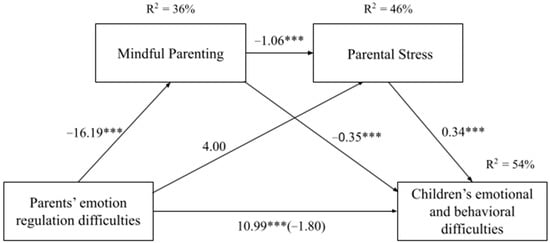
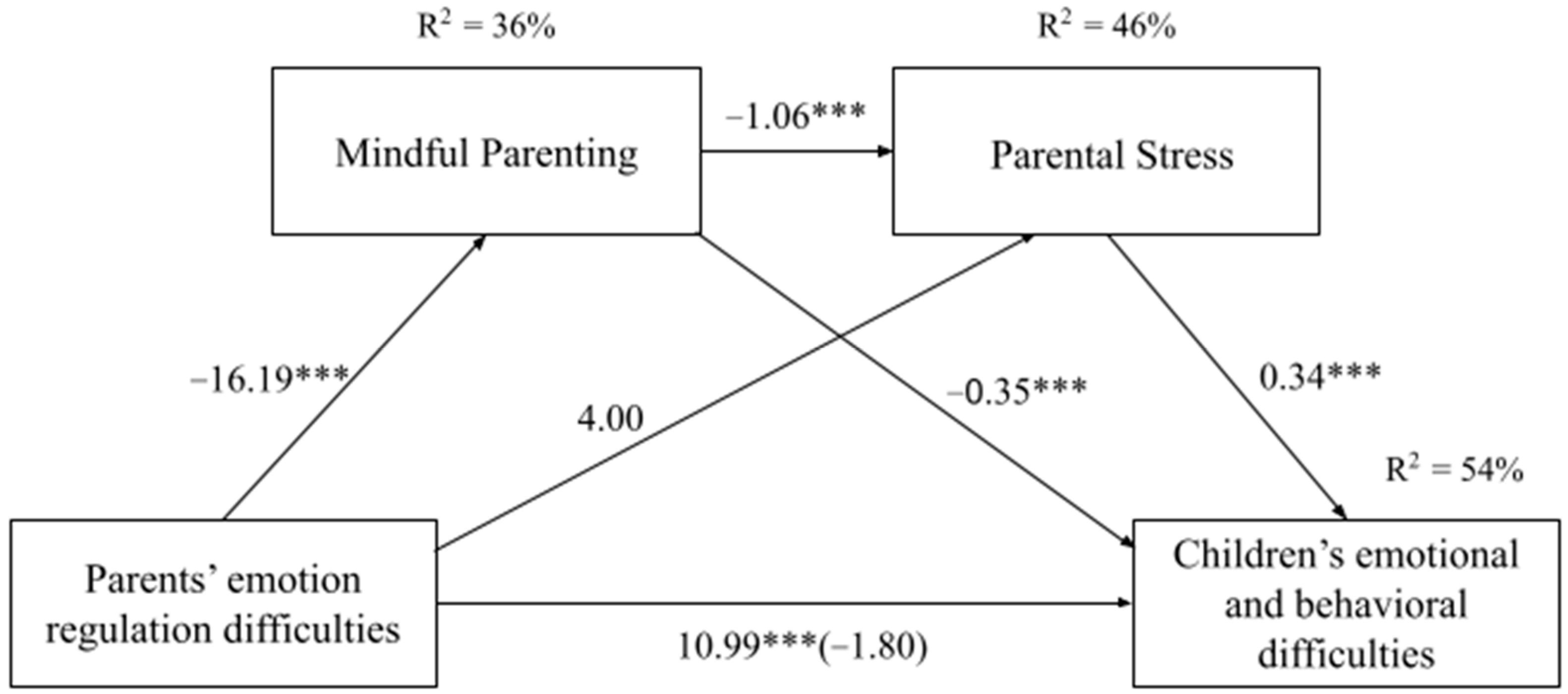
Figure 1 illustrates the serial mediation model examined in the sample of adoptive parents. A significant indirect association (Ind1) between parents’ emotion regulation difficulties and children’s EBD through mindful parenting was detected (effect = 5.64, SE = 1.36, 95% CI = [3.11, 8.42]). Parents’ emotion regulation difficulties were negatively and significantly associated with mindful parenting (b = −16.19, SE = 1.29, 95% CI = [−18.73, −13.65]), and mindful parenting was negatively associated with children’s EBD (b = −0.35, SE = 0.08, 95% CI = [−0.51, −0.19]). A sequential indirect association (Ind3) between parents’ emotion regulation difficulties and children’s EBD through mindful parenting and parental stress was also identified (effect = 5.80, SE = 1.14, 95% CI = [3.65, 8.07]). Greater difficulties in parents’ emotion regulation were associated with lower mindful parenting, which was negatively associated with parental stress (b = −1.06, SE = 0.10, 95% CI = [−1.25, −0.87]). Parental stress was positively associated with children’s EBD (b = 0.34, SE = 0.04, 95% CI = [0.26, 0.42]). The indirect association between parents’ emotion regulation difficulties and children’s EBD through parental stress (Ind2) was not significant (effect = 1.35, SE = 0.88, 95% CI = [−0.23, 3.27]). The comparison between the two indirect effects (Ind1 and Ind3) revealed no statistically significant difference between them (C2: effect = −0.004, 95% CI = [−0.11, 0.10]). After accounting for mindful parenting and parental stress, the remaining direct association between parents’ emotion regulation difficulties and children’s EBD was not statistically significant (effect = −1.80, SE = 1.86, 95% CI = [−5.46, 1.86].
Figure 1.
Sequential Mediation Model. Note: Non-standardized coefficients of the mediation model of the association between adoptive parents’ emotion regulation difficulties and children’s emotional and behavioral difficulties, through mindful parenting and parental stress, controlling for the child’s age and special educational needs. The value outside the parentheses represents the total effects of parents’ emotion regulation difficulties on the levels of children’s emotional and behavioral difficulties. The value within parentheses represents the direct effect of parents’ emotion regulation difficulties on children’s emotional and behavioral difficulties when controlling for the mediating effect of mindful parenting and parental stress. *** p < 0.001.
3.3. Moderated Mediation Analyses
Exploratory moderated mediation analyses provided preliminary evidence that the indirect effect of parents’ emotion regulation difficulties on children’s EBD through mindful parenting (Ind1) differed by family type (i.e., adoptive vs. non-adoptive; Index = 3.25, SE = 1.60, 90% CI [0.58, 5.86]); see Table 3). The estimated indirect effect was larger in adoptive families (effect = 5.74, SE = 1.35, 90% CI = [3.58, 7.96]) than in non-adoptive families (effect = 2.48, SE = 0.88, 90% CI = [1.08, 4.01]). Additionally, exploratory evidence suggested that the indirect effect of parents’ emotion regulation difficulties on children’s EBD through parental stress (Ind2) also differed by family type (Index = −2.86, SE = 1.36, 90% CI [−5.05, −0.59]). The 90% CI suggests that this indirect effect was significant in non-adoptive families (effect = 4.10, SE = 1.10, 90% CI = [2.35, 5.94]) but not in adoptive families (effect = 1.23, SE = 0.85, 90% CI = [−0.01, 2.76]). In contrast, the exploratory analyses did not provide evidence that the indirect effect of parents’ emotion regulation difficulties on children’s EBD through mindful parenting and parental stress (Ind3) differed by family type (Index = 1.49, SE = 1.37, 90% CI [−0.74, 3.77]). Nevertheless, the 90% CIs for this indirect effect excluded zero in both adoptive families (effect = 5.73, SE = 1.12, 90% CI = [3.99, 7.66]) and non-adoptive families (effect = 4.24, SE = 0.80, 90% CI = [3.04, 5.67]). After controlling for the indirect effects described, the direct effect of parents’ emotion regulation difficulties on children’s EBD remained significant in non-adoptive families (effect = −4.47, SE = 1.37, 90% CI = [−6.73, −2.21]) but was not significant in adoptive families (effect = −1.83, SE = 1.84, 90% CI = [−4.85, 1.20].
Table 3.
Conditional indirect effects.
3.4. Sensitivity Analyses
3.4.1. Sociodemographic Adjustment
Sensitivity analyses additionally adjusting for parental age, parental sex, and household size, alongside child age and special educational needs, yielded results largely consistent with those of the primary moderated mediation model (see Supplementary Table S2). The indices of moderated mediation retained their statistical significance patterns, including the significant between-group difference in the indirect association through parental stress. The only notable difference concerned the conditional indirect association through parental stress among adoptive families, which became statistically significant in the sensitivity model (effect = 1.38, SE = 0.87, 90% CI [0.12, 2.94]), whereas its confidence interval included zero in the primary model. Overall, these findings support the robustness of the exploratory between-group comparisons, while indicating some sensitivity of the within-group indirect association to covariate adjustment.
3.4.2. PSC-17-Only Analyses
Additional sensitivity analyses were conducted among children aged 6–17 years, whose EBD were assessed using the PSC-17 (n = 454; 259 adoptive and 195 non-adoptive families), to examine the robustness of the findings when using a common outcome measure (see Supplementary Table S3). The sequential mediation analysis among adoptive families yielded results consistent with those obtained in the full sample, with significant indirect associations through mindful parenting and sequentially through mindful parenting and parental stress, whereas the indirect association through parental stress alone remained nonsignificant. Similarly, the moderated mediation analysis largely replicated the original pattern of findings. The indirect association through parental stress remained significantly stronger among non-adoptive families, and the indirect association through mindful parenting stronger among adoptive families, whereas the indices of moderated mediation for the sequential indirect association remained nonsignificant. Overall, the main findings were consistent when analyses were restricted to children assessed using the same EBD instrument.
4. Discussion
The present study explored the indirect associations of mindful parenting and parental stress on the association between adoptive parents’ emotion regulation difficulties and children’s EBD, and whether these associations differed between adoptive and non-adoptive families. Overall, the results revealed a sequential indirect association between parents’ emotion regulation difficulties and children’s EBD, statistically involving mindful parenting and parental stress, in both family types. Additionally, exploratory analyses provided preliminary evidence that the magnitude of specific indirect associations differed between adoptive and non-adoptive families.
Regarding our first aim, results showed that adoptive parents with greater difficulties in emotion regulation reported lower levels of mindful parenting, higher parental stress, and greater EBD in their children, consistent with the hypothesized sequential indirect association. This finding is consistent with previous studies reporting associations between greater parental emotion regulation difficulties and lower levels of mindful parenting (Thompson, 2019; Vernon & Moretti, 2022). Emotion regulation may be conceptualized as a self-regulatory resource that enables parents to manage the emotional demands inherent to caregiving, while remaining emotionally available and responsive to their children’s needs (Rutherford et al., 2015). From a theoretical perspective, parents who struggle to regulate their emotions may become emotionally overwhelmed and reactive, making it more difficult to remain attentive, emotionally aware, non-judgmental, and sensitive during parent–child interactions, all of which are core components of mindful parenting (Bögels et al., 2010; Duncan et al., 2009; Vernon & Moretti, 2022). Lower levels of mindful parenting have also been theoretically linked to difficulties in emotionally attuned parent–child interactions and opportunities for emotional co-regulation, which may be associated with greater parental stress and children’s EBD (Burgdorf et al., 2019; Gurney-Smith et al., 2017). One possible explanation for these findings is that lower levels of mindful parenting may be associated with greater difficulties in approaching the everyday demands of parenting with present-moment awareness, acceptance, and emotional self-regulation, potentially contributing to greater perceptions of parenting stress (Chorão et al., 2022; Bögels et al., 2010; Burgdorf et al., 2019). Similarly, limited mindful awareness and non-reactivity during parent–child interactions may be associated with a less positive family emotional climate, more frequent conflictual interactions (Bariola et al., 2011), and less sensitive and consistent parenting practices, all of which have been linked to children’s EBD (Ribas et al., 2024). Furthermore, our findings are consistent with previous research suggesting that mindful parenting may be a relevant process in understanding parental stress and children’s emotional and behavioral adjustment in adoptive families (Chorão et al., 2022; Bögels et al., 2010; Burgdorf et al., 2019; Gurney-Smith et al., 2017; Rodrigues et al., 2024).
4.1. Differences and Similarities Between Adoptive and Non-Adoptive Families
The findings of the present study provided preliminary evidence that the magnitude of specific indirect associations may differ across family types. First, exploratory analyses suggested that the indirect association involving mindful parenting was stronger among adoptive than non-adoptive families. Adoptive parents face not only the normative challenges of parenthood, but also distinct demands that may not be as salient in non-adoptive contexts, including helping children process pre-adoption adversity, supporting the gradual formation of a secure attachment and responding sensitively to adoption-related questions and identity concerns (D. M. Brodzinsky, 2011; Gorla et al., 2025). Within this context, mindful parenting may represent a particularly relevant process to investigate in adoptive families, given its potential role in parents’ emotional availability, responsiveness, and attunement to children who have experienced early adversity (Bögels et al., 2010; Burgdorf et al., 2019; Paine et al., 2021). Theoretically, rather than reacting automatically to challenging behaviors, which may themselves reflect the child’s early adversity, mindful parenting may allow adoptive parents to pause, regulate their own emotional responses, and respond in ways that communicate safety, acceptance, and consistency (Bögels et al., 2010; Duncan et al., 2009).
Second, despite evidence suggesting that adoptive parents often face additional parenting challenges related to their children’s early adverse experiences and the specific demands of adoptive parenting (Chorão et al., 2022; McKay et al., 2010; Tasker & Wood, 2016), the indirect association through parental stress was stronger among non-adoptive families. This difference remained statistically significant in sensitivity analyses adjusting for additional sociodemographic characteristics, although the indirect association also became statistically significant among adoptive families following this adjustment. One possible explanation is that, in adoptive families, aspects of parent–child interaction quality may be particularly relevant to understanding children’s emotional and behavioral adjustment, beyond parents’ perceptions of parenting stress alone. Nevertheless, this interpretation remains speculative, as parent–child interaction quality was not directly assessed and should be investigated in future longitudinal studies.
Despite these specificities, the sequential indirect effect of parents’ emotion regulation difficulties on children’s EBD through mindful parenting and parental stress was statistically significant in both adoptive and non-adoptive families. However, the index of moderated mediation did not indicate a statistically significant difference in this sequential indirect effect between family types. This finding suggests that the sequential pathway may be relevant in both family contexts, although the absence of a statistically significant difference should not be interpreted as evidence of equivalence between groups. Taken together, these findings suggest that, although the sequential association involving mindful parenting and parental stress was observed in both family contexts, the magnitude of the specific indirect effects may vary according to family type. These results highlight the importance of considering both shared and potentially distinct family processes when examining the associations between parents’ emotion regulation difficulties and children’s emotional and behavioral adjustment. Furthermore, after accounting for the indirect pathways, the direct association between parents’ emotion regulation difficulties and children’s EBD remained statistically significant in non-adoptive families but not in adoptive families. However, this difference in statistical significance does not, by itself, establish a between-group difference in the direct association, nor does the absence of a statistically significant direct association establish that the relationship operates primarily through the proposed mediators. Given the cross-sectional design and exploratory nature of the moderated mediation analyses, these findings should be interpreted cautiously and should not be considered evidence of causal mechanisms or equivalent processes across family types.
Importantly, these exploratory differences should not be attributed exclusively to adoption status. Adoptive families vary considerably in children’s pre-adoption experiences, age at placement, time since adoption, and developmental needs, which may contribute to heterogeneity in parenting experiences and children’s adjustment (Gunnar et al., 2007; Harwood et al., 2013; Palacios & Brodzinsky, 2010; Sánchez-Sandoval & Palacios, 2012). Indeed, research involving children adopted shortly after birth highlights the relevance of parenting and family processes even in the absence of prolonged institutional or foster care experiences (Leve et al., 2019). As adoption-related characteristics were not examined as potential moderators in the present study, their contribution to the observed associations remains unclear.
4.2. Strengths, Limitations and Future Research
This study makes several important contributions. Collaboration with all Portuguese Social Security Organizations facilitated the recruitment of a large and diverse sample of adoptive parents, providing valuable insights into parenting processes within this relatively understudied population. In addition, by examining parents’ emotion regulation difficulties, mindful parenting, parental stress, and children’s EBD within a serial mediation framework, this study contributes to a more integrated understanding of the associations among these constructs in adoptive families, beyond approaches that consider these factors in isolation. The findings also extend attention beyond children’s pre-adoption characteristics to potentially modifiable parental processes, identifying mindful parenting as a promising correlate of children’s adjustment that warrants further longitudinal and intervention research.
Findings should be interpreted considering several limitations. First, the cross-sectional design precludes causal inferences and does not allow the temporal ordering assumed in the sequential mediation model to be established. Although the proposed sequential mediation model was theoretically grounded, alternative temporal sequences and bidirectional associations are plausible. For example, children’s EBD may increase parental stress, compromise parents’ ability to engage in mindful parenting, and place greater demands on their emotion regulation capacities, highlighting the likely bidirectional nature of these family processes. Likewise, given that parenting processes and children’s emotional and behavioral adjustment may be differently associated across developmental stages, future longitudinal research should examine whether the associations identified in this study vary as a function of children’s age.
Second, all study variables were assessed through parent-report measures, which may have introduced shared method variance. As the same parent reported their own emotion regulation difficulties, mindful parenting, and parental stress, as well as their children’s EBD, the observed associations, particularly the serial indirect pathway, may partly reflect parental perceptions and shared reporting tendencies rather than exclusively the underlying family processes. Future studies should incorporate multiple informants and observational assessments to address this limitation.
Third, children’s EBD were assessed with two age-specific instruments (PPSC and PSC-17). Although both measures assess related domains of emotional and behavioral functioning, they differ in item content and structure, and transforming their scores to a common scale does not establish psychometric equivalence. This issue is particularly relevant given the differences in children’s ages and instrument distributions between adoptive and non-adoptive families. Nevertheless, sensitivity analyses restricted to children assessed using the PSC-17 yielded findings largely consistent with those obtained in the full sample, providing additional support for the robustness of the main conclusions. Future studies should consider measurement approaches that allow stronger comparability of EBD across developmental stages.
Fourth, the use of convenience sampling and recruitment through social media and research networks may have introduced self-selection bias, as parents with greater interest in parenting or children’s mental health may have been more likely to participate. Furthermore, because the total number of eligible parents reached through these recruitment channels was unknown, participation rates could not be calculated. These factors may limit the representativeness of the sample and the generalizability of the findings to the broader populations of adoptive and non-adoptive families.
Fifth, although the overall sample was relatively large, no model-specific power analysis was conducted for the moderated mediation effects, and insufficient statistical power to detect differences in indirect effects across family types cannot be ruled out. Given these considerations, the moderated mediation analyses were conducted within an exploratory framework, using a less conservative significance threshold (p < 0.10; 90% CIs) to increase sensitivity to potentially meaningful group differences. However, this approach does not compensate for limited statistical power and entails an increased risk of Type I error. Accordingly, the observed differences in indirect associations through mindful parenting and parental stress should be interpreted as preliminary rather than conclusive evidence of distinct processes across family type. Future studies with larger, adequately powered samples and conventional significance thresholds are needed to establish the robustness of these findings.
Finally, genetic influences should be considered when interpreting comparisons between family types. In non-adoptive families, parent–child associations may partly reflect shared genetic influences, whereas adopted children may have inherited vulnerabilities that interact with pre-adoption experiences and their adoptive family environment. As these factors were not assessed in the present study, their potential contributions to the observed associations remain unknown, warranting caution when interpreting differences between adoptive and non-adoptive families.
4.3. Implications for Clinical Practice
The present findings may have implications for future parenting intervention research. Across both adoptive and non-adoptive families, a sequential indirect association was identified between parents’ emotion regulation difficulties and children’s EBD, statistically involving lower mindful parenting and higher parental stress. These findings suggest that parents’ emotion regulation, mindful parenting, and parental stress may represent promising targets for future interventions aimed at promoting children’s adjustment. However, given the cross-sectional design, further research is needed to determine whether modifying these processes leads to improvements in children’s EBD.
At the same time, exploratory analyses provided preliminary evidence of differences in the magnitude of specific indirect associations across family types. Mindful parenting appeared to play a more prominent role among adoptive families, whereas parental stress showed a stronger indirect association among non-adoptive families. Although these findings may inform future research into the specific needs of different family contexts, they do not yet justify recommending distinct intervention approaches for adoptive and non-adoptive families. Future longitudinal and intervention studies should examine whether targeting these processes improves children’s adjustment and whether tailoring interventions to different family contexts enhances their effectiveness.
Supplementary Materials
The following supporting information can be downloaded at: https://www.mdpi.com/article/10.3390/ejihpe16110172/s1, Table S1: Hierarchical Regression Model for Children’s Emotional and Behavioral Difficulties (n = 298 adoptive parents); Table S2: Conditional Indirect Effects Adjusted for Additional Covariates; Table S3: Sensitivity Analyses Restricted to Children Aged 6–17 Years Assessed With the PSC-17.
Author Contributions
V.L. conceptualized and designed the study, drafted the initial manuscript, and conducted statistical analyses. S.A. participated in data collection and curation and critically reviewed and revised the manuscript. I.O., M.O.-A. and M.C.C. reviewed and revised the manuscript. R.P. conceptualized and designed the study, supervised the work, and reviewed and revised the manuscript. All authors have read and agreed to the published version of the manuscript.
Funding
This study was integrated into the R&D Unit of the Center for Research in Neuropsychology and Cognitive and Behavioural Intervention (CINEICC), University of Coimbra. The Principal Investigator of this research project, Raquel Pires, was supported by the Portuguese Foundation for Science and Technology (FCT) through a research contract granted by the Funding Call “Scientific Employment Stimulus 2017” (CEECIND/02463/2017). This work was also supported by structural funds of the Center for Research in Neuropsychology and Cognitive and Behavioural Intervention (DOI:10.54499/UIDP/00730/2020). Stephanie Alves research work is supported by FCT, under HEI-Lab R&D Unit (references UID/PRR/05380/2025, UID/PRR2/05380/2025, UID/05380/2025 with the DOIs https://doi.org/10.54499/UID/PRR/05380/2025; https://doi.org/10.54499/UID/PRR2/05380/2025; https://doi.org/10.54499/UID/05380/2025). The funders do not play a role in the study design, collection, management, analysis, and interpretation of the data or the decision to submit the report for publication, including authority over these activities.
Institutional Review Board Statement
The study was conducted in accordance with the Declaration of Helsinki and approved by the Ethics Committee of the Faculty of Psychology and Educational Sciences of the University of Coimbra, Portugal (date of approval: 30 January 2020).
Informed Consent Statement
Electronic informed consent was obtained from all participants before they completed the study questionnaires.
Data Availability Statement
Data are available upon reasonable request from the corresponding author.
Conflicts of Interest
The authors declared no potential conflicts of interest with respect to the research, authorship, or publication of this article.
Abbreviations
The following abbreviations are used in this manuscript:
| EBD | Emotional and Behavioral Difficulties |
| PSC-17 | Pediatric Symptom Checklist-17 |
| PPSC | Preschool Pediatric Symptom Checklist |
| DERS-SF | Difficulties in Emotion Regulation Scale–Short Form |
| IM-P | Interpersonal Mindfulness in Parenting Scale |
| PSI-SF | Parenting Stress Index-Short Form |
References
- Abidin, R. R. (1995). Parenting stress index: Professional manual (3rd ed.). Psychological Assessment Resources. [Google Scholar]
- Akinwande, M. O., Dikko, H. G., & Samson, A. (2015). Variance inflation factor: As a condition for the inclusion of suppressor variable(s) in regression analysis. Open Journal of Statistics, 5(7), 754–767. [Google Scholar] [CrossRef]
- Alves, S., Chorão, A., Caetano, B. P., Henriques, M. R., Pastor, I., & Pires, R. (2022). Post adoption help-seeking in Portugal: A comprehensive study on parental difficulties and help-seeking behaviors and perceptions. International Journal of Environmental Research and Public Health, 19(18), 11283. [Google Scholar] [CrossRef] [Scilit] [PubMed]
- Askeland, K. G., Hysing, M., La Greca, A. M., Aarø, L. E., Tell, G. S., & Sivertsen, B. (2017). Mental health in internationally adopted adolescents: A meta-analysis. Journal of the American Academy of Child & Adolescent Psychiatry, 56(3), 203–213. [Google Scholar] [CrossRef] [Scilit] [PubMed]
- Aydin, A. (2023). Examining the mediating role of mindful parenting: A study on the relationship between parental emotion regulation difficulties and problem behaviors of children with ASD. Journal of Autism and Developmental Disorders, 53(5), 1873–1885. [Google Scholar] [CrossRef] [Scilit] [PubMed]
- Bariola, E., Gullone, E., & Hughes, E. K. (2011). Child and adolescent emotion regulation: The role of parental emotion regulation and expression. Clinical Child and Family Psychology Review, 14, 198–212. [Google Scholar] [CrossRef] [Scilit] [PubMed]
- Bird, G. W., Peterson, R., & Miller, S. H. (2002). Factors associated with distress among support-seeking adoptive parents. Family Relations, 51(3), 215–220. [Google Scholar] [CrossRef] [Scilit]
- Bornstein, M. H. (2019). Handbook of parenting: Volume 3. Being and becoming a parent (3rd ed). Routledge. [Google Scholar] [CrossRef] [Scilit]
- Bögels, S. M., Lehtonen, A., & Restifo, K. (2010). Mindful parenting in mental health care. Mindfulness, 1(2), 107–120. [Google Scholar] [CrossRef] [Scilit] [PubMed]
- Brodzinsky, D., Gunnar, M., & Palacios, J. (2022). Adoption and trauma: Risks, recovery, and the lived experience of adoption. Child Abuse & Neglect, 130, 105309. [Google Scholar] [CrossRef] [Scilit] [PubMed]
- Brodzinsky, D. M. (2011). Children’s understanding of adoption: Developmental and clinical implications. Professional Psychology: Research and Practice, 42(2), 200–207. [Google Scholar] [CrossRef] [Scilit]
- Brodzinsky, D. M., & Pinderhughes, E. (2005). Parenting and child development in adoptive families. Handbook of Parenting, 1, 279–311. [Google Scholar]
- Burgdorf, V., Szabó, M., & Abbott, M. J. (2019). The effect of mindfulness interventions for parents on parenting stress and youth psychological outcomes: A systematic review and meta-analysis. Frontiers in Psychology, 10, 1336. [Google Scholar] [CrossRef] [Scilit] [PubMed]
- Canzi, E., Ranieri, S., Barni, D., & Rosnati, R. (2019). Predictors of parenting stress during early adoptive parenthood. Current Psychology, 38(3), 811–820. [Google Scholar] [CrossRef] [Scilit]
- Ceballo, R., Lansford, J. E., Abbey, A., & Stewart, A. J. (2004). Gaining a child: Comparing the experiences of biological parents, adoptive parents, and stepparents. Family Relations, 53(1), 38–48. [Google Scholar] [CrossRef] [Scilit]
- Chorão, A., Canavarro, M. C., & Pires, R. (2022). Explaining parenting stress among adoptive parents: The contribution of mindfulness, psychological flexibility, and self-compassion. International Journal of Environmental Research and Public Health, 19(21), 14534. [Google Scholar] [CrossRef] [Scilit] [PubMed]
- Cohen, J. (1988). Power analysis for the behavioral sciences. New York University. [Google Scholar]
- Deater-Deckard, K. (2004). Parenting stress. Yale University Press. [Google Scholar]
- Deave, T., Johnson, D., & Ingram, J. (2008). Transition to parenthood: The needs of parents in pregnancy and early parenthood. BMC Pregnancy and Childbirth, 8, 30. [Google Scholar] [CrossRef] [Scilit] [PubMed]
- Duncan, L. G. (2007). Assessment of mindful parenting among parents of early adolescents: Development and validation of the interpersonal mindfulness in parenting scale [Doctoral dissertation, Pennsylvania State University]. [Google Scholar]
- Duncan, L. G., Coatsworth, J. D., & Greenberg, M. T. (2009). A model of mindful parenting: Implications for parent–child relationships and prevention research. Clinical Child and Family Psychology Review, 12, 255–270. [Google Scholar] [CrossRef] [Scilit] [PubMed]
- Escobar, M. J., Pereira, X., & Santelices, M. P. (2014). Behavior problems and attachment in adopted and non-adopted adolescents. Children and Youth Services Review, 42, 59–66. [Google Scholar] [CrossRef] [Scilit]
- Finet, C., Vermeer, H. J., Juffer, F., Bijttebier, P., & Bosmans, G. (2020). Adopted children’s behavioral adjustment over time: Pre-adoption experiences and adoptive parenting. The Journal of Early Adolescence, 40(4), 453–479. [Google Scholar] [CrossRef] [Scilit]
- Frazier, P. A., Tix, A. P., & Barron, K. E. (2004). Testing moderation and mediation effects in counseling psychology research. Journal of Counseling Psychology, 51(1), 115–134, (Correction in 2004, Journal of Counseling Psychology, 51(2), 157). [Google Scholar] [CrossRef] [Scilit]
- Galán-Luque, T., Quiñonero-Fernández, L., & Orgilés, M. (2026). Pre-adoption and post-adoption factors associated with internalizing problems in adopted children and adolescents: A systematic review. Children and Youth Services Review, 184, 108857. [Google Scholar] [CrossRef] [Scilit]
- Geurtzen, N., Scholte, R. H. J., Engels, R. C. M. E., Tak, Y. R., & van Zundert, R. M. P. (2015). Association between mindful parenting and adolescents’ internalizing problems: Non-judgmental acceptance of parenting as core element. Journal of Child and Family Studies, 24(4), 1117–1128. [Google Scholar] [CrossRef] [Scilit]
- Gorla, L., Fusco, C., & Santona, A. (2025). Openly communicate about adoption: The role of parents’ attachment and reflective functioning. Family Relations, 74(5), 2471–2486. [Google Scholar] [CrossRef] [Scilit]
- Gouveia, M. J., Carona, C., Canavarro, M. C., & Moreira, H. (2016). Self-compassion and dispositional mindfulness are associated with parenting styles and parenting stress: The mediating role of mindful parenting. Mindfulness, 7(3), 700–712. [Google Scholar] [CrossRef] [Scilit]
- Gratz, K. L., & Roemer, L. (2004). Multidimensional assessment of emotion regulation and dysregulation: Development, factor structure, and initial validation of the difficulties in emotion regulation scale. Journal of psychopathology and behavioral assessment, 26(1), 41–54. [Google Scholar] [CrossRef] [Scilit]
- Gunnar, M. R., Van Dulman, M. H. M., & The International Adoption Project Team. (2007). Behavior problems in postinstitutionalized internationally adopted children. Development and Psycholopathology, 19(1), 129–148. [Google Scholar] [CrossRef] [Scilit] [PubMed]
- Gurney-Smith, B., Downing, P., Kidd, K., & McMillin, R. (2017). ‘Minding the gap’: Developing mindfulness for adoption. Adoption & Fostering, 41(2), 110–119. [Google Scholar] [CrossRef] [Scilit]
- Hannigan, L. J., Walaker, N., Waszczuk, M. A., McAdams, T. A., & Eley, T. C. (2017). Aetiological influences on stability and change in emotional and behavioral problems across development: A systematic review. Psychopathology Review, a4(1), 52–108. [Google Scholar] [CrossRef] [Scilit] [PubMed]
- Harwood, R., Feng, X., & Yu, S. (2013). Preadoption adversities and postadoption mediators of mental health and school outcomes among international, foster, and private adoptees in the United States. Journal of Family Psychology, 27(3), 409–420. [Google Scholar] [CrossRef] [Scilit] [PubMed]
- Haydicky, J., Shecter, C., Wiener, J., & Ducharme, J. M. (2015). Evaluation of MBCT for adolescents with ADHD and their parents: Impact on individual and family functioning. Journal of Child and Family Studies, 24(1), 76–94. [Google Scholar] [CrossRef] [Scilit]
- Hayes, A. F. (2022). Introduction to mediation, moderation, and conditional process analysis: A regression-based approach (3rd ed.). The Guilford Press. [Google Scholar]
- Hornfeck, F., Bovenschen, I., Heene, S., Zimmermann, J., Zwönitzer, A., & Kindler, H. (2019). Emotional and behavior problems in adopted children–The role of early adversities and adoptive parents’ regulation and behavior. Child Abuse & Neglect, 98, 104221. [Google Scholar] [CrossRef] [Scilit] [PubMed]
- Jellinek, M. S., Murphy, J. M., Robinson, J., Feins, A., Lamb, S., & Fenton, T. (1988). Pediatric symptom checklist: Screening school-age children for psychosocial dysfunction. The Journal of Pediatrics, 112(2), 201–209. [Google Scholar] [CrossRef] [Scilit] [PubMed]
- Judge, S. (2003). Determinants of parental stress in families adopting children from Eastern Europe. Family Relations, 52(3), 241–248. [Google Scholar] [CrossRef] [Scilit]
- Juffer, F., & van Ijzendoorn, M. H. (2005). Behavior problems and mental health referrals of international adoptees: A meta-analysis. Jama, 293(20), 2501–2515. [Google Scholar] [CrossRef] [Scilit] [PubMed]
- Kaufman, E. A., Xia, M., Fosco, G., Yaptangco, M., Skidmore, C. R., & Crowell, S. E. (2016). The difficulties in emotion regulation scale short form (DERS-SF): Validation and replication in adolescent and adult samples. Journal of Psychopathology and Behavioral Assessment, 38(3), 443–455. [Google Scholar] [CrossRef] [Scilit] [PubMed]
- Keyes, M. A., Sharma, A., Elkins, I. J., Iacono, W. G., & McGue, M. (2008). The mental health of US adolescents adopted in infancy. Archives of Pediatrics & Adolescent Medicine, 162(5), 419–425. [Google Scholar] [CrossRef] [Scilit] [PubMed]
- Kriebel, D. K., & Wentzel, K. (2011). Parenting as a moderator of cumulative risk for behavioral competence in adopted children. Adoption Quarterly, 14(1), 37–60. [Google Scholar] [CrossRef] [Scilit]
- León, E., Palacios, J., Román, M., Moreno, C., & Peñarrubia, M. G. (2015). Parental stress, family functioning and children’s psychological adjustment in adoptive families: A comparative and longitudinal study. Family Science, 6(1), 50–57. [Google Scholar] [CrossRef] [Scilit]
- Leve, L. D., Neiderhiser, J. M., Ganiban, J. M., Natsuaki, M. N., Shaw, D. S., & Reiss, D. (2019). The early growth and development study: A dual-family adoption study from birth through adolescence. Twin Research and Human Genetics, 22(6), 716–727. [Google Scholar] [CrossRef] [Scilit] [PubMed]
- Lionetti, F., Pastore, M., & Barone, L. (2015). Parenting stress: The roles of attachment states of mind and parenting alliance in the context of adoption. Parenting, 15(2), 75–91. [Google Scholar] [CrossRef] [Scilit]
- McClelland, G. H., & Judd, C. M. (1993). Statistical difficulties of detecting interactions and moderator effects. Psychological Bulletin, 114(2), 376–390. [Google Scholar] [CrossRef] [Scilit] [PubMed]
- McGlone, K., Santos, L., Kazama, L., Fong, R., & Mueller, C. (2002). Psychological stress in adoptive parents of special-needs children. Child Welfare, 81, 151–171. [Google Scholar] [PubMed]
- McKay, K., Ross, L. E., & Goldberg, A. E. (2010). Adaptation to parenthood during the post-adoption period: A review of the literature. Adoption Quarterly, 13(2), 125–144. [Google Scholar] [CrossRef] [Scilit]
- Melançon, F., Cossette, L., Smith, C., Beauvais-Dubois, C., Cyr, C., & Smolla, N. (2019). Parenting stress of adoptive mothers, mother–child conflict, and behavior problems during adolescence among international adoptees. Journal of Family Psychology, 33(8), 988–993. [Google Scholar] [CrossRef] [Scilit] [PubMed]
- Moreira, H., & Canavarro, M. C. (2017). Psychometric properties of the interpersonal mindfulness in parenting scale in a sample of Portuguese mothers. Mindfulness, 8, 691–706. [Google Scholar] [CrossRef] [Scilit]
- Moreira, H., Gouveia, M. J., & Canavarro, M. C. (2020). A bifactor analysis of the difficulties in emotion regulation scale-short form (DERS-SF) in a sample of adolescents and adults. Current Psychology, 41, 757–782. [Google Scholar] [CrossRef] [Scilit]
- Morris, A. S., Silk, J. S., Steinberg, L., Myers, S. S., & Robinson, L. R. (2007). The role of the family context in the development of emotion regulation. Social Development, 16(2), 361–388. [Google Scholar] [CrossRef] [Scilit] [PubMed]
- Murphy, J. M., Bergmann, P., Chiang, C., Sturner, R., Howard, B., Abel, M. R., & Jellinek, M. (2016). The PSC-17: Subscale scores, reliability, and factor structure in a new national sample. Pediatrics, 138(3), e20160038. [Google Scholar] [CrossRef] [Scilit] [PubMed]
- Paine, A. L., Perra, O., Anthony, R., & Shelton, K. H. (2021). Charting the trajectories of adopted children’s emotional and behavioral problems: The impact of early adversity and postadoptive parental warmth. Development and Psychopathology, 33(3), 922–936. [Google Scholar] [CrossRef] [Scilit] [PubMed]
- Palacios, J., & Brodzinsky, D. (2010). Review: Adoption research: Trends, topics, outcomes. International Journal of Behavioral Development, 34(3), 270–284. [Google Scholar] [CrossRef] [Scilit]
- Parent, J., McKee, L. G., Rough, J. N., & Forehand, R. (2016). The association of parent mindfulness with parenting and youth psychopathology across three developmental stages. Journal of Abnormal Child Psychology, 44(2), 191–202. [Google Scholar] [CrossRef] [Scilit] [PubMed]
- Ribas, L. H., Montezano, B. B., Nieves, M., Kampmann, L. B., & Jansen, K. (2024). The role of parental stress on emotional and behavioral problems in offspring: A systematic review with meta-analysis. Jornal de Pediatria, 100(6), 565–585. [Google Scholar] [CrossRef] [Scilit] [PubMed]
- Rodrigues, M., Rato, M. P., Canavarro, M. C., & Pires, R. (2024). Associations between preadoption maltreatment and adoptees’ emotional and behavioral difficulties: The buffering role of mindful parenting. Mindfulness, 15(6), 1395–1414. [Google Scholar] [CrossRef] [Scilit]
- Rubin, M. (2021). When to binarize p-values: A decision guide for alpha levels in exploratory and confirmatory research. Journal of Trial and Error, 2(1), 22–39. [Google Scholar]
- Rutherford, H. J., Wallace, N. S., Laurent, H. K., & Mayes, L. C. (2015). Emotion regulation in parenthood. Developmental Review, 36, 1–14. [Google Scholar] [CrossRef] [Scilit] [PubMed]
- Santos, S. V. (2008, October 2–4). Forma reduzida do parenting stress index (PSI): Estudo preliminar. XIII Conferência Internacional Avaliação Formas e Contextos, Braga, Portugal. [Google Scholar]
- Sánchez-Sandoval, Y., & Palacios, J. (2012). Emotional and behavioral problems in adopted and non-adopted children. Clínica Y Salud, 23(3), 221–234. [Google Scholar] [CrossRef] [Scilit]
- Sheldrick, R. C., Henson, B. S., Merchant, S., Neger, E. N., Murphy, J. M., & Perrin, E. C. (2012). The preschool pediatric symptom checklist (PPSC): Development and initial validation of a new social/emotional screening instrument. Academic Pediatrics, 12(5), 456–467. [Google Scholar] [CrossRef] [Scilit] [PubMed]
- Smith-McKeever, T. C. (2004). Child behavioral outcomes in African American adoptive families. Adoption Quarterly, 7(4), 29–56. [Google Scholar] [CrossRef] [Scilit]
- Soares, J., Barbosa-Ducharne, M., Palacios, J., & Pacheco, A. (2017). Adopted children’s emotion regulation: The role of parental attitudes and communication about adoption. Psicothema, 29, 49–54. [Google Scholar] [CrossRef] [Scilit] [PubMed]
- Tasker, F., & Wood, S. (2016). The transition into adoptive parenthood: Adoption as a process of continued unsafe uncertainty when family scripts collide. Clinical Child Psychology and Psychiatry, 21(4), 520–535. [Google Scholar] [CrossRef] [Scilit] [PubMed]
- Thompson, R. A. (1994). Emotion regulation: A theme in search of definition. Monographs of the Society for Research in Child Development, 59, 25–52. [Google Scholar] [CrossRef] [Scilit] [PubMed]
- Thompson, R. A. (2019). Emotion dysregulation: A theme in search of definition. Development and Psychopathology, 31(3), 805–815. [Google Scholar] [CrossRef] [Scilit] [PubMed]
- Tso, W. W. Y., Leung, L. K., Chow, M. S. C., Wang, Y., Li, C., Hui, K. Y., Ma, L., Wong, M. W., Lui, M. P. K., Wong, W. H. S., Lee, S. L., Lee, T. M. C., & Ip, P. (2023). Mental health of children with special educational needs and the return to in-person learning after the COVID-19 pandemic. JAMA Network Open, 6(12), e2346106. [Google Scholar] [CrossRef] [Scilit] [PubMed]
- van den Dries, L., Juffer, F., van IJzendoorn, M. H., & Bakermans-Kranenburg, M. J. (2009). Fostering security? A meta-analysis of attachment in adopted children. Children and Youth Services Review, 31(3), 410–421. [Google Scholar] [CrossRef] [Scilit]
- Vernon, J. R. G., & Moretti, M. M. (2022). Parent emotion regulation, mindful parenting, and youth attachment: Direct and indirect associations with internalizing and externalizing problems. Child Psychiatry & Human Development, 55, 987–998. [Google Scholar] [CrossRef] [Scilit] [PubMed]
- Weistra, S., & Luke, N. (2017). Adoptive parents’ experiences of social support and attitudes towards adoption. Adoption & Fostering, 41(3), 228–241. [Google Scholar] [CrossRef] [Scilit]
- Zhao, J., Wu, M., Wu, L., Hou, H., Xie, J., Su, C., Li, X., & Wu, J. (2024). Parental mindful parenting and adolescent resilience: The chain mediating role of self-compassion and emotion regulation. Current Psychology, 43, 32399–32411. [Google Scholar] [CrossRef] [Scilit]
- Zimmer-Gembeck, M. J., Rudolph, J., Kerin, J., & Bohadana-Brown, G. (2022). Parent emotional regulation: A meta-analytic review of its association with parenting and child adjustment. International Journal of Behavioral Development, 46(1), 63–82. [Google Scholar] [CrossRef] [Scilit]

Disclaimer/Publisher’s Note: The statements, opinions and data contained in all publications are solely those of the individual author(s) and contributor(s) and not of MDPI and/or the editor(s). MDPI and/or the editor(s) disclaim responsibility for any injury to people or property resulting from any ideas, methods, instructions or products referred to in the content. |
© 2026 by the authors. Published by MDPI on behalf of the Spanish Scientific Society for Research and Training in Health Sciences. Licensee MDPI, Basel, Switzerland. This article is an open access article distributed under the terms and conditions of the Creative Commons Attribution (CC BY) license.