


Abstract
Previous studies on velvet antler processing have mainly evaluated single techniques, and systematic comparisons of processing combinations are limited. This study investigated the effects of different processing combinations on the nutritional composition and physicochemical properties of velvet antler from red deer and sika deer. A 2 × 2 factorial design was applied: Blood-Retained vs. Blood-Removed and Boiled/Fried (zhuzha; no deep-frying) vs. Vacuum Freeze-Dried. In this study, Boiled/Fried was treated as a single processing method. The four processing combinations were analyzed as independent groups using one-way ANOVA. Additionally, two-way ANOVA was conducted to evaluate the main effects of pretreatment, dehydration method, and their interaction on the measured indices. To account for species background, a three-way ANOVA (species × pretreatment × dehydration) was further conducted for key indices. Moisture, crude protein, ash, and crude fat contents were determined. All composition-related indices were evaluated on both wet-weight and dry-weight bases to distinguish moisture-driven concentration or dilution effects from processing-related retention changes. Principal component analysis (PCA) and orthogonal partial least squares discriminant analysis (OPLS-DA) were conducted for multivariate evaluation. Spearman’s rank correlation was used for association analysis, and Pearson’s correlation with linear regression was applied to quantify linear relationships (reported as r). Freeze-drying significantly reduced moisture content (p < 0.01) and increased crude protein content (p < 0.05). PCA and OPLS-DA demonstrated clear compositional separation among the four processing combinations, with moisture and crude protein as the main contributors (cumulative explained variance > 83%). The effects of Blood-Retained and Blood-Removed treatments differed between species. Three-way ANOVA indicated significant species-dependent effects (e.g., species × pretreatment and or species × dehydration interactions), while the pretreatment × dehydration interaction was significant for TAAs. In the Boiled/Fried groups, total amino acid content (TAA) decreased with increasing moisture. In the Freeze-Dried groups, moisture was significantly negatively correlated with TAAs in the Blood-Retained treatment (Pearson r = −0.886, p < 0.05), whereas no significant correlation was observed in the Blood-Removed treatment (r = 0.429, p > 0.05). Wet- versus dry-basis comparisons indicated that some between-treatment differences were attributable to moisture-related concentration or dilution effects, whereas differences persisting on a dry basis more directly reflected processing-related nutrient retention. Processing combinations produced species-dependent effects in velvet antler. The three-way ANOVA supported species-dependent pretreatment effects and confirmed that the influence of blood retention or removal on amino acid outcomes was contingent on the dehydration regime (pretreatment × dehydration for TAAs). From an application standpoint, no single processing route is universally optimal across all quality attributes; freeze-drying provides a robust baseline, whereas the choice of blood retention or removal should be made in a target-oriented manner (e.g., physicochemical stability versus protein and amino acid retention) while accounting for species background and interaction effects. Therefore, these findings provide a scientific basis for improving product quality, processing efficiency, and standardization in China’s velvet antler industry.
1. Introduction
According to the Chinese Pharmacopoeia, velvet antler refers to the unossified juvenile antler densely covered with fine velvet hair from male sika deer (Cervus nippon Temminck) or red deer (Cervus elaphus Linnaeus). The unossified antler of male sika deer is termed “Sika deer velvet antler,” whereas that of male red deer is termed “Red deer velvet antler” [1]. Velvet antler is a traditional Chinese medicinal material with both medicinal and dietary applications. It is rich in amino acids [2], peptides, growth factors, and other bioactive constituents [3]. Research has demonstrated that bioactive polypeptides promote cell proliferation [4] and collagen contributes to bone health, thereby offering potential health benefits [5]. In addition, velvet antler can promote reproductive system development and enhance immune function [6]. Velvet antler is rich in heat-sensitive active substances and is sensitive to processing conditions, so processing technology determines its quality [7].
Velvet antler processing involves dehydration and drying of fresh material to produce stable products suitable for storage, transportation, and clinical or dietary use. The process generally comprises two stages: pretreatment and drying/dehydration. Pretreatment determines the compositional basis of the final matrix. The Blood-Retained method aims to preserve blood-derived bioactive constituents, whereas the Blood-Removed method emphasizes shape stabilization and deodorization but may result in the loss of water-soluble components. During drying/dehydration, the traditional Boiled/Fried (zhuzha; boiling followed by hot-air or oven drying) method effectively reduces moisture content; however, high temperatures may cause protein denaturation and the Maillard reaction [8]. In contrast, vacuum freeze-drying (Freeze-Dried) is based on low-temperature sublimation and theoretically maximizes retention of heat-sensitive constituents by preserving their structural integrity and bioactivity [9]. Although the effects of individual processing factors on velvet antler quality have been reported, systematic evaluation of combined processing strategies remains limited. Previous studies have primarily focused on sika deer velvet antler. For example, Hou et al. [10] compared vacuum freeze-drying with boiled-water drying and analyzed proximate and nutrient composition, including moisture, lipids, protein, amino acids, fatty acids, cholesterol, and minerals. However, the integrated effects of different processing combinations and their potential to alter the intrinsic association network among nutritional constituents have not been comprehensively investigated. Xinjiang is a major production region for red deer velvet antler in China, and optimization of processing technology is essential to enhance its industrial value. Therefore, in this study, velvet antlers from both red deer and sika deer were systematically examined. A 2 × 2 factorial processing design was established (Blood-Retained vs. Blood-Removed; Boiled/Fried vs. Freeze-Dried), and the four processing combinations were treated as independent groups to evaluate their effects on proximate composition and amino acid profiles. ANOVA within a factorial framework was used to evaluate the main effects and interaction effects among species, pretreatment, and dehydration, including three-way interactions. Multivariate statistical analyses were further applied to elucidate dynamic association patterns among nutritional constituents, providing a theoretical basis for precision processing and quality regulation of velvet antler.
2. Materials and Methods
2.1. Materials
Materials: Twelve fresh, morphologically uniform three-branch velvet antlers from 3-year-old red deer and twelve fresh, morphologically uniform two-bar velvet antlers from 3-year-old sika deer were used in this study. The red deer (Tarim Red deer) velvet antlers were collected from the Red Deer Experimental Breeding Base at Tarim University in Aral, Xinjiang, China, while the sika deer velvet antlers were obtained from Dongfeng County, Jilin Province, China. All samples were collected from different individuals. The experimental procedures were approved by the Science and Technology Ethics Committee of Tarim University (Approval No. PA20260323002).
Ethics Statement: Velvet antler samples were obtained as commercially harvested products during the routine harvesting season, in accordance with standard agricultural practices and animal welfare guidelines. No live animals were subjected to experimental manipulation, invasive procedures, or direct handling specifically for this study; only pre-collected samples were analyzed. Therefore, ethical approval was not required.
2.2. Experimental Design
Experimental Design: For each species, velvet antlers underwent two pretreatment conditions (Blood-Retained or Blood-Removed), followed by two dehydration methods (Boiled/Fried or Freeze-Dried). This design generated four processing groups:
- (1)
- Blood-Retained + Boiled/Fried.
- (2)
- Blood-Retained + Freeze-Dried.
- (3)
- Blood-Removed + Boiled/Fried.
- (4)
- Blood-Removed + Freeze-Dried.
Each group included three replicates, with one antler per replicate (one antler was defined as one experimental unit). After processing, all antlers were sliced, pulverized, sieved, packaged, and labeled for subsequent analyses. In all tables and figures, “Red deer” and “Sika deer” refer to velvet antler samples derived from the respective species.
3. Methods
3.1. Preparation of Blood-Retained Velvet Antlers
Immediately after harvesting, velvet antlers assigned to the Blood-Retained group were positioned with the cut end facing upward. A thin layer of wheat flour was applied to the cut surface, which was then cauterized using a heated branding iron to seal the bleeding vessels and prevent blood loss [11]. The prepared samples were weighed and immediately subjected to the designated processing procedure.
3.2. Preparation of Blood-Removed Velvet Antlers
Immediately after harvesting, velvet antlers assigned to the Blood-Removed group were inverted with the cut end facing downward. The antlers were gently squeezed manually from the tip toward the cut end to facilitate blood drainage. During this process, a mechanical-assisted method was used to enhance blood removal [12]. Specifically, a No. 16 needle connected to a hand-operated air pump was inserted into the antler tip. Using compressed air, blood was gradually expelled through the cut end. Bleeding continued until the effluent color changed sequentially from bright red to dark red, then to pale red, and finally to a clear liquid. At this point, bleeding was considered complete. The samples were then weighed and immediately subjected to the designated processing procedure. In this study, “dehydration method” denotes the overall processing route (Boiled/Fried vs. Freeze-Dried), rather than an isolated drying principle.
3.3. Boiled/Fried Processing
Boiled/Fried processing (zhuzha) refers to boiling followed by repeated oven drying without deep-frying. After pretreatment, velvet antlers were washed to remove impurities, and excess connective tissue was trimmed [13]. The samples were boiled in water for 10–20 min to remove surface contaminants and inactivate microorganisms [14]. When the antler tips softened, the samples were air-dried under ambient conditions and then oven-dried at 71 °C for 2 h. The air-drying and oven-drying procedures were repeated daily until the antler tips became elastic [15].
3.4. Freeze-Dried Velvet Antler
After pretreatment, velvet antlers were sliced and placed in a freeze dryer. Samples were frozen at −45 °C for 2 h, after which the vacuum pump was activated. The temperature was gradually increased to 30 °C, with the total freeze-drying process lasting 72 h [16].
3.5. Analysis of Conventional Nutrients in Velvet Antler Under Different Processing Methods
Analyses were conducted according to Feed Analysis and Feed Quality Testing Techniques (edited by Zhang Liying) [17]. Moisture content was determined using the direct oven-drying method with a drying oven (DHG-9140A; Shanghai Qixin Scientific Instrument Co., Ltd., Shanghai, China). Ash content was determined by incineration in a muffle furnace (Xinjiang Xinhuali Kexi Technology Co., Ltd., Urumqi, China). Crude protein was measured using a K9860 automatic Kjeldahl nitrogen analyzer (Hanon Advanced Technology Group Co., Ltd., Jinan, China). Crude fat was determined using a SOX406 automatic fat analyzer (Hanon Advanced Technology Group Co., Ltd., Jinan, China). Amino acids were quantified by liquid chromatography–tandem mass spectrometry (LC–MS/MS) using a SCIEX QTRAP 6500+ system (Shanghai Majorbio Bio-Pharm Technology Co., Ltd., Shanghai, China).
3.6. Data Analysis
Data were compiled in Excel and analyzed using SPSS 26.0 with one-way analysis of variance (ANOVA). Two-way ANOVA was conducted to evaluate the effects of pretreatment, dehydration method, and their interaction. In addition, three-way ANOVA was performed to assess the effects of pretreatment, dehydration method, species, and their interactions (results are provided in the Supplementary Material; Table S3). Results are expressed as mean ± standard deviation. In addition, one-way ANOVA was performed using data converted to a dry weight basis for analysis (Supplementary Tables S1 and S2). Multiple comparisons were performed using the least significant difference (LSD) test. Differences were considered statistically significant at p < 0.05.
3.6.1. Multivariate Statistical Analysis
Multivariate analyses were conducted in Python 3.12.5 using the acquired dataset. Principal component analysis (PCA) was applied as an unsupervised method to characterize intrinsic sample clustering patterns and to identify potential outliers without prior class assignment. Orthogonal partial least squares discriminant analysis (OPLS-DA) was subsequently performed as a supervised approach to evaluate group discrimination based on dehydration process, species (red deer vs. sika deer), and pretreatment. Model predictive ability was further evaluated by leave-one-out cross-validation (Q2). For comparisons showing significant differences, model robustness was assessed using 200-permutation tests. Differential biomarkers were identified based on variable importance in projection (VIP) values > 1.0.
3.6.2. Feasibility Assessment for Data Integration
To determine whether the red deer and sika deer velvet antlers exhibited comparable responses to processing treatments and to define the strategy for subsequent analyses, we first assessed the concordance of trend directions between the two species.
- (1)
- Estimation of treatment effects
Freeze-drying effect (%) = [(mean of all Freeze-Dried samples − mean of all Boiled/Fried samples)/mean of all Boiled/Fried samples] × 100%.
Blood-retention effect (%) = [(mean of all Blood-Retained samples − mean of all Blood-Removed samples)/mean of all Blood-Removed samples] × 100%
- (2)
- Judgment criteria and decision strategy
Concordance in the direction of change was used as the primary criterion. When the effect directions were consistent between red deer and sika deer velvet antlers, the processing-response patterns were considered comparable. The datasets were therefore pooled for downstream analyses to increase sample size and statistical power.
3.6.3. Statistical Design for Correlation Analysis and Between-Group Comparisons
Based on this feasibility assessment for data integration, Spearman correlation analysis was performed. Correlation coefficients (r) were calculated between conventional nutrient components and total amino acids (TAAs) within the Freeze-Dried group and within the Boiled/Fried group.
- (1)
- Primary between-group comparison: Using the combined sample size (n = 12), Fisher’s Z-transformation test was applied to evaluate differences in correlation coefficients between the Freeze-Dried and Boiled/Fried groups. This analysis aimed to determine whether the processing method systematically altered the intrinsic associations among nutrient components.
- (2)
- Subgroup trend exploration and statistical power considerations: Correlation coefficients were further calculated for the four “dehydration processing–pretreatment” subgroups (n = 6) to explore potential interaction trends. Given the limited stability of correlation estimates and insufficient statistical power under small-sample conditions, and to minimize the risk of false-negative findings, this analysis was considered descriptive only. Accordingly, Fisher’s Z-transformation tests were not performed for comparisons among subgroup correlation coefficients. These results are intended to inform hypothesis generation for future studies.
4. Experimental Results
4.1. Analysis of Conventional Nutrient Component Contents of Velvet Antler Samples Under Different Dehydration Methods
4.1.1. Conventional Nutrient Component Contents
The effects of different dehydration methods on the proximate composition of velvet antler samples are summarized in Table 1. Freeze-drying significantly reduced moisture content in both the red deer and sika deer groups (p < 0.01) and increased crude protein content (red deer, p < 0.01; sika deer, p < 0.05). In the red deer group, crude fat content differed significantly among dehydration methods (Boiled/Fried > Freeze-Dried), whereas no significant difference was observed in the sika deer group. Ash content did not differ across treatments (p > 0.05). Dry basis data (Supplementary Table S1) showed that in red deer, Freeze-Dried samples had significantly higher crude protein than Boiled/Fried samples in the Blood-Retained group (p < 0.05); Boiled/Fried samples had significantly higher ash than Freeze-Dried samples in the Blood-Removed group (p < 0.01); and Boiled/Fried samples had significantly higher crude fat than Freeze-Dried samples in both pretreatment groups (p < 0.01). No significant differences were observed among treatments for sika deer on a dry basis (Supplementary Table S1, p > 0.05).
Table 1.
Comparison of the effects of different dehydration processing methods on nutrient components of velvet antler samples.
4.1.2. Multivariate Statistical Analysis of Proximate Composition Under Different Dehydration Methods
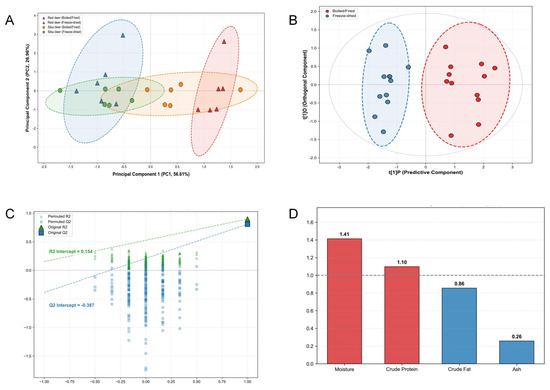
The PCA results (Figure 1A) showed that the first two principal components explained 83.57% of the total variance, indicating that they captured most dehydration-induced compositional variation. Loading analysis indicated that PC1 was primarily associated with moisture (0.934), crude protein (−0.903), and crude fat (0.739), whereas PC2 was mainly driven by ash (0.948). The Boiled/Fried group clustered on the positive side of PC1 and was characterized by higher moisture and crude fat contents. In contrast, the Freeze-Dried group was located on the negative side of PC1 and was characterized by higher crude protein content, with tighter sample clustering. Overall, moisture, crude protein, and crude fat were the major contributors to the compositional differences among dehydration methods.
Figure 1.
Multivariate statistical analysis of conventional nutritional composition indices of velvet antler. (A) PCA score plot showing the overall distribution of samples by species and dehydration method. PC1 (56.61%) and PC2 (26.96%) together explain 83.57% of the total variance; PC1 is primarily driven by moisture and crude fat and represents the main dimension distinguishing processing methods, The shaded ellipses indicate the distribution regions of samples in each group; (B) OPLS-DA score plot showing clear separation between the Boiled/Fried and Freeze-Dried groups (R2Y = 0.893, Q2 = 0.87),The shaded ellipses indicate the distribution regions of samples in each group, The grey circle represents the 95% confidence region of the total samples.; (C) permutation test (200 permutations); the Q2 intercept (−0.387) indicates good model validity with no evidence of overfitting; (D) VIP plot showing the contribution of each index to discrimination between dehydration methods; moisture and crude protein (VIP > 1.0) are identified as the main differential indices.
To further identify variables driving group separation, a supervised orthogonal partial least square–discriminant analysis (OPLS-DA) model was constructed (Figure 1B). The model showed strong performance (R2X(cum) = 0.764; R2Y(cum) = 0.893; Q2(cum) = 0.87), indicating good fit and predictive ability. The two groups were clearly separated along the t(1) component, and the Freeze-Dried group displayed tighter clustering than the Boiled/Fried group. Model robustness was evaluated using a permutation test (n = 200). In Figure 1C, the permuted R2 and Q2 values were lower than those of the original model, with y-intercepts of R2 = 0.154 and Q2 = −0.387 (p < 0.05), confirming model validity and indicating no overfitting.
To identify the key physicochemical factors responsible for the separation between the Boiled/Fried and Freeze-Dried groups, variable importance in projection (VIP) values were extracted from the OPLS-DA model. As shown in Figure 1D, moisture (VIP = 1.41) and crude protein (VIP = 1.10) exceeded the threshold of 1.0 and were the primary variables distinguishing the two processing methods. In contrast, crude fat (VIP = 0.86) and ash (VIP = 0.26) contributed less to the separation.
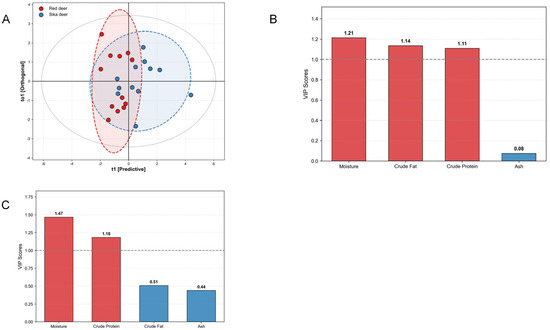
Both PCA and OPLS-DA results indicate that dehydration processing drives compositional changes in velvet antler mainly through alterations in moisture and crude protein. To assess the effect of species background, an additional OPLS-DA model was constructed based on species classification (red deer velvet antler vs. sika deer velvet antler). As shown in Figure 2A, the model exhibited low predictive ability (Q2 = 0.141 < 0.5), and the two species largely overlapped in the score plot, indicating highly similar baseline physicochemical profiles. Species-specific VIP analysis revealed differences in sensitivity to dehydration (Figure 2B,C). Although moisture and crude protein were key discriminating variables in both species (VIP > 1.0), crude fat contributed significantly in red deer velvet antler (VIP = 1.14) but not in sika deer velvet antler (VIP = 0.51).
Figure 2.
Compositional difference analysis between red deer and sika deer velvet antler. (A) OPLS-DA score plot of nutritional composition indices by species. Red dots represent red deer and blue dots represent sika deer, showing highly similar compositional profiles (R2Y = 0.365, Q2 = 0.141), The shaded ellipses indicate the distribution regions of samples in each group. The grey circle represents the 95% confidence region of the total samples. (B) VIP plot comparing dehydration methods in red deer velvet antler. Indices with VIP > 1.0 (red bars) indicate major contributors to processing differences, including moisture, crude fat, and crude protein; ash (blue bars) shows a lower contribution; (C) VIP plot comparing dehydration methods in sika deer velvet antler. Moisture and crude protein (VIP > 1.0) are the primary markers differentiating dehydration methods, whereas crude fat and ash contribute less.
4.2. Conventional Nutritional Composition of Velvet Antler Subjected to Different Pretreatments
4.2.1. Conventional Nutritional Composition (Contents)
Nutrient composition under different preprocessing methods is presented in Table 2. Overall, preprocessing had minimal effects on major nutrients. In both red deer and sika deer velvet antlers, the moisture, ash, and crude fat did not differ significantly between Blood-Retained and Blood-Removed groups (p > 0.05). A significant difference was observed only in red deer velvet antler processed by the Boiled/Fried method, where crude protein was higher in the Blood-Removed group than in the Blood-Retained group (p = 0.002). Dry-basis data (Supplementary Table S2) showed that a significant difference was observed only in red deer velvet antler processed by the Boiled/Fried method, in which crude protein was higher in the Blood-Removed group than in the Blood-Retained group (p < 0.01), while no significant differences were found for sika deer velvet antler among all comparisons (p > 0.05).
Table 2.
Comparison of the effects of different pretreatments on the nutritional composition of velvet antler.
4.2.2. Statistical Analysis of Nutrient Components in Velvet Antler Under Different Preprocessing Methods
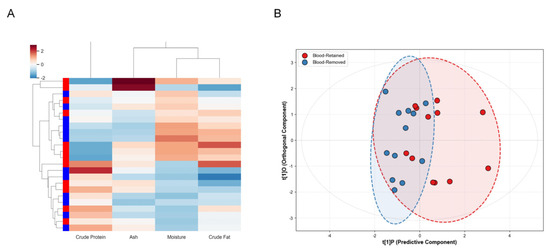
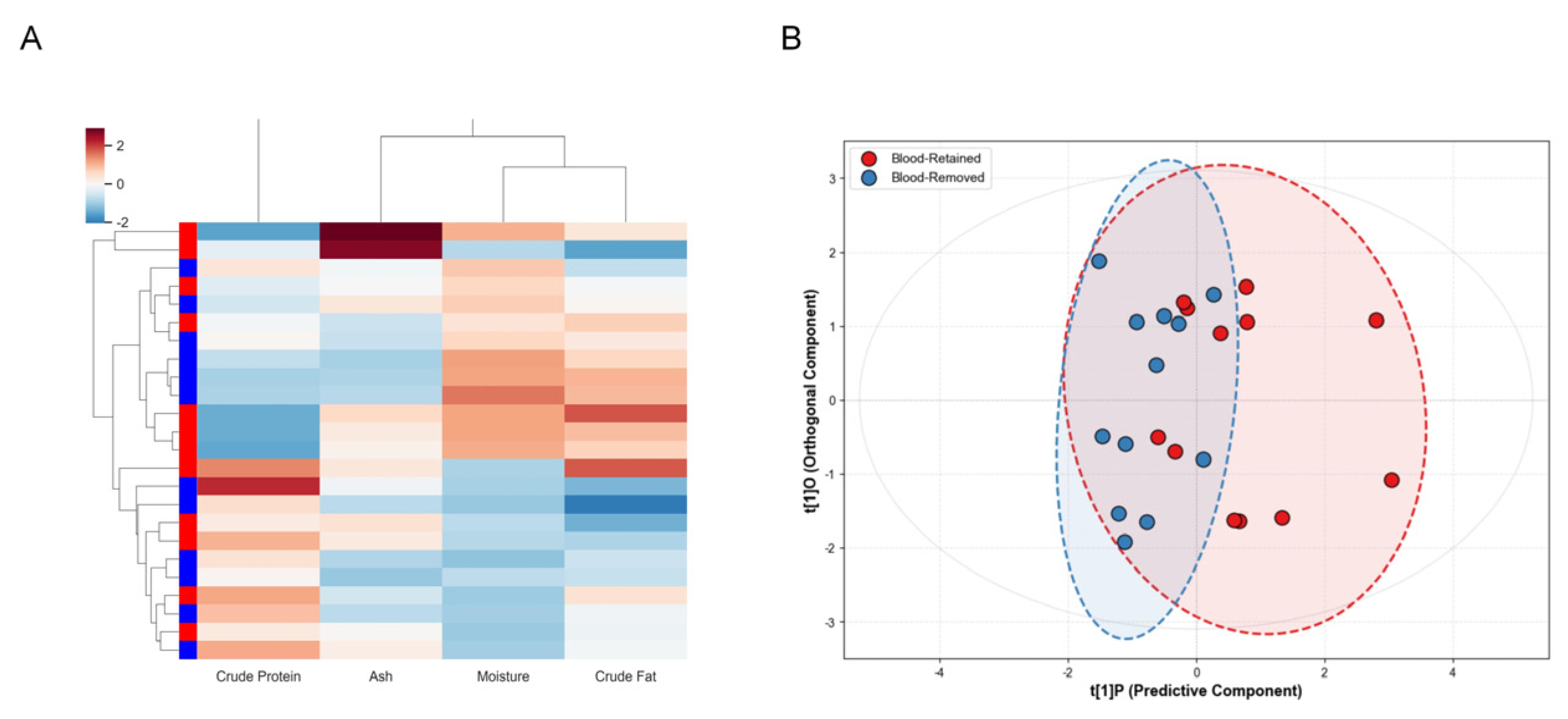
The hierarchical clustering heatmap (Figure 3A) shows interlaced clustering of samples subjected to different preprocessing methods, with no clear separation between Blood-Retained and Blood-Removed groups. This pattern indicates high similarity in basic physicochemical and proximate composition. The OPLS-DA score plot (Figure 3B) shows partial separation along the first predictive component (t1); however, the confidence ellipses overlap substantially, and the model demonstrates low predictive ability (Q2 = 0.256). These findings suggest that preprocessing does not substantially alter the overall nutrient profile. Multivariate analysis indicates that preprocessing exerts a limited effect on the global nutrient composition of velvet antler, and both groups remain largely comparable in physicochemical characteristics.
Figure 3.
Multivariate statistical analysis of preprocessing effects on velvet antler nutrient composition. (A) Hierarchical clustering heatmap of nutrient components; red indicates Blood-Retained samples and blue indicates Blood-Removed samples; (B) OPLS-DA score plot of nutrient components; red dots represent Blood-Retained samples and blue dots represent Blood-Removed samples, The shaded ellipses indicate the distribution regions of samples in each group. The grey circle represents the 95% confidence region of the total samples..
4.3. Two-Way and Three-Way ANOVA of Pretreatment, Dehydration, and Velvet Antler Variety on Nutritional Indicators
Two-way ANOVA was performed to evaluate the main effects of pretreatment, dehydration method, and their interaction on the conventional nutritional components of red deer velvet antler. The dehydration method showed a highly significant effect on moisture, crude protein, and crude fat (p < 0.01), whereas pretreatment significantly affected ash content (p < 0.01). No significant interaction was observed for any of the measured parameters (p > 0.05).
Two-way ANOVA was performed to evaluate the main effects of pretreatment, dehydration method, and their interaction on the conventional nutritional components of sika deer velvet antler (as shown in Table 3 and Table 4). The dehydration method significantly affected moisture and crude protein (p < 0.01). No significant interaction was observed for any of the measured parameters (p > 0.05).
Table 3.
Two-way ANOVA analysis of the effects of pretreatment, dehydration method, and their interaction on conventional nutritional components of red deer velvet antler.
Table 4.
Two-way ANOVA analysis of the effects of pretreatment, dehydration method, and their interaction on conventional nutritional components of sika deer velvet antler.
Three-way ANOVA results (Supplementary Table S3) showed that velvet antler variety significantly affected moisture and crude protein (p < 0.01), pretreatment significantly affected ash (p < 0.01), and the dehydration method significantly affected moisture, crude protein, and crude fat (p < 0.01). Significant two-way interactions were observed for variety × pretreatment on ash and crude fat (p < 0.05) and for variety × dehydration on moisture and crude fat (p < 0.05), whereas no significant three-way interaction was detected.
4.4. Amino Acid Content of Velvet Antler
4.4.1. Amino Acid Content of Velvet Antler Under Different Dehydration Processing Methods
The effects of different dehydration methods on the TAA content of red deer velvet antler are presented in Table 5. In Blood-Retained samples, the TAA content was significantly lower in the Boiled/Fried group than in the Freeze-Dried group (p < 0.01). In Blood-Removed samples, no significant difference was observed between Boiled/Fried and Freeze-Dried treatments (p > 0.05). Dry-basis data (Supplementary Table S1) showed that in the blood-removed samples, the Boiled/Fried group had significantly higher TAA content than the Freeze-Dried group (p < 0.05).
Table 5.
Amino acid content of red deer velvet antler under different dehydration processing methods (g/100 g).
Table 6 shows the effects of dehydration methods on sika deer velvet antler. In Blood-Retained samples, Freeze-Dried specimens had significantly higher TAA content than Boiled/Fried specimens (p < 0.01). In Blood-Removed samples, the TAA content did not differ significantly between the two dehydration methods (p > 0.05). Dry-basis data (Supplementary Table S1) showed that in the Blood-Removed samples, the Boiled/Fried group had significantly higher TAA content than the Freeze-Dried group (p < 0.05).
Table 6.
Amino acid content of sika deer velvet antler under different dehydration processing methods (g/100 g).
4.4.2. Amino Acid Content of Velvet Antler Under Different Pretreatment Methods
The effects of pretreatment methods on red deer velvet antler are summarized in Table 7. Among Boiled/Fried samples, TAA content did not differ between Blood-Retained and Blood-Removed groups (p > 0.05). However, among Freeze-Dried samples, the Blood-Retained group showed significantly higher TAA content than the Blood-Removed group (p < 0.05). Dry-basis data (Supplementary Table S2) showed that in the Freeze-Dried samples, the Blood-Retained group had significantly higher TAA content than the Blood-Removed group (p < 0.05).
Table 7.
Amino acid content of red deer velvet antler under different pretreatment methods (g/100 g).
Similarly, as shown in Table 8, pretreatment methods did not affect TAA content in Boiled/Fried sika deer velvet antler (p > 0.05). In contrast, in Freeze-Dried samples, the Blood-Retained group had significantly higher TAA content than the Blood-Removed group (p < 0.05). Dry-basis data (Supplementary Table S2) showed that in the Freeze-Dried samples, the Blood-Retained group had significantly higher TAA content than the Blood-Removed group (p < 0.05).
Table 8.
Amino acid content of sika deer velvet antler subjected to different pretreatment methods (g/100 g).
4.4.3. Two-Way and Three-Way ANOVA of Pretreatment, Dehydration, and Velvet Antler Variety on Total Amino Acid Content
To further clarify the effects of pretreatment, dehydration method, and their interaction on the total amino acid content of red deer velvet antler and sika deer velvet antler, two-way analysis of variance was employed to test the significance of the data.
The two-factor analysis of variance (ANOVA) indicated that (Table 9 and Table 10), in red deer velvet antler, both pretreatment and dehydration method had a highly significant effect on total amino acid content (p < 0.01), whereas no significant interaction was observed between these two factors (p > 0.05). In sika deer velvet antler, pretreatment, dehydration method, and their interaction all had a significant effect on total amino acid content (p < 0.01).
Table 9.
Two-way ANOVA analysis of the effects of pretreatment, dehydration method, and their interaction on the total amino acids of red deer velvet antler.
Table 10.
Two-way ANOVA analysis of the effects of pretreatment, dehydration method, and their interaction on total amino acids of sika deer velvet antler.
Three-way ANOVA results (Supplementary Table S3) showed that velvet antler variety, pretreatment, and dehydration method all significantly affected TAA content (all p < 0.01). A significant two-way interaction was observed for pretreatment × dehydration (p < 0.01), while the three-way interaction was not significant (p > 0.05).
4.4.4. Content of Essential Amino Acids in Velvet Antler After Different Processing Methods
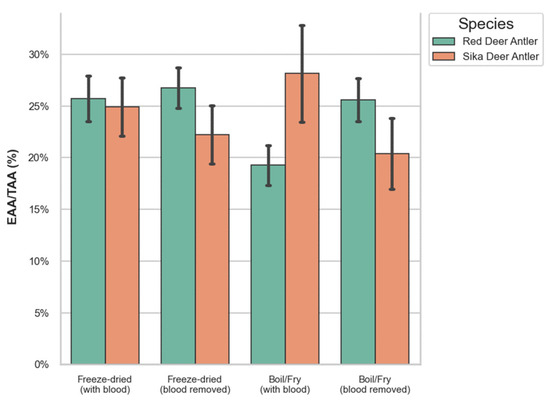
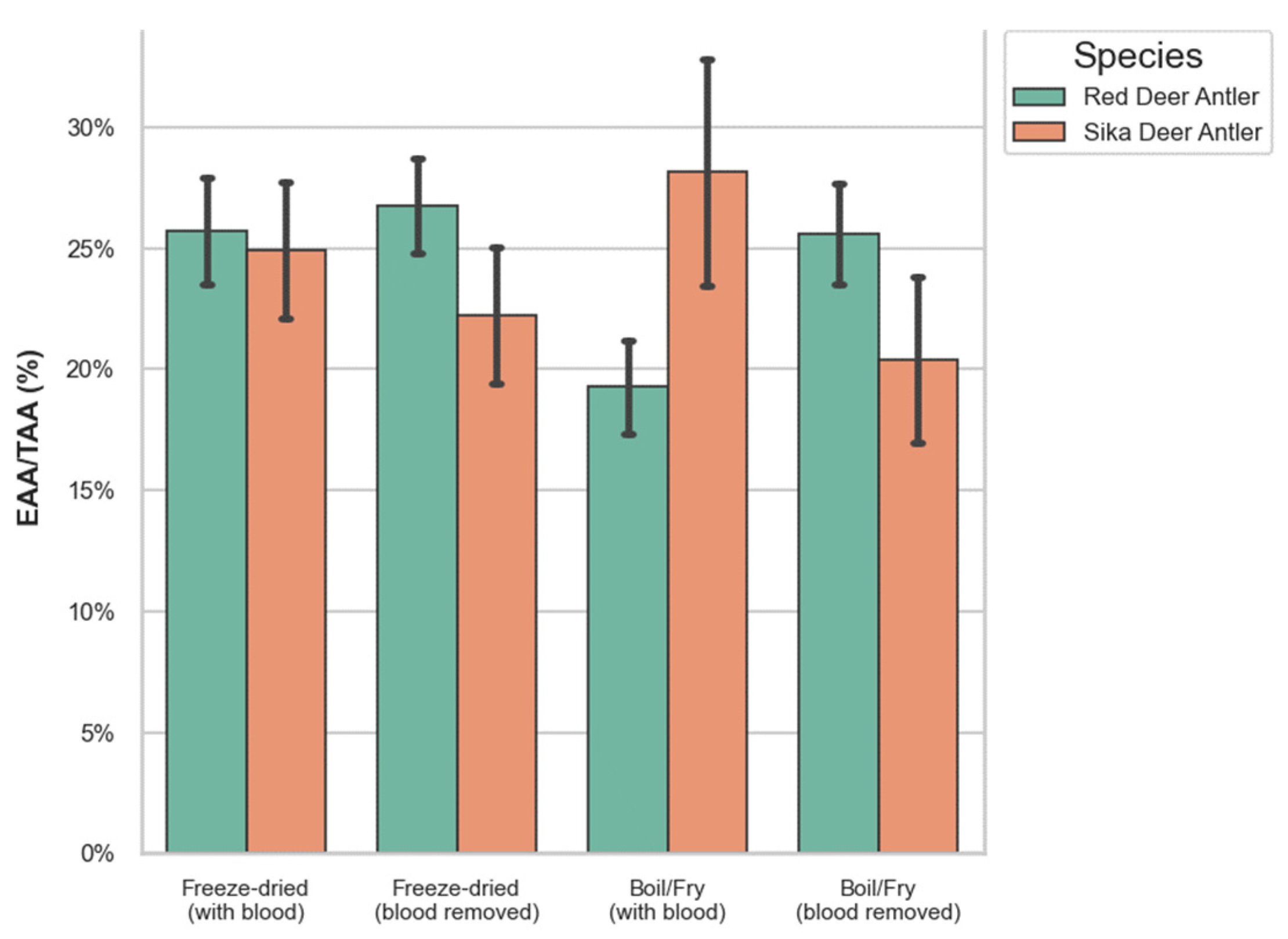
Figure 4 illustrates the proportion of essential amino acids under different processing conditions. In red deer velvet antler, the Blood-Retained Boiled/Fried group had a significantly lower proportion of essential amino acids than the other three groups, which did not differ from each other. In sika deer velvet antler, the Blood-Retained Boiled/Fried group showed a significantly higher proportion of essential amino acids than the Blood-Removed Boiled/Fried group, whereas the Blood-Retained Freeze-Dried and Blood-Removed Freeze-Dried groups did not differ significantly from the other groups.
Figure 4.
Proportions of essential amino acids (%) in velvet antler under different processing methods. Green represents red deer velvet antler and orange represents sika deer velvet antler.
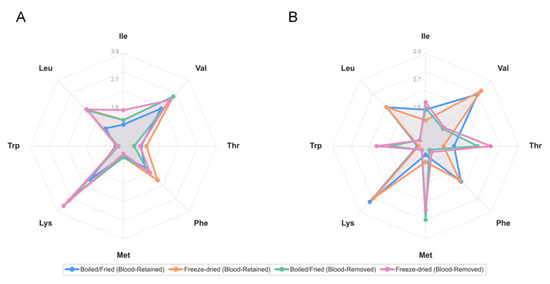
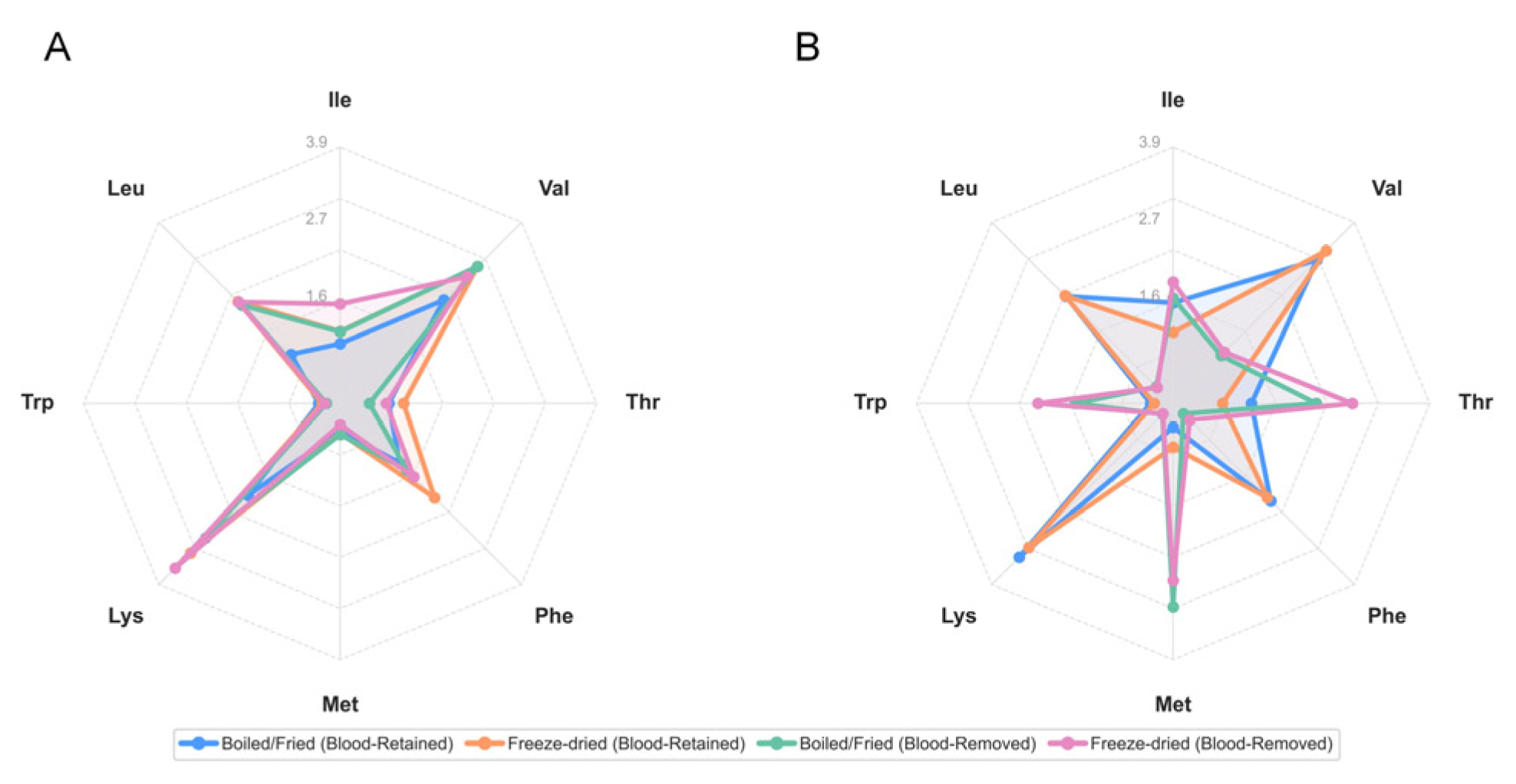
As shown in Figure 5, the essential amino acid composition of velvet antler varied with processing method. In red deer, Lys and Val contents were higher in the Blood-Removed Freeze-Dried and Blood-Removed Boiled/Fried groups. In sika deer, these amino acids were higher in the Blood-Retained Freeze-Dried and Blood-Retained Boiled/Fried groups.
Figure 5.
Radar charts of essential amino acid composition in velvet antler under different processing methods (g/100 g): (A) red deer velvet antler; (B) sika deer velvet antler. Both charts use the same radial scale; curves extending farther outward indicate higher amino acid content.
4.5. Assessment of the Feasibility of Data Integration
Following the procedure described in Section 3.6.2, we assessed whether data from red deer and sika deer could be combined. The response magnitudes and trends with respect to dehydration methods and pretreatments were compared between species.
Blood-Retained effect (%) = [(mean of Blood-Retained − mean of Blood-Removed)/mean of Blood-Removed] × 100. Trend consistency was assessed by direction of change. Consistent, partially consistent, basically consistent, and inconsistent indicate identical, same direction with different magnitude, broadly similar, and opposite trends between red deer and sika deer, respectively.
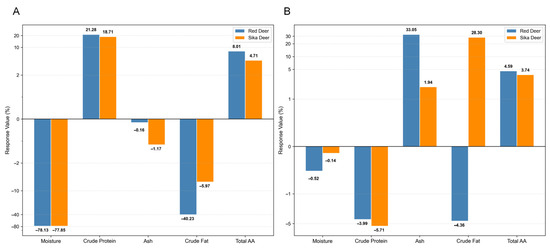
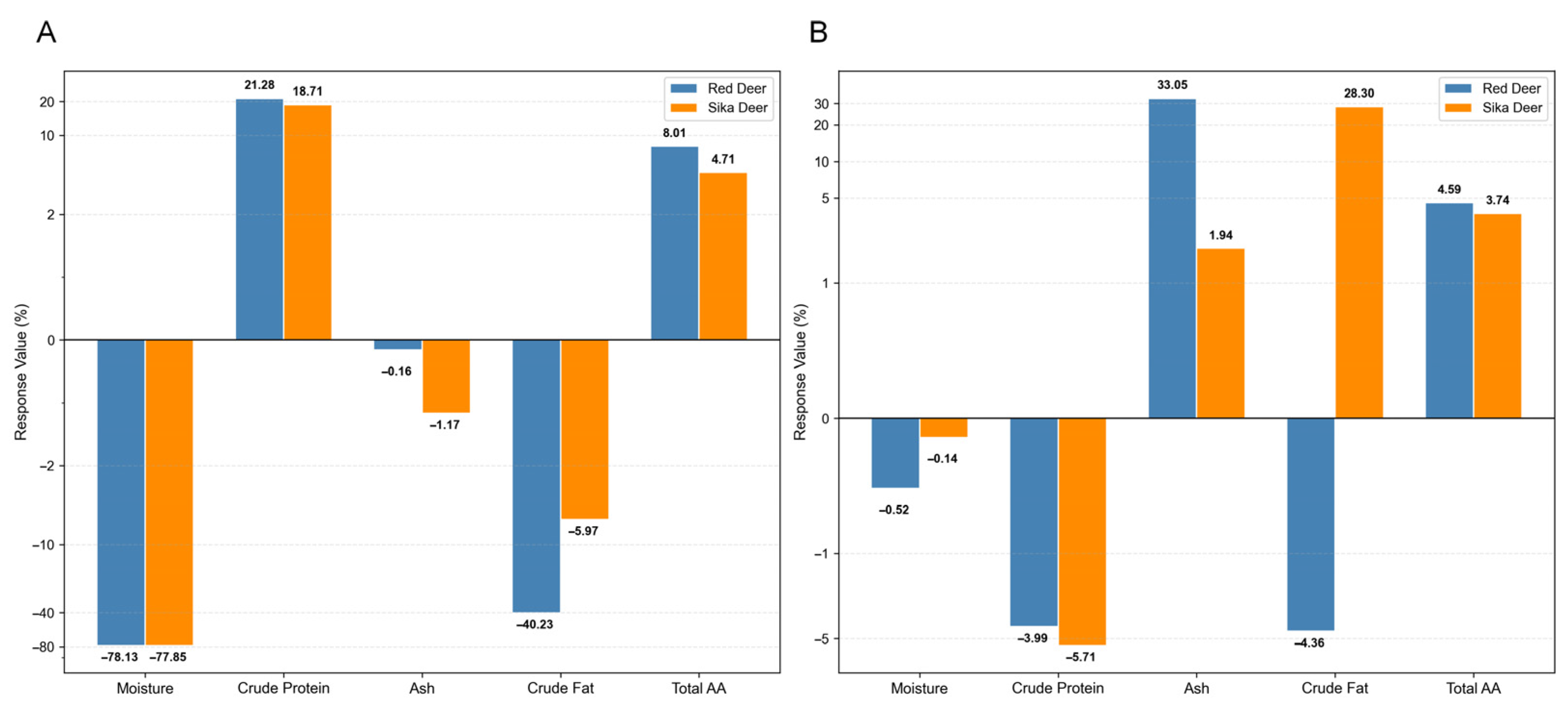
As summarized in Table 11 and Figure 6, both species showed largely concordant directional changes in key nutritional indices. Under freeze-drying, moisture decreased markedly, whereas crude protein and TAAs increased in both species. Under the Blood-Retained treatment, TAAs also increased in both species. In contrast, crude fat showed species-specific responses, with a greater decrease in red deer under freeze-drying. Ash content remained relatively stable across processing methods. Given the consistency in major response patterns, data from both species were pooled to increase sample size and statistical power for subsequent association analyses.
Table 11.
Comparison of response trends of the two types of velvet antler to processing methods.
Figure 6.
Bar plots showing processing-response trends in chemical component contents of red deer and sika deer velvet antler: (A) freeze-drying effect; (B) Blood-Retained effect. Response values are expressed as percent changes relative to the corresponding reference group. To accommodate the wide dynamic range, the y-axis uses a symmetric logarithmic scale with a linearly expanded region around zero, allowing visualization of both small variations and large differences.
4.6. Correlation Analysis Between TAAs and Nutritional Components in the Pooled Dataset
4.6.1. Overall Comparison of Correlation Patterns Between Processing Methods
Table 12 shows the correlations between each component and TAAs under Freeze-Dried and Boiled/Fried treatments. Under the Boiled/Fried treatment, moisture was significantly negatively correlated with TAAs (r = −0.699, p < 0.05), whereas no significant correlation was observed under freeze-drying (r = 0.035, p > 0.05). For both treatments, crude protein, ash, and crude fat were not significantly correlated with TAAs (all p > 0.05). Differences in correlation strength between processing methods were further evaluated using Fisher’s Z test.
Table 12.
Comparison of correlations between composition traits and TAAs under freeze-drying and boiling/frying.
In the Boiled/Fried group, TAAs were significantly negatively correlated with moisture (r = −0.699, p = 0.011; Table 12). No significant correlation was observed in the Freeze-Dried group (r = 0.035, p = 0.914). Fisher’s Z test indicated a marginal difference between the two correlation coefficients (Z = 1.915, p = 0.055; Table 13). No other compositional indices showed significant correlations with TAAs within either group (all p > 0.05; Table 12), and no significant between-group differences in correlation strength were detected (all p > 0.05; Table 13).
Table 13.
Fisher’s Z test comparisons of correlation coefficients between amino acids and nutritional indices in the Freeze-Dried and Boiled/Fried groups.
4.6.2. Correlation Trend Analysis of TAAs with Components Under Combinations of Different Processing Methods and Pretreatments
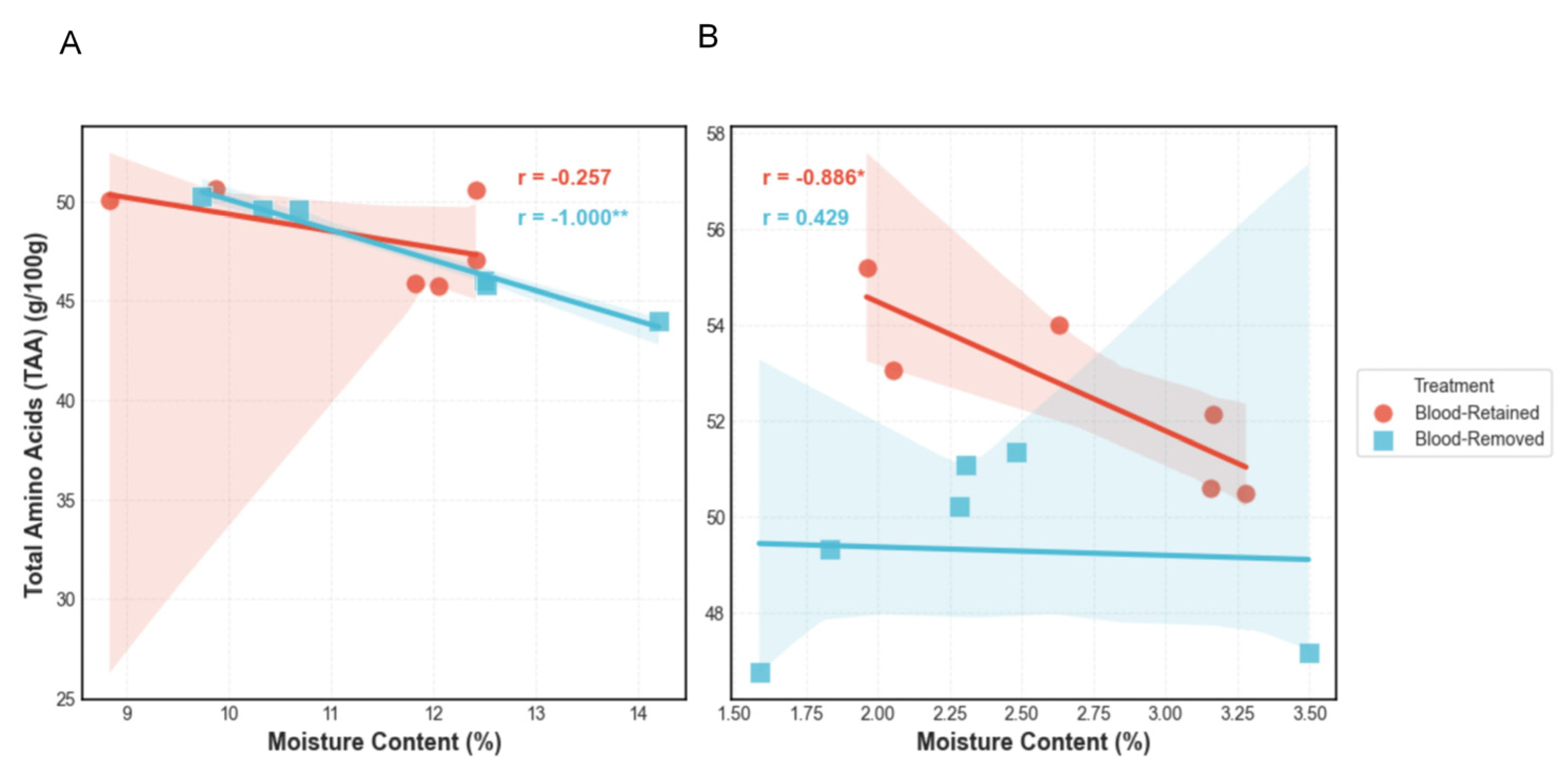
As shown in Table 14, the correlations between compositional components and TAAs varied across processing/pretreatment combinations. The relationship between TAAs and moisture content varied by subgroup. Significant negative correlations were observed in the Freeze-Dried, Blood-Retained subgroup (r = −0.886, p < 0.05) and the Boiled/Fried, Blood-Removed subgroup (r = −1.000, p < 0.01). In contrast, the Freeze-Dried, Blood-Removed subgroup showed a non-significant positive trend (r = 0.429). Across all four subgroups, TAAs tended to correlate positively with crude protein. The strongest association occurred in the Freeze-Dried, Blood-Removed subgroup and was statistically significant (r = 0.886, p < 0.05), whereas correlations in the remaining subgroups were not significant. Correlations of ash and crude fat with TAAs were weak and inconsistent in direction, and none reached statistical significance (all p > 0.05).
Table 14.
Correlation coefficient (r) trends of TAAs with components in different pretreatment groups under different processing methods.
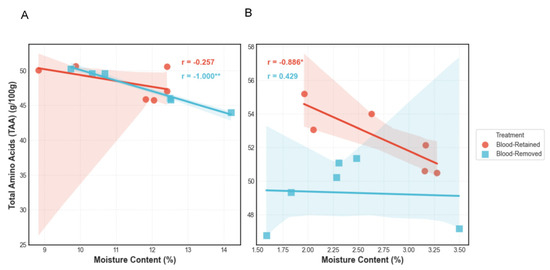
Intra-group comparisons suggest that pretreatment (bleeding status) and processing method jointly influence overall quality indicators. Figure 7 illustrates these relationships using scatterplots with linear regression. In the Boiled/Fried groups (Figure 7A), TAAs decreased with increasing moisture regardless of bleeding status. The Blood-Removed subgroup showed a perfect negative correlation (r = −1.000, p < 0.01), while the Blood-Retained subgroup showed a weaker, non-significant association (r = −0.257, p > 0.05). In the Freeze-Dried groups (Figure 7B), trends differed by pretreatment. The Blood-Retained subgroup showed a significant negative correlation (r = −0.886, p < 0.05), whereas the Blood-Removed subgroup showed a non-significant positive trend with a relatively flat regression line (r = 0.429).
Figure 7.
Relationship between moisture content and total amino acids (TAAs) in velvet antler under different processing methods. (A) Boiled/Fried; (B) freeze-drying. Red circles indicate the Blood-Retained group and blue squares indicate the Blood-Removed group. Solid lines represent fitted linear regression lines and shaded areas denote the 95% confidence intervals. Pearson’s correlation coefficients (r) are shown (* p < 0.05, ** p < 0.01).
5. Analysis and Discussion
5.1. Mechanistic Effects of Dehydration Processing on the Retention of Nutritional Components in Velvet Antler
This study showed that freeze-drying significantly reduced moisture content and increased crude protein density in velvet antler. These findings suggest that moisture removal may influence apparent nutrient levels, potentially through changes in the physicochemical state of water and mass transfer pathways during processing [18]. The results of the two-factor analysis of variance indicated that the dehydration method had a highly significant effect on moisture, crude protein, and crude fat contents, as well as a significant effect on total amino acid content. This suggests that the processing route (termed “dehydration method” in this study) is closely associated with variations in moisture and major nutrient indices.
To help distinguish dehydration-induced concentration effects from processing-driven compositional changes, dry-weight basis data were analyzed (Supplementary Table S1), while comparisons between wet- and dry-basis results were used as supportive evidence, given that both effects may coexist.
In red deer samples, crude protein in the Blood-Retained Freeze-Dried group was significantly higher than in the Blood Retained Boiled/Fried group on both wet and dry bases, suggesting that the difference may not be explained solely by dehydration-induced concentration and could involve processing-associated changes. Regarding ash, the Blood-Removed Boiled/Fried group showed higher values than the Blood-Removed Freeze-Dried group only on a dry-weight basis, with no clear difference on a wet basis; this may indicate a potential predominance of processing influences. Crude fat in the Boiled/Fried group was significantly higher than in the corresponding Freeze-Dried group on both bases, suggesting that the observed variation may partly reflect processing-related lipid redistribution or retention rather than moisture changes alone [19].
For TAAs, Freeze-Dried groups showed higher amino acid content on a wet-weight basis, whereas the difference was not observed on a dry-weight basis, a pattern more consistent with a predominantly concentration-driven effect. By contrast, the higher dry-basis TAAs observed in Blood-Removed Boiled/Fried samples may indicate that processing could influence amino acid retention and extractability [20].
Three-way ANOVA results (Supplementary Table S3) further showed that the processing method had highly significant effects on moisture, crude protein, crude fat, and TAAs (p < 0.01), supporting its important role in shaping nutritional composition. In addition, the significant interaction between velvet antler variety and dehydration method on moisture and crude fat (p < 0.05) suggests that the impact of freeze-drying versus Boiled/Fried processing may depend on the sample group (variety), highlighting the importance of accounting for raw material heterogeneity (e.g., variety, provenance, morphology) when selecting dehydration conditions.
In contrast, boiling/frying may induce heat-driven exudation. The negative correlation between moisture and TAAs in the Boiled/Fried groups is consistent with the possibility that, under high-temperature aqueous conditions, water migration may occur alongside the loss of soluble nutrients. This effect may result from thermal disruption of cell membrane permeability, where liquid water facilitates the outward diffusion of intracellular solutes [21]. Heat-induced protein denaturation and Maillard reactions that may occur during processing could also be associated with protein structural changes and nutrient loss [22]. Notably, exudate losses, microstructural changes, and Maillard reaction markers were not directly measured in this study; therefore, these mechanisms are proposed as plausible explanations rather than definitive conclusions.
However, freeze-drying may facilitate moisture removal while potentially helping to stabilize nutrients in situ. This process relies on solid-phase sublimation, in which water is removed directly as vapor, thereby potentially reducing solute transport associated with liquid water movement. The low-temperature conditions also help preserve cytoskeletal structure, promoting retention of heat-sensitive components such as amino acids [23], and may contribute to greater overall nutrient preservation [24]. This mechanism may explain why moisture changes were not significantly correlated with TAAs in the Freeze-Dried groups and why crude protein content was higher than in the Boiled/Fried groups. Although crude protein and TAAs showed a positive correlation trend in both processing methods, the association was not statistically significant, suggesting more complex protein transformation dynamics. During heat processing, denaturation and solubilization of insoluble proteins may occur simultaneously with degradation and loss of soluble proteins [25]. These concurrent processes may offset each other, meaning crude protein content does not necessarily reflect the actual level of bioavailable amino acids.
In this study, the Boiled/Fried and Freeze-Dried treatments differ not only in drying principles but also in overall processing routes. Therefore, the observed differences in nutritional composition should be interpreted as outcomes of two integrated processing strategies, rather than being attributed solely to the drying method itself. Future research may further explore the independent effect of drying methods by strictly controlling for other confounding variables.
5.2. Differential Responses of Different Velvet Antler Varieties to Pretreatment (Blood-Retained vs. Blood-Removed)
To help distinguish moisture-driven concentration effects from pretreatment-related compositional changes, results were additionally evaluated on a dry-weight basis (Supplementary Table S2); comparisons between wet- and dry-basis data were used only as supportive evidence, given that both effects may coexist.
For both deer species, total amino acids in the Blood-Retained Freeze-Dried antler were significantly higher than those in the Blood-Removed Freeze-Dried antler on both wet- and dry-weight bases. Because this difference persists after normalization to dry matter, it is less likely to be driven solely by moisture differences; rather, it may reflect that the Blood-Retained pretreatment preserves a greater amount of blood-derived nitrogen-containing components, thereby increasing the total measurable amino acids [26]. In contrast, in red deer, crude protein in the Blood-Removed Boiled/Fried group was significantly higher than that in the Blood-Retained Boiled/Fried group on both wet- and dry-weight bases. This may suggest that, during heating (especially when a boiling step is involved), Blood-Retained samples may lose more soluble nitrogen-containing compounds [27], whereas blood removal may reduce such losses, thereby resulting in a higher crude protein content in the final product.
The impact of pretreatment on velvet antler quality differed between the two study groups and may depend on the extent to which retained blood contributes primarily to moisture-related dilution versus serving as a source of blood-derived nutrients. Two-way and three-way ANOVA performed within each group further supported this observation. In red deer velvet antler, both pretreatment and dehydration method had a significant effect on total amino acid content, whereas the interaction between the two factors was not significant, indicating that the effects of these two factors were relatively independent. In contrast, in sika deer velvet antler, pretreatment, dehydration method, and their interaction all had significant effects on total amino acid content, indicating that sika deer velvet antler is more sensitive to the combination of “Pretreatment × Dehydration method”.
Three-way ANOVA showed that velvet antler variety had highly significant effects on moisture, crude protein, and TAAs (p < 0.01). Pretreatment also exerted highly significant effects on ash and TAAs (p < 0.01). In addition, the variety × pretreatment interaction significantly affected ash and crude fat (p < 0.05), indicating that the modulatory effects of blood removal on the nutritional composition of velvet antler may be species-specific.
In red deer velvet antler, the Blood-Retained group had significantly lower crude protein than the Blood-Removed group, possibly due to dilution from the high moisture content of residual blood within the dense vascular network. In addition, Figure 5 shows a lower proportion of essential amino acids in the Blood-Retained Boiled/Fried group. This pattern is consistent with the possibility that, in red deer velvet antler, blood components under high-temperature conditions may contribute to degradation of certain heat-sensitive amino acids [28]. Therefore, blood removal followed by freeze-drying may be preferable for maintaining amino acid profile stability in red deer velvet antler.
The dilution effect in sika deer velvet antler may be less pronounced because of its lower relative blood proportion, where blood may function as a potential “nutrient reservoir”. During freeze-drying, free amino acids and serum proteins are better preserved [29], which may enhance the nutritional value of Blood-Retained Freeze-Dried velvet antler. In contrast, crude fat in red deer velvet antler is highly sensitive to processing (VIP > 1.0), whereas it remains relatively stable in sika deer velvet antler. This difference suggests that lipid microstructure or deposition patterns may be species-specific [30]. The lipid system in red deer velvet antler may accordingly be more susceptible to thermal degradation or solvent extraction.
Taken together, these results suggest that pretreatment effects may be component-dependent and may vary across sample backgrounds, supporting the need for group-aware optimization rather than assuming a uniform response. Notably, these mechanisms were not directly measured in the present study; thus, they are proposed as plausible explanations based on prior literature rather than definitive conclusions.
5.3. Processing-Induced Nutritional Remodeling Mechanisms and Target-Oriented Process Optimization Strategies
Multivariate analyses (PCA and OPLS-DA) identified dehydration method as the primary determinant of physicochemical properties. In the PCA model, PC1 and PC2 together explained >83% of the total variance, while species-related differences were less pronounced. The loading plot showed an inverse relationship between the “moisture–lipid” and “crude protein–amino acid” dimensions [31], indicating that freeze-drying preserves nutrients in situ by removing the aqueous matrix [32]. In this study, PCA and OPLS-DA analyses were conducted on a small sample size for exploratory visualization and trend identification, rather than to establish a broadly generalizable classification model. The robustness of the observed findings will need to be validated in larger cohort studies in the future.
Three-way ANOVA (Supplementary Table S3) revealed a significant pretreatment × dehydration method interaction for TAAs (p < 0.01), indicating that the effect of pretreatment on amino acid retention depends on the dehydration method, and that the combined effect may not be adequately described by the sum of their main effects. In contrast, no significant three-way interaction (species × pretreatment × dehydration method) was detected for any measured parameter (p > 0.05), suggesting that higher-order synergistic effects among the three factors may be limited under the present conditions; therefore, interpretation can primarily rely on main effects and two-way interactions.
These findings support the refinement of velvet antler processing strategies. Given that the two sample sets differed not only by species but also by provenance and antler morphology, species effects cannot be clearly separated from source- and background-related factors in the present design. Therefore, the observed between-group differences should not be attributed solely to species and may reflect a combination of provenance, management, genetic background, and harvest stage. From an application standpoint, no single processing route is universally optimal across all quality attributes. Instead, processing may be selected in a target-oriented manner according to prioritized indicators (e.g., moisture control, protein and amino acid retention, ash, and lipid-related traits). Notably, the significant pretreatment × dehydration interaction for TAAs suggests that pretreatment choices should be considered together with the dehydration method to improve amino acid retention and product consistency. A limitation of this study is that bioactive compounds and functional activities were not assessed. While proximate composition and amino acid profiles provide a basis for evaluating nutritional composition and related indices, future studies should incorporate functional assays to more comprehensively characterize the effects of processing on velvet antler bioactivity.
6. Conclusions
In this study, we applied a 2 × 2 processing design (Blood-Retained vs. Blood-Removed pretreatment; Boiled/Fried vs. Freeze-Dried dehydration) to systematically evaluate how processing strategies influence the nutritional architecture of velvet antler from red deer and sika deer. The results showed that the dehydration method was a primary determinant of physicochemical properties. Comparisons on wet- and dry-weight bases further indicated that some between-treatment differences were associated with moisture-related concentration or dilution effects, whereas differences that persisted on a dry-matter basis more directly reflected processing-related changes in nutrient retention. Compared with Boiled/Fried processing, freeze-drying tended to achieve improved retention of protein- and amino acid-related nutritional indicators (e.g., crude protein and total amino acids, TAAs). Importantly, pretreatment effects were species-dependent, and the pretreatment × dehydration interaction observed for TAAs indicates that the influence of blood retention or removal on amino acid retention depends on the dehydration regime rather than being uniform across processing routes.
From an application standpoint, the present results suggest that no single processing route is universally optimal across all quality attributes. Instead, processing may be selected in a target-oriented manner according to prioritized indicators (e.g., moisture control, protein and amino acid retention, ash, and lipid-related traits), while accounting for species background and the observed pretreatment × dehydration interaction for TAAs. In general, freeze-drying provides a relatively robust baseline for improving nutrient preservation and product consistency, whereas the choice of blood retention or removal may be adjusted depending on whether the primary objective is to enhance amino acid yield or to improve compositional stability.
Supplementary Materials
The following supporting information can be downloaded at: https://www.mdpi.com/article/10.3390/pr14081201/s1, Table S1: Comparison of the effects of different dehydration processing methods on nutrient components and total amino acid content of velvet antler samples (dry basis). Table S2: Comparison of the effects of different pretreatments on the nutritional composition and total amino acid content of velvet antler (dry basis). Table S3: p-values of main effects and interactions (variety × pretreatment × dehydration) with respect to chemical composition.
Author Contributions
Conceptualization, W.Q.; methodology, W.Q.; software, X.H.; validation, Y.Z., X.Z. (Xilai Zhao) and Y.T.; formal analysis, X.H.; investigation, X.Z. (Xu Zhou) and L.M.; resources, W.Q.; data curation, X.H.; writing—original draft preparation, X.H.; writing—review and editing, Y.Z. and X.Z. (Xilai Zhao); supervision, W.Q.; project administration, W.Q.; funding acquisition, W.Q. All authors have read and agreed to the published version of the manuscript.
Funding
This work was supported by the Key Field Science and Technology Tackling Plan of Xinjiang Production and Construction Corps: Integration and Demonstration of Meat Red Deer Breeding and High-Efficiency Cultivation Technology (2023AB00702); and the 2025 Xinjiang Talent Development Fund: Research on Key Technological Innovations in Tianshan Talent Red Deer Cultivation and Red Deer Product Development (525402001).
Data Availability Statement
The original contributions presented in the study are included in the article. Further inquiries can be directed to the corresponding author.
Acknowledgments
The authors of this article would like to express gratitude to Tarim University and the Data Testing Center for their contributions to this article.
Conflicts of Interest
The authors declare no conflicts of interest.
Abbreviations
The following abbreviations are used in this manuscript:
| ANOVA | Analysis of Variance |
| PCA | Principal Component Analysis |
| OPLS-DA | Orthogonal Partial Least Squares Discriminant Analysis |
| TAAs | Total Amino Acids |
References
- Wang, Y.-H.; Zhang, X.L.; Zhao, H.; Zhao, H.-P.; Luo, W.-W.; Li, Z.; Sun, Y.-S. Effects of different processing methods on crude protein and hydrolyzed amino acid contents in Velvet antler. Chin. Tradit. Herb. Drugs 2017, 48, 3085–3091. [Google Scholar] [CrossRef]
- Xia, P.; Liu, D.; Jiao, Y.; Wang, Z.; Chen, X.; Zheng, S.; Fang, J.; Hao, L. Health effects of peptides extracted from deer antler. Nutrients 2022, 14, 4183. [Google Scholar] [CrossRef] [Scilit] [PubMed]
- Feleke, M.; Bennett, S.; Chen, J.; Hu, X.; Williams, D.; Xu, J. New physiological insights into the phenomena of deer antler: A unique model for skeletal tissue regeneration. J. Orthop. Transl. 2021, 27, 57–66. [Google Scholar] [CrossRef] [Scilit] [PubMed]
- Jo, K.; Jang, W.Y.; Yun, B.S.; Kim, J.S.; Lee, H.S.; Chang, Y.B.; Suh, H.J. Effect of deer antler extract on muscle differentiation and 5-aminoimidazole-4-carboxamide ribonucleoside (AICAR)-induced muscle atrophy in C2C12 cells. Food Sci. Anim. Resour. 2021, 41, 623–635. [Google Scholar] [CrossRef] [Scilit]
- Sun, H.; Xiao, D.; Liu, W.; Li, X.; Lin, Z.; Li, Y.; Ding, Y. Well-known polypeptides of deer antler velvet with key actives: Modern pharmacological advances. Naunyn-Schmiedeberg’s Arch. Pharmacol. 2024, 397, 15–31. [Google Scholar] [CrossRef] [Scilit] [PubMed]
- Gao, F.; Wang, Y.; Liu, J.; Xie, Y.; Geng, Y.; He, Z.; Geng, J.; Li, J.; Chen, W.; Du, R. Protective effects of Velvet antler polypeptides on cyclophosphamide-induced myelosuppression in mouse and bone marrow mesenchymal stem cells. Nutrients 2025, 17, 3428. [Google Scholar] [CrossRef] [Scilit]
- Liu, C.; Li, Z.; Jin, C.; Zhang, L.; Liu, S.; Xia, Y.; Gong, R.; Wang, Z.; Sun, Y. Processed Velvet antler: Nutritional profile, in vitro antioxidant capacities, and alleviating symptoms of kidney-yang deficiency in mice. J. Food Meas. Charact. 2020, 14, 2163–2175. [Google Scholar] [CrossRef] [Scilit]
- Gong, R.Z.; Wang, Y.H.; Gao, K.; Zhang, L.; Liu, C.; Wang, Z.S.; Wang, Y.F.; Sun, Y.S. Quantification of furosine (Nε-(2-furoylmethyl)-l-lysine) in different parts of Velvet antler with various processing methods and factors affecting its formation. Molecules 2019, 24, 1255. [Google Scholar] [CrossRef] [Scilit]
- Ma, Y.; Yi, J.; Jin, X.; Li, X.; Feng, S.; Bi, J. Freeze-drying of fruits and vegetables in food industry: Effects on phytochemicals and bioactive properties attributes—A comprehensive review. Food Rev. Int. 2023, 39, 6611–6629. [Google Scholar] [CrossRef] [Scilit]
- Hou, Z.; Zhang, X.; Zhao, Y. Effects of different processing technologies on nutritional components in the Velvet antler of sika deer (Cervus nippon). Int. Agric. Eng. J. 2020, 29, 306–315. [Google Scholar]
- GB/T 41188-2021; Processing Specification for Velvet antler. National Technical Committee for Standardization of Pilose Antler Products (SAC/TC 403): Changchun, China, 2021. Available online: https://openstd.samr.gov.cn/bzgk/gb/newGbInfo?hcno=7F8F08466F2B60EB8361482CD6B386D8 (accessed on 5 December 2025).
- Zhang, Y. Velvet antler processing methods. Jilin Anim. Husb. Vet. Med. 2021, 42, 102+105. [Google Scholar] [CrossRef]
- Cui, S. Processing methods for blood Velvet antler. Jilin Agric. 2001, 30–31. [Google Scholar] [CrossRef]
- Zhang, R.; Li, Y. Velvet antler processing techniques (Paozhi). Guangming J. Chin. Med. 2012, 27, 822–823. [Google Scholar] [CrossRef]
- Tian, Y.; Huang, X.L.; Hou, Z.H. Study on processing technology of Velvet antler based on principal component and cluster analysis. Sci. Technol. Food Ind. 2021, 42, 311–318. [Google Scholar] [CrossRef]
- Ma, Q.; Wang, L.E.; Li, L.J.; Zhang, Z.M.; Wu, X.M.; Pei, J.F. Low-temperature freeze-drying processing technology of Velvet antler. J. Econ. Anim. 2007, 21–22+26. [Google Scholar] [CrossRef]
- Zhang, L.Y. Feed Analysis and Feed Quality Testing Methods; China Agricultural University Press: Beijing, China, 2016; Available online: https://vufind.library.sh.cn/Record/f2693565-d31b-485e-ae84-b2e2d7f473d6 (accessed on 10 December 2025).
- Yang, R.L.; Li, Q.; Hu, Q.P. Physicochemical properties, microstructures, nutritional components, and free amino acids of Pleurotus eryngii as affected by different drying methods. Sci. Rep. 2020, 10, 121. [Google Scholar] [CrossRef] [Scilit] [PubMed]
- Arranz-Martínez, P.; Corzo-Martínez, M.; Vázquez, L.; Torres, C.F.; Marangoni, A.G. Influence of thermal processing on the phase behavior of a novel acylglyceride-alkylglyceride lipid-based delivery system. Food Funct. 2018, 9, 4028–4035. [Google Scholar] [CrossRef] [Scilit] [PubMed]
- Wang, Y.; Wang, Y.; Luan, D. Thermal degradation characteristics of amino acids in rainbow trout fillets during traditional high temperature short time processing and microwave processing. J. Food Meas. Charact. 2023, 17, 1940–1952. [Google Scholar] [CrossRef] [Scilit]
- Bertel, C.; Neuner, G. A novel method for measuring heat injury in leaves provides insights into the sequence of processes of heat injury development. Plant Methods 2025, 21, 89. [Google Scholar] [CrossRef] [Scilit] [PubMed]
- Khalid, W.; Maggiolino, A.; Kour, J.; Arshad, M.S.; Aslam, N.; Afzal, M.F.; Meghwar, P.; Zafar, K.U.; De Palo, P.; Korma, S.A. Dynamic alterations in protein, sensory, chemical, and oxidative properties occurring in meat during thermal and non-thermal processing techniques: A comprehensive review. Front. Nutr. 2022, 9, 1057457. [Google Scholar] [CrossRef] [Scilit]
- Assegehegn, G.W. Freeze Drying Process Design of Pharmaceutical Dispersions. Doctoral Dissertation, Universidad de Huelva, Huelva, Spain, 2020. Available online: https://produccioncientifica.uhu.es/documentos/60ad9dbff2da1a4511732822 (accessed on 13 December 2025).
- Mu, Y.; Zhang, B.; Zeng, C.; Zhu, T.; Hu, S. Mechanistic and multi-parametric insights into preserving nutritional, bioactive, and flavor attributes of daylily (Hemerocallis citrina): A comparative evaluation of freeze-drying, hot-air drying, and sun drying. LWT 2025, 218, 117510. [Google Scholar] [CrossRef] [Scilit]
- Li, D.; Ma, Y.; Acevedo-Fani, A.; Lu, W.; Singh, H.; Ye, A. Heat-induced modifications of pea protein: Implications for solubility and digestion behaviour. Curr. Res. Food Sci. 2025, 11, 101173. [Google Scholar] [CrossRef] [Scilit]
- Takis, P.G.; Vuckovic, I.; Kowalka, A.M.; Tan, T.; Suvakov, M.; Meloche, R.; Lanza, I.R.; Macura, S. Toward Absolute Quantification of Soluble Proteins via Proton Nuclear Magnetic Resonance Spectroscopy: Total Protein Concentration in Blood Plasma. Anal. Chem. 2024, 96, 16162–16169. [Google Scholar] [CrossRef] [Scilit]
- Yan, Y.-B.; Wang, Q.; He, H.-W.; Zhou, H.-M. Protein thermal aggregation involves distinct regions: Sequential events in the heat-induced unfolding and aggregation of hemoglobin. Biophys. J. 2004, 86, 1682–1690. [Google Scholar] [CrossRef] [Scilit]
- Asiri, Z.A.; Alshehry, Z.H.; Zourob, M.; Alharbi, M.S.; Al Shomar, H.M.; AlGadhi, A.; Alshehri, A.S. Instability of acylcarnitine and amino acids in dried blood spots preserved at various temperatures: The impact on retrospective analysis of inborn errors of metabolism biomarkers. Comp. Clin. Pathol. 2024, 33, 467–478. [Google Scholar] [CrossRef] [Scilit]
- Flaumenhaft, E.J.; Khat, T.; Marschner, S. Retention of coagulation factors and storage of freeze-dried plasma. Mil. Med. 2021, 186, 400–407. [Google Scholar] [CrossRef] [Scilit] [PubMed]
- Tang, L.; Zhang, R.; Liu, H.; Xing, X. Comparative study on lipid components of wax-sliced Velvet antler and blood-sliced Velvet antler from sika deer. Spec. Wild Econ. Anim. Plant Res. 2020, 42, 1–5+11. [Google Scholar] [CrossRef]
- Mari, A.; Parisouli, D.N.; Krokida, M. Exploring osmotic dehydration for food preservation: Methods, modelling, and modern applications. Foods 2024, 13, 2783. [Google Scholar] [CrossRef] [Scilit]
- Yang, J.; Miao, M. Analysis of the influence of different drying methods on the active ingredients of fresh medicine. Chin. Med. Nat. Prod. 2022, 2, e1–e4. [Google Scholar] [CrossRef] [Scilit]

Disclaimer/Publisher’s Note: The statements, opinions and data contained in all publications are solely those of the individual author(s) and contributor(s) and not of MDPI and/or the editor(s). MDPI and/or the editor(s) disclaim responsibility for any injury to people or property resulting from any ideas, methods, instructions or products referred to in the content. |
© 2026 by the authors. Licensee MDPI, Basel, Switzerland. This article is an open access article distributed under the terms and conditions of the Creative Commons Attribution (CC BY) license.