


Abstract
Dust generated during coal mining and transportation poses serious threats to miners’ health, operational safety, and the surrounding environment. However, comprehensive review studies on dust suppression in coal mines remain limited, particularly those integrating dust movement laws with numerical simulation approaches. This review presents a systematic and reproducible analysis of dust control methods in coal mines with a particular focus on numerical simulation. Current research progress and development trends are summarized from three aspects: structural optimization of dust suppression devices, optimization of operating conditions, and ventilation system design. Existing studies indicate that structural improvements mainly concentrate on nozzle geometry, diameter, installation position, and spraying distance, while operating condition optimization primarily involves pressure regulation. Due to the complexity and high cost of full-scale experimental platforms, ventilation system optimization is largely achieved through numerical simulation, supplemented by field measurements. Studies based purely on numerical simulations remain limited in addressing the chemical modification of dust removers; however, with the advancement of molecular dynamics techniques, this area may represent a promising direction for future research.
1. Introduction
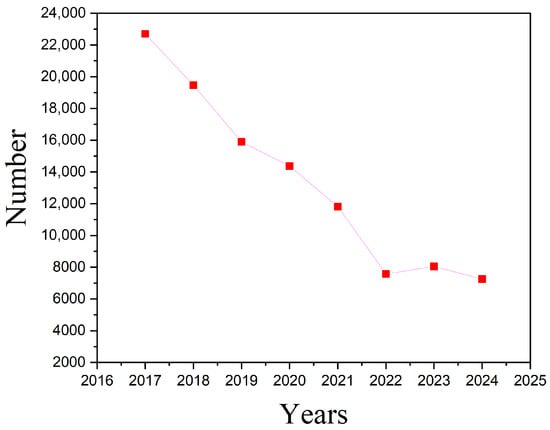
China possesses abundant coal resources, with proven reserves of 187.55 billion tons as of 2020, making it the largest coal storage country and producer worldwide. In the same year, national coal production reached 3.84 billion tons, accounting for nearly half of global output. Coal mining generates substantial dust, which severely degrades the working environment and contributes to occupational diseases, particularly pneumoconiosis [1,2]. In China, over 90% of the approximately one million occupational disease cases are pneumoconiosis, with 80% of affected individuals employed in coal mines. The annual number of newly reported occupational pneumoconiosis cases in China from 2017 to 2024 is presented in Figure 1 [3,4].
Figure 1.
Number of newly reported occupational pneumoconiosis cases in China from 2017 to 2024.
Dust removal in coal mines dates to the late 19th century. At that time, coal miners faced severe health problems, especially respiratory problems, due to the large amount of coal dust and other particulate matter produced during mining. The earliest coal mine dust removal devices were simple washers and wet precipitators, which used water to trap coal dust and other particulate matter. However, these devices have problems such as low efficiency, high cost, and complex maintenance [4]. With the development of technology, coal mine dust removal equipment has been improved. In the early 20th century, mechanical precipitators appeared, using rotating screens or rollers to capture coal dust and other particulate matter. In the middle of the 20th century, the development of electronic technology promoted the appearance of electrostatic precipitators. Coal mine dust removal technology has matured, including ultrasonic dust precipitators, magnetic dust precipitators, electrostatic dust precipitators, surfactant dust precipitators, and other types of equipment [5].
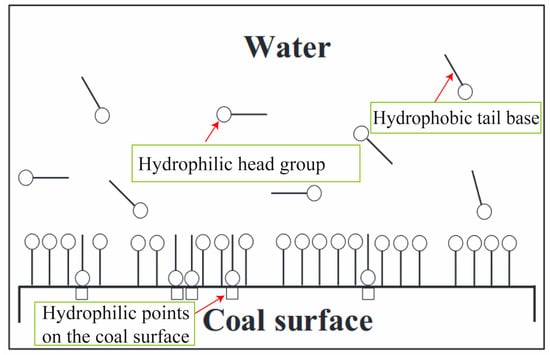
Many scholars have reviewed the current status of coal mine dust removal research. Xu et al. (2018) and Li et al. (2021) introduced the development of surfactant-assisted coal dust suppression technology, including the chemical structure, type, adsorption mechanism, efficiency evaluation methods, and key influencing factors of surfactants, and proposed several suggestions [6,7]. A diagram illustrating surfactant adsorption on the coal surface is shown in Figure 2. While this review provides rich and detailed content, it focuses solely on one dust removal method.
Figure 2.
Diagram of adsorption of surfactant on the coal surface [6].
In contrast, Liu et al. (2021) reviewed the research progress on coal workers’ pneumoconiosis and mine dust control [8]. Although the scope is broad, the content lacks specificity. Zhang et al. (2021) also summarized the development status of Chinese technologies for preventing coal mine dust disasters, covering topics such as pneumoconiosis prevalence, dust hazards, dust dispersion laws, coal dust wetting theory, ventilation dust removal, wet dust suppression, and personal protection measures [5]. However, the discussion of the dust remover was limited.
Considering water-based methods, Zhou and Qin (2021) provided a comprehensive and well-organized review of coal dust suppression technologies based on water media and their influencing factors. Nevertheless, their review did not address ventilation-based or dry dust removal methods [9]. Similarly, Zhang et al. (2022) provided an overview of dust removal methods from physical and chemical perspectives, including multiple dust removal techniques, yet ventilation and dry dust suppression were still not covered [4].
As summarized above, existing review papers exhibit certain limitations, such as focusing on a single method, lacking comprehensive coverage, or omitting important approaches like ventilation and dry dust removal. A detailed summary of these reviews on coal dust suppression research is provided in Table 1.
Table 1.
Summary of review of coal dust suppression research.
With the continuous development of coal mine dust removal technology, numerical simulation has become an efficient method for studying and optimizing the coal mine dust removal process. Complex physical processes, such as flow field, dust movement, and particle trapping in a coal mine dust removal system, can be simulated and analyzed through numerical simulation, thereby providing theoretical guidance and engineering optimization basis for the design and improvement of dust removal technology. Ding et al. (2025) combined numerical and molecular dynamics simulations to investigate the wetting and aggregating behavior of surfactants for coal dust suppression, linking microscopic chemical interactions with macroscopic performance [10]. Wang et al. (2025) employed CFD simulations to analyze and optimize the flow field of an air-assisted spraying device on a tunnel boring machine [11]. In addition, Wang et al. (2025) integrated numerical simulations with laboratory and field tests to evaluate the cumulative dust suppression effects of foam and dust extraction fans at a continuous miner face [12]. The aim of this paper is to review the application of numerical simulation in coal mine dust removal research, to summarize current research results, and to look forward to the direction of future development.
2. Systematic Literature Collection
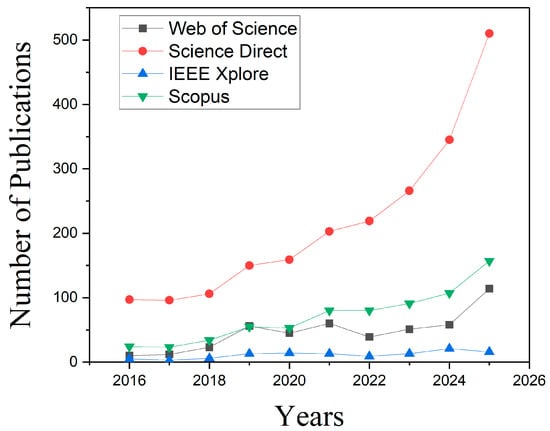
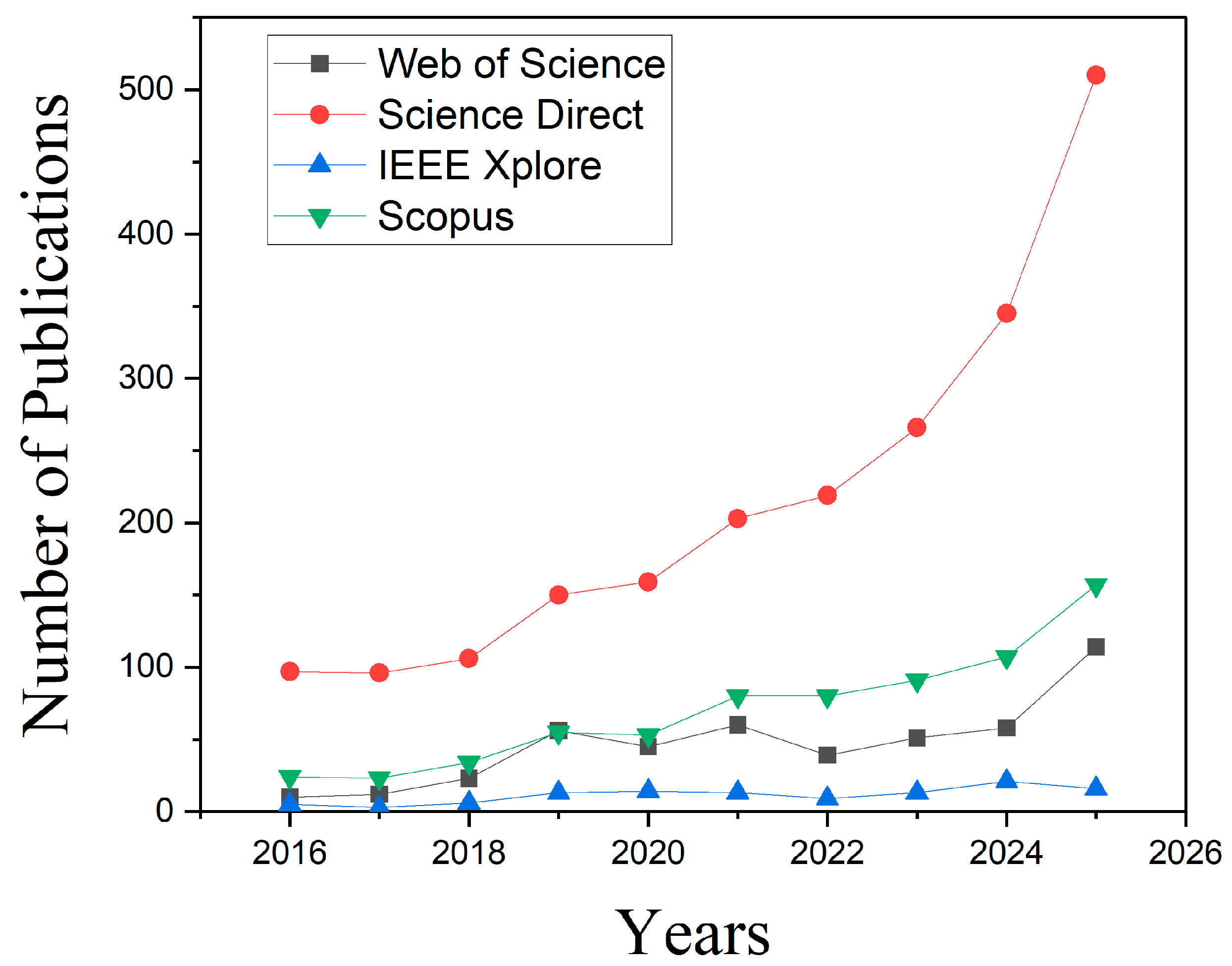
The most important keywords in this review are ‘coal mine,’ ‘fully mechanized mining face,’ ‘dust removal,’ and ‘dust suppression.’ To attempt a liberal and reproducible review, a systematic literature collection was conducted for coal mine dust removal research. The collected works span from 2016 to the present and consist exclusively of English-language literature. The following scientific index engines and search strategies were employed. The number of publications during 2016–2025 in four scientific index engines is shown in Figure 3.
Figure 3.
Number of publications during 2016–2025 in four scientific index engines.
(i) Web of Science: (“coal mine” OR “fully mechanized mining face” OR “mining”) (Topic)) and ((“dust removal” OR “control dust” OR “dust suppression”) (Topic)) AND (publication date: 2016–2025).
(ii) Science Direct: (“coal mine” OR “fully mechanized mining face” OR “mining”) AND (“dust removal” OR “control dust” OR “dust suppression”) AND (publication date: 2016–2025).
(iii) IEEE Xplore: (“Full Text & Metadata”: “coal mine” OR “Full Text & Metadata”: “fully mechanized mining face” OR “Full Text & Metadata”: “mining”) AND (“Full Text & Metadata”: “dust removal” OR “Full Text & Metadata”: “control dust” OR “Full Text & Metadata”: “dust suppression”) AND (publication date: 2016–2025).
(iv) Scopus: (TITLE-ABS-KEY (“coal mine” OR “fully mechanized mining face” OR “mining”) AND TITLE-ABS-KEY (“dust removal” OR “control dust” OR “dust suppression”)) AND (publication date: 2016–2025).
3. Law of Dust Movement
The movement law of coal mine dust is significant for dust control. Many scholars have simulated the diffusion law of coal mine dust using Fluent 12.0 software, and some simulation results have been compared with field measurements. Table 2 summarizes published studies on dust dispersion in coal mines. Mathematical models, dust types, and occasions in the papers are listed.
Table 2.
Summary of the papers on dust dispersion in the coal mine.
Hu et al. (2016) investigated the dispersion behavior of dust following tunnel blasting in coal mines [13]. Their results revealed that respirable particles exhibited alternating dense and dilute phases along the roadway, whereas coarser particles (diameter > 5 μm) tended to settle and accumulate near the floor. Although the initial respirable dust concentration slightly exceeded air quality standards, it rapidly declined to acceptable levels. In contrast, the total concentration of dust generally fell short of air quality standards.
Chen et al. (2018) examined the spatial distribution of airborne dust within the breathing zone along the walkway of a fully mechanized mining face with a 7 m extraction height [14]. They reported that dust generated during coal cutting and hydraulic support advancement accumulated on the leeward side of the shearer, forming a high-concentration belt approximately 36 m in length, with peak values exceeding 2850 mg/m3. Vertically, elevated concentrations were observed in the ranges of 0–1.55 m and 5.55–6.80 m, compared with the intermediate zone (1.55–5.55 m). Based on these findings, a novel dust control system was proposed, achieving an overall removal efficiency of 69.6%.
Similarly, Zhou et al. (2018) conducted numerical simulations to explore airflow–dust interactions beneath a dust extraction fan in a mechanized mining face [15]. The results indicated that during cutting operations, high-concentration dust plumes (>1000 mg/m3) formed within 0–20 m downwind of the shearer and propagated toward the working area along the walkway. To mitigate this issue, a hydraulic axial-flow dust removal fan was developed, reducing dust levels to below 500 mg/m3. Field validation demonstrated removal efficiencies of 66.5% for total dust and 61.8% for respirable dust.
Cai et al. (2018) investigated multi-source dust diffusion in a fully mechanized mining face and analyzed particle size distributions at different locations [16]. A high-concentration zone approximately 2 m in length formed in front of the roller, with peak concentrations reaching 3000 mg/m3. Additionally, a substantial proportion of coarse particles (>70 μm) settled within 40 m of the air outlet.
Zhang et al. (2018) examined the relationship between respirable dust transport and turbulent airflow [17]. At breathing height, respirable dust concentration was negatively correlated with inlet air velocity. As turbulence intensity increased, high-concentration regions gradually diminished; however, when the inlet velocity exceeded 2.5 m/s, the effectiveness of ventilation-based dust control weakened.
Hu et al. (2019) analyzed gas–particle two-phase flow around the road-header driver and observed that the highest dust concentrations recirculated from the rear of the operator position [18]. Similarly, Xiu et al. (2019) identified the location, extent, and intensity of high-concentration dust belts in mechanized mining faces and emphasized that dust dispersion patterns are closely associated with the advancement of hydraulic supports [19].
Moreover, Zhang et al. (2020) illustrated the movement law of dust during coal mining in the downwind and upwind directions of the fully mechanized mining face and optimized the spraying dust reduction device [20]. This improvement increased the total dust efficiency by about 52% and the respiratory dust efficiency by about 43%. In addition, Zhou et al. (2021) stated the law of dust diffusion in the fully mechanized working face under different air humidity conditions [21]. Dust concentration and dust diffusion distance are taken as two evaluation criteria. The simulation results show that increased humidity weakens the dust diffusion ability. Keeping the relative humidity of coal mines at 75~85% is recommended, which benefits miners’ health.
Taking into consideration the severe dust pollution in the 3401 fully mechanized working face of Xin ’an Coal Mine, Zhang et al. (2021) conducted numerical simulations to analyze the spatial distribution of dust concentration and particle sizes, providing theoretical guidance for precise and efficient spray dust removal on the working face [22]. A similar simulation was made by Lu et al. (2021) [23]. They elaborated on the transport of dust particles in the longwall mining face and identified safe areas. It was pointed out that the location and size of the secure areas in the XY and YZ planes are related to the wind speed. However, Song et al. (2021) determined dust dispersion and combined it with the gas spatial distribution to identify two critical areas for prevention and control [24]. Based on similar theory and numerical simulations, Jiang et al. (2021) studied the concentration distribution and diffusion characteristics of dust particles in a fully mechanized mining face with multiple dust sources, indicating that dust particles released from the upper source move upward while those released from the lower source move downward with the airflow [25]. Recently, Zhou et al. (2022) and Nie et al. (2022) found the dust migration law caused by ascensional/descensional ventilation in the fully mechanized coal mining faces and the large-scale mine, respectively, and proposed a new dust removal technology [1,3].
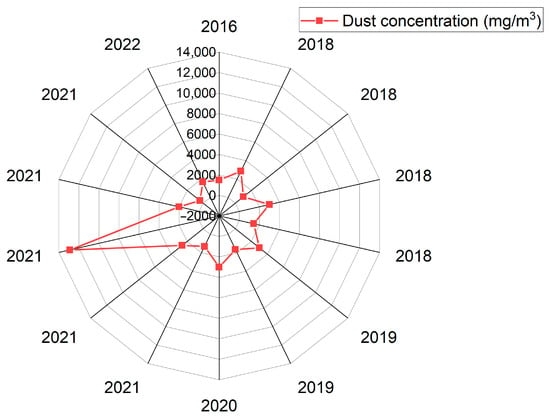
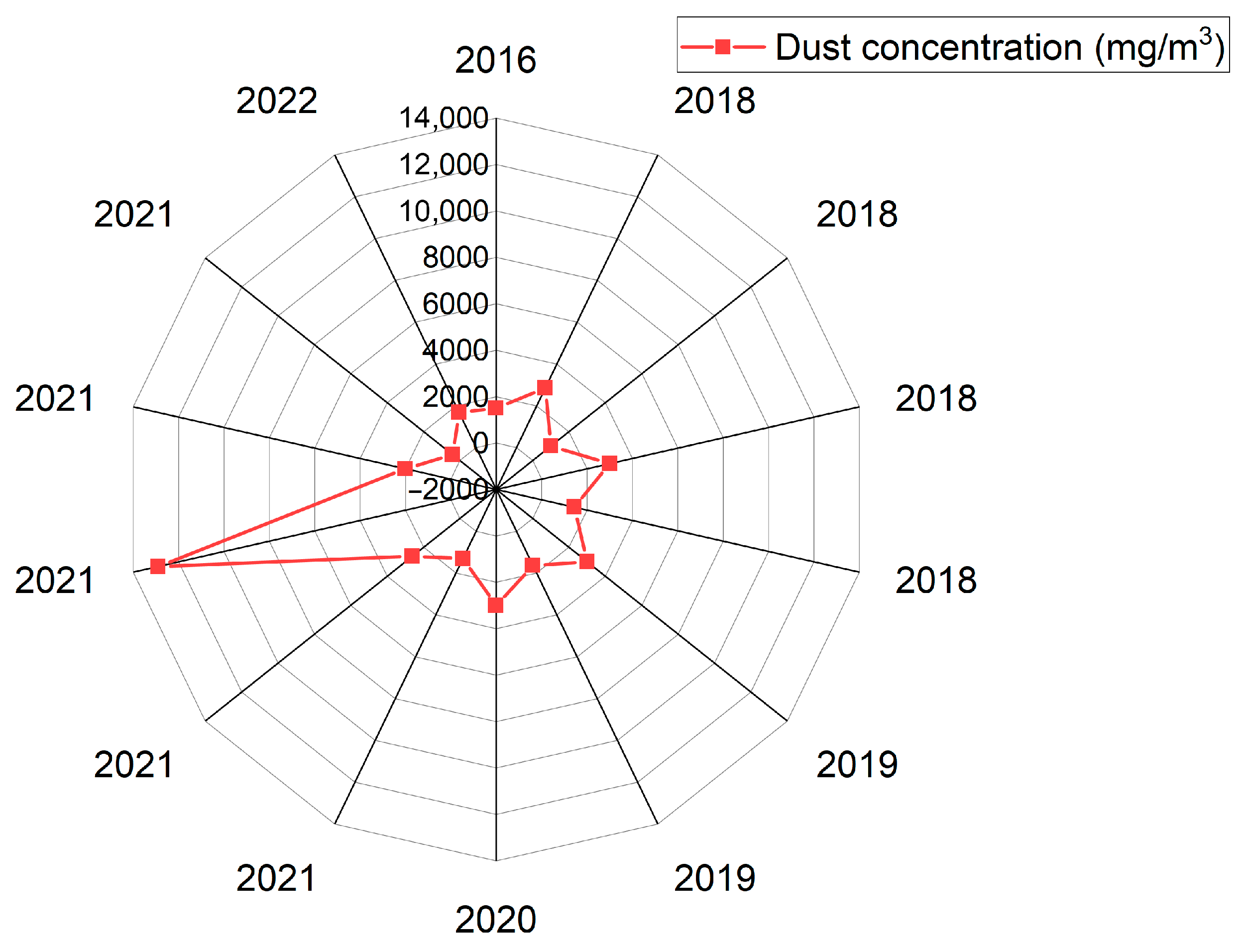
The above studies highlight that numerous publications have investigated coal mine dust diffusion under various mining conditions, with most dust concentrations around 2000 mg/m3, as shown in Figure 4. Most insights into dust movement have been derived from numerical simulations, often complemented by field measurements to ensure accuracy and reliability. Fluent software, together with the κ-ε and DPM mathematical models, is commonly used in these studies, although Zhou et al. (2022) employed the κ-ω model [1].
Figure 4.
Dust concentration distribution.
Research typically considers both total dust and respirable dust. Respirable dust is of primary concern for occupational health assessments, as its diffusion directly affects miners’ exposure risk, whereas total dust is mainly studied to understand transport and deposition processes in production environments. High dust concentrations are usually observed at fully mechanized mining faces, making them the most representative and suitable sites for simulation studies due to their complex airflow patterns and dust dynamics.
Overall, these studies demonstrate that coal mine dust movement is influenced by multiple factors, including airflow patterns, mining operations, and equipment layout. Numerical simulations have proven effective in identifying high-concentration dust zones, mapping dust transport pathways, and evaluating the performance of dust suppression technologies such as sprays, foam, and extraction fans. When combined with field measurements, these simulations have further enabled the optimization of dust control strategies, enhancing both total and respirable dust removal efficiencies.
Future research should focus on three main directions: (1) strengthening theoretical understanding and selecting more realistic mathematical models to improve simulation accuracy; (2) emphasizing respirable dust to better safeguard miners’ health; and (3) continuing to use fully mechanized mining faces as the primary research site, given their representativeness and complex dust dynamics.
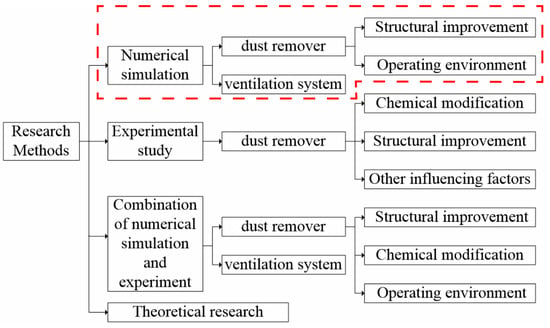
Existing dust removal techniques in coal mines include dust removers and ventilation systems. Figure 5 summarizes the improvement of dust removal technology based on a comprehensive literature review. Among them, the enhancement of dust removers mainly includes optimizing the structure, operating environment, and chemical modification. The content within the red box presents an analysis of existing dust removal methods based on numerical simulation. Due to the chemical modification of the dust remover being mainly studied by experiment, there are very few papers on chemical modification through numerical simulation alone, so this article will not discuss it. The main contents of the review include the improvement of the dust collector structure, the progress of the dust collector operating environment, and the optimization of the ventilation system.
Figure 5.
A summary of the improvement of dust removal technology.
4. Improve the Efficiency of Dust Removal by Numerical Simulation
Numerical simulation of coal mine dedusting uses computational methods to model airflow, dust dispersion, and the performance of dedusting equipment. It involves developing mathematical models, selecting numerical methods, defining boundary and initial conditions, and performing simulations to predict equipment effectiveness, optimizing dust control strategies, and analyzing dust diffusion characteristics. Key aspects include airflow simulation (velocity, direction, pressure), dust diffusion (concentration, particle size, transport paths), and equipment performance (filter resistance, nozzle design, placement). Fluent, a widely used CFD software ANSYS Fluent 2022 R1 by ANSYS Inc., Canonsburg, PA, USA, supports turbulence, multi-phase flow, chemical reactions, and fluid–structure interactions, providing pre- and post-processing tools for geometry setup, solution computation, and result visualization. Its validated reliability across engineering fields makes it a standard platform for modeling coal mine airflow, dust transport, and dedusting equipment, offering theoretical guidance and technical support for effective mine ventilation and dust control [26,27,28].
Dust removers and ventilation systems are commonly used in coal mine dust removal. The following summarizes the research status of the numerical simulation of coal mine dust removal from these two aspects.
4.1. Improvement of Coal Mine Dust Remover
Typically, the dust removal efficacy of a coal mine dust remover is enhanced in three ways: structural Improvement of the dust remover, chemical modification of the medium used for dust removal, and optimization of the operating environment. Compared to numerical simulation, chemical modification for increasing dust removal efficiency is typically performed via experimental methods. Therefore, the following summarizes the dust remover structure improvement and operating environment optimization.
4.1.1. Structural Improvement of Coal Mine Dust Remover
Numerous researchers have optimized the structure of the dust remover by numerical simulation. A summary of the papers on the structural improvement of the dust remover by numerical simulation is listed in Table 3. Chen et al. (2018) designed wet dust-collecting nets applied to a 7 m fully mechanized mining face with 69.6% dust removal efficiency [14]. Liu et al. (2019), Xu et al. (2019), and Xu et al. (2020) simulated three nozzle diameters (1.6 mm, 2.0 mm, 2.4 mm) [29,30,31]. They determined that the nozzle diameters of 2.4 mm provided the most significant dust suppression effect, as well as suction apertures located on both sides of the ejector roller were more efficient. Peng et al. (2020) and Peng et al. (2022) instituted external spray negative pressure mist curtain dust suppression devices and negative pressure jet dust removal water curtain technology [32,33]. At the same time, nozzle installation position, conical cover angle, conical cover length, nozzle type, and the distance between the nozzle opening and the air suction port were optimized, respectively. Arya et al. (2020) proposed a flooded-bed dust scrubber system with a 66.5% dust removal efficacy [34]. Zhang et al. (2020) optimized the opening mode of hydraulic support spraying, significantly improving the total dust and respirable dust removal efficiency [20].
Table 3.
Summary of the papers on the structural improvement of the dust remover by numerical simulation.
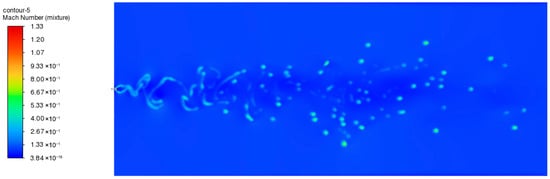
In summary, numerical simulations have been widely used to optimize the structure of coal mine dust removers. Studies show that parameters such as nozzle diameter, installation position, spray angle, and suction aperture placement significantly affect dust removal efficiency. For instance, a nozzle diameter of 2.4 mm and dual-side suction apertures enhanced dust suppression, while wet dust-collecting nets, negative-pressure mist curtains, and optimized hydraulic support spraying further improved both total and respirable dust removal. When the inlet pressure reaches 0.1 MPa, the internal airflow of the Laval nozzle can reach sonic velocity, as shown in Figure 6. This will be an important direction for future research. These findings indicate that careful structural design guided by numerical simulation is essential for efficient, targeted dust control, providing theoretical guidance and practical strategies for fully mechanized mining operations.
Figure 6.
Flow field distribution of the Laval nozzle.
4.1.2. Optimization of the Operating Environment of Coal Mine Dust Remover
Simulation of the coal mine dust control operating environment is mainly utilized to optimize spraying pressure. A summary of the papers on the optimization of the operating environment of the dust remover by numerical simulation is listed in Table 4. Liu et al. (2019) optimized the sprinkling pressure of an external spraying system to achieve a spraying pressure of 5 MPa, which provided the most effective dust suppression [29]. The distribution of droplet sizes in the formed spray field when a nozzle with an orifice diameter of 2.4 mm was used under a spraying pressure of 1–5.5 MPa. On the other hand, Xu et al. (2020) and Peng et al. (2022) proposed a spray dust-settling device and negative pressure jet dust-removal water curtain technology, respectively, and the conclusion was that 6 MPa had excellent atomization and dust suppression efficacy [31,33]. However, Xu et al. (2019) put forward that the dust suppression effect was evident when the spraying pressure reached 8 MPa [30]. Similarly, Shi et al. (2019) simulated coalbed water infection and concluded that an injection pressure of 8 MPa was generally acceptable, along with other optimized parameters; the injection duration was 10 h, the diameter of the boreholes was 80 mm, and the porosity was 4% [35]. Considering air humidity conditions in the fully mechanized mining face, Zhou et al. (2021) pointed out that the optimal relative humidity was between 75% and 85% [21].
Table 4.
Summary of the papers on optimization of the operating environment of the dust remover by numerical simulation.
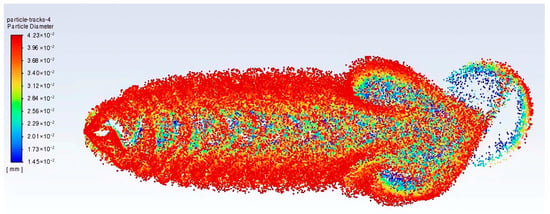
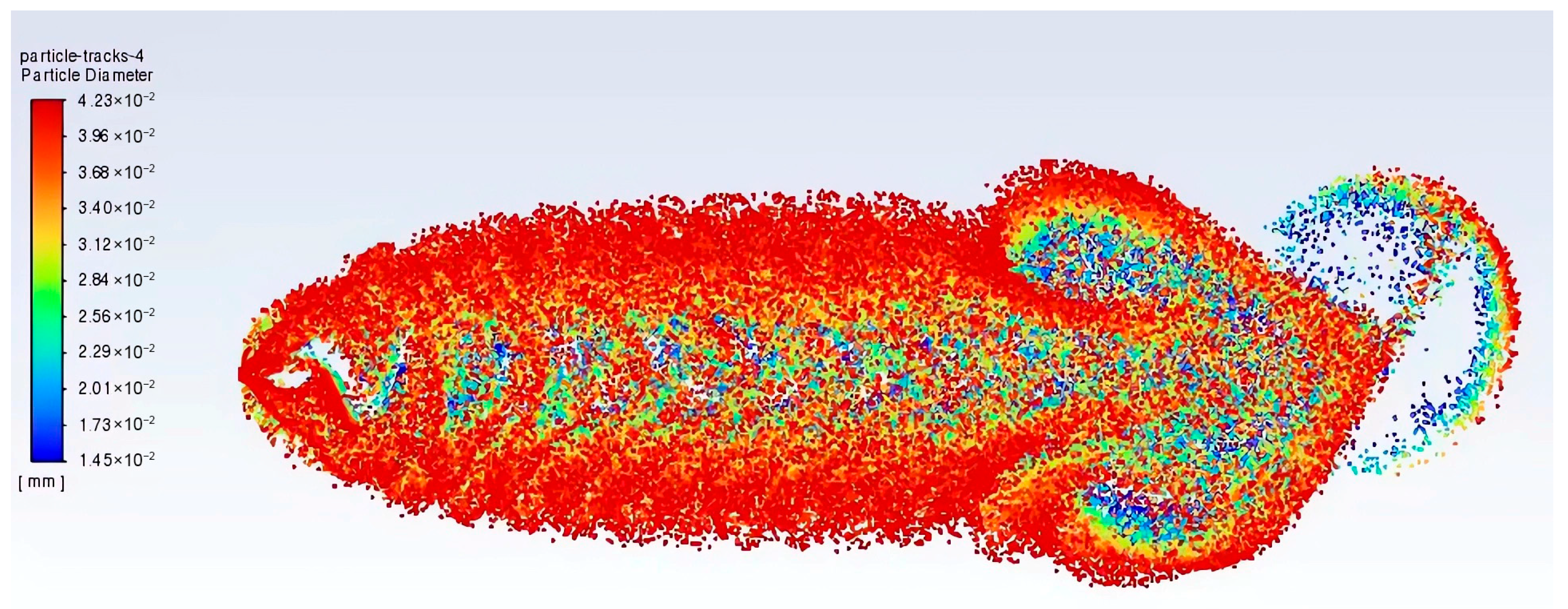
Numerical simulations have shown that optimizing operating parameters, particularly spraying pressure, is crucial for effective dust suppression. Pressures between 5 and 8 MPa generally provide optimal atomization and dust removal, while additional factors such as injection duration and air humidity (75–85%) further influence performance. Recent studies indicate that dual-phase (air–liquid) nozzles can achieve efficient dust suppression at lower spraying pressures, providing energy savings and enhanced operational safety, shown in Figure 7 [36,37,38]. Precise adjustment of these parameters remains essential for reliable and effective dust control in fully mechanized coal mining operations.
Figure 7.
Droplet size distribution of the air–liquid two-phase nozzle at a water pressure of 0.1 MPa.
4.2. Optimization of the Ventilation System
Due to the difficulty of constructing an experimental platform for ventilation systems, numerical simulation is frequently used to study the effect of ventilation systems on dust removal efficacy. The accuracy of numerical simulation can be verified through field measurements. Field measurement is not considered an experiment in this paper. Numerous academicians have extensively researched ventilation systems, including Hua Yun, Nie Wen, Yin Shuai, Liu Qiang, and Geng Fan. A summary of the papers on the optimization of a ventilation system is listed in Table 5.
Hua et al. (2018, 2020) investigated various ventilation strategies, including blower ventilation, long-compression short-suction (LCSS) ventilation, far-pressing-near-absorption (FPNA) ventilation, a multi-radial-vortex-based ventilation system, and a dust-control wind curtain system [39,40,41,42]. Their studies focused on optimizing both the structural layout and airflow parameters of these systems. Structurally, in blower and LCSS ventilation, dust was effectively confined upstream of the driver when the distance between the compressed airflow outlet and the heading end (Lp) exceeded 30 m. For FPNA ventilation, the optimal distance between the generator of multi-radial rotating flow and the tunneling face (LG) was 20 m, whereas the ideal dust-extraction position (ds) in the wind curtain system was 1. Regarding airflow optimization, the recommended pressurized air volume (QP) for FPNA ventilation ranged from 230 to 400 m3/min. In the multi-radial-vortex system, an inflow-to-outflow ratio of 0.75 proved most effective, while the suggested air exhaust rate for the wind curtain system was 330 m3/min.
Geng et al. (2018, 2019) investigated hybrid ventilation and air curtain systems, focusing on the effects of gas velocity, exhaust duct length, and the presence of an air curtain on particulate control [43,44]. Their results indicate that air velocity must be sufficiently high, the vent should be positioned close to the mining site, and the air curtain can effectively reduce spatiotemporal dust concentrations.
Similarly, Yin et al. (2019, 2020) studied air curtain systems with an emphasis on structural optimization [45,46]. Key parameters included the distance between the cutting face and the air-curtain generator (Le), the distance between the forced air opening and the cutting face (LY), the height of the forced air cylinder above the floor (LH), and the distance from the cylinder center to the nearest coal wall (LJ).
Liu et al. (2019) further examined air curtain performance, evaluating the influence of airflow on dust suppression, including the axial-to-radial pressure airflow rate ratio of the air curtain generator (Ra/r) and the exhaust airflow rate of the dust removal fan (Re/p) [47,48]. In the same study, a long-duct forced and short-duct exhaust ventilation system was analyzed, identifying an optimal distance of 35 m between the pressure ventilation outlet and the tunnel face.
More recently, Nie et al. (2022, 2023) investigated FPNA mixed-mode ventilation and airborne air-curtain dust control technologies, analyzing airflow effects, particularly air-absorption volumes (Qe) and other ventilation parameters [49,50].
Other studies have also examined ventilation systems. Zhang et al. (2021) investigated a novel onboard air-curtain dust control method and the effects of turbulent airflow generated by coal cutting (TACC) on dust concentration in the shearer operator’s working area, as well as the contamination characteristics of coal dust [51,52]. Wang et al. (2021) further proposed structural and airflow optimizations for air curtain systems, including adjustments to the forced-air volume and suction region [53]. They found that setting the forced-air volume to 350 m3/min and positioning the suction area near the side wall opposite the forced-air duct minimized the diffusion distance of high-concentration dust. Additionally, Cai et al. (2019) and Xiu et al. (2020) investigated optimal airflow rates in mining ventilation systems, reporting recommended values of 2600 m3/min and 1500–2000 m3/min, respectively [54,55].
Similarly, Mo and Ma (2022) optimized wind speed in a mine ventilation system [56]. In a study analogous to Hua et al. (2018), Cai et al. (2021) examined a far-pressing-near-absorption (FPNA) ventilation system, considering not only the pressurized air volume (Qy) but also the exhaust airflow (Qc) and the height of the pressure duct above the tunnel floor (Dy) [30,57]. Optimal dust suppression was achieved when Qc was 550 m3/min, and Dy was 2 m. Finally, Gao et al. (2021) and Wu et al. (2021) investigated swirling ventilation systems, including wall-mounted swirling ventilation and dual-radial swirl shielding ventilation [58,59]. The optimal blowing-to-suction flow ratios were 0.8 and 1.5, respectively.
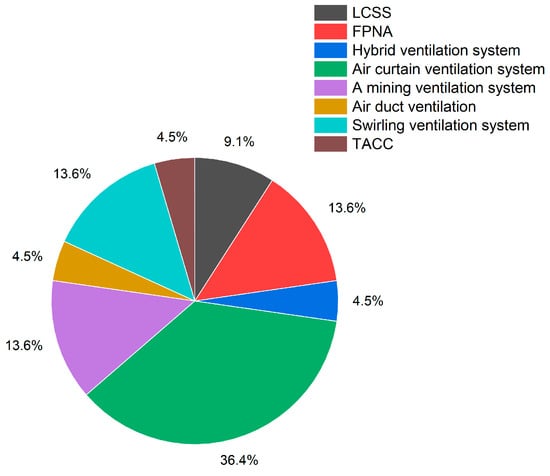
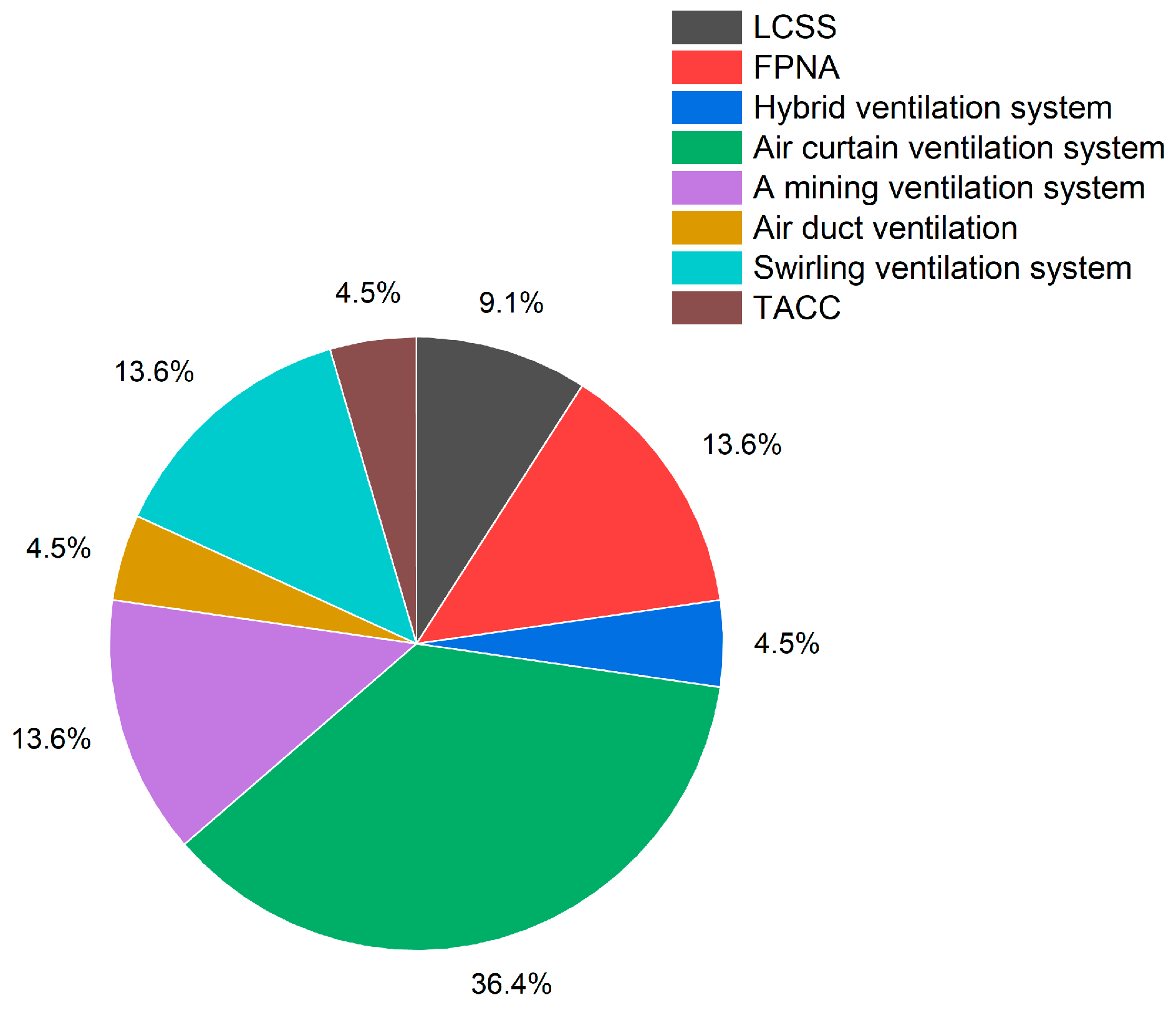
Numerical simulations have been widely applied to optimize coal mine ventilation systems, focusing on both structural configurations and airflow parameters. Key factors include airflow rate, wind speed, blowing-to-suction ratios, and the positioning and height of ventilation components. Optimized ventilation modes, such as air curtains, hybrid systems, and swirling ventilation. The air curtain ventilation system is widely applied, as shown in Figure 8. It forms a localized high-speed airflow barrier, which can efficiently, flexibly, and energy-efficiently reduce dust concentrations in the working area. However, simulation outcomes are often site-specific, as geological conditions, roadway geometry, and operational parameters vary significantly among mines. Therefore, field verification remains essential to ensure reliability. Future research should aim to develop more generalized modeling frameworks to improve the generalizability and transferability of simulation results across different mining conditions.
Figure 8.
Proportion of different ventilation systems.
Table 5.
Summary of the papers on the optimization of the ventilation system by numerical simulation.
5. Discussion
Dust control in coal mines remains a significant challenge due to the complexity and variability of mining conditions. Numerical simulation has become a critical tool for investigating and optimizing dedusting strategies. Previous research demonstrates that numerical simulations provide valuable insights into three main aspects: structural optimization of dust removal devices, operating environment parameters of dust removal devices, and ventilation system design.
Structural optimization primarily targets the nozzle, focusing on geometry, diameter, installation position, and spacing. Most studies, however, explore only a limited range of parameters, restricting comprehensive investigation of the full design space. This limitation may prevent the identification of superior configurations. Numerical simulations overcome these constraints by enabling broader parameter exploration, reducing experimental costs and time, and generating more precise and systematic optimization results.
The operating environment, particularly pressure optimization, demonstrates similar constraints. Reported optimal pressures range from 5 MPa to 8 MPa across different studies, highlighting the strong site-dependence of the results and their limited generalizability. This variability emphasizes the necessity of multi-site validation and context-specific calibration when implementing simulation-based optimization strategies.
Due to the difficulty of constructing experimental platforms for ventilation systems, their optimization is primarily conducted through numerical simulations combined with field measurements. Optimization efforts generally focus on both airflow and structural parameters. Airflow-related variables include airflow rate, wind speed, and blowing-to-suction ratios, while structural parameters involve the location, spacing, and height of ventilation components. However, the applicability of simulation results remains limited, as optimal values for the same parameters often vary under different coal mine conditions. Moreover, experimental validation of ventilation system simulations is challenging, making field measurements essential to ensure reliability and practical applicability.
With the advancement of molecular dynamics, studies relying solely on numerical simulations to investigate the chemical modification of dust removal devices are expected to become increasingly prevalent, further expanding the scope and precision of dust control research [10,61,62,63].
6. Conclusions
This review summarizes the application of numerical simulation methods in coal mine dust control, emphasizing structural optimization of dust removal devices, operating condition optimization of dust removal devices, and ventilation system design. Key findings include:
Structural optimization: Nozzle design—including geometry, diameter, position, and spacing—plays a central role in dust removal efficiency. Numerical simulations enable broader exploration of parameter space, overcoming the limitations of small-scale experimental studies.
Operating environment: Pressure parameters play a crucial role in dust removal performance. However, existing studies often examine limited pressure ranges, and the reported optimal values vary significantly across different mining conditions.
Ventilation systems: Airflow and structural parameters are essential for controlling dust concentration and distribution. However, optimization outcomes are strongly dependent on mine-specific conditions and require field measurements to ensure reliability.
Future research should focus on developing unified, scalable, and physics-informed simulation frameworks that enhance the generalizability and transferability of results across diverse mining environments. Integration of advanced computational modeling with multi-site validation will facilitate the design of robust dust control systems, ultimately improving both occupational safety and operational efficiency in coal mining operations.
Author Contributions
Conceptualization, S.T. and A.R.H.R.; methodology, M.D.I.; software, W.Z.; validation, S.T., M.D.I. and A.R.H.R.; formal analysis, C.W.; investigation, M.D.I.; resources, S.T.; data curation, S.T.; writing—original draft preparation, S.T.; writing—review and editing, C.W.; visualization, A.R.H.R.; supervision, M.D.I.; project administration, M.D.I.; funding acquisition, S.T. All authors have read and agreed to the published version of the manuscript.
Funding
This research was funded by the Key Project of the Anhui Natural Science Foundation, 2024AH050525 and the Key Project of the Anhui Natural Science Foundation, 2023AH051703 and the Key Project of the Anhui Natural Science Foundation, 2025AHGXZK30378.
Data Availability Statement
These data were derived from the following resources available in the public domain: https://www.webofscience.com/wos/woscc/advanced-search, accessed on 1 March 2026; https://ieeexplore.ieee.org/search/advanced, accessed on 1 March 2026; https://www.sciencedirect.com/search/entry, accessed on 1 March 2026; https://www.scopus.com/home.uri?zone=header&origin=sbrowse, accessed on 1 March 2026.
Conflicts of Interest
Author Chaokun Wei was employed by the company Chery Automobile Corporation. Author Wei Zhang was employed by the company Dongguan Mistec Spraying Technology Co., Ltd. The remaining authors declare that the research was conducted in the absence of any commercial or financial relationships that could be construed as a potential conflict of interest.
References
- Zhou, G.; Liu, Y.; Kong, Y.; Hu, Y.; Song, R.; Tian, Y.; Jia, X.; Sun, B. Numerical analysis of dust pollution evolution law caused by ascensional/descensional ventilation in fully mechanized coal mining face based on DPM-DEM model. J. Environ. Chem. Eng. 2022, 10, 107732. [Google Scholar] [CrossRef] [Scilit]
- Yang, Y.; Huang, F.; Kang, S. Mechanism of penetration rate improvement in hot dry rock under the coupling of impact load and confining pressure release. Reserv. Sci. 2026, 2, 52–64. [Google Scholar] [CrossRef] [Scilit]
- Nie, W.; Yang, B.; Du, T.; Peng, H.; Zhang, X.; Zhang, Y. Dynamic dispersion and high-rise release of coal dust in the working surface of a large-scale mine and application of a new wet dust reduction technology. J. Clean. Prod. 2022, 351, 131356. [Google Scholar] [CrossRef] [Scilit]
- Zhang, Q.; Fan, L.; Wang, H.; Han, H.; Zhu, Z.; Zhao, X.; Wang, Y. A review of physical and chemical methods to improve the performance of water for dust reduction. Process Saf. Environ. 2022, 166, 86–98. [Google Scholar] [CrossRef] [Scilit]
- Zhang, H.; Han, W.; Xu, Y.; Wang, Z. Analysis on the Development Status of Coal Mine Dust Disaster Prevention Technology in China. J. Healthc. Eng. 2021, 2021, 5574579. [Google Scholar] [CrossRef] [Scilit]
- Xu, G.; Chen, Y.; Eksteen, J.; Xu, J. Surfactant-aided coal dust suppression: A review of evaluation methods and influencing factors. Sci. Total Environ. 2018, 639, 1060–1076. [Google Scholar] [CrossRef] [Scilit] [PubMed]
- Li, S.; Zhao, B.; Lin, H.; Shuang, H.; Kong, X.; Yang, E. Review and prospects of surfactant-enhanced spray dust suppression: Mechanisms and effectiveness. Process Saf. Environ. 2021, 154, 410–424. [Google Scholar] [CrossRef] [Scilit]
- Liu, G.; Xu, Q.; Zhao, J.; Nie, W.; Guo, Q.; Ma, G. Research Status of Pathogenesis of Pneumoconiosis and Dust Control Technology in Mine—A Review. Appl. Sci. 2021, 11, 10313. [Google Scholar] [CrossRef] [Scilit]
- Zhou, Q.; Qin, B. Coal dust suppression based on water mediums: A review of technologies and influencing factors. Fuel 2021, 302, 121196. [Google Scholar] [CrossRef] [Scilit]
- Ding, X.; Xu, Q.; Wang, K.; Luo, Z.; Wei, T.; Wang, T.; Wang, J.; Fu, Q.; Wang, T. Numerical and molecular dynamics simulation on the wetting-coating-aggregating behaviors of biomass and betaine-based surfactants in suppression coal dust pollution. J. Clean. Prod. 2025, 525, 146646. [Google Scholar] [CrossRef] [Scilit]
- Wang, X.; Wang, P.; Li, S.; Chen, S. Development and application of air-assisted spraying device for dust suppression on tunnel boring machine. Tunn. Undergr. Space Technol. 2025, 159, 106469. [Google Scholar] [CrossRef] [Scilit]
- Wang, J.; Du, J.; Jin, K.; Yang, T.; Zhou, W.; Zhu, X.; Wang, H.; Zhang, K. Research on the cumulative dust suppression effect of foam and dust extraction fan at continuous miner driving face. Atmosphere 2025, 16, 1290. [Google Scholar] [CrossRef] [Scilit]
- Hu, S.; Feng, G.; Ren, X.; Xu, G.; Chang, P.; Wang, Z.; Zhang, Y.; Li, Z.; Gao, Q. Numerical study of gas–solid two-phase flow in a coal roadway after blasting. Adv. Powder Technol. 2016, 27, 1607–1617. [Google Scholar] [CrossRef] [Scilit]
- Chen, D.; Nie, W.; Cai, P.; Liu, Z. The diffusion of dust in a fully-mechanized mining face with a mining height of 7 m and the application of wet dust-collecting nets. J. Clean. Prod. 2018, 205, 463–476. [Google Scholar] [CrossRef] [Scilit]
- Zhou, G.; Feng, B.; Yin, W.; Wang, J. Numerical simulations on airflow-dust diffusion rules with the use of coal cutter dust removal fans and related engineering applications in a fully-mechanized coal mining face. Powder Rev. Prospect. 2018, 339, 354–367. [Google Scholar] [CrossRef] [Scilit]
- Cai, P.; Nie, W.; Hua, Y.; Wei, W.; Jin, H. Diffusion and pollution of multi-source dusts in a fully mechanized coal face. Process Saf. Environ. 2018, 118, 93–105. [Google Scholar] [CrossRef] [Scilit]
- Zhang, Q.; Zhou, G.; Qian, X.; Yuan, M.; Sun, Y.; Wang, D. Diffuse pollution characteristics of respirable dust in fully-mechanized mining face under various velocities based on CFD investigation. J. Clean. Prod. 2018, 184, 239–250. [Google Scholar] [CrossRef] [Scilit]
- Hu, S.; Liao, Q.; Feng, G.; Huang, Y.; Shao, H.; Fan, Y.; Ye, Y. Numerical study of gas-solid two-phase flow around road-header drivers in a fully mechanized excavation face. Powder Technol. 2019, 344, 959–969. [Google Scholar] [CrossRef] [Scilit]
- Xiu, Z.; Nie, W.; Chen, D.; Yan, J.; Cai, P.; Liu, Q.; Wei, C. Numerical simulation study on the coupling mechanism of composite-source airflow–dust field in a fully mechanized caving face. Powder Technol. 2019, 356, 443–457. [Google Scholar] [CrossRef] [Scilit]
- Zhang, G.; Zhou, G.; Song, S.; Zhang, L.; Sun, B. CFD investigation on dust dispersion pollution of down/upwind coal cutting and relevant countermeasures for spraying dustfall in fully mechanized mining face. Adv. Powder Technol. 2020, 31, 3177–3190. [Google Scholar] [CrossRef] [Scilit]
- Zhou, G.; Zhang, L.; Liu, R.; Sun, B.; Kong, Y.; Huang, Z. Numerical simulation investigation for the pollution characteristics of dust particles in the fully mechanized mining face under different air humidity conditions. J. Environ. Chem. Eng. 2021, 9, 106861. [Google Scholar] [CrossRef] [Scilit]
- Zhang, L.; Zhou, G.; Ma, Y.; Jing, B.; Sun, B.; Han, F.; He, M.; Chen, X. Numerical analysis on spatial distribution for concentration and particle size of particulate pollutants in dust environment at fully mechanized coal mining face. Powder Technol. 2021, 383, 143–158. [Google Scholar] [CrossRef] [Scilit]
- Lu, X.; Wang, C.; Xing, Y.; Shen, C.; Shi, G. Investigation on the dust migration behavior and safety zone in the fully mechanized mining face. Environ. Sci. Pollut. Res. 2021, 28, 20375–20392. [Google Scholar] [CrossRef] [Scilit] [PubMed]
- Song, S.; Zhou, G.; Duan, J.; Meng, Q.; Sun, B.; Wang, Y. CFD simulation of multi-phase and multi-component diffusion of air-dust-gas in a fully mechanized mining face. Environ. Sci. Pollut. Res. 2021, 28, 18260–18275. [Google Scholar] [CrossRef] [Scilit]
- Jiang, W.; Xu, X.; Wen, Z.; Wei, L. Applying the similarity theory to model dust dispersion during coal-mine tunneling. Process Saf. Environ. 2021, 148, 415–427. [Google Scholar] [CrossRef] [Scilit]
- Xin, S.; Han, X.; Sun, Q.; Li, M.; Wu, Y.; Zhang, Z.; Yang, W. Numerical studies on the effects of the hybrid cooling and dust suppression solution in hot fully-mechanized mining face. Int. J. Refrig. 2024, 166, 73–83. [Google Scholar] [CrossRef] [Scilit]
- Nguyen, Q.; Nguyen, T.; Nguyen, P. Study on the Influence of Some Ventilation Parameters on Dust Dispersion in Heading Face Coal Mine Using CFD Numerical Model. Appl. Sci. 2024, 14, 5643. [Google Scholar] [CrossRef] [Scilit]
- Li, S.; She, X.; Nan, S.; Jin, H.; Geng, F.; Ding, J.; Ren, B.; Zhou, G.; Ouyang, M.; Wei, Y.; et al. Research on the characteristics of coal dust explosion in mine cartridge filter based on numerical simulation. Adv. Powder Technol. 2025, 36, 105015. [Google Scholar] [CrossRef] [Scilit]
- Liu, Z.; Nie, W.; Peng, H.; Yang, S.; Chen, D.; Liu, Q. The effects of the spraying pressure and nozzle orifice diameter on the atomizing rules and dust suppression performances of an external spraying system in a fully-mechanized excavation face. Powder Technol. 2019, 350, 62–80. [Google Scholar] [CrossRef] [Scilit]
- Xu, C.; Nie, W.; Liu, Z.; Peng, H.; Yang, S.; Liu, Q. Multi-factor numerical simulation study on spray dust suppression device in coal mining process. Energy 2019, 182, 544–558. [Google Scholar] [CrossRef] [Scilit]
- Xu, C.; Nie, W.; Yang, S.; Peng, H.; Liu, Z.; Ma, Q.; Guo, C.; Liu, Q. Numerical simulation of the multi-index orthogonal experiments on the spray dust-settling devices. Powder Technol. 2020, 371, 217–230. [Google Scholar] [CrossRef] [Scilit]
- Peng, H.; Nie, W.; Liu, Z.; Xiu, Z.; Yang, S.; Xu, C.; Ma, Q.; Guo, C. Optimization of external spray negative-pressure mist-curtain dust suppression devices for roadheaders based on a multi-factor orthogonal experiment. J. Clean. Prod. 2020, 275, 123603. [Google Scholar] [CrossRef] [Scilit]
- Peng, H.; Nie, W.; Zhang, S.; Cheng, W.; Liu, Q.; Guo, C.; Ma, Q.; Zhou, Z.; Xu, C.; Hua, Y.; et al. Research on negative pressure jet dust-removal water curtain technology for coal mine cleaner production. Fuel 2022, 310, 122378. [Google Scholar] [CrossRef] [Scilit]
- Arya, S.; Sottile, J.; Novak, T. Numerical Modeling of a Flooded-Bed Dust Scrubber Integrated into a Longwall Shearer. Mining Metall. Explor. 2020, 37, 1105–1119. [Google Scholar] [CrossRef] [Scilit]
- Shi, Y.; Wang, P.; Liu, R.; Tan, X.; Zhang, W. Numerical Simulation and Engineering Application of Coalbed Water Injection. Math. Probl. Eng. 2019, 2019, 6309160. [Google Scholar] [CrossRef] [Scilit]
- Tang, S.; Ibrahim, M.D.; Rigit, A.R.H.; Zhang, W.; Wei, C. A systematic review of coal mine dust suppression methods based on numerical simulations and experimental investigations. Int. J. Eng. Technol. Innov. 2025, 15, 237–253. [Google Scholar] [CrossRef] [Scilit]
- Tang, S.; Ibrahim, M.D.; Rigit, A.R.H.; Zhang, W.; Wei, C. Analysis of atomization performance of linear Laval nozzle under varied water pressures based on VOF and DPM Models. Int. J. Eng. Technol. Innov. 2024, 14, 335–354. [Google Scholar] [CrossRef] [Scilit]
- Tang, S.; Ibrahim, M.D.; Rigit, A.R.H.; Zhang, W.; Wei, C. Experimental analysis of the effect of water pressure on the atomization performance of a Linear Laval nozzle and comparison with numerical analysis. Materia 2024, 29, e20240460. [Google Scholar] [CrossRef] [Scilit]
- Hua, Y.; Nie, W.; Cai, P.; Liu, Y.; Peng, H.; Liu, Q. Pattern characterization concerning spatial and temporal evolution of dust pollution associated with two typical ventilation methods at fully mechanized excavation faces in rock tunnels. Powder Technol. 2018, 334, 117–131. [Google Scholar] [CrossRef] [Scilit]
- Hua, Y.; Nie, W.; Wei, W.; Liu, Q.; Liu, Y.; Peng, H. Research on multi-radial swirling flow for optimal control of dust dispersion and pollution at a fully mechanized tunnelling face. Tunn. Undergr. Space Technol. 2018, 79, 293–303. [Google Scholar] [CrossRef] [Scilit]
- Hua, Y.; Nie, W.; Liu, Q.; Peng, H.; Wei, W.; Cai, P. The development and application of a novel multi-radial-vortex-based ventilation system for dust removal in a fully mechanized tunnelling face. Tunn. Undergr. Space Technol. 2020, 98, 103253. [Google Scholar] [CrossRef] [Scilit]
- Hua, Y.; Nie, W.; Liu, Q.; Yin, S.; Peng, H. Effect of wind curtain on dust extraction in rock tunnel working face: CFD and field measurement analysis. Energy 2020, 197, 117214. [Google Scholar] [CrossRef] [Scilit]
- Geng, F.; Luo, G.; Wang, Y.; Peng, Z.; Hu, S.; Zhang, T.; Chai, H. Dust dispersion in a coal roadway driven by a hybrid ventilation system: A numerical study. Process Saf. Environ. 2018, 113, 388–400. [Google Scholar] [CrossRef] [Scilit]
- Geng, F.; Gui, C.; Wang, Y.; Zhou, F.; Hu, S.; Luo, G. Dust distribution and control in a coal roadway driven by an air curtain system: A numerical study. Process Saf. Environ. 2019, 121, 32–42. [Google Scholar] [CrossRef] [Scilit]
- Yin, S.; Nie, W.; Liu, Q.; Hua, Y. Transient CFD modelling of space-time evolution of dust pollutants and air-curtain generator position during tunneling. J. Clean. Prod. 2019, 239, 117924. [Google Scholar] [CrossRef] [Scilit]
- Yin, S.; Nie, W.; Guo, L.; Liu, Q.; Hua, Y.; Cai, X.; Cheng, L.; Yang, B.; Zhou, W. CFD simulations of air curtain dust removal effect by ventilation parameters during tunneling. Adv. Powder Technol. 2020, 31, 2456–2468. [Google Scholar] [CrossRef] [Scilit]
- Liu, Q.; Nie, W.; Hua, Y.; Peng, H.; Liu, C.; Wei, C. Research on tunnel ventilation systems: Dust Diffusion and Pollution Behaviour by air curtains based on CFD technology and field measurement. Build. Environ. 2019, 147, 444–460. [Google Scholar] [CrossRef] [Scilit]
- Liu, Q.; Nie, W.; Hua, Y.; Peng, H.; Ma, H.; Yin, S.; Guo, L. Long-duct forced and short-duct exhaust ventilation system in tunnels: Formation and dust control analysis of pressure ventilation air curtain. Process Saf. Environ. 2019, 132, 367–377. [Google Scholar] [CrossRef] [Scilit]
- Nie, W.; Cai, X.; Peng, H.; Ma, Q.; Liu, Q.; Hua, Y.; Guo, L.; Cheng, L.; Sun, N.; Bao, Q. Distribution characteristics of an airflow–dust mixture and quantitative analysis of the dust absorption effect during tunnel sub-regional coal cutting. Process Saf. Environ. 2022, 164, 319–334. [Google Scholar] [CrossRef] [Scilit]
- Nie, W.; Zhang, Y.; Guo, L.; Zhang, X.; Peng, H.; Chen, D. Research on airborne air curtain dust control technology and air volume optimization. Process Saf. Environ. 2023, 172, 113–123. [Google Scholar] [CrossRef] [Scilit]
- Zhang, X.; Nie, W.; Peng, H.; Chen, D.; Du, T.; Yang, B.; Niu, W. Onboard air curtain dust removal method for longwall mining: Environmental pollution prevention. J. Environ. Chem. Eng. 2021, 9, 106387. [Google Scholar] [CrossRef] [Scilit]
- Zhang, G.; Sun, B.; Song, S.; Wang, H.; Zhou, G. CFD comparative analysis on the pollution characteristics of coal dust under turbulent airflow from coal cutting in the fully mechanized mining face. Process Saf. Environ. 2021, 146, 515–530. [Google Scholar] [CrossRef] [Scilit]
- Wang, H.; Sa, Z.; Cheng, W.; Zhang, R.; Yang, S. Effects of forced-air volume and suction region on the migration and dust suppression of air curtain during fully mechanized tunneling process. Process Saf. Environ. 2021, 145, 222–235. [Google Scholar] [CrossRef] [Scilit]
- Cai, P.; Nie, W.; Chen, D.; Yang, S.; Liu, Z. Effect of air flowrate on pollutant dispersion pattern of coal dust particles at fully mechanized mining face based on numerical simulation. Fuel 2019, 239, 623–635. [Google Scholar] [CrossRef] [Scilit]
- Xiu, Z.; Nie, W.; Yan, J.; Chen, D.; Cai, P.; Liu, Q.; Du, T.; Yang, B. Numerical simulation study on dust pollution characteristics and optimal dust control air flow rates during coal mine production. J. Clean. Prod. 2020, 248, 119197. [Google Scholar] [CrossRef] [Scilit]
- Mo, J.; Ma, W. Research on the numerical simulation of the dust pollution characteristics and the optimal dust suppression wind-speed on fully mechanised caving face. Energ. Explor. Exploit. 2022, 40, 800–815. [Google Scholar] [CrossRef] [Scilit]
- Cai, X.; Nie, W.; Yin, S.; Liu, Q.; Hua, Y.; Guo, L.; Cheng, L.; Ma, Q. An assessment of the dust suppression performance of a hybrid ventilation system during the tunnel excavation process: Numerical simulation. Process Saf. Environ. 2021, 152, 304–317. [Google Scholar] [CrossRef] [Scilit]
- Gao, R.; Wang, P.; Li, Y.; Liu, R. Determination of optimal blowing-to-suction flow ratio in mechanized excavation face with wall-mounted swirling ventilation using numerical simulations. Int. J. Coal Sci. Technol. 2021, 8, 248–264. [Google Scholar] [CrossRef] [Scilit]
- Wu, K.; Shi, S.; Shi, Y.; Chen, Y. CFD-Based Determination of the Optimal Blowing and Suction Air Volume Ratio of Dual-Radial Swirl Shielding Ventilation in a Fully Mechanized Excavation Face. Geofluids 2021, 2021, 5473256. [Google Scholar] [CrossRef] [Scilit]
- Wang, P.; Gao, R.; Liu, R.; Yang, F. CFD-based optimization of the installation location of the wall-mounted air duct in a fully mechanized excavation face. Process Saf. Environ. 2020, 141, 234–245. [Google Scholar] [CrossRef] [Scilit]
- Xu, N.; Wang, Y. Effect of nanomaterials on improving the apparent viscosity of heavy oil and the environmental evaluation of reservoir environment. Reserv. Sci. 2026, 2, 1–15. [Google Scholar] [CrossRef] [Scilit]
- Li, W.; Liao, J. Microscopic analysis of flow resistance of oil displacement fluid in reservoir fractures. Reserv. Sci. 2026, 2, 16–33. [Google Scholar] [CrossRef] [Scilit]
- Zhou, G.; Meng, Q.; Zhao, Z.; Chen, X.; Yan, G.; Chen, J.; Lv, Y. Application optimization of bio-based dust suppression material using sisal leaves as raw material in open-pit coal mines: Molecular dynamics analysis and experimental research. Powder Technol. 2025, 462, 121134. [Google Scholar] [CrossRef] [Scilit]

Disclaimer/Publisher’s Note: The statements, opinions and data contained in all publications are solely those of the individual author(s) and contributor(s) and not of MDPI and/or the editor(s). MDPI and/or the editor(s) disclaim responsibility for any injury to people or property resulting from any ideas, methods, instructions or products referred to in the content. |
© 2026 by the authors. Licensee MDPI, Basel, Switzerland. This article is an open access article distributed under the terms and conditions of the Creative Commons Attribution (CC BY) license.