
Article

Effect-Directed Extraction of Grape Pomace: Optimizing Antioxidant and Antibrowning Efficacy

by
Ignacio Cabezudo
*,
Maximiliano Campero
,
Andrea M. Escalante
and
Ricardo L. E. Furlan
Farmacognosia, Facultad de Ciencias Bioquímicas y Farmacéuticas, Universidad Nacional de Rosario and Consejo Nacional de Investigaciones Científicas y Técnicas (CONICET), Suipacha 531, Rosario 2000, Argentina
*
Author to whom correspondence should be addressed.
Processes 2026, 14(6), 925; https://doi.org/10.3390/pr14060925 (registering DOI)
Submission received: 24 January 2026 / Revised: 6 March 2026 / Accepted: 10 March 2026 / Published: 14 March 2026

Abstract

The increasing interest in valorizing agricultural by-products has positioned grape pomace as a rich source of bioactive compounds. This study developed an effect-directed extraction (EDE) approach guided by bioactivity quantification on thin layer chromatography (TLC). Twelve grape pomaces were screened based on antioxidant and tyrosinase inhibitory properties. Using hydroalcoholic solvent (ethanol:water, 1:1), the two most promising sources (Malbec from San Rafael) were subjected to response surface methodology (RSM) to optimize extraction of anti-browning and antioxidant compounds visualized as TLC spots. Temperature and time were optimized (76 °C, 45 min), and samples were analyzed using TLC coupled with DPPH and laccase inhibition bioautography. Antioxidant compounds showed retention factor values on TLC plates of 0.37 and 0.75 (DPPH/ABTS-active), while laccase inhibition occurred at Rf 0.35, coinciding with the primary tyrosinase inhibition zone. However, subsequent bioassay-guided HPLC fractionation and HRMS/MS analysis revealed that tyrosinase and laccase inhibitions are mediated by distinct compounds within this bioactive zone, highlighting a synergistic multi-target effect in the optimized extract that is retained throughout the process. The primary tyrosinase inhibitor at Rf ~0.35 was tentatively elucidated as an acylated anthocyanin, consistent with malvidin-3-O-(p-coumaroyl)glucoside. Optimized extracts were evaluated on Pink Lady apple slices at different timepoints. The browning index was reduced by 25% versus the control at 15 h, confirmed by significantly lower ΔE values (p < 0.05). The process requires only food-grade solvents and conventional equipment, facilitating scale-up for grape pomace generated worldwide. Validating the EDE strategy, this TLC-guided approach successfully tracked and preserved the primary anti-tyrosinase activity from the crude waste matrix down to the tentatively identified molecule, contributing to circular economy objectives in the wine industry.

1. Introduction

The food and beverage industry, while focused on producing consumable goods, generates significant waste streams throughout the production process [1]. In this context, the concept of a circular economy has gained importance, encouraging the utilization of valuable components found in these streams. Grapes (Vitis spp., Vitaceae) are one of the largest fruit crops produced worldwide [2]. Each year, over 39.6 million tons (57% of the total crop) are processed by the wine industry, with Vitis vinifera being the most widely planted species [3].
Grape pomace (GP), a by-product of winemaking consisting of skins, seeds, stems, and pulp, exemplifies the potential for repurposing agro-industrial waste. The wine industry generates approximately 8.49 million tons of grape pomace per year worldwide [4]. Traditionally considered waste, GP retains valuable components, including dietary fibre, grape seed oil, and a rich content of polyphenols such as anthocyanins, catechins, and proanthocyanidins. These compounds are promising candidates for functional foods, nutraceuticals, or food preservation due to their antioxidant and enzyme-inhibitory properties [3].
Enzymatic browning is a natural process that causes discoloration in fruits and vegetables after harvesting or processing, presenting a major challenge in the food industry. This reaction leads to undesirable colour changes and quality deterioration, impacting marketability and shelf life. While chemical additives like sulphur dioxide are effective inhibitors, there is growing consumer demand for natural alternatives [5]. Plant extracts, particularly those rich in phenolic compounds, are promising candidates. Effective control of enzymatic browning often requires more than a single inhibitor. The complexity of the reaction suggests that a synergistic, multi-target approach is more likely to succeed than single-mechanism agents. One strategy can imply simultaneously inhibiting key oxidative enzymes [5].
Grape-derived products have received attention for their anti-browning properties, while grape seed extracts have gained popularity specifically for their antioxidant and anti-aging effects. To recover these bioactive compounds, various extraction methods have been employed, ranging from conventional solvent extraction to novel technologies such as ultrasound-assisted extraction, microwave-assisted extraction, supercritical fluid extraction, and enzyme-assisted extraction [6]. While advanced techniques are gaining traction for improving yields, conventional maceration remains widely used due to its simplicity, though it requires optimization to be cost-effective [7,8].
Among these process parameters, the choice of extraction solvent is crucial. While water alone is often insufficient for extracting less polar phenolics, ethanol–water mixtures significantly improve recovery [9]. Hydroalcoholic mixtures are widely reported as effective, safe, and food-grade solvents for extracting bioactive compounds from plant matrices [8]. However, large-scale application faces challenges related to the operational costs and energy requirements necessary for efficient ethanol recovery and solvent disposal [10].
Despite these advances, most studies analyze bioactivity (via spectrophotometry) and chemical composition (via chromatography) separately, often missing correlations and synergistic effects [7]. Furthermore, although the shifting research focus from simple characterization to mechanistic elucidation is evident [7], extract preparation is typically optimized based on the biological activity of the whole extract [11]. This approach often fails to determine whether bioactivity is driven by specific individual compounds or the mixture. Standardized extraction methods guided by rigorous biological testing are crucial to ensuring reliability [12]. While conventional High-Performance Liquid Chromatography (HPLC) remains the analytical standard for robust separation—and when coupled with mass spectrometry (MS) can provide identification—it inherently operates “blind” to direct biological activity during the initial exploration of crude extracts, often requiring time-consuming micro-fractionation.
Thin-Layer Chromatography (TLC) bioautography emerges as a superior tool for the parallel screening of complex matrices, directly pinpointing the active compounds on the TLC plate. By coupling separation with biological detection, TLC-bioautography serves as a rapid ‘functional filter’ to guide the optimization process [13,14]. Therefore, effect-directed extraction (EDE) on TLC offers a targeted solution. Techniques such as tyrosinase inhibition bioautography (TLC-TYR) [15,16] and antioxidant assays (TLC-ABTS) [14,17] allow for the visual screening of active spots directly on TLC plates. This study aims to prove that GP material can be subjected to extraction optimization strategies based specifically on bioactivity data obtained via TLC. The EDE workflow includes the following steps: (1) screening GPs from varying sources; (2) effect-directed analysis on TLC to locate specific antioxidant and anti-tyrosinase zones; (3) optimization of extraction conditions (time and temperature) focused on these desired spots; (4) bioassay-guided HPLC fractionation coupled with MS structural elucidation to identify the anti-browning agent; and (5) application of the optimized extracts to apple slices for browning prevention. This approach directly links TLC-detected bioactivity with observable effects in food systems.

2. Materials and Methods

Mushroom tyrosinase, laccase from Trametes versicolor, ABTS, DPPH, L-tyrosine Tyr, L-DOPA, kojic acid, diphenylboric acid 2-aminoethyl ester, polyethylene glycol, polyvinylpolypyrrolidone (PVPP) were purchased from Sigma-Aldrich (St. Louis, MO, USA), HPLC grade acetonitrile from Sintorgan (Buenos Aires, Argentina), sodium phosphate monobasic and dibasic salts were purchased from Cicarelli (San Lorenzo, Argentina), agar was purchased from Britania (Buenos Aires, Argentina). All other reagents were analytical grade, and the water used was re-distilled and ion-free. Thin-layer chromatography was carried out on aluminium-backed silica gel 60 F254 (Merck, Darmstadt, Germany).

2.1. Grape Pomace Material

Samples of Vitis vinifera GP were collected from various cultivars and regions as detailed in Table 1. Whole GP samples, consisting of seeds, skins, pulp remnants, and grape stalks, were collected after the red winemaking process from different vineyards and stored frozen at −20 °C. The material was then dried in a forced-air oven at 50 °C for 24 h to achieve moisture content below 6%, determined using the oven-drying method on a subsample [18]. This temperature was selected to maximize drying efficiency while avoiding significant degradation of procyanidins and anthocyanins [19]. Dried GP was ground using a blade mill and sieved to obtain a homogeneous particle size fraction (0.25–2.38 mm) to ensure consistent mass transfer and control extraction variability. Samples were stored at 8 °C until use.

2.2. General Extraction Procedure

To ensure strict control over extraction parameters (temperature, time, and stirring) and minimize experimental variability, all extractions were performed using a Carousel 12 Plus Reaction Station (Radleys, Saffron Walden, UK). This parallel extraction workstation allowed for simultaneous processing of samples under identical conditions. For each extraction, 1.0 g of the sieved powder was mixed with 10 mL of solvent (ethanol:water, 1:1 v/v), maintaining a constant solid-to-solvent ratio of 1:10 (w/v).
During the initial screening phase of the GP samples, the extraction conditions were fixed at 40 °C for 2 h, with a constant magnetic stirring speed of 300 rpm. These parameters served as the baseline before the optimization stage (described in Section 2.5), where time and temperature were varied according to the experimental design.

2.3. General TLC Spotting and Development

TLC plates (silica gel 60 F254 on aluminum backing) were cut to 20 cm × 7 cm or 10 cm × 7 cm, depending on the experiment. Chromatograms were run and processed using equipment from CAMAG (Muttenz, Switzerland). Separation of natural mixtures was performed on 7 cm height TLC layers. Samples were applied in 4 mm bands onto the TLC plate using a CAMAG Automatic TLC Sampler 4 (ATS 4) under air flux. After solvent evaporation, TLC images were captured under white light and UV light with a TLC Visualizer [20]. For TLC spotting, the amount of sample applied in each spot was 0.5 µL for standard solutions and 4 µL for GP whole extracts, depending on the sample, to achieve ideal visualization and scanning quantitation conditions.
Two distinct mobile phases were employed to optimize the chromatographic separation: an initial screening of the 12 GP samples was conducted using ethyl acetate:acetic acid (10:0.5), mobile phase 1. In the optimisation phase, a less polar mobile phase of ethyl acetate:hexane:acetic acid (6:4:1), mobile phase 2, was employed to improve resolution in the TLC-ABTS assay. Mobile phase 1 was kept for development of all of the TLC-TYR assays. A p-value lower than 0.05 was selected as the decision level for statistically significant differences (see detailed composition in Table S1) between GP samples 1–12 regarding tyrosinase inhibition and ABTS scavenging activity.

2.4. TLC Scavenging and Inhibition Assays

2.4.1. TLC-ABTS Assay

To prepare radical ABTS•+, a 3.6 mg/mL ABTS and 0.66 mg/mL K2S2O8 solution was stirred in the dark at room temperature for 12–16 h [21]. Agar was dissolved at 90 °C in distilled water, cooled to 40 °C, and mixed with the ABTS•+ solution [21]. For a 10 cm2 TLC plate, 14 mg agar, 1.5 mL water and 60 µL of ABTS•+ were employed, or else staining solution was proportional to the area of the TLC plate used. This mixture was poured over developed TLC plates to form a gel layer [22]. White spots against a blue background indicated antioxidant activity. Quantitative analysis was performed on the densitograms obtained from the TLC scanner, the areas of the spots were integrated and converted to relative peak areas for statistical comparison [20].

2.4.2. TLC-DPPH Assay

The staining solution 0.2% (w/v) of 2,2-diphenyl-1-picrylhydrazyl (DPPH) was prepared in a 1:1 (v/v) ethanol:water mixture. After development and thorough drying, the TLC plates were carefully dipped into the DPPH solution for 2 s time. The plates were then removed from the DPPH solution, allowed to air-dry in the dark, and immediately visualized under visible light using a digital imaging system CAMAG Visualizer [17].

2.4.3. TLC-Tyrosinase Assay

Agar (135 mg) was dissolved in 11.2 mL phosphate buffer (20 mM, pH 6.8) at 90 °C. After cooling to 55 °C, 2.8 mL of L-tyrosine (2.5 mM) was added. At 35 °C, 130 µL of tyrosinase solution (3800 U/mL) was added, mixed gently, and poured over the TLC plate. These amounts were used for a 70 cm2 TLC plate, the quantities were modified proportionally according to the TLC plate size required [16]. Kojic acid (4 µg) was run in parallel as a positive control. Inhibition zones (white on brown background) were analyzed by scanning images at 475 nm. Kojic acid (4 µg) was run in parallel as a positive control. Inhibition zones (white on brown background) were acquired by densitometric scanning at 475 nm to maximize the contrast of the active bands. Quantitative analysis was performed on the densitograms obtained from the TLC scanner; the areas of the spots were integrated and converted to relative peak areas for statistical comparison [16].

2.4.4. TLC-Laccase Assay

Agar was dissolved at 90 °C in 100 mM acetate buffer (pH 5.0) to achieve a final gel concentration of 1.4% (w/v). After cooling to 40 °C, the agar was mixed with freshly prepared ABTS (acting as the enzymatic substrate, 20 mg/mL) and a stock solution of laccase (1 U/mL). This laccase stock was diluted into the agar mixture to yield final plate concentrations of 0.5 mg/mL for ABTS and 1 × 10⁻³ U/mL for laccase. The mixture was stirred, poured onto the TLC plate and allowed to produce a solid gel. For a 10 cm2 normal phase TLC plate, 14 mg agar, 1.5 mL buffer, 38 μL of ABTS, and 8 μL of laccase were employed, or quantities proportional to the plate area. Plates were incubated for 30 min before imaging under visible light [20].

2.5. Extraction Optimization and Validation

A factorial design was implemented using Minitab Statistical software version 17 (Minitab, LLC, State College, PA, USA) to evaluate the effects of temperature and time on the extraction efficiency for tyrosinase inhibition. Temperature levels were 28 °C, 50 °C, and 76 °C; time levels were 15, 45, and 90 min. The upper temperature limit of 76 °C was strategically selected to operate safely below the boiling point of the ethanol-water azeotrope (~78 °C). Multireactor operates as an open reflux system at atmospheric pressure, staying below ebullition minimizes solvent loss and ensures that solvent composition and the solid-to-solvent ratio remain constant throughout the extraction. Eighteen experiments were performed for the two best GP samples (GP9 and GP10), which exhibited the highest anti-tyrosinase activity and sufficiently good antioxidant activity in our screening assays. A similar design was used for antioxidant optimization, but with only two time levels (15 and 90 min) and 12 experiments in total. Significance was tested via ANOVA with a significance level of α = 0.05.
For optimization validation, samples GP9 and GP10 were extracted under optimal conditions in triplicate. Samples (1 g) were mixed with 10 mL of ethanol:water (1:1), extracted at 76 °C for 15 or 45 min (for antioxidant or tyrosinase activity, respectively), filtered, and stored in amber tubes at 4 °C. Activity was confirmed via TLC assays. The optimized extraction dry matter yield was obtained by a gravimetric method. The optimized extracts were placed in pre-weighed vials and evaporated to dryness until a constant weight was achieved. The yield was calculated from a triplicate as the percentage of the dry residue weight relative to the initial mass of grape pomace.

2.6. Anti-Browning Effect Application on Apple Slices

Pink Lady apples were sliced (5 mm thick) and dipped in 2–4% (v/v) GP extract solutions in 20 mM phosphate buffer (pH 6.8) for 3 min. Treated slices were drained, blotted dry, and stored at room temperature. Changes in color were recorded over 15 h using a CAMAG TLC visualizer. Controls included 30 µM kojic acid (positive) and buffer alone (negative). Images were analyzed in Fiji software version 1.54K (National Institutes of Health, Bethesda, MD, USA) to extract to extract CIELab* color data, as detailed in Table S2 [15,23].
The Browning Index (BI) was calculated using:
B I   = 100 X 0.31 0.17
where X =
X = ( a   + 1.75 L   ) / ( 5.645 L   + a   3.012 b   )
Color difference, Δ E , was calculated as [24]:
Δ E   =   [ ( Δ L ) 2   +   ( Δ a ) 2 + ( Δ b   ) 2 ]
Statistical analysis of BI and ΔE across treatments was performed using ANOVA and multiple comparisons using GraphPad Prism software version 8 (GraphPad Software, San Diego, CA, USA), with p < 0.05 as the threshold for significance (Table S2).
To validate the chosen food matrix and ensure the solvent vehicle did not interfere with the assay, controls were prepared. Basal PPO activity was also analysed in vitro: Briefly, 50 g of fresh tissue from the same Pink Lady apple batch was homogenized with 50 mL of phosphate buffer in the presence of 4 g PVPP. The homogenate was then centrifuged at 10,000× g for 10 min, and the resulting supernatant was collected as the purified enzymatic extract. Catalytic activity was measured spectrophotometrically at 475 nm by monitoring the initial rate of dopachrome formation. The reaction mixture consisted of 1 mL of phosphate buffer, 0.5 mL of 25 mM L-DOPA as the substrate, and 100 μL of the purified enzyme extract. One unit of enzymatic activity (U) was defined as an increase of 0.001 in absorbance per minute. In the case of solvent control, 2% ethanol was added.

2.7. Bioassay-Guided Purification and Spectral Characterization

To isolate the active compounds, the optimized extract was concentrated and partitioned with ethyl acetate (AcOEt). The enriched AcOEt fraction was purified using a semipreparative HPLC (Shimadzu LC-20 AR, Shimadzu Corporation, Kyoto, Japan) equipped with a Diode Array Detector (SPD M40, Shimadzu Corporation) and a Phenomenex Synergi 4 µm Hydro-RP LC Column (150 × 10 mm, Phenomenex, Torrance, CA, USA). The mobile phase consisted of water with 0.1% formic acid (Solvent A) and acetonitrile with 0.1% formic acid (Solvent B), using a gradient elution: 0 min 10% B, 12 min 30% B, 16 min 80% B, 18 min 80% B, 18 min 10% B, 28 min 10% B, at 4.0 mL/min. Chromatograms were monitored at 315 nm, and fractions were collected throughout the run.
To identify the active peak, all collected fractions were retrospectively evaluated using both TLC-Tyrosinase and TLC-Laccase bioassays. The crude extract (4 µL), the AcOEt fraction (8 µL), and the highly active HPLC fraction (25 µL) were spotted on TLC plates and developed using mobile phase 1 (as described in Section 2.3). To thoroughly document the chemical profile of the purification steps, the plates were first recorded under white light and UV 365 nm. Subsequently, they were subjected to Natural Product-Polyethyleneglycol (NP-PEG) derivatization. This specific reagent is used to detect flavonoids and phenolic acids as distinct fluorescent zones under UV light, aiding in the preliminary chemical profiling of the active spots.
To confirm the chemical identity between the chromatographic peak and the TLC spot, the in situ UV-Vis spectrum of the active zone on the TLC plate was acquired using the CAMAG TLC Scanner and compared to the DAD spectrum of the active HPLC fraction.
The purified active fraction was subsequently analyzed using a high-resolution liquid chromatography-tandem mass spectrometry (LC-HRMS/MS) system. The analysis was performed on an ACQUITY Premier UPLC coupled to a SYNAPT XS high-resolution mass spectrometer (Waters Corporation, Milford, MA, USA). Chromatographic separation was achieved using an ACQUITY UPLC BEH C18 column (2.1 × 50 mm, 1.7 μm). Mass spectrometry data were acquired in positive electrospray ionization (ESI+) mode, capturing both high-resolution full scan and MS/MS fragmentation spectra. System control, data acquisition, and precise mass fragmentation processing were performed utilizing MassLynx software version 4.2 (Waters Corporation, Milford, MA, USA) for analysis.

2.8. Statistical Analysis

Statistical analysis was performed using GraphPad Prism. The significance of the RSM models was tested via ANOVA with a confidence level of 95% (α = 0.05). For the screening and apple slice experiments, differences between treatment groups were evaluated using ANOVA followed by Tukey’s multiple comparisons test. A p-value < 0.05 was considered statistically significant.

3. Results and Discussion

3.1. Selection of GP Samples Based on Antioxidant and Tyrosinase Inhibitory Effects on TLC

Twelve GP samples from different cultivars and origins were subjected to standardized extraction (multireactor system, 2 h, 40 °C, 300 rpm) to ensure consistency (samples list in Table 1). TLC plates were spotted using the GP extracts and developed using mobile phase 1. During preliminary chromatographic screenings, the mobile phases were optimized to modulate the overall polarity and fine-tune the eluotropic strength. This ensured that the targeted active compounds migrated within an ideal retardation factor range (Rf 0.3–0.8). Subsequently, TLC-ABTS and TLC-TYR bioautographic assays were performed. Each extract was applied in identical volumes on separate lanes.
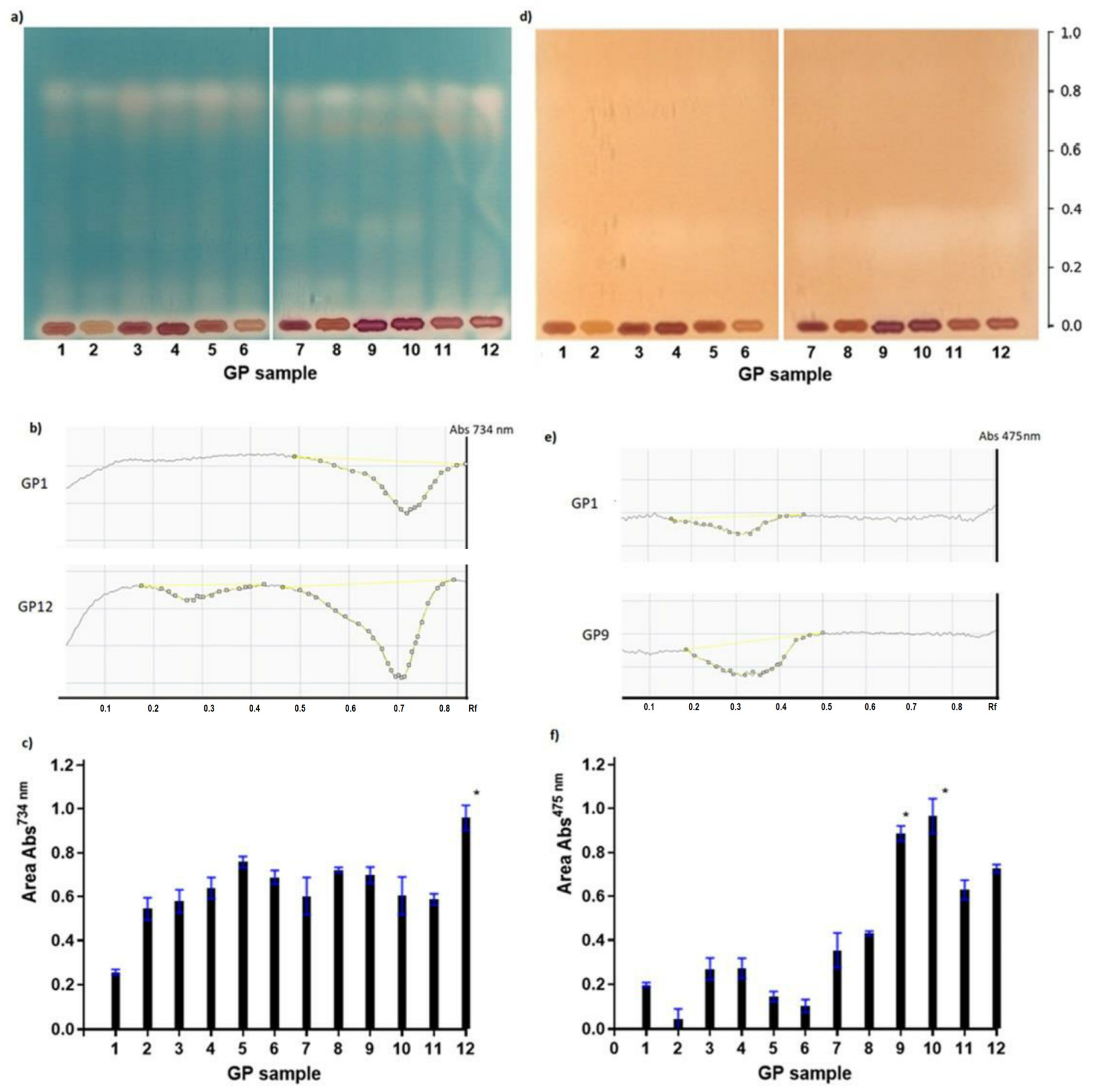
The most prominent spots were characterised using their retardation factor (Rf) value. Antioxidant white spots against a blue background were observed after plate coverage with ABTS•+ (Figure 1a). In TLC-ABTS, a spot at Rf 0.75 was detected across the extracts, appearing most intense in GP5, GP8, GP11, and GP12 samples (Figure 1a).
Regarding tyrosinase inhibition, active zones also appeared as white spots on a brown background following enzyme incubation. TLC-TYR showed an inhibition spot with an Rf of 0.34, most prominent in GP9–GP12 (Figure 1d), suggesting that different active compounds are responsible for each activity [18]. This observation aligns with the fact that polyphenolic antioxidant content in GP varies based on grape variety and culture conditions, contributing to the variable antioxidant properties. Such variability is a global trend, referencing diverse phenolic profiles across different Vitis cultivars and origins [7].
Visual differences were quantified using a TLC scanner at 734 nm (ABTS) and 475 nm (tyrosinase). Representative densitogram scans are shown in Figure 1b,e. For ABTS, spot intensity varied by sample (e.g., Rf = 0.75 in GP1; dual peaks in GP12). Quantitative analysis of the TLC plates (Figure 1c) at 734 nm for ABTS•+ revealed that GP12 exhibited the highest antioxidant activity, approximately 60% greater than the average of the 12 GP extracts, although only 30% higher than GP9. However, given our focus on the anti-browning potential of these extracts, we prioritized tyrosinase inhibitory activity. Assessment of the TLC plates at 475 nm for tyrosinase inhibition (Figure 1f) showed that GP9 and GP10 displayed the most prominent inhibition spots. Statistical analysis using Tukey’s multiple comparison test confirmed that the peak areas for GP9 (0.92 ± 0.035) and GP10 (0.95 ± 0.079) were significantly larger (p < 0.05) than those of the other extracts.
At this point, it was decided to prioritize tyrosinase inhibition over ABTS scavenging during sample selection. Direct enzymatic inhibition of the polyphenol oxidase (PPO) complex remains the most effective primary target for achieving long-term control of detrimental enzymatic browning. Driven by the objective of developing a suppressor aligned with the apple model, GP9 and GP10 were therefore selected for subsequent optimization [15,24,25].

3.2. Optimization of Time and Temperature Using GP9 and GP10 Hydroalcoholic Extractions

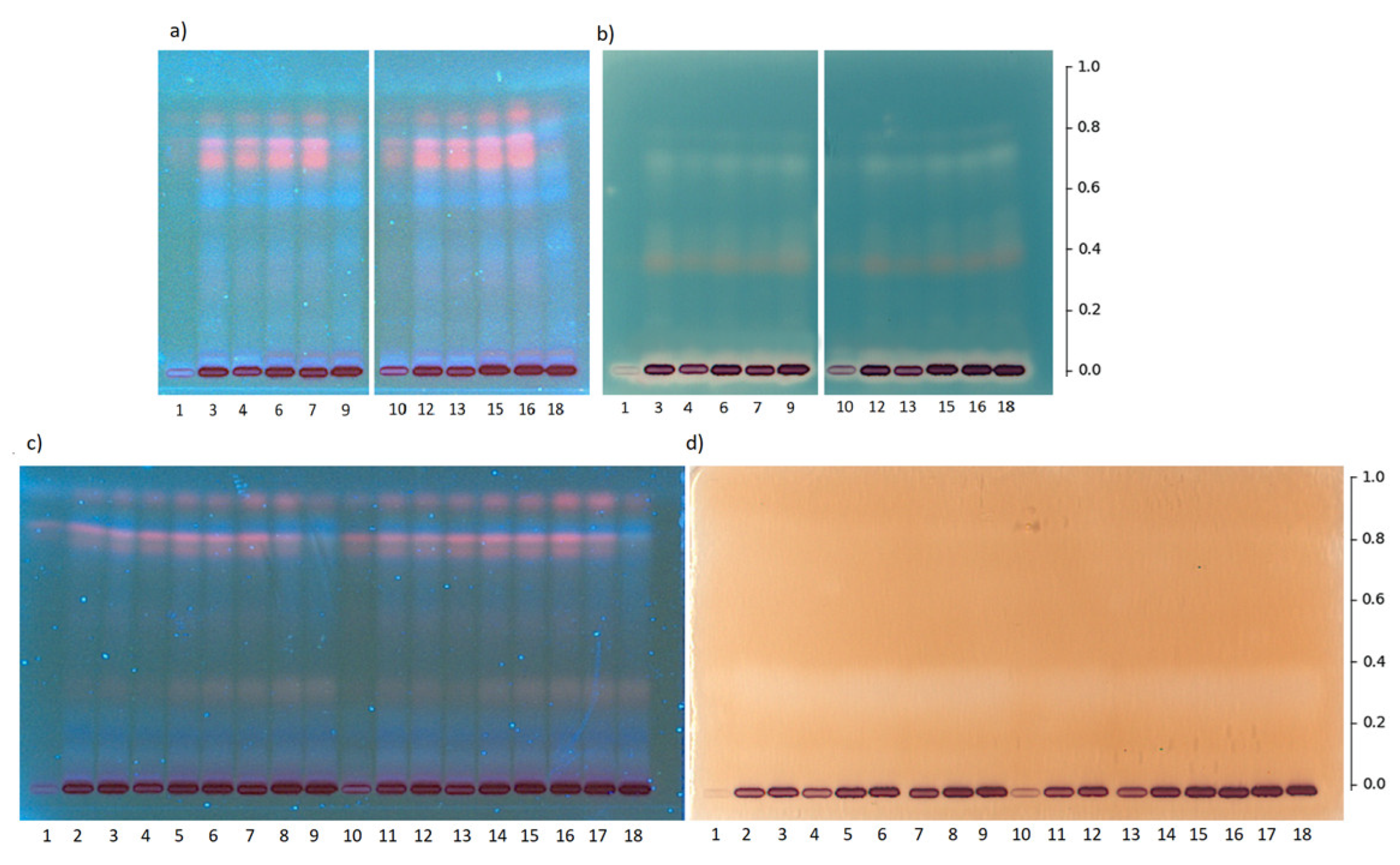
To optimize the extraction conditions for bioactive compounds, a response surface methodology (RSM) design was employed. Eighteen experiments were conducted varying two independent factors: temperature (three levels) and extraction time (three levels) (Table 2, the design is summarized in Table S3). The prepared extracts were spotted on TLC plates, developed, covered with the respective reagent, and analysed via TLC-ABTS and TLC-TYR. While the separate optimization of antioxidant and anti-tyrosinase activities may not have yielded the highest overall bioactivity, it allowed for a focused investigation of factors influencing each activity, facilitating the development of extracts optimized for specific applications [9]. Figure 2a,b show the TLC-ABTS profile of the 12 extracts obtained from the experimental design. Figure 2a depicts the plate before ABTS assay (UV 365 nm), while Figure 2b shows the plate after coverage with the radical under white light. Similarly, Figure 2c,d illustrate the TLC-TYR plate showing the 18 extracts.
Each lane was scanned and quantified as in the screening phase. This quantification of inhibition spots was used to prepare response surface models. The quantified white spots for the TLC-ABTS assay corresponded to Rf values of 0.37 and 0.72 (mobile phase 2), while for the TLC-TYR assay, the Rf value was 0.34 (mobile phase 1). Table 2 presents the quantitative results from both TLC assays.
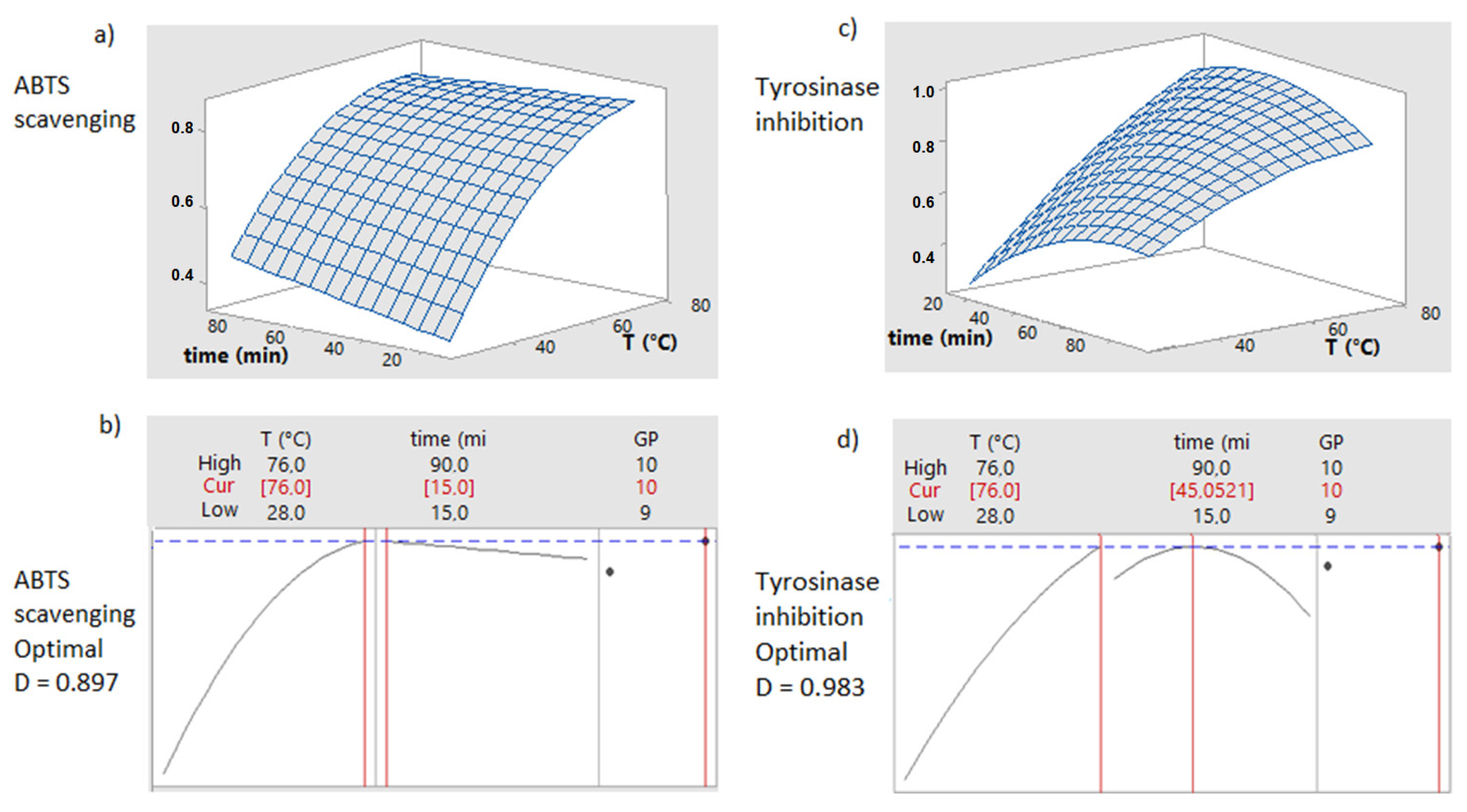
Analysis of variance (ANOVA) was performed to assess the significance of the response surface models. For the ABTS assay, the model was statistically significant, indicating that variations in temperature, time, and GP source had a significant impact on antioxidant capacity [26,27]. Temperature was the most significant factor (p = 0.004), demonstrating a clear positive correlation with ABTS scavenging activity. This finding aligns with observations that the highest experimental values for phenolic content and antioxidant capacity in grape pomace were obtained at the highest tested temperature (60 °C), attributed to enhanced solubility and faster mass transfer. In our study, increasing the temperature from the lowest to the highest level resulted in a twofold increase in the quantified TLC-ABTS spot area [26,27]. The 3D response surface plot (Figure 3a) for ABTS activity reveals a positive linear relationship with increasing temperature, suggesting that higher temperatures favor antioxidant extraction within the tested range. In contrast, extraction time (p = 0.313) and GP source (p = 0.143) did not exhibit statistically significant main effects on ABTS scavenging activity.
A similar ANOVA was conducted for the TLC-TYR assay, and the model was found to be highly significant (p < 0.001), confirming that the extraction conditions had a substantial effect on tyrosinase inhibition. Temperature was again the most significant single factor (p < 0.001), showing a strong positive influence on inhibition [26]. The 3D response surface plot for tyrosinase inhibition (Figure 3c) displays a more complex, potentially quadratic surface, indicating an interaction between temperature and time. The surface suggests that higher temperatures generally enhance inhibition. However, achieving the maximum anti-tyrosinase activity at 76 °C indicates that the enhanced mass transfer and solubility of the targeted active compounds at this temperature significantly outweigh the partial loss of other thermosensitive phenolics. This observation perfectly aligns with our Effect-Directed Extraction (EDE) strategy, which prioritizes functional bioactivity over the preservation of the total phenolic profile.
Preliminary screenings for antioxidant recovery indicated a rapid saturation yield (a plateau effect), which rendered intermediate optimization points unnecessary. In contrast, the recovery of tyrosinase inhibitors required the intermediate time point (45 min) was required to capture the curvature of the response surface. This is supported by the significant interaction between time and temperature (p = 0.008). GP source had a marginal effect (p = 0.081) on the extraction of inhibitor compounds. By intentionally selecting the two highest-performing cultivars (GP9 and GP10) from the screening phase to undergo optimization, the biological variance between them was minimized. The optimized protocol produces high-potency extracts from either of the pre-selected cultivars.

3.3. Validation of Response Surface Values

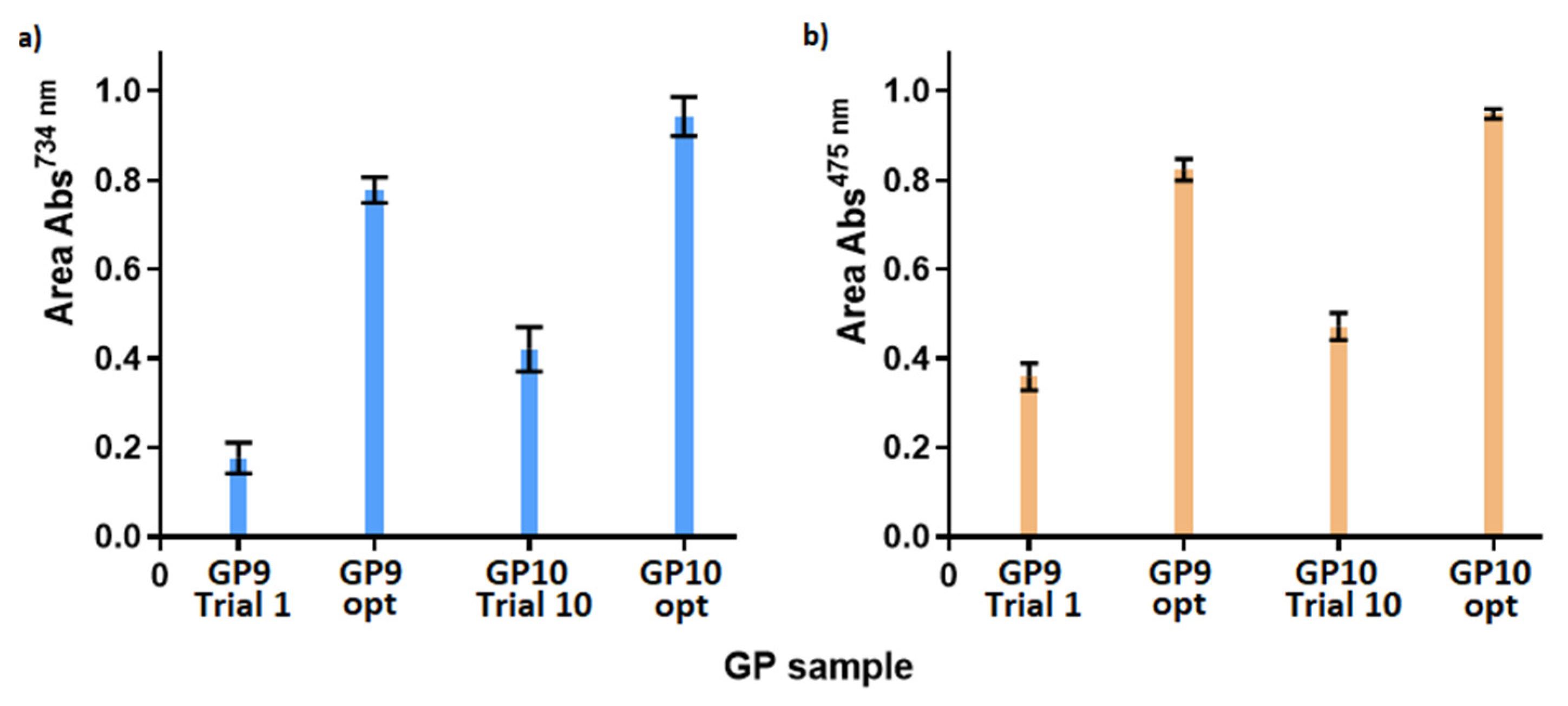
The optimization model predicted that the optimal extraction conditions for maximizing ABTS total area were 76 °C, 15 min, and GP10 as the source (Figure 4a). This optimal temperature of 76 °C for antioxidant extraction aligns with findings that higher temperatures enhance the solubility and extraction yield of antioxidant phenolics [18]. The model predicted an Abs 734 nm area of 0.857 (95% CI: 0.557–1.157), while the actual measured area was 0.933 (Figure 4b).
Conversely, for maximizing tyrosinase inhibition, the optimal conditions predicted were 45 min, 76 °C, and GP10 as the pomace source. The inclusion of two additional trials (Trial 1 and Trial 10) on the validation TLC plate, representing non-optimal conditions, showed a significant decrease in both ABTS scavenging activity and tyrosinase inhibition compared to the optimized conditions (Figure 4).
Our finding that 76 °C is a key temperature in the optimal conditions for tyrosinase inhibition from grape pomace aligns with the general understanding that extraction temperature can significantly influence the recovery of bioactive compounds. Furthermore, a study on white grape pomace also reported anti-tyrosinase activity in ethanol-based extracts, highlighting the potential of this byproduct as a source of such inhibitors [9]. While Ferri et al. employed a subsequent overnight ethanol extraction at 24 °C following enzymatic treatment to recover bioactive compounds from white grape pomace, our study optimized a single-step hydroalcoholic extraction at 76 °C for 45 min to directly maximize tyrosinase inhibition by RSM [9]. For maximizing tyrosinase inhibition (76 °C, 45 min, GP10), the model predicted an Abs475 nm area of 0.985 (95% CI: 0.865–1.105), and the actual measured area was 0.949. The actual values for the optimized GP10 extract were within the prediction interval (0.108 for Abs 734 nm and 0.0531 for Abs 475 nm) compared to the predicted values. The optimized extraction process (GP10, 76 °C, 45 min) achieved a dry matter yield of 10.9 +- 0.25% (w/w). The achieved dry matter yield (10.9%) is highly consistent with literature values for the hydroalcoholic extraction of grape pomace, which typically range between 8% and 15% (w/w) depending on the cultivar, solvent polarity, and operating conditions [7].

3.4. Additional DPPH Radical Scavenging and Laccase Enzyme Inhibition Bioactivities on TLC

To characterize the bioactive profiles within the optimized GP extracts, post-chromatographic application of DPPH reagent enabled the visualization of antioxidant zones [14,17]. The DPPH assay revealed scavenging spots with Rf values matching those observed in the ABTS assay [26], suggesting a consistent antioxidant profile across different radical-scavenging mechanisms (Figure S2a).
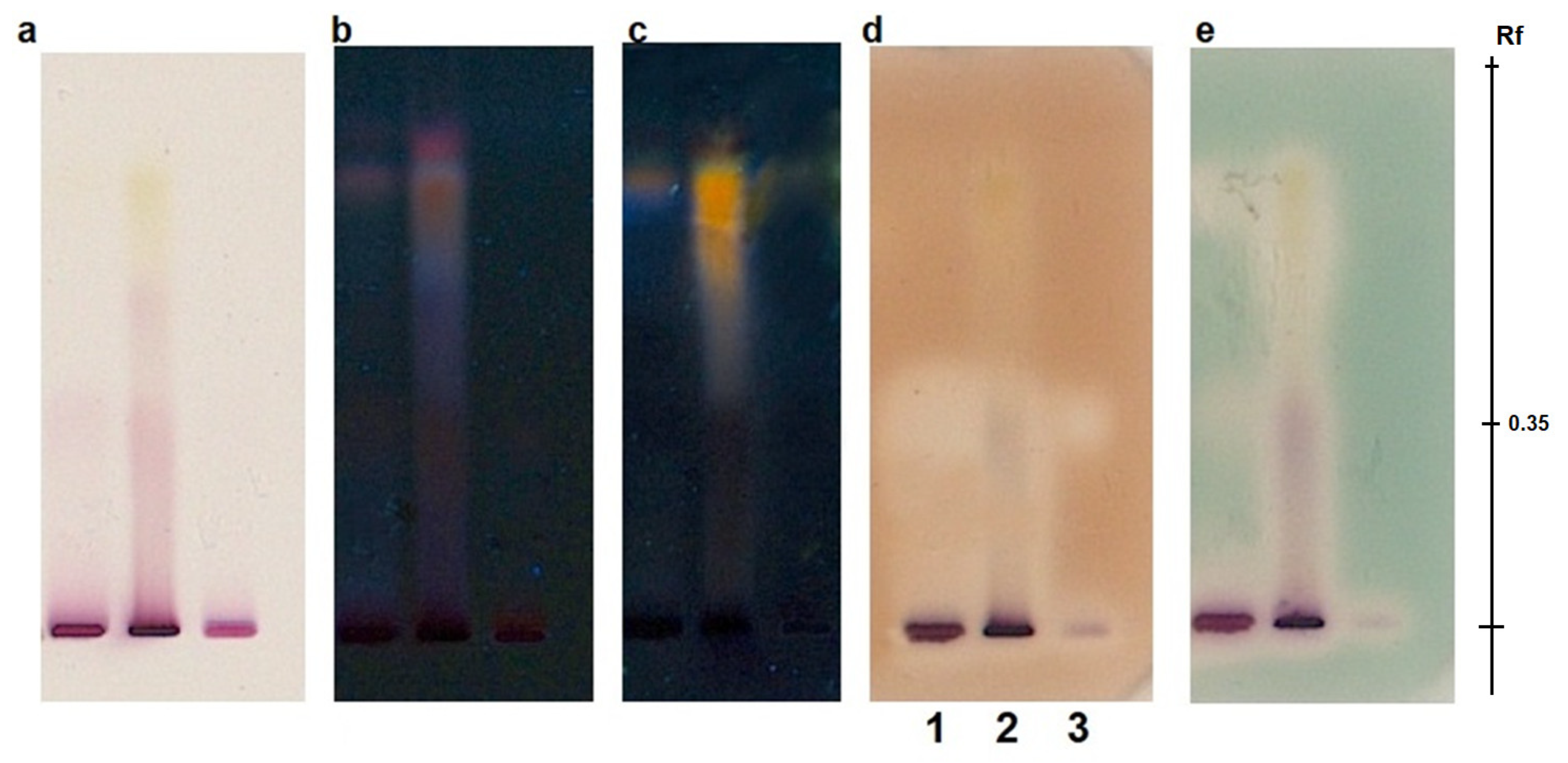
Additionally, a TLC-based laccase inhibition assay was conducted to explore the potential to inhibit other key multicopper oxidases involved in browning [20]. A distinct inhibitory zone was visualized in the laccase assay, which strictly co-localized (similar Rf ≈ 0.35) with the primary zone exhibiting tyrosinase inhibition (Figure S2b). Initially, this dual inhibitory effect seemed mechanistically supported by recent findings on the cross-inhibition of copper-containing enzymes, where small-molecule tyrosinase inhibitors have been proven to promiscuously target the catalytic centers of laccase due to their shared active site features [28].

3.5. Effect-Directed Fractionation and HRMS/MS Structural Elucidation

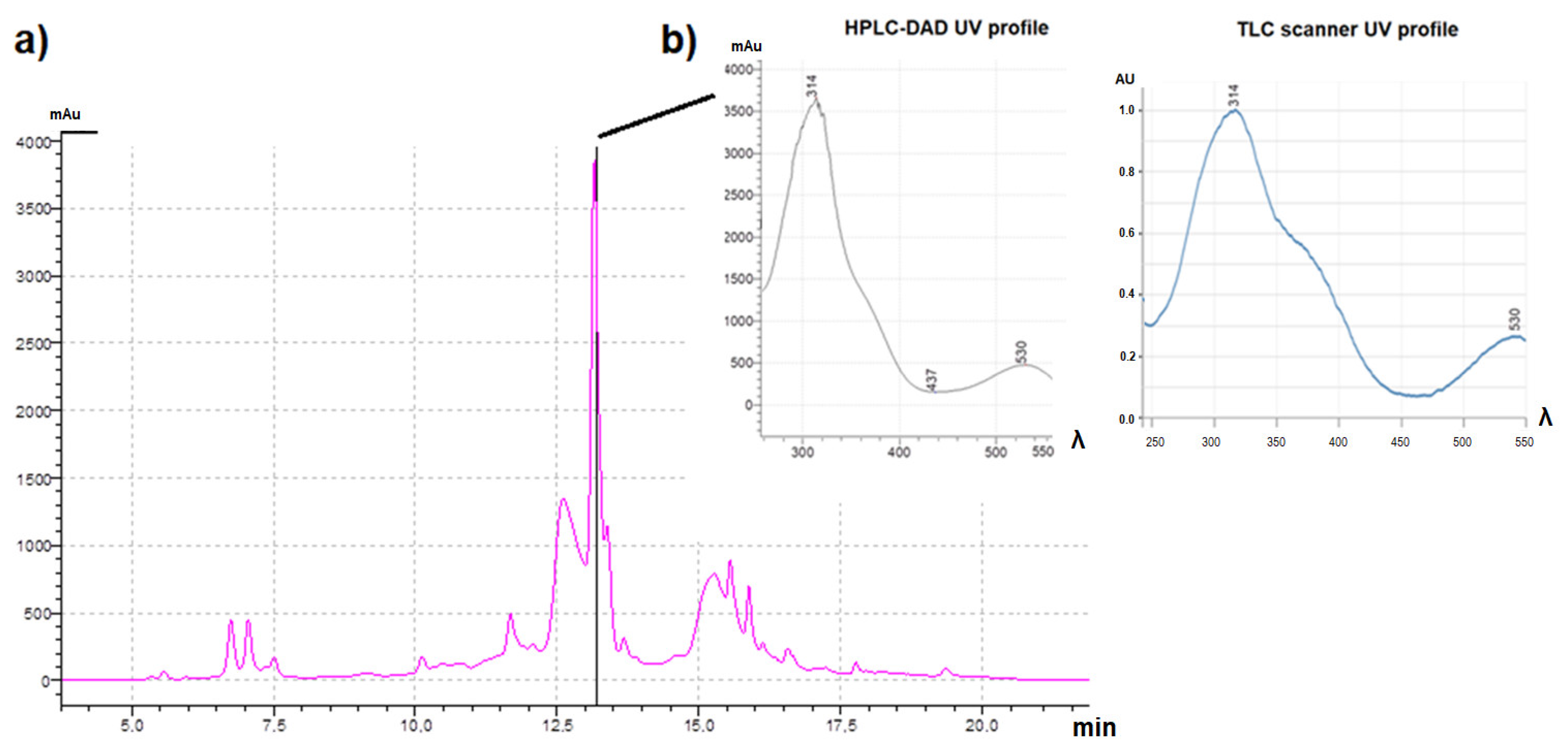
To characterize the active agents and move beyond simple TLC co-migration, the optimized extract was subjected to bioassay-guided fractionation. The AcOEt-enriched fraction was analyzed by HPLC-DAD, revealing a complex profile with a major prominent peak eluting at 13.0–13.5 min when monitored at 315 nm (Figure 5a). Retrospective evaluation of all collected fractions via enzymatic bioassays confirmed that the anti-tyrosinase activity was exclusively retained in this specific 13.0–13.5 min fraction. This successful resolution of previously co-migrating bioactive compounds highlights the value of orthogonal separation techniques. While the normal-phase silica TLC separated the crude mixture primarily based on polar functional groups—resulting in the initial co-migration at Rf 0.35—the reverse-phase HPLC (C18 column) provided a distinct separation mechanism governed by hydrophobicity, resolving the compounds within the complex natural mixture.
To unequivocally correlate the bioactive TLC spot with this HPLC peak, their UV-Vis spectra were compared (Figure 5b). The in situ spectrum of the active TLC spot obtained via an HPTLC scanner perfectly matched the DAD spectrum of the 13.0–13.5 min HPLC peak, both displaying a characteristic λmax at ~314–315 nm and a secondary absorption band in the visible region at ~530 nm. The chemical profile of this isolated active fraction was then evaluated on TLC (Figure 6). Under UV 365 nm following NP-PEG derivatization, the crude and AcOEt fractions exhibited intense fluorescence typical of flavonols. However, the HPLC-purified active fraction appeared as a distinct dark, UV-quenching spot on the TLC plate. Crucially, while the TLC-Tyrosinase assay (Figure 6d) confirmed that this specific isolated fraction retained anti-tyrosinase activity, the TLC-Laccase assay (Figure 6e) revealed no laccase inhibition at Rf 0.35. The dual inhibitory effect observed in the crude extract is mediated by distinct, co-eluting compounds rather than a single cross-inhibiting molecule.
To elucidate the exact molecular structure of this purified active agent, the fraction was analysed by High-Resolution Mass Spectrometry (HRMS/MS) (Figure S3). The analysis revealed a predominant precursor ion at m/z 639.1735 in positive mode (Figure S3a). The observed mass (m/z 639.1735) matches the theoretical exact mass for malvidin-3-O-(p-coumaroyl)glucoside (639.1713) with an accuracy error of ~3.4 ppm. Crucially, DAD monitoring during the mass spectrometry analysis (Figure S3b) also perfectly conserved the characteristic dual UV-Vis absorption bands (~315 nm and ~530 nm). This spectral conservation serves as confirmation that the mass signature obtained corresponds exactly to the active molecule originally pinpointed on the TLC plate (Figure 5b).
The MS/MS spectrum of the precursor ion (Figure S3c) yielded a major characteristic product ion at m/z 331.0854. This corresponds to the malvidin aglycone resulting from the diagnostic cleavage between the flavylium ring and the sugar moiety, representing the neutral loss of the p-coumaroyl-glucoside block (308 Da). This primary fragmentation pathway is consistent with recent extensive LC-MS profiling of red grape pomace [29]. Further magnification of the fragmentation spectrum (Figure S3d) revealed a specific secondary MS/MS pattern of the aglycone core itself. These prominent ions are highly diagnostic for the characteristic cleavage of the methoxylated B-ring and the central C-ring of malvidin: m/z 315.0854 corresponds to the loss of a methane molecule/methyl radical (–16 Da), while m/z 299.0554 strongly reflects the neutral loss of a methanol molecule (–32 Da) from the methoxy groups. Subsequent losses of carbon monoxide (–28 Da) and formyl radicals (–29 Da) drive the lower mass fragments at m/z 287.0558 and m/z 270.0533, respectively [30].
This high-resolution mass signature, coupled with the UV-quenching behaviour on the TLC plate, firmly identifies the primary isolated anti-tyrosinase agent as an acylated anthocyanin, highly consistent with malvidin-3-O-(p-coumaroyl)glucoside (theoretical exact mass: 639.1713). The malvidin core accounts for the 530 nm visible absorption and the lack of NP-PEG fluorescence, while the p-coumaric acid conjugation dictates the strong 315 nm UV absorption. While crude Vitis vinifera extracts, particularly from grape pomace, have been increasingly recognized for their ‘skin-whitening’ properties in the cosmetic industry [31], the attribution of this specific activity to this complex anthocyanin remained, to the best of our knowledge, underexplored until this study.

3.6. Anti-Browning Effect on Apples of the Optimised Extracts

To minimize inherent biological variability and establish a robust internal control for baseline Polyphenol Oxidase (PPO) activity, Pink Lady apples of strictly uniform commercial ripeness were selected. Under the assayed conditions, the apple extract exhibited a basal enzymatic activity of 172.8 U/g of fresh weight. Furthermore, the evaluation of the ethanol effect demonstrated that the addition of ethanol in the concentration used did not alter the kinetics of PPO. The reaction rate slopes were identical for both the control extract and the maximum 2% ethanol treatment (y = 8.6 × 10⁻⁵ t + 1.90 × 10⁻² and y = 8.4 × 10⁻⁵ t + 2.33 × 10⁻², respectively; with t expressed in seconds). This confirms that the solvent concentrations used do not exert an inhibitory effect per se on the PPO. The 2–4% (v/v) application range was specifically selected to balance efficacy with physical constraints (pigmentation that interfered with the colorimetric evaluation).
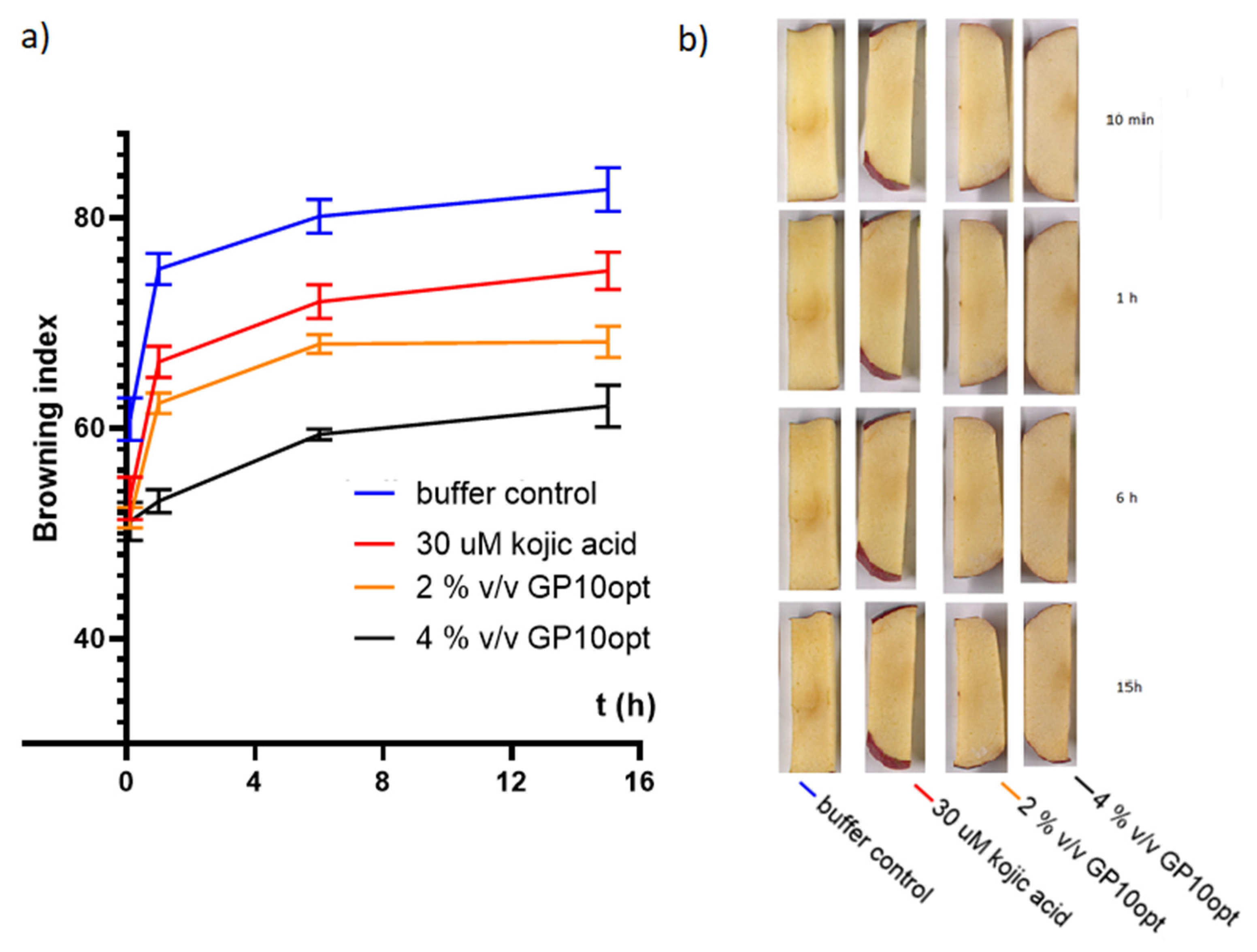
To quantify the overall browning of the apple slices, we initially measured the Browning Index (BI), a common indicator of browning in foods [15]. As depicted in Figure 7, the browning index (BI) increased over time for all treatments, indicating the progression of the enzymatic browning reaction [32]. Despite this progression, a significant decrease in Browning Index (BI) and color difference was found in treated slices. Increasing the concentration of the GP extract from 2% to 4% v/v resulted in a dose response reduction in the Browning Index (Figure 5). When using 4% v/v, browning was 62.1 units at 15 h for the 4% v/v GP10 extract, compared to the control slices where BI was 82.7 at 15 h, Table S2a. Similarly, the color difference (ΔE) was significantly lower in treated samples (ΔE of 7.35 for the 4% v/v GP10 extract) compared to the control (ΔE of 11.4) at 15 h, Table S2b. Notably, the 4% v/v GP extract exhibited the most potent anti-browning activity, effectively inhibiting enzymatic browning and maintaining a significantly lower BI throughout the 15 h experiment, outperforming the reference anti-browning agent kojic acid in Pink Lady apple tissue. While our study focused on grape pomace, other authors reported the use of extracts from unripe Vitis vinifera grapes as an anti-browning additive in wine. Authors found that the antioxidant complex from these unripe grapes contributed to increased anti-browning capacity [33].

3.7. Mechanistic Insights and Comparison with Commercial Inhibitors

Both concentrations of GP10 treatments consistently showed a significant reduction in BI compared to the control at all time points. Notably, the GP10 extract outperformed 30 µM Kojic acid in preventing apple browning. This concentration provided a sub-maximal baseline of inhibition, thereby allowing for a precise evaluation of differences between the treatments over time. This superior efficacy is attributed to the multi-target mechanism of the crude extract compared to the single-mode action of the reference compound. While kojic acid acts primarily as a specific tyrosinase inhibitor, our bioautographic results (Section 3.4) confirmed that the GP extract concurrently inhibits laccase, another oxidative enzyme potentially involved in browning processes. Furthermore, the extract provides an antioxidant shield, scavenging reactive species and quinones. This triple action—inhibiting tyrosinase, inhibiting laccase, and scavenging radicals—supports conclusions from previous bibliometric analysis, which indicated that GP phenolic extracts often exert a multi-target mechanism [7].
Crucially, the anti-browning effect observed in apple model aligns with recent propositions that specific, structurally complex anthocyanins can act beyond simple antioxidant shielding. While simple endogenous apple phenolics typically act as substrates for PPO—driving the browning cascade [34]—exogenous acylated anthocyanins behave fundamentally differently. Recent literature highlights that anthocyanin mixtures rich in p-coumaroyl derivatives exhibit tyrosinase inhibitory capacity through competitive inhibition [35].
The use of color difference (ΔE) served as a complementary validation to the anti-browning effect [36]. ΔE revealed a reduction in color change in apple slices treated with the GP extract, as evidenced by lower ΔE values compared to the control [24]. The multiple comparisons test also revealed significant differences in ΔE values between the control and both 2% and 4% v/v GP10 extract treatments in Table S2b (which lists the raw experimental data) and Figure S1 (containing values of ΔE shown by apple slices with different treatments at 1, 6 and 15 h). The protective trend remained consistent across both metrics, confirming that the extract effectively minimized global color alteration regardless of the parameter employed. In the fresh-cut produce industry, a color difference (ΔE > 3.0) is generally considered the threshold for visual perception by the average consumer. Although the color difference in treated slices remained above this visual perceptibility threshold (ΔE > 3.0), the GP extract significantly reduced the extent of browning compared to the untreated control. This threshold for visual perceptibility can vary depending on the specific food matrix, surface texture, and ambient lighting conditions.
The Malus domestica slice model is universally recognized in food science as a highly rigorous and demanding matrix for browning studies due to its high endogenous PPO activity and complex phenolic profile [37]. Furthermore, testing at room temperature with full oxygen exposure represents an accelerated stress test. While this model serves as a robust proof-of-concept demonstrating the efficacy of the extract, establishing its broader generalizability will require future extended shelf-life trials across diverse food matrices.

4. Conclusions

This study demonstrates the efficacy of an Effect-Directed Extraction (EDE) strategy, guided by TLC-bioautography, to valorize grape pomace (GP) into high-value anti-browning agents. Unlike conventional optimizations based on generic yield or total phenolic content, this approach specifically optimized extraction parameters based on the maximization of bioactivity halos. Through the screening of 12 different GP sources, samples from the San Rafael region (GP9 and GP10) were identified as the best candidates. Response Surface Methodology (RSM) successfully optimized the process, defining 76 °C as the critical temperature for maximizing bioactivity. While antioxidant extraction was faster (15 min), maximum tyrosinase inhibition required a longer duration (45 min), a difference accurately predicted by the models and experimentally validated.
Characterization of the optimized extracts revealed a highly synergistic, multifunctional bioactive profile. While initial post-chromatographic assays showed that tyrosinase and laccase inhibition co-localized at Rf 0.35, subsequent bioassay-guided HPLC-DAD fractionation and HRMS/MS spectral matching strongly demonstrated that these activities originate from distinct, co-migrating polyphenols. The isolated anti-tyrosinase fraction was tentatively identified as malvidin-3-O-(p-coumaroyl)glucoside. Its coumaroyl moiety provides structural mimicry to tyrosine, explaining its targeted enzyme inhibition, while it completely lacks laccase inhibitory activity. This demonstrates that the optimized EDE process successfully targets a complex of specialized compounds capable of interfering with browning mechanisms through multiple, complementary pathways simultaneously. Most notably, the optimized GP extracts demonstrated promising practical efficacy in a highly susceptible food matrix. When applied to fresh Pink Lady apple slices, the 4% (v/v) extract significantly mitigated enzymatic browning over 15 h (reducing the Browning Index by 25%), outperforming kojic acid, a standard reference inhibitor.
In conclusion, this work establishes a scalable, green engineering protocol using food-grade solvents to transform massive agro-industrial waste into a natural preservative. By bridging the gap between analytical screening (TLC) and food application, this approach supports the circular bioeconomy, offering a sustainable path to reduce food waste. While this study establishes a robust optimization for Malbec pomace, some boundaries remain. The impact of varietal and environmental factors (terroir) on the optimal parameters, as well as the long-term sensory stability of the extracts, should be addressed in future pilot-scale and sensory trials.

Supplementary Materials

The following supporting information can be downloaded at https://www.mdpi.com/article/10.3390/pr14060925/s1, Figure S1: Values of the color difference (ΔE) shown by apple slices with different treatments at 1, 6 and 15 h; Figure S2: (a) DPPH scavenging on TLC spotting GP9 and GP10 optimised extracts; (b) laccase inhibition assay on TLC spotting GP9 and GP10 optimised extracts; Figure S3: High-Resolution LC-MS/MS and DAD characterization of the purified anti-tyrosinase compound. (a) Total Ion Chromatogram (TIC) in TOF MS/MS mode showing the primary peak. (b) DAD spectrum, displaying the characteristic dual UV-Vis absorption profile (λmax ~315 nm and ~530 nm), consistent with TLC data. (c) TOF MS/MS spectrum of the precursor ion at m/z 639.1735, highlighting the predominant product ion at m/z 331.0854. (d) Magnified view of the MS/MS spectrum detailing the secondary fragmentation pattern of the aglycone, including diagnostic ions at m/z 315.0854, 299.0554, 287.0558, and 270.0533; Table S1: Multiple comparisons test of GP samples regarding (a) tyrosinase inhibition (b) ABTS scavenging; Table S2: Multiple comparisons test for differentiating control and treatments in (a) browning index and (b) color difference; Table S3: Experimental design factors, levels, and specifications used in the General Full Factorial Designs for grape pomace extraction optimization.

Author Contributions

I.C.: Conceptualization, data curation, formal analysis, investigation, methodology, validation, writing. M.C.: Investigation, methodology, validation. A.M.E.: Data curation, formal analysis. R.L.E.F.: Conceptualization, Writing—review and editing, funding acquisition, project administration. All authors have read and agreed to the published version of the manuscript.

Funding

PICT-2021-1034, CONICET (PIP 11220200102423CO), ACRE PPCT 2023 (80020220600144UR).

Data Availability Statement

The original contributions presented in the study are included in the article and its Supplementary Material. Further inquiries can be directed to the corresponding author.

Acknowledgments

The authors would like to thank María Rocío Meini for her kind contribution of some of the grape pomace samples and her insightful comments throughout this research.

Conflicts of Interest

The authors declare that the research was conducted in the absence of any commercial or financial relationships that could be construed as a potential conflict of interest.

References

  1. Ordoñez-Cano, A.J.; Ramírez-Esparza, U.; Alvarado-González, M.; Baeza-Jiménez, R.; Espinoza-Hicks, J.C.; Prado-Barragán, L.A.; Buenrostro-Figueroa, J.J. Valorization of Pistachio Green Hull: Advances in Extraction and Characterization of Phenolic Compounds. Processes 2025, 13, 3761. [Google Scholar] [CrossRef]
  2. Gerardi, C.; D’amico, L.; Migoni, D.; Santino, A.; Salomone, A.; Carluccio, M.A.; Giovinazzo, G. Strategies for Reuse of Skins Separated From Grape Pomace as Ingredient of Functional Beverages. Front. Bioeng. Biotechnol. 2020, 8, 645. [Google Scholar] [CrossRef]
  3. Almanza-Oliveros, A.; Bautista-Hernández, I.; Castro-López, C.; Aguilar-Zárate, P.; Meza-Carranco, Z.; Rojas, R.; Michel, M.R.; Martínez-Ávila, G.C.G. Grape Pomace—Advances in Its Bioactivity, Health Benefits, and Food Applications. Foods 2024, 13, 580. [Google Scholar] [CrossRef]
  4. Castellanos-Gallo, L.; Ballinas-Casarrubias, L.; Espinoza-Hicks, J.C.; Hernández-Ochoa, L.R.; Muñoz-Castellanos, L.N.; Zermeño-Ortega, M.R.; Borrego-Loya, A.; Salas, E. Grape Pomace Valorization by Extraction of Phenolic Polymeric Pigments: A Review. Processes 2022, 10, 469. [Google Scholar] [CrossRef]
  5. Singh, B.; Suri, K.; Shevkani, K.; Kaur, A.; Kaur, A.; Singh, N. Enzymatic Browning of Fruit and Vegetables: A Review. In Enzymes in Food Technology: Improvements and Innovations; Kuddus, M., Ed.; Springer: Singapore, 2018; pp. 63–78. ISBN 978-981-13-1933-4. [Google Scholar]
  6. Soares, C.; Moreira, M.M.; Ramos, S.; Ramalhosa, M.J.; Correia, M.; Svarc-Gajić, J.; Delerue-Matos, C.; Barroso, M.F. A Critical Assessment of Extraction Methodologies for the Valorization of Agricultural Wastes: Polyphenolic Profile and Bioactivity. Processes 2023, 11, 1767. [Google Scholar] [CrossRef]
  7. Galante, M.; Brassesco, M.E.; Maragoni Santos, C.; Beres, C.; Fai, A.E.C.; Cabezudo, I. Grape Pomace as a Natural Source of Antimicrobial Agents for Food Preservation. Front. Nutr. 2025, 12, 1650450. [Google Scholar] [CrossRef] [PubMed]
  8. Artem, V.; Negreanu–Pirjol, T.; Ranca, A.; Ciobanu, C.; Bratu, M.M.; Popoviciu, D.R.; Moldovan, L.; Vasile, M.; Negreanu-Pirjol, B.-S. Total Phenolic Content Correlated with Antioxidant Activity of Some Grape Pomace Biomass Hydroalcoholic Extracts, White and Red Varieties. UPB Sci. Bull. Ser. B 2021, 83, 61–72. [Google Scholar]
  9. Ferri, M.; Rondini, G.; Calabretta, M.M.; Michelini, E.; Vallini, V.; Fava, F.; Roda, A.; Minnucci, G.; Tassoni, A. White Grape Pomace Extracts, Obtained by a Sequential Enzymatic plus Ethanol-Based Extraction, Exert Antioxidant, Anti-Tyrosinase and Anti-Inflammatory Activities. New Biotechnol. 2017, 39, 51–58. [Google Scholar] [CrossRef]
  10. Li, Z.; Smith, K.H.; Stevens, G.W. The Use of Environmentally Sustainable Bio-Derived Solvents in Solvent Extraction Applications—A Review. Chin. J. Chem. Eng. 2016, 24, 215–220. [Google Scholar] [CrossRef]
  11. Mangiapelo, L.; Blasi, F.; Ianni, F.; Suvieri, C.; Sardella, R.; Volpi, C.; Cossignani, L. Optimization of a Simple Analytical Workflow to Characterize the Phenolic Fraction from Grape Pomace. Food Bioprocess Technol. 2024, 17, 1942–1957. [Google Scholar] [CrossRef]
  12. Vaou, N.; Stavropoulou, E.; Voidarou, C.; Tsigalou, C.; Bezirtzoglou, E. Towards Advances in Medicinal Plant Antimicrobial Activity: A Review Study on Challenges and Future Perspectives. Microorganisms 2021, 9, 2041. [Google Scholar] [CrossRef]
  13. Choma, I.M.; Grzelak, E.M. Bioautography Detection in Thin-Layer Chromatography. J. Chromatogr. A 2011, 1218, 2684–2691. [Google Scholar] [CrossRef]
  14. Cabezudo, I.; Salazar, M.O.; Ramallo, I.A.; Furlan, R.L. Effect-Directed Analysis in Food by Thin-Layer Chromatography Assays. Food Chem. 2022, 390, 132937. [Google Scholar] [CrossRef]
  15. Cabezudo, I.; Ayelen Ramallo, I.; Alonso, V.L.; Furlan, R.L.E. Effect Directed Synthesis of a New Tyrosinase Inhibitor with Anti-Browning Activity. Food Chem. 2021, 341, 128232. [Google Scholar] [CrossRef]
  16. García, P.; Furlan, R.L.E. Multiresponse Optimisation Applied to the Development of a TLC Autography for the Detection of Tyrosinase Inhibitors. Phytochem. Anal. 2015, 26, 287–292. [Google Scholar] [CrossRef] [PubMed]
  17. Danciu, V.; Hosu, A.; Cimpoiu, C. Comparative Evaluation of Antioxidant Activity Using 1,1-Diphenyl-2-Picrylhydrazyl and 2,2′-Azino-Bis(3-Ethylbenzothiazoline-6-Sulphonic Acid) Methods. JPC-J. Planar Chromatogr.-Mod. TLC 2016, 29, 306–309. [Google Scholar] [CrossRef]
  18. Cabezudo, I.; Galetto, C.S.; Romanini, D.; Furlán, R.L.E.; Meini, M.R. Production of Gallic Acid and Relevant Enzymes by Aspergillus Niger and Aspergillus Oryzae in Solid-State Fermentation of Soybean Hull and Grape Pomace. Biomass Convers. Biorefinery 2022, 13, 14939–14947. [Google Scholar] [CrossRef]
  19. Yu, J.; Ahmedna, M. Functional Components of Grape Pomace: Their Composition, Biological Properties and Potential Applications. Int. J. Food Sci. Technol. 2013, 48, 221–237. [Google Scholar] [CrossRef]
  20. Cabezudo, I.; Furlan, R.L.E. Thin Layer Chromatography Assay to Detect Laccase Inhibitors. Food Chem. 2024, 460, 140583. [Google Scholar] [CrossRef]
  21. Re, R.; Pellegrini, N.; Proteggente, A.; Pannala, A.; Yang, M.; Rice-Evans, C. Antioxidant Activity Applying an Improved ABTS Radical Cation Decolorization Assay. Free Radic. Biol. Med. 1999, 26, 1231–1237. [Google Scholar] [CrossRef]
  22. Zampini, I.C.; Ordoñez, R.M.; Isla, M.I. Autographic Assay for the Rapid Detection of Antioxidant Capacity of Liquid and Semi-Solid Pharmaceutical Formulations Using ABTS•+ Immobilized by Gel Entrapment. AAPS PharmSciTech 2010, 11, 1159–1163. [Google Scholar] [CrossRef]
  23. Wu, J.-J.; Cheng, K.-W.; Li, E.T.S.; Wang, M.; Ye, W.-C. Antibrowning Activity of MRPs in Enzyme and Fresh-Cut Apple Slice Models. Food Chem. 2008, 109, 379–385. [Google Scholar] [CrossRef] [PubMed]
  24. Lante, A.; Tinello, F.; Nicoletto, M. UV-A Light Treatment for Controlling Enzymatic Browning of Fresh-Cut Fruits. Innov. Food Sci. Emerg. Technol. 2016, 34, 141–147. [Google Scholar] [CrossRef]
  25. Moon, K.M.; Kwon, E.-B.; Lee, B.; Kim, C.Y. Recent Trends in Controlling the Enzymatic Browning of Fruit and Vegetable Products. Molecules 2020, 25, 2754. [Google Scholar] [CrossRef] [PubMed]
  26. Moutinho, J.; Gouvinhas, I.; Domínguez-Perles, R.; Barros, A. Optimization of the Extraction Methodology of Grape Pomace Polyphenols for Food Applications. Molecules 2023, 28, 3885. [Google Scholar] [CrossRef]
  27. Pop, A.; Fizeșan, I.; Vlase, L.; Rusu, M.E.; Cherfan, J.; Babota, M.; Gheldiu, A.-M.; Tomuta, I.; Popa, D.-S. Enhanced Recovery of Phenolic and Tocopherolic Compounds from Walnut (Juglans regia L.) Male Flowers Based on Process Optimization of Ultrasonic Assisted-Extraction: Phytochemical Profile and Biological Activities. Antioxidants 2021, 10, 607. [Google Scholar] [CrossRef]
  28. Chaudhary, D.; Chong, F.; Neupane, T.; Choi, J.; Jee, J.-G. New Inhibitors of Laccase and Tyrosinase by Examination of Cross-Inhibition between Copper-Containing Enzymes. Int. J. Mol. Sci. 2021, 22, 13661. [Google Scholar] [CrossRef]
  29. Oliveira, J.; Alhinho da Silva, M.; Teixeira, N.; De Freitas, V.; Salas, E. Screening of Anthocyanins and Anthocyanin-Derived Pigments in Red Wine Grape Pomace Using LC-DAD/MS and MALDI-TOF Techniques. J. Agric. Food Chem. 2015, 63, 7636–7644. [Google Scholar] [CrossRef]
  30. Flamini, R. Mass Spectrometry in Grape and Wine Chemistry. Part I: Polyphenols. Mass Spectrom. Rev. 2003, 22, 218–250. [Google Scholar] [CrossRef]
  31. Sharafan, M.; Malinowska, M.A.; Ekiert, H.; Kwaśniak, B.; Sikora, E.; Szopa, A. Vitis vinifera (Vine Grape) as a Valuable Cosmetic Raw Material. Pharmaceutics 2023, 15, 1372. [Google Scholar] [CrossRef]
  32. Perez-Gago, M.B.; Serra, M.; Alonso, M.; Mateos, M.; del Río, M.A. Effect of Whey Protein- and Hydroxypropyl Methylcellulose-Based Edible Composite Coatings on Color Change of Fresh-Cut Apples. Postharvest Biol. Technol. 2005, 36, 77–85. [Google Scholar] [CrossRef]
  33. Fia, G.; Gori, C.; Bucalossi, G.; Borghini, F.; Zanoni, B. A Naturally Occurring Antioxidant Complex from Unripe Grapes: The Case of Sangiovese (v. Vitis vinifera). Antioxidants 2018, 7, 27. [Google Scholar] [CrossRef] [PubMed]
  34. Fang, T.; Chen, J.; Lin, Q.; Zhong, Y.; Duan, Y.; Bi, J. Phenolic Profiling Reveals the Metabolite Basis of Flesh Colour and Fresh-Cut Browning in Apple Fruit. Int. J. Food Sci. Technol. 2022, 57, 2257–2266. [Google Scholar] [CrossRef]
  35. Shen, M.; Liu, K.; Liang, Y.; Liu, G.; Sang, J.; Li, C. Extraction Optimization and Purification of Anthocyanins from Lycium Ruthenicum Murr. and Evaluation of Tyrosinase Inhibitory Activity of the Anthocyanins. J. Food Sci. 2020, 85, 696–706. [Google Scholar] [CrossRef]
  36. Pathak, S.S.; Sonawane, A.; Srinivas, A.; Pradhan, R.C. Application of Image Analysis for Detecting the Browning of Unripe Banana Slices. ACS Food Sci. Technol. 2021, 1, 1507–1513. [Google Scholar] [CrossRef]
  37. Sultan, M.Z.; Farouk, K.A.; Elbagoury, M.M.; Yahia, E.M. Trends in Biochemical, Anatomical Mechanisms and Molecular Aspects in Enzymatic Browning of Apples: A Review. Eur. Food Res. Technol. 2025, 251, 3305–3326. [Google Scholar] [CrossRef]
Figure 1. Bioactivity screening of grape pomace (GP) extracts 1–12. (a) TLC-ABTS bioautography. (b) Representative densitograms at 734 nm for GP1 and GP12. (c) Quantified ABTS scavenging activity (peak area). (d) TLC-TYR bioautography. (e) Representative densitograms at 475 nm for GP1 and GP9. (f) Quantified tyrosinase inhibitory activity (peak area). * Indicates statistically significant differences from other groups (Tukey’s test, p < 0.05).
Processes 14 00925 g001
Figure 2. (a) Extracts of GP9 (lanes 1–9) and GP10 (lanes 10–18) developed with mobile phase 1 under UV 365. (b) TLC-ABTS under visible light, the values of each factor and response from each of the trials are shown in (a) in Table 2. (c) Extracts of GP9 (lanes 1–9) and GP10 (lanes 10–18) developed with mobile phase 2 under UV 365. (d) TLC-TYR under visible light.
Processes 14 00925 g002
Figure 3. (a) TLC-ABTS response surface vs. time and temperature, (b) Response optimization for TLC-ABTS selecting temperature, time and GP from left to right (red = selected value), (c) TLC-TYR vs. time and temperature, (d) Response optimization for TLC-TYR selecting temperature, time and GP conditions from left to right (red = selected value).
Processes 14 00925 g003
Figure 4. Validation of the extraction optimisation area values: (a) ABTS scavenging using GP9 (Trial 1 and optimised sample) and GP10 (Trial 10 and optimised sample); (b) tyrosinase inhibition using GP9 (Trial 1 and optimised sample) and GP10 (Trial 10 and optimised sample).
Processes 14 00925 g004
Figure 5. Bioassay-guided isolation and comparative UV-Vis spectral matching of the active anti-browning compound. (a) HPLC-DAD chromatogram of the AcOEt-enriched grape pomace extract monitored at 315 nm. (b) Comparative UV-Vis spectral matching. The in situ spectrum acquired via HPTLC scanner directly from the bioactive TLC spot (Rf = 0.35) perfectly matches the spectrum obtained via HPLC-DAD from the isolated bioactive peak (13.0–13.5 min).
Processes 14 00925 g005
Figure 6. Bioassay-guided fractionation and TLC characterization of the active anti-browning agents. Lanes correspond to: (1) Optimized hydroalcoholic extract; (2) AcOEt enriched fraction; (3) HPLC-purified active fraction. The plates are visualized under: (a) White light; (b) UV 365 nm; (c) UV 365 nm after derivatization with NP-PEG reagent; (d) TLC-Tyrosinase bioautography under visible light; (e) TLC-Laccase bioautography under visible light; in Rf = 0.35, the purified fraction (Lane 3) demonstrates tyrosinase inhibition (d) but lacks laccase inhibition (e).
Processes 14 00925 g006
Figure 7. Enzymatic browning treatments on Pink lady slices: (a) values of the four treatments from 10 min to 15 h. (b) some of the apple slices treated and analyzed for the browning index values obtained.
Processes 14 00925 g007
Table 1. Samples of Vitis vinifera grape pomace.
Sample IDCultivarRegion
GP1MalbecValle de Uco, Mendoza
GP2Cabernet SauvignonValle de Uco, Mendoza
GP3MalbecValle de Uco, Mendoza
GP4MalbecGualtallari, Mendoza
GP5MalbecTunuyán, Mendoza
GP6MalbecSan Rafael, Mendoza
GP7MalbecSan Rafael, Mendoza
GP8MarselanVictoria, Entre Ríos
GP9MalbecSan Rafael, Mendoza
GP10MalbecSan Rafael, Mendoza
GP11Cabernet SauvignonSan Rafael, Mendoza
GP12Cabernet SauvignonSan Rafael, Mendoza
Table 2. Optimization results of the extraction of GP9 and GP10: (a) TLC-ABTS results (12 trials); (b) TLC-TYR results (18 trials).
(a) ABTS Scavenging Optimisation
TrialGPT (°C)Time (min)ABTS Total Area
1928150.05
3928900.27
4950150.61
6950900.59
7976150.71
9976900.90
101028150.39
121028900.46
131050150.56
151050900.80
161076150.95
181076900.75
(b) Tyrosinase Inhibition Optimisation
Trial No.GPT (°C)Time (min)Tirosinase inh. (Peak Area)
1928150.11
2928450.33
3928900.44
4950150.37
5950450.70
6950900.81
7976150.81
8976450.96
9976900.85
101028150.30
111028450.48
121028900.52
131050150.52
141050450.74
151050900.85
161076150.99
171076450.96
181076900.78
Disclaimer/Publisher’s Note: The statements, opinions and data contained in all publications are solely those of the individual author(s) and contributor(s) and not of MDPI and/or the editor(s). MDPI and/or the editor(s) disclaim responsibility for any injury to people or property resulting from any ideas, methods, instructions or products referred to in the content.