


Abstract
The sustainable valorization of citrus processing by-products represents a key challenge for the food industry, aiming to reduce waste while recovering valuable bioactive compounds. In this study, a cloud point extraction strategy was developed using soy lecithin as a natural, food-grade surfactant to isolate phenolic antioxidants from orange juice industry residues. Response Surface Methodology was applied to two streams of orange juice by-products, to evaluate the combined effects of pH, NaCl concentration, and lecithin content on extraction efficiency, with total polyphenolic content, DPPH radical scavenging activity, and ferric reducing antioxidant power serving as response variables. Partial Least Squares (PLS) analysis was additionally employed to integrate all antioxidant responses and identify a multivariate optimum. The optimized conditions (pH 3.4, 12% NaCl, 11% lecithin) enabled maximal recovery of antioxidant constituents, highlighting the effectiveness of lecithin-based micellar systems. To assess practical applicability, the optimized extract from the oil emulsion residue (Stream A) was incorporated into tsipouro, a traditional Greek distillate, and its stability was monitored under controlled light and temperature conditions for 30 days at three concentration levels. Results demonstrated that both environmental factors significantly influenced antioxidant retention and physical stability, underscoring the importance of formulation design. Specifically, high gel concentration at 2% w/v, low temperature at 20 °C and light exposure provided the highest overall desirability for TPC, FRAP, and DPPH responses. Overall, this work introduces a green, scalable, and food-compatible extraction approach that not only supports circular economy principles but also opens new opportunities for the development of functional alcoholic beverages enriched with natural antioxidants.
1. Introduction
The global citrus processing industry generates substantial volumes of by-products, representing approximately 50–60% of the original fruit mass. These wastes consist of peels, seeds and pulp residues [1]. Despite their rich composition of bioactive compounds—particularly phenolic antioxidants with health-promoting properties—these materials are mostly used as animal feed, composting, or getting disposed, resulting in both environmental issues and a significant loss of economic value [2]. The imperative to transition toward circular economy models has intensified research efforts to develop sustainable valorization strategies that can efficiently recover these valuable compounds while adhering to green chemistry principles and food safety standards [3].
Conventional extraction techniques for phenolic compounds typically rely on organic solvents such as methanol, ethanol, or acetone, which, despite their effectiveness, are related to toxicity, environmental impact, high operational costs, and regulatory constraints for food applications [4]. Cloud point extraction (CPE) has emerged as a promising alternative, utilizing the phase separation behavior of non-ionic or zwitterionic surfactants above their cloud point temperature to selectively divide hydrophobic and amphiphilic compounds into a surfactant-rich phase [5]. This approach offers several advantages such as reduced solvent consumption, lower toxicity, compatibility with aqueous matrices, and the potential for scalability for industrial applications [6].
Soy lecithin is a naturally derived phospholipid mixture obtained as a by-product of soybean oil refining. It presents unique opportunities as it is considered a food-grade surfactant for CPE applications [7]. Its amphiphilic nature enables the formation of micellar structures that solubilize phenolic compounds through hydrophobic interactions and hydrogen bonding. Moreover, lecithin is considered GRAS (Generally Recognized as Safe), presents widespread availability, low cost, and is of natural origin. All these characteristics align very well with the consumers’ demand for clean-label ingredients and sustainable processing technologies [8]. Despite these advantages, the systematic optimization of lecithin-based CPE for citrus by-product valorization remains understudied in the literature [9].
Although the interest in cloud point extraction and the use of natural food-grade surfactants such as lecithin is growing, most studies remain focused on laboratory-scale optimization, with limited consideration of their applicability in real food matrices [9]. The transition from optimized extraction systems into real food or beverages—where formulation complexity, storage conditions, and matrix interactions affect bioactives’ performance—remains insufficiently studied, resulting in limited industrial applications [10]. Furthermore, while using food industry by-products as a source of bioactive compounds is consistent with the ideas of the circular economy and valorization, these methods are rarely investigated in an integrated framework that connects process improvement with a final product [11]. Even if Response Surface Methodology (RSM) is widely applied for parameter optimization, its use as a predictive tool to support scale-up of lecithin-based cloud point extraction systems remains limited [12]. In order to fill these gaps, integrated studies that go beyond extraction yield and include stability and performance evaluations under conditions relevant to the application are needed.
Accordingly, the present study aims to: (i) apply RSM to evaluate the combined effects of pH, NaCl concentration, and lecithin content on the extraction efficiency of phenolic antioxidants from orange juice processing residues, using total polyphenolic content (TPC), DPPH radical scavenging activity, and ferric reducing antioxidant power (FRAP) as response variables; (ii) create and verify a soy lecithin-based food-grade cloud point extraction method that maximizes bioactive recovery while maintaining process sustainability and scalability; and (iii) fortify tsipouro, a traditional Greek distillate, by adding the optimized extract at three concentration levels, and monitor the antioxidant retention and stability under controlled light and temperature conditions over a 30-day storage period. In addition to the response-specific RSM models, Partial Least Squares (PLS) analysis was also employed to integrate all antioxidant responses from both streams and to identify a unified multivariate optimum, enabling a system-level interpretation of extraction behavior and stability.
2. Materials and Methods
2.1. Chemicals and Reagents
From Panreac (Barcelona, Spain), gallic acid (≥99.0% w/w), Folin–Ciocalteu reagent, ammonium iron (II) sulfate hexahydrate (≥99.0% w/w), ethanol (≥99.8% v/v), and thiobarbituric acid were sourced. Trolox (≥96.5% w/w) was purchased from Glentham Life Sciences (Corsham, UK). Sigma-Aldrich (Darmstadt, Germany) supplied TPTZ (≥98% w/w), DPPH (≥90.0% w/w) and methanol (≥99.8% v/v). Iron (III) chloride hexahydrate (≥99.0% w/w) was obtained from Merck (Darmstadt, Germany). Penta (Prague, Czech Republic) provided anhydrous sodium carbonate and anhydrous citric acid. Lecithin soya (>97%) was from ABS Food (Vignoza PD, Italy). Sodium chloride was purchased from Carlo Erba (Milano, Italy). Deionized water used in all experiments was produced using a deionizing column.
2.2. By-Products Preparation for the CPE Procedure
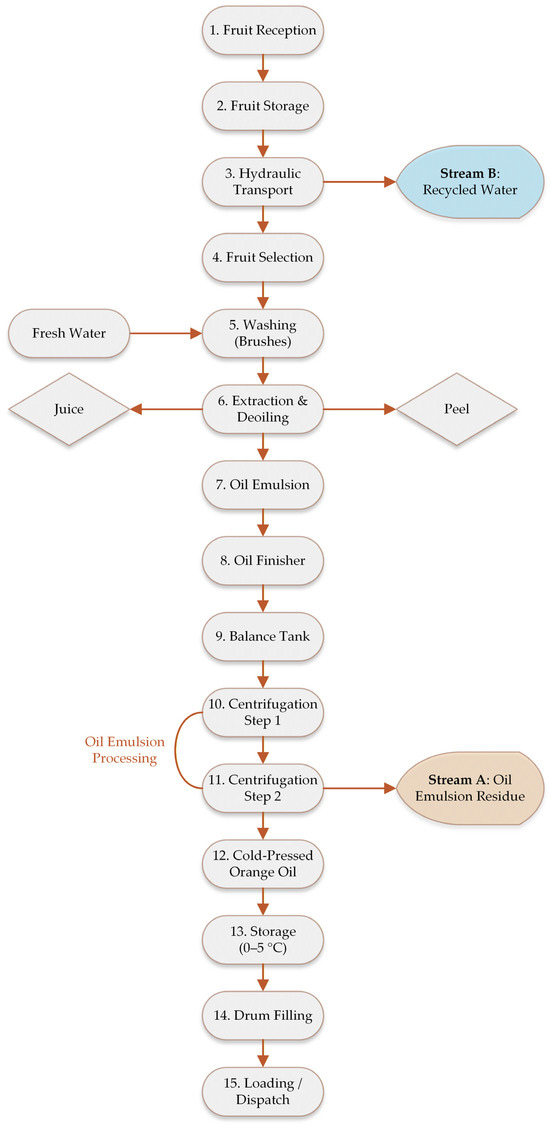
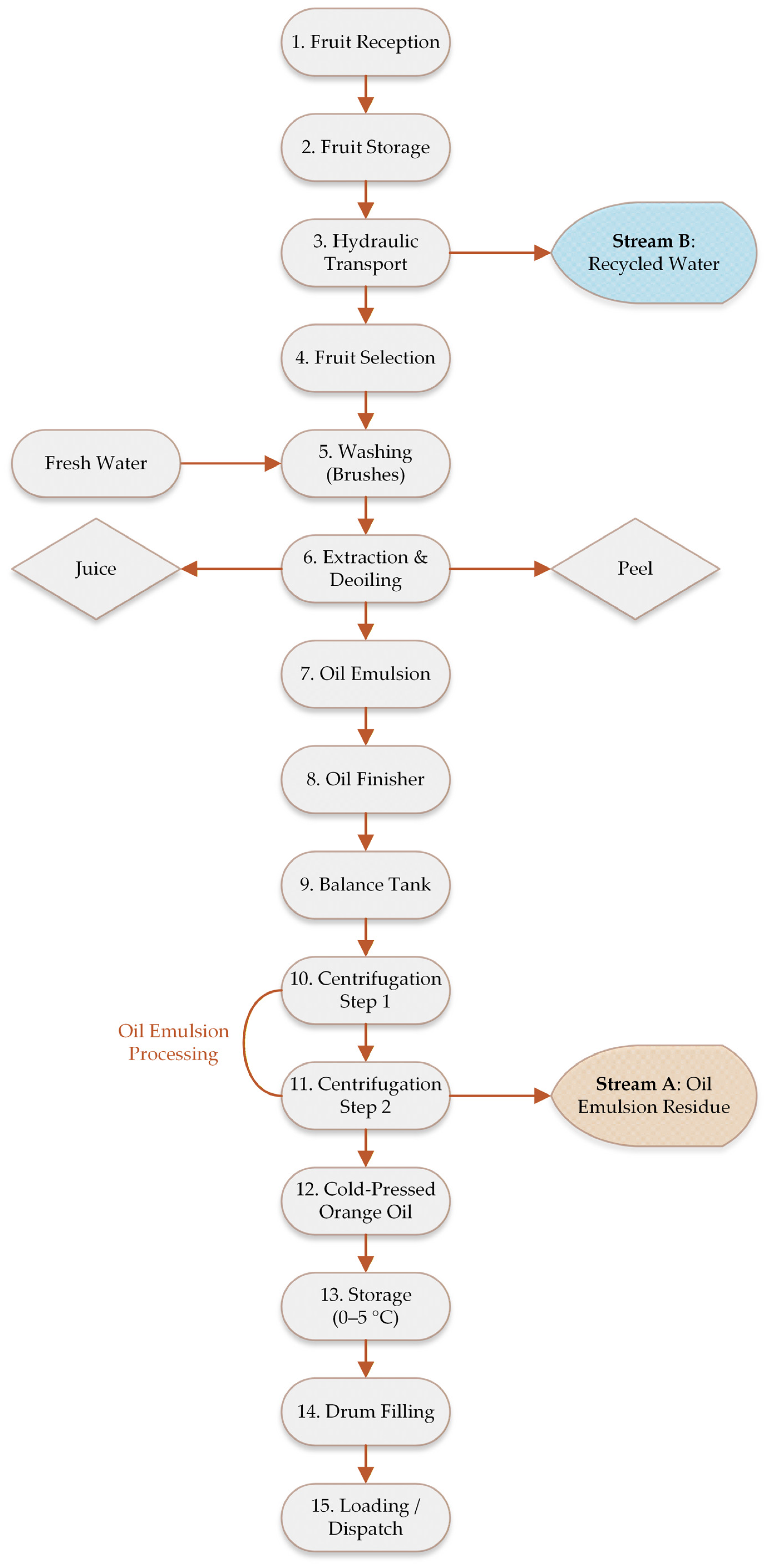
Orange juice industry liquid by-products were provided by Cosmojuice IKE (Ireo-Mideas Argolidas, Greece). The orange variety was Navel. Two distinct aqueous streams were investigated for their polyphenolic content and antioxidant activity. The first by-product is the oil emulsion residue obtained after the second centrifugation step during deoiling (Stream A), while the second by-product corresponds to the recycled water used during hydraulic fruit transport (Stream B). Figure 1 presents the cold-pressed orange oil production flow chart, clearly indicating the stages at which these waste streams are generated. Both by-products were stored at −40 °C until further use.
Figure 1.
Simplified process flow diagram of cold-pressed orange oil production.
The pH of the samples was measured using an XS pH 60 VioLab bench pH meter equipped with a 201 T DHS electrode (Capri, Italy). Prior to analysis, both by-products were homogenized and centrifuged at 3600× g for 10 min (NEYA 16R, Remi Elektrotechnik Ltd., Palghar, India) to separate the essential oil phase, the aqueous phase, and solid residues. The essential oil present in Stream A was collected in a separate vial, while the oil-free supernatant (Stream A) was used for the cloud point extraction (CPE) procedure. Stream B contained no essential oil; therefore, a single centrifugation step was sufficient.
For the CPE procedure, Response Surface Methodology was employed (see Section 2.3). For this purpose, 20 mL of each the by-products were mixed with soya lecithin at certain concentrations (1, 8, 15%). The mixtures were agitated (Heidolph MR Hei-Standard, Schwabach, Germany) at a speed of 800 rpm at 42 ± 1 °C for 30 min. Both the temperature and time values were selected based on preliminary experiments and available literature. Moreover, the given temperature minimizes energy consumption and prevents the degradation of polyphenols [13]. The aqueous phase was separated from the surfactant rich phase through centrifugation at 3600× g for 5 min before decantation. The amounts of both surfactant and water phases were measured following centrifugation.
2.3. Experimental Design for the CPE Procedure
A three-factor, three-level Box–Behnken design (15 runs) was used to fit a full quadratic model including linear, interaction, and squared terms. Design evaluation indicated adequate power for detecting linear effects (0.62) and moderate power for curvature and interactions, consistent with the requirements of a second-order RSM model. The design exhibited acceptable D-efficiency (36.6%) and low average prediction variance (0.38), confirming its suitability for robust model estimation.
A three-factor, three-level Box–Behnken design was employed to evaluate the combined effects of pH (X1), NaCl concentration (X2), and surfactant (lecithin) content (X3) on the extraction performance of the lecithin-based cloud point extraction system. The coded and actual levels of the independent variables are presented in Table 1. The selected ranges were based on preliminary trials and former bibliography [14] to ensure phase separation, micelle formation, and adequate phenolic solubilization.
Table 1.
Experimental design and coded levels of the independent variables used in the RSM optimization of the lecithin-based CPE system.
2.4. Experimental Design for the Stability Assessment of Tsipouro Formulations
A custom three-factor response surface design was constructed to investigate the combined effects of the gel concentration obtained from the optimized extract (X1, 0, 1, 2% w/v), temperature (X2, 20/60 °C), and light exposure (X3, OFF/ON) on the stability of the tsipouro formulations. The model included linear terms for all factors, a quadratic term for gel concentration (X12), and two-factor interactions (X1 × X2, X1 × X3, X2 × X3). A total of 14 experimental runs were generated, including replicated center points to allow estimation of pure error and assessment of model adequacy. Design diagnostics indicated acceptable D- and G-efficiencies and prediction variance across the experimental region, supporting the suitability of the design for stability modeling.
Samples were stored in a controlled stability chamber (Model CH 250, ARGO LAB, Kunshan, China) capable of maintaining precise temperature and humidity conditions. Fourteen experimental combinations were generated based on a three-factor design, with coded levels −1, 0, and +1 for each variable (Table 2). The design matrix included both low- and high-temperature/light conditions to simulate realistic storage scenarios.
Table 2.
Experimental factors and coded levels.
Total polyphenols (TPC), antioxidant activity (DPPH, FRAP) and visual stability (phase separation) were monitored at regular intervals. The resulting data were fitted to second-order polynomial models to identify the most favorable formulation and storage conditions for preserving extract functionality in tsipouro.
2.5. Total Polyphenol Content (TPC)
Photometric determination of the total polyphenol content (TPC) was performed utilizing the Folin–Ciocalteu method [15]. Upon combining 100 μL of the extract (dilutions were applied when necessary) with 100 μL of the Folin–Ciocalteu reagent for two minutes, 800 μL of 5% w/v sodium carbonate solution was introduced. The solution was incubated for 20 min at 40 °C, in the dark. Then, the absorbance at 740 nm was measured with a Shimadzu spectrophotometer (UV-1700, Shimadzu Europa GmbH, Duisburg, Germany). The results were expressed as mg gallic acid equivalents (GAE) per liter.
2.6. Polyphenols’ Recovery
The assessment of polyphenol recovery was conducted via a polyphenol mass balance. The calculation of surfactant retrieval was performed utilizing a method that had been previously established [15] and Equation (1) with slight modifications:
where Cs denotes the concentration of polyphenols in the volume Vs of the surfactant phase, C0 corresponds to the concentration of polyphenols in the initial sample volume V0 (20 mL), and Cw represents the concentration of polyphenols in the volume of the water phase Vw. The average concentration of each phase was obtained using the Folin–Ciocalteu method. The result was then expressed in mg GAE/L.
2.7. Ferric-Reducing Antioxidant Power (FRAP) Assay
A formerly established method [16] was implemented to perform the FRAP assay. A volume of 50 μL of the sample was combined with 50 μL of iron (III) chloride solution (4 mM in 0.05 M HCl) in an Eppendorf tube. Subsequently, the resultant mixture was subjected to incubation at 37 °C for 30 min. Next, 900 μL of TPTZ solution (1 mM in 0.05 M hydrochloric acid) was introduced. Following a 5 min interval, the absorbance was measured at 620 nm. The ferric-reducing capacity (PR) was determined using a calibration curve, which was created using ascorbic acid diluted in 0.05 M hydrochloric acid. The concentrations of ascorbic acid varied between 0.05 and 0.5 mmol/L. The PR of the samples was quantified in mmol of ascorbic acid equivalents (AAE) per liter.
2.8. DPPH Scavenging Antiradical Activity
The DPPH scavenging activity was calculated using a procedure that had been previously specified [15]. A volume of 25 μL of diluted (1:5) extract sample was combined with 975 μL of DPPH solution (100 μmol/L in methanol), and the absorbance at 515 nm was measured immediately (A515(i)) and 30 min later (A515(f)). Antiradical activity (AAR) was expressed as mmol ascorbic acid equivalents (AAE) per liter, using an ascorbic acid calibration curve.
2.9. Statistical Analysis
All statistical analyses were performed using JMP® Pro 16 (SAS Institute Inc., Cary, NC, USA). Data were first evaluated for normality using the Kolmogorov–Smirnov test. Differences among treatments were assessed by one-way analysis of variance (ANOVA), and mean comparisons were conducted using Tukey’s HSD test at a significance level of p < 0.05. Each CPE extraction experiment was conducted in duplicate, and all analytical measurements were performed in triplicate.
3. Results and Discussion
3.1. RSM Design and Experimental Responses
Two distinct aqueous streams originating from citrus juice processing were evaluated as matrices for lecithin-based cloud point extraction. Stream A corresponded to the emulsion residue aqueous phase, characterized by the presence of dispersed lipophilic compounds, whereas Stream B represented the citrus recycled water collected during fruit handling. The pH values of the by-products were 5.02 ± 0.1 and 4.68 ± 0.1 at 25 °C, respectively. Both matrices were subjected to a three-factor, three-level Box–Behnken design to investigate the combined effects of pH (X1), NaCl concentration (X2), and lecithin content (X3) on extraction performance. The experimental runs and measured responses (TPC, FRAP, DPPH) for both streams are presented in Table 3. Runs in which no surfactant-rich phase was formed are indicated with missing values, reflecting combinations of low salinity and/or extreme surfactant levels that prevented micelle aggregation and phase separation.
Table 3.
Experimental matrix of the Box–Behnken design and measured responses for the two citrus-processing aqueous streams generated during orange juice production (Stream A: oil emulsion residue aqueous phase; Stream B: citrus recycled water).
According to the results, TPC for Stream A ranged between 260.85 and 693.94 mg GAE/L, while FRAP ranged between 564.54 and 1671.45 μmol AAE/L and DPPH between 197.39 and 593.65 μmol AAE/L. Regarding the Stream B, TPC ranged between 76.17 and 131.39 mg GAE/L, FRAP between 160.82 and 369.64 μmol AAE/L and DPPH between 61.71 and 311.26 μmol AAE/L. In addition to the absolute antioxidant values, the calculated recovery percentages further highlighted the superior extraction performance of Stream A, with recoveries ranging from 37.26% to 93.92%, compared to 62.97% to 78.97% in Stream B. The higher recoveries observed in Stream A reflect the presence of emulsified lipophilic domains that promote micelle structuring and phenolic partitioning into the surfactant-rich phase, whereas the more dilute and hydrophilic nature of Stream B limits extraction efficiency. The essential oil fraction collected from Stream A was not used in the CPE procedure or subsequent analyses.
Previous applications of cloud point extraction to citrus matrices provide meaningful benchmarks for interpreting our optimized lecithin-based CPE system. In the work of Katsoyannos et al., a two-step CPE using Tween 80 recovered up to ~72.4% of total carotenoids from orange juice under optimized conditions, demonstrating the feasibility of CPE for value-added extraction from citrus juice streams [14]. Similarly, Chatzilazarou et al. [17] reported 91–92% recovery of carotenoids and lycopene from red-fleshed orange juice using a multi-step CPE with non-ionic surfactant Genapol X-080, highlighting the influence of pH, salt concentration, and surfactant content on extraction efficiency. In comparison, our lecithin-based CPE system under RSM-optimized pH, NaCl, and surfactant levels showed comparable or enhanced recovery of polyphenolic antioxidants (TPC, DPPH, FRAP), underscoring the potential of food-grade surfactants for scalable valorization of citrus by-products.
3.2. Model Fitting and Statistical Significance
All responses were successfully fitted to quadratic RSM models, with R2 values ranging from 0.858 to 0.994 (Table 4). The models for Stream B (TPC-B, FRAP-B, DPPH-B) exhibited particularly strong predictive performance (R2 > 0.91), reflecting the more homogeneous nature of the fruit with recycled water matrix. In contrast, Stream A responses showed greater variability, especially for TPC-A, although FRAP-A and DPPH-A still achieved high R2 values (>0.97). ANOVA revealed that NaCl concentration (X2) was consistently the most influential factor across all models, while lecithin content (X3) significantly affected TPC and FRAP responses. For DPPH-B, pH (X1) and its quadratic term were dominant contributors, indicating strong pH-dependent radical scavenging behavior.
Table 4.
Model summary, ANOVA statistics, and lack-of-fit tests for the quadratic RSM models fitted to the two cold pressed orange oil streams.
Lack-of-fit tests were non-significant for all models (p > 0.65), confirming that the quadratic equations adequately described the experimental data. Significant model terms varied by response, with NaCl concentration (X2) consistently emerging as a major negative contributor; however, its effect was not uniformly negative across all responses or matrices. Instead, its influence depended on the specific antioxidant parameter and the physicochemical characteristics of each stream, reflecting a response-dependent and matrix-dependent behavior. Lecithin (X3) and pH (X1) showed matrix-dependent effects.
Regression analysis revealed that NaCl concentration (X2) exerted a strong negative effect on several responses, but this trend was not universal, as DPPH-A did not follow the same pattern. Lecithin content (X3) significantly enhanced TPC and FRAP values, particularly in Stream B, while pH (X1) exerted a dominant positive effect on DPPH-B. Significant quadratic terms (X12, X32) in the recycled-water stream indicated pronounced curvature and matrix-dependent extraction behavior.
3.3. Response Surface Analysis
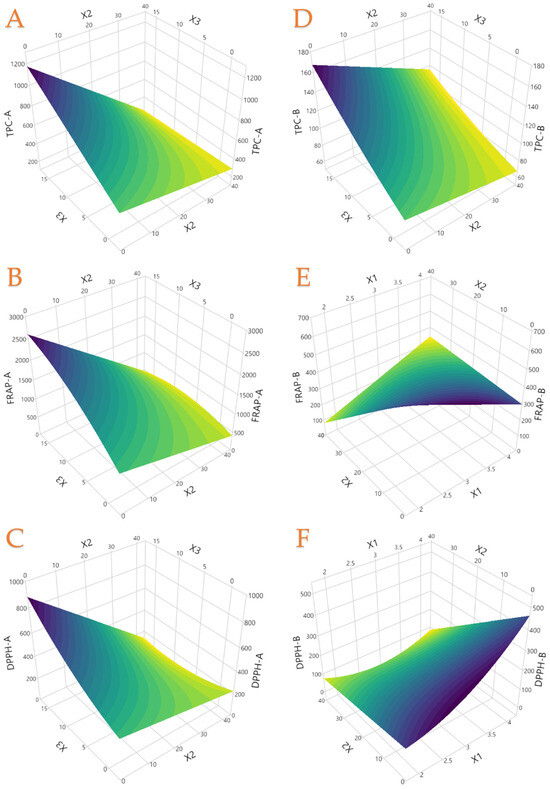
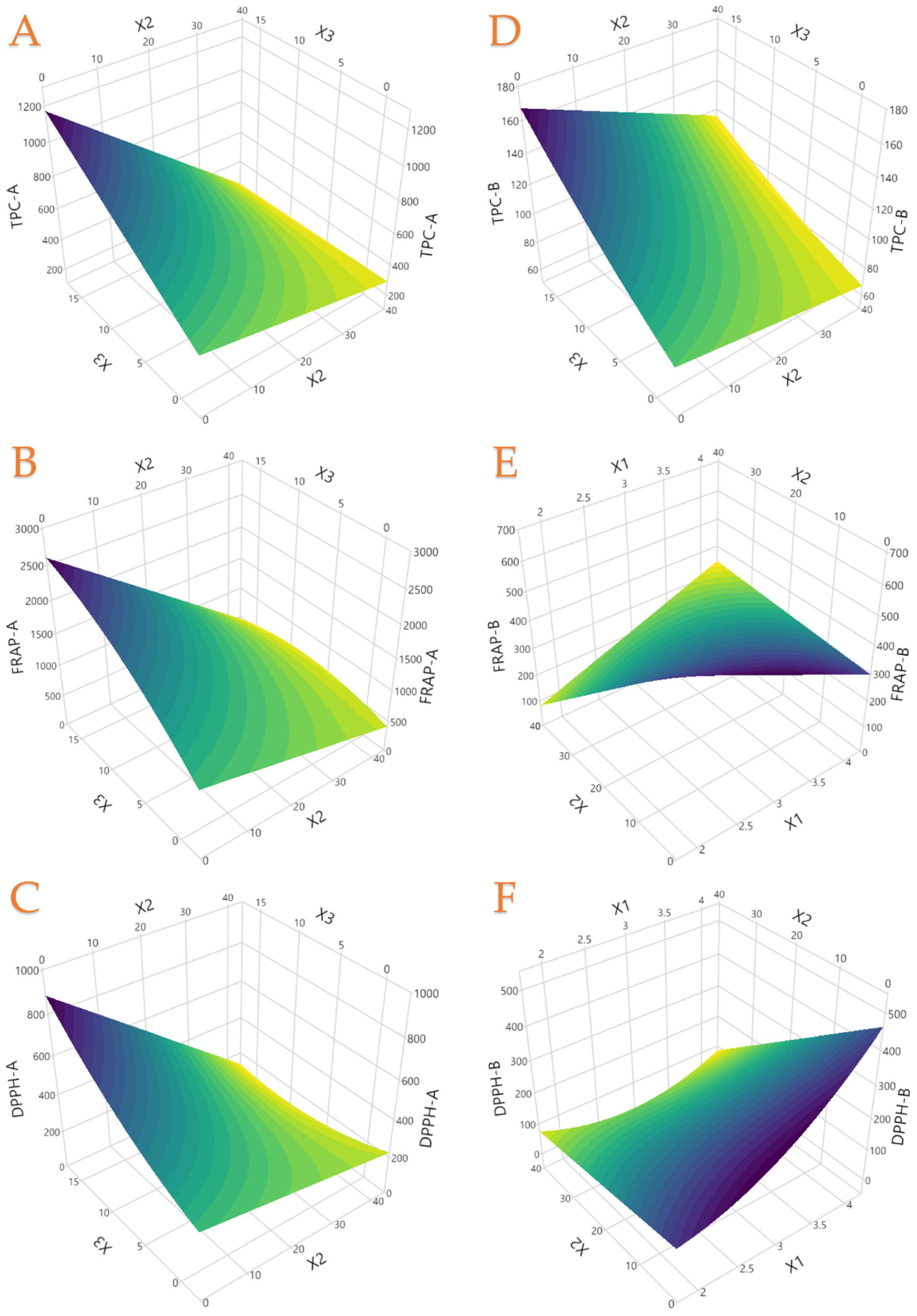
Figure 2 presents the 3D response surface plots for the most influential factor combinations affecting antioxidant recovery in both cold pressed orange oil streams. For Stream A (plots A–C), NaCl and lecithin concentrations (X2–X3) were the dominant variables across all responses, although their effects were not uniform across all antioxidant metrics. For Stream B (plots D–F), pH and NaCl (X1–X2) exhibited strong synergistic effects, particularly for DPPH radical scavenging activity, consistent with the statistical significance of the interaction and quadratic terms. The effect of NaCl was generally inhibitory at higher concentrations, but the magnitude and direction of its influence differed between Stream A and Stream B, confirming that salinity interacts with matrix composition and surfactant structuring in a non-uniform and response-dependent manner.
Figure 2.
Three-dimensional response surface plots showing the effects of NaCl concentration (X2) and lecithin content (X3) on antioxidant recovery in the oil emulsion residue aqueous stream (A–C), and the effects of pH (X1) and NaCl concentration (X2) in the citrus recycled water stream (D–F). Responses include total polyphenolic content (TPC), ferric reducing antioxidant power (FRAP), and DPPH radical scavenging activity. The color gradients represent the predicted response values: darker purple shades correspond to higher antioxidant responses, whereas yellow shades indicate lower responses, according to the fitted quadratic RSM models.
3.4. Multivariate Partial Least Squares (PLS) Analysis
A PLS model was constructed by integrating all six responses (TPC-A, FRAP-A, DPPH-A, TPC-B, FRAP-B, DPPH-B) in order to capture the multivariate structure of the system and to evaluate common and matrix-dependent extraction patterns across the two citrus-processing streams. The NIPALS algorithm was used, and cross-validation (K = 7) indicated that a seven-factor solution was statistically adequate (van der Voet p = 0.206), avoiding overfitting while still retaining the major sources of variation. Although the full nine-factor model minimized the PRESS value, it was not significantly superior to the seven-factor model and therefore was not selected for interpretation.
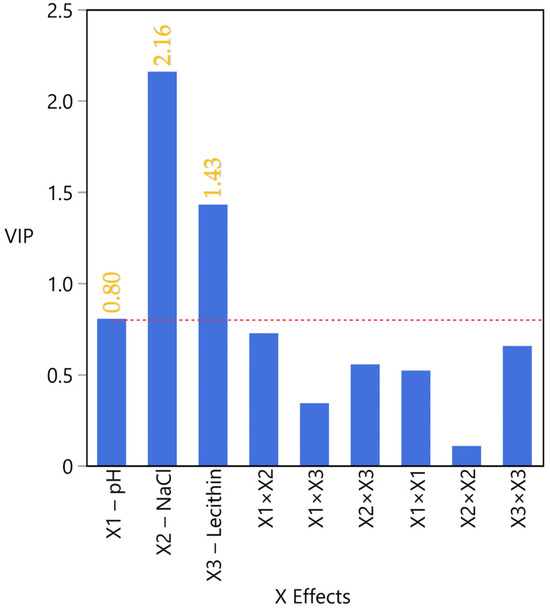
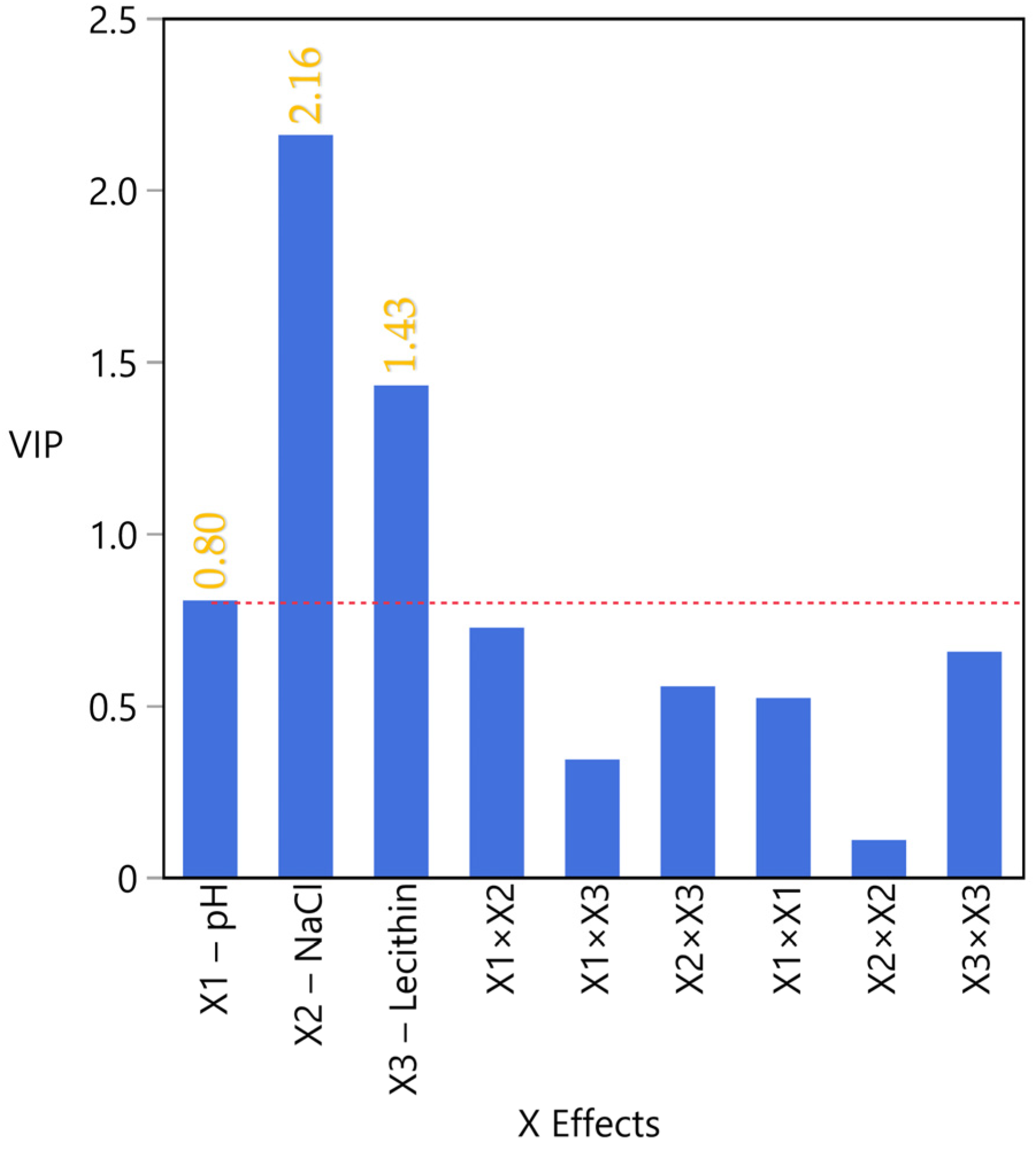
The model explained 82% of the X-variance and more than 99% of the cumulative Y-variance, indicating that the three experimental factors and their polynomial terms were sufficient to describe the multivariate response space. According to Figure 3, VIP scores highlighted NaCl concentration (X2) as the dominant driver of the system (VIP = 2.16), although its effect was not consistently negative across all antioxidant responses. Lecithin content (X3) also showed high importance (VIP = 1.43), contributing positively to phenolic and FRAP recovery. In contrast, pH (X1) had a more moderate influence (VIP = 0.80), reflecting its selective effect on DPPH activity, particularly in the recycling-water stream. All interaction and quadratic terms exhibited VIP < 0.8, indicating limited relevance despite their localized significance in the RSM models.
Figure 3.
Variable Importance in Projection (VIP) scores from the global PLS model integrating all six antioxidant responses (TPC-A, FRAP-A, DPPH-A, TPC-B, FRAP-B, DPPH-B). The dashed red line marks the conventional threshold of VIP = 0.8 for variable significance.
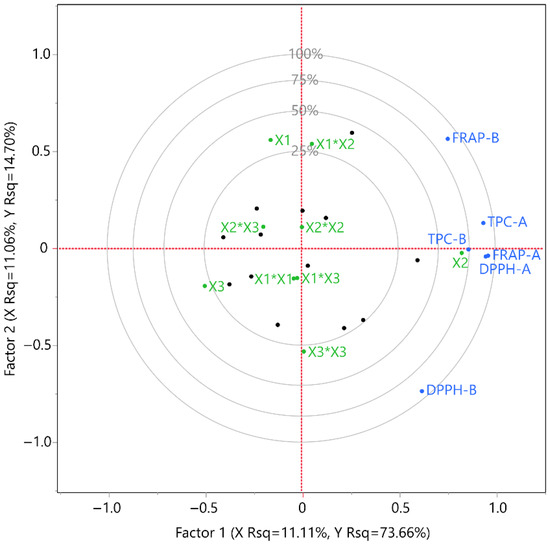
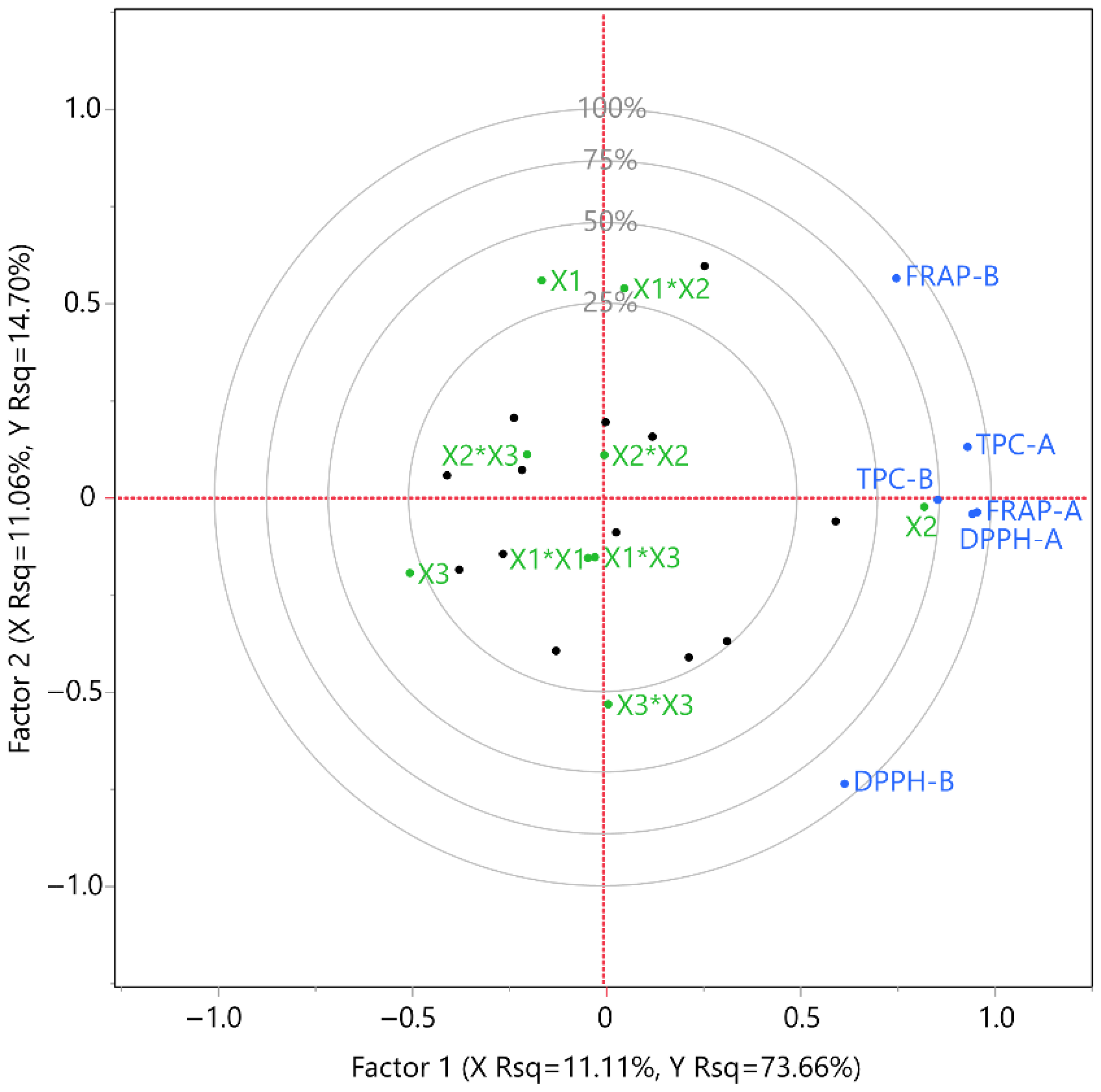
The score plot (Figure 4) revealed a clear separation between the two cold-pressed orange oil streams, with the recycled-water responses (TPC-B, FRAP-B, DPPH-B) clustering tightly along the same latent directions. In contrast, the oil-emulsion residue aqueous phase responses (TPC-A, FRAP-A, DPPH-A) exhibited greater dispersion, reflecting the more heterogeneous composition of the matrix. The directional alignment of NaCl (X2) with negative response vectors indicated a suppressive role, but this effect varied depending on the specific response and matrix, while lecithin (X3) aligned positively with phenolic and FRAP responses. pH (X1) showed selective association with DPPH-B, consistent with its matrix-dependent effect.
Figure 4.
PLS score and loading plot for the integrated antioxidant dataset. The plot illustrates the multivariate relationships between the experimental factors (X1–pH, X2–NaCl, X3–lecithin and their polynomial terms) and all six antioxidant responses (TPC-A, FRAP-A, DPPH-A, TPC-B, FRAP-B, DPPH-B). Concentric circles represent correlation levels, and the first two latent factors capture the dominant structure of the multivariate space. Red dashed lines denote the axes of the two latent factors and divide the plot into quadrants that indicate the direction and sign of correlations. Green labels correspond to predictor variables (factors and interaction terms), whereas blue labels correspond to antioxidant responses, allowing clear visual separation between predictors and outcomes.
Overall, the PLS analysis validated the conclusions drawn from the individual RSM models and provided a unified interpretation of the system: NaCl contributed substantially to the variation in antioxidant responses, but its influence was not uniformly negative across all variables, reinforcing the need for a nuanced, matrix-dependent interpretation. Lecithin enhances extraction efficiency across matrices, and pH effects remained selective and response-specific. This multivariate perspective supports the existence of two distinct optimal extraction regimes, consistent with the physicochemical differences between the two cold-pressed orange oil streams.
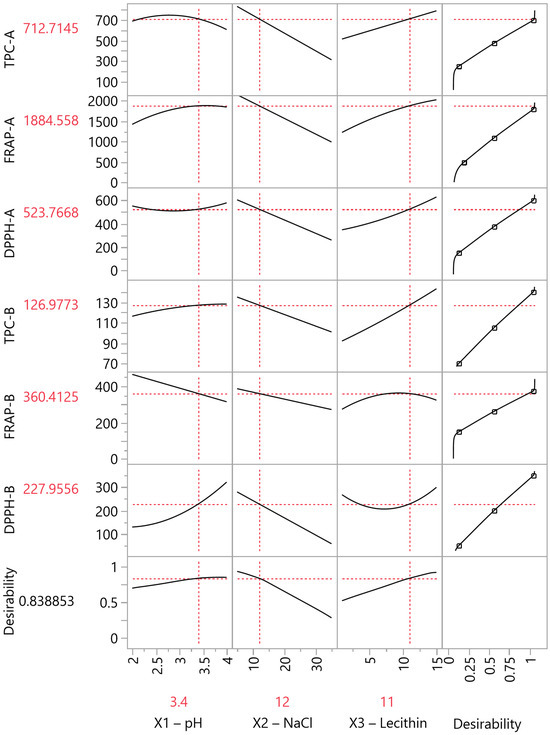
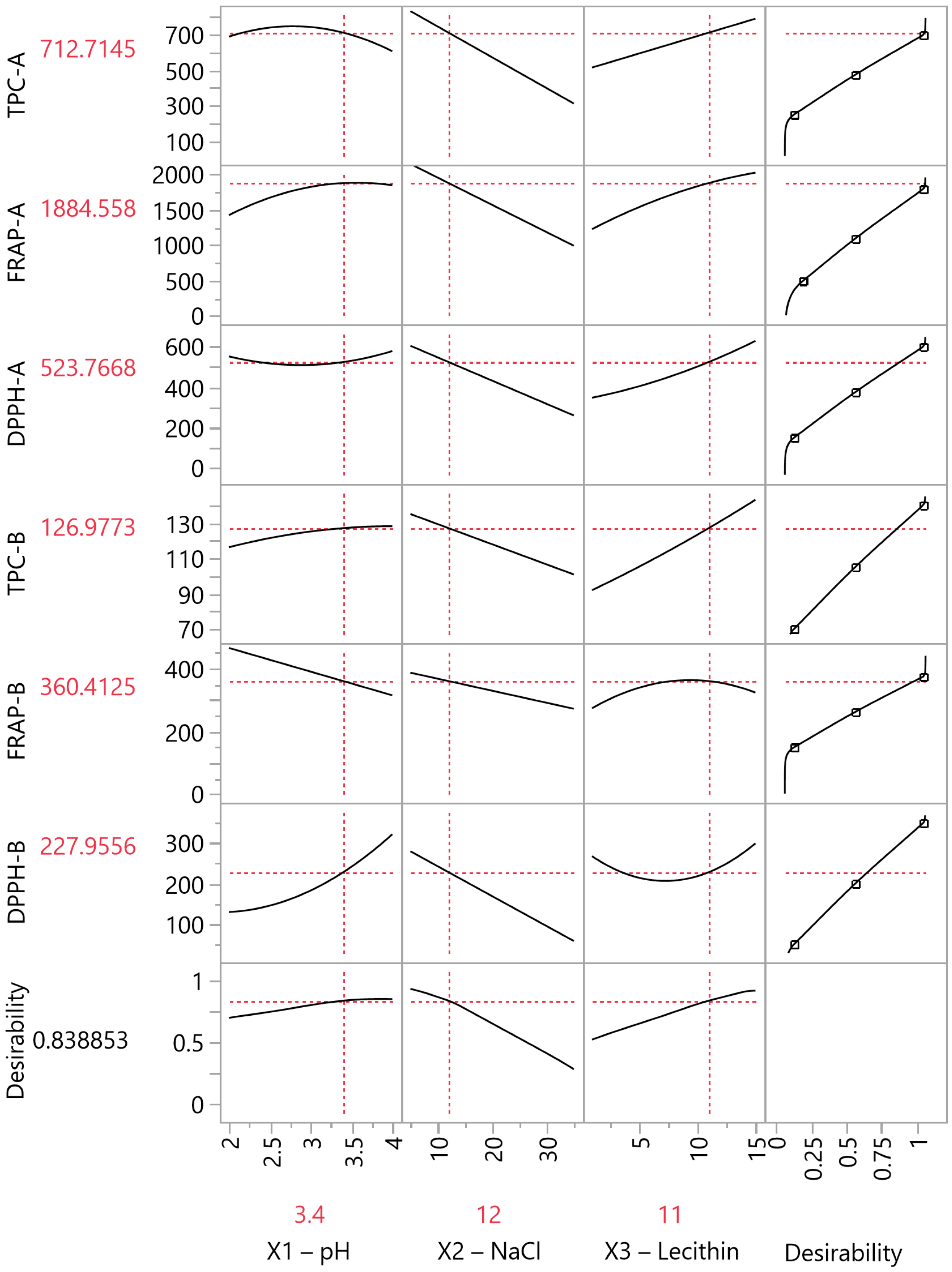
The prediction profiler (Figure 5) derived from the PLS model provided an integrated visualization of the directional effects of the experimental factors on all six responses. Consistent with the VIP analysis, NaCl concentration (X2) showed a decreasing trend for several antioxidant responses, but not for all, confirming that its role cannot be generalized as uniformly suppressive. Lecithin content (X3) exhibited a positive trend, particularly for TPC and FRAP, whereas pH (X1) displayed a selective influence, primarily enhancing DPPH activity in the recycled-water stream. While not based on formal optimization algorithms, the profiler revealed optimal factor combinations that maximize predicted responses across the multivariate space, reinforcing the global patterns identified by the PLS loadings and VIP scores.
Figure 5.
Prediction profiler derived from the PLS model integrating all six antioxidant responses. The profiler illustrates the individual effects of pH (X1), NaCl concentration (X2), and lecithin content (X3) on each response variable (TPC-A, FRAP-A, DPPH-A, TPC-B, FRAP-B, DPPH-B), as well as on the overall desirability function. Black curves represent model predictions, while red dashed lines indicate the optimal factor levels that maximize each response. Black boxes denote the experimental ranges of each factor, indicating the domain within which the model predictions are considered reliable.
3.5. Integrated Optimization and Process Interpretation
The optimization workflow combined response-specific RSM modeling with a PLS multivariate analysis to derive both local and system-wide extraction optima. In the first stage, RSM models were fitted separately for each antioxidant response (TPC, FRAP, DPPH) and for each stream (oil-emulsion aqueous residue and recycled-water). These models revealed that the optimal conditions varied across responses and matrices, reflecting the distinct chemical composition and extraction behavior of the two side streams. Although RSM successfully captured the curvature and individual factor effects, it did not provide a single operating point capable of maximizing all responses simultaneously.
To address this limitation, a PLS model integrating all six responses (TPC-A, FRAP-A, DPPH-A, TPC-B, FRAP-B, DPPH-B) was developed. Rather than indicating a uniformly dominant negative effect of NaCl, the PLS analysis showed that its influence varied depending on the matrix and the specific antioxidant metric, highlighting the need for careful balancing of salinity during extraction. Lecithin exhibited a consistently positive contribution across most responses, while pH played a selective role—particularly enhancing DPPH activity in the recycled-water stream. Importantly, the PLS-based prediction profiler enabled the identification of a common multivariate optimum, representing the best compromise across all responses and both matrices. This global optimum was found at pH 3.4, 12% NaCl, and 11% lecithin, a combination that simultaneously maximized phenolic recovery, FRAP activity, and DPPH scavenging capacity while ensuring stable gel formation without phase-separation issues.
At these conditions, the predicted responses were 712.7 mg GAE/L (TPC-A), 1884.6 μmol AAE/L (FRAP-A), 523.8 μmol AAE/L (DPPH-A), 127.0 mg GAE/L (TPC-B), 360.4 μmol AAE/L (FRAP-B), and 228.0 μmol AAE/L (DPPH-B), confirming that a single operating point can support high antioxidant recovery in both streams. This convergence indicates that, despite the chemical differences between the two matrices, their extraction behavior can be jointly optimized through a unified set of conditions.
Overall, the integrated RSM–PLS framework distinguishes between local optima (RSM) and a multivariate optimum (PLS), providing a robust basis for process design. The optimization results highlight that NaCl must be carefully balanced, as its impact is strongly dependent on the physicochemical characteristics of each stream and the specific antioxidant metric considered. The resulting operational window—pH 3.4, 12% NaCl, 11% lecithin—offers a practical and efficient protocol for the simultaneous valorization of both cold-pressed orange oil side streams, maximizing antioxidant recovery while maintaining process stability.
3.6. Selection of the Extract for Application in Tsipouro Distillate
Although both cold pressed orange oil streams were successfully optimized through the integrated RSM–PLS framework, only one extract was selected for incorporation into tsipouro. The oil emulsion aqueous phase residue (Stream A) was ultimately chosen because it produced a highly enriched antioxidant fraction through the cloud point extraction (CPE) process. In this system, lecithin acted as the amphiphilic surfactant, forming a surfactant-rich gel phase capable of selectively concentrating phenolic compounds and other bioactives. This CPE-derived gel phase constituted the final extract used for fortification.
Compared to the citrus recycled water stream (Stream B), Stream A generated a substantially more potent antioxidant fraction, allowing effective enrichment of tsipouro at low addition levels. The optimized CPE conditions (pH 3.4, 12% NaCl, 11% lecithin) enhanced micelle formation and partitioning efficiency, yielding a gel phase with high TPC, FRAP, and DPPH values. This explains the elevated antioxidant measurements observed in the fortified tsipouro samples. For these reasons, the CPE-derived gel from Stream A was selected for the subsequent storage-stability study.
3.7. Application of Lecithin-Based Extract in Tsipouro: Stability Study
To assess the practical applicability of the optimized lecithin-based extract, a stability study was performed using tsipouro as an alcoholic matrix. The extract corresponded to the surfactant-rich gel phase obtained from Stream A (oil emulsion aqueous residue) under the optimized CPE conditions (pH 3.4, 12% NaCl, 11% lecithin). This gel phase, enriched in phenolic and other amphiphilic antioxidants, was incorporated into tsipouro at three concentrations (0%, 1%, and 2% w/v).
A three-factor RSM design was used to evaluate the effects of gel concentration (X1), temperature (X2: 20/60 °C), and light exposure (X3: OFF/ON) on antioxidant stability over 30 days. The complete TPC, FRAP, and DPPH datasets are presented in Table 5 and Supplementary Tables S1 and S2.
Table 5.
Total phenolic content (TPC) of tsipouro samples during storage (0–30 days).
Across all assays, fortified samples exhibited higher initial antioxidant values, consistent with the concentrated nature of the CPE-derived gel. Small variations in initial TPC, FRAP, and DPPH values among replicates were expected due to the intrinsic micro-heterogeneity of the surfactant-rich phase.
The fitted RSM models revealed distinct stability patterns for each antioxidant response. TPC remained the most predictable endpoint, with gel concentration (X1) consistently emerging as the dominant factor. DPPH also showed excellent model performance at all time points, reflecting a robust and multi-factorial radical scavenging response. In contrast, FRAP displayed excellent model adequacy at early storage (0–5 days) but significant lack-of-fit at later stages (15–30 days), indicating increasing non-linearity associated with redox transformations in the alcoholic matrix.
A consolidated overview of significant effects, model fit, and dominant factors is presented in Table 6. These results collectively identify day 15 as a transition point for FRAP behavior, while TPC and DPPH remain well-described by the quadratic models throughout storage.
Table 6.
Summary of significant model terms, model fit statistics, and dominant factors for all antioxidant responses across storage time.
The graphical diagnostics supporting the RSM models (residual plots, prediction profiles, leverage plots, and desirability functions) are provided in Supplementary Figures S1–S6. To avoid redundancy, only the key outcomes are summarized here, while detailed visualizations can be found in the Supplementary Materials. Collectively, these diagnostics confirm model adequacy, absence of systematic bias, and acceptable prediction variance across the experimental domain.
3.8. Optimization of Antioxidant Responses
Because the RSM models did not yield reliable mathematical optima—due to the absence of significant quadratic terms for TPC and DPPH and the presence of lack-of-fit for FRAP at mid-storage—the final optimization was performed using PLS multivariate modeling. The PLS-based optimization was used to identify robust optima across all storage times, complementing the RSM analysis and providing a more reliable basis for multi-response decision-making. A multi-response optimization analysis was then conducted to determine the experimental conditions that maximize antioxidant stability across all measured responses (TPC, FRAP, DPPH) and storage times. The desirability-based optimization, informed by the PLS models, showed that each response exhibits a distinct optimum, reflecting the different chemical mechanisms captured by the assays (Table 7).
Table 7.
Optimization results based on desirability analysis.
For the TPC responses, the optimal conditions were obtained at the highest gel concentration (X1 = 2), high temperature (X2 = L2), and light exposure (X3 = L2). Under these settings, the predicted phenolic retention across storage was maximized, with an overall desirability of approximately 0.84. The DPPH responses favored a similar high gel loading but under milder thermal conditions: the optimum was found at X1 = 2, X2 = L1, and X3 = L2, yielding the highest predicted radical scavenging activity with a desirability of about 0.89. In contrast, the FRAP responses reached their optimum at an intermediate gel concentration (X1 = 1), low temperature (X2 = L1), and light exposure (X3 = L2), with a desirability close to 0.84, consistent with the redox-sensitive nature of the assay.
These findings confirm that no single set of conditions simultaneously maximizes all responses. TPC is enhanced under more intense conditions (high gel, high temperature, light), DPPH under high gel but low temperature and light, and FRAP under intermediate gel and low temperature. In practice, a compromise operating window can be defined around relatively high gel concentrations (X1 ≈ 1–2) under low temperature (X2 = L1) and light exposure (X3 = L2), which balances phenolic retention, reducing power, and radical scavenging activity while acknowledging that each assay has its own strict optimum.
3.9. Comparison with Previously Reported Literature
To the Authors’ knowledge there are scarce studies implementing RSM for CPE and the subsequent preparation of a food or beverage. Andrés et al. [18] optimized the extraction of phenolic compounds from brewer’s spent grain by studying the extraction temperature, time, and liquid-to-solid ratio using a central composite design. They evaluated total phenolic content and antioxidant activity via multiple assays (DPPH, ABTS, reducing power), and found that lower temperatures and moderate liquid/solid ratios favored higher phenolic yields. Under optimal conditions (30 °C, ~122 min, 10 mL/g), the predicted and experimental values were in good agreement, and HPLC analysis showed gallic acid and other phenolic acids as major constituents, demonstrating the validity and predictive power of RSM for complex extractions. Similar extraction optimization strategies combining RSM with alternative technologies (e.g., ultrasound-assisted extraction) have also shown that the experimental design can substantially increase recoveries of phenolics compared to classical methods, highlighting the importance of variable interactions and model fitting in maximizing both TPC and antioxidant performance [19].
Optimization of enzyme-assisted extraction from watermelon rind using RSM resulted in up to a three-fold increase in polyphenols and enhanced radical scavenging activity compared to conventional extraction, clarifying the advantage of RSM for designing efficient processes in lignocellulosic matrices [20]. Likewise, RSM has been applied to the extraction of polyphenols from grapefruit by-products using microwave-assisted extraction. This study showed that the adjustment of solvent and processing variables with the use of a statistical design can lead to high yields of phenolics and improved antioxidant activity suitable for active packaging applications [21]. Finally, a study on the extraction of phytochemicals from olive pomace using natural deep eutectic solvents (NADES) combined with RSM demonstrated that process parameters significantly affected total TPC, FRAP, and DPPH radical scavenging activity. These findings support the general observation that multivariate optimization approaches efficiently capture the complex interactions between independent variables and response metrics in phenolic extraction processes [22].
Cloud Point Extraction (CPE) has emerged as an effective pre-concentration technique for analytes in food and beverage matrices, complementing multivariate optimization methods. CPE utilizes the phase separation of non-ionic surfactants above their cloud point temperature to concentrate target analytes into a small surfactant-rich phase, facilitating subsequent analytical detection. Regarding alcoholic beverages, CPE has been successfully applied for the determination of haloanisoles—compounds associated with cork taint—by combining Triton X-114 extraction with direct microvial insert thermal desorption followed by GC–MS, achieving low ng/L detection limits and recoveries in the range of ~89–111% across wine, beer, and whisky samples [23].
In another study, cloud point extraction combined with reversed-phase HPLC was applied for the quantification of multiple phenolic compounds in Thai local wines, demonstrating substantial enrichment of gallic acid, protocatechuic acid, and vanillic acid, along with good analytical precision and low detection limits. Recoveries of spiked samples were reported in the range of approximately 90–110%. Collectively, these studies illustrate that CPE not only enhances preconcentration prior to chromatographic analysis but is also applicable to both organoleptic- and quality-related analytes as well as nutritionally relevant polyphenols in alcoholic beverage matrices [24].
Τhe extraction of total phenolics from pomegranate peel was optimized using a rotatable central composite design (RCCD) combined with CPE (Triton X-114), achieving up to ~95% recovery of phenols and flavonoids under optimized conditions (surfactant ~8%, NaCl ~4%, pH ~4), highlighting CPE’s capacity to selectively partition bioactive compounds with high efficiency while maintaining a green and cost-effective profile [25]. Similarly, cloud point extraction has been successfully applied to extract polyphenols and carotenoids from horned melon peel. Optimized conditions yielded recoveries consistent with predictive RSM models and demonstrated that both polar and non-polar antioxidant fractions can be effectively enriched using CPE coupled with statistical optimization [26].
Summarizing, these studies underscore that (i) CPE is a powerful green extraction technique capable of effective pre-concentration of antioxidant compounds across diverse agricultural residues, and (ii) RSM provides statistically robust models that allow the identification of optimal extraction conditions with high predictive validity. The results of the present study—demonstrating strong R2 values for the developed quadratic models and effective multivariate optimization of lecithin-mediated cloud point extraction—are consistent with this broader methodological precedent. These findings further illustrate that the combined application of response surface methodology and CPE enables both efficient extraction and practical insights for the valorization of food-processing by-products.
3.10. Limitations and Future Perspectives
Although the present study demonstrates the effectiveness of lecithin-based cloud point extraction for recovering phenolic antioxidants from citrus processing residues and confirms the stability of the resulting extract in an alcoholic matrix, several limitations should be acknowledged. Firstly, the surfactant-rich gel phase obtained through CPE may entrap additional co-extracted constituents beyond phenolics, including minor lipophilic or amphiphilic compounds originating from the oil emulsion residue aqueous stream. While lecithin is food-grade and widely used in beverage applications, the complete chemical characterization of the gel phase was beyond the scope of this study and warrants further investigation to ensure full compositional transparency and safety. Secondly, the stability assessment was conducted under controlled laboratory conditions using a single alcoholic matrix (tsipouro), which may not fully represent the behavior of the extract in other beverage systems with different ethanol levels, pH values, or colloidal structures. Finally, although RSM provided valuable insight into factor effects within the experimental domain, the identification of optimum conditions relied on PLS-based multivariate modeling, and extrapolation beyond the tested ranges should be approached with caution.
Future research should focus on expanding the chemical profiling of the CPE-derived gel phase using advanced analytical techniques such as LC-MS/MS or NMR to identify potential co-extracted compounds and better understand micelle–phenolic interactions. Additional studies could explore the application of the optimized extract in diverse food and beverage matrices, including low-alcohol or non-alcoholic systems, to evaluate matrix-dependent stability and sensory impacts. Scaling up the CPE process and assessing its techno-economic feasibility at pilot or industrial level would further support its adoption within circular economy frameworks. Moreover, integrating encapsulation, emulsification, or co-processing strategies with the CPE-derived gel may enhance antioxidant delivery and broaden its functional applications. Collectively, these directions can strengthen the valorization potential of citrus by-products and promote the development of sustainable, antioxidant-enriched food and beverage products.
4. Conclusions
This study demonstrates the successful integration of lecithin-based cloud point extraction with statistical modeling tools for the sustainable recovery and application of phenolic antioxidants from citrus-processing by-products, specifically the aqueous phase of cold-pressed orange oil residues. The optimized CPE conditions (pH 3.4, 12% NaCl, 11% lecithin) enabled efficient formation of a surfactant-rich gel phase with high antioxidant potency. This extract was effectively incorporated into tsipouro, where RSM revealed the dominant influence of gel concentration and temperature on antioxidant stability during 30-day storage. To complement the RSM findings, PLS multivariate modeling was employed to identify robust optimum conditions across all antioxidant responses. The combined analysis showed that high gel concentration (2% w/v), low temperature (20 °C), and light exposure provided the highest overall desirability for TPC, FRAP, and DPPH responses. These results highlight the potential of food-grade micellar systems not only for valorizing citrus waste streams but also for developing functional alcoholic beverages enriched with natural antioxidants. Overall, the work provides a robust methodological framework linking green extraction, multivariate optimization, and real-matrix application, supporting future advances in circular economy strategies and functional product development.
Supplementary Materials
The following supporting information can be downloaded at: https://www.mdpi.com/article/10.3390/pr14060917/s1, Table S1: Ferric reducing antioxidant power (FRAP) of tsipouro samples during storage (0–30 days). Table S2: DPPH radical scavenging activity of tsipouro samples during storage (0–30 days). Figure S1: Prediction profilers for TPC at all storage times (0, 5, 15, 30 days). Figure S2: Prediction profilers for FRAP at all storage times (0, 5, 15, 30 days). Figure S3: Prediction profilers for DPPH at all storage times (0, 5, 15, 30 days). Figure S4: Interaction plots for TPC. Figure S5: Interaction plots for FRAP. Figure S6: Interaction plots for DPPH.
Author Contributions
Conceptualization, A.C. and S.I.L.; methodology, V.A. and E.B.; software, V.A.; validation, S.I.L., V.A., E.B. and A.C.; formal analysis, E.B., O.S. and M.T.; investigation, E.B., O.S., V.A. and M.T.; resources, S.I.L. and A.C.; data curation, E.B. and V.A.; writing—original draft preparation, E.B. and V.A.; writing—review and editing, E.B., V.A., O.S., M.T., S.I.L. and A.C.; visualization, V.A.; supervision, S.I.L. and A.C.; project administration, S.I.L. and A.C.; funding acquisition, S.I.L. All authors have read and agreed to the published version of the manuscript.
Funding
This research received no external funding.
Data Availability Statement
The original contributions presented in this study are included in the article/Supplementary Materials. Further inquiries can be directed to the corresponding authors.
Acknowledgments
The authors would like to thank the company COSMOJUICE IKE (Ireon Mideas-Argolidas, Greece) for kindly providing the cold pressed orange oil by-products. We also would like to thank George Nikolaou, Production Director of the company, for kindly sharing his knowledge and experience regarding orange juice production. The authors used digital tools for minor language editing; all scientific content, data interpretation, and study design were developed exclusively by the authors.
Conflicts of Interest
The authors declare no conflicts of interest.
Abbreviations
The following abbreviations are used in this manuscript:
| CPE | Cloud Point Extraction |
| GRAS | Generally Recognized as Safe |
| RSM | Response Surface Methodology |
| TPC | Total Polyphenolic Content |
| FRAP | Ferric Reducing Antioxidant Power |
| GAE | Gallic Acid Equivalents |
| AAE | Ascorbic Acid Equivalents |
| RCCD | Rotatable Central Composite Design |
| PLS | Partial Least Squares |
References
- Andrade, M.A.; Barbosa, C.H.; Shah, M.A.; Ahmad, N.; Vilarinho, F.; Khwaldia, K.; Silva, A.S.; Ramos, F. Citrus By-Products: Valuable Source of Bioactive Compounds for Food Applications. Antioxidants 2023, 12, 38. [Google Scholar] [CrossRef] [Scilit] [PubMed]
- Ahmad, T.; Esposito, F.; Cirillo, T. Valorization of Agro-Food by-Products: Advancing Sustainability and Sustainable Development Goals 2030 through Functional Compounds Recovery. Food Biosci. 2024, 62, 105194. [Google Scholar] [CrossRef] [Scilit]
- Circular Economy—Environment—European Commission. Available online: https://environment.ec.europa.eu/strategy/circular-economy_en (accessed on 1 February 2026).
- Chemat, F.; Vian, M.A.; Fabiano-Tixier, A.-S.; Nutrizio, M.; Jambrak, A.R.; Munekata, P.E.S.; Lorenzo, J.M.; Barba, F.J.; Binello, A.; Cravotto, G. A Review of Sustainable and Intensified Techniques for Extraction of Food and Natural Products. Green Chem. 2020, 22, 2325–2353. [Google Scholar] [CrossRef] [Scilit]
- Kori, S. Cloud Point Extraction Coupled with Back Extraction: A Green Methodology in Analytical Chemistry. Forensic Sci. Res. 2021, 6, 19–33. [Google Scholar] [CrossRef] [Scilit] [PubMed]
- de Mesquita, L.M.S.; Contieri, L.S.; e Silva, F.A.; Bagini, R.H.; Bragagnolo, F.S.; Strieder, M.M.; Sosa, F.H.B.; Schaeffer, N.; Freire, M.G.; Ventura, S.P.M.; et al. Path2Green: Introducing 12 Green Extraction Principles and a Novel Metric for Assessing Sustainability in Biomass Valorization. Green Chem. 2024, 26, 10087–10106. [Google Scholar] [CrossRef] [Scilit]
- Karadag, A.; Cakmakoglu, S.K.; Bekiroglu, H.; Karasu, S.; Ozer, H.; Sagdic, O.; Yildirim, R.M. Innovative Utilization of Olive Mill Wastewater Phenolics Extracted by Lecithin: Spray-Dried Powders in Cake Formulations. J. Food Meas. Charact. 2024, 18, 7979–7993. [Google Scholar] [CrossRef] [Scilit]
- Program, H.F. Generally Recognized as Safe (GRAS). Available online: https://www.fda.gov/food/food-ingredients-packaging/generally-recognized-safe-gras (accessed on 1 February 2026).
- Negrea, M.; Cocan, I.; Jianu, C.; Alexa, E.; Berbecea, A.; Poiana, M.-A.; Silivasan, M. Valorization of Citrus Peel Byproducts: A Sustainable Approach to Nutrient-Rich Jam Production. Foods 2025, 14, 1339. [Google Scholar] [CrossRef] [Scilit]
- Gupta, A.; Sanwal, N.; Bareen, M.A.; Barua, S.; Sharma, N.; Joshua Olatunji, O.; Prakash Nirmal, N.; Sahu, J.K. Trends in Functional Beverages: Functional Ingredients, Processing Technologies, Stability, Health Benefits, and Consumer Perspective. Food Res. Int. 2023, 170, 113046. [Google Scholar] [CrossRef] [Scilit]
- Pal, P.; Singh, A.K.; Srivastava, R.K.; Rathore, S.S.; Sahoo, U.K.; Subudhi, S.; Sarangi, P.K.; Prus, P. Circular Bioeconomy in Action: Transforming Food Wastes into Renewable Food Resources. Foods 2024, 13, 3007. [Google Scholar] [CrossRef] [Scilit]
- Shilomboleni, H.; De Plaen, R. Scaling up Research-for-Development Innovations in Food and Agricultural Systems. Dev. Pract. 2019, 29, 723–734. [Google Scholar] [CrossRef] [Scilit]
- Antony, A.; Farid, M. Effect of Temperatures on Polyphenols during Extraction. Appl. Sci. 2022, 12, 2107. [Google Scholar] [CrossRef] [Scilit]
- Katsoyannos, E.; Gortzi, O.; Chatzilazarou, A.; Athanasiadis, V.; Tsaknis, J.; Lalas, S. Evaluation of the Suitability of Low Hazard Surfactants for the Separation of Phenols and Carotenoids from Red-Flesh Orange Juice and Olive Mill Wastewater Using Cloud Point Extraction. J. Sep. Sci. 2012, 35, 2665–2670. [Google Scholar] [CrossRef] [Scilit] [PubMed]
- Athanasiadis, V.; Chatzimitakos, T.; Mantiniotou, M.; Bozinou, E.; Lalas, S.I. Exploring the Antioxidant Properties of Citrus Limon (Lemon) Peel Ultrasound Extract after the Cloud Point Extraction Method. Biomass 2024, 4, 202–216. [Google Scholar] [CrossRef] [Scilit]
- Athanasiadis, V.; Chatzimitakos, T.; Bozinou, E.; Kotsou, K.; Palaiogiannis, D.; Lalas, S.I. Optimization of Extraction Parameters for Enhanced Recovery of Bioactive Compounds from Quince Peels Using Response Surface Methodology. Foods 2023, 12, 2099. [Google Scholar] [CrossRef] [Scilit]
- Chatzilazarou, A.; Katsoyannos, E.; Lagopoulou, M.; Tsaknis, J. Application of Cloud Point Extraction with the Aid of Genapol X-080 in the Pre-Concentration of Lycopene and Total Carotenoids from Red Fleshed Orange. Ernährung 2011, 35, 5–13. [Google Scholar]
- Andres, A.I.; Petron, M.J.; Lopez, A.M.; Timon, M.L. Optimization of Extraction Conditions to Improve Phenolic Content and In Vitro Antioxidant Activity in Craft Brewers’ Spent Grain Using Response Surface Methodology (RSM). Foods 2020, 9, 1398. [Google Scholar] [CrossRef] [Scilit]
- Iadecola, R.; Ciccoritti, R.; Ceccantoni, B.; Bellincontro, A.; Amoriello, T. Optimization of Phenolic Compound Extraction from Brewers’ Spent Grain Using Ultrasound Technologies Coupled with Response Surface Methodology. Sustainability 2022, 14, 3309. [Google Scholar] [CrossRef] [Scilit]
- Mushtaq, M.; Sultana, B.; Bhatti, H.N.; Asghar, M. RSM Based Optimized Enzyme-Assisted Extraction of Antioxidant Phenolics from Underutilized Watermelon (Citrullus Lanatus Thunb.) Rind. J. Food Sci. Technol. 2015, 52, 5048–5056. [Google Scholar] [CrossRef] [Scilit]
- Kaanin-Boudraa, G.; Brahmi, F.; Wrona, M.; Nerín, C.; Moudache, M.; Mouhoubi, K.; Madani, K.; Boulekbache-Makhlouf, L. Response Surface Methodology and UPLC-QTOF-MSE Analysis of Phenolic Compounds from Grapefruit (Citrus × Paradisi) by-Products as Novel Ingredients for New Antioxidant Packaging. LWT 2021, 151, 112158. [Google Scholar] [CrossRef] [Scilit]
- Cabrera, L.; Xavier, L.; Zecchi, B. Extraction of Phenolic Compounds with Antioxidant Activity from Olive Pomace Using Natural Deep Eutectic Solvents: Modelling and Optimization by Response Surface Methodology. Discov. Food 2024, 4, 29. [Google Scholar] [CrossRef] [Scilit]
- Cacho, J.I.; Campillo, N.; Viñas, P.; Hernández-Córdoba, M. Cloud Point Extraction and Gas Chromatography with Direct Microvial Insert Thermal Desorption for the Determination of Haloanisoles in Alcoholic Beverages. Talanta 2016, 160, 282–288. [Google Scholar] [CrossRef] [Scilit]
- Vichapong, J.; Santaladchaiyakit, Y.; Burakham, R.; Srijaranai, S. Cloud-Point Extraction and Reversed-Phase High Performance Liquid Chromatography for Analysis of Phenolic Compounds and Their Antioxidant Activity in Thai Local Wines. J. Food Sci. Technol. 2014, 51, 664–672. [Google Scholar] [CrossRef] [Scilit]
- More, P.R.; Arya, S.S. Lecithin-Based Micellar Extraction of Bioactive from Pomegranate Peel and Its Application in Indian Flat Bread (Chapati) as a Bioactive Emulsifier. Food Humanit. 2024, 3, 100346. [Google Scholar] [CrossRef] [Scilit]
- Travičić, V.; Cvanić, T.; Vidović, S.; Pezo, L.; Hidalgo, A.; Šovljanski, O.; Ćetković, G. Sustainable Recovery of Polyphenols and Carotenoids from Horned Melon Peel via Cloud Point Extraction. Foods 2024, 13, 2863. [Google Scholar] [CrossRef] [Scilit]

Disclaimer/Publisher’s Note: The statements, opinions and data contained in all publications are solely those of the individual author(s) and contributor(s) and not of MDPI and/or the editor(s). MDPI and/or the editor(s) disclaim responsibility for any injury to people or property resulting from any ideas, methods, instructions or products referred to in the content. |
© 2026 by the authors. Licensee MDPI, Basel, Switzerland. This article is an open access article distributed under the terms and conditions of the Creative Commons Attribution (CC BY) license.