Non-Isolated High-Voltage-Gain Step-Up DC–DC SISC Converter for Renewable Energy Applications

Abstract
1. Introduction
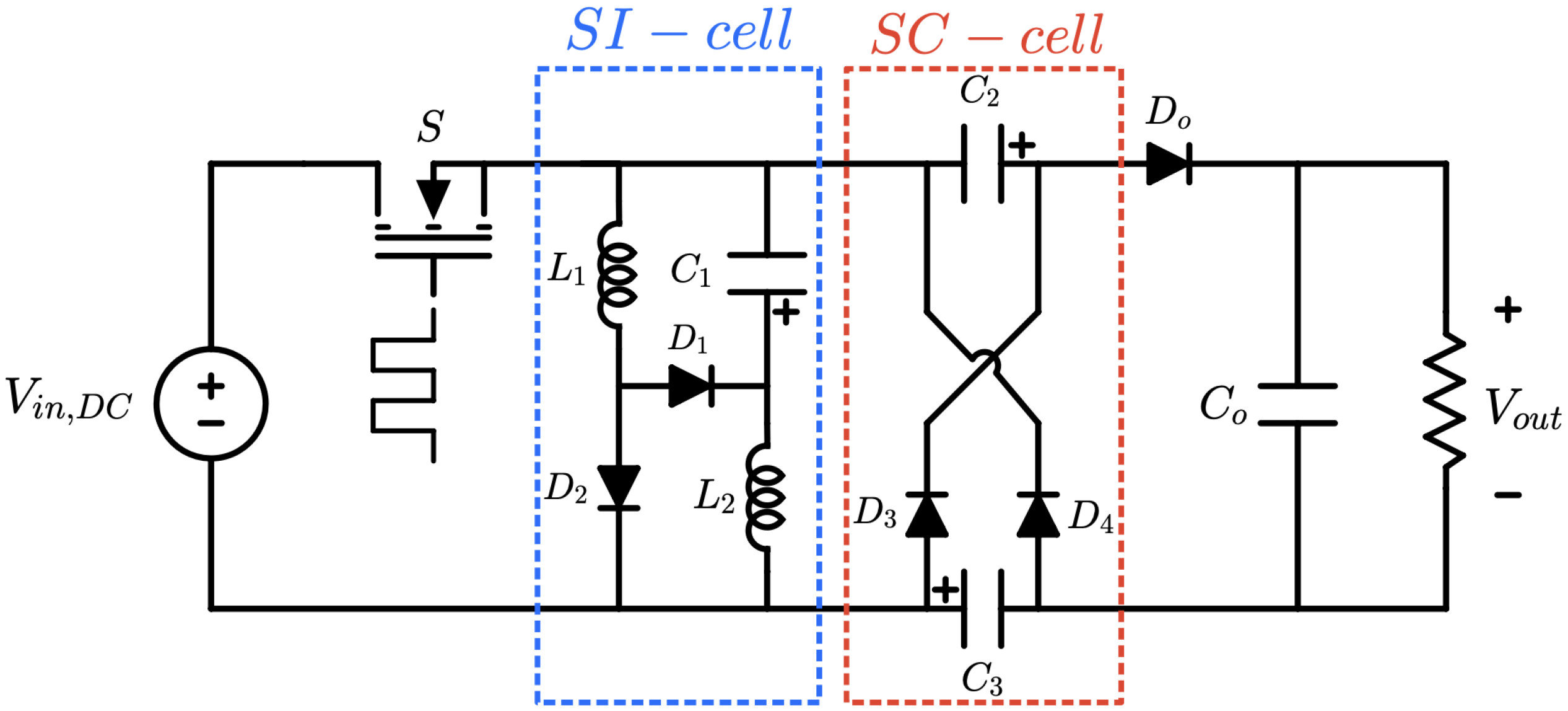
2. SISC Converter
- All the circuit elements are lossless.
- The inductors’ values are adequately high to guarantee working in continuous conduction mode (CCM).
- The capacitors’ values are adequately high to provide constant voltage without any ripples during converter operation.
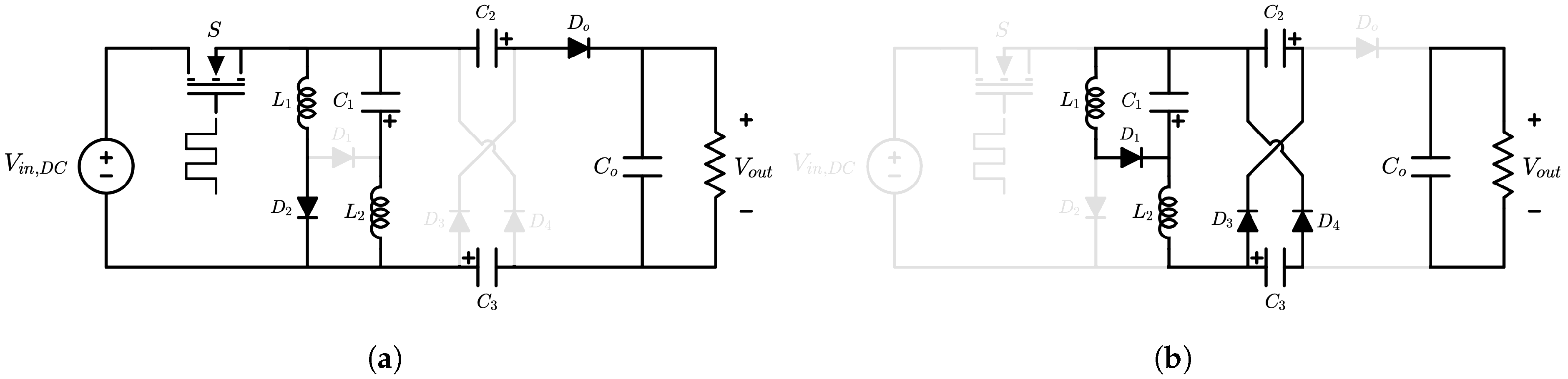
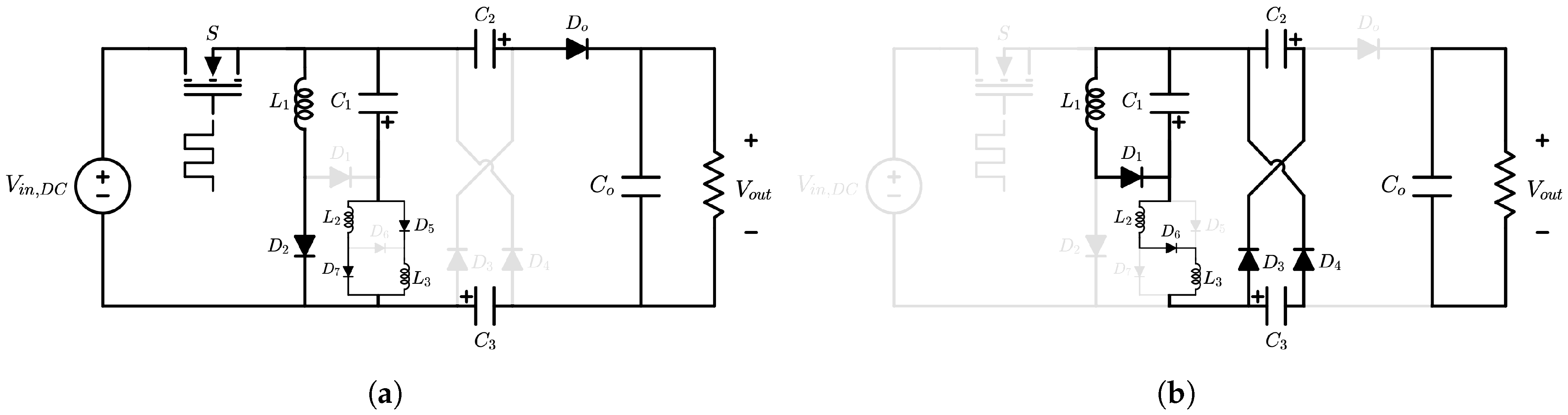
- The two proposed topologies have two modes according to the operation of their semiconductor switches.
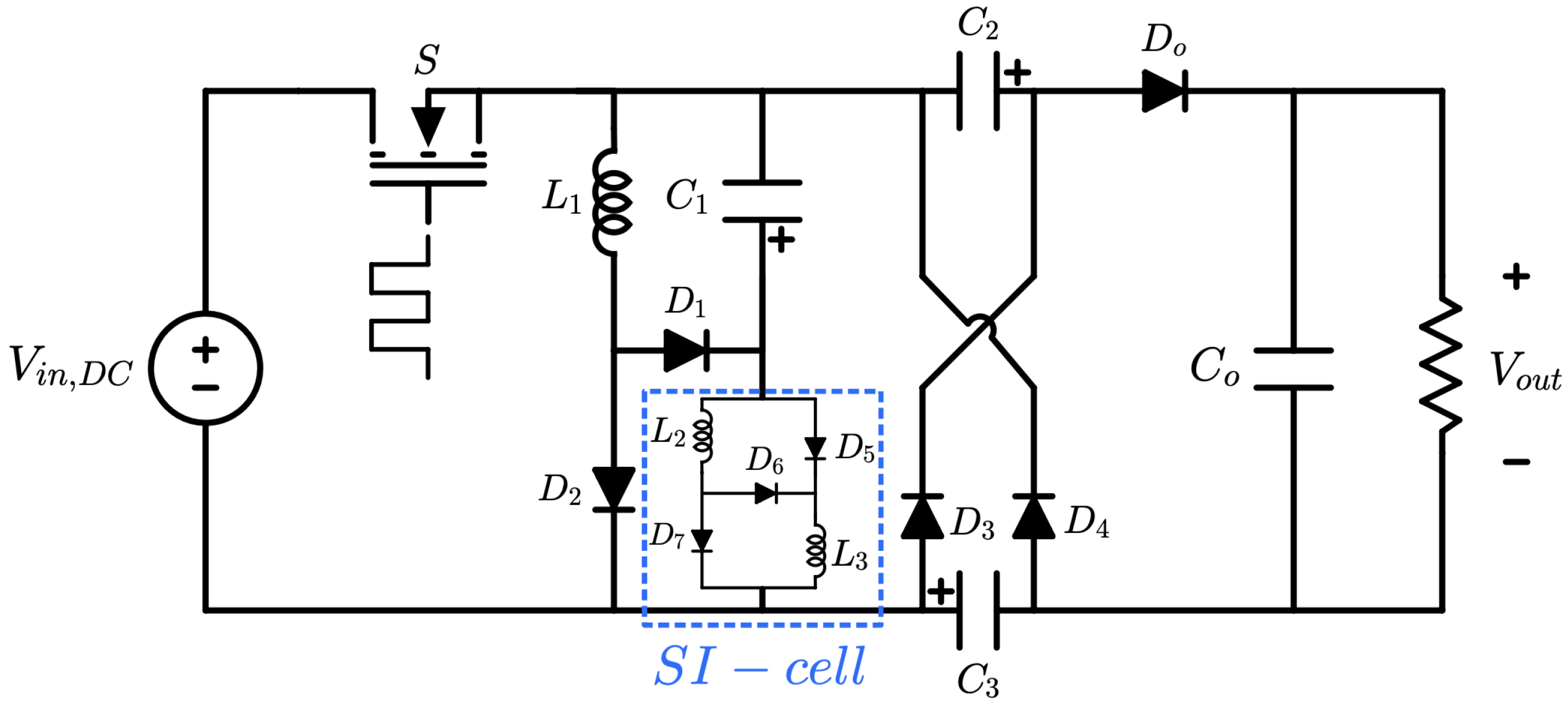
3. Extended Topology of SISC Converter
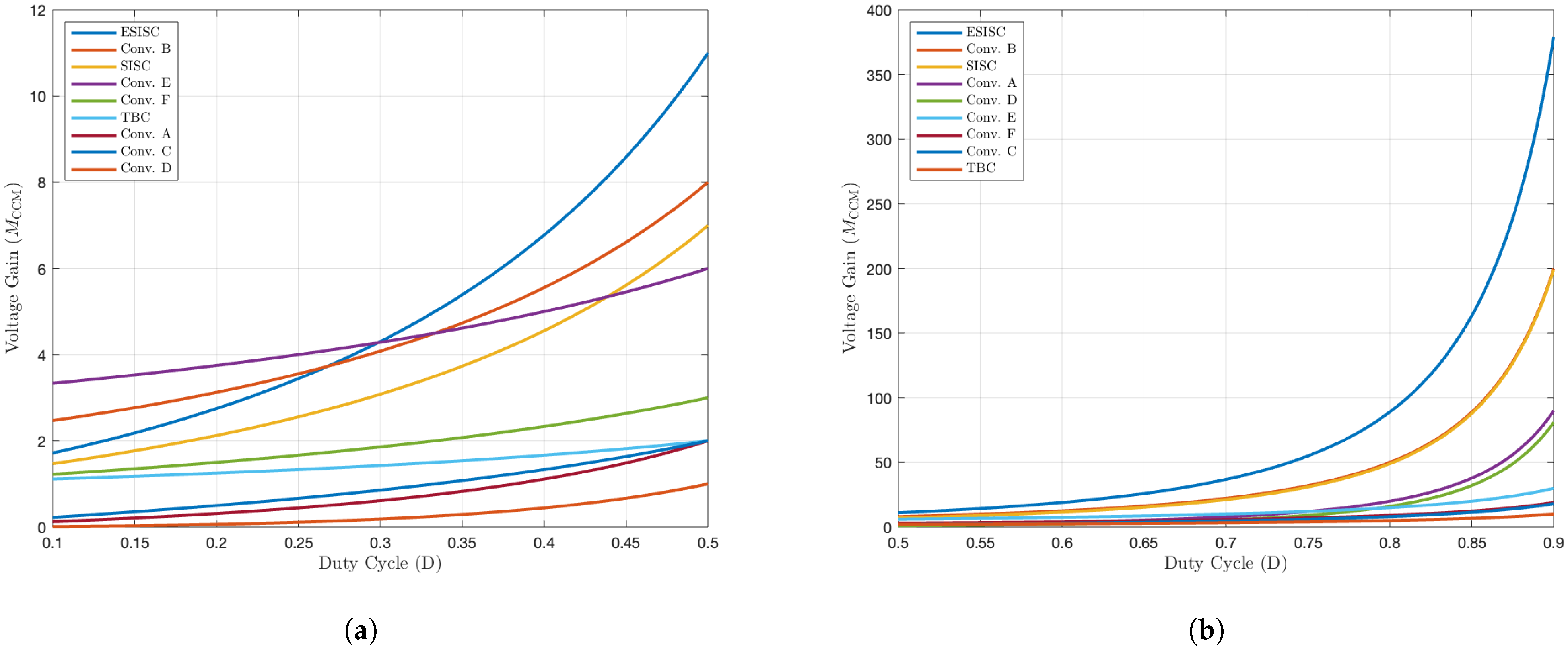
4. Comparison Analysis
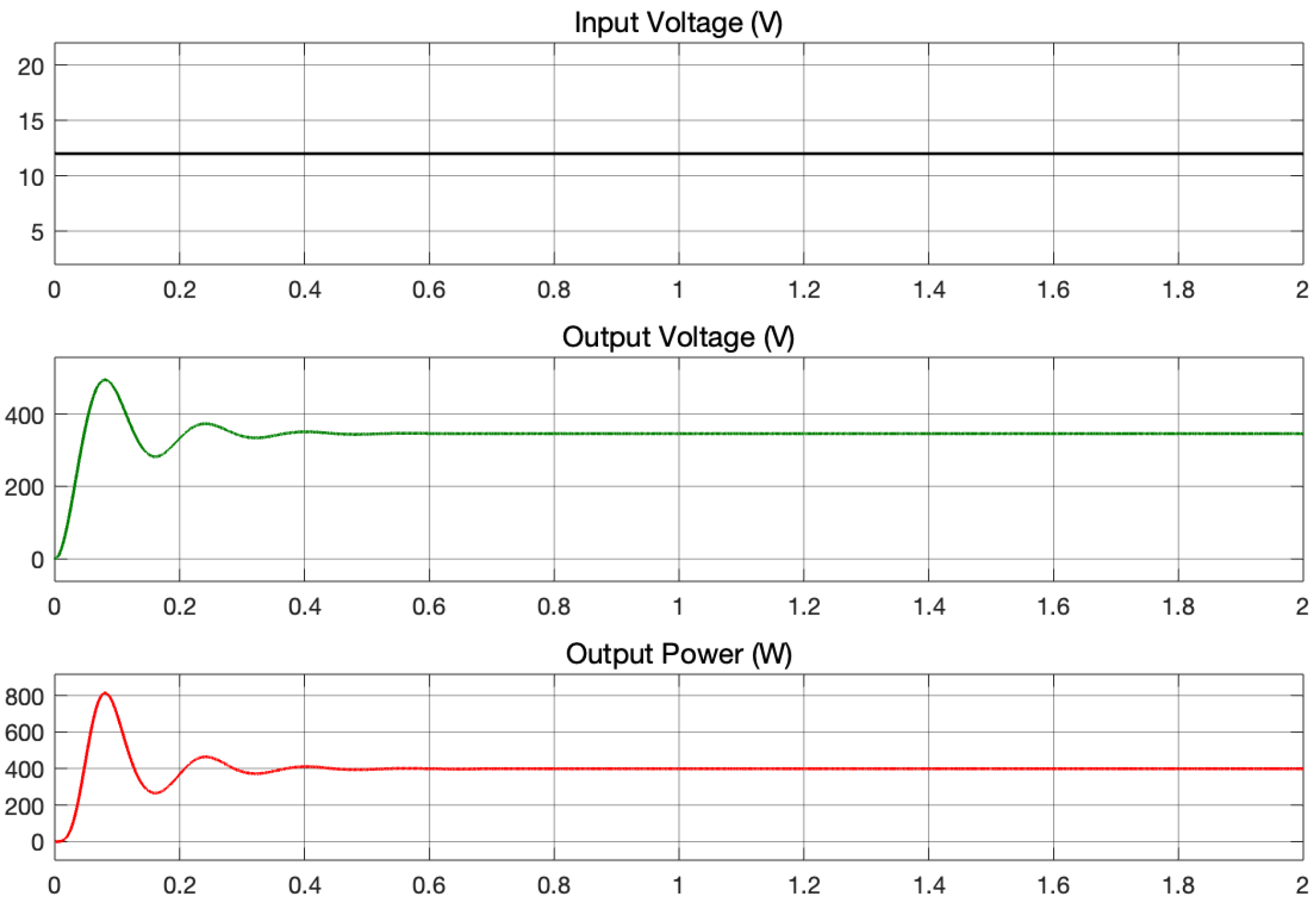
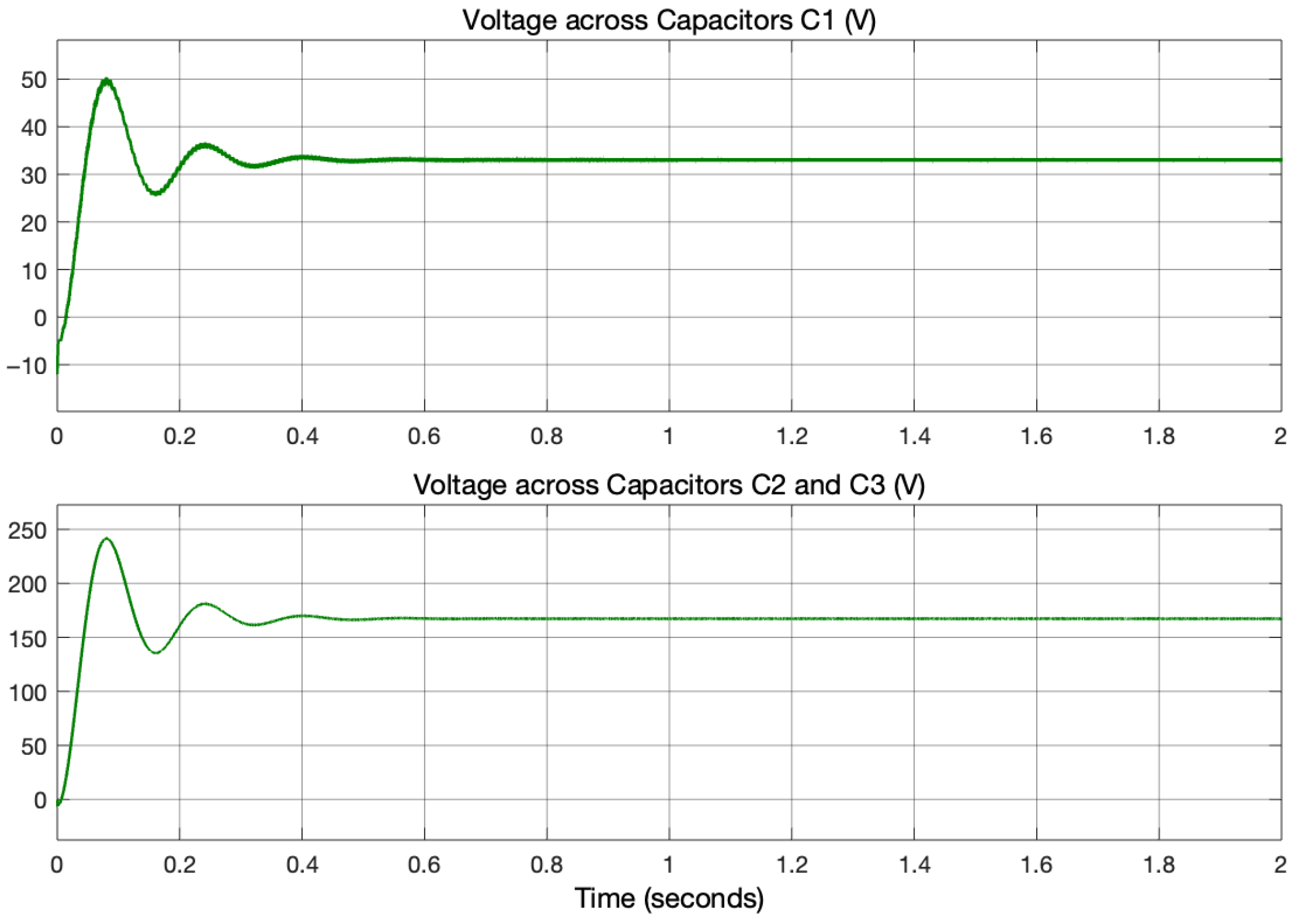
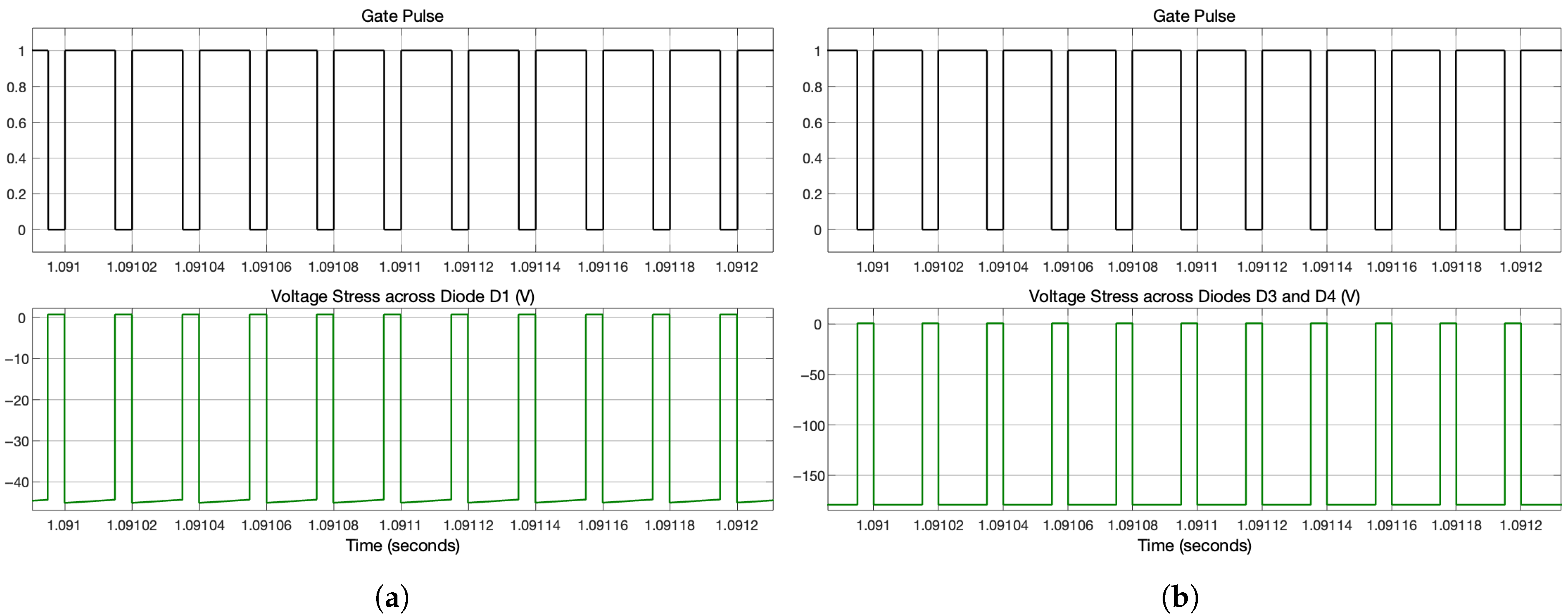
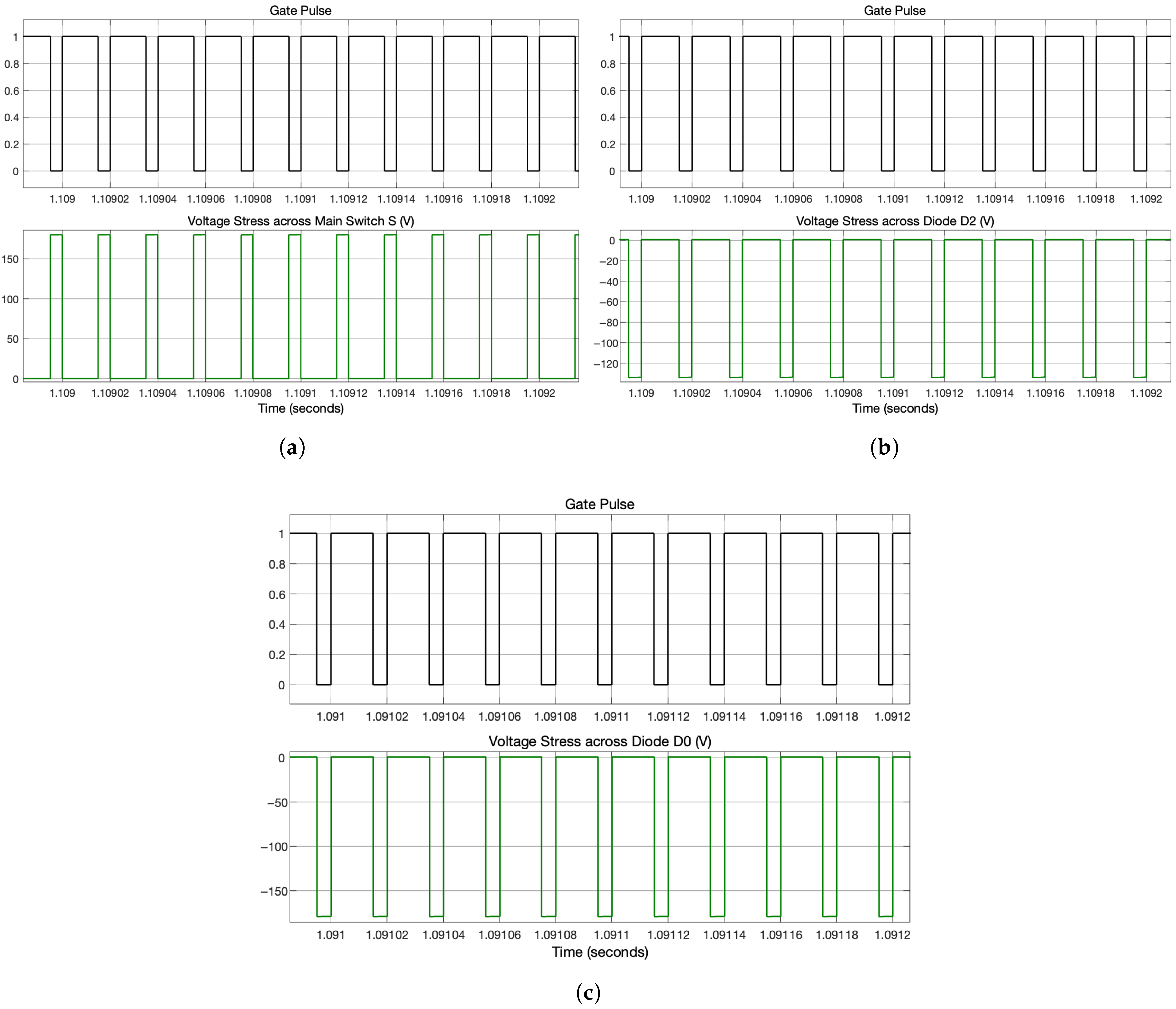
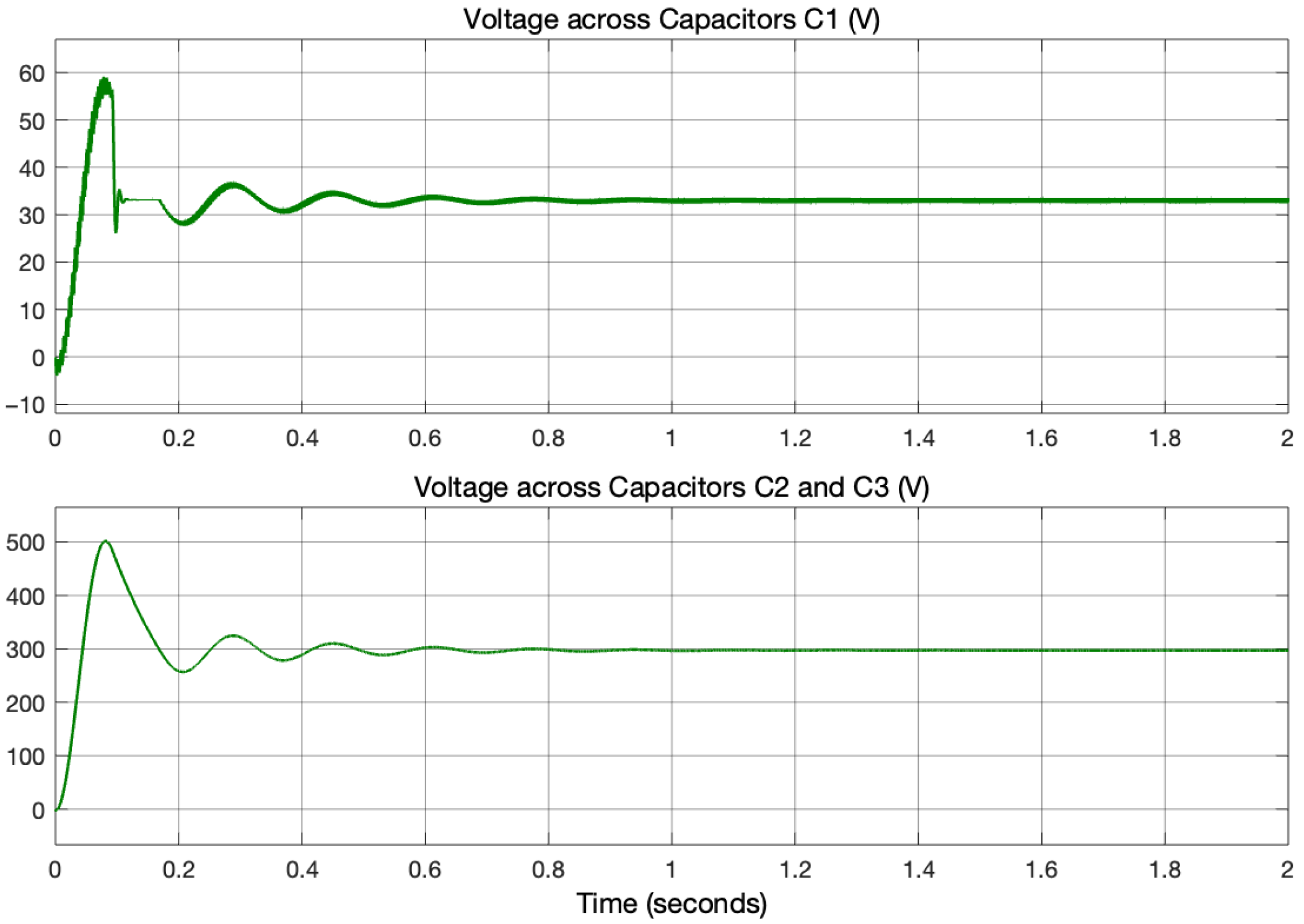
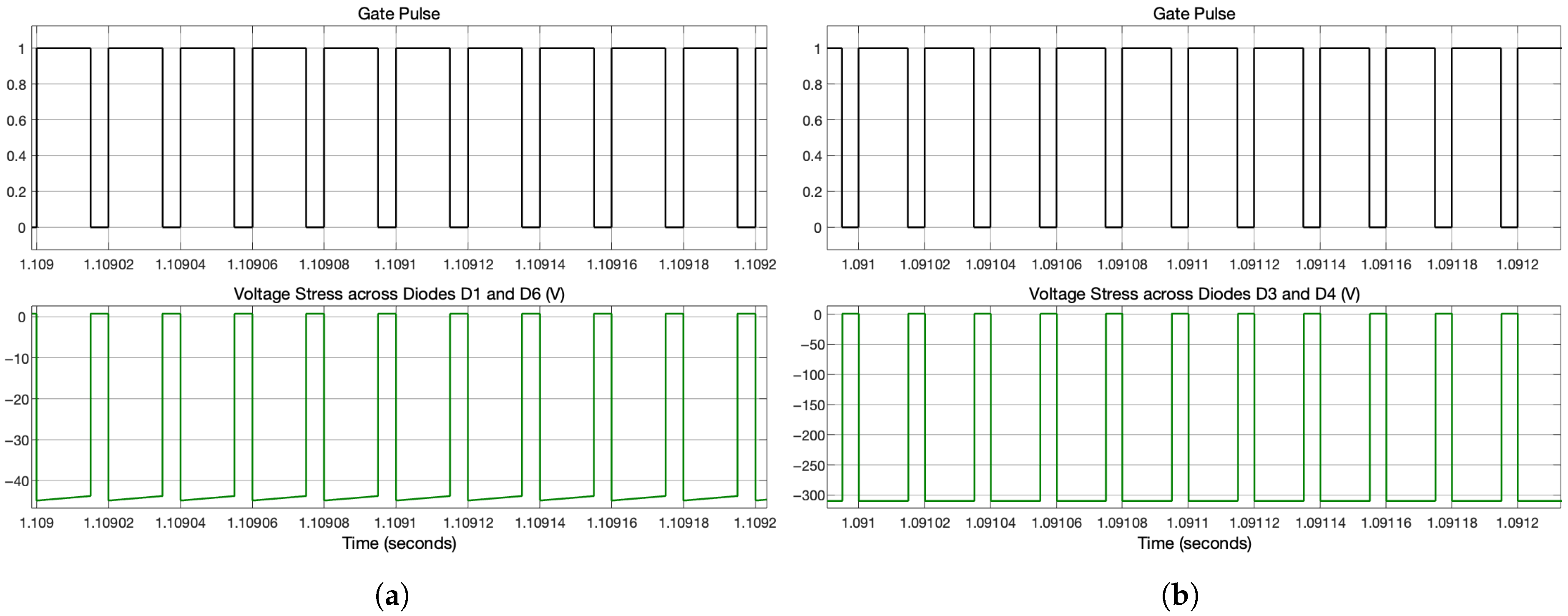
5. Simulation Results
5.1. SISC Converter
5.2. ESISC Converter
6. Conclusions
Funding
Data Availability Statement
Conflicts of Interest
References
- Gupta, T.; Pandit, G.K.; Sharan, B.; Mishra, H.; Singh, S.; Dewan, R. A robust approach for analysis and visualization of CO2 and greenhouse gas emission and its effect. In Proceedings of the 10th International Conference on Computing for Sustainable Global Development (INDIACom), New Delhi, India, 15–17 March 2023; IEEE: New York, NY, USA, 2023; pp. 238–243. [Google Scholar]
- Atia, R.; Yamada, N. Sizing and analysis of renewable energy and battery systems in residential microgrids. IEEE Trans. Smart Grid 2016, 7, 1204–1213. [Google Scholar] [CrossRef] [Scilit]
- Patterson, M.; Macia, N.F.; Kannan, A.M. Hybrid microgrid model based on solar photovoltaic battery fuel cell system for intermittent load applications. IEEE Trans. Energy Convers. 2015, 30, 359–366. [Google Scholar] [CrossRef] [Scilit]
- Kheirollahi, R.; Zhao, S.; Zhang, H.; Lu, X.; Wang, J.; Lu, F. Coordination of ultrafast solid-state circuit breakers in radial DC microgrids. IEEE Trans. Emerg. Sel. Top. Power Electron. 2022, 10, 4690–4702. [Google Scholar] [CrossRef] [Scilit]
- Zhu, X.; Zhang, B.; Li, Z.; Li, H.; Ran, L. Extended switched-boost DC-DC converter adopting switched-capacitor/switched-inductor cells for high step-up conversion. IEEE J. Emerg. Sel. Top. Power Electron. 2017, 5, 1020–1030. [Google Scholar] [CrossRef] [Scilit]
- Gong, L.; Peng, Y.; Cui, C.; Chen, J.; Jiang, L.; Xu, J.; Fang, X.; Wang, Y. A hybrid phase-frequency control of dual active bridge converters for hold-up time extension in more electric aircrafts applications. IEEE Trans. Power Electron. 2024, 39, 14135–14141. [Google Scholar] [CrossRef] [Scilit]
- Hasanpour, S.; Siwakoti, Y.; Blaabjerg, F. A new soft-switching high gain DC/DC converter with bipolar outputs. IET Power Electron. 2024, 17, 144–156. [Google Scholar] [CrossRef] [Scilit]
- Maroti, P.; Padmanaban, S.; Bhaskar, M.; Blaabjerg, F.; Ramachandaramurthy, V.; Siano, P.; Fedák, V. Multistage switched inductor boost converter for renewable energy application. In Proceedings of the IEEE Conference on Energy Conversion (CENCON), Kuala Lumpur, Malaysia, 30–31 October 2017; IEEE: New York, NY, USA, 2017. [Google Scholar] [CrossRef] [Scilit]
- Mousa, M.; Ahmed, M.; Orabi, M. A switched inductor multilevel boost converter. In Proceedings of the IEEE International Conference on Power and Energy, Kuala Lumpur, Malaysia, 29 November–1 December 2010; IEEE: New York, NY, USA, 2010. [Google Scholar] [CrossRef] [Scilit]
- Vinnikov, D.; Roasto, I.; Strzelecki, R.; Adamowicz, M. Step-up DC/DC converters with cascade quasi-Z-source network. IEEE Trans. Ind. Electron. 2012, 59, 3727–3736. [Google Scholar] [CrossRef] [Scilit]
- Lopez, M.; Ramos, J.; Gutierrez, E.; Saldana, J. Modeling and analysis of switch-mode cascade converters with a single active switch. IET Power Electron. 2008, 1, 478–487. [Google Scholar] [CrossRef] [Scilit]
- Forouzesh, M.; Shen, Y.; Yari, K.; Siwakoti, Y.P.; Blaabjerg, F. High-efficiency high step-up DC-DC converter with dual coupled inductors for grid-connected photovoltaic systems. IEEE Trans. Power Electron. 2018, 33, 5976–5982. [Google Scholar] [CrossRef] [Scilit]
- Samadian, A.; Hosseini, S.H.; Sabahi, M. A new three-winding coupled inductor nonisolated quasi-Z-source high step-up DC-DC converter. IEEE Trans. Power Electron. 2021, 36, 11523–11531. [Google Scholar] [CrossRef] [Scilit]
- Oh, Y.; Choi, W.; Kwon, J. Design of a step-up DC-DC converter for standalone photovoltaic systems with battery energy storages. Energies 2022, 15, 44. [Google Scholar] [CrossRef] [Scilit]
- Dizangian, N.; Jovanovic, S.; Poure, P. Modeling and experimental verification of a single-switch quadratic boost DC-DC converter with high voltage gain for energy harvesting. Energies 2025, 18, 5447. [Google Scholar] [CrossRef] [Scilit]
- Babaiahgari, B.; Valdez-Resendiaz, J.E.; Alejo-Reyes, A.; Rosas-Caro, J.C.; Silva-Vera, E.D. Quadratic boost converter with reduced current ripple. Appl. Sci. 2025, 15, 10815. [Google Scholar] [CrossRef] [Scilit]
- Algamluoli, A.; Wu, X. Ultra-high voltage gain DC-DC converter based on new interleaved switched capacitor inductor for renewable energy systems. Int. J. Circuit Theory Appl. 2023, 52, 2435–2465. [Google Scholar] [CrossRef] [Scilit]
- Allehyani, A. An interleaved multilevel DC-DC boost converter with direct input to output connection. IEEE Trans. Ind. Appl. 2023, 59, 7027–7038. [Google Scholar] [CrossRef] [Scilit]
- Samuel, V.L.; Keerthi, G.; Prabhakar, M. Ultra-high gain DC-DC converter based on interleaved quadratic boost converter with ripple-free input current. Int. Trans. Electr. Energy Syst. 2020, 30, e12622. [Google Scholar] [CrossRef] [Scilit]
- Khalid, H.; Mekheilef, S.; Siddique, M.; Mubin, M.; Seyedmahmoudian, M.; Stojcevski, A.; Ahmed, M. A high voltage gain multi-stage DC-DC boost converter with reduced voltage stress. IETE J. Res. 2022, 70, 2032–2046. [Google Scholar] [CrossRef] [Scilit]
- Shoaei, A.; Abbaszadeh, K.; Allahyari, H. A single-inductor multi-input multi-level high step-up DC-DC converter based on switched-diode-capacitor cells for PV applications. IEEE J. Emerg. Sel. Top. Ind. Electron. 2023, 4, 18–27. [Google Scholar] [CrossRef] [Scilit]
- Ranjana, M.; SreeramulaReddy, N.; Kumar, R. A novel non-isolated switched inductor floating output DC-DC multilevel boost converter for fuelcell applications. In Proceedings of the IEEE Students’ Conference on Electrical, Electronics, and Computer Science (SCEECS), Bhopal, India, 1–2 March 2014; IEEE: New York, NY, USA, 2014; pp. 1–5. [Google Scholar] [CrossRef] [Scilit]
- Rajaei, A.; Khazan, R.; Mahmoudian, M.; Mardaneh, M.; Gitizadeh, M. A dual inductor high step-up DC/DC converter based on the cockcroft-walton multiplier. IEEE Trans. Power Electron. 2018, 33, 9699–9709. [Google Scholar] [CrossRef] [Scilit]
- Axelord, B.; Berkovich, Y.; Ioinovici, A. Switched-capacitor/switched-inductor structures for getting transformerless hybrid DC-DC PWM converters. IEEE Trans. Circuits Syst. I Regul. Pap. 2008, 55, 687–696. [Google Scholar] [CrossRef] [Scilit]
- Maroti, P.; Padmanaban, S.; Holm-Nielsen, J.; Bhaskar, M.; Meraj, M.; Iqbal, A. A new structure of high voltage gain SEPIC converter for renewable energy applications. IEEE Access 2019, 7, 89857–89868. [Google Scholar] [CrossRef] [Scilit]
- Rezaie, M.; Abbasi, V. Effective combination of quadratic boost converter with voltage multiplier cell to increase voltage gain. IET Power Electron. 2020, 13, 2322–2333. [Google Scholar] [CrossRef] [Scilit]
- Chandrasekar, G.; Lakshmanan, S. A high efficiency active X2G boost converter with hybrid optimized prportional integral controller for PV powered EV charging applications. Sci. Rep. 2025, 15, 36282. [Google Scholar] [CrossRef] [Scilit] [PubMed]
- Zhang, N.; Zhang, G.; See, K.; Zhang, B. A single-switch quadratic buck-boost converter with continuous input port current and continuous output port current. IEEE Trans. Power Electron. 2017, 33, 4157–4166. [Google Scholar] [CrossRef] [Scilit]
- Rafiee, R.; Batmani, Y. On the design of novel single-switch low loss boost converters with high step-up voltages. IEEE Trans. Power Electron. 2025, 40, 8206–8215. [Google Scholar] [CrossRef] [Scilit]
- Qin, L.; Zhou, L.; Hassan, W.; Soon, J.; Tian, M.; Shen, J. A family of transformer-less single-switch dual-inductor high voltage gain boost converters with reduced voltage and current stresses. IEEE Trans. Power Electron. 2021, 36, 5674–5685. [Google Scholar] [CrossRef] [Scilit]





| T | at | at | CG | S/D/L/C/T | ||||
|---|---|---|---|---|---|---|---|---|
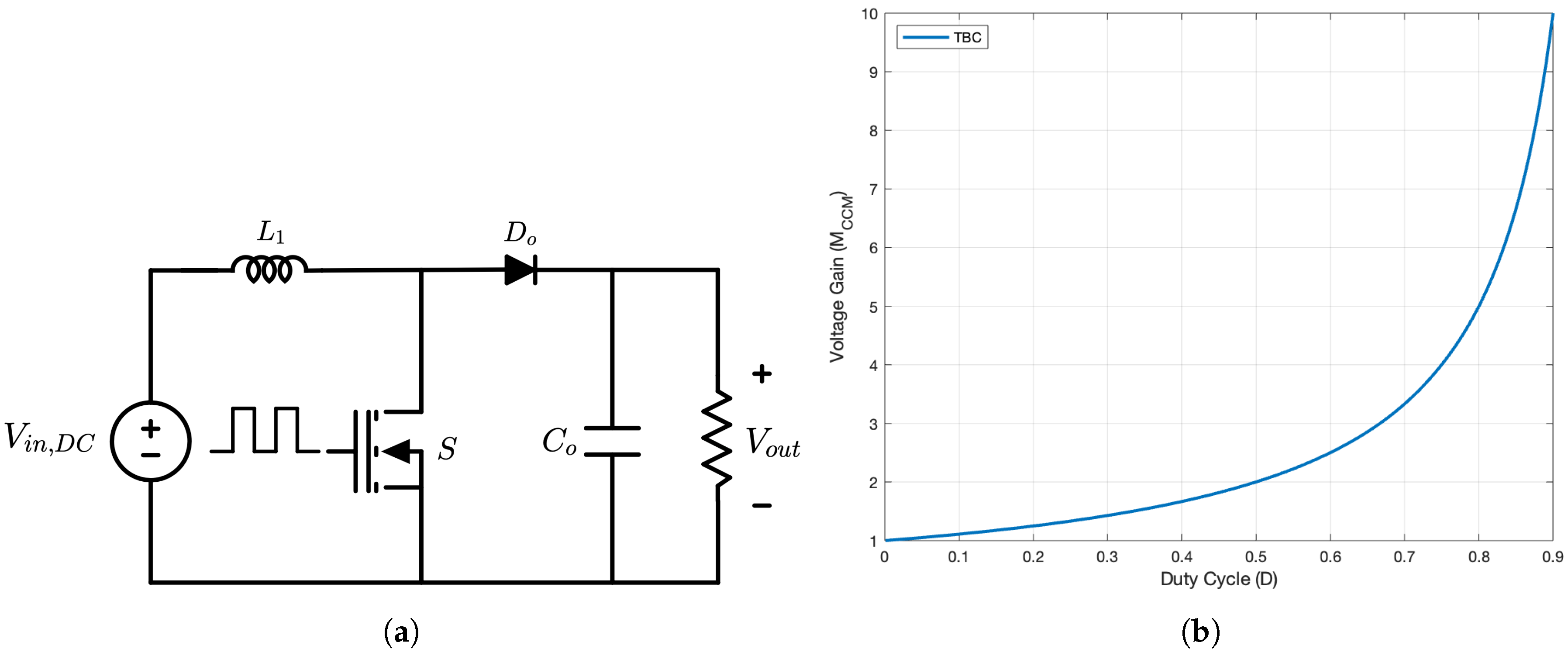
| TBC | 4 | 1 | - | - | ✓ | 1/1/1/1/4 | ||
| [25] | 12 | 1 | 50 kHz | ✓ | 1/3/3/3/10 | |||
| [26] | 32 | 1 | 100 kHz | ✓ | 1/5/3/3/12 | |||
| [27] | 6 | 1 | 10 kHz | ✓ | 1/6/2/4/13 | |||
| [28] | 9 | 40 kHz | ✓ | 1/5/3/3/12 | ||||
| [29] | 12 | 1 | 50 kHz | ✓ | 1/8/3/3/15 | |||
| [30] | 7 | 100 kHz | ✓ | 1/8/3/3/15 | ||||
| SISC | 31 | 50 kHz | ✓ | 1/5/2/4/12 | ||||
| ESISC | 55 | 50 kHz | ✓ | 1/8/3/4/16 |
| Parameter | Value |
|---|---|
| Input voltage () | 12 V |
| Output voltages () | 345 V/605 V |
| Rated power () | 400 W |
| Switching frequency () | 50 kHz |
| Duty cycle (D) | 75% |
| Inductor () | 1 mH |
| Inductors ( and ) | 5 mH |
| Capacitor () | 200F |
| Capacitors ( and ) | 150 F |
| Capacitor () | 100F |
Disclaimer/Publisher’s Note: The statements, opinions and data contained in all publications are solely those of the individual author(s) and contributor(s) and not of MDPI and/or the editor(s). MDPI and/or the editor(s) disclaim responsibility for any injury to people or property resulting from any ideas, methods, instructions or products referred to in the content. |
© 2026 by the author. Licensee MDPI, Basel, Switzerland. This article is an open access article distributed under the terms and conditions of the Creative Commons Attribution (CC BY) license.
Share and Cite
Almalaq, Y. Non-Isolated High-Voltage-Gain Step-Up DC–DC SISC Converter for Renewable Energy Applications. Processes 2026, 14, 640. https://doi.org/10.3390/pr14040640
Almalaq Y. Non-Isolated High-Voltage-Gain Step-Up DC–DC SISC Converter for Renewable Energy Applications. Processes. 2026; 14(4):640. https://doi.org/10.3390/pr14040640
Chicago/Turabian StyleAlmalaq, Yasser. 2026. "Non-Isolated High-Voltage-Gain Step-Up DC–DC SISC Converter for Renewable Energy Applications" Processes 14, no. 4: 640. https://doi.org/10.3390/pr14040640
APA StyleAlmalaq, Y. (2026). Non-Isolated High-Voltage-Gain Step-Up DC–DC SISC Converter for Renewable Energy Applications. Processes, 14(4), 640. https://doi.org/10.3390/pr14040640