


Abstract
Insect flours have attracted increasing interest as potential functional ingredients, although their interactions with beneficial microorganisms remain insufficiently characterized. This study evaluated the in vitro growth-promoting effects of Tenebrio molitor and Hermetia illucens flours on four beneficial bacterial species and characterized their amino acid and low-molecular-weight peptide profiles. The flours were obtained following lipid extraction with pressurized n-propane. Glucose-free MRS broth supplemented with 1% (w/v) insect flour was compared with an unsupplemented control and inulin. Both flours significantly increased Lacticaseibacillus rhamnosus counts compared with the negative control, whereas only H. illucens significantly increased Lactobacillus acidophilus counts. No significant growth enhancement was observed for Bifidobacterium longum or Bifidobacterium adolescentis. Following acid hydrolysis, the sum of quantified amino acids reached 313.8 and 272.4 mg g−1 in T. molitor and H. illucens, respectively. LC–ESI–MS/MS revealed five shared putative peptide assignments, with a broader range of assignments in T. molitor. These findings demonstrate species-dependent bacterial growth responses and compositional differences between the insect flours. Their potential prebiotic activity remains a hypothesis requiring further investigation, including studies of selective microbial utilization and host health benefits.
1. Introduction
Tenebrio molitor and Hermetia illucens are attracting growing interest as sources of protein, lipids, and other compounds with nutritional and technological value. Their composition varies with species, rearing conditions, developmental stage, and processing. These factors matter when processors separate insect biomass into lipid- and protein-rich fractions because each fraction can show properties that differ from whole-insect flour [1].
Defatting supports insect-biomass fractionation by recovering lipids and changing the relative composition and functionality of the remaining solids. Studies of Hermetia illucens flour before and after defatting report substantial changes in lipid and protein proportions after extraction [2]. The resulting solid deserves evaluation as a functional ingredient rather than treatment as a low-value oil-extraction residue.
Pressurized n-propane offers an attractive route for lipid recovery because it operates at relatively mild temperature and can shorten extraction time. Previous work with insect matrices reported efficient lipid recovery and oils with good oxidative stability [1,3]. A biorefinery process should, however, evaluate both the recovered oil and the solid fraction. Functional uses for the solid could improve biomass utilization and increase the value of both process streams.
Insect-derived ingredients can also interact with beneficial intestinal microorganisms. de Carvalho et al. [4] showed that Tenebrio molitor flour supported the viability and metabolic activity of Lactobacillus cultures under nutritional stress. The response can depend on ingredient composition and processing history. Bonomini et al. [5] evaluated whole Hermetia illucens larvae, a protein isolate, and a chitin-rich fraction and observed that all tested materials supported the growth of Limosilactobacillus reuteri. However, bacterial growth decreased as the chitin content increased, indicating that the composition of the insect-derived fractions influenced the observed response.
Matrix composition may involve more than one active component. Defatted insect flours contain proteins, peptides, amino acids, chitin, and other compounds whose accessibility can change during processing. Refael et al. [6] demonstrated that isolated insect chitin significantly increased gut microbial alpha diversity compared with whole insect powders, particularly favoring bacterial groups such as Ruminococcaceae, Lachnospiraceae, Faecalibacterium, and Roseburia, without pronounced changes in short-chain fatty acid production. These findings suggest that both chemical composition and nutrient accessibility may influence microbial responses, although the effects depend on the experimental model and microbial populations evaluated.
Although previous studies have investigated the interactions between insect-derived ingredients and beneficial intestinal microorganisms, important knowledge gaps remain regarding the growth-promoting potential of insect flours from different species and their associated molecular composition. Previous investigations have examined whole insect materials and isolated fractions, including chitin-rich fractions [4,5,6]. However, the relationship between the compositional characteristics of insect-derived matrices and species-dependent bacterial growth responses remains insufficiently characterized. Evaluating bacterial growth alongside amino acid and peptide profiles may provide complementary information on the potential functional applications of these ingredients.
Therefore, this study evaluated the in vitro growth-promoting effects of Tenebrio molitor and Hermetia illucens flours on four beneficial bacterial species and characterized their total amino acid and low-molecular-weight peptide profiles. The flours were obtained as solid fractions following lipid extraction with pressurized n-propane, but the effects of the extraction process itself were not investigated. The findings were interpreted as evidence of bacterial growth-promoting potential rather than confirmation of prebiotic activity.
2. Materials and Methods
2.1. Insect Flours and Defatting
Biofábrica Brasileira de Proteínas Ltda. (Águaí, São Paulo, Brazil) supplied dehydrated Hermetia illucens and Tenebrio molitor flours. We milled the flours with a knife mill (Solab SL-30; Solab, Piracicaba, Brazil) and then defatted them with pressurized n-propane (White-Martins, São Paulo, Brazil). The study evaluated only the resulting defatted flours; it did not analyze whole or non-defatted flours in the microbiological, amino acid, or peptide assays [1,3].
2.2. Pressurized N-Propane Extraction
Lipids were extracted using pressurized n-propane, following the pilot-scale procedures described for insect matrices [1,3]. The n-propane (99.5% purity, White Martins, Brazil) was pressurized using a syringe pump (500D; Teledyne ISCO, Lincoln, NE, USA). The solvent flow was controlled manually using a micrometric valve mounted on a heated aluminum block to minimize cooling during depressurization.
Approximately 900 g of each meal was placed in an extraction vessel with an internal diameter of 6.62 cm and a height of 46.0 cm. Extraction was performed at 40 °C and 60 bar, with an n-propane flow rate of approximately 3 mL min−1, for 60 min. After extraction and solvent separation, the degreased solid fractions were recovered for microbiological and molecular analyses.
2.3. Decontamination of the Defatted Flours
The Tenebrio molitor and Hermetia illucens flours, defatted with n-propane and pressurized, were decontaminated prior to the microbiological tests in order to reduce interference from the native microbiota. The samples were held at 100 °C for 24 h and then exposed to ultraviolet (UV) radiation for 60 min in a laminar flow hood. This procedure was adapted from the work of Carvalho et al. [4].
2.4. Bacterial Cultures and Inoculum Preparation
The following species were used: Lacticaseibacillus rhamnosus, Lactobacillus acidophilus, Bifidobacterium longum, and Bifidobacterium adolescentis. The cultures were provided by the Bioactive Technology Laboratory at the Federal Rural University of Pernambuco (UFRPE) in Recife, Brazil. The stock cultures were stored at −80 °C. The cultures were reactivated in Man, Rogosa, and Sharpe (MRS) broth and incubated at 37 °C for 24 h under anaerobic conditions.
Each bacterial suspension was adjusted to an optical density of 1.0 at 600 nm (OD600 = 1.0). Viable cell concentrations were confirmed by serial decimal dilutions and plating on MRS agar, followed by incubation at 37 °C for 48 h under anaerobic conditions.
2.5. In Vitro Growth-Promoting Assay
Glucose-free Man, Rogosa, and Sharpe (MRS) broth was used as the basal medium. The medium was supplemented with Tenebrio molitor or Hermetia illucens flour, previously defatted using pressurized n-propane, at a concentration of 1% (w/v). Glucose-free MRS broth without supplementation was used as the negative control, while glucose-free MRS broth supplemented with 1% (w/v) inulin served as the positive control.
Each medium was inoculated with 10% (v/v) of the standardized bacterial suspension and incubated at 37 °C for 24 h under anaerobic conditions. Following incubation, serial decimal dilutions were prepared and plated on MRS agar. The plates were subsequently incubated at 37 °C for 48 h under anaerobic conditions.
Viable cell concentrations (CFU mL−1) were calculated based on the number of colonies counted, the corresponding decimal dilution factor, and the volume plated. The resulting values were converted to log10 CFU mL−1 for statistical analysis and presentation.
2.6. Total Amino Acid Analysis
The total amino acid composition of pressurized n-propane-defatted Tenebrio molitor and Hermetia illucens flours was determined following acid hydrolysis. Accordingly, the results represent amino acids recovered from the hydrolyzed matrices rather than free amino acids originally present in the samples.
The samples were hydrolyzed with 6 mol L−1 HCl at a sample-to-acid ratio of 1:25 (w/v) for 8 min at 121 °C. Each hydrolyzed sample was subsequently washed five times with 5 mL of Milli-Q water (Millipore SAS, Molsheim, France). and evaporated to dryness in a sand bath at 110 °C. The resulting residue was reconstituted in 25 mL of Milli-Q water and filtered through a 0.45-µm cellulose filter [7].
Amino acid analysis was performed by high-performance liquid chromatography (HPLC; model 20A, Shimadzu, Kyoto, Japan) coupled to a fluorescence detector (RF-20A, Shimadzu). Prior to injection, the samples were derivatized with o-phthaldialdehyde (OPA; Sigma-Aldrich Brasil Ltda., Barueri, SP, Brazil), sodium borate (Lafan), Brij (Sigma-Aldrich), and mercaptoethanol (Neon). Chromatographic separation was carried out using a Shim-pack GIST C8 column (4.6 × 250 mm; Shimadzu) maintained at 30 °C, with an injection volume of 5 µL and a flow rate of 0.5 mL min−1.
The mobile phases consisted of (A) 20 mmol L−1 sodium acetate adjusted to pH 5.40 and (B) acetonitrile:methanol:water (45:45:10, v/v/v). Gradient elution was performed using 20% B from 1 to 50 min, 40% B from 50 to 120 min, and 90% B from 120 to 137 min, followed by a return to 20% B from 137 to 140 min. Fluorescence was monitored at excitation and emission wavelengths of 340 and 455 nm, respectively.
Amino acids were identified and quantified using external calibration curves prepared from analytical standards (Sigma-Aldrich) over a concentration range of 0.1–5.0 µg mL−1. The standards included aspartic acid, glutamic acid, asparagine, histidine, serine, alanine, glutamine, glycine, threonine, arginine, tyrosine, valine, methionine, phenylalanine, isoleucine, leucine, and lysine. During acid hydrolysis, asparagine and glutamine may undergo deamidation, being converted into aspartic acid and glutamic acid, respectively; thus, the results are expressed as aspartic acid + asparagine and glutamic acid + glutamine. All calibration curves exhibited coefficients of determination (R2) ≥ 0.99 [8].
2.7. Low-Molecular-Weight Peptide Profiling by LC–ESI–MS/MS
Low-molecular-weight peptides were profiled by liquid chromatography–electrospray ionization–tandem mass spectrometry (LC–ESI–MS/MS). Briefly, 0.1 g of each sample was suspended in 1 mL of 50 mmol L−1 ammonium bicarbonate, vortexed for 40 s, and centrifuged for 15 min. Subsequently, 100 µL of the supernatant was mixed with 900 µL of mobile phase, vortexed for 1 min, and centrifuged at 4000 rpm for 10 min. The resulting mixture was maintained at −20 °C for 1 h, after which 100 µL of the supernatant was diluted with 900 µL of mobile phase prior to analysis.
Three injections of independently prepared peptide extracts were performed using a Waters Quattro Premier XE triple-quadrupole mass spectrometer (Waters Corporation, Milford, MA, USA) equipped with an electrospray ionization (ESI) source operating in positive-ion mode and coupled to a Waters 515 pump (Waters Corporation, Milford, MA, USA). Chromatographic separation was carried out on an XBridge C18 column (4.6 × 50 mm, 3.5 µm, Waters Corporation, Milford, MA, USA) using acetonitrile/water/formic acid (70.0:29.9:0.1, v/v/v) as the mobile phase under isocratic conditions at a flow rate of 300 µL min−1. A sample volume of 5 µL was injected through a Rheodyne valve (Rheodyne, Inc., Rohnert Park, CA, USA), and each analysis was performed for 5 min at ambient temperature. The capillary and cone voltages were set at 4.0 kV and 20 V, respectively, while the source and desolvation temperatures were maintained at 110 and 350 °C, respectively. Argon was used as the collision gas at a pressure of 3.0 × 10⁻³ Torr and a collision potential of 15 V.
Candidate peptide ions were screened over an m/z range of 132–400 using constant neutral-loss scanning of 46 Da (NL46), with Q1 and Q3 scanning synchronously and Q3 maintained 46 m/z units below Q1. This neutral loss, associated with the carboxylic moiety of protonated peptides, was employed as a screening criterion rather than as definitive evidence of peptide identity. Selected precursor ions were subsequently subjected to collision-induced dissociation (CID), with Q1 fixed at the precursor m/z and Q3 scanned from m/z 20 to a value 10 m/z units above the precursor.
Peptide sequences were putatively assigned by manual de novo interpretation of CID spectra acquired from precursor ions selected by neutral-loss screening of 46 Da. For dipeptides, candidate C-terminal residues were inferred from y1 ions, and the nominal precursor–y1 mass difference was matched to the N-terminal residue mass. Longer sequences were evaluated using successive y-ion mass differences. Immonium ions, b-series ions, and neutral losses provided complementary evidence, with supporting fragments required in at least two available spectra. Product ions were matched within a mass tolerance of ±0.5 Da. Multiple isobaric candidates were retained when supported by the fragmentation data, and leucine/isoleucine remained unresolved (I/L). Accordingly, all proposed sequences were considered putative assignments rather than unequivocal structural identifications.
The putative peptide sequences were searched against the BIOPEP-UWM database [9], and complementary searches were performed using Peptipedia, AHTPDB, DRAMP, and APD. For sequences containing I/L residues, both alternatives were searched separately. Associations with previously reported biological activities were verified against primary literature sources whenever possible. Bioactivity annotations were used exclusively to provide functional context for the putatively assigned peptide sequences and were not considered experimental evidence of biological activity in the insect flours.
2.8. Statistical Analysis
All experiments were conducted in three independent experimental runs, with each treatment evaluated in triplicate within each run. The triplicate measurements were averaged to obtain one representative value per treatment for each independent run (n = 3). For each bacterial species, treatment effects were analyzed separately using analysis of variance (ANOVA) in a randomized complete block design, with treatment considered as a fixed effect and experimental run as the blocking factor. Four treatments were evaluated: the negative control, inulin, pressurized n-propane-defatted Tenebrio molitor flour, and pressurized n-propane-defatted Hermetia illucens flour. When significant treatment effects were detected, means were compared using Tukey’s test (p < 0.05). Results are expressed as mean ± standard deviation of the three independent experimental runs.
3. Results and Discussion
3.1. Strain-Dependent Bacterial Growth Response
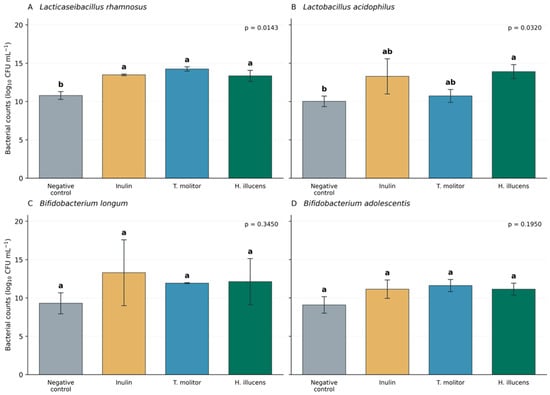
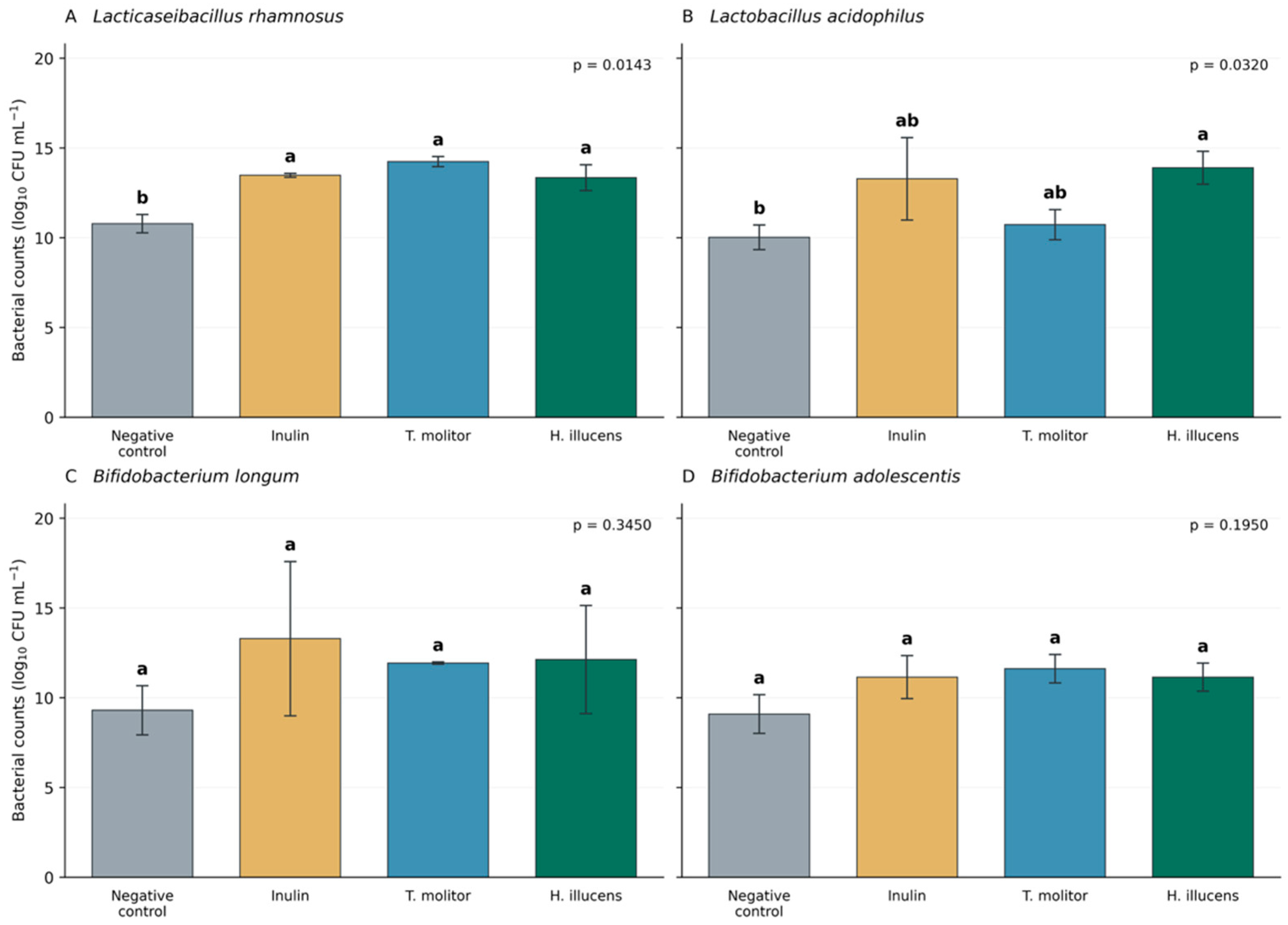
The two pressurized n-propane-defatted flours produced strain-dependent growth responses across the four bacterial species (Figure 1). The treatment effect reached significance for Lacticaseibacillus rhamnosus (p = 0.0143) and Lactobacillus acidophilus (p = 0.0320), but not for Bifidobacterium longum (p = 0.3450) or Bifidobacterium adolescentis (p = 0.1950). These results show that neither matrix produced a uniform response across the tested microorganisms.
Figure 1.
Growth of beneficial bacterial species in glucose-free MRS broth supplemented with pressurized n-propane-defatted insect flours: (A) Lacticaseibacillus rhamnosus, (B) Lactobacillus acidophilus, (C) Bifidobacterium longum, and (D) Bifidobacterium adolescentis. Bars represent means ± standard deviations from three independent experimental runs (n = 3). Different letters within each panel indicate significant differences among treatments according to Tukey’s test (p < 0.05).
All supplemented treatments, including inulin and both insect flours, produced higher Lacticaseibacillus rhamnosus counts than the negative control (p < 0.05). The result indicates that the supplemented media supplied components that supported growth under the assay conditions. It does not identify the responsible component because glucose-free MRS still contains other nutrients and the experiment did not measure substrate consumption. The response agrees with the broader observation by de Carvalho et al. [4] that Tenebrio molitor flour can support Lactobacillus viability and metabolic activity under nutritional stress, although the different processing histories and assay designs limit direct comparison.
Lactobacillus acidophilus exhibited a significant response to Hermetia illucens flour supplementation compared with the negative control (p < 0.05). However, no significant difference was observed between the two insect flours, despite the numerically higher bacterial counts obtained with H. illucens. Similarly, Tenebrio molitor flour and inulin did not differ significantly from the negative control. These findings indicate that H. illucens flour supported bacterial growth under the experimental conditions, although its superiority over T. molitor flour could not be statistically established.
None of the supplemented treatments, including inulin and the two defatted insect flours, significantly increased Bifidobacterium longum or Bifidobacterium adolescentis counts compared with the negative control. The negative-control medium may have supported growth sufficiently to reduce the measurable effect of supplementation. The lack of an inulin response also limits the interpretation of these rows as evidence for or against substrate utilization. The result emphasizes the need to evaluate each bacterial strain with an assay that provides an appropriate dynamic range.
Overall, both insect flours promoted Lacticaseibacillus rhamnosus growth relative to the negative control, whereas only Hermetia illucens produced a clear response in Lactobacillus acidophilus. The two Bifidobacterium species showed no additional growth response. These differences highlight the importance of strain-specific nutritional requirements and substrate accessibility when researchers assess insect-derived matrices as microbiota-modulating ingredients.
3.2. Total Amino Acid Profiles
The pressurized n-propane-defatted flours showed distinct total amino acid profiles (Table 1). Acid hydrolysis recovered 284.4 mg g−1 of the 17 quantified amino acids from Tenebrio molitor and 208.7 mg g−1 from Hermetia illucens. These values describe amino acids recovered from the hydrolyzed solid fractions; they do not represent total protein or the concentration of free amino acids in the original flours.
Table 1.
Total amino acid profiles of pressurized n-propane-defatted insect flours.
Tenebrio molitor contained more aspartic acid + asparagine, glutamic acid + glutamine, histidine, serine, glycine, threonine, arginine, alanine, valine, phenylalanine, isoleucine, and lysine than Hermetia illucens (Table 1). Hermetia illucens contained more tyrosine, methionine, and leucine, whereas glutamine did not differ between the matrices. Lysine showed a high concentration in both flours and a higher value in Tenebrio molitor. Published insect studies also report substantial variation in amino acid composition, which can reflect species, developmental stage, rearing conditions, diet, and processing [1,2,10].
Defatting changes the relative contribution of non-lipid constituents in the resulting solid. Because this study did not analyze whole insect flours in parallel, the present amino acid profiles characterize the co-product of pressurized n-propane extraction rather than the specific effect of defatting on amino acid composition.
The amino acid profiles provide context for the bacterial results but do not establish a direct amino acid–growth relationship. Tenebrio molitor contained more quantified amino acids overall, yet Hermetia illucens produced the clearest response in Lactobacillus acidophilus. Accessibility of nitrogen-containing compounds, peptides, other nutrients, and strain-specific metabolic requirements probably contributed together to the observed responses.
3.3. Low-Molecular-Weight Peptide Profiles
LC–ESI–MS/MS revealed distinct qualitative profiles of putative low-molecular-weight peptides in the two defatted flours (Table 2). Five assignments—S(I/L), AE, CT, GF, and T(I/L)—occurred in both matrices. Hermetia illucens also showed (I/L)V, whereas Tenebrio molitor showed EA, TV, (I/L)P, DP, DV, MP, EV, and D(I/L). The (I/L) notation reflects the reporting of leucine and isoleucine as alternative assignments under the analytical conditions used and is retained to represent these possibilities within the proposed peptide sequences. Taken together, these profiles provide a qualitative characterization of the putative peptides detected in each matrix, highlighting both shared and matrix-specific assignments, while comparisons of peptide abundance remain outside the scope of the present analysis.
Table 2.
Putatively assigned peptide sequences in pressurized n-propane-defatted insect flours based on LC–ESI–MS/MS fragmentation data.
Previous studies and databases have associated several of the assigned sequences with angiotensin-converting enzyme (ACE) inhibition, dipeptidyl peptidase IV (DPP-IV) inhibition, α-glucosidase inhibition, or glucose-related responses [11,12,13,14,15,16,17,18]. These reported associations provide a useful basis for considering the potential functional relevance of the putative peptides identified in the two insect flours and for guiding further investigations. Their contribution to bioactivity within each matrix may be influenced by factors such as peptide concentration, stability, accessibility, and persistence during gastrointestinal digestion, which can be explored through complementary functional and digestion studies. In this context, the annotations presented in Supplementary Table S1 place the putative assignments within the broader literature on bioactive peptides and help identify promising targets for future evaluation.
Tenebrio molitor showed a broader range of putative peptide assignments, suggesting differences in the peptide profiles of the two defatted matrices. The bacterial responses exhibited a distinct pattern, with Lacticaseibacillus rhamnosus responding to both flours and Lactobacillus acidophilus showing a significant response to Hermetia illucens compared with the negative control. Considered together, these observations highlight the value of interpreting peptide diversity alongside the broader nutritional characteristics of each matrix and the metabolic capacities of the bacterial strains. The observed growth responses may reflect the combined contributions of available peptides, amino acids, carbohydrates, and other nutrients, together with strain-specific substrate utilization. This perspective provides a basis for further exploring how matrix composition and peptide characteristics may contribute to bacterial stimulation.
The peptide profiles identify candidates for targeted functional investigation, but authentic standards, quantitative analysis, and direct bioactivity assays would be necessary to determine whether any candidate contributes to the properties of the defatted flours.
Previous studies have demonstrated that individual fractions of insect-derived materials may influence bacterial growth differently. Bonomini et al. [5] reported that whole Hermetia illucens larvae, a protein isolate, and a chitin-rich fraction supported Limosilactobacillus reuteri growth, although the growth-promoting effect decreased with increasing chitin content. In the present study, Tenebrio molitor exhibited a higher sum of quantified amino acids (313.8 mg g−1) and a broader range of putative peptide assignments than Hermetia illucens (272.4 mg g−1). Nevertheless, both flours significantly increased Lacticaseibacillus rhamnosus counts, whereas only H. illucens differed significantly from the negative control for Lactobacillus acidophilus. These findings indicate that the observed bacterial responses cannot be explained solely by the total quantified amino acid content or the number of putative peptide assignments. Because individual flour fractions, including chitin, were not evaluated separately, their contributions to bacterial growth remain undetermined.
3.4. In Vitro Growth-Promoting Potential and Study Limitations
The bacterial growth responses observed in this study were strain-dependent. Both insect flours significantly increased Lacticaseibacillus rhamnosus counts compared with the negative control, whereas only Hermetia illucens significantly increased Lactobacillus acidophilus counts. No significant effects were observed for Bifidobacterium longum or Bifidobacterium adolescentis. Although the amino acid and putative peptide profiles differed between the flours, the specific components responsible for bacterial growth stimulation could not be identified. These findings indicate that the observed responses should be interpreted in relation to the bacterial species evaluated rather than attributed to individual flour constituents.
The present study evaluated bacterial growth in individual cultures without measuring substrate consumption, fermentation metabolites, or the effects of isolated flour fractions. Furthermore, non-defatted flours were not included, preventing conclusions regarding the influence of pressurized n-propane extraction. Therefore, the results support the hypothesis that these insect flours may contain components with potential prebiotic relevance, but they do not establish prebiotic activity according to the criteria proposed by Gibson et al. [19]. Further studies involving fraction-specific assays, complex intestinal microbial communities, and host health outcomes are necessary to investigate this hypothesis.
4. Conclusions
Pressurized n-propane-defatted Tenebrio molitor and Hermetia illucens flours exhibited strain-dependent growth-promoting effects on beneficial bacteria. Both flours significantly increased Lacticaseibacillus rhamnosus counts compared with the negative control, whereas only H. illucens significantly stimulated Lactobacillus acidophilus. No significant growth enhancement was observed for Bifidobacterium longum or Bifidobacterium adolescentis. The flours also exhibited distinct amino acid profiles and qualitative differences in putatively assigned low-molecular-weight peptides. These findings support the potential valorization of defatted insect flours as functional ingredients. Their possible prebiotic activity remains a hypothesis that requires further investigation to establish selective microbial utilization and associated host health benefits.
Supplementary Materials
The following supporting information can be downloaded at: https://www.mdpi.com/article/10.3390/pr14233822/s1. Table S1: Contextual database and literature annotations for the putative peptide sequences reported in Table 3. Supplementary Note S1. Interpretation of Reported Peptide Bioactivities.
Author Contributions
Conceptualization, L.C.-F., A.L.F.P. and E.C.M.; Methodology, L.C.-F., A.L.F.P. and E.C.M.; Investigation, L.C.-F., A.L.F.P., E.C.M., C.D.S., B.C.B.B. and A.C.F.; Formal analysis, L.C.-F., A.L.F.P., E.C.M., C.D.S., B.C.B.B., A.C.F., T.C.P. and C.E.B.; Data curation, L.C.-F., A.L.F.P., E.C.M., C.D.S., B.C.B.B., A.C.F., T.C.P. and C.E.B.; Writing—original draft preparation, L.C.-F., A.L.F.P., E.C.M., C.D.S., B.C.B.B., A.C.F., T.C.P. and C.E.B.; Writing—review and editing, L.C.-F., A.L.F.P., E.C.M., C.D.S., B.C.B.B., A.C.F., T.C.P. and C.E.B.; Supervision, L.C.-F.; Project administration, L.C.-F. All authors have read and agreed to the published version of the manuscript.
Funding
This research received no external funding.
Data Availability Statement
The data supporting the findings of this study are available from the corresponding author upon reasonable request.
Acknowledgments
The authors acknowledge the scientific collaboration associated with Research Project No. 442535/2024-4, under CNPq/MCTI/FNDCT Call No. 22/2024.
Conflicts of Interest
The authors declare no conflicts of interest.
References
- da Silva, N.M.; Bevilaqua, G.C.; da Silva, C.; Forte, M.B.S.; Feihrmann, A.C.; Cardozo-Filho, L. Obtaining and characterization of flour and oil from black soldier fly (Hermetia illucens) and yellow mealworm (Tenebrio molitor) larvae for human consumption. Appl. Food Res. 2025, 5, 101359. [Google Scholar] [CrossRef] [Scilit]
- Zozo, B.; Wicht, M.M.; Mshayisa, V.V.; van Wyk, J. The Nutritional Quality and Structural Analysis of Black Soldier Fly Larvae Flour before and after Defatting. Insects 2022, 13, 168. [Google Scholar] [CrossRef] [Scilit] [PubMed]
- da Cruz, R.M.S.; da Silva, C.; da Silva, E.A.; Hegel, P.; Barão, C.E.; Cardozo-Filho, L. Composition and oxidative stability of oils extracted from Zophobas morio and Tenebrio molitor using pressurized n-propane. J. Supercrit. Fluids 2022, 181, 105504. [Google Scholar] [CrossRef] [Scilit]
- de Carvalho, N.M.; Teixeira, F.; Silva, S.; Madureira, A.R.; Pintado, M.E. Potential prebiotic activity of Tenebrio molitor insect flour using an optimized in vitro gut microbiota model. Food Funct. 2019, 10, 3909–3922. [Google Scholar] [CrossRef] [Scilit] [PubMed]
- Bonomini, M.G.; Verstringe, S.; Bruggeman, G.; Vandercruyssen, R.; Carmans, H.; Caligiani, A. Characterisation, antibacterial activity, and prebiotic potential of dried Hermetia illucens L. larvae and of their fractions. J. Insects Food Feed 2025, 11, 273–288. [Google Scholar] [CrossRef] [Scilit]
- Refael, G.; Riess, H.T.; Levi, C.S.; Magzal, F.; Tamir, S.; Koren, O.; Lesmes, U. Responses of the human gut microbiota to physiologically digested insect powders or isolated chitin thereof. Future Foods 2022, 6, 100197. [Google Scholar] [CrossRef] [Scilit]
- Denardi-Souza, T.; Massarolo, K.C.; Tralamazza, S.M.; Badiale-Furlong, E. Monitoring of fungal biomass changed by Rhizopus oryzae in relation to amino acid and essential fatty acids profile in soybean meal, wheat and rice. CyTA-J. Food 2018, 16, 156–164. [Google Scholar] [CrossRef] [Scilit]
- Corleto, K.A.; Singh, J.; Jayaprakasha, G.K.; Patil, B.S. A sensitive HPLC-FLD method combined with multivariate analysis for the determination of amino acids in l-citrulline rich vegetables. J. Food Drug Anal. 2019, 27, 717–728. [Google Scholar] [CrossRef] [Scilit] [PubMed]
- Minkiewicz, P.; Iwaniak, A.; Darewicz, M. BIOPEP-UWM Database of Bioactive Peptides: Current Opportunities. Int. J. Mol. Sci. 2019, 20, 5978. [Google Scholar] [CrossRef] [Scilit] [PubMed]
- Yi, L.; Lakemond, C.M.M.; Sagis, L.M.C.; Eisner-Schadler, V.; van Huis, A.; van Boekel, M.A.J.S. Extraction and characterisation of protein fractions from five insect species. Food Chem. 2013, 141, 3341–3348. [Google Scholar] [CrossRef] [Scilit] [PubMed]
- Lan, V.T.T.; Ito, K.; Ohno, M.; Motoyama, T.; Ito, S.; Kawarasaki, Y. Analyzing a dipeptide library to identify human dipeptidyl peptidase IV inhibitor. Food Chem. 2015, 175, 66–73. [Google Scholar] [CrossRef] [Scilit] [PubMed]
- Nongonierma, A.B.; Mooney, C.; Shields, D.C.; FitzGerald, R.J. Inhibition of dipeptidyl peptidase IV and xanthine oxidase by amino acids and dipeptides. Food Chem. 2013, 141, 644–653. [Google Scholar] [CrossRef] [Scilit] [PubMed]
- Cheung, H.S.; Wang, F.L.; Ondetti, M.A.; Sabo, E.F.; Cushman, D.W. Binding of peptide substrates and inhibitors of angiotensin-converting enzyme. Importance of the COOH-terminal dipeptide sequence. J. Biol. Chem. 1980, 255, 401–407. [Google Scholar] [CrossRef] [Scilit]
- Morifuji, M.; Koga, J.; Kawanaka, K.; Higuchi, M. Branched-chain amino acid-containing dipeptides, identified from whey protein hydrolysates, stimulate glucose uptake rate in L6 myotubes and isolated skeletal muscles. J. Nutr. Sci. Vitaminol. 2009, 55, 81–86. [Google Scholar] [CrossRef] [Scilit] [PubMed]
- Hatanaka, T.; Inoue, Y.; Arima, J.; Kumagai, Y.; Usuki, H.; Kawakami, K.; Kimura, M.; Mukaihara, T. Production of dipeptidyl peptidase IV inhibitory peptides from defatted rice bran. Food Chem. 2012, 134, 797–802. [Google Scholar] [CrossRef] [Scilit] [PubMed]
- van Platerink, C.J.; Janssen, H.G.M.; Haverkamp, J. Application of at-line two-dimensional liquid chromatography-mass spectrometry for identification of small hydrophilic angiotensin I-inhibiting peptides in milk hydrolysates. Anal. Bioanal. Chem. 2008, 391, 299–307. [Google Scholar] [CrossRef] [Scilit]
- Mora, L.; González-Rogel, D.; Heres, A.; Toldrá, F. Iberian dry-cured ham as a potential source of alpha-glucosidase-inhibitory peptides. J. Funct. Foods 2020, 67, 103840. [Google Scholar] [CrossRef] [Scilit]
- Moreno-Mariscal, C.; Carrera-Alvarado, G.; Mora, L.; Toldrá, F. Neprilysin (NEP) and angiotensin-converting enzyme-I (ACE-I) inhibitory dipeptides from chicken carcass hydrolysates. LWT 2025, 221, 117591. [Google Scholar] [CrossRef] [Scilit]
- Gibson, G.R.; Hutkins, R.; Sanders, M.E.; Prescott, S.L.; Reimer, R.A.; Salminen, S.J.; Scott, K.; Stanton, C.; Swanson, K.S.; Cani, P.D.; et al. Expert consensus document: The International Scientific Association for Probiotics and Prebiotics (ISAPP) consensus statement on the definition and scope of prebiotics. Nat. Rev. Gastroenterol. Hepatol. 2017, 14, 491–502. [Google Scholar] [CrossRef] [Scilit] [PubMed]

Disclaimer/Publisher’s Note: The statements, opinions and data contained in all publications are solely those of the individual author(s) and contributor(s) and not of MDPI and/or the editor(s). MDPI and/or the editor(s) disclaim responsibility for any injury to people or property resulting from any ideas, methods, instructions or products referred to in the content. |
© 2026 by the authors. Licensee MDPI, Basel, Switzerland. This article is an open access article distributed under the terms and conditions of the Creative Commons Attribution (CC BY) license.