


Abstract
Aiming at the challenges of gas (CH4) drainage difficulties and reservoir stimulation in deep low-permeability coal seams, taking the No. 2 coal sample from Shuanglong Coal Mine as the research object, a high-power ultrasonic experimental system (25 kHz, 18 kW) was employed, combined with low-pressure nitrogen adsorption (LP-N2) and nuclear magnetic resonance (NMR) joint testing methods. The dynamic evolution laws of multi-scale pore structures and specific surface areas of the coal under different ultrasonic treatment durations (0–240 min) were systematically investigated. The results indicate that ultrasonic waves can exert significant physical modification on the coal body through high-frequency mechanical vibration and cavitation effects. As the treatment duration extends from 0 min to 240 min, the maximum adsorption capacity of the coal sample increases remarkably from 4.18 cm3/g to 12.35 cm3/g (a 2.95-fold increase), the total pore volume rises from 0.0062 cm3/g to 0.0187 cm3/g (with a cumulative growth rate of 201.61%), and the BET specific surface area leaps from 3.4 m2/g to 8.2 m2/g (with a cumulative growth rate of 141.2%). Meanwhile, NMR T2 spectrum analysis reveals that ultrasonic modification exhibits significant differentiation characteristics across pores of various scales. The area change rate of the macropore and microfracture intervals reaches 176.50% at 240 min (with a linear fitting slope of 0.79), and its expansion rate and increment far exceed those of micropores and mesopores (with slopes of 0.17 and 0.19, respectively). This effectively breaks closed pore channels and promotes the connectivity of microfractures, thereby substantially improving the overall pore connectivity and gas seepage performance of the coal reservoir.
1. Introduction
At present, with the gradual depletion of shallow coal resources, coal mining in China is accelerating toward the deep crust [1,2]. As the mining depth extends downward, the multi-field coupling effect of the in situ stress field, temperature field, and fluid field intensifies sharply, endowing deep coal and rock masses with composite dynamic disaster characteristics typical of “high in-situ stress, high gas pressure, and strong latent pressure-relief response [3,4,5].” Under this background, the prevention and control of underground disasters such as coal and gas outbursts are becoming increasingly severe, while low gas drainage efficiency remains the core bottleneck restricting the safe and efficient mining of deep strata [6,7,8]. Fundamentally, the vast majority of coal seams in China have experienced complex and multi-stage tectonic evolutions, resulting in a dense coal matrix, endogenetic fractures heavily compacted or mineral-filled, and a permeability consistently hovering at an extremely low level of 0.1–1.0 × 10⁻⁶ µm2 [9]. How to break through the matrix constraints, unblock closed or semi-closed migration channels, and achieve the three-dimensional construction of macro- and meso-fracture networks in the reservoir has become a crucial technological direction urgently needed to be broken through in the fields of coalbed methane development and mine disaster management.
To improve the fluid migration capacity of low-permeability coal seams, the engineering and academic communities have long been committed to the innovation of hydraulic stimulation technologies. Conventional pressure-relief and permeability-enhancement methods, such as hydraulic fracturing [10], hydraulic slotting [11], high-pressure pulse water injection [12], and hydraulic flushing [13], have achieved remarkable results in practice. However, when facing deep complex tectonic soft coal or arid water-deficient mining areas, the aforementioned fluid-injection technologies exhibit obvious limitations. On the one hand, large-scale injection of high-energy fluids easily triggers severe water-lock effects and clay mineral expansion, causing secondary pollution to the reservoir. On the other hand, the fluid propagation path is strictly controlled by primary fractures, and the stimulation range is often difficult to precisely control under high in situ stress. Therefore, introducing non-fluid-injection-dependent physical-field-enhanced stimulation technologies has gradually become a research hotspot [14,15]. As a water-free and pollution-free dry fracturing method, ultrasonic physical modification has demonstrated unique application potential since its introduction into the fields of rock mechanics and coal science. Its basic principle is to utilize high-frequency mechanical vibration and transient microjets released by the collapse of cavitation bubbles to act on the solid–liquid interface of coal and rock, inducing microcrack initiation, propagation, and mutual interconnection through alternating stress fatigue effects [16,17,18]. This physical process can not only precisely regulate energy injection in designated regions, but also produce differentiated cleaning and reconstruction effects on nanometer-scale micropores, transitional mesopores, and macroscopic fractures. Yang et al. [19] investigated the effect of ultrasonic modification of coal on methane adsorption. Oxygen content in coal is second only to carbon. It plays a critical role in gas adsorption within the coal matrix. Therefore, analyzing the surface oxygen content of coal samples is crucial. X-ray photoelectron spectroscopy (XPS) tests were conducted on four coal samples before and after ultrasonic treatment. This was used to evaluate the surface contents of carbon and oxygen. The results showed that surface carbon content increased after ultrasonic treatment, while oxygen content decreased. Compared with the raw coal samples, the oxygen content of the treated samples decreased by 45.28% to 57.09%. Cui et al. [20] conducted an in-depth study on the methane adsorption behavior under three different modes of ultrasonic comprehensive effect (UCE), ultrasonic thermal effect (UTE), and ultrasonic mechanical vibration effect (UMVE). The research results showed that CH4 adsorption was significantly inhibited by UCE, and this inhibition was mainly dominated by UTE. In contrast, UMVE enhanced CH4 adsorption to a certain extent. Tian et al. [21] constructed a molecular structure model of the pore wall based on the results of coal chemical structure tests. The molecular simulation results showed that the ultrasonic-induced chemical changes in coal molecules reduced their oxygen-containing structures, thereby improving the competitive adsorption behavior of CH4 and CO2 in small pores. Wang et al. [22] established a mechanical damage model for coal subjected to ultrasonic excitation with varying durations. They found that the peak stress error fluctuated within a narrow range, demonstrating that the proposed model can effectively capture the influence of ultrasonic excitation on coal damage evolution. Cao et al. [23] investigated the spatial damage effects of water-based ultrasonic waves on the structure and permeability of high-rank coal. The results showed that with the extension of treatment duration, the permeability of the coal body increased by several orders of magnitude, and the growth rate was relatively rapid during the pore-generating stage and the connected pore-cluster formation stage, whereas it was relatively slow during the expansion stage. Zhang et al. [24] investigated the CH4 seepage and desorption processes in coal bodies subjected to ultrasonic cavitation treatment using numerical simulation. The results indicate that ultrasonic cavitation effectively enlarges the adsorption pores within the range of 2–15 nm and significantly enhances the spatial size, connectivity, and complexity of seepage pores. In addition, ultrasonic cavitation can substantially improve the CH4 flow capacity of the reservoir, with the permeability increasing to 113.64 times its original value.
Although extensive macro-permeability tests and desorption kinetics studies have been conducted by researchers worldwide on ultrasonic-fractured coal, confirming the effectiveness of acoustic radiation in enhancing fluid migration rates, existing findings largely focus on macroscopic apparent physical parameters. A systematic quantitative analysis regarding the deep-seated evolution of the full-aperture pore space and fluid occurrence states within coal remains lacking. Coal is essentially a complex heterogeneous porous medium composed of multi-scale pores [25], where micropores govern gas adsorption capacity, whereas mesopores and macropores serve as the primary pathways for gas diffusion and seepage [26]. As a core controlling variable that determines acoustic energy accumulation and structural damage, the continuous irradiation of ultrasonic treatment duration—specifically how it quantitatively modifies pore volume evolution, specific surface area distribution, and pore connectivity across various scales, and particularly the differentiation characteristics and underlying dynamic mechanisms of multi-scale pores in response to ultrasonic irradiation—has yet to be fully elucidated.
Based on this, taking the raw coal from the No. 2 coal seam of Shuanglong Coal Mine in Shaanxi Province as the research object, this paper designs and constructs a submerged ultrasonic irradiation experimental system with precise temperature control. By setting a single-variable treatment duration gradient (0–240 min) combined with joint LP-N2 and NMR testing methods, this study systematically analyzes the modification laws and microscopic dynamic mechanisms of ultrasonic treatment duration on the pore structure of weakly caking coal across multiple quantitative dimensions, including multi-scale pore volume increments, BET specific surface area evolution, T2 spectrum area migration, and pore connectivity changes. This work aims to provide a solid theoretical foundation for the engineering design of efficient ultrasonic permeability enhancement in deep low-permeability coal seams.
2. Experimental Samples, System, and Testing Methods
2.1. Coal Sample Selection and Preparation
Coal samples for experimental testing were collected from the No. 2 coal seam of Shuanglong Coal Mine in Shaanxi Province. To ensure the uniformity of the native structure and basic properties of the coal samples as much as possible and minimize the impact of heterogeneity on the experimental results, raw coal was taken from the same location of the coal seam on site, sealed in airtight bags, and transported to the laboratory. The raw coal was prepared into pulverized coal and cylindrical coal samples (coal cores) of various particle sizes and dimensions for microstructural testing of the pore network. Furthermore, based on the GB/T 30732–2014 standard [27], the macro-components of the coal sample (including ash, volatile matter, moisture, and fixed carbon) were quantitatively determined using an automated proximate analyzer (WS-G818, Changsha Yuanguang Ruixiang Technology Co., Ltd.). The basic proximate analysis results of the coal sample are listed in Table 1.
Table 1.
Basic parameters of Shuanglong Coal Mine No. 2 coal samples.
2.2. Experimental System
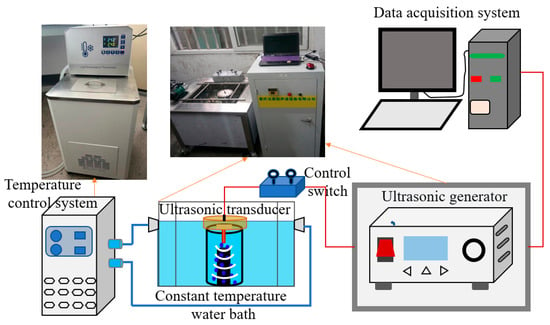
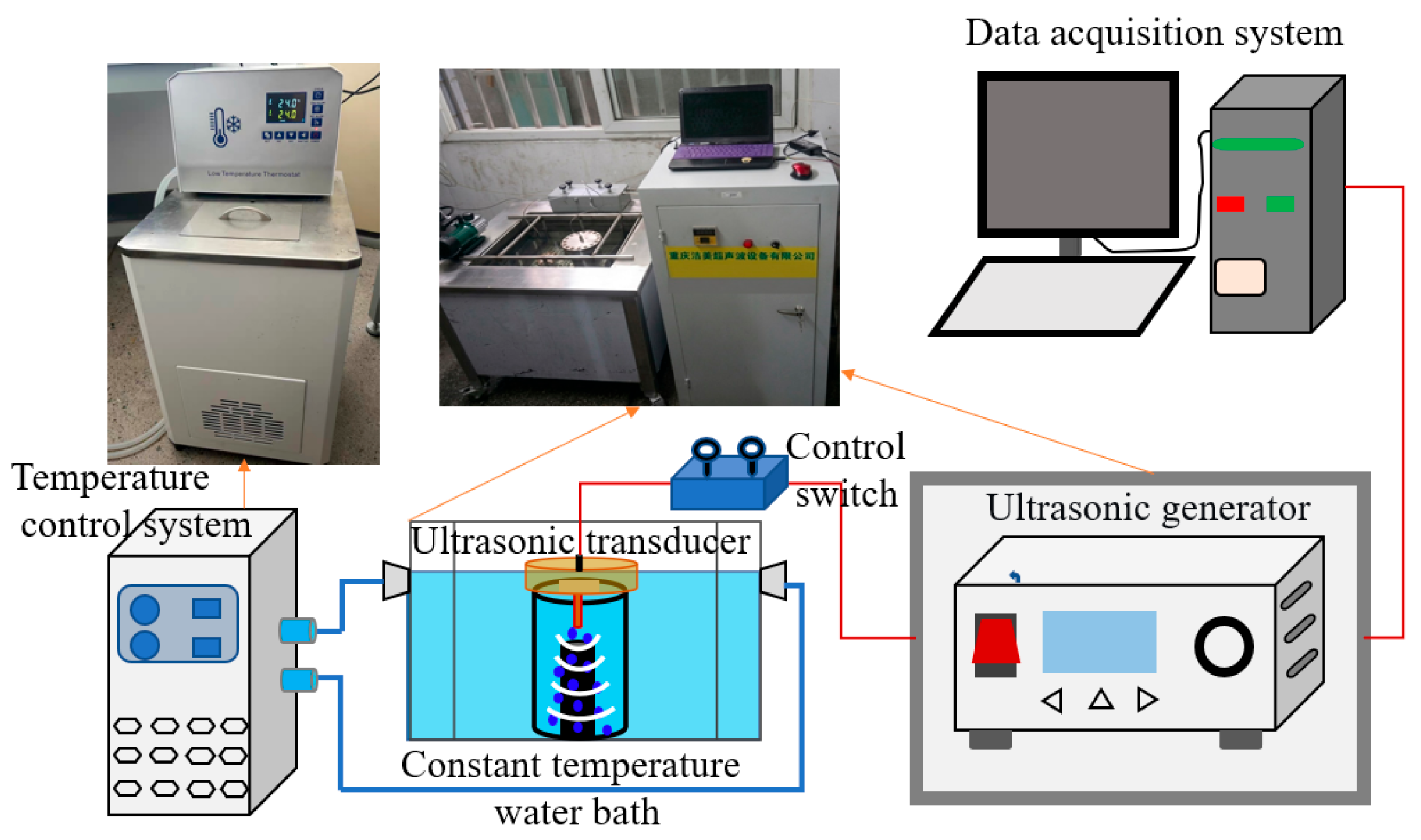
The experimental system mainly consists of three parts: an ultrasonic excitation system, a temperature control system, and a data acquisition system, as shown in Figure 1. Among them, the ultrasonic excitation system serves as the core power source, mainly comprising a high-power ultrasonic generator, a transducer, and a horn (TENLIN-1200, Jiangsu Tianling Instrument Co., Ltd.). It can stably output high-frequency mechanical vibrations with a frequency of 25 kHz and adjustable power, generating strong cavitation effects and microjets through liquid media to act on the coal body and achieve the expansion and interconnection of multi-scale pores. To address the load response characteristics of ultrasonic treatment under multi-specimen, high-power liquid–solid coupled conditions, the system achieves effective control of load parameters through a combination of “constant hardware output and multi-dimensional dynamic monitoring.” On the one hand, the generator integrates intelligent automatic frequency tracking and load impedance matching modules, which can fine-tune the output waveform in real time according to the temporal variations in density and temperature of the liquid medium within the reaction vessel, thereby ensuring that the transducer always operates at resonance (with the liquid level height and mass-to-volume ratio kept identical in every experiment). On the other hand, relying on a power closed-loop control system and a multi-channel data acquisition module, the operating current, voltage, and effective output power during loading are dynamically captured throughout the entire process and subjected to closed-loop amplitude-stabilized regulation, thereby effectively suppressing and compensating for load fluctuations caused by changes in the density of the cavitation bubble cluster.
Figure 1.
Experimental flowchart for preparing coal samples with various moisture states.
The temperature control system consists of an intelligent constant-temperature water bath (SUNDI-Z, Wuxi Guanya Constant Temperature Refrigeration Technology Co., Ltd.), a Pt100 platinum resistance temperature sensor, and circulation piping. It can precisely control the ambient temperature during the experiment at the set value (25 ± 1 °C with an error margin controlled within ±0.5 °C). This effectively suppresses the drift disturbance of the system load impedance induced by the ultrasonic thermal effect, thereby ensuring single-variable control of the acoustic-field physical modification. The data acquisition system integrates a multi-channel power monitoring module and a real-time temperature recorder (MIK-RN6500, Hangzhou Mike Sensor Technology Co., Ltd.), enabling dynamic capture and storage of the aforementioned ultrasonic load parameters and water-bath temperature throughout the entire process, thus ensuring parameter controllability during acoustic-field loading and reproducibility of the experimental data.
2.3. Experimental Methods
In this experiment, a combined NMR (Varian INOVA300, USA) and LP-N2 (Micromeritics 3Flex, USA) characterization method was employed to quantitatively characterize the dynamic evolution laws of the pore and fracture structures of coal under ultrasonic treatment across multiple scales. Standard cylindrical coal core specimens were used for NMR testing and were subjected to vacuum saturation treatment prior to testing to establish a stable nuclear magnetic resonance fluid response signal. Taking the transverse relaxation time T2 spectrum and its cumulative signal area as core indicators, the distribution and evolution laws of micropores, mesopores, macropores, and fractures were quantitatively calculated. To reveal the regulatory effect of ultrasound on the nanoscale pore structure, after each ultrasonic treatment node, parallel coal samples processed under identical conditions were synchronously selected to prepare 60–80 mesh particle specimens for LP-N2 testing. Based on the BET and BJH models, the specific surface area, pore volume, and pore size distribution were quantitatively characterized.
It should be noted that the two methods differ in principle and detection range; therefore, their results are not numerically merged but treated as independent evidence for mutual verification. In LP-N2 analysis, nitrogen molecules serve as the probe, and the effective analysis range lies mainly within the mesopore and macropore regions (approximately 2–100 nm). Pore volumes below 2 nm may be underestimated, and the resolution for macropores above 100 nm is limited; thus, LP-N2 is used primarily to constrain the specific surface area and pore volume distributions of mesopores and macropores. Regarding the data-processing models, the classical BET model provides a robust assessment of multilayer adsorption specific surface area, yet its applicability at the high-pressure region has boundaries; the BJH model relies heavily on the Kelvin equation and capillary condensation theory and is applicable mainly to the mesopore range, so it is prone to theoretical deviations and limitations in the ultramicropore region (<2 nm) or under complex pore geometries. LF-NMR detects the relaxation signals of hydrogen protons in water-saturated pores, covering approximately 1 nm to hundreds of micrometers. It is sensitive to the relative volume changes in the overall pore system and is therefore suitable for tracking the relative evolution of pore groups before and after ultrasonic treatment; its limitation is that it cannot directly provide specific surface area. Accordingly, the integrated interpretation compares only whether the pore-volume variation trends are consistent within the overlapping range of the two methods (approximately 1–100 nm), so as to verify the reliability of the relative evolution. Within this range, both methods provide only relative distribution trends and are not used to calibrate each other; any discrepancy is attributed to differences in methodological principles, and no numerical splicing or absolute pore-size calibration is performed.
3. Experimental Procedures and Scheme
3.1. Experimental Procedures
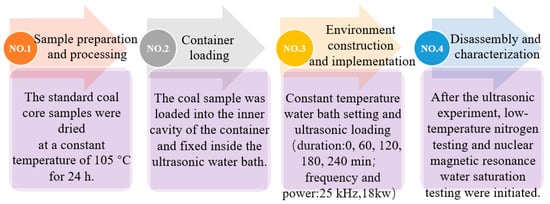
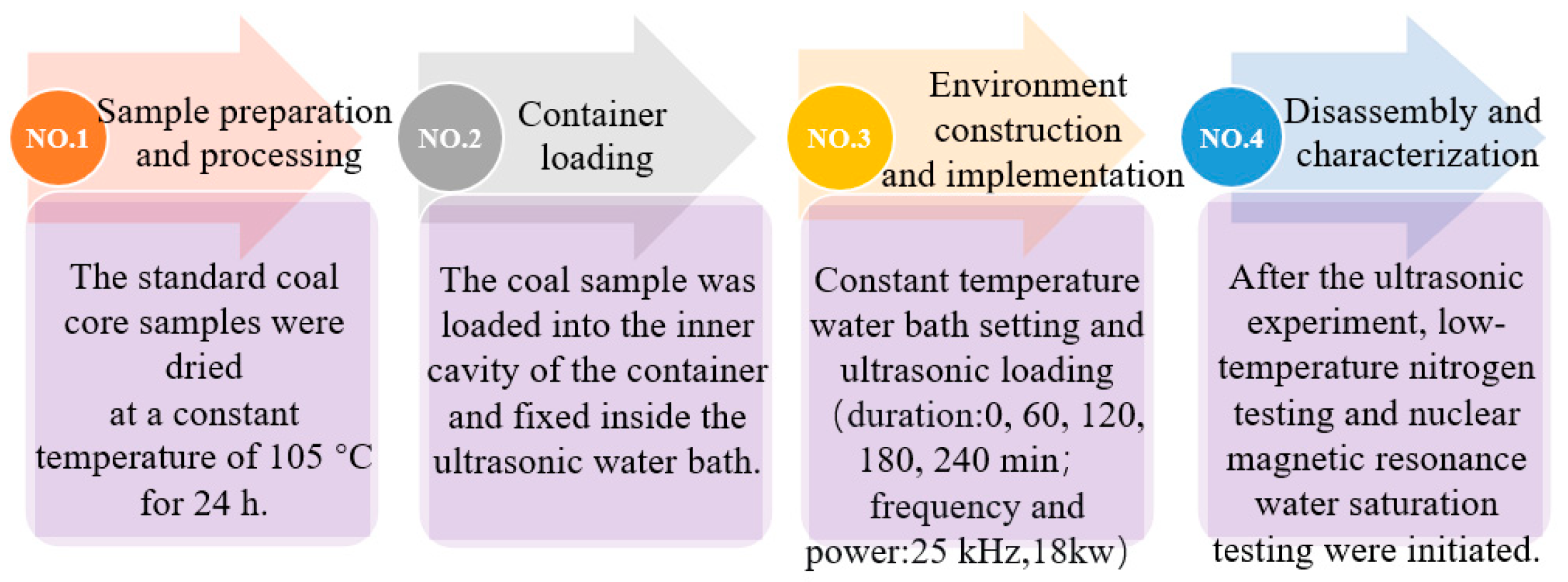
The experimental procedures included sample pretreatment, ultrasonic treatment, and microstructural characterization. The specific steps are illustrated in Figure 2.
Figure 2.
Experimental workflow chart.
- (1)
- Sample Preparation: Sample Processing and Pretreatment: Representative coal samples were collected and prepared in accordance with national standards to obtain standard core specimens. The specimens were placed in a vacuum drying oven and dried at a constant temperature of 105 °C for 24 h until reaching a constant weight, thereby eliminating the interference of free water on micropore measurements.
- (2)
- Specimen Loading: The pretreated coal specimens were smoothly loaded into the inner cavity of a dedicated container and securely fixed at the optimal acoustic energy focusing zone inside the ultrasonic water bath.
- (3)
- Ultrasonic treatment of coal samples: The ultrasonic bath was filled with water, and the temperature control system was initiated to precisely set and stabilize the water bath temperature at the target experimental temperature, suppressing secondary thermal disturbance on the coal structure. The ultrasonic excitation frequency and output power were configured according to the experimental scheme (25 kHz, 18 kW). The ultrasonic energy output was initiated, with water serving as the transmission medium to act on the coal specimens inside the container. During the experiment, the acquisition computer monitored and recorded the operating status, power stability of the ultrasonic generator, and water bath temperature fluctuations in real time, maintaining continuous acoustic irradiation up to the specified durations.
- (4)
- Microscopic characterization of the final-state samples: Upon reaching the targeted treatment durations, the ultrasonic control cabinet and constant-temperature water bath system were powered off. The container was disassembled from the water bath, and the ultrasound-treated coal specimens were retrieved. The NMR specimens were subjected to T2 spectrum measurements following vacuum saturation. The pulverized coal particle specimens for LP-N2 testing were placed back into the 105 °C constant-temperature drying oven until constant weight was achieved, followed by adsorption–desorption isotherm characterizations.
3.2. Experimental Scheme
Homogeneous coal samples sourced from the same origin with similar structural characteristics were selected for the experiment. During testing, the prepared cylindrical coal samples (ϕ 50 × 50 mm) were placed on a fixed base inside a container filled with water. The ultrasonic horn was inserted vertically into the container from the top. The immersion depth of the ultrasonic tool head radiating surface into the water was fixed at 20 mm, and the clearance distance between the radiating end face and the top end face of the coal specimen was fixed at 10 mm to ensure consistency of ultrasonic energy transmission distance through the medium and the repeatability of the experiment. In this experiment, a total of five ultrasonic duration nodes were established: 0 min (untreated blank control, designated as Z1#), 6 min, 120 min, 180 min, and 240 min (sequentially designated as Z2#–Z5#). Homologous coal blocks were crushed and sieved to obtain 60–80 mesh particulate coal samples, which were divided into five groups (designated as S1#–S5#). Among them, the S1# coal sample served as the blank control group without ultrasonic treatment, while the S2#–S5# samples served as the ultrasonic treatment groups. To effectively reduce experimental random errors caused by coal-rock heterogeneity and to ensure the reliability and statistical regularity of the test data, three independent parallel coal samples were set for each group of large cylindrical samples and powder coal samples. All test results are presented as arithmetic means, and standard deviation error bars are introduced in the relevant data figures and tables. Throughout the experiment, the ultrasonic power was uniformly set to 18 kW, the operating frequency was set to 25 kHz, and the constant-temperature water bath during processing was strictly controlled at 26 °C.
4. Effect of Ultrasonic Treatment Time on the Pore Structure Evolution of Coal
4.1. Low-Temperature Nitrogen Adsorption–Desorption Isotherm
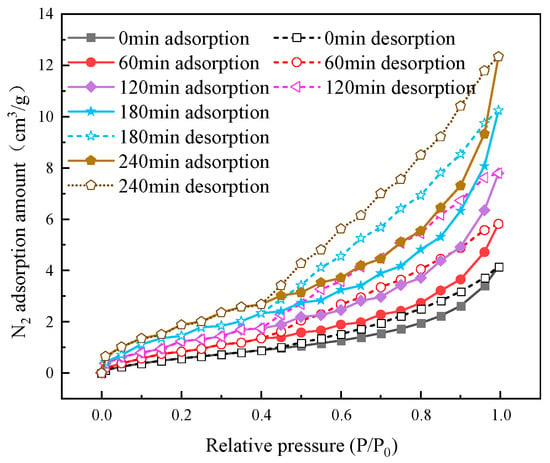
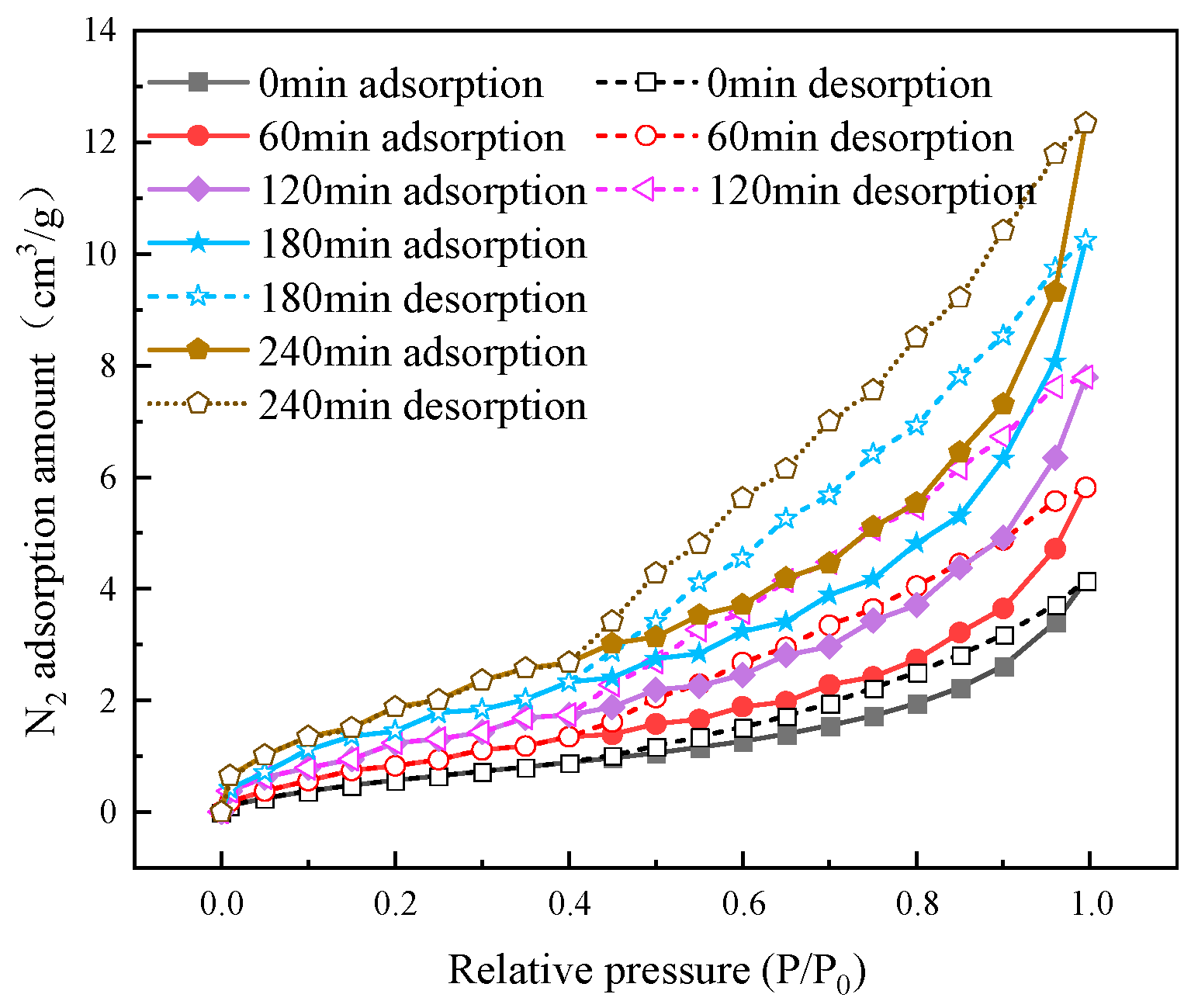
To investigate the modification effect of ultrasonic treatment duration on the microscopic pore structure of the No. 2 coal from Shuanglong Mine, the low-temperature nitrogen adsorption–desorption isotherms of coal samples under varying ultrasonic treatment durations (0 min, 60 min, 120 min, 180 min, and 240 min) at 77.3 K were plotted (Figure 3). According to IUPAC standards [28], the adsorption isotherms of both the raw coal and the coal samples treated with varying ultrasonic durations exhibit typical Type IV isotherm characteristics, displaying prominent H3-type hysteresis loops in the medium-to-high relative pressure range (P/P0 > 0.40). This indicates that the pore morphology within the Shuanglong No. 2 coal samples is predominantly composed of parallel plate-like slit-shaped pores and irregular open pores. With the progressive extension of ultrasonic treatment duration, the overall adsorption–desorption isotherms shift markedly upward along the Y-axis, and both the area and opening amplitude of the hysteresis loops exhibit a continuous expansion trend with processing time. This demonstrates that the intense shock waves and mechanical shear forces generated by ultrasonic cavitation effectively fracture the closed or semi-closed pore structures originally existing within the coal matrix, promoting the evolution and development of micropores and mesopores into macropores and connected pores, thereby significantly enhancing the pore connectivity of the coal matrix. Quantitative analysis reveals that the maximum adsorption capacity of the untreated raw coal (0 min) at a saturated relative pressure (P/P0 ≈ 0.995) is merely 4.18 cm3/g. After 60 min of ultrasonic treatment, the total N2 adsorption amount at P/P0 ≈ 0.995 increased to 5.80 cm3/g, representing a 38.76% increase compared to the raw coal. When the ultrasonic treatment duration is increased to 120 min and 180 min, the saturated adsorption capacity further grows to 7.80 cm3/g and 10.25 cm3/g, with growth rates of 86.60% and 145.22%, respectively. When the ultrasonic treatment duration reaches 240 min, the saturated adsorption capacity climbs to a peak value of 12.35 cm3/g, which is 2.95 times that of the raw coal. Furthermore, in the high-pressure region (P/P0 > 0.80), the steeply upward-sloping trend of the adsorption branch becomes increasingly pronounced with longer ultrasonic times, further confirming that prolonged ultrasonic action induces the generation of a large number of macropore and fracture structures within the coal body. These structural features indicate the creation of expanded physical adsorption spaces and gas diffusion channels within the coal matrix. Such characteristics exhibit a macro-evolutionary trend that is highly conducive to gas migration.
Figure 3.
Low-temperature nitrogen adsorption–desorption isotherms of Shuanglong No. 2 coal samples under varying ultrasonic treatment durations.
4.2. Pore Size Distribution Evolution
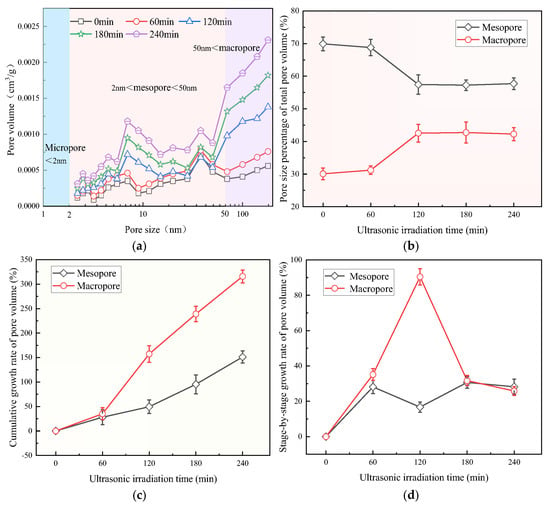
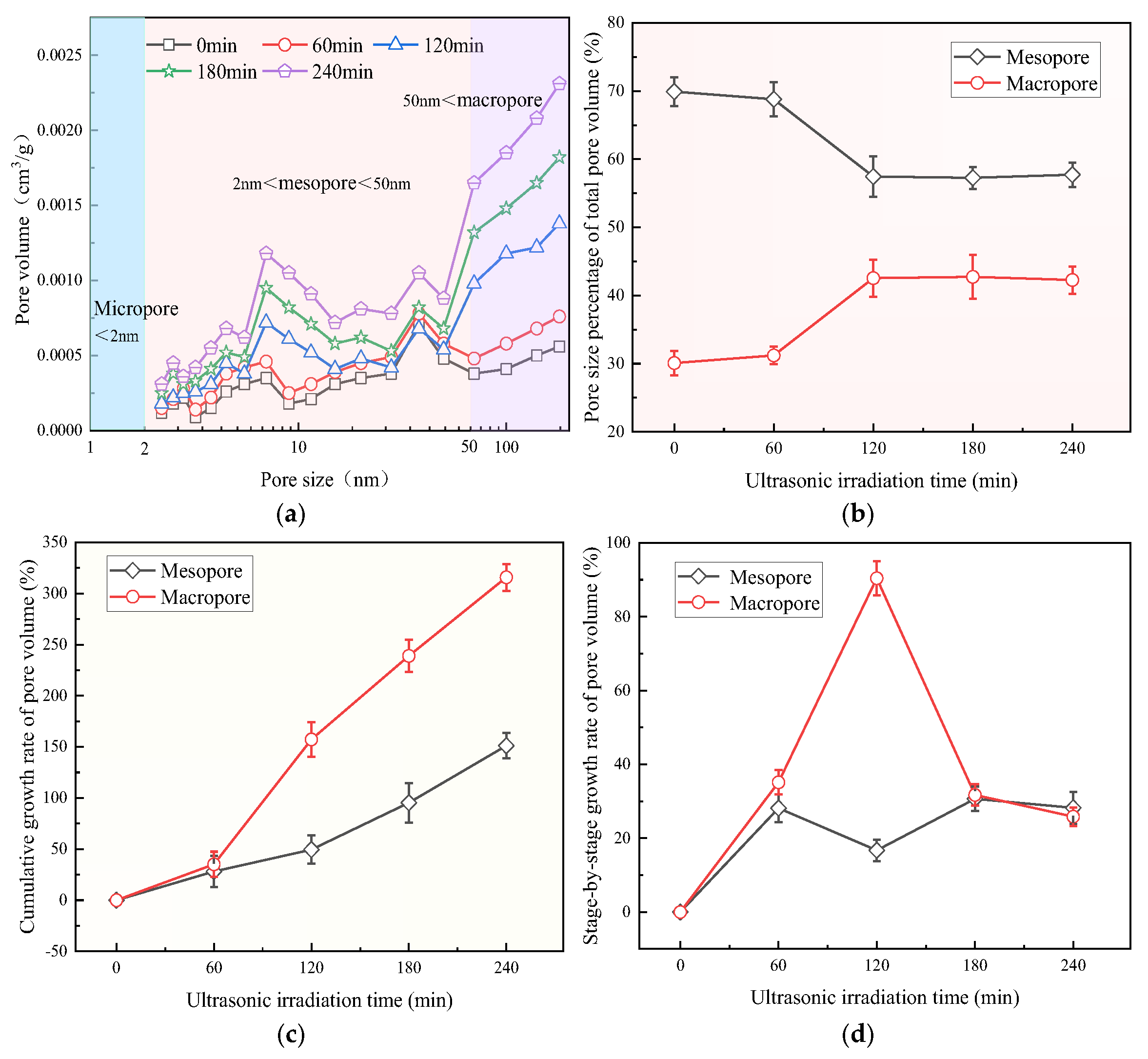
Based on the low-temperature nitrogen adsorption data and BJH model calculations, the evolution characteristics of the pore structure of Shuanglong No. 2 coal under varying ultrasonic treatment durations are illustrated in Figure 4. The raw coal (0 min) without ultrasonic treatment exhibits a total pore volume of merely 0.0062 cm3/g, featuring a pore microstructure dominated by mesopores and supplemented by macropores (Figure 4a). The volumes of mesopores (2–50 nm) and macropores (>50 nm) are 0.0043 cm3/g and 0.0019 cm3/g, accounting for 69.35% and 30.65% of the total pore volume, respectively (Figure 4b). With the extension of ultrasonic treatment duration, the incremental pore volume distribution curves shift substantially upward along the ordinate across the full pore size range, showing remarkably pronounced pore expansion responses near the mesopore primary peaks at 7.0 nm and 38.0 nm, as well as within the macropore range (>50 nm). After ultrasonic treatment for 60 min, 120 min, 180 min, and 240 min, the total pore volume of the coal body continuously climbs to 0.0080 cm3/g, 0.0112 cm3/g, 0.0147 cm3/g, and 0.0187 cm3/g, corresponding to cumulative growth rates relative to the raw coal of 29.03%, 81.95%, 137.09%, and 201.61%, respectively (Figure 4c). Regarding the cumulative evolution trend categorized by pore size, the pore creation and expansion effects of ultrasonic cavitation and mechanical spallation are particularly intense on macropores and backbone-connected pores. At 240 min, the macropore volume surges to 0.0079 cm3/g, with a cumulative growth rate relative to the raw coal reaching as high as 315.78%, significantly exceeding the 151.16% cumulative increase observed for mesopores (which increased to 0.0108 cm3/g). Consequently, the proportion of macropores in the total pore volume sharply jumps from 30.08% to 42.28%, effectively facilitating the transformation of the coal pore network toward a highly connected seepage-type structure.
Figure 4.
Effect of ultrasonic treatment duration on the pore size distribution of coal. (a) Pore volume-pore size distribution. (b) Percentage of pore size in total pore volume. (c) Cumulative growth rate of pore volume. (d) Stage−by−stage growth rate of pore volume.
Further introducing stage-by-stage growth rates between adjacent phases to analyze the kinetic characteristics (as shown in Figure 4d) reveals that ultrasonic modification exhibits pronounced stage specificity and marginal diminishing effects. During the 60–120 min stage, macropores exhibit a trend of significant growth, reaching a peak stage-by-stage growth rate of 90.40%, which drives the total pore volume to achieve its maximum stage increase of 40.0%. However, as the treatment duration is further extended to 180 min and 240 min, the stage-by-stage growth rate of macropores drops significantly to 31.72% and 25.84%, and the stage growth rate of total pore volume also gradually slows down to 27.20%. This indicates that ultrasound rapidly breaks the closed/semi-closed mesopore bottlenecks in the early stage and induces their collapse and expansion into macropores; however, as the vulnerable microstructures undergo substantial changes and gas channels become interconnected, the further erosion efficiency of ultrasonic energy on the pore structure gradually levels off toward saturation.
4.3. Variation in BET Specific Surface Area
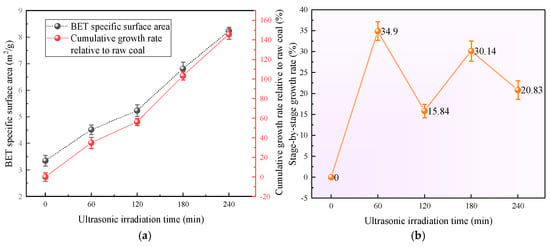
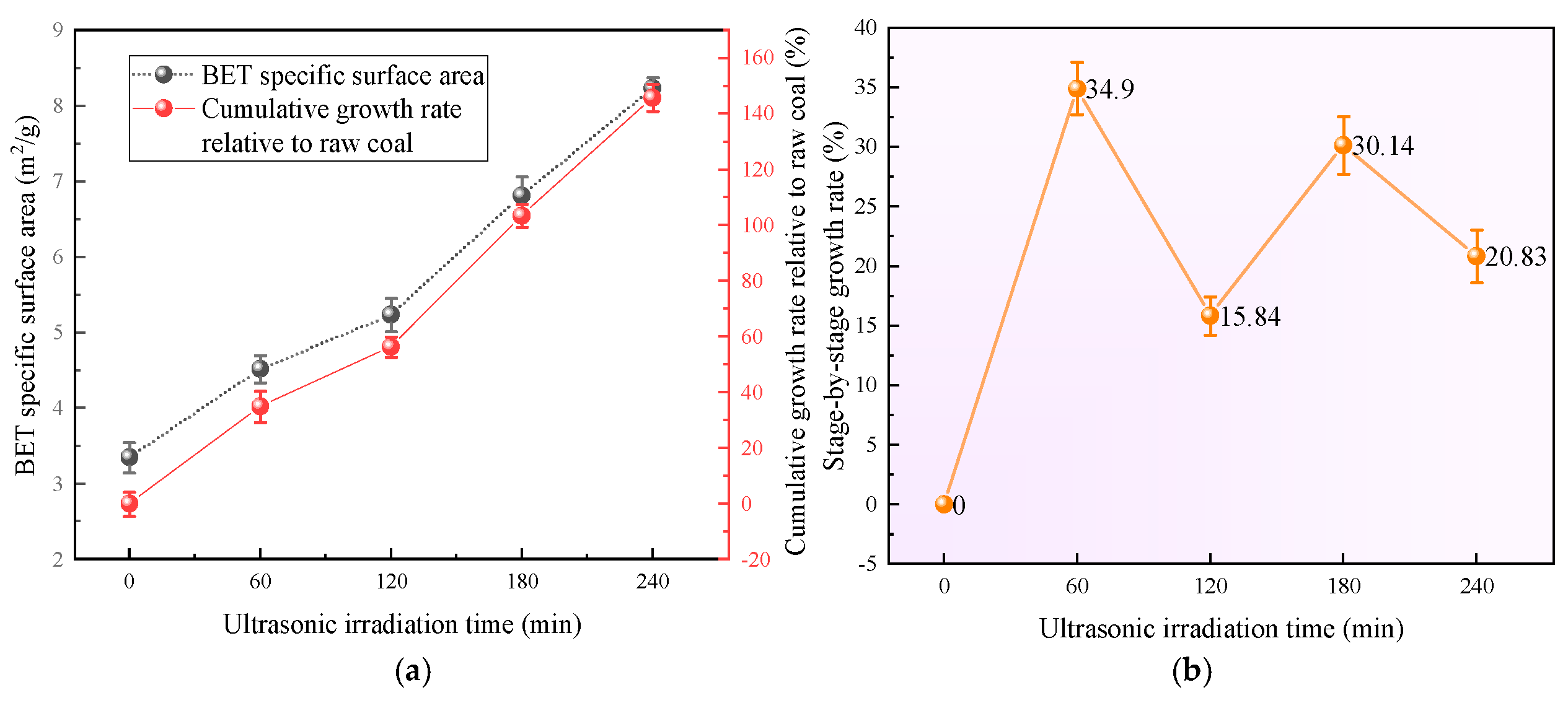
Based on low-temperature nitrogen adsorption data and BET model fitting results, the variation characteristics of the BET specific surface area of Shuanglong No. 2 coal samples under varying ultrasonic treatment durations are illustrated in Figure 5. The raw coal (0 min) without ultrasonic treatment has a BET specific surface area of 3.4 m2/g, reflecting the microscopic characteristics of a dense primitive coal matrix with fewer effective adsorption sites. With the continuous extension of ultrasonic treatment duration, the specific surface area of the coal exhibits a strong cumulative expansion effect. As shown in Figure 5a, it successively climbs to 4.5 m2/g, 5.2 m2/g, 6.8 m2/g, and 8.2 m2/ g at 60 min, 120 min, 180 min, and 240 min, respectively, with cumulative growth rates relative to the raw coal (0 min) reaching 32.4%, 52.9%, 100.0%, and 141.2%, respectively. At 240 min, the specific surface area increases to 2.4 times that of the raw coal. This indicates that the local high-pressure shock waves generated by the high-frequency mechanical vibration of ultrasound and the violent collapse of cavitation bubbles [29] effectively overcome the bonding strength of the coal matrix, erode the organic matter and tiny mineral particles blocking the pore channels, unblock a large number of closed and semi-closed pores, and induce microscopic roughening and microcrack nucleation on the pore wall surfaces [30].
Figure 5.
Effect of ultrasonic treatment duration on the BET specific surface area of coal. (a) BET specific surface area. (b) Stage−by−stage growth rate.
Further, by combining the stage-by-stage growth rate relative to the previous stage to analyze its stage evolution kinetics, it can be seen that the staged growth rate of the specific surface area presents two obvious peaks, as shown in Figure 5b. In the initial stage of 0–60 min, the cavitation effect of ultrasound rapidly disintegrates the vulnerable microstructures, leading to a rapid 34.9% increase in specific surface area. During the 60–120 min stage, as some original micropores and mesopores (in the untreated raw coal) are expanded and merged into macropores under the strong impact, the incremental contribution to specific surface area per unit mass is moderated, and the stage-wise growth rate decreases to 15.8%. As ultrasonic energy continues to penetrate into the deep matrix of the coal body during the 120–180 min stage, the primary macropore walls undergo severe collapse and secondary erosion, generating a large number of secondary microscopic network-like rough structures, which drives the stage-by-stage growth rate to a second peak rebound of 30.1%. When the treatment duration is further extended to 240 min, the stage-by-stage growth rate smoothly falls back to 20.8%, indicating that under prolonged ultrasonic action, the erosion mechanism of the coal pore wall and the expansion mechanism of the surface area gradually tend toward saturation and plateau. The significant broadening of the specific surface area greatly enriches the free gas adsorption sites and diffusion space on the coal surface, effectively enhancing the microscopic permeability and gas migration efficiency of the coal seam. This inference is consistent with the conclusions reported in previous studies regarding the modification of coal pores by ultrasound [18].
4.4. NMR T2 Spectrum Analysis
LF-NMR technology uses hydrogen-rich (1H) fluids within coal pores as physical probes. By analyzing the relaxation dynamics of protons under an external magnetic field, the micropore architecture and fluid occurrence characteristics of coal can be effectively revealed. The T2 is the most critical parameter in this characterization. In the complex environment of porous media, T2relaxation behavior is jointly governed by free relaxation, surface relaxation, and diffusion relaxation mechanisms. Based on classical NMR theory, T2 can be expressed by the following equation [31]:
where T2 is the total transverse relaxation time of the coal sample, ms; T2B is the bulk relaxation time of the fluid within the coal sample, ms; T2D is the diffusion relaxation time induced by the magnetic field gradient, ms; ρ2 is the transverse surface relaxivity of the coal matrix, µm/ms; S/V is the surface-area-to-volume ratio of the coal pores, µm−1.
In the relaxation system of pore fluids within the coal matrix, free relaxation, surface relaxation, and diffusion relaxation contribute differently to T2. In this study, experiments were conducted in a highly homogeneous magnetic field. Under this condition, the effects of free relaxation and diffusion relaxation are extremely weak and negligible. Therefore, the total transverse relaxation time T2 is almost completely governed by surface relaxation (T2S). Consequently, T2 can be simplified and approximated as T2S, as expressed in Equation (2) [32].
As indicated by Equation (2), the relaxation time of reservoir fluids depends on the pore structure (S/V). Smaller pores correspond to a larger specific surface area and stronger interactions between the pore surface and water. Consequently, the water relaxation rate increases, resulting in a shorter relaxation time. Assuming that the pores inside coal have simple shapes, Equation (2) can be transformed into the relationship between T2 and the pore radius r, as shown in Equation (3) [32]:
For simplicity, let constant C = ρ2Fs. Then, the pore radius r of the coal and the transverse relaxation time T2 satisfy the following linear proportional relationship [32]:
where r is the pore radius of the coal, nm; Fs is the pore shape factor (dimensionless, taking 3 for spherical pores and 2 for cylindrical pore throats, while coal pores are generally considered to be predominantly cylindrical); C is the pore size conversion coefficient of the coal sample.
Although Equation (4) establishes a linear correspondence between the T2 and the r, the ρ2 in actual multi-component coal rocks is not strictly constant. This is due to the spatial variability of complex mineral compositions and pore surface micro-characteristics. Meanwhile, sample saturation conditions (such as vacuum water-saturation degree and micropore wetting states) also pose potential disturbances to the T2 signal amplitude and pore volume quantification. Therefore, directly converting T2 into absolute pore sizes tends to introduce substantial calculation errors. To ensure the reliability of quantitative analysis, all specimens underwent strict and uniform vacuum-saturation pretreatment prior to testing. We performed comparative analyses based on the T2 spectral areas and relative change rates of identical parallel samples, thereby effectively avoiding the uncertainties caused by absolute parameter calibration and spatial fluctuations of ρ2. Since the inverted continuous T2 spectrum is essentially approximated by a set of discrete data points, trapezoidal numerical integration in logarithmic coordinates was adopted to calculate the spectral area of each graded interval. This accurately quantifies the fluid storage space within different pore size ranges (such as micropores, mesopores, or macropores). Its mathematical integration expression is [32]:
where S represents the integrated peak area of the target relaxation interval corresponding to a specific pore size segment, a.u.; Ai and Ai+1 denote the NMR signal amplitudes corresponding to the i-th and i + 1-th discrete data points, respectively, a.u.; T2,i and T2,i+1 are the corresponding transverse relaxation times, ms; and n and m define the starting and ending index positions of the specific pore size classification interval within the original discrete data sequence, respectively.
Although low-temperature nitrogen adsorption testing can finely characterize the specific surface area and pore volume distribution of micropores and mesopores in coal, it is limited by the principle of capillary condensation and struggles to comprehensively reveal the connectivity status of occluded pores and macroscopic fractures. In contrast, NMR technology serves as a non-destructive probe for pore structure [33], which can directly reflect the occurrence characteristics and spatial connectivity of fluids in pores of different scales through the transverse relaxation time (T2) spectrum of hydrogen protons under water-saturated conditions [33]. Therefore, this section tested and analyzed the water-saturated T2 spectra of the Shuanglong No. 2 coal samples under varying ultrasonic treatment durations, thereby cross-validating the modification laws of ultrasonic cavitation on the multi-scale pore structure of the coal samples from the perspective of pore fluid dynamics.
Although the classical B.B. Khodot classification is widely used for the geometric division of pore space in coal, the dynamic variability of the rock matrix surface relaxivity in multi-component coal–rock systems means that converting relaxation times directly into absolute pore diameters can introduce computational errors. Accordingly, following established rock-physics testing practice, this study divides the pore populations according to the multi-peak morphology of the T2 spectrum and the distribution of troughs between adjacent peaks, using each trough as the boundary node between pore populations. A trough represents a local minimum in the signal contribution between adjacent pore systems and can therefore be regarded as a natural structural boundary between different pore populations within a given sample. On this basis, the T2 spectrum is partitioned into several intervals corresponding to pore populations dominated by micro-, meso-, and macropores, respectively. This approach provides a more objective and stable basis for reflecting the relative evolution of pore volume at each level before and after ultrasonic treatment.
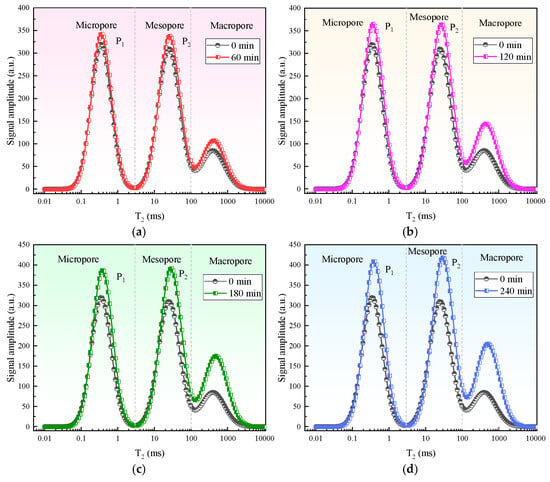
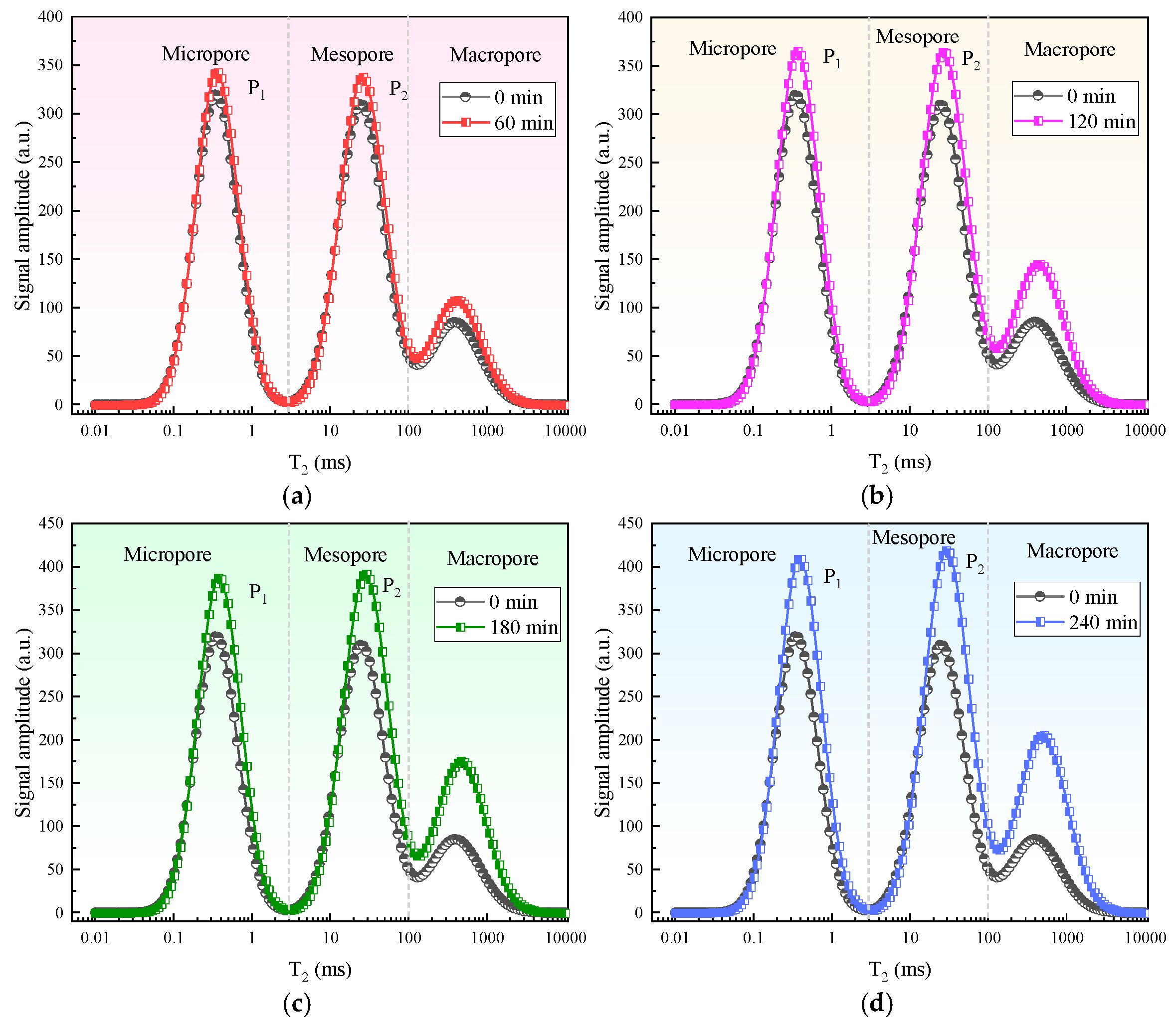
As can be seen from Figure 6, the NMR T2 spectra of the Shuanglong No. 2 coal samples under varying ultrasonic treatment durations all exhibit prominent tri-modal distribution characteristics. Moreover, the envelope area and peak intensity of each relaxation peak show a clear growth trend with the extension of the ultrasonic treatment duration, which maintains a high degree of consistency with the growth trends of pore volume and specific surface area observed in the low-temperature nitrogen adsorption tests. As the ultrasonic treatment duration progressively increases from 0 min to 240 min, the maximum peak value of the first peak (P1) corresponding to the micropore range steadily increases from 319.09 a.u. for the raw coal to 408.80 a.u., and the maximum peak value of the second peak (P2) corresponding to the mesopore range synchronously grows from 310.00 a.u. to 418.50 a.u., indicating that ultrasonic cavitation and mechanical vibration exert a balanced and sustained capacity-expansion effect on the micropores and transitional mesopores within the coal matrix. From the perspective of the microscopic variation in relaxation time, the peak vertices of P1 and P2 shift to the right to a certain extent with prolonged ultrasonic time, illustrating that the average pore diameters of micropores and mesopores slightly increase under ultrasonic erosion.
Figure 6.
Effect of ultrasonic treatment duration on NMR T2 curves of Shuanglong No. 2 coal. (a) 0 min–60 min. (b) 0 min–120 min. (c) 0 min–180 min. (d) 0 min–240 min.
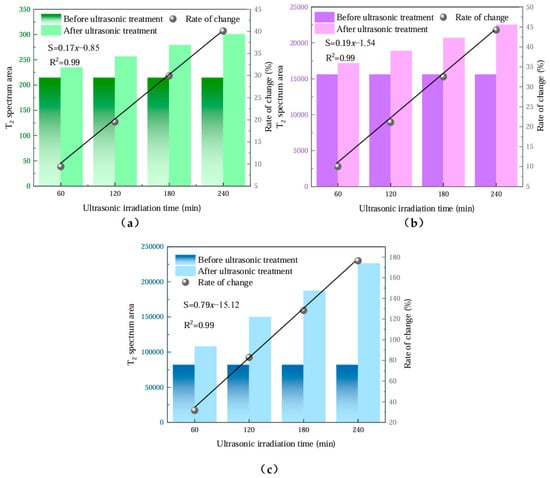
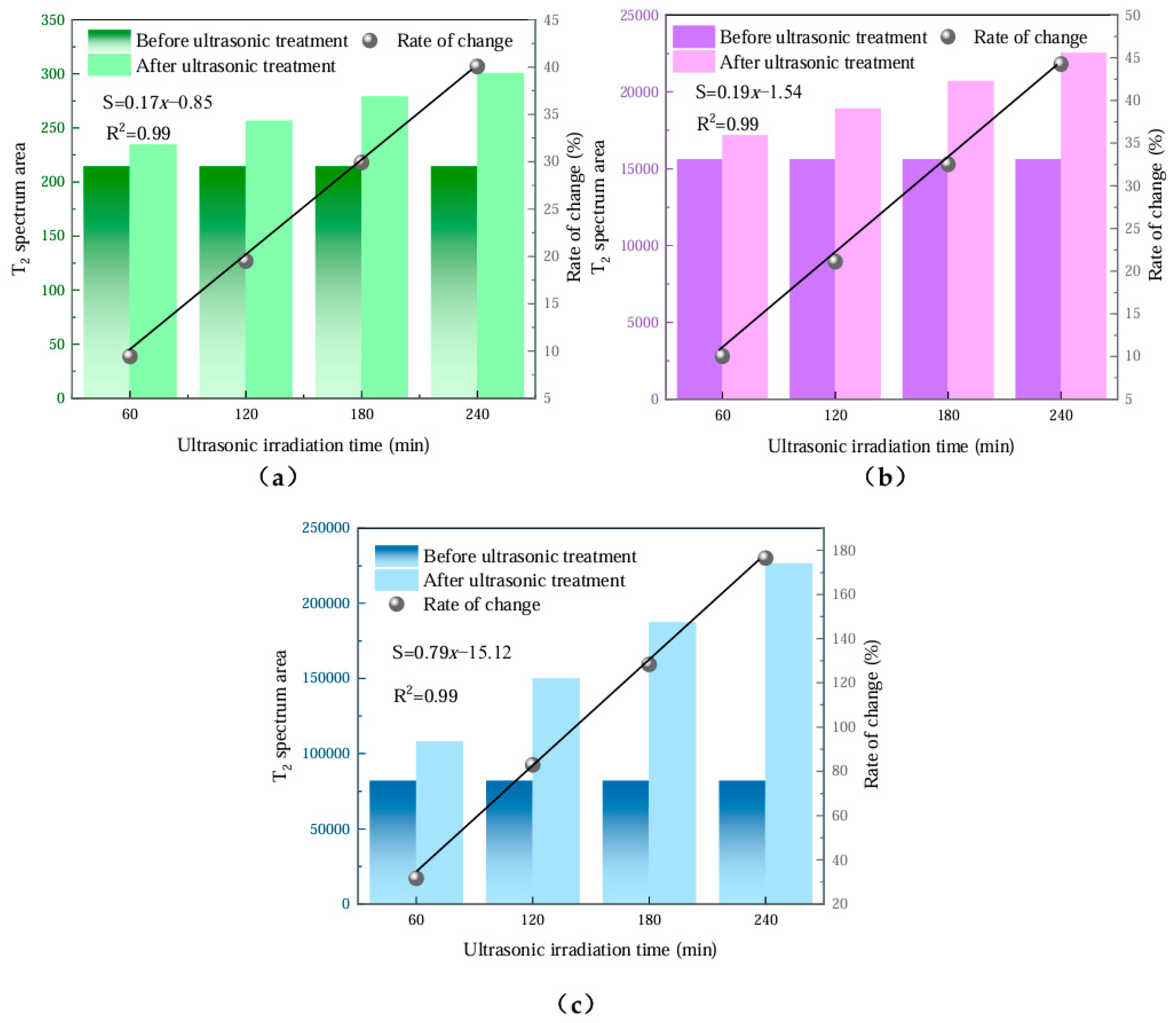
Meanwhile, from the evolution of the integrated areas of the T2 spectra for pores of various scales, as shown in Figure 7, as the ultrasonic treatment duration is extended from 60 min to 240 min, the area changes in micropores, mesopores, and macropores & microfractures steadily increase to 40.07%, 44.26%, and 176.50%, respectively. Furthermore, the rate of change in each interval exhibits a highly consistent linear increasing pattern with ultrasonic time (with correlation coefficients R2 all reaching 0.99). Among them, the linear fitting slopes for micropores and mesopores are relatively small (0.17 and 0.19, respectively), whereas the fitting slope for the macropore and microfracture interval is as high as 0.79. This demonstrates that there are significant differentiation characteristics in the response sensitivity of pores of different scales to ultrasonic irradiation, and the expansion rate and absolute increment of macroscopic pore-fracture spaces induced by ultrasonic cavitation and mechanical vibration far exceed those of microscopic pores, thereby significantly improving the overall pore connectivity and seepage performance of the coal reservoir.
Figure 7.
Effect of ultrasonic treatment duration on the T2 spectrum area variation in Shuanglong No. 2 coal. (a) Micropore. (b) Mesopore. (c) Macropore and microfracture.
4.5. Mechanisms and Limitations of Ultrasound-Induced Modification of Coal Pore Structure
To clarify the modification effect of ultrasonic waves on the pore-fracture structure of coal, it is necessary to clearly distinguish between experimentally measured macroscopic data and the inferred micro-physical mechanisms. From direct observation results, LP-N2 and LF-NMR tests confirm that ultrasonic treatments with various durations significantly promote the expansion of multi-scale pore volumes in coal samples, with the growth of macropores and microfractures being particularly prominent. When discussing the underlying physical mechanisms, although direct observation of micro-cavitation bubbles is technically limited, the experimental boundaries and macroscopic response characteristics of this study provide robust evidence for acoustic cavitation. On the one hand, the applied ultrasonic frequency (25 kHz) and power (18 kW) fall within the effective threshold range for triggering cavitation in liquid media, providing sufficient energy for the growth and collapse of cavitation bubbles during the rarefaction half-cycle. On the other hand, if ultrasonic action stemmed solely from macroscopic static pressure or mechanical shear, coal damage should be uniformly distributed. Instead, experiments revealed a selective and explosive growth of macropores and microfractures, with a maximum area increase of up to 176.5%. This localized microstructural erosion and connectivity precisely correspond to the high-speed microjets and strong shock waves generated by the asymmetric collapse of cavitation bubbles at pore-throat boundaries. Furthermore, strict temperature control using a constant 26 °C water bath throughout the experiment effectively eliminated thermal stress interference, thereby verifying that the observed pore-fracture evolution is primarily driven by the synergy of acoustic cavitation and mechanical erosion.
Although this study reveals the evolution characteristics of multi-scale pore and fracture systems in coal under ultrasonic treatment, several limitations remain, which also point out directions for future research. First, regarding micro-characterization and permeability validation, limited by the current experimental scheme, this study mainly evaluates the evolution of pore and fracture structures based on LP-N2 and LF-NMR tests. Scanning electron microscopy (SEM) images were not combined to directly observe the micro-morphology of damage and erosion, and Fourier-transform infrared spectroscopy (FTIR) was lacking for analyzing matrix functional group changes. Meanwhile, permeability tests were not directly integrated to macroscopically verify the fluid transport enhancement resulting from the improved pore-fracture network. The combination of these multi-dimensional characterizations and seepage measurements will be further refined in future studies. Second, regarding the translation from laboratory scale to engineering applications, directly scaling up laboratory-scale ultrasonic parameters to large-scale underground mining still faces significant technical and economic challenges, particularly encountering engineering bottlenecks in long-term continuous ultrasonic application. However, the primary objective of this study is not to directly apply continuous, large-scale ultrasonic equipment across the entire mine. Instead, this study aims to reveal the fundamental pore evolution mechanisms and determine the optimal time window of ultrasonic action. These findings mainly provide foundational theoretical support and core parameters for enhancing underground gas drainage. Future practical engineering strategies can focus on clearing localized borehole blockages and targeted permeability enhancement in low-permeability zones, thereby offering a feasible technical pathway for mine gas disaster prevention.
5. Conclusions
Based on the results of this study, the following conclusions can be drawn:
- (1)
- Ultrasonic treatment can continuously modify the internal microscopic pore structure of the coal body. As the treatment duration is extended from 60 min to 240 min, the low-temperature nitrogen adsorption saturation capacity of the coal sample increases from 5.80 cm3/g to 12.35 cm3/g, with the cumulative growth rate of total pore volume relative to the raw coal reaching 201.61%, and the maximum BET specific surface area increasing to 8.2 m2/g (2.4 times that of the raw coal).
- (2)
- Quantitative characterization of the NMR T2 spectra shows that the area change rates of micropores, mesopores, and macropores & microfractures exhibit a highly linear increasing trend with ultrasonic treatment time (R2 = 0.99). Notably, the linear fitting slope for the macropore and microfracture interval is as high as 0.79 (with a maximum area increase of 176.50%), which is significantly higher than the growth rates of micropores (0.17) and mesopores (0.19).
- (3)
- Ultrasonic modification exhibits clear stage-specific kinetic characteristics. During the 60–120 min stage, macropore development and pore volume growth experience a peak explosive period. Subsequently, with the full disintegration of vulnerable microstructures and the interconnection of gas pathways, the ultrasonic erosion efficiency gradually plateaus, ultimately effectively promoting the transformation of the coal pore network into a highly connected seepage-type structure.
Author Contributions
M.L.: Conceptualization, Funding acquisition, Data curation, Writing—original draft, Writing—review & editing. R.L.: Data curation, Formal analysis, Investigation, Supervision. P.Z.: Resources, Investigation, Methodology, Validation. L.W.: Resources, Investigation, Methodology. All authors have read and agreed to the published version of the manuscript.
Funding
This work was supported by the Shaanxi Provincial Natural Science Foundation (Grant nos. 2025JC-YBMS-472).
Data Availability Statement
The original contributions presented in this study are included in the article. Further inquiries can be directed to the corresponding authors.
Conflicts of Interest
Authors Mingyang Liu and Peng Zhang were employed by the company CCTEG Xi’an Research Institute (Group) Co., Ltd. Author Li Wang was employed by the company Northwest Branch of CCTEG Beijing Huayu Engineering Co., Ltd. The remaining authors declare that the research was conducted in the absence of any commercial or financial relationships that could be construed as potential conflicts of interest. The CCTEG Xi’an Research Institute (Group) Co., Ltd. and the Northwest Branch of CCTEG Beijing Huayu Engineering Co., Ltd. had no role in the design of the study; in the collection, analyses, or interpretation of data; in the writing of the manuscript, or in the decision to publish the results.
References
- Deng, Y.; Pan, W.; Ma, C.; Liu, S.; Zhao, Z.; Deng, C.; Li, M. Research on the failure law and actual measurement of floor in extremely close distance thick coal seam mining. Sci. Rep. 2025, 15, 42435. [Google Scholar] [CrossRef] [Scilit] [PubMed]
- Li, R.; Wen, H.; Fan, S.; Wang, H.; Cheng, X.; Mi, W.; Liu, B.; Liu, M. Migration characteristics of constant elements in the process of coal dissolution by liquid CO2. Energy 2024, 295, 131006. [Google Scholar] [CrossRef] [Scilit]
- Wang, H.; Xie, L.; Li, Y.; Hao, Y.; Qi, X. Study on the formation and evolution of constant stress concentration shell in overburden rock strata during coal seam mining. Rock Mech. Rock Eng. 2025, 58, 9363–9390. [Google Scholar] [CrossRef] [Scilit]
- Yang, X.; Zhang, C.; Wang, E.; Liu, D.; Li, Z.; Li, Y.; Yang, S. Thermo-hydro-mechanical coupling analysis of parameter evolution and failure mechanism during deep coal and gas outbursts. Fuel 2027, 429, 140777. [Google Scholar] [CrossRef] [Scilit]
- Niu, Y.; Wang, E.; Li, Z.; Gao, F.; Zhang, Z.; Li, B.; Zhang, X. Identification of Coal and Gas Outburst-Hazardous Zones by Electric Potential Inversion During Mining Process in Deep Coal Seam. Rock Mech. Rock Eng. 2022, 55, 3439–3450. [Google Scholar] [CrossRef] [Scilit]
- Lin, J.; Ren, T.; Wang, G.; Booth, P.; Nemcik, J. Experimental investigation of N2 injection to enhance gas drainage in CO2 -rich low permeable seam. Fuel 2018, 215, 665–674. [Google Scholar] [CrossRef] [Scilit]
- Wang, H.; Wen, H.; Li, Z.; Mi, W. Influence of Liquid CO2 extraction and dissolution on coal adsorption characteristics. Minerals 2023, 13, 650. [Google Scholar] [CrossRef] [Scilit]
- Huo, B.; Jing, X.; Fan, C.; Han, Y. Numerical investigation of flue gas injection enhanced underground coal seam gas drainage. Energy Sci. Eng. 2019, 7, 3204–3219. [Google Scholar] [CrossRef] [Scilit]
- Zhao, Y.-Y.; Zhao, Y.-X.; Zhao, Z.-H.; Wei, M.; Wang, Z.; Zhang, J. Time dependency of permeability and deformation of coal during gas storage in deep coal reservoirs. Int. J. Hydrogen Energy 2025, 98, 341–352. [Google Scholar] [CrossRef] [Scilit]
- Wang, C.; Zhang, Y.; Ge, C.; Nan, B.; Zhou, B.; Li, X.; Xu, C. Mechanism of gas drainage enhancement of pulsating hydraulic fracturing in the deep soft-hard heterogeneous coal seam with low permeability and it’s application. Geoenergy Sci. Eng. 2026, 268, 214829. [Google Scholar] [CrossRef] [Scilit]
- Zhao, Y.; Lin, B.; Liu, T.; Li, Q.; Kong, J. Gas flow field evolution around hydraulic slotted borehole in anisotropic coal. J. Nat. Gas Sci. Eng. 2018, 58, 189–200. [Google Scholar] [CrossRef] [Scilit]
- Ma, C.; Jiang, Y.; Xing, H.; Li, T. Numerical modelling of fracturing effect stimulated by pulsating hydraulic fracturing in coal seam gas reservoir. J. Nat. Gas Sci. Eng. 2017, 46, 651–663. [Google Scholar] [CrossRef] [Scilit]
- Zhang, R.; Cheng, Y.; Yuan, L.; Zhou, H.; Wang, L.; Zhao, W. Enhancement of gas drainage efficiency in a special thick coal seam through hydraulic flushing. Int. J. Rock Mech. Min. Sci. 2019, 124, 104085. [Google Scholar] [CrossRef] [Scilit]
- Liang, X.; Kang, T.; Kang, J.; Li, H.; Zhu, W. Synergistic mechanism of ultrasonic-chemical effects on the CH4 adsorption–desorption and physicochemical properties of Jincheng anthracite. ACS Omega 2023, 8, 1079–1087. [Google Scholar] [CrossRef] [Scilit] [PubMed]
- Chen, S.; Zhu, Z.; Zhao, Y.; Gu, G.; Ma, C.; Wang, C. Numerical simulation and parametric analysis of ultrasonic velocity test in fractured rock based on the discrete element method. Rock Mech. Rock Eng. 2024, 57, 8563–8579. [Google Scholar] [CrossRef] [Scilit]
- Mi, W.; Wen, H.; Fan, S.; Wang, S.; Wu, X.; Wei, G.; Liu, B.; Li, R.; Cheng, X.; Liu, M. Correlation analysis of injection parameters for low-medium pressure injection of liquid CO2 for CH4 displacement in coal seams. Energy 2023, 278, 127760. [Google Scholar] [CrossRef] [Scilit]
- Tang, Z.; Zhai, C.; Zou, Q.; Qin, L. Changes to coal pores and fracture development by ultrasonic wave excitation using nuclear magnetic resonance. Fuel 2016, 186, 571–578. [Google Scholar] [CrossRef] [Scilit]
- Zuo, S.; Wang, C.; Si, J.; Zhang, L.; Tian, F.; Peng, S.; Li, Z. The effect of temperature and ultrasonic power on the microstructure evolution of coal modified by clean fracturing fluid: An experimental study. Energy 2024, 306, 132436. [Google Scholar] [CrossRef] [Scilit]
- Yang, W.; Wang, L.; Zhang, B.; Song, Z.; Tian, C. Ultrasonic modification of coal nanopore physicochemical structure: Investigating CH4/CO2 adsorption behavior. Fuel 2025, 393, 134920. [Google Scholar] [CrossRef] [Scilit]
- Cui, S.; Shi, Q.; Qin, Y.; Ji, R.; Li, C.; Mi, Y.; Zhao, B. The behavior and model of methane adsorption on coal by ultrasonic enhancement. Fuel 2024, 377, 132795. [Google Scholar] [CrossRef] [Scilit]
- Tian, C.; Wang, L.; Yang, W.; Liu, M.; Hou, J.; Zhang, K.; Shu, L. Study on Ultrasonic Modification of CH4/CO2 competitive adsorption behavior in coal: A pore wall molecular structure perspective. Langmuir 2026, 42, 5114–5132. [Google Scholar] [CrossRef] [Scilit] [PubMed]
- Wang, R.; Li, S.; Lin, H.; Luo, R.; Ji, P.; Qin, L.; Qiu, Y.; Zhang, X. Mechanical damage characteristics and constitutive model of coal under ultrasonic cavitation erosion. Phys. Fluids 2025, 37, 057128. [Google Scholar] [CrossRef] [Scilit]
- Cao, L.; Guo, X.; Song, L.; Deng, C.; Zhang, Y.; Mu, Y.; Liu, F.; Xu, J. Spatial evolution mechanism of coal structure damage and gas permeability under water-based ultrasonic treatment. Environ. Earth Sci. 2024, 83, 299. [Google Scholar] [CrossRef] [Scilit]
- Zhang, L.; Deng, C.; Guo, X. Ultrasonic cavitation response mechanism of coalbed methane desorption- seepage and coal pores damage. Process Saf. Environ. Prot. 2025, 201, 107552. [Google Scholar] [CrossRef] [Scilit]
- Sun, Y.; Zhao, Y.; Yuan, L. Impact of coal composition and pore structure on gas adsorption: A study based on a synchrotron radiation facility. Greenh. Gases Sci. Technol. 2020, 10, 116–129. [Google Scholar] [CrossRef] [Scilit]
- Guo, H.; Yuan, L.; Cheng, Y.; Wang, K.; Xu, C. Experimental investigation on coal pore and fracture characteristics based on fractal theory. Powder Technol. 2019, 346, 341–349. [Google Scholar] [CrossRef] [Scilit]
- GB/T 30732-2014; Proximate Analysis of Coal—Instrumental Method. Standards Press of China: Beijing, China, 2014. (In Chinese)
- Gao, J.; Li, Z.; Tao, X.; Li, X.; Zhu, K. A comprehensive study of multiscale pore structural characteristics in deep-buried coals of different ranks. Sci. Rep. 2025, 15, 8299. [Google Scholar] [CrossRef] [Scilit] [PubMed]
- Shi, Q.; Qin, Y.; Li, J.; Wang, Z.; Zhang, M.; Song, X. Simulation of the crack development in coal without confining stress under ultrasonic wave treatment. Fuel 2017, 205, 222–231. [Google Scholar] [CrossRef] [Scilit]
- Wang, Y.; Deng, C.; Guo, X. Improvement Mechanism of Coal Pore Microstructure by Mineral Variations in the Ultrasonic Cavitation Environment. Energy Technol. 2025, 13, 2500385. [Google Scholar] [CrossRef] [Scilit]
- Zhang, P.; Lu, S.; Li, J.; Chen, C.; Xue, H.; Zhang, J. Petrophysical characterization of oil-bearing shales by low-field nuclear magnetic resonance (NMR). Mar. Pet. Geol. 2018, 89, 775–785. [Google Scholar] [CrossRef] [Scilit]
- Chen, A.; Zhai, C.; Yu, X.; Xu, J.; Zheng, Y.; Zhu, X.; Xu, H. Quantitative analysis of the effect of NaClO stimulation in anthracite and bituminous coal with FTIR and LF-NMR. Energy Fuels 2024, 38, 2018–2032. [Google Scholar] [CrossRef] [Scilit]
- Liu, T.; Liu, K.; Lin, B.; Li, J.; Wang, J.; Li, M.; Xu, J.; Zhang, J. Evolution of pore-fractures in coal under multiple stress paths and its effect on seepage based on LF-NMR. Rock Mech. Rock Eng. 2025, 58, 7649–7669. [Google Scholar] [CrossRef] [Scilit]

Disclaimer/Publisher’s Note: The statements, opinions and data contained in all publications are solely those of the individual author(s) and contributor(s) and not of MDPI and/or the editor(s). MDPI and/or the editor(s) disclaim responsibility for any injury to people or property resulting from any ideas, methods, instructions or products referred to in the content. |
© 2026 by the authors. Licensee MDPI, Basel, Switzerland. This article is an open access article distributed under the terms and conditions of the Creative Commons Attribution (CC BY) license.