


Abstract
In this paper, a distribution shape of the objective function-oriented probabilistic constrained multi-objective stochastic optimization for industrial processes is proposed. First, to effectively reduce the impact of randomness in the optimization process, each objective function is regarded as a random variable. The uncertainties embedded within the objective function are quantified through the probability density function (PDF) shape, thereby transforming the traditional constrained multi-objective optimization problem into a probabilistic constrained multi-objective optimization problem focusing on the distribution shape of the objective function. Second, a multi-objective differential evolution (MODE) algorithm generated from a Cauchy–Gaussian mixture distribution is designed. A linear decay mechanism is employed to adjust the distribution weights to achieve a balance between global exploration and local exploitation. Finally, the numerical simulations and the experiments based on industrial data further confirm the effectiveness of the proposed method. Compared with the conventional mean-based multi-objective optimization method, the proposed method reduces the average PDF-tracking errors for the two objectives by 6.31% and 44.10% in the numerical example, and by 3.40% and 2.55% in the offline industrial case study.
1. Introduction
In recent years, the optimization operations for industrial processes have become increasingly important, such as the blast furnace ironmaking process [1,2], wastewater treatment process [3,4,5], and petrochemical process [6]. These operations require maximizing the production efficiency and minimizing energy consumption, material usage, emissions, and production costs while ensuring the product quality satisfies the process constraints. Growing societal demands for energy conservation, production safety, and policy compliance have placed new requirements on industry. These factors, combined with fluctuations in raw material composition and operating conditions, make the optimization of complex industrial processes essential. Such research is essential for improving product quality and minimizing the consumption of energy, materials, and costs [7,8], thereby ensuring safe, efficient, and stable industrial operations.
The optimization for industrial processes is usually viewed as a complex multi-objective optimization issue with multiple constraints whose complexity mainly includes the following:
(1) The optimized model that characterizes the dynamic relationship between the decision variables and the operation indexes shows strong nonlinearity and uncertainties.
(2) The entire industrial process is usually composed of multiple subsystem units with the production requirements, and its ultimate goal is to synergistically optimize multiple indexes of the industrial processes.
Due to the influence of external factors, such as fluctuations in raw material composition, changes in operating conditions, and equipment aging, the traditional optimization method of coordinating subsystems by the operational experiences cannot guarantee optimal operation of the entire industrial process. Under the circumstances, the uncertainties embedded into objective functions may exhibit non-Gaussian characteristics, motivating distribution-based evaluation in stochastic optimization [9,10,11]. Therefore, the primary motivation of this paper is to reduce the uncertainties embedded into the optimization process and improve the robustness of optimization algorithms.
It is well known that the prerequisite for solving stochastic optimization problems is to effectively quantify the randomness into the optimization model. The probability density function (PDF) of random variables, a crucial metric for assessing the uncertainties, is usually employed to quantify uncertainties in industrial processes. In recent years, the PDF shape optimization of stochastic system-oriented control methods, the modeling methods, and optimization for industrial processes have garnered increasing attention. For instance, Li et al. [9] developed a control method for stochastic systems by approximating the output PDF with a radial basis function neural network; control was then achieved by adjusting the network’s weight vectors. Zhou et al. [10] proposed a data-driven modeling method based on the PDF shape optimization of modeling errors. In this approach, model randomness is reduced by optimizing the integral of the squared error between the estimated error PDF and an ideal distribution. Similarly, Li et al. [11] utilized a stochastic optimization method focused on the objective function’s PDF shape, which effectively reduces embedded randomness and enhances the robustness and reliability of the optimization process.
Moreover, the optimization problem for practical complex industrial processes often involves multiple conflicting indexes and complicated constraints, which can be formulated as a constrained multi-objective optimization (CMO) problem [12]. Due to the interdependence among different operational indexes and the stringent requirements with process constraints, the problem of solving the CMO problem for complex industrial processes is highly challenging. Essentially, the optimization of complex industrial processes involves finding an optimal balance between the coordination of multiple objectives and the satisfaction of feasibility requirements. Among existing algorithms, multi-objective differential evolution (MODE) [13,14] has received widespread attention for its strong global search ability and low structural complexity. To further improve MODE, researchers have proposed various enhancements. For example, an adaptive constraint-handling strategy with differential mutation and a replacement mechanism was proposed to improve the optimization capability of MODE in [15], the results showed that both the diversity and the convergence of the population can be effectively enhanced. Similarly, an adaptive mutation strategy combined with a random learning mechanism was developed in [16] to automatically adjust mutation operations. By simultaneously addressing diversity and convergence, MODE with an adaptive mutation strategy provides a promising approach for industrial multi-objective optimization.
In order to reduce the impact of randomness in the optimization process, the PDF distribution shape of the objective function is viewed as the optimized index, rather than the traditional optimization method based on the mean-value of the objective function with random characteristics. As a result, the proposed method no longer considers whether the PDF shape of the objective function obeys a Gaussian type. Meanwhile, the optimization effect is improved by introducing the MODE algorithm with an adaptive mutation strategy. Building on the PDF-based studies in [9,10,11] and the evolutionary methods in [13,14,15,16], the main contribution of this research lies in integrating PDF-based objective evaluation, probabilistic constraint handling, and adaptive MODE within a multi-objective stochastic optimization framework. The main contributions are summarized as follows:
(1) In order to effectively manage uncertainties, each objective is treated as a random variable and quantified via its distribution shape; by optimizing the PDF shape of each objective function, the traditional constrained multi-objective optimization problem is transformed into a probabilistic constrained multi-objective stochastic optimization problem.
(2) To enhance the diversity and convergence of the solution set, an adaptive mutation method based on the Cauchy and Gaussian distributions is proposed. Meanwhile, the mutation parameters are constructed using a Cauchy–Gaussian mixture distribution, and adaptive control over the mutation process is achieved through a linearly dynamic adjustment mechanism. In this way, a dynamic balance between population diversity and convergence is effectively maintained throughout the optimization process.
(3) The effectiveness and superiority of the proposed method are verified through the numerical simulations and the experimental validation based on the actual data from the blast furnace ironmaking process.
The structure of this article is organized as follows: Section 2 presents the problem description, detailing the multi-objective optimization problems in industrial processes and the uncertainties they face; Section 3 provides a detailed description of the methods employed in this study, including the distribution shape-based probabilistic constrained multi-objective stochastic optimization method and the adaptive mutation MODE algorithm; Section 4 verified the effectiveness of the proposed method through numerical simulation and application to ironmaking process in a blast furnace; Section 5 concludes the paper, summarizing the research findings.
2. Problem Description
Multi-objective optimization problems for industrial processes typically aim to determine the optimal decision variables by optimizing performance indexes such as energy consumption, emissions, and operating costs, subject to the product quality constraints. As a result, multi-objective optimization for industrial processes can be formulated as a following constrained multi-objective optimization problem:
where x = [x1,x2,…,xn] ∈ Rn is the decision variable, and the functions fi(x),(i = 1,2,…n) and gj(x),(j = 1,2,…m) denote the ith objective function and the jth constraint function, respectively, which describe the nonlinear relationships between the decision variables and the operation indexes. The feasible solution space X ∈ Rn defines the set of allowable solutions. For each decision component x, and denote its lower and upper bounds, respectively.
Due to the influence of various uncertainties in practical industrial processes, such as fluctuations in raw material composition, changes in operating conditions, and external environment variations, strong randomness exists in both the optimized objective function and the constraint function. Under such circumstances, it is necessary to ensure that the constraints embedded into the random variables are satisfied with a certain probability. Therefore, a principle should be adopted that allows for limited constraint violations while ensuring that the probability of constraints exceeds a predefined confidence level [17,18]. For this purpose, the traditional constrained multi-objective optimization problem for industrial processes is transformed into the following probabilistic constrained multi-objective stochastic optimization problem:
where the functions fi and gi denote the objective and constraint functions, respectively: , , where and are the nominal predictions, ωi and vi are the corresponding random prediction errors. The notation P{·} denotes the probability of the specified event. The errors are defined on , where Ω, Ψ, and P are the sample space, event sigma-algebra, and probability measure, respectively. Here, θj ∈ (0,1) is the allowable violation probability, and 1 − θj is the required confidence level. Equation (2) extends Equation (1) by introducing random prediction errors and chance constraints; it reduces to Equation (1) when the errors vanish and the nominal functions coincide with their deterministic counterparts.
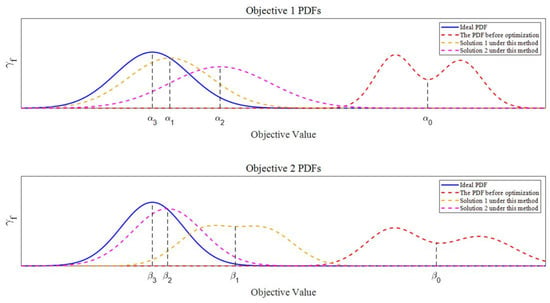
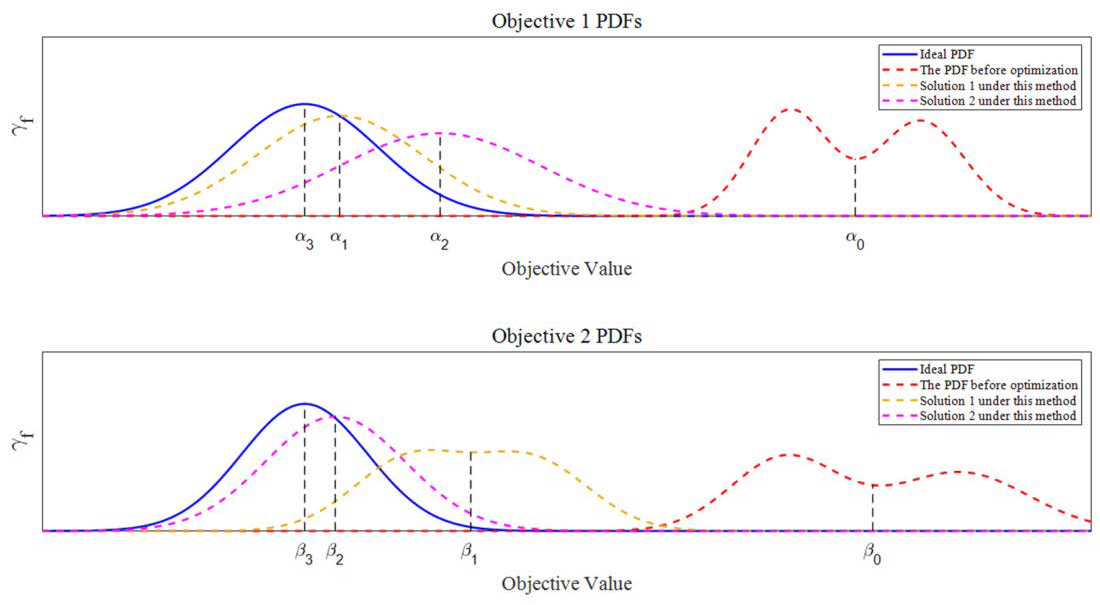
Mean-based optimization evaluates the expected objective values but does not explicitly optimize their dispersion or distributional shape. PDF-based approaches instead evaluate prescribed distributional criteria, as investigated in non-Gaussian process optimization and modeling-error PDF shaping [9,10,11]. In other words, the traditional optimization methods focus solely on the mean value of the objective function and ignore the fact that the PDF shape of the objective function exhibits non-Gaussian features [19,20,21]. In practice, uncertainties inherent in industrial processes rarely follow a standard normal distribution. As shown in Figure 1, the uncertainty inherent in the industrial processes results in a non-Gaussian PDF shape of the objective function. Consequently, traditional mean-based optimization struggles to handle such non-Gaussian features, making it difficult to achieve the ideal target distribution. In contrast, the multi-objective stochastic optimization method based on PDF shape yields optimized PDFs that approximate the Gaussian-shaped ideal PDF. However, due to the trade-off relationship among multiple objectives, solution 1 and solution 2 cannot simultaneously approach the ideal PDF across different objective functions.
Figure 1.
A multi-objective stochastic optimization method based on the distribution shape of the objective function.
In this paper, we mainly focus on solving the multi-objective optimization problem by optimizing the PDF shape of the objective function. Let denote the estimated PDF of the ith objective function, and let denote a scalar performance index evaluating this PDF. The probabilistic constrained multi-objective stochastic optimization problem in (2) can be further reformulated into the PDF shape of the objective-function-based probabilistic constrained multi-objective stochastic optimization as follows:
This formulation specifies a distribution-based comparison criterion for the stochastic objectives; it is not claimed to be equivalent to expected-value minimization or other stochastic optimization criteria, where is the continuous function of the PDF of the nth objective function defined on set X. It can be seen that the impact of uncertainties can be reduced, and the robustness of optimization method is improved by optimizing the PDF shape of the objective function. Indeed, the introduction of a multi-objective stochastic optimization method enables the simultaneous consideration of multiple performance indexes and reduces the influence of uncertainties into the optimization process.
3. Multi-Objective Stochastic Optimization Algorithm
3.1. Probabilistic Constrained Multi-Objective Stochastic Algorithm
Kernel density estimation (KDE), as a common nonparametric estimation method, is especially suitable to shape the probability distribution of random variables [22,23]. Therefore, the KDE method is used to estimate the PDF of the objective function with the following random variables:
where n is the sample size, xi represents the random sample, and ψ is the kernel function with bandwidth h. The bandwidth h in the kernel function determines the smoothness of the target function PDF. Too small a bandwidth will cause the PDF to oscillate excessively, while too large a bandwidth will result in an overly smooth curve that masks local features of the data. Therefore, for bandwidth h, this paper adopts the optimal bandwidth for the Gaussian kernel function. In this paper, the Gaussian kernel function can effectively capture the complex distribution characteristics in the data, making it particularly suitable for estimating the PDF shape of complex industrial processes.
To minimize the impact of uncertainties embedded into the objective function, the PDF shape of the objective function is expected to approach the ideal PDF as a Gaussian type. According to Stochastic Distribution Control (SDC) theory, the smaller the variance of an ideal PDF of a Gaussian type, the less randomness is embedded into the objective function [24,25]. In this case, the error integral between the estimated PDF shape of the objective function and the ideal PDF is considered as the following performance index:
where the ideal PDF is defined as , i = 1,2,…,n, and the parameters μi,d and σi,d represent the mean and variance of the ideal PDF, respectively. Here, a and b correspondingly denote the lower and upper limits of the numerical integration interval, rather than bounds on the support of the stochastic objective. The interval is selected to cover a prescribed reference range and the observed objective samples.
Meanwhile, the entropy, as a measure of uncertainties, is often used in the optimization of industrial processes [26]. This is mainly because the smaller the entropy, the lower the uncertainties embedded into the objective function. For this purpose, the entropy with mean constraint is constructed as the following performance index:
where αi,1 and αi,2 are the weights, Ji,1 and Ji,2 are the entropy and the mean value of the objective function, respectively.
Therefore, the performance index in (5) is regarded as a PDF tracking-based optimization problem, and the performance index in (6) is regarded as the entropy of the mean constraint-based optimization problem. To handle the opportunity constraints, kernel density estimation is employed to calculate the probability of meeting the constraints. Specifically, the satisfaction probability is determined by numerically integrating the estimated PDF over the feasible region, where the resulting integral directly represents the probability of meeting the constraints. Feasible solutions are always prioritized, while infeasible ones are ranked according to their constraint violations. Feasible solutions are ranked by non-dominated sorting: the first front contains solutions not dominated by any other feasible solution, and subsequent fronts are obtained by successively removing the preceding fronts. Solutions are selected by rank, with larger crowding distances preferred within a partially accepted front [27]. In order to quantify the degree of probabilistic constraint violations, a novel violation measure is introduced as follows:
The CV value is zero when the probabilistic constraints are satisfied. Otherwise, infeasible solutions are ranked by the sum of reciprocal satisfaction probabilities, with smaller values preferred. This guides the population to converge to high confidence intervals, enhancing the feasibility and robustness of the solution.
3.2. MODE with Adaptive Mutation Strategy
In order to effectively reduce the uncertainties in the optimization process, the randomness can be quantified by the PDF shape of the objective function. MODE is used as the optimizer. Among them, the choice of mutation strategy critically influences the algorithm’s global exploration ability and local convergence behavior in MODE. An appropriate mutation strategy can effectively guide the population toward the Pareto front [28, 29]. Therefore, in order to balance the diversity and the convergence during the search process, an adaptive mutation MODE algorithm is proposed based on a Cauchy–Gaussian mixture distribution [29]. Compared with conventional mutation strategies, the proposed method introduces adaptive scaling factors ε and κ, and the mutation strategy is formulated as follows:
where xpbest is a randomly selected vector from the top p% individuals in the current generation population, xr1 and xr2 are random individuals in the population, and xa is an individual of the population before mutation.
The transition from global exploration to local exploitation during evolution is achieved by adjusting the weights of the Cauchy and Gaussian distributions. In the early stage, the Cauchy distribution has a higher weight, promoting global search by escaping local optima. In the later stage, the weight of the Gaussian distribution increases, aiding local convergence. Thus, the scaling factors and for the ath individual in generation G are generated as follows:
where Cauchy(μ,sc) represents a random sample drawn from the Cauchy distribution with the location parameter μ and the scale parameter sc, and X(0,1) denotes a sample from the standard normal distribution. The two scaling factors use separately generated Cauchy and Gaussian random samples, and their location parameters are maintained and updated separately. They control movement toward the guiding individual and differential perturbation, respectively. The parameter ϑ is typically set to a small positive value to ensure that, in the later stages of evolution, the perturbation centers around the mean value of the Gaussian distribution, thereby enhancing local search diversity. Scaling factors are clipped to their prescribed range, and out-of-bound mutant components are clipped to the nearest decision bound. The weight φ of the mixture distribution is defined as follows:
where Gmax denotes the maximum number of generations.
In order to efficiently guide the search process towards more promising regions, an adaptive update mechanism based on successful mutation parameters is used. Specifically, when an offspring individual outperforms its parent in fitness, its corresponding scaling factors are deemed successful and are stored in the successful parameter sets Γsucc and Ksucc. At the end of each generation, the Lehmer mean of these successful parameters is computed as follows:
It is evident that the greater weights of successful parameters are assigned by the Lehmer mean, preserving the mutation trends during the search process. Consequently, the location parameters are dynamically updated using a learning rate as follows:
where trate is the preset learning rate. Location parameters are clipped to their prescribed range after updating. Successful parameter samples are collected when offspring outperform their corresponding parents under constraint-aware comparison. If no successful samples are available, the corresponding location parameter remains unchanged. For convenience, the proposed algorithm is referred to as the MODE algorithm with an adaptive mutation strategy based on a Cauchy–Gaussian mixture distribution.
3.3. Summary of Algorithms
This paper proposes two optimization methods to address multi-objective optimization problems and uncertainties in complex industrial processes. First, based on the probabilistic constrained multi-objective stochastic optimization algorithm, the KDE method is employed to estimate the PDF of the objective function. By accurately tracking the PDF shape of the objective function and minimizing the error between the estimated PDF and the ideal Gaussian-type PDF, multiple performance indicators such as energy consumption, emissions, and cost are optimized while addressing the impact of uncertainties. Additionally, a performance index based on entropy is introduced to further reduce uncertainties in the objective function, improving the robustness and reliability of the optimization results. This method effectively handles constraints, prioritizes feasible solutions, and ranks infeasible solutions based on their constraint violations, guiding the solution set toward high-confidence regions. Secondly, the adaptive mutation MODE algorithm is proposed, which uses a Cauchy–Gaussian mixture distribution to adjust the mutation strategy, balancing global exploration and local convergence. In the early stages of evolution, a higher weight is given to the Cauchy distribution to promote global search and avoid local optima, while in later stages, the weight of the Gaussian distribution increases to enhance local convergence. The algorithm also incorporates an adaptive update mechanism based on successful mutation parameters, improving the search efficiency and stability by recording successful mutation parameters and updating them using the Lehmer mean.
Together, these methods provide more precise and efficient optimization tools to address uncertainties and multi-objective optimization in complex industrial processes. By evaluating uncertainty-related characteristics through distribution-based performance indices and guiding population selection using non-dominated sorting and crowding distance [27], the proposed optimization methods aim to improve economic efficiency and product quality stability in industrial processes and support energy saving, emissions reduction, green transformation, and automation improvement.
Algorithm 1 summarizes the distribution-based multi-objective stochastic optimization procedure, combining KDE-based performance evaluation, probabilistic constraint handling, and MODE with adaptive scaling-factor generation. C-MODE is used separately as a comparison algorithm in the experiments.
| Algorithm 1. Distribution shape of the objective function-oriented probabilistic constrained multi-objective stochastic optimization. |
|
4. Simulation Experiment
4.1. Numerical Simulation
In order to demonstrate the effectiveness of the proposed method, the following probabilistic constrained multi-objective stochastic optimization problem is considered:
The distributions and parameter values of the random variables in Equation (18) are summarized in Table 1.
Table 1.
Distributions and parameters of the random variables in Equation (18).
The population size and the maximum numbers are set to 25 and 40, respectively, and the crossover factor is 0.8. Additionally, a mixed probability distribution-based mutation strategy is employed. Since the position and scale parameters are adaptively adjusted during the evolutionary process via Equations (16) and (17), it is necessary to set an initial value for it. Specifically, the position parameters με and δκ are set to 0.5, the scale parameter sc of the Cauchy distribution and the standard deviation ϑ of the Gaussian distribution are set to 0.1, and the learning rate trate is set to 0.1.
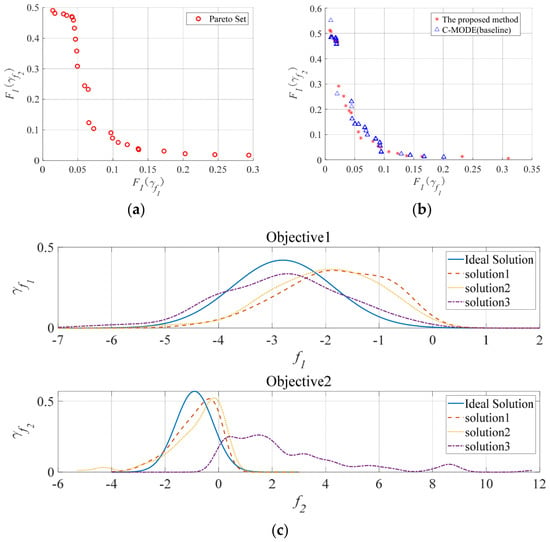
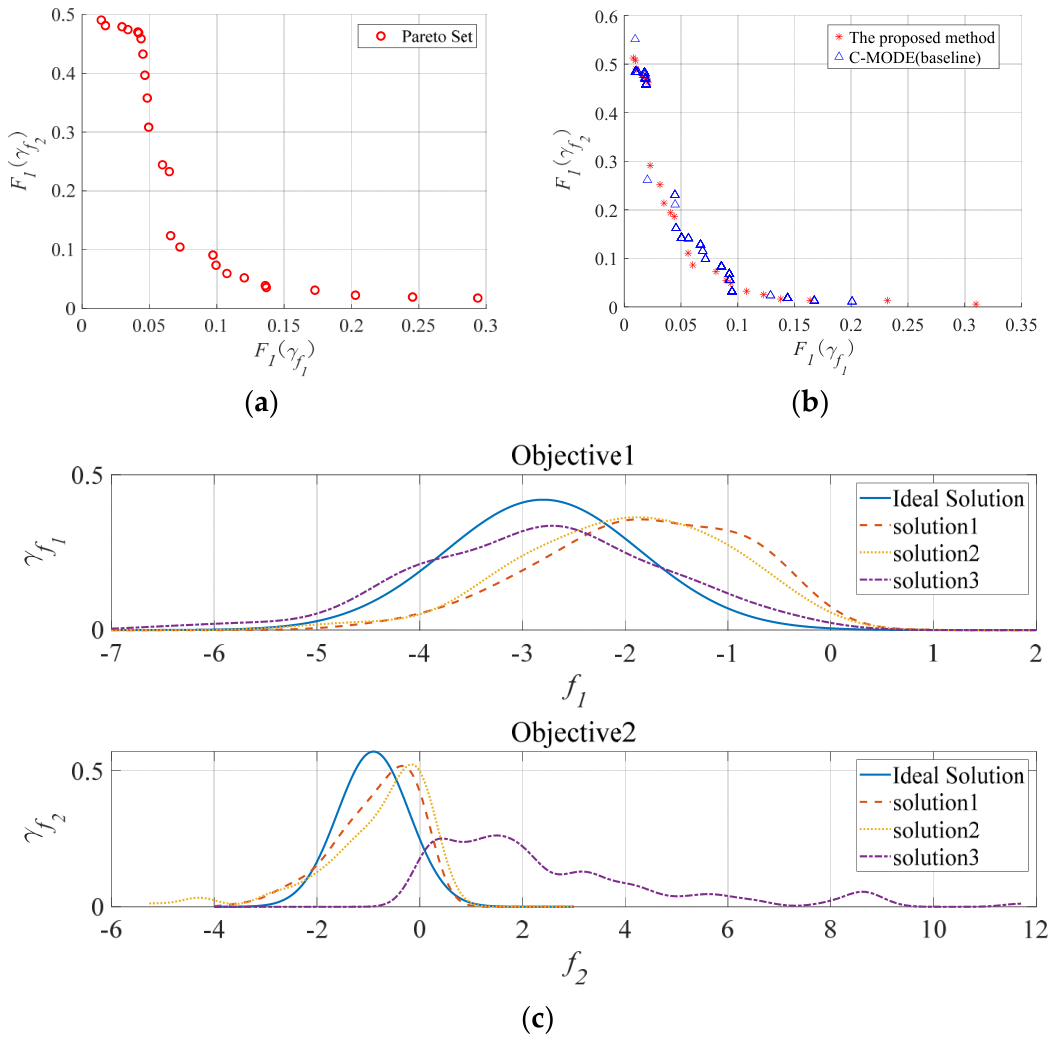
When the performance index shown in (5) based on the PDF tracking of the objective function is used, this paper uses the historical optimal solution sample statistics method to set the parameters and make this ideal distribution closer to the optimum. Therefore, the mean μd and the variance σd of objective function f1 are set to μd = −2.8 and σd = 0.95, respectively, and for objective function f2 −0.9 and 0.7, respectively. The pareto optimal solutions are displayed in Figure 2a by the proposed method, and the pareto fronts of the proposed method and C-MODE over 30 runs are compared in Figure 2b. It can be seen that the solutions by the proposed method are closer to the origin, indicating superior convergence and diversity. Furthermore, Figure 2c illustrates the PDFs of several representative pareto optimal solutions alongside the predefined ideal PDFs; it can be observed that the PDFs of objective functions better match the ideal PDFs, and the proposed method enables the pareto optimal solutions to effectively reduce randomness.
Figure 2.
PDF tracking of the objective-function-based optimization method: (a) Pareto optimal solution; (b) Pareto optimal solutions with different algorithms; (c) PDF of the objective function corresponding to several representative Pareto-optimal solutions.
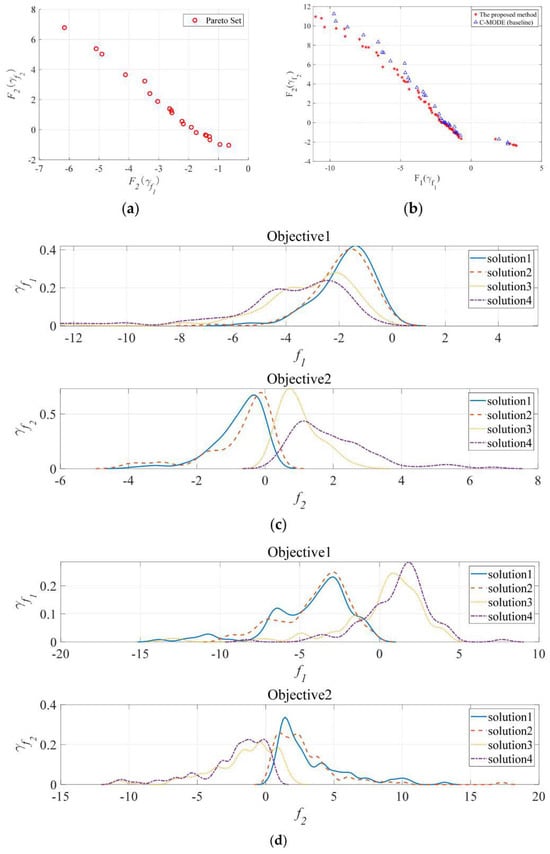
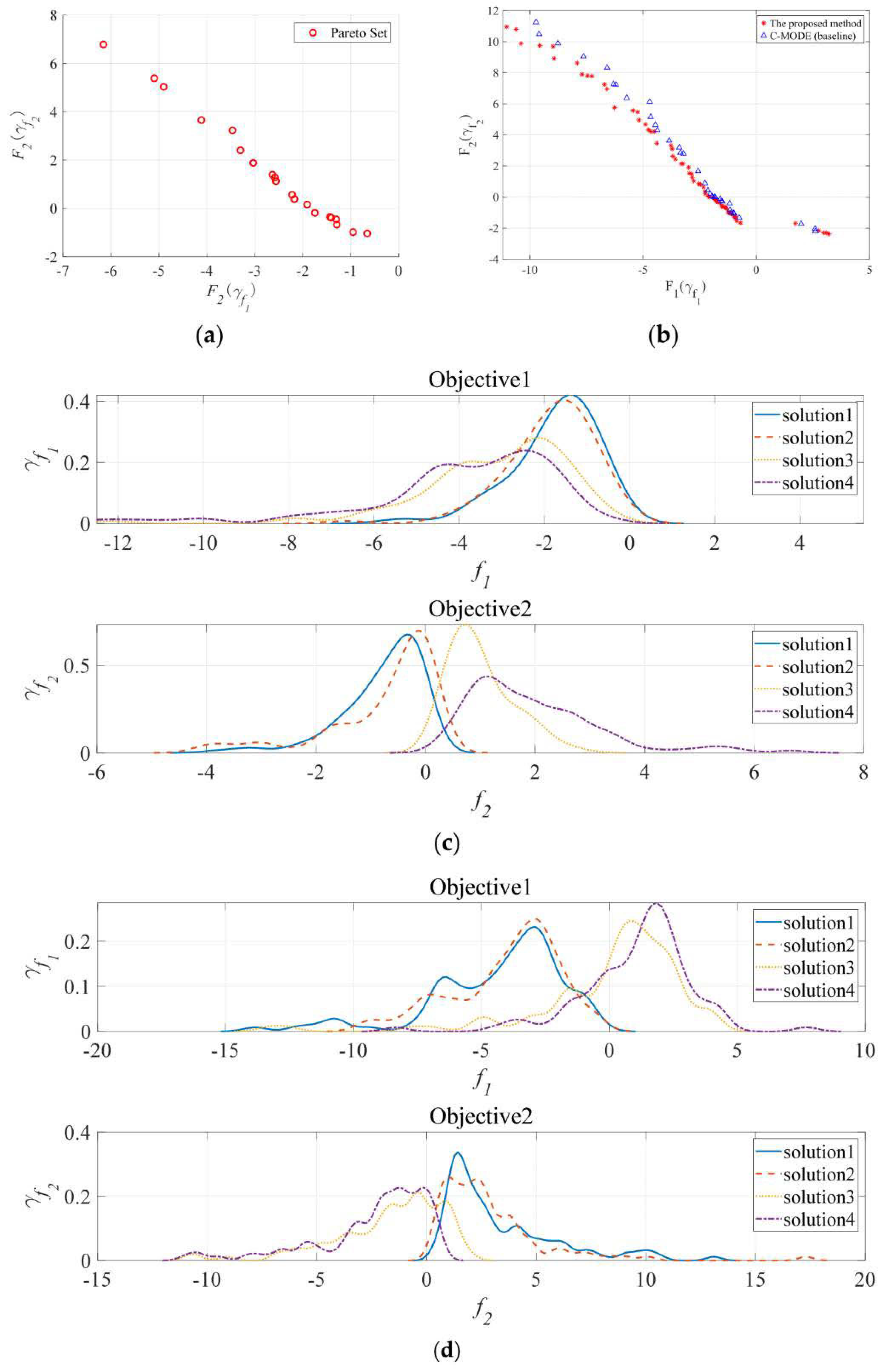
Furthermore, the entropy with mean constraint-based optimization performance index in (6) is used, and then the weights αi,1 and αi,2 are set to 0.5 and 0.25, respectively. The Pareto optimal solutions are shown in Figure 3a, while the Pareto optimal solutions obtained by different algorithms are presented in Figure 3b. It can be seen that the proposed algorithm significantly outperforms the C-MODE in terms of both the convergence and the distribution of the solution set, indicating superior global search ability and local convergence performance. As shown in Figure 3c, the PDFs of several representative Pareto optimal solutions exhibit pronounced Gaussian characteristics, and the distributions of the PDFs in the two objective functions further highlight the mutual trade-off relationship between them. In addition, Figure 3d presents the results obtained by a conventional optimization method based on the mean values of the objective functions. Compared with the proposed method, this traditional approach shows larger deviations from the ideal PDFs and higher embedded randomness.
Figure 3.
Entropy with mean-value constraint-based optimization method and traditional methods: (a) Pareto optimal solution; (b) Pareto optimal solutions with different algorithms; (c) PDF of the objective function corresponding to several representative Pareto-optimal solutions; (d) Traditional optimization method based on the mean value of the objective function.
To supplement the numerical results, an additional four-configuration comparison was conducted. Table 2 reports the performance under a common PDF-tracking evaluation criterion.
Table 2.
Quantitative performance of the four configurations under a common PDF-tracking evaluation criterion.
Under PDF tracking, the proposed algorithm achieves a statistically significant HV improvement over C-MODE, whereas the IGD difference is not significant.
4.2. Application to Ironmaking Process in a Blast Furnace
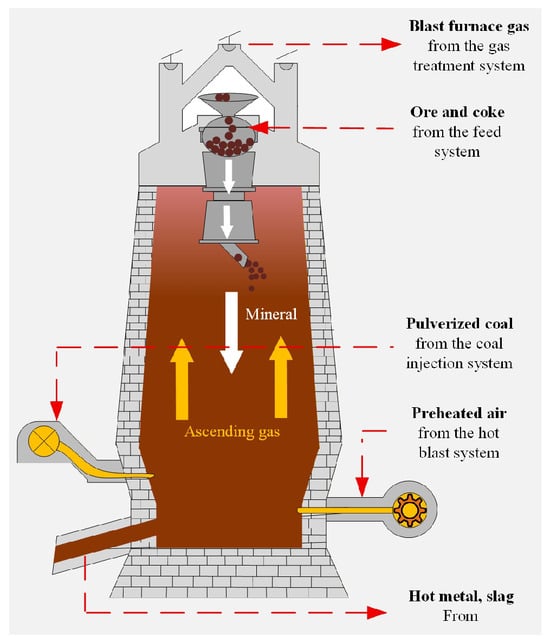
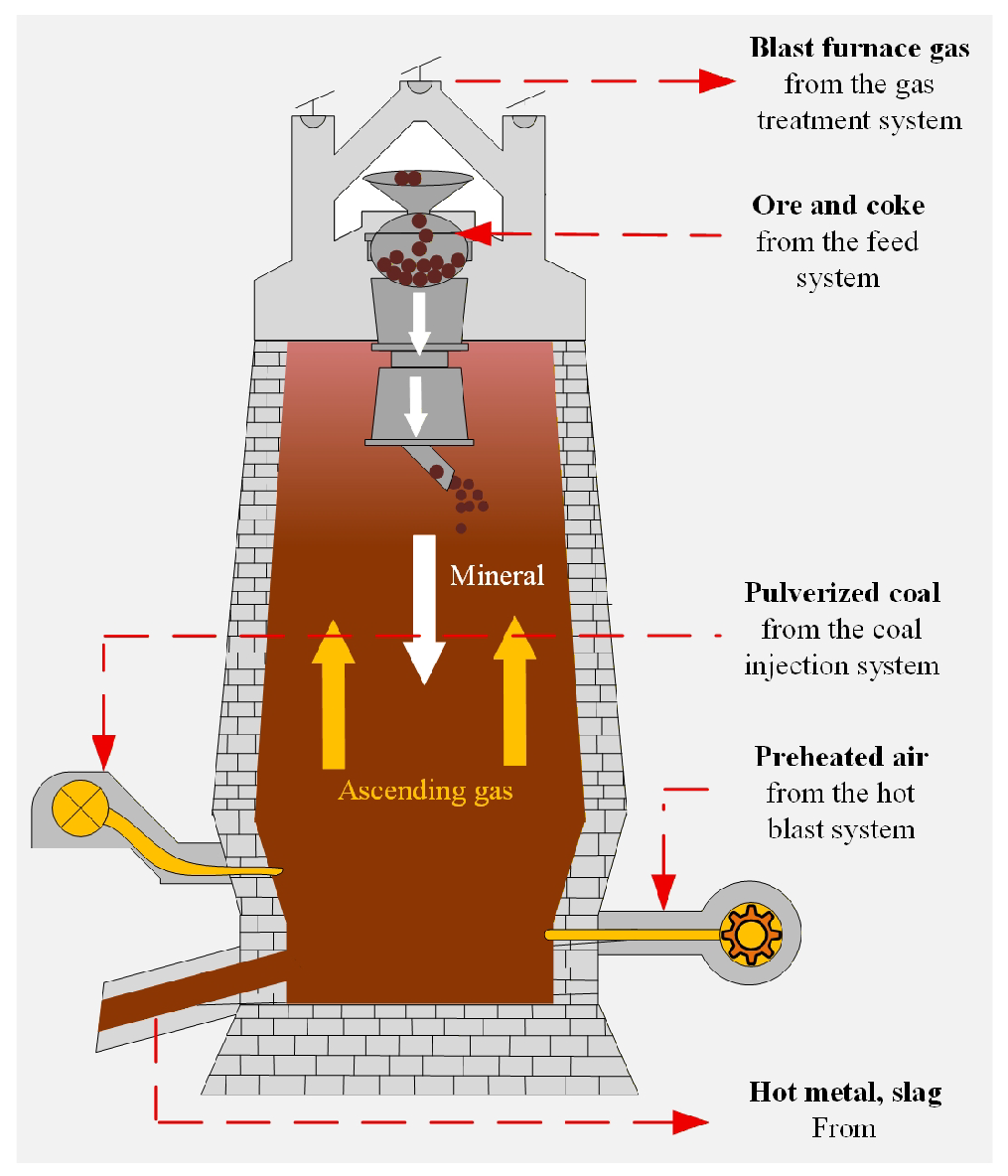
In this section, an industrial experiment based on actual production data from a large blast furnace in southwestern China is carried out to verify the applicability and effectiveness of the proposed method. As a typical industrial process with high energy consumption and large emissions, the ironmaking process in a blast furnace plays a crucial role in determining the energy efficiency and the pollutant emission levels [30]. The core structure of the blast furnace ironmaking process is displayed in Figure 4, which is mainly composed of the furnace body, the feed system, the pulverized coal injection system, the gas dedusting system, and the hot metal handling system. Iron ore, coke, and fluxes, after being properly proportioned, are continuously charged from the furnace top and gradually descend under gravity. Simultaneously, high-temperature hot air is injected from the bottom and is combusted with pulverized coal in the tuyere zone to provide the required heat. Physical and chemical reactions are carried out in the hearth, resulting in the formation of molten iron and slag. The pollutant gases generated during the process are treated through the gas cleaning process to ensure compliance with environmental emissions standards.
Figure 4.
Schematic of blast furnace ironmaking process.
In order to achieve the goals of reducing energy consumption, minimizing pollutant emissions, and ensuring stable and efficient operation, it is necessary to obtain optimized decisions on key process parameters by optimizing the operating conditions of the blast furnace. As a result, optimization of the blast furnace ironmaking process mainly focuses on optimizing decisions achieved by the optimizing operational index, such as economic costs and CO2 emissions, with the premise of meeting the constraints of molten iron quality (such as the silicon content (Si content) and the molten iron temperature).
4.2.1. Economic Cost- and Emissions-Based Multi-Objective Stochastic Optimization
To optimize the blast furnace ironmaking process, it is necessary to construct the mathematical models that describe the relationships between the decision variables and the economic costs, the CO2 emissions, the molten iron temperature, and the silicon content. Due to the strong nonlinearity and multivariable coupling characteristics of the blast furnace ironmaking process, it is difficult to obtain traditional mechanism models. Therefore, by means of a deep neural network (DNN) with powerful approximation and learning capabilities, a neural network with the Gated Recurrent Unit (GRU) [31,32] is employed to construct the models of the economic costs, the CO2 emissions, the molten iron temperature and the silicon content. Although the DNN model can describe the relationship between the decision variables and the operation index, model error is inevitable, and its PDF shape is usually assumed to follow a Gaussian type. However, given that the impact of model nonlinearity and randomness in the modeling process exists, the PDF shape of modeling error is difficult to satisfy the Gaussian assumption [12]. In other words, the PDF shape of model error to be optimized has typical non-Gaussian features. The result shows that the model error with a Gaussian-type focused conventional optimization method cannot effectively reduce the randomness into optimization progress. Under the circumstances, the randomness within each objective function caused by model error with non-Gaussian features should be considered for the optimization.
On the other hand, there are numerous factors influencing the economic costs, the CO2 emissions, the molten iron temperature and the silicon content. Here, the correlation analysis method is used to select the greatest influence on the aforesaid indexes to reduce the computational complexity, and the selected decision variables include coal injection rate, cold air flow rate, oxygen enrichment flow rate, hot air temperature, hot air pressure, differential pressure, and blower humidity. Overall, the economic cost and the emissions-based multi-objective stochastic optimization for the blast furnace ironmaking process can be summarized as follows:
where , , and represent the nonlinear model outputs corresponding to economic cost, CO2 emissions, molten iron temperature, and silicon content, respectively. x = [x1,x2,x3,x4,x5,x6,x7] denotes the set of decision variables, , , , and . ωi and τj represent the uncertainty of the objective function and the constraint function, respectively. l1 and l2 are the lower and the upper bounds of molten iron temperature, respectively, and l3 and l4 are the lower and the upper bounds of decision variables, respectively. The decision variables, their units, lower and upper bounds, and operational relevance are summarized in Table 3. The variables and their bounds were specified by process engineers based on the operating requirements of the blast furnace.
Table 3.
Decision variables, units, and operating bounds for the blast furnace case study.
The main purpose of the proposed method is to acquire the optimal decision by optimizing the PDF shape of the objective function and constraint function. The quality intervals in (19) define the admissible operating conditions. Under random modeling errors, the problem is reformulated by requiring these intervals to be satisfied with prescribed probabilities and evaluating the stochastic objectives using PDF-based performance indices, as follows:
where J(⋅) represent the performance index in (5) and (6). It can be observed that the Pareto optimal solution set can achieve a trade-off between economic costs and CO2 emissions by optimizing the PDF shape of each objective function that describe economic costs and CO2 emissions.
4.2.2. Results Analysis and Discussion
To verify the effectiveness of the proposed method, the industrial experiment is conducted based on actual production data. The population size is set to 30, the maximum number of generations is 40, and the crossover factor is 0.8, the position parameters are selected as με = μκ = 0.5, the scale parameter sc of the Cauchy distribution and the standard deviation ϑ of the Gaussian distribution are set to 0.1 in (11) and (12), and the learning rate trate is set to 0.1 in (16) and (17).
According to the process requirements, the silicon content is constrained within the interval [0.4%, 0.6%], and the temperature of molten iron is restricted to the interval [1480 °C, 1520 °C]. The risk level εi is set at 0.04. ω1 is a gamma distribution with both shape and scale parameters equal to 9.5, ω2 is a gamma distribution with the shape parameter of 3 and the scale parameter of 2, τ1 and τ2 follow a gamma distribution with shape and scale parameters of 0.1 and 1, respectively. Meanwhile, the ideal PDF of economic cost is selected as a Gaussian distribution with a mean of 1977 and a variance of 29, and the ideal PDF of CO2 emissions is selected as a Gaussian distribution with a mean of 24 and a variance of 3.
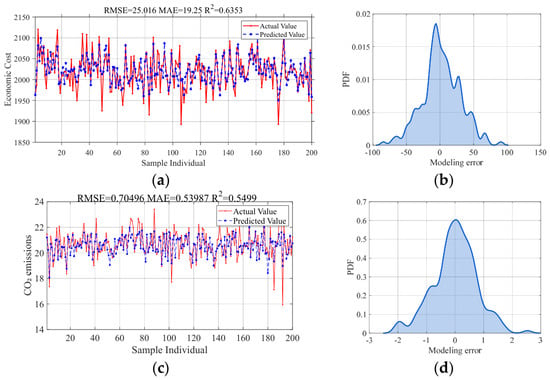
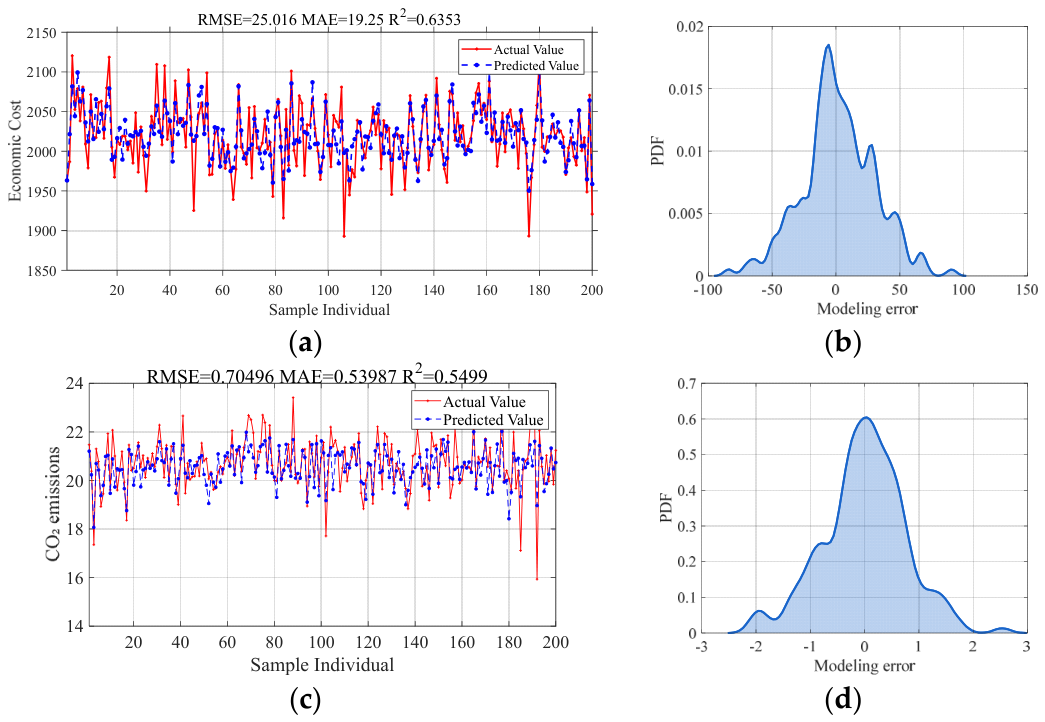
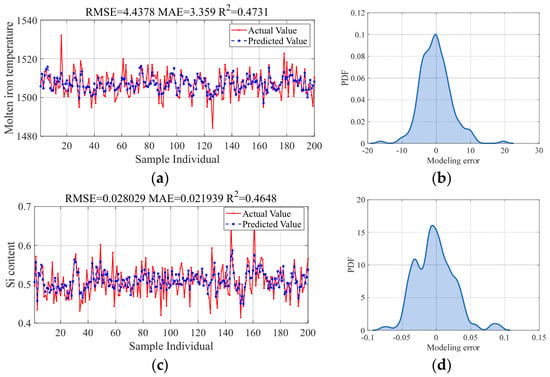
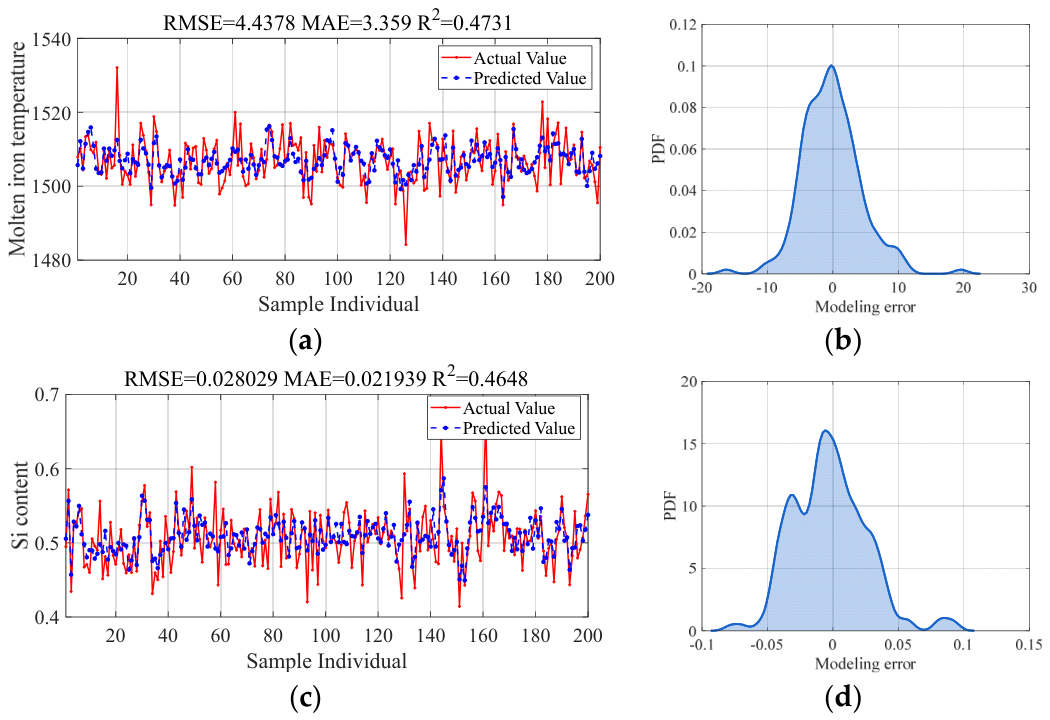
The modeling results of the objective function (economic cost and carbon dioxide emissions) and the constraint function (molten iron temperature and silicon content) are shown in Figure 5 and Figure 6, respectively. As shown in Figure 5 and Figure 6, there is a deviation between the actual values and the predicted values of the model, which leads to modeling errors in the model to be optimized. It can be seen that the probability density function shape of the modeling error shows obvious non-Gaussian characteristics. Therefore, the traditional optimization methods based on the mean have limitations in solving such stochastic optimization problems, and these methods cannot effectively capture the actual distribution characteristics of the error.
Figure 5.
Modeling effects for the objective function model: (a) Modeling error of the economic cost; (b) PDF of modeling error for economic cost; (c) Modeling error of CO2 emissions; (d) PDF of modeling error for CO2 emissions.
Figure 6.
Modeling effects for the constraint function model: (a) Modeling error of molten iron temperature; (b) PDF of modeling error for molten iron temperature; (c) Modeling error of Si content; (d) PDF of modeling error for Si content.
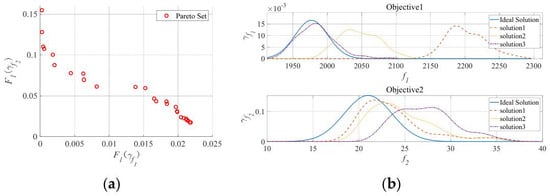
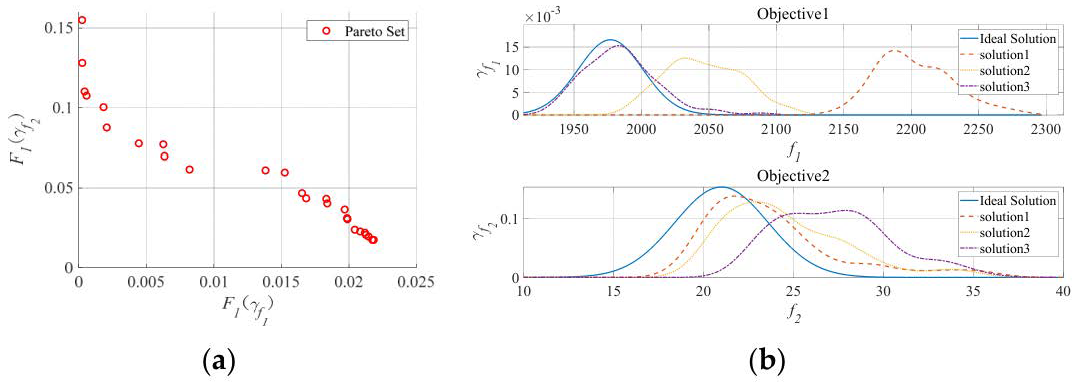
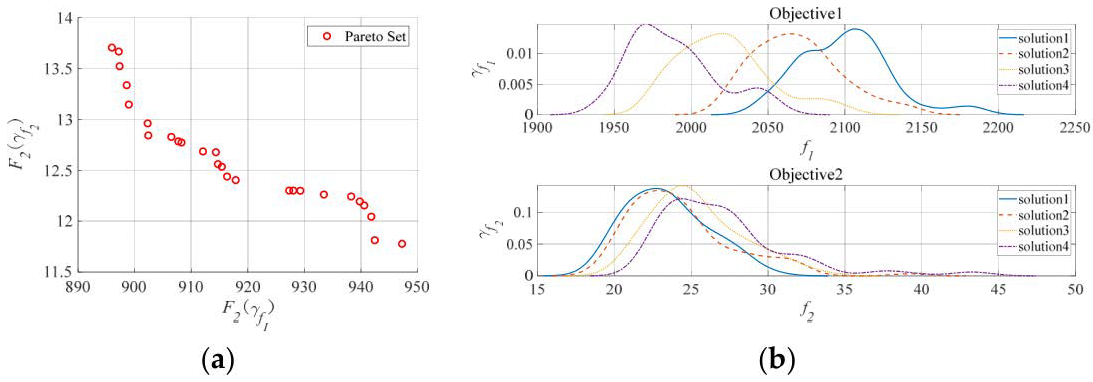
This paper employs a PDF tracking method, as defined in Equation (5), to address the multi-objective stochastic optimization problem described in Equation (20). Figure 7 presents the Pareto front of the obtained solution set along with the corresponding PDF profiles for selected solutions. Specifically, Figure 7a illustrates the solution set for the errors between the target functions and the ideal PDFs, demonstrating the efficacy of the proposed approach in multi-objective optimization for uncertain industrial processes. As shown in Figure 7b, the error PDFs for both economic cost and CO2 emissions significantly converge toward ideal distributions. These results provide strong evidence that the optimization method effectively suppresses and mitigates the stochastic uncertainties embedded within each objective function.
Figure 7.
PDF tracking of the objective-function-based optimization method: (a) Pareto optimal solution; (b) PDF of the objective function corresponding to several representative Pareto-optimal solutions.
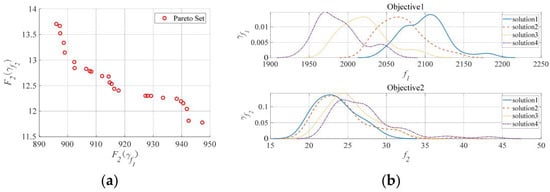
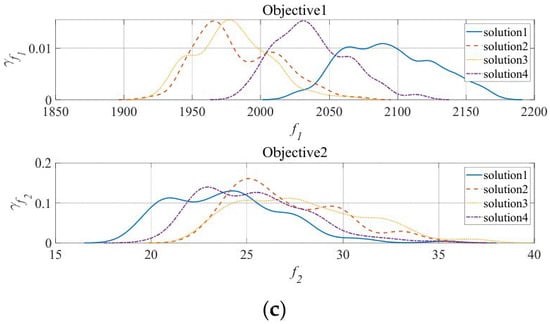
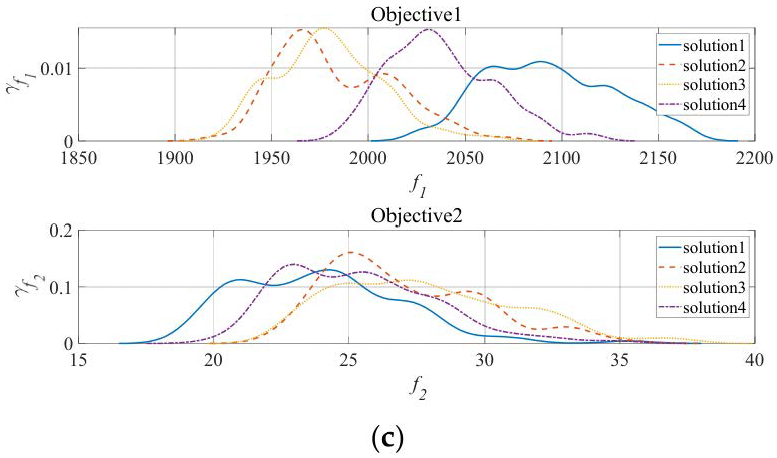
Furthermore, the entropy with mean constraints shown in (6) is used for the multi-objective stochastic optimization shown in (20). The weightings αi,1 and αi,2 in (7) and (8) are set to 0.5 and 0.45, respectively. The Pareto optimal solutions are shown in Figure 8a, and the PDF shapes corresponding to several representative Pareto optimal solutions are depicted in Figure 8b. The results indicate that the Pareto optimal solutions exhibit a favorable distribution and convergence. Meanwhile, the PDF shape of each objective function shown in Figure 8b corresponding to several representative solutions generally demonstrates a distinct Gaussian characteristic. For the conventional optimization method based on the mean values of the objective functions, the PDF shapes of several Pareto optimal solutions are shown in Figure 8c. As shown, the PDFs of the objective functions exhibit non-Gaussian characteristics, further indicating that this mean-value-based optimization approach tends to result in solutions with higher randomness.
Figure 8.
Entropy with mean-value constraint-based optimization method: (a) Pareto optimal solution; (b) PDF of the objective function corresponding to several representative Pareto-optimal solutions; (c) Optimization method based on the mean value of the objective function of the traditional blast furnace ironmaking system.
5. Conclusions
This study combined distribution-based objective evaluation with chance constraints for multi-objective stochastic optimization of industrial processes and employed MODE with adaptive scaling-factor generation as the solution method. Compared with the conventional mean-based multi-objective optimization method, the proposed method respectively reduced the average PDF-tracking errors for the two objectives from 0.065277 and 0.138072 to 0.061159 and 0.077179 in the numerical example, corresponding to reductions of 6.31% and 44.10%, respectively. In the offline industrial case study, the corresponding errors decreased from 0.004584 and 0.034066 to 0.004428 and 0.033198, representing reductions of 3.40% and 2.55%, respectively. These results indicate improved agreement with the prescribed reference PDFs under the selected evaluation criterion. They should not be interpreted directly as equivalent reductions in economic cost, CO2 emissions, or process variability.
Several limitations remain. The evaluation is limited to two-objective problems, and the computational performance in higher-dimensional settings requires further investigation. The industrial results are obtained through offline optimization using GRU surrogate models and have not been validated through plant implementation. Their reliability depends on prediction accuracy, data coverage, and the assumed error distributions. The sensitivity to reference-PDF parameters, KDE bandwidths, and sampling settings also requires further assessment. Moreover, the current industrial objective models use decision-independent additive noise, so improved PDF tracking does not establish a reduction in objective variance or differential entropy.
Future research will focus on validating the prediction models using temporally separated data and assessing the uncertainty models using actual prediction residuals. Parallel computation and operating-condition-specific decision libraries will also be investigated to improve computational efficiency, with feasibility reassessed when operating conditions change. Industrial evaluation will proceed through historical-data replay and online shadow operation before controlled plant trials. Candidate operating decisions will require engineering assessment of furnace stability, fuel utilization, heat balance, and equipment safety before implementation.
Author Contributions
Z.Z.: supervision, formal analysis, funding acquisition. X.L.: Writing—original draft, investigation, methodology, validation, supervision. R.Z.: Writing—review and editing, formal analysis. M.L.: conceptualization, methodology, software, writing—review and editing, formal analysis. All authors have read and agreed to the published version of the manuscript.
Funding
This research was supported in part by the Special Project for Science and Technology Cooperation and Exchange of Shanxi Province under Grant 202304041101001, in part by the Science and Technology Research Special Fund of Taihang Laboratory in Shanxi province under Grant THYF-KJGG-25010700, THYF-KJGG-26012100, in part by the Shanxi Key Laboratory Of Advanced Control and Industrial Intelligence under Grant 202404010931015; in part by the Special Fund for Science and Technology Innovation Teams of Shanxi Province under Grant 202304051001004.
Data Availability Statement
The industrial data used in this study are subject to confidentiality restrictions imposed by the data provider and are not publicly available.
Conflicts of Interest
The authors declare no conflicts of interest.
References
- Fontes, D.; Vasconcelos, L.; Brito, R. Blast furnace hot metal temperature and silicon content prediction using soft sensor based on fuzzy C-means and exogenous nonlinear autoregressive models. Comput. Chem. Eng. 2020, 141, 107028. [Google Scholar] [CrossRef] [Scilit]
- Liu, Y.; Zhou, P.; Sun, X.; Chai, T. Optimal tracking control of blast furnace molten iron quality based on Krotov’s method and nonlinear subspace identification. IEEE Trans. Ind. Electron. 2024, 71, 9610–9619. [Google Scholar] [CrossRef] [Scilit]
- Zhou, P.; Wang, X.; Chai, T. Multiobjective operation optimization of wastewater treatment process based on reinforcement self-learning and knowledge guidance. IEEE Trans. Cybern. 2023, 53, 6896–6909. [Google Scholar] [CrossRef] [Scilit] [PubMed]
- Han, H.; Liu, Y.; Qiao, J. Mechanism-data-driven multiobjective optimization for wastewater treatment process. IEEE Trans. Ind. Inform. 2024, 20, 7810–7819. [Google Scholar] [CrossRef] [Scilit]
- Zhou, P.; Zhang, S.; Chai, T. Adaptive constraint penalty-based multiobjective operation optimization of an industrial dynamic system with complex multiconstraint. IEEE Trans. Cybern. 2024, 54, 4724–4737. [Google Scholar] [CrossRef] [Scilit] [PubMed]
- Dai, X.; Zhao, L.; He, R.; Du, W.; Zhong, W.; Li, Z.; Qian, F. Data-driven wasserstein distributionally robust chance-constrained optimization for crude oil scheduling under uncertainty. Chin. J. Chem. Eng. 2024, 69, 152–166. [Google Scholar] [CrossRef] [Scilit]
- Du, S.; Zhou, W.; Wu, D.; Fei, M. Learning-based collaborative optimization for multi-objective energy-aware distributed assembly blocking flow shop scheduling. Comput. Ind. Eng. 2025, 206, 111214. [Google Scholar] [CrossRef] [Scilit]
- Ye, F.; You, R.; Yang, L.; Lu, H.; Xie, H. A novel data-driven rule-base approach with driving factor decomposition for multi-scenario prediction on carbon emission reduction. Comput. Ind. Eng. 2025, 206, 111217. [Google Scholar] [CrossRef] [Scilit]
- Li, M.; Zhou, P.; Wang, L.; Yuan, Y. Data-driven multiobjective predictive optimal control of refining process with non-gaussian stochastic distribution dynamics. IEEE Trans. Ind. Inform. 2021, 17, 7269–7278. [Google Scholar] [CrossRef] [Scilit]
- Zhou, P.; Wang, C.; Li, M.; Wang, H.; Wu, Y.; Chai, T. Modeling error PDF optimization based wavelet neural network modeling of dynamic system and its application in blast furnace ironmaking. Neurocomputing 2018, 285, 167–175. [Google Scholar] [CrossRef] [Scilit]
- Li, M.; Zhou, P.; Wang, H. Objective PDF-shaping based stochastic optimization with probabilistic constraints and its application. IEEE Trans. Ind. Electron. 2024, 71, 3024–3033. [Google Scholar] [CrossRef] [Scilit]
- Qiao, K.; Yu, K.; Qu, B.; Liang, J.; Song, H.; Yue, C. An evolutionary multitasking optimization framework for constrained multiobjective optimization problems. IEEE Trans. Evol. Comput. 2022, 26, 263–277. [Google Scholar] [CrossRef] [Scilit]
- Liang, J.; Lin, H.; Yue, C.; Yu, K.; Guo, Y.; Qiao, K. Multiobjective differential evolution with speciation for constrained multimodal multiobjective optimization. IEEE Trans. Evol. Comput. 2023, 27, 1115–1129. [Google Scholar] [CrossRef] [Scilit]
- Wang, Q.; Hao, Y.; Xu, Y.; Ma, T.; Zhang, X. An energy-aware scheduling method for parallel tasks based on an adaptive differential evolution algorithm in a multi-cloud environment. Expert Syst. With Appl. 2026, 296, 129008. [Google Scholar] [CrossRef] [Scilit]
- Liu, B.; Bi, X. Adaptive ε-constraint multi-objective evolutionary algorithm based on decomposition and differential evolution. IEEE Access 2021, 9, 17596–17609. [Google Scholar] [CrossRef] [Scilit]
- Farda, I.; Thammano, A.; Morris, J. Differential evolution with self-adaptive mutation and population improvement strategy for optimization problems. IEEE Access 2024, 12, 131809–131829. [Google Scholar] [CrossRef] [Scilit]
- Zhao, T.; Pan, X.; Yao, S.; Ju, C.; Li, L. Strategic bidding of hybrid AC/DC microgrid embedded energy hubs: A two-stage chance constrained stochastic programming approach. IEEE Trans. Sustain. Energy 2020, 11, 116–125. [Google Scholar] [CrossRef] [Scilit]
- Ma, R.; Li, X.; Gao, W.; Lu, P.; Wang, T. Random-fuzzy chance-constrained programming optimal power flow of wind integrated power considering voltage stability. IEEE Access 2020, 8, 217957–217966. [Google Scholar] [CrossRef] [Scilit]
- Zhou, H.; Zhang, H.; Yang, C. Hybrid-model-based intelligent optimization of ironmaking process. IEEE Trans. Ind. Electron. 2020, 67, 2469–2479. [Google Scholar] [CrossRef] [Scilit]
- Zhou, Q.; Yin, Y.; Peng, D.; Zhao, H.; Xing, L.; Jiang, X.; Xu, Z.; Xu, C. Multi-objective optimization of blast furnace dosing and operation based on NSGA-II. In Proceedings of the 2022 4th International Conference on Electrical Engineering and Control Technologies, Shanghai, China, 16–18 December 2022; IEEE: New York, NY, USA, 2022; Volume 12, pp. 16–18. [Google Scholar]
- Zhang, C.; Ng, K.; Jin, Z.; Sun, X.; Qin, Y. Risk-averse two-stage stochastic programming model for gate assignment problem under arrival time uncertainty. Comput. Ind. Eng. 2025, 207, 111269. [Google Scholar] [CrossRef] [Scilit]
- Wang, Y.; Ding, Y.; Shahrampour, S. TAKDE: Temporal adaptive kernel density estimator for real-time dynamic density estimation. IEEE Trans. Pattern Anal. Mach. Intell. 2023, 45, 13831–13843. [Google Scholar] [CrossRef] [Scilit] [PubMed]
- Majdara, A.; Nooshabadi, S. Nonparametric density estimation using copula transform, bayesian sequential partitioning, and diffusion-based kernel estimator. IEEE Trans. Knowl. Data Eng. 2020, 32, 821–826. [Google Scholar] [CrossRef] [Scilit]
- Liu, Y.; Wang, H.; Guo, L. Observer-based feedback controller design for a class of stochastic systems with non-Gaussian variables. IEEE Trans. Autom. Control 2015, 60, 1445–1450. [Google Scholar] [CrossRef] [Scilit]
- Ren, M.; Zhang, J.; Wang, H. Minimized tracking error randomness control for nonlinear multivariate and non-Gaussian systems using the generalized density evolution equation. IEEE Trans. Autom. Control 2014, 59, 2486–2490. [Google Scholar] [CrossRef] [Scilit]
- Zhang, Q.; Zhang, J.; Wang, H. Data-driven minimum entropy control for stochastic nonlinear systems using the cumulant-generating function. IEEE Trans. Autom. Control 2023, 68, 4912–4918. [Google Scholar]
- Deb, K.; Pratap, A.; Agarwal, S.; Meyarivan, T. A fast and elitist multiobjective genetic algorithm: NSGA-II. IEEE Trans. Evol. Comput. 2002, 6, 182–197. [Google Scholar] [CrossRef] [Scilit]
- Wang, G.; Gao, D.; Pedrycz, W. Solving Multiobjective Fuzzy Job-Shop Scheduling Problem by a Hybrid Adaptive Differential Evolution Algorithm. IEEE Trans. Ind. Inform. 2022, 18, 8519–8528. [Google Scholar] [CrossRef] [Scilit]
- Zhang, J.; Sanderson, A.C. JADE: Adaptive Differential Evolution With Optional External Archive. IEEE Trans. Evol. Comput. 2009, 13, 945–958. [Google Scholar] [CrossRef] [Scilit]
- Lou, S.; Yang, C.; Zhang, X.; Zhang, H.; Wu, P. Data/mechanism hybrid-driven modeling of blast furnace smelting system and global sequential optimization. J. Process Control 2024, 139, 103235. [Google Scholar] [CrossRef] [Scilit]
- Xia, M.; Shao, H.; Ma, X.; de Silva, C. A stacked GRU-RNN-based approach for predicting renewable energy and electricity load for smart grid operation. IEEE Trans. Ind. Inform. 2021, 17, 7050–7059. [Google Scholar] [CrossRef] [Scilit]
- Wang, X.; Yan, J.; Wang, X.; Wang, Y. Air quality forecasting using the GRU model based on multiple sensors nodes. IEEE Sens. Lett. 2023, 7, 1–4. [Google Scholar] [CrossRef] [Scilit]

Disclaimer/Publisher’s Note: The statements, opinions and data contained in all publications are solely those of the individual author(s) and contributor(s) and not of MDPI and/or the editor(s). MDPI and/or the editor(s) disclaim responsibility for any injury to people or property resulting from any ideas, methods, instructions or products referred to in the content. |
© 2026 by the authors. Licensee MDPI, Basel, Switzerland. This article is an open access article distributed under the terms and conditions of the Creative Commons Attribution (CC BY) license.