


Abstract
Converter steel slag contains abundant calcium-bearing phases but remains underutilised because of its heterogeneous composition and the potential co-release of undesirable elements. In this study, a hydroxyapatite-rich calcium-phosphate powder was prepared from converter steel slag through sequential water–acetic acid leaching followed by phosphate precipitation and hydrothermal treatment. The slag was first leached with deionised water at a liquid-to-solid ratio of 50 mL·g−1 for 30 min at 25 °C. The residue was subsequently leached with 1 mol·L−1 acetic acid at 65 °C for 1 h. The combined leachates were reacted with phosphoric acid, adjusted to pH 11 using sodium hydroxide, and hydrothermally treated at 120 °C for 48 h. X-ray diffraction indicated that hydroxyapatite was the dominant identifiable crystalline phase, accompanied by a minor β-tricalcium phosphate phase. Fourier-transform infrared spectroscopy confirmed phosphate- and hydroxyl-related functional groups. Scanning electron microscopy revealed predominantly needle-like particles with lengths of approximately 1–12 μm. Inductively coupled plasma optical emission spectrometry gave calcium and phosphorus concentrations of 183.96 and 82.33 mg·L−1, respectively, corresponding to an apparent Ca/P molar ratio of approximately 1.73. In a 24 h extract assay using human bone marrow-derived mesenchymal stem cells, the relative cell viability was 103.74% ± 1.82% at 1% extract and decreased to 65.22% ± 4.81% at 5% extract and 5.31% ± 0.73% at 100% extract. The 1% extract group did not differ significantly from the control. The 5–100% extract groups showed significantly lower viability than the control group, with p < 0.01. These results demonstrate the feasibility of converting calcium-bearing components of converter steel slag into a hydroxyapatite-rich calcium-phosphate powder at laboratory scale. Further work is required to establish calcium mass balance, quantitative phase composition, trace-element distribution, process reproducibility, and long-term biological performance.
1. Introduction
Converter steel slag is a major solid by-product of the steelmaking industry. Its chemical composition is dominated by calcium-, iron-, silicon-, magnesium-, and aluminium-bearing phases, which gives it considerable potential as a secondary mineral resource [1,2,3]. However, its heterogeneous mineralogy and volume instability complicate its direct application in high-value products [1,2]. Potential release of trace elements such as Al, Cr, and V adds further environmental constraints [4,5]. Most current utilisation routes remain focused on construction materials, aggregate production and other relatively low-value applications. Therefore, developing approaches that selectively recover valuable components from steel slag is important for improving resource efficiency and reducing the environmental burden associated with steel production [1,2,3].
Several routes have been explored to obtain calcium-phosphate materials from steelmaking and related slags, with differences in feedstock, pretreatment, and target product. Ashrit et al. prepared hematite-based, calcium-rich hydroxyapatite from acid-leached Linz–Donawitz slag fines [6]. Hydrothermal treatment of blast-furnace slag has also been used to produce hydroxyapatite-containing materials, with the accompanying zeolite phases varying with synthesis temperature [7], while a hydroxyapatite–zeolite composite has been reported from disposed steel slag [8]. Suzuki et al. investigated hydrothermal hydroxyapatite precipitation as a route for phosphorus extraction from synthesised steelmaking slag [9]. Together, these studies demonstrate several slag-based conversion pathways, but their different feedstocks, process configurations, and product objectives mean that their results should be interpreted within their respective contexts.
Hydroxyapatite has a nominal composition of Ca10(PO4)6(OH)2 and a theoretical calcium-to-phosphorus molar ratio of approximately 1.67 [10,11]. Its phase composition, crystallinity, morphology, and stoichiometry are strongly influenced by the calcium and phosphate concentrations, pH, temperature, reaction time, and the presence of foreign ions [10,11,12]. In particular, deviations from the ideal calcium-to-phosphorus ratio may promote the formation of other calcium-phosphate phases, such as β-tricalcium phosphate, calcium-deficient hydroxyapatite, or amorphous calcium phosphate [10,11,12]. Hydrothermal treatment can improve the crystallisation of calcium-phosphate phases and provide an effective route for controlling particle morphology and phase development [7,8,9].
Other studies have examined steel-slag-derived calcium-phosphate materials for specific applications. Fe-doped hydroxyapatite derived from converter slag has been investigated for photocatalytic xanthate degradation and Cr(VI) reduction [13], and hydroxyapatite coating material has been reported from waste steelmaking slag [14]. In a different process context, Barca et al. evaluated European BOF and EAF slags for phosphate removal from synthetic and real wastewater; phosphate removal was attributed predominantly to the precipitation of calcium-phosphate complexes, most probably hydroxyapatite [15]. These studies address photocatalysis, coating materials, or phosphate removal from water, whereas the present work examines the conversion of calcium-bearing converter-slag leachates into a calcium-phosphate powder. Their distinct feedstocks and endpoints provide important context for interpreting the different process objectives.
Leaching is a key step in mobilising calcium from converter steel slag. The sequential water–acetic acid route exploits staged calcium dissolution: in our previous study, water pretreatment preferentially dissolved free CaO, tricalcium silicate (C3S), and part of the dicalcium silicate (C2S), whereas subsequent acetic-acid treatment promoted further Ca release from residual C2S and Ca2Fe2O5 [16]. Published kinetic work also shows that Ca release during acetic-acid leaching depends on operating conditions [17]. In that study of converter-slag leaching for indirect CO2 mineralisation, the sequential route achieved a reported Ca recovery of 75.9%, compared with 68.31% for direct leaching with 1 mol·L−1 acetic acid, while acetic-acid consumption was approximately 90% lower than for direct acid leaching [16]. This stage-specific dissolution provides a process basis for using the combined leachates as the Ca feedstock for phosphate conversion in the present study. The co-mobilisation of Fe and other elements depends on slag mineralogy and leaching conditions [18,19]. In the present calcium-phosphate route, overall reagent input and aqueous-stream generation also reflect phosphoric-acid addition, pH adjustment with NaOH, and product washing.
Our previous study investigated the mechanism and operating behaviour of sequential water–acetic acid leaching of converter steel slag for calcium recovery in the context of indirect CO2 mineralization [16]. That work focused on calcium mobilisation during the leaching stages. The present study addresses the subsequent use of the resulting calcium-bearing leachates for calcium-phosphate formation. Thus, the two studies examine related but distinct stages of steel-slag valorization: calcium recovery through leaching in our previous study [16], and downstream product formation and characterisation in the present work.
Building on the leaching results of our previous study [16], the present work examines the downstream use of the combined calcium-bearing leachates for phosphate precipitation and hydrothermal treatment to produce a hydroxyapatite-rich calcium-phosphate powder. The study characterises the slag and resulting powder in terms of chemical and phase composition, functional groups, morphology, and elemental characteristics. It also evaluates the response of human bone marrow-derived mesenchymal stem cells (hBMSCs) after 24 h exposure to the powder extract using a CCK-8 assay. This assay provides an initial profile of extract-associated cellular metabolic activity; broader evaluation of cytocompatibility and osteogenic performance can build on this profile through complementary biological endpoints and exposure periods [12,20,21].
2. Materials and Methods
2.1. Materials
The converter steel slag used in this study was basic oxygen furnace (BOF) slag (BOFS), obtained from a steel plant in Tangshan, China. The slag was first crushed and sieved to <1 mm, then dry-ground in a planetary ball mill (PM 100, Retsch, Germany) at 300 rpm for approximately 5–8 min using a 50 mL zirconia jar and 5 mm zirconia balls at a ball-to-powder mass ratio of approximately 12:1. The ground material was sieved to obtain particles smaller than 30 μm and dried at 105 °C for 24 h in a forced-air oven. After cooling to room temperature, the powder was stored in a desiccator before use. Because particle size affects Ca-leaching kinetics in acetic acid [17], the <30 μm fraction was selected as a controlled fine-particle feed to standardise the particle-size range for leaching and maintain comparability with our previous sequential water–acetic acid leaching study [16].
Acetic acid (CH3COOH, AR grade), phosphoric acid (H3PO4, AR grade), and sodium hydroxide (NaOH, AR grade) used in the leaching and hydrothermal synthesis procedures were purchased from Sinopharm Chemical Reagent Co., Ltd. (Shanghai, China). Deionized (DI) water (resistivity 18.2 MΩ·cm) was used throughout all experiments.
2.2. Characterisation of Converter Steel Slag
The bulk oxide composition of the converter steel slag was determined by X-ray fluorescence spectrometry (XRF; S8 TIGER, Bruker, Germany). Before analysis, the dried slag powder was homogenised and prepared according to the instrument manufacturer’s instructions.
The crystalline phases of the slag were identified by powder X-ray diffraction using a diffractometer (SmartLab SE, Rigaku, Japan) equipped with Cu Kα radiation. Patterns were collected over a 2θ range of 10°–80°, with a step size of 0.02° and a scanning rate of 5°·min−1. Diffraction data were analysed using JADE 9.0 software and the ICDD PDF-2009 database.
2.3. Sequential Water–Acetic Acid Leaching
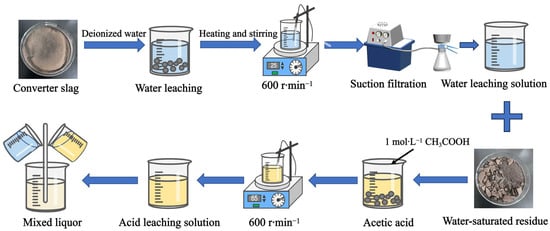
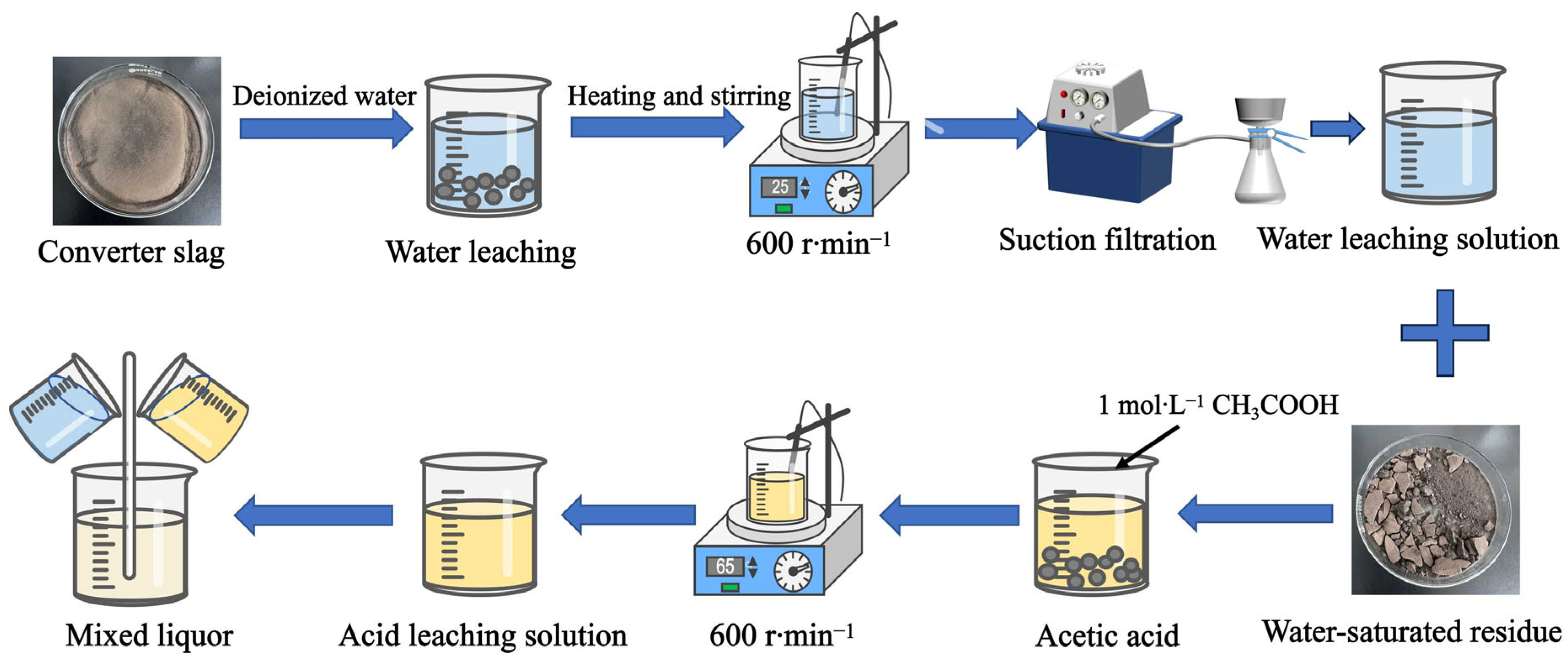
A 7.00 g portion of dried converter steel slag powder was mixed with 350 mL of deionised water at a liquid-to-solid ratio of 50 mL·g−1. The suspension was stirred at 600 r·min−1 and 25 °C for 30 min. After leaching, the suspension was filtered under vacuum to separate the water leachate from the solid residue.
After vacuum filtration, the collected water-leached residue was directly freeze-dried before the second leaching stage. A 5 g portion of the dried residue was then contacted with 250 mL of 1 mol·L−1 acetic acid, corresponding to a liquid-to-solid ratio of 50 mL·g−1. Previous studies have shown that calcium dissolution during acetic-acid leaching depends on acid concentration, temperature, particle size, and mass-transfer conditions [22,23]. In the present study, the suspension was stirred at 600 r·min−1 and 65 °C for 1 h. After completion of the second leaching step, the suspension was filtered under vacuum to obtain the acid leachate and the final solid residue.
The operating conditions were informed by our previous comparative study of sequential water–acetic acid leaching of converter steel slag for calcium recovery [16]. That study selected water leaching at 25 °C, a liquid-to-solid ratio of 50 mL·g−1, and a stirring rate of 600 r·min−1 for 30 min, followed by acid leaching with 1 mol·L−1 acetic acid at 65 °C, a liquid-to-solid ratio of 50 mL·g−1, and a stirring rate of 600 r·min−1 for 60 min. This process uses the same method, which is 30 min of water leaching, followed by 60 min of acetic acid leaching under specified temperature, liquid–solid ratio, and stirring conditions.
The water and acid leachates were combined at a volume ratio of 1:1. The volumes of the individual and combined leachates were recorded. The calcium concentrations in the leachates were determined by inductively coupled plasma optical emission spectrometry. The calcium leaching efficiency was calculated as:
where mCa,leachate is the total mass of calcium in the water and acid leachates, and mCa,initial is the total mass of calcium in the initial slag sample. The overall calcium-leaching efficiency represents the fraction of the initial calcium inventory recovered in the water and acetic-acid leachates combined; the calcium content of the recovered powder is characterised separately in Section 3.4.
The overall process route is shown in Figure 1.
Figure 1.
Sequential leaching procedure.
2.4. Preparation of the Hydroxyapatite-Rich Powder
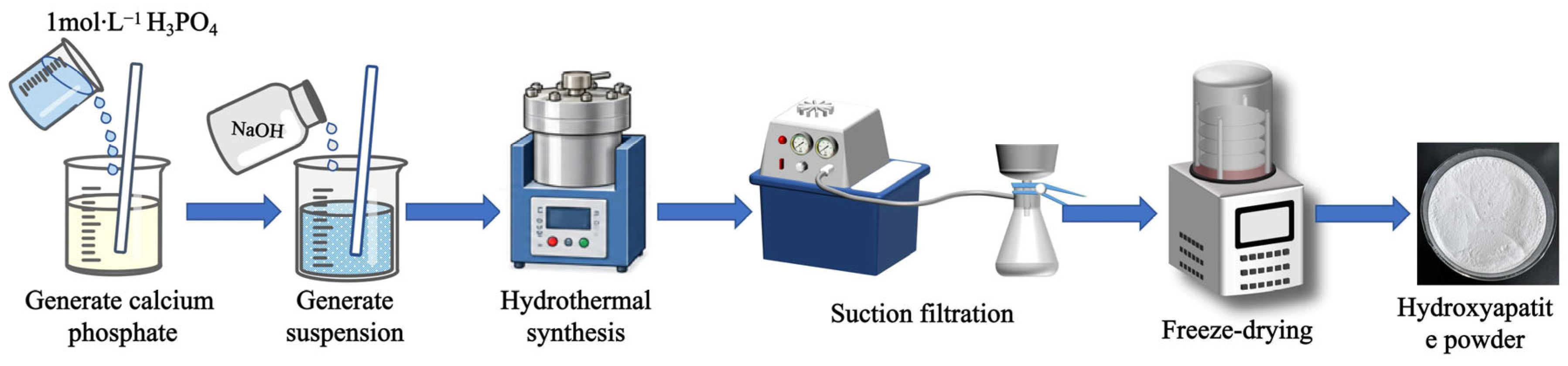
Phosphoric acid solution (1 mol·L−1) was added dropwise to the combined leachates under continuous stirring until the suspension reached pH 1.5. Sodium hydroxide solution (1.25 mol·L−1) was then added gradually until pH 11 was reached. The resulting alkaline suspension was transferred to a CEL-HAR laboratory hydrothermal reactor (China) with a PTFE liner and a stainless-steel outer vessel and maintained at 120 °C for 48 h. Related hydrothermal studies using slag-derived or iron-containing precursors have reported hydroxyapatite or related calcium-phosphate products under optimised conditions [13,24,25].
The pH sequence was used to regulate phosphate speciation during precipitation. Addition of phosphoric acid established an acidic precursor solution, followed by gradual adjustment to pH 11, which favours the formation of more highly deprotonated phosphate species and supports calcium-phosphate precipitation [10,11]. Hydrothermal treatment at 120 °C for 48 h was used to promote crystallisation and crystal growth. In slag-derived hydrothermal systems, temperature has been shown to influence secondary-phase formation, hydroxyapatite crystal size, and crystallinity [7]. A 48 h hydrothermal treatment has also been used for hydroxyapatite precipitation from synthesised steelmaking slag [9].
After hydrothermal treatment, the reactor was cooled naturally to room temperature. The solid product was recovered by vacuum filtration, washed three times with deionised water, and freeze-dried. The post-reaction filtrate and wash liquors constitute the aqueous outputs of the product-recovery step. The dried product was weighed and stored in a sealed container before characterisation. The following quantities were defined separately to distinguish the recovery of freeze-dried solid from the phosphorus material balance. The feed-basis gravimetric recovery of the freeze-dried solid was calculated as
where Rdry is the feed-basis gravimetric recovery of freeze-dried solid (%), mdry,product is the mass of freeze-dried solid recovered from the batch (g), and minitial,slag is the initial mass of dried slag powder charged to the process (g). Phosphorus utilisation was defined as
where UP is the phosphorus utilisation (%), mP,product is the mass of elemental phosphorus retained in the recovered freeze-dried product (g), and mP,input is the total mass of elemental phosphorus introduced into the phosphate-conversion stage from the combined leachates and phosphoric acid (g).
The phosphorus associated with each aqueous stream was calculated as
where mP,aq,i is the mass of elemental phosphorus in aqueous stream i (g), CP,aq,i is the measured phosphorus concentration in stream i (g·L−1), and Vaq,i is the volume of stream i (L).
For the overall aqueous output, the phosphorus mass was expressed as
where mP,aq,total is the total phosphorus mass in the post-reaction filtrate and wash liquors, and i denotes each individual aqueous stream, including the post-reaction filtrate and each washing fraction. Concentration and volume were expressed using mutually consistent units.
The overall process route is shown in Figure 2.
Figure 2.
Phosphorus-source addition, pH adjustment, and hydrothermal synthesis procedure.
2.5. Phase and Functional-Group Characterisation
The crystalline phases of the synthesised powder were identified using the same diffractometer and acquisition conditions as those used for the converter steel slag. The observed diffraction features were interpreted by qualitative comparison with standard reference patterns for hydroxyapatite and β-tricalcium phosphate using the ICDD PDF-2009 database. The resulting pattern provides a phase-level description of the synthesised calcium-phosphate material, with hydroxyapatite and β-tricalcium phosphate used as reference phases for peak interpretation.
Fourier-transform infrared (FTIR) spectra of the synthesised powder were recorded using a Nicolet iS20 spectrometer (Thermo Scientific, USA). Before measurement, the dried powder was mixed with dry KBr and ground thoroughly in an agate mortar, then pressed into a transparent pellet. A background spectrum was collected before the sample spectrum. Spectra were acquired over the wavenumber range of 400–4000 cm−1 at a resolution of 4 cm−1 using 32 scans. The characteristic absorption bands were assigned according to published reference data for calcium-phosphate and hydroxyapatite materials [10,11].
2.6. Morphological and Elemental Analysis
The morphology of the synthesised powder was examined by field-emission scanning electron microscopy (FESEM; Regulus 8230, Hitachi, Japan). The powder was dispersed on a conductive sample holder and coated with gold before observation. Images were collected at suitable magnifications.
The local elemental composition was analysed by energy-dispersive X-ray spectroscopy coupled with scanning electron microscopy. EDS measurements were performed at an accelerating voltage of 5 kV. Elemental mapping was performed for Ca, P, O, and the principal impurity elements detected in the product. Because energy-dispersive X-ray spectroscopy provides local compositional information, the results were interpreted together with the bulk elemental analysis. The observed elongated morphology was compared with high-aspect-ratio hydroxyapatite morphologies reported in the literature [26]. Particle-size distributions of the synthesised powder were measured by laser diffraction using a Mastersizer 3000 particle-size analyser (Malvern, UK). The powder was dispersed in deionised water and ultrasonicated for 5 min before measurement. The resulting distribution is reported on a volume basis. SEM was used to examine particle morphology and the apparent lengths of the elongated particles.
2.7. ICP-OES Analysis
To determine the elemental composition of the recovered powder, a 4 g portion was added to 200 mL of dilute hydrochloric acid and heated in a water bath until complete dissolution. The digest was diluted to a known final volume with deionised water and analysed by ICP-OES. The analysis covered Ca, P, Fe, Si, Al, and Mg and followed the laboratory workflow established for calcium-rich materials, including calibration and blank correction [27]. The Ca/P value was calculated from the measured Ca and P concentrations in the digestion solution and is reported as an apparent molar ratio.
The calcium-to-phosphorus molar ratio was calculated as
where CCa and CP are the measured mass concentrations of calcium and phosphorus, respectively, and MCa and MP are their molar masses.
2.8. Cell Culture and Sample Extract Preparation
Human bone marrow-derived mesenchymal stem cells (hBMSCs) were obtained from Saibai Kang Biotechnology Co., Ltd. (China) and cultured in an iCell primary mesenchymal stem cell serum-free culture system at 37 °C in a humidified atmosphere containing 5% CO2.
The synthesised powder was extracted in serum-free culture medium at a powder-to-medium ratio of 0.2 g·mL−1 for 24 h. The extract was filtered through a 0.22 μm membrane and diluted with serum-free culture medium to final concentrations of 1%, 5%, 10%, 30%, 50%, 70%, and 100%. Extraction time, extraction medium, solid-to-liquid ratio, and filtration conditions can influence the composition of the extract and the resulting biological response; these conditions were therefore reported explicitly [28].
2.9. Experimental Grouping and CCK-8 Assay
hBMSCs were seeded in 96-well plates at a density of 6 × 10³ cells per well and cultured overnight to allow cell attachment. The control group received 100 μL of serum-free culture medium per well, whereas the treatment groups received 100 μL of the corresponding sample extracts. Each condition was tested in three technical replicate wells on a single 96-well assay plate.
After 24 h of exposure, the culture medium was removed, and the wells were washed three times with phosphate-buffered saline. Subsequently, 100 μL of culture medium containing 10% CCK-8 reagent was added to each well. The plates were incubated at 37 °C for 2 h under 5% CO2. Absorbance was measured at 450 nm using a SPARK 10M microplate reader.
The absorbance of the background wells, which contained culture medium and CCK-8 reagent without cells, was used for background correction. Relative cell viability was calculated using the following equation:
where ODsample represents the absorbance of the cells exposed to the sample extract, ODcontrol represents the absorbance of the untreated control cells, and ODblank represents the absorbance of the background wells.
The results were expressed as the mean ± standard deviation of three technical replicate wells per condition; the standard deviation describes well-to-well variation within the assay plate. Statistical significance was assessed using one-way analysis of variance followed by Dunnett’s multiple-comparison test. Differences were considered statistically significant at p < 0.05, and highly significant at p < 0.01 [21,29].
3. Results and Discussion
3.1. Chemical Composition and Phase Characteristics of Converter Steel Slag
The chemical composition of the converter steel slag is presented in Table 1. CaO and Fe2O3 were the predominant oxide components, with mass fractions of 40.86% and 35.84%, respectively. The high CaO content confirms that the slag is a promising secondary calcium source for calcium-phosphate synthesis. However, the considerable Fe2O3 content and the presence of SiO2, MgO, and Al2O3 indicate that calcium extraction may be accompanied by the dissolution of non-calcium components.
Table 1.
Bulk oxide composition of converter steel slag (wt%).
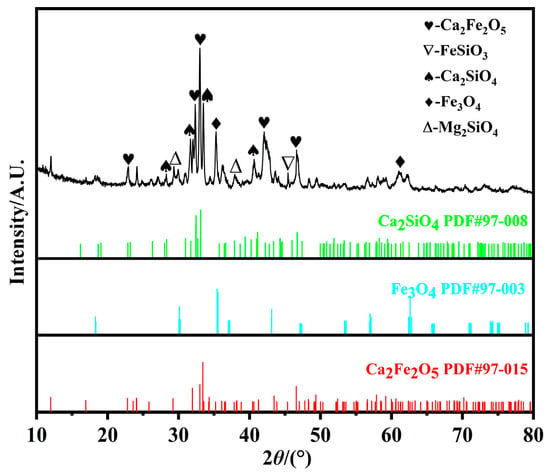
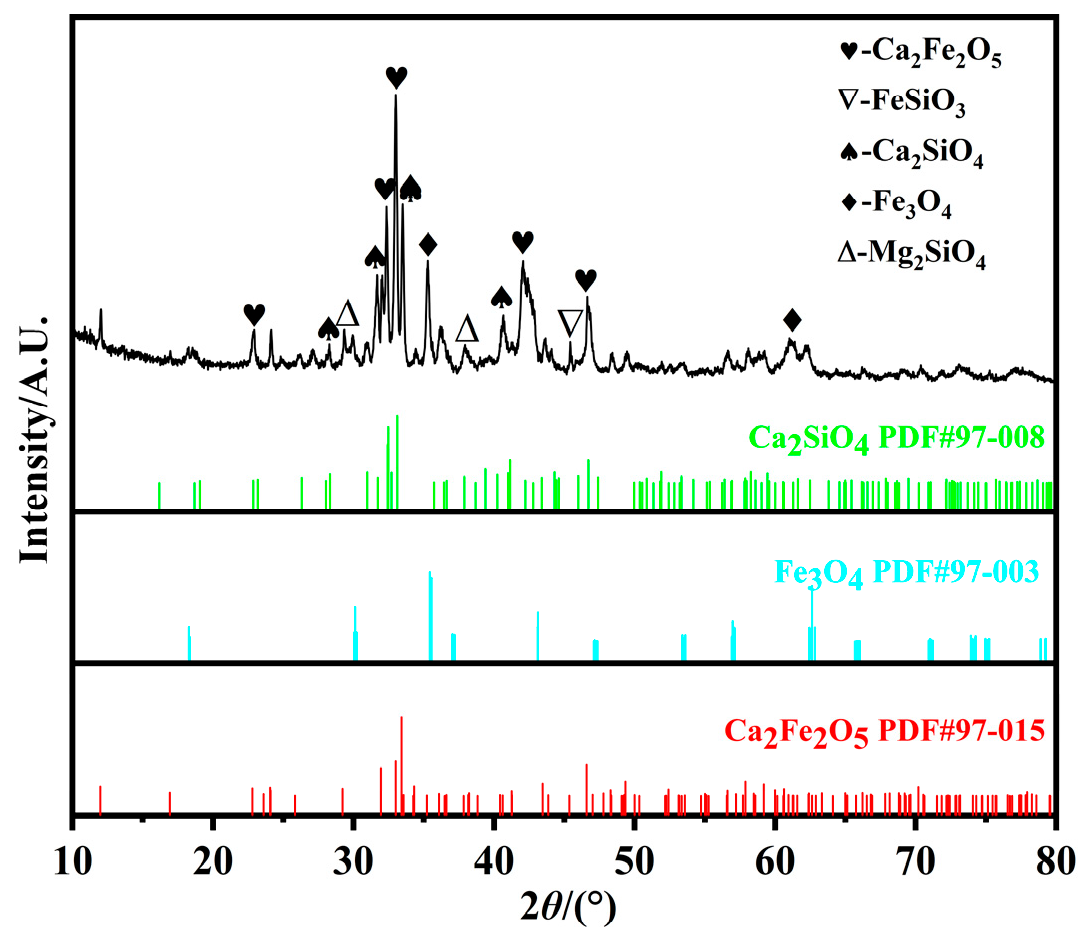
The XRD pattern of the raw slag is shown in Figure 3. The main diffraction peaks were assigned to Ca2Fe2O5 and Ca2SiO4, indicating that calcium was distributed among multiple mineral phases. These phases provide chemically distinct calcium-bearing sources during the sequential leaching process. Based on the identified phases, representative reaction pathways for water leaching and acetic-acid leaching can be expressed as follows.
Figure 3.
X-ray diffraction pattern of converter steel slag.
During water leaching, the hydrolysis of dicalcium silicate may be represented by
A representative hydrolysis pathway for dicalcium ferrite, with Fe(III) retained initially in a hydroxide-rich solid phase, is
Under acetic-acid conditions, proton-assisted dissolution of the calcium-bearing phases can be represented by
where HAc denotes CH3COOH and Ac− denotes CH3COO−. In Equation (11), Fe3+ is used for stoichiometric representation of the dissolved Fe(III) component; in the aqueous system, Fe(III) may undergo hydrolysis and acetate complexation depending on pH and solution composition. These reactions provide a chemically consistent framework for interpreting calcium mobilisation from the XRD-identified phases.
Previous studies have reported the release of calcium and iron during acidic leaching of steelmaking slag and have shown that the leaching response is influenced by reaction time, liquid-to-solid ratio, temperature, and mass-transfer conditions [17,18]. Our previous study further examined calcium recovery using a sequential water–acetic acid route at the converter-steel-slag scale [16]. Taken together, these studies support the interpretation that water leaching and subsequent acetic-acid treatment promote calcium mobilisation through the complementary reaction of readily reactive and acid-reactive calcium-bearing phases. The phase-specific contribution of Ca2Fe2O5 can be further resolved by combining leachate analysis with characterisation of the corresponding solid residues. The phases identified in the present converter-slag pattern include Ca2SiO4 (C2S) and Ca2Fe2O5 (C2F), the latter representing a calcium–iron oxide phase rather than a separately identified iron-silicate phase. Under the same sequential water–acetic acid operating conditions, our previous study reported calcium leaching rates of 15.47% during water leaching and 57.11% during the subsequent acetic-acid stage, together with an overall two-step calcium recovery of 75.9% calculated from the ICP-OES-derived calcium masses using the mass-based expression reported in that study [16]. XRD analysis in that study showed that the water-leached residue was dominated by C2S and Ca2Fe2O5, together with Fe3O4 and MgFe2O4; after acetic-acid treatment, C2S, Ca2Fe2O5, MgFe2O4, and Fe3O4 remained detectable, while the Ca2Fe2O5 reflections were weakened. These phase changes indicate that readily reactive calcium-bearing components were mobilised during water leaching, whereas the acid stage promoted further calcium release from residual calcium-silicate and calcium–iron oxide phases. The persistence of Fe3O4 and MgFe2O4 in the leached residue provides a phase-level basis for interpreting the limited enrichment of iron-bearing components in the downstream calcium-phosphate product.
The mineralogical complexity of converter steel slag is important for the subsequent synthesis process. Although the XRF-reported bulk CaO content provides a favourable calcium source, iron- and magnesium-bearing crystalline phases may affect the Ca/P ratio, crystal growth, and phase composition of the precipitated product. Therefore, the chemical composition of the raw slag should be considered together with the crystalline phases identified by XRD, the elemental composition of the leachates, and the composition of the final powder.
3.2. Formation and Phase Composition of the Calcium-Phosphate Product
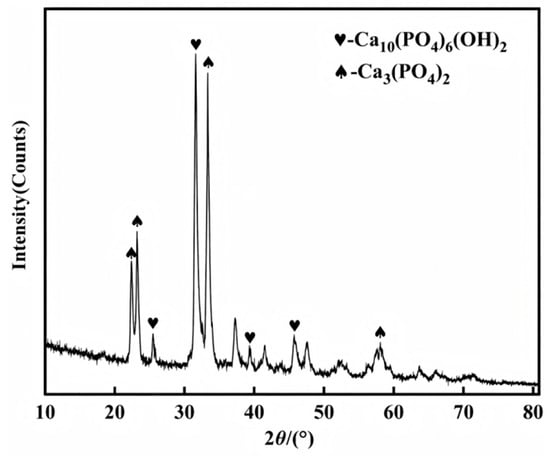
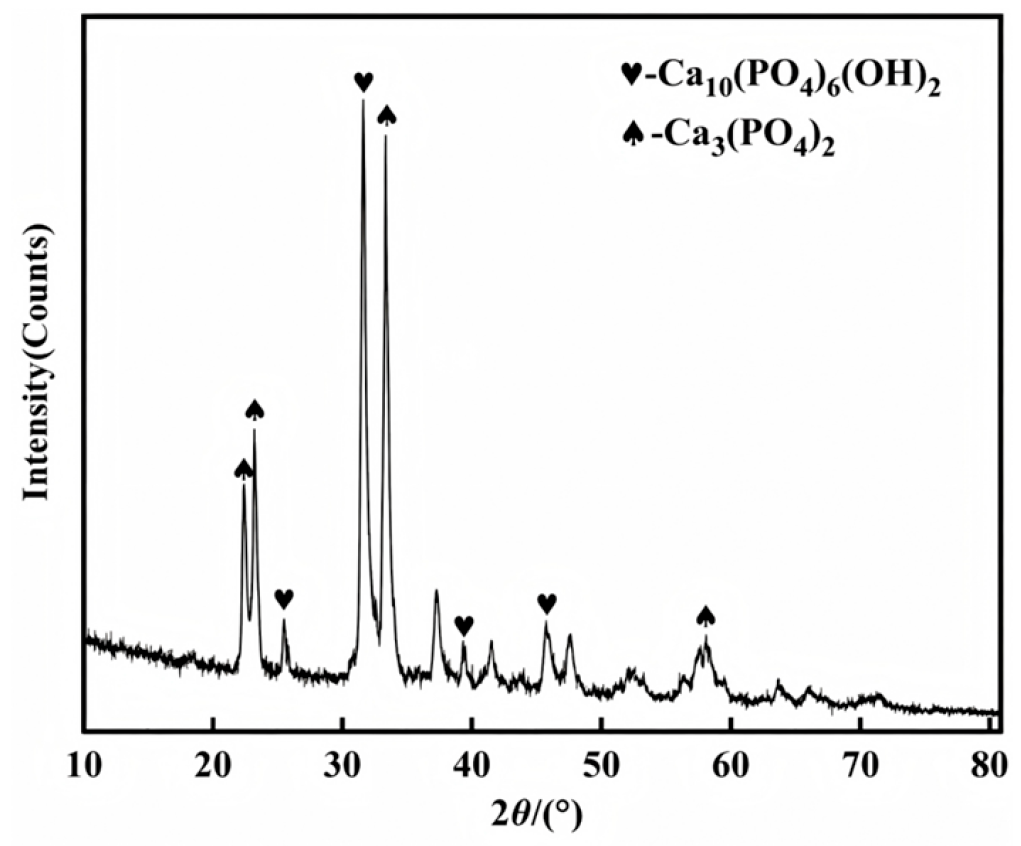
The XRD pattern of the synthesised powder is shown in Figure 4. The principal reflections near 25.9° and 31.7°–34.1° were consistent with characteristic hydroxyapatite reflections. Several weaker features were observed in the 38°–47° range, where weak reflections from hydroxyapatite and β-tricalcium phosphate may partially overlap. The resulting profile is characteristic of a hydroxyapatite-dominant calcium-phosphate product with weak β-tricalcium-phosphate-related contributions.
Figure 4.
X-ray diffraction pattern of the synthesised powder. The symbols indicate hydroxyapatite and β-tricalcium-phosphate-related reflections identified by comparison with ICDD reference patterns. Weak unmarked features represent additional low-intensity or broad structural contributions within the calcium-phosphate pattern.
The formation of hydroxyapatite can be represented by the overall reaction:
The actual precipitation process is more complex because the calcium was derived from a multicomponent slag leachate and the phosphate species changed with pH. At low pH, protonated phosphate species are dominant, whereas increasing the pH promotes the formation of more highly deprotonated phosphate species required for hydroxyapatite precipitation. Therefore, adjustment to pH 11 favoured the formation and crystallisation of hydroxyapatite during hydrothermal treatment.
The broad features observed between 50° and 53° may arise from overlapping weak calcium-phosphate reflections and contributions from low-crystallinity or amorphous calcium-phosphate domains. In hydrothermal calcium-phosphate systems, calcium deficiency and carbonate incorporation can influence phase development, crystallinity, and diffraction characteristics [30,31,32,33]. Calcium-deficient apatite is also closely related to β-tricalcium phosphate formation under appropriate compositional and thermal conditions [30,31].
Within this phase framework, the synthesised material is described as hydroxyapatite-rich calcium phosphate with weak reflections associated with β-tricalcium phosphate. The XRD pattern therefore provides a qualitative description of the crystalline phase assemblage, while the relative proportions of the individual calcium-phosphate phases remain a subject for dedicated quantitative phase analysis.
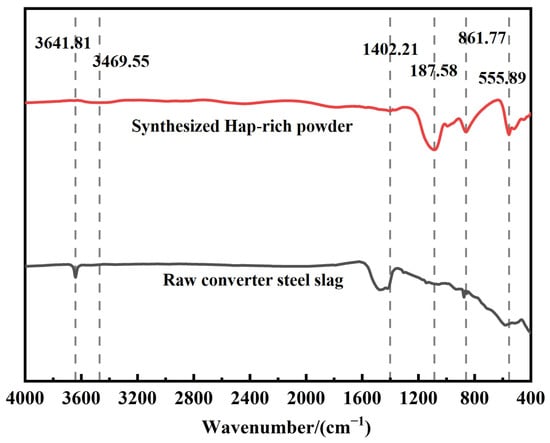
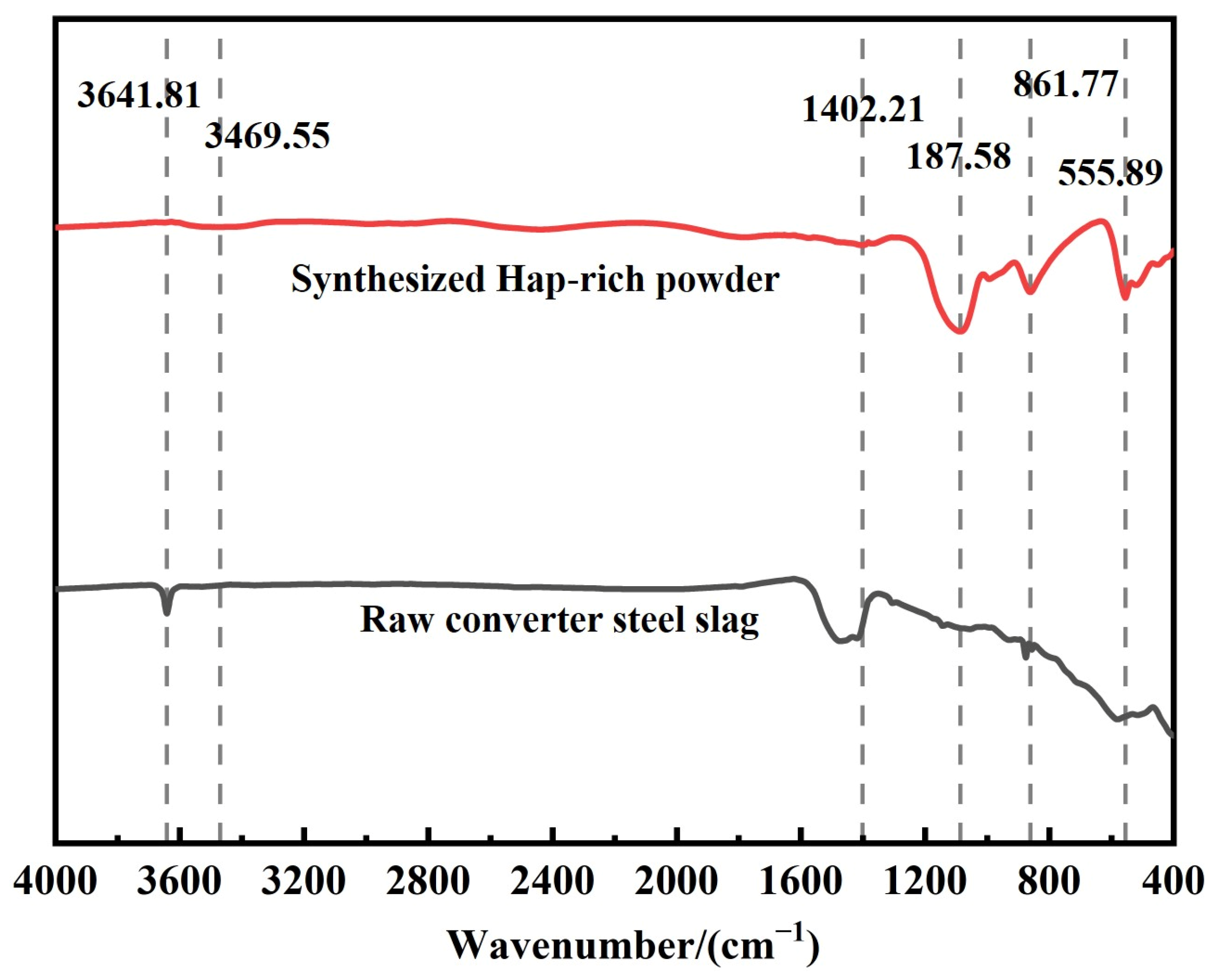
The FTIR spectrum of the synthesised powder is shown in Figure 5. The bands near 1087 and 555 cm−1 were assigned to the ν3 stretching and ν4 bending vibrations of PO43−, respectively, which are characteristic of phosphate-containing calcium-phosphate structures [10]. The band near 3641 cm−1 was attributed to structural OH− groups in the apatite lattice, whereas the broader band near 3469 cm−1 was mainly associated with adsorbed water [11].
Figure 5.
FTIR spectrum of the synthesised powder.
The bands near 1402 and 861 cm−1 were associated with carbonate-related vibrational modes. Carbonate-containing hydroxyapatites may exhibit carbonate bands in this region, with their position and intensity influenced by the substitution environment and maturation conditions [32,33]. These absorption features indicate phosphate-, hydroxyl-, water-, and carbonate-related structural environments in the synthesised calcium-phosphate material.
The FTIR results support the presence of phosphate- and hydroxyl-containing calcium phosphate, which is consistent with the XRD identification of hydroxyapatite. However, FTIR cannot independently distinguish the proportions of hydroxyapatite and β-tricalcium phosphate. The phase assignment should therefore be based on the combined interpretation of XRD, FTIR, and bulk elemental analysis.
3.3. Functional Groups and Morphology
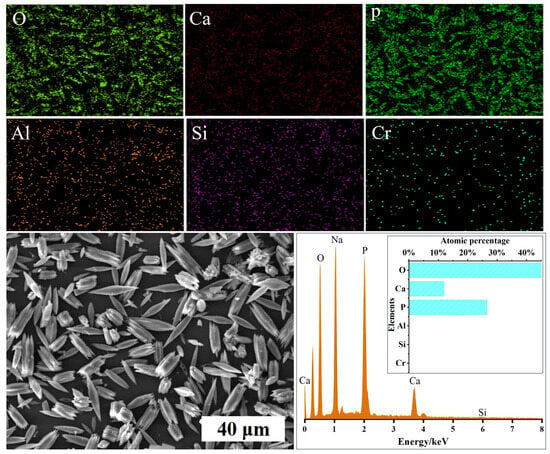
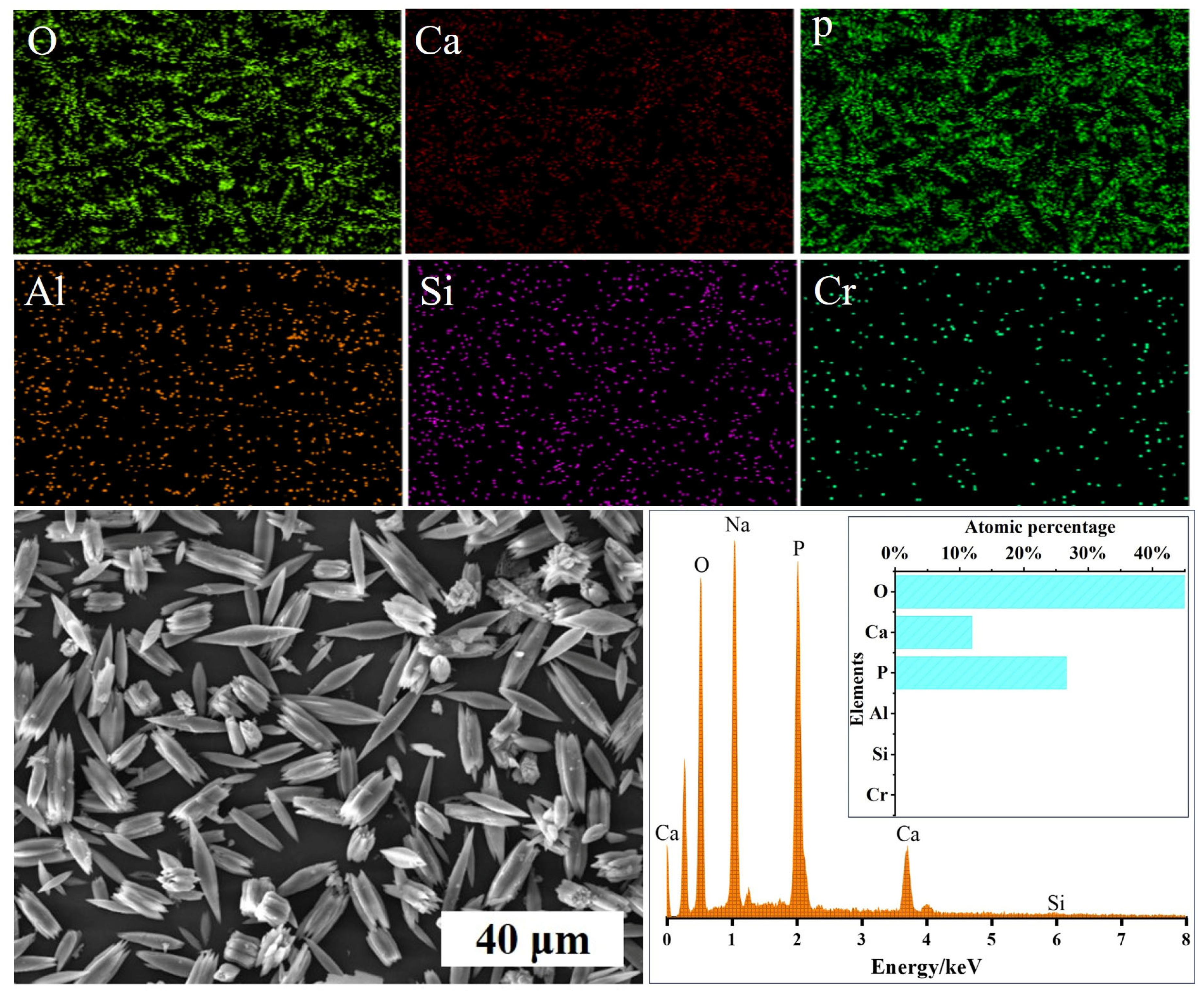
Representative SEM images are shown in Figure 6. The synthesised powder consisted mainly of needle-like or elongated particles with lengths of approximately 1–12 μm. The particles showed varying degrees of aggregation, which may have occurred during nucleation, hydrothermal crystal growth, filtration, or freeze-drying.
Figure 6.
SEM image, EDS spectrum, and elemental maps of the synthesised powder.
The observed needle-like morphology is consistent with anisotropic growth of calcium-phosphate crystals under hydrothermal conditions. Crystal growth is affected by supersaturation, pH, temperature, reaction time, and the adsorption of foreign ions on specific crystal surfaces. The residual Mg, Fe, Si, or Al species from the slag may have influenced nucleation and crystal growth, thereby contributing to the variation in particle morphology [26].
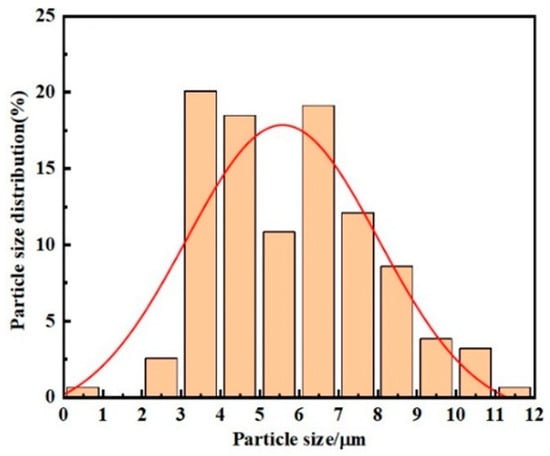
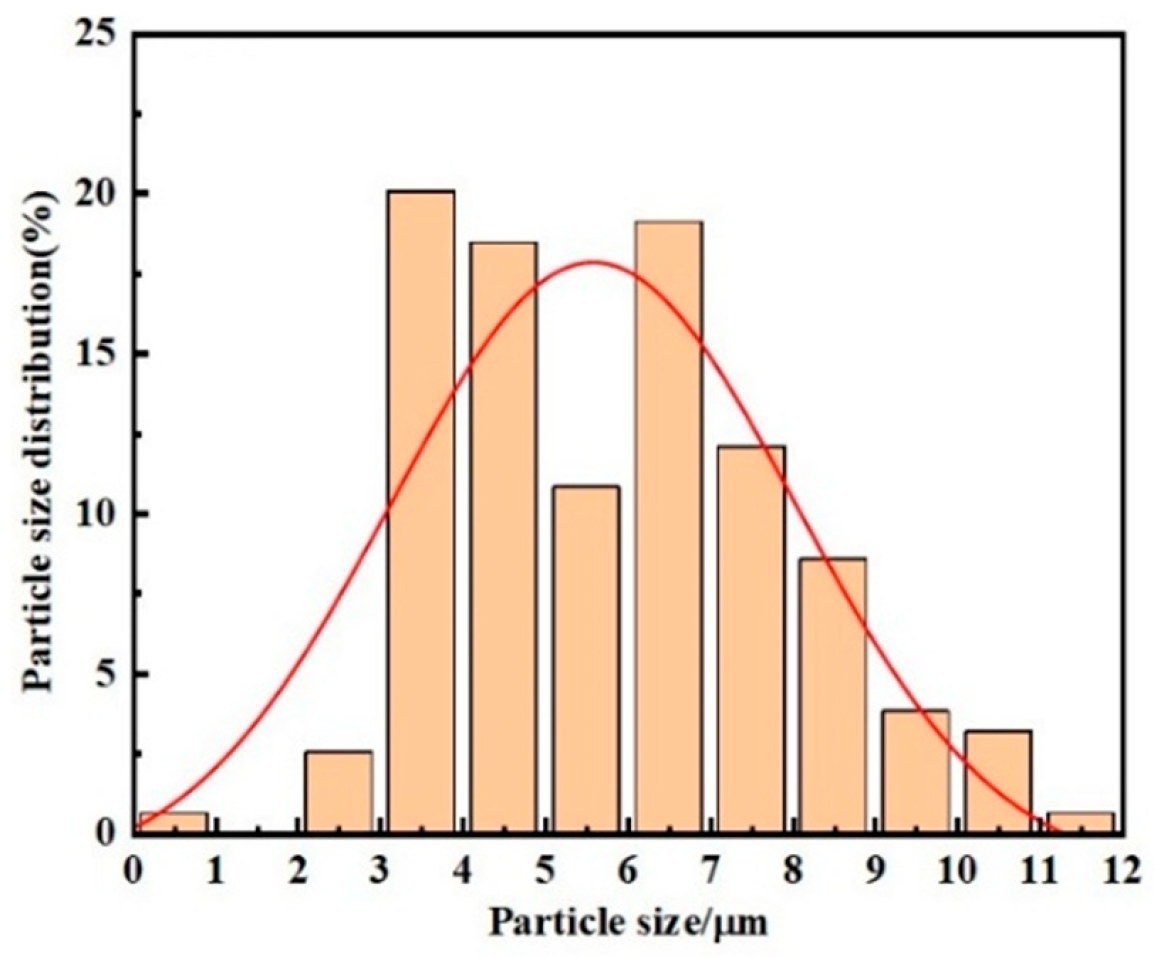
The laser-diffraction particle-size distribution of the synthesised powder is shown in Figure 7. The distribution is reported on a volume basis, and the reported mean particle size is approximately 5 μm. Most of the plotted volume distribution falls within approximately 3–8 μm. These results provide complementary descriptions of the powder: laser diffraction characterises the equivalent particle-size distribution of the wet-dispersed powder, whereas SEM reveals particle morphology and the apparent lengths of the elongated particles.
Figure 7.
Volume-based particle-size distribution of the synthesised powder measured by laser diffraction.
3.4. Elemental Composition and Apparent Ca/P Ratio
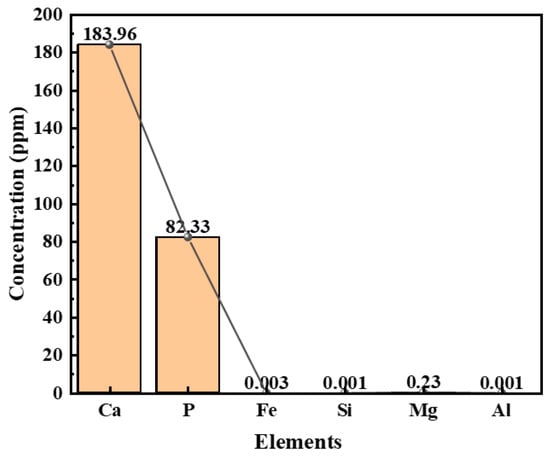
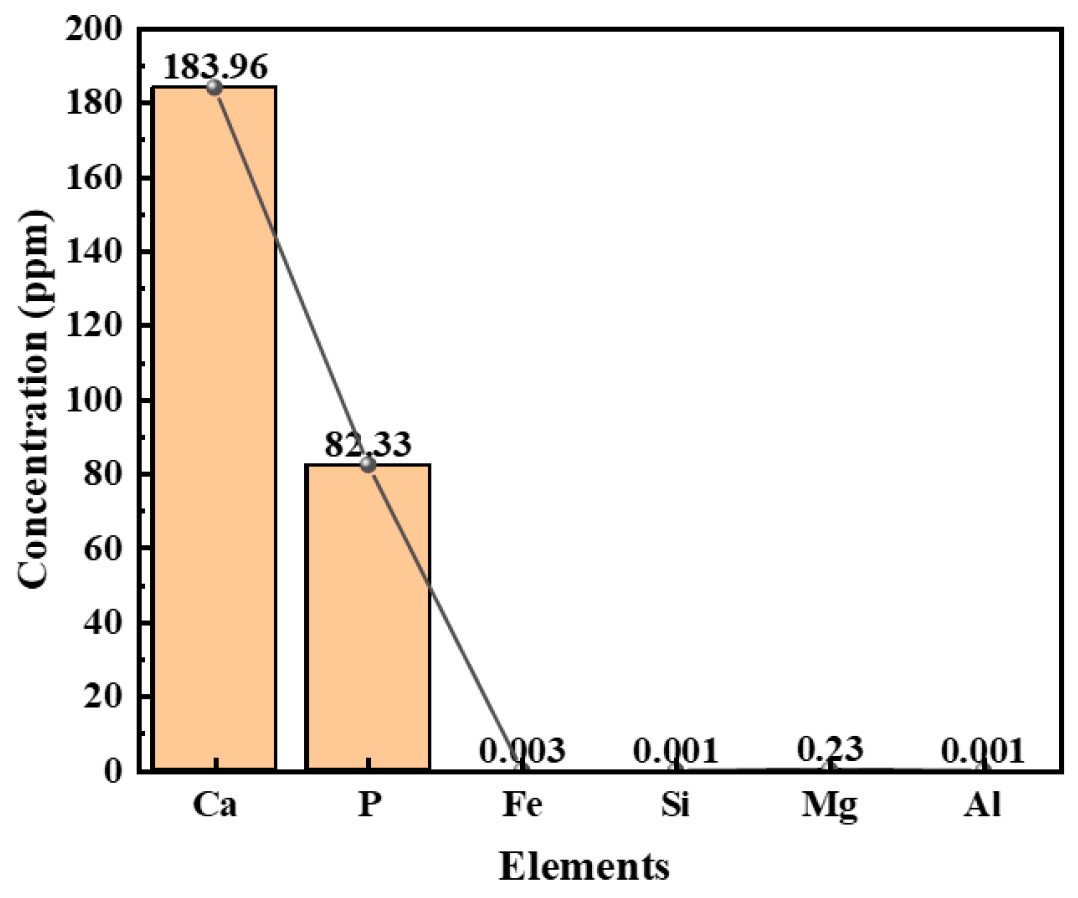
The elemental concentrations measured after acid digestion are shown in Figure 8. The calcium and phosphorus concentrations were 183.96 and 82.33 mg·L−1, respectively. The measured concentrations of Fe, Si, Al, and Mg were 0.003, 0.001, 0.001, and 0.23 mg·L−1, respectively.
Figure 8.
Element concentrations measured after acid digestion of the synthesised powder.
These concentrations were measured after digestion of the recovered powder and describe the elemental composition of the final calcium-phosphate product. In combination with the residue-phase evolution reported under the same sequential-leaching conditions [16], the low measured Fe, Si, and Al concentrations are consistent with limited carryover of these elements into the recovered powder. The elemental results therefore complement the phase-level interpretation of calcium mobilisation and impurity retention during the two-step leaching process.
The calculated value of approximately 1.73 is close to the theoretical Ca/P ratio of hydroxyapatite, which is approximately 1.67. This result is consistent with the formation of a hydroxyapatite-rich product. Nevertheless, the slightly higher ratio may be related to calcium-rich apatite, carbonate substitution, incomplete digestion, residual calcium-containing impurities, or analytical uncertainty.
The measured Ca and P concentrations provide the elemental basis for calculating the apparent Ca/P molar ratio. Because this ratio is derived from the digestion solution, it is interpreted at the elemental-composition level and considered together with the XRD phase assignments and the phosphate- and hydroxyl-related functional groups identified by FTIR. The combined characterisation supports describing the recovered powder as hydroxyapatite-rich calcium phosphate.
The apparent Ca/P molar ratio was calculated as follows:
The SEM–EDS observations provide local elemental context, whereas ICP-OES provides the bulk digestion-solution profile. For the recovered powder, the quantified profile comprises Ca, P, Fe, Si, Al, and Mg; the starting slag contained 4.19 wt% MnO by XRF. Cr, V and Mn are priority analytes for expanded process qualification because their partitioning among the slag, leachates, residues and recovered calcium-phosphate fraction depends on feedstock mineralogy and leaching conditions [4,5,17]. Application-specific evaluation can integrate their batch-level concentrations and element-specific detection limits with the phase, morphology and Ca/P evidence presented here.
3.5. Concentration-Dependent Response of hBMSCs
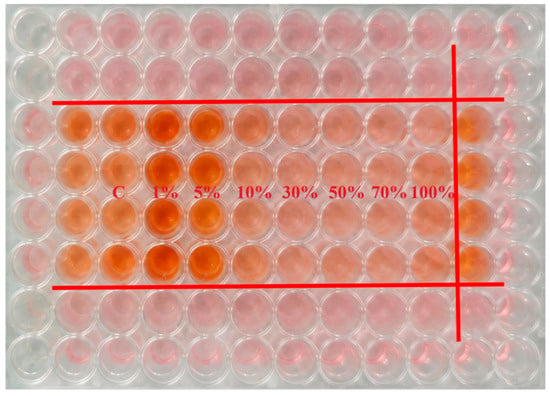
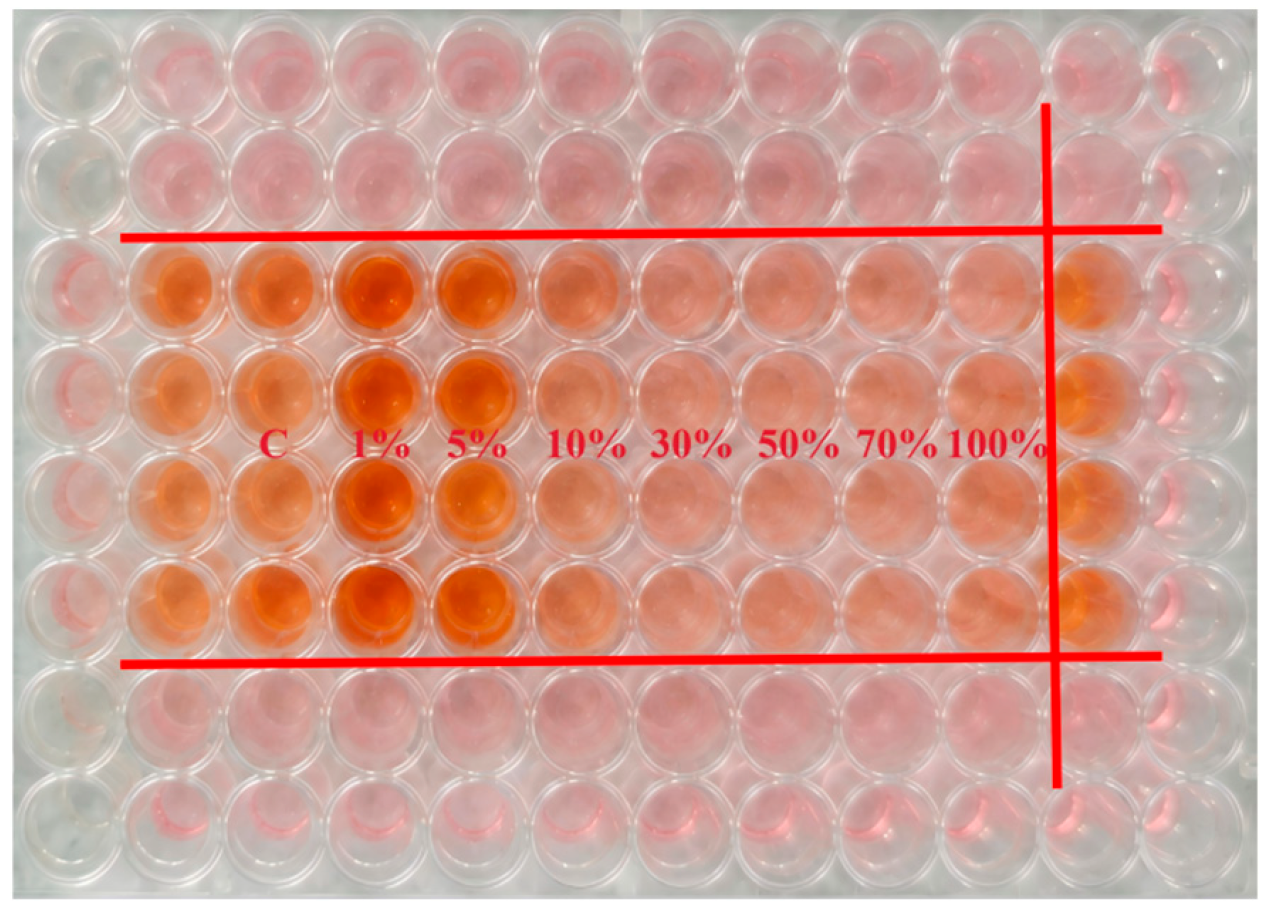
The short-term response of hBMSCs to the synthesised powder extracts was evaluated using a CCK-8 assay (Figure 9). The powder was extracted in serum-free culture medium at a powder-to-medium ratio of 0.2 g·mL−1 for 24 h. The extract was filtered through a 0.22 μm membrane and diluted to final concentrations of 1%, 5%, 10%, 30%, 50%, 70%, and 100%.
Figure 9.
Colour development after CCK-8 incubation for the control and sample-extract groups.
hBMSCs were seeded at 6 × 10³ cells per well in 96-well plates and cultured overnight. The cells were then exposed to 100 μL of the corresponding extract or serum-free culture medium as the control. Each condition was measured using three technical replicate wells on the same assay plate. After 24 h of exposure, the cells were washed three times with phosphate-buffered saline and incubated with 100 μL of culture medium containing 10% CCK-8 reagent for 2 h. Absorbance was measured at 450 nm.
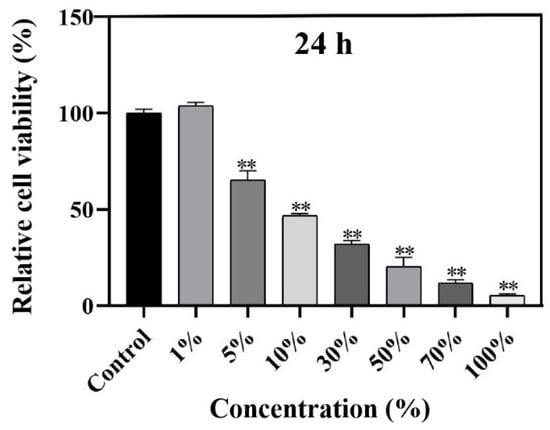
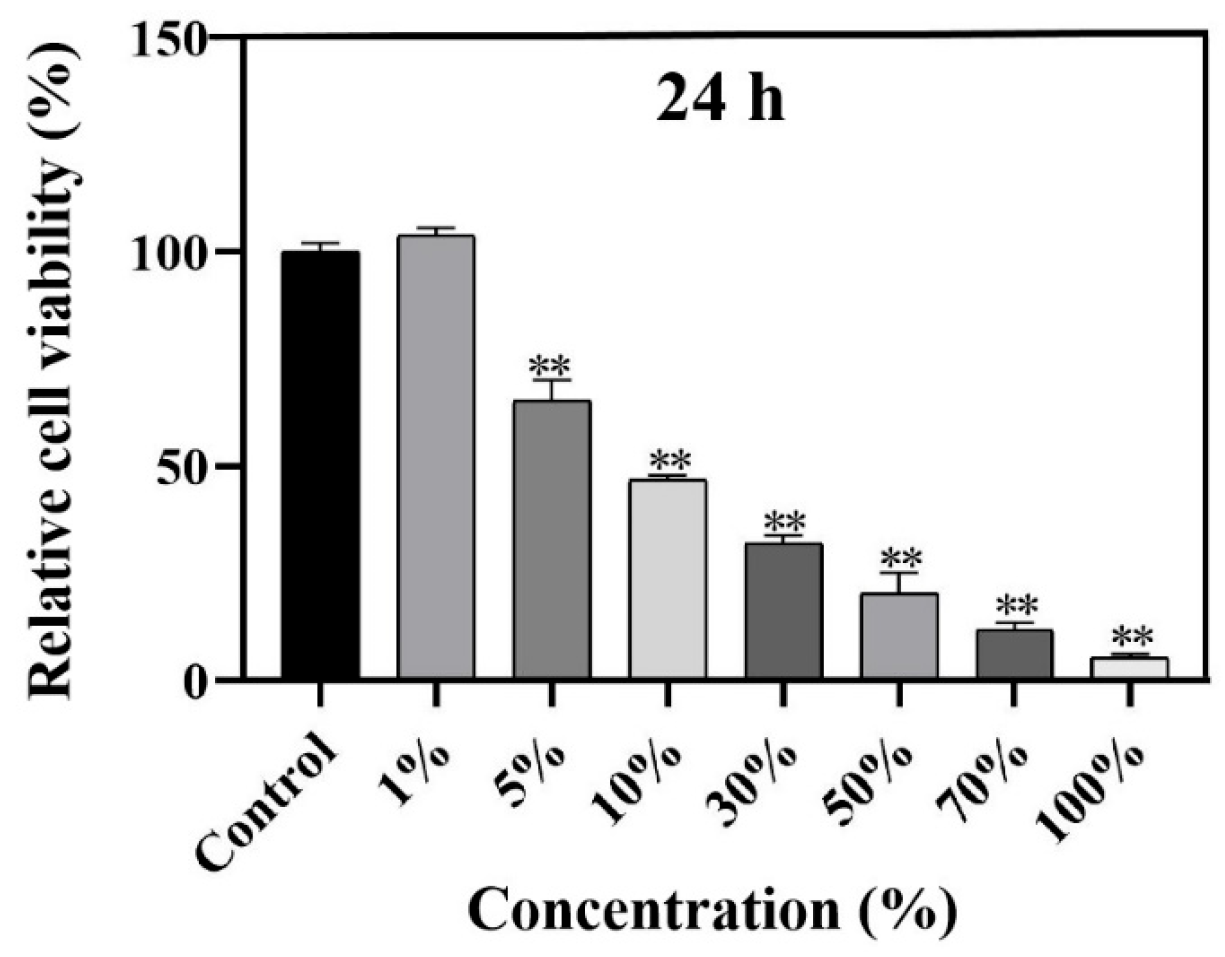
The relative cell viability of the control group was normalised to 100.00% ± 2.04%. The 1% extract group showed a relative cell viability of 103.74% ± 1.82%, which was slightly higher than the control group. This difference was not statistically significant, indicating that the 1% extract did not produce an apparent inhibitory effect on hBMSC metabolic activity after 24 h of exposure.
A clear concentration-dependent decrease in cell viability was observed at extract concentrations of 5% and above. The relative cell viabilities were 65.22% ± 4.81%, 46.70% ± 1.12%, 31.89% ± 1.97%, 20.26% ± 4.84%, 11.68% ± 1.77%, and 5.31% ± 0.73% for the 5%, 10%, 30%, 50%, 70%, and 100% extract groups, respectively. Compared with the control group, all groups from 5% to 100% showed statistically significant reductions in relative cell viability, with p < 0.01, as indicated in Figure 10. Under the specified extraction and 24 h exposure conditions, these data provide a preliminary concentration-dependent cellular-response profile of the tested powder extract. The CCK-8 signal is interpreted as an assay-based measure of cellular metabolic activity, while broader conclusions regarding cytocompatibility and biomedical suitability require complementary biological evidence [20,21,29,34].
Figure 10.
Relative viability of hBMSCs after exposure to different concentrations of the synthesised powder extract for 24 h. Data are presented as mean ± standard deviation from three technical replicate wells per condition. Compared with the control group, ** p < 0.01.
The numerical summary of the CCK-8 results is provided in Table 2. Relative cell viability is reported as mean ± standard deviation from three technical replicate wells per group.
Table 2.
Mean relative cell viability of hBMSCs after 24 h exposure to sample extracts.
3.6. Limitations and Process Implications
The results demonstrate that calcium-bearing components of converter steel slag can be converted into a hydroxyapatite-rich calcium-phosphate powder through sequential water–acetic acid leaching and hydrothermal treatment. The combined XRD, FTIR, SEM, and ICP-OES results support the formation of a hydroxyapatite-rich calcium-phosphate powder and provide complementary information on its phase, structural, morphological, and elemental characteristics. The process also produced particles with a morphology commonly observed for hydrothermally synthesised calcium phosphates.
However, the current evidence supports a laboratory-scale materials-conversion proof of concept rather than a complete calcium-recovery process or biomedical-grade hydroxyapatite product. The process performance should be evaluated using calcium leaching efficiency, product yield, calcium recovery, phosphorus utilisation, impurity removal, and reproducibility. Quantitative phase analysis and a more complete trace-element assessment are also required. Across extract concentrations, the 24 h hBMSC CCK-8 assay provides a concentration-dependent cellular-response profile that complements the materials characterisation. The CCK-8 measurements were obtained from three technical replicate wells per condition on one assay plate; the reported standard deviations therefore describe within-plate variation for the tested extract. The assay provides a preliminary short-term response profile for the tested powder sample under the specified extraction conditions, whereas reproducibility across independently prepared synthesis batches is a separate process-validation attribute. At the process level, the material-characterisation results can be complemented by three independent balance descriptors: the feed-basis recovery of freeze-dried solid, phosphorus incorporation into the recovered product, and phosphorus associated with the post-reaction and washing liquid streams. Together, these descriptors provide a structured basis for evaluating product recovery, phosphorus utilisation, and aqueous-stream management as the route is developed.
Collectively, the findings indicate that converter steel slag is a feasible calcium-containing feedstock for the preparation of hydroxyapatite-rich calcium phosphate. Further optimisation of the leaching conditions, Ca/P ratio, pH control, and hydrothermal parameters may improve phase purity, reduce impurity incorporation, and strengthen the potential value of the resulting material.
4. Discussion
The results demonstrate that calcium-bearing components of converter steel slag can be converted into a hydroxyapatite-rich calcium-phosphate powder through sequential water–acetic acid leaching, phosphate precipitation, and hydrothermal treatment. The high CaO content and the presence of Ca2Fe2O5 and Ca2SiO4 indicate that the converter slag contains multiple calcium-bearing phases with different chemical reactivities. The water–acetic acid sequence provides a rational framework for promoting calcium mobilisation from these phases through an initial water-reactive step followed by proton-assisted dissolution of more acid-reactive components. The reaction pathways presented in Section 3.1 provide a chemical basis for interpreting this complementary leaching behaviour. The stage-level calcium recovery and residue-phase evolution reported under the same operating conditions provide a process-level basis for interpreting the relative reactivity of the identified calcium-bearing phases [16]. The dominant hydroxyapatite-related reflections, the weak β-tricalcium-phosphate-related contributions, the phosphate- and hydroxyl-related FTIR bands, and the apparent Ca/P ratio of approximately 1.73 collectively characterise a hydroxyapatite-rich calcium-phosphate product. This phase assemblage is chemically consistent with the use of a multicomponent slag-derived calcium source followed by alkaline hydrothermal treatment. Related hydrothermal studies using slag-derived or iron-containing precursors have also reported hydroxyapatite-rich products with secondary calcium-phosphate phases or elemental incorporation [13,24,35].
The phosphate and hydroxyl bands in the FTIR spectrum, together with the needle-like particles observed by SEM, are consistent with hydrothermal calcium-phosphate formation. The 1–12 μm particle lengths are descriptive observations from selected fields, and the apparent Ca/P ratio is derived from the digestion solution; these measurements complement the phase identification provided by XRD and FTIR. The low measured Fe, Si, Al, and Mg concentrations provide complementary evidence for limited transfer of these elements into the recovered calcium-phosphate fraction under the applied sequential-leaching conditions. Interpreting this profile together with the starting-slag XRF composition and residue-phase evolution provides a process-level view of element partitioning. Cr, V and Mn are priority analytes for the next stage of process qualification, where batch-specific concentrations and element-specific detection limits can be integrated with the present phase, morphology and Ca/P evidence. This staged characterisation provides a clear basis for application-specific environmental and biomedical evaluation while keeping the present conclusions aligned with the measured analytical scope.
At the process level, the previously reported stage-resolved leaching results and residue XRD observations provide a consistent interpretation of the downstream product composition. Water leaching mobilised readily reactive calcium-bearing components, whereas acetic acid promoted additional calcium release from residual C2S and Ca2Fe2O5. Fe3O4 and MgFe2O4 remained detectable in the leached residue under the corresponding conditions [16]. The low Fe, Si, and Al concentrations measured in the present powder are consistent with limited transfer of these elements into the recovered calcium-phosphate fraction. Because converter steel slag contains multiple mineral phases, the relative contribution of individual phases is interpreted from the combined calcium-recovery data, residue-phase evolution, and final-powder elemental composition.
During synthesis, gradual adjustment of the phosphoric-acid-containing leachate to pH 11 increased the proportion of more highly deprotonated phosphate species and may have raised the supersaturation of the calcium-phosphate system, thereby promoting solid formation and nucleation. A poorly ordered calcium-phosphate precursor, potentially including an amorphous phase, may have formed during precipitation and subsequently evolved through dissolution–reprecipitation and crystallisation during hydrothermal ageing at 120 °C for 48 h [10,36]. The needle-like morphology is consistent with anisotropic hydrothermal crystal growth. Previous studies of hydroxyapatite have reported elongated morphologies associated with facet-dependent growth and preferential extension along the crystallographic c-axis [37,38]. This literature-supported pathway provides a plausible interpretation of the calcium-phosphate formation and particle morphology observed in this study.
Our previous comparative study showed that the liquid-to-solid ratio was the principal factor affecting calcium leaching in both stages. The highest calcium leaching in the water stage was obtained at 25 °C, whereas the acid-leaching response reached a maximum at 65 °C under the tested conditions. Increasing the acetic acid concentration promoted calcium dissolution, while higher acid concentrations could also increase the release of Fe and Al into solution [16]. In that study, sequential leaching achieved an overall calcium recovery of 75.9%, compared with 68.31% for direct leaching with 1 mol·L−1 acetic acid under the corresponding comparison conditions [16]. These results provide a process basis for using an initial water-leaching stage followed by acetic-acid treatment to prepare a calcium-bearing solution for downstream phosphate conversion.
The composition of the leachate defines the calcium availability, Ca/P balance, and coexisting-ion environment for subsequent calcium-phosphate formation. Together with pH, hydrothermal temperature can influence phase development and crystal growth in calcium-phosphate systems [7,10,11]. For example, Ryu et al. [7] observed hydroxyapatite formation across the temperatures tested in a blast-furnace-slag-derived system, while the secondary zeolite phases, hydroxyapatite crystal size, and crystallinity varied with temperature. In a separate hydrothermal study using synthesised steelmaking slag, Suzuki et al. [9] reported phosphorus recoveries of 73% from glassy slag and 58% from crystallised slag after treatment at 613 K for 48 h, illustrating the influence of precursor structure on hydroxyapatite precipitation. Taken together, these studies indicate that calcium-phosphate formation is influenced by both the composition of the calcium-bearing precursor and the hydrothermal environment. The powder obtained from the slag-derived leachate was characterised as hydroxyapatite-rich calcium phosphate, with weak β-tricalcium-phosphate-related reflections and an apparent Ca/P molar ratio of approximately 1.73; SEM showed predominantly needle-like particles with observed lengths of approximately 1–12 μm.
The 24 h hBMSC extract assay showed a concentration-dependent response. Each condition was measured in three technical replicate wells on a single assay plate, so the reported standard deviations describe well-to-well variation within that assay. These results provide a preliminary short-term response profile for the tested powder sample under the specified extraction conditions; reproducibility across independently prepared synthesis batches should be established as part of subsequent process validation. The 1% extract did not significantly reduce cell metabolic activity, whereas the 5–100% extracts significantly reduced viability relative to the control. This result may reflect the concentration of dissolved or suspended components in the extracts, but the effects of extract pH, ionic strength, dissolved ions, and residual particles were not independently quantified. Material crystallinity, colloidal stability, and composition may also affect the cellular response [21,29]. Accordingly, these findings define the short-term hBMSC response under the tested extract conditions; complementary biological endpoints and longer exposure periods can extend the evaluation to broader cytocompatibility and osteogenic performance [12,20,21].
The present study establishes a laboratory-scale materials-conversion proof of concept and defines the phase, structural, morphological, and elemental characteristics of the recovered powder. The next process-validation layer comprises the feed-basis gravimetric recovery, phosphorus utilisation, phosphorus distribution between the recovered solid and aqueous streams, quantitative phase fractions, trace-element distribution, and batch-to-batch reproducibility. Expanded biological testing with characterised extracts and longer exposure periods is also required before the product can be considered for biomedical applications [35,39]. Although the present process uses sequential water–acetic acid leaching rather than seawater leaching, recent work on converter steel slag in seawater showed that Ca and Mg release depends on slag mineralogy and the leaching medium and may involve diffusion-controlled dissolution [40]. Therefore, future work should quantify the calcium mass balance and the composition of each leachate.
The present batch-scale procedure specifies the liquid inputs for the two leaching stages, the reagent concentrations and pH endpoints used for phosphate conversion, the three-cycle product-washing procedure, and the hydrothermal conditions. A quantitative assessment of overall reagent use, aqueous-effluent generation, and energy demand requires batch-level records of the phosphoric-acid and NaOH volumes, wash-water and final liquid-stream volumes, and metered electricity consumption during heating and stirring. These measurements provide the basis for evaluating process performance, environmental implications, and scale-up potential. Within this material-balance framework, the phosphorus input is paired with phosphorus retained in the recovered solid and phosphorus associated with the reaction filtrate and wash liquors. These quantities provide the basis for calculating phosphorus utilisation and the residual phosphorus mass of each aqueous stream, complementing the phase, morphological, and elemental characterisation reported in this study.
Converter steel slag provides a secondary calcium-bearing feedstock for the laboratory-scale preparation of hydroxyapatite-rich calcium phosphate, establishing a resource-valorisation basis for further process development. Translation beyond the laboratory will depend on controlling feedstock variability and impurity transfer while maintaining consistent calcium mobilisation, product phase composition, and batch-to-batch reproducibility. The present process also identifies practical optimisation targets, including solids handling and filtration, product washing, and the 48 h hydrothermal residence time, which influence throughput, water and reagent management, and equipment utilisation. Commercial prospects will depend on product yield and specifications, process throughput, reagent and energy requirements, and effluent management. Pilot-scale techno-economic assessment and life-cycle evaluation, supported by a complete material and energy balance and aqueous-stream characterisation, can establish the economic and environmental performance of the route. The present results provide a laboratory-scale basis for this development and identify the process variables to be evaluated as the route advances.
5. Conclusions
- (1)
- Sequential water–acetic acid leaching followed by phosphate precipitation and hydrothermal treatment converted calcium-bearing components of converter steel slag into a hydroxyapatite-rich calcium-phosphate powder at laboratory scale. This establishes a proof of concept for the material-conversion route under the conditions tested; quantitative calcium recovery, phosphorus utilisation, product yield, and batch-to-batch reproducibility remain to be established through process validation.
- (2)
- XRF showed a high bulk CaO content in the converter steel slag. In the synthesised powder, XRD identified hydroxyapatite as the dominant identifiable crystalline phase, with weak β-tricalcium-phosphate-related reflections. FTIR showed phosphate- and hydroxyl-related bands, SEM revealed predominantly needle-like particles, and ICP-OES gave an apparent Ca/P molar ratio of approximately 1.73. Taken together, these results support describing the product as hydroxyapatite-rich calcium phosphate, while quantitative phase proportions remain to be established by dedicated phase analysis.
- (3)
- The 24 h hBMSC extract assay showed a concentration-dependent response: the 1% extract group did not differ significantly from the control, whereas the 5–100% extract groups showed significantly lower relative cell viability (p < 0.01). This result defines the short-term cellular response under the tested extract conditions; broader assessment of biological safety requires complementary endpoints and exposure periods.
Author Contributions
Conceptualisation, Y.W. and J.L.; data curation, P.Y. and K.Z.; formal analysis, P.Y. and K.Z.; funding acquisition, Y.W. and J.L.; investigation, P.Y. and K.Z.; methodology, P.Y. and K.Z.; project administration, Y.W. and J.L.; resources, Y.W. and J.L.; software, J.D. and Q.L.; supervision, Y.W. and J.L.; validation, J.D. and Q.L.; visualisation, P.Y., J.D., and Q.L.; writing—original draft preparation, P.Y. and K.Z.; writing—review and editing, Y.W. All authors have read and agreed to the published version of the manuscript.
Funding
The authors wish to acknowledge the financial support from Yanzhao Iron and Steel Laboratory Regional Innovation Ability Promotion Project (YZISL2024009), Innovative Research Group Project of Natural Science Foundation of Hebei Province (E2022209093, E2026209178), National Natural Science Foundation of China (52674430), and Central Guiding Local Science and Technology Development Fund Project (254Z1005G).
Data Availability Statement
The original contributions presented in this study are included in the article. Further inquiries can be directed to the corresponding authors.
Conflicts of Interest
The authors declare no conflicts of interest.
References
- Gao, W.; Zhou, W.; Lyu, X.; Liu, X.; Su, H.; Li, C.; Wang, H. Comprehensive utilization of steel slag: A review. Powder Technol. 2023, 422, 118449. [Google Scholar] [CrossRef] [Scilit]
- Shu, K.; Sasaki, K. Occurrence of steel converter slag and its high value-added conversion for environmental restoration in China: A review. J. Clean. Prod. 2022, 373, 133876. [Google Scholar] [CrossRef] [Scilit]
- Zhang, X.; Chen, J.; Jiang, J.; Li, J.; Tyagi, R.D.; Surampalli, R.Y. The potential utilization of slag generated from iron- and steelmaking industries: A review. Environ. Geochem. Health 2020, 42, 1321–1334. [Google Scholar] [CrossRef] [Scilit] [PubMed]
- Chaurand, P.; Rose, J.; Briois, V.; Olivi, L.; Hazemann, J.-L.; Proux, O.; Domas, J.; Bottero, J.-Y. Environmental impacts of steel slag reused in road construction: A crystallographic and molecular (XANES) approach. J. Hazard. Mater. 2007, 139, 537–542. [Google Scholar] [CrossRef] [Scilit] [PubMed]
- Gomes, H.I.; Funari, V.; Mayes, W.M.; Rogerson, M.; Prior, T.J. Recovery of Al, Cr and V from steel slag by bioleaching: Batch and column experiments. J. Environ. Manag. 2018, 222, 30–36. [Google Scholar] [CrossRef] [Scilit] [PubMed]
- Ashrit, S.S.; Chatti, R.V.; Sarkar, S. Synthesis and characterization of hematite based calcium rich hydroxyapatite—A nanomaterial from LD slag fines. J. Environ. Chem. Eng. 2020, 8, 103581. [Google Scholar] [CrossRef] [Scilit]
- Ryu, G.U.; Kim, G.M.; Khalid, H.R.; Lee, H.K. The effects of temperature on the hydrothermal synthesis of hydroxyapatite-zeolite using blast furnace slag. Materials 2019, 12, 2131. [Google Scholar] [CrossRef] [Scilit] [PubMed]
- Kuwahara, Y.; Ohmichi, T.; Kamegawa, T.; Mori, K.; Yamashita, H. Synthesis of hydroxyapatite-zeolite composite material from disposed steel slag and investigation of its structural and physicochemical characteristics. Chem. Lett. 2009, 38, 626–627. [Google Scholar] [CrossRef] [Scilit]
- Suzuki, M.; Nishioka, S.; Murayama, N. Phosphorus extraction from synthesized steelmaking slag by hydrothermal hydroxyapatite precipitation. J. Sustain. Metall. 2023, 9, 700–709. [Google Scholar] [CrossRef] [Scilit]
- Dorozhkin, S.V. Calcium orthophosphates in nature, biology and medicine. Materials 2009, 2, 399–498. [Google Scholar] [CrossRef] [Scilit]
- LeGeros, R.Z. Calcium phosphate-based osteoinductive materials. Chem. Rev. 2008, 108, 4742–4753. [Google Scholar] [CrossRef] [Scilit] [PubMed]
- Samavedi, S.; Whittington, A.R.; Goldstein, A.S. Calcium phosphate ceramics in bone tissue engineering: A review of properties and their influence on cell behavior. Acta Biomater. 2013, 9, 8037–8045. [Google Scholar] [CrossRef] [Scilit] [PubMed]
- Shu, K.; Chuaicham, C.; Noguchi, Y.; Xu, L.; Sasaki, K. In-situ hydrothermal synthesis of Fe-doped hydroxyapatite photocatalyst derived from converter slag toward xanthate photodegradation and Cr(VI) reduction under visible-light irradiation. Chem. Eng. J. 2023, 459, 141474. [Google Scholar] [CrossRef] [Scilit]
- Chen, X.; Zhao, Q.; Xia, W.; Tao, M.; Mei, X.; Liu, C.; Saxén, H.; Zevenhoven, R. Synthesis of hydroxyapatite coating material from waste steelmaking slag. J. Environ. Chem. Eng. 2026, 14, 123364. [Google Scholar] [CrossRef] [Scilit]
- Barca, C.; Gérente, C.; Meyer, D.; Chazarenc, F.; Andrès, Y. Phosphate removal from synthetic and real wastewater using steel slags produced in Europe. Water Res. 2012, 46, 2376–2384. [Google Scholar] [CrossRef] [Scilit] [PubMed]
- Zhang, K.; Cang, Q.; Peng, L.; Wang, Y.; Zhang, S.; Li, H.; Yu, S.; Hu, B.; Yao, X.; Du, P.; et al. The mechanism of calcium leaching from steel slag based on the water-acetic acid two-step leaching route. Processes 2025, 13, 4077. [Google Scholar] [CrossRef] [Scilit]
- Kusaka, E.; Suehiro, R.; Iwamizu, Y. Kinetics of calcium leaching from particulate steelmaking slag in acetic acid solution. ISIJ Int. 2022, 62, 263–274. [Google Scholar] [CrossRef] [Scilit]
- Klug, J.L.; Medeiros, S.L.S.; Caldas, H.; Bentes, M.; Becker, H. Separation of iron and calcium from a BSSF steelmaking slag through acid leaching. Mater. Res. 2022, 25, e20210571. [Google Scholar] [CrossRef] [Scilit]
- Kokko, M.; Kauppinen, T.; Hu, T.; Tanskanen, P.; Kallio, R.; Lassi, U.; Pesonen, J. Two-stage leaching of calcium and vanadium from high-calcium steelmaking slag. Environ. Technol. 2024, 45, 5966–5981. [Google Scholar] [CrossRef] [Scilit] [PubMed]
- ISO 10993-5:2009; Biological Evaluation of Medical Devices—Part 5: Tests for In Vitro Cytotoxicity. ISO: Geneva, Switzerland, 2009. Available online: https://www.iso.org/standard/36406.html (accessed on 31 October 2026).
- Kovrlija, I.; Menshikh, K.; Abreu, H.; Cochis, A.; Rimondini, L.; Marsan, O.; Rey, C.; Combes, C.; Locs, J.; Loca, D. Challenging applicability of ISO 10993-5 for calcium phosphate biomaterials evaluation: Towards more accurate in vitro cytotoxicity assessment. Biomater. Adv. 2024, 160, 213866. [Google Scholar] [CrossRef] [Scilit] [PubMed]
- Yang, M.; Zhang, S.; Wang, Y.; Li, Z.; Wen, J.; Quan, X.; Lu, C. A cleaner-sustainable process for recovering valuable elements from steel slag with acetic acid: Leaching studies and multi-value-added products. J. Environ. Chem. Eng. 2024, 12, 112825. [Google Scholar] [CrossRef] [Scilit]
- Liu, L.; Gan, M.; Fan, X.; Gao, Z.; Sun, Z.; Ji, Z.; Wei, J.; Ma, S. Mechanism of ultrasonic enhanced acetic acid efficiently leaching of steel slag and synthesis of calcium carbonate whiskers. Sep. Purif. Technol. 2024, 339, 126615. [Google Scholar] [CrossRef] [Scilit]
- Pupilli, F.; Tavoni, M.; Drouet, C.; Tampieri, A.; Sprio, S. Iron-doped hydroxyapatite by hydrothermal synthesis: Factors modulating the Fe2+, Fe3+ content. Open Ceram. 2024, 18, 100610. [Google Scholar] [CrossRef] [Scilit]
- Huang, J.; Liu, T.; Zhang, Y.; Hu, P. Comparative study of microwave-assisted and hydrothermal hydroxyapatite synthesis from neutralization slag: Optimization, energy, and adsorption. Ceram. Int. 2024, 50, 42157–42168. [Google Scholar] [CrossRef] [Scilit]
- Diez-Escudero, A.; Espanol, M.; Ginebra, M.-P. High-aspect-ratio nanostructured hydroxyapatite: Towards new functionalities for a classical material. Chem. Sci. 2024, 15, 55–76. [Google Scholar] [CrossRef] [Scilit] [PubMed]
- Szymczycha-Madeja, A.; Welna, M.; Zabłocka-Malicka, M.; Pohl, P.; Szczepaniak, W. Development and validation of an analytical method for determination of Al, Ca, Cd, Fe, Mg and P in calcium-rich materials by ICP OES. Molecules 2021, 26, 6269. [Google Scholar] [CrossRef] [Scilit] [PubMed]
- Heise, T.; Sawyer, A.Y.; Hirai, T.; Schaible, S.; Sy, H.; Wickramasekara, S. Report on investigation of ISO 10993-12 extraction conditions. Regul. Toxicol. Pharmacol. 2022, 131, 105164. [Google Scholar] [CrossRef] [Scilit] [PubMed]
- Andrée, L.; Joziasse, L.S.; Adjobo-Hermans, M.J.W.; Yang, F.; Wang, R.; Leeuwenburgh, S.C.G. Effect of hydroxyapatite nanoparticle crystallinity and colloidal stability on cytotoxicity. ACS Biomater. Sci. Eng. 2024, 10, 6964–6973. [Google Scholar] [CrossRef] [Scilit] [PubMed]
- Gibson, I.R.; Rehman, I.; Best, S.M.; Bonfield, W. Characterization of the transformation from calcium-deficient apatite to β-tricalcium phosphate. J. Mater. Sci. Mater. Med. 2000, 11, 533–539. [Google Scholar] [CrossRef] [Scilit] [PubMed]
- Destainville, A.; Champion, E.; Bernache-Assollant, D.; Laborde, E. Synthesis, characterization and thermal behavior of apatitic tricalcium phosphate. Mater. Chem. Phys. 2003, 80, 269–277. [Google Scholar] [CrossRef] [Scilit]
- Panda, R.N.; Hsieh, M.F.; Chung, R.J.; Chin, T.S. FTIR, XRD, SEM and solid state NMR investigations of carbonate-containing hydroxyapatite nanoparticles synthesized by hydroxide-gel technique. J. Phys. Chem. Solids 2003, 64, 193–199. [Google Scholar] [CrossRef] [Scilit]
- Sakhno, Y.; Iafisco, M.; Jaisi, D. Role of Maturation Temperature on Structural Substitution of Carbonate in Hydroxyapatite Nanoparticles. JOM 2021, 73, 1044–1052. [Google Scholar] [CrossRef] [Scilit]
- ISO 10993-1:2025; Biological Evaluation of Medical Devices—Part 1: Requirements and General Principles for the Evaluation of Biological Safety Within a Risk Management Process. ISO: Geneva, Switzerland, 2025. Available online: https://www.iso.org/standard/10993-1 (accessed on 1 November 2025).
- Tran, D.L.; Ta, Q.T.H.; Tran, M.H.; Nguyen, T.M.Y.H.; Le, N.T.T.; Nguyen, H.A.P.; Park, H.J.; Park, K.D.; Nguyen, D.H. Optimized synthesis of biphasic calcium phosphate: Enhancing bone regeneration with a tailored β-tricalcium phosphate/hydroxyapatite ratio. Biomater. Sci. 2025, 13, 969–979. [Google Scholar] [CrossRef] [Scilit] [PubMed]
- Montes-Hernandez, G.; Renard, F. Nucleation of Brushite and Hydroxyapatite from Amorphous Calcium Phosphate Phases Revealed by Dynamic In Situ Raman Spectroscopy. J. Phys. Chem. C 2020, 124, 15302–15311. [Google Scholar] [CrossRef] [Scilit]
- Sans, J.; Sanz, V.; Puiggalí, J.; Turon, P.; Alemán, C. Controlled Anisotropic Growth of Hydroxyapatite by Additive-Free Hydrothermal Synthesis. Cryst. Growth Des. 2021, 21, 748–756. [Google Scholar] [CrossRef] [Scilit]
- Neira, I.S.; Kolen’ko, Y.V.; Lebedev, O.I.; Van Tendeloo, G.; Gupta, H.S.; Guitián, F.; Yoshimura, M. An Effective Morphology Control of Hydroxyapatite Crystals via Hydrothermal Synthesis. Cryst. Growth Des. 2009, 9, 466–474. [Google Scholar] [CrossRef] [Scilit]
- Geng, X.; Tang, Y.; Yuan, B.; Dai, Y.; Yu, H.-P.; Xiong, Z.-C.; Zhu, Y.-J.; Chen, X. Biomimetically ordered ultralong hydroxyapatite nanowires-based hierarchical hydrogel scaffold with osteoimmunomodulatory and osteogenesis abilities for augmenting bone regeneration. Chem. Eng. J. 2024, 488, 151136. [Google Scholar] [CrossRef] [Scilit]
- Zhang, K.; Wang, Y.-J.; Li, J.-G.; Xu, Z.-H.; Wang, Y.-T.; Liu, T.-J.; Gao, A.-M. Leaching Mechanism of Ca and Mg from Converter Steel Slag in Seawater. J. Environ. Chem. Eng. 2025, 13, 119805. [Google Scholar] [CrossRef] [Scilit]

Disclaimer/Publisher’s Note: The statements, opinions and data contained in all publications are solely those of the individual author(s) and contributor(s) and not of MDPI and/or the editor(s). MDPI and/or the editor(s) disclaim responsibility for any injury to people or property resulting from any ideas, methods, instructions or products referred to in the content. |
© 2026 by the authors. Licensee MDPI, Basel, Switzerland. This article is an open access article distributed under the terms and conditions of the Creative Commons Attribution (CC BY) license.