


Abstract
The expanding electric vehicle market is driving a critical demand for lithium-ion battery materials, positioning spent batteries as a strategic urban resource. Conventional hydrometallurgical studies are typically constrained by low solid-to-liquid (S/L) ratios (e.g., 1:50 g/mL), which limits their industrial relevance. This work adapted and optimized the MONOLITHOS-patented HCl–H2O2 leaching system to achieve in situ oxidative delithiation and selectively extract lithium (Li) from spent lithium iron phosphate (LFP) black mass under intensified S/L ratios (1:10 to 1:2 g/mL) relevant to scalable applications. Leaching parameters were optimized using response surface methodology based on a Box–Behnken design. High solids loadings introduced mass-transfer limitations and proton depletion, while LFP delithiation was governed by competitive iron dissolution. Under optimized ambient leaching conditions at intensified pulp density, selective leaching achieved 86.0% Li extraction efficiency while suppressing iron dissolution to 19.2% through solid-state FePO4 fixation. Downstream purification at a controlled acidic pH precipitated 99.7% of the dissolved iron, with minimal lithium co-precipitation (<0.55%). Subsequent oxidative polishing removed residual iron, and thermal preconcentration enabled carbonate precipitation, yielding technical-grade Li2CO3 with an estimated mass-balance purity of 97.3%. The results demonstrate an efficient, low-energy, intensified route for sustainable LFP recycling at industrially relevant pulp densities.
1. Introduction
Lithium-ion batteries (LIBs) are widely deployed in electric vehicles, portable electronics, and large-scale energy storage systems due to their superior energy density, extended cycle life, and environmental compatibility within the global transition toward renewable energy [1,2]. Global LIB shipments reached 1545.1 GWh in 2024 and are projected to exceed 5000 GWh by 2030 [3]. Among prevailing LIB cathode chemistries (including LiNixMnyCo1−x−yO2 [NMC], LiMn2O4 [LMO], LiCoO2 [LCO], and LiFePO4 [LFP]), LFP is increasingly prioritized for electric mobility owing to its exceptional thermal stability, structural reversibility, and lower raw material costs [4,5]. With global electric vehicle deployment projected to reach 145 million units by 2030, demand for LFP cathodes is accelerating rapidly [6]. However, LFP batteries typically reach their end-of-life (EoL) within 5–10 years [7], generating vast volumes of spent battery waste that pose severe resource management, human health, and environmental challenges if unmanaged [8]. EoL battery management devoid of good recycling practices leads to hazardous electrolytes (LiPF6) decomposition and phosphorus leaching, posing great ecological and public health risks [9,10,11]. Nevertheless, spent LFP cathode black mass represents a high-grade secondary resource rich in lithium (2–5 wt%) alongside concentrated iron and phosphate (P2O5 > 40 wt%) [12,13,14]. Efficient recycling of spent LFP batteries is therefore imperative to mitigate ecological hazards, secure critical mineral supply chains, and advance circular economy principles. Unlike cobalt- and nickel-rich cathode chemistries (e.g., NMC), where recovery is driven by high-value transition metals, the primary economic value in spent LFP black mass is concentrated almost in lithium, while iron and phosphorus constitute low-value matrix components (Table 1). Consequently, LFP recycling requires a distinct hydrometallurgical strategy focused on selective lithium delithiation while keeping iron in the solid phase [15].
Table 1.
Elemental composition (wt%) and market value benchmarks of spent LFP vs. NMC cathode materials (data adapted from Gerold et al. [16]).
Currently, spent LFP recycling is predominantly categorized into pyrometallurgical processing, direct cathode regeneration, and hydrometallurgical extraction [17]. Pyrometallurgical smelting operates via simple workflows and minimizes aqueous waste generation; however, it requires extreme thermal energy input (>1200 °C) to break down the LFP olivine crystal matrix. Furthermore, pyrometallurgy locks valuable lithium into the slag phase, requiring capital-intensive secondary recovery steps while releasing hazardous off-gases that necessitate complex scrubbing systems [18,19]. Direct regeneration seeks to repair degraded cathodes by restoring local stoichiometry (Li, Fe, and P) in situ via solid-state or hydrothermal re-lithiation [20,21]. Despite its low chemical consumption, direct regeneration is highly sensitive to initial cathode degradation history, surface impurity contamination, and structural lattice defects, rendering commercial-scale implementation difficult for heterogeneous waste feeds [22]. Conversely, hydrometallurgy offers superior extraction efficiencies, exceptional product purity, and significantly lower energy requirements [23]. This route relies on aqueous chemical leaching to solubilize cathode constituents from black mass, followed by liquid-phase separation, purification, and salt crystallization [24].
To optimize hydrometallurgical delithiation, various lixiviants have been investigated. Organic acids such as acetic acid (CH3COOH) [25], formic acid (CH2O2) [26], and p-toluenesulfonic acid (TSA) [27] demonstrate selective leaching capabilities; however, their industrial deployment is bottlenecked by sluggish kinetics, high reagent costs, and unwanted ferric-organic chelation that lowers Li/Fe separation factors [28,29]. Alternatively, strong chemical oxidants including sodium persulfate (Na2S2O8) [30], sodium hypochlorite (NaClO) [31], and ammonium persulfate ((NH4)2S2O8) [32] can selectively extract Li+ ions without collapsing the core crystal lattice. Nevertheless, these oxidants suffer from poor thermal stability, rapid self-decomposition, and high operational costs [33]. Consequently, inorganic mineral acids such as sulfuric acid (H2SO4) [34], phosphoric acid (H3PO4) [35], and hydrochloric acid (HCl) [36] remain the industry standard due to their high reactivity, low cost, and feedstock adaptability. For instance, Cong et al. [37] reported 95.23% Li recovery from LFP black mass using a 0.315 M H2SO4-H2O2 mixture; however, achieving high yield required an elevated operating temperature (62 °C). Similarly, Chen et al. [38] achieved 100% Li extraction with only 2.7% Fe co-dissolution using H3PO4, but the system relied on high chemical consumption. A major limitation of conventional inorganic leaching frameworks is their reliance on high thermal inputs (60–90 °C) to overcome kinetic barriers, introducing a substantial energy penalty.
To overcome these kinetic and energetic barriers, the combination of hydrochloric acid (HCl) and hydrogen peroxide (H2O2), functioning via synergistic proton-exchange and oxidative chemistry, has been shown to be highly effective among leaching systems [38]. The chloride medium promotes the formation of distinct chloro-complexes when compared with the sulfate medium [39]. In a comparative thermodynamic study, Mohammad Zadeh et al. [40] reported superior selectivity for HCl (Li/Fe > 100) relative to H2SO4 at 38 °C. Within the HCl–H2O2 system, controlled oxidation–reduction potential (ORP) enables in situ oxidation of Fe2+ to Fe3+ inside the olivine lattice. This drives selective release of Li+ into solution while retaining iron as an insoluble solid-state ferric phosphate (FePO4) phase. The mechanism permits selective lithium extraction at ambient temperature (25 ± 2 °C), thereby eliminating the need for external heating.
Despite these advantages, process intensification and industrial scalability remain primary bottlenecks in hydrometallurgical recycling. As summarized in Table 2, recent selective LFP delithiation studies (2022–2026) have demonstrated high lithium extraction efficiencies using a range of mineral and organic acid-based lixiviants. Nevertheless, many of these processes remain limited to relatively dilute pulp densities (50–186.9 g/L) or rely on elevated temperatures (60–250 °C) to overcome kinetic barriers. Attempting to scale up by simply increasing batch pulp density (>200 g/L) often induces a sharp drop in metal yield due to boundary-layer mass transfer limitations and proton starvation. Furthermore, non-linear interactions between acid strength, oxidant dosage, and solid loading render conventional one-factor-at-a-time experimental approaches inefficient. Response surface methodology (RSM) based on a Box–Behnken design (BBD) provides a rigorous statistical framework to model non-linear parameter interactions, evaluate response surface curvature, and identify process optima [41].
The main objective of this study is to adapt and optimize the Monolithos versatile HCl-H2O2 leaching technology [42] for the selective delithiation of non-thermally treated spent LFP black mass under process-intensified conditions. This work addresses this literature gap by systematically evaluating selective leaching mechanisms across high S/L ratios (10–50% w/v, corresponding to 100–500 g/L). RSM is used to map parameter interactions (HCl concentration, H2O2 peroxide dosage, and S/L ratio) and establish operational boundaries for lithium extraction and iron suppression. Finally, an integrated downstream purification sequence combining NaOH-H2O2 precipitation, oxidative solution polishing, thermal preconcentration, and crystallization is validated to produce high-purity lithium carbonate (Li2CO3) precursors for closed-loop battery manufacturing.
Table 2.
Selected recent lixiviant systems, leaching parameters, and lithium efficiencies for the selective leaching of lithium from spent LFP black mass [16,43,44,45,46,47,48,49,50,51].
2. Materials and Methods
2.1. Chemicals and Reagents
The leaching reagents used in this research, hydrochloric acid (HCl, 37% w/w aqueous solution, ACS grade, PanReac AppliChem, Castellar del Vallès, Spain) and hydrogen peroxide (H2O2, 35% w/w aqueous solution, Solvay S.A., Brussels, Belgium), were of analytical grade. HCl was used to assess the leaching performance of the LFP cathode material, while H2O2 served as an oxidizing agent. Sodium hydroxide (NaOH, analytical grade) was employed for pH adjustment during Fe precipitation, while anhydrous sodium carbonate (Na2CO3, analytical grade) served as the precipitant for Li2CO3 synthesis. All chemicals were used as received without further purification. Finally, all solutions were prepared and diluted using deionized water.
2.2. Feed Characterization
The primary feedstock used in this study was non-thermally treated black mass derived from a spent LiFePO4 (LFP) battery, supplied by Monolithos Catalysts and Recycling Ltd. (Athens, Greece). To ensure physical and chemical consistency across subsequent leaching experiments, the raw black mass was mechanically sieved to achieve a uniform particle size fraction of <150 μm (with characteristic distribution metrics and ). This fine granulometry ensures high interfacial surface area, minimizing unreacted core diffusion barriers across the solid particles. To determine the head grade of the LFP black mass, total acid dissolution was executed on representative samples. Complete dissolution was achieved using an initial sample mass of 0.50 g, digested in aqua regia at 95 °C for 2 h. Following digestion, the solution was quantitatively diluted to a final volume of 100 mL using deionized water. The resulting leachate was analyzed with Inductively Coupled Plasma Optical Emission Spectroscopy (ICP-OES, Thermo Fisher Scientific, Waltham, MA, USA, iCAP 6500 Series) in radial view mode. Specific atomic emission lines were selected to minimize spectral overlaps, comprising Li (610.3 nm) and Fe (218.7 nm). The elemental concentrations of the LFP black masses are summarized in Table 3.
Table 3.
Primary metal components in the cathode materials of the LFP LIBs.
2.3. Leaching Experiments
All batch leaching experiments were performed in a 250 mL glass beaker equipped with a cover to minimize evaporative losses and maintain precise control over reaction conditions. The selective leaching of lithium from the LFP black mass was performed at room temperature (25 ± 2 °C) to evaluate low-energy recovery. A measured volume of HCl (2.0, 2.5, and 3.0 M) was added to the beaker, followed by LFP powder at solid-to-liquid (S/L) pulp densities of 10%, 30%, and 50% w/v (corresponding to 100, 300, and 500 g/L, or solid-to-liquid mass-to-volume ratios of 1:10, 1:3.33, and 1:2 g/mL, respectively). The mixture remained under stirring to maintain a uniform suspension and prevent mass-transfer limitations. The leaching process was formally initiated by the addition of H2O2 (1.0–3.0% v/v), with t = 0 defined upon completing the oxidant addition. Here, H2O2 acts as an oxidant, facilitating delithiation from the olivine structure by oxidizing Fe2+ to Fe3+, thereby driving the selective dissolution of Li while retaining the iron-phosphate matrix in the solid phase.
After maintaining the reaction for 1 h, the slurry was separated by vacuum filtration using 3–5 μm qualitative filter paper (Shaanxi Syvet, Xi’an, China). The resulting filter cake was washed with 1.0 M HCl to recover entrained lithium ions and dried at 90 °C overnight. The pregnant leach solution (PLS) was analyzed for Li and Fe via ICP-OES (calibrated with 99.9% multi-element standards) to determine the selectivity index, while the solid residue was reserved for further characterization. Crystalline phase identification of the synthesized lithium carbonate precipitate was carried out by X-ray diffraction (XRD) using Cu–Kα radiation (λ = 1.54060 Å) in a coupled 2θ/θ scanning geometry. To further assess the degree of selective leaching of Li in the leaching system, the leaching selectivity was introduced, and it is given by Equation (1):
where ρi (mol/L) denotes the molar concentration of lithium and iron metal ions in the leaching solution.
The leaching dissolution efficiency (η%) of each element (Li or Fe) was calculated using Equation (2):
where C(l) is the element concentration in the leach liquor, V(f) is the volume of the final leach liquor, C(s) is the element concentration in the black mass, and M(i) is the initial mass of black mass input fed into the beaker.
2.4. Design of Experiments (DoE)
To systematically establish predictive mathematical models for the selective extraction of Li from EoL LFP cathode material, an RSM based on a three-factor BBD was implemented. This statistical framework was utilized to model the non-linear relationship between key process parameters and metal recoveries while minimizing the experimental footprint. The independent variables investigated were HCl concentration (Factor A), H2O2 dosage (Factor B), and solid-to-liquid ratio (Factor C). These factors were evaluated at three coded levels: low (−1), center (0), and high (+1). The parameter level codes and the experimental ranges derived for the BBD leaching optimizations are detailed in Table 4.
Table 4.
Parameter level codes and values used in LFP leaching BBD.
The Minitab software (Minitab® LLC, State College, PE, USA, version 22.4.0) was used to design the three-factor and three-level experiments. With the statistical analysis provided by the software, the regression and graphical analysis were obtained. To quantify the leaching recovery (Y), a second-order polynomial model was proposed to describe the system’s behavior, accounting for linear effects, mutual interactions, and quadratic curvature represented as Equation (3):
where Y is a response variable, k is the number of independent variables, ε is the unknown error constant, β0 is a constant, and βi is the regression coefficient. The statistical analysis of models and the quantification of variable significance have been conducted by ANOVA (analysis of variance).
To assess experimental reproducibility and calculate pure experimental error, five independent replicate runs were conducted at the design center point (2.5 M HCl, 2 vol% H2O2, and 30% w/v solid loading). Furthermore, optimal condition validation trials were executed in triplicate (), and values are reported as mean ± standard deviation.
2.5. Purification of LFP Leachate
Following the leaching of LFP black mass using a HCl-H2O2 system, the resulting leachate was processed in a subsequent purification stage to remove iron by sequential pH adjustment with NaOH. Precipitation experiments were conducted in 250 mL beakers stirred with a PTFE-coated magnetic stirrer bar (Fisherbrand, Pittsburgh, PA, USA, 30 × 60, octagonal) at a constant rate of 300 rpm. For each experimental run, 100 mL of LFP leachate was introduced into the beaker, which was equipped with a glass cover to minimize evaporation losses. A known volume above the stoichiometric requirement of 1% w/v H2O2 was initially added to the PLS for pretreatment and to ensure sufficient oxidation of Fe2+ to Fe3+.
The PLS was preheated to 50 °C before the precipitating agent (3.0 M NaOH) was added dropwise. A thermometer was utilized to monitor the solution, maintaining a steady reaction temperature of 60 °C. The experiments investigated the effect of pH at target values of 2.5, 3, 3.5, and 4. The precipitation start time for all runs was defined as the moment the target pH was reached. Once attained, the reaction was maintained for a duration of 30 min. Upon completion, the slurry was subjected to vacuum filtration using a hydrophilic PTFE membrane filter (0.22 μm pore size) to separate the residue from the purified PLS. To maximize lithium recovery and ensure the accuracy of the mass balance, the obtained residue was thoroughly washed with deionized water to displace any entrained lithium-bearing mother liquor. The filter cakes were further dried in an oven at 80 °C for a minimum of 24 h until a constant weight was achieved. The metal concentrations in the filtrate were determined via ICP-OES (Thermo Fisher Scientific, Waltham, MA, USA), and the precipitate was subjected to characterization. The precipitation percentage (P*) was calculated using Equation (4) [52]:
where C0 is the element concentration in the solution before precipitation, C is the solution concentration after precipitation, V0 is the solution volume before precipitation, and V is the volume of the solution after precipitation. This equation expresses P* as the percentage of elements precipitated during each step.
2.6. Li2CO3 Synthesis
Following optimized leaching and impurity removal, lithium was recovered from the purified pregnant leach solution (PLS) as lithium carbonate (Li2CO3). The purified leachate was first preconcentrated by continuous heating and then treated with a stoichiometric excess of saturated Na2CO3 solution at 90 °C under continuous stirring (300 rpm) for 1 h to induce precipitation. After a 30 min settling period, the Li2CO3 crystals were collected by vacuum filtration using qualitative filter paper (0.45 µm pore size, Shaanxi Syvet). The recovered solids were thoroughly washed with hot deionized water to remove residual sodium ions and subsequently oven-dried to constant mass at 85 °C for 1 h prior to characterization.
3. Results and Discussion
3.1. Statistical Modeling and ANOVA Analysis
Using a BBD experiment conducted at room temperature, the leaching was fixed at 60 min within the selective leaching range. The leaching experimental results for lithium (Li) and iron (Fe) were analyzed using RSM. A total of 17 experimental runs were conducted to facilitate the establishment of a statistical relationship between the independent leaching parameters HCl concentration (A), H2O2 dosage (B), and S/L ratio (C), and the response (Y) in percentage dissolution, represented by second-order polynomial quadratic equations (Table 5). The empirical model for Li dissolution and Fe co-dissolution is presented in Equations (5) and (6):
where YLi and YFe represent the predicted percentage extraction of lithium and co-dissolution of iron, respectively; A denotes the hydrochloric acid concentration (M); B represents the hydrogen peroxide dosage (vol%); and C represents the solid-to-liquid pulp density (% w/v).
Table 5.
The Box–Behnken design of the variables and response for Li and Fe.
The model equation illustrates the impact of all linear terms (A, B, and C), quadratic terms (A2, B2, and C2), and two-way interactions (AB, AC, and BC) between the process conditions and responses. To ensure statistical integrity, the reliability of the regression models was examined via Analysis of Variance (ANOVA), as detailed in Table 6. Significance testing was performed at a 95% (α = 0.05) confidence level; models for both Li (F = 31.18, p < 0.00) and Fe (F = 22.98, p = 0.01) were found to be highly statistically significant.
Table 6.
Analysis of variance (ANOVA) for Li and Fe dissolution efficiency (%).
For Li extraction, the R2 value of 97.57% and a Predicted R2 of 82.55% indicate high model adequacy and strong predictive capability, and can effectively explain the process being studied (Table 7). Conversely, the Fe model exhibited a significant lack-of-fit (p = 0.001). While a significant lack-of-fit generally indicates that a regression equation possesses mathematical limitations in modeling data variance, this statistical outcome is physically justified by the underlying chemistry of the system.
Table 7.
Adequacy of mathematical models established to predict metal solubilization from LFP black mass.
The disparity observed between the high coefficient of determination (R2 = 96.73%) and the lower predicted coefficient (R2pred = 48.74%), accompanied by a significant lack-of-fit (p = 0.001), indicates that the empirical second-order polynomial model exhibits reduced predictive extrapolation capabilities for iron co-dissolution across boundary conditions. From a physical chemistry perspective, this mathematical discrepancy does not stem from experimental error, but reflects the severe, non-linear phase-transition boundaries inherent to the system. Iron behavior is governed by simultaneous, competitive reaction pathways: acid-driven matrix dissolution versus peroxide-induced oxidative precipitation of solid-state FePO4. At the critical redox/pH boundary (Figure 6), iron shifts abruptly between complete solubility and insoluble ferric phosphate fixation, introducing sharp gradient transitions that second-order polynomial regression models cannot smoothly accommodate. Nevertheless, the high adjusted coefficient of determination (R2adj = 92.52%) confirms that over 92% of the internal response variance is adequately explained, allowing the response surface to reliably identify the multi-variable optimization optimum within the evaluated experimental domain.
Nevertheless, the high adjusted coefficient of determination () confirms that over 92% of the response variance is adequately explained by the fitted RSM. Thus, the model retains sufficient predictive capacity to reliably establish optimal conditions and define the boundaries of the selective leaching design space.
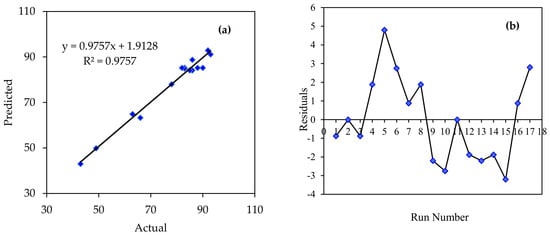
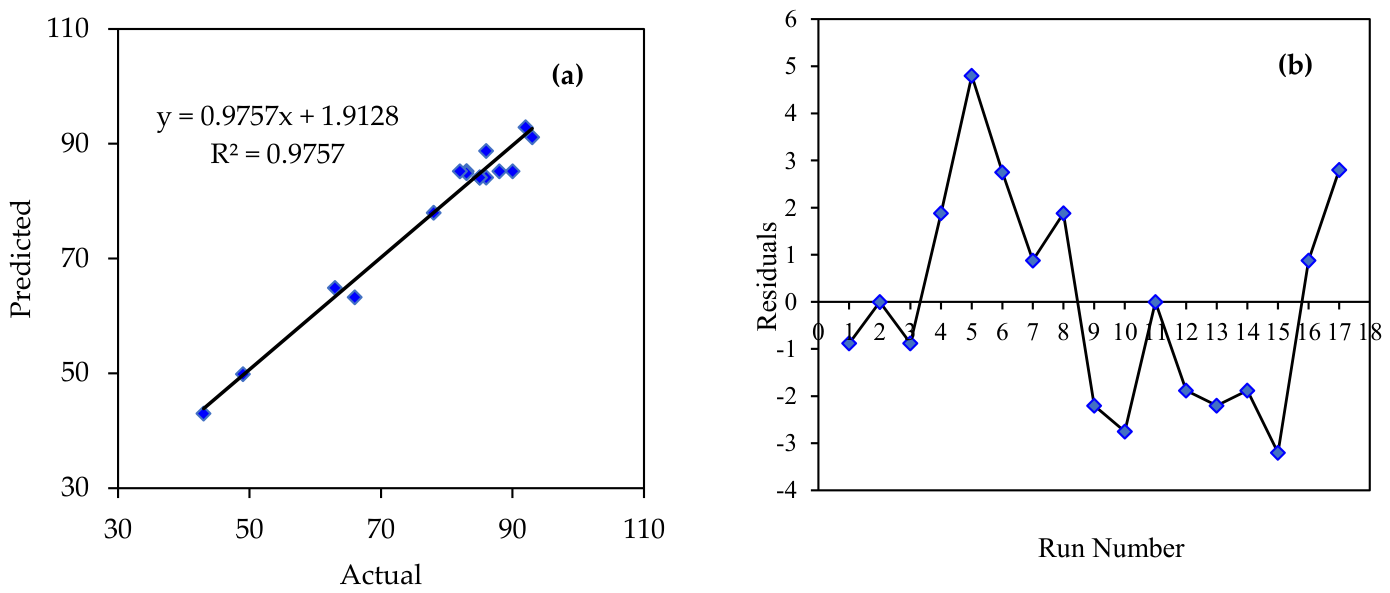
According to the deviation between the Li dissolution predicted through the model and the actual experimental results, as shown in Figure 1a, the data points exhibit excellent linearity along the 45° diagonal, confirming that the 17 sets of experimental runs are normally distributed and free from major systematic errors. Again, Figure 1b displays the relationship between the number of experiments and the internally studentized residuals.
Figure 1.
(a) Linear plots of model-predicted vs. actual experimental dissolution efficiencies. (b) The plot of internally studentized residuals.
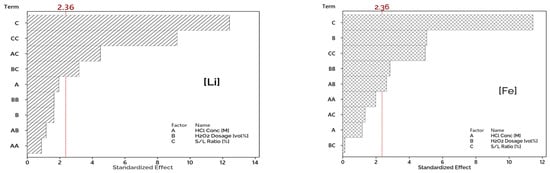
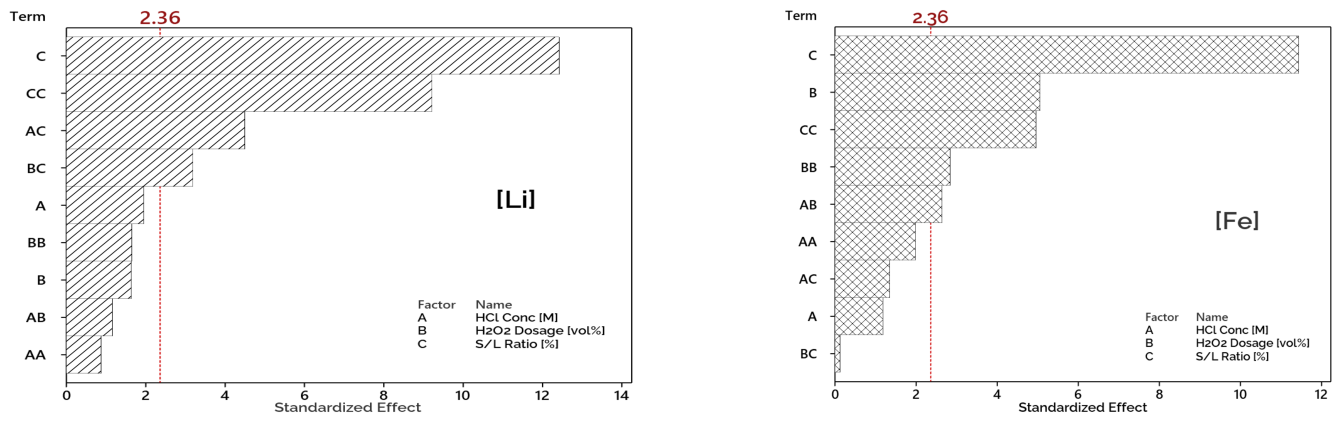
The residuals are distributed over the interval (−3, +5), indicating a symmetric distribution about zero and confirming that the regression model has been correctly established and satisfies the statistical assumption of homoscedasticity. The Pareto charts for the ANOVA F-values, as shown in Figure 2, reveal the level of importance of the various individual parameters and their interactions with Li and Fe, respectively. For Li extraction, the hierarchy of significance follows the order C > CC > AC > BC, showing that lithium release is controlled primarily by the solid–liquid ratio rather than linear acid strength or oxidant concentration. While H2O2 dosage is significant for Fe, standalone HCl concentration is statistically non-significant for both elements across the evaluated range. In the LFP matrix, Li+ is liberated once Fe is oxidized or the olivine structure is destabilized, rendering delithiation non-acid-limited within the tested domain. The strong significance of C and CC indicates that Li extraction increases sharply at lower pulp densities but exhibits diminishing returns at very low S/L ratios. Furthermore, the significant AC and BC interaction terms demonstrate that the beneficial effects of acid and oxidant become observable only when the S/L ratio is low enough to permit adequate interfacial mass transfer; at elevated solid loadings, severe mass-transfer resistance and localized reagent starvation dominate the kinetics. In contrast, for Fe dissolution, the hierarchy of statistical influence is given by C > B > CC > B2 > AB, confirming that oxidant dosage and its synergistic interaction with acid strength are critical in governing redox potential and driving solid-state FePO4 fixation.
Figure 2.
The Pareto chart of the standardized effects for Li dissolution and Fe co-dissolution.
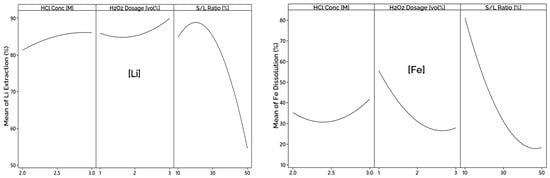
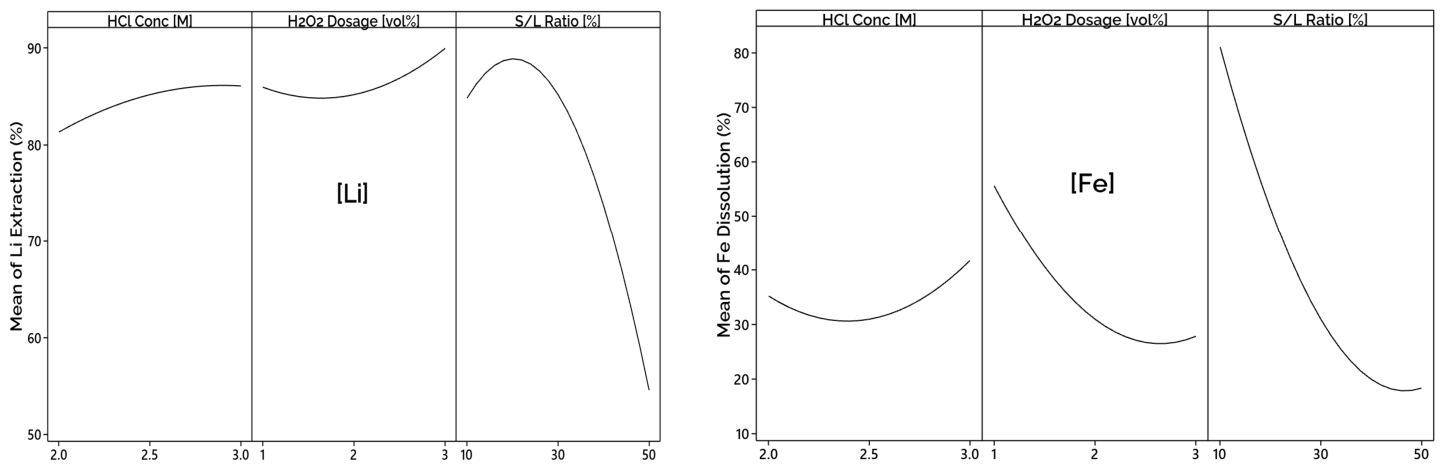
The individual plots showing the individual influences of the input parameters for Li dissolution and Fe co-dissolution were evaluated using main effects plots, as shown in Figure 3, respectively. These one-factor plots assume all other factors are constant while showing the overall effect of a certain process condition on the metal dissolution. The results in Figure 3 show that an increase in the concentration of HCl had a progressive positive effect on the leaching dissolution of Li before starting to plateau, while a parabolic trend is seen for Fe dissolution. Again, the leaching dissolution efficiency of Li increased with increasing H2O2, achieving its maximum at the highest dosage studied. Conversely, the addition of the oxidant shows a sharp decline in the iron co-dissolution, confirming its effective role in suppressing iron co-dissolution through oxidative precipitation.
Figure 3.
The individual effect plots for Li extraction and Fe dissolution.
Furthermore, it can be observed that the solid-to-liquid ratio exerted the most significant impact on both responses. For lithium dissolution, a distinct parabolic curvature is visible, where extraction efficiencies peaked at intermediate solid-to-liquid ratios before declining sharply due to mass-transfer limitations and proton starvation. Similarly, increasing the S/L ratio continuously suppressed the iron co-dissolution, driving its dissolution down toward its minimum.
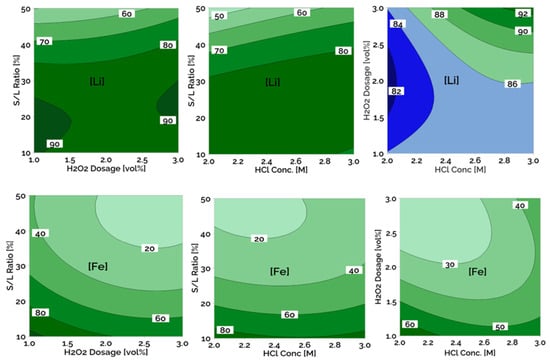
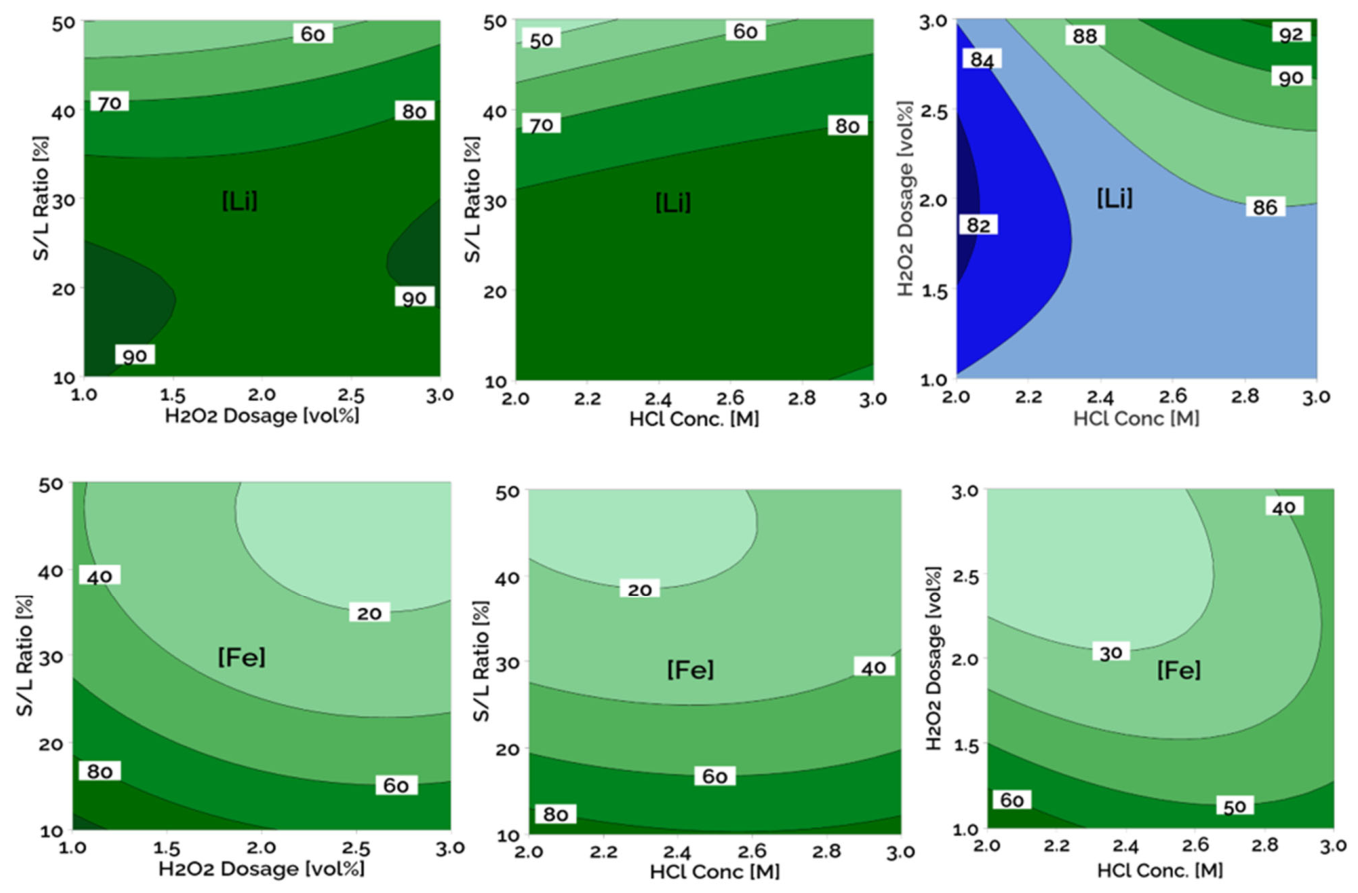
The two-dimensional (2D) contour plots in Figure 4 show the combined effects of the significant input parameters on Li and Fe leaching dissolution efficiency. Each plot depicts the interaction between two input parameters while holding the third constant. For the Li contour plots, the results show that the interaction between H2O2 and HCl concentration had an insignificant effect on Li dissolution within the range studied. In contrast, Li extraction was significantly influenced by the interaction between the S/L ratio and HCl concentration. It can be observed that increasing the HCl concentration positively affected Li extraction as the S/L ratio increased from 10 to ≈35%. Similarly, the interaction between the S/L ratio and H2O2 had a significant effect on Li extraction, with Li extraction increasing with H2O2 across lower and intermediate S/L ratios. There is a sharp drop in the dissolution efficiency when high S/L ratios are combined with low H2O2 dosages. Furthermore, the Fe contour plots are also shown in Figure 4.
Figure 4.
Two-dimensional contour plots showing the effects of the individual parameters on Li extraction and Fe dissolution. The contour color gradients represent the dissolution efficiency (%), with darker color shades denoting higher percentage values.
The results clearly show that the interaction between the H2O2 dosage and HCl significantly influenced Fe dissolution within the range studied. It can be observed that increasing the H2O2 dosage minimized iron co-dissolution between 2 and 2.5 M HCl. In contrast, the interaction between the S/L ratio and HCl had a relatively insignificant effect on iron leaching. Lastly, the interaction between the S/L ratio and H2O2 dosage had a prominent impact on Fe leaching. The statistical analysis confirmed that the developed response surface model adequately describes the selective leaching behavior of the LFP black mass and can therefore be used to evaluate the influence of the operating variables on lithium extraction.
3.2. Parameter Sensitivity and Physical Chemistry Mechanisms
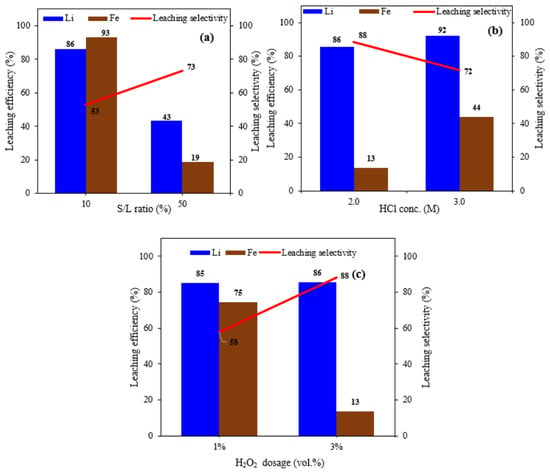
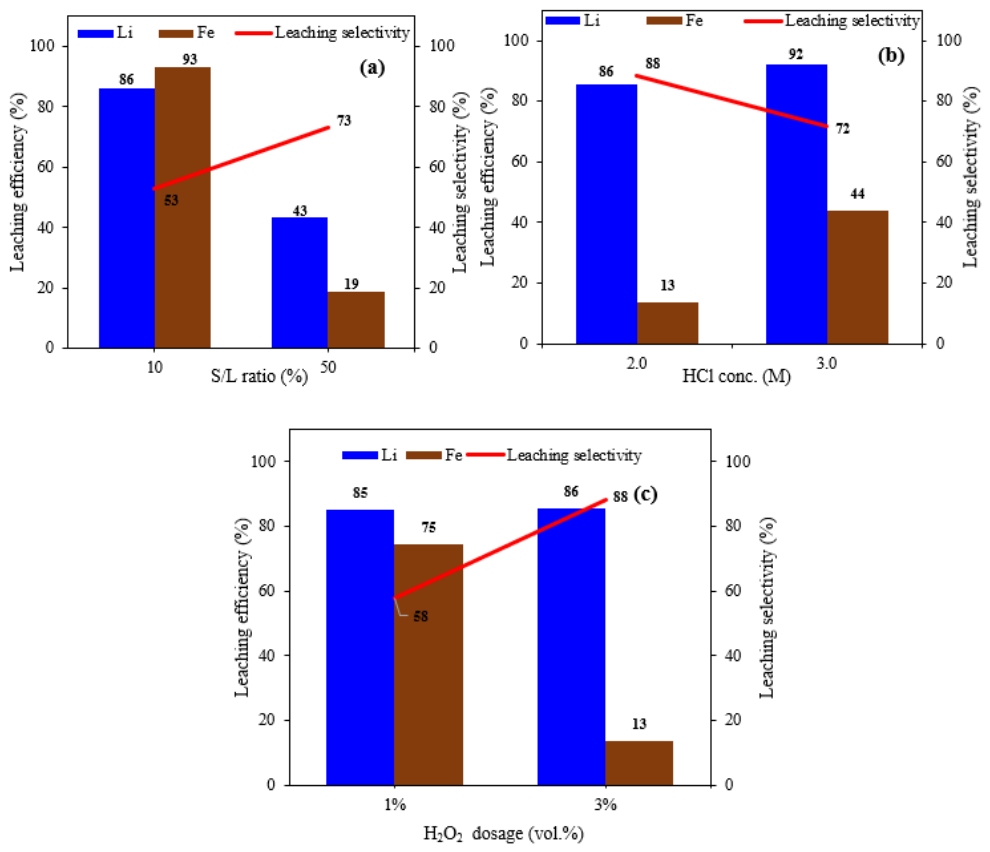
To further interpret the statistically validated response surface model and identify the operating conditions that maximize lithium extraction, the influence of each process variable was examined individually using parameter sensitivity plots generated from the 17-run Box–Behnken Design (BBD) experiments. Although these plots illustrate the effect of varying one factor while the remaining variables are held at their central levels, they are derived from the complete RSM dataset rather than from separate one-factor-at-a-time experiments. The influence of each process parameter is discussed in the following sections. Figure 5 displays the effects of the various factors on the selective leaching of Li from LFP black mass.
Figure 5.
Effect of (a) solid-to-liquid ratio, (b) HCl concentration, (c) H2O2 dosage on the selective leaching of Li.
3.2.1. Effect of Solid-to-Liquid Ratio on LFP Selective Leaching
The effect of the S/L ratio on dissolution efficiency and the Li-Fe selectivity is shown in Figure 5a. This evaluation was done by isolating specific response vectors from the BBD matrix, where the S/L ratio was increased from 10% to 50%, while alternative parameters were fixed at their statistical center points (2.0 M HCl and 2% v/v H2O2) at room temperature. When the S/L ratio was increased from 10% to 50%, there was a significant decrease in Li extraction (from 86% to 43%), accompanied by a concurrent rise in selectivity (from 53 to 73). These findings demonstrate a strong alignment with previous studies on LFP leaching, while also highlighting critical benchmarks. The observed negative correlation between the S/L ratio and dissolution efficiency is consistent with the results of refs. [48,49]. In their work, Li extraction typically decreased at high S/L ratios. This was attributed to the reduced contact between the LFP black mass and the leaching agent, which restricts the diffusion of ions at the solid–liquid interface. It can be inferred that at lower solid loadings (10%), HCl is in relative excess compared to the available solid mass, providing an abundant chemical driving force for near-complete dissolution. The stoichiometric relationship between HCl consumption and the LiFePO4 dissolution can be established from the primary selective delithiation reaction (Equation (7)):
From Equation (7), the required acid-to-mineral molar ratio is 1:1. Given an ICP-OES head grade of 32.12 wt% Fe (translating to 90.67 wt% active LiFePO4), a 100 mL volume of 2.0 M HCl supplies 0.20 moles of H+ against a molar demand of 0.06 moles for a 10.0 g solid mass. This yields an acid excess factor (λ) of 3.48, providing a steep concentration gradient across the fluid boundary layer. Conversely, increasing the S/L ratio to 50% w/v expands the solid mass to 50.0 g (0.29 moles LiFePO4), compressing λ to 0.70. This establishes an absolute theoretical acid deficit of 30.4%, mathematically capping the maximum possible Li extraction at 69.6% and confirming that localized proton starvation limits the system. This confirms that the sharp extraction decline at 50% w/v results from a coupled physicochemical regime: stoichiometric proton deficiency () caps the maximum theoretical yield, while elevated slurry viscosity drastically impairs hydrodynamic shear, thickening the stagnant Nernst boundary layer around the particles and suppressing both oxidant diffusion and outward Li+ mass transport.
3.2.2. Effect of HCl Concentration on LFP Selective Leaching
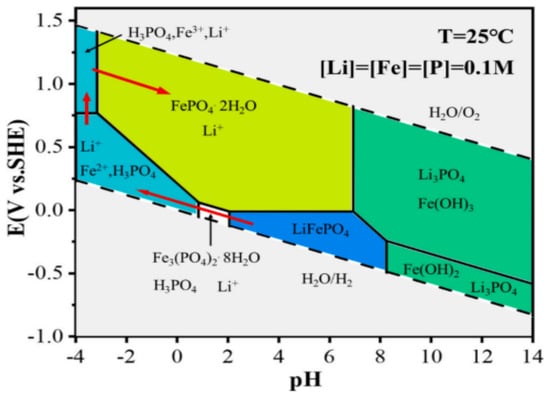
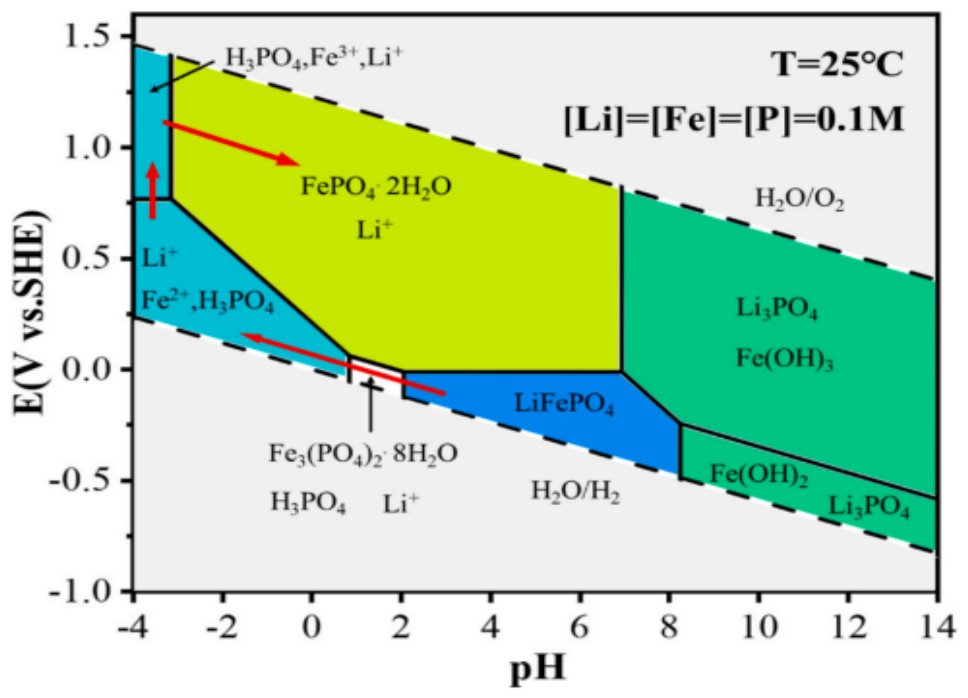
The impact of increased acid strength on selectivity, Li and Fe dissolution efficiency is depicted in Figure 5b. When HCl concentration was increased from 2.0 M to 3.0 M (at a constant 3% H2O2 dosage and S/L ratio of 30%), the Li dissolution increased slightly from 86% to 92% but caused Fe co-dissolution to more than triple (from 13% to 44%) and, consequently, dropped selectivity significantly from 88 to 72. This observation aligns with the selectivity threshold noted by ref. [49] and ref. [37]. While H+ ions are critical for disrupting the stable olivine LFP lattice, excessive acid strength also impedes the reprecipitation of FePO4·2H2O, thereby increasing impurity levels in the leachate. According to the shrinking core model utilized by ref. [46], leaching is limited by the internal diffusion of acid through an FePO4 product layer. Surpassing stoichiometric requirements leads to the chemical dissolution of this protective FePO4 layer, shifting the process from selective leaching to total leaching. This breakdown is supported by the Eh-pH diagram shown in Figure 6. The diagram demonstrates that while solid FePO4·2H2O remains stable under moderately acidic, oxidative conditions, transitioning the system into a highly concentrated acid region (pH ≤ −3) completely suppresses the solid phase, shifting the thermodynamic equilibrium into the entirely soluble, aqueous H3PO4, Fe3+, Li+ region. Under these highly acidic boundary conditions, the protective layer undergoes chemical breakdown into Fe3+ species. This breakdown is further supported by Mohammed Zadeh et al. [40], who observed that at low pH ranges, dissolution of Fe and P can reach nearly 50%, which mirrors the selectivity loss observed at 3.0 M HCl. Thus, an optimal leaching environment must balance proton activity and redox potential to achieve selective Li dissolution.
Figure 6.
The E-pH diagram for the Li-Fe-P-H2O system at 25 °C [53].
3.2.3. Effect of H2O2 Dosage on LFP Selective Leaching
To evaluate the impact of H2O2 dosage on leaching selectivity and Li and Fe dissolution efficiency, the H2O2 dosage was varied while maintaining a fixed S/L ratio of 30%, 2.0 M HCl, a 60 min leaching duration, and room temperature (Figure 5c). At 1% H2O2 dosage, iron leaching is significant (75%), resulting in low selectivity (SLi = 58%). Increasing the dosage to 3% suppresses iron co-dissolution to 13%, while maintaining stable Li dissolution (86%) and surging the selectivity upwards to SLi = 88%. This phenomenon can be explained as H2O2 oxidizes Fe2+ to Fe3+, which combines with PO43− to form FePO4, making Li more easily leached. This performance is in consensus with the results of ref. [46] and ref. [37]. Zhang et al. [46] found that in the absence of H2O2, selectivity was only 66.93%, but it surged significantly upon the addition of H2O2. Similarly, Cong et al. [37] also noted that raising H2O2/Li ratios to an optimal ratio of 2.13 effectively increased Li extraction while simultaneously decreasing Fe co-dissolution. This observed phenomenon may be justified by the iron-phosphorus fixation mechanism described by ref. [50], who identified H2O2 as the primary reagent for ensuring Fe remains in the solid phase while Li+ is released. This aligns with the in situ oxidation model, where H2O2 elevates the solution oxidation–reduction potential, theoretically poising the system within the thermodynamic stability domain of solid FePO4·2H2O (>0.60 V vs. SHE, as delineated in the Eh-pH diagram in Figure 6). In the absence of an oxidant (non-oxidative acid leaching), HCl promotes congruent, unselective dissolution of both Fe2+ and Li+ into solution. Introducing H2O2 triggers topotactic oxidative extraction: Fe2+ is oxidized to Fe3+ within the olivine framework, prompting the ejection of Li+ into the aqueous phase while retaining the three-dimensional phosphate framework as insoluble solid-state FePO4. While direct morphological and phase characterization of the washed residue (XRD/SEM-EDS) will further quantify crystal lattice parameters in larger pilot demonstrations, the elemental mass balance confirms this mechanism, with over 80% of the total iron inventory immobilized in the leach residue. Despite H2O2 having the potential to achieve high metal separation, at higher oxidant dosages, it levels off Li dissolution. Ref. [46] and ref. [37] stated that, once the H2O2/Li molar ratio reaches a specific threshold (~2.1 to 2.5), Fe2+ is completely oxidized, and further oxidant additions yield diminishing returns. Furthermore, excessive H2O2 concentrations are prone to catalytic decomposition into water and oxygen, particularly in the presence of Fe3+.
3.3. Optimization and Model Experimental Validation
Based on the results obtained under varying leaching conditions, the leaching behavior of Li and Fe highlights a significant tradeoff. While Li is easily liberated through acid-driven dissolution, Fe suppression relies on maintaining oxidative conditions by H2O2 addition to induce precipitation as solid FePO4. To resolve this, the developed second-order regression models were utilized to estimate optimum operating conditions using the Minitab software desirability approach. In Table 8, recommendations for Li and Fe dissolution efficiencies (or extraction efficiencies) are provided when leaching EoL LFP batteries: 32.86% (S/L ratio); 2.34 M HCl and 3.0 vol% H2O2 at room temperature for 60 min will generate the highest trade-off. Verification of the model was done again in the laboratory to look at the suitability of the experimental results with the model obtained.
Table 8.
Experimental results under optimal process parameters.
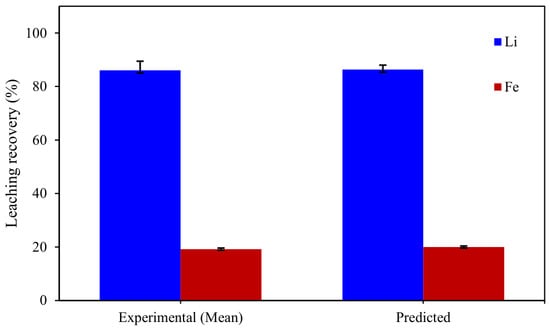
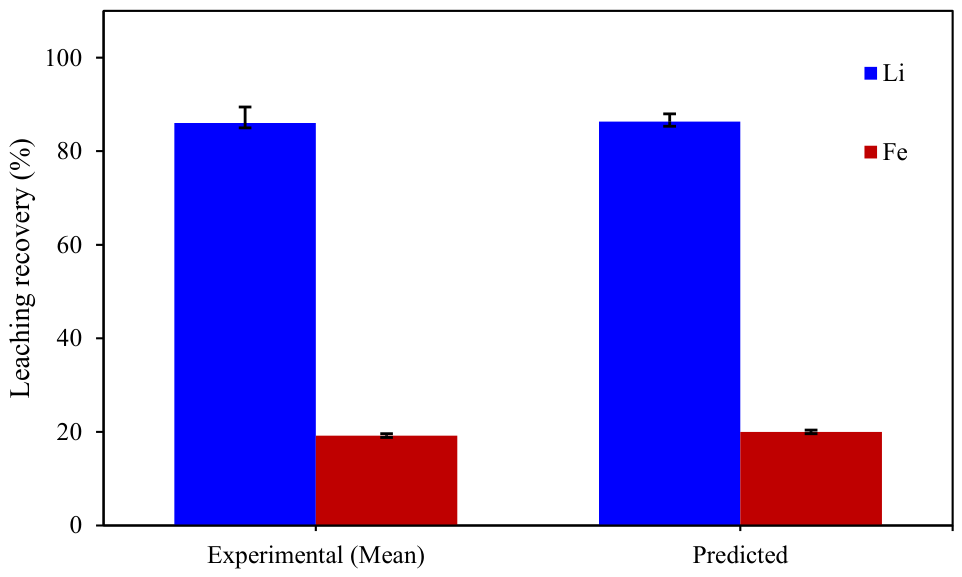
Experimental verification was carried out in triplicate () at the optimal condition (32.86% w/v solid-to-liquid ratio, 2.34 M HCl, and 3.0 vol% H2O2), resulting in mean Li and Fe dissolution efficiencies of 86.0 ± 1.2% and 19.2 ± 0.8%, respectively. These closely match the model-predicted values of 86.34% for Li extraction and 20.0% for Fe co-dissolution, demonstrating low percentage relative errors of 0.39% and 4.02%, respectively. In addition, the five center-point replicate runs in the BBD matrix demonstrated high experimental precision, with standard deviations of ±3.6% for Li (mean 85.2%) and ±1.6% for Fe (mean 31.0%), confirming robust experimental repeatability and validating the low residual pure error in ANOVA. In other words, Li is highly dissolved, and Fe is successfully suppressed as graphically illustrated in Figure 7.
Figure 7.
Comparison of predicted and experimental validation values for the Li extraction and Fe dissolution under optimized conditions.
3.4. Purification of LFP Leachates
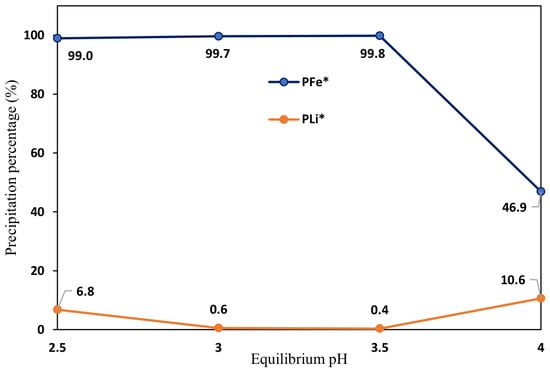
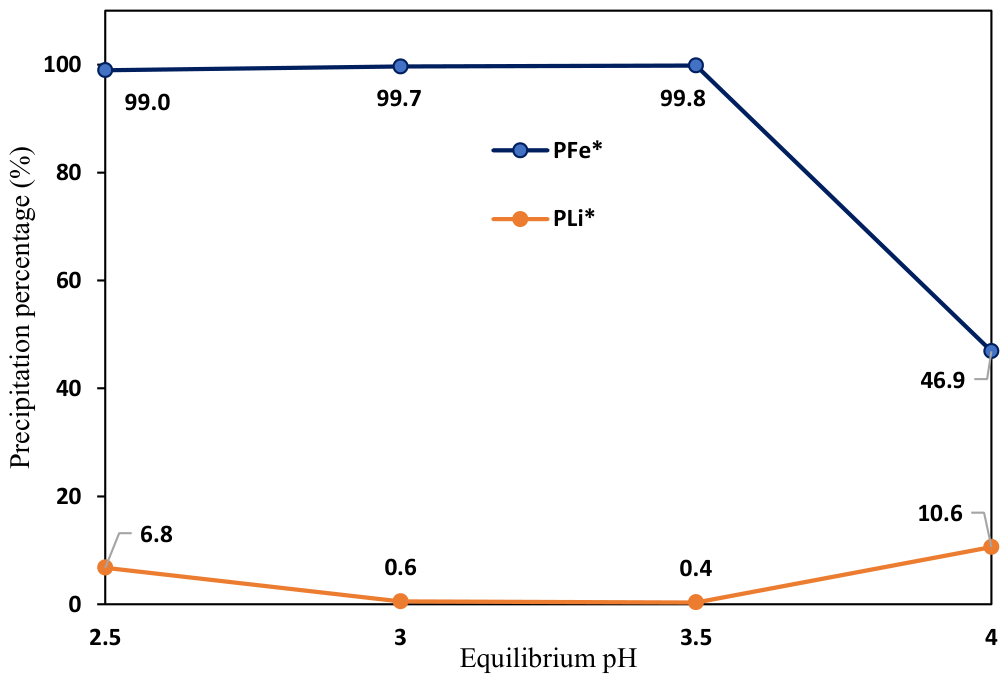
When studying iron removal from the HCl-H2O2 LFP-based PLS, the precipitation percentage at 60 °C for Fe was found to be high (99.0%), even at the lowest studied pH level of 2.5, as shown in Figure 8.
Figure 8.
Precipitation percentages of Fe and Li from the HCl-H2O2 based LFP leachate (PFe* and PLi* represent the percentage of Fe precipitated and Li co-precipitated, respectively).
When 3 M NaOH was used to modify the pH, the precipitation percentage increased to a near-complete value of 99.7% at pH 3.0 and reached a plateau at 99.8% at a pH of 3.5, as presented in Table 9.
Table 9.
Fe and Li precipitation behavior for the H2O2-NaOH LFP precipitation system.
Since substantial Fe precipitation was supported by the availability of PO43− ions, this finding demonstrates that optimum separation efficiency between Li and FePO4 may be attained for LFP-based leach solution at pH 3 to 3.5. This behavior aligns closely with findings by Chang et al. [54], who identified pH 3 as the optimal equilibrium point for achieving high-purity FePO4 with a precipitation percentage of 99.57%. Similarly, Zou et al. [55] reported a high precipitation percentage of 97.8% at pH 2.0, rising to > 99% for pH levels between 2.5 and 4.5. In the current study, the use of 1% vol. of H2O2 (w/w%), equivalent to 3.7 mL, for pretreatment ensured sufficient oxidation of Fe2+ to Fe3+, shifting the equilibrium toward the stable FePO4 solid phase. This oxidation step is essential for successful precipitation and follows Equation (8):
The high Fe precipitation percentage at low pH is primarily attributed to the availability of PO43− ions, which facilitates the formation of amorphous FePO4 via Equation (9):
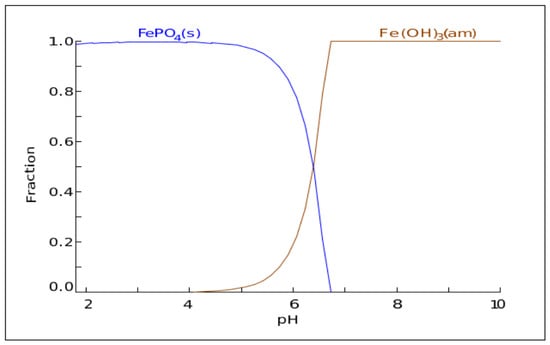
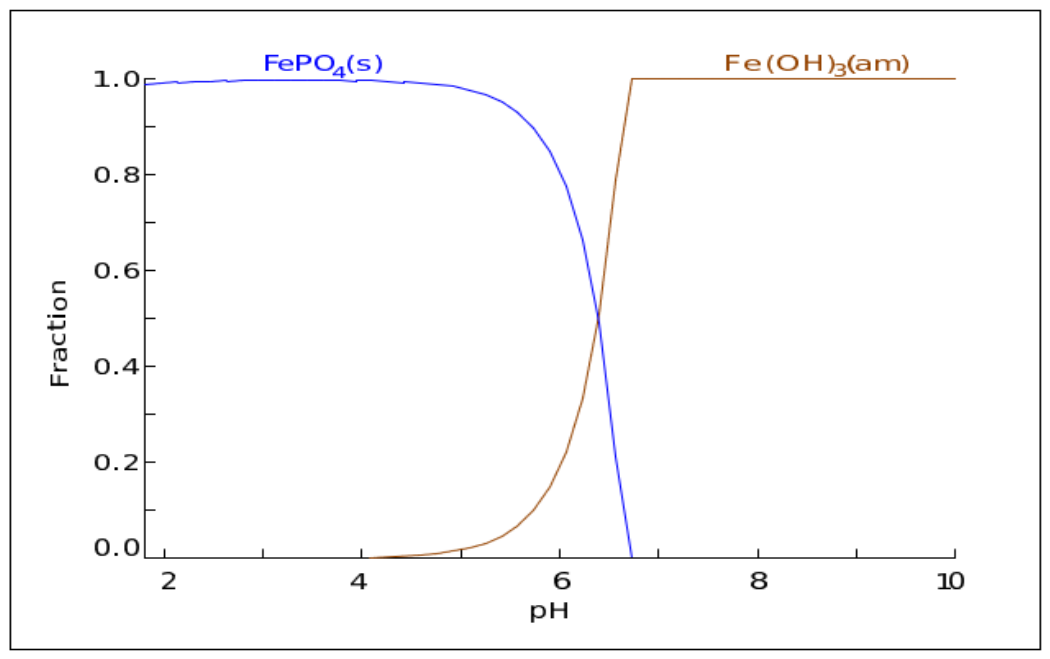
As illustrated in the Pourbaix (Eh vs. pH) diagram for the Li-Fe-P-H2O system (Figure 6), Fe3+ preferentially precipitates as FePO4∙2H2O at acidic pH levels (typically pH 2.0–3.0) when the redox potential is maintained above 0.5 V. This theoretical stability region directly supports the near-complete precipitation observed in the current study’s pH 3.0–3.5 window. To further evaluate the competition between phosphate and hydroxide species, a speciation diagram was simulated using Hydra-Medusa software (32-bit version, KTH Royal Institute of Technology, Stockholm, Sweden) as shown in Figure 9. The simulation confirms that under the experimental conditions, FePO4(s) is the sole dominant species up to ≈ pH 5.0. This theoretical dominance confirms that the iron removed in the pH 3.0–3.5 window is recovered primarily as a phosphate salt rather than a hydroxide, ensuring high product purity as justified by the Ksp values reported by [55].
Figure 9.
Speciation diagram for Fe-PO43− by Medusa and Hydra software.
In their studies, the authors of [55] further justify this by noting that FePO4 has a significantly lower solubility product constant (Ksp = 1.4 × 10⁻²⁷) compared to AlPO4 (Ksp = 4.0 × 10⁻²⁰), ensuring that iron phosphate precipitation is favored over other species, including hydroxides, in a pH range of ~ 3.0. In contrast to the high precipitation percentages observed at mildly acidic levels (pH 3.0–3.5), an apparent precipitation drop was recorded at pH 4.0 (sample S2179), where the calculated Fe removal efficiency decreased to 46.9% while Li loss increased to 10.6%. While thermodynamic speciation (Figure 9) predicts sustained stability of solid FePO4 and insoluble Fe(OH)3 above pH 3.5, this empirical outcome is governed by solid–liquid separation and colloidal phenomena rather than thermodynamic dissolution. Rapid dropwise addition of concentrated 3.0 M NaOH to achieve pH 4.0 creates intense localized basicity zones, inducing burst nucleation of amorphous, non-settling colloidal ferric oxyhydroxide and hydrated hydroxide precipitates according to Equation (10):
These sub-micron colloidal fines resist standard gravitational settling and partially penetrate or bypass standard filtration media. When the resulting PLS filtrate is stabilized with dilute acid prior to ICP-OES analysis, these entrained colloidal particulates redissolve, registering as apparent aqueous iron in solution. Furthermore, the elevated viscosity and high specific surface area of this gelatinous, uncoagulated phase substantially exacerbate mechanical liquor retention, directly accounting for the observed spike in lithium entrapment (10.6%). Consequently, operating at a controlled equilibrium window of pH 3.0–3.5 represents the critical process boundary, balancing rapid crystalline macro-floc aggregation, minimal colloidal peptization, and negligible lithium entrainment (<0.6%).
3.5. Synthesis and Purity Evaluation of Lithium Carbonate
Following oxidative precipitation, the pregnant leach solution (PLS) still contained residual iron at a level unsuitable for high-purity Li2CO3 production. For instance, sample S2203 (initial pH 3.0) had an iron concentration of 19 mg/L. To achieve further iron removal, an oxidative polishing step was performed on the Li-rich solution at a target pH of 3.5 using 2 mL of 30 wt.% H2O2 and 1 M NaOH. This trial was designated S2231. During polishing, H2O2 addition ensured complete oxidation of residual Fe2+ to Fe3+, resulting in quantitative precipitation of iron as Fe(OH)3. The solution volume increased from 70 mL to 100 mL (specific volume expansion factor = 1.43). Raising the pH from 3.0 to 3.5 reduced the iron concentration below the ICP detection limit (ND), corresponding to >99% iron removal. Accounting for the dilution factor from volume expansion (70 mL to 100 mL), the absolute mass of lithium decreased from 356.0 mg (5085 mg/L in 70 mL) to 245.9 mg (2459 mg/L in 100 mL), representing an actual lithium mass loss of 30.9% (approximately 31%, rather than the 51.6% concentration decrease). This loss is primarily attributed to physical liquor entrainment within the voluminous, gelatinous Fe(OH)3 precipitate, colloidal surface adsorption, and localized sampling variances during slurry separation. In commercial continuous circuits, this entrained lithium can be mitigated and largely recovered via multi-stage counter-current displacement cake washing, typically requiring 1.5–2.5 L wash water per kg of dry cake (wash ratio 1.5–2.5), and by recycling the resulting wash filtrates back to the primary leaching circuit to maintain high cumulative recovery. Subsequent lithium precipitation from the polished PLS (S2231) was performed by addition of Na2CO3. This reagent was selected because lithium chloride is difficult to dry at industrial scale, whereas Li2CO3 is readily handled as a solid product. Precipitation from dilute solutions (Li < 10 g/L) is known to be sensitive to temperature, CO32−/Li+ molar ratio, and ionic strength. Literature indicates that efficient carbonate precipitation typically requires an initial lithium concentration of at least 7.5 g/L [51]. Since the polished PLS contained only 2.459 g/L Li, the solution was preconcentrated by a factor of 5.0 prior to precipitation. This yielded a single-pass lithium precipitation efficiency of 29.7% (73 mg Li precipitated), leaving a residual concentration of 1572 mg/L in the filtrate (S2256). This moderate single-stage recovery is governed by the retrograde solubility of Li2CO3 (~7.2 g/L at 90 °C) and the remaining aqueous volume. In commercial recycling plants, overall lithium recovery is closed-loop: the mother liquor is continuously recycled back to the thermal evaporation circuit to utilize residual lithium ions and exploit the common-ion effect ( excess), driving cumulative circuit recovery above 85–90%.
Based on the aqueous Li+ mass balance from ICP-OES measurements of solution depletion, the precipitation of 73 mg Li stoichiometrically equates to a theoretical pure Li2CO3 mass of 0.39 g. Comparing this value to the actual weighed dry cake mass of 0.40 g yielded an estimated chemical purity of 97.25% (≈ 97.3%) for the recovered crude product. However, as noted from the moderate single-stage precipitation efficiency (29.7%), this indirect calculation does not exclude the co-precipitation or physical inclusion of entrained soluble salts, primarily NaCl and trace sodium/iron species. The post-precipitation filtrate contained 10 mg/L residual iron, likely due to increased alkalinity after Na2CO3 addition and stabilization of colloidal iron species. While the recovered solid represents a technical-grade lithium precursor, upgrading to certified battery-grade specifications (>99.5% Li2CO3) under industrial flowsheets requires subsequent secondary purification, such as carbonation into soluble lithium bicarbonate (LiHCO3), polishing filtration to reject insoluble silicates/hydroxides, and thermal decomposition recrystallization.
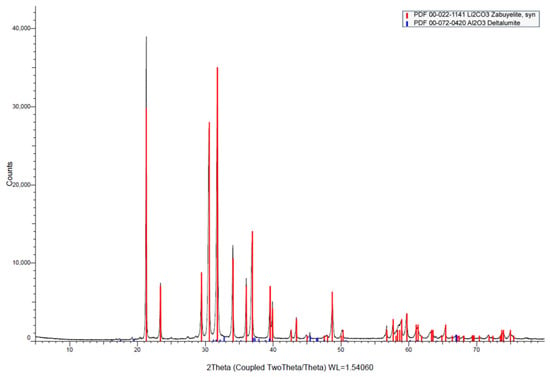
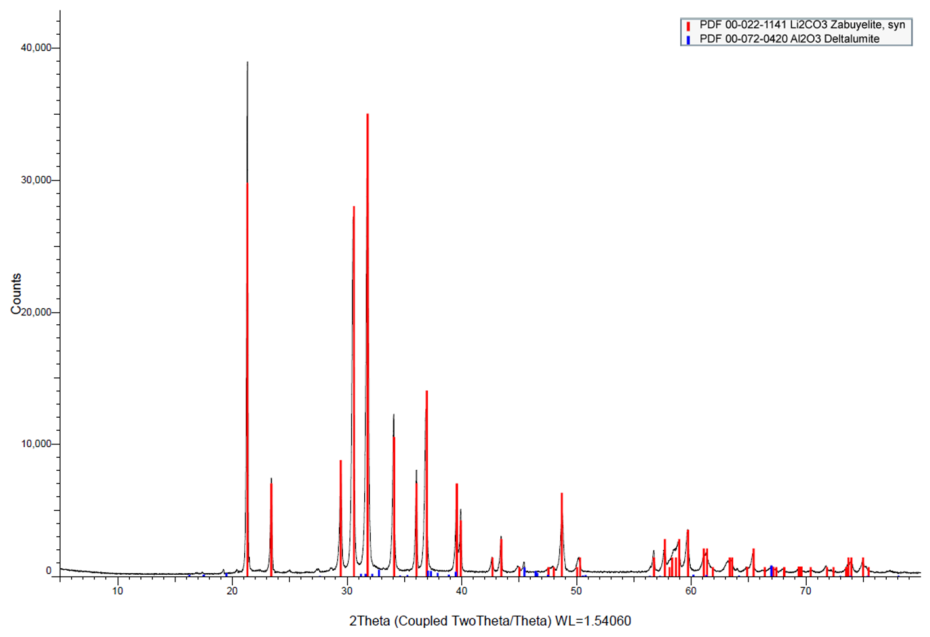
The crystallographic phase purity and structural characteristics of the precipitated product were directly evaluated via powder X-ray diffraction (Figure 10). As shown, all predominant diffraction reflections align with the monoclinic zabuyelite phase (Li2CO3, PDF 00-022-1141) with distinct diffraction peaks indicative of high crystallinity. Minor baseline reflections correspond to trace reference/substrate markers (PDF 00-072-0420) without detectable co-precipitated secondary crystalline lithium salts, supporting the structural integrity of the recovered technical-grade product.
Figure 10.
Powder X-ray diffraction (XRD) pattern of the synthesized Li2CO3 precipitate (black line), indexed against the standard reference pattern for zabuyelite (Li2CO3, PDF 00-022-1141; red lines) and Al2O3 (PDF 00-072-0420; blue lines). Data collected using Cu–Kα radiation (λ = 1.54060 Å).
3.6. Integrated Flowsheet
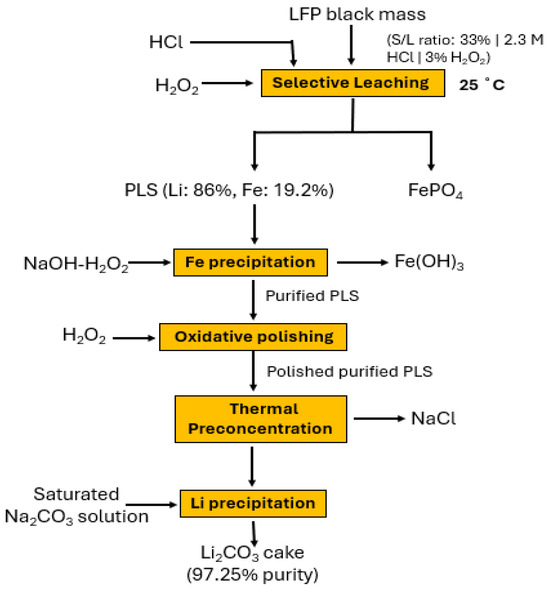
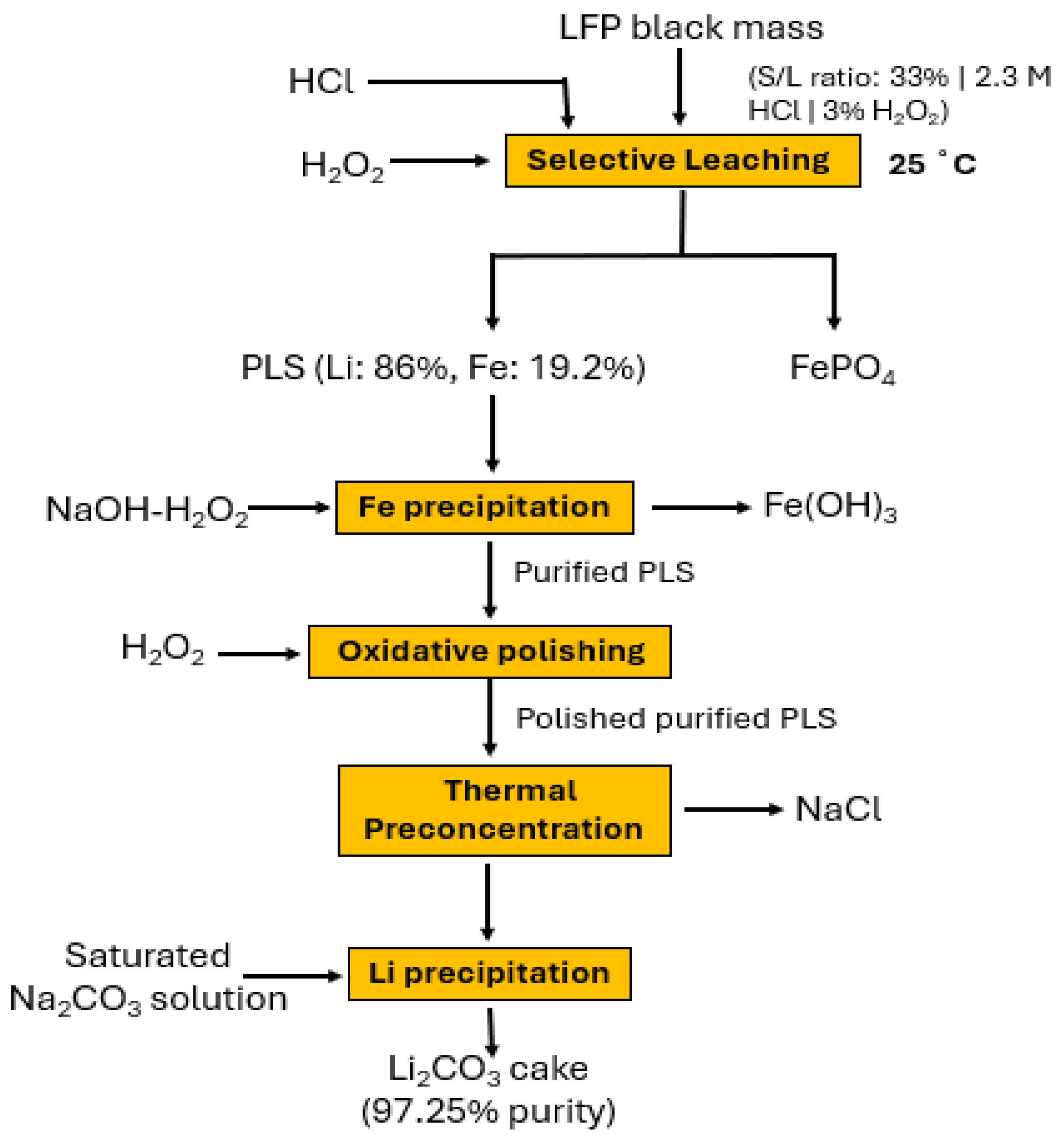
Based on the data obtained, a flowsheet for the selective recovery of lithium as Li2CO3 using the HCl–H2O2 system from the LFP black mass is presented in Figure 11. The process begins with transferring the valuables in the LFP black mass via a selective leaching step. The black mass is contacted with an optimized lixiviant consisting of 2.3 M HCl and 3 wt% H2O2 at a high S/L ratio of 33% (w/v). Under these conditions, lithium is preferentially solubilized, while a substantial fraction of the iron remains in the solid phase as an insoluble ferric phosphate (FePO4). This results in an optimized pregnant leach solution (PLS) containing 86% of the available lithium and only 19.2% of the iron. Following solid–liquid separation, impurities such as residual iron in the PLS are removed in a purification stage using an oxidative NaOH-H2O2 process, precipitating the iron as a mixed solid phase of FePO4 and insoluble Fe(OH)3 (as outlined in Section 3.4). To ensure complete removal of any remaining multivalent transition metal impurities before lithium recovery, the solution undergoes an oxidative polishing step with controlled H2O2 additions. The purified PLS is then subjected to thermal preconcentration, which simultaneously increases the lithium concentration and induces fractional crystallization of sodium chloride (NaCl) salts. Finally, lithium is recovered by adding a saturated Na2CO3 solution at elevated temperature, yielding a 97.25% Li2CO3 purity. This integrated sequence demonstrates effective lithium recovery with minimal iron crossover, providing a low-energy, selective route for valorising LFP black mass.
Figure 11.
Proposed flowsheet for the selective recovery and purification of Li from LFP black mass using HCl–H2O2 lixiviant system.
3.7. Scalability Assessment and Techno-Economic Considerations
To evaluate the industrial scalability and practical impact of this process, the operating parameters identified in this work (32.86% w/v solids loading at 25 °C) were compared against conventional benchmark hydrometallurgical systems (typically 50–100 g/L solids loading at 60–90 °C). Intensifying the pulp density to ~33% w/v yields an immediate threefold reduction in required reactor working volumes and liquid effluent handling for an equivalent annual throughput of spent LFP black mass. This volumetric compression reduces equipment sizing, agitation vessel footprints, and facility capital expenditure (CAPEX). From an operational expenditure (OPEX) standpoint, conducting selective delithiation at ambient room temperature (25 ± 2 °C) eliminates the substantial thermal energy penalty associated with heating large volumes of acidic slurry to 60–90 °C. Furthermore, leaching at high solids loadings directly generates a concentrated pregnant leach solution (>5.0 g/L Li), substantially lowering the thermal duty required for downstream evaporative preconcentration prior to lithium carbonate precipitation. While operation at 32.86% w/v offers substantial capital and thermal savings, scale-up introduces preliminary operational risks that require targeted engineering mitigations: (i) Slurry Rheology and Agitator Stalling: High solids loading induces non-Newtonian shear-thinning behavior, which risks localized dead zones and motor overload; this is mitigated through high-torque, dual-impeller hydrofoil systems (e.g., Lightnin A310/A320) optimized for uniform off-bottom particle suspension. (ii) Exothermic Heat Accumulation: Peroxide decomposition and concentrated acid neutralization release exothermic enthalpy; in unheated large-scale reactors, internal cooling jackets or controlled staged addition of H2O2 are required to maintain slurry temperature near the optimal 25 °C boundary and prevent thermal runaway or parasitic H2O2 degradation. (iii) Cake Compressibility: Downstream filtration of fine-grained residues (d50 ≈ 45 μm) poses blinding risks on filter cloths, which can be mitigated using continuous horizontal belt filters or automated filter presses equipped with high-pressure displacement washing. Incorporating these engineering controls ensures that the demonstrated thermal savings and reduced water circulation translate reliably to full-scale operations.
4. Conclusions
This current study investigated selective lithium leaching from LFP black mass using an intensified HCl–H2O2 lixiviant system over a range of solid-to-liquid ratios. Process parameters were optimized by response surface methodology based on a Box–Behnken design. Under the identified optimal conditions (2.34 M HCl, 3.0 vol.% H2O2, 32.86% w/v solids loading, 25 °C, 60 min), lithium extractionreached 86.0% while iron dissolution was limited to 19.2%, effectively retaining the iron-phosphate matrix in the solid residue.
Downstream purification of the pregnant leach solution was performed by addition of 3.0 M NaOH at 60 °C for 30 min within a controlled pH window of 3.0–3.5. This step precipitated 99.7% of the dissolved iron with minimal lithium co-precipitation (<0.55%). Subsequent oxidative polishing reduced residual iron to below detection limits, enabling recovery of lithium as technical-grade Li2CO3 with an estimated stoichiometric purity of 97.3%.
Future work could consider evaluating reagent recycling, effluent chloride management, and integration with industrial purification circuits to validate the route for commercial deployment.
5. Patents
The leaching process reported in this study adapts technology protected under European Patent Application No. EP4174196A1.
Supplementary Materials
The following supporting information can be downloaded at https://www.mdpi.com/article/10.3390/pr14203356/s1, Section S1: Computational setup, activity models, and equilibrium reactions; Table S1: Thermodynamic equilibrium constants (log K at 298.15 K) for aqueous and solid species. References [54,55] cited in the supplementary materials (Puigdomenech, 2004; Baes & Mesmer, 1976) are included in the main text reference list.
Author Contributions
Conceptualization, G.N., A.M.M., R.M.C., N.H.N. and I.Y.; methodology, G.N., A.M.M., and E.P.; software, G.N.; validation, G.N., R.M.C., and N.H.N.; formal analysis, G.N. and R.M.C.; investigation, G.N. and E.P.; resources, I.Y. and E.P.; data curation, G.N.; writing—original draft preparation, G.N.; writing—review and editing, G.N., A.M.M., R.M.C., N.H.N., and I.Y.; visualization, I.Y.; supervision, I.Y., A.M.M., R.M.C., and N.H.N.; project administration, A.M.M. and I.Y.; funding acquisition, I.Y. and E.P. All authors have read and agreed to the published version of the manuscript.
Funding
This research was supported by the European Union’s Erasmus+ programme under the Erasmus Mundus Joint Master’s Degree in Sustainable Mineral and Metal Processing Engineering (EMJM PROMISE). Open access funding support was facilitated through the FinELib agreement with the University of Oulu.
Data Availability Statement
The original contributions presented in this study are included in the article/Supplementary Material. Further inquiries can be directed to the corresponding author.
Acknowledgments
The authors acknowledge the technical and experimental support provided by the laboratory staff at Monolithos Catalysts & Recycling Ltd. and the Oulu Mining School at the University of Oulu.
Conflicts of Interest
Anastasia Maria Moschovi, Ekaterini Polyzou, and Iakovos Yakoumis are employed by Monolithos Catalysts & Recycling Ltd. The remaining authors declare that the research was conducted in the absence of any commercial or financial relationships that could be construed as a potential conflict of interest.
References
- Liu, Y.; Liu, T.; Zhao, J.; Shao, Y.; Li, X.; Li, Z.; Zhang, Y.; Liu, S.; Lin, Z.; Bettels, F.; et al. Recycling and direct regeneration of valuable cathode materials from spent Li-ion batteries: A comprehensive review. J. Mater. Chem. A 2025, 13, 8968–9004. [Google Scholar] [CrossRef] [Scilit]
- Wang, C.; Tao, R.; Xing, P.; Ni, J.; Cun, Z.; Liu, S.; Wang, X.; Dai, Y.; Long, Z.; Sun, Z.; et al. State-of-the-art review on liberation of cathode material in pretreatment recycling of spent lithium-ion battery. Resour. Conserv. Recycl. 2025, 218, 108257. [Google Scholar] [CrossRef] [Scilit]
- Yang, Q.; Su, Y.; Wang, X.; Xiao, K.; Chen, T.; Fu, J. Emerging strategies for sustainable holistic recycling of spent lithium-ion batteries. Adv. Funct. Mater. 2026, 36, e14524. [Google Scholar] [CrossRef] [Scilit]
- Luo, B.; Xu, B.; Yan, Q.; Zhou, Y.; Dong, Z.; Huang, X.; Zhao, Z. Advances and challenges in recycling spent LiFePO4 batteries. Sep. Purif. Technol. 2025, 362, 131780. [Google Scholar] [CrossRef] [Scilit]
- Zhang, H.; Wang, J.; Wang, H.; Ge, Z.; Xie, W.; Zhao, R.; Hao, J.; Zhang, G.; He, Y. Research progress on recycling of spent lithium iron phosphate batteries. Process Saf. Environ. Prot. 2025, 201, 107512. [Google Scholar] [CrossRef] [Scilit]
- Yang, H.; Zheng, N.; Dong, L.; Song, Y.; Li, W.; Zhou, X.; Ren, Z.; Zhou, Z. Recovery and preparation of battery-grade iron phosphate from leaching slag of spent lithium iron phosphate battery cathode materials. Sep. Purif. Technol. 2025, 379, 135023. [Google Scholar] [CrossRef] [Scilit]
- Xiao, X.; Wang, L.; Wu, Y.; Song, Y.; Chen, Z.; He, X. Cathode regeneration and upcycling of spent LIBs: Toward sustainability. Energy Environ. Sci. 2023, 16, 2856–2868. [Google Scholar] [CrossRef] [Scilit]
- Qi, C.; Yao, T.; Zhai, W.; Zhang, M.; Song, L.; He, J. Advances in degradation mechanism and sustainable recycling of LiFePO4-type lithium-ion batteries. Energy Storage Mater. 2024, 71, 103623. [Google Scholar] [CrossRef] [Scilit]
- He, K.; Zhang, Z.-Y.; Zhang, F.-S. A green process for phosphorus recovery from spent LiFePO4 batteries by transformation of delithiated LiFePO4 crystal into NaFeS2. J. Hazard. Mater. 2020, 395, 122614. [Google Scholar] [CrossRef] [Scilit]
- Shi, H.; Zhang, J.; Ou, L. A comprehensive review: Evaluating emerging green leaching technologies for recycling spent lithium-ion batteries. Chem. Eng. J. 2025, 506, 160006. [Google Scholar] [CrossRef] [Scilit]
- Wang, Y.; Yu, J.; Wang, D.; Han, J.; Zeng, H. Advancing thermal treatment technologies for recycling end-of-life lithium-ion batteries. Chem. Eng. J. 2025, 522, 167596. [Google Scholar] [CrossRef] [Scilit]
- Bin Abu Sofian, A.D.A.; Majid, S.R.; Kang, K.; Kim, J.-K.; Show, P.L. Upcycling and recycling of spent battery waste for a sustainable future: Progress and perspectives. Prog. Mater. Sci. 2025, 153, 101478. [Google Scholar] [CrossRef] [Scilit]
- Shen, Y.; Zhang, S. Recent advances in sustainable reductive roasting for spent lithium-ion batteries recycling. Energy Storage Mater. 2025, 79, 104358. [Google Scholar] [CrossRef] [Scilit]
- Wang, X.; Bian, X.; Huang, Y.; Qiao, S.; Wu, W. Study on the mechanism of Na2CO3-roasting decomposition for water leach residue. Environ. Res. 2024, 261, 119655. [Google Scholar] [CrossRef] [Scilit]
- Nong, C.; Yuan, H.; Liu, Z.; Liu, H.; Han, J.; Gu, J.; Chen, Y. Hydrometallurgical recycling technologies for spent LiFePO4 batteries: Recent advances and challenges. Renew. Sustain. Energy Rev. 2026, 231, 116725. [Google Scholar] [CrossRef] [Scilit]
- Gerold, E.; Lerchbammer, R.; Antrekowitsch, H. Parameter Study on the Recycling of LFP Cathode Material Using Hydrometallurgical Methods. Metals 2022, 12, 1706. [Google Scholar] [CrossRef] [Scilit]
- Zhao, T.; Marthi, R.; Mahandra, H.; Chae, S.; Traversy, M.; Sadri, F.; Choi, Y.; Ghahreman, A. Direct selective leaching of lithium from industrial-grade black mass of waste lithium-ion batteries containing LiFePO4 cathodes. Waste Manag. 2023, 171, 134–142. [Google Scholar] [CrossRef] [Scilit]
- Shan, M.; Dang, C.; Meng, K.; Cao, Y.; Zhu, X.; Zhang, J.; Xu, G.; Zhu, M. Recycling of LiFePO4 cathode materials: From laboratory scale to industrial production. Mater. Today 2024, 73, 130–150. [Google Scholar] [CrossRef] [Scilit]
- Li, X.; Gao, S.; Zhou, F.; Qu, X.; Cai, Y.; Wang, D.; Yin, H. NaOH-assisted roasting for corecovery of spent LiFePO4 and LiCoO2 batteries. ACS Sustain. Chem. Eng. 2023, 11, 12695–12703. [Google Scholar] [CrossRef] [Scilit]
- Li, X.; Zhou, F.; Gao, S.; Zhao, J.; Wang, D.; Yin, H. NaOH-assisted low-temperature roasting to recover spent LiFePO4 batteries. Waste Manag. 2022, 153, 347–354. [Google Scholar] [CrossRef] [Scilit]
- Li, D.; Zhi, X.; Zhang, L.; Xie, F.; Wu, M. Direct regeneration of spent lithium-ion batteries: Advancing from powder to cell. J. Energy Chem. 2025, 111, 767–789. [Google Scholar] [CrossRef] [Scilit]
- Tang, D.; Ji, G.; Wang, J.; Liang, Z.; Chen, W.; Ji, H.; Ma, J.; Liu, S.; Zhuang, Z.; Zhou, G. A multifunctional amino acid enables direct recycling of spent LiFePO4 cathode material. Adv. Mater. 2024, 36, 2309722. [Google Scholar] [CrossRef] [Scilit]
- Wang, W.; Wang, R.; Zhan, R.; Du, J.; Chen, Z.; Feng, R.; Tan, Y.; Hu, Y.; Ou, Y.; Yuan, Y.; et al. Probing hybrid LiFePO4/FePO4 phases in a single olive LiFePO4 particle and their recovering from degraded electric vehicle batteries. Nano Lett. 2023, 23, 7485–7492. [Google Scholar] [CrossRef] [Scilit]
- Swain, B. Recovery and recycling of lithium: A review. Sep. Purif. Technol. 2017, 172, 388–403. [Google Scholar] [CrossRef] [Scilit]
- Kumar, J.; Neiber, R.R.; Park, J.; Ali Soomro, R.; Greene, G.W.; Ali Mazari, S.; Young Seo, H.; Hong Lee, J.; Shon, M.; Wook Chang, D.; et al. Recent progress in sustainable recycling of LiFePO4-type lithium-ion batteries: Strategies for highly selective lithium recovery. Chem. Eng. J. 2022, 431, 133993. [Google Scholar] [CrossRef] [Scilit]
- Yang, Y.; Meng, X.; Cao, H.; Lin, X.; Liu, C.; Sun, Y.; Zhang, Y.; Sun, Z. Selective recovery of lithium from spent lithium iron phosphate batteries: A sustainable process. Green Chem. 2018, 20, 3121–3133. [Google Scholar] [CrossRef] [Scilit]
- Li, Y.; Dong, L.; Shi, P.; Ren, Z.; Zhou, Z. Selective recovery of lithium from lithium iron phosphate. J. Power Sources 2024, 598, 234158. [Google Scholar] [CrossRef] [Scilit]
- Yadav, P.; Jie, C.J.; Tan, S.; Srinivasan, M. Recycling of cathode from spent lithium iron phosphate batteries. J. Hazard. Mater. 2020, 399, 123068. [Google Scholar] [CrossRef] [Scilit]
- Chai, X.; Yu, X.; Shen, Q.; Li, X.; Lin, Y.; Cai, W.; Yuan, Y. Study on green closed-loop regeneration of waste lithium iron phosphate based on oxalic acid system. Waste Manag. 2024, 181, 168–175. [Google Scholar] [CrossRef] [Scilit]
- Zhou, H.; Hu, Q.; Li, L.; Ma, X.; Cao, Z. Endogenous advanced oxidation process with peracetic acid for recycling spent LiFePO4 batteries. Chem. Eng. Sci. 2024, 295, 120202. [Google Scholar] [CrossRef] [Scilit]
- Gao, M.; Sun, F.; Peng, W.; Dai, W.; Zhang, Z.; Zhang, L.; Zhang, H.; Ma, Y.; Zhang, L.; Song, D. Green and efficient method for the realization of full-component recovery of LiFePO4 black powder. Green Chem. 2024, 26, 7377–7383. [Google Scholar] [CrossRef] [Scilit]
- Liu, W.; Li, K.; Wang, W.; Hu, Y.; Ren, Z.; Zhou, Z. Selective leaching of lithium ions from LiFePO4 powders using hydrochloric acid and sodium hypochlorite system. Can. J. Chem. Eng. 2023, 101, 1831–1841. [Google Scholar] [CrossRef] [Scilit]
- Peng, D.; Zhang, J.; Zou, J.; Ji, G.; Ye, L.; Li, D.; Zhang, B.; Ou, X. Closed-loop regeneration of LiFePO4 from spent lithium-ion batteries: A “feed three birds with one scone” strategy toward advanced cathode materials. J. Clean. Prod. 2021, 316, 128098. [Google Scholar] [CrossRef] [Scilit]
- Liu, G.; Liu, Z.; Gu, J.; Wang, S.; Wu, Y.; Yuan, H.; Chen, Y. Facile and sustainable recovery of spent LiFePO4 battery cathode materials in a Ca(ClO)2 system. Green Chem. 2024, 26, 3317–3328. [Google Scholar] [CrossRef] [Scilit]
- Zhang, Z.; Tang, J.; Su, M.; Xu, J.; Shih, K. Design and optimization of an economically viable and highly efficient strategy for Li recycling from spent LiFePO4 batteries. ACS Sustain. Chem. Eng. 2023, 11, 16124–16132. [Google Scholar] [CrossRef] [Scilit]
- Guo, Z.; Ji, S.; Lai, C.; Zhang, D.; Nie, L.; Hou, Y.; Zhang, Y.; Zhang, Y.; Bai, L. Recycle of spent LiFePO4 batteries: An eco-friendly closed-loop technique based on less solvent solid-state reaction. Sep. Purif. Technol. 2025, 354, 128871. [Google Scholar] [CrossRef] [Scilit]
- Cong, J.; Luo, S.H.; Sun, Q.; Liu, X.; Wang, Y.K.; Yan, S.X.; Li, P.W. Study on deep synergistic leaching mechanism of spent lithium iron phosphate under the H2SO4-H2O2 system and precise chemical precipitation recovery strategy of lithium carbonate. Sep. Purif. Technol. 2025, 363, 132326. [Google Scholar] [CrossRef] [Scilit]
- Chen, X.; Li, J.; Kang, D.; Zhou, T.; Ma, H. A novel closed-loop process for the simultaneous recovery of valuable metals and iron from a mixed type of spent lithium-ion batteries. Green Chem. 2019, 21, 6342–6352. [Google Scholar] [CrossRef] [Scilit]
- Drajlin, D.S.; Suarez, D.S.; Toro, N.; Gálvez, E.D.; Pinna, E.G.; Rodriguez, M.H. Comparative Study of the Dissolution of LCO in HCl Medium with and without H2O2. Metals 2022, 12, 727. [Google Scholar] [CrossRef] [Scilit]
- Cheng, C.Y.; Barnard, K.R.; Zhang, W.; Robinson, D.J. Synergistic solvent extraction of nickel and cobalt: A review of recent developments. Solvent Extr. Ion Exch. 2011, 29, 719–754. [Google Scholar] [CrossRef] [Scilit]
- Mohammad Zadeh, A.H.; Ye, A.; Azimi, G. Selective lithium recovery from LFP-type black mass: Comparative evaluation of inorganic and organic acid systems under constant-pH leaching conditions. Waste Manag. 2026, 217, 115517. [Google Scholar] [CrossRef] [Scilit]
- Dai, X.; Qi, T.; Li, X.; Peng, Z.; Liu, G.; Qiusheng, Z.; Wang, Y.; Shen, L. Selective leaching of lithium from mixed spent lithium iron phosphate powder. J. Environ. Chem. Eng. 2024, 12, 114091. [Google Scholar] [CrossRef] [Scilit]
- Yang, Y.; Song, S.; Lei, S.; Sun, W.; Hou, H.; Jiang, F.; Ji, X.; Zhao, W.; Hu, Y. A process for combination of recycling lithium and regenerating graphite from spent lithium-ion battery. Waste Manag. 2019, 85, 529–537. [Google Scholar] [CrossRef] [Scilit]
- Ren, L.; Liu, B.; Bao, S.; Ding, W.; Zhang, Y.; Hou, X.; Lin, C.; Chen, B. Recovery of Li, Ni, Co and Mn from spent lithium-ion batteries assisted by organic acids: Process optimization and leaching mechanism. Int. J. Min. Metall. Mater. 2024, 31, 518–530. [Google Scholar] [CrossRef] [Scilit]
- Moschovi, A.M.; Yakoumis, I.; Polyzou, E.; Sofianou, A.M.; Papagianni, S. Process of Recovery of Critical Metals from Electrochemical Stack Devices. European Patent Office EP4174196A1, 3 May 2023. [Google Scholar]
- Chen, X.; Chen, Y.; Zhou, T.; Liu, D.; Hu, H.; Fan, S. Hydrometallurgical recovery of metal values from sulfuric acid leaching liquor of spent lithium-ion batteries. Waste Manag. 2015, 38, 349–356. [Google Scholar] [CrossRef] [Scilit]
- Ou, J.; Kang, S.; Chen, J.; Liao, G.; Zhang, F.; Leng, E. Study on the selective recovery of metals from lithium iron phosphate cathode materials based on hydrothermal oxidation. J. Energy Storage 2024, 101, 113832. [Google Scholar] [CrossRef] [Scilit]
- Zhang, M.; Wang, W.; Jiang, L.; Chang, Z.; Wei, D.; Anwar, H.; Wu, C.; Dong, B.; Gao, D. In-situ oxidation for selective lithium extraction from spent LiFePO4 cathodes by low acid dosage. J. Ind. Eng. Chem. 2024, 139, 473–480. [Google Scholar] [CrossRef] [Scilit]
- Xu, K.; Dong, S.; Hai, C.; Ma, L.; Sun, Y.; Xu, Q.; He, X.; Zhou, Y. E-pH diagram-guided low-temperature short-time sulfuric acid leaching for efficient recovery of lithium and iron from high-aluminum LiFePO4 black powder. Waste Manag. 2025, 205, 115028. [Google Scholar] [CrossRef] [Scilit]
- Liu, R.; Liu, Y.; Li, J.; Chen, Y.; Zhu, Y.; Zhang, K.; Zhao, S.; Du, L.; Zhu, X.; Zhang, L. A Closed-Loop Process for Rapid and Selective Lithium Extraction and Resynthesis from Spent LiFePO4 Batteries. Molecules 2025, 30, 2587. [Google Scholar] [CrossRef] [Scilit]
- Zou, Y.; Chernyaev, A.; Seisko, S.; Sainio, J.; Lundström, M. Removal of iron and aluminum from hydrometallurgical NMC-LFP recycling process through precipitation. Miner. Eng. 2024, 218, 109037. [Google Scholar] [CrossRef] [Scilit]
- Chang, H.-F.; Lin, J.-Y.; Cheng, T.-M.; Lai, C.-H. Advanced absolute chemical precipitation for high-purity metal recovery in all-types of lithium-ion battery recycling. Sep. Purif. Technol. 2025, 361, 131454. [Google Scholar] [CrossRef] [Scilit]
- Masetti, O.; Pietrantonio, M.; Forte, F.; Pucciarmati, S.; Tammaro, M.; Fontana, D. Reclaiming lithium, iron, phosphorus and carbon from the cathodic powder of lithium-ion batteries by hydrometallurgy. J. Mater. Cycles Waste Manag. 2026, 28, 1521–1530. [Google Scholar] [CrossRef] [Scilit]
- Puigdomenech, I. HYDRA/MEDUSA Software Package; Royal Institute of Technology: Stockholm, Sweden, 2004. [Google Scholar]
- Baes, C.F.; Mesmer, R.E. The Hydrolysis of Cations; Wiley-Interscience: New York, NY, USA, 1976. [Google Scholar]

Disclaimer/Publisher’s Note: The statements, opinions and data contained in all publications are solely those of the individual author(s) and contributor(s) and not of MDPI and/or the editor(s). MDPI and/or the editor(s) disclaim responsibility for any injury to people or property resulting from any ideas, methods, instructions or products referred to in the content. |
© 2026 by the authors. Licensee MDPI, Basel, Switzerland. This article is an open access article distributed under the terms and conditions of the Creative Commons Attribution (CC BY) license.