


Abstract
Sustainable microalgal biodiesel requires cultivation approaches that lower resource demand without compromising biomass performance. Here, Arthrospira platensis was cultivated in natural Marmara seawater collected at different times of the year and in synthetic media, and its response to salt and potassium stress was examined. Biomass production was assessed through a Central Composite Design within a Response Surface Methodology framework. Lipid measurements were retained as descriptive experimental data because the corresponding response model did not reach statistical significance. Optical-density measurements were converted to biomass concentration using a gravimetrically established OD600-to-dry-biomass factor. Total lipids were recovered by a modified Bligh and Dyer extraction, fatty acids were quantified by GC-FID, and cetane numbers were estimated from the FAME profiles. Salt had the strongest statistical association with biomass (p < 0.0001), and potassium was also significant (p = 0.0043). Although the quadratic biomass equation was significant (p = 0.0002; R2 = 0.9537), its highly significant lack of fit (p < 0.0001) restricts its predictive use. Within the tested factor space, the largest predicted biomass value was 1.317 g L−1 at 16.8 g L−1 salt and 0.5 g L−1 potassium; because both settings coincide with the design limits, this point is treated as a boundary maximum rather than a stationary or global optimum. Measured lipid contents spanned 14.67–18.43%. Among the cultivation conditions, the October 2025 seawater culture gave the highest mean estimated cetane number (57.78 ± 0.04; n = 3). The experiments confirm that A. platensis can grow in Marmara seawater, suggesting a possible means of decreasing freshwater use. Since the seasonal seawater batches were not fully characterized before cultivation, however, biological differences among them cannot be assigned to individual seawater constituents. Further work should therefore combine broader experimental ranges and improved model adequacy with contemporaneous chemical characterization of each seawater batch.
1. Introduction
Growing energy demand and the environmental burden of fossil-fuel use continue to motivate the development of renewable energy alternatives. Greenhouse gas emissions and other impacts associated with conventional fuels have intensified interest in lower-carbon energy systems [1,2]. Biofuels form one component of this transition and may contribute to reduced dependence on fossil resources. Their development is also relevant to SDG 7 (Affordable and Clean Energy), SDG 12 (Responsible Consumption and Production), and SDG 13 (Climate Action).
Microalgae are attractive feedstocks for advanced biodiesel because they combine rapid biomass formation with photosynthetic carbon conversion and, under suitable conditions, lipid accumulation [3,4]. Their cultivation does not require the same arable-land base as conventional oil crops and therefore avoids direct competition for cropland. Some species can also be grown with saline water, wastewater, or industrial CO2 streams, creating opportunities to integrate biofuel production with resource-recovery strategies [5].
Despite these advantages, commercial-scale microalgal biodiesel remains constrained by both cost and process complexity [6]. Water supply and the preparation of nutrient-rich synthetic media are important contributors to cultivation requirements, and cultivation/nutrient provision can represent a substantial share of overall production costs [7]. This has encouraged investigation of less resource-intensive media, including systems based on natural seawater [8].
Changes in nutrient availability and salinity can reshape microalgal physiology, with consequences for biomass formation, lipid content, and fatty-acid distribution [9,10]. Salt exposure affects cellular water balance and membrane function and may alter metabolic allocation. Potassium, in turn, participates in enzyme function, osmotic regulation, and photosynthetic processes. Examining these two factors together can therefore help clarify how the cultivation environment influences biomass and lipid-related responses relevant to biodiesel production.
Arthrospira platensis (Spirulina) is widely studied because of its fast growth, valuable biochemical composition, high protein content, and ability to tolerate stressful cultivation environments [11]. Although its established applications are mainly associated with food and nutraceutical products, it has also been investigated as a potential biofuel feedstock [12]. Its tolerance of alkaline and saline media makes it particularly relevant to cultivation strategies in which seawater or salt stress is deliberately incorporated.
Response Surface Methodology (RSM) provides a structured means of examining several experimental factors and their interactions with fewer trials than a full-factorial exploration. In a Central Composite Design (CCD), linear, interaction, and quadratic terms can be estimated and represented by a second-order model [13,14]. RSM has consequently been applied in microalgal process studies to explore cultivation variables and identify response trends for biomass and lipid production [15].
Research on nutrient stress in microalgae is extensive, yet fewer studies have combined natural seawater cultivation of A. platensis with a designed salt–potassium experiment and subsequent biodiesel-related characterization. Seasonal use of natural seawater adds another practical dimension because source-water properties may change over time. To the best of my knowledge, the specific combination of Marmara seawater cultivation, salt/potassium CCD evaluation, and FAME/cetane assessment has not previously been reported for A. platensis. More broadly, seawater-based cultivation is being explored as a way to decrease reliance on freshwater in algal production systems [16,17].
Accordingly, this work examined whether A. platensis could be cultivated with Marmara seawater collected in different months and separately evaluated the biomass response to salt and potassium levels by CCD-based RSM. Lipid content was retained as an experimentally measured compositional variable rather than an optimized response. The recovered lipids were characterized by GC-FID, and fatty-acid composition was used to estimate cetane number. The study therefore links cultivation feasibility, statistical factor evaluation, and biodiesel-related characterization while explicitly considering the limitations of the experimental design.
2. Materials and Methods
2.1. Microorganism and Cultivation Conditions
Arthrospira platensis was the test organism in all cultivation experiments. Stock material was maintained in Zarrouk medium under laboratory conditions. Experimental cultures were prepared in 250 mL Erlenmeyer flasks at a 200 mL working volume. The flasks were not mechanically agitated; instead, an aquarium pump continuously supplied surface aeration. Illumination was continuous (24 h) using 7 W OSRAM LED lamps (2400 K), with an average incident intensity of approximately 3.80 klux. Cultures were maintained at 25 ± 2 °C and received an airflow of approximately 10 L h−1.
Before inoculation, each medium was adjusted to pH 8.0. Actively growing inoculum was transferred aseptically into the liquid experimental cultures.
2.2. Seawater Sampling and Culture Media Preparation
Seawater was collected in the Gulf of Izmit, Kocaeli (Marmara Sea), in March, June, and October 2025. After filtration, it was used directly as the alternative cultivation water. The individual seasonal batches were not subjected to a complete pre-cultivation chemical analysis; source-water salinity, nutrients, major ions, and trace metals were therefore unavailable for batch-specific interpretation. Seasonal outcomes are consequently treated as empirical responses to the collected waters rather than effects attributable to particular unmeasured constituents. Table 1 provides environmental context from independent Marmara Sea monitoring sources without assigning those external measurements to the experimental samples. The national 2025 Marmara Sea Quality Bulletin covers physicochemical and nutrient-related monitoring [18], and the September 2025 ASTRA dataset for the North-Eastern Marmara Sea reports salinity, pH, dissolved oxygen, phosphate, nitrate + nitrite, ammonium, total nitrogen, and total phosphorus [19]. Older surface-water measurements compiled in an official regional report are included only to illustrate regional ranges [20]. None of these external data are presented as measurements of the seawater used in the March, June, or October cultures. Table 2 provides Composition of cultivation media used for Arthrospira platensis cultivation in this study.
Table 1.
Environmental reference information for Marmara Sea water quality. These values are contextual data from external monitoring sources and are not direct measurements of the seawater samples used in the present cultivation experiments.
Table 2.
Composition of cultivation media used for Arthrospira platensis cultivation in this study.
2.3. Experimental Design and Optimization
A Central Composite Design within the RSM framework was used to examine salt and potassium as experimental factors. Biomass concentration and lipid content were recorded for each run. Design-Expert (Stat-Ease Inc., Minneapolis, MN, USA) was used to fit initial second-order models and to perform ANOVA, including evaluation of lack of fit. Because the lipid model was not significant, it was excluded from subsequent response-surface optimization and from any multi-response desirability procedure. Experimental work was conducted in triplicate, with mean ± standard deviation reported when replicate values were available [16].
2.4. Growth Measurements and Kinetic Analysis
Growth was followed by OD600 using a Jenway 6800 UV–VIS spectrophotometer (UK). Aliquots were transferred aseptically to 3 mL quartz cuvettes and measured against distilled water. Samples giving OD600 values above 1.0 were diluted before reading. Conversion from optical density to biomass concentration relied on an endpoint gravimetric factor. For this purpose, the complete 100 mL calibration culture was centrifuged at the end of cultivation and the recovered solids were dried to constant mass. The resulting dry-biomass concentration (Xdry, g L−1) was divided by the corresponding final OD600 to obtain k (k = Xdry/OD600). The two endpoint determinations produced factors of approximately 1.243 and 1.217 g L−1 OD−1, respectively (OD600 = 0.861, Xdry = 1.07 g L−1; OD600 = 0.951, Xdry = 1.157 g L−1). Biomass at other sampling times was then estimated from X (g L−1) = k × OD600 using the applicable experimental factor. Thus, the procedure was an endpoint dry-weight conversion rather than a multi-point regression calibration.
Specific growth rate (µ) and doubling time (DT) were calculated during the exponential growth phase using µ = [ln(X2) − ln(X1)]/(t2 − t1) and DT = ln(2)/µ, where X1 and X2 are biomass concentrations at cultivation times t1 and t2, respectively [21].
2.5. Lipid Extraction
Total lipids were recovered by a modified Bligh and Dyer extraction [22]. Dried biomass (0.2 g) was contacted with 40 mL methanol, 80 mL chloroform, and 20 mL of 0.4% CaCl2 solution, giving a methanol:chloroform:CaCl2-solution volume ratio of 2:4:1. The suspension was homogenized to facilitate transfer of lipids to the organic phase and was then allowed to separate into phases.
The chloroform-rich phase was collected and evaporated at 60 °C. After removal of residual solvent, the recovered lipid was determined gravimetrically and expressed relative to dry biomass. Three replicate extractions were performed.
2.6. Fatty Acid Methyl Ester (FAME) Analysis
FAME composition was determined on an Agilent 7820A gas chromatograph equipped with flame-ionization detection. Separation employed a CARBOWAX 20M capillary column (30 m × 320 µm × 0.25 µm). Before GC analysis, approximately 0.1 g of the lipid sample was dissolved in n-heptane and reacted with methanolic KOH to form methyl esters. Following vortexing and centrifugation, the upper FAME-containing layer was used for injection. Helium served as the carrier gas, the injector was operated at a 1:50 split ratio, and the detector was held at 280 °C. Components were assigned by comparing their retention times with those of standard FAME mixtures [23].
2.7. Cetane Number Determination
The cetane number (CN) of each fatty acid methyl ester was estimated using the empirical relationship proposed by Klopfenstein [24]: CNi = 58.1 + 2.8[(ni − 8)/2] − 15.9(DBi), where ni is the number of carbon atoms in the corresponding fatty acid and DBi is the number of double bonds. The estimated cetane number of the biodiesel mixture was calculated as the composition-weighted sum of the individual FAME cetane numbers, CN = Σ(wi × CNi), where wi is the mass fraction of the corresponding FAME [24,25].
2.8. Statistical Analysis
All analyses were carried out in triplicate. Where replicate observations were available, results are given as mean ± standard deviation (n = 3). RSM regression and ANOVA were conducted in Design-Expert (Stat-Ease Inc., USA), using p < 0.05 as the criterion for statistical significance. Model evaluation considered both the overall regression test and the lack-of-fit test; therefore, statistical significance of the regression alone was not taken as proof of adequate predictive performance.
3. Result and Discussion
3.1. Growth Characteristics of Arthrospira platensis
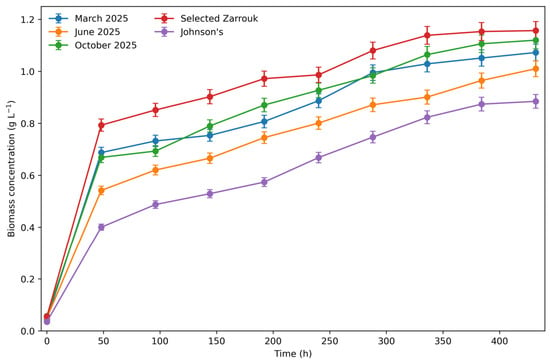
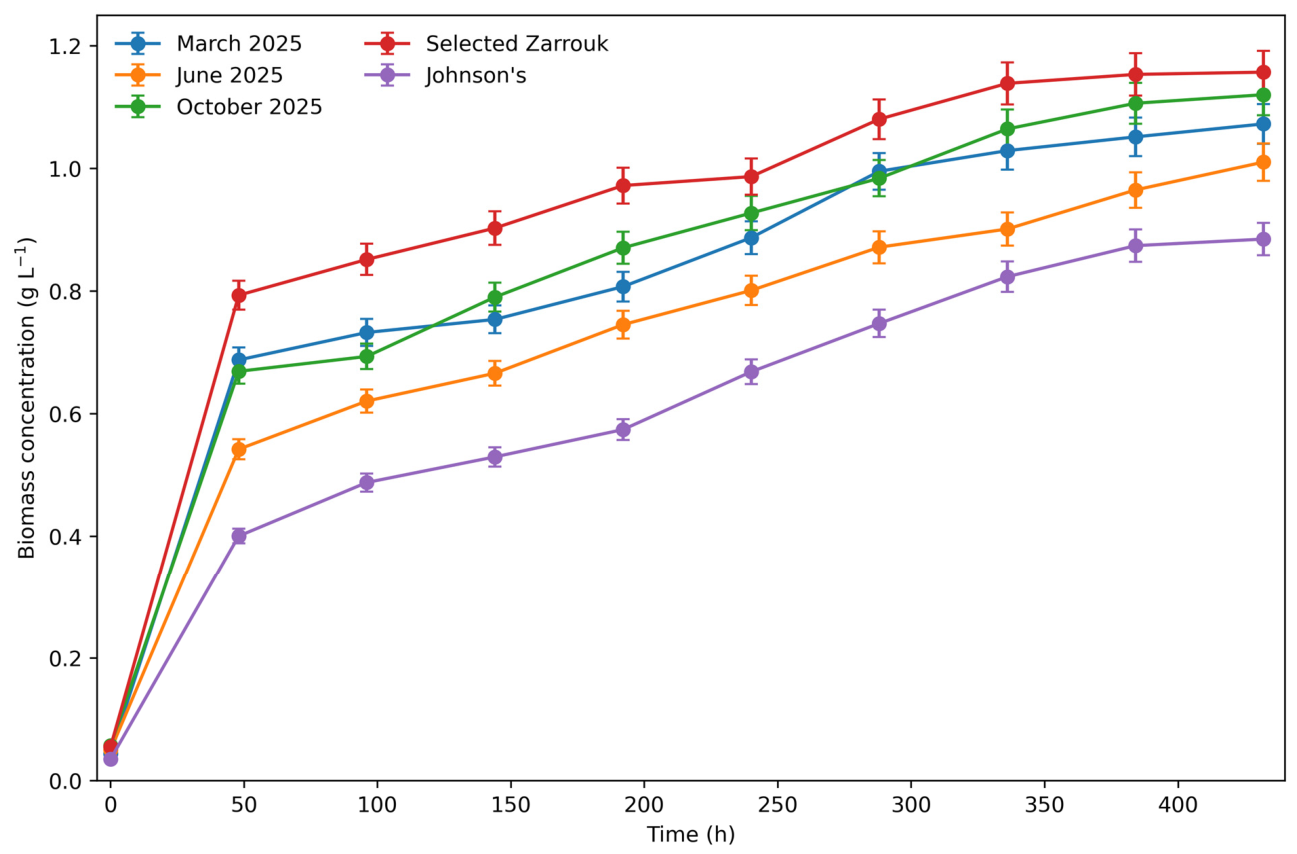
A. platensis formed biomass in every medium tested, including the Marmara seawater collected in March, June, and October 2025. Figure 1 presents the triplicate growth profiles as mean ± standard deviation. Salinity responses in Arthrospira depend on both exposure level and acclimation history. For example, cultures adapted over extended periods can maintain substantial biomass over a broad salinity range, whereas sudden or excessive salt exposure can suppress growth [26]. This literature context is used only to interpret general salinity tolerance and does not imply chemical equivalence between controlled NaCl experiments and the seasonal seawater batches used here.
Figure 1.
Growth profiles of Arthrospira platensis cultivated in Marmara seawater collected in March, June, and October 2025 and in selected Zarrouk and Johnson’s media. Data are presented as mean ± standard deviation (n = 3). Error bars represent the standard deviation of three replicate measurements.
Among the media compared, the selected Zarrouk medium produced the greatest biomass, although all three Marmara seawater cultures also showed sustained growth. The seawater profiles differed across March, June, and October. Regional monitoring confirms that salinity, pH, dissolved oxygen, and nutrient species vary and are routinely assessed in Marmara waters [18,19]; historical observations likewise show broad regional ranges for phosphate, nitrate, ammonium, total nitrogen, and total phosphorus [20]. Because these data were not measured in the exact aliquots used for cultivation, they cannot explain the seasonal growth differences mechanistically. The seasonal comparisons are therefore descriptive, with no causal assignment to salinity, nitrate, phosphate, potassium, sodium, or trace metals.
The capacity of A. platensis to persist under saline cultivation is compatible with reports of physiological acclimation across elevated salinity conditions [26]. Such responses, however, depend on strain, exposure regime, and cultivation environment. The present observations therefore demonstrate feasibility under the conditions tested, not a general stimulatory effect of salinity on biomass.
Taken together, these experiments show that filtered Marmara seawater can sustain A. platensis under the laboratory conditions applied here. This may be useful for cultivation concepts intended to lower freshwater demand, but any environmental or economic advantage must still be verified at a larger scale and with direct characterization of the source water.
3.2. RSM-Based Evaluation of Biomass Production Under Salt and Potassium Stress
Biomass data from the salt–potassium CCD were fitted with a quadratic RSM equation. The overall model was significant (F = 28.83, p = 0.0002) and accounted for a large fraction of the observed variance (R2 = 0.9537). These statistics are considered together with the lack-of-fit result rather than being treated, by themselves, as evidence of predictive adequacy. The experimental matrix generated using the Central Composite Design (CCD), including the investigated salt and potassium stress levels and their corresponding biomass concentrations and lipid contents, is presented in Table 3.
Table 3.
Central Composite Design (CCD) matrix and experimental responses obtained for biomass concentration and lipid content of Arthrospira platensis.
Across the CCD, biomass ranged from 0.478 to 1.345 g L−1 and measured lipid content from 14.67 to 18.43%. Run 4, which used the highest tested salt and potassium levels, yielded the largest observed biomass value. The largest measured lipid percentage occurred under a different, intermediate-to-high stress combination. The biomass dataset was subsequently fitted to a quadratic response model, and ANOVA was used to quantify the contribution and significance of the model terms (Table 4).
Table 4.
Analysis of variance (ANOVA) for the quadratic model developed for biomass concentration of Arthrospira platensis.
Salt produced the strongest model effect on biomass (p < 0.0001), while potassium also contributed significantly (p = 0.0043). The salt–potassium interaction (AB; p = 0.0434) and the quadratic salt term (A2; p = 0.0130) were significant, whereas B2 was not (p = 0.4284). The model nevertheless showed a highly significant lack of fit (F = 553.60, p < 0.0001), demonstrating that the quadratic form did not account for all systematic variation in the biomass data. The center-point replicates were very close to one another, which produced a small pure-error estimate and may have amplified the lack-of-fit F statistic; this does not remove the statistical evidence of lack of fit.
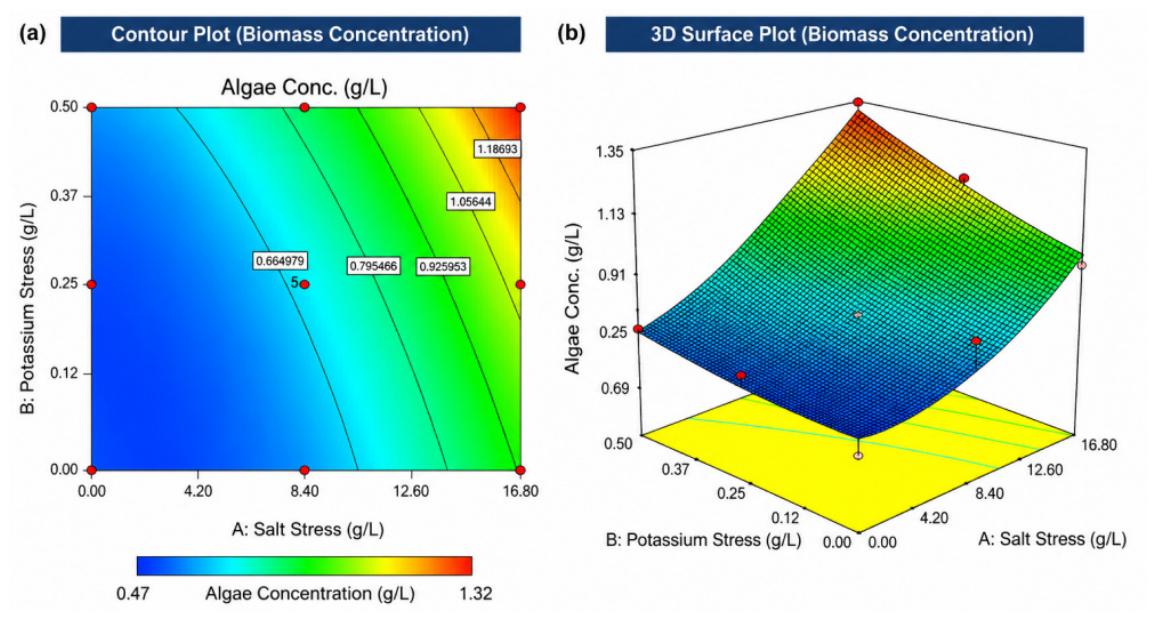
For this reason, the fitted surface is used as a descriptive representation of factor trends within the experimental space rather than as a validated extrapolative model. Its largest predicted biomass value within that space was 1.317 g L−1 at 16.8 g L−1 salt and 0.5 g L−1 potassium. Both settings are the upper limits of the design, so this point is described as a boundary maximum and not as a stationary or global optimum. Determining whether a maximum exists beyond these limits requires experiments over an expanded factor range.
The positive potassium coefficient may reflect the physiological roles of K+ in enzyme activity, photosynthetic electron transfer, and intracellular osmotic regulation. Potassium participates in metabolic processes related to carbon assimilation and protein synthesis in microalgal cells [8,25], providing a plausible biological context for the observed biomass trend.
The fitted equation contained significant salt-related linear/quadratic terms and a significant salt–potassium interaction. Because lack of fit was also significant, however, these coefficients are interpreted only as trends within the design space. The same restriction applies to the predicted value of 1.317 g L−1 at 16.8 g L−1 salt and 0.5 g L−1 potassium; no claim of global optimality or desirability-based model reliability is made.
From a process perspective, biomass production under saline conditions is relevant to strategies that seek to reduce freshwater consumption. At the same time, the boundary location of the largest prediction and the significant lack of fit require restraint in interpreting the RSM output. The analysis therefore identifies factor-response patterns within the tested region rather than a finalized optimum cultivation recipe.
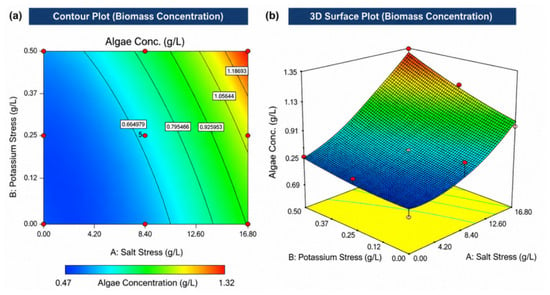
Figure 2 maps the biomass response predicted across the experimental salt–potassium region. The fitted surface rises toward the high ends of both factors. In view of the boundary location of this maximum and the significant lack of fit, the plot is interpreted as a visualization of within-domain behavior rather than evidence for a stationary global optimum.
Figure 2.
(a) Contour plot and (b) three-dimensional response surface plot showing the combined effects of salt stress and potassium stress on biomass concentration of Arthrospira platensis.
3.3. Effect of Stress Conditions on Lipid Content
Measured lipid percentages from the CCD were also examined statistically. The fitted quadratic lipid model was not significant (F = 0.77, p = 0.5974), so the tested salt and potassium levels did not explain lipid variation adequately through this model. Accordingly, the lipid surface was not used for optimization, predictive response-surface interpretation, or multi-response desirability analysis. The analysis of variance (ANOVA) results for the quadratic model developed to evaluate the effects of salt and potassium stress on the lipid content of Arthrospira platensis are presented in Table 5.
Table 5.
Analysis of variance (ANOVA) for the quadratic model developed for lipid content of Arthrospira platensis.
No individual term in the lipid model reached statistical significance. The measured values, which ranged from 14.67 to 18.43%, are therefore retained as compositional observations relevant to biodiesel evaluation rather than as evidence of statistically established salt or potassium effects. Although stress can increase lipid accumulation in some microalgae, the magnitude and direction of this response vary with organism and cultivation conditions [25]. In A. platensis, long-term salinity acclimation has been reported to modify several biochemical components without producing a clear salinity-dependent lipid trend [26], consistent with the non-significant model obtained here.
Lack of fit for the lipid equation was itself non-significant (p = 0.6509), but that result cannot substitute for significance of the overall regression. A predictive lipid optimum is therefore not reported. Instead, the measured lipid percentages are compared descriptively with previous work, without inferring a causal stress-response relation from the present RSM analysis.
Stress may redirect cellular carbon toward storage lipids, but the outcome is controlled by factors such as strain, nutrient availability, irradiance, salinity, and growth stage [25]. Thus, the present findings do not conflict with reports of stress-induced lipid accumulation; they show only that the salt and potassium ranges examined here did not generate a statistically resolvable quadratic lipid response.
This statistical result also means that visual resemblance between fitted biomass and lipid surfaces cannot be interpreted as coupled optimization. Interpretation of lipid behavior is therefore limited to the measured values, whereas statistically significant factor effects are discussed only for biomass.
3.4. Fatty Acid Composition and Biodiesel Properties
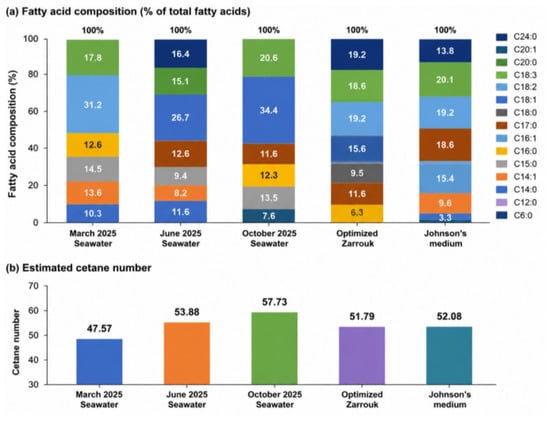
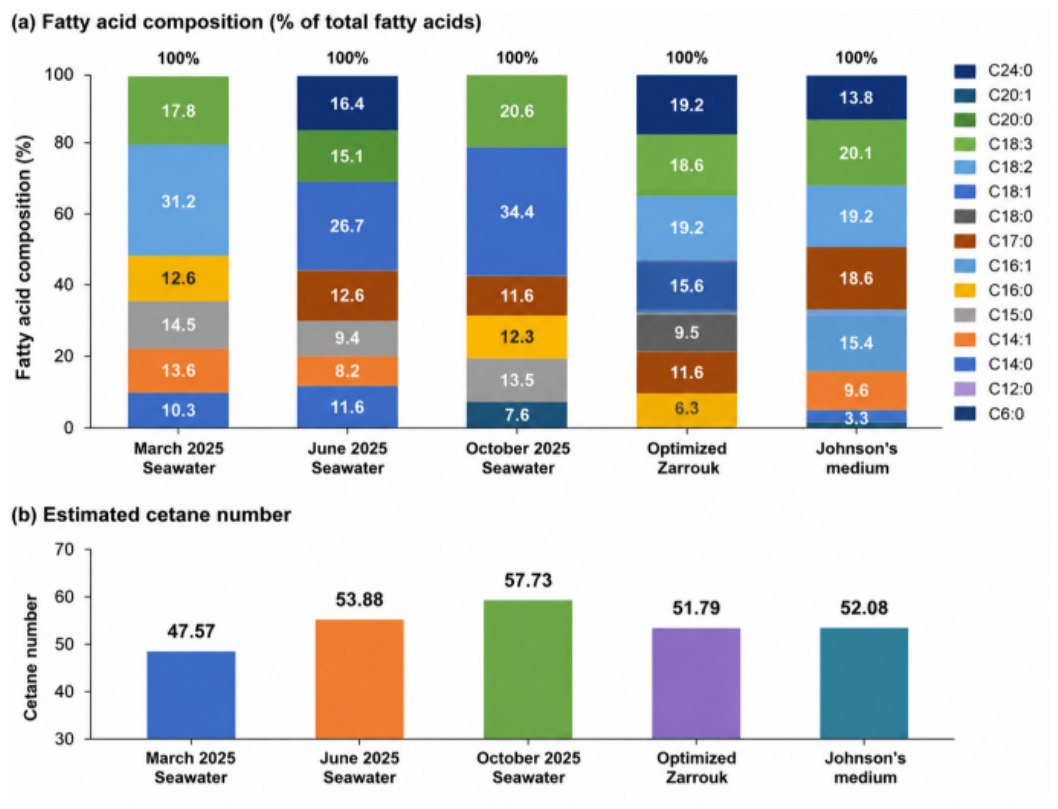
Fatty-acid distribution is important for biodiesel assessment because both carbon-chain length and unsaturation affect ignition-related fuel behavior. The five cultivation conditions produced different FAME profiles (Table 6). C18:2 occurred in every sample at 19.2–31.2% of total fatty acids; where detected, C18:3 accounted for 15.1–20.1%. The October 2025 seawater culture contained the highest C18:1 fraction (34.4%). Saturated and monounsaturated components also varied by cultivation condition. Because chemistry of the seasonal seawater batches was not comprehensively measured, these compositional differences are not assigned to specific source-water constituents. A comparative overview of the major fatty acid profiles reported in previous studies on Arthrospira platensis cultivated under different salinity and salt-stress conditions is presented in Table 7, providing a literature-based context for evaluating the fatty acid composition observed in the present study.
Table 6.
Fatty acid composition (% of total fatty acids) and estimated cetane numbers of Arthrospira platensis cultivated under different culture conditions.
Table 7.
Selected literature comparison of major fatty acids in A. platensis under salinity/salt-stress conditions. Values are % of total fatty acids/FAMEs as reported by the original studies.
Fatty-acid patterns differed appreciably among the cultivation media (Table 6), but the absence of batch-specific seawater chemistry prevents attribution of the seasonal differences to particular ions or nutrients. Previous work demonstrates that salinity acclimation can modify the fatty-acid profile of A. platensis; under long-term salt exposure, lower saturated fractions and greater oleic-acid abundance have been reported [26]. A more recent mixotrophic salt-stress study also found condition-dependent shifts in individual FAMEs while retaining C16:0 as the predominant component [27]. Together, these reports indicate that salinity response depends on acclimation history, nutrient regime, cultivation mode, and strain.
Both saturated and unsaturated fatty acids contributed to the measured profiles. Their relative abundance matters for biodiesel because chain length and unsaturation affect ignition quality and related fuel properties. Here, the FAME data are used chiefly to compare biodiesel-related composition among cultivation conditions, not to propose a biochemical mechanism for the seasonal seawater response. Literature comparisons must also distinguish α- from γ-linolenic acid because γ-linolenic acid is frequently an important C18:3 isomer in A. platensis [27].
Figure 3 highlights the compositional differences among the five culture conditions. March and June seawater cultures contained substantial C18:2 and C18:3 fractions, whereas October seawater was characterized by a much larger C18:1 fraction (34.4%). The selected Zarrouk culture showed a broader mixture of saturated, monounsaturated, and polyunsaturated fatty acids.
Figure 3.
Comparative fatty acid composition and estimated cetane numbers of Arthrospira platensis lipids cultivated under different culture conditions.
Estimated cetane number also varied among the cultures. October 2025 seawater gave the highest mean value (57.78 ± 0.04), followed by June seawater (53.89 ± 0.02), Johnson’s medium (52.06 ± 0.07), selected Zarrouk medium (51.74 ± 0.05), and March seawater (47.57 ± 0.06) (n = 3). These are composition-based estimates and should not be interpreted as results of engine testing.
Taken together, the FAME profiles and calculated cetane values justify further evaluation of A. platensis lipids as a biodiesel feedstock. Other studies similarly show that cultivation and stress conditions can alter algal fatty-acid composition and fuel-related characteristics [6,25,26,27]. The present dataset combines seasonal Marmara seawater cultures with a separate salt–potassium CCD and condition-specific FAME/cetane assessment. It does not, however, establish a fully optimized biodiesel process; additional standardized fuel-property testing is required before fuel suitability can be confirmed.
3.5. Sustainability Implications and Future Perspectives
The laboratory results establish that filtered Marmara seawater can sustain A. platensis and therefore may offer a route to lower freshwater use in cultivation. This potential should not be interpreted as a demonstrated process-scale sustainability benefit, because neither life-cycle assessment nor techno-economic analysis was performed and the seasonal seawater batches were not completely characterized.
Using filtered natural seawater with limited pretreatment is a practical feature of the investigated approach. Because freshwater demand can be substantial in large-scale algal cultivation, saline-water systems may reduce pressure on freshwater resources [11,28]. The observed growth of A. platensis in Marmara seawater supports further testing of this concept, while its economic and environmental performance still requires dedicated techno-economic and life-cycle analyses. Table 8 brings together biomass, lipid content, estimated cetane number, and qualitative process observations for the five cultivation conditions.
Table 8.
Comparative evaluation of growth, lipid content, estimated cetane number, and process-related observations for A. platensis under the investigated cultivation conditions.
The cultivation conditions differed in biomass formation, lipid percentage, fatty-acid profile, and estimated cetane number. Salt and potassium showed significant associations with biomass in the RSM analysis, but the significant lack of fit prevents strong predictive use of the quadratic biomass equation. The lipid measurements remain useful compositional data, although they are not treated as an optimized response because the lipid regression was non-significant. Maintaining this distinction is important when considering the process-development implications of the study.
These findings favor continued investigation of saline and seawater-based cultivation rather than designation of a final optimum process. Subsequent designs should extend beyond the current boundary levels, seek improved model adequacy, and directly characterize every seawater batch. Such experiments would permit biomass, lipid yield, fuel quality, and resource demand to be evaluated together on a statistically stronger basis.
From an environmental standpoint, seawater-based algal cultivation could help decrease freshwater consumption and dependence on agricultural land. The present work did not quantify greenhouse gas emissions, carbon neutrality, or life-cycle impacts, however; these remain potential benefits rather than experimentally demonstrated outcomes.
The work also intersects with SDG 7, SDG 12, and SDG 13 through its focus on renewable-fuel feedstocks and cultivation concepts designed to use less freshwater. Direct claims of SDG-level benefit would require evidence from scale-up, life-cycle assessment, and techno-economic evaluation.
Future studies should address pilot-scale operation, seasonal source-water chemistry, process economics, life-cycle impacts, and long-term stability. Measuring salinity, pH, nitrate/nitrite, phosphate, ammonium, major ions, and relevant trace metals in every seawater batch would allow biological responses to be related quantitatively to the actual water composition.
In summary, filtered Marmara seawater supported A. platensis cultivation, while the CCD showed statistically significant biomass associations with salt and potassium over the tested ranges. The same analysis also revealed limitations that are important for further development: the biomass regression had significant lack of fit, its largest prediction occurred at the edge of the design, and the lipid model was non-significant.
4. Conclusions
This work compared A. platensis cultivation in natural Marmara seawater and synthetic media and used a CCD-based RSM analysis to examine salt and potassium effects. Salt was the dominant biomass factor (p < 0.0001), with potassium also significant (p = 0.0043). The quadratic biomass regression reached significance (p = 0.0002; R2 = 0.9537), but its highly significant lack of fit (p < 0.0001) restricts predictive interpretation.
The largest model-predicted biomass within the experimental region was 1.317 g L−1 at 16.8 g L−1 salt and 0.5 g L−1 potassium. Because these are the upper limits of both factors, the condition represents a boundary maximum rather than a stationary or global optimum. The lipid regression was non-significant (p = 0.5974), so no lipid response-surface optimum or multi-response desirability result is claimed. Measured lipid content instead is reported descriptively over the observed range of 14.67–18.43%.
A. platensis also grew in each of the March, June, and October 2025 Marmara seawater cultures. The largest mean estimated cetane number occurred in the October seawater condition (57.78 ± 0.04). Because the three source-water batches were not comprehensively characterized before use, their biological differences cannot be linked to individual nutrient, ion, or trace-metal concentrations.
Overall, the results justify further development of seawater-based A. platensis cultivation as a possible freshwater-saving strategy. Before scale-up, future work should broaden the experimental factor space, develop models with adequate lack-of-fit behavior, characterize every seawater batch directly, and integrate biomass productivity and lipid yield with standardized fuel testing, techno-economic analysis, and life-cycle assessment.
Funding
This research received no external funding.
Data Availability Statement
The data presented in this study are available on request from the corresponding author. The data are not publicly available due to intellectual property and commercial restrictions.
Conflicts of Interest
The author declares no conflicts of interest.
References
- Chisti, Y. Biodiesel from microalgae. Biotechnol. Adv. 2007, 25, 294–306. [Google Scholar]
- Mata, T.M.; Martins, A.A.; Caetano, N.S. Microalgae for biodiesel production and other applications: A review. Renew. Sustain. Energy Rev. 2010, 14, 217–232. [Google Scholar]
- Sharma, A.K.; Jaryal, S.; Sharma, S.; Dhyani, A.; Tewari, B.S.; Mahato, N. Biofuels from microalgae: A review on microalgae cultivation, biodiesel production techniques and storage stability. Processes 2025, 13, 488. [Google Scholar]
- Cherian, T.; Geetha, U.; Shahulhameed, F.P.P.; Eranhottu, S. Biofuel production from algae: Opportunities, challenges, and future prospects. In Catalytic Applications of Biochar for Environmental Remediation: Valorization of Lignocellulosic Waste Biomass into Bioenergy; Chapter 10; ACS Publications: Washington, DC, USA, 2024; Volume 3, pp. 201–221. [Google Scholar]
- Rahman, A.; Agrawal, S.; Nawaz, T.; Pan, S.; Selvaratnam, T. A review of algae-based produced water treatment for biomass and biofuel production. Water 2020, 12, 2351. [Google Scholar]
- Markou, G.; Nerantzis, E. Microalgae for high-value compounds and biofuels production: A review with focus on cultivation under stress conditions. Biotechnol. Adv. 2013, 31, 1532–1542. [Google Scholar]
- Wang, S.; Yan, W.; Zhao, F. Recovery of solid waste as functional heterogeneous catalysts for organic pollutant removal and biodiesel production. Chem. Eng. J. 2020, 401, 126104. [Google Scholar]
- Kutluk, T. Lipid productivity of marine microalgae Dunaliella tertiolecta in Marmara seawater and Johnson’s media with different salinities and evaluation as a raw material source for biofuel production. J. Aquac. Nat. Resour. 2021, 7, 266–273. [Google Scholar]
- Converti, A.; Casazza, A.A.; Ortiz, E.Y.; Perego, P.; Del Borghi, M. Effect of temperature and nitrogen concentration on the growth and lipid content of Nannochloropsis oculata and Chlorella vulgaris for biodiesel production. Chem. Eng. Process. 2009, 48, 1146–1151. [Google Scholar]
- Chotchindakun, K.; Buddhasiri, S.; Kuntanawat, P. Enhanced growth and productivity of Arthrospira platensis H53 in a nature-like alkalophilic environment and its implementation in sustainable Arthrospira cultivation. Sustainability 2024, 16, 8627. [Google Scholar]
- Salman, J.M.; Majrashi, N.; Hassan, F.M.; Al-Sabri, A.; Jabar, E.A.-A.; Ameen, F. Cultivation of blue-green algae (Arthrospira platensis Gomont, 1892) in wastewater for biodiesel production. Chemosphere 2023, 335, 139107. [Google Scholar]
- Markou, G.; Chentir, I.; Tzovenis, I. Microalgae and cyanobacteria as food: Legislative and safety aspects. In Cultured Microalgae for the Food Industry: Current and Potential Applications; Elsevier: Amsterdam, The Netherlands, 2021; pp. 249–264. [Google Scholar]
- Myers, R.H.; Montgomery, D.C.; Anderson-Cook, C.M. Response Surface Methodology: Process and Product Optimization Using Designed Experiments, 4th ed.; Wiley: Hoboken, NJ, USA, 2016. [Google Scholar]
- Kutluk, T.; Gürkaya Kutluk, B. Lipase catalysis: An environmentally friendly production for polyol esters (biolubricant) from microalgae oil. Environ. Technol. 2023, 44, 4099–4112. [Google Scholar]
- Kutluk, T.; Gürkaya Kutluk, B. A commercial lipase Resinase® HT (Aspergillus oryzae) efficiency on triglycerides transesterification and process optimization. Sustain. Chem. Pharm. 2022, 30, 100862. [Google Scholar]
- Gao, F.; Zhang, X.-L.; Zhu, C.-J.; Huang, K.-H.; Liu, Q. High-efficiency biofuel production by mixing seawater and domestic sewage to culture freshwater microalgae. Chem. Eng. J. 2022, 443, 136361. [Google Scholar] [CrossRef] [Scilit]
- Kumar, R.R.; Strezov, V.; Lovitt, R.W.; Kan, T.; Weldekidan, H.; He, J.; Singh, S. Biofuel production from microalgae: Challenges and opportunities. Renew. Sustain. Energy Rev. 2020, 127, 109835. [Google Scholar]
- Republic of Türkiye Ministry of Environment; Urbanization and Climate Change. Deniz Kalitesi Bülteni 2025 – Marmara Denizi [Marine Quality Bulletin 2025 – Marmara Sea]. Ankara, Türkiye, 2025. [Google Scholar]
- Mutlu, S.; Aslan, E.; Özsu, E. CTD and nutrient data collected by the RV TÜBİTAK MARMARA during the ASTRA cruise in September 2025 (Western Black Sea, North-Eastern Marmara Sea). PANGAEA 2026. [Google Scholar] [CrossRef]
- Akın, B.; Balas, C.; Atıcı, T. Balıkesir–Çanakkale İlleri (TR22 Düzey-II Bölgesi) Bütünleşik Kıyı Alanları Planlaması: Deniz Ekosistemi Uzman Değerlendirme Raporu; Republic of Türkiye Ministry of Environment and Urbanization, Spatial Planning General Directorate: Ankara, Türkiye, 2020. [Google Scholar]
- Vonshak, A. Spirulina: Growth, physiology and biochemistry. In Spirulina platensis (Arthrospira): Physiology, Cell Biology and Biotechnology; Vonshak, A., Ed.; Taylor & Francis: London, UK, 1997; pp. 43–65. [Google Scholar]
- Bligh, E.G.; Dyer, W.J. A rapid method of total lipid extraction and purification. Can. J. Biochem. Physiol. 1959, 37, 911–917. [Google Scholar]
- David, F.; Sandra, P.; Vickers, A.K. Column selection for the analysis of fatty acid methyl esters. Agilent Technologies Application Note; Agilent Technologies: Santa Clara, CA, USA, 2005; pp. 1–5. [Google Scholar]
- Klopfenstein, W.E. Estimation of cetane index for esters of fatty acids. J. Am. Oil Chem. Soc. 1982, 59, 531–533. [Google Scholar]
- Hu, Q.; Sommerfeld, M.; Jarvis, E.; Ghirardi, M.; Posewitz, M.; Seibert, M.; Darzins, A. Microalgal triacylglycerols as feedstocks for biofuel production: Perspectives and advances. Plant J. 2008, 54, 621–639. [Google Scholar] [CrossRef] [Scilit]
- Markou, G.; Kougia, E.; Arapoglou, D.; Chentir, I.; Andreou, V.; Tzovenis, I. Production of Arthrospira platensis: Effects on growth and biochemical composition of long-term acclimatization at different salinities. Bioengineering 2023, 10, 233. [Google Scholar] [CrossRef] [Scilit]
- Russo, N.P.; Ballotta, M.; Usai, L.; Torre, S.; Giordano, M.; Fais, G.; Casula, M.; Dessì, D.; Nieri, P.; Damergi, E.; et al. Mixotrophic cultivation of Arthrospira platensis (Spirulina) under salt stress: Effect on biomass composition, FAME profile and phycocyanin content. Mar. Drugs 2024, 22, 381. [Google Scholar] [CrossRef] [Scilit]
- Yu, Z.; Hou, Q.; Liu, M.; Xie, Z.; Ma, M.; Chen, H.; Pei, H. From lab to application: Cultivating limnetic microalgae in seawater coupled with wastewater for biodiesel production on a pilot scale. Water Res. 2023, 229, 119471. [Google Scholar]

Disclaimer/Publisher’s Note: The statements, opinions and data contained in all publications are solely those of the individual author(s) and contributor(s) and not of MDPI and/or the editor(s). MDPI and/or the editor(s) disclaim responsibility for any injury to people or property resulting from any ideas, methods, instructions or products referred to in the content. |
© 2026 by the author. Licensee MDPI, Basel, Switzerland. This article is an open access article distributed under the terms and conditions of the Creative Commons Attribution (CC BY) license.