


Abstract
Styrene–acrylic elastomeric waterproofing membranes are widely used in exterior construction because of their flexibility, adhesion, and ease of application; however, their long-term performance depends on resistance to environmental aging and on surface interactions with water. This work presents a comparative experimental assessment of commercially available elastomeric waterproofing membranes, combining tensile/elongation testing before and after hydrolytic, thermal, and QUV accelerated aging with static water contact-angle measurements on selected systems. Four Sika systems (Sika® Elastic Roof, SikaFill®-90 MP, SikaFill®-365 Duralastic Terrace, and SikaFill®) as well as two additional commercially available competitor membranes (Competitor 1 and Competitor 2) were examined. Membrane films were prepared at controlled thickness and curing conditions, and elongation at break and elongation retention were used as primary mechanical durability descriptors. All investigated membranes exhibited pronounced elastomeric behavior in the unaged state, with elongation values exceeding 500% and, for the most flexible formulations, 1000%. Environmental aging progressively reduced deformation capacity, with QUV exposure producing the most severe mechanical degradation. Baseline surface wettability measurements on unaged specimens further differentiated the selected membranes: Competitor 2 revealed the highest mean water contact angle (98.8 ± 3.7°), followed by Sika® Elastic Roof (91.4 ± 2.2°), both indicating hydrophobic behavior; SikaFill® was slightly hydrophilic and close to the 90° transition (87.3 ± 3.3°), while SikaFill®-365 Duralastic Terrace exhibited the lowest contact angle (84.6 ± 3.0°) and hydrophilic behavior. The combined results indicated that initial flexibility alone is insufficient to describe long-term functional performance. Elongation retention provides a direct measure of mechanical durability, whereas contact angle captures differences in baseline surface wettability that are relevant to water–membrane interactions. The observed ranking in wettability highlights the influence of formulation and surface chemistry and provides complementary baseline information alongside the accelerated-aging assessment. These findings support performance-based selection and formulation optimization of elastomeric waterproofing membranes for demanding exterior applications.
1. Introduction
Styrene acrylic elastomeric waterproofing membranes are widely applied in the protection of roofs, terraces, façades, and exposed concrete substrates because they combine high deformability, adhesion to mineral substrates, relatively straightforward application, water resistance, and favorable cost–performance characteristics. Their film-forming mechanism, based on the coalescence of polymer latex particles, enables the formation of continuous, flexible membranes capable of accommodating substrate movements and providing effective resistance against water ingress. As waterborne systems, these materials are typically based on latex dispersions in which styrene and acrylic or methacrylic monomers are copolymerized to tailor the balance between stiffness, elasticity, hydrophobicity, and film-forming ability [1]. The styrene component generally contributes mechanical strength, hardness, and water resistance, whereas the acrylic fraction provides flexibility, weatherability, and improved resistance to environmental exposure. Consequently, adjustment of copolymer composition, glass-transition temperature (Tg), molecular architecture, particle morphology, and additive package provides a versatile route for designing membranes for demanding exterior applications [2,3,4].
The formation of a continuous protective membrane from an aqueous latex is itself a multistage physicochemical process. Following application, evaporation of water progressively increases the polymer-particle concentration, leading to particle packing, interparticle contact, deformation, coalescence, and ultimately interdiffusion and entanglement of polymer chains across the original particle boundaries [5]. The extent of these processes depends strongly on the relationship between the drying temperature and the minimum film-forming temperature, as well as on particle size, polymer Tg, molecular weight, surfactants, coalescing agents, plasticizers, and particle morphology [5,6,7,8]. Incomplete particle deformation or insufficient chain interdiffusion can leave residual particle boundaries, pores, and mechanically weak regions within the film, whereas effective coalescence produces a continuous polymeric network capable of sustaining large strains while restricting liquid-water penetration. Modern latex design therefore seeks to reconcile an inherent film-formation dilemma: polymers sufficiently soft to coalesce readily at ambient temperature may provide inadequate hardness or mechanical stability, whereas harder polymers often require coalescing agents or more sophisticated particle architectures to form defect-free films. Recent strategies include high-Tg/low-Tg latex blends, core–shell and multiphase particles, hybrid organic–inorganic latexes, and post-film-formation crosslinking [6,7].
It is mentioned that for elastomeric waterproofing applications, maintaining a continuous film is essential in order to accommodate substrate deformation and microcracking without compromising barrier integrity. Although high initial elongation is desirable, long-term performance depends on retaining sufficient extensibility under prolonged exposure to UV radiation, heat, oxygen, moisture, and wet–dry cycles. These environmental factors can act synergistically, causing polymer degradation through chain scission, oxidation, and crosslinking. Consequently, the membrane may progressively undergo loss of mechanical performance, embrittlement, discoloration, and reduced waterproofing efficiency [6,8,9].
Among environmental stressors, ultraviolet radiation is particularly important for organic exterior coatings because absorption of sufficiently energetic photons by chromophoric groups, impurities, residual initiator fragments, additives, or oxidation products can initiate radical reactions within the polymer matrix. In the presence of oxygen, these reactions can propagate through photo-oxidative pathways involving the formation and decomposition of hydroperoxides and the generation of additional radical species promoting polymer-chain scission and/or additional crosslinking. The relative importance of these competing processes determines the evolution of molecular weight, crosslink density, segmental mobility, and ultimately the mechanical behavior of the aged coating [10,11]. Experimental studies of acrylic coating systems have demonstrated that chain scission and crosslinking may occur concurrently and that their relative rates evolve during weathering [12].
Molecular degradation directly affects elastomeric performance. Chain scission reduces polymer molecular weight and network connectivity, while oxidative crosslinking restricts segmental mobility and increases stiffness, both contributing to reduced extensibility. Macroscopically, photo-oxidation can lead to embrittlement, cracking, discoloration, and loss of waterproofing performance. However, degradation is strongly formulation-dependent due to the multiphase nature of coatings. Vuong and Linh demonstrated that accelerated UV/condensation aging of a waterborne styrene–acrylic coating caused changes in characteristic infrared bands, formation of photo-oxidation products, weight loss, and yellowing, attributed to photolysis, photo-oxidation, and hydrolysis. Such observations demonstrate that the macroscopic deterioration of styrene–acrylic coatings originates from chemical modifications of the polymeric phase and reinforce the importance of connecting molecular degradation with functional performance [13]. Xin et al. further showed that vinyltriethoxysilane modification of waterborne styrene–acrylic coatings improved the aging resistance of coated bamboo, as reflected by reduced color changes and improved dimensional stability. These findings highlight the importance of polymer network design and coating–substrate interactions in mitigating macroscopic deterioration during environmental exposure [14].
The styrene-to-acrylic ratio is only one factor controlling coating durability. The chemical nature of the acrylic monomers and the resulting glass-transition temperature also influence film flexibility and the ability to accommodate substrate deformation. Moreover, film formation and polymer network structure affect coating continuity, permeability, and resistance to environmental stresses [15]. Pigments, fillers, surfactants, and stabilizers also influence UV penetration, moisture transport, stress development, and component migration [16]. The dispersion and interfacial compatibility of pigments and fillers determine whether they reinforce the coating or introduce defects that facilitate water ingress and crack initiation. Residual surfactants may accumulate at interfaces or migrate toward the film surface, increasing water sensitivity and potentially weakening adhesion during prolonged moisture exposure [17]. UV absorbers and hindered amine light stabilizers can reduce photo-oxidation, chain scission, and crosslinking [18], while covalently incorporated UV-absorbing groups can further improve stability by limiting migration or leaching [19]. Moisture can cause polymer plasticization, swelling, additive migration, and hydrolytic degradation, while wet–dry cycles generate repeated internal stresses. Thermal exposure may additionally promote physical aging, component loss, crosslinking, and oxidation. Therefore, hydrolytic, thermal, and photo-oxidative aging provide complementary measures of coating durability [20]. Related studies on polyester-based self-adhesive asphalt waterproofing membranes have also examined thermo-oxidative aging and freeze–thaw cycling, highlighting the importance of evaluating durability under different environmental stressors [21].
Accelerated weathering tests are commonly used to simulate outdoor aging and assess the durability of polymeric materials within a practical timeframe. In particular, QUV accelerated aging, employing fluorescent UVA lamps and controlled condensation cycles, has been extensively adopted to reproduce the combined effects of UV radiation and moisture. Despite its widespread use, the degradation behavior of styrene–acrylic elastomeric membranes under QUV exposure remains highly dependent on formulation parameters, such as polymer composition, styrene-to-acrylic ratio, filler content, pigment selection, and the presence of stabilizing additives [6,22].
Fluorescent UV/condensation testing is widely used to simulate key weathering stresses, including UV radiation, heat, and moisture. ASTM G154 [19] covers fluorescent UV exposure of nonmetallic materials, while ASTM D4587 specifically addresses paints and coatings. However, laboratory exposure hours cannot be directly converted into years of natural weathering.ASTM D1640/D1640M-14 (2022); Standard Testseverity depends strongly on lamp type, irradiance, temperature, moisture conditions, and cycle duration, with UVB-313 generally providing more aggressive exposure than UVA-340 [19].
Weathering-induced degradation can be evaluated using FTIR together with mechanical, optical, and morphological techniques to relate molecular changes to macroscopic performance. However, data for highly deformable styrene–acrylic waterproofing membranes remain relatively limited. For these materials, elongation at break (εb) and elongation retention () after aging is particularly important, as loss of extensibility can compromise crack-bridging and waterproofing performance even when tensile strength or surface appearance remains acceptable [23].
Commercial styrene–acrylic membranes have complex proprietary formulations, with variations in binder composition, fillers, pigments, stabilizers, and additives leading to different aging responses. Comparative testing can therefore reveal differences in durability, although mechanistic interpretation is limited when detailed compositions are unavailable. Surface wettability provides complementary information to mechanical testing. Water contact angle reflects surface chemistry and morphology but should not be considered a direct measure of bulk water impermeability, as it can be affected by oxidation, additive migration, and surface changes. Although acrylic-based coatings have been widely studied, systematic data on elastomeric styrene–acrylic waterproofing membranes remain limited, particularly studies correlating QUV exposure with mechanical, chemical, and waterproofing performance and the influence of formulation strategies on UV durability [24,25].
Against this background, the principal knowledge gap is not simply whether styrene–acrylic materials undergo environmental aging, which is well established, but how strongly commercially relevant elastomeric waterproofing formulations differ in their ability to retain large-strain mechanical performance under distinct degradation environments. Direct comparative studies applying hydrolytic, thermal, and UV/moisture accelerated aging to multiple commercial membranes under controlled conditions remain comparatively scarce. Establishing such differences is important for both product selection and the rational design of more durable exterior membrane formulations.
The present study provides a comparative experimental assessment of commercially relevant elastomeric waterproofing membranes subjected to distinct accelerated-aging environments. The work focuses on the evolution and retention of mechanical deformability, complemented by baseline surface-wettability characterization. Specifically, the study evaluates the mechanical performance and durability of commercially available styrene–acrylic elastomeric waterproofing membranes under hydrolytic, thermal, and QUV accelerated aging, with elongation retention used as a principal durability indicator. Tensile behavior is evaluated before and after the different aging protocols to distinguish formulation-dependent susceptibility to moisture, heat, and combined UV/moisture exposure. In addition, static water contact-angle measurements are performed on selected membranes to characterize surface wettability and complement the bulk mechanical assessment with a surface-sensitive functional descriptor. By integrating initial mechanical performance, property retention after accelerated aging, and surface wettability, the study seeks to establish comparative structure/formulation–property–durability relationships relevant to exterior waterproofing applications and to identify performance characteristics that should be prioritized in the development of more durable elastomeric membrane systems.
2. Materials and Methods
The experimental work was conducted at the laboratory facilities of Sika Hellas ABEE, Athens, Greece, using the company’s infrastructure and testing equipment. Static water contact-angle measurements were performed at Aristotle University of Thessaloniki (AUTH), Thessaloniki, Greece.
2.1. Materials
Six single-component, waterborne elastomeric waterproofing membranes based on acrylic or styrene–acrylic polymer technology were investigated. Four SikaFill® Waterproofing Membrane systems (Sika® Elastic Roof, SikaFill®-90 MP, SikaFill®-365 Duralastic Terrace, and SikaFill®) and two additional commercially available competitor membranes (Competitor 1 and Competitor 2) were included. The competitor products were anonymized in the mechanical-aging comparison. All materials were used as supplied, without modification.
SikaFill® Elastic Roof is an elastomeric, water-based acrylic waterproofing membrane intended for applications such as roofs and terraces, repair works, and waterproofing details. It exhibits very high elasticity, making it particularly suitable for accommodating substrate cracking and movements. The membrane also provides very good resistance to UV exposure. The recommended application consumption is approximately 1.5–2.0 kg/m2, applied in two coats.
SikaFill®-90 MP is a reinforced, high-performance acrylic waterproofing membrane characterized by high elasticity and good retention of its mechanical properties. It provides enhanced resistance to UV exposure and is suitable for application on both horizontal and inclined surfaces. In addition, it exhibits very good resistance to standing water.
SikaFill®-365 Duralastic Terrace is a high-performance elastomeric waterproofing membrane specifically developed for terrace applications. It is designed to withstand continuous UV exposure, temperature fluctuations, and substrate cracking. In terms of mechanical performance, it combines higher tensile strength with balanced elasticity and provides very good resistance to standing water.
SikaFill® is a reinforced elastomeric waterproofing membrane developed for demanding exposure and service conditions. It exhibits very high elasticity, among the highest within its product category, together with very high resistance to UV exposure.
According to the technical data provided by the manufacturers, all tested materials are single-component, waterborne elastomeric coatings based on acrylic or styrene–acrylic polymer dispersions, formulated for exterior use. The products differ in polymer composition, filler and pigment systems, and the incorporation of functional additives intended to enhance mechanical performance and weathering resistance.
2.2. Membrane Preparation
Membrane films were prepared by applying liquid coatings onto inert, non-absorptive substrates using calibrated film applicators and stencils, in accordance with standard practices for coating application (ASTM D823) [25]. Applicator-applied films were produced at nominal dry film thicknesses of 500, 750, and 1000 μm, while stencil-applied membranes were prepared at thicknesses of 2000 and 2500 μm.
Following application, the films were cured either under accelerated conditions at 60 °C for 24 h or under controlled laboratory conditions (23 ± 2 °C and 50 ± 5% relative humidity (RH), in accordance with ASTM D3924 [26] and ASTM D1640 [27]) for a period of 14 days to ensure complete film formation and drying. Free-standing membrane specimens were carefully detached from the substrates and conditioned for at least 24 h prior to testing, following standard conditioning procedures (ASTM D618) [28].
2.3. QUV Accelerated UV Aging
Accelerated weathering was performed using a QUV accelerated weathering tester (Q-Lab Corporation, Westlake, OH, USA) equipped with UVA-340 fluorescent lamps, following the principles of ASTM G154 [17,19]. The exposure cycle was selected to simulate combined UV radiation and moisture stress conditions relevant to outdoor service environments [4,9]. The applied aging protocol consisted of (i) UV exposure at 60 °C for 8 h and (ii) condensation at 50 °C for 4 h. At predefined exposure intervals, specimens were removed from the chamber and conditioned at laboratory conditions for 24 h prior to testing.
2.4. Mechanical Testing
Specimen thicknesses were selected and recorded for the investigated products and were measured before testing as described below. Mechanical (tensile) testing was conducted in accordance with ISO 527-3, which specifies procedures for determining the tensile properties of thin films and sheets and was used as the basis for the preparation, specimen geometry, and tensile-testing conditions applied to the SikaFill systems and the corresponding competitor products (Competitor 1 and Competitor 2). This method is particularly suitable for styrene–acrylic waterproofing membranes due to their flexible, rubber-like behavior, allowing reliable determination of tensile strength and elongation at break. Elongation at break was selected as a principal mechanical descriptor because the ability of elastomeric waterproofing membranes to accommodate deformation is critical to maintaining membrane continuity. However, it should not be considered a standalone indicator of overall service-life performance. The mechanical performance of the membranes was evaluated before and after the specified accelerated-aging conditions. Elongation retention provides a clearer basis for comparing the durability of the different membrane systems. Therefore, elongation retention, expressed as a percentage:
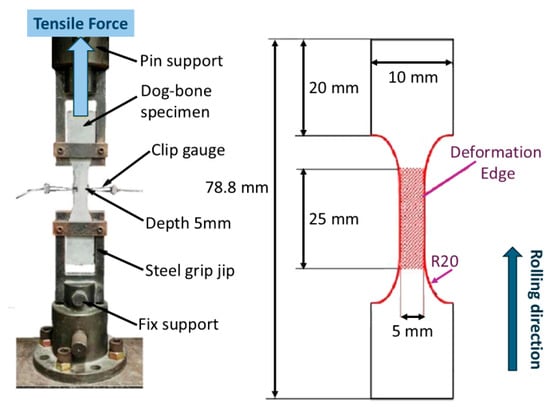
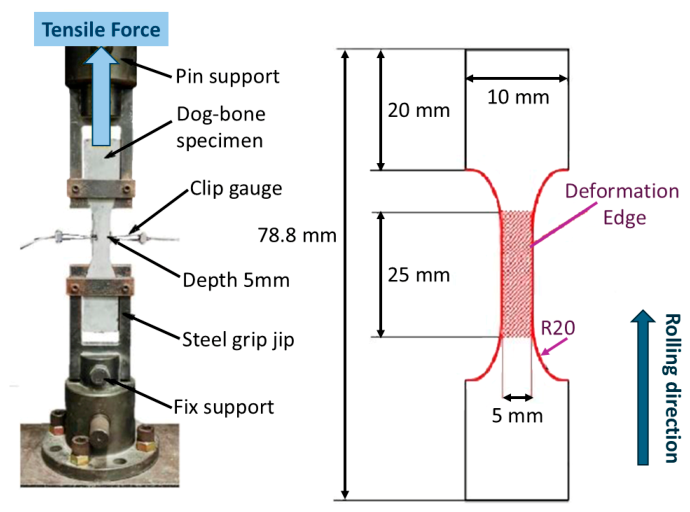
where is the elongation at break after aging, is the elongation at break before aging and is the elongation retention (%). Prior to testing, the specimens were cut into standardized dog-bone geometry suitable for thin films (Figure 1).
Figure 1.
Schematic representation of the tensile testing configuration and geometry of the dog-bone specimen used for the mechanical characterization of the waterproofing membranes.
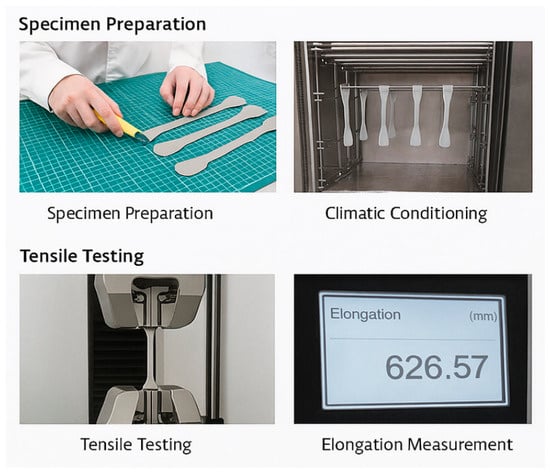
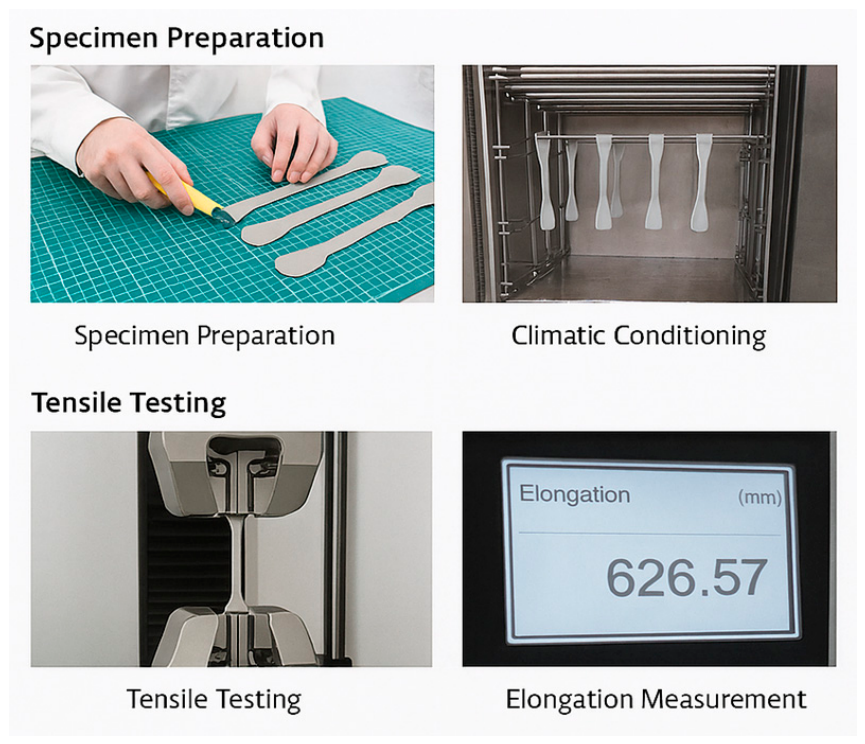
The thickness of each specimen was measured at three different locations, and the mean thickness was calculated and recorded in accordance with ISO 527-1. Before mechanical testing, the specimens were conditioned at 23 °C and 50% RH for 24 h, in accordance with ISO 291. The specimens were subsequently mounted in the grips of the universal universal tensile-testing machine. The initial distance between the grips (initial gauge length) was set according to ISO 527-3. Pneumatic/mechanical grips were used to ensure uniform clamping of the specimens and to prevent slippage during testing (Figure 2).
Figure 2.
Determination of elongation according to ISO 527-3.
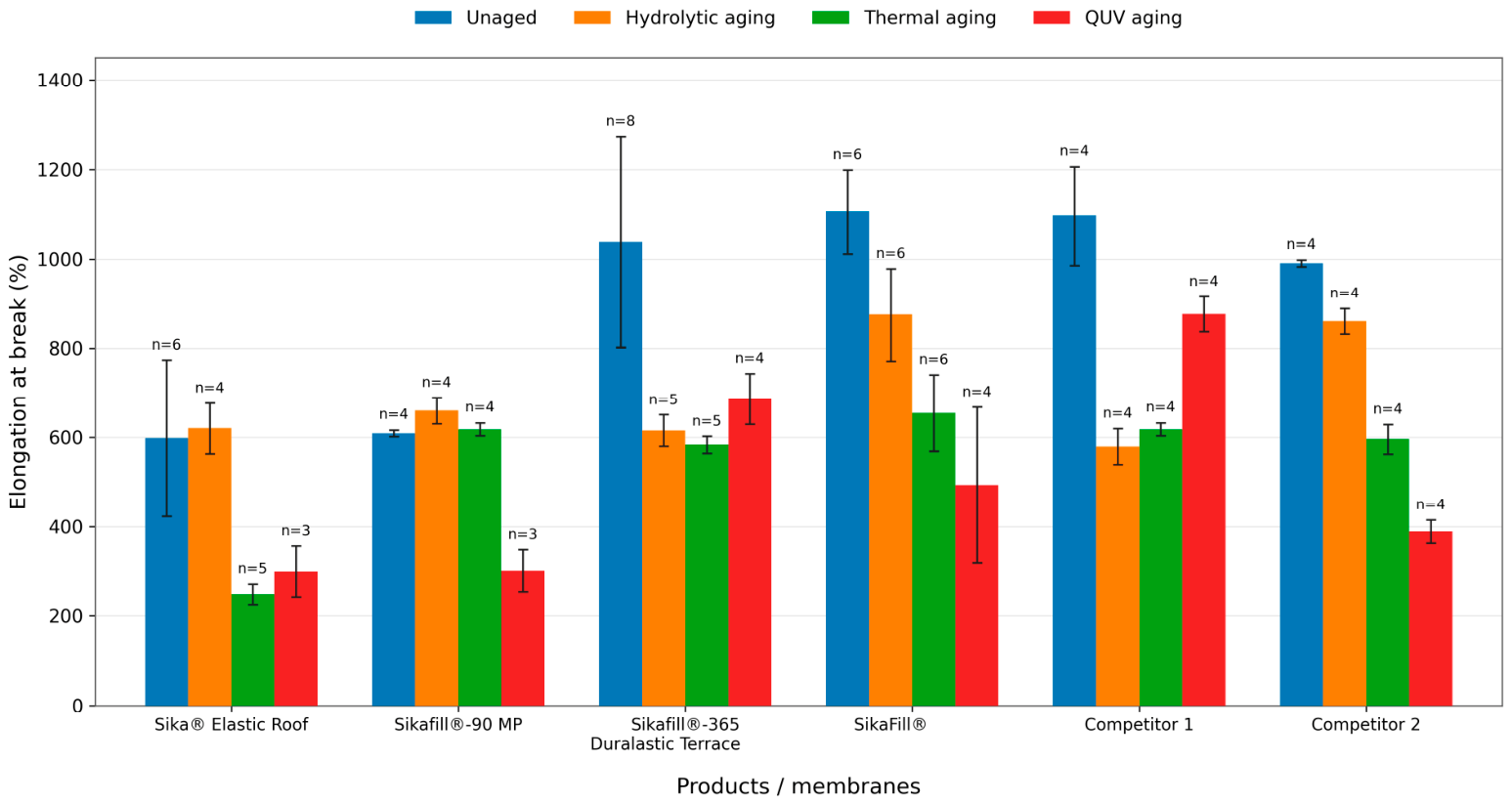
The tensile tests were conducted at a constant crosshead speed of 50 mm/min, as specified for the experimental procedure. During each test, the applied load (N), tensile stress (MPa), and elongation (%) were continuously recorded. The point of specimen failure was determined by detecting the characteristic decrease in force associated with fracture. The main mechanical properties determined from the tensile tests were tensile strength (MPa), defined as the maximum tensile stress reached during the test; elongation at break, εb, (%), corresponding to the percentage elongation of the specimen at fracture; and Young’s modulus, where applicable, determined from the initial elastic region of the stress–strain curve. In addition, the force at tensile strength (N) was recorded as the applied force corresponding to the maximum tensile stress. The number of valid specimens varied by product and exposure condition. Exact sample sizes are reported in Table A1, Table A2, Table A3, Table A4, Table A5 and Table A6 and are shown above the corresponding bars in Figure 3. Results are reported as mean ± standard deviation (SD). Tensile strength and elongation at break were determined for both unaged samples and specimens subjected to different aging protocols.
Figure 3.
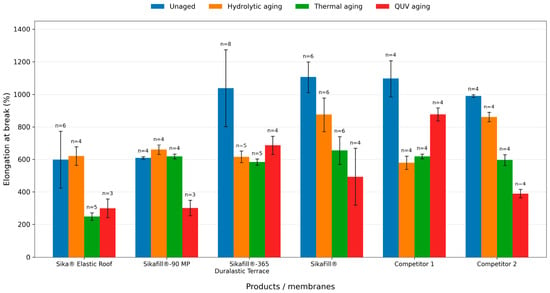
Comparative elongation at break under unaged, hydrolytic, thermal, and QUV aging conditions. Bars show mean values and error bars show ±1 standard deviation; the sample size (n) is indicated above each bar and varies by product and exposure condition according to Table A1, Table A2, Table A3, Table A4, Table A5 and Table A6.
2.5. Aging Protocols
To assess durability under different environmental stressors, elongation at break was measured after hydrolytic aging, thermal aging, and QUV accelerated weathering. The retention of elongation relative to the unaged state was used as a comparative durability indicator. Regarding the aging protocols and the corresponding exposure durations, it is mentioned that the QUV accelerated-weathering protocol consisted of repeated cycles of 8 h UV exposure at 60 °C followed by 4 h condensation at 50 °C. Hydrolysis resistance was evaluated by exposing the samples to water for 7 and 14 days at 20 °C, as well as for 7 days at 70 °C. For each condition, the initial mass and the mass after drying were recorded, and the percentage increase in mass (%) was calculated. Thermal aging was performed by exposing the samples to 80 °C for 28 days. Accelerated weathering was carried out using QUV exposure for 500, 1000, 1500, and 2000 h, using the exposure cycle described in Section 2.3. The mechanical properties of the samples were evaluated at the specified exposure intervals to assess changes associated with accelerated aging. For each experimental dataset, the results were statistically evaluated and reported as the mean ± standard deviation (SD). Table 1 provides an overview of the conditioning and accelerated-aging procedures applied to the investigated waterproofing membranes, together with the corresponding characterization methods.
Table 1.
Summary of the conditioning and accelerated-aging protocols applied to the investigated waterproofing membranes and the corresponding characterization methods.
2.6. Static Water Contact-Angle Measurements
Surface wettability was evaluated by static water contact-angle measurements to assess surface characteristics of the waterproofing membranes. This technique provides information on the hydrophilic/hydrophobic character of the membrane surface and was used here as a baseline characterization of selected unaged membranes. Surface wettability was assessed using an MSA Mobile Surface Analyzer (KRÜSS GmbH, Hamburg, Germany) for four selected membrane systems:
Sample 1: Competitor 2 (specimens S5 and S32).
Sample 2: Sika® Elastic Roof (specimens S44 and S30).
Sample 3: SikaFill® (specimens S1 and S2).
Sample 4: SikaFill®-365 Duralastic Terrace (specimens S8 and S19).
It is mentioned that contact-angle measurements were performed on selected unaged membranes and therefore represent baseline surface wettability rather than aging-induced changes. Contact-angle measurements were performed only on selected unaged membranes and therefore represent baseline surface wettability rather than aging-induced changes. The underlying contact-angle measurements are supplied as an Excel file in the Supplementary Materials. For each specimen, five contact-angle runs were performed, with successive measurements recorded at 2 s intervals. Droplet profiles were fitted using the Ellipse (Tangent-1) method. Mean contact angles and standard deviations were calculated for each paired membrane system. For interpretation, mean water contact angles above 90° were classified as hydrophobic, whereas values below 90° were classified as hydrophilic; values close to 90° were treated as transitional/borderline wettability.
3. Results
3.1. Tensile and Elongation Performance of Elastomeric Membranes
The tensile and elongation behavior of the investigated elastomeric waterproofing membranes was evaluated in order to assess their mechanical performance and deformation capability under standardized testing conditions. Elongation-at-break measurements were selected as a key indicator of elastomeric behavior, as this parameter is directly related to membrane flexibility and crack-bridging ability in service applications.
All membrane specimens were prepared using controlled application techniques and predefined film thicknesses, including applicator-applied films with dry thicknesses of 500 μm, 750 μm, and 1000 μm, as well as stencil-applied membranes with higher thicknesses of 2000 μm and 2500 μm. Tensile testing was conducted at a constant crosshead speed of 50 mm/min, in accordance with elastomeric membrane testing practices.The number of valid specimens varied by product and exposure condition; exact sample sizes are reported in Table A1, Table A2, Table A3, Table A4, Table A5 and Table A6 and above the corresponding bars in Figure 3.
Two curing conditions were examined to evaluate the influence of early- and full-stage film formation on mechanical performance. Specimens were tested after accelerated curing at 60 °C for 1 day, as well as after extended curing for 14 days in a controlled curing room. This approach enabled the assessment of mechanical property development as a function of curing time, which is particularly relevant for waterborne elastomeric systems.
The tested materials included Sika® Elastic Roof, SikaFill® products originating from different production lines, SikaFill®-365 Duralastic Terrace, SikaFill®-90 MP, and two competitor elastomeric waterproofing membranes. Differences in elongation behavior were observed between the products, reflecting variations in polymer composition, formulation strategy, and film build.
In general, membranes tested after extended curing exhibited higher elongation at break compared to those tested after short-term thermal curing, indicating progressive polymer coalescence and network development. Film thickness was also found to influence mechanical performance, with thicker membranes showing enhanced deformation capacity, attributed to reduced stress concentration and improved bulk elastomeric response.
The comparative evaluation demonstrated that elastomeric membranes designed specifically for roof waterproofing applications maintained high elongation values across a wide range of film thicknesses, confirming their suitability for applications requiring substrate movement accommodation. Variations observed among commercial products highlight the critical role of formulation design in achieving durable elastomeric performance.
3.2. Mechanical Performance and Elongation Behavior
The mechanical performance of the investigated elastomeric waterproofing membranes was evaluated through tensile testing, with elongation at break used as the primary indicator of elastomeric behavior. Distinct differences were observed among the tested products, reflecting variations in polymer composition and formulation design [28,29].
Among the Sika systems examined, Sika® Elastic Roof exhibited tensile elongation values in the range of approximately 566% to 720%, depending on film thickness and curing conditions. SikaFill®-90 MP presented elongation values between 609% and 680%, indicating a moderately high deformation capacity.
SikaFill®-365 Duralastic Terrace showed high unaged elongation. Seven values could be verified in the consolidated laboratory records: 927.8, 990.2, 910, 920, 990, 966, and 981%, yielding a mean of 955.0 ± 34.8% (n = 7). For external product context, the current Product Data Sheet reports a tensile strain at break of 350% according to UNE 53165. This declared PDS value is not directly compared with the ISO 527-3 results of the present study because the test method, specimen geometry, thickness, and conditioning differ.
The competing commercial elastomeric membranes, referred to as Competitor 1 and Competitor 2, exhibited elongation values ranging approximately from 900% to 1100%, depending on the specific product and testing conditions. While these values overlapped with the high-performing elastomeric systems, differences in elongation consistency and sensitivity to testing conditions were observed.
Overall, the results highlight that, although all tested products are classified as elastomeric waterproofing membranes, their mechanical behavior varies substantially, underscoring the decisive role of formulation strategy in determining deformation capability.
3.3. Effect of Aging Conditions: Hydrolysis, Thermal Exposure, and QUV Weathering
To assess durability under different environmental stressors, elongation at break was measured following hydrolytic exposure, thermal aging, and QUV accelerated weathering. All membranes exhibited mechanical degradation to varying degrees; however, the extent of elongation retention strongly depended on formulation characteristics [9].
To facilitate a direct comparison of durability among the investigated elastomeric waterproofing membranes, elongation retention after exposure to hydrolysis, thermal aging, and QUV accelerated weathering was evaluated. Elongation retention is expressed as the ratio of aged elongation at break to the corresponding unaged value and represents a critical indicator of long-term elastomeric performance. Figure 3 presents the elongation at break of all investigated membranes before and after exposure to hydrolytic, thermal, and QUV aging conditions. The results clearly illustrate the progressive reduction in elongation as a function of environmental stress. In particular, QUV exposure resulted in the most pronounced overall decrease in elongation across the investigated systems. This result is consistent with the effects of combined UV, heat, and condensation exposure; however, the present mechanical dataset alone cannot identify the underlying chemical degradation mechanism. Thermal aging also led to significant embrittlement in certain formulations, whereas hydrolytic exposure caused more moderate reductions (Table 2).
Table 2.
Elongation at break, εb, (%) of the investigated products.
After hydrolysis exposure, Sika® Elastic Roof retained elongation values of approximately 577–620%, indicating moderate resistance to moisture-induced degradation. SikaFill®-90 MP exhibited slightly improved hydrolytic stability, with elongation values up to 660%, while SikaFill®-365 Duralastic Terrace revealed lower elongation retention after hydrolysis, with a mean value of 615.6%, suggesting increased sensitivityto prolonged moisture exposure in comparison to its unaged mechanical performance. In contrast, SikaFill® maintained comparatively high elongation retention, with values reaching approximately 875%, indicating enhanced hydrolysis resistance.
Thermal aging resulted in a pronounced reduction in elongation for several formulations. Sika® Elastic Roof retained elongation values in the range of 250–274%, reflecting a marked reduction in elongation under the applied accelerated thermal-aging condition. SikaFill®-90 MP exhibited improved thermal stability, retaining elongation values up to 618%, while SikaFill®-365 Duralastic Terrace retained elongation values around 584%. These results suggest that certain formulations are better optimized to withstand elevated temperature conditions.
QUV accelerated weathering produced the most severe impact on mechanical performance. After QUV exposure, Sika® Elastic Roof retained elongation values of approximately 300–350%, indicating substantial UV-induced degradation. SikaFill®-90 MP exhibited improved UV resistance, with elongation values ranging from approximately 302% to 614%. Notably, SikaFill®-365 Duralastic Terrace maintained elongation values as high as 687%, demonstrating superior resistance to UV-induced embrittlement. SikaFill retained elongation values close to 494%, indicating balanced durability under accelerated weathering.
The anonymized competing products showed divergent behavior under QUV exposure. Competitor 1 exhibited high elongation retention values approaching 875%, whereas Competitor 2 presented lower retention, with elongation values ranging between approximately 390% and 460%. These differences demonstrate a strong formulation-dependent response to QUV exposure. Because the products have proprietary compositions and no FTIR-ATR or thermal analysis was performed, the specific contributions of polymer backbone, stabilizers, pigments, and other formulation components cannot be determined from the present dataset. Overall, the aging results confirm that elastomeric waterproofing membranes display markedly different durability profiles depending on formulation design, even when initial mechanical performance appears comparable (Table A1, Table A2, Table A3 and Table A4).
Notably, substantial differences were observed among the tested products, indicating that formulation parameters such as polymer composition, stabilizer content, and pigment systems play a critical role in determining long-term durability. The use of elongation retention as a comparative indicator provides a more reliable assessment of performance under service-like conditions than initial mechanical properties alone.
The results demonstrate progressive degradation of mechanical performance, with QUV exposure producing the most severe reduction due to photo-oxidative mechanisms. Differences among formulations highlight the influence of polymer composition and stabilizing systems on long-term durability.
Table 3 presents substantial differences in elongation retention among the investigated membranes depending on the applied aging condition. SikaFill®-90 MP exhibited the highest resistance to hydrolytic and thermal aging, with retention values of 108.3% and 101.5%, respectively, indicating that its deformation capacity was essentially maintained or slightly increased after exposure. In contrast, thermal aging caused a pronounced reduction in elongation retention for Sika® Elastic Roof (37.7%). Under QUV aging, Competitor 1 showed the highest retention (79.9%), followed by SikaFill®-365 Duralastic Terrace (71.9%), whereas Competitor 2 exhibited the lowest value (39.3%). Overall, the results demonstrate that resistance to aging is strongly dependent on both membrane formulation and exposure type, with no single product exhibiting the highest retention under all three aging conditions.
Table 3.
Elongation retention, , (%) of the investigated products.
3.4. Elongation Retention and Comparative Durability Assessment
Based on Figure 3, Table 2, Table 3 and Table A1, Table A2, Table A3 and Table A4, the following conclusions can be drawn. Hydrolytic aging resulted in moderate elongation losses for most formulations. Products designed for high flexibility exhibited improved retention, indicating enhanced resistance to water-induced plasticization and polymer chain degradation. Membranes with optimized elastomeric backbones maintained a significant portion of their initial deformation capacity, whereas systems with lower elastomeric content showed a larger relative reduction from their high unaged elongation under the tested hydrolytic condition.
Thermal aging produced a more pronounced effect on elongation retention. Certain formulations experienced substantial reductions, indicating a loss of extensibility under the applied elevated-temperature condition. In contrast, other membranes retained a higher percentage of their initial elongation. Similarly, Li et al. reported distinct thermo-oxidative aging responses among commercial bituminous and polymer self-adhesive waterproofing membranes, with differences associated with reinforcement structure and polymer modification. Although these systems differ from the styrene–acrylic membranes investigated here, their findings provide a useful comparison for the product-dependent retention of mechanical performance [30]. The underlying molecular changes and the contribution of specific polymer phases or additive packages were not directly evaluated.
QUV accelerated weathering had the most severe impact on elongation retention across all tested products. UV radiation-induced photo-oxidation is a plausible degradation pathway; however, the present mechanical dataset does not isolate the underlying chemical mechanisms. Marked differences were observed among formulations.Membranes engineered for long-term outdoor exposure exhibited significantly higher elongation retention after QUV aging, underlining the effectiveness of UV stabilizers, pigment systems, and polymer architecture in mitigating UV-induced degradation [6].
Based on elongation retention under the individual aging conditions, the tested membranes exhibited distinct performance profiles; no single product showed the highest retention under all conditions. The comparison is therefore limited to the measured mechanical response and does not constitute a mechanistic ranking of formulation technologies. This comparative analysis emphasizes that initial elongation values alone are insufficient predictors of long-term performance, highlighting the importance of durability-focused formulation strategies.
3.5. Surface Wettability and Contact-Angle Response
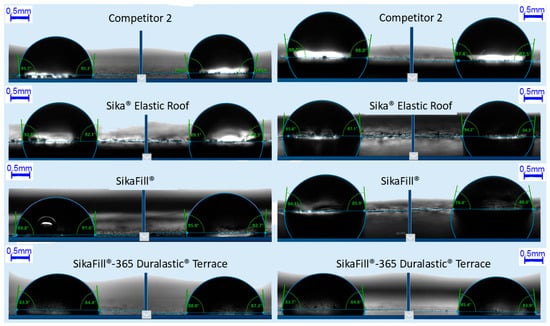
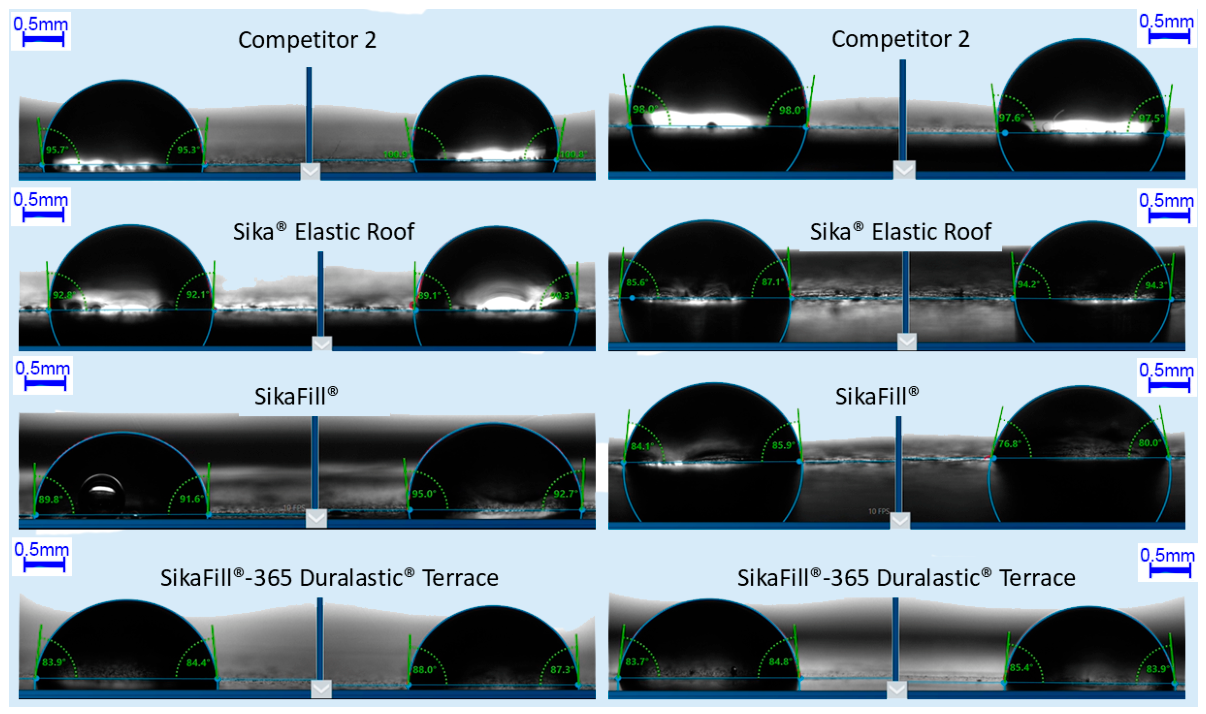
Static water contact-angle measurements revealed clear differences in surface wettability among the four selected unaged membranes. Representative droplet profiles and the corresponding contact-angle measurements are illustrated in Figure 4.
Figure 4.
Representative images of static water contact-angle measurements on the surface of the unaged styrene–acrylic waterproofing membranes. The contact angle was determined from the left and right sides of the sessile water droplet using (KRÜSS ADVANCE, KRÜSS GmbH, Hamburg, Germany).
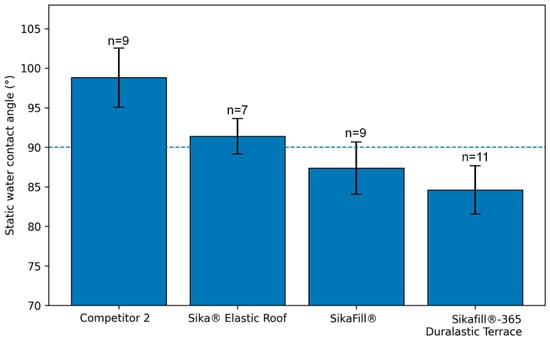
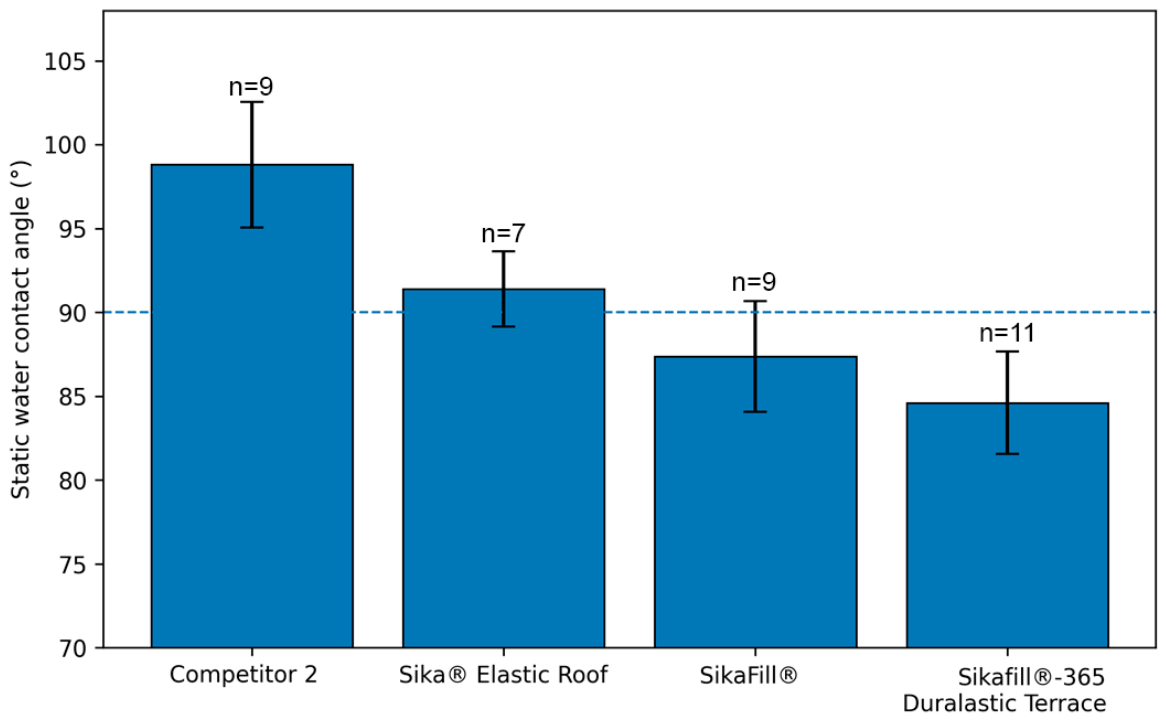
Competitor 2 exhibited the highest mean contact angle, 98.8 ± 3.7°, and was therefore classified as hydrophobic. Sika® Elastic Roof revealed a mean contact angle of 91.4 ± 2.2°, also corresponding to hydrophobic behavior, although it was closer to the 90° wettability transition. SikaFill® yielded a mean value of 87.3 ± 3.3° and was classified as slightly hydrophilic/borderline, while SikaFill®-365 Duralastic Terrace exhibited the lowest mean contact angle, 84.6 ± 3.0°, indicating hydrophilic surface behavior (Table 4, Figure 5).
Table 4.
Static water contact-angle results for the four selected unaged elastomeric waterproofing membranes. Values are reported as mean ± standard deviation from the paired specimen sets.
Figure 5.
Static water contact angle of the investigated unaged membrane surfaces (mean ± standard deviation). The dashed line at 90° indicates the conventional boundary between hydrophilic and hydrophobic wetting behavior.
The specimen-level measurements were consistent with the overall ranking. For Competitor 2, specimens S5 and S32 presented mean contact angles of 96.6 ± 3.4° and 101.0 ± 4.1°, respectively. For Sika® Elastic Roof, specimens S30 and S44 yielded 91.0 ± 2.8° and 91.8 ± 1.7°. For SikaFill®, the two specimens straddled the 90° threshold (S1: 91.4 ± 2.7°; S2: 83.3 ± 3.9°), explaining the borderline mean behavior of the paired system. Both SikaFill®-365 Duralastic Terrace specimens exhibited consistently hydrophilic behavior (S19: 84.8 ± 4.1°; S8: 84.4 ± 2.0°).
These results demonstrate that the investigated membranes differ not only in bulk mechanical durability but also in their initial surface affinity toward water. A higher static contact angle indicates reduced wetting of the membrane surface, whereas a lower angle indicates greater spreading of the water droplet. The contact-angle data should therefore be interpreted as a complementary baseline surface property rather than as a direct substitute for water-absorption or permeability testing. In particular, the near-threshold behavior of SikaFill® illustrates why reporting the measured angle and variability is more informative than relying only on a binary hydrophobic/hydrophilic classification.
The combined dataset nevertheless demonstrates the value of evaluating both surface and bulk descriptors. The mechanical results quantify the capacity of the membranes to retain elastomeric deformation after hydrolytic, thermal, and QUV exposure, whereas contact-angle measurements distinguish their initial water–surface interaction. Future work should repeat contact-angle measurements after defined QUV and hydrolytic exposure intervals; such paired measurements would enable direct assessment of aging-induced changes in wettability and their possible association with mechanical-property retention.
These results should be interpreted as an initial surface-wettability ranking rather than as direct evidence of waterproofing durability. A higher static contact angle can be consistent with reduced wetting of the exposed surface, but water ingress and long-term membrane performance also depend on polymer chemistry, porosity, defects, film thickness, adhesion, and aging-induced changes. Consequently, no causal relationship between initial contact angle and elongation retention is claimed from the present dataset.
3.6. Integrated Interpretation of Wettability and Durability
The wettability results should be considered together with the durability response of the investigated membranes, while recognizing that the contact-angle measurements in the present study represent only the initial, unaged surface condition. The initial contact angle characterizes the wetting behavior of the original surface, whereas future measurements following aging could provide an indication of the stability of surface functionality. Limited changes in contact angle after aging could suggest retention of the initial wetting characteristics, while more pronounced decreases may indicate increased surface polarity, surface modification, or exposure of more hydrophilic domains.
In the present study, mechanical durability and initial surface wettability were investigated as complementary descriptors of membrane performance. The mechanical tests provide information on changes occurring in the bulk material under hydrolytic, thermal, and accelerated UV/moisture aging, whereas contact-angle measurements characterize initial surface properties of selected unaged membranes. As part of the planned future experimental work, contact-angle measurements will also be performed after the different aging treatments. This will enable the direct correlation of changes in mechanical performance with the evolution of surface wettability and will provide a more comprehensive assessment of both bulk and surface stability. Formulations retaining their mechanical properties while exhibiting only minor changes in wettability after aging demonstrate greater overall resistance to the applied aging conditions, whereas changes in contact angle may provide an additional indicator of surface-level degradation.
The contact-angle results obtained in the present experimental campaign are reported as mean ± standard deviation based on the available replicate measurements. The current study emphasizes descriptive comparison of the investigated systems rather than inferential statistical analysis across all combinations of formulation and aging conditions. In future work, specimen-level datasets will be systematically collected for the extended aging and wettability experiments, enabling appropriate one- or two-factor statistical analyses, including multiplicity-controlled post hoc comparisons where justified. This approach will allow the individual and combined effects of formulation and aging conditions to be quantitatively assessed.
4. Conclusions
This study presented a comparative experimental evaluation of the mechanical performance, accelerated-aging durability, and initial surface wettability of elastomeric waterproofing membranes. The principal findings are summarized as follows:
- All tested membranes exhibited high elongation at break in the unaged state, while descriptive differences in elongation retention were observed after aging. Inferential statistical significance was not established from the available dataset.
- Film thickness and curing conditions influenced mechanical performance, with thicker membranes generally showing enhanced deformation capability.
- Hydrolysis and thermal aging resulted in moderate to significant reductions in elongation, depending on formulation characteristics.
- QUV accelerated weathering produced the greatest overall reduction in elongation under the conditions examined. Because QUV combines UV radiation, elevated temperature, and condensation, the contribution of each stressor and the associated chemical mechanisms cannot be isolated from the present mechanical data.
- The products exhibited formulation-dependent elongation retention, and no single membrane provided the highest retention under all investigated aging conditions.
- Comparative analysis confirmed that the tested products differed in sustained elastomeric performance. The specific roles of polymer composition, stabilizing systems, pigments, and other formulation components require targeted chemical and thermal characterization.
Contact angle measurements performed on selected unaged specimens differentiated the selected surfaces: Competitor 2 (98.8 ± 3.7°) and Sika® Elastic Roof (91.4 ± 2.2°) were hydrophobic; SikaFill® (87.3 ± 3.3°) was slightly hydrophilic and close to the 90° transition; and SikaFill®-365 Duralastic Terrace (84.6 ± 3.0°) was hydrophilic.
Taken together, the mechanical-aging and wettability results provide complementary insight into the performance of elastomeric waterproofing membranes. The study supports performance-based product selection and formulation optimization by distinguishing initial flexibility, retention of deformation capacity after environmental aging, and surface wetting behavior as separate but relevant descriptors of long-term functional performance.
Supplementary Materials
The following supporting information can be downloaded at https://www.mdpi.com/article/10.3390/pr14203340/s1. Contact-angle measurement data are provided with the submission as supporting information. Contact-angle measurements are supplied as an Excel file.
Author Contributions
Conceptualization, A.K.; methodology, A.K., M.P., O.O., S.E. and I.K.; validation, A.K., M.P. and I.K.; formal analysis, A.K., M.P., S.E. and I.K.; investigation, A.K., M.P. and O.O.; resources, A.K., T.K. and I.K.; writing—original draft preparation, A.K., M.P., S.E. and I.K.; writing—review and editing, M.P., T.K. and I.K.; visualization, A.K.; supervision, T.K. and I.K. All authors have read and agreed to the published version of the manuscript.
Funding
This research received no external funding.
Data Availability Statement
The data presented in this study are available on request from the corresponding author due to legal restrictions.
Acknowledgments
The authors gratefully acknowledge Sika Hellas ABEE for providing access to its laboratory facilities, testing equipment, and technical infrastructure used for the experimental work presented in this study. During the preparation of this manuscript, the authors used ChatGPT Plus, powered by GPT-6to assist in creating part of the background template for the graphical abstract. The authors subsequently reviewed and edited the generated output and take full responsibility for the content of this publication.
Conflicts of Interest
Author Artemis Kontiza was employed by the company SIKA HELLAS ABEE. The remaining authors declare that the research was conducted in the absence of any commercial or financial relationships that could be construed as a potential conflict of interest.
Abbreviations
The following abbreviations are used in this manuscript:
| elongation retention | |
| RH | relative humidity |
| SD | standard deviation |
| Tg | glass-transition temperature |
| εb | elongation at break |
Appendix A
Table A1.
Tabulated parameters of Sika® Elastic Roof elongation at break.
Table A2.
Tabulated parameters of SikaFill®-90 MP elongation at break.
Table A3.
Tabulated parameters of SikaFill®-365 Duralastic Terrace elongation at break.
Table A4.
Tabulated parameters of SikaFill® elongation at break.
Table A5.
Tabulated parameters of Competitor 1 elongation at break.
Table A6.
Tabulated parameters of Competitor 2 elongation at break.
References
- Kontiza, A.; Pastrafidou, M.; Kartsonakis, I.A. Styrene–Acrylic Elastomeric Waterproofing Membranes: Composition, Performance, Durability and Emerging Formulation Technologies. Polymers 2026, 18, 1390. [Google Scholar] [CrossRef] [Scilit] [PubMed]
- Keddie, J. Film Formation of Latex. Mater. Sci. Eng. R Rep. 1997, 21, 101–170. [Google Scholar] [CrossRef] [Scilit]
- Keddie, J.L.; Routh, A.F. Fundamentals of Latex Film Formation: Processes and Properties; Springer Laboratory Manuals in Polymer Science; Springer: Dordrecht, The Netherlands; New York, NY, USA, 2010; ISBN 978-90-481-2844-0. [Google Scholar]
- Steward, P.A.; Hearn, J.; Wilkinson, M.C. An Overview of Polymer Latex Film Formation and Properties. Adv. Colloid Interface Sci. 2000, 86, 195–267. [Google Scholar] [CrossRef] [Scilit] [PubMed]
- Cummings, S.; Zhang, Y.; Smeets, N.; Cunningham, M.; Dubé, M. On the Use of Starch in Emulsion Polymerizations. Processes 2019, 7, 140. [Google Scholar] [CrossRef] [Scilit]
- Frigione, M. Assessment of the Ageing and Durability of Polymers. Polymers 2022, 14, 1934. [Google Scholar] [CrossRef] [Scilit] [PubMed]
- Maraveas, C.; Kyrtopoulos, I.V.; Arvanitis, K.G.; Bartzanas, T. The Aging of Polymers under Electromagnetic Radiation. Polymers 2024, 16, 689. [Google Scholar] [CrossRef] [Scilit] [PubMed]
- Celina, M.C. Review of Polymer Oxidation and Its Relationship with Materials Performance and Lifetime Prediction. Polym. Degrad. Stab. 2013, 98, 2419–2429. [Google Scholar] [CrossRef] [Scilit]
- Özkan, E. Strength, Elongation and Toughness of New and Weathered Polyvinyl Chloride and Chlorinated Polyethylene Roofing Membranes. Archit. Sci. Rev. 1994, 37, 123–135. [Google Scholar] [CrossRef] [Scilit]
- Decker, C.; Zahouily, K. Photodegradation and Photooxidation of Thermoset and UV-Cured Acrylate Polymers. Polym. Degrad. Stab. 1999, 64, 293–304. [Google Scholar] [CrossRef] [Scilit]
- Nichols, M.E.; Gerlock, J.L.; Smith, C.A. Rates of Photooxidation Induced Crosslinking and Chain Scission in Thermoset Polymer Coatings—I. Polym. Degrad. Stab. 1997, 56, 81–91. [Google Scholar] [CrossRef] [Scilit]
- Nichols, M.E.; Gerlock, J.L. Rates of Photooxidation Induced Crosslinking and Chain Scission in Thermoset Polymer Coatings II. Effect of Hindered Amine Light Stabilizer and Ultraviolet Light Absorber Additives. Polym. Degrad. Stab. 2000, 69, 197–207. [Google Scholar] [CrossRef] [Scilit]
- Nguyen, T.V.; Nguyen Tri, P.; Nguyen, T.D.; El Aidani, R.; Trinh, V.T.; Decker, C. Accelerated Degradation of Water Borne Acrylic Nanocomposites Used in Outdoor Protective Coatings. Polym. Degrad. Stab. 2016, 128, 65–76. [Google Scholar] [CrossRef] [Scilit]
- Xin, F.; Dong, Q.; Pan, Y.; Hu, Y.; Feng, X.; Yang, Z.; He, Y.; Peng, D.; Li, L.; Fang, Q.; et al. Innovative Synthesis of Waterborne Styrene–Acrylic Resin Tailored for Bamboo. Polymers 2026, 18, 468. [Google Scholar] [CrossRef] [Scilit] [PubMed]
- Shang, B.; Zhao, X.; Wang, X.; Feng, K.; Wu, X.; Li, H.; Yang, L. A Comparative Study Evaluating the Effects of Different Weight Percentages of Kaolinite Nanosheets on the Styrene-Acrylic Latex Coating Properties. Mater. Today Commun. 2025, 49, 114079. [Google Scholar] [CrossRef] [Scilit]
- Fischer, E.; Storti, G.; Cuccato, D. Aqueous Free-Radical Polymerization of Non-Ionized and Fully Ionized Methacrylic Acid. Processes 2017, 5, 23. [Google Scholar] [CrossRef] [Scilit]
- Baklan, D.; Bilousova, A.; Myronyuk, O. UV Aging of Styrene-Acrylic Polymer SiO2 and TiO2 Composites. Mater. Today Commun. 2024, 38, 107990. [Google Scholar] [CrossRef] [Scilit]
- ASTM G154-23; Practice for Operating Fluorescent Ultraviolet (UV) Lamp Apparatus for Exposure of Nonmetallic Materials. G03 Committee ASTM International: West Conshohocken, PA, USA, 2023. [CrossRef] [Scilit]
- ASTM D4587-23; Practice for Fluorescent UV-Condensation Exposures of Paint and Related Coatings. D01 Committee ASTM International: West Conshohocken, PA, USA, 2023. [CrossRef] [Scilit]
- Sabet-Bokati, K.; Plucknett, K. Water-Induced Failure in Polymer Coatings: Mechanisms, Impacts and Mitigation Strategies—A Comprehensive Review. Polym. Degrad. Stab. 2024, 230, 111058. [Google Scholar] [CrossRef] [Scilit]
- Tan, J.; Zhang, C.; Sun, G.; Ma, X.; Du, H. An Investigation of the Effects of Thermo-Oxidative Aging and the Freeze–Thaw Cycle on the Performance of Polyester-Based, Self-Adhesive Asphalt Waterproofing Membranes. Appl. Sci. 2024, 14, 8237. [Google Scholar] [CrossRef] [Scilit]
- Ładosz, Ł.; Sudoł, E.; Kozikowska, E.; Choińska, E. Artificial Weathering Test Methods of Waterborne Acrylic Coatings for Steel Structure Corrosion Protection. Materials 2024, 17, 1857. [Google Scholar] [CrossRef] [Scilit] [PubMed]
- Merlatti, C.; Perrin, F.X.; Aragon, E.; Margaillan, A. Natural and Artificial Weathering Characteristics of Stabilized Acrylic–Urethane Paints. Polym. Degrad. Stab. 2008, 93, 896–903. [Google Scholar] [CrossRef] [Scilit]
- Yan, D.; Chen, S.; Xiao, X.; Zhang, F.; Chen, I. Characteristics of a Two-Component Waterborne Acrylic Emulsion Waterproof Coating Based on Underground Engineering. JESTR 2022, 15, 99–108. [Google Scholar] [CrossRef] [Scilit]
- ASTM D823-18; Practices for Producing Films of Uniform Thickness of Paint, Varnish, and Related Products on Test Panels. D01 Committee ASTM International: West Conshohocken, PA, USA, 2022. [CrossRef] [Scilit]
- ASTM D3924-16(2019); Specification for Standard Environment for Conditioning and Testing Paint, Varnish, Lacquer, and Related Materials. D01 Committee ASTM International: West Conshohocken, PA, USA, 2019. [CrossRef] [Scilit]
- ASTM D1640M-14; TestMethods for Drying, Curing, or Film Formation of Organic Coatings. D01 Committee ASTM International: West Conshohocken, PA, USA, 2022. [CrossRef] [Scilit]
- ASTM D618-21; Practice for Conditioning Plastics for Testing. D20 Committee ASTM International: West Conshohocken, PA, USA, 2021. [CrossRef] [Scilit]
- Schwarz, D.; Pagáč, M.; Petruš, J.; Polzer, S. Effect of Water-Induced and Physical Aging on Mechanical Properties of 3D Printed Elastomeric Polyurethane. Polymers 2022, 14, 5496. [Google Scholar] [CrossRef] [Scilit] [PubMed]
- Li, S.; Du, Y.; Geng, W.; Zhang, R.; Sun, G.; Ma, X. Experimental Study on Thermal Oxidative Aging Effects on the Performance and Compatibility of Different Types of Waterproofing Membranes. Polymers 2026, 18, 162. [Google Scholar] [CrossRef] [Scilit] [PubMed]

Disclaimer/Publisher’s Note: The statements, opinions and data contained in all publications are solely those of the individual author(s) and contributor(s) and not of MDPI and/or the editor(s). MDPI and/or the editor(s) disclaim responsibility for any injury to people or property resulting from any ideas, methods, instructions or products referred to in the content. |
© 2026 by the authors. Licensee MDPI, Basel, Switzerland. This article is an open access article distributed under the terms and conditions of the Creative Commons Attribution (CC BY) license.