


Abstract
A fixed-time sliding mode controller based on an adaptive neural network is developed for the path tracking problem of robotic manipulators with model uncertainty and external nonlinear interference. Firstly, a fixed-time sliding surface and sliding mode reaching law are designed based on the dynamic model of the robotic manipulator, which ensures that the error signal converges along the sliding surface within a fixed time. The speed of the state approaching the sliding surface can be flexibly adjusted through the reaching law, and it has strong robustness to parameter perturbations and external disturbances. Then, the uncertainty of model parameters and external disturbances is regarded as composite interference, and an adaptive neural network is utilized to approximate the disturbance online for adaptive fitting. This does not require precise modelling, the control input jitter is reduced, the composite disturbance is compensated in real time, and the system tracking accuracy is improved. Subsequently, the fixed-time stability characteristics of the closed-loop system are demonstrated through Lyapunov stability theory. Finally, the effectiveness and robustness of the proposed control strategy are verified through simulation.
1. Introduction
With the rapid development of technologies such as artificial intelligence and automated control, robotic manipulators have demonstrated broad application prospects in practical work. Robotic manipulators can complete repetitive tasks such as welding, assembly, and handling, assisting in minimally invasive surgeries in healthcare. In addition, they are widely used in logistics sorting, hazardous environment operations, and aviation component assembly [1,2,3,4]. As a nonlinear, multi-input, multi-output time-varying system, research on the tracking problem of target trajectories by robotic manipulators has been relatively complete, such as adaptive control [5,6], neural network control [7,8,9,10,11,12,13,14], sliding mode control [15,16], backstepping control [17,18], and other control methods.
Due to its powerful adaptive learning ability, neural networks have been favored by many scholars. In [11], based on complete state feedback control and output feedback control, a neural network is proposed to control the online approximation of the unknown dynamic model of the rehabilitation robot. Adaptive neural networks and disturbance observers are combined in [12], which simultaneously solves the problems of model parameter perturbations and unknown system disturbances. The uncertain model is learned online through neural networks, and weight adaptive laws are designed based on Lyapunov functions. Sliding mode control has been widely used in industrial production due to its special structure and insensitivity to external disturbances. However, traditional terminal sliding mode control methods suffer from singularity phenomena and slow convergence speed of state tracking errors, which cannot meet the control requirements of nonlinear systems such as robots. Based on this, some literature combines neural networks with sliding mode control to improve system tracking accuracy, and this solution has been validated by robotic manipulators. A composite controller was developed in [13], where neural networks are utilized to approximate the uncertain parts of the dynamic model and environmental disturbances, and sliding mode controllers are used to track the position of joint output angles. A novel neural network sliding mode control scheme has been proposed [14], which is innovative in that the designed switch gain can achieve dynamic adaptive adjustment, and the approximation error and external disturbances are suppressed.
It is worth noting that in the above analysis, the convergence time of tracking error cannot be calculated and can only be measured through actual experiments. In the tracking control of robotic manipulators, convergence speed is an important performance indicator that reflects the response characteristics of the tracking system. The upper bound of the convergence time of tracking error can be calculated through finite time control theory, but it is important to know the initial value of the system state [19,20]. However, in actual operation, it is difficult to accurately obtain the initial state of the system. Therefore, fixed time control has been developed because it is independent of the initial state value. In [21], a fixed-time sliding mode controller based on an RBF neural network is designed, which ensures the system converges to a stable state within a fixed time while solving unknown dynamic models and external disturbances. Finally, a comparison was made with a finite-time sliding mode controller, and the good tracking performance of the proposed strategy is demonstrated by simulation results. For the trajectory tracking control of multi-joint robotic manipulators with input saturation, reinforcement learning, RBF neural network, and fixed time theory are combined in reference [22], and a new non-singular fast terminal sliding mode is adopted. In [16], a fixed-time sliding mode control based on fixed-time disturbance observer compensation is presented to solve the tracking control of robotic manipulators with unknown models and external disturbances. In the above controller, there are some parameters that need to be determined, such as feedback gains from different terms, and it is necessary to design adaptive update laws. However, updating the law may hinder the synchronization of neural networks, which is a tricky problem.
In view of the above analysis, the fixed time synchronization problem of delayed neural networks has been addressed in [23,24,25]. Unlike traditional adaptive control, [23] can determine multi-control gains with a unified update law adaptively, and its beneficial effects have been shown by some studies. However, for strongly coupled nonlinear systems like robotic manipulators, this composite control is difficult to generalize. Although fixed time control has been widely applied in various applications, how to solve the uncertainty of robot systems with input dead zones and delay constraints remains unresolved. The authors in [26,27] address uncertain system dynamic parameters while ensuring fixed time convergence of neural network weights. It is worth studying that hierarchical control was carried out in [27]. The upper layer is based on fixed-time state estimation, while the lower layer neural network approximates uncertainty. At present, only a small portion of the composite control strategy of neural networks and fixed-time sliding mode control has been applied to path tracking control of nonlinear robotic systems. Therefore, this paper attempts to combine the above algorithms to improve the convergence speed and tracking accuracy of the tracking system.
In this work, a fixed-time sliding mode control based on adaptive neural networks is designed to address the problems of model parameter perturbations and external disturbances in nonlinear robotic manipulator tracking control. The main contributions are summarized as follows:
- (1)
- A fixed-time sliding mode controller based on an adaptive neural network was developed to address issues such as unmodeled dynamics, disturbances, and convergence time. Compared with the finite-time sliding mode controller in reference [15], the proposed scheme ensures faster convergence speed and tracking accuracy. Unlike the adaptive update law in [21], there is no need to give the boundary of the aggregate disturbance in advance. Regularization is employed to avoid weight oscillations and improve approximation accuracy.
- (2)
- Different from the controller design methods in references [14,15,16], a switching function regarding tracking error is used in the sliding mode control section, and the designed convergence law is only related to the sliding surface. Even in the presence of model errors or sudden disturbances, the state can still be forced to converge along the sliding surface by switching functions, which ensure tracking accuracy.
- (3)
- Adaptive neural networks are utilized to approximate and compensate for uncertain parts of dynamic models and external disturbances, without the need for preset disturbance upper bounds, which avoids control input redundancy. Unlike existing asymptotic convergence or finite time convergence, the system tracking error can converge to the vicinity of the origin within a fixed time, and the convergence time is independent of the initial state of the system.
2. Problem Description and Preliminaries
2.1. Problem Description
For an N-rigid body system, when considering external disturbances, its dynamic equation can be given by [11,15,16]:
where respectively represent the joint angle, angular velocity, and angular acceleration of the robotic manipulator. is the inertia matrix. and represent the Coriolis centripetal force vector and gravity term vector, respectively. is the required control torque. The Jacobian matrix can be expressed as . The nonlinear constraint force exerted by the external on the robotic arm system can be displayed by .
For the convenience of control design, let , , we can obtain:
Due to the correlation between the dynamics of a robotic manipulator and its own characteristics, actual operation, and speed, these factors often change and are difficult to predict. Describe the above matrix in the form of uncertain terms as follows: ,
,
. The dynamics of robotic manipulators can be redefined as
The system (2) can be rewritten as
Assumption 1.
In system (3), is bounded, that is, it satisfies , where is a constant.
Assumption 2.
, and are both continuously bounded, and the expected trajectory set in this article is also continuously bounded.
Remark 1.
Due to the limitations of its structure, the robotic manipulator is constrained by its own output energy in actual operation and control, so Assumption 1 is reasonable. Therefore, , , and are all bounded, and there exists a positive constant that satisfies .
2.2. Preliminaries
Lemma 1
[28]. If there exists a continuous radial bounded function , and meet the following conditions:
- (1)
- (2)
- For any satisfies the inequality , where , , , and are all positive numbers, and , , then the original system can converge to zero in a fixed time, and the convergence time satisfies:
Lemma 2
[28]. If there exists a continuous radial bounded function, and meet the following conditions:
- (1)
- (2)
- For any satisfies the inequality , where , , , and are all positive numbers, and , , then the original system can converge to zero in a fixed time, and the convergence time satisfies:
Remark 2.
From (5) and (6), the convergence time of the system is only related to parameters , , , and , and is independent of the initial state of the system. In practical operation control, it can be used in scenarios with strict requirements for tracking time.
3. Controller Design
The purpose of path tracking for a robotic manipulator is to track the joint angle onto the desired joint angle . In this section, a fixed time sliding mode controller based on the convergence law is designed to enable the system to track the desired trajectory, i.e., .
The definition of state error is as follows:
The fixed time sliding surface is selected as
where the constants , , , and are positive and satisfy , .
Inspired by [21], the sliding mode approach law can be designed as follows
where the constants , , and are positive and satisfy , .
By taking the derivative of (8), we can obtain
Based on the Equations (9) and (10), the control law is designed as
Theorem 1.
For system (4), when the sliding surface in (8) and the controller in (11) are used, the system can accurately track the desired trajectory within a fixed time.
Proof of Theorem 1.
The Lyapunov function can be constructed as
The time derivative of is designed as
where , .
According to Lemma 1, the designed tracking control strategy can enable the robotic arm to track the desired trajectory within a fixed time, and the upper bound of the maximum convergence time is given by
After reaching the sliding stage, . According to (8), we have
It is worth noting that (15) only describes the dynamic relationship between errors and , and cannot determine whether the upper bound of the fixed convergence time is independent of the initial state. To solve the above problems, the dynamic relationship of errors is transformed into an integral form of time state.
Let , , then the derivative of the tracking error signal is expressed as
Substituting (16) into (15), then (15) becomes
According to (17), after reaching the fixed time sliding surface, the tracking errors and will quickly converge to 0 within a fixed time and are independent of the initial state. The upper bound of the convergence time is
Therefore, when reaching the sliding surface, the convergence time for the tracking system to reach the equilibrium point from any initial state is
. □
Remark 3.
Based on the above analysis, the designed fixed time sliding mode control strategy can achieve precise tracking of the desired trajectory within a fixed time in both the arrival and sliding phases. Therefore, the total convergence time of the system is . According to (14) and (19), the convergence time is only related to the coefficients , , , , and the exponents , , .
4. Design of Adaptive Neural Network Controller
Composite disturbance is an unknown nonlinear function; therefore, (11) cannot meet the actual control needs. Adaptive neural networks are introduced for online approximation of .
A fixed-time sliding mode controller based on an adaptive neural network can be designed as
where represents the input variable of the adaptive neural network, is the estimated weight vector of the neural network, denotes the radial basis function, is the optimal weight of the neural network, defined as . The of neural networks can be used to approximate .
where is the estimation error of the neural network, and it is bounded, .
The adaptive law is given as
where the gain matrix , is a small positive number (In [11,12,15], the value of ranges from 0.01 to 0.05).
Theorem 2.
For system (4), the sliding surface in (8), the switching control law in (9), implemented in combination with the control law in (20), can ensure the system is globally stable and the tracking error converges to 0 within a fixed time , where can be given by
Proof of Theorem 2.
A Lyapunov function candidate is designed as
The time derivative of is
. □
Remark 4.
According to the previous definition, inspired by reference [21], for ease of calculation, we set and , then (25) becomes
Thus, fixed-time stability is achieved according to Lemma 2. We can further deduce that and the tracking error converges to the zero domain, and the convergence time is satisfied
Remark 5.
The two convergence times and are calculated here because the system has two stages in the convergence process, namely sliding mode control and composite control (sliding mode and neural network).
In the sliding mode control stage, we have , where is the time from the system state to the sliding surface, and is the time from the state inside the sliding surface to zero.
is the convergence time of the neural network weights. The introduction of neural networks has changed the structure of the system’s Lyapunov. Therefore, the total convergence time is .
5. Research Simulations
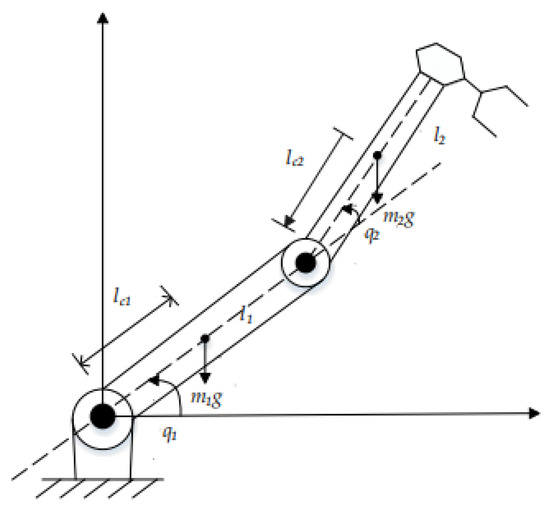
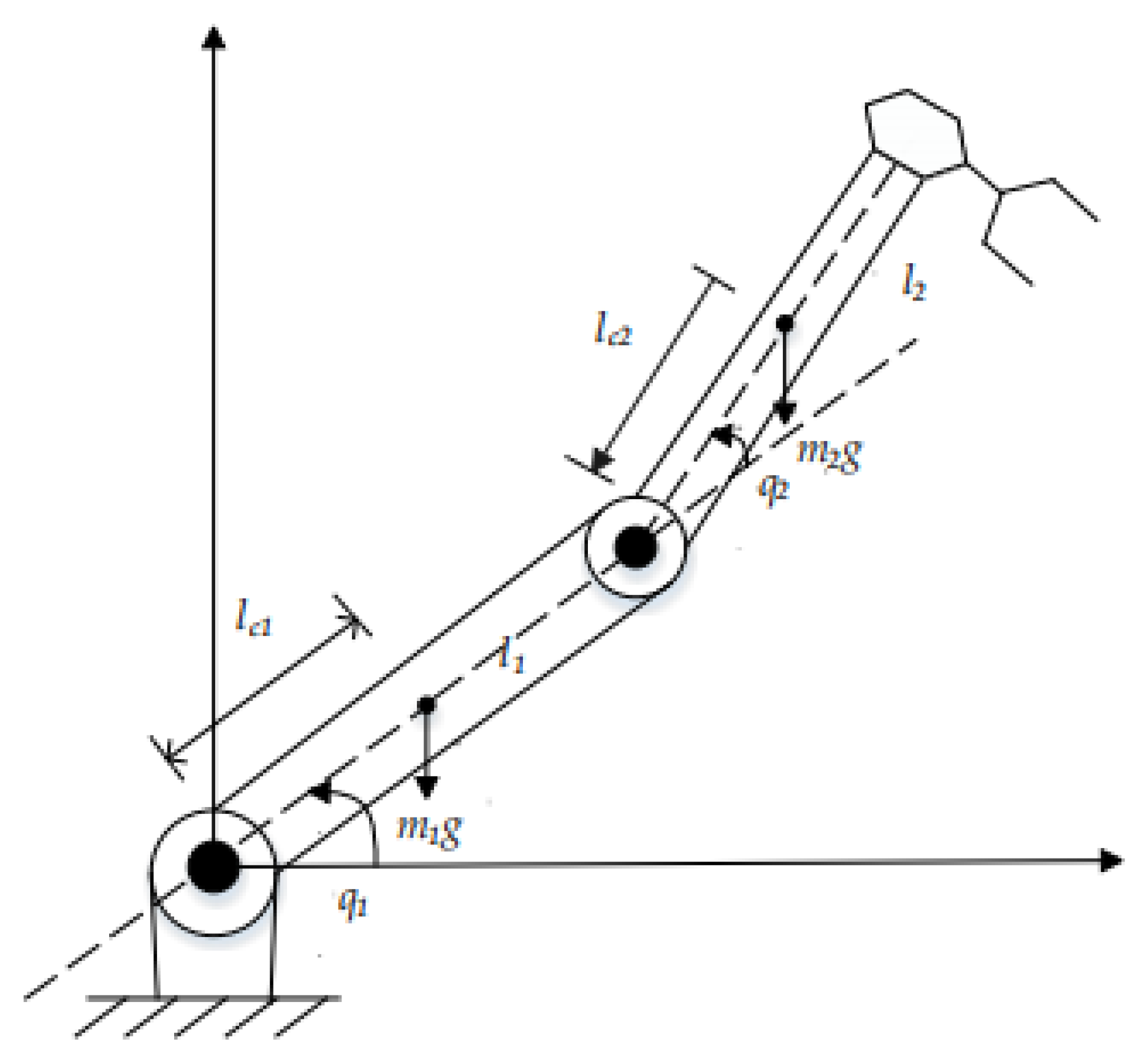
In this section, to verify the effectiveness of the proposed control strategy, simulations will be conducted on a robotic manipulator with model uncertainty and external disturbances, and compared with the method in [15]. The planar model of the manipulator is shown in Figure 1. The masses of joint links 1 and 2 are and , respectively. and represent the length of the two links. The inertia matrix is represented by and respectively. and are the distances from the endpoints of joints 1 and 2 to the center of mass.
Figure 1.
Schematic of a two-joint manipulator [7].
The uncertain parts of the system model are set as , , .
The coefficient matrix of the dynamic model in (1) is described as follows [11,15]:
The expected trajectory is set to be consistent with [15], , . The width of the neural network is set to 1.5, and other control parameters are selected as follows: , . The controller parameter selection is as follows: , , , , , , , , . The initial state of the system is defined as , , and the simulation time is set as 40 s.
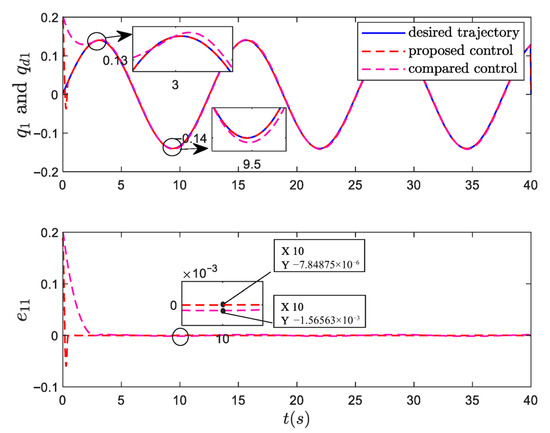
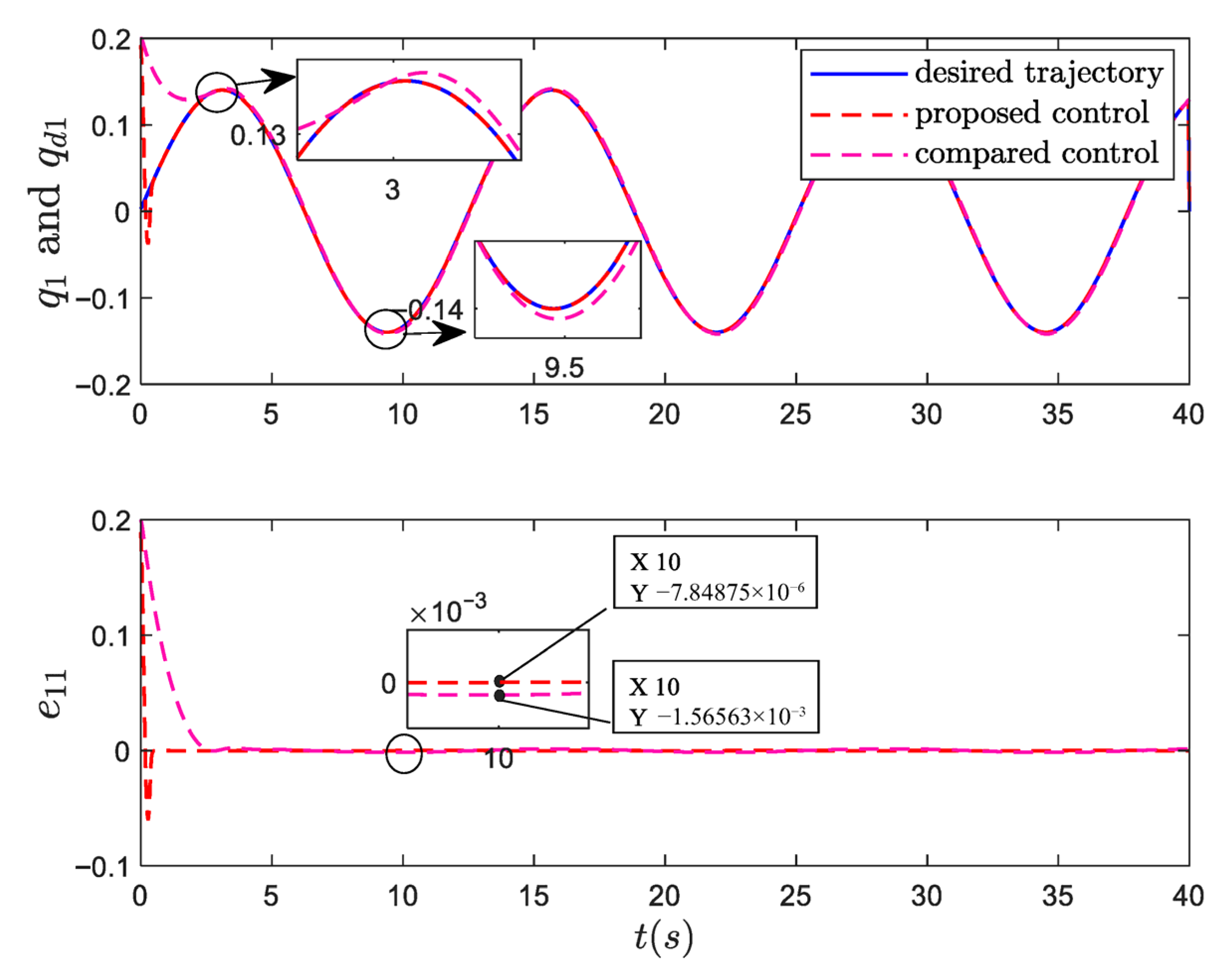
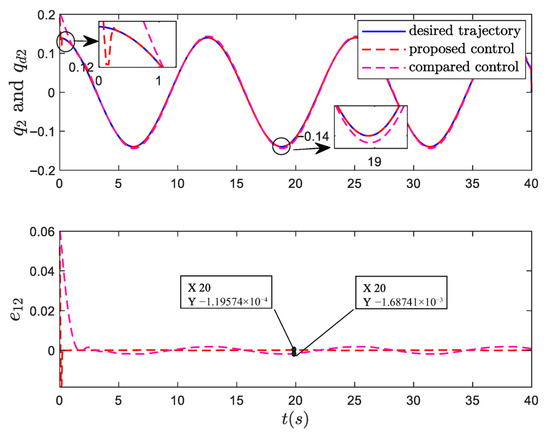
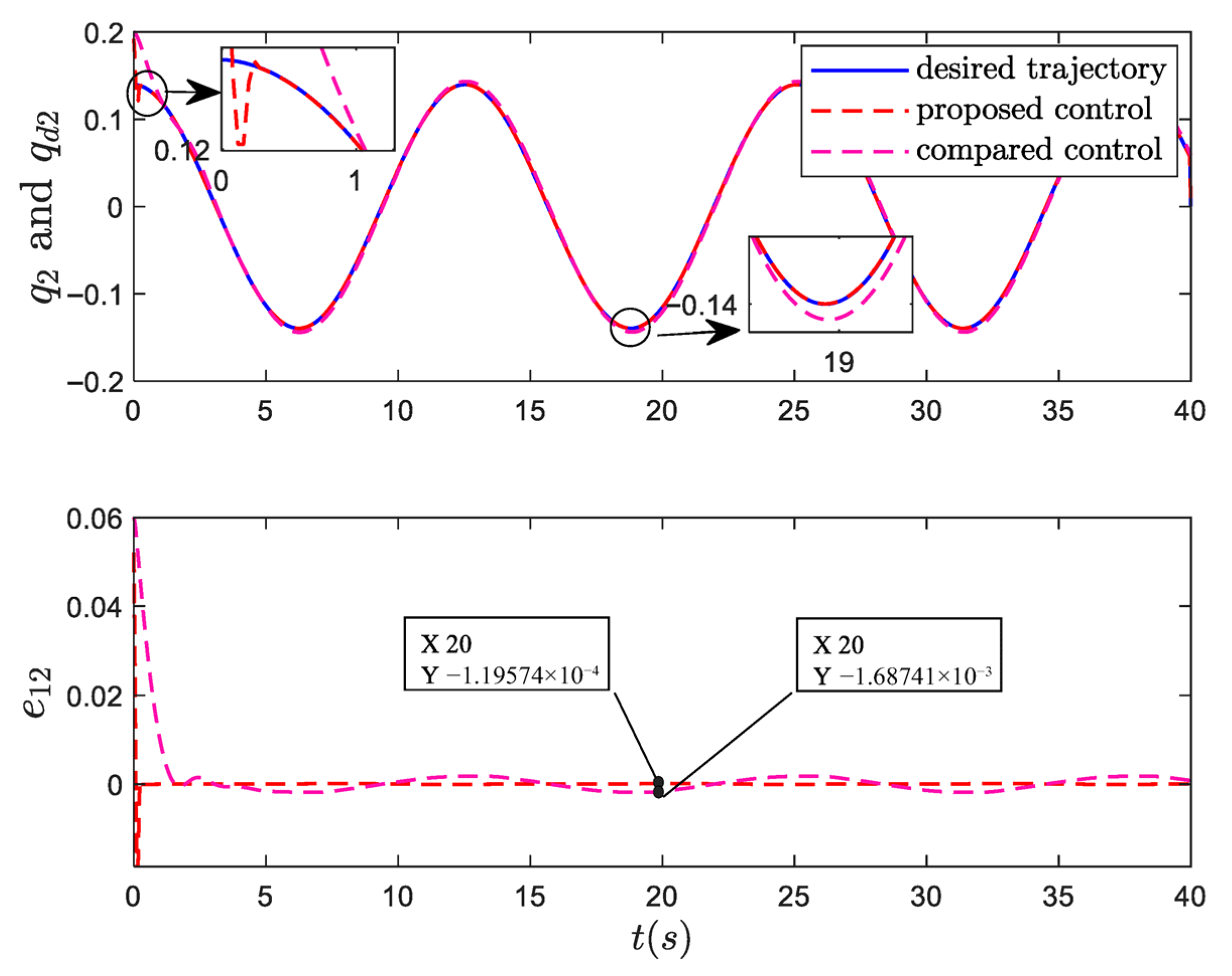
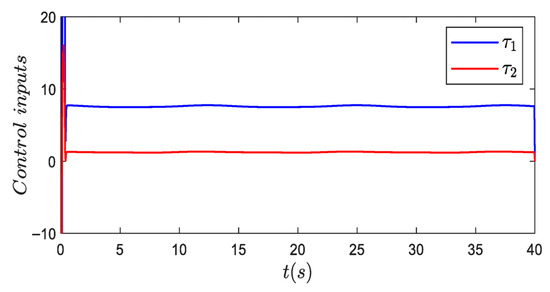
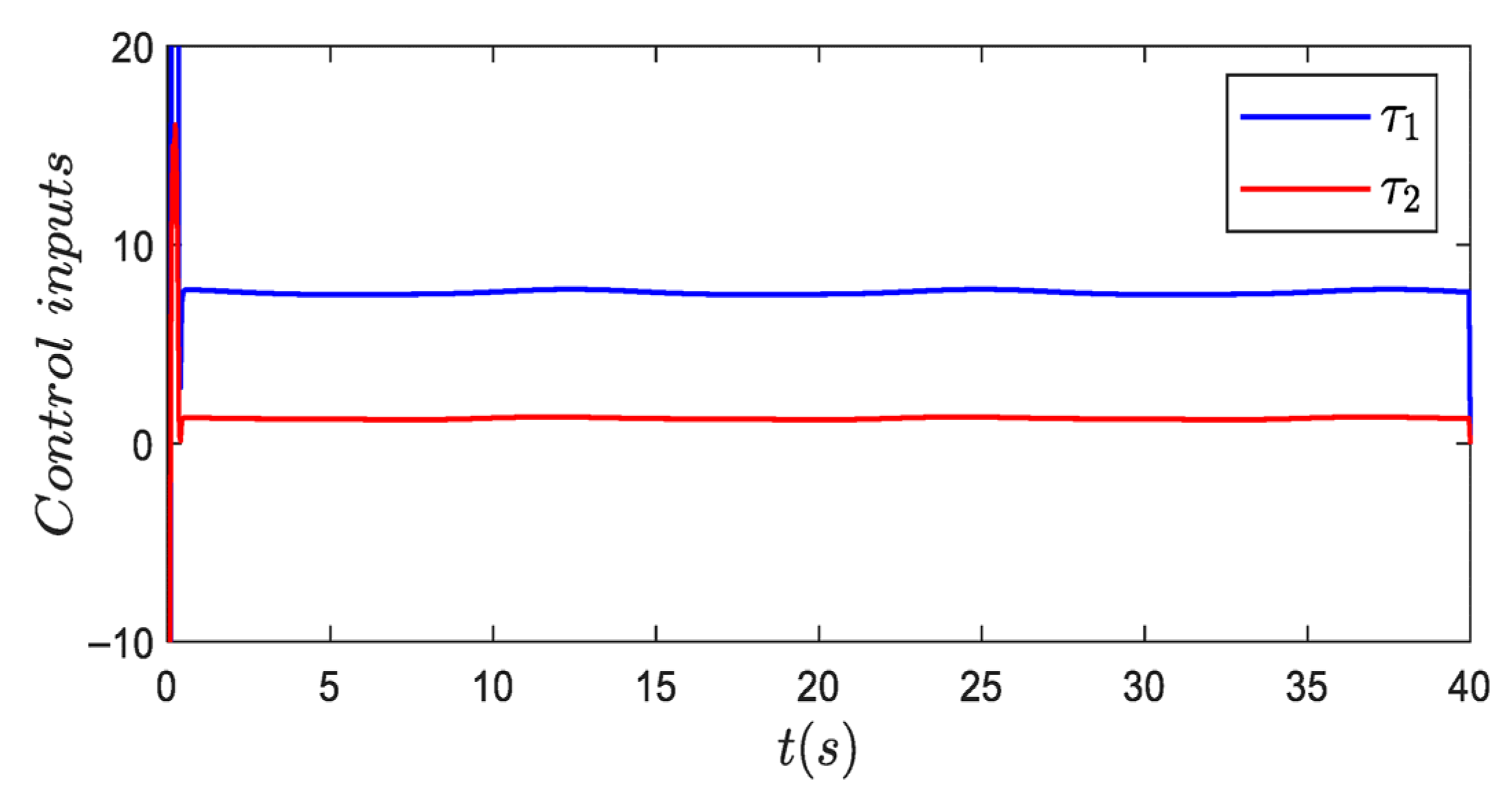
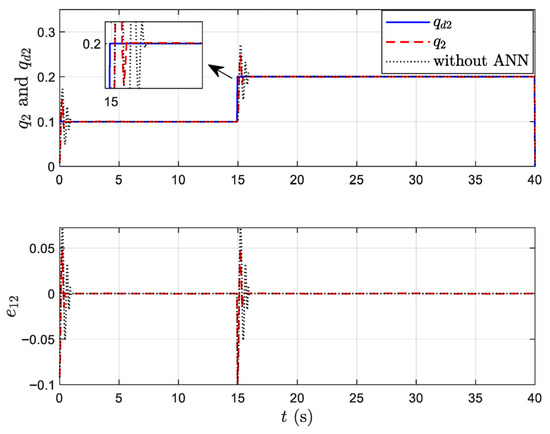
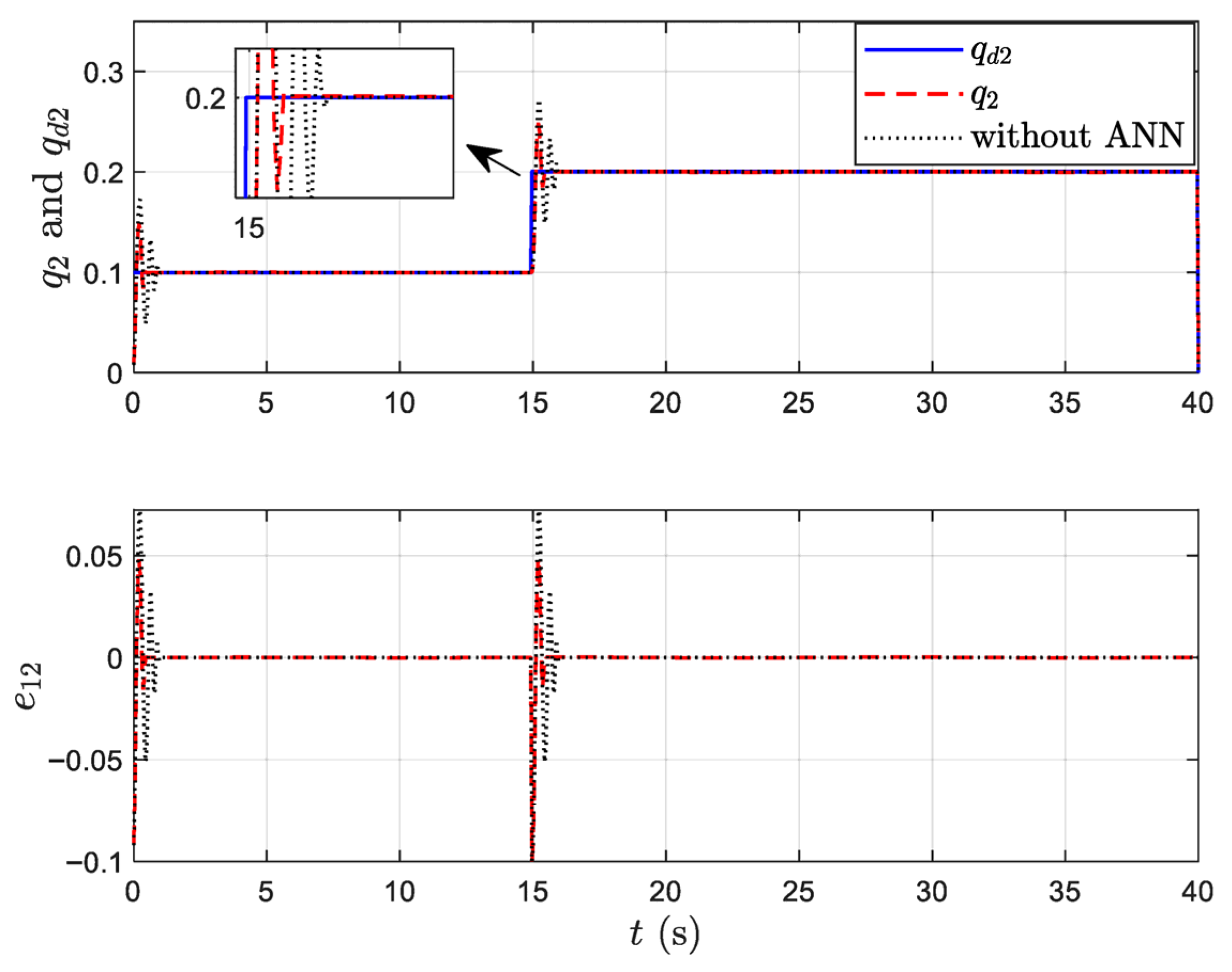
The simulation results are shown in Figure 2, Figure 3, Figure 4, Figure 5, Figure 6, Figure 7, Figure 8 and Figure 9. The comparison curves of position tracking and tracking error are shown in Figure 2 and Figure 3. Both control strategies can be implemented with good tracking performance within the influence of model uncertainty and external nonlinear disturbances. It is obvious that the tracking error in this article converges to near zero within approximately 0.15 s, and its convergence time is included in the upper bound value . From the simulation results in Figure 2, it can be seen that when the initial state of the system is far from the equilibrium point, the tracking performance of the controller proposed in this paper is better than that of the comparative controller. When a composite control combining a fixed time sliding surface and neural network compensation is adopted, the response time of the system is faster, and the impact of system uncertainty can be effectively reduced. The control inputs are presented in Figure 4. The torque response curves of the two joints are smooth and without any back-and-forth crossing phenomenon, which demonstrates that the system runs smoothly without chattering.
Figure 2.
Trajectory tracking and error of joint 1.
Figure 3.
Trajectory tracking and error of joint 2.
Figure 4.
Control inputs for joints 1 and 2.
Figure 5.
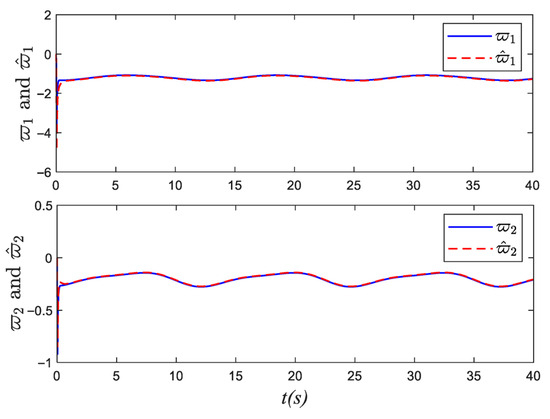
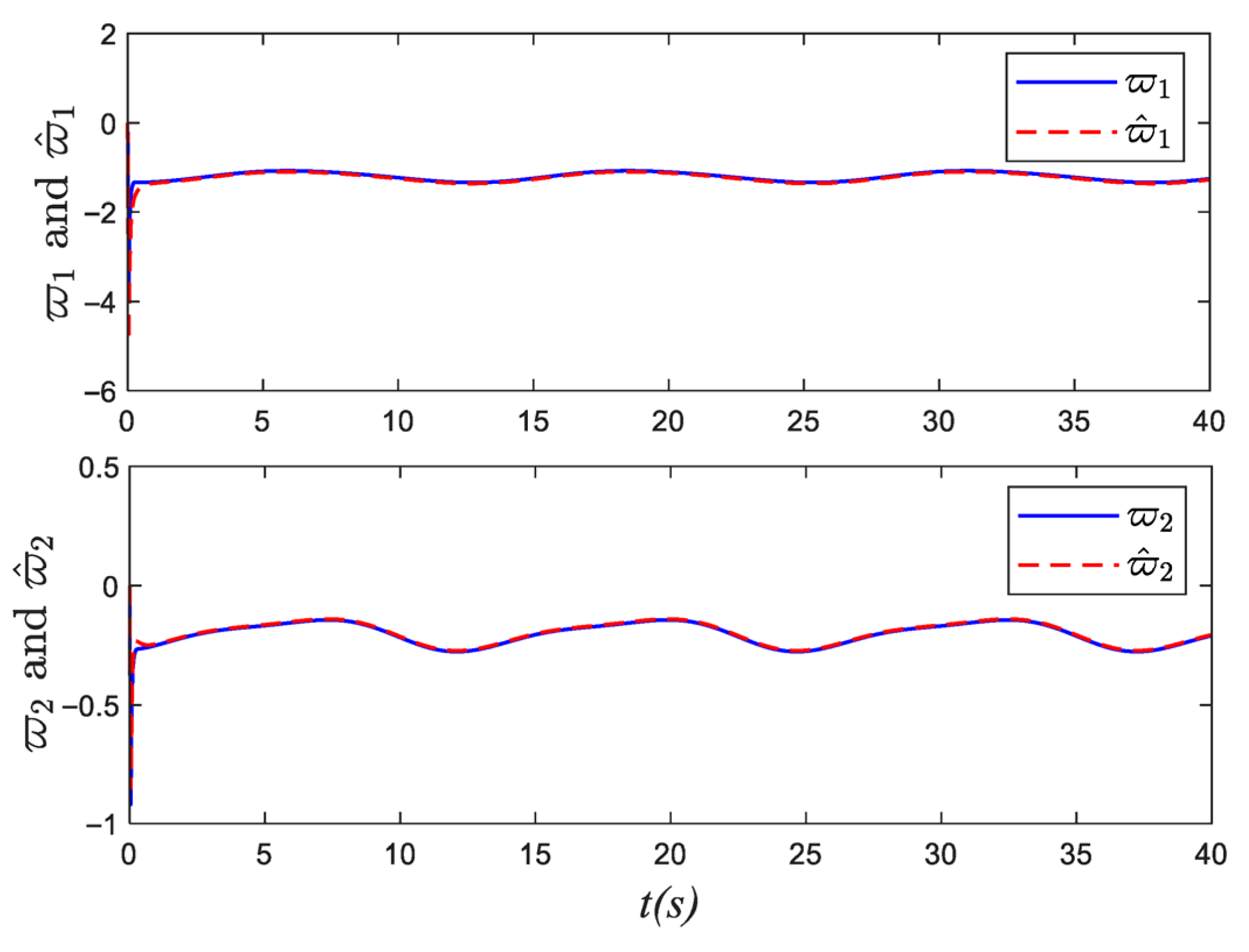
Composite disturbances and estimated values of joints 1 and 2.
Figure 6.
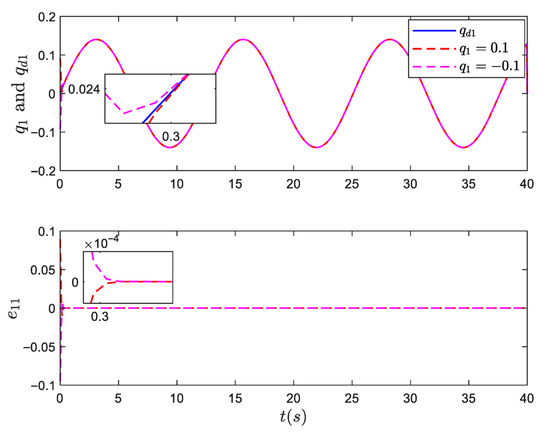
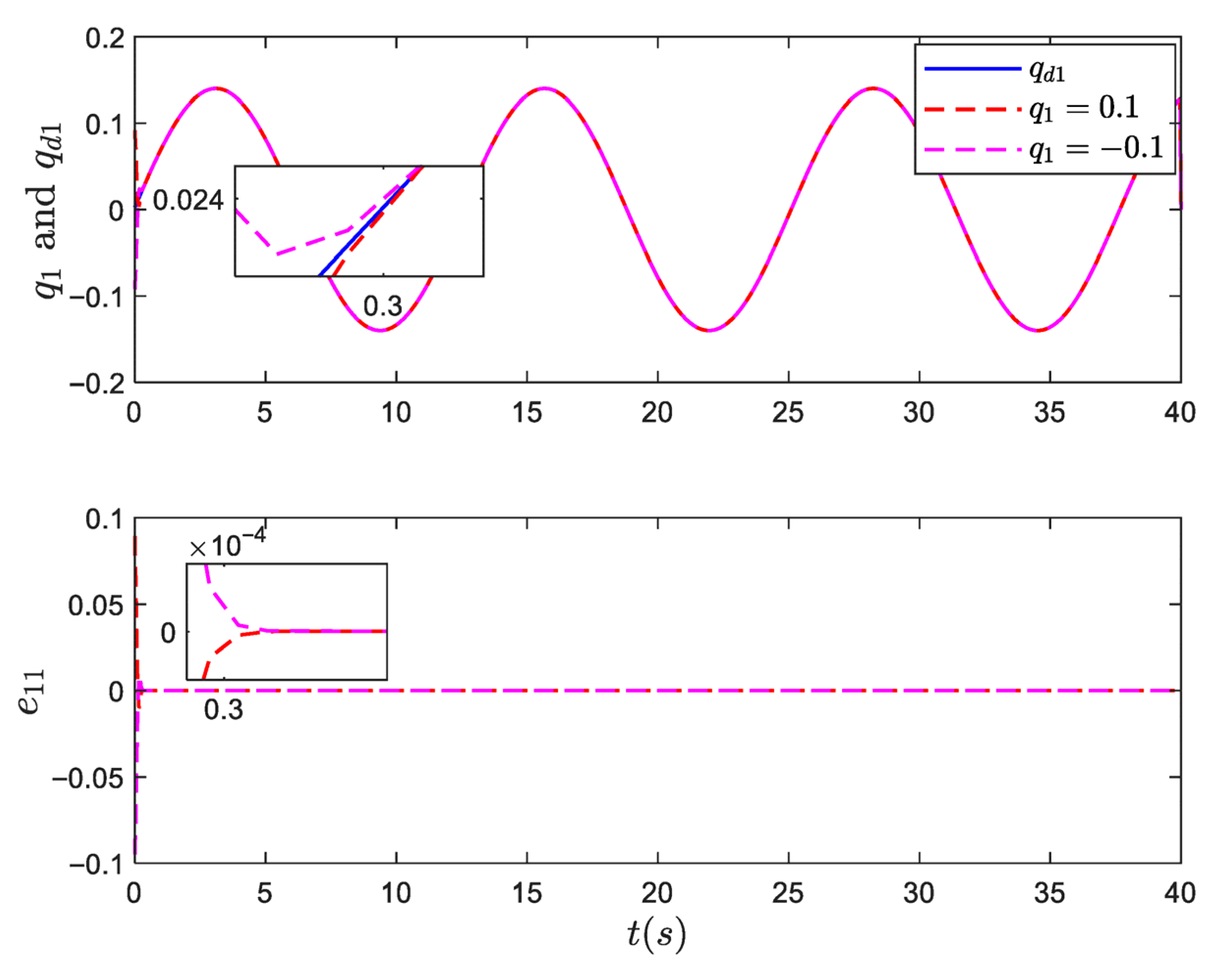
Trajectory tracking and error of joint 1 in different initial states.
Figure 7.
Trajectory tracking and error of joint 2 in different initial states.
Figure 8.
Trajectory tracking and error of joint 1 with two methods.
Figure 9.
Trajectory tracking and error of joint 2 with two methods.
Table 1 presents the response characteristics of the two joints under different methods. From the data in Table 1, there is a smaller steady-state error in the developed controller as compared to the nonsingular terminal sliding mode control. Further analysis shows that the proposed method provides a fast recovery time and there is no positional deviation in subsequent tracking.
Table 1.
Response characteristics of a two-link robotic manipulator: (a) Link 1 and (b) Link 2, where , , and denote the rise time, settling time, and steady-state error, respectively.
The true value of the composite disturbance and the estimated output value of the neural network are shown in Figure 5. The uncertainty of dynamic models and external disturbances can be effectively estimated through neural networks and compensated for by controllers. The results indicate that the observation error can converge to the zero domain in a relatively short time.
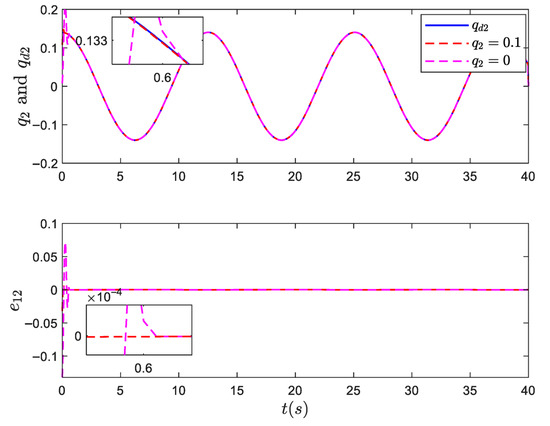
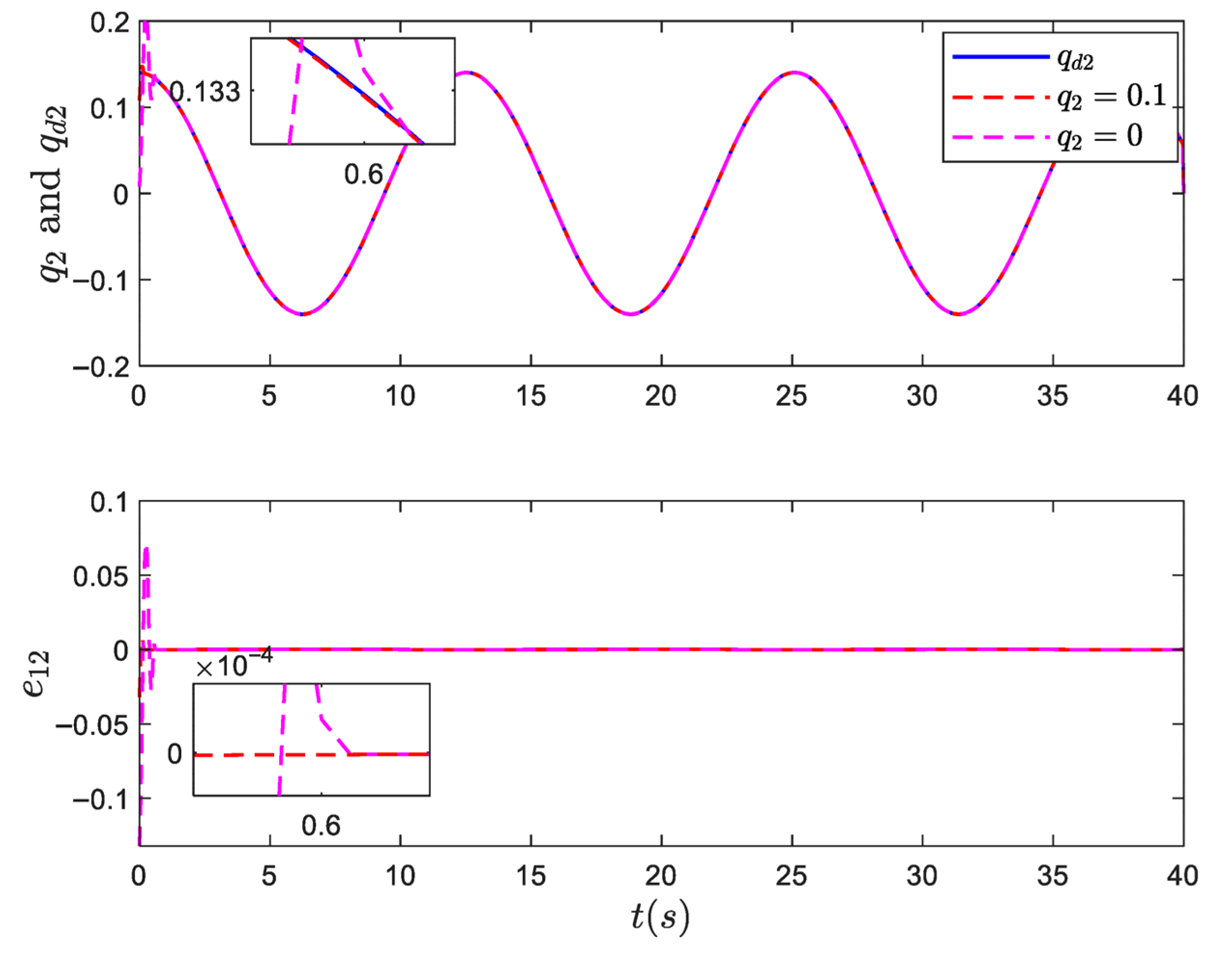
In addition, to validate that the convergence time of the system under the designed control law (20) is independent of the initial state, different initial states are set and . The simulation results are described in Figure 6 and Figure 7, with an error convergence time of around 0.6s, which is included in the upper bound value .
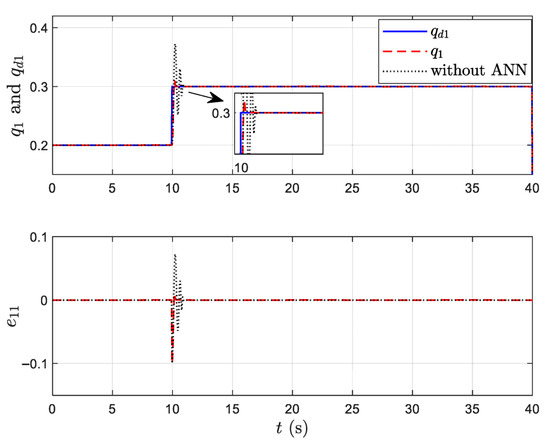
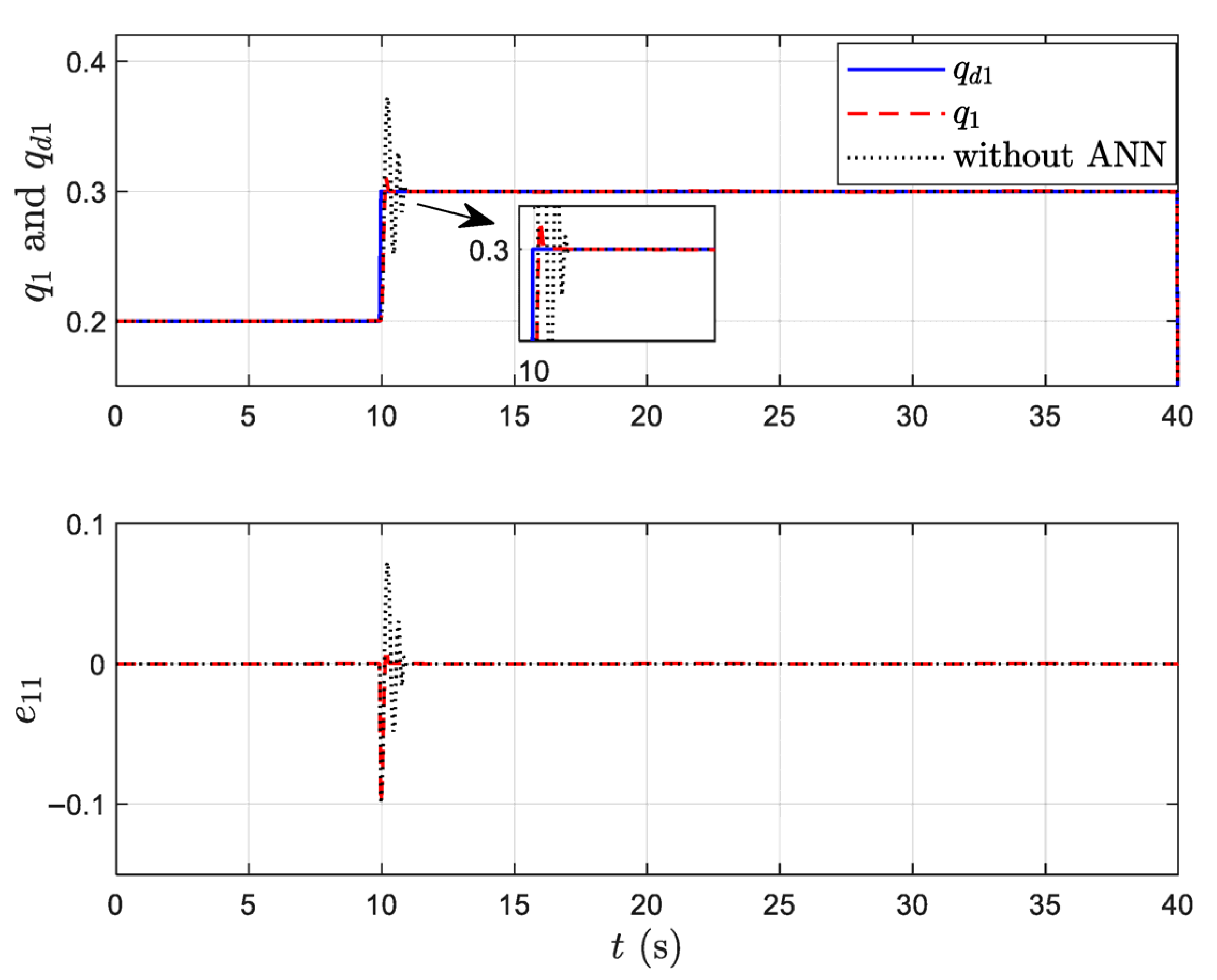
Figure 8 and Figure 9 show the tracking performance of two methods. The tracking curve of the controller in this article is red, and the one without an adaptive neural network (ANN) is black. From the data in the figure, it can be seen that by using an ANN, the tracking time can be shortened. At the step time, the error of the proposed method briefly increases and then converges quickly to near zero, while the error fluctuation of the comparative method is greater and the convergence speed is slower. For fluctuations at the step, the trajectory slope transition before the step can be increased. In future research, feedforward processing can be applied to neural networks to eliminate learning delays.
6. Conclusions
In this work, a fixed-time sliding mode control method based on neural network compensation was studied for path tracking control of n-joint robotic manipulators with model parameter perturbations and environmental disturbances. To achieve the control objective, a fixed-time convergent sliding mode controller is designed, which ensures that the actual angle tracks the desired trajectory within a fixed time. Subsequently, the uncertain parts of the model and external nonlinear disturbances are treated as composite disturbances, and an adaptive neural network is used for online approximation and compensation. The system tracking error can converge to zero within a fixed time, as proven by the Lyapunov stability theorem. Uncertainty can be estimated online by adaptive neural networks, which reduces reliance on “conservative upper bounds” and further reduces control input chattering. Once the system state reaches the sliding surface, it remains invariant to external disturbances and parameter perturbations. The dynamic characteristics of the system tracking error are reflected by the sliding surface , and the neural network weight adaptive update is based on the sliding mode error. Neural networks focus on “correcting tracking bias” to avoid blind learning without targets and improve tracking efficiency. Finally, the effectiveness of the designed controller is verified through simulation. The advantages of this study can provide an idea for tasks such as strong, robust assembly and sorting. As an extension of this work, it would be very attractive to consider adapting single manipulator control to multi-manipulator task space collaborative trajectory tracking through distributed neural sliding mode control.
Author Contributions
Conceptualization, D.M. and J.L.; methodology, D.M. and T.L.; software, D.M. and L.R.; validation, T.L., M.I.S. and J.L.; formal analysis, D.M.; investigation, D.M. and M.I.S.; resources, D.M. and J.L.; data curation, T.L.; writing—original draft preparation, D.M.; writing—review and editing, D.M. and T.L.; visualization, D.M. and L.R.; supervision, M.I.S. and J.L.; project administration, D.M.; funding acquisition, J.L. All authors have read and agreed to the published version of the manuscript.
Funding
This research was funded by the Natural Science Research Project of Anhui Provincial Department of Education titled “Research and Optimization of Kinematic Stability of Eight Link Stamping Mechanisms” (No. 2023AH052823), the research is supported by Anhui Province University Research Project-Key Natural Science Project “Research on large-scale photovoltaic component cleaning robot based on big data technology and its comprehensive intelligent control platform” (No. 2024AH050597).
Data Availability Statement
All data used to support the findings of this study are included within the article.
Conflicts of Interest
The authors declare no conflicts of interest.
References
- Wang, Q.; Xu, W.; Leng, Z. Adaptive event-triggered anti-windup trajectory tracking control for robotic manipulator. ISA Trans. 2025, 167, 1137–1146. [Google Scholar] [CrossRef] [Scilit] [PubMed]
- Halamka, V.; Zavřel, J.; Hrabačka, M.; Beneš, P.; Bulín, R.; Hajžman, M.; Šika, Z. Control strategies for enhancing manipulability in tensegrity-based redundant robots and manipulators. Nonlinear Dyn. 2025, 113, 11647–11667. [Google Scholar] [CrossRef] [Scilit]
- Muñoz-Vázquez, A.J.; Sánchez-Torres, J.D.; Jiménez-Rodríguez, E.; Loukianov, A.G. Predefined-Time Robust Stabilization of Robotic Manipulators. IEEE/ASME Trans. Mechatron. 2019, 24, 1033–1040. [Google Scholar] [CrossRef] [Scilit]
- Feng, Q.; Li, Z.; Cai, J.; Guo, D. Acceleration-Level Configuration Adjustment Scheme for Robot Manipulators. IEEE Trans. Ind. Inform. 2021, 17, 147–157. [Google Scholar] [CrossRef] [Scilit]
- Di Paola, V.; Goldsztejn, A.; Zoppi, M.; Caro, S. Design of a Sliding Mode-Adaptive Proportional-Integral-Derivative Control for Aerial Systems with a Suspended Load Exposed to Wind Gusts. ASME. J. Comput. Nonlinear Dynam 2023, 18, 061008. [Google Scholar] [CrossRef] [Scilit]
- Romero, J.G. A robust adaptive velocity observer for mechanical systems transformed in cascade form. Acta Autom. Sin. 2024, 165, 111671. [Google Scholar] [CrossRef] [Scilit]
- Li, T.; Zhang, G.; Zhang, T.; Pan, J. Adaptive Neural Network Tracking Control of Robotic Manipulators Based on Disturbance Observer. Processes 2024, 12, 499. [Google Scholar] [CrossRef] [Scilit]
- Chen, Z.; Liang, Q.; Wei, Z.; Chen, X.; Shi, Q.; Yu, Z.; Sun, T. An Overview of In Vitro Biological Neural Networks for Robot Intelligence. Cyborg Bionic Syst. 2023, 4, 0001. [Google Scholar] [CrossRef] [Scilit]
- Zhang, R.; Chen, Q.; Guo, H. Chebyshev neural network-based adaptive nonsingular terminal sliding mode control for hypersonic vehicles. Math. Probl. Eng. 2020, 2020, 6830141. [Google Scholar] [CrossRef] [Scilit]
- Fu, K.; Dang, X. Light-Weight Convolutional Neural Networks for Generative Robotic Grasping. IEEE Trans. Ind. Inform. 2024, 20, 6696–6707. [Google Scholar] [CrossRef] [Scilit]
- He, W.; Ge, S.S.; Li, Y.; Chew, E.; Ng, Y.S. Neural Network Control of a Rehabilitation Robot by State and Output Feedback. J. Intell. Robot. Syst. 2015, 80, 15–34. [Google Scholar] [CrossRef] [Scilit]
- Yu, X.; He, W.; Xue, C.; Sun, Y.; Sun, C. Disturbance observer-based adaptive neural network tracking control for robots. Acta Autom. Sin. 2019, 45, 1307–1324. [Google Scholar]
- Men, X.; Guo, C. Adaptive composite control of an upper limb compliant exoskeleton robot based on RBF neural network. Control Eng. China 2023, 32, 586–594. [Google Scholar]
- Zhao, X.; Liu, Z.; Cao, C. Adaptive Neural Network-based Sliding Mode Controller Design for Manipulator Systems. Control Eng. China 2023, 30, 1624–1629. [Google Scholar]
- Liang, X.; Wang, H.; Zhang, Y. Adaptive nonsingular terminal sliding mode control for rehabilitation robots. Comput. Electr. Eng. 2022, 99, 107718. [Google Scholar] [CrossRef] [Scilit]
- Li, T.; Zhang, G.; Zhang, T.; Pan, J. Fixed-Time Sliding Mode Control for Robotic Manipulators Based on Disturbance Observer. Int. J. Aerosp. Eng. 2024, 2024, 1263459. [Google Scholar] [CrossRef] [Scilit]
- Gao, Z.; Guo, G. Fixed-time formation control of AUVs based on a disturbance observer. Acta Autom. Sin. 2019, 45, 1094−1102. [Google Scholar]
- Zhang, Z.; Sheng, A.; Qi, G.; Li, Y. Finite-time standoff tracking control of moving target by means of backstepping for non-holonmic robot. Acta Autom. Sin. 2019, 45, 540–552. [Google Scholar]
- Bao, J.; Wang, H.; Liu, X. Adaptive finite-time tracking control for robotic manipulators with funnel boundary. Int. J. Adapt. Control Signal Process. 2020, 34, 575–589. [Google Scholar] [CrossRef] [Scilit]
- Zhang, P.; Li, H.; Chen, B.; Wang, J.; Zhang, H. A novel ultra-local model-based finite time synergetic robustness control for uncertain robotic manipulators. J. Frankl. Inst. 2024, 361, 107362. [Google Scholar] [CrossRef] [Scilit]
- Liu, Y.; Xiong, Y.; Yang, H. Fixed-time sliding mode control of multi-joint robot based on RBF neural network. Control Decis. 2022, 37, 2790–2798. [Google Scholar]
- Cao, S.; Sun, L.; Jiang, J.; Zuo, Z. Reinforcement Learning-Based Fixed-Time Trajectory Tracking Control for Uncertain Robotic Manipulators with Input Saturation. IEEE Trans. Neural Netw. Learn. Syst. 2023, 34, 4584–4598. [Google Scholar] [CrossRef] [Scilit] [PubMed]
- Jiang, S.; Song, Y.; Zeng, W.; Zhang, H.; Cai, S.; Lu, X. New results on adaptive fixed-time control for convex-delayed neural networks. ISA Trans. 2023, 134, 134–143. [Google Scholar] [CrossRef] [Scilit] [PubMed]
- Abdurahman, A.; Tohti, R.; Li, C. New results on fixed-time synchronization of impulsive neural networks via optimized fixed-time stability. J. Appl. Math. Comput. 2024, 70, 2809–2826. [Google Scholar] [CrossRef] [Scilit]
- Sun, W.; Guo, W.; Li, B.; Wen, S.; Cao, J.; Abdel-Aty, M. Finite/Fixed-Time Controls of Neural Networks in a Signed Graph. IEEE Trans. Syst. Man. Cybern. Syst. 2024, 54, 1049–1058. [Google Scholar] [CrossRef] [Scilit]
- Wu, Y.; Niu, W.; Kong, L.; Yu, X.; He, W. Fixed-time neural network control of a robotic manipulator with input deadzone. ISA Trans. 2023, 135, 449–461. [Google Scholar] [CrossRef] [Scilit]
- Gu, R.; Han, T.; Xiao, B.; Zhan, X.; Yan, H. Task-space tracking for networked heterogeneous robotic systems via adaptive neural fixed-time control. ISA Trans. 2024, 155, 184–192. [Google Scholar] [CrossRef] [Scilit]
- Zuo, Z.; Han, Q.; Ning, B.; Ge, X.; Zhang, X. An overview of recent advances in fixed-time cooperative control of multiagent systems. IEEE Trans. Ind. Inform. 2018, 14, 2322–2334. [Google Scholar] [CrossRef] [Scilit]

Disclaimer/Publisher’s Note: The statements, opinions and data contained in all publications are solely those of the individual author(s) and contributor(s) and not of MDPI and/or the editor(s). MDPI and/or the editor(s) disclaim responsibility for any injury to people or property resulting from any ideas, methods, instructions or products referred to in the content. |
© 2026 by the authors. Licensee MDPI, Basel, Switzerland. This article is an open access article distributed under the terms and conditions of the Creative Commons Attribution (CC BY) license.