


Abstract
This study investigates the Lower Cretaceous Madongshan Formation in the Liupanshan Basin, a classic saline lacustrine succession, to elucidate the key mechanisms for high-quality source rock development. An integrated approach combining organic geochemistry (Rock-Eval, Gas Chromatography–Mass Spectrometry [GC-MS], δ13C) and inorganic elemental geochemistry (X-ray Fluorescence [XRF]) was applied to a well-characterized outcrop section. The results reveal that the Madongshan Formation contains mature, oil-prone source rocks dominated by Type II1 and II2 kerogen. Geochemical proxies consistently indicate deposition within an arid to semi-arid climate, which drove the formation of a stratified, saline-to-hypersaline water column with persistent bottom-water anoxia (Pristane/Phytane [Pr/Ph] < 0.5). Isotopic and biomarker data confirm a mixed source input, with an average contribution of approximately 55% from aquatic organisms supplemented by a significant terrestrial influx. Based on these findings, we propose a “Salinity-Driven Preservation” model. This model posits that climate-induced salinity played a critical role in establishing a persistent halocline, leading to an intensely anoxic “preservation factory” at the lake bottom. Current evidence suggests that this exceptional preservation efficiency was a pivotal factor compensating for moderate productivity to control organic matter enrichment. This study provides a robust framework for predicting source rock quality in the Liupanshan Basin and serves as a valuable analogue for other saline lacustrine systems.
1. Introduction
Cretaceous lacustrine deposits are a significant source of hydrocarbons globally [1], with saline lacustrine systems, in particular, representing unique yet complex petroleum provinces [2]. In such systems, the interplay between primary productivity and preservation conditions is fundamentally different from that in freshwater or marine environments. For instance, while salinity-induced water column stratification can create anoxic bottom waters that enhance organic matter preservation [3,4], hypersalinity may simultaneously suppress primary productivity [5], creating a delicate and often poorly understood balance. Current debates center on whether organic enrichment in such systems is primarily productivity-driven or preservation-dominated [6,7]. This knowledge gap presents a significant challenge for hydrocarbon exploration in these settings.
The Liupanshan Basin in northern China, a tectonic junction preserving a thick succession of Cretaceous lacustrine strata, provides an excellent natural laboratory to investigate these processes. The Lower Cretaceous Madongshan Formation, in particular, comprises (>200 m thick) unit of organic-rich shales and calcareous mudstones with widespread hydrocarbon shows [8,9]. Despite its recognized potential, multi-stage tectonic overprinting and a limited understanding of source rock heterogeneity have hampered conventional exploration efforts in the basin [10]. However, recent unconventional exploration, including the discovery of oil and gas shows in wells such as Gucan-1, has renewed interest in the Madongshan Formation as a primary exploration target [8]. Previous research on the Madongshan Formation has laid a crucial foundation but has often focused on individual aspects of the petroleum system. For example, some studies have highlighted the importance of sedimentation rates or terrestrial organic matter input [11,12], while others have emphasized the role of water stratification in preservation [9]. However, a systematic investigation that integrates these multiple controlling factors is still lacking. Critically, the causal links between the overarching arid climate, the hydrochemical dynamics of the saline lake, and the specific mechanisms of organic matter enrichment have not been fully elucidated. It remains unclear precisely how the interplay between productivity and preservation under fluctuating saline conditions governed the development of the most effective source rocks.
To address this gap, this study presents an integrated sedimentological and geochemical investigation of the Madongshan Formation. By combining bulk organic geochemistry (Total Organic Carbon [TOC], Rock-Eval), molecular biomarker analysis (GC-MS), and inorganic elemental proxies (XRF) [13], we aim to: (1) comprehensively evaluate the source rock potential; (2) systematically reconstruct the paleoenvironmental conditions, with a focus on paleoclimate and paleosalinity; and (3) deconvolve the controlling factors on organic matter enrichment. Ultimately, we establish a new geological model that clarifies the unique mechanisms of source rock formation in this saline lacustrine system, providing a robust scientific basis for future hydrocarbon exploration in the Liupanshan Basin and other similar settings.
2. Geological Background
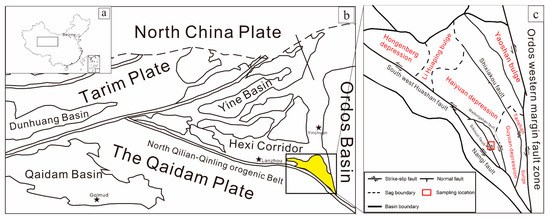
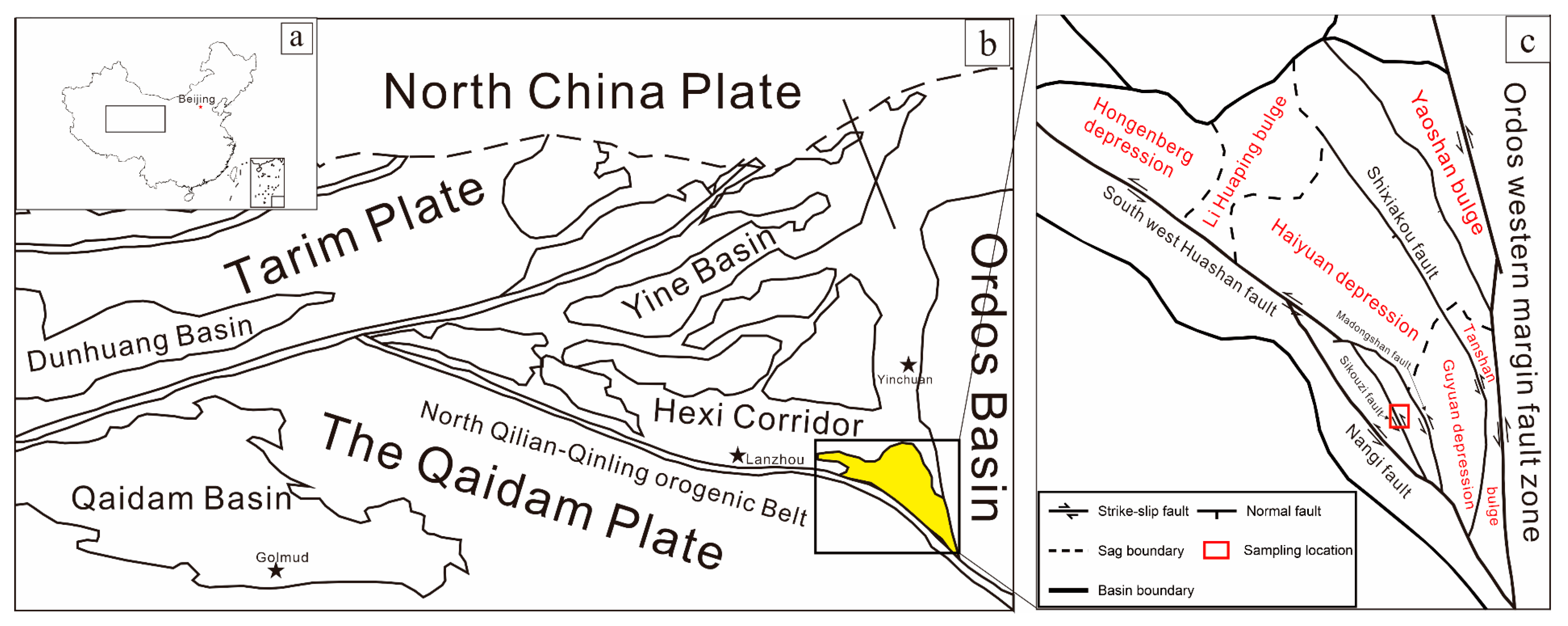
The Liupanshan Basin, situated in the Ningxia Hui Autonomous Region of China, is a Meso-Cenozoic, multi-cycle superimposed basin of significant hydrocarbon potential. Tectonically, it occupies a critical junction between the Alxa Block, the Ordos Block, and the North Qilian Fold Belt (Figure 1) [9]. Developed on a Proterozoic to Lower Paleozoic basement, the basin has undergone a complex tectonic history that includes an initial cratonic stage (Carboniferous–Triassic), a key phase of fault-controlled basin development (Jurassic–Cretaceous), and a final stage of foreland basin formation (Paleogene–Quaternary) [14]. The sedimentary fill is thus dominated by Mesozoic strata, primarily of Jurassic and Cretaceous age. Due to a major regional uplift and erosion event from the Late Cretaceous to the Paleocene, the preserved succession is mainly composed of Lower Cretaceous strata. This sequence is stratigraphically divided, in ascending order, into the Sanqiao (K1s), Shangpu (K1h), Liwaxia (K1l), Madongshan (K1m), and Naijiahe (K1n) formations [15].
Figure 1.
Geological setting and sampling location of the Madongshan Formation in the Liupanshan Basin. (a) Index map showing the location of the Liupanshan Basin within China. (b) Regional tectonic framework showing the location of the study area (yellow polygon) relative to adjacent tectonic plates and basins. (c) Tectonic sketch of the Liupanshan Basin, illustrating the major structural elements and the sampling location (red box). The base map for panel (a) was generated using QGIS software (version 3.22; https://qgis.org/) with public domain data (Projection: WGS84 (EPSG:4326)) from Natural Earth (www.naturalearthdata.com). The geological maps in panels (b,c) were compiled based on previous studies and internal data.
3. Materials and Methods
The focus of this study is the Madongshan Formation (K1m), which represents the most widely distributed and organic-rich interval within the Lower Cretaceous. It is conformably overlain by the Naijiahe Formation and underlain by the Liwaxia Formation, and consists of a thick succession (>200 m on average) of dark, organic-rich shales and calcareous mudstones. During the deposition of the Madongshan Formation, the basin center was characterized by a range of lacustrine environments, transitioning from shallow-lake to deep-lake facies, while deltaic systems developed along the basin margins [9].
3.1. Geological Setting and Sampling
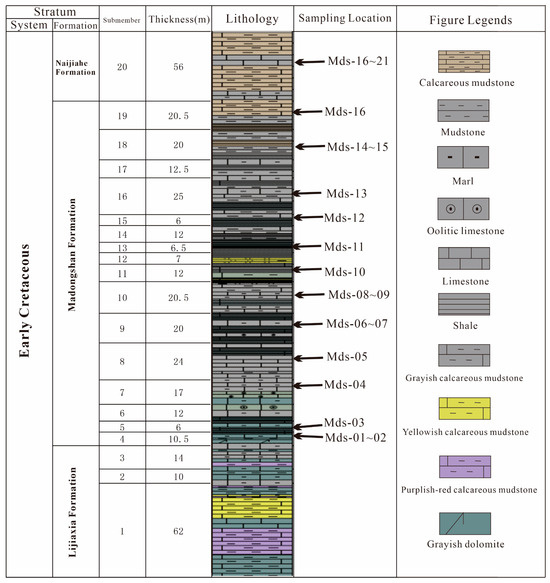
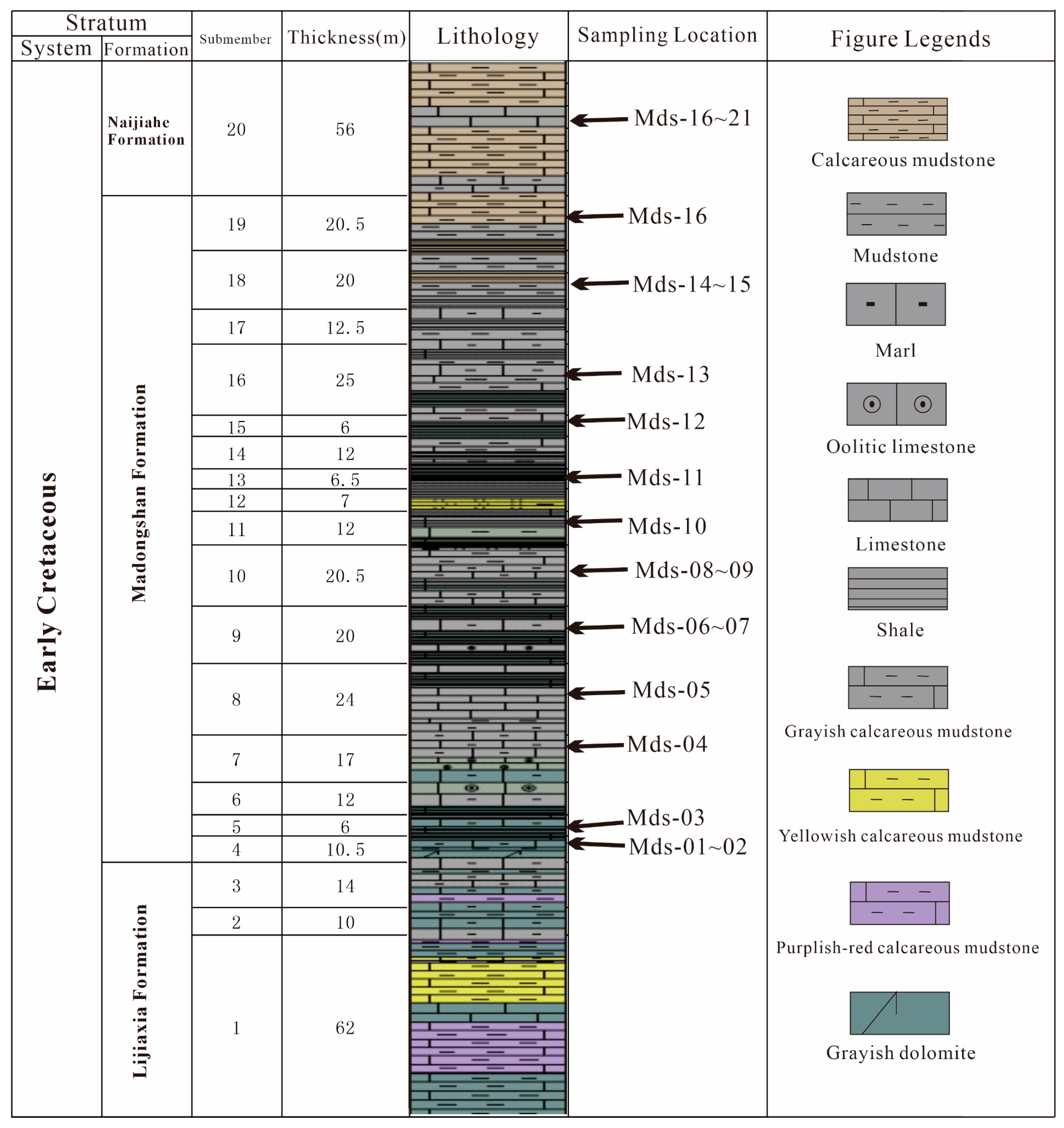
A total of 21 fresh shale and mudstone samples were collected from a well-exposed outcrop section of the Cretaceous Madongshan Formation near the Sikouzi Reservoir, Guyuan City, Liupanshan Basin, China (see Figure 1c for location), to ensure data reliability, weathered surfaces were removed to obtain fresh bedrock samples. The sampling was conducted at irregular intervals (averaging ~10 m) based on lithological variations to ensure comprehensive coverage of the formation. The lithology of this section, identified based on detailed field outcrop observations and confirmed by major element characteristics, is characterized by interbedded variegated mudstone, gray marl, and tan calcareous shale. Samples were collected in ascending stratigraphic order, representing the lithological variations throughout the formation (Figure 2).
Figure 2.
Lithostratigraphic column of the Early Cretaceous Madongshan Formation in the Liupanshan Basin. The column details the vertical succession of lithologies, defined submembers, thicknesses, and the precise stratigraphic positions of the analyzed samples.
3.2. Geochemical Analyses
All collected samples (n = 21) were subjected to total organic carbon (TOC) content and major element analysis. Based on the TOC results and lithological characteristics, a subset of four samples was strategically selected as representative proxies to cover the key lithofacies, distinct sedimentary facies (ranging from semideep to deep lacustrine settings), and the full spectrum of organic richness observed in the formation. Specifically, these samples include: Mds-03 (Marl, TOC 0.13%), representing the organic-lean baseline deposited in a semi-deep lake environment; Mds-14 (Shale, TOC 1.87%), representing typical high-quality source rocks deposited in a deep lacustrine setting; and Mds-05/06 (Calcareous Shale, TOC 1.92–2.76%), representing the distinct lithofacies (calcareous shale) that characterizes the primary high-quality source rock intervals in the formation. Stratigraphically, these samples are distributed across the lower, middle, and upper intervals of the formation (Figure 2). These representative samples were then subjected to more detailed molecular organic geochemical analyses, including Rock-Eval pyrolysis, bitumen extraction, and biomarker analysis via gas chromatography-mass spectrometry (GC-MS).
3.3. Bulk Geochemistry
3.3.1. TOC Content and Major Elements
Prior to analysis, all samples were crushed to a powder of approximately 100 mesh (<0.15 mm). For TOC analysis, an aliquot of each powdered sample was treated with excess 10% hydrochloric acid (HCl; Sinopharm Chemical Reagent Co., Ltd., Shanghai, China) at 60 °C to remove carbonate minerals. The carbonate-free residues were then washed with distilled water until neutral and dried in an oven at 60 °C. The TOC content was determined using a LECO CS230 carbon/sulfur analyzer (LECO Corporation, St. Joseph, MI, USA) following the Chinese national standard GB/T 19145-2022 [16].
Major element concentrations were determined on another aliquot of the bulk rock powder using X-ray fluorescence (XRF) spectrometry with a (Rigaku ZSX Primus II, Tokyo, Japan) instrument.
3.3.2. Rock-Eval Pyrolysis
Rock-Eval pyrolysis was performed on approximately 100 mg of powdered rock from the four selected samples using a Rock-Eval VI instrument (Vinci Technologies, Rueil-Malmaison, France) according to the standard GB/T 18602-2012 [17]. The analysis yielded several parameters, including the free hydrocarbons (S1, mg HC/g rock), remaining hydrocarbon generative potential (S2, mg HC/g rock), carbon dioxide yield from kerogen cracking (S3, mg CO2/g rock), and the temperature of maximum hydrocarbon generation (Tmax, °C). From these, the hydrogen index (HI = S2/TOC × 100, mg HC/g TOC) and the production index (PI = S1/(S1 + S2)) were calculated [18].
3.3.3. Vitrinite Reflectance (Ro) Measurement
The vitrinite reflectance measurements were conducted on polished rock-epoxy resin blocks. The samples were prepared in accordance with the ASTM D2797 standard [19]. Random reflectance values (%Ro) were measured using a Leica DM4500P petrographic microscope (Leica Microsystems, Wetzlar, Germany) equipped with a Craic MSP 400 micro-photometer (CRAIC Technologies, San Dimas, CA, USA) under oil immersion, following the ASTM D7708-14 standard for dispersed organic matter [20]. For each sample, at least 20 indigenous vitrinite particles were identified based on their optical properties (color, morphology, and reflectance intensity) to ensure statistical reliability, and the mean random reflectance was reported.
3.4. Molecular Geochemistry (Biomarkers)
3.4.1. Bitumen Extraction and Fractionation
The four selected powdered samples (approx. 50–100 g each) were solvent-extracted for 72 h using a Soxhlet apparatus with a mixture of dichloromethane (DCM) and methanol (93:7, v/v). After extraction, the solvent was removed using a rotary evaporator, and the total extractable organic matter (EOM, also known as bitumen) was obtained and weighed.
The EOM was subsequently fractiointo saturated hydrocarbons, aromatic hydrocarbons, and NSO compounds (resins and asphaltenes) using column chromatography. The EOM was dissolved in a minimum amount of n-hexane and loaded onto a glass column packed with activated silica gel and alumina. Saturated hydrocarbons were eluted using n-hexane, followed by aromatic hydrocarbons using a mixture of n-hexane and DCM (7:3, v/v).
3.4.2. Gas Chromatography-Mass Spectrometry (GC-MS)
The saturated hydrocarbon fractions were analyzed using an Agilent 6890N gas chromatograph (Agilent Technologies, Santa Clara, CA, USA) coupled to an Agilent 5975i mass spectrometer (Agilent Technologies, Santa Clara, CA, USA). The GC was equipped with a DB-5ms (or HP-5ms) fused-silica capillary column (30 m × 0.25 mm i.d. × 0.25 μm film thickness). Helium was used as the carrier gas at a constant flow rate of 1.0 mL/min. The GC oven temperature was programmed as follows: held at 80 °C for 2 min, ramped to 310 °C at a rate of 4 °C/min, and held at 310 °C for 20 min.
The mass spectrometer was operated in electron impact (EI) mode at 70 eV, with a source temperature of 230 °C. Data were acquired in full scan mode over a mass range of m/z 50–550. Biomarker compounds were identified by comparing their mass spectra and retention times with published literature and standard libraries [13].
3.5. Kerogen Isolation and Carbon Isotope Analysis
Kerogen Isolation: Prior to isotopic and elemental analysis, kerogen was isolated from the bulk rock samples to eliminate mineral interference. The samples were crushed to <200 mesh and treated successively with hydrochloric acid (HCl) to remove carbonates and hydrofluoric acid (HF; Sinopharm Chemical Reagent Co., Ltd., Shanghai, China) to remove silicates at a controlled temperature of 60 °C. The residues were thoroughly washed with distilled water until neutral and dried.
Isotope and Elemental Measurement: The isolated kerogen samples were analyzed for stable carbon isotopes (δ13C) and elemental composition (H/C ratios) using a Flash EA 1112 elemental analyzer (Thermo Fisher Scientific, Waltham, MA, USA) coupled to a Finnigan DELTA plus XP isotope ratio mass spectrometer (IRMS) (Thermo Fisher Scientific, Bremen, Germany). The δ13C values are reported in the standard per mil (‰) notation relative to the Vienna Peedee Belemnite (VPDB) standard, with an analytical precision of better than ±0.1‰.
3.6. Isotopic Mass Balance Calculation
To quantify the relative contributions of aquatic versus terrestrial organic matter, a standard two-component isotopic mass balance model was employed [21]. The bulk kerogen δ13C value of a sample (δsample) is assumed to be a linear mixture of an aquatic end-member (δaquatic) and a terrestrial end-member (δterrestrial), expressed as:
where faquatic is the fraction of the total organic carbon derived from aquatic organisms. By rearranging Equation (1), faquatic can be calculated directly:
For the practical calculation, the end-member values were selected based on established geochemical frameworks for lacustrine systems [22]. The aquatic end-member (δaquatic) was set at −28‰, a representative value for lacustrine algae. The terrestrial end-member (δterrestrial) was set at −22‰. While typical C3 plants average around −27‰, values can range up to −20‰ under water-stressed conditions. Given the arid paleoclimate inferred for the Madongshan Formation, this heavier value (−22‰) accounts for the likely 13C-enrichment in terrestrial vegetation due to aridity-induced stomatal closure.
The uncertainty of the calculated fraction (Δf) was evaluated using standard error propagation [21], which considers the analytical uncertainty of the end-member values (Δδaquatic and Δδterrestrial) as follows:
Following the conservative approach proposed by Brian Fry [23]. a variability of ±1.5‰ was assumed for both end-members in the uncertainty calculation.
4. Results
4.1. Geochemical Evaluation of Source Rocks
The hydrocarbon generation potential of the Madongshan Formation was evaluated based on the abundance, type, and thermal maturity of its organic matter.
4.1.1. Organic Matter Abundance
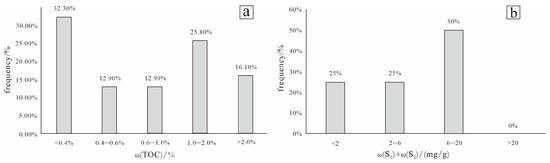
The Total Organic Carbon (TOC) contents of the 21 analyzed samples range from 0.13% to 3.44%, with an average of 1.11% (Figure 3a). The hydrocarbon potential (S1 + S2) values vary between 0.10 mg/g and 13.4 mg/g, averaging 7.4 mg/g (Figure 3b). For the four samples selected for solvent extraction, the chloroform bitumen “A” content ranges from 0.01% to 0.07%, with a mean of 0.05% (Table 1).
Figure 3.
Evaluation of organic matter richness and hydrocarbon potential for the Madongshan Formation source rocks. (a) Frequency distribution of Total Organic Carbon (TOC) contents. (b) Frequency distribution of the hydrocarbon potential (S1 + S2).
Table 1.
Key geochemical characteristics of the representative subset of source rock samples (n = 4) from the Madongshan Formation.
4.1.2. Organic Matter Type
For the effective source rock samples, the hydrogen index (HI) values of the samples are between 242.8 and 605.8 mg HC/g TOC. According to the group component analysis of the extractable organic matter, the saturated/aromatic hydrocarbon ratios are calculated to be between 4.68 and 6.48 (Table 1). The kerogen δ13C values range from −28.49‰ to −21.71‰, with a mean of −25.76‰.
4.1.3. Thermal Maturity
Multiple thermal maturity indicators were measured (Table 1). The vitrinite reflectance (Ro) values are tightly clustered between 0.80% and 0.84% (average 0.82%). The Rock-Eval Tmax values range from 442 °C to 445 °C, with an average of 443.6 °C. Additionally, the atomic H/C ratios of the kerogen were determined to be between 0.12 and 0.26 (average 0.19).
4.2. Major Element Geochemistry and Paleo-Weathering Conditions
The major element oxide compositions of the Madongshan Formation samples were determined by XRF analysis to investigate their provenance characteristics and paleo-weathering conditions (Table 2). The Chemical Index of Alteration (CIA) was calculated to quantify the degree of chemical weathering in the source area.
Table 2.
Major element compositions (wt.%) and calculated Chemical Index of Alteration (CIA) values for the Madongshan Formation samples (n = 21).
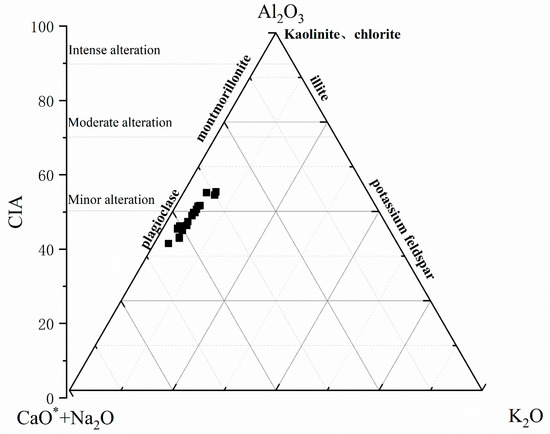
The CIA values were calculated using molecular proportions of the oxides according to the formula of Nesbitt and Young (1982) [26]: CIA = 100 × [Al2O3]/([Al2O3] + [CaO*] + [Na2O] + [K2O]), where [] denotes the molecular proportion. A correction for CaO was applied to account for carbonate and phosphate contributions, following the method of McLennan (1993) [27]. Specifically, CaO was first corrected for apatite using P2O5. If the remaining CaO exceeded Na2O, CaO was set equivalent to Na2O to minimize the influence of carbonate-derived calcium. Therefore, in the calculation formula, CaO* represents only the calcium oxide related to the silicate component. The corrected CIA values for the Madongshan Formation samples range from 28.33% to 64.88%, with an average of 41.67%. Generally, CIA values of 50–65 suggest incipient or weak weathering, 65–85 indicate moderate weathering, and values > 85 signify intense chemical weathering under humid conditions. Considering that fresh upper continental crust materials typically have CIA values around 50 [27,28], the low average value indicates that the source rocks supplied to the basin were, on the whole, subjected to a very low degree of chemical weathering. This observation is consistent with the arid to semi-arid climatic conditions generally inferred for saline lacustrine basin settings.
4.3. Biomarker Characteristics of Source Rocks
The biomarker compositions of the saturated hydrocarbon fractions were analyzed by GC-MS to characterize the organic matter source input and depositional conditions. The distributions of n-alkanes, terpanes, and steranes are described below.
4.3.1. n-Alkanes, Pristane, and Phytane
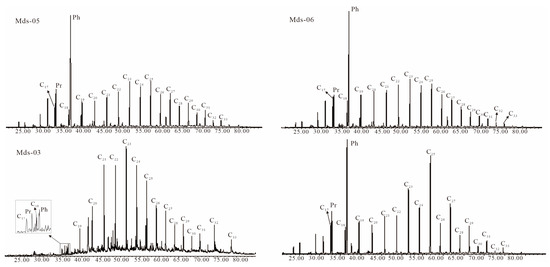
The m/z 85 mass fragmentograms show that the n-alkanes in the analyzed samples exhibit a unimodal distribution, ranging from n-C15 to n-C33 with a maximum peak at either n-C23 or n-C25 (Figure 4). A slight odd-over-even predominance is observed [28], with Carbon Preference Index (CPI) values ranging from 1.04 to 1.33. Pristane (Pr) and phytane (Ph) are present in all samples, with a pronounced dominance of phytane. This is reflected in the very low Pr/Ph ratios [29,30], which range from 0.08 to 0.28.
Figure 4.
Representative m/z 85 mass fragmentograms of saturated hydrocarbon fractions, illustrating the distribution of n-alkanes in selected samples from the Madongshan Formation. Numbers denote the carbon number of n-alkanes. Pr = pristane; Ph = phytane.
4.3.2. Terpanes and Hopanes
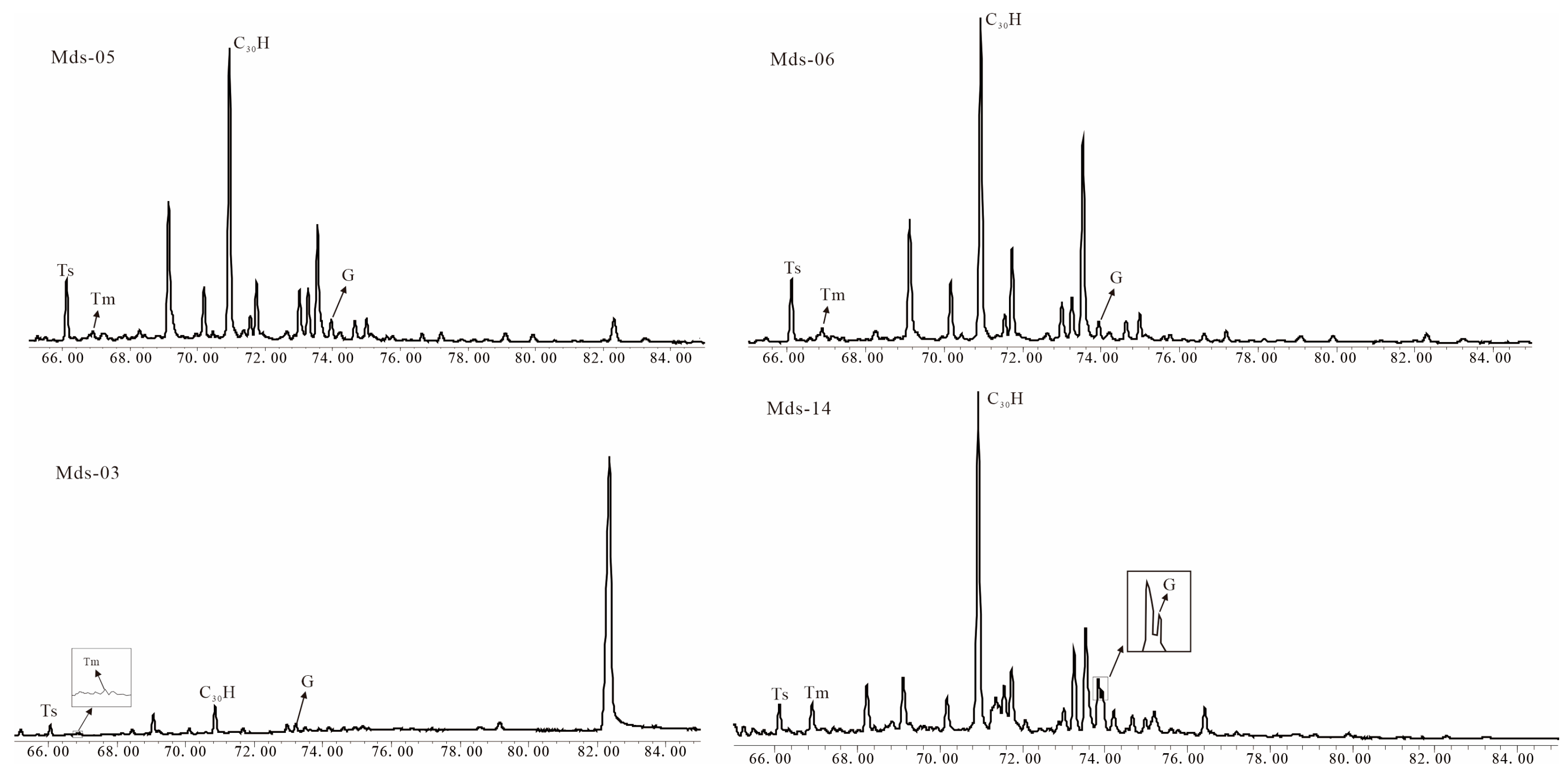
The terpane distributions are revealed in the m/z 191 mass fragmentograms (Figure 5). The C27 18α(H)-trisnorneohopane (Ts) is typically more abundant than its 17α(H) counterpart (Tm), except in sample Mds-14. The C30 17α(H),21β(H)-hopane is the most abundant peak in the hopane series for all samples. Gammacerane is also detected in all four representative samples, with the Gammacerane/C30 hopane ratio (Gammacerane Index [31]) calculated to be between 0.15 and 0.64.
Figure 5.
Representative m/z 191 mass fragmentograms of saturated hydrocarbon fractions, illustrating the distribution of terpanes in selected samples from the Madongshan Formation. Peak identifications are as follows: Ts = C27 18α(H)-22,29,30-trisnorneohopane; Tm = C27 17α(H)-22,29,30-trisnorhopane; G = gammacerane.
4.3.3. Steranes
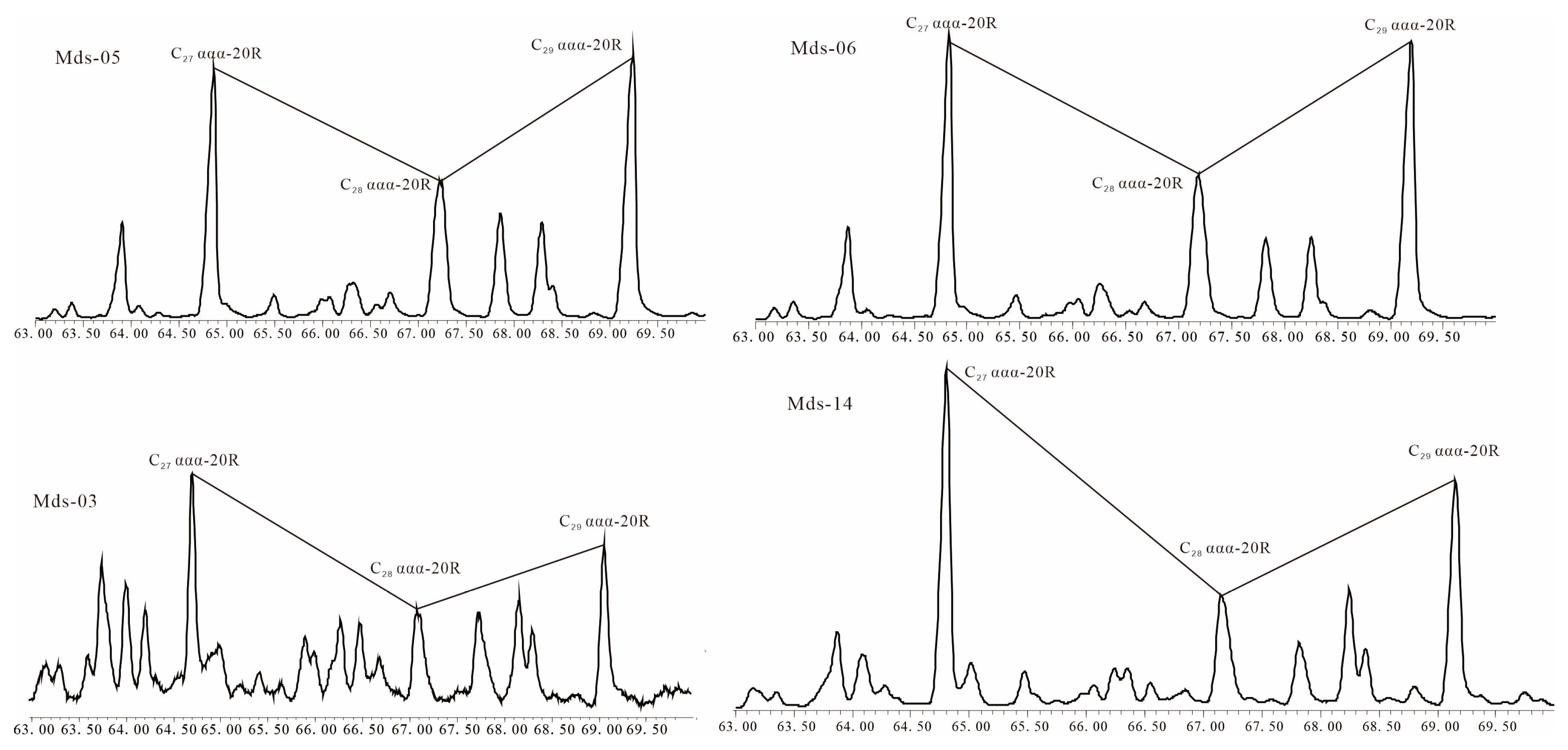
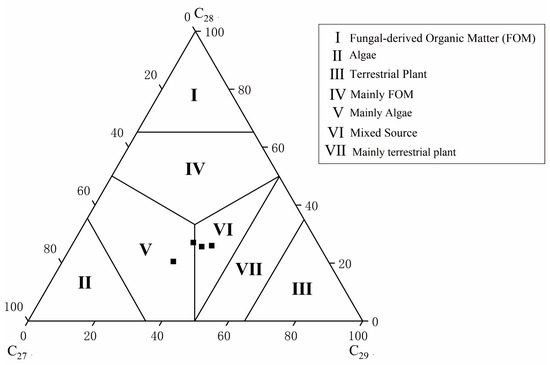
The distribution of C27–C29 regular steranes, identified in the m/z 217 mass fragmentograms, exhibits a distinctive ‘V-shaped’ distribution pattern, where C27 steranes are less abundant than C28 and C29 steranes (Figure 6). Maturity-sensitive sterane isomerization ratios were also determined. The C29 20S/(20S + 20R) epimer ratios range from 0.20 to 0.39, and the C29 ββ/(αα + ββ) isomer ratios vary between 0.60 and 0.81.
Figure 6.
Representative m/z 217 mass fragmentograms of saturated hydrocarbon fractions, showing the distribution of steranes in selected samples from the Madongshan Formation. The labels denote the regular steranes (C27 cholestane, C28 ergostane, and C29 stigmastane) with different stereoisomeric configurations (e.g., ααα-20R and αββ-20S+20R).
5. Discussion
5.1. Assessment of Hydrocarbon Generation Potential of the Madongshan Formation Source Rocks
5.1.1. Organic Matter Abundance and Hydrocarbon Yield
A comprehensive evaluation of the Madongshan Formation reveals a source rock with significant, albeit heterogeneous, hydrocarbon generation potential. Based on the geochemical criteria for terrestrial saline lacustrine basins (Table 3) [32], the source rocks exhibit a wide range of quality. Although 36% of samples are classified as marginal, a substantial portion (45%) qualify as good to excellent source rocks, evidenced by their high Total Organic Carbon (TOC > 1.0%) and hydrocarbon potential (S1 + S2 > 6 mg/g).
Table 3.
Evaluation index of organic matter abundance of terrestrial source rocks.
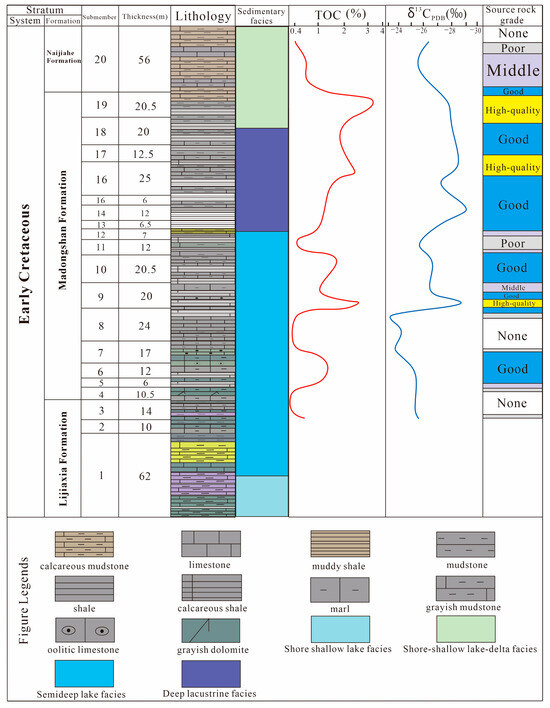
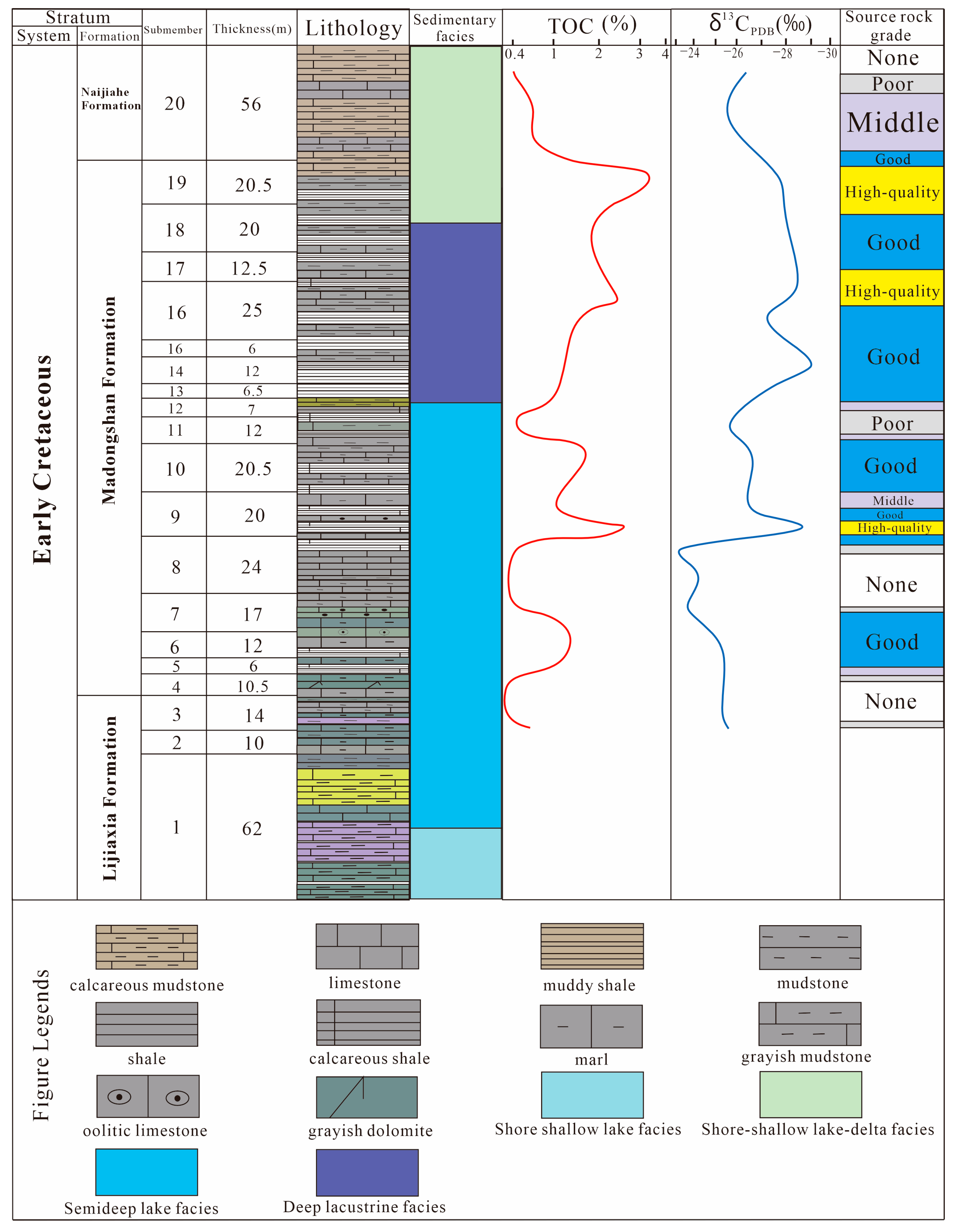
However, a key geochemical anomaly is the pronounced discrepancy between the high hydrocarbon generation potential (average S1 + S2 = 7.4 mg/g) and the remarkably low content of residual soluble organic matter (chloroform bitumen “A” averaging only 0.05%). In a typical source rock, these parameters should correlate positively. This disparity potentially indicates that the Madongshan source rocks are not poor in quality, but rather have likely undergone efficient hydrocarbon expulsion. Once generation surpassed the rock’s retention capacity (i.e., matrix adsorption and pore saturation), large volumes of generated oil and gas were effectively expelled, leaving behind only minimal residual bitumen. Therefore, the low bitumen content should be interpreted as an indicator of an effective, “spent” source rock, not a poor one [25]. Furthermore, the stratigraphic distribution of these high-quality intervals appears to be non-random, appearing to be closely linked to the depositional environment. This relationship is clearly illustrated in the chemostratigraphic profile (Figure 7). The intervals with the highest TOC content and designated as ‘Good’ to ‘High-quality’ source rocks are predominantly concentrated within the deep lacustrine facies, particularly in the middle to lower part of the Madongshan Formation (Submembers 8–15). Conversely, TOC values decrease significantly within the shallower, more proximal shore-shallow lake and delta facies in the upper part of the formation. This strong facies control indicates that the development of the most effective source rocks was linked to deposition in a relatively deep, low-energy, and likely anoxic lacustrine setting, which was most conducive to the preservation of organic matter [33].
Figure 7.
Chemostratigraphic profile of the studied section of the Madongshan Formation. This figure illustrates the vertical distribution of lithology, sedimentary facies, Total Organic Carbon (TOC) content, and kerogen δ13C values, alongside the interpreted source rock quality.
5.1.2. Organic Matter Type and Thermal Maturity
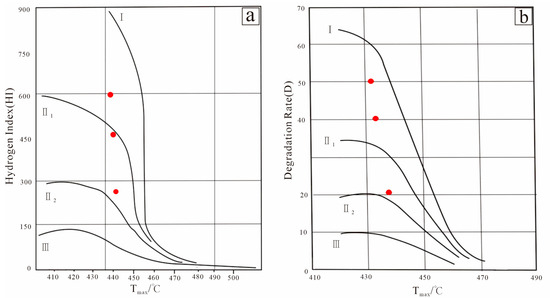
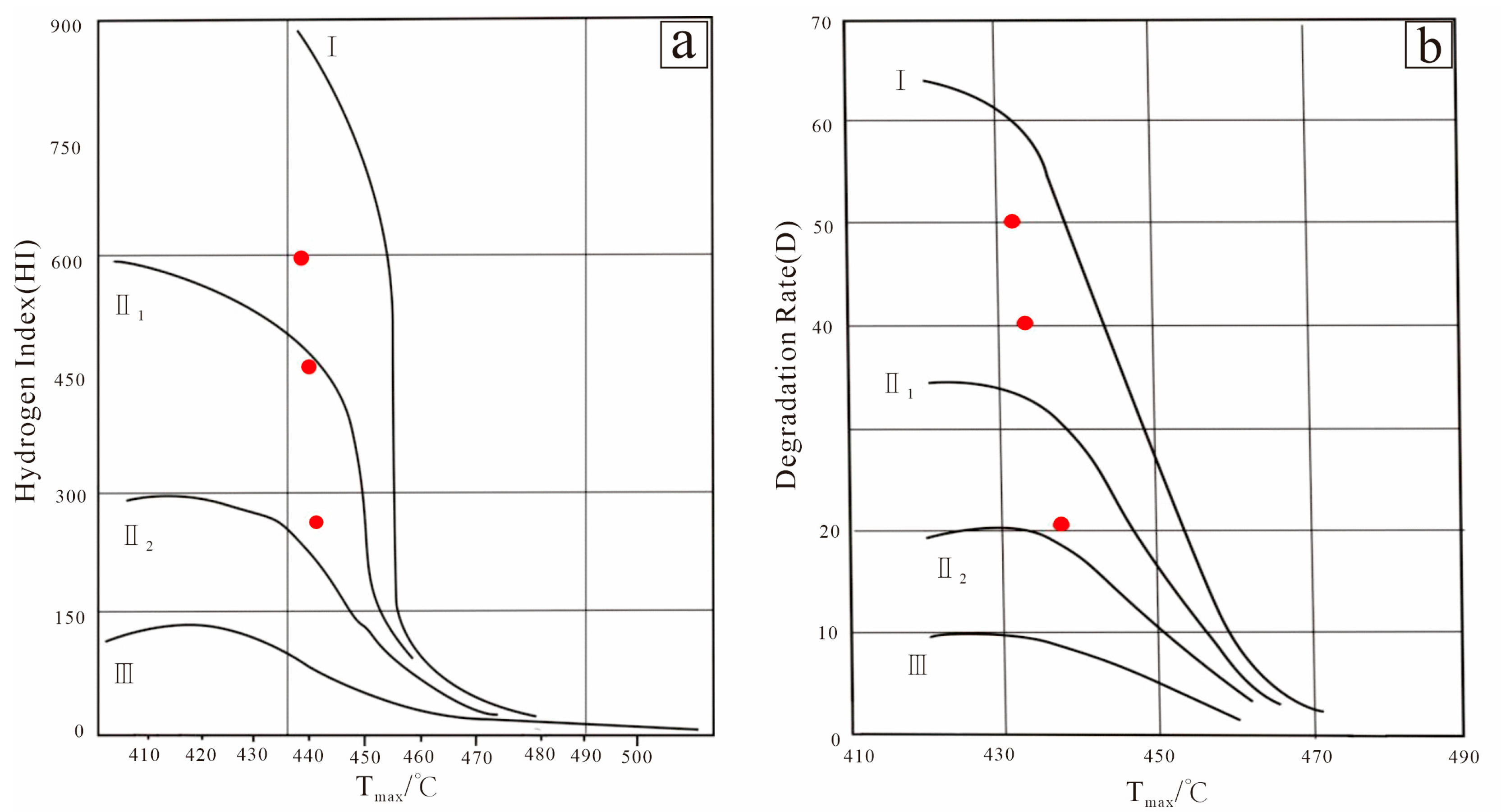
The quality and nature of the generated hydrocarbons are primarily controlled by the organic matter type and its thermal maturity. The kerogen type was systematically assessed using multiple classification diagrams. The conventional HI-Tmax diagram (Figure 8a) indicates that the organic matter in the analyzed source rock intervals is predominantly Type II1 and Type II2 kerogen [24,34]. This classification is independently corroborated by the Degradation Rate (D)-Tmax plot (Figure 8b), where the samples consistently fall within the same Type II1 and II2 fields, supporting their high potential for oil generation.
Figure 8.
Determination of kerogen type and thermal maturity for the Madongshan Formation source rocks using (a) a modified van Krevelen diagram (Hydrogen Index vs. Tmax) and (b) a supplementary Degradation Rate vs. Tmax diagram. The fields for different kerogen types (I, II1, II2, and III) are shown for reference. The red dots (●) represent the representative source rock samples from the Madongshan Formation analyzed in this study.
This dual-diagram classification is further supported by independent molecular and isotopic evidence. The high saturated/aromatic hydrocarbon ratios (4.68–6.48) are characteristic of oil-prone, Type II kerogen [35]. Furthermore, the kerogen δ13C values (−28.49‰ to −21.71‰) plot within the mixing field of lacustrine algae and C3 terrestrial plants, which is the typical parent material composition for Type II kerogen in a lacustrine setting [36].
The thermal maturity parameters collectively place the source rocks firmly within the main oil-generation window. The vitrinite reflectance (Ro) values (0.80–0.84%) and Rock-Eval Tmax values (442–445 °C) are highly consistent, both indicating a mature stage. This confirms that the high-quality Type II organic matter has undergone sufficient thermal stress to generate and expel significant quantities of hydrocarbons, reinforcing the expulsion hypothesis discussed above.
5.2. Controlling Factors of Organic Matter Enrichment
The enrichment patterns of organic matter in source rocks are primarily governed by the interplay between two primary sets of factors: the supply of organic matter (input) and the efficiency of its preservation in the geological record. To understand the development of the high-quality source rocks in the Madongshan Formation, it is therefore essential to systematically evaluate both of these controlling factors. The following sections will first deconvolve the provenance of the organic material and then reconstruct the paleoenvironmental conditions that governed its preservation.
5.2.1. The Influence of Organic Matter Input: A Mixed Source System
Based on the molecular analysis of the selected representative subset, the provenance of organic matter in the Madongshan Formation is not from a single source but reflects a dynamic interplay between autochthonous (aquatic) and allochthonous (terrestrial) inputs. This mixed source nature is consistently revealed by multiple independent geochemical proxies.
- 1.
- Molecular Fingerprints: The Qualitative Evidence
The molecular composition of the bitumen provides diagnostic qualitative evidence for mixed sources. The n-alkanes display a unimodal distribution with a mid-chain hump (peaking at n-C23~n-C25) and low CPI values (1.04–1.33), which suggests a notable contribution from aquatic biomass (algae and bacteria). However, the consistent presence of long-chain n-alkanes (>n-C27) simultaneously confirms an input from terrestrial higher plants [36].
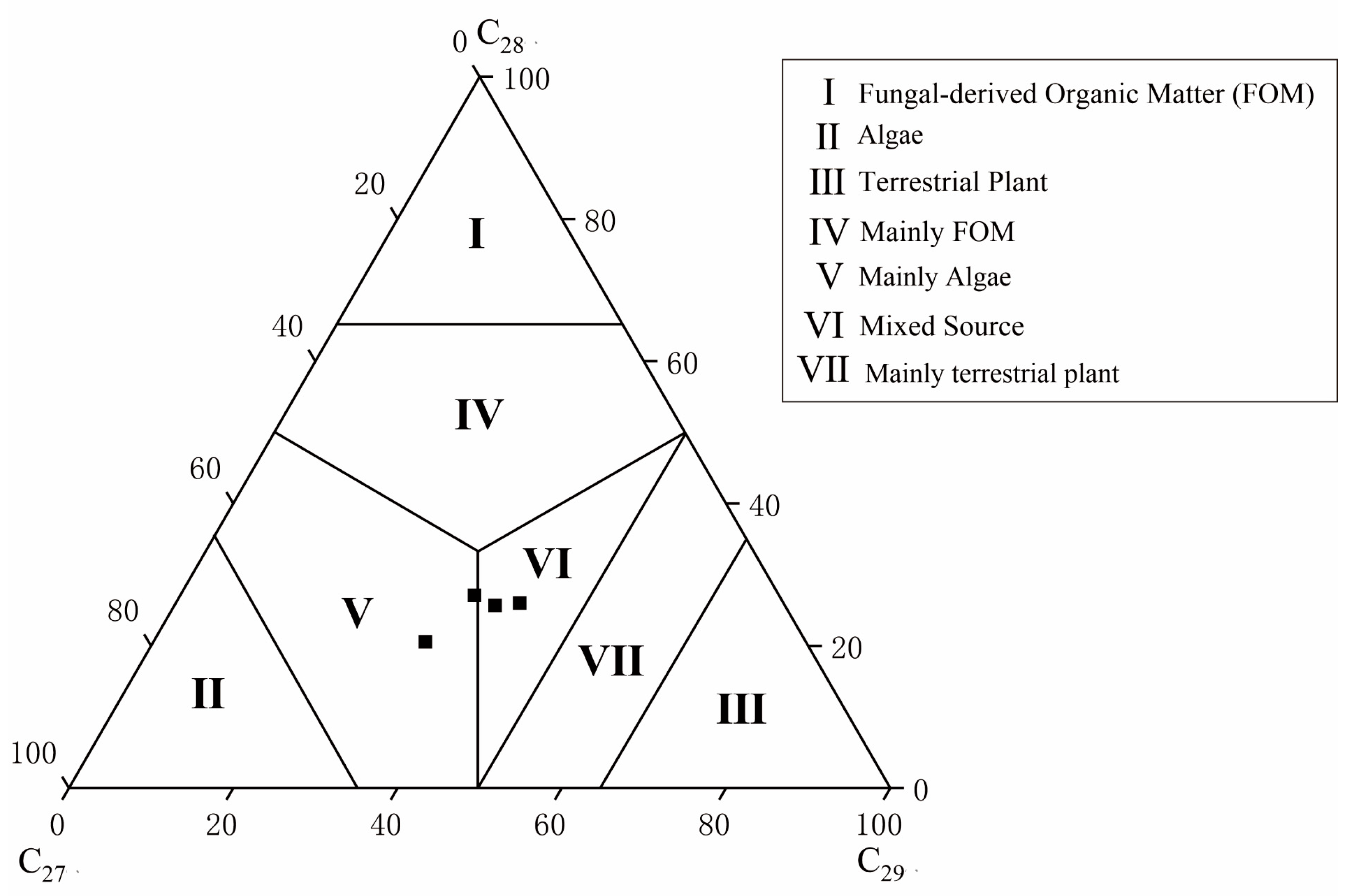
This interpretation is strongly corroborated by the sterane distributions. On a C27-C28-C29 ternary diagram (Figure 9), the samples plot squarely within the “Mixed Source” field (VI), intermediate between the algal (V) and terrestrial plant (VII) end-members. The roughly equal contributions of C27 (algal-derived) and C29 (terrestrially derived) steranes provide an strong molecular indication of this dual provenance [37].
Figure 9.
Ternary diagram of C27-C28-C29 regular steranes used to determine the organic matter provenance for the Madongshan Formation samples. The results show that all data points plot (■) within the “Mixed Source” field (VI), indicating contributions from both aquatic (algal) and terrestrial organic matter. The classification fields are after Huang & Meinschein (1979) [38].
- 2.
- Isotopic Record: Quantitative Assessment and Stratigraphic Fluctuation
Carbon isotope analysis not only complements the mixed source conclusion but also reveals its dynamic nature over time. The bulk kerogen δ13C values range from −28.49‰ to −21.71‰, falling within the mixing zone of lacustrine algae and C3 terrestrial plants. Using a standard isotopic mass balance model (see Section 3.5 for methodology), the average contribution from aquatic organisms is estimated at approximately 55 ± 8%. This result highlights that while aquatic productivity formed the baseline, terrestrial input was a substantial and integral component of the total organic matter budget.
Crucially, the stratigraphic profile of δ13C (Figure 7) is not static. The vertical fluctuations of the δ13C curve directly record the shifting balance between these two sources through time. The negative isotopic excursions, which predominantly correspond to the high-quality source rock intervals within the deep lacustrine facies, signify periods of enhanced algal productivity and/or reduced terrestrial influx [39]. Conversely, the less negative δ13C values in the upper part of the formation reflect a greater proportion of terrestrial input, consistent with the progradation of shore-shallow lake and delta facies.
- 3.
- Paleoproductivity Constraints
Beyond the source type, assessing the intensity of primary productivity is crucial for determining the controlling mechanism of organic enrichment. Phosphorus (P) is commonly utilized as a proxy for algal blooms in lacustrine ecosystems and serves as a direct proxy for paleoproductivity. In the Madongshan Formation, the P2O5 contents are consistently low (ranging from 0.08% to 0.17%, with a mean of 0.11%; Table 2). These values are characteristic of nutrient-limited, oligotrophic-to-mesotrophic lake waters, rather than hypereutrophic conditions driven by massive nutrient influx.
Current P-proxy constraints suggest that the organic enrichment may not have been primarily driven by high-intensity algal blooms. Instead, the relatively low nutrient availability points towards moderate primary productivity. Consequently, the presence of moderate TOC values (>1.0%) despite such inferred nutrient scarcity suggests that preservation played a pivotal role. While acknowledging the limitations of relying solely on phosphorus as a proxy, we tentatively infer that the high preservation efficiency (discussed in Section 5.2.2) effectively compensated for the limited biological input. It appears to have served as a significant, if not dominant, control on organic matter accumulation in this context.
- 4.
- Synthesis: A Climate-Modulated Dual-Source Model
In summary, the molecular and isotopic data converge to indicate a climate-modulated, dual-source system. The baseline organic matter was dominated by lacustrine algae, but this was regularly supplemented by significant influxes of terrestrial organic matter. The vertical shifts in δ13C suggest that this balance was likely controlled by climatic fluctuations: drier periods favored a more restricted, algae-dominated saline lake, while wetter periods led to increased riverine runoff, transporting more terrestrial organic matter into the basin [40,41]. This dynamic interplay was fundamental to the formation of the Madongshan source rocks.
5.2.2. The Influence of Preservation Conditions: A Salinity-Driven Anoxic Environment
The enrichment of organic matter in the Madongshan Formation was not a singular event but was governed by a synergistic interplay of paleoclimatic, paleosalinity, and paleoredox conditions. While major element proxies (n = 21) provide a framework, detailed biomarker evidence from the representative samples further elucidates that each of these factors played a distinct but interconnected role in controlling both the primary productivity and the ultimate preservation of organic matter.
- 1.
- Paleoclimatic Conditions: An Arid Backdrop
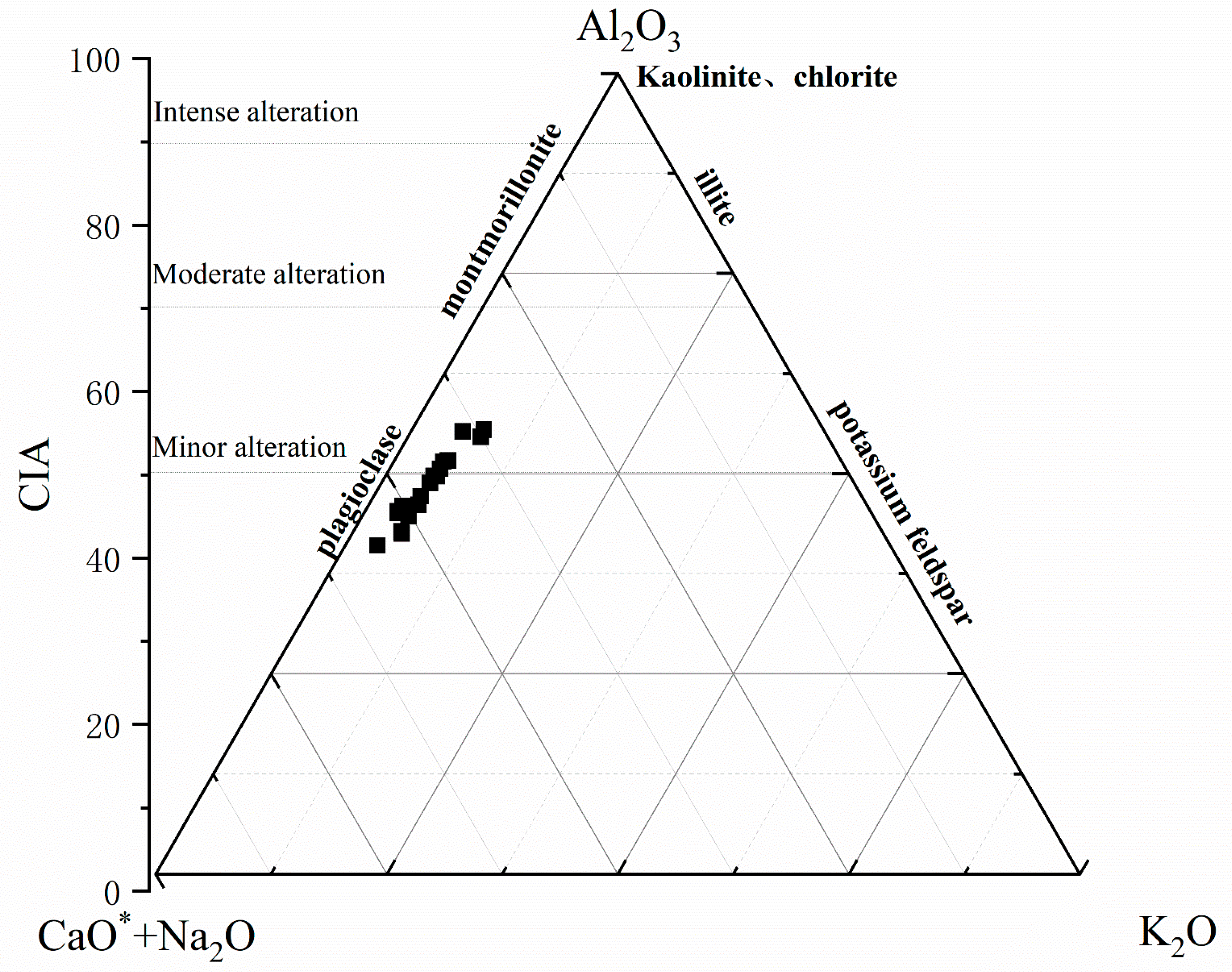
The regional paleoclimate established the environmental framework for deposition. The Chemical Index of Alteration (CIA) values of the Madongshan shales show a wide range from 28.33% to 64.88%, with a low average of 41.67%. These values, when plotted on an A-CN-K ternary diagram (Figure 10), fall predominantly within the field of weak chemical weathering. Based on this extensive major element dataset (n = 21), this indicates that the source area was dominated by physical weathering processes under a predominantly arid to semi-arid climate [42]. Such a climate was a key contributing factor for organic matter enrichment via two pathways: (1) it drove intense evaporation, leading to the development of a saline water body, and (2) it limited terrestrial runoff and clastic dilution, creating a relatively stable depositional setting.
Figure 10.
Evaluation of source area weathering intensity using an A-CN-K (Al2O3–(CaO + Na2O)–K2O) ternary diagram. The data points plot (■) along the plagioclase-illite weathering trend, indicating a low degree of chemical weathering consistent with an arid climate. Weathering trend lines are from Nesbitt and Young (1982) [26].
- 2.
- Paleosalinity and Water Column Stratification: The Key to Preservation
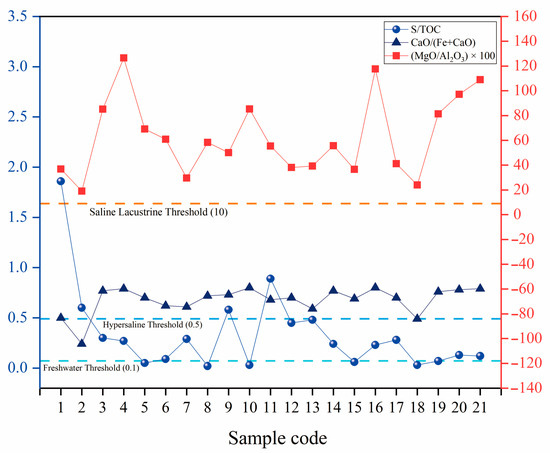
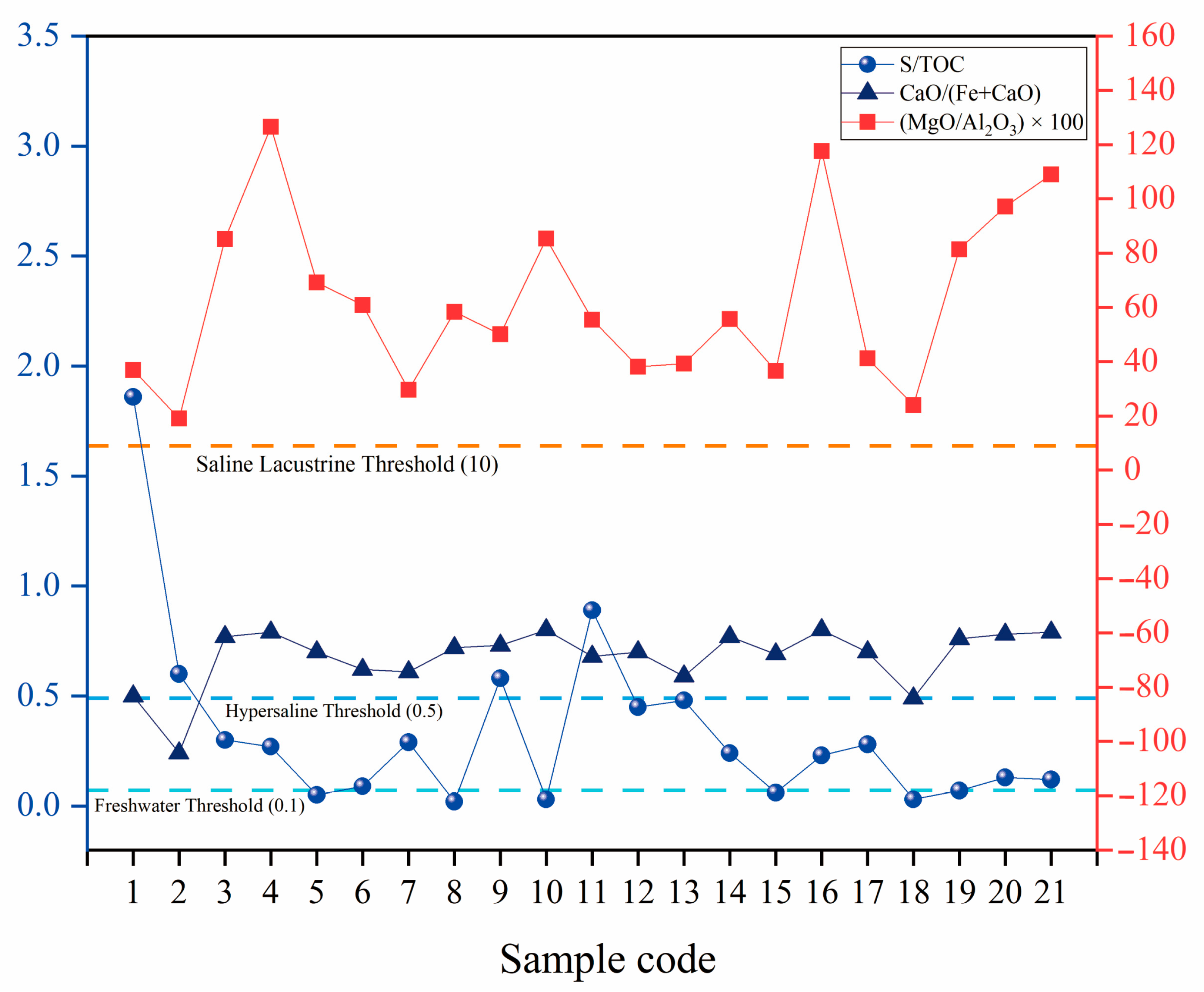
The arid climate directly resulted in a saline to hypersaline lacustrine environment, which was a primary factor for preservation. This is supported by multiple geochemical proxies. The gammacerane index (average 0.39) consistently exceeds the hypersaline threshold (>0.3), indicating a strongly stratified water column [43]. This is robustly supported by major element proxies, which are visualized against key environmental thresholds in Figure 11. The vast majority of CaO/(Fe + CaO) ratios plot consistently above the established hypersaline criterion of 0.5, while the (MgO/Al2O3) × 100 values are almost entirely elevated far beyond the saline lacustrine threshold of 10. This direct visualization provides compelling and immediate evidence for a persistent hypersaline depositional environment.
Figure 11.
Stratigraphic variations in key geochemical proxies for paleosalinity in the Madongshan Formation. The plots show changes in S/TOC, CaO/(Fe + CaO), and (MgO/Al2O3) × 100 ratios. Dashed horizontal lines indicate critical thresholds for interpreting paleosalinity [43].
This hypersalinity was a major driver in establishing a stable chemical stratification (a halocline), which acted as a physical barrier, preventing the mixing of oxygen-rich surface waters with the bottom waters. This stratification was the direct cause of the anoxic conditions that facilitated the preserving organic matter. Furthermore, the low S/TOC ratios (average 0.27) suggest that while saline, the system did not support vigorous sulfate-reducing bacterial activity, thus limiting a key pathway of organic matter degradation [43,44].
Admittedly, these geochemical proxies are subject to various controls. Major element ratios (e.g., CaO/(Fe + CaO), MgO/Al2O3) may be influenced by lithological heterogeneities (such as detrital carbonate or evaporite input) and diagenetic processes, while the Gammacerane Index likely reflects stratification rather than directly indicating salinity.
However, within the context of the Madongshan Formation, we suggest that these proxies may remain relatively reliable indicators of paleo-salinity based on two converging lines of evidence: (1) The Correlation of inorganic and organic signals: The high Ca/Mg signals show a consistent relationship with high Gammacerane values. This consistency suggests that a common environmental driver—water column salinity—likely played a key role in controlling both the chemical precipitation and the biological community structure, potentially masking the influence of detrital inputs; (2) The moderate thermal maturity: The observed maturity (Ro ≈ 0.84%) indicates that the strata appear to have undergone minimal diagenetic alteration, suggesting that the primary elemental signatures have been preserved without significant remobilization.
While this consistency is noteworthy, we acknowledge that these indicators may have limitations. We agree that future investigations integrating additional trace element proxies (e.g., Sr/Ba, B, and redox-sensitive trace elements) could be valuable in further refining and more precisely constraining the paleoenvironmental evolution of the basin.
- 3.
- Paleoredox Conditions: The Final Seal on Preservation
The ultimate burial and preservation of organic matter were primarily influenced by the bottom-water redox conditions. The salinity-induced stratification led to persistent and intense anoxia at or near the sediment–water interface. This is suggested by the extremely low Pr/Ph ratios (<0.5) observed in the analyzed subset, which are a classic indicator of anoxic, typically hypersaline environments. The intensely reducing conditions are further highlighted by the high saturated/aromatic hydrocarbon ratios (average 5.77), suggesting extensive hydrogenation of organic compounds during early diagenesis. This persistent anoxia effectively shut down aerobic microbial degradation, the most efficient pathway for destroying organic matter, thus ensuring its high preservation efficiency and burial.
- 4.
- Synthesis: A “Salinity-Driven Anoxic Preservation” Model
In synthesis, the preceding analyses converge to reveal a clear causal pathway for the development of high-quality source rocks in the Madongshan Formation. An arid paleoclimate established a saline lacustrine basin, which in turn induced strong and persistent water column stratification (a halocline). This stratification was the critical tipping point, creating a “perfect storm” for organic matter preservation by: (1) generating intense and stable bottom-water anoxia that severely inhibited aerobic microbial degradation, and (2) enhancing the adsorption and sequestration of organic matter onto mineral surfaces within the hypersaline brine.
This powerful synergy between environmental factors resulted in an exceptionally high preservation efficiency, leading to TOC enrichment levels comparable to world-class evaporitic lacustrine systems like the Green River Formation [45,46]. Based on this interplay, we propose a “Salinity-Driven Anoxic Preservation” model for the Madongshan Formation. This model, where climate-induced salinity is the primary driver for the anoxic conditions necessary for exceptional preservation, provides a plausible explanation for the formation of the rich, oil-prone source rocks in the Liupanshan Basin and may be applicable to other similar saline lacustrine systems globally.
5.3. The Geological Model for Organic Matter Enrichment in the Madongshan Formation
Based on the comprehensive analyses of organic matter input and paleoenvironmental controls derived from the representative sample set, the preceding findings are synthesized into a conceptual geological mode that explains the formation of the high-quality, oil-prone source rocks in the Madongshan Formation. This model is predicated on the synergistic convergence of three critical geological conditions: (1) an arid to semi-arid paleoclimate that drove evaporation; (2) a dual-source organic matter input system, with a baseline of aquatic productivity supplemented by terrestrial influx; and (3) the consequent development of a chemically stratified, saline-to-hypersaline water body [3].
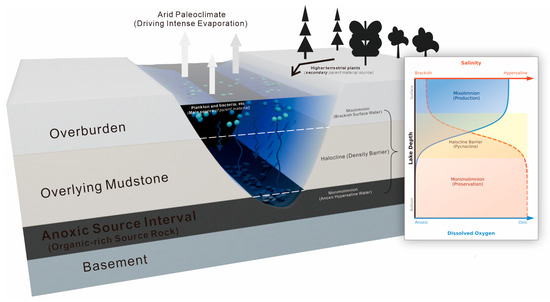
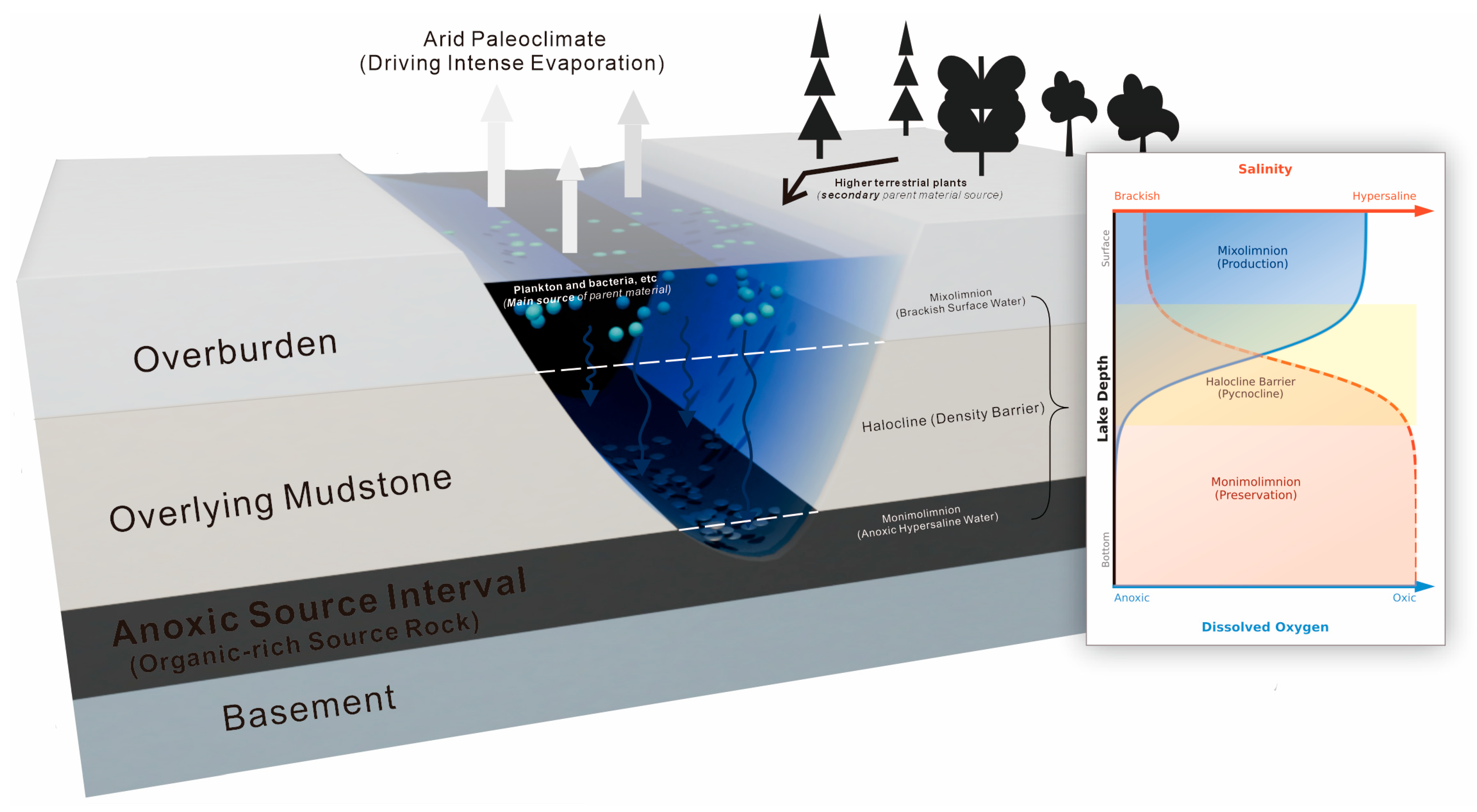
This model, schematically illustrated in Figure 12, outlines a “Salinity-Driven Preservation” system that was effectively promoted the sequestration of organic carbon. During the main depositional phase of the source rocks (the deep-water salt lake stage), the water column likely developed a stratified three-layer system. The surface layer, rendered mildly brackish by evaporation, supported a community of halotolerant plankton and bacteria, representing the primary source of organic matter (~60%), while also receiving intermittent input of terrestrial organic matter (~40%). The critical feature was the halocline—a sharp salinity gradient that acted as a stable physical barrier, effectively isolating the deep bottom waters from surface oxygen exchange [47]. The bottom layer, consequently, became a stagnant, hypersaline, and intensely anoxic (Eh < −150 mV) “preservation factory”.
Figure 12.
Salinity-driven preservation model for organic matter enrichment in the Madongshan Formation. The 3D block diagram illustrates a meromictic lake system developed under an arid paleoclimate with intense evaporation. The water column is stratified into an oxygenated mixolimnion (surface) and an anoxic, hypersaline monimolimnion (bottom), separated by a stable halocline density barrier. The inset chart shows conceptual hydrochemical profiles, demonstrating how the sharp salinity gradient (halocline) coincides with oxygen depletion, effectively isolating the bottom water. This “anoxic factory” favors the preservation of mixed organic matter (aquatic and terrestrial) within the organic-rich source interval, distinct from the overlying mudstone and underlying basement.
Within this system, two key mechanisms worked in concert to maximize organic matter enrichment. First, the persistent anoxia in the bottom waters significantly inhibited aerobic microbial degradation, which is the most destructive pathway for organic carbon. Second, the hypersaline conditions may have further enhanced preservation by limiting the activity of certain microbial communities and potentially promoting the adsorption of organic compounds onto mineral surfaces. It was the efficacy of this “Salinity-Driven Preservation” that allowed the Madongshan Formation to accumulate rich source rocks, despite not necessarily having exceptionally high primary productivity. This model not only elucidates the primary controls for the Liupanshan Basin but also provides a valuable framework for understanding and predicting high-quality source rock intervals in other ancient saline lacustrine systems worldwide.
6. Conclusions
This study provides a systematic evaluation of the geochemical characteristics and controlling factors of organic matter enrichment in the Cretaceous Madongshan Formation. Based on a framework established by bulk geochemical analysis of the entire stratigraphic section (n = 21), integrated with detailed molecular characterization of selected representative key intervals (n = 4), the main conclusions are as follows:
- (1)
- The Madongshan Formation contains a substantial sequence of effective, mature, oil-prone source rocks. A detailed assessment of the selected representative samples indicates these rocks are dominated by high-quality Type II1 and Type II2 kerogen and have entered the main oil-generation window, suggesting considerable hydrocarbon potential for the Liupanshan Basin.
- (2)
- Multi-proxy evidence suggests that the development of these source rocks was governed by a systematic interplay of geological factors. An arid paleoclimate served as the fundamental control, which led to the formation of a saline to hypersaline lacustrine system characterized by a dual-source organic input. This, in turn, induced a strong and persistent chemical stratification (halocline), resulting in stable, anoxic bottom-water conditions. While this climatic interpretation is robust based on the current major element and biomarker data, we acknowledge that future investigations integrating trace element proxies could further refine these paleoclimatic reconstructions.
- (3)
- The central contribution of this work is the proposal of a “Salinity-Driven Preservation” model. Synthesizing the data from these representative facies, this model proposes that climate-induced salinity was likely a critical mechanism in creating the intensely anoxic bottom-water conditions necessary for exceptional preservation. Our analysis suggests that this high preservation efficiency played a pivotal role in organic matter enrichment, effectively compensating for the moderate primary productivity indicated by the geochemical data. Based on this model, we suggest that future exploration in the Liupanshan Basin should focus on the deep-lacustrine facies within the middle-to-upper Madongshan Formation, where the coupling of salinity stratification and anoxia was most conducive to source rock development.
Supplementary Materials
The following supporting information can be downloaded at: https://www.mdpi.com/article/10.3390/pr14020224/s1, Table S1. Raw geochemical analysis data of the Madongshan.
Author Contributions
Conceptualization, H.Y., X.W. and R.L.; Methodology, H.Y., H.H. and X.W.; Validation, H.Y., X.W., Y.K. and X.Q.; Formal Analysis, H.Y.; Investigation, H.Y., Y.K., X.Q. and J.C.; Resources, X.W., H.H. and R.L.; Data Curation, H.Y. and J.C.; Writing—Original Draft Preparation, H.Y.; Writing—Review and Editing, H.Y., X.W. and H.H.; Visualization, H.Y. and Y.K.; Supervision, X.W. and X.Q.; Project Administration, R.L.; Funding Acquisition, R.L. All authors have read and agreed to the published version of the manuscript.
Funding
This research was funded by the National Natural Science Foundation of China (Grant Nos. 42273064 and 42302157); the Natural Science Basic Research Program of Shaanxi Province (Grant No. 2021JQ-229); and the Fundamental Research Funds for Central Universities, CHD (Grant No. 300102274201).
Data Availability Statement
The original contributions presented in this study are included in the article/Supplementary Materials. Further inquiries can be directed to the corresponding authors.
Acknowledgments
The authors are grateful to the staff of the Metallogenic Dynamics Laboratory at Chang’an University for their invaluable assistance with the experimental analyses. Special thanks are also extended to Chuanyi Liu for his generous support during the fieldwork.
Conflicts of Interest
The authors declare no conflicts of interest.
References
- Bohacs, K.M.; Carroll, A.R.; Neal, J.E.; Mankiewicz, P.J. Lake-Basin Type, Source Potential, and Hydrocarbon Character: An Integrated Sequence-Stratigraphic–Geochemical Framework. In Lake Basins Through Space and Time; American Association of Petroleum Geologists: Tulsa, OK, USA, 2000. [Google Scholar]
- Warren, J.K. Evaporites: Sediments, Resources and Hydrocarbons; Springer: Berlin/Heidelberg, Germany, 2006. [Google Scholar]
- Xu, S.; Wang, Y.; Bai, N.; Wu, S.; Liu, B. Organic Matter Enrichment Mechanism in Saline Lacustrine Basins: A Review. Geol. J. 2024, 59, 155–168. [Google Scholar] [CrossRef] [Scilit]
- Al-Matary, A.M.; Hakimi, M.H.; Mustapha, K.A.; Rahim, A.; Naseem, W.; Al-Shawafi, Z.A. Molecular Compositions of Oil-Bearing Sandstones and Oil-Asphaltenes from the Kharir Oilfields in the Western Central Masila Basin, Yemen. ACS Omega 2024, 9, 17398–17414. [Google Scholar] [CrossRef] [Scilit]
- Meyers, P.A. Organic Geochemical Proxies of Paleoceanographic, Paleolimnologic, and Paleoclimatic Processes. Org. Geochem. 1997, 27, 213–250. [Google Scholar] [CrossRef] [Scilit]
- Meyers, P.A. Applications of Organic Geochemistry to Paleolimnological Reconstructions: A Summary of Examples from the Laurentian Great Lakes. Org. Geochem. 2003, 34, 261–289. [Google Scholar] [CrossRef] [Scilit]
- Bohacs, K.M.; Grabowski, G.J. Green River Formation, Laney Member, Eocene, Wyoming, USA—A Balanced-Fill Lake System with Microbial Carbonate and Oil Shale, an Analog for Part of the South Atlantic Pre-Salt. In Sequence Stratigraphy: Applications to Fine-Grained Rocks; The American Association of Petroleum Geologists and Brazilpetrostudies: Tulsa, OK, USA, 2022. [Google Scholar]
- Song, Y.; Paerhati, P.; Xu, S.; Jiang, S.; Gao, B.; Li, S.; Cao, Q.; Li, Z.; Wan, L.; Li, C. Paleoenvironment and Hydrocarbon Potential of Salinized Lacustrine Shale with High Terrigenous Input in the Paleogene Biyang Depression (East China): Evidence from Organic Petrography and Geochemistry. Energies 2024, 17, 3003. [Google Scholar] [CrossRef] [Scilit]
- Li, W.; Bai, R.; Jiang, T.; Guo, W. Geochemical Characteristics of Source Rock from Madongshan Formation of Cretaceous in Liupanshan Basin: A Case Study of Ninggucan1 Well. Chin. J. Geol. 2020, 55, 963–973. [Google Scholar] [CrossRef]
- Han, S.; Du, X.; He, Y.; Wang, C.; Huo, M.; Mu, X.; Wang, Y.; Huang, J.; Zhang, C. Sedimentary Paleoenvironment and Organic Matter Enrichment Characteristics of Lacustrine Shahezi Shale in Songliao Basin: Insights from the Continental Scientific Drilling. ACS Omega 2024, 9, 21097–21115. [Google Scholar] [CrossRef] [Scilit]
- Gao, Y.; He, X.; Cheng, X.; Tang, X.; Hua, C.; Zan, L.; Zhang, P.; Chen, X.; Pang, Y. Discussion on high hydrocarbon generation efficiency of saline lacustrine source rocks with low TOC: A case study of the second member of Funing Formation, Qintong Sag, Subei Basin. Pet. Reserv. Eval. Dev. 2024, 14, 678–687, (In Chinese with English abstract). [Google Scholar] [CrossRef]
- Lu, K.; Li, C.; Zhou, F.; Zhang, C.; Xu, T. Mechanism of high efficient reservoir formation of low abundance source rocks in the north of Dongpu Depression. Fault-Block Oil Gas Field 2021, 28, 470–474, (In Chinese with English abstract). [Google Scholar]
- Peters, K.E.; Walters, C.C.; Moldowan, J.M. The Biomarker Guide; Cambridge University Press: Cambridge, UK, 2005; Volume 1, ISBN 0-521-78158-2. [Google Scholar]
- Dong, Y.; Zhao, X.; Pang, Q.; Ma, Y.; Du, F.; Chen, Y.; Li, D.; Mao, Z.; Feng, Z. Terrestrial Records of the Early Cretaceous Paleoclimate Changes in the Liupanshan Basin, NW China: Evidence from Sedimentology and Geochemistry. Res. Sq. 2023. [Google Scholar] [CrossRef] [Scilit]
- Ma, Y.; Pan, J.; Fu, D.; Wang, Y.; Wang, Y.; Chang, D.; Cheng, L.; Fu, W. The Organic Geochemistry, Pore Structure and Methane Adsorption/Storage Capacity of Lacustrine Shales from the Cretaceous Madongshan Formation, Liupanshan Basin, China. J. Nat. Gas Sci. Eng. 2021, 96, 104287. [Google Scholar] [CrossRef] [Scilit]
- GB/T 19145-2022; Determination of Total Organic Carbon in Sedimentary Rock. Standards Press of China: Beijing, China, 2022. Available online: https://openstd.samr.gov.cn/bzgk/gb/newGbInfo?hcno=C912976E07147F2B4F9AB25389C13930 (accessed on 23 December 2025). (In Chinese)
- GB/T 18602-2012; Petroleum and Natural Gas Industries—Source Rock Evaluation—Rock-Eval Method. Standards Press of China: Beijing, China, 2012. Available online: https://openstd.samr.gov.cn/bzgk/gb/newGbInfo?hcno=69BB393FE862C4C7302D01EEC4D5FF40 (accessed on 23 December 2025). (In Chinese)
- Peters, K.E. Guidelines for Evaluating Petroleum Source Rock Using Programmed Pyrolysis. AAPG Bull. 1986, 70, 318–329. [Google Scholar] [CrossRef] [Scilit]
- ASTM D2797; Standard Practice for Preparing Coal Samples for Microscopical Analysis by Reflected Light. ASTM International: Conshohocken, PA, USA, 2021.
- ASTM D7708-14; Standard Test Method for Microscopical Determination of the Reflectance of Vitrinite Dispersed in Sedimentary Rocks. ASTM International: Conshohocken, PA, USA, 2023.
- Phillips, D.L.; Gregg, J.W. Uncertainty in Source Partitioning Using Stable Isotopes. Oecologia 2001, 127, 171–179. [Google Scholar] [CrossRef] [Scilit]
- Meyers, P.A. Preservation of Elemental and Isotopic Source Identification of Sedimentary Organic Matter. Chem. Geol. 1994, 114, 289–302. [Google Scholar] [CrossRef] [Scilit]
- Fry, B. Stable Isotope Ecology; Springer: Berlin/Heidelberg, Germany, 2006; Volume 521. [Google Scholar]
- Tissot, B.P.; Welte, D.H. Petroleum Formation and Occurrence; Springer Science & Business Media: Berlin/Heidelberg, Germany, 2013; ISBN 3-642-87813-X. [Google Scholar] [CrossRef] [Scilit]
- Peters, K.E.; Cassa, M.R. Applied Source Rock Geochemistry. In The Petroleum System—From Source to Trap; American Association of Petroleum Geologists: Tulsa, OK, USA, 1994. [Google Scholar]
- Nesbitt, H.W.; Young, G.M. Early Proterozoic Climates and Plate Motions Inferred from Major Element Chemistry of Lutites. Nature 1982, 299, 715–717. [Google Scholar] [CrossRef] [Scilit]
- Cao, H.; Lei, Y.; Wang, X.; Guo, X. Late Cretaceous Paleoclimate and Paleoenvironment in the Songliao Basin, China. J. Paleolimnol. 2021, 66, 313–331. [Google Scholar] [CrossRef] [Scilit]
- Xiao, W.; Zhang, B.; Yang, K.; Wang, Y.; Wen, S.; Ma, K.; Cao, G. Geochemical Characteristics of the Upper Permian Longtan Formation from Northeastern Sichuan Basin: Implications for the Depositional Environment and Organic Matter Enrichment. Acta Geol. Sin. 2023, 97, 1196–1213. [Google Scholar] [CrossRef] [Scilit]
- Seifert, W.K.; Michael Moldowan, J. Applications of Steranes, Terpanes and Monoaromatics to the Maturation, Migration and Source of Crude Oils. Geochim. Cosmochim. Acta 1978, 42, 77–95. [Google Scholar] [CrossRef] [Scilit]
- Bray, E.E.; Evans, E.D. Distribution of N-Paraffins as a Clue to Recognition of Source Beds. Geochim. Cosmochim. Acta 1961, 22, 2–15. [Google Scholar] [CrossRef] [Scilit]
- Lotfy, N.M.; Farouk, S.; Hakimi, M.H.; Ahmad, F.; El Shennawy, T.; El Nady, M.M.; Salama, A.; Shehata, A.M. Biomarker and Isotopic Characteristics of Miocene Condensates and Natural Gases, West Delta Deep Marine Concession, Eastern Mediterranean, Egypt. Sci. Rep. 2024, 14, 235. [Google Scholar] [CrossRef] [Scilit]
- Katz, B.J. The Green River Shale: An Eocene Carbonate Lacustrine Source Rock. In Petroleum Source Rocks; Springer: Berlin/Heidelberg, Germany, 1995; pp. 309–324. [Google Scholar]
- Li, L.; Bao, Z.; Li, L.; Li, Z.; Ban, S.; Li, Z.; Wang, T.; Li, Y.; Zheng, N.; Zhao, C.; et al. The Source and Preservation of Lacustrine Shale Organic Matter: Insights from the Qingshankou Formation in the Changling Sag, Southern Songliao Basin, China. Sediment. Geol. 2024, 466, 106649. [Google Scholar] [CrossRef] [Scilit]
- Gluyas, J.G.; Swarbrick, R.E. Petroleum Geoscience; John Wiley & Sons: Hoboken, NJ, USA, 2021; ISBN 1-119-23234-1. [Google Scholar]
- Ogbesejana, A.B.; Liu, B.; Gao, S.; Akinyemi, S.A.; Bello, O.M.; Song, Y. Applying Biomarkers as Paleoenvironmental Indicators to Reveal the Organic Matter Enrichment of Shale during Deep Energy Exploration: A Review. RSC Adv. 2023, 13, 25635–25659. [Google Scholar] [CrossRef] [Scilit]
- Karadirek, S. Paleoenvironmental Settings of the Soma Coal Basin (Turkey): Insights from Maceral Data, Biomarker, and Carbon Isotopic Composition. ACS Omega 2023, 8, 47974–47990. [Google Scholar] [CrossRef] [Scilit]
- Guo, W.; Chen, G.; Li, Y.; Li, Y.; Zhang, Y.; Zhou, J.; Han, W.; Xu, X.; Ma, Y.; Dang, H. Factors Controlling the Lower Radioactivity and Its Relation with Higher Organic Matter Content for Middle Jurassic Oil Shale in Yuqia Depression, Northern Qaidam Basin, China: Evidence from Organic and Inorganic Geochemistry. ACS Omega 2021, 6, 7360–7373. [Google Scholar] [CrossRef] [Scilit]
- Huang, W.-Y.; Meinschein, W.G. Sterols as Ecological Indicators. Geochim. Cosmochim. Acta 1979, 43, 739–745. [Google Scholar] [CrossRef] [Scilit]
- Zhong, G.; Li, Y. Evaluation of the Geological Characteristics and Exploration Potential of Tight Oil in the Neogene Upper Ganchaigou Formation in the Zhahaquan Area, Qaidam Basin. ACS Omega 2023, 8, 27206–27215. [Google Scholar] [CrossRef] [Scilit]
- Street-Perrott, F.A.; Perrott, R.A. Abrupt Climate Fluctuations in the Tropics: The Influence of Atlantic Ocean Circulation. Nature 1990, 343, 607–612. [Google Scholar] [CrossRef] [Scilit]
- Font, E.; Duarte, L.V.; Dekkers, M.J.; Remazeilles, C.; Egli, R.; Spangenberg, J.E.; Fantasia, A.; Ribeiro, J.; Gomes, E.; Mirão, J.; et al. Rapid Light Carbon Releases and Increased Aridity Linked to Karoo–Ferrar Magmatism during the Early Toarcian Oceanic Anoxic Event. Sci. Rep. 2022, 12, 4342. [Google Scholar] [CrossRef] [Scilit]
- Rezapour, S.; Asadzadeh, F.; Nouri, A.; Khodaverdiloo, H.; Heidari, M. Distribution, Source Apportionment, and Risk Analysis of Heavy Metals in River Sediments of the Urmia Lake Basin. Sci. Rep. 2022, 12, 17455. [Google Scholar] [CrossRef] [Scilit]
- Barham, A.; Ismail, M.S.; Hermana, M.; Zainal Abidin, N.S. Biomarker Characteristics of Montney Source Rock, British Columbia, Canada. Heliyon 2021, 7, e08395. [Google Scholar] [CrossRef] [Scilit]
- Zhou, K.; Sun, J.; Yang, M.; Zhang, S.; Wang, W.; Gao, R.; Zhang, P.; Wang, W.; Liu, H.; Shao, L.; et al. Geochemical Characteristics of the Middle Jurassic Coal-Bearing Mudstones in the Dameigou Area (Qaidam Basin, NW China): Implications for Paleoclimate, Paleoenvironment, and Organic Matter Accumulation. ACS Omega 2023, 8, 47540–47559. [Google Scholar] [CrossRef] [Scilit]
- Tofte, M.; Carroll, A. Spatiotemporal Quantification of Organic Matter Accumulation in the Eocene Green River Formation, Bridger Basin, Wyoming. Geosites 2022, 50, 1–20. [Google Scholar] [CrossRef] [Scilit]
- Morris, J.N. Depositional Controls on the Stratigraphic Variability of Lacustrine Sedimentary Cycles, Green River Formation, Uinta Basin, Utah. Master’s Thesis, The University of Utah, Salt Lake City, UT, USA, 2021. [Google Scholar]
- Chen, G.; Tang, Y.; Nan, Y.; Yang, F.; Wang, D. Paleo-Sedimentary Environments and Controlling Factors for Enrichment of Organic Matter in Alkaline Lake Sediments: A Case Study of the Lower Permian Fengcheng Formation in Well F7 at the Western Slope of Mahu Sag, Junggar Basin. Processes 2023, 11, 2483. [Google Scholar] [CrossRef] [Scilit]

Disclaimer/Publisher’s Note: The statements, opinions and data contained in all publications are solely those of the individual author(s) and contributor(s) and not of MDPI and/or the editor(s). MDPI and/or the editor(s) disclaim responsibility for any injury to people or property resulting from any ideas, methods, instructions or products referred to in the content. |
© 2026 by the authors. Licensee MDPI, Basel, Switzerland. This article is an open access article distributed under the terms and conditions of the Creative Commons Attribution (CC BY) license.