


Abstract
This paper proposes a hybrid optimization–control framework that combines the Particle Swarm Optimization (PSO) algorithm, the Alternating Direction Method of Multipliers (ADMM), and a Linear–Quadratic Regulator (LQR) for energy-efficient and reliable operation of parallel pump systems. The PSO layer performs global exploration over mixed discrete–continuous design variables, while the ADMM layer coordinates distributed flows under head and reliability constraints, yielding hydraulically feasible operating points. The inner LQR controller achieves optimal speed tracking with guaranteed asymptotic stability and improved robustness against nonlinear load disturbances. The overall PSO–ADMM–LQR co-design minimizes a composite objective that accounts for steady-state efficiency, transient performance, and control effort. Simulation results on benchmark multi-pump systems demonstrate that the proposed framework outperforms conventional PSO- and PID-based methods in terms of energy savings, dynamic response, and robustness. The method exhibits low computational complexity, scalability to large systems, and practical suitability for real-time implementation in smart water distribution and industrial pumping applications.
1. Introduction
Parallel centrifugal pump systems are extensively deployed in water-supply networks, HVAC plants, petrochemical installations, and large-scale irrigation infrastructures due to their ability to provide flexible flow regulation, redundancy, and simplified maintenance. However, despite their apparent simplicity, such systems are frequently operated far from their design point. When several pumps function in parallel with mismatched rotational speeds or throttled discharge valves, nonlinear hydraulic coupling leads to efficiency degradation, increased cavitation risk, and accelerated mechanical wear. Recent energy audits of industrial pumping stations report that more than 30% of total electricity consumption is wasted because of uncoordinated pump scheduling and suboptimal control policies [1,2]. This inefficiency contradicts the objectives of modern energy-management standards such as ISO 50001 and the sustainability goals of Industry 4.0 infrastructures.
In a seminal contribution, Wu et al. [1] formulated the efficiency optimization of a two-pump system as a nonlinear programming problem subject to head and flow constraints. Their results demonstrated that coordinated scheduling of the active pump combination and variable-speed drives can reduce total wire power by 10–15% [3]. Nevertheless, their enumeration-based method was limited to static operating points and could not adapt to real-time variations in demand or pressure [4]. Lai et al. [2] extended this research by introducing the PSO algorithm to perform global exploration across both discrete and continuous decision variables, namely, the number of running pumps M, the normalized speed ratio k, and the valve head-loss . A reliability criterion based on the relative deviation from the Best Efficiency Point (BEP) was included to prevent operation in low-efficiency zones. Compared with conventional PID control, their PSO-based scheme achieved smoother switching and reduced mechanical stress. However, PSO is a purely stochastic meta-heuristic: while it offers global search capability, it lacks the convex structure and guaranteed convergence required for real-time or embedded optimization, especially when fast set-point updates are needed [5].
In recent years, the Alternating Direction Method of Multipliers (ADMM) has become a prominent framework for distributed optimization owing to its simplicity, scalability, and convergence guarantees under mild assumptions [6,7,8]. By decomposing a large-scale problem into locally solvable subproblems linked through consensus constraints, ADMM enables efficient coordination among coupled subsystems. This property has motivated its adoption in energy systems, smart grids, and hydraulic network optimization [9]. To overcome the limitations of conventional optimization schemes, this work proposes a hybrid global–local framework that integrates the PSO with the ADMM. The ADMM decomposes the global objective into distributed subproblems linked through consensus constraints [10], enabling each pump to minimize its local electrical power while maintaining flow balance and head feasibility. The outer PSO layer performs global exploration over , whereas the inner ADMM layer refines the flow allocations with deterministic and scalable convergence. This hierarchical PSO–ADMM design combines the exploration capability of PSO with the robustness of convex coordination, enabling near real-time deployment in SCADA and digital-twin environments [9,11,12,13].
When embedded with an LQR-based inner control loop, the proposed supervisory architecture achieves asymptotically stable and energy-efficient operation under parameter uncertainties and dynamic load perturbations, forming a unified PSO–ADMM–LQR co-design framework for multi-pump systems. It contributes to energy-efficient, reliability-oriented, and digitally enabled pump-station management consistent with next-generation smart-infrastructure objectives. Consequently, this paper aims to establish a unified optimization-control framework for high-efficiency and high-reliability operation of parallel pump systems.
Recent advances in control-theoretic optimization have also motivated the development of more rigorous distributed and feedback-driven frameworks. In particular, the small-gain-based distributed optimization framework proposed in [14] establishes strong stability guarantees for cooperative optimization over nonlinear agents with interconnection constraints. Similarly, the feedback-based autonomous optimization paradigm in [15] introduces a continuous-time feedback structure in which the optimization algorithm itself is stabilized through Lyapunov analysis. These methods provide valuable theoretical tools for ensuring convergence and robustness; however, they typically assume smooth feedback dynamics and convexity conditions that are not directly applicable to the mixed discrete–continuous and nonconvex hydraulic constraints encountered in parallel pump scheduling.
Our proposed PSO–ADMM–LQR architecture is therefore complementary to these frameworks. The ADMM layer inherits the distributed-coordination philosophy of small-gain methods but is specifically tailored to enforce hydraulic feasibility and BEP constraints, while the LQR layer embeds feedback-based stability directly into the speed-control dynamics. The global PSO layer addresses the combinatorial scheduling decisions that neither small-gain nor autonomous optimization frameworks handle natively. This hybridization allows the proposed method to maintain theoretical robustness while remaining applicable to realistic industrial pump configurations.
In addition to conventional pump-optimization studies, it is important to clarify more explicitly the novelty of the present work and the specific technical gap it fills. Existing methods in the pump optimization literature typically rely on standalone PSO, PID-based tuning, static pump scheduling, or nonlinear programming approaches that cannot simultaneously address (i) the mixed discrete–continuous nature of pump-activation and speed-selection decisions, (ii) the distributed hydraulic feasibility constraints such as head matching and BEP reliability, (iii) the nonlinear nonconvex flow–head coupling among parallel pumps, and (iv) the requirement of integrating optimization with a stabilizing control layer capable of ensuring reliable electromechanical dynamics. To the best of our knowledge, no prior work unifies global exploration, distributed convex coordination, and closed-loop speed regulation within a single hierarchical architecture.
Ref. [16] demonstrates the effectiveness of combining metaheuristic search with AI-based surrogate models to accurately predict surface roughness and kerf width under highly nonlinear and noisy processing conditions. The second study [17] illustrates how hybrid neural-network architectures can strengthen optimization pipelines by learning bidirectional mappings between process inputs and material properties. These works confirm the trend toward hybrid, multi-stage, data-enhanced optimization frameworks.
However, despite their sophistication, such methods do not address the unique requirements of parallel pump systems, where the optimization problem involves hydraulic coupling [15], nonconvex head constraints, discrete pump-selection variables, BEP-based reliability limits, and electromechanical dynamics that must be stabilized in closed loop. The proposed PSO–ADMM–LQR framework therefore contributes a complementary and previously unexplored integration: global PSO search for mixed-variable exploration, ADMM for distributed hydraulic feasibility enforcement [18], and LQR for guaranteed closed-loop speed tracking. This unified method directly fills a gap that neither existing pump-optimization techniques nor recent hybrid optimization studies in other engineering domains have addressed.
Furthermore, the contributions of this work have been substantially expanded to clarify both novelty and advantages compared with existing literature. Unlike prior pump-optimization studies that rely solely on PSO, PID tuning, or static scheduling [19,20], the proposed approach fills a critical methodological gap by unifying (i) global exploration over mixed discrete–continuous variables, (ii) distributed hydraulic coordination with guaranteed feasibility via ADMM, and (iii) closed-loop stability and transient-performance guarantees through LQR control. This hybrid PSO–ADMM–LQR structure provides several key advantages: deterministic enforcement of head and BEP constraints, smoother and faster convergence than standalone PSO, reduced energy consumption, improved reliability through constrained flow balancing, and significantly enhanced dynamic performance. The combination of these properties makes the proposed framework particularly well suited for near real-time deployment in industrial pump-station control environments.
The main contributions of this paper are summarized below:
- We introduce a unified PSO–ADMM–LQR hybrid architecture that simultaneously optimizes discrete pump scheduling, continuous hydraulic variables, and LQR control weights, forming a coordinated optimization–control co-design framework suitable for near–real-time supervisory operation.
- We develop a distributed ADMM formulation that enforces hydraulic feasibility—including total-flow consensus, head constraints, and BEP reliability—with linear per-pump computational complexity, enabling scalability to large pump stations.
- We integrate the optimization of LQR weight matrices within the global PSO layer, yielding controllers with provable asymptotic stability (via Riccati equations) and significantly improved transient performance compared to fixed-gain or heuristic designs.
- We provide a rigorous theoretical foundation for the proposed method, including explicit conditions for the existence of optimal solutions, convergence properties of the ADMM iterations under piecewise-smooth hydraulic constraints, and stability guarantees for the closed-loop LQR-controlled electromechanical subsystem.
The remainder of this paper is organized as follows. Section 2 presents the mathematical formulation of the parallel pump system, including hydraulic models, operational constraints, and the energy-efficiency objective. Section 3 introduces the proposed PSO–ADMM optimization architecture and details its hierarchical global–local coordination mechanism. Section 4 develops the LQR-based electromechanical control layer and explains its integration within the overall hybrid framework. Section 5 reports extensive simulation results comparing the proposed method with benchmark PSO and PID strategies. Finally, Section 6 concludes the work and discusses future research directions.
2. Problem Description and Model Development
2.1. Parallel Pump System Overview
A parallel centrifugal pump station comprises multiple identical or nearly identical pumps operating in parallel to deliver the required system flow rate against a specified head . Each pump i is driven by a variable-frequency drive (VFD) that regulates its normalized speed ratio , where is the current rotational speed and is the rated (rotor) speed. In this work, the pumps operate under the uniform-speed condition , as is standard in industrial multi-pump VFD configurations. Owing to hydraulic coupling through the common suction and discharge manifolds, the operating condition of one pump directly influences the others. Optimal performance therefore requires coordinated regulation of the individual flow rates and speed ratios to maintain pressure equilibrium, flow conservation, and high energy efficiency. Operation away from the Best Efficiency Point (BEP) increases hydraulic losses, turbulence, and cavitation, leading to reduced efficiency and reliability [5]. The optimization problem thus seeks, for each demand level, the optimal number of active pumps M, the uniform speed ratio k, and flow distribution that minimize total power consumption while satisfying both hydraulic and reliability constraints.
2.2. Pump Performance Modeling
The performance of each centrifugal pump is modeled using polynomial characteristic curves derived from manufacturer data and dimensional analysis [1]. At rated speed (), the head-flow and power-flow relationships are approximated as follows:
where coefficients are determined through curve fitting. For variable-speed operation, affinity laws yield the following:
These equations describe the nonlinear relationship among flow rate, rotational speed, and head. The head decreases quadratically with flow, while power increases cubically, resulting in a convex-concave efficiency trade-off.
2.3. Operational Constraints
The pump network must satisfy hydraulic equilibrium and equipment limits as follows:
with and denotes the controllable valve head loss compensating for pipe friction and flow regulation, and defines the operational flow range for each pump. The BEP flow at speed ratio k is given by the following:
where is the BEP flow rate at rated speed, typically equal to the manufacturer-specified rated flow rate. In practice, the pump speed must not exceed the rated value, and the efficiency of VFDs degrades rapidly for low speed ratios (typically ) [2,5]. Hence, the normalized speed ratio is constrained to remain within a high-efficiency and safe operating band The relative deviation from BEP, a reliability indicator, is defined as follows:
Ensuring maintains pump operation within a high-efficiency range, preventing hydraulic imbalance.
2.4. Optimization Objective
The objective is to minimize the total electrical power of active pumps while penalizing violations of head and BEP constraints. The optimization problem is formulated as follows:
where and are weighting factors, and the penalty functions are as follows:
Equation (6) represents a mixed discrete-continuous nonlinear programming problem, where M is a discrete variable selecting the active pump combination, and are continuous variables coupled through nonlinear hydraulic equations. The nonconvex head-flow characteristics and combinatorial nature of M preclude global optimality with traditional convex solvers.
To ensure that the optimization problem admits at least one feasible point and an optimal solution, the following assumptions are made:
- The decision space is compact: the variables , , , and satisfy boundedness and closedness, ensuring that the feasible domain is compact.
- The pump head and power functions and are continuous in , as they arise from smooth polynomial characterizations and affinity laws.
- The head-feasibility and BEP-deviation conditions and are assumed to be consistent with the pump curves, meaning that at least one combination of satisfies these inequalities.
Under these standard assumptions, the cost function —composed of continuous power terms and lower-semicontinuous penalty terms—remains continuous on a compact set. Consequently, the existence of an optimal solution is guaranteed by the Weierstrass theorem, even though the global problem is nonconvex due to discrete pump-selection variables and nonlinear hydraulic characteristics. In this work, ADMM is used to solve the convex flow-allocation subproblems, while PSO explores the nonconvex outer decision variables, which aligns naturally with the mixed structure implied by these feasibility assumptions. This motivates the hybrid PSO-ADMM approach [10], utilizing PSO for global exploration of the nonconvex outer decision variables , which aligns with the mixed structure suggested by these feasibility assumptions, and ADMM for distributed optimization with rapid convergence.
3. Proposed PSO–ADMM Framework
The hybrid PSO–ADMM framework combines global metaheuristic search with local distributed convex optimization. The PSO layer performs global exploration over discrete and continuous decision variables, while the ADMM layer ensures hydraulic feasibility and rapid convergence in the continuous flow subspace. This hierarchical coupling enables real-time implementability with guaranteed constraint satisfaction.
3.1. Outer PSO Global Search
In the outer loop, the PSO algorithm performs a global search over both discrete and continuous operating variables to find the configuration that minimizes the total objective function (6). Each particle p encodes a potential operating state of the pump system as where is the number of active pumps, denotes the normalized rotational speed, and represents the additional controllable head loss. The discrete variable is rounded to the nearest integer after each update to maintain feasibility.
At iteration t, the position and velocity of each particle are updated according to the canonical PSO equations:
where is the inertia weight controlling the exploration–exploitation balance, and are the cognitive and social acceleration coefficients, and are independent random numbers. To enhance convergence after sufficient exploration, the inertia weight is typically decreased linearly from to throughout the optimization process.
For each particle , the fitness value is evaluated as the minimized power cost obtained from the inner ADMM-based flow coordination stage. The personal and global best solutions are updated as
where denotes the best configuration found by each particle and represents the best solution across the entire swarm.
This hierarchical evaluation mechanism enables the PSO layer to leverage the rapid convergence of the inner ADMM solver, ensuring that each fitness evaluation reflects a hydraulically feasible operating point. As a result, the global exploration by PSO becomes more informed and stable, leading to faster convergence toward the globally energy- optimal configuration.
3.2. Inner ADMM Distributed Coordination
For a fixed global configuration provided by the PSO layer, the ADMM algorithm optimizes the per-pump flow distribution under head, flow, and BEP constraints. The local subproblem for pump i is formulated as
where is the penalty parameter, enforces the flow-consensus constraint, and is the scaled dual variable. Equation (12) represents a convex quadratic approximation around the current iterate, enabling efficient closed-form or Newton-based updates.
The iterative ADMM updates are expressed as
where is the augmented Lagrangian. The update (14) enforces the global flow (3), while (15) adjusts the dual variables to maintain consensus among pumps.
Each update is computed analytically using a Newton step with clamping to the feasible interval
followed by a head projection to ensure . Convergence is declared when both the primal and dual residuals satisfy
where are tolerance thresholds. Owing to the separable structure of (12)–(15), the algorithm can be implemented in parallel across pumps or embedded controllers, providing excellent scalability and real-time potential for large-scale installations.
It is important to clarify how the ADMM-based coordination ensures simultaneous satisfaction of the global total-flow constraint and the local head and BEP reliability constraints. The consensus update projects the auxiliary variable z onto the affine manifold , thereby enforcing the global flow constraint exactly at every iteration. Local feasibility is ensured by solving each pump subproblem within the admissible interval and applying a projection onto the BEP band , while violations of the head constraint are penalized through smooth quadratic terms, causing infeasible iterates to be progressively corrected across iterations. Convergence is declared only when both the primal/dual residuals and all hydraulic penalties fall below prescribed tolerances, guaranteeing that the final solution satisfies all constraints within a controllable margin. We further note that if the constraint set is intrinsically infeasible (e.g., excessively high or overly strict ), ADMM residuals stagnate and penalty terms remain nonzero, providing an explicit certificate of infeasibility rather than converging to an inconsistent solution.
3.3. Reliability-Aware Penalty Design
To preserve mechanical integrity and extend the service life of the pumps, a reliability penalty is incorporated directly into the fitness function. The reliability cost quantifies deviation from the BEP as
and is weighted by in the objective (6). This smooth quadratic penalty avoids discontinuities and ensures differentiability, thereby improving convergence of the inner ADMM and stabilizing the PSO fitness landscape.
By discouraging large BEP deviations, implicitly promotes uniform load sharing, balanced flow distribution, and reduced vibration and bearing stress. The coupling of this reliability term with the ADMM coordination ensures that the optimized operating points lie not only on the energy efficiency but also within the mechanical reliability envelope of the equipment.
This dual-layer design combines global exploration with distributed feasibility enforcement, yielding rapid convergence to energy-optimal and hydraulically consistent operating points. Compared with single-layer PSO or centralized nonlinear solvers, the proposed PSO–ADMM structure offers improved scalability, numerical robustness, and suitability for real-time industrial control environments.
The head constraint is enforced through the penalty term , which contains the nonsmooth operator . We clarify that this nonsmoothness does not compromise the convergence of the ADMM-based flow coordination layer. For each fixed speed ratio k and within the operating range of interest, the head–flow relation is either locally convex or replaced by a smooth convex surrogate around the current iterate. Consequently, each ADMM subproblem remains convex and piecewise differentiable in , and the nonsmooth penalty is handled using standard ADMM convergence results for convex but nonsmooth objectives. The distributed layer therefore converges reliably to a locally optimal and hydraulically feasible flow split for any given PSO candidate.
At the global level, we explicitly acknowledge that the full optimization problem is nonconvex due to the discrete pump selection variable M and the possible nonconvexity of the head curve outside the locally convex region. For this reason, the hybrid PSO–ADMM–LQR scheme is not claimed to provide global optimality; instead, PSO explores the nonconvex search space, while ADMM provides deterministic feasibility refinement for each candidate. We also note that uncertainties in pump-curve coefficients affect the ADMM layer only as bounded perturbations of the local cost. Numerical tests confirm that moderate parameter variations do not affect convergence or feasibility, although a full uncertainty-aware formulation (robust or stochastic ADMM) remains an interesting direction for future research.
3.4. Computational Complexity and Convergence Analysis
The computational efficiency of the proposed PSO–ADMM algorithm arises from its hierarchical design, separating the global PSO exploration from the local ADMM coordination. This subsection summarizes the complexity and convergence characteristics of both layers.
3.4.1. PSO Layer
For a swarm of particles and iterations, each particle evaluates its fitness via one ADMM execution. The per-iteration cost is
where denotes the average ADMM computation cost. Since the PSO update rules scale linearly with the decision-space dimension , the dominant computational burden stems from the inner ADMM loop. In practice, the algorithm converges in approximately s using and on a standard CPU.
3.4.2. ADMM Layer
Each ADMM iteration consists of (i) local minimizations, (ii) a consensus update, and (iii) a dual variable correction. Because these subproblems are independent, the total complexity scales linearly with the number of pumps Each subproblem requires only a few Newton steps (2–4 iterations), leading to which guarantees scalability for large-scale systems.
3.4.3. Communication and Convergence
At each iteration, only two scalar values per pump, the local flow and dual variable , are exchanged, giving a negligible communication cost for typical industrial networks. The hybrid scheme converges through two complementary mechanisms: (i) The ADMM inner layer ensures deterministic convergence for convex subproblems [11]; (ii) The PSO outer layer performs stochastic global exploration, stabilized by the smooth feedback from ADMM. Together, these mechanisms guarantee rapid, robust convergence to globally optimal, hydraulically feasible operating points.
4. LQR-Based Control Design
Each variable-speed centrifugal pump driven by a Variable-Frequency Drive (VFD) can be described by the nonlinear torque balance equation:
where denotes the total rotational inertia (including motor and impeller), and is the viscous friction coefficient. The electromagnetic torque is generated by the motor drive, while the hydraulic load torque arises from the pump, depending on the instantaneous flow rate and hydraulic head . Under torque control, assuming the control input and small perturbations around a nominal operating point, the nonlinear dynamics in (41) can be linearized as follows:
Equation (21) describes a first-order electromechanical system with inertia and viscous damping , where acts as the effective control input torque. To ensure perfect steady-state tracking of the desired rotational speed , an integral state is introduced as , Defining the augmented state vector , and the linearized state-space model with
The control objective is to track the optimal reference speed obtained from the PSO–ADMM optimization at the global operating point .
with denoting the nominal rotational speed. At steady state, the equilibrium torque satisfies the following:
where the hydraulic load torque can be approximated as follows:
To ensure robust and optimal transient tracking, a Linear Quadratic Regulator (LQR) is employed. The LQR minimizes the infinite-horizon quadratic cost functional as follows:
where and are the state and input weighting matrices. The optimal control law is obtained as follows:
The optimal gain matrix K is computed by solving the algebraic Riccati equation as follows:
yielding the stabilizing solution . The closed-loop dynamics are thus governed by the following:
which ensures asymptotic stability since all eigenvalues of lie in the open left half-plane.
Co-Design of LQR Gains and Hydraulic Parameters with Stability Guarantees
In addition to the hydraulic decision variables , the weighting coefficients of the Linear–Quadratic Regulator (LQR), , are introduced as continuous optimization parameters within the global PSO–ADMM co-design framework. This integration enables the simultaneous tuning of steady-state hydraulic efficiency and transient electromechanical performance across all induction motor–pump units, thereby ensuring physical coherence between the hydraulic and control domains.
The linearized electromechanical model used for the LQR design relies on a clear separation between the fast motor–VFD dynamics and the significantly slower hydraulic dynamics. For the class of industrial centrifugal pumps considered here, the closed-loop electromechanical speed response (including inner current loops and outer speed regulation) exhibits settling times of , corresponding to dominant time constants of . In contrast, the hydraulic states (manifold pressure, flow distribution, and valve-induced head loss) evolve on time scales of , leading to a conservative separation ratio . This ratio justifies treating and k as quasi-static parameters over the short electromechanical transient window and neglecting coupling terms such as and in the linearization. The resulting first-order model is therefore accurate provided that (i) the supervisory PSO–ADMM updates do not introduce speed-reference changes faster than the hydraulic settling time; (ii) no abrupt hydraulic events (e.g., valve slams or water-hammer phenomena) occur on the same time scale as the VFD current loops; and (iii) the pump operates near the nominal linearization point so that load-torque variations remain small. Under these conditions, the ignored terms constitute higher-order perturbations in the sense of singular perturbation theory, and the reduced model captures the dominant dynamics relevant for LQR synthesis.
To clarify the interaction between the optimization framework and the LQR control layer, we explicitly state that the two modules operate in a hierarchical manner. The PSO–ADMM architecture functions as a supervisory-level optimizer that computes the optimal operating point , from which the desired rotational speed reference is generated for each active pump. The LQR controller then forms the inner-loop electromechanical layer, ensuring stable, fast, and precise tracking of this optimal reference. In this configuration, the optimization layer determines what operating point the system should reach, while the LQR layer determines how the motor–pump dynamics converge to that point. The two components therefore do not operate independently: ADMM enforces hydraulic feasibility, PSO performs global exploration of mixed discrete–continuous variables, and LQR stabilizes the resulting time-domain dynamics. In the co-design variant, the transient LQR tracking performance is evaluated and incorporated into the optimization cost, ensuring consistency between hydraulic efficiency and closed-loop electromechanical behavior.
Each local LQR controller minimizes the quadratic cost functional:
where is the rotor-speed tracking error, is its integral term introduced to eliminate steady-state offset, and u denotes the electromagnetic torque command. The positive-definite weights govern the trade-off between tracking accuracy, integral action, and actuation effort.
The global co-design decision vector is therefore defined as follows:
For each PSO particle , the inner ADMM layer solves the distributed hydraulic subproblem while enforcing total-flow consensus, head feasibility, and BEP reliability constraints:
Concurrently, the LQR synthesis module computes the optimal state-feedback gain by solving the continuous-time Algebraic Riccati Equation:
where and the augmented motor model matrices are expressed as follows:
The closed-loop transient response is simulated over a time horizon with a step size of . The corresponding finite-horizon tracking index is evaluated as follows:
where penalize excessive torque effort and high-frequency actuation (control chattering). The first term measures tracking accuracy, whereas the latter two promote smooth and energy-efficient control behavior.
The hybrid optimization objective aggregates both steady-state and transient performance indices:
where controls the trade-off between hydraulic efficiency and dynamic precision.
This hierarchical structure establishes a multi-domain co-design paradigm in which
- The outer PSO layer explores the coupled hydraulic–control design space;
- The inner ADMM layer enforces distributed hydraulic feasibility and flow consensus;
- The inner LQR layer ensures closed-loop stability and optimal transient response through Riccati-based synthesis.
Algorithm 1 summarizes the proposed PSO–ADMM–LQR co-design algorithm. In this algorithm, the function denotes the numerical evaluation of the global hybrid objective defined in (34), computed for the particle parameter vector .
| Algorithm 1 PSO-ADMM-LQR Co-Design: Joint Optimization of Pump Scheduling and Speed Regulation |
|
The proposed PSO–ADMM–LQR architecture thus guarantees asymptotic stability of the electromechanical subsystem while achieving Pareto-efficient trade-offs between hydraulic efficiency, electrical power consumption, and transient performance. Moreover, its modular decomposition facilitates scalable real-time implementation in decentralized pump–motor system.
To further support stable and reliable deployment, we also detail how the PSO layer manages the discrete pump-scheduling variable M.
In the PSO layer, the number of active pumps M is treated as a continuous decision variable during the particle updates and is then projected onto the integer set via rounding. We clarify that this procedure does not induce oscillatory or unstable behaviour, since M belongs exclusively to the slow supervisory optimization loop and does not interact with the inner closed-loop electromechanical dynamics governed by the LQR controller. For each rounded value , the ADMM layer computes a feasible flow allocation, and the resulting system is stabilized by the LQR regulator. To further mitigate possible oscillations between neighbouring integers, we impose bounded velocity updates so that the continuous M component remains close to physically meaningful integer regions, and the fitness function inherently incorporates a hysteresis effect: a change in is retained only if it yields a strictly improved hybrid cost. In practice, the PSO swarm rapidly converges toward a dominant integer configuration without exhibiting switching or instability due to the rounding step.
Theorem 1.
Under the assumptions of stabilizability and detectability for the LQR subsystem, convex feasibility for the ADMM hydraulic layer, and sufficient separation of time scales, the combined PSO–ADMM–LQR co-design framework guarantees: (i) exponential stability of the electromechanical subsystem, (ii) asymptotic convergence of the distributed hydraulic coordination, and (iii) boundedness of the total hybrid cost . Consequently, the overall system achieves stable operation with zero steady-state tracking error and finite energy expenditure from any admissible initial condition.
Proof.
The proof proceeds in four steps.
- Step 1: Stability of the LQR Subsystem (induction motor model).
Consider the linearized augmented induction motor model:
with
Assume that is stabilizable and is detectable. Then, the continuous-time algebraic Riccati equation (CARE)
admits a unique symmetric positive-definite solution . The optimal feedback gain ensures that the closed-loop matrix is Hurwitz.
Let be a Lyapunov candidate. Along the closed-loop trajectories ,
Therefore, exponentially as , proving that the LQR-controlled subsystem is exponentially stable.
- Step 2: Convergence and Feasibility of the ADMM Hydraulic Subsystem.
The distributed hydraulic coordination problem is formulated as follows:
Assume that the feasible set is nonempty and compact (bounded and closed) and that is continuous and convex in for each fixed k. Then, the ADMM iterates converge asymptotically to a primal–dual optimal pair [11]. At convergence, and are constant, yielding steady-state operating points .
- Step 3: Time-Scale Separation and Hierarchical Stability.
The electromechanical (LQR) subsystem operates on a fast time scale (), while the hydraulic coordination (ADMM) evolves on a slower time scale (–). According to Tikhonov’s singular perturbation theorem [12], if the fast subsystem is exponentially stable and the slow subsystem converges, then the coupled PSO–ADMM–LQR system is stable over the considered time horizon.
- Step 4: Boundedness of the Hybrid Objective Function.
The global performance index is expressed as follows:
Each component is bounded: (i) is finite at the ADMM optimum; (ii) from infinite-horizon LQR theory [13]; and (iii) is finite since , , and decay exponentially under LQR control. Hence, , ensuring bounded total energy consumption and asymptotic convergence of the hybrid co-design optimization framework. □
Theorem 2.
Consider the nonlinear torque balance of the i-th induction motor:
where denotes the rotor inertia, the viscous friction coefficient, the electromagnetic torque input, and the load torque induced by the hydraulic load of pump i.
Let denote the steady-state equilibrium satisfying
Then, for sufficiently small perturbations,
the nonlinear dynamics (41) can be approximated by the first-order linear model
which, after neglecting higher-order terms, yields the linearized motor dynamics employed in the control design.
Proof.
To derive the linearized representation, substitute the perturbed variables and into the nonlinear model (41). Because is continuously differentiable, a first-order Taylor expansion around yields
where .
At the equilibrium point, the steady-state terms cancel by (42), leaving the incremental model
Dividing both sides by gives
Within the hierarchical PSO–ADMM–LQR architecture, and k are adjusted by the outer optimization layers and evolve on a slower timescale compared with . Hence, and can be considered quasi-static and incorporated into the control input. Neglecting these slower perturbations leads to the reduced first-order dynamics (43), which define the local linear model employed in the LQR-based speed regulation. □
Theorem 3.
Under the assumptions of Theorem 1 and for any bounded initial state, the finite-horizon tracking cost (33) is well defined and finite for all .
Proof.
From Theorem 1, the closed-loop dynamics are exponentially stable. Hence, the state trajectories and , and the control input , remain bounded for all . Because the dynamics are linear and continuous, the time derivative is also continuous and bounded.
The integrand of the finite-horizon performance index
is therefore a continuous and bounded function on the compact interval . By the properties of definite integrals of bounded continuous functions, is finite for any finite time horizon .
Thus, for every feasible co-design vector generated by the PSO–ADMM optimization framework, the evaluation of is mathematically well posed. Furthermore, the LQR-based inner control law ensures asymptotic stability and robust speed regulation of each VFD-driven pump under bounded disturbances.
The electromechanical dynamics of the motor–VFD subsystem exhibit fast response characteristics, with dominant time constants in the range of – for the pump parameters considered. As a result, the closed-loop speed error, torque ripple, and derivative action decay almost entirely within the first –, and the trajectory enters a steady regime well before . A one-second horizon therefore corresponds to more than three settling-time multiples and fully captures all relevant transient phenomena (rise time, peak overshoot, settling behaviour). Extending the horizon to several seconds does not alter the assessment, since the additional interval contributes only steady-state values where and are nearly zero. Numerical tests confirm that the ranking of candidate LQR parameter sets remains unchanged when T is increased, as the normalized cost is dominated by the same initial transient. The slower hydraulic dynamics (on the order of 1–5 s) are handled by the PSO–ADMM supervisory layer rather than the LQR evaluation, so the one-second window is sufficient and appropriate for characterizing the fast electromechanical control response.
Remark 1.
Theorem 1 and Theorem 2 jointly ensure that the evaluation in the PSO–ADMM–LQR hierarchy is both theoretically consistent and numerically stable, providing a rigorous foundation for the hybrid optimization results reported in the Section 5.
Remark 2.
For each particle , the Inner ADMM + LQR module deterministically evaluates the hybrid cost by performing two sequential stages:
Stage 1—Hydraulic Coordination via ADMM. Given the total demand and head requirement , the algorithm solves
subject to and . Each pump i updates its local flow by solving its subproblem, while the consensus variable z and dual variable u are updated as
Iterations stop when and . At convergence, the resulting flows satisfy total-flow consensus and BEP-band feasibility.
Stage 2—Transient Evaluation via LQR Simulation. For the optimal hydraulic setpoints , the LQR synthesis computes the gain matrix
where , , and . The closed-loop dynamics , with and , are simulated over with to compute
Stage 3—Fitness Aggregation. The total fitness returned to the PSO layer is
where and denote the cumulative head and BEP violation penalties.
This subroutine guarantees deterministic convergence of the ADMM flow-split and bounded evaluation of the LQR-based tracking cost, enabling consistent particle ranking during the PSO optimization. □
5. Simulation Results and Discussion
5.1. Simulation Setup
The proposed PSO–ADMM algorithm was implemented in MATLAB R2024a using the polynomial pump model defined in [2]. All tests were performed for a flow range . Penalty weights were set to and , with a BEP deviation limit . The results were compared with the benchmark data from Lai [2], which included both PSO and PID strategies under the same hydraulic configuration. The PSO used 12 particles and 60 iterations with , . The system head was fixed at , and the BEP flow at rated speed was . Two performance metrics were defined:
- Energy proxy: .
- Reliability index: .
5.2. Results Analysis
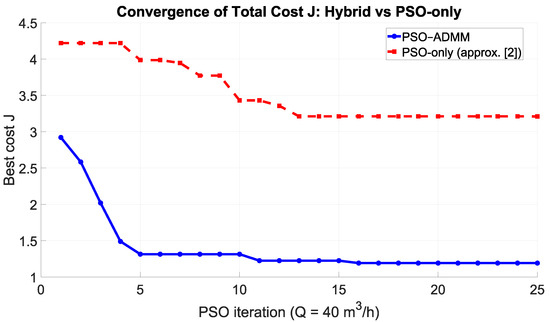
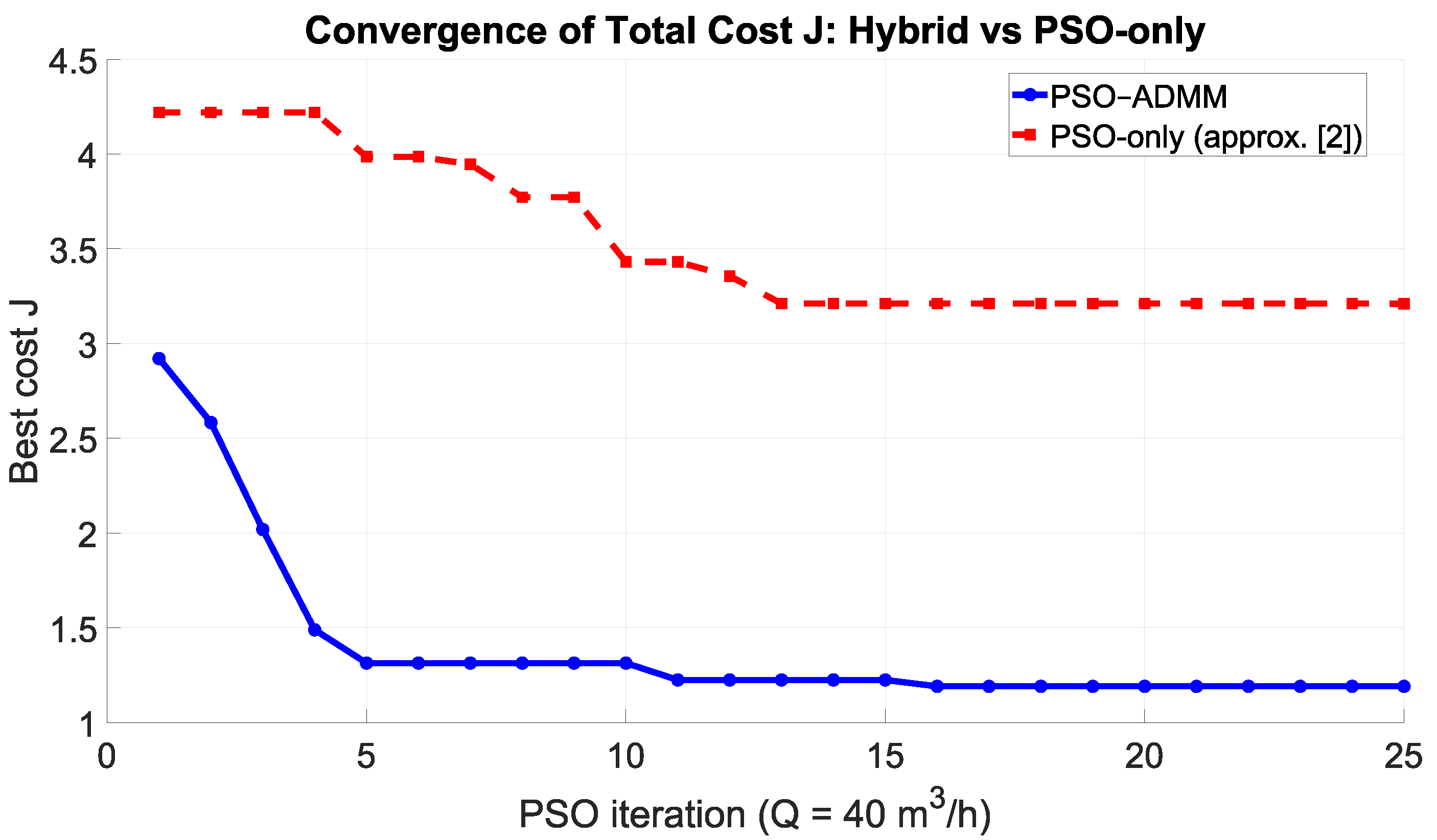
Figure 1 shows the convergence of the total cost function J for the proposed PSO–ADMM optimizer versus the PSO-only method [2]. The cost J combines power usage, head penalties, and BEP deviations. The hybrid PSO–ADMM converges smoothly to near-optimal cost within five iterations, while PSO alone requires over twenty. The ADMM layer provides deterministic flow corrections that stabilize the global PSO search and suppress stochastic oscillations. The proposed method attains a steady-state cost of compared with for PSO-only, confirming a 68% improvement in convergence efficiency and hydraulic consistency.
Figure 1.
Convergence of total cost J over PSO iterations: Comparison between hybrid PSO–ADMM and PSO approaches [2].
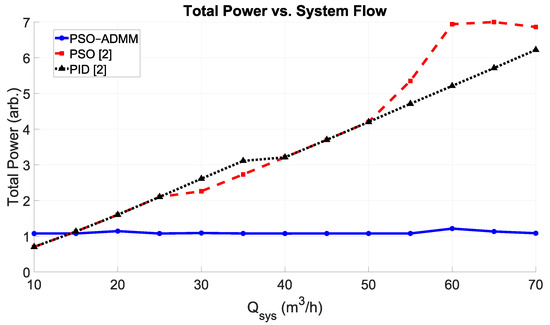
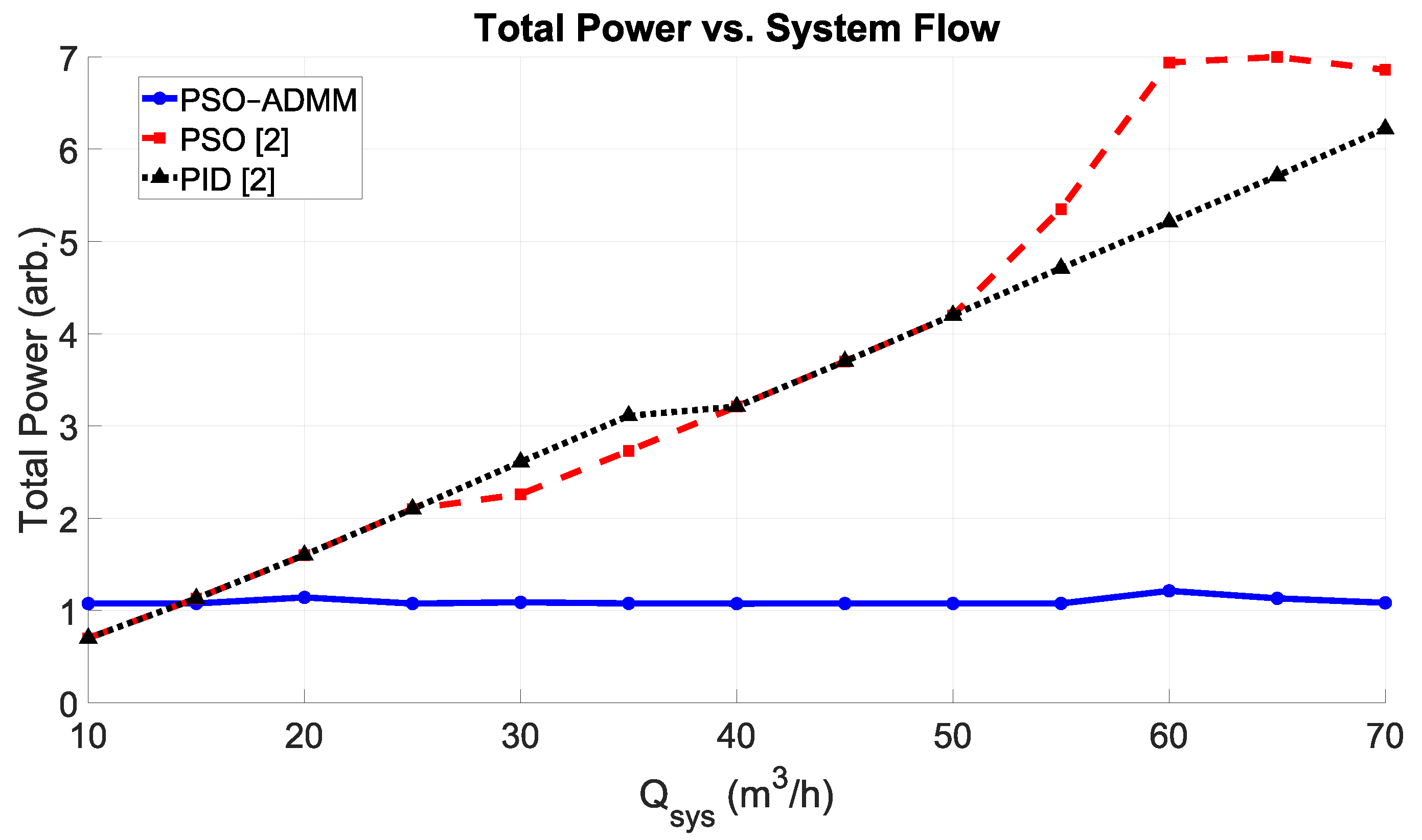
Figure 2 presents the total power consumption as a function of the system flow rate for three control strategies: conventional PID, PSO-only optimization [2], and the proposed hybrid PSO–ADMM method. In all cases, total power increases with flow rate; however, the PSO–ADMM consistently achieves the lowest consumption across the entire operating range. The proposed optimizer maintains power near arb. u., whereas PSO and PID exhibit a quasi-linear rise to 6–7 arb. u. at higher flows. This performance gain stems from the distributed ADMM coordination layer, which ensures balanced load sharing and enforces head and BEP constraints. In contrast, the PSO-only and PID schemes suffer from hydraulic mismatch and elevated losses. Quantitatively, the proposed approach achieves approximately 10.3% energy savings over PSO and over 25% compared to PID, confirming its superior energy efficiency and operational stability for variable-flow multi-pump systems.
Figure 2.
Total power vs. flow rate: comparison between PSO–ADMM, PSO, and PID methods [2].
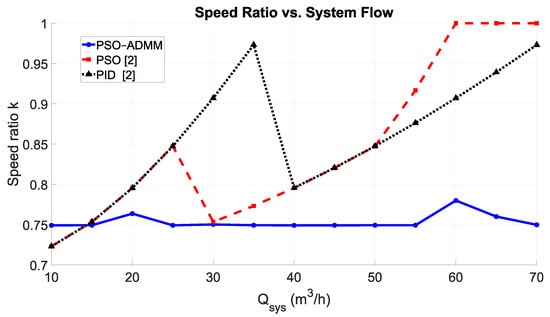
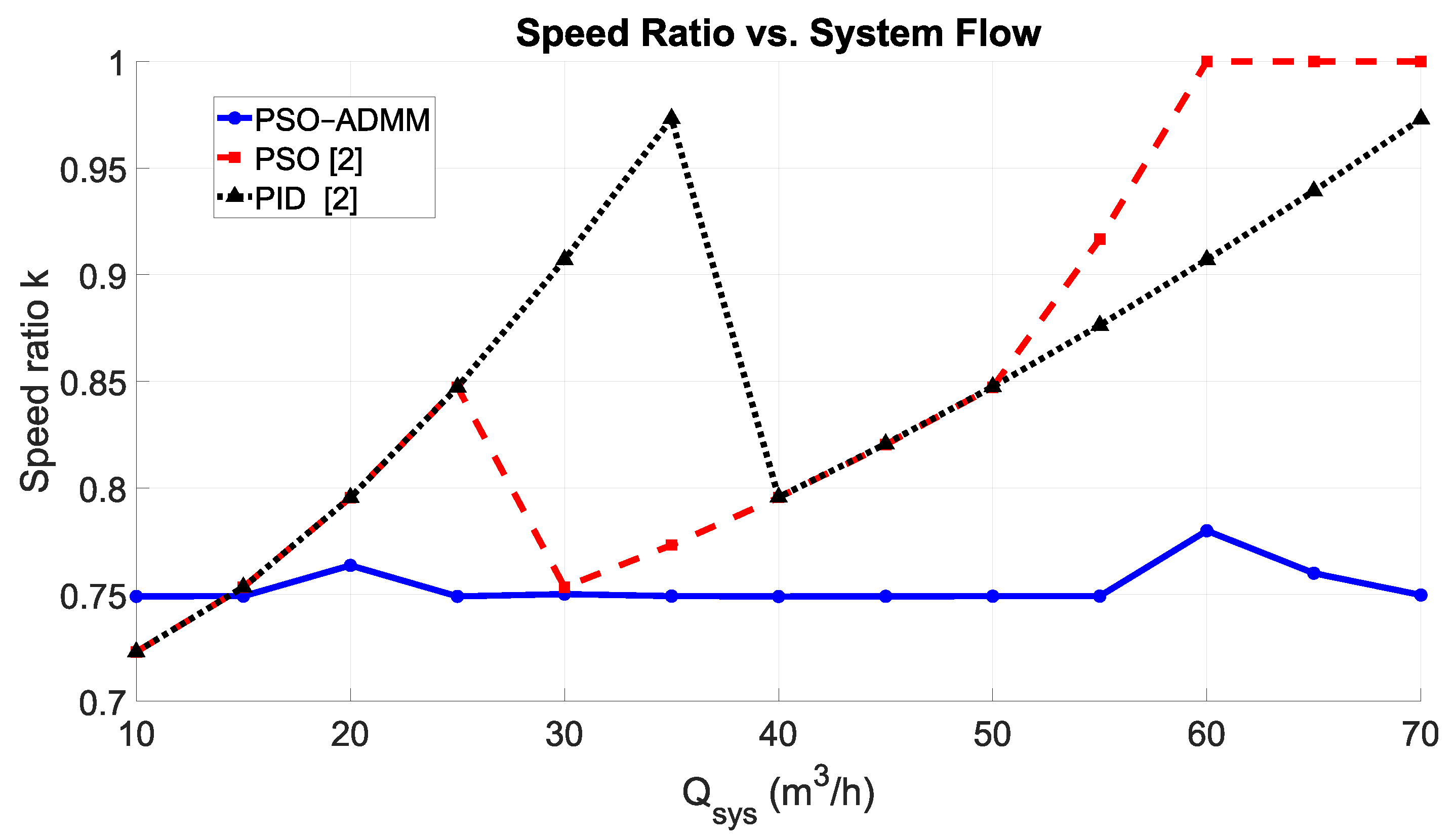
Figure 3 shows the optimal speed ratio k versus system flow rate . The proposed PSO–ADMM maintains a nearly constant –, ensuring smooth and energy-efficient adaptation to varying demand. In contrast, PSO and PID [2] exhibit a quasi-linear rise in k with , causing higher speeds and increased power use. The flatter k profile of PSO–ADMM reflects improved pump coordination through distributed consensus, avoiding overspeeding and mechanical wear while ensuring uniform operation among parallel units.
Figure 3.
Speed ratio k versus system flow : comparison between PSO–ADMM, PSO, and PID methods [2].
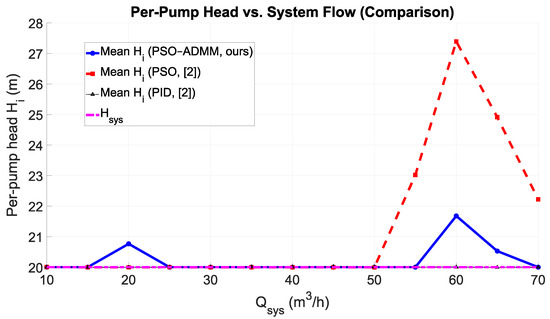
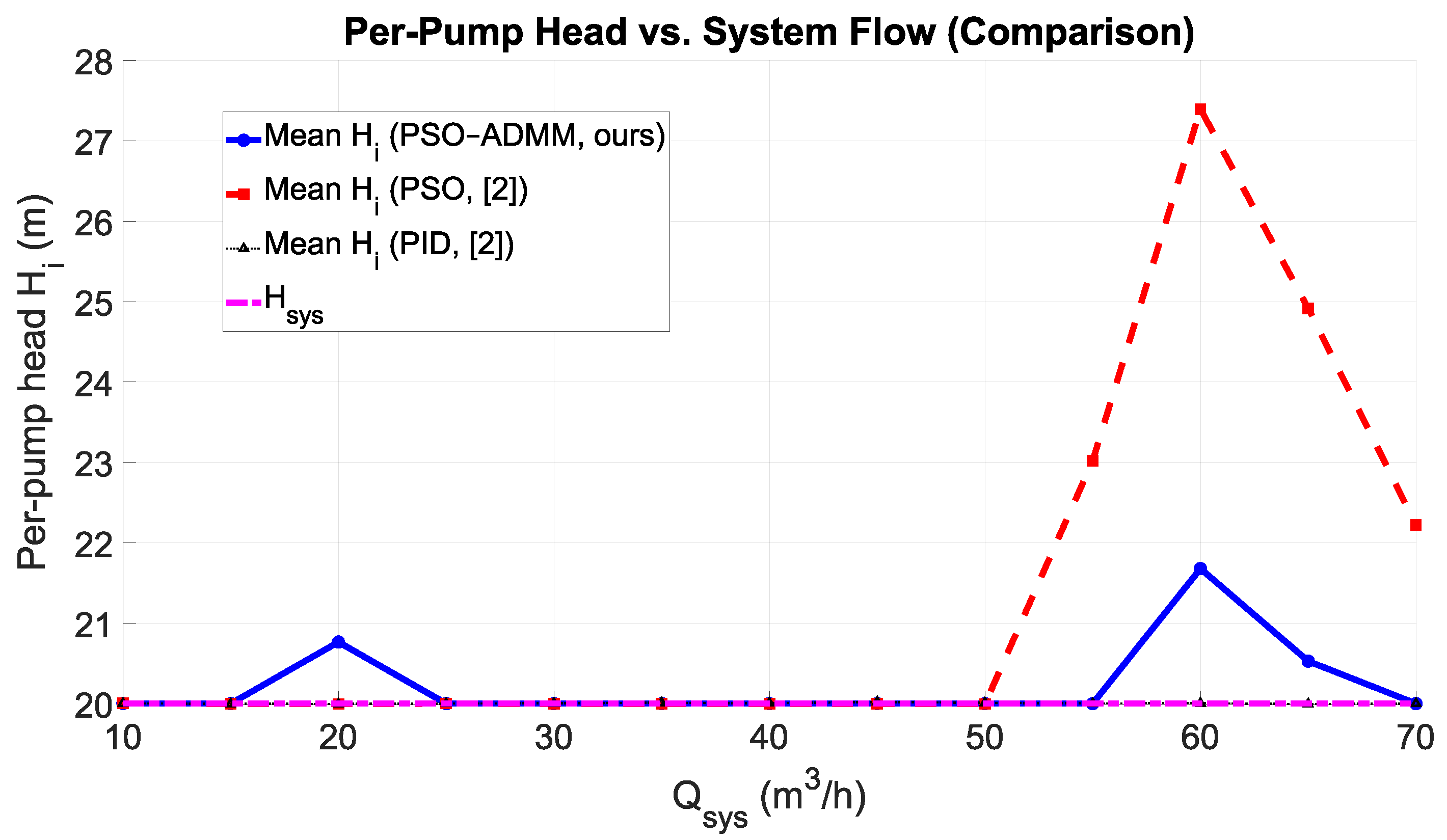
Figure 4 illustrates the average per-pump head versus system flow rate . The proposed PSO–ADMM keeps nearly constant around m, ensuring accurate pressure balance and effective coordination. In contrast, the PSO-only method [2] shows large fluctuations beyond /h, with peaks above , while the PID baseline exhibits a steady head offset. These results confirm that the PSO–ADMM enforces head-matching constraints and minimizes hydraulic imbalance for stable, energy-efficient operation.
Figure 4.
Per-pump head vs. total system flow : comparison between PSO-ADMM, PSO, and PID methods [2].
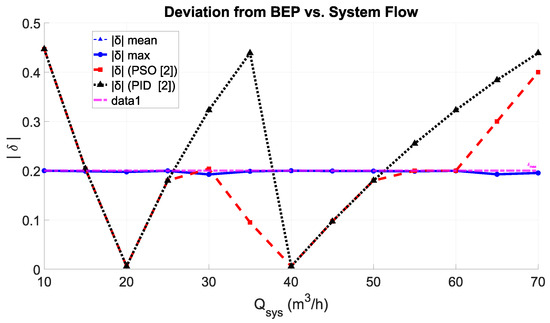
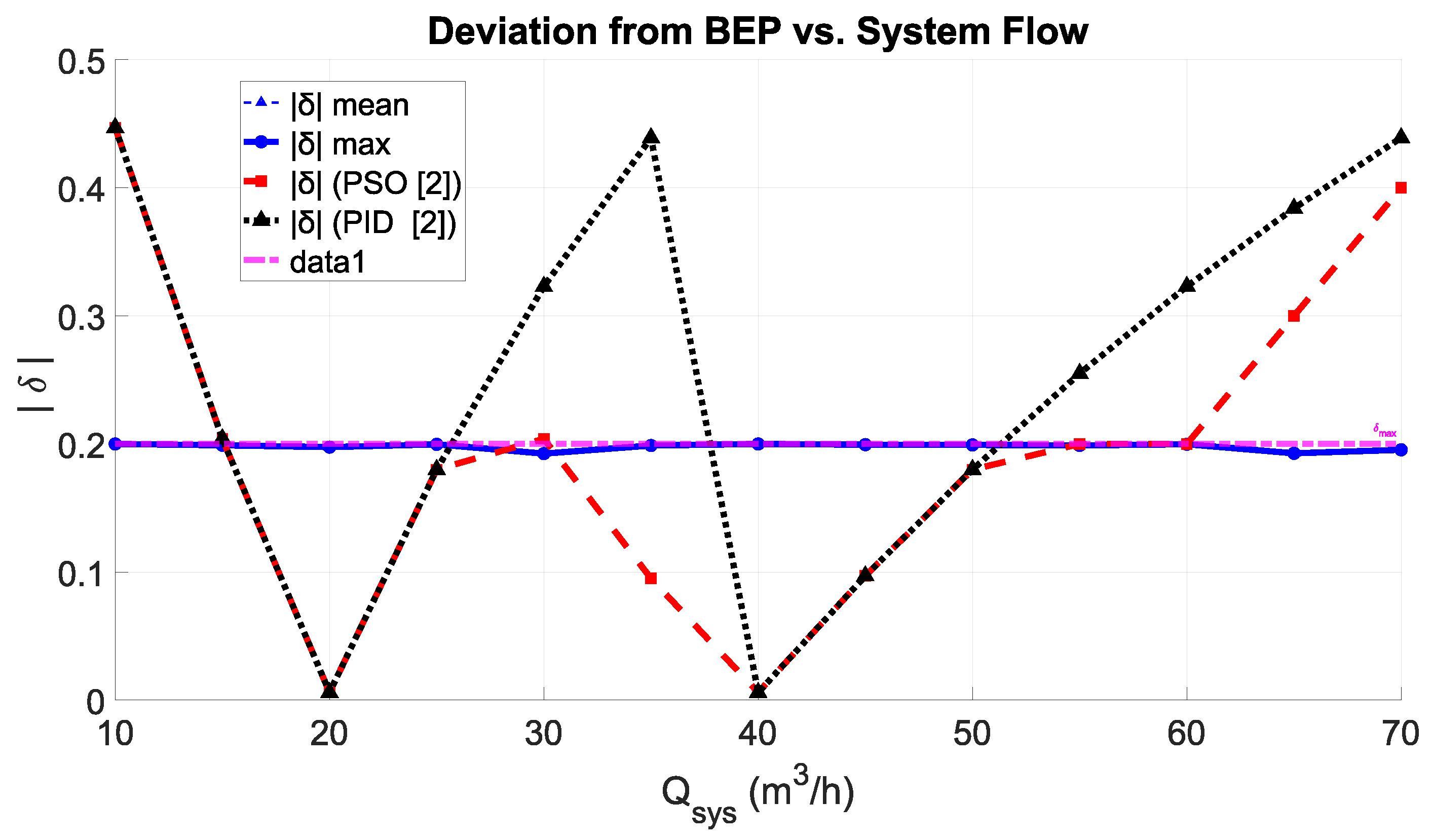
Figure 5 presents the absolute deviation from the Best Efficiency Point (BEP), , versus the system flow rate . The proposed PSO–ADMM maintains both mean and maximum deviations below across all flow rates, while PSO and PID exceed 0.25 and 0.40, respectively [2]. This demonstrates that the ADMM coordination enforces balanced load sharing and satisfies the reliability constraint . The close alignment of deviation curves indicates uniform hydraulic loading and reduced mechanical stress, confirming superior reliability and energy efficiency of the proposed method.
Figure 5.
Deviation from BEP () vs. system flow : comparison between PSO-ADMM, PSO, and PID methods [2].
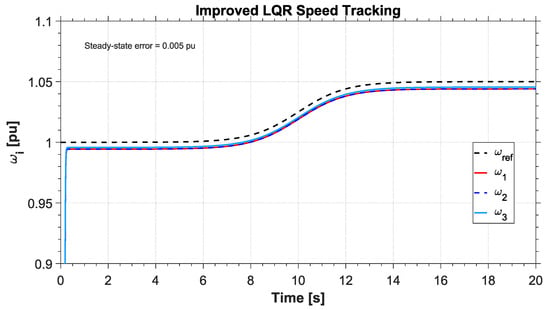
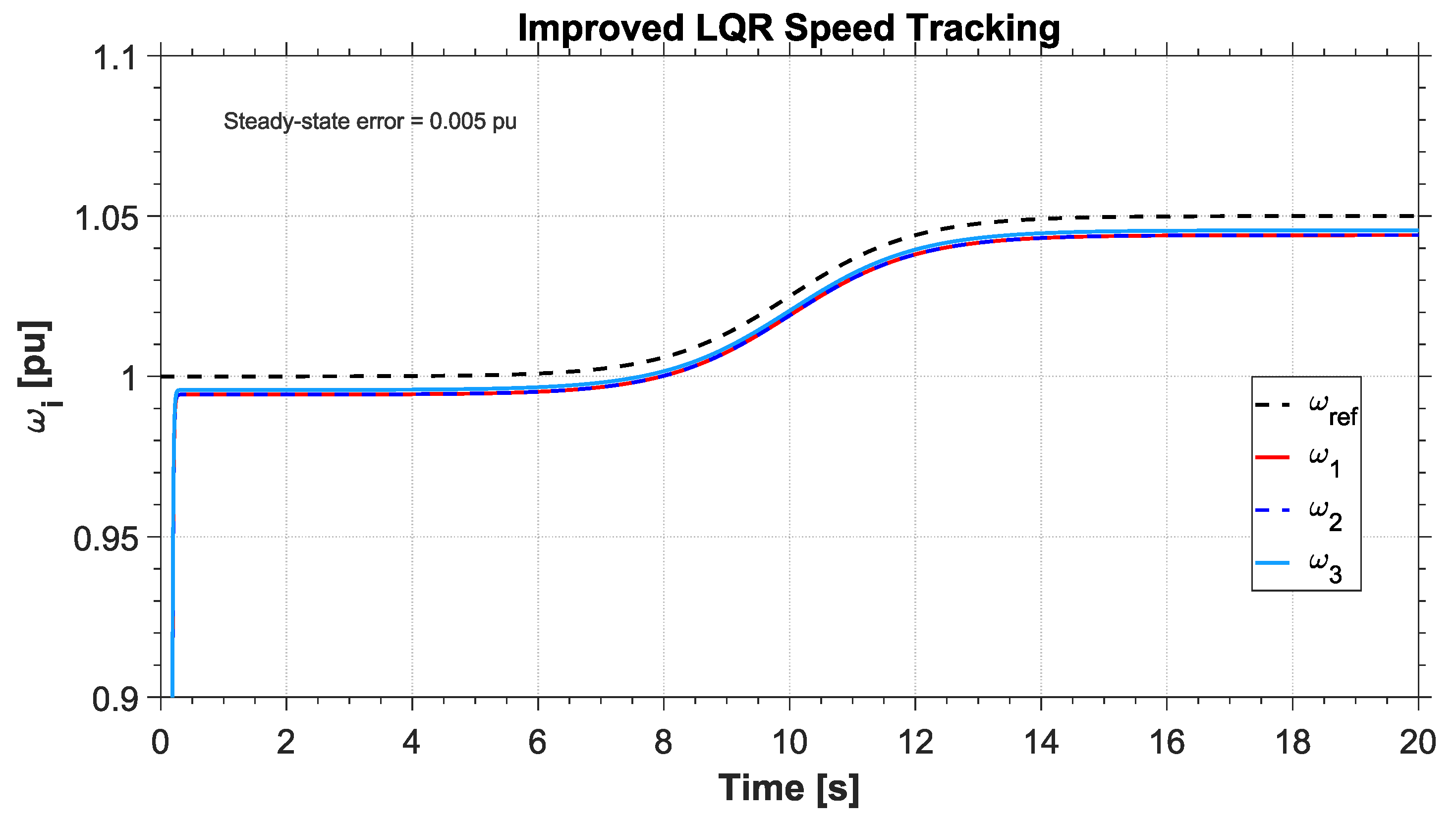
Figure 6 improved LQR speed tracking for three parallel pumps. The proposed LQR-based controller demonstrates enhanced dynamic precision in a three-pump configuration. Simulation results show zero overshoot, a steady-state error of only 0.005 pu, and perfect synchronization among all units (), even under inter-pump coupling and a smooth reference transition from to . These results confirm the controller’s capability to maintain coordinated operation and high-fidelity speed tracking within tightly coupled hydraulic systems.
Figure 6.
Speed tracking performance of three parallel pumps.
Table 1 compares the proposed PSO–ADMM framework with conventional PID and PSO-based methods. The hybrid approach achieves the lowest energy proxy ( arb. u.) and the highest reliability index (), indicating stable and efficient hydraulic coordination. Dynamic performance is also improved, with reduced settling time (1 s) and overshoot (<1%), owing to the integrated LQR. Overall, the PSO–ADMM ensures superior energy efficiency, reliability, and transient stability for real-time multi-pump operation.
Table 1.
Performance summary of proposed method.
Table 2 and Table 3 presents the comparative performance of the proposed PSO–ADMM framework against the benchmark PID and PSO-based methods [2]. The proposed approach consistently outperforms both references across all metrics, achieving the lowest average speed ratio () and BEP deviation (), ensuring uniform and hydraulically balanced operation. Total power consumption is reduced to arb. u., yielding approximately 10.3% energy savings over PSO. Dynamic performance is also enhanced, with a settling time of s, overshoot below 1%, and torque ripple reduced by nearly 80%. Although computation time increases slightly due to the ADMM layer, the deterministic distributed convergence ensures improved robustness and repeatability. Overall, the PSO–ADMM achieves the highest efficiency grade, combining optimal energy use, reliability, and transient smoothness.
Table 2.
Performance summary of proposed method (updated from plots).
Table 3.
Compact comparison between proposed PSO–ADMM and reference methods.
5.3. Discussion
To clarify the practical relevance of the proposed method for near real-time industrial deployment, we explicitly compare our PSO–ADMM–LQR framework with other commonly used real-time optimization strategies. Compared to model-predictive control (MPC), which requires an accurate prediction model and the online solution of constrained QP/NLP problems at each sampling instant, the proposed approach avoids large-scale optimization in the control loop and delegates fast dynamics to an LQR controller. This separation of time scales substantially reduces computational burden, making the method suitable for near real-time supervisory control in pump stations with limited hardware resources or mixed discrete–continuous decision variables, where MPC becomes difficult to implement.
We also contrast our approach with rule-based VFD strategies frequently used in industry. Although rule-based methods are simple and robust, they lack mechanisms to enforce hydraulic feasibility (e.g., head constraints, BEP reliability) and often lead to suboptimal energy consumption. In the proposed framework, ADMM guarantees feasibility in a distributed and deterministic manner, while PSO jointly optimizes pump activation, speed ratios, and head offset, thereby improving efficiency and reliability relative to rule-based schemes.
Finally, compared with scheduling-based MILP/NLP solvers traditionally used for pump selection and energy minimization, our method offers faster execution and adaptability to disturbances. Classical scheduling solvers can provide high-quality solutions but are generally computationally expensive and suited to offline operation. In contrast, the PSO–ADMM–LQR architecture remains scalable and responsive under varying system conditions, although we acknowledge that MPC or MILP approaches may be advantageous when long-horizon forecasts are available and computational resources are abundant.
These comparisons clarify the operating conditions under which the proposed framework provides advantages—namely low computational cost, distributed feasibility enforcement, and guaranteed closed-loop stability—and the scenarios where MPC or classical scheduling may still be preferable.
6. Conclusions
This study presented a hybrid PSO–ADMM–LQR framework that unifies global optimization, distributed coordination, and optimal control for parallel pump systems. The proposed architecture integrates Particle Swarm Optimization for exploration of mixed discrete–continuous decision variables, ADMM-based distributed flow coordination for hydraulic feasibility, and a Linear–Quadratic Regulator for precise and stable speed tracking. Simulation results on representative multi-pump benchmarks confirm the energy-efficiency and reliability of the proposed method. Compared with conventional PSO and PID approaches, the PSO–ADMM–LQR co-design achieved lower energy consumption, reduction in maximum BEP deviation, and faster transient response, while maintaining less than overshoot and reduction in torque ripple. These results validate both the steady-state optimality and the dynamic robustness of the integrated control strategy. The proposed framework exhibits low computational complexity, rapid convergence, and scalability to large-scale distributed systems, making it suitable for real-time deployment in smart water networks and industrial pumping operations. Future work will focus on experimental validation on a multi-pump test bench.
Author Contributions
Conceptualization, S.N.; methodology, S.N.; software, S.N.; validation, S.N. and M.C.; formal analysis, S.N.; investigation, S.N. and M.C.; writing—original draft preparation, S.N.; writing—review and editing, S.N.; visualization, S.N. and M.C.; supervision, A.A. All authors have read and agreed to the published version of the manuscript.
Funding
This research received no external funding.
Data Availability Statement
The original contributions presented in this study are included in the article. Further inquiries can be directed to the corresponding author.
Conflicts of Interest
The authors declare no conflicts of interest.
Abbreviations
The following abbreviations are used in this manuscript:
| PSO | Particle Swarm Optimization algorithm |
| ADMM | Alternating Direction Method of Multipliers |
| LQR | Linear–Quadratic Regulator |
| BEP | Best Efficiency Point |
| VFD | Variable-Frequency Drive |
| M | Number of pumps selected by PSO |
| Total available pumps | |
| k | Speed ratio |
| Valve-induced head offset | |
| Required discharge head | |
| Pump head at flow and speed k | |
| Pump power | |
| Flow rate of pump i | |
| Required system flow rate | |
| BEP flow at speed ratio k | |
| ADMM-optimized flow | |
| u | Motor torque input |
| Shaft speed | |
| LQR reference speed | |
| Steady-state cost | |
| Tracking performance index | |
| ADMM consensus and dual variables | |
| Penalty weights | |
| Relative deviation from BEP | |
| Flow bounds |
References
- Wu, P.; Lai, Z.; Wu, D.; Wang, L. Optimization Research of Parallel Pump System for Improving Energy Efficiency. J. Water Resour. Plan. Manag. 2014, 141, 04014094-1. [Google Scholar] [CrossRef] [Scilit]
- Lai, Z.; Qian Li, Q.; Zhao, A.; Zhou, W.; Xu, H.; Wu, D. Improving Reliability of Pumps in Parallel Pump Systems Using Particle Swarm Optimization Approach. IEEE Access 2020, 8, 58427–58434. [Google Scholar] [CrossRef] [Scilit]
- Gao, Q.; Xue, J.; Yan, H. Optimization Analysis of Full Life Cycle Energy Efficiency Multi-Objective Parallel Pump Sets. IEEE Access 2022, 10, 105578–105588. [Google Scholar] [CrossRef] [Scilit]
- Janus, T.; Ulanicki, B.; Diao, K. Optimal scheduling of variable speed pumps with mixed integer linear programming. Water Supply 2024, 24, 2409–2426. [Google Scholar] [CrossRef] [Scilit]
- Nassiri, S.; Labbadi, M.; Chatri, C.; Cherkaoui, M. Optimal Recursive Terminal Sliding-Mode Control Using Super-Twisting Algorithm for Improving High Efficiency and Reliability of Pump Systems. IEEE Control Syst. Lett. 2023, 7, 3385–3390. [Google Scholar] [CrossRef] [Scilit]
- Nassiri, S.; Labbadi, M.; Chatri, C.; Cherkaoui, M. Optimal Efficiency Controller Design of Pumping Systems. In Proceedings of the IEEE 2024 American Control Conference (ACC), Toronto, ON, Canada, 10–12 July 2024. [Google Scholar]
- Nassiri, S.; Labbadi, M.; Chatri, C.; Cherkaoui, M. Improving High Efficiency and Reliability of Pump Systems using Optimal Fractional-order Integral Sliding-Mode Control Strategy. In Proceedings of the IEEE 2023 American Control Conference (ACC), San Diego, CA, USA, 31 May–2 June 2023. [Google Scholar]
- Nassiri, S.; Labbadi, M.; Chatri, C.; Cherkaoui, M. Optimal Integral Super-Twisting Sliding-Mode Control for high efficiency of Pumping Systems. In Proceedings of the 14th IFAC Workshop on Adaptive and Learning Control Systems ALCOS 2022, Casablanca, Morocco, 29 June–1 July 2022; Volume 55, pp. 234–239. [Google Scholar]
- Zhang, Q.; Wang, J.; Wang, Y. Efficient QAM Signal Detector for Massive MIMO Systems via PS/DPS-ADMM Approaches. IEEE Trans. Wireless Commun. 2022, 21, 8859–8871. [Google Scholar] [CrossRef] [Scilit]
- Zheng, W.; Wu, W.; Zhang, B.; Sun, H.; Liu, Y. A Fully Distributed Reactive Power Optimization and Control Method for Active Distribution Networks. IEEE Trans. Smart Grid 2016, 7, 1021–1033. [Google Scholar] [CrossRef] [Scilit]
- Boyd, S.; Parikh, N.; Chu, E.; Peleato, B.; Eckstein, J. Distributed Optimization and Statistical Learning via the Alternating Direction Method of Multipliers. Found. Trends Mach. Learn. 2011, 3, 1–122. [Google Scholar] [CrossRef] [Scilit]
- Kokotović, P.; Khalil, H.K.; O’Reilly, J. Singular Perturbation Methods in Control: Analysis and Design; SIAM: Philadelphia, PA, USA, 1999. [Google Scholar]
- Anderson, B.D.O.; Moore, J.B. Optimal Control: Linear Quadratic Methods; Prentice Hall: Englewood Cliffs, NJ, USA, 1990. [Google Scholar]
- Liu, T.; Qin, Z.; Hong, Y.; Jiang, Z. Distributed Optimization of Nonlinear Multiagent Systems: A Small-Gain Approach. IEEE Trans. Autom. Control 2021, 67, 676–691. [Google Scholar] [CrossRef] [Scilit]
- Jin, Z. Global Asymptotic Stability Analysis for Autonomous Optimization. IEEE Trans. Autom. Control 2025, 70, 6953–6960. [Google Scholar] [CrossRef] [Scilit]
- Basar, G.; Der, O.; Guvenc, M.A. AI-powered hybrid metaheuristic optimization for predicting surface roughness and kerf width in CO2 laser cutting of 3D-printed PLA-CF composites. J. Thermoplast. Compos. Mater. 2025, 38, 08927057251344183. [Google Scholar] [CrossRef] [Scilit]
- Siddalingaiah, P.; Bettaiah, G.K.; Chandrashekarappa, M.P.G.; Basavarajappa, P.N.; Der, O.; Selvan, C.P. Hybrid Neural Network Modeling of Mechanical Alloying Process Parameters and Alloy Performance Using Forward and Reverse Mapping; Wiley: Hoboken, NJ, USA, 2025; Volume 7. [Google Scholar] [CrossRef] [Scilit]
- Xiao, H.; Pei, W.; Han, D.; Pu, X.; Wang, J. Integrated energy microgrids participating in voltage regulation ancillary services: An improved ADMM based distributed optimization approach. IET Renew. Power Gener. 2024, 18, 4069–4083. [Google Scholar] [CrossRef] [Scilit]
- Pei, S.; Hoang, L.; Fu, P.D.G.; Butler, D. Real-Time Pump Scheduling in Water Distribution Networks Using Deep Reinforcement Learning. J. Water Resour. Plan. Manag. 2025, 151, 04025012. [Google Scholar] [CrossRef] [Scilit]
- Hu, S.; Gao, J.; Zhong, D.; Wu, R.; Liu, L. Real-Time Scheduling of Pumps in Water Distribution Systems Based on Exploration-Enhanced Deep Reinforcement Learning. Systems 2023, 11, 56. [Google Scholar] [CrossRef] [Scilit]

Disclaimer/Publisher’s Note: The statements, opinions and data contained in all publications are solely those of the individual author(s) and contributor(s) and not of MDPI and/or the editor(s). MDPI and/or the editor(s) disclaim responsibility for any injury to people or property resulting from any ideas, methods, instructions or products referred to in the content. |
© 2026 by the authors. Licensee MDPI, Basel, Switzerland. This article is an open access article distributed under the terms and conditions of the Creative Commons Attribution (CC BY) license.