


Abstract
Pneumatic separation is essential in paddy processing, but poor pre-segregation of rice husk–brown rice mixtures causes rice husk retention and brown rice loss. A stepped feeding chute was proposed in this study to enhance the gravity-driven segregation of rice husk–brown rice mixtures before pneumatic separation. The discrete element method was used to simulate particle motion under different step heights and analyze the effects of step height on particle bed porosity, vertical displacement difference, and motion trajectories. Results showed that segregation was governed by the coupled effects of density and surface-roughness differences: brown rice tended to percolate downward, whereas rice husks tended to interlock and remain in the upper layer. The degree of separation first increased and then decreased with increasing step height, owing to the combined influence of porosity-induced changes in vertical displacement difference and impact-induced trajectory fluctuations that promoted remixing. An optimal step height of 13 mm, approximately 1.86 times the brown rice kernel length, reduced rice husk retention by more than 30% and brown rice loss by more than 40%. This design provides an effective approach to improving pneumatic separation. It may also guide the design of segregation-enhanced conveying systems for heterogeneous particulate food materials.
1. Introduction
In the process of paddy hulling, the separation of rice husks and brown rice is an indispensable stage [1]. Usually, the mixture of rice husks and brown rice transports along the inclined chute driven by gravity from the hulling system to the pneumatic separation system for completing the separation. However, because the mixture is not completely separated in the separation region, rice husk and brown rice enter the opposite transport region, respectively, resulting in rice husk retention and brown rice loss. Improving the degree of segregation (DOS) is the key to solving this problem before the mixture enters the separation region. In addition, the rice husk and brown rice mixture is a binary mixture with multiple property differences [2,3]. Therefore, to find a method to improve the DOS in the flow process under gravity is not only of great engineering significance for separating rice husk and brown rice, but also of great application value to improve the segregation and mixing of binary mixtures with multiple property differences [4].
In industrial practice, binary mixtures with differing properties are widespread across many sectors: In some processes [5], separation of mixture components is required to enhance production efficiency and product quality [6,7,8], whereas in others the opposite objective, i.e., maintaining or promoting mixing, is pursued [9,10,11]. Consequently, to enhance or suppress segregation, extensive research has been conducted from various perspectives on the segregation and mixing behavior of binary and multi-component granular mixtures.
For example, in the early research work on the mixing and segregating of mixtures particles, Williams (1976) [12] suggested that there are many properties of particles that can give rise to segregation, such as the differences in particle size, density, shape, and resilience. The difference in particle size is the most important. Attention therefore was concentrated on size segregation. In research of Savage and Lun (1988) [13], dry cohesionless granular solids were used to study particle size segregation in inclined chute flow. They proposed “random fluctuating sieve” and “squeeze expulsion”—two segregation mechanisms. By combining these two proposed mechanisms, the net percolation velocity of each species is obtained. A model for predicting particle size segregation in chute flow was established. Vallance and Savage [14] and Berton and Delannay [15] verified Savage and Lun’s theoretical and predictive models using two-dimensional skewed flow and bi-dispersed disk-inclined flow, respectively, and both showed that they were consistent with Savage and Lun’s proposed “random wave screen” and “squeeze-discharge” (collectively known as dynamic screening) separation mechanisms for size differences. Therefore, in the later studies, scholars studied the particle size segregation in greater depth based on “random fluctuating sieve” and “squeeze expulsion” (kinetic sieving) under different working conditions. In addition, they have developed various structures to promote the separation or mixing of the mixture. For instance, Meng [16,17] developed an indented cylinder screen to facilitate the separation of broken rice and whole rice. This device enables smaller broken rice grains to gather near the indentations (pockets) and utilizes these pockets to lift the broken rice to a higher position before ejecting them, thereby achieving the separation of whole and broken rice grains. Chen and Hao [18], based on Meng’s foundational research, observed that broken rice grains exhibit aggregation not only in proximity to the indentations (pockets) but also at the center of the rice grain pile. This phenomenon is consistent with the segregation mechanism described by Savage and Lun et al. Li et al. [19] further analyzed the relationship between radial particle distribution in the indented cylinder and screening performance and showed that the concentration of broken rice in the outer layer affected its chance of entering the indents. To reduce the segregation degree of broken rice at the center and enhance the segregation degree near the indentations (pockets), Chen introduced a stirring device based on Meng’s original design, and Li proposed a strip baffle structure, which improved the screening efficiency of whole and broken rice by reducing the inward aggregation of broken rice and expanding the disturbance region. Based on the above literature, from a theoretical perspective, the segregation caused by size differences can be addressed by referencing the mechanisms of dynamic sieving for the development and optimization of related segregation or mixing equipment. However, for mixtures of rice husks and brown rice, although there is a significant difference in their volumes, the disparity in their spatial occupancy is relatively small, while the difference in surface roughness is more pronounced. Consequently, dynamic sieving fails to adequately reveal the segregation mechanisms of rice husks and brown rice during gravity-driven flow processes. This limitation has led to bottlenecks in the development of equipment aimed at promoting the segregation of rice husks and brown rice.
For mixtures of rice husks and brown rice exhibiting multi-property differences, our team employed EDEM simulations to investigate their flow behavior on an inclined chute [20]. The results revealed that their segregation mechanism resembles a stochastic fluctuating screening process. However, this mechanism differs fundamentally from segregation driven by particle size differences and is distinct from density-induced segregation. The segregation mechanism arises from the significant differences in surface roughness and density between rice husks and brown rice. Rice husks, with their lower density and higher surface roughness, exhibit poor flowability and tend to interlock at the upper layers of the particle bed due to their rough surfaces. In contrast, brown rice, with smoother surfaces and higher density, can penetrate downward into the bed. By creating additional vertical pathways or space for brown rice to flow toward the depth of the bed, brown rice migrates farther downward, while rice husks remain trapped in the upper layers. This amplifies the segregation degree between the two materials [20].
To improve the degree of segregation (DOS) of rice husks and brown rice before entering the pneumatic separation zone, this study, building on previous research on segregation in inclined chutes [20], adopts a stepped feeding structure to increase the movement space of particles in the depth direction of the material layer. The discrete element method (DEM) is used to simulate the flow process of the mixture at different step heights, and the combined effects of particle percolation and remixing caused by collision rebound on the degree of segregation are analyzed in conjunction with the porosity of the particle population, the vertical displacement difference between rice husks and brown rice, and the motion trajectories of bottom-layer particles. On this basis, a fitting relationship between step height and outlet degree of segregation is established, the step height is selected under given structural and operating conditions, and the pneumatic separation performance of the selected structure is evaluated through full-machine experiments. The above research applies the analysis of particle packing and motion mechanisms to the selection of stepped structural parameters, providing a design basis for improving the material layering state before pneumatic separation.
2. Materials and Methods
Building on previous research on the segregation of rice husks and brown rice in inclined chutes [20], this paper uses DEM to analyze the changes in particle motion, material layer structure, and degree of segregation under different step heights, and evaluates the pneumatic separation performance through full-machine experiments with the selected stepped structure installed. The numerical model, working condition settings, and experimental methods are described below.
2.1. Numerical Simulations
2.1.1. Mechanical Contact Model
The three-dimensional discrete element method was used to simulate the flow of rice husks and brown rice in the stepped chute, and the Hertz–Mindlin model was employed to describe the contacts between particles and between particles and walls [21,22,23,24]. Under the studied conditions, the materials were regarded as cohesionless particles, and adhesion and liquid bridge effects were neglected [25]. Referring to the contact models used in existing DEM studies, this paper adopts the Hertz–Mindlin model to describe the interactions between particles and between particles and walls [21,22,23,24]. Contact forces and torques were calculated based on the contact state and relative motion of the particles, where the coefficient of restitution was used to determine the collision damping, the static friction coefficient was used to limit the tangential friction force, and the rolling friction coefficient was used to describe the rolling resistance in the contact. Each contact action, together with gravity, determined the translation and rotation of the particles, and the equations of motion were as follows:
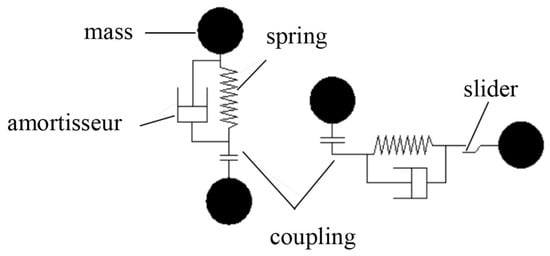
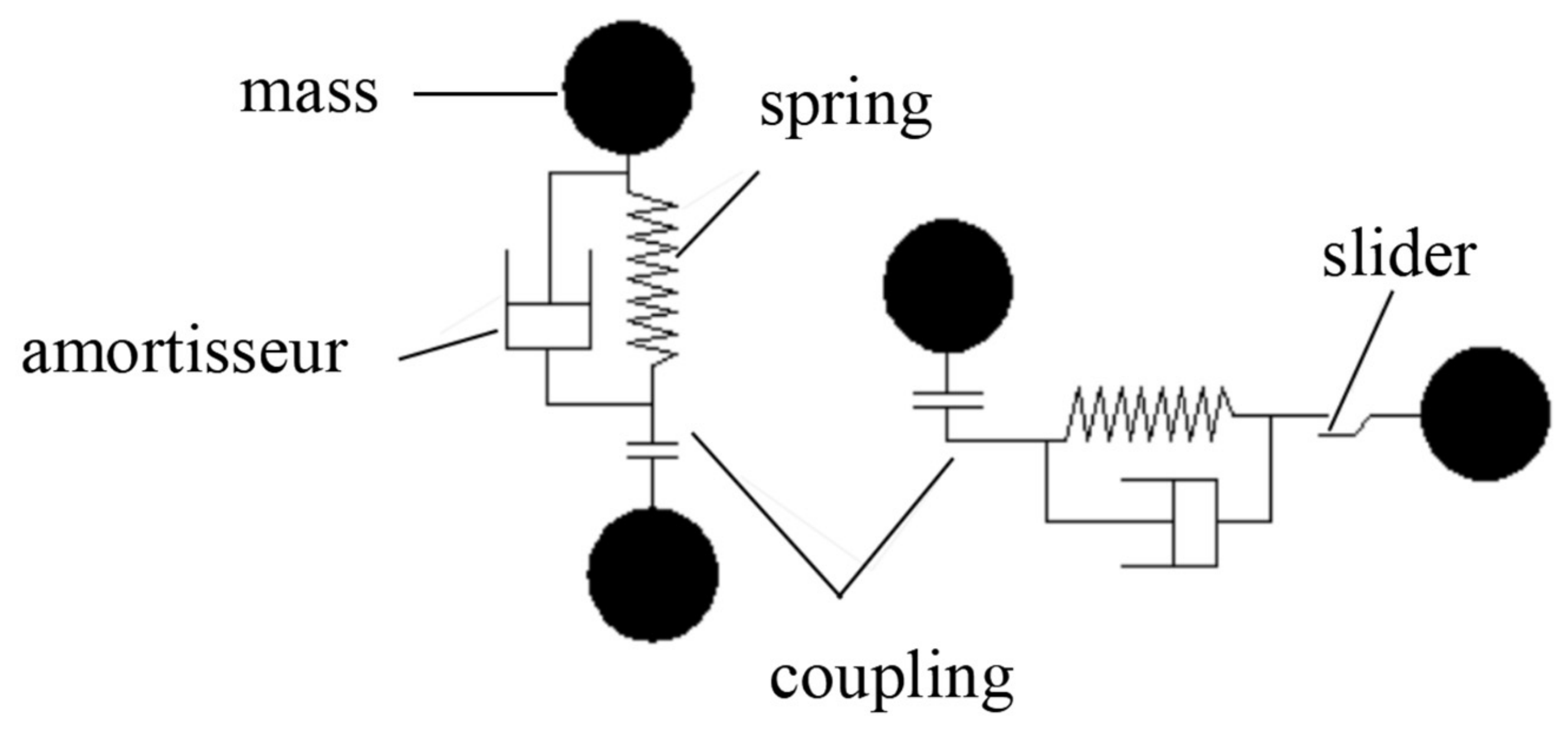
where vi and ωi are the translational velocity and angular velocity of particle i, respectively; mi and Ii are its mass and moment of inertia, respectively; g is the gravitational acceleration; ni is the number of contacts involved in the summation, and the summation terms cover the contact interactions between particles and between particles and walls; Fn and Ft are the normal and tangential elastic contact forces, respectively, corresponding to the spring action in Figure 1; and are the normal and tangential damping forces, respectively, corresponding to the energy dissipation action represented by the damper. The above contact forces, together with gravity, determine the particle translation in Equation (1). In Equation (2), Tt is the torque generated by tangential contact action, and Tr is the rolling friction torque that opposes relative rolling; both jointly affect the rotation of the particles.
Figure 1.
Hertz-Mindlin contact model.
2.1.2. DEM Model of Particles and Geometry
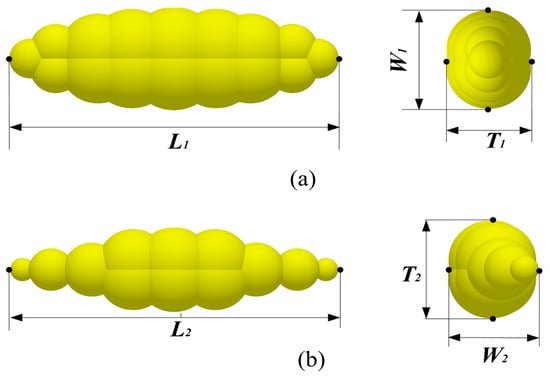
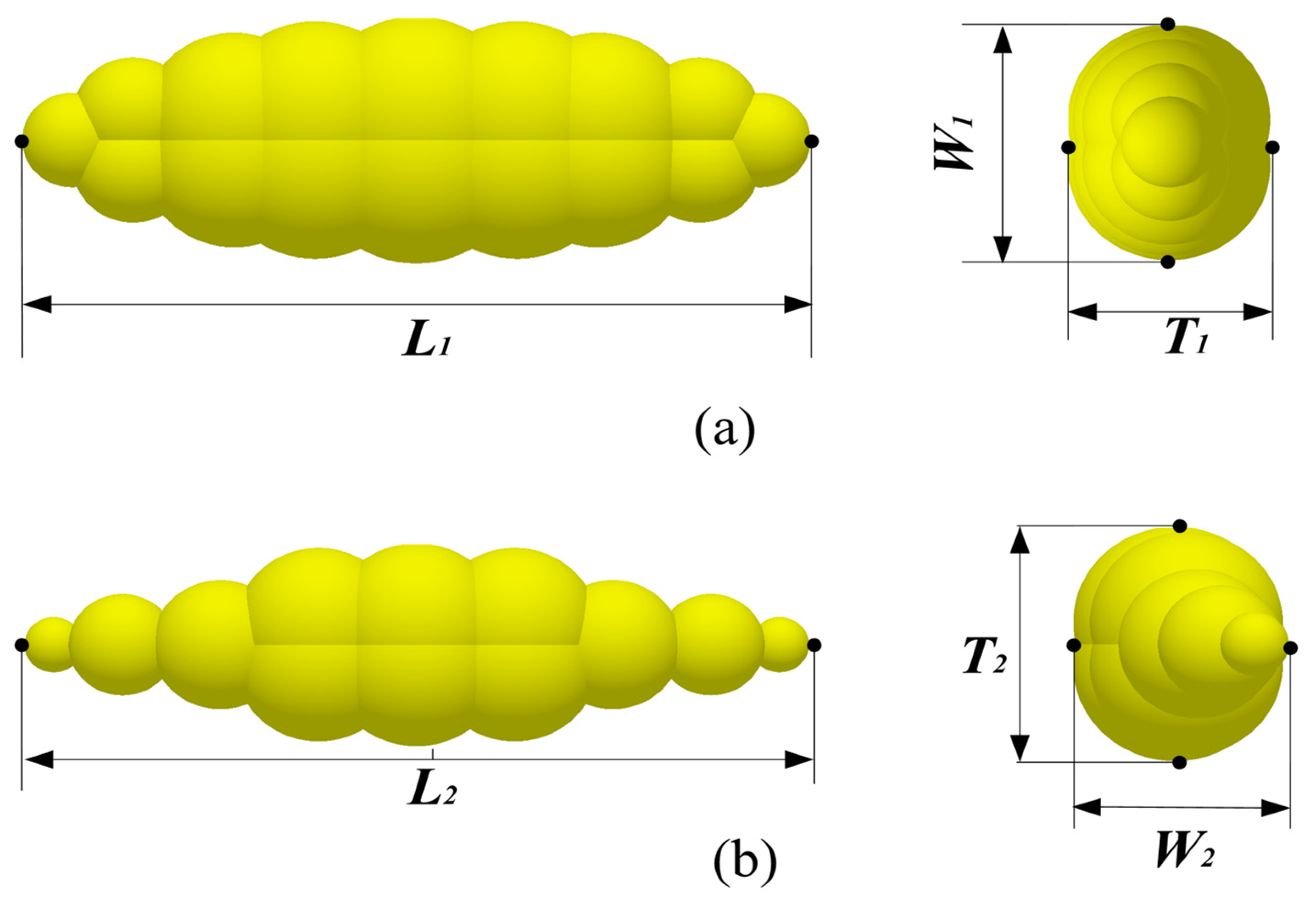
Particle model: Following the particle modeling method used in previous studies on rice husk and brown rice segregation [20], the overlapping sphere method was used to construct brown rice and rice husk particle models, as shown in Figure 2. For accurate reconstruction of particle geometry, image analysis was performed on 100 brown rice kernels and 100 rice husks to obtain their characteristic dimensions, including length (L), width (W), and thickness (T). The particle model geometry was constructed using the average characteristic dimensions of the samples, including length, width, and thickness. The particle mass for each material was assigned according to the mean value measured from 100 brown rice kernels and 100 rice husks. The corresponding material properties used in the DEM model are presented in Table 1. The dimensions used to construct the brown rice and rice husk particle models are presented in Table 2. The DEM input parameters were established using experimentally measured values together with data adopted from relevant published studies [24,26,27,28,29]. The material properties and contact parameters required by the model were determined from experimental measurements and previous studies, with specific values listed in Table 1 [20,27]. Contact types included brown rice–brown rice, brown rice–rice husk, rice husk–rice husk, and the contacts of brown rice and rice husk with the wall; each combination was assigned a coefficient of restitution, static friction coefficient, and rolling friction coefficient. Fixed representative parameters were used for the same contact combination, and no further random distribution of parameters was set. The particle model, material properties, and contact parameters were kept consistent across different step height conditions to compare the effects of changes in the stepped structure on particle flow and segregation behavior.
Figure 2.
3D models of particles in the DEM simulation models: (a) brown rice; (b) rice husk [20].
Table 1.
Physical parameters and their values of particle and geometry in simulations.
Table 2.
Detailed Dimensional Parameters of the Model.
Accurate reconstruction of the thin-walled rice husk geometry in EDEM would require approximately 700 small constituent spheres for each particle, resulting in a considerable increase in computational cost with little gain in model accuracy. Consequently, a simplified representation was employed to balance geometric fidelity and computational efficiency. To achieve a reasonable balance between geometric fidelity and computational efficiency, a simplified modelling strategy was therefore adopted with reference to methods reported in previous studies, as detailed below:
To preserve the physical representativeness of the simplified model, its geometric volume was set equal to the actual volume occupied by a rice husk.
To accommodate the larger constituent spheres used in the simplified representation, with only 35 spheres required for each husk model, the effective density was adjusted accordingly so that the total mass of the model remained equivalent to that of an actual rice husk.
Accordingly, the effective density of the simplified model was determined so that the resulting model mass was equal to that of the corresponding real rice husk, thereby maintaining mass equivalence. The calculation formula is as follows:
m = ρRVR = ρmVm
The relationship between the real rice husk properties and the DEM particle parameters is described by Equation (3), where ρR and VR correspond to the measured density and volume of the actual husk, respectively, and ρm and Vm represent the equivalent parameters of the numerical model. mR is the measured mass of an individual rice husk.
To obtain the physical density of rice husks, the sample mass and geometric volume were experimentally determined. The mass of each husk was recorded using an analytical balance (accuracy of 0.0001 g, METTLER TOLEDO, Greifensee, Zurich, Switzerland). Because of the irregular and thin-walled morphology of rice husks, the samples were flattened in the thickness direction before image acquisition. Their projected areas were extracted using image processing, and the corresponding thickness values were measured with a digital vernier caliper (accuracy 0.01 mm, DELI Group Co., Ltd., Ningbo, Zhejiang, China). The actual husk volume was then calculated from these geometric measurements, allowing the real density to be obtained.
For the DEM model, the particle volume was directly calculated by the software, and the equivalent density parameter was determined according to Equation (3) [30].
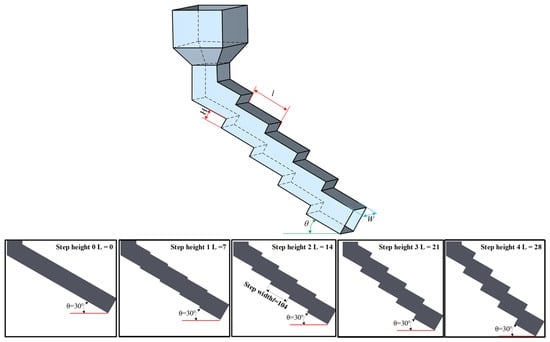
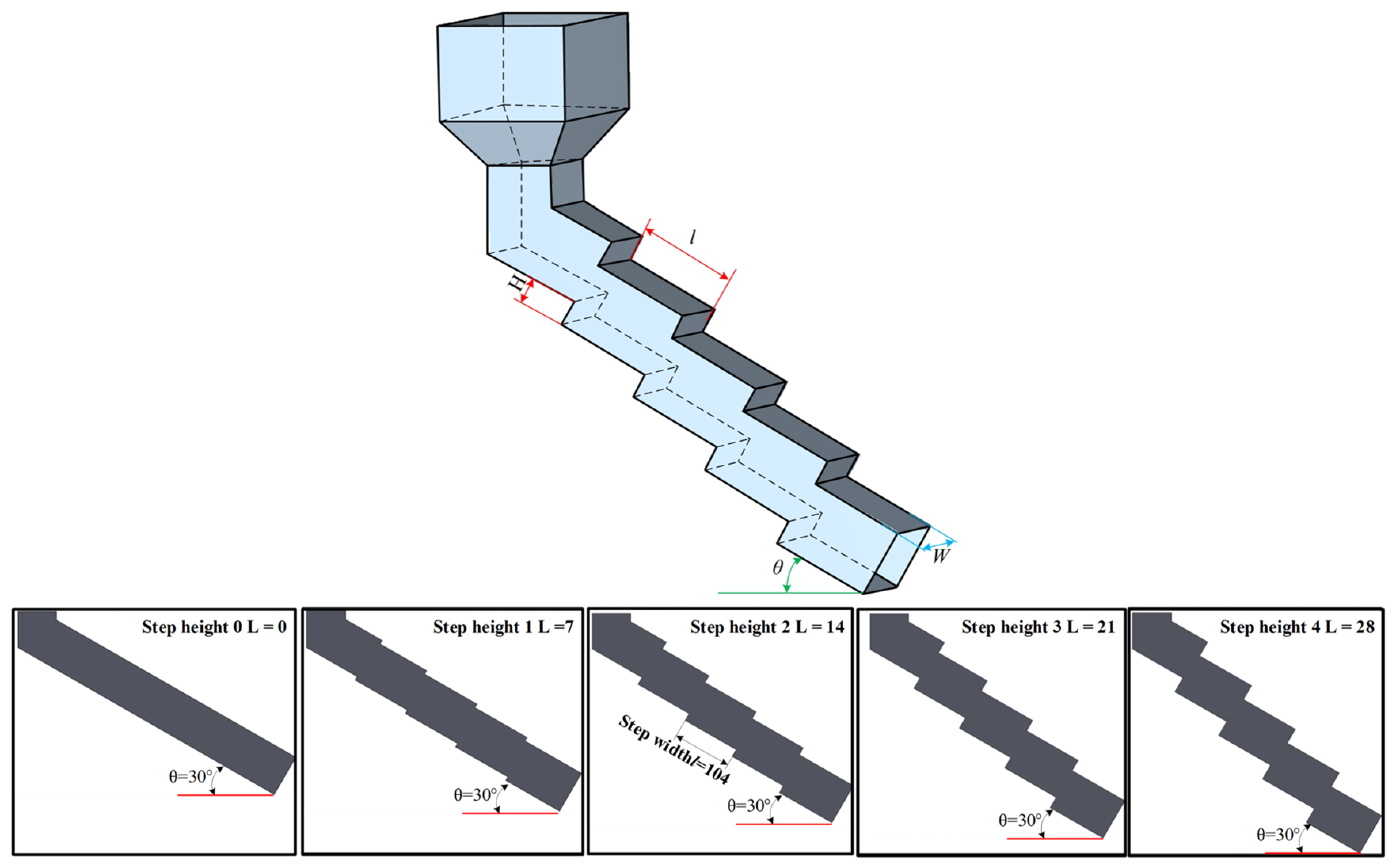
Geometry model: Based on the conclusions drawn from the experimental investigation, DEM simulations were further performed to evaluate particle behavior within the stepped feeder and to provide a basis for optimizing its structural parameters. The preceding results showed that creating additional vertical flow paths within the granular bed enhances the downward percolation of brown rice, while rice husks remain predominantly in the upper region, thereby improving vertical segregation between the two components. Given that additional vertical space promotes the downward percolation of brown rice and thereby strengthens vertical segregation [31], the chute inclination and streamwise travel distance were kept constant in the present design, while the available mobility space in the bed-depth direction was increased. On this basis, a stepped chute geometry was designed to facilitate downward particle migration, with the corresponding structural configuration shown in Figure 3. Under constant chute length and inclination, variations in step height (H) directly alter the available space for particle migration across the depth of the bulk layer. Accordingly, step height was selected as the principal structural parameter for optimization, and EDEM simulations were conducted to ex amine the motion and segregation behavior of the rice husk–brown rice mixture under different step-height conditions.
Figure 3.
Schematic diagram of the stepped chute.
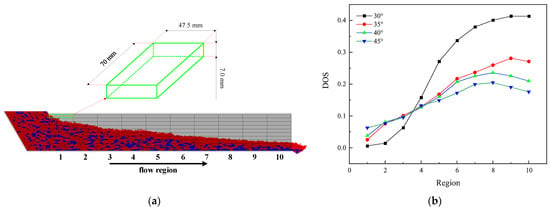
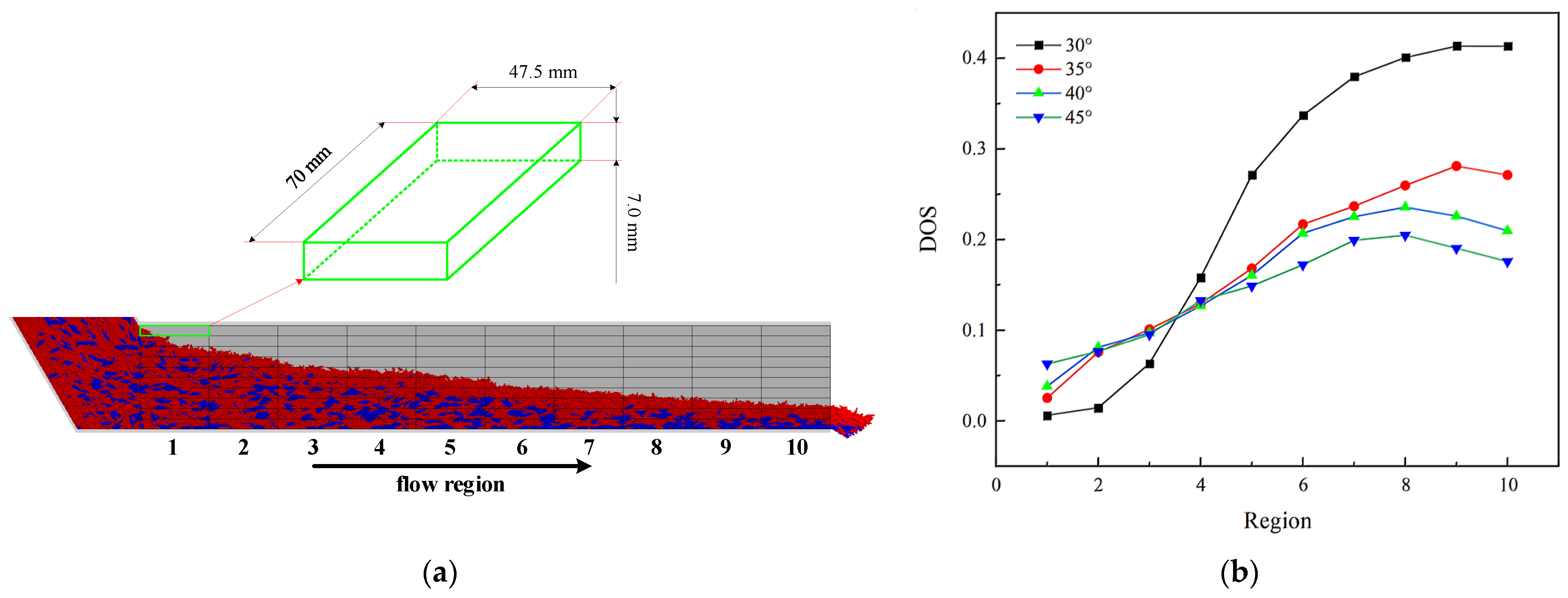
When defining the range of step height, the elongated ellipsoidal shape of the particles was considered to ensure that the selected dimensions were consistent with their characteristic geometry and motion behavior. Based on the characteristic particle length (L), a dimensionless step-height ratio was introduced, with H specified as nL (n = 0, 1, 2, 3, 4) to systematically evaluate the influence of step size. The stepped chute was arranged in five equal-length sections, with each section length l fixed at 104 mm. To illustrate the along-flow segregation law on which the structural design was based, Figure 3 presents the regional division method of previous flat chute studies and the changes in degree of segregation at different inclination angles [20,27]. As shown in Figure 4a, the statistical range was equally divided into 10 regions along the particle flow direction, numbered 1–10 from upstream to downstream; the material layer was further divided into 10 layers along the depth direction, forming a total of 100 cuboid statistical cells. Each statistical cell had a length, a width, and a height of 47.5, 70, and 7 mm, respectively. The abscissa of Figure 4b represents the region number along the flow direction, used to describe the variation in segregation degree with spatial position.
Figure 4.
Regional division and segregation degree variation in previous flat chute studies: (a) schematic diagram of spatial statistical region division [27]; (b) variation in the degree of segregation (DOS) with flow region number under different chute inclination angles [20].
Previous results have shown that at a 30° inclination angle, the degree of segregation gradually increases along the flow direction and tends to stabilize downstream [20]. To further promote the layering of rice husks and brown rice within a limited conveying length, this paper adopts a stepped structure to increase the migration space of particles along the depth direction of the material layer, and investigates the effect of step height under fixed section length and chute inclination angle conditions. The simulation geometric model consists of a hopper and a stepped chute, with the structure shown in Figure 3.
2.1.3. Simulation Conditions
Each simulation was initialized by randomly introducing rice husk and brown rice particles into the hopper to establish a mixed granular bed. Once particle generation was completed and the granular bed had reached a stable state, the outlet at the bottom of the hopper was released, allowing the rice husk-brown rice mixture to flow into the stepped chute under gravity. During the simulation, particle-level data, including position, velocity, and collision events, were recorded automatically every 0.001 s to capture the evolution of the granular flow. A particle mixture of approximately 1.5 kg was used in each simulation, with a rice husk-to-brown rice mass ratio of 1:4 and a corresponding number ratio of 2:1. The mixture composition was defined according to the representative proportion of rice husks and brown rice observed in actual processing operations.
2.2. Experiments
2.2.1. Experimental Materials
Experimental samples consisted of the japonica rice cultivar Dongnong 429, obtained from the Rice Research Institute, Northeast Agricultural University, China. The harvested paddy grains were dried prior to testing and maintained at room temperature until further use. The paddy samples had an initial moisture content of approximately 11.1% (w.b.). Before the experiments, they were cleaned by sieving to eliminate impurities, broken kernels, and immature grains so as to obtain a relatively homogeneous sample population. Based on previous studies [27], the paddy samples were conditioned to a target moisture content of 12%, which has been reported as an appropriate level for subsequent processing [31]. To obtain the desired moisture condition, the grains were placed in a programmable temperature–humidity chamber and allowed to equilibrate under controlled environmental conditions. After conditioning, the moisture content of the paddy grains was measured by the oven-drying method, followed by dehulling using a Rubber-roll husker (SY95-PC+PAE5, Satake Corporation, Hiroshima, Japan) to separate the brown rice from the husks. Following dehulling, the brown rice and rice husks were manually separated to obtain the two components required for subsequent testing.
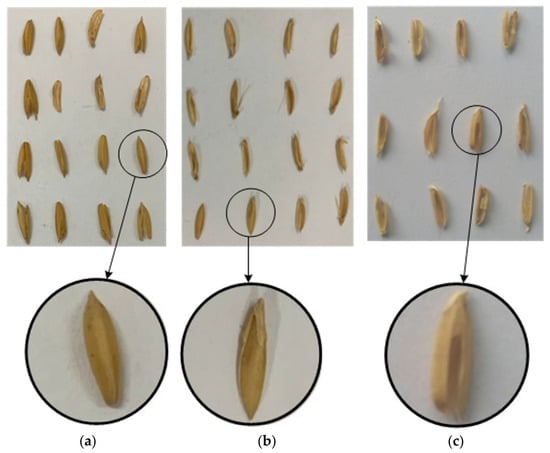
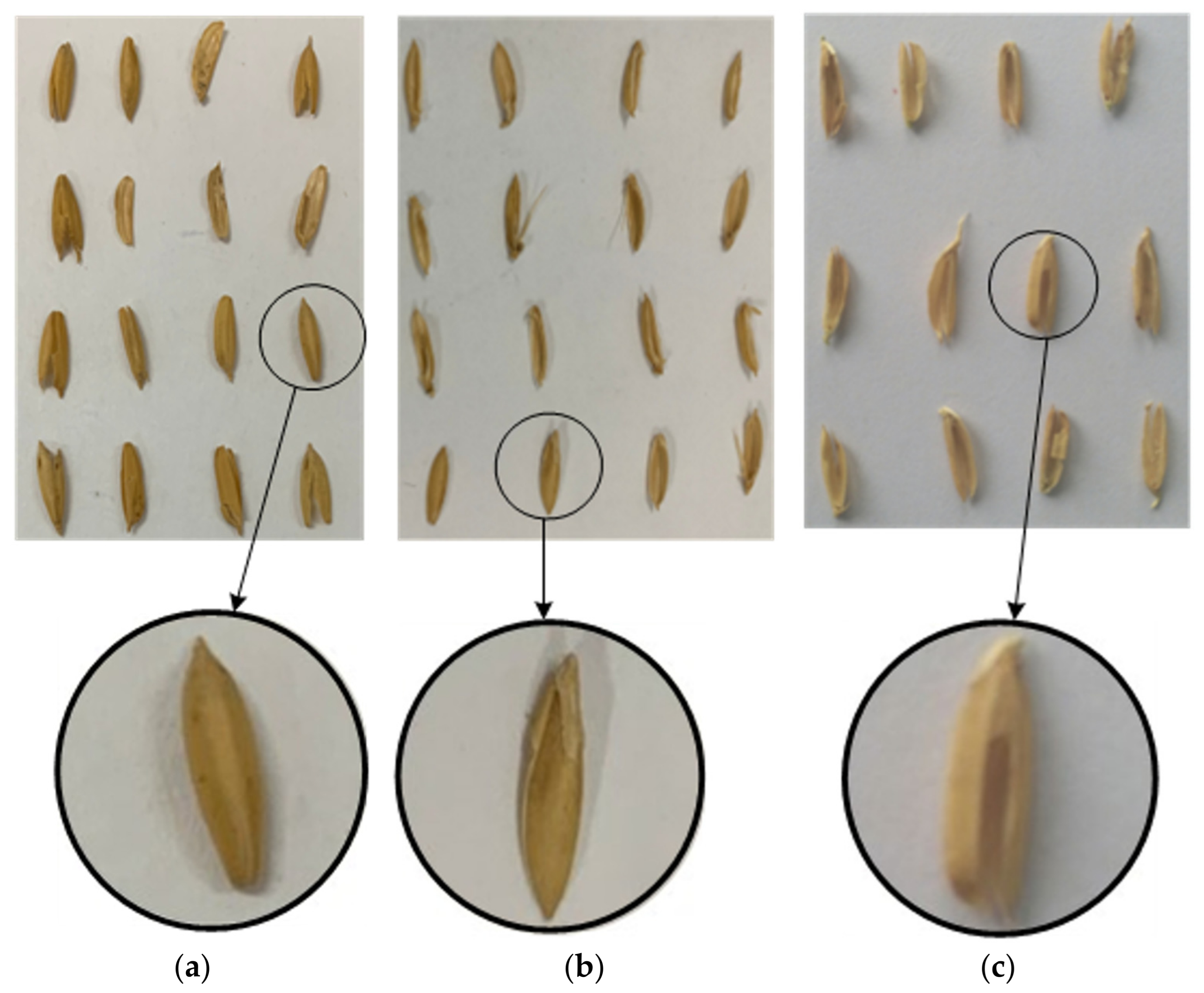
Considering the irregular morphology of rice husks, a morphology-based classification strategy was employed to establish a representative DEM particle model. According to the fracture characteristics of the husk structure, three typical forms were identified (Figure 5) [26]: intact palea, separated lacerated lemma, and lacerated lemma attached to intact palea. These observed configurations agreed with the husk rupture patterns reported in our previous study [26].
Figure 5.
Results from the husking experiment: the rupture pattern of the rice husk: (a) single intact palea; (b) lacerated lemma; (c) the lacerated lemma still connected to the intact palea [26].
The first and second forms dominated the sample population and showed limited differences in their external geometry, while the third form appeared rarely. Hence, the average dimensions obtained from the first two representative types were used for particle reconstruction to reduce model complexity while maintaining sufficient geometric fidelity (Figure 5a,b).
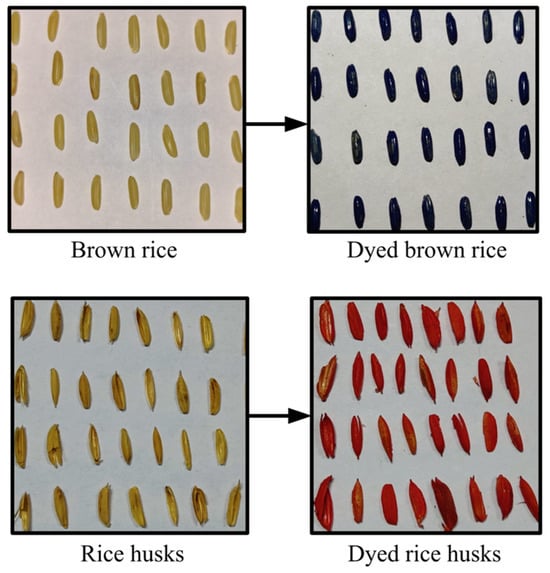
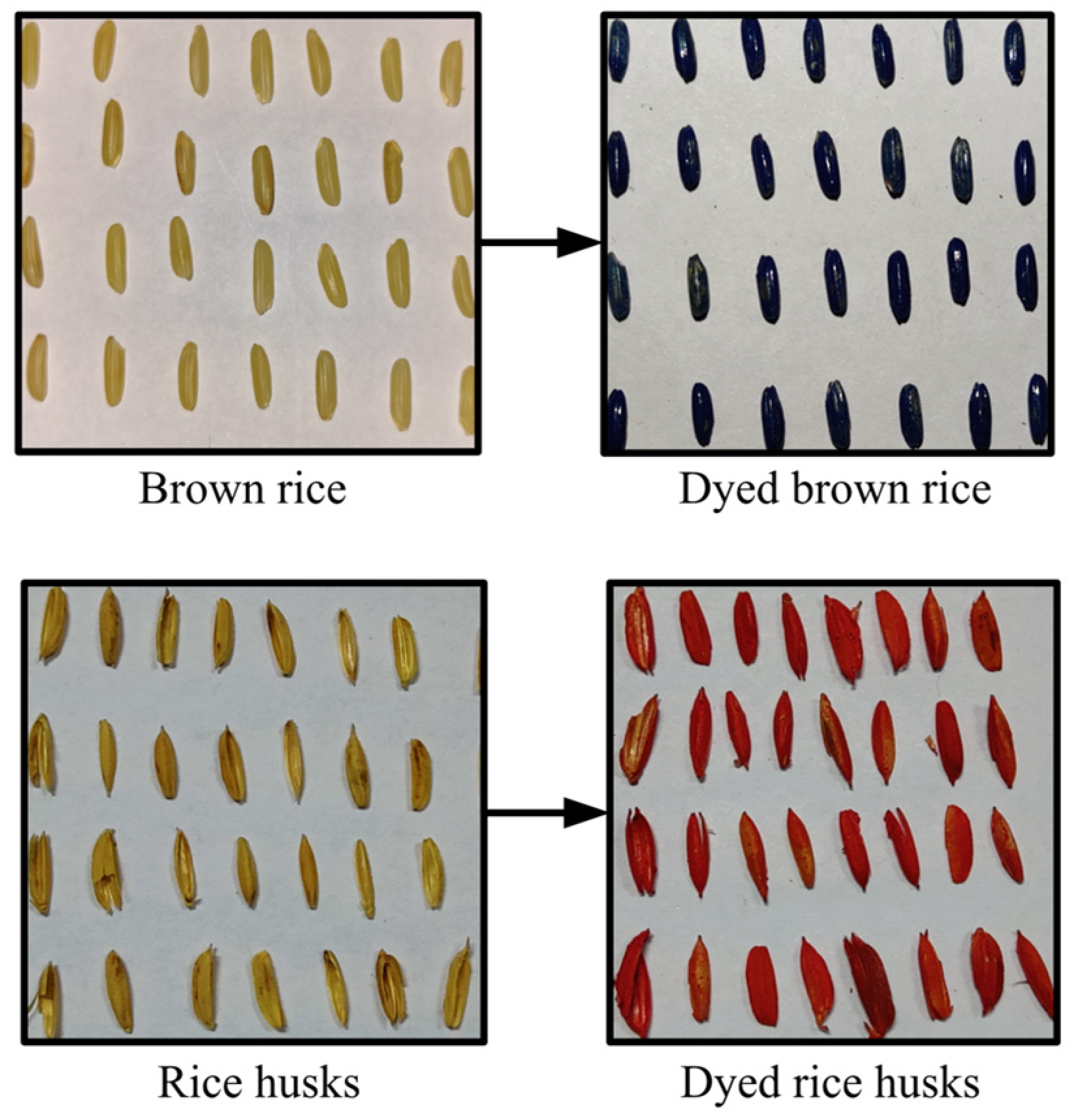
For accurate identification of different particle components in the inclined stepped chute, the rice husks and brown rice were color-marked based on previous research procedures [32]. High-pressure atomized spray paint was used to label the two materials, with rice husks and brown rice colored red and blue, respectively (Figure 6) [20]. The coating thickness was controlled to be sufficiently small so that the surface texture and particle mass remained unchanged, ensuring that the treatment did not significantly affect the subsequent experiments.
Figure 6.
Colored rice husk and brown rice, red rice husks, and blue brown rice [20].
2.2.2. Experimental Equipment
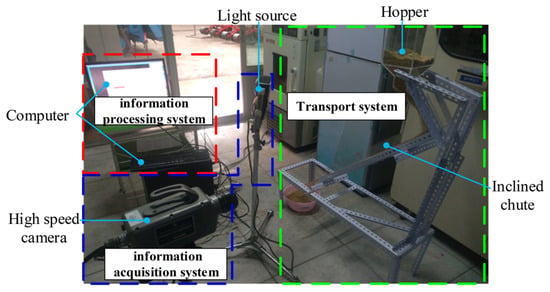
The DEM numerical model used in this study is consistent with that employed in previous research, and the experimental verification platform is shown in Figure 7 [28]. The experimental setup comprised three functional units. The first was the conveying system, which consisted of a feed hopper and an inclined chute. The dimensions of the inclined chute used in the experimental setup were identical to those adopted in the DEM simulations, ensuring consistency between the physical and numerical models. To facilitate visual observation and image acquisition, the conveying system was fabricated from transparent rigid acrylic (Plexiglas). Image recording was performed using a high-speed camera (Phantom V5.1-4G, Vision Research, Wayne, NJ, USA) with an auxiliary light source (XSJ2 × 1300-2, Seagull, Shanghai, China). The captured images were processed on a Lenovo G50-80 computer using Phantom Multicam (version 1.1), Phantom Video Player (version 1.1), and PCC (version 2.8). The spatial distribution of particles was observed and compared through high-speed camera images. The outlet mass flow rate was obtained by collecting and weighing the discharged material at fixed intervals and then calculating based on the corresponding sampling duration. The above results were used to compare the particle distribution and macroscopic conveying performance in the experiment and simulation, respectively; the specific experimental methods can be found in references [20,27].
Figure 7.
Experimental platform for transporting mixtures in an inclined chute [29].
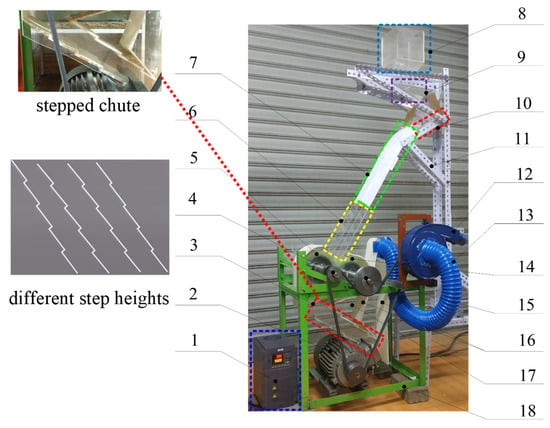
To evaluate the pneumatic separation performance of the device after installing the stepped chute, the experimental platform shown in Figure 8 was built. The stepped chute and air duct were manufactured by resin 3D printing, and the enclosure panels were made of transparent acrylic to facilitate observation of internal material flow. The partial enlarged view in Figure 8 marks the stepped conveying section and its connection position with the winnowing area. This experiment evaluated the separation performance of the device by measuring the rice husk retention rate and the brown rice loss ratio. The remaining parameters of the platform are listed in Table 3.
Figure 8.
Pilot-scale rubber-roll huller [33]. 1. Speed regulator; 2. motor; 3. stepped chute; 4. fast roller pulley; 5. fast roller; 6. straight feeding plate; 7. parabolic feeding plate; 8. hopper; 9. short feeding plate; 10. accumulation plate; 11. frame; 12. negative pressure fan; 13. husk conveying pipe; 14. slow roller; 15. slow roller pulley; 16. air duct wall; 17. transparent sidewall housing; 18. frame.
Table 3.
Technical specifications of the homemade rubber-roll huller [27].
2.2.3. Experimental Methods
To evaluate the applicability of the system to different grain morphologies, three paddy types—long grain, medium-long grain, and short grain—were used in the dehusking and pneumatic separation tests. To minimize the influence of moisture variation, the three paddy types were conditioned to a similar moisture level of 11–12%. Prior to the experiments, impurities and defective grains, including broken and shriveled kernels, were removed to ensure sample uniformity. Prior to the experiments, 50 kg of each paddy type was prepared and evenly partitioned into ten replicate batches to ensure consistent sample allocation across the tests. The operating conditions were set to a feed rate of 496.37 g/(min·cm) and an air velocity of 4.5 m/s at the brown rice outlet. All three types of rice were tested under these operating conditions to evaluate the separation performance of the selected stepped structure under different grain type conditions. The rubber-roll gap was determined based on the results presented in Chapter 2, which showed that reducing the clearance appropriately could suppress grain rotation when the longitudinal axis of the paddy was perpendicular to the roll shaft. Based on the preceding analysis, a roll clearance of 0.7 mm was selected instead of the previously reported optimum value of 0.8 mm. The circumferential speed difference between the rubber rolls was then treated as another key variable, as it determines the magnitude of relative shear displacement during dehusking. The results presented in Chapter 2 showed that minimizing shear displacement, provided that sufficient displacement for dehusking is maintained, helps reduce brown rice breakage. Therefore, a circumferential speed difference of 2 m/s was selected for the present tests. Based on the structural parameters of the platform and using Equations (4)–(6), the linear speed of the fast roll was calculated to be approximately 15 m/s, and that of the slow roll was calculated to be approximately 13 m/s.
where V0 denotes the linear velocity of the motor pulley (m/s), Vk denotes the linear velocity of the fast roller (m/s), Vm denotes the linear velocity of the slow roller (m/s), ΔV denotes the linear velocity difference (m/s), Rg denotes the radius of the motor pulley (m), rk denotes the radius of the fast roller pulley (m), and rm denotes the radius of the slow roller pulley (m). After setting all operating parameters, the paddy samples were loaded. The rubber-roll huller was first operated until a stable running state was achieved, after which the hopper outlet was opened to start the dehusking process. The resulting husk–brown rice mixture was collected and subsequently sorted into its individual components for further evaluation. Separation performance was assessed in terms of husk retention and brown rice loss. Each rice variety was evaluated in five replicates, and the test order was alternated among treatments to reduce systematic experimental error. To minimize potential order effects, the three rice types were tested in a cyclically rotated sequence. The order was long–medium–short grain in the first cycle, medium–short–long grain in the second, and short–long–medium grain in the third, with the sequence repeated until completion of all trials.
The separation performance was assessed against the requirements specified in the Rice Milling Operating Specification, which limits the husk content in the paddy–brown rice mixture to 0.8% and the brown rice loss to no more than 30 kernels per 100 kg of husk. Mass-balance calculations showed that brown rice and husk were produced at an approximate mass ratio of 4:1 after dehusking, yielding nearly 1 kg of husk per experimental batch. Accordingly, the husk retention rate (Z) was expressed as a mass-based ratio in the subsequent analysis. After conversion to the test-scale sample mass, the allowable brown rice loss was set at ≤0.3 kernels per kilogram of husk, which was used as the acceptance threshold in the subsequent evaluation. For convenient comparison with the specification, a loss ratio R was defined as the evaluation index, where R > 1 indicates non-compliance and R ≤ 1 indicates compliance. The husk retention rate and the value of R were calculated using Equations (7) and (8), respectively:
where m4 is the retained husk mass (kg), Z is the retention rate (%), R is the loss ratio, N1 is the actual number of lost kernels for each group, and N0 is the maximum allowable number of lost kernels for compliance (0.3 kernels).
3. Results and Discussion
3.1. Verification of Simulation Results
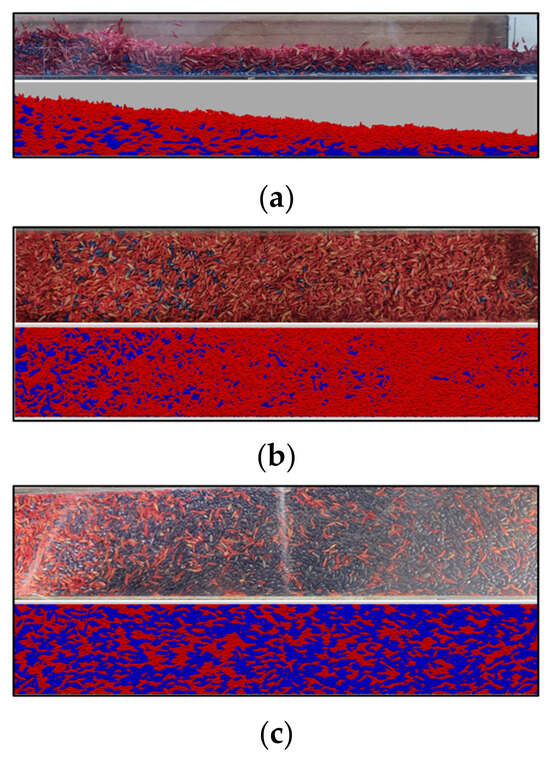
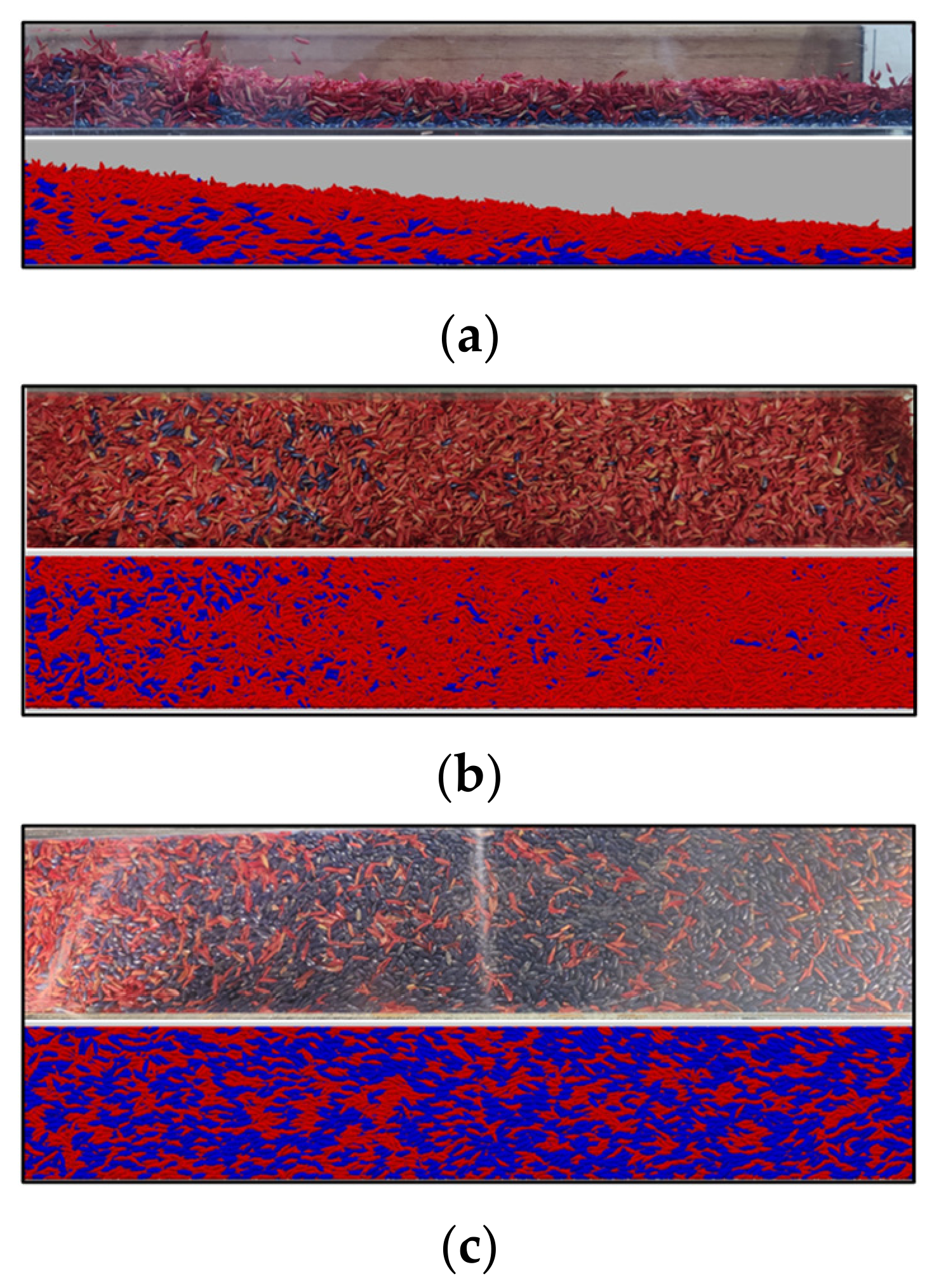
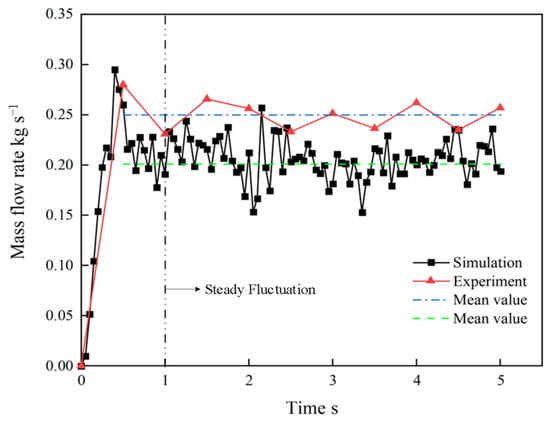
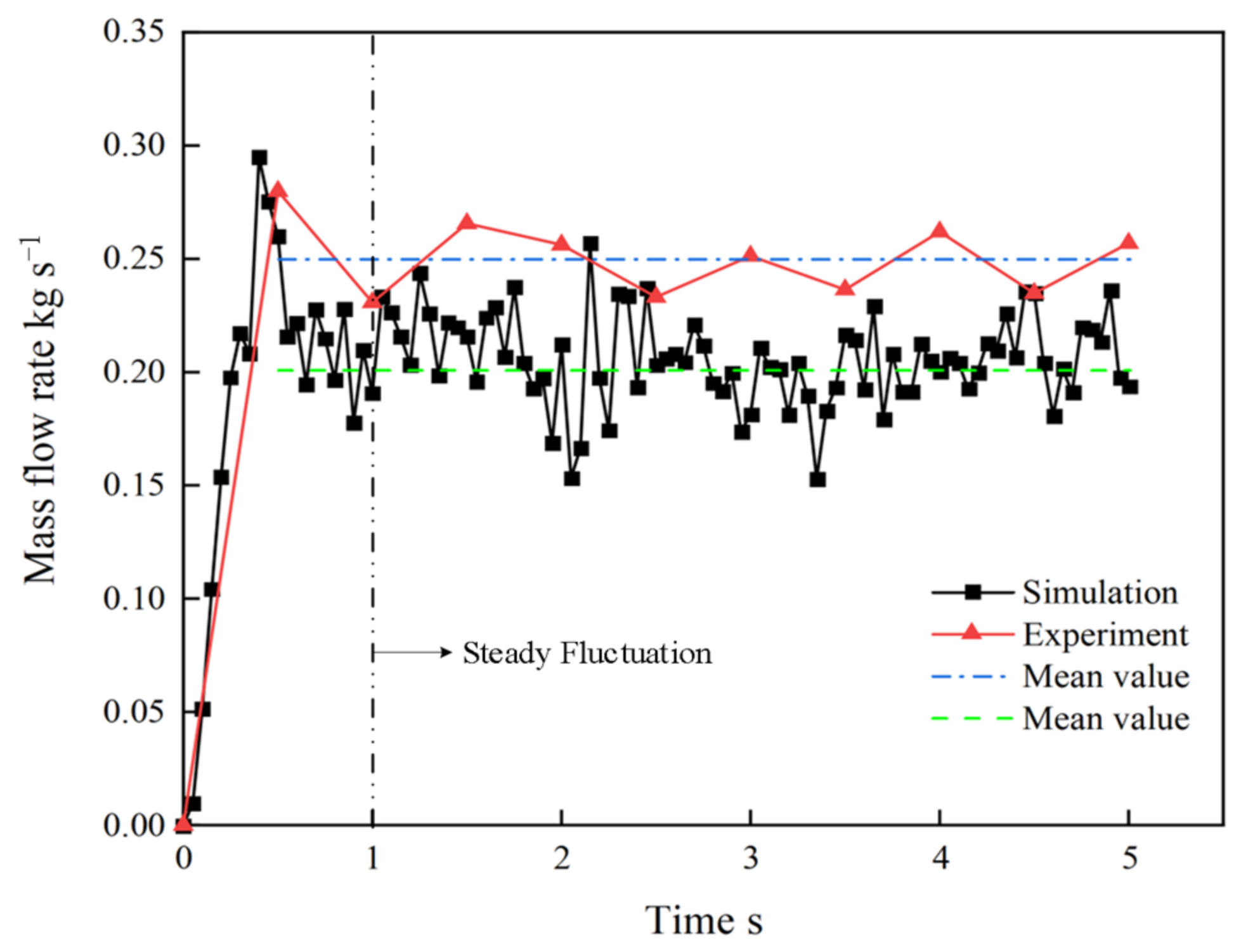
The numerical model used in this study is consistent with that employed in our previous work, with the only difference lying in the structure of the feeding plate. In the earlier study, the model was validated from both qualitative and quantitative perspectives. Figure 9 a–c [20] show the distributions of husk and brown rice from the front, top, and bottom views of the chute, respectively, under both experimental and simulation conditions when the particle flow reached a steady state (note that all results were obtained at a chute inclination of 30°). Figure 10 [20] presents the mass flow rate of the mixed particles at the outlet of the chute with an inclination of 30° (note that a step height of zero corresponds to a straight feeding plate with a 30° inclination). Table 4 gives the analysis of variance results for the mass flow rate. As can be seen from Figure 9, the distributions of husk and brown rice obtained from the experiments and simulations follow the same pattern, demonstrating the accuracy of the simulation results. The trends and magnitudes of the mass flow rate obtained experimentally and numerically are also consistent, although the experimental mean value is slightly higher than the simulated value. Our previous study has shown that this discrepancy is mainly caused by the material of the chute plate. In actual production, the chute is made of steel plate, and therefore, the parameters of the chute plate in the simulation model are set according to the properties of steel. However, for ease of observation and recording, an acrylic chute was used in the experimental setup, and the friction coefficient of acrylic is lower than that of steel. Although there is a small error in the friction coefficient, it is insufficient to affect the results of this paper [34]. According to the analysis of variance in Table 4, the p value is 0.19675 (p > 0.01), indicating that there is no significant difference between the experimental and simulation results. In summary, the model is suitable for investigating the segregation behavior of husk and brown rice during chute flow, and the accuracy of the model is therefore not verified again in this paper.
Figure 9.
The distribution of rice husks and brown rice in the inclined chute when the particle flow is stable in experiments and simulation: (a) the front view; (b) the upper view; (c) the bottom view. (The inclined angle of chute is 30°; the recording time range is 1.5–3.5 s.) [20].
Figure 10.
Variation in outlet particle mass flow rate with time in the simulation and the experiment at a chute inclination angle of 30° [20].
Table 4.
Analysis of variance for the mass flow rate.
3.2. Effect of Stepped Height on Segregation
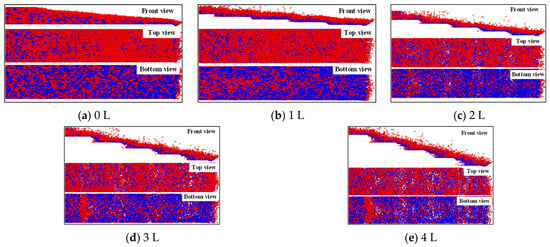
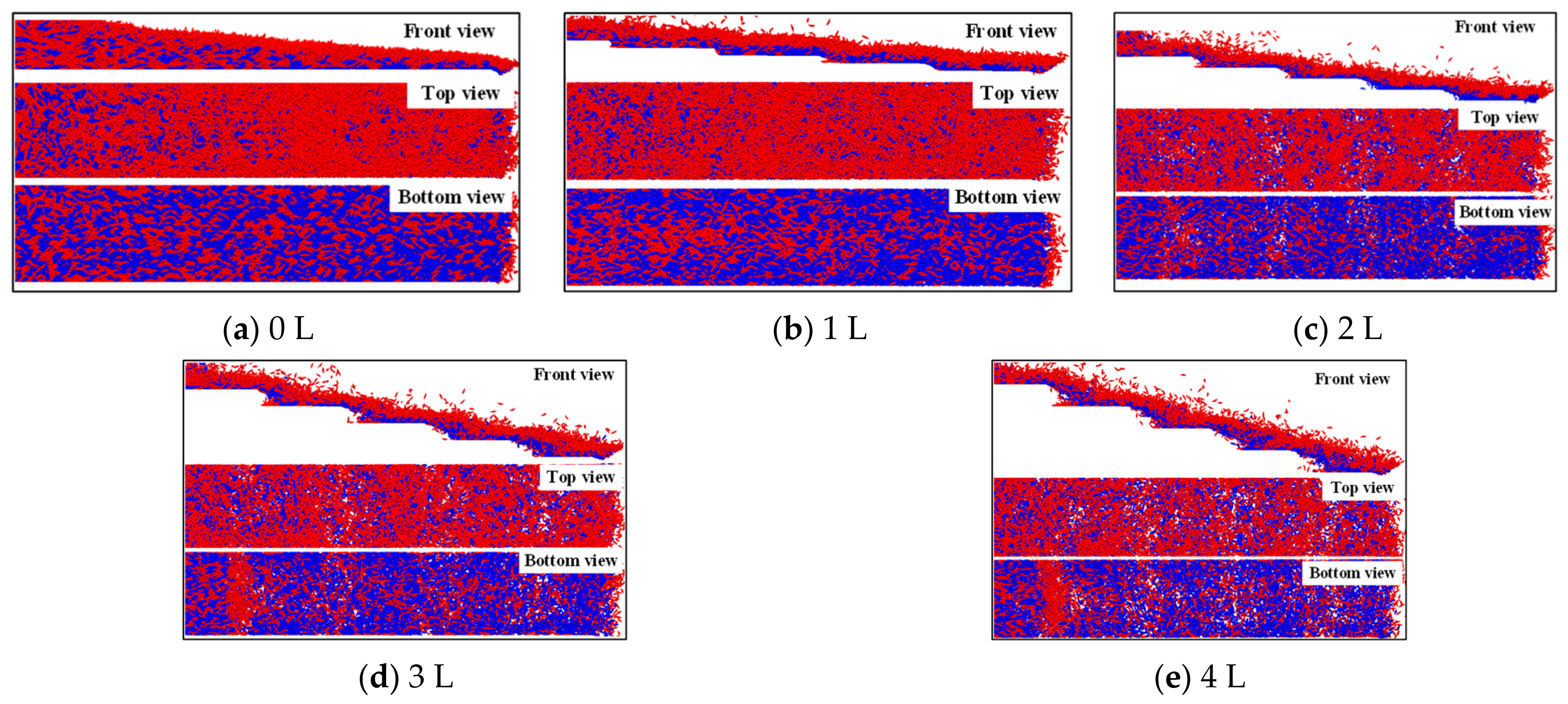
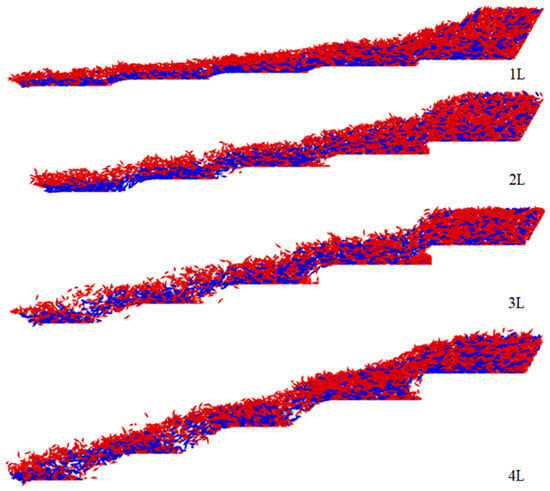
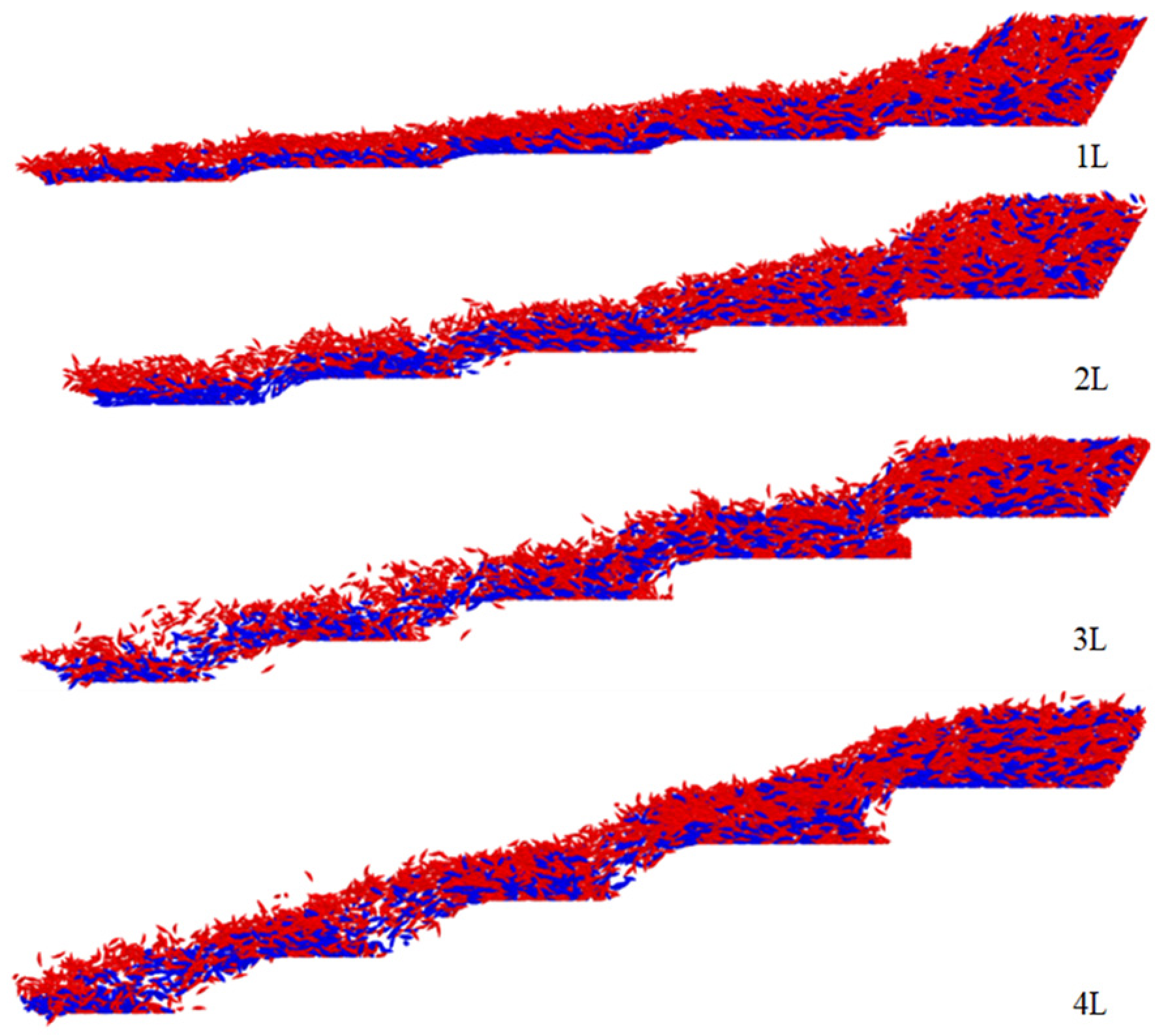
To enhance the degree of separation between husk and brown rice before they enter the pneumatic separation zone, a stepped feeding structure based on the segregation mechanism of husk and brown rice is proposed in this study. Figure 11 presents snapshots of the mixed particles flowing along feed plates at different step heights, where 0 L represents the conventional flat chute without steps, serving as the baseline for comparison; 1 L, 2 L, 3 L, and 4 L represent chutes with different step heights, respectively. The figure indicates that the degree of segregation at step heights L and 2 L is slightly higher than at 0 L, 3 L, and 4 L. From the front view, the segregation at L and 2 L also appears slightly higher than at 0 L, whereas the top and bottom views suggest the opposite trend. However, due to the presence of steps, the particle concentration decreases, so many blue particles observed in the top view are in fact not located in the upper layer of the flow, and similarly, many red particles in the bottom view are not in the bottom flow layer. Therefore, qualitative snapshots can only provide an initial indication that an appropriately chosen step height can effectively enhance the segregation between husk and brown rice. To quantitatively evaluate the effect of step height on segregation, this study calculated the degree of segregation of mixed particles at the chute outlet under different step heights and used this to guide the structural design of the stepped chute.
Figure 11.
The snapshot of the mixture at different step heights flowing along the feeding plate.
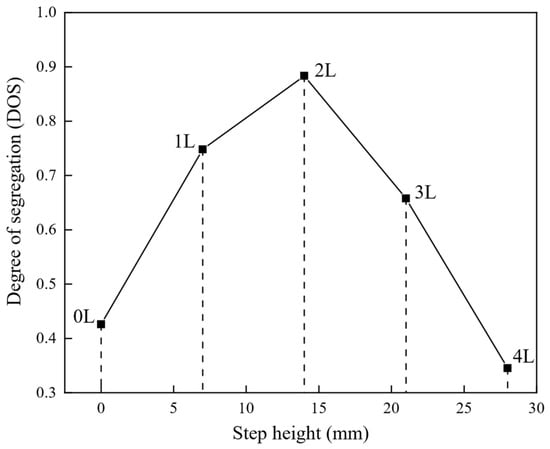
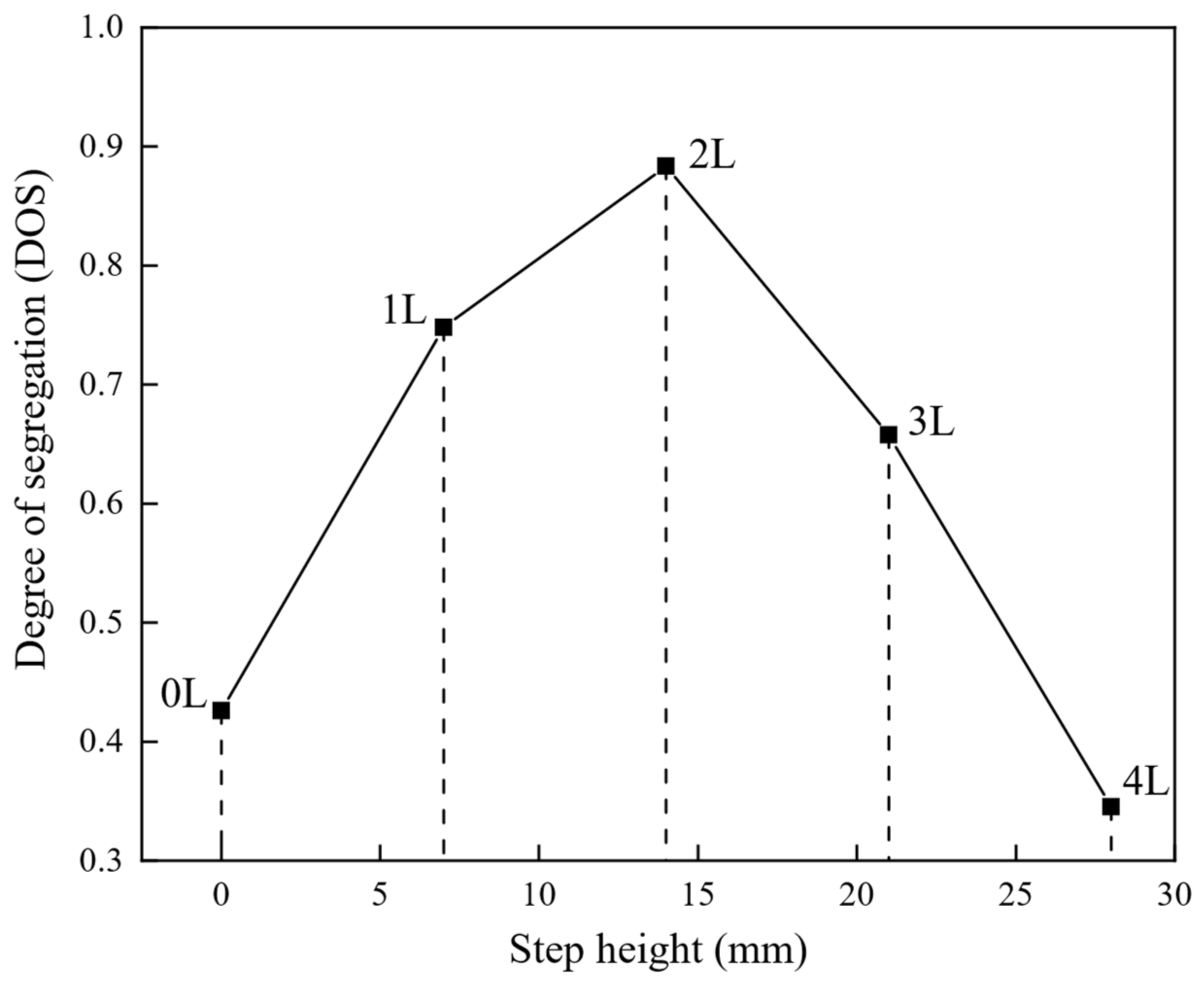
Figure 11 shows the variation in the degree of particle segregation at the chute outlet with step height. Among the five preliminary simulation conditions of 0 L, 1 L, 2 L, 3 L, and 4 L, the degree of segregation shows a trend of first increasing and then decreasing with increasing step height, with the 2 L condition yielding the highest degree of segregation. As described in Section 3.1, segregation between husk and brown rice arises because the probability that brown rice fills the voids in the particle flow layer from above is higher than that of husk. This difference in filling probability is due to the lower surface roughness and higher density of brown rice, which result in a greater gravitational force and make it difficult for brown rice to form a stable structure with surrounding husk and brown rice. Once a void appears in a lower layer, the self-weight of the brown rice above can readily overcome the friction with neighboring particles and move downwards to a lower flow layer. In contrast, husk has higher surface roughness and lower density, so for husk to move to the bottom layer under its own weight, it must not only overcome friction but also break the interlocking between particles caused by excessive roughness. In combination with Figure 12, it can be observed that the number of voids within the particle flow layer increases markedly at step heights of 2 L, 3 L, and 4 L. These phenomena indicate that step height can alter the packing structure of the particle flow layer. Accordingly, it is hypothesized that the porosity formed by moderate loosening of the material layer is conducive to the movement of brown rice toward the bottom layer; as the material layer becomes further loosened, the space for downward movement of rice husks also increases, potentially reducing the difference in downward movement between the two types of particles, which is unfavorable for segregation. This effect will be further analyzed below in conjunction with changes in porosity and particle displacement difference.
Figure 12.
The variation in particle segregation degree at the exit with the increase in step height. Note: 0 L represents the conventional flat chute, used as the baseline for comparison; L is the average length of brown rice used in modeling.
3.3. Mechanism by Which Step Height Affects the Segregation Performance of Rice Husk and Brown Rice
Efficient separation of rice husk and brown rice depends on the microscopic packing structure formed by the particle assembly during flow along the chute, and the step height is a key structural parameter governing particle packing state, motion behavior, and separation performance. In this section, based on discrete element simulations and experimental results, the evolution of porosity and motion trajectories of the particle assembly under different step heights is systematically analyzed. The intrinsic mechanism by which step height influences the segregation and mixing of rice husk and brown rice is thereby elucidated, providing a theoretical basis for optimization of structural parameters.
As shown in Figure 13, the microscopic packing structures of particles at different step heights visually illustrate how the compactness of the particle assembly varies with step height. With a gradual increase in step height, the particle packing becomes progressively looser; however, the degree of segregation of the particles exhibits a trend of first increasing and then decreasing.
Figure 13.
Microscopic accumulation structure diagram of particles at different step heights.
According to Figure 12, to explain the observed phenomenon that the segregation degree decreases again as step height continues to increase, and in combination with the segregation mechanism previously established in this study, i.e., segregation of rice husk and brown rice in an inclined chute is driven by the coupled effects of surface roughness and density differences two hypotheses are proposed. (a) Rice husk has a low density, high surface roughness, and poor flowability, whereas brown rice has a higher density, a smoother surface, and readily fills voids downward. An increase in step height loosens the particle packing and enlarges internal voids, so that porosity rises with step height, thereby altering the difference in downward displacement between brown rice and rice husk. (b) As the step height increases, the kinetic energy of falling particles also increases, enhancing the impact intensity of collisions between particles and the chute, thus intensifying the randomness (turbulence) of particle motion.
Therefore, to verify the above hypotheses, a series of validation analyses was carried out to systematically investigate the regulatory effect of step height on the microscopic packing structure and porosity of the particle assembly, and to clarify the mechanism by which step-induced, impact-driven disorder in particle motion affects the segregation process of the mixture.
3.3.1. Influence of Step Height on the Microscopic Packing Structure and Porosity of Particles
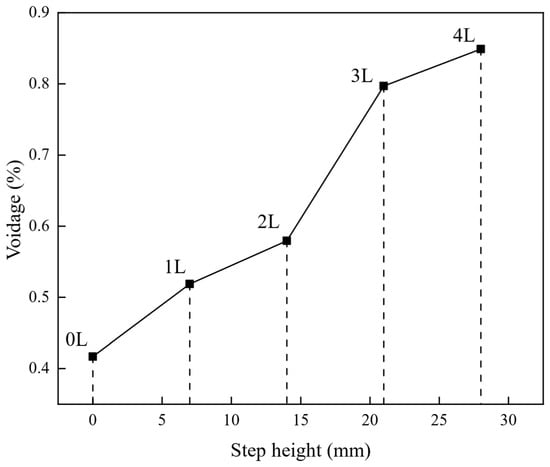
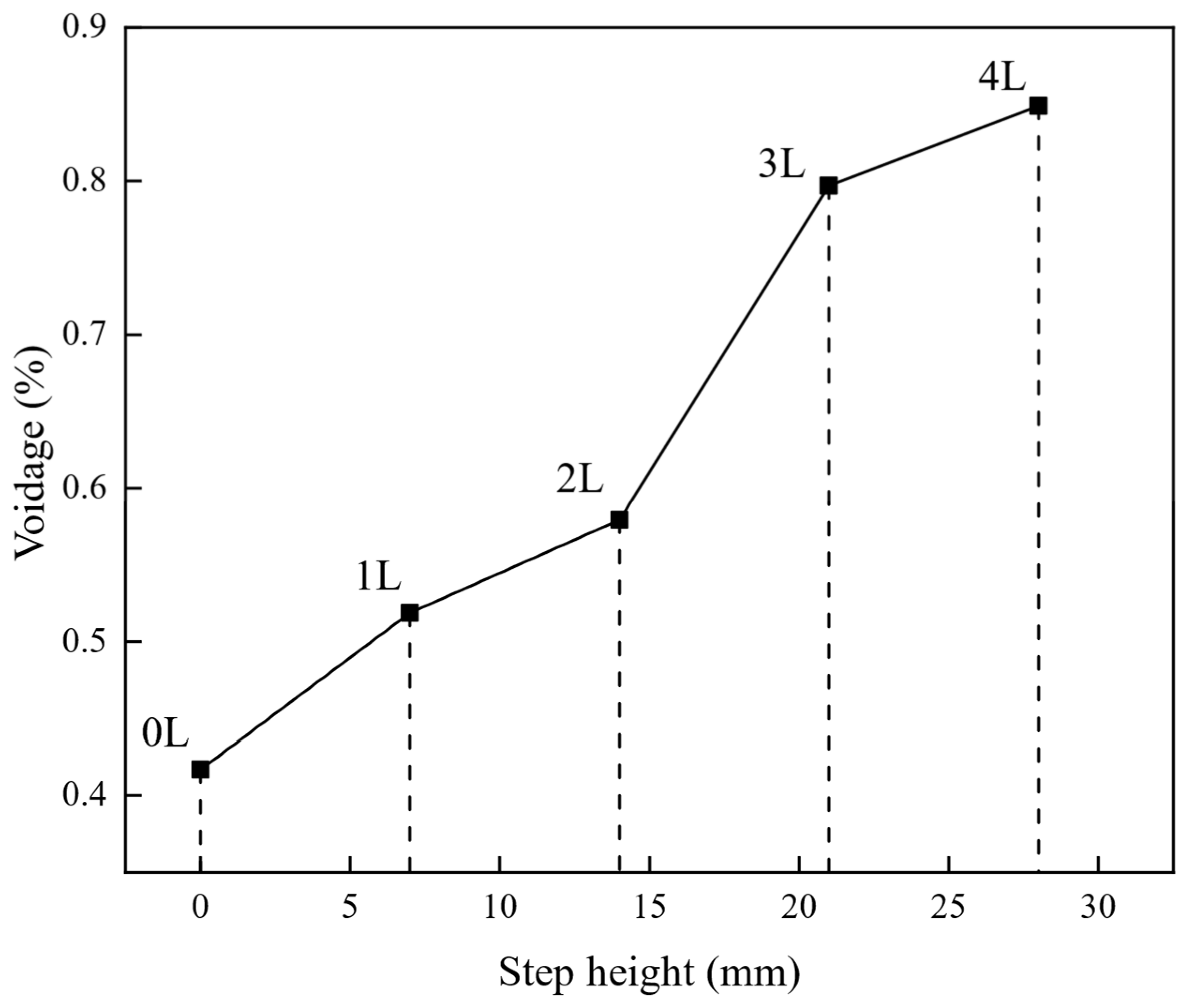
Figure 14 presents the porosity of the particle population at the chute outlet under different step heights. When the step height increases from 0 L to 2 L, the porosity gradually increases; when increasing from 2 L to 3 L, the porosity increases significantly; when increasing from 3 L to 4 L, the increase diminishes. Combined with Figure 12, it can be seen that among the five preliminary simulation conditions, 2 L corresponds to the highest degree of segregation, while when step height increases from 2 L to 3 L, porosity increases rapidly and the degree of segregation decreases. This correspondence supports the explanation that moderate loosening of the material layer is conducive to segregation and also indicates that the effect of increased porosity on segregation behavior needs to be further analyzed in conjunction with the relative motion of the two types of particles.
Figure 14.
Variation in particle group porosity at the exit of the plate with different step heights. Note: 0 L represents the conventional flat chute, used as the baseline for comparison; L is the average length of brown rice used in modeling.
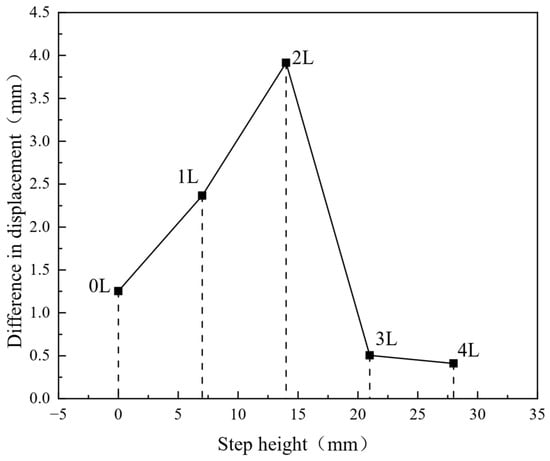
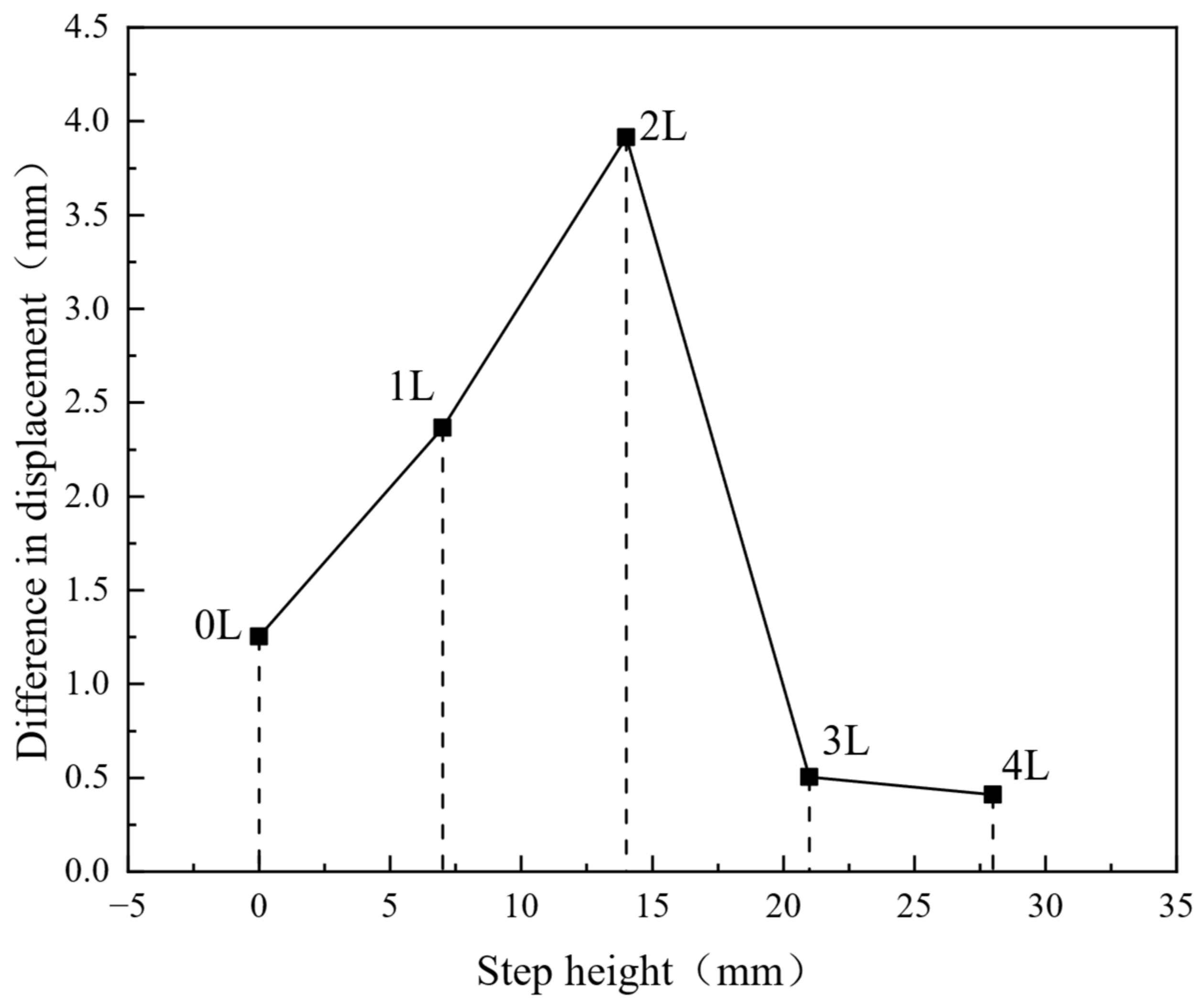
As shown in Figure 15, the curves of displacement difference between particles at different step heights indicate that, within the range of 0 L to 2 L, the displacement difference between brown rice and rice husk increases rapidly with step height and reaches a peak at approximately 2 L, after which it drops sharply and then tends to stabilize. This pattern is broadly consistent with the evolution of porosity and the trend of segregation degree, confirming that a moderate porosity can enlarge the displacement difference between brown rice and rice husk and thereby enhance segregation performance, whereas an excessively high porosity reduces the displacement difference and intensifies back mixing. This verifies that the first hypothesis is correct.
Figure 15.
Variation in displacement difference with step height. Note: 0 L represents the conventional flat chute, used as the baseline for comparison; L is the average length of brown rice used in modeling.
3.3.2. Influence of Step Height on Particle Motion Trajectories
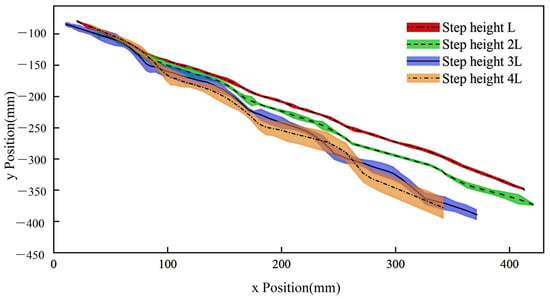
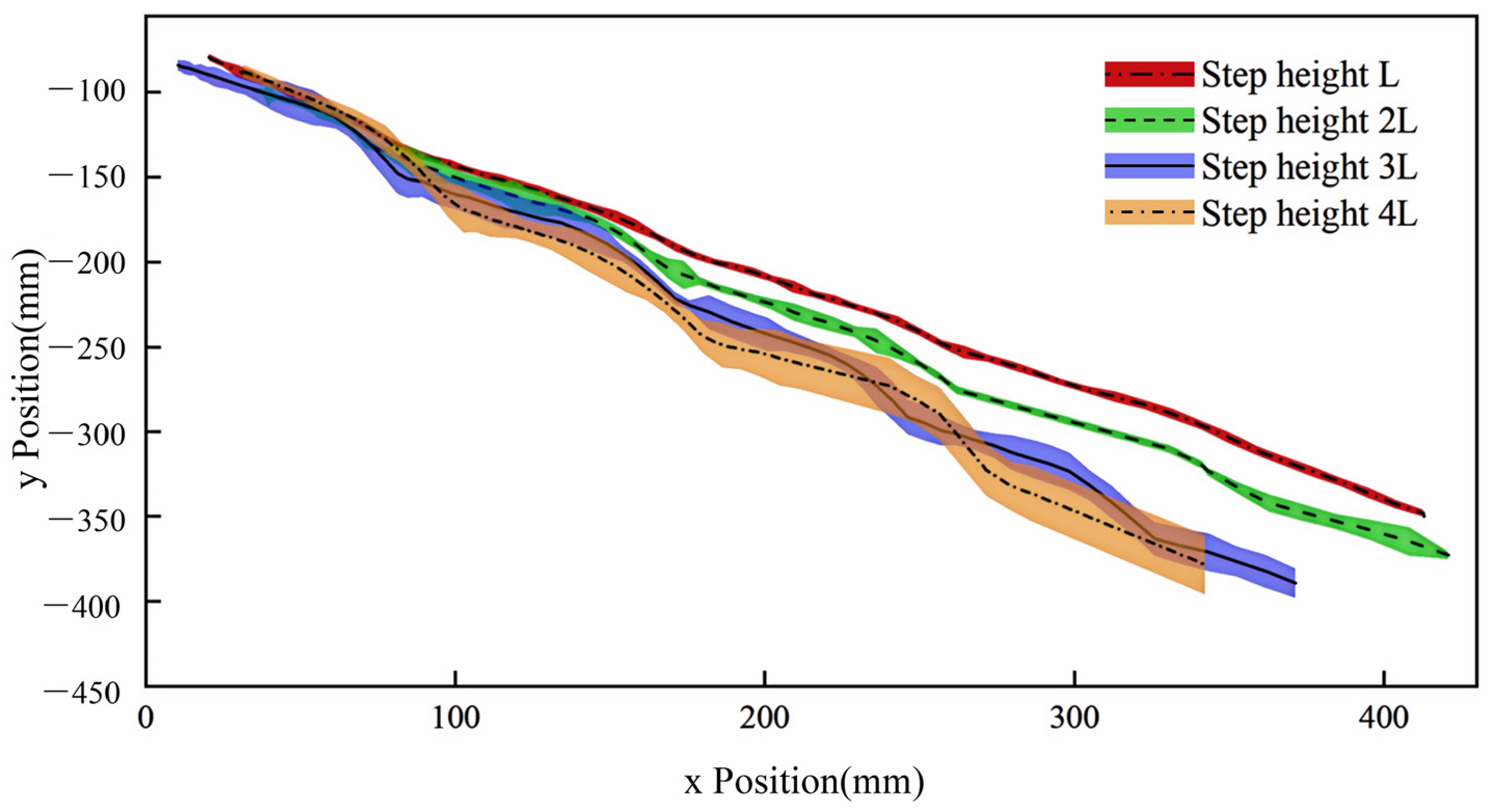
The degree of particle splashing and the stability of particle motion trajectories are key dynamic factors affecting stratification, and they couple with the evolution of porosity to jointly determine the final separation performance. In line with the above hypotheses, an increase in step height raises the kinetic energy of falling particles, intensifies their impact with the chute surface, and thereby induces splashing and disruption of the established stratified structure. To verify this hypothesis, a statistical analysis of the motion trajectories of particles in the bottom flow layer was conducted for different step heights.
Comparison of the microscopic packing structures at different step heights in Figure 13 clearly shows that the extent of particle splashing varies markedly with step height. Figure 16 presents the motion trajectories of particles in the bottom flow layer at different step heights, providing a direct illustration of the flow stability of the bottom particles. When the step height is 1 L or 2 L, the motion trajectories of the bottom particles essentially coincide with the contour of the steps, with only minimal deviation. This indicates that no pronounced splashing of bottom particles occurs; instead, they flow smoothly along the chute surface, the particle flow layer remains highly ordered, and the established stratification of rice husk and brown rice is preserved. When the step height is increased to 3 L and 4 L, however, the trajectories exhibit large fluctuations and markedly greater deviation, demonstrating that, once step height exceeds a certain threshold, impact-induced rebound causes bottom particles to collide violently with upper particles, leading to extensive splashing.
Figure 16.
The movement trajectories of particle groups at the bottom of the flow layer at different step heights.
In combination with the porosity evolution shown in Figure 14, it can be inferred that particle splashing is mainly caused by the impact between the particle flow and the chute. Such splashing further increases the porosity of the system. When the impact intensity is excessively high, the particle flow undergoes pronounced rebound, causing the mixing rate to exceed the segregation rate and ultimately leading to a marked reduction in segregation degree. This verifies the second hypothesis.
In summary, step height governs the separation performance of rice husk and brown rice through a coupled dual mechanism: regulating the microscopic packing structure and thereby altering porosity, and modifying the kinetic energy of falling particles and thus inducing impact-driven splashing. When the step height is too low, the particle packing is overly compact and voids are insufficient, hindering the downward percolation of brown rice and resulting in incomplete stratification. When the step height lies within an optimal range, the porosity is moderate, particle motion is stable and free from splashing, and a balance is achieved between the downward penetration of brown rice and the upward migration of husk, yielding the highest segregation degree. When the step height is too high, the particles become excessively loose and impact-induced splashing is severe; the motion probabilities of rice husk and brown rice tend to converge, back-mixing becomes pronounced, and the separation performance declines significantly. This mechanism comprehensively elucidates the intrinsic way in which step height affects the separation of rice husk and brown rice.
3.4. Optimization of Stepped Chute Parameters and Validation of Air Separation Performance
Based on the mechanism by which step height influences separation performance, as revealed in Section 3.3, the overall structural parameters of the stepped chute were finely optimized with the optimal step height as the core design variable, and the optimal parameter combination was determined. The separation performance was then verified by whole-machine pneumatic separation tests, in order to assess the suitability of the optimized structure under actual production conditions and provide support for engineering application.
3.4.1. Determination of the Optimal Structural Parameters of the Stepped Chute
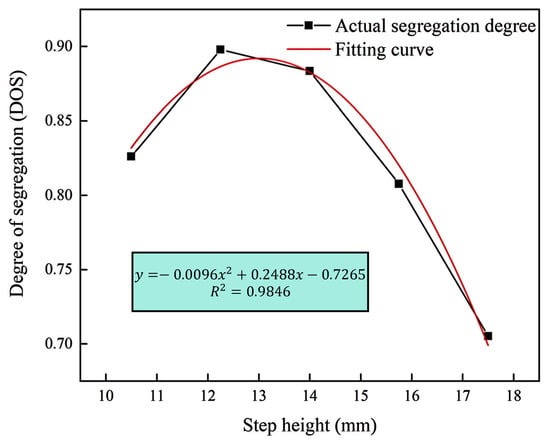
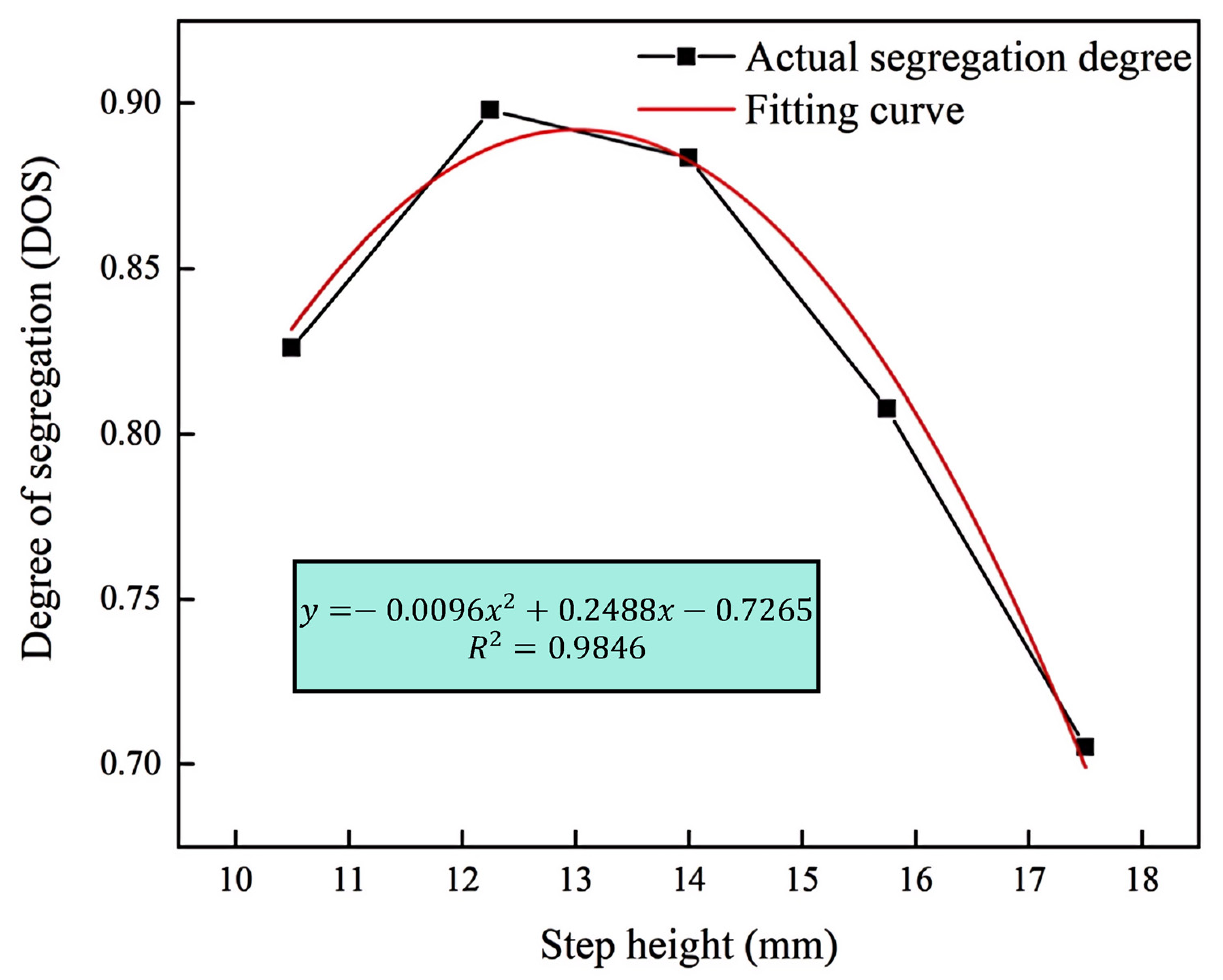
Under fixed conditions of a chute inclination of 30°, a total length of 400 mm, and a step width of 104 mm, the step height was finely optimized using the degree of segregation (DOS) as the primary evaluation index. Taking the brown rice kernel length L (approximately 7 mm) as the reference and drawing on the preliminary conclusion in Section 3.3 that “the optimal operating condition is concentrated around 2 L”, a refined gradient test was designed around 2 L. Discrete element simulations were conducted for step heights of 1.5 L, 1.75 L, 2.25 L, and 2.5 L.
As shown in Figure 17, the DOS varies with increasing step height. The results indicate that the DOS first increases and then decreases as step height increases: when the step height reaches 2.25 L, the DOS begins to decline, while the DOS at 1.75 L is higher than that at 2 L. This suggests that the optimal step height is not exactly 2 L but lies within the range 1.75 L to 2 L. To further quantify the optimum, the DOS data at different step heights are fitted using a quadratic polynomial, yielding the following fitted equation:
where the independent variable x denotes the step height (mm) and the dependent variable y denotes the degree of segregation (DOS) of the rice husk–brown rice mixture.
y = −0.0096x2 + 0.2488x − 0.7265
Figure 17.
Variation in the segregation degree with the increase in step height.
The coefficient of determination of this fitting equation is R2 = 0.9846, indicating that the quadratic polynomial can well describe the variation in the DOS with step height obtained from the simulations in this study. The extreme position obtained from the fitting equation is 12.9583 mm. Considering manufacturing convenience, it is rounded to 13 mm, approximately 1.86 times the length of brown rice grains, which was selected as the step height under the working conditions set in this study.
Under this parameter combination, the DOS at the outlet of the mixture reaches 0.9, the particle porosity falls within the optimal range, no evident splashing is observed, and a stable stratification of rice husk and brown rice is achieved. The stepped structure provides sufficient downward percolation space for brown rice while avoiding excessive loosening and splashing of particles, thereby maximizing the dynamic screening effect driven by density and surface roughness differences. Previous research [20] compared the segregation behavior of flat chutes at inclination angles of 30–45° and found that the 30° condition yielded a higher degree of segregation in the downstream region, and proposed that increasing the motion space in the depth direction of the particle flow could further promote segregation. Based on this research foundation, this paper adopts a 30° inclination angle and introduces a stepped structure, focusing on investigating the effect of step height. Comprehensively considering the simulation results, fitting equation, and processing requirements, the final step parameters were determined as follows: a height of 13 mm, a total chute length of 400 mm, and a single-step width of 104 mm.
3.4.2. Experimental Validation of Air Separation Performance
The stepped chute with the optimal parameters was installed on a dehusking air separation test platform, and three typical paddy varieties—long grain, medium grain, and short grain—were selected for validation tests. The husk retention rate and the brown rice loss ratio were used as evaluation indices, and the separation performance was assessed with reference to the “Technical Operating Code for Rice Milling Process”. During the tests, the air flow velocity for pneumatic separation was maintained at 4.5 m/s and the feed rate was kept stable. Each test set was repeated five times, and a cross-testing scheme was adopted to eliminate systematic error.
The separation indices measured for the three rice varieties at different step heights are summarized in Table 5. The experimental results show that, with the optimized stepped chute, the air separation indices for all three paddy varieties satisfied the relevant industry standards. The husk retention rates for long grain, medium grain, and short grain paddy were 0.51%, 0.50%, and 0.46%, respectively, all well below the specification limit of ≤0.8%. The corresponding brown rice loss ratios were 0.67, 0.33, and 1.0, all meeting the requirement of ≤1. Compared with a conventional flat chute, the stepped chute reduced husk retention by more than 30% and reduced the brown rice loss rate by more than 40%, while exhibiting good adaptability to different grain types. These tests demonstrate that the stepped chute, by providing a pre-separation function, reduces rice husk and brown rice entrainment and collision at the air separation stage from the outset, enabling the separation targets to be achieved in a single air separation step. Consequently, secondary air separation is no longer required to meet production specifications, effectively addressing the long-standing problems of incomplete separation and excessive brown rice loss in traditional air separation processes.
Table 5.
Test result parameters.
3.4.3. Analysis of the Engineering Application Value of the Optimized Structure
The optimized stepped chute features a simple structure and is easy to manufacture. It can be directly integrated into the pneumatic feeding system of existing rubber-roller dehuskers without major modifications to the overall machine, resulting in low retrofit costs and strong compatibility. The stepped chute promotes the formation of layering of mixed particles before entering the pneumatic separation zone by altering the conveying surface structure, thereby reducing the number of separation stages. This structure has been installed on the experimental platform used, and the reported separation performance results indicate that under the tested material and operating conditions, single winnowing has the feasibility of meeting the evaluated separation requirements. This provides a basis for further research on reducing repeated winnowing or subsequent recovery processing. Under the same throughput and product quality requirements, if this structure can reduce repeated processing, it may reduce the energy consumption of the corresponding and simplify the processing flow.
3.4.4. Study Limitations and Scope of Application
The results of this study should be interpreted in the context of the particle model, operating conditions, and verification scope. The numerical simulation adopts representative particle sizes and a mass-equivalent simplified rice husk model, and describes particle interactions based on given contact parameters and the cohesionless assumption. Previous straight chute experiments have provided verification basis for this model under corresponding working conditions [20], but the model still does not fully describe the thin-shell morphology of rice husks, the shape distribution of different varieties, and differences in contact characteristics. Previous inclination comparison studies have provided the basis for adopting a 30° chute [20], and this paper accordingly focuses on investigating the effect of step height, without systematically evaluating the interaction between step height and factors such as inclination angle, feed rate, and air velocity. Therefore, the step height of approximately 13 mm is an optimized design value under the studied materials, model, and working conditions, and its applicability to other conditions still requires verification.
The numerical simulation compared multiple step heights, while the full-machine separation performance experiment used the selected structure. The experimental results for the three types of rice reflect the separation performance of this structure under the tested conditions, but cannot determine the respective optimal step heights for different varieties, nor can they replace direct verification of particle flow under different stepped structures. The existing results do not yet cover industrial-scale continuous operation. Subsequent studies can investigate the feasibility of expanding processing capacity by increasing chute width, but step height and flow distance should not be directly scaled proportionally with equipment size; the effects of width changes and corresponding feed conditions on flow uniformity and separation performance still require further evaluation.
4. Conclusions
This study systematically investigated the segregation mechanism of rice husk and brown rice mixtures during flow on an inclined surface under gravity, and proposed a stepped feeding structure to enhance pre-separation prior to pneumatic separation. By means of discrete-element simulations and full-machine experiments, the effects of structural parameters on separation performance were elucidated and the engineering applicability of the optimized structure was verified. The main conclusions are as follows:
- Step height is the key structural parameter governing particle separation performance, and the degree of segregation of the mixture varies with step height in a “first increasing, then decreasing” manner. When the step height is too low, the particle bed is excessively compact, penetration space is insufficient, and brown rice cannot effectively move downwards, resulting in poor stratification. When the step height is too high, the particle bed becomes overly loose, impact-induced splashing intensifies, and the sharp increase in porosity causes the motion probabilities of rice husk and brown rice to converge; severe back-mixing then destroys the stratified structure and markedly degrades separation performance. Simulation and experimental results confirm that 13 mm (approximately 1.86 times the brown rice kernel length) is the optimal step height. Under this parameter, the porosity of the particle bed lies within the optimal range, particle motion is stable and free from splashing, and the segregation degree reaches its maximum. The stepped chute can thus, by regulating porosity and particle trajectories, fully exploit the dynamic screening effect driven by density and surface-roughness differences.
- The efficient segregation of rice husk and brown rice in an inclined chute does not rely solely on particle size differences, but is predominantly governed by the coupled effects of surface roughness and density differences. Specifically, brown rice, with a relatively smooth surface and higher density, can readily overcome frictional resistance under its own weight, autonomously form vertical channels within the particle bed and percolate downwards into deeper layers. In contrast, rice husk, characterized by low density and high surface roughness, is unable to penetrate the compact bed and tends to interlock and be retained in the upper part of the particle layer. This stable stratified structure, in which brown rice sinks and husk floats, overcomes the limitations of conventional air flow-based separation and provides favorable initial conditions for subsequent pneumatic separation, constituting the core mechanism for achieving efficient pre separation.
- Application of the optimized stepped chute in a dehusking air separation system verified its excellent engineering compatibility and separation efficiency. Full machine air separation tests showed that the optimized stepped chute exhibits good adaptability to three typical paddy types (long, medium, and short grain) and that all separation indices meet the requirements of the “Technical Operating Code for Rice Milling Process”. Husk retention was reduced by more than 30% and brown rice loss was reduced by more than 40%. The application of the stepped chute on the experimental platform used demonstrates the feasibility of integrating this structure with existing separation systems. The single-winnowing results under the tested conditions provide a basis for further research on reducing repeated processing and simplifying the processing flow.
The stepped feeding structure proposed in this study not only provides a practical technical solution for loss reduction and efficiency enhancement in paddy processing, but also, by leveraging differences in material properties, elucidates the separation behavior of multi-property particles in combined gravity–airflow fields. It thus offers an important theoretical reference and structural design guideline for the development of high-efficiency separation technologies for other multi-component granular materials.
Author Contributions
Conceptualization, K.L., P.Z. and P.C.; software, Y.L. and L.L.; validation, Y.L., L.L. and J.Z.; formal analysis, H.L.; resources, P.C., P.Z. and K.L.; data curation, P.Z.; writing—original draft preparation, K.L.; writing—review and editing, P.C.; visualization, H.L.; supervision, H.L. and P.C.; project administration, P.C.; funding acquisition, P.C. All authors have read and agreed to the published version of the manuscript.
Funding
This work was supported by the Xinjiang Talent Development Fund–Tianchi Talents (grant number 524308002) and the President’s Fund Project of Tarim University in Xinjiang (grant number 2024ZD083).
Institutional Review Board Statement
Not applicable.
Informed Consent Statement
Not applicable.
Data Availability Statement
The original contributions presented in this study are included in the article. Further inquiries can be directed to the corresponding author.
Acknowledgments
The authors are grateful to the anonymous reviewers for their comments.
Conflicts of Interest
The authors declare no conflicts of interest.
Abbreviations
The following abbreviations are used in this manuscript:
| DEM | discrete element method |
| DOS | degree of separation |
| EDEM | extended discrete element method |
| L | length |
| T | thickness |
| W | width |
References
- Ji, S.; Li, X.; Zhao, D.; Li, H.; Sun, Z.; Li, Z.; Li, A.; Gao, H.; Wang, X.; Han, Y.; et al. Interaction Mechanism Between Two Stages of Separation Explains Residual Rice Husk Formation in a Multi-Baffle Separation Duct. Food Bioprod. Process. 2026, 156, 381–395. [Google Scholar] [CrossRef] [Scilit]
- Duan, Y.; Peckham, J.; Umbanhowar, P.B.; Ottino, J.M.; Lueptow, R.M. Designing Minimally Segregating Granular Mixtures for Gravity-driven Surface Flows. AIChE J. 2023, 69, e18032. [Google Scholar] [CrossRef] [Scilit]
- Duan, Y.; Umbanhowar, P.B.; Ottino, J.M.; Lueptow, R.M. Modelling Segregation of Bidisperse Granular Mixtures Varying Simultaneously in Size and Density for Free Surface Flows. J. Fluid Mech. 2021, 918, A20. [Google Scholar] [CrossRef] [Scilit]
- Sahu, V.K.; Kumawat, S.; Agrawal, S.; Tripathi, A. Particle Force-Based Density Segregation Theory for Multi-Component Granular Mixtures in a Periodic Chute Flow. J. Fluid Mech. 2023, 956, A8. [Google Scholar] [CrossRef] [Scilit]
- Bhattacharya, T.; McCarthy, J.J. Chute Flow as a Means of Segregation Characterization. Powder Technol. 2014, 256, 126–139. [Google Scholar] [CrossRef] [Scilit]
- China Institute of Agricultural Mechanization. Agricultural Machinery Design Manual; Chen, Z., Ed.; China Agricultural Science and Technology Press: Beijing, China, 2007; ISBN 9787802333352. [Google Scholar]
- Ramaioli, M. Granular Flow Simulations and Experiments for the Food Industry. Doctoral Dissertation, Ecole Polytechniquefederale De Lausanne, Lausanne, Switzerland, 2008. [Google Scholar]
- Nakano, M.; Abe, T.; Kano, J.; Kunitomo, K. DEM Analysis on Size Segregation in Feed Bed of Sintering Machine. ISIJ Int. 2012, 52, 1559–1564. [Google Scholar] [CrossRef] [Scilit]
- Li, C.; Honeyands, T.; O’Dea, D.; Moreno-Atanasio, R. DEM Study on Size Segregation and Voidage Distribution in Green Bed Formed on Iron Ore Sinter Strand. Powder Technol. 2019, 356, 778–789. [Google Scholar] [CrossRef] [Scilit]
- Zhang, T.F.; Gan, J.Q.; Yu, A.B.; Pinson, D.; Zhou, Z.Y. Size Segregation of Granular Materials During Paul-Wurth Hopper Charging and Discharging Process. Powder Technol. 2021, 378, 497–509. [Google Scholar] [CrossRef] [Scilit]
- Hajra, S.K.; Shi, D.; McCarthy, J.J. Granular Mixing and Segregation in Zigzag Chute Flow. Phys. Rev. E 2012, 86, 061318. [Google Scholar] [CrossRef] [Scilit] [PubMed]
- Williams, J.C. The Segregation of Particulate Materials. A Review. Powder Technol. 1976, 15, 245–251. [Google Scholar] [CrossRef] [Scilit]
- Savage, S.B.; Lun, C.K.K. Particle Size Segregation in Inclined Chute Flow of Dry Cohesionless Granular Solids. J. Fluid Mech. 1988, 189, 311–335. [Google Scholar] [CrossRef] [Scilit]
- Vallance, J.W.; Savage, S.B. Particle Segregation in Granular Flows down Chutes. In Solid Mechanics and Its Applications; Springer: Dordrecht, The Netherlands, 2000; pp. 31–51. [Google Scholar]
- Berton, G.; Delannay, R.; Richard, P.; Taberlet, N.; Valance, A. Two-Dimensional Inclined Chute Flows: Transverse Motion and Segregation. Phys. Rev. E 2003, 68, 051303. [Google Scholar] [CrossRef] [Scilit] [PubMed]
- Meng, X. Mechanism of Rice Milling Whitening and Numerical Prediction Method of Milling Rate. Doctoral Dissertation, Northeast Agricultural University, Harbin, China, 2022. [Google Scholar]
- Chen, H. Screening Characteristics of White Rice in Stirring-Type Pocket Drum Screen. Master’s Dissertation, Northeast Agricultural University, Harbin, China, 2021. [Google Scholar]
- Gray, J.M.N.T.; Chugunov, V.A. Particle-Size Segregation and Diffusive Remixing in Shallow Granular Avalanches. J. Fluid Mech. 2006, 569, 365–398. [Google Scholar] [CrossRef] [Scilit]
- Coetzee, C.J. Calibration of the Discrete Element Method and the Effect of Particle Shape. Powder Technol. 2016, 297, 50–70. [Google Scholar] [CrossRef] [Scilit]
- Chen, P.; Jia, F.; Han, Y.; Meng, X.; Li, A.; Chu, Y.; Zhao, H. Study on the Segregation of Brown Rice and Rice Husks Mixture in Inclined Chute Flow. Powder Technol. 2022, 404, 117393. [Google Scholar] [CrossRef] [Scilit]
- Han, Y.; Jia, F.; Zeng, Y.; Jiang, L.; Zhang, Y.; Cao, B. Effects of Rotation Speed and Outlet Opening on Particle Flow in a Vertical Rice Mill. Powder Technol. 2016, 297, 153–164. [Google Scholar] [CrossRef] [Scilit]
- Han, Y.; Jia, F.; Zeng, Y.; Jiang, L.; Zhang, Y.; Cao, B. DEM Study of Particle Conveying in a Feed Screw Section of Vertical Rice Mill. Powder Technol. 2017, 311, 213–225. [Google Scholar] [CrossRef] [Scilit]
- Cao, B.; Jia, F.; Zeng, Y.; Han, Y.; Meng, X.; Xiao, Y. Effects of Rotation Speed and Rice Sieve Geometry on Turbulent Motion of Particles in a Vertical Rice Mill. Powder Technol. 2018, 325, 429–440. [Google Scholar] [CrossRef] [Scilit]
- Zeng, Y.; Jia, F.; Chen, P.; Qiu, H.; Han, Y.; Meng, X.; Xiao, Y. Effects of Convex Rib Height on Spherical Particle Milling in a Lab-Scale Horizontal Rice Mill. Powder Technol. 2019, 342, 1–10. [Google Scholar] [CrossRef] [Scilit]
- Li, H.; Li, Y.; Gao, F.; Zhao, Z.; Xu, L. CFD–DEM Simulation of Material Motion in Air-and-Screen Cleaning Device. Comput. Electron. Agric. 2012, 88, 111–119. [Google Scholar] [CrossRef] [Scilit]
- Chen, P.; Jia, F.; Liu, H.; Han, Y.; Zeng, Y.; Meng, X.; Xiao, Y.; Li, G. Effects of Feeding Direction on the Hulling of Paddy Grain in a Rubber Roll Huller. Biosyst. Eng. 2019, 183, 196–208. [Google Scholar] [CrossRef] [Scilit]
- Chen, P. Study on the Hulling Mechanism of Paddy Grain in an Rubber Roll Huller. Doctoral Dissertation, Northeast Agricultural University, Harbin, China, 2020. [Google Scholar]
- Chen, P.; Han, Y.; Jia, F.; Meng, X.; Xiao, Y.; Bai, S. DEM Simulations and Experiments Investigating the Influence of Feeding Plate Angle in a Rubber-Roll Paddy Grain Huller. Biosyst. Eng. 2021, 201, 23–41. [Google Scholar] [CrossRef] [Scilit]
- Zeng, Y.; Jia, F.; Zhang, Y.; Meng, X.; Han, Y.; Wang, H. DEM Study to Determine the Relationship Between Particle Velocity Fluctuations and Contact Force Disappearance. Powder Technol. 2017, 313, 112–121. [Google Scholar] [CrossRef] [Scilit]
- Jia, F.; Shi, Y.; Han, Y.; Wang, H.; Yao, L.; Zeng, Y.; Jiang, L.; Zhang, Q. Improving Milling Quality of Brown Rice with Compound Enzyme Solution Humidification. Trans. Chin. Soc. Agric. Eng. 2015, 31, 264–271. [Google Scholar] [CrossRef]
- Gray, J.M.N.T.; Ancey, C. Segregation, Recirculation and Deposition of Coarse Particles Near Two-Dimensional Avalanche Fronts. J. Fluid Mech. 2009, 629, 387–423. [Google Scholar] [CrossRef] [Scilit]
- Wiederseiner, S.; Andreini, N.; Épely-Chauvin, G.; Moser, G.; Monnereau, M.; Gray, J.M.N.T.; Ancey, C. Experimental Investigation into Segregating Granular Flows down Chutes. Phys. Fluids 2011, 23, 013301. [Google Scholar] [CrossRef] [Scilit]
- Han, Y.; Zhao, D.; Jia, F.; Qiu, H.; Li, A.; Bai, S. Experimental and numerical investigation on the shape approximation of rice particle by multi-sphere particle models. Adv. Powder Technol. 2020, 31, 1574–1586. [Google Scholar] [CrossRef] [Scilit]
- Sun, Z.; Li, A.; Ji, S.; Li, H.; Li, Z.; Gao, H.; Wang, X.; Li, X.; Han, Y.; Zhao, D. Numerical Study of Rice Grain Milling Uniformity in the Abrasive Milling Process. Foods 2025, 14, 630. [Google Scholar] [CrossRef] [Scilit] [PubMed]

Disclaimer/Publisher’s Note: The statements, opinions and data contained in all publications are solely those of the individual author(s) and contributor(s) and not of MDPI and/or the editor(s). MDPI and/or the editor(s) disclaim responsibility for any injury to people or property resulting from any ideas, methods, instructions or products referred to in the content. |
© 2026 by the authors. Licensee MDPI, Basel, Switzerland. This article is an open access article distributed under the terms and conditions of the Creative Commons Attribution (CC BY) license.