


Abstract
Developing stable plant-based probiotic beverages requires innovative formulation strategies. While chickpea aquafaba, a protein-containing by-product, shows promise for the development of functional foods, its specific application in probiotic matrices remains underexplored. This study evaluated a coconut-based probiotic beverage supplemented with aquafaba by monitoring viable cell counts, pH, sugar and organic acid profiles, and antioxidant activity during 30 days of refrigerated storage. A 22 full factorial experimental design was used to investigate the effects of aquafaba and sucrose concentrations on the viability of Lacticaseibacillus casei NRRL B-442. The selected formulation (30% aquafaba and 50 g/L sucrose) achieved the highest viable cell count after fermentation (9.88 ± 0.09 log CFU/mL), compared with 8.40 ± 0.07 log CFU/mL in the control (coconut). During 30 days of refrigerated storage, the formulation R4 maintained probiotic viability above the recommended functional threshold (>7.0 log CFU/mL), reaching 7.40 log CFU/mL at day 30, whereas the control (coconut) declined to 6.77 log CFU/mL. R4 formulation also exhibited a slower decline in pH (4.50 vs. 3.20 in the control (coconut) at day 30) and higher lactate concentration after fermentation (2.04 vs. 0.79 g/L). Carbohydrate profiling revealed sustained sucrose utilization during storage, while the control (coconut) showed early metabolic stabilization. Monte Carlo simulation estimated an 87.9% probability for R4 and 24.8% for the coconut control of meeting the predefined viability criterion of 7.0 log CFU/mL under the modeled storage conditions. R4 beverage maintained viable cell counts above the predefined criterion of 7.0 log CFU/mL throughout storage, unlike the control (coconut). These results emphasize that integrating formulation optimization with predictive microbiology and stochastic modeling is a key component for developing robust probiotic plant-based beverages. This approach provides a complementary framework for evaluating uncertainty in predicted probiotic viability under the evaluated storage conditions.
1. Introduction
The technological performance of probiotic beverages is largely determined by the composition of the delivery matrix, which governs microbial growth, metabolic activity, and long-term cell survival. Several plant-based substrates, including soy, oat, and coconut, have been investigated for the development of fermented beverages and yogurt-like products [1,2,3,4,5,6,7,8,9]. However, maintaining probiotic viability during refrigerated storage remains particularly challenging because many plant-based matrices, depending on their composition, may exhibit lower buffering capacity than dairy systems rich in milk proteins, inorganic phosphate, and citrate [10]. Consequently, when lactic acid bacteria continue to metabolize residual sugars under refrigeration, the accumulation of organic acids causes a rapid and pronounced decline in pH, inducing cellular stress that impairs long-term probiotic survival. The development of stable non-dairy probiotic beverages increasingly relies on formulation strategies capable of simultaneously supporting microbial growth, moderating acidification, and preserving probiotic functionality throughout storage [11,12,13,14].
For example, a study on coconut- and chickpea-based fermented beverages fermented by Lacticaseibacillus paracasei reported viable counts above 8 log CFU/mL after fermentation; however, pronounced post-acidification caused a marked decline in pH within only 10 days of refrigerated storage, reducing product shelf life and consumer acceptability [5]. These findings highlight the need for formulation strategies capable of minimizing post-acidification while maintaining probiotic viability throughout refrigerated storage.
To address these challenges, chickpea aquafaba, the cooking liquor generated during chickpea processing, has emerged as a promising functional ingredient for probiotic plant-based food formulations, contributing to the valorization of an underutilized by-product [15,16,17]. Aquafaba contains soluble proteins, polysaccharides, saponins, and phenolic compounds that are associated with important technological properties, including emulsification, foaming, and water retention [18]. Previous studies have shown that aquafaba improves the physical stability of plant-based formulations while providing nutrients capable of supporting the growth and persistence of lactic acid bacteria during fermentation and refrigerated storage [19,20]. In addition, formulations containing legume-derived ingredients have shown improved probiotic survival and lower inactivation rates than those prepared with conventional protective agents under specific processing and storage conditions [21,22]. Despite these promising findings, the application of chickpea aquafaba to optimize plant-based probiotic beverages and improve their technological stability throughout refrigerated storage has been comparatively underexplored for the development of probiotic beverages.
Beyond plant-based matrix formulation, a robust assessment of probiotic stability necessitates multidimensional analytical methodologies, such as cell enumeration and chromatographic metabolic profiling, to characterize the microbial and physicochemical dynamics during storage [23]. While experimental shelf-life studies demonstrate probiotic survival in specific batches, these traditional methods remain deterministic. They describe observed outcomes but fail to fully capture inherent uncertainty associated with the estimated kinetic parameters. Consequently, they lack the predictive power to probabilistically guarantee product reliability across future commercial batches.
To overcome this limitation, stochastic approaches based on Monte Carlo simulation have been used to estimate shelf-life performance and probabilistically assess probiotic survival [24,25,26]. This shift toward probabilistic reliability profiles significantly improves predictions by accounting for the aforementioned uncertainty under controlled storage conditions, thereby preventing the overestimation of survival and reducing commercial risks for functional foods [27,28].
Therefore, this study aimed to optimize the formulation of a coconut-based probiotic beverage supplemented with chickpea aquafaba using experimental design. The selected formulation was subsequently characterized by monitoring probiotic viability, physicochemical properties, carbohydrate metabolism and antioxidant activity during 30 days of refrigerated storage. Finally, predictive microbiology based on Monte Carlo stochastic simulation was applied to assess the uncertainty associated with the modeled decline in probiotic viability during refrigerated storage, providing a probabilistic assessment of the technological robustness of the selected formulation.
2. Materials and Methods
2.1. Preparation of Plant-Based Matrices
To obtain the chickpea aquafaba, 100 g of raw chickpeas were soaked with 400 mL of water for 12 h. After soaking, the chickpeas were cooked in a pressure cooker (Tramontina Vancouver, 4.5 L, Carlos Barbosa, Brazil) at 115–120 °C (pressure range 70–80 kPa) for 40 min, with the addition of 100 mL of water (1:1 w/v). The aquafaba was then separated from the cooked chickpeas with a strainer and filtered with a voile cloth. The coconut extract was prepared by mixing coconut mesocarp with boiling distilled water in the proportion of 1:5 (w/v). The mixture was processed in a domestic blender (Mondial, Sorocaba, Brazil) for 2 min at a minimum speed. The resulting suspension was filtered with a voile cloth, and the solid waste was discarded. Both matrices were processed at 110 ± 2 °C for 10 min in a sealed autoclave (Phoenix, Araraquara, Brazil) prior to formulation to ensure microbiological safety and reduce the indigenous microbiota and minimize microbial interference during fermentation.
2.2. Experimental Design and Formulation
To evaluate the effect between ingredients on probiotic viability, a 22 full factorial design with three center points was employed. The independent variables analyzed were aquafaba concentration (ranging from 10% to 30% v/v) and added sugar concentration (sucrose, ranging from 0 to 50 g/L). The central points (Runs 5 (C), 6 (C), and 7 (C)) consisted of 20% aquafaba and 25 g/L of sugar. The final volume of all formulations was standardized using coconut extract. The experimental results were evaluated using Statistica software (version 14.0.0.15, TIBCO, Palo Alto, CA, USA).
2.3. Microorganism, Fermentation Conditions, and Monitoring
The probiotic strain L. casei NRRL B-442 was used in this study. The inoculum preparation was achieved by activating 1.5 mL of the glycerol stock culture inoculated in Erlenmeyer flasks (250 mL) containing 100 mL of MRS broth (KASVI, Curitiba, Paraná, Brazil) with 10 mL of 200 mM bibasic potassium phosphate buffer at pH 7. Activation was carried out at 37 ± 2 °C for 24 h. The inoculum concentration was standardized at 8 log CFU/mL, and 2% (v/v) was added to the beverage, corresponding to a theoretical initial concentration of approximately 6.3 log CFU/mL.
Fermentation was conducted in an incubator (Marconi®, MA415, Piracicaba, Brazil) at 37 ± 2 °C for 24 h. Fermentation performance was evaluated by monitoring pH and viable cell counts before and after incubation. pH was measured using a potentiometer (Marconi®, MA415, Piracicaba, Brazil). Viable cell counts were expressed in log CFU/mL and performed using the spread plate method on MRS Agar (KASVI, Curitiba, Paraná).
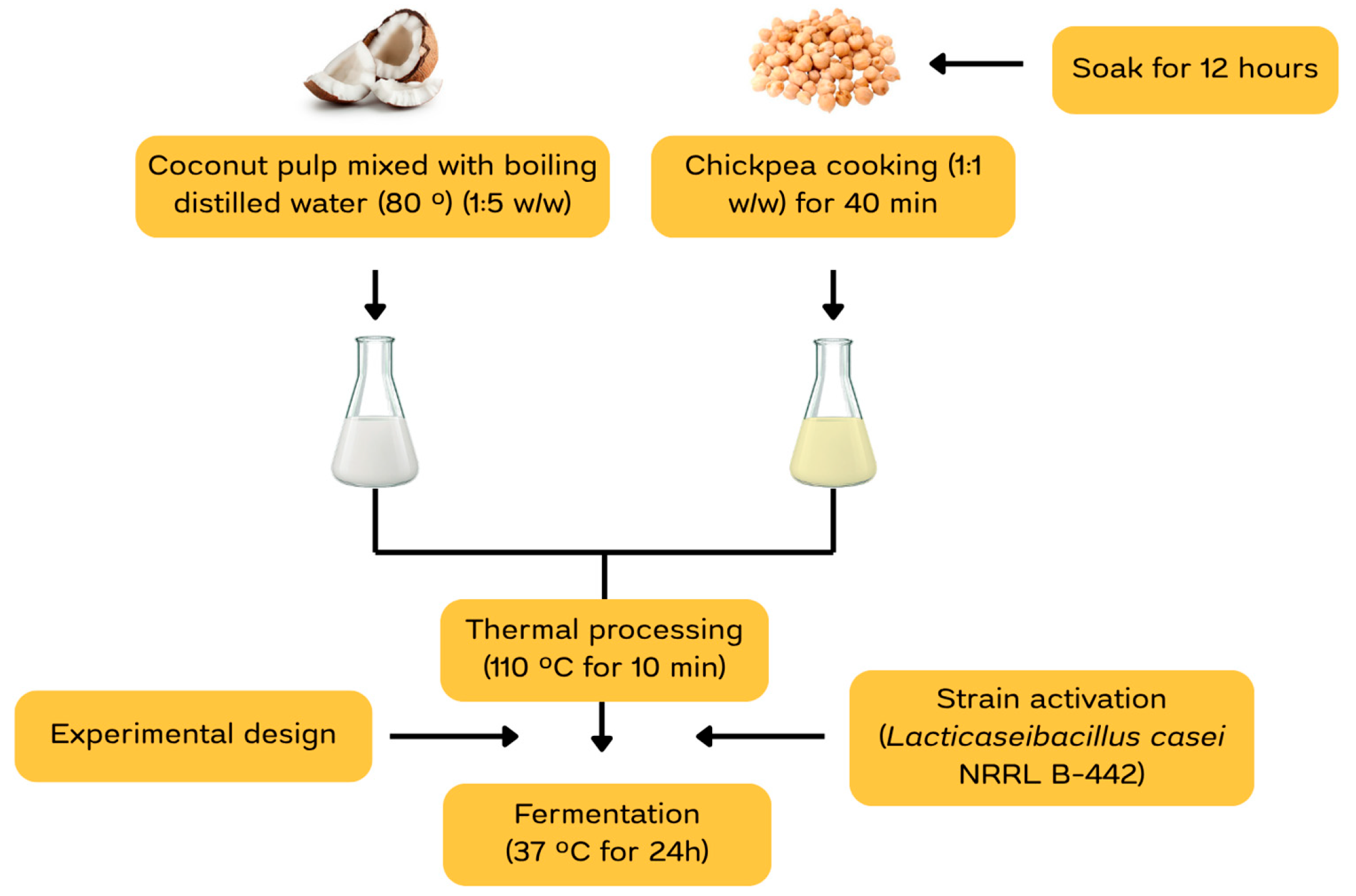
A schematic representation of the experimental workflow used to produce the plant-based probiotic beverage is provided in Figure 1.
Figure 1.
Schematic representation of the experimental workflow to produce the plant-based probiotic beverage. The flowchart details the extraction procedures for the coconut and chickpea aquafaba matrices, followed by thermal processing and the controlled fermentation stage (37 ± 2 °C for 24 h) inoculated with L. casei NRRL B-442 according to the experimental design.
2.4. Refrigerated Storage Stability
To evaluate the final product’s stability, the selected formulation (yielding the highest cell viability) and the control (coconut) were subjected to a shelf-life study. After fermentation, the beverages were distributed into multiple sterile 100 mL glass bottles, each filled with 70 mL of fermented product, and stored under refrigeration at 4 ± 2 °C for 30 days. The number of viable cells of L. casei NRRL B-442 was assessed at 0, 1, 15, and 30 days. The pH was also monitored throughout this period to assess post-acidification.
2.5. Stochastic Modeling and Shelf-Life Assessment
A stochastic analysis was performed using Monte Carlo simulation to assess the uncertainty associated with the modeled decline in probiotic viability during refrigerated storage following the predictive microbiology approach described by Di Biase et al. and Nikmaram et al. [25,27]. Unlike deterministic predictions based solely on point estimates, this approach incorporates the uncertainty associated with the estimated kinetic parameters, allowing probabilistic prediction of the viable cell concentration at the end of storage.
For each formulation, a linear regression model was fitted to viable-cell counts obtained during the storage period, expressed as:
where Nt represents the predicted viable cell count (log CFU/mL) at storage time t (days).
Nt = N0 + k ⋅ t
N0 is the estimated viable count at the beginning of the shelf-life period (day 0).
k is the specific inactivation rate (expressed as log CFU/mL per day).
t is the storage time in days.
The estimated coefficients and their corresponding standard errors were used to generate 10,000 stochastic simulations, assuming approximately normal distributions for the model parameters. The viable-cell concentration for each realization was then estimated using Nfinal = N0 + k·t, with t = 29 days representing the modeled storage interval adopted in the simulation. The 29-day interval was adopted to represent the elapsed period between the initial storage assessment and the end of the 30-day observation period. The probability of meeting the predefined viable cell count criterion of 7.0 log CFU/mL was calculated as the proportion of simulations yielding Nfinal ≥ 7.0 log CFU/mL.
The stochastic analysis considered uncertainty in the fitted coefficients but did not incorporate covariance between parameter estimates or batch-to-batch variability. All statistical analyses, linear regressions and Monte Carlo simulations were performed using R version 4.4.1 (R Core Team, Vienna, Austria). Data manipulation was conducted using the dplyr package, and probability density distributions were generated using ggplot2.
2.6. Sugar and Organic Acid Profile
Sugars consumption and production of organic acids during fermentation and storage were determined analytically. The concentrations of sucrose, glucose, fructose, and lactic acid (expressed in g/L) were quantified at 0 h, 24 h, 15 days, and 30 days. Sucrose, glucose and fructose quantification were performed using Infinity 1260 HPLC (Agilent, Santa Clara, CA, USA) system using a Bio-Rad HPX-87C column (300 × 7.8 mm) at 60 °C (Bio-Rad, Hercules, CA, USA). Ultrapure water was used as the eluent (0.6 mL/min). Sugars were detected by a refractive index (RI) detector (Agilent) [29].
Organic acids quantification was in the same chromatographic system equipped with a 300 × 7.8 mm Aminex HPX-87H column (Bio-Rad) at 50 °C. A UV-DAD detector (Agilent) set at 210 nm was used. The analysis run time was 40 min, with a 5 mM sulfuric acid mobile phase at a flow rate of 0.4 mL/min. All analytes were quantified through calibration curves.
2.7. Total Phenolic Compounds
The total phenolic compounds (TPC) of the beverages were estimated using the Folin–Ciocalteu method [30], modified by Almeida [31]. An aliquot of 10 µL of the sample was mixed with 200 µL of Folin–Ciocalteu reagent. After 3 min, 100 µL of a 20% sodium carbonate solution was added. Absorbance was read at 765 nm, using a microplate reader Biotek Epoch (Agilent) and Gen6 1.04 software (Agilent). Gallic acid (Sigma-Aldrich, St. Louis, MO, USA) was used as the standard, and the results were expressed as milligrams of gallic acid equivalents per milliliter (mg GAE/mL).
2.8. Total Antioxidant Activity
The in vitro antioxidant potential of the beverages was assessed using three distinct assays (DPPH, ABTS, and FRAP), since a single method cannot comprehensively evaluate the diverse antioxidant mechanisms present in the complex plant-based matrix.
DPPH Radical Scavenging Assay: 90 µL of the sample was reacted with 1800 µL of DPPH (2,2-diphenyl-1-picrylhydrazyl) solution. After 15 min of incubation in the dark, the reduction of the DPPH radical was measured at an absorbance of 515 nm using an Evolution 220 UV-Vis spectrophotometer (Thermo Scientific, Waltham, MA, USA) and Thermo Insight Customizer User Environment (CUE) software v1 2.0 (Thermo Scientific) [32].
ABTS Radical Cation Scavenging Assay: The ABTS radical cation was generated by reacting ABTS with potassium persulfate. 15 µL of the sample was mixed with 1500 µL of the ABTS working solution. The absorbance was read at 734 nm using an Evolution 220 UV-Vis spectrophotometer (Thermo Scientific) and Thermo Insight Customizer User Environment (CUE) software v1 2.0 (Thermo Scientific, Waltham, MA, USA) after 6 min of incubation in the dark. Results were expressed as µmol Trolox equivalents per mL (µmol TE/mL) [33].
FRAP (Ferric Reducing Antioxidant Power) Assay: 15 µL of the sample was mixed with 285 µL of FRAP reagent (consisting of acetate buffer, TPTZ, and FeCl3). The absorbance was recorded at 593 nm after 30 min of incubation at 37 ± 2 °C, in the absence of light in a microplate reader (Agilent, Biotek Epoch, Santa Clara, CA, USA) using the software Gen6 1.04 (Agilent). Ascorbic acid (AA) was used to generate a calibration curve, and the results were expressed as micromolar of ascorbic acid equivalent per milliliter (μmol AAE/mL) [29].
All reagents used for the determination of total antioxidant activity were purchased from Sigma-Aldrich.
2.9. Statistical Analysis and Modeling
Data were expressed as mean ± standard deviation. Statistical significance was assessed at a significance level of α = 0.05, using Statistica version 14.0.0.15 (TIBCO, Palo Alto, CA, USA). The model fit was assessed using the F-test. The results were illustrated through a Pareto chart and a Contour plot, enabling the identification of the conditions that maximize bacterial growth. Graphs were generated with R version 4.4.1 (R Core Team, Vienna, Austria).
3. Results
3.1. Influence of Plant-Based Matrix Composition on Probiotic Viability
The experimental results revealed an interaction between sucrose supplementation and aquafaba concentration (Table 1).
Table 1.
Experimental design and measured responses (viable cell count and final pH) for the optimization of the plant-based probiotic beverage.
The control (coconut) supported the growth of L. casei NRRL B-442, reaching a viable cell count of 8.40 ± 0.07 log CFU/mL after fermentation. However, all supplemented formulations exhibited higher viable cell counts, ranging from 8.53 ± 0.05 to 9.08 ± 0.06 log CFU/mL, with the formulation containing 30% aquafaba and 50 g/L sucrose (Run 4) achieving the highest cell density (9.88 ± 0.09 log CFU/mL). These results indicate that the combined supplementation with aquafaba and sucrose was associated with higher viable cell counts after fermentation.
The individual effects of aquafaba and sucrose became evident when comparing the factorial experiments. At the highest sucrose concentration (50 g/L), increasing the aquafaba content from 10% (Run 3) to 30% (Run 4) increased the viable cell count from 8.88 ± 0.08 to 9.88 ± 0.09 log CFU/mL, while the final pH increased from 4.44 ± 0.01 to 4.64 ± 0.01. In contrast, when sucrose was absent (Runs 1 and 2), increasing aquafaba concentration resulted in a slight increase in both viable cell counts (8.53 to 8.55 log CFU/mL) and final pH (5.13 to 5.35). These findings indicate that the beneficial effect of aquafaba became more pronounced in the presence of sucrose, suggesting a positive interaction between both variables.
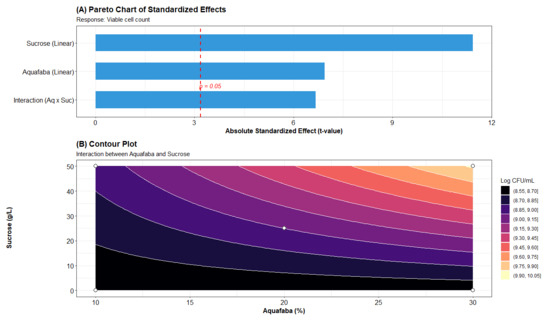
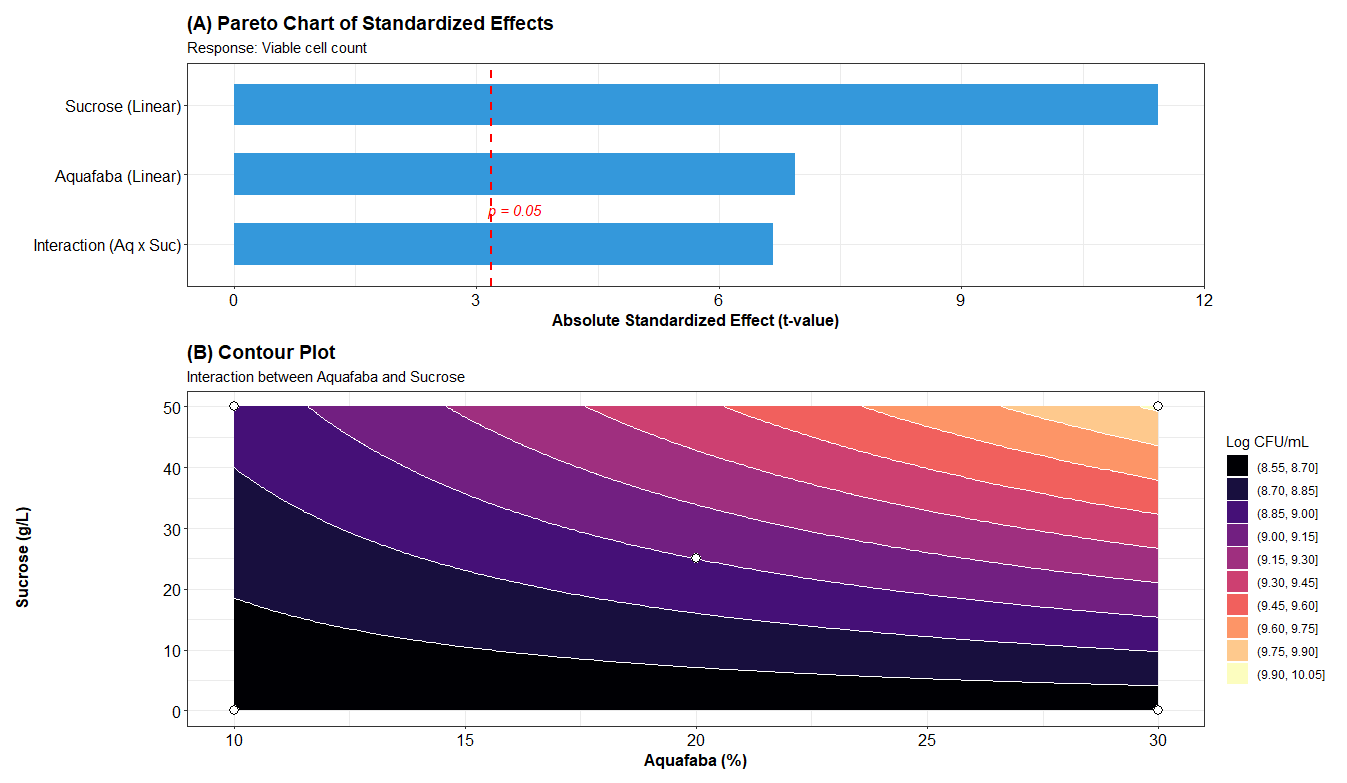
The center-point experiments (Runs 5–7), performed with 20% aquafaba and 25 g/L sucrose, showed viable cell counts ranging from 9.03 ± 0.06 to 9.08 ± 0.06 log CFU/mL and final pH values between 4.57 ± 0.03 and 4.66 ± 0.02. The Pareto chart (Figure 2A) summarizes the standardized effects of the formulation variables on the viable cell count of L. casei NRRL B-442. All evaluated terms exceeded the statistical significance threshold (p < 0.05), demonstrating that sucrose concentration, aquafaba concentration, and their interaction significantly affected probiotic number of viable cells.
Figure 2.
Influence of plant-based matrix composition on the viability of L. casei NRRL B-442. (A) Pareto chart depicting the absolute standardized effects of the independent variables and their interaction. (B) Response surface contour plot showing the interaction between aquafaba and sucrose. The color gradient indicates that the optimal region for maximum viable cell count (lighter region, upper right) is achieved at the concurrent maximum levels of both evaluated factors.
Sucrose concentration exerted a significant positive effect on the final viable cell counts. Although previous research indicates that matrices composed of coconut and whole chickpea extracts can support lactic acid bacteria growth without additional carbohydrates [5], the inclusion of an accessible carbon source may have favored higher viable cell counts in the aquafaba-supplemented formulations. Nevertheless, the formulations containing lower levels of aquafaba also supported probiotic growth, with differences of approximately 1 log CFU/mL compared with formulations containing higher aquafaba levels. These findings suggest that both carbohydrate availability and aquafaba concentration may influence the final viable cell counts, although the observed differences should not be interpreted as evidence that sucrose was required for probiotic growth.
This positive effect of sucrose availability is consistent with previous reports that increasing sugar concentrations in legume–coconut beverages can accelerate fermentation kinetics, resulting in a faster pH decline and increased organic acid production [5]. In the present study, greater availability of an accessible carbon source may have supported a higher viable population of L. casei during fermentation, contributing to the higher cell counts observed at the end of the fermentation period. The maintenance of these relatively high viable counts may have subsequently favored probiotic survival during refrigerated storage.
Aquafaba concentration also significantly improved probiotic viability, exhibiting a significant positive interaction with sucrose. While sucrose promoted initial growth, organic acid accumulation subsequently restricted proliferation in unbuffered environments. Chickpea aquafaba mitigates this limitation by supplying soluble proteins and complex polysaccharides that potentially buffer against acidification, alongside nitrogenous compounds lacking in the coconut extract. This cooperative mechanism aligns with previous studies demonstrating that combining fermentable carbohydrates with protein-rich legume substrates effectively maximizes lactic acid bacteria growth [34,,35].
The adequacy of the polynomial regression model was evaluated by analysis of variance (ANOVA). The fitted model explained 98.67% of the variability in probiotic viability (R2 = 0.9867). Model significance was confirmed by F-test (F = 74.43, p < 0.05), demonstrating that the fitted equation adequately described the relationship between formulation variables and probiotic viability within the investigated experimental domain.
A two-factor factorial regression model including the interaction term was fitted to describe the relationship between viable cell count (Y) and the independent variables (Equation (2)). In the model, all independent variables are expressed as coded values.
where Y represents the predicted viable cell count (log CFU/mL), x is the coded value for chickpea aquafaba percentage, y is the coded value for sucrose concentration, and xy is the interaction between them.
Y = 9.00 + 0.255x + 0.420y + 0.245xy
Figure 2B presents the contour plot generated from the fitted model. The response surface demonstrates a progressive increase in probiotic viability as both sucrose concentration and aquafaba content increase within the evaluated experimental domain. The highest predicted viable cell counts were observed in the upper-right region of the surface, corresponding to the combination of 50 g/L sucrose and 30% aquafaba. The contour plot further confirms the significant interaction identified in the Pareto analysis, indicating that the positive effect of sucrose became more pronounced as aquafaba concentration increased. Within the evaluated experimental domain, the simultaneous use of the highest levels of both ingredients produced the highest probiotic viable cell counts, demonstrating that formulation optimization depended on their combined effects rather than on the individual contribution of each factor.
The effect of sucrose availability on probiotic viability depended on the composition of the beverage matrix. Although sucrose provides an accessible carbon source for ATP generation and biomass formation [36,37,38], increasing its concentration in the coconut control did not result in the highest viable cell counts. This may be related to greater organic acid accumulation and post-acidification in the less buffered control matrix. The significant sucrose × aquafaba interaction further indicates that the effect of carbohydrate availability was influenced by the presence of aquafaba. Thus, the superior technological performance of R4 may be attributed to the combined effects of sucrose availability and aquafaba-derived matrix properties, which favored the maintenance of higher viable cell counts during fermentation and refrigerated storage.
Chickpea aquafaba is naturally rich in soluble proteins, peptides, and complex polysaccharides [39,,40]. These components may contribute to the buffering capacity of the matrix. These observations are well-supported by previous studies on legume-supplemented non-dairy matrices, which demonstrate that integrating protein-rich by-products is essential to buffer metabolic acids and deliver the nitrogenous precursors necessary for probiotic stability during both fermentation and subsequent cold storage [41,42,43].
Overall, the response surface analysis demonstrates that probiotic viability was governed by the combined effects of carbon availability and plant-based matrix composition rather than by either factor alone. These findings highlight the importance of formulation optimization for developing stable plant-based probiotic beverages and identify chickpea aquafaba as a promising functional ingredient capable of enhancing the technological performance of coconut-based fermented products.
The chromatographic profiles obtained after 24 h of fermentation (Table 2) provided insight into the substrate utilization pattern of L. casei NRRL B-442. Glucose and fructose concentrations remained unchanged among all formulations (p > 0.05), ranging from 10.40 to 11.49 g/L and from 10.37 to 11.04 g/L, respectively.
Table 2.
Concentration of residual sugars and organic acids (g/L) in the formulated matrices and the control (coconut) after 24 h of fermentation by L. casei NRRL B-442.
In contrast, residual sucrose concentrations differed among the formulations (p < 0.05). The control (coconut) contained only 18.69 ± 0.56 g/L residual sucrose, whereas formulations supplemented with 50 g/L sucrose (Runs 3 and 4) retained approximately 64–68 g/L after fermentation. Likewise, the center-point formulations (Runs 5 (C)–7 (C)), initially containing 25 g/L sucrose, showed intermediate residual concentrations (61.81–65.60 g/L). These results indicate that sucrose was supplied in excess relative to the metabolic demand of L. casei NRRL B-442, allowing high probiotic populations to be achieved while leaving a substantial proportion of the carbohydrate unconsumed.
The organic acid profile further demonstrated that formulation composition markedly influenced bacterial metabolism. Lactate concentrations were significantly higher in sucrose-supplemented formulations than in the control (coconut). While the control accumulated only 0.79 ± 0.43 g/L lactate after 24 h, supplemented formulations produced between 1.95 and 2.40 g/L. The highest lactate concentration was observed in Run 6 (2.40 ± 0.06 g/L), followed by Runs 5 and 4, indicating that all formulations containing aquafaba and sucrose promoted more active fermentative metabolism than the control (coconut) beverage.
Acetate concentrations differed according to formulation, with higher concentrations observed in the formulations without added sucrose. The highest acetate concentrations were observed in formulations without sucrose supplementation (Runs 1 and 2), whereas only trace amounts were detected in the sucrose-supplemented formulations. No acetate was detected in the control. The results suggest that formulation composition may have altered the profile of fermentation products.
Despite the considerable amount of residual sucrose remaining after fermentation, the observed viable cell counts indicate that complete substrate depletion was not required to support substantial cell proliferation during fermentation. These findings suggest that probiotic performance depends not only on carbohydrate availability but also on the physicochemical characteristics of the fermentation plant-based matrix. In particular, the incorporation of chickpea aquafaba was associated with greater fermentative activity while supporting high probiotic viability, reinforcing its potential as a functional ingredient for improving the technological performance of coconut-based fermented beverages.
3.2. Shelf-Life Assessment and Probiotic Survival Dynamics Under Cold Storage
The formulation containing 30% chickpea aquafaba and 50 g/L sucrose (Run 4) showed the highest experimentally observed viable cell count and was therefore selected for subsequent storage evaluation.
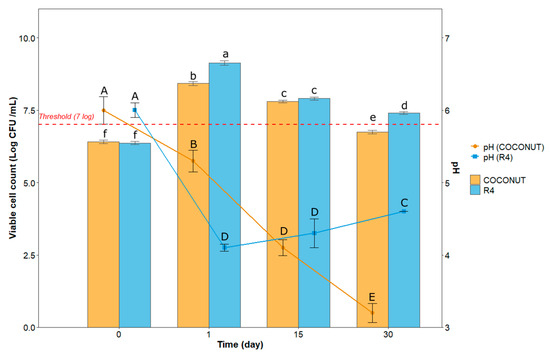
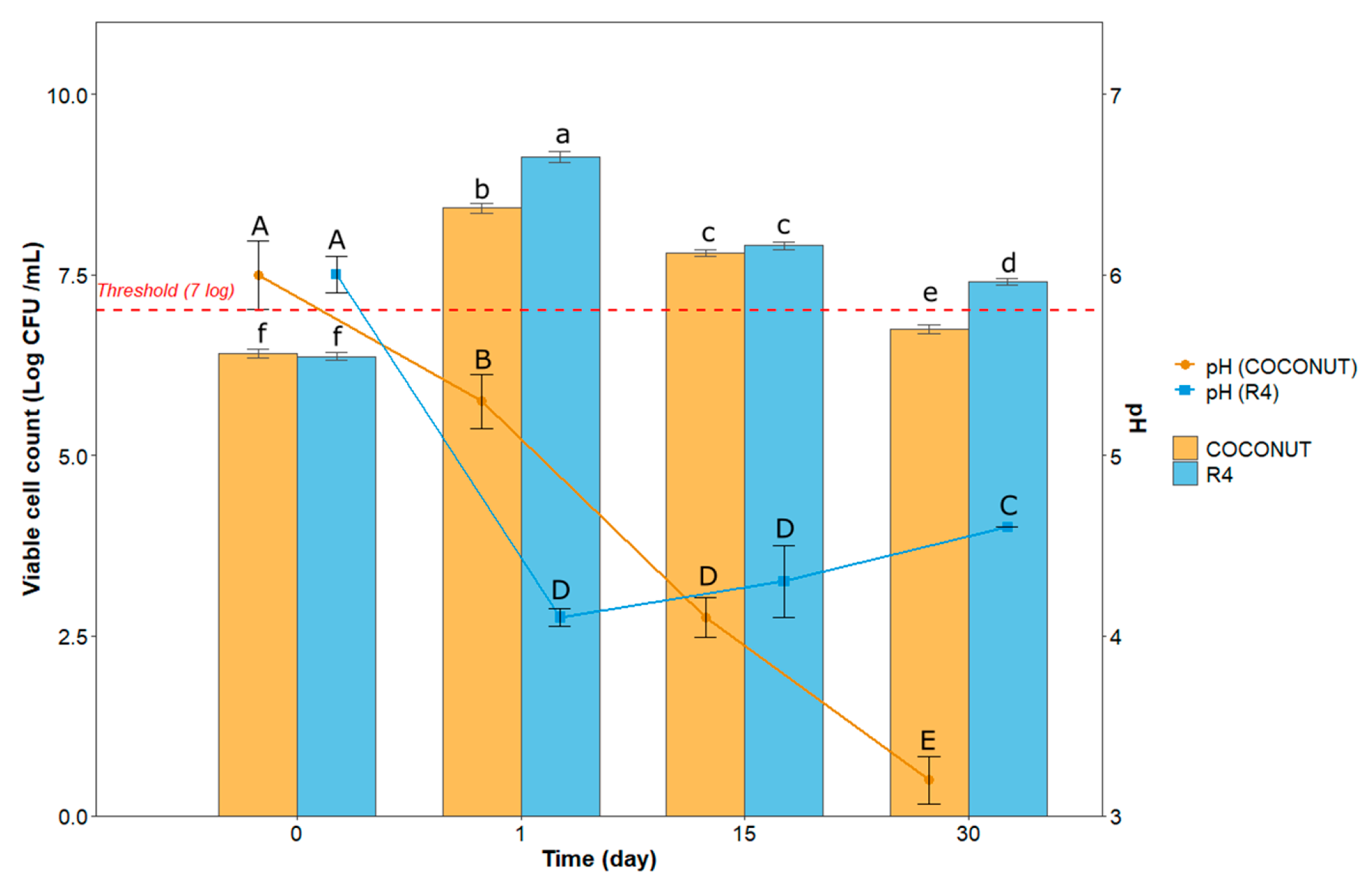
Figure 3 illustrates the changes in viable cell counts and pH during 30 days of refrigerated storage (4 °C) in sterile glass bottles. Distinct trends were observed between the control (coconut) and the selected formulation (R4), indicating that aquafaba supplementation influenced both probiotic survival and acidification during storage.
Figure 3.
Shelf-life assessment of viable cell counts and pH of the control (coconut) and the selected formulation (R4) during refrigerated storage. Time 0 represents the unfermented mixture immediately after inoculation, while Day 1 represents the end of the 24 h fermentation period (start of storage). The primary y-axis (bars) displays the L. casei NRRL B-442 viability, while the secondary y-axis (lines) tracks the pH kinetics. Error bars denote standard deviations of the means. The red dashed line denotes the critical cell viable count threshold (7 log CFU/mL). Lowercase letters (a–f) indicate significant differences among cell count values, and uppercase letters (A–E) indicate significant differences among pH values, according to Tukey’s test (p < 0.05).
The control (coconut) exhibited a more pronounced reduction in pH during refrigerated storage than the R4 formulation. This behavior is consistent with previous studies showing that coconut-based beverages can undergo post-acidification during storage, with decreases in pH and increases in titratable acidity linked to the continued metabolism of fermentable sugars by lactic acid bacteria [44,45,46]. During the refrigerated storage period (from day 1 to day 30), the continued decrease in pH was accompanied by a progressive decline in probiotic viability from its post-fermentation peak, indicating an association between post-acidification and reduced bacterial survival.
In contrast, the R4 formulation exhibited a slower reduction in pH while maintaining viable cell counts above 7 log CFU/mL throughout the storage period. These findings indicate that aquafaba supplementation enhanced the capacity to resist severe post-acidification and sustain a minimum target viable count during prolonged refrigeration. Previous studies indicate that legume-derived ingredients, particularly proteins and polysaccharides, can improve the physicochemical stability of plant-based food matrices and, in some formulations, help maintain probiotic viability during storage; however, these effects depend on the specific legume ingredient, product formulation, and storage conditions [47,48,49]. In fermented plant-based beverages, post-acidification is a primary cause of probiotic mortality, as the rapid accumulation of organic acids induces lethal cellular stress by disrupting the transmembrane pH gradient and depleting intracellular ATP. By mitigating this pH drop, the optimized matrix possibly shielded the bacterial cells, consistent with the concurrent maintenance of probiotic viability and a more stable pH profile in R4 formulation.
The control (coconut) provided readily fermentable sugars and a protective lipid emulsion, but inherently lacked sufficient buffering capacity and essential nitrogenous compounds. The incorporation of chickpea aquafaba addressed these critical deficiencies by supplying a high concentration of soluble proteins, peptides, and complex polysaccharides. Furthermore, the nitrogen-containing compounds of aquafaba may also have contributed to nutrient availability under cold stress. Structurally, the amphiphilic proteins from aquafaba combined with the coconut lipids to form a stable colloidal dispersion, which may have contributed to the physicochemical stability of the beverage matrix. By creating this synergistically buffered microenvironment, the selected matrix ensured superior long-term probiotic stability compared to the control, aligning with previous studies on legume-supplemented non-dairy beverages [13,50,51,52,53,54,55].
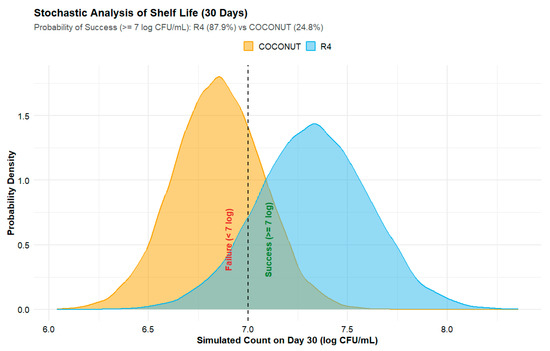
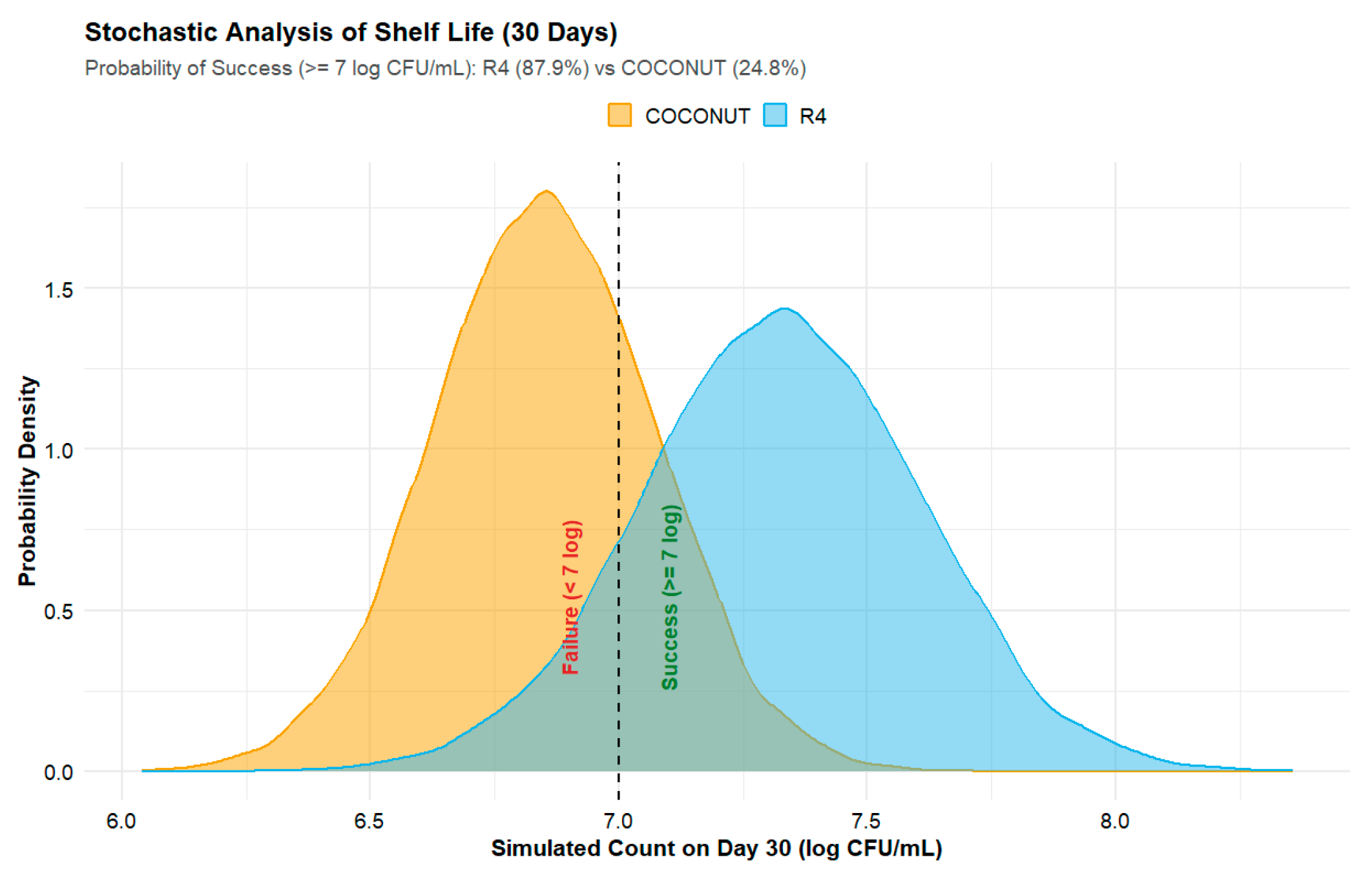
The shelf-life reliability of the formulations was evaluated through a stochastic Monte Carlo simulation (Figure 4). The results demonstrate that the selected R4 plant-based matrix showed a higher probability of meeting the criterion, significantly outperforming the control.
Figure 4.
Stochastic Monte Carlo simulation (10,000 iterations) predicting the probabilistic shelf-life reliability of the selected plant-based matrix (R4) and the control (coconut) after 30 days of refrigerated storage. The probability density curves illustrate the likelihood of maintaining the viable cell count above the minimum target viable count of 7.0 log CFU/mL (indicated by the vertical dashed line).
Stochastic approaches provide insights beyond deterministic analyses by revealing how kinetic uncertainty affects survival probabilities. Formulations with similar average viable counts may demonstrate vastly different likelihoods of maintaining minimum probiotic thresholds, making Monte Carlo simulations a complementary tool for formulation screening and shelf-life validation.
The fitted regression models estimated an initial viable count (N0) of 9.05 ± 0.15 log CFU/mL for the selected R4 formulation, whereas the control (coconut) presented an estimated initial population of 8.51 ± 0.12 log CFU/mL. During the subsequent refrigerated storage period, both formulations exhibited a gradual decline in viable cell counts, which is consistent with the progressive accumulation of organic acids and the post-acidification commonly observed in fermented probiotic beverages. The estimated inactivation rates were similar between formulations, reaching −0.0596 ± 0.01 log CFU/mL/day for R4 and −0.0574 ± 0.01 log CFU/mL/day for the control (coconut).
Considering 7.0 log CFU/mL as the minimum viable population, the stochastic model predicted an 87.9% probability that the R4 formulation would maintain viable counts above this threshold after 30 days of refrigerated storage. In contrast, the control (coconut) exhibited only a 24.8% probability of satisfying the same criterion (Figure 4), indicating a substantially greater risk of functional failure despite presenting a similar average rate of viability decline. These estimates reflect uncertainty in the fitted model parameters under the experimental storage conditions evaluated.
Interestingly, the superior probabilistic performance of R4 was not primarily associated with a slower inactivation kinetics during storage. Instead, both formulations exhibited comparable values of the inactivation rate (k), suggesting that refrigerated storage imposed a similar physiological stress on the probiotic population regardless of the plant-based matrix composition.
These findings suggest that the main advantage of aquafaba in the present system may arise during fermentation, through the attainment of a higher viable-cell population before refrigerated storage. The nutritional composition of aquafaba, characterized by soluble proteins, peptides, oligosaccharides and other fermentable constituents, may provide a more favorable environment for bacterial growth, allowing L. casei NRRL B-442 to achieve a higher cell density before storage begins. Once refrigeration was initiated, however, both formulations displayed comparable viability loss rates, indicating that the primary technological advantage of aquafaba lies in maximizing the initial probiotic population instead of substantially modifying the subsequent inactivation kinetics.
From the perspective of predictive microbiology, these results suggest that increasing the initial viable population may represent a more effective formulation strategy than attempting to achieve only marginal reductions in the inactivation rate during storage. Because both formulations exhibited similar kinetic behavior, relatively small differences in N0 produced a marked shift in the probability distribution of viable counts at the end of shelf life. Consequently, R4 formulation maintained a substantially wider margin above the ‘critical probiotic threshold’, defined as the minimum viable population (7.0 log CFU/mL) used here as a predefined viability criterion for probiotic product development. By achieving a significantly higher N0 during fermentation and providing a buffered matrix that mitigates post-acidification stress, R4 formulation showed a larger predicted margin above the predefined viability criterion. As demonstrated by the Monte Carlo simulation, this wider margin ensures that even when accounting for uncertainty associated with the fitted model parameters and the expected kinetics of cell decline, the statistical probability of the batch dropping below the minimum target viable count on the shelf is minimized.
Predictive modeling has been used to estimate the shelf life of fermented beverages, considering that microbial survival can vary according to time, temperature, and the food matrix. Therefore, the Monte Carlo analysis indicates that incorporating chickpea aquafaba not only improves fermentation performance but also enhances the robustness of the probiotic beverage by increasing the probability that the product will maintain its functional characteristics during refrigerated shelf life.
Although the probabilistic approach provides a more informative assessment of shelf-life reliability than deterministic predictions, some limitations should be acknowledged. The simulation was developed using viability data obtained under controlled refrigerated storage conditions and assumes that cell decline follows a linear trend throughout the evaluated period. Therefore, extrapolation of these predictions to other storage temperatures or formulations should be performed with caution. Future studies incorporating dynamic temperature profiles and alternative predictive models may further improve the robustness of probabilistic shelf-life assessment.
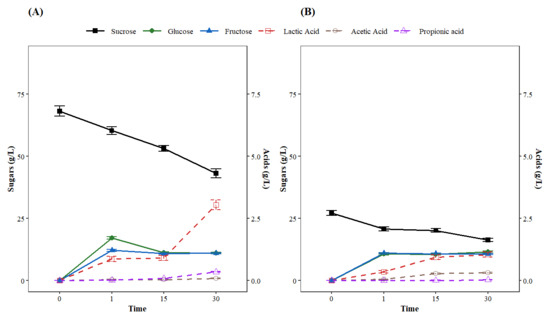
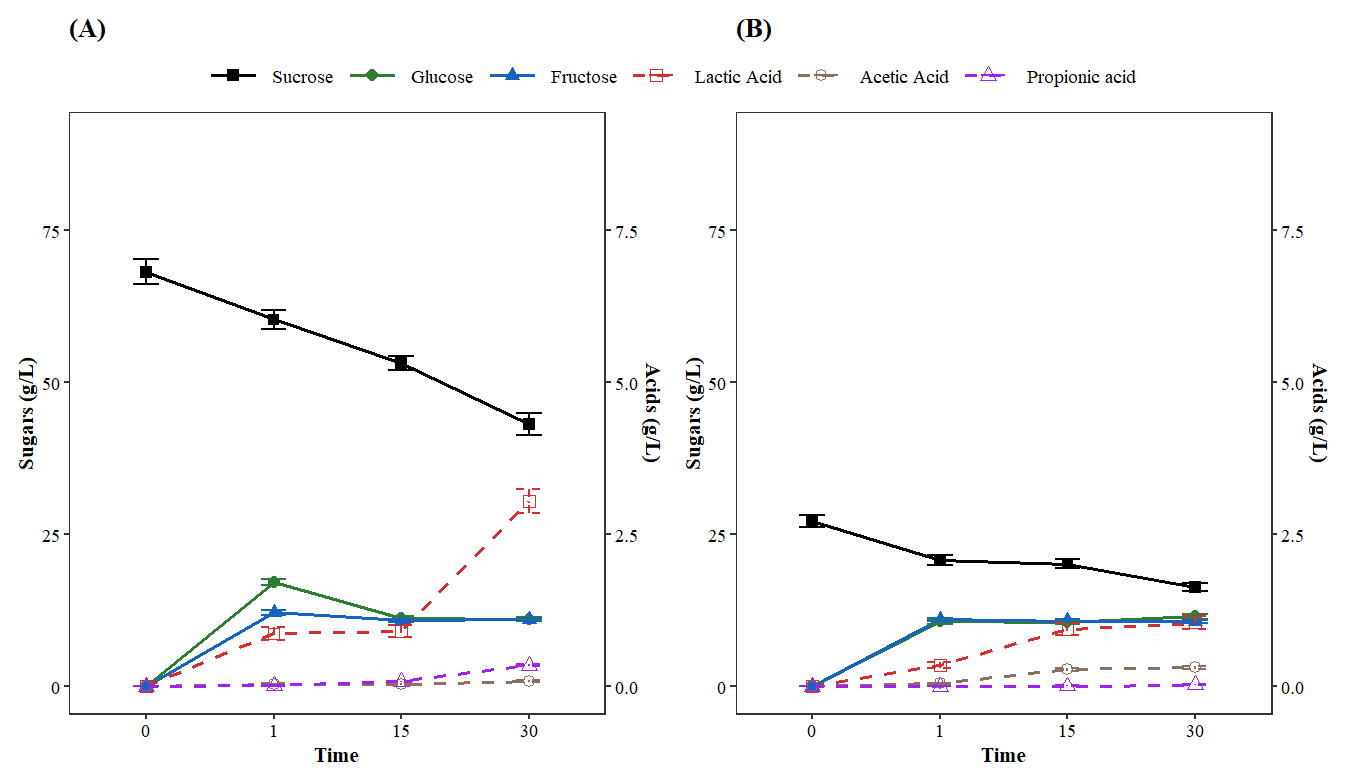
The metabolic profiles of the selected R4 plant-based matrix (Figure 5A) and the control (coconut) (Figure 5B) reveal distinct fermentative dynamics during refrigerated storage.
Figure 5.
Comparative metabolic profiling during initial fermentation (0 h to 24 h) and refrigerated storage (15 d to 30 d). The graphs illustrate the consumption of carbohydrates (solid lines, left axis) and the production of organic acids (dashed lines, right axis) for (A) the optimally formulated plant-based matrix (R4, 30% aquafaba and 50 g/L sucrose) and (B) the control (coconut).
The metabolic profiles of the R4 formulation (Figure 5A) and the control (coconut) (Figure 5B) revealed distinct patterns of carbohydrate consumption and organic acid production during refrigerated storage. In the R4 formulation, sucrose concentrations decreased progressively throughout the 30-day storage period, whereas the control (coconut) exhibited only limited sucrose consumption after the initial fermentation stage. These results suggest that carbohydrate utilization continued for a longer period in the aquafaba-supplemented formulation.
Lactic acid production also differed markedly between the formulations. R4 beverage exhibited a progressive increase in lactate concentration during storage, reaching values approximately fourfold higher than those observed in the control (coconut) at day 30. In contrast, lactate concentrations in the control (coconut) increased only slightly after fermentation and remained relatively stable throughout storage.
The simultaneous observation of continued sucrose consumption, increased lactate production, and higher probiotic viability suggests that the aquafaba-containing formulation provided a buffered microenvironment capable of sustaining basal metabolic activity even under cold stress. In the poorly buffered control (coconut), the rapid initial drop in pH likely induced severe acute acid stress, which may have reduced metabolic activity under the evaluated storage conditions. Conversely, the buffering contribution potentially provided by soluble proteins and other matrix components in R4 formulation may have mitigated this acid stress. By maintaining a more stable pH profile, the selected matrix provided a microenvironment that enabled the continued consumption of sucrose and production of lactic acid by L. casei at 4 °C, consistent with residual microbial metabolic activity during refrigerated storage. This residual microbial metabolic activity during refrigerated storage aligns with previous studies on legume-supplemented non-dairy beverages [56,57].
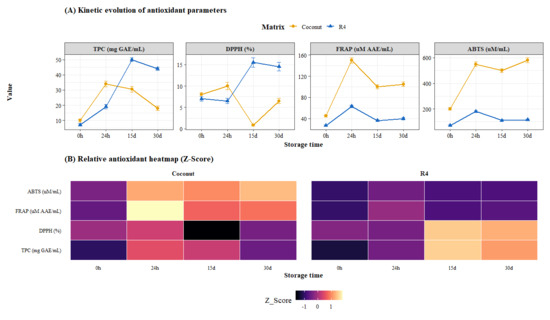
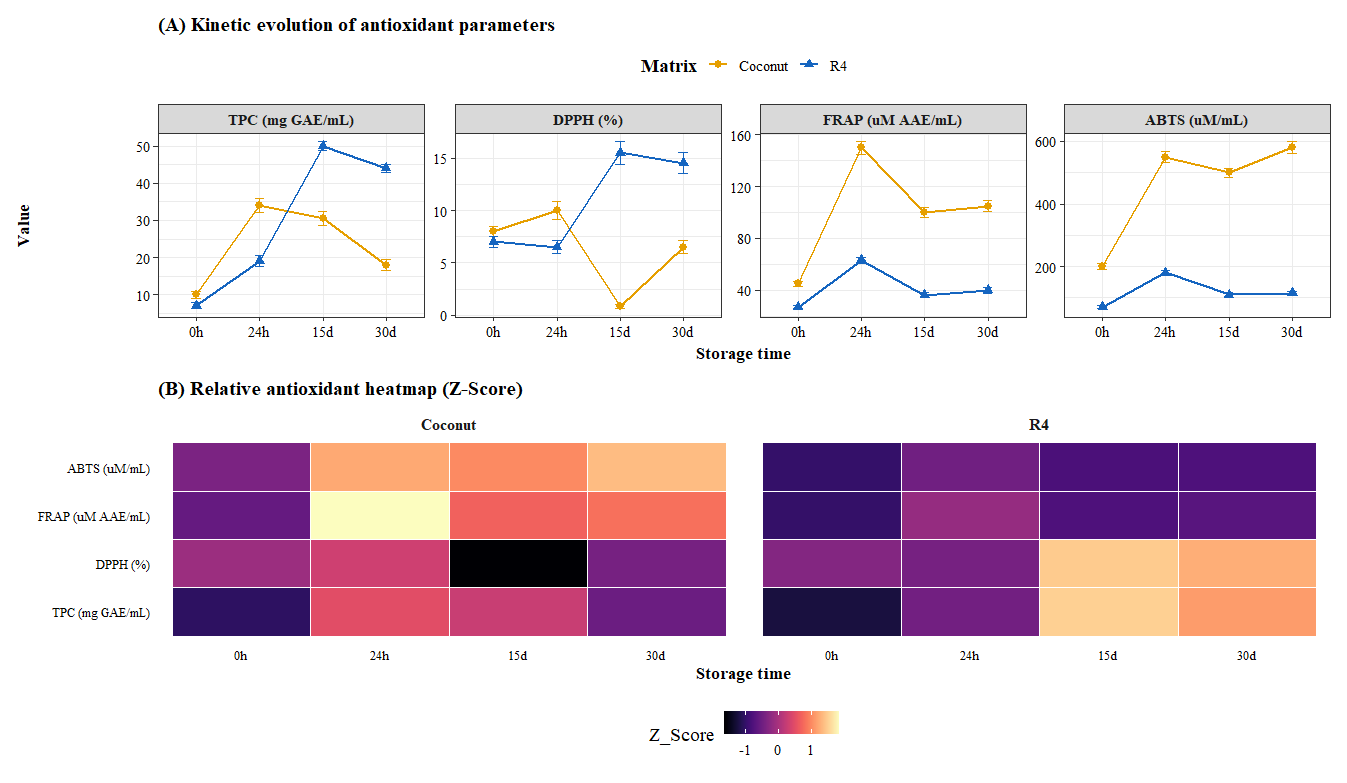
The kinetic profiling of antioxidant parameters (Figure 6A) and the corresponding Z-score heatmap (Figure 6B) reveal a plant-based matrix-dependent metabolic response during fermentation and subsequent cold storage.
Figure 6.
Evaluation of the antioxidant potential of the selected plant-based matrix (R4) and control (coconut) during initial fermentation (0 h to 24 h) and refrigerated storage (15 d to 30 d). (A) Kinetic evolution of absolute values for Total Phenolic Compounds (TPC) and in vitro antioxidant capacity evaluated via DPPH, FRAP, and ABTS assays. (B) Heatmap visualization of the relative antioxidant activity expressed as Z-scores, demonstrating the temporal shifts and peak accumulation periods within each specific plant-based matrix.
The control (coconut) exhibited an immediate increase in antioxidant activity after fermentation, reaching maximum values for TPC, FRAP and ABTS at 24 h. The increase in TPC and antioxidant activity after fermentation may reflect changes in the extractability or chemical composition of antioxidant compounds associated with microbial metabolism. These findings are consistent with previous studies reporting that fermentation may increase the availability of antioxidant compounds naturally present in plant-based products [58,59,60]. However, part of this antioxidant capacity declined during refrigerated storage, suggesting progressive modification of the antioxidant profile over time.
In contrast, R4 formulation exhibited a different temporal pattern. Although FRAP and ABTS values remained lower than those of the control (coconut), TPC and DPPH radical scavenging activity increased during refrigerated storage, reaching maximum values at day 15. Similar behavior has been reported for fermented coconut-based beverages during refrigerated storage [44].
The distinct trends observed across the TPC, DPPH, ABTS, and FRAP assays provide complementary insights into the biochemical dynamics during storage, indicating that specific antioxidant mechanisms are affected differently. For instance, FRAP variations reflect shifts in the concentration or accessibility of reducing compounds, whereas DPPH and ABTS measurements capture the matrix’s overall radical-scavenging capacity. Ultimately, these complementary results demonstrate that aquafaba supplementation not only broadens the initial diversity of antioxidants in the coconut matrix but also distinctly modulates the beverage’s oxidative stability throughout storage.
Notably, the progressive increase in TPC and DPPH activity observed in R4 formulation suggests that chickpea aquafaba contributed to maintaining or enhancing these antioxidant responses during refrigerated storage. These findings reinforce the potential of aquafaba as a functional ingredient for improving the technological quality of plant-based fermented beverages.
4. Conclusions
This study demonstrates that optimizing beverage plant-based matrix composition is an effective strategy for improving the technological performance of probiotic beverages. Under the controlled refrigerated conditions evaluated, the formulation containing 30% chickpea aquafaba and 50 g/L sucrose showed the highest experimentally observed probiotic viability after fermentation and maintained viable counts above 7.0 log CFU/mL at the end of the 30-day storage period. The formulation also exhibited a smaller pH decrease than control (coconut). Stochastic modeling further indicated a higher probability of meeting the predefined viable-cell criterion at the end of storage, although this probability reflects uncertainty in the fitted kinetic parameters rather than batch-to-batch or commercial variability. Overall, these findings identify chickpea aquafaba as a promising and sustainable functional ingredient capable of improving the technological stability of coconut-based probiotic beverages while contributing to the valorization of an underutilized plant-derived by-product. Although the present study demonstrates the technological potential of chickpea aquafaba under controlled laboratory conditions. Nevertheless, these findings provide evidence supporting further investigation of chickpea aquafaba as a functional ingredient in plant-based probiotic beverages.
Author Contributions
Conceptualization, T.V.F., S.R. and A.Y.S.d.S.; methodology, A.Y.S.d.S., M.d.F.D.L. and F.E.B.S.; software, A.Y.S.d.S. and T.V.F.; validation, T.V.F. and S.R.; formal analysis, A.Y.S.d.S., M.d.F.D.L. and F.E.B.S.; investigation A.Y.S.d.S. and T.V.F.; resources, T.V.F. and S.R.; data curation, A.Y.S.d.S. and T.V.F.; writing—original draft preparation, A.Y.S.d.S.; writing—review and editing, A.Y.S.d.S., S.R. and T.V.F.; visualization, A.Y.S.d.S. and T.V.F.; supervision, T.V.F.; project administration, T.V.F.; funding acquisition, T.V.F. and S.R. All authors have read and agreed to the published version of the manuscript.
Funding
This study was financed in part by the Coordination for the Improvement of Higher Education Personnel-Brasil (CAPES)-Finance Code 001, National Council for Scientific and Technological Development (CNPq) and Ceará Foundation for Scientific and Technological Development Support (FUNCAP).
Data Availability Statement
The original contributions presented in this study are included in the article. Further inquiries can be directed to the corresponding author.
Acknowledgments
The authors thank the USDA-ARS Culture Collection (NRRL Culture Collection, United States Department of Agriculture, Peoria, IL, USA) for the Lacticaseibacillus casei NRRL B442 microbial strain. The authors also acknowledge the ‘Futuras Cientistas’ program (CETENE/CNPq) for supporting scientific outreach and research initiation. During the preparation of this work, the authors used Grammarly Pro (version 14.1325.0) to improve the language and readability of the manuscript. After using this tool/service, the authors reviewed and edited the content as needed and took full responsibility for the content of the published article.
Conflicts of Interest
The authors declare no conflicts of interest.
Abbreviations
The following abbreviations are used in this manuscript:
| DPPH | 2,2-Diphenyl-1-Picrylhydrazyl |
| ABTS | 2,2′-azino-bis(3-ethylbenzothiazoline-6-sulfonic acid) |
| FRAP | Ferric Reducing Antioxidant Power |
| TPC | Total Phenolic Compounds |
| HPLC | High-Performance Liquid Chromatography |
| CFU/mL | Colony Forming Unit per Milliliter |
| GAE/mL | Gallic Acid Equivalent per Milliliter |
| AAE/mL | Ascorbic Acid Equivalent per Milliliter |
| ANOVA | Analysis of Variance |
| MRS | Man, Rogosa, and Sharpe |
| RI | Refractive Index |
| UV-DAD | Ultraviolet-Diode Array Detector |
References
- Joyce, O.-N.C.; Chinweike, O.F.; Godswill, C.C.; Ifeanyi, O.O.; Vivian, I.N.; Christian, S.O. Production of Fermented Soymilk Drink Containing Probiotic Bacillus Coagulans. Eur. J. Nutr. Food Saf. 2021, 13, 51–61. [Google Scholar] [CrossRef] [Scilit]
- Tu, C.; Tang, S.; Azi, F.; Hu, W.; Dong, M. Use of Kombucha Consortium to Transform Soy Whey into a Novel Functional Beverage. J. Funct. Foods 2019, 52, 81–89. [Google Scholar] [CrossRef] [Scilit]
- Sanjukta, S.; Sahoo, D.; Rai, A.K. Fermentation of Black Soybean with Bacillus Spp. for the Production of Kinema: Changes in Antioxidant Potential on Fermentation and Gastrointestinal Digestion. J. Food Sci. Technol. 2022, 59, 1353–1361. [Google Scholar] [CrossRef] [Scilit] [PubMed]
- AL Zahrani, A.J.; Shori, A.B. Viability of Probiotics and Antioxidant Activity of Soy and Almond Milk Fermented with Selected Strains of Probiotic Lactobacillus spp. LWT 2023, 176, 114531. [Google Scholar] [CrossRef] [Scilit]
- Mesquita, M.C.; Leandro, E.d.S.; de Alencar, E.R.; Botelho, R.B.A. Fermentation of Chickpea (Cicer arietinum L.) and Coconut (Coccus nucifera L.) Beverages by Lactobacillus Paracasei Subsp Paracasei LBC 81: The Influence of Sugar Content on Growth and Stability during Storage. LWT 2020, 132, 109834. [Google Scholar] [CrossRef] [Scilit]
- Carbonell-Capella, J.M.; Buniowska, M.; Esteve, M.J.; Frígola, A. Effect of Stevia Rebaudiana Addition on Bioaccessibility of Bioactive Compounds and Antioxidant Activity of Beverages Based on Exotic Fruits Mixed with Oat Following Simulated Human Digestion. Food Chem. 2015, 184, 122–130. [Google Scholar] [CrossRef] [Scilit] [PubMed]
- Aparicio-García, N.; Martínez-Villaluenga, C.; Frias, J.; Peñas, E. Production and Characterization of a Novel Gluten-Free Fermented Beverage Based on Sprouted Oat Flour. Foods 2021, 10, 139. [Google Scholar] [CrossRef] [Scilit] [PubMed]
- Limbad, M.; Gutierrez-Maddox, N.; Hamid, N.; Kantono, K.; Liu, T.; Young, T. Microbial and Chemical Changes during Fermentation of Coconut Water Kefir Beverage. Appl. Sci. 2023, 13, 7257. [Google Scholar] [CrossRef] [Scilit]
- Giri, S.S.; Sukumaran, V.; Sen, S.S.; Park, S.C. Use of a Potential Probiotic, Lactobacillus Casei L4, in the Preparation of Fermented Coconut Water Beverage. Front. Microbiol. 2018, 9, 1976. [Google Scholar] [CrossRef] [Scilit] [PubMed]
- Wang, X.; Kong, X.; Zhang, C.; Hua, Y.; Chen, Y.; Li, X. Comparison of Physicochemical Properties and Volatile Flavor Compounds of Plant-Based Yoghurt and Dairy Yoghurt. Food Res. Int. 2023, 164, 112375. [Google Scholar] [CrossRef] [Scilit] [PubMed]
- Asif, N.; Anwar, O.; Arif, S.; Anwar, Z.; Iahtisham-Ul-Haq; Ercisli, S.; Mugabi, R.; Nayik, G.A. The Rise of Plant-Based Milk Alternatives: Exploring Nutritional, Health, and Sustainability Impacts. Food Chem. X 2026, 34, 103528. [Google Scholar] [CrossRef] [Scilit] [PubMed]
- Rasika, D.M.; Vidanarachchi, J.K.; Rocha, R.S.; Balthazar, C.F.; Cruz, A.G.; Sant’Ana, A.S.; Ranadheera, C.S. Plant-Based Milk Substitutes as Emerging Probiotic Carriers. Curr. Opin. Food Sci. 2021, 38, 8–20. [Google Scholar] [CrossRef] [Scilit]
- Kumar, V.; Naik, B.; Kumar, A.; Khanduri, N.; Rustagi, S.; Kumar, S. Probiotics Media: Significance, Challenges, and Future Perspective—A Mini Review. Food Prod. Process. Nutr. 2022, 4, 17. [Google Scholar] [CrossRef] [Scilit]
- Awulachew, M.T. Probiotics and Thermal Processing: A Review of Challenges and Protective Strategies. Lett. Food Res. 2025, 1, e25057. [Google Scholar] [CrossRef] [Scilit]
- Sivaraj, D.; Dalbhagat, C.G.; Venugopal, A.P.; Thivya, P.; Nimbkar, S.; Gowda, N.A.N.; Mishra, S.; Kambhampati, V. Aquafaba as a Sustainable and Plant-Based Egg Alternative: Recent Advances in Extraction, Nutritional Insights, and Functional Characterization. Food Bioproc. Technol. 2025, 18, 8927–8953. [Google Scholar] [CrossRef] [Scilit]
- Hippolite, L.R.; Feng, Z.; Zhang, Y.; Lee, S.J.; Serventi, L. Sensory Quality of Upcycled Legume Water: Expectation vs. Reality. Front. Food Sci. Technol. 2023, 3, 1143371. [Google Scholar] [CrossRef] [Scilit]
- Stasiak, J.; Stasiak, D.M.; Libera, J. The Potential of Aquafaba as a Structure-Shaping Additive in Plant-Derived Food Technology. Appl. Sci. 2023, 13, 4122. [Google Scholar] [CrossRef] [Scilit]
- Huang, Y.P.; Masarweh, C.; Paviani, B.; Mills, D.A.; Barile, D. Exploring Bioactive Compounds in Chickpea and Bean Aquafaba: Insights from Glycomics and Peptidomics Analyses. Food Chem. 2024, 460, 140635. [Google Scholar] [CrossRef] [Scilit] [PubMed]
- Karatay, G.G.B.; Galvão, A.M.M.T.; Hubinger, M.D. Storage Stability of Conventional and High Internal Phase Emulsions Stabilized Solely by Chickpea Aquafaba. Foods 2022, 11, 1588. [Google Scholar] [CrossRef] [Scilit] [PubMed]
- Kahraman Ilıkkan, Ö.; Bağdat, E.Ş.; Yılmaz, İ.; Beyter, N.; Yüzay, I.E. A Novel Synbiotic Edible Film Based on Aquafaba, Psyllium Husk Powder, PEG 400, and Lactiplantibacillus Plantarum 299v and Applicability on Kashar Cheese. J. Food Meas. Charact. 2024, 18, 10166–10181. [Google Scholar] [CrossRef] [Scilit]
- Martins, G.N.; Guerrero Sánchez, M.; Carboni, A.D.; Cenard, S.; Fonseca, F.; Gómez-Zavaglia, A.; Castilho, P.C. Use of Legume Wastewater Extracts on the Storage Stability of Freeze-Dried Lactiplantibacillus Plantarum WCFS1. Food Bioproc. Technol. 2025, 18, 1707–1718. [Google Scholar] [CrossRef] [Scilit]
- Colucci Cante, R.; Nigro, F.; Lentini, G.; Passannanti, F.; Gallo, M.; Mauriello, F.; Budelli, A.L.; Nigro, R. Improvement of Functional and Technological Properties of Chickpea Aquafaba Through Lactic Fermentation. Legume Sci. 2025, 7, e70018. [Google Scholar] [CrossRef] [Scilit]
- Fenster, K.; Freeburg, B.; Hollard, C.; Wong, C.; Laursen, R.R.; Ouwehand, A.C. The Production and Delivery of Probiotics: A Review of a Practical Approach. Microorganisms 2019, 7, 83. [Google Scholar] [CrossRef] [Scilit] [PubMed]
- Dorota, Z.; Danuta, K.K.; Antoni, G.; Motyl, I. Predictive Modelling of Lactobacillus Casei KN291 Survival in Fermented Soy Beverage. J. Microbiol. 2014, 52, 169–178. [Google Scholar] [CrossRef] [Scilit] [PubMed]
- Di Biase, M.; Le Marc, Y.; Bavaro, A.R.; De Bellis, P.; Lonigro, S.L.; Lavermicocca, P.; Postollec, F.; Valerio, F. A Predictive Growth Model for Pro-Technological and Probiotic Lacticaseibacillus Paracasei Strains Fermenting White Cabbage. Front. Microbiol. 2022, 13, 907393. [Google Scholar] [CrossRef] [Scilit] [PubMed]
- Misiou, O.; Zourou, C.; Koutsoumanis, K. Development and Validation of a Predictive Model for the Effect of Temperature, PH and Water Activity on the Growth Kinetics of Bacillus Coagulans in Non-Refrigerated Ready-to-Eat Food Products. Food Res. Int. 2021, 149, 110705. [Google Scholar] [CrossRef] [Scilit] [PubMed]
- Nikmaram, P.; Mousavi, S.M.; Kiani, H.; Emamdjomeh, Z.; Razavi, S.H.; Mousavi, Z. Modeling the Effect of Inulin, PH and Storage Time on the Viability of Selected Lactobacillus in a Probiotic Fruity Yogurt Drink Using the Monte Carlo Simulation. J. Food Qual. 2016, 39, 362–369. [Google Scholar] [CrossRef] [Scilit]
- Pahija, E.; Spann, R.; Sin, G. Robust Monitoring of Lactic Acid Bacteria with Sequential Monte Carlo. Comput. Aided Chem. Eng. 2020, 48, 1615–1620. [Google Scholar] [CrossRef] [Scilit]
- Nascimento, C.S.d.; Santos, B.N.; Fonteles, T.V.; Rodrigues, S. From Probiotic to Postbiotic: Conversion of Acerola Juice by Thermosonication. Processes 2025, 13, 2122. [Google Scholar] [CrossRef] [Scilit]
- Folin, O.; Ciocalteu, V. On Tyrosine and Tryptophane Determinations in Proteins. J. Biol. Chem. 1927, 73, 627–650. [Google Scholar] [CrossRef] [Scilit]
- Almeida, F.D.L.; Cavalcante, R.S.; Cullen, P.J.; Frias, J.M.; Bourke, P.; Fernandes, F.A.N.; Rodrigues, S. Effects of Atmospheric Cold Plasma and Ozone on Prebiotic Orange Juice. Innov. Food Sci. Emerg. Technol. 2015, 32, 127–135. [Google Scholar] [CrossRef] [Scilit]
- Brand-Williams, W.; Cuvelier, M.E.; Berset, C. Use of a Free Radical Method to Evaluate Antioxidant Activity. LWT Food Sci. Technol. 1995, 28, 25–30. [Google Scholar] [CrossRef] [Scilit]
- Rufino, M.D.S.M.; Alves, R.E.; de Brito, E.S.; Pérez-Jiménez, J.; Saura-Calixto, F.; Mancini-Filho, J. Bioactive Compounds and Antioxidant Capacities of 18 Non-Traditional Tropical Fruits from Brazil. Food Chem. 2010, 121, 996–1002. [Google Scholar] [CrossRef] [Scilit]
- Davoodi, S.; Behbahani, M.; Shirani, E.; Mohabatkar, H. Influence of Sucrose, Glucose, Stevia Leaf and Stevioside on the Growth and Lactic Acid Production by Lactobacillus Plantarum, Lactobacillus Brevis and Lactobacillus Casei. Iran. J. Sci. Technol. Trans. A Sci. 2016, 40, 275–279. [Google Scholar] [CrossRef] [Scilit]
- He, Y.; Meda, V.; Reaney, M.J.T.; Mustafa, R. Aquafaba, a New Plant-Based Rheological Additive for Food Applications. Trends Food Sci. Technol. 2021, 111, 27–42. [Google Scholar] [CrossRef] [Scilit]
- Sala, M.; Barbiroli, A.; Borgonovo, G.; Rollini, M.; Cappa, C. Physicochemical Properties of Chickpeas Cooking Water (Aquafaba): Effects of Hydrothermal Process Conditions and Clarification. LWT 2025, 238, 118820. [Google Scholar] [CrossRef] [Scilit]
- Zhang, Q.; Yu, Z.; Wang, X. Isolating and Evaluating Lactic Acid Bacteria Strains with or without Sucrose for Effectiveness of Silage Fermentation. Grassl. Sci. 2015, 61, 167–176. [Google Scholar] [CrossRef] [Scilit]
- Popa, D.; Ustunol, Z. Influence of Sucrose, High Fructose Corn Syrup and Honey from Different Floral Sources on Growth and Acid Production by Lactic Acid Bacteria and Bifidobacteria. Int. J. Dairy Technol. 2011, 64, 247–253. [Google Scholar] [CrossRef] [Scilit]
- Yazici, G.N.; Taspinar, T.; Ozer, M.S. Aquafaba: A Multifunctional Ingredient in Food Production. Biol. Life Sci. Forum 2022, 18, 24. [Google Scholar] [CrossRef] [Scilit]
- Serventi, L.; McNeill, J. Upcycling Aquafaba and Liluva (Food Processing Wastewater of Legumes) into New Value-Added Products. Curr. Opin. Food Sci. 2024, 58, 101197. [Google Scholar] [CrossRef] [Scilit]
- Kowalska, E.; Ziarno, M. Characterization of Buckwheat Beverages Fermented with Lactic Acid Bacterial Cultures and Bifidobacteria. Foods 2020, 9, 1771. [Google Scholar] [CrossRef] [Scilit] [PubMed]
- Hurtado-Murillo, J.; Franco, W.; Contardo, I. Role of Quinoa (Chenopodium Quinoa Willd) and Chickpea (Cicer arietinum L.) Ratio in Physicochemical Stability and Microbiological Quality of Fermented Plant-Based Beverages during Storage. Foods 2024, 13, 2462. [Google Scholar] [CrossRef] [Scilit] [PubMed]
- Chen, L.; Wu, D.; Schlundt, J.; Conway, P.L. Development of a Dairy-Free Fermented Oat-Based Beverage with Enhanced Probiotic and Bioactive Properties. Front. Microbiol. 2020, 11, 609734. [Google Scholar] [CrossRef] [Scilit] [PubMed]
- Qadi, W.S.M.; Mediani, A.; Benchoula, K.; Wong, E.H.; Misnan, N.M.; Sani, N.A. Characterization of Physicochemical, Biological, and Chemical Changes Associated with Coconut Milk Fermentation and Correlation Revealed by 1H NMR-Based Metabolomics. Foods 2023, 12, 1971. [Google Scholar] [CrossRef] [Scilit] [PubMed]
- Mauro, C.S.I.; Garcia, S. Coconut Milk Beverage Fermented by Lactobacillus Reuteri: Optimization Process and Stability during Refrigerated Storage. J. Food Sci. Technol. 2019, 56, 854–864. [Google Scholar] [CrossRef] [Scilit] [PubMed]
- Goveas, L.C.; Ashwath, K.S.; Nazerath, B.R.; Dsouza, O.; Ullekh; Umesh, A.; Muddappa, V.S. Development of Coconut Water-Based Exopolysaccharide Rich Functional Beverage by Fermentation with Probiotic Lactobacillus Plantarum SVP2. Biocatal. Agric. Biotechnol. 2021, 34, 102030. [Google Scholar] [CrossRef] [Scilit]
- Li, M.; Hou, X.; Lin, L.; Jiang, F.; Qiao, D.; Xie, F. Legume Protein/Polysaccharide Food Hydrogels: Preparation Methods, Improvement Strategies and Applications. Int. J. Biol. Macromol. 2023, 243, 125217. [Google Scholar] [CrossRef] [Scilit] [PubMed]
- Chaturvedi, S.; Chakraborty, S. Evaluation of Quality Attributes and in Vitro Characteristics of Synbiotic Legume-Based Beverage during Storage. Food Biosci. 2023, 55, 103000. [Google Scholar] [CrossRef] [Scilit]
- Gunturk, S.; Ergin Zeren, F.; Kucukcetin, A.; Comak Gocer, E.M. Microbiological and Physicochemical Properties of Bean, Lentil, and Chickpea Kefirs as Plant-Based Dairy Alternatives. Eur. Food Res. Technol. 2026, 252, 266. [Google Scholar] [CrossRef] [Scilit]
- Costa, M.G.M.; Fonteles, T.V.; Jesus, A.L.T.D.; Rodrigues, S. Sonicated Pineapple Juice as Substrate for L. Casei Cultivation for Probiotic Beverage Development: Process Optimization and Product Stability. Food Chem. 2013, 139, 261–266. [Google Scholar] [CrossRef] [Scilit] [PubMed]
- Tripathi, M.K.; Giri, S.K. Probiotic Functional Foods: Survival of Probiotics during Processing and Storage. J. Funct. Foods 2014, 9, 225–241. [Google Scholar] [CrossRef] [Scilit]
- Sibanda, T.; Marole, T.A.; Thomashoff, U.L.; Thantsha, M.S.; Buys, E.M. Bifidobacterium Species Viability in Dairy-Based Probiotic Foods: Challenges and Innovative Approaches for Accurate Viability Determination and Monitoring of Probiotic Functionality. Front. Microbiol. 2024, 15, 1327010. [Google Scholar] [CrossRef] [Scilit] [PubMed]
- Sánchez, B.; Ruiz, L.; Gueimonde, M.; Ruas-Madiedo, P.; Margolles, A. Toward Improving Technological and Functional Properties of Probiotics in Foods. Trends Food Sci. Technol. 2012, 26, 56–63. [Google Scholar] [CrossRef] [Scilit]
- Condurso, C.; Merlino, M.; Miller, A.; Di Rosa, A.R.; Accetta, F.; Leonardi, M.; Cicero, N.; Gervasi, T. Developing Novel Plant-Based Probiotic Beverages: A Study on Viability and Physicochemical and Sensory Stability. Foods 2025, 14, 2148. [Google Scholar] [CrossRef] [Scilit] [PubMed]
- Gungor, G.; Akpinar, A.; Yerlikaya, O. Production of Plant-Based Fermented Beverages Using Probiotic Starter Cultures and Propionibacterium spp. Food Biosci. 2024, 59, 103840. [Google Scholar] [CrossRef] [Scilit]
- Kalkan, S.; Incekara, K.; Otağ, M.R.; Unal Turhan, E. The Influence of Hazelnut Milk Fortification on Quality Attributes of Probiotic Yogurt. Food Sci. Nutr. 2025, 13, e70235. [Google Scholar] [CrossRef] [Scilit] [PubMed]
- Zhao, J.; Bhandari, B.; Gaiani, C.; Prakash, S. Physicochemical and Microstructural Properties of Fermentation-Induced Almond Emulsion-Filled Gels with Varying Concentrations of Protein, Fat and Sugar Contents. Curr. Res. Food Sci. 2021, 4, 577–587. [Google Scholar] [CrossRef] [Scilit] [PubMed]
- Pereira, A.L.F.; Feitosa, W.S.C.; Abreu, V.K.G.; Lemos, T.d.O.; Gomes, W.F.; Narain, N.; Rodrigues, S. Impact of Fermentation Conditions on the Quality and Sensory Properties of a Probiotic Cupuassu (Theobroma Grandiflorum) Beverage. Food Res. Int. 2017, 100, 603–611. [Google Scholar] [CrossRef] [Scilit] [PubMed]
- Tu, C.; Azi, F.; Huang, J.; Xu, X.; Xing, G.; Dong, M. Quality and Metagenomic Evaluation of a Novel Functional Beverage Produced from Soy Whey Using Water Kefir Grains. LWT 2019, 113, 108258. [Google Scholar] [CrossRef] [Scilit]
- Liu, W.T.; Huang, C.L.; Liu, R.; Yang, T.C.; Lee, C.L.; Tsao, R.; Yang, W.J. Changes in Isoflavone Profile, Antioxidant Activity, and Phenolic Contents in Taiwanese and Canadian Soybeans during Tempeh Processing. LWT 2023, 186, 115207. [Google Scholar] [CrossRef] [Scilit]

Disclaimer/Publisher’s Note: The statements, opinions and data contained in all publications are solely those of the individual author(s) and contributor(s) and not of MDPI and/or the editor(s). MDPI and/or the editor(s) disclaim responsibility for any injury to people or property resulting from any ideas, methods, instructions or products referred to in the content. |
© 2026 by the authors. Licensee MDPI, Basel, Switzerland. This article is an open access article distributed under the terms and conditions of the Creative Commons Attribution (CC BY) license.