


Abstract
Water in a coal seam matrix critically dictates the kinetic response and pore enhancement efficacy during liquid CO2 displacement, yet the underlying mechanisms governing full-scale pore structure evolution under varying moisture regimes remain inadequately quantified. To address this issue, this study investigates the impact of the initial moisture content on pore damage in low-permeability anthracite. Low-field nuclear magnetic resonance and low-temperature nitrogen adsorption experiments were conducted. These techniques were combined to systematically evaluate the full-scale pore structure evolution before and after liquid CO2 immersion. The results indicate that the specific surface area, total pore volume, and T2 spectrum integral areas of microscopic pores at all scales exhibit a distinct non-linear, single-peak evolution pattern with increasing initial moisture content. The initial moisture content of 4.8% serves as a critical turning point for full-scale pore-space expansion and closure, at which the T2 spectrum integral areas for micropores, mesopores, and macropores increase by 116.9%, 221.4%, and 243.5%, respectively, compared to the dry group, thereby effectively clearing blind-end pore throats; below this inflection point, moisture primarily mediates the carbonic acid dissolution response. Beyond this critical threshold, the mechanism transitions into a physical antagonism dominated by water-locking truncation and low-temperature frost-heaving damage. Compared to the 4.8% peak group, the T2 spectrum integral areas for macropores, mesopores, and micropores in the 7.2% high-moisture group decrease significantly by 68.8%, 61.6%, and 46.1%, respectively, leading to an overall occlusion of full-scale pores. These findings provide crucial engineering guidance for field practices involving liquid CO2 injection into moisture-bearing coal seams to enhance coalbed methane displacement.
1. Introduction
Coal seam geological conditions in China are inherently complex, with a majority of seams classified as typical deep, low-permeability reservoirs. These characteristics lead to low efficiency in traditional coalbed methane (CBM) drainage, maintaining a severe outlook for mine gas disaster prevention and control [1,2]. Under the strategic framework of “dual carbon” goals, injecting carbon dioxide (CO2) into coal seams to enhance coalbed methane recovery (CO2-ECBM) has been recognized as a green and innovative pathway that integrates gas disaster mitigation, clean energy development, and carbon emission reduction [3,4]. However, under high in situ stress, deep coal matrices are highly compact with poor pore connectivity, which imposes tremendous resistance to fluid migration within the seams. Consequently, effectively improving the pore structure of low-permeability coal and enhancing gas drainage permeability remain critical bottlenecks urgently awaiting solutions in the fields of mine outburst prevention and disaster mitigation.
In recent years, the technique of enhancing coal seam permeability through high-pressure injection of liquid CO2 has attracted extensive attention due to its advantages, such as no formation contamination and no water-blocking effect [5,6]. Existing studies have predominantly focused on physical outburst control mechanisms, including intense explosive fracturing during liquid CO2 injection or liquid–gas phase-transition disturbances. However, in actual engineering practice, coal seams are generally characterized by inherent water-bearing properties. When high-pressure liquid CO2 is injected into a water-bearing coal seam, as the formation temperature rebounds, it not only undergoes a dynamic phase transition during its migration into the deep coal mass but also rapidly engages in complex fluid–rock geochemical reactions with the native water in the coal seam. The carbonic acid solution formed by CO2 dissolution in water exhibits pronounced weak acidity, which can exert significant chemical dissolution effects on carbonate minerals such as calcite and dolomite, as well as on certain silicate minerals within the coal matrix [7,8]. This “dissolution–acidification” process not only unblocks micro-fractures by removing mineral “plugs” but also induces the re-development of full-scale pore structures within the coal mass.
Extensive research has been conducted by both domestic and international scholars regarding CO2–water–rock interactions, which confirms that CO2 acidification can effectively improve the pore structures of rocks and coal matrices [9]. However, current investments are predominantly focused on the long-term scale reactions of supercritical CO2 within deep saline aquifers or deep coal seams [10]. Feng et al. [11] analyzed the variation patterns of coal structure, organic matter, and elemental content in anthracite induced by supercritical CO2–water interactions. They observed that as the moisture content increased from 0% to 20%, the methane yield was enhanced by 46.1%. However, at a moisture content of 30%, methane production ceased to increase due to the leaching loss of nutrients. Li et al. [12] investigated the microscopic effects of varying moisture contents on deep bituminous coal seams. They found that water in supercritical CO2–water coupled coal samples induced mineral dissolution, exacerbated structural defects, and reduced the contents of aromatic structures and oxygen-containing functional groups. Furthermore, the micropore volume increased with rising moisture content, reaching the peak degree of structural damage at moisture contents between 5.85% and 7.19%. Additionally, Liu et al. [13] utilized nuclear magnetic resonance to evaluate the impact of supercritical CO2–water intrusion on coals with varying porosities. They observed that post-treatment pore evolution primarily occurred within the micropore range, with porosity changes exceeding 6% in low-porosity coal samples compared to less than 2.3% in high-porosity counterparts. Moreover, Zhou et al. [14] conducted uniaxial and true triaxial mechanical tests on bituminous coals with varying moisture contents before and after supercritical CO2 treatment. Their results revealed that the coupled action of supercritical CO2 and water reduced both the uniaxial compressive strength and elastic modulus of coal samples, with the reduction rates exhibiting a trend of initial increase followed by a decrease. At a water saturation level of 80%, the maximum strength reduction rate reached 39.30% post-treatment. However, under deep in situ stress conditions, the strength and elastic modulus of the bituminous coal showed no pronounced weakening; the average strength reduction rate was merely 4.03%. Zhang et al. [15] discovered that the compressive strength of coal decreased sharply during the first 0 to 3 days of supercritical CO2 soaking. Furthermore, the combined damaging effect of water and supercritical CO2 on coal was found to be significantly stronger than that of either factor applied individually; after 3 days of joint exposure, the reduction in compressive strength accounted for 82.09% of the total loss. Overall, supercritical CO2 operates above its critical point as a continuous single-phase fluid without phase interfaces, primarily modifying coal structures through high-diffusivity organic extraction and steady-state pressure-gradient-driven chemical dissolution. However, liquid CO2 exhibits distinct functional mechanisms compared to supercritical CO2. Beyond low viscosity and high flow permeability, liquid CO2 offers significant advantages in intense thermodynamic phase transitions and unsteady dynamic responses. During injection and contact with coal matrices, liquid CO2 undergoes rapid liquid-to-gas phase change, accompanied by massive volume expansion and latent heat absorption [16]. The resulting phase-change pressure and thermal stresses from cryogenic shock rapidly interconnect the micro- and sub-micropore–fracture networks within coal. Furthermore, fluid transport during this phase-transition evolution window demonstrates highly dynamic and unsteady characteristics [17]. Nevertheless, few studies have addressed the short-to-medium-term leaching and acidification effects of liquid CO2 on coal matrices during this critical phase-transition window following injection.
More importantly, the native moisture content of coal seams serves as a key variable governing the kinetic rates of CO2 acidification reactions. Moisture exerts a dual effect within the coal matrix: on one hand, water acts as an essential medium for CO2 hydrolysis to form carbonic acid, with the moisture content dictating both the phase-interface area and acid concentration during chemical dissolution; on the other hand, excessive moisture induces pore occupancy, competitive adsorption, and water-locking effects, which significantly elevate capillary entry pressure and decrease gas relative permeability, thereby impeding the diffusive transport of CO2. Simultaneously, the preferential occupancy of active adsorption sites by water molecules and their restriction on fluid migration weaken both CO2–CH4 displacement efficiency and the short-term leaching-induced permeability enhancement response, ultimately yielding a moisture threshold effect for gas drainage enhancement [18]. Currently, there is a lack of systematic and quantitative experimental research on the mechanistic impacts of liquid CO2 leaching and acidification on full-scale pore structure evolution under varying moisture conditions—particularly regarding the competitive interplay between dissolution pore development and moisture boundary constraints.
Based on these considerations, this study selected low-permeability coal seams as the research object and conducted comparative experiments on liquid CO2 immersion and acidification within coal matrices featuring varying moisture contents. Utilizing advanced micro-testing techniques, including low-field nuclear magnetic resonance and low-temperature nitrogen adsorption, we analyzed the evolution characteristics of full-scale pore structures—spanning micropores, mesopores, and macropores—inside the coal body before and after the immersion–acidification process. Furthermore, the controlling laws governing the variations in specific surface area and total pore volume as a function of initial moisture content were elucidated. This research aims to reveal the intrinsic mechanism of fluid–coal/rock geochemical interactions following liquid CO2 injection into moisture-bearing coal seams, thereby providing crucial theoretical support for cross-phase fluid synergistic modification, coalbed permeability enhancement, and precise gas drainage.
2. Experimental
2.1. Coal Sample Selection and Pretreatment
The experimental anthracite samples were collected from the low-permeability coal seam of the Yangquan No. 2 Coal Mine in Shanxi Province, China. To minimize the impacts of oxidation and external environmental factors on the pristine structure of the coal, large blocks of run-of-mine coal were sealed in airtight sampling bags and promptly transported to the laboratory. In accordance with the standards set by the International Society for Rock Mechanics (ISRM) [19], the raw coal was core-drilled and machined parallel to the bedding direction into standard cylindrical specimens measuring 50 mm in diameter and 100 mm in height. Concurrently, corresponding granular coal samples were exfoliated and screened from the same block of raw coal for low-temperature nitrogen adsorption tests, thereby ensuring the homogeneity of the microscopic pore structure characterization. A grinding machine (S-6630, Taiwan, China) was utilized for the fine leveling of the specimen end-faces, strictly controlling the parallelism within ±0.5 mm. Furthermore, based on the GB/T 30732-2014 standard, an automatic proximate analyzer (BOGF-3000, Henan, China) was employed to quantitatively determine the macroscopic components of the anthracite (including ash, volatile matter, moisture, and fixed carbon) [20]. The proximate analysis results of the coal samples are presented in Table 1.
Table 1.
Results of industrial analysis of coal sample.
2.2. Preparation of Coal Samples with Different Moisture Contents
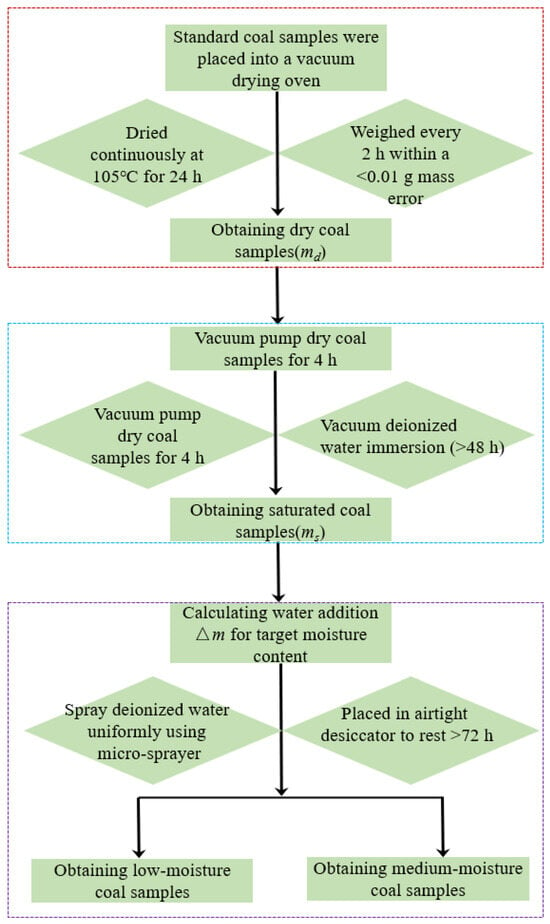
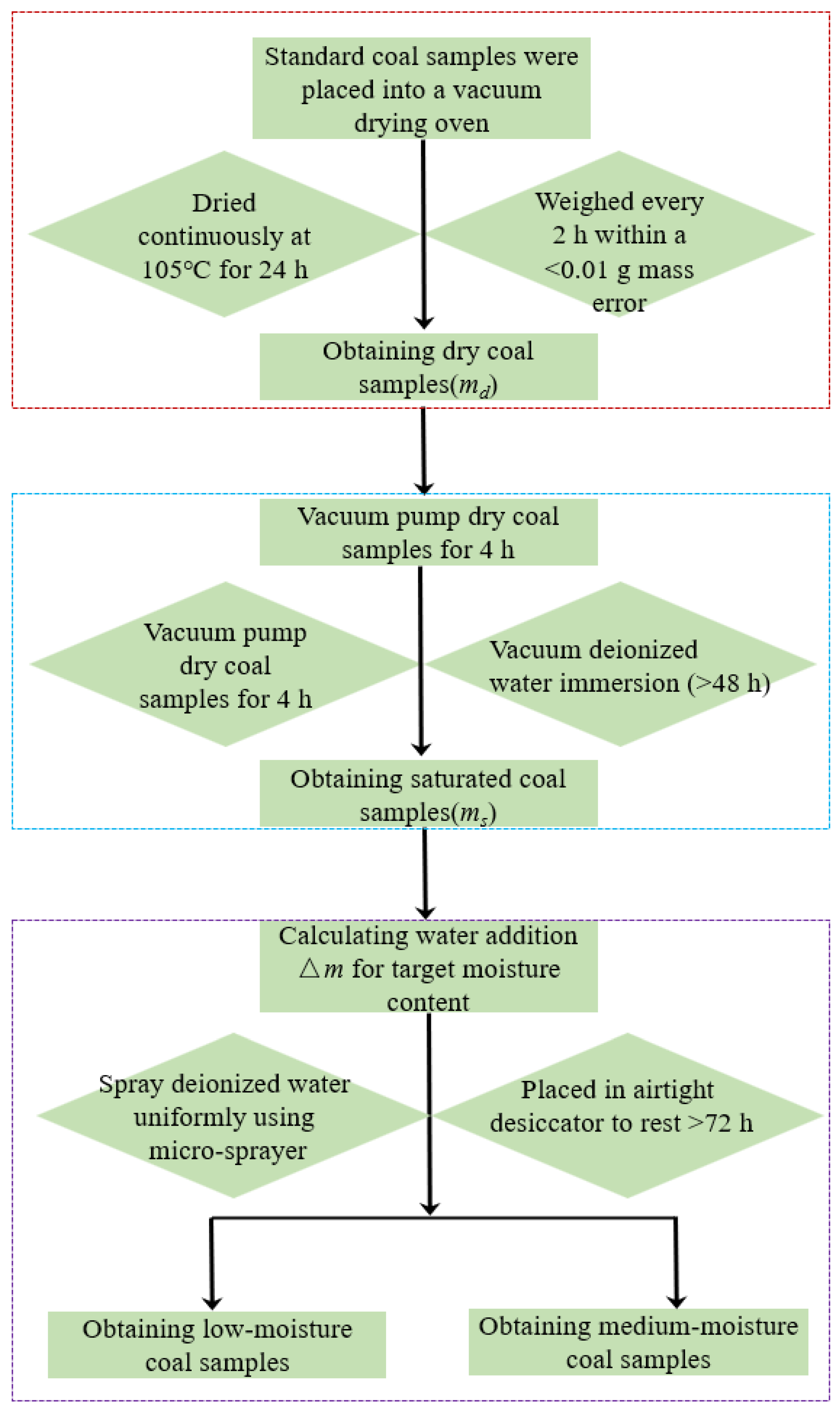
The moisture content of the coal samples was calculated using Equation (1). Upon testing, the average saturated moisture content of the coal samples was determined to be 7.2%. To investigate the regulatory effects of moisture on the leaching and acidification of liquid CO2, four distinct moisture content gradients were established: the dry state (Dry), low-water status (LWS), medium-water status (MWS), and saturated water status (SWS). The detailed preparation procedures are illustrated in Figure 1.
Figure 1.
Experimental flowchart for preparing coal samples with various moisture states.
(1) Preparation of dry coal samples: The pre-machined standard coal samples were placed into a vacuum drying oven and dried continuously at 105 °C for 24 h. The sample mass was weighed every 2 h until the mass variance between two consecutive measurements was less than 0.01 g, at which point the samples were considered fully dried. The mass of the dry coal sample at this time was recorded as md.
(2) Preparation of SWS coal samples: The dried coal samples were placed into a vacuum filtration vessel and evacuated under vacuum for 4 h to eliminate the gas within the pores. Subsequently, deionized water was injected under vacuum to fully submerge the coal samples, which were then kept immersed for more than 48 h. Upon removal, the surface water was wiped off using a damp towel, and the samples were weighed repeatedly until their mass stabilized. The mass of the saturated coal sample at this point was recorded as ms. The saturated moisture content (ws) of the coal samples was calculated as follows:
where ws is the saturated moisture content of the coal sample, %; ms is the mass of the saturated coal sample, g; and md is the mass of the fully dried coal sample, g.
(3) Preparation of LWS and MWS coal samples: Based on the fully dried mass (md) and the saturated moisture content (ws), the required water addition (Δm) to achieve the target moisture content was calculated. The corresponding mass of deionized water was uniformly sprayed onto the surface of the coal samples using a micro-spray method. Subsequently, the samples were tightly wrapped with multiple layers of plastic wrap and placed into an airtight desiccator to rest for 72 h. This allowed the water to fully and uniformly migrate through the internal pores of the coal matrix, driven by capillary forces.
2.3. Experimental Apparatus and Procedures
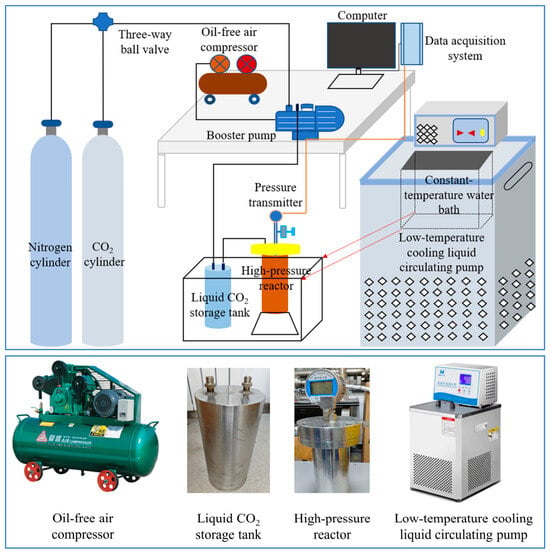
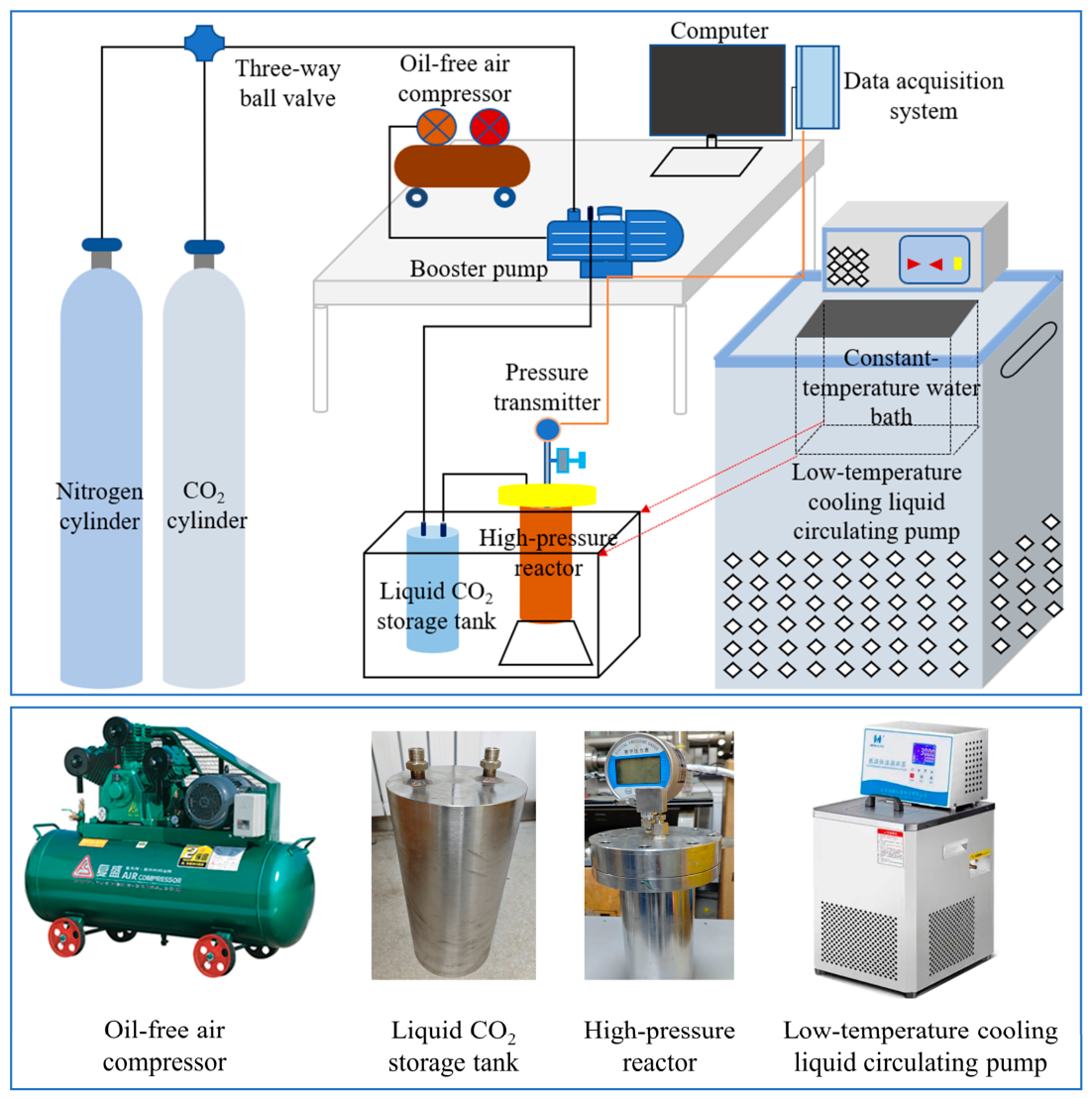
The as-prepared coal samples with different moisture contents were placed into a high-pressure resistant reactor, and the experiments were conducted using a self-developed liquid CO2 leaching system. A schematic diagram of the experimental apparatus is shown in Figure 2.
Figure 2.
Schematic diagram of the experimental setup.
The entire experimental apparatus primarily consists of a high-pressure gas supply unit, a high-pressure resistant reactor unit, a low-temperature refrigeration circulation unit, and a data acquisition unit. The high-pressure gas supply unit employed in the experiment comprises a CO2 cylinder, a pressure-reducing valve, and a three-way valve. The high-pressure gas from the cylinder is regulated by the pressure-reducing valve and then sequentially introduced into a booster pump and a liquid CO2 storage tank via high-pressure pipelines, before finally being injected into the high-pressure resistant reactor. The reactor features a stainless-steel main body possessing a design pressure limit of 30 MPa and a temperature tolerance range of −30 to 150 °C. The system temperature is controlled by a low-temperature refrigeration circulating pump with a temperature control range of −40 to 100 °C and a digital display resolution of 0.01 °C. This equipment integrates dual internal and external circulation systems: the internal circulation ensures a uniform and stable temperature inside the instrument, while the external circulation delivers low-temperature constant-temperature fluid at a flow rate of 5 to 18 L/min. For data monitoring, the critical experimental parameters are monitored using piezoresistive pressure transmitters (range: 0~10 MPa, non-linearity: 0.01% FS). The two channels of signals output by the transmitters undergo I/V conversion and filtering via a DAQM-4206 isolated signal conditioning module and are ultimately stored continuously throughout the process by the upper computer software with a sampling period of 90 ms.
The experimental procedures were as follows:
(1) System pre-cooling and purging: The low-temperature refrigeration circulating pump was turned on, and the high-pressure resistant reactor was placed into a constant-temperature water bath. The liquid temperature in the water bath was adjusted to the preset experimental temperature (−5 °C) to maintain the temperature conditions required for keeping CO2 in a liquid state. Low-pressure helium gas was then introduced to purge the high-pressure pipelines and the high-pressure resistant reactor for 10 min to eliminate residual air.
(2) High-pressure liquid CO2 injection: The air compressor and booster pump were started to pressurize and inject CO2 gas into the liquid CO2 storage tank, causing it to undergo a phase change into the liquid state under the low-temperature and high-pressure environment. Subsequently, the liquid CO2 from the storage tank was injected into the high-pressure resistant reactor. The pressure inside the reactor was stabilized at the preset working pressure (5.0 MPa) using the pressure-regulating valve. At this point, the CO2 was stably maintained in a liquid state under the specified temperature and pressure conditions (−5 °C, 5.0 MPa).
(3) Constant-temperature static leaching: The valves at both the front and rear ends of the reactor body were closed to maintain a high-pressure, sealed state. Under the preset temperature and pressure conditions, the liquid CO2 was allowed to fully contact the coal samples with different moisture contents, inducing leaching and acidification reactions. This static leaching process was continuously sustained for 72 h.
(4) Depressurization and sample retrieval: Upon completion of the leaching process, the needle valve at the rear of the reactor was finely adjusted to depressurize the system at an extremely slow and steady rate (0.05 MPa/min). This was done to maximize the avoidance of physical impacts and mechanical fracturing on the coal matrix induced by rapid liquid-to-gas phase changes, thereby ensuring that the modification of the pore structure stemmed purely from the chemical leaching and acidification effects. After depressurizing to atmospheric pressure, the coal samples were retrieved and immediately subjected to subsequent pore structure re-testing.
2.4. Experimental Scheme
In this study, the moisture content of the coal samples was selected as the core variable, with four experimental groups established: dry (0%, the raw dry coal sample without any CO2 immersion treatment, serving as the blank control group), low-water (1.5%), medium-water (4.8%), and high-water groups (near-saturated moisture content, 7.2%). The corresponding samples were labeled as D1–D3, L1–L3, M1–M3, and S1–S3. Throughout the experiments, the environmental parameters for leaching were kept constant across all groups, with a leaching temperature of −5.0 °C, a pressure maintained at 5.0 MPa, and a continuous leaching duration of 72 h. By comparing the pore structure characteristics of the coal samples with different initial moisture states under identical leaching conditions, the chemical damage and structural modification effects of moisture on the liquid CO2 leaching and acidification of the coal matrix were quantitatively analyzed. The detailed experimental parameters are summarized in Table 2.
Table 2.
Experimental parameters.
2.5. Experimental Methods
2.5.1. Pore Structure Analysis of Coal Samples
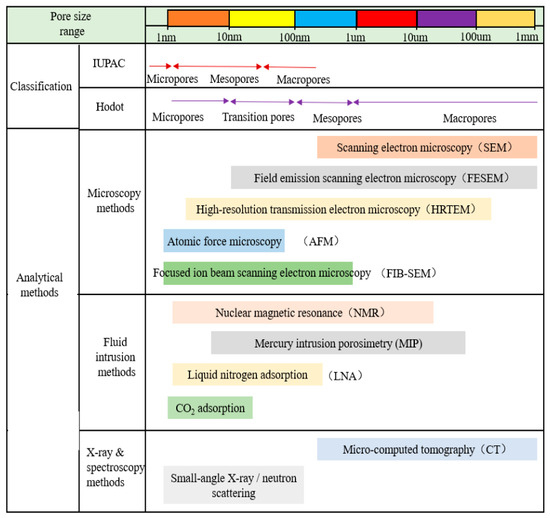
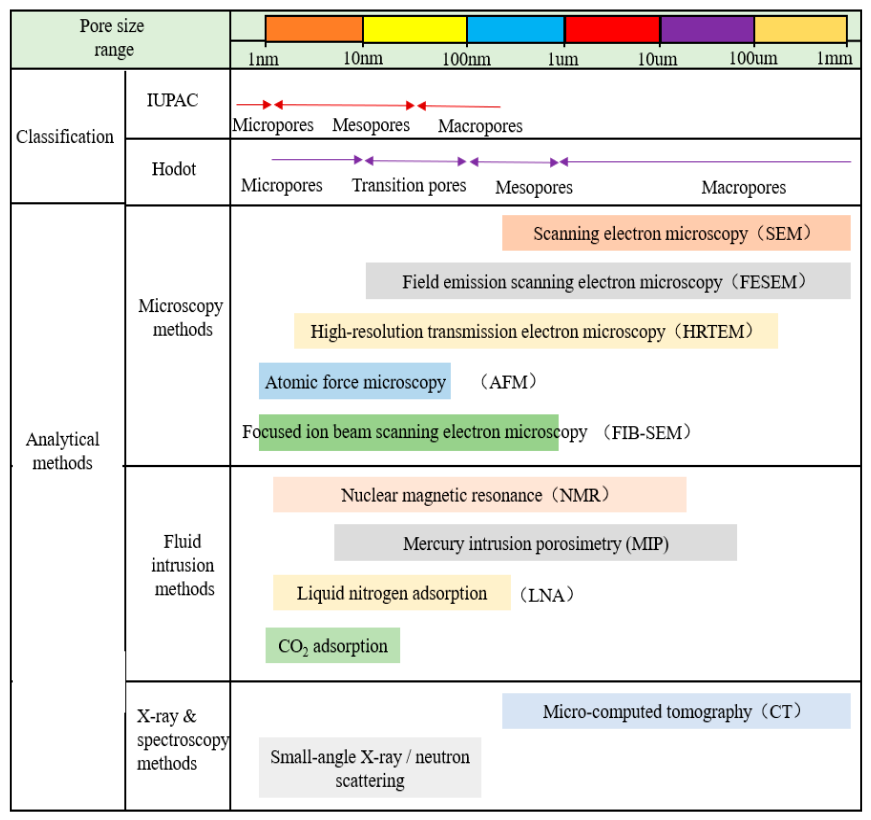
The pore classification methods adopted in this study include the International Union of Pure and Applied Chemistry (IUPAC) scheme and the Hodot classification method [21,22], with the pore-size division boundaries of each system illustrated in Figure 3. Based on the pore diameter measurement ranges of different testing techniques, a comprehensive approach combining nuclear magnetic resonance (following the Hodot classification) and low-temperature nitrogen adsorption (following the IUPAC scheme) was utilized to analyze the pore structure before and after the reactions.
Figure 3.
Classification and analytical methods of coal matrix pores [21].
2.5.2. Experimental Reliability Analysis
Coal is a highly heterogeneous, naturally fractured geological medium. To ensure that the observed single-peak evolutionary trend of the pore structure and the critical response at a 4.8% moisture content possess clear physical significance—rather than being experimental artifacts or sampling noise—a statistical evaluation was conducted on all parallel replicates. The coefficient of variation (Equation (2)) was employed to quantitatively assess the dispersion and repeatability of the experimental test data.
where CV is the coefficient of variation (%), which measures the relative dispersion (or fluctuation) of the data; S is the sample standard deviation; and is the sample arithmetic mean.
3. Analysis of Micro- and Mesopore Evolution Characteristics Based on Low-Temperature Nitrogen Adsorption
3.1. Adsorption–Desorption Isotherms and Variations in Pore Geometry
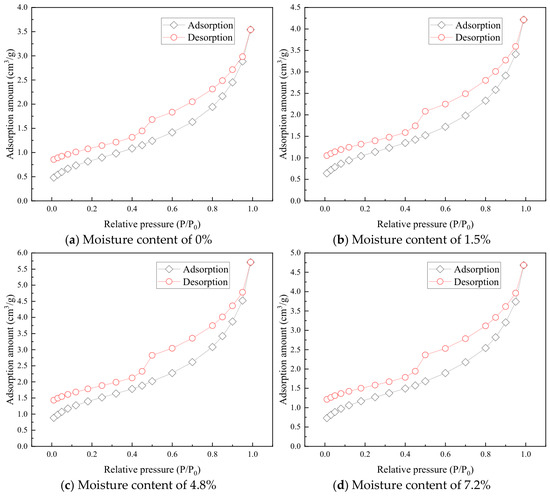
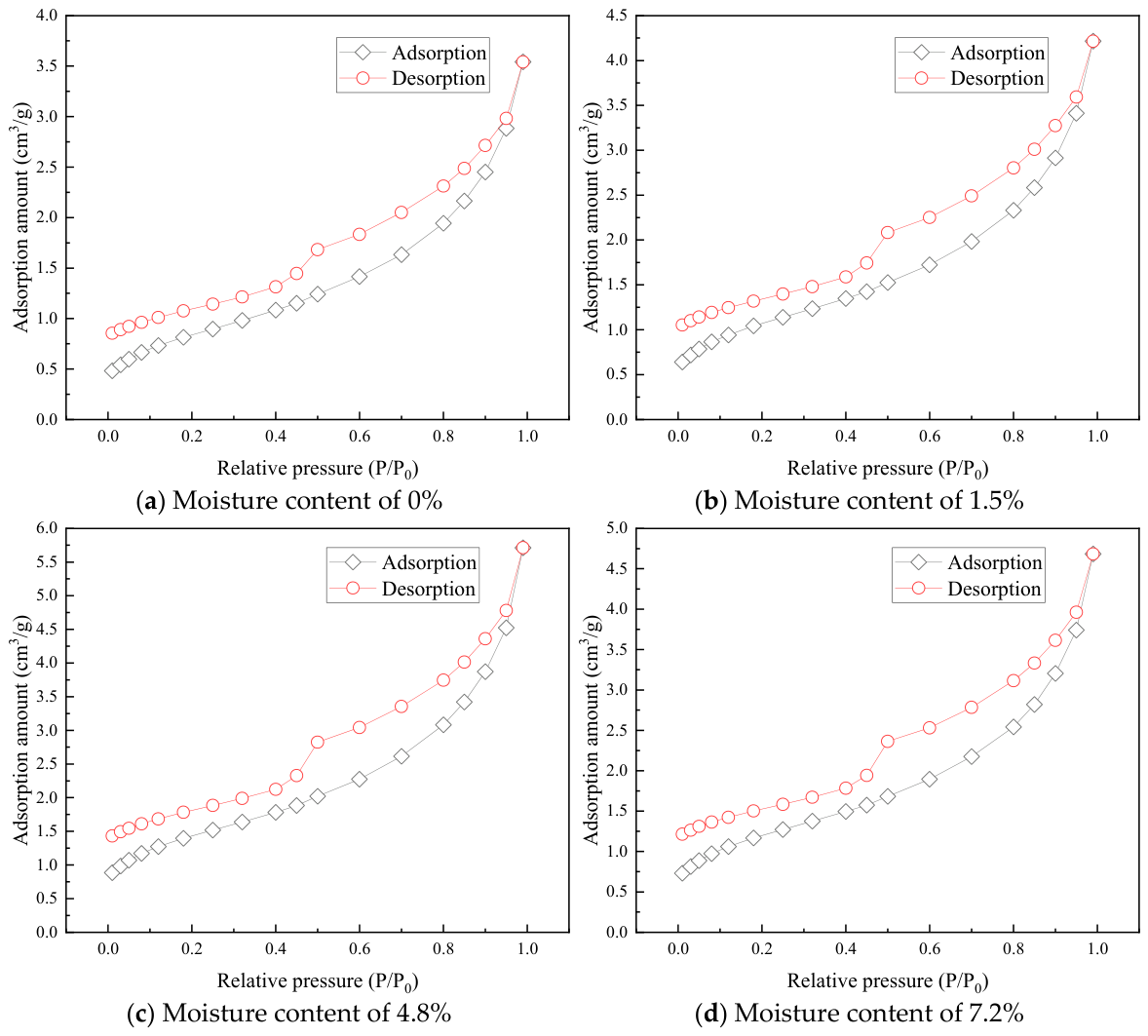
The low-temperature nitrogen adsorption–desorption isotherms of coal samples with different initial moisture contents after liquid CO2 leaching and acidification are illustrated in Figure 4. Regarding the macroscopic morphology of the curves, the adsorption isotherms of all four coal groups exhibit the characteristics of Type IV(a) isotherms according to the IUPAC classification. In the relatively low-pressure stage (P/P0 < 0.1), the curves present a distinct upward convexity accompanied by a rapid jump in adsorption capacity, which features the micropore filling characteristic of Type I isotherms, confirming the extreme development of primary micropores and ultramicropore matrices within this high-rank anthracite. When the relative pressure reaches the medium-to-high-pressure region (P/P0 > 0.45), the adsorption and desorption branches separate due to capillary condensation, forming a prominent hysteresis loop. Notably, the isotherms of all groups display two micro-physical hallmarks unique to dense anthracite: first, when the desorption path is depressurized to around P/P0 ≈ 0.45, all curves exhibit a forced “step-like sharp drop” inflection point induced by the tensile strength limit of the liquid nitrogen capillary condensate; second, the curves show a distinct unclosed adsorption–desorption phenomenon (residual hysteresis loop) in the low-pressure region (P/P0 → 0). These two types of characteristics reflect the pore blocking and matrix swelling gas-locking features caused by the complex “slit-like interconnected networks” and “ink-bottle-shaped narrow-necked pores” inside the anthracite.
Figure 4.
Low-temperature nitrogen adsorption–desorption isotherms under different moisture contents.
While maintaining the fundamental skeletal characteristics of the anthracite, the different initial moisture contents exhibit distinct non-linear quantitative variations regarding the degree of pore modification induced by liquid CO2 leaching and acidification. As the initial moisture content of the coal matrix increases from 0% to 4.8%, the maximum saturated adsorption capacity (P/P0≈0.99) of the isotherms significantly increases in a stepwise manner from 3.54 to 5.71 cm3/g. Concurrently, the wide region of the hysteresis loop between the adsorption and desorption branches expands markedly, and the loop morphology evolves toward Type H3. This indicates that the involvement of an appropriate amount of moisture greatly facilitates the acidification and dissolution effects of the CO2-H2O system on heterogeneous minerals, such as carbonates in the coal. Consequently, originally occluded micropores are cleared and interconnected, converting into parallel-plate slit-like mesopores with large pore volumes [23]. However, when the initial moisture content further increases to 7.2%, both the maximum adsorption capacity and the hysteresis loop width exhibit a conspicuous decline compared to the medium-water group (with the maximum adsorption capacity dropping to 4.68 cm3/g). This evolutionary trend quantitatively confirms that the excess water film under high-water status exerts a competitive hindrance against the matrix diffusion of liquid CO2. Additionally, the physical plugging of localized fine pore channels induced by ice-crystal expansion—resulting from the freezing of internal free water under the −5.0 °C environment—collectively suppresses further expansion and modification of the full-scale pore volume by hydrochemical acidification. The aforementioned results demonstrate that moisture exerts a distinct critical promotion effect during the process of liquid CO2 leaching and acidification for modifying anthracite.
3.2. Variations in Specific Surface Area and Pore Volume with Moisture Content
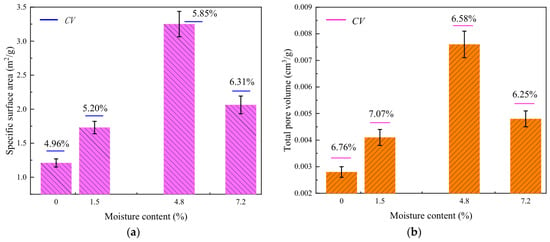
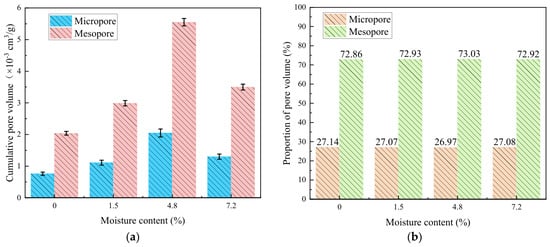
Combined with the characterization results of the low-temperature nitrogen adsorption experiments, the pore structure parameters of the coal samples subjected to liquid CO2 leaching and acidification with different initial moisture contents were quantitatively calculated. This was achieved using the BET model based on multilayer adsorption theory and the BJH model based on capillary condensation theory [24]. The calculated core indicators, such as the specific surface area and total pore volume, are illustrated in Figure 5. The pore volume distribution and volume fraction across different pore-size ranges are shown in Figure 6.
Figure 5.
Variation characteristics of specific surface area and total pore volume with moisture content (error bars represent the standard deviations (SDs) of three parallel specimens, n = 3). (a) Variation in specific surface area with initial moisture content. (b) Variation in total pore volume with initial moisture content.
Figure 6.
Pore volume distribution and proportion across different pore-size ranges (error bars represent the standard deviations (SDs) of three parallel specimens, n = 3). (a) Pore volume distribution of different pore sizes. (b) Proportion of pore volume for different pore sizes.
Analyzing Figure 5a,b reveals that after the leaching and acidification effects of liquid CO2 under different initial moisture states, both the specific surface area and total pore volume of the anthracite samples exhibit an extremely significant non-linear, single-peak evolutionary trend with increasing moisture content. Furthermore, the response inflection points of both indicators show a high degree of consistency, reaching their maximum values under the initial moisture content condition of 4.8%. In the completely dry state (0%), the mean specific surface area of the coal samples is only 1.21 m2/g, and the mean total pore volume is 0.0028 cm3/g. As the initial moisture content increases to 1.5% and 4.8%, the mean specific surface area leaps to 1.73 m2/g and 3.25 m2/g, representing substantial increases of 43.0% and 168.6% compared to the dry group, respectively. Concurrently, the mean total pore volume expands rapidly from 0.0028 cm3/g to 0.0041 cm3/g and 0.0076 cm3/g, with growth rates reaching 46.4% and 171.4%, respectively.
The coefficients of variation (CVs) calculated from three parallel measurements of specific surface area and total pore volume are all controlled within 4.96%~7.07%, demonstrating the good reproducibility and statistical rigor of the experimental data. Further extraction of the cumulative volume and relative proportion of micropores and mesopores within the low-temperature N2 adsorption response range reveals that both micropore and mesopore volumes maintain a single-peak variation pattern consistent with the total pore volume (Figure 6a). At a moisture content of 4.8%, the micropore volume reaches a peak of 2.05 × 10⁻³ cm3/g, while the mesopore volume simultaneously peaks at 5.53 × 10⁻³ cm3/g, which is 2.70 times that of the micropore volume. From the perspective of absolute increment, the expansion of mesopores contributes most significantly to the total pore volume growth, indicating that the coupled liquid CO2 leaching–acidification and hydration effects exert the most pronounced capacity enhancement and performance modification on the mesoporous structure. Although the absolute volumes of micropores and mesopores fluctuate significantly, their volume fractions remain strictly stable at around 27% and 73%, respectively, across the entire moisture content range (Figure 6b)—with the micropore fraction fluctuating between only 26.97% and 27.14% and the mesopore fraction fluctuating between 72.86% and 73.03%. This characteristic of “mesopore dominance in absolute increment, coupled with micro-mesopore synergy in relative growth” demonstrates that mesopores not only play an absolutely dominant role in the adsorption pore structure of anthracite, but also serve as the primary driver behind the non-linear evolution of total pore volume.
From the perspective of chemical reaction mechanisms, coal seams inherently contain a certain amount of carbonate minerals (such as calcite CaCO3 and dolomite CaMg(CO3)2) [25]. In the dry group, pure liquid CO2 acts as a non-electrolyte and exhibits no reactivity; in the absence of moisture mediation, it cannot dissociate to release the H+ required for acid-dissolution reactions. With the introduction of initial moisture, liquid CO2 rapidly dissolves into the attached water film on the coal surface, forming a weakly acidic carbonic acid solution system through hydration and ionization [25], as described in Equation (3).
From the perspective of chemical equilibrium shift, variations in moisture content significantly regulate the effective active reaction volume and ionization equilibrium within the liquid water film. In the low-to-optimal moisture range (0%~4.8%), an appropriate increase in water film thickness expands the spatial volume for the CO2 gas–liquid interfacial hydration reaction, shifting the primary ionization equilibrium of carbonic acid to the right and substantially enhancing the total yield of H+ in the water film system. From the perspective of chemical reaction kinetics, the intense acid dissolution reaction (Equation (4)) occurring between H+ and minerals such as calcite [10]—which fill and deposit within the primary micro-to-mesopore and fracture channels—is essentially a heterogeneous process jointly governed by the interfacial chemical reaction rate and the mass transfer (diffusion) rate of H+ through the liquid water film.
According to heterogeneous reaction kinetics, the surface dissolution rate of minerals (r) can be expressed as
where r is the apparent dissolution rate of minerals (mol/m2 · s); k is the apparent rate constant (m/s), which reflects the intrinsic chemical reaction kinetics at the interface as well as the mass transfer/diffusion capacity of protons through the liquid water film; and CH+ denotes the H+ activity concentration at the mineral–liquid interface (mol/cm3).
At a moisture content of 4.8%, the formation of a continuous liquid water film drastically reduces the mass transfer resistance of H+ toward the mineral surface. Consequently, the proton transport flux reaches its peak, driving the dissolution kinetic rate to its maximum. Under the action of this highly efficient dissolution, carbonate minerals blocking the primary pore throats are dissolved and shed, inducing the opening and interconnection of previously closed and dead-end pores. This leads to a massive conversion from micropores to mesopores and macropores, resulting in an order-of-magnitude surge in total pore volume. Meanwhile, the interconnection of pore channels and the roughening of pore walls jointly contribute to a significant growth in specific surface area at the initial moisture content of 4.8%. However, when the initial moisture content crosses the critical threshold of 4.8% and further escalates to a highly water-saturated state of 7.2%, excessive moisture not only induces a dilution effect on H+, but the thickened water film also lengthens the diffusion path for ions, thereby hindering the outward diffusion of dissolution products (Ca2+ and HCO3−). Consequently, the dissolution modification effect exhibits an apparent decline under the dual suppression of shifted ionization equilibrium and kinetic mass transfer barriers. Driven by this effect, the pore modification performance of coal samples suffers a significant degradation, the mean specific surface area substantially drops back to 2.06 m2/g, and the mean total pore volume shrinks to 0.0048 cm3/g, representing sharp reductions of 36.6% and 36.8% compared to the 4.8% peak group, respectively. At this stage, physical hindrance and low-temperature compressive plugging mechanisms supersede chemical dissolution to become the dominant factors. According to the capillary pressure theory in reservoir physics, smaller pore throat radii lead to an exponential multiplication of the capillary displacement resistance. Under the highly saturated state of 7.2%, free water—confined by strong adsorption forces and ultra-fine pore throats—is highly prone to forming continuous liquid films and microscopic “water plugs” within the pore pathways. Consequently, due to the extremely high capillary resistance, the invading non-polar liquid CO2 cannot effectively displace or breach these water plugs, thereby inducing a severe water-locking effect within the deep matrix. This effect not only truncates the free pathways for liquid CO2 diffusion into the deep coal matrix but also blocks contact between the acidic electrolyte system (H2CO3) and the deep carbonate minerals. This shielding results in the deep coal body remaining within a blind zone of acidification modification, which macroscopically restricts the overall progress of pore unblocking and volume expansion. This pattern is directly validated by the latest findings of Wang et al. [26], who investigated the impacts of varying initial moisture contents (0%, 5%, and 10%) on the microstructural evolution of coal exposed to supercritical CO2. Their experimental results likewise exhibited a distinct unimodal response, mechanistically confirming that an optimal moisture level (4.8%~5%) enhances CO2–coal interactions by improving fluid transport and pore accessibility. Conversely, excessive moisture induces severe water-locking effects through capillary condensation and liquid film formation, thereby hindering fluid diffusion.
Additionally, since the leaching experiment temperature was maintained at −5.0 °C, the bound and free water that could not be displaced under the highly saturated state was highly susceptible to freezing phase transition. Under the volumetric constraint of the highly rigid anthracite matrix, the volume expansion of ice crystals generates localized frost-heaving pressure, leading to the elastic closure or physical filling of the surrounding nanoscale pore throats by the ice body. During the subsequent experimental and drying-dehydration processes, these pore channels—which suffered physical plugging and structural damage—could hardly recover fully. Consequently, this resulted in a significant reduction in both the specific surface area and total pore volume of the 7.2% group coal samples.
4. Full-Scale Pore Modification Characteristics Analysis Based on Nuclear Magnetic Resonance
4.1. Transverse Relaxation Time (T2) Distribution and Pore Classification Characteristics
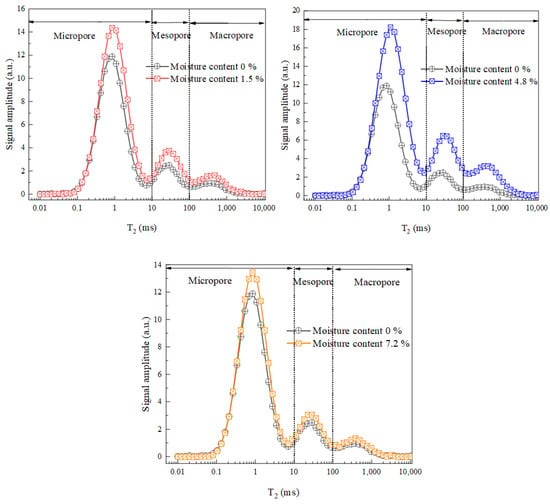
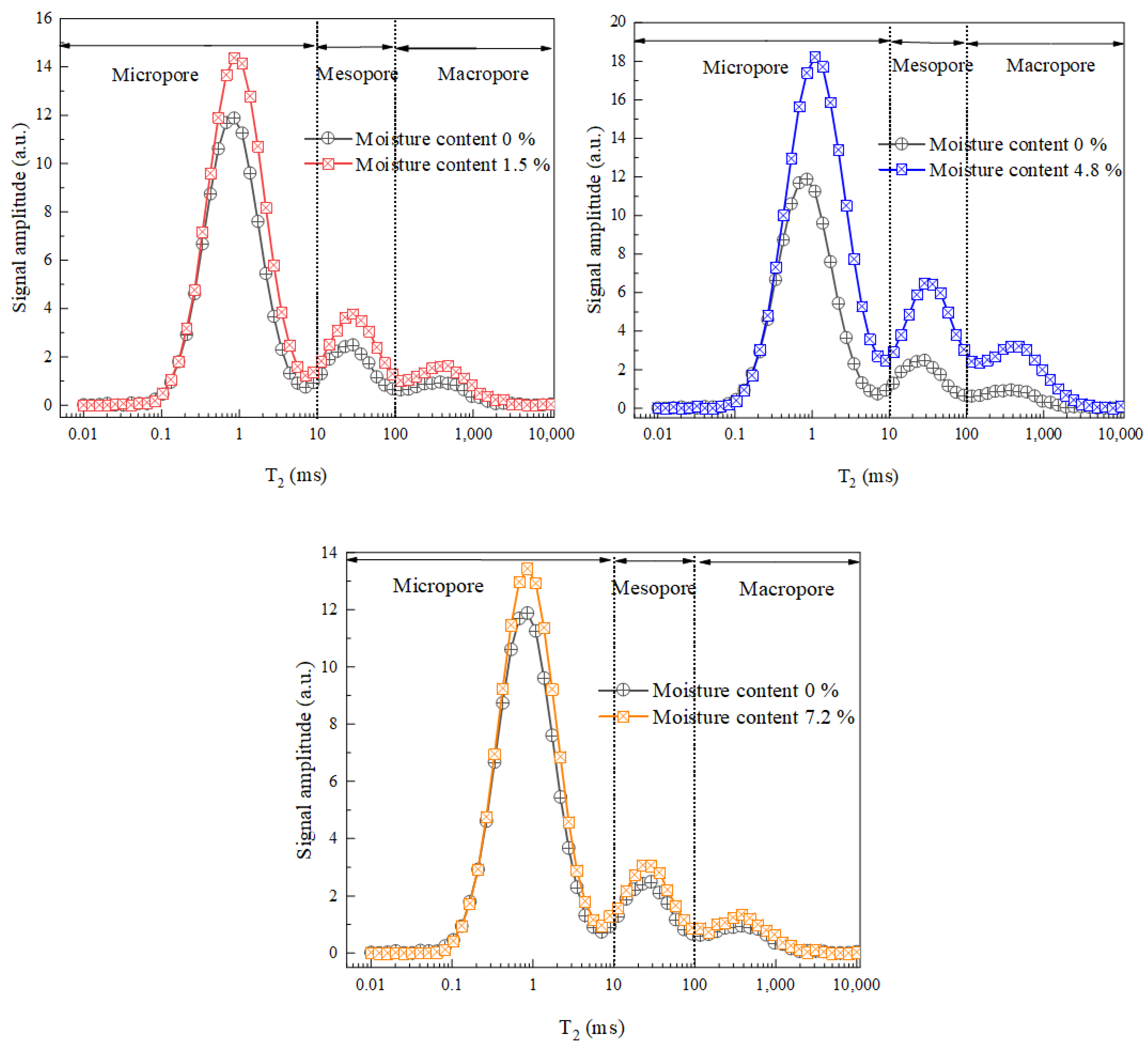
To analyze the structural modifications of the coal pores after liquid CO2 leaching under different initial moisture contents, the nuclear magnetic resonance test data were inverted and acquired based on the 1H proton distribution of water molecules inside distinct pores, referencing the Hodot classification method [27]. In this study, fixed T2 boundary values (using 10 and 100 ms as cutoff points) were adopted to categorize the pore sizes of the coal matrix into micropores, mesopores, and macropores. The nuclear magnetic resonance T2 spectra of the coal samples after liquid CO2 leaching at varying initial moisture contents were subsequently plotted, as illustrated in Figure 7.
Figure 7.
Spectrum distribution curves of coal samples with different initial moisture contents after liquid CO2 immersion.
The T2 distribution curves across all experimental groups exhibit a typical “triple-peak” skeletal characteristic. This implies that although the primary anthracite matrix is inherently dense, it still possesses a complex topological network interlaced with full-scale (micro-, meso-, and macro-) pores. In Figure 7, the amplitudes of the triple peaks for the baseline group (“moisture content of 0%”) remain at a relatively low level. As the moisture content progressively increases from 0% to 1.5% and further to 4.8%, the amplitudes of all three peaks expand continuously. Notably, the coal sample with a moisture content of 4.8% exhibits the most intense expansion: the amplitude of the micropore peak not only increases substantially but also widens toward longer relaxation times. An increase in the width of the T2 spectral peak interval signifies pore-size enlargement, whereas a rise in the signal amplitude of the T2 peak indicates an increase in pore quantity. Furthermore, the mesopore– and macropore–fracture peaks demonstrate pronounced growth. When the moisture content reaches 7.2%, the signal amplitudes of all three peaks exhibit an overall reduction compared to the 4.8% peak group, with the curve falling back almost to the level of the dry group (0% moisture content). This behavior aligns well with the variation trend observed in Figure 5, where both the specific surface area and the total pore volume undergo a significant decrease.
4.2. Variation in Sub-Regional Integral Area of T2 Spectra
According to the transverse relaxation theory in rock physics [28], the transverse relaxation rate of fluid within porous media can be expressed as
where T2 is the total transverse relaxation time of the coal sample, ms; T2B is the bulk relaxation time of the fluid inside the coal sample, ms; T2D is the diffusion relaxation time induced by the magnetic field gradient, ms; ρ2 is the transverse surface relaxivity of the coal pore, um/ms; and S/V is the specific surface area-to-volume ratio of the coal pore, um−1.
Under a low-field homogeneous magnetic field environment, and when the experimental fluid is water at ambient temperature and pressure, the influences of the bulk and diffusion relaxations of the fluid on the total relaxation rate are extremely negligible. Consequently, Equation (6) can be approximately simplified into a classical mapping relationship dominated by surface relaxation [29]:
To simplify the calculation, let the constant C = ρ2 Fs. Thus, the coal pore radius, r, and the transverse relaxation time, T2, satisfy the following linear proportional relationship:
where r is the pore radius of the coal matrix, nm; Fs is the pore shape factor (dimensionless; taken as 3 for spherical pores and 2 for cylindrical pore throats, with coal pores generally considered to be predominantly cylindrical); and C is the pore-size conversion coefficient of the coal sample, nm/ms.
Based on the linear correspondence in Equation (8), the magnitude of the transverse relaxation time, T2, on the abscissa directly reflects the geometric scale of the space occupied by the fluid inside the coal matrix. Since the inverted T2 spectrum consists of a series of discrete data points, the spatial volume corresponding to each pore class can be quantitatively characterized through integration. Utilizing the trapezoidal numerical integration method, the sub-regional integral areas of the T2 spectrum consistently follow the equation below [29]:
where Sarea is the sub-regional integral area of the T2 spectrum within the target relaxation time interval, a.u.; Ai is the nuclear magnetic resonance signal amplitude corresponding to the i-th data point, a.u.; Ai+1 is the nuclear magnetic resonance signal amplitude corresponding to the i+1-th data point, a.u.; T2,i is the transverse relaxation time corresponding to the i-th data point, ms; T2,i+1 is the transverse relaxation time corresponding to the i+1-th data point, ms; n is the starting data point index of the target pore classification interval (micropores, mesopores, or macropores) in the raw data; and m is the ending data point index of the target pore classification interval in the raw data.
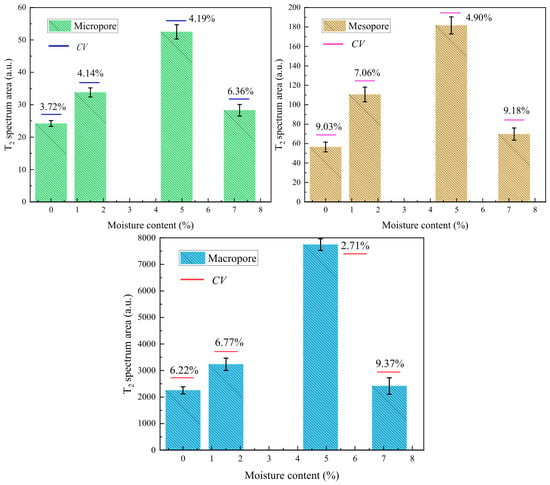
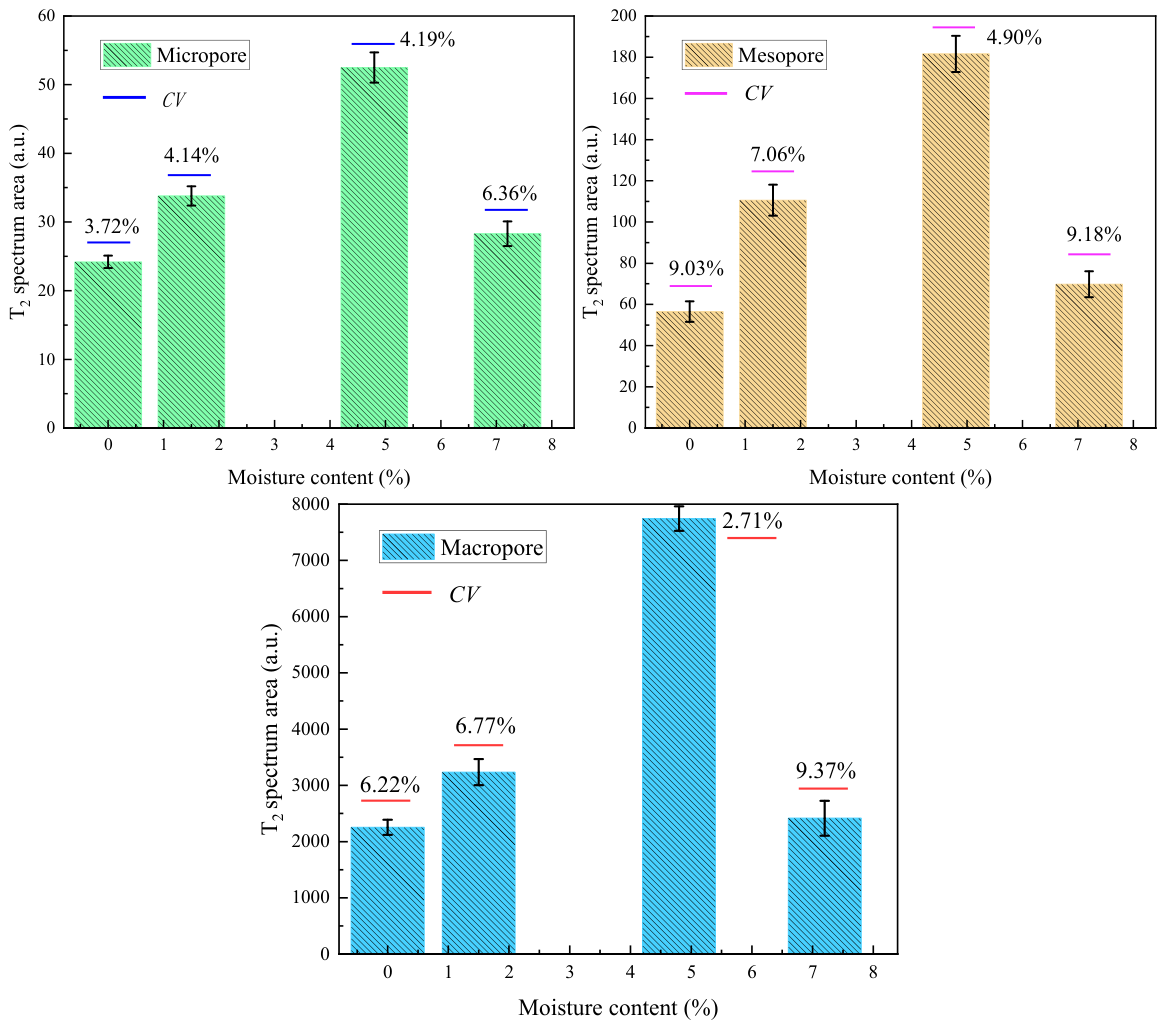
The evolutionary laws of the sub-regional integral areas of the T2 spectra for coal samples with different initial moisture contents after liquid CO2 leaching, calculated according to the aforementioned method, are illustrated in Figure 8. The analysis reveals that the nuclear magnetic resonance test results are in good agreement with the conclusions drawn from the low-temperature N2 adsorption measurements. The T2 spectral areas of micropore, mesopore, and macropore ranges all exhibit a synchronized response character across the entire moisture content range, centered around the critical threshold of 4.8%. Furthermore, the nuclear magnetic resonance measurements provide deeper insights into the evolutionary details of macropores and micro-fractures that cannot be captured by low-temperature N2 adsorption. Under the 4.8% moisture content condition, the integral areas of micropores, mesopores, and macropores increase by 116.9% (from 24.2 to 52.5), 221.4% (from 56.5 to 181.6), and 243.5% (from 2254.3 to 7743.8) compared to those of the dry group, respectively. Under this moisture content condition, the non-uniform stress induced by hydration swelling not only drives the expansion of adsorption pores, but also promotes the significant development and connectivity of macropores and micro-fractures. When the moisture content escalates to 7.2%, the T2 spectral integral areas across all pore classes decrease, falling back almost to levels adjacent to the dry group. Specifically, for the macropore interval, which serves as the primary seepage channel, its T2 spectral integral area plummets from 7743.8 to 2415.6, representing a sharp decrease of up to 68.8%. Meanwhile, the mesopores and micropores, which predominantly act as adsorption and storage spaces, also display varying degrees of reduction, with decreases of 61.6% for mesopores and 46.1% for micropores. This evolutionary feature indicates that under a high moisture content, not only are the micro- and mesopores occupied by capillary-bound water, but the macropore seepage channels also experience a severe water-locking effect.
Figure 8.
Changes in T2 spectrum area of coal samples with different initial moisture contents after liquid CO2 immersion (error bars represent the standard deviations (SDs) of three parallel specimens, n = 3).
The aforementioned quantitative analytics based on nuclear magnetic resonance relaxation spectra demonstrate that, under benchmark experimental conditions, moisture content exerts a pronounced non-linear, single-peak regulatory effect on the pore microstructure of coal. Specifically, a moisture content of 4.8% constitutes a critical turning point governed by the trade-off between matrix dissolution enhancement and capillary water-locking blockage. However, this critical threshold and the corresponding pore evolution profile were established under specific temperature and pressure regimes representative of shallow-to-medium-depth field operations. In real-world deep coalbed methane mining or phase-change displacement engineering, escalating burial depths induce marked shifts in geothermal, pore-pressure, and in situ stress regimes, which subsequently superimpose non-linear variations on the governing dissolution mechanisms and water-locking dynamics. Thermodynamically, deeper coal seams characterized by elevated geothermal temperatures accelerate the heat absorption and phase-transition rate of injected liquid CO2. Driven by the reverse shift in exothermic dissolution equilibrium, the aqueous solubility of CO2 diminishes, thereby suppressing H2CO3-induced mineral dissolution kinetics and potentially inducing a slight rightward shift in the critical moisture threshold. Geomechanically, deeper formations subjected to high in situ stress states typically coincide with elevated reservoir pore pressures, necessitating higher injection pressures. These heightened pressures simultaneously amplify capillary driving forces and enhance the adsorption capacity of coal for CO2, thereby recalibrating the competitive equilibrium between water-locking blockage and gas displacement. In summary, the established critical moisture content and single-peak pore evolution profile provide direct operational guidelines and theoretical baselines for high-rank anthracite seams in the Qinshui Basin under comparable operating schemes. When extending liquid CO2-ECBM technology to deeper, higher-temperature, or variable-rank coal reservoirs, these benchmark data serve as crucial baseline references for field parameter calibration and multi-field coupled model construction.
5. Conclusions
Based on the results of this study, the following conclusions can be drawn:
(1) The structural modification of low-permeability moist anthracite induced by liquid CO2 leaching exhibits a distinct non-linear unimodal evolutionary pattern. Statistical evaluation demonstrates high data reproducibility, with the coefficient of variation across parallel samples staying below 10% (CV < 10%). Specifically, the macroscopic specific surface area; total pore volume; and integrated areas of macro-, meso-, and micropores derived from T2 spectra all display a trend of initial increase followed by a decrease as the initial moisture content rises. Peak values across all these parameters are consistently achieved at an initial moisture content of 4.8%, highlighting strong coherence between macroscopic structural changes and microscopic responses.
(2) The initial moisture content of 4.8% serves as the inflection point for the full-scale pore-space expansion and locking. At this specific moisture content, the T2 spectral integral areas of micropores, mesopores, and macropores increase by 116.9%, 221.4%, and 243.5% compared to the dry group, respectively, achieving effective connectivity across the full-scale channels. Conversely, when the moisture content escalates to 7.2%, the T2 spectral integral area within the macropore interval plummets by 68.8% compared to the 4.8% peak, while the mesopores and micropores exhibit sharp decreases of 61.6% and 46.1%, respectively, resulting in an overall shrinkage of the pore space.
(3) Moisture exhibits pronounced dual physicochemical effects of synergistic enhancement and damage antagonism during the leaching and acidification process. Below the critical moisture content (4.8%), moisture primarily mediates the carbonic acid dissolution response, acting as a synergistic promoter. Once this critical threshold is exceeded, the mechanism transitions into physical antagonism dominated by water-locking truncation and frost-heave damage from cryogenic freezing. This evolutionary pattern provides a technical foundation for liquid CO2 displacement of coalbed methane under baseline conditions in high-rank anthracite from the Qinshui Basin; furthermore, when extended to coals of varying ranks, it serves as a critical reference for parameter calibration and multiphysics coupled model development.
Author Contributions
F.H.: Data curation, Writing—original draft, Writing—review and editing. R.L.: Data curation, Formal analysis, Investigation, Supervision. M.H.: Resources, Investigation, Methodology, Validation. S.F.: Conceptualization, Resources, Investigation, Methodology. T.X.: Resources, Investigation, Methodology. All authors have read and agreed to the published version of the manuscript.
Funding
This research received no external funding.
Data Availability Statement
The raw data supporting the conclusions of this article will be made available by the authors, without undue reservation, upon reasonable request.
Conflicts of Interest
The authors declare no conflicts of interest.
References
- Leng, K.; Guan, B.; Liu, W.; Jiang, C.; Cong, S.; Xin, Y. Research progress of coalbed methane extraction. Energy Rep. 2024, 12, 5728–5746. [Google Scholar] [CrossRef] [Scilit]
- Li, S.; Tang, D.; Pan, Z.; Xu, H.; Tao, S.; Liu, Y.; Ren, P. Geological conditions of deep coalbed methane in the eastern margin of the Ordos Basin, China: Implications for coalbed methane development. J. Nat. Gas. Sci. Eng. 2018, 53, 394–402. [Google Scholar] [CrossRef] [Scilit]
- Fang, Z.; Yang, C.; Wang, R. Monitoring technologies for CO2 storage in coal seams and enhanced coalbed methane recovery: A review of field applications. Fuel Process. Technol. 2025, 276, 108274. [Google Scholar] [CrossRef] [Scilit]
- Kumar, J.; Mendhe, V.; Samanta, A. Integrated insights into CO2 storage, trapping mechanisms, and hydrocarbon recovery in coal and shale from the damodar Valley Basin, India. Ind. Eng. Chem. Res. 2025, 64, 21946–21962. [Google Scholar] [CrossRef] [Scilit]
- Hu, G.; He, W.; Sun, M. Enhancing coal seam gas using liquid CO2 phase-transition blasting with cross-measure borehole. J. Nat. Gas. Sci. Eng. 2018, 60, 164–173. [Google Scholar] [CrossRef] [Scilit]
- Wen, H.; Cheng, X.; Fan, S.; Xu, Y.; Ren, S.; Guo, J. A method for detecting hidden fire source in deep mine goafs based on radon measurement and its experimental verification. Appl. Geochem. 2020, 117, 104603. [Google Scholar] [CrossRef] [Scilit]
- Li, R.; Wen, H.; Fan, S.; Wang, H.; Cheng, X.; Mi, W.; Liu, B.; Liu, M. Migration characteristics of constant elements in the process of coal dissolution by liquid CO2. Energy 2024, 295, 131006. [Google Scholar] [CrossRef] [Scilit]
- Wang, H.; Wen, H.; Li, Z.; Mi, W. Influence of liquid CO2 extraction and dissolution on coal adsorption characteristics. Minerals 2023, 13, 650. [Google Scholar] [CrossRef] [Scilit]
- Eyitayo, S.; Gamadi, T.; Kolawole, O.; Watson, M. Experimental study of scCO2 injection strategies: Effects on geochemical reactions and reservoir properties in sandstone and carbonate formations. Gas. Sci. Eng. 2025, 140, 205660. [Google Scholar] [CrossRef] [Scilit]
- Xu, R.; Li, R.; Ma, J.; He, D.; Jiang, P. Effect of mineral dissolution/precipitation and CO2 exsolution on CO2 transport in geological carbon storage. Acc. Chem. Res. 2017, 50, 2056–2066. [Google Scholar] [CrossRef] [Scilit]
- Feng, X.; Yan, L.; Guo, H.; Huang, Z.; Urynowicz, M. Enhancement of biogenic coalbed methane by ScCO2–H2O treatment. Energy Fuels 2025, 39, 7781–7789. [Google Scholar] [CrossRef] [Scilit]
- Li, R.; Ge, Z.; Wang, Z.; Zhou, Z.; Zhou, J.; Li, C. Effect of supercritical carbon dioxide (ScCO2) on the microstructure of bituminous coal with different moisture contents in the process of ScCO2 enhanced coalbed methane and CO2 geological sequestration. Energy Fuels 2022, 36, 3680–3694. [Google Scholar] [CrossRef] [Scilit]
- Liu, Q.; Song, D.; Qiu, L.; Ma, Y.; Pan, B.; Peng, Y.; Wang, P.; Yang, G.; Zhu, Y. Characterization and mechanism of multi-scale pore changes in scCO2-water injection into different porosity coal specimen. Energy 2024, 298, 131391. [Google Scholar] [CrossRef] [Scilit]
- Zhou, Z.; Sheng, M.; Ge, Z.; Li, R.; Gong, S.; Zhang, H. Mechanical properties and failure characteristics of supercritical carbon dioxide soak in water-bearing coal rocks. Energy 2024, 286, 129599. [Google Scholar] [CrossRef] [Scilit]
- Zhang, X.; Wang, K.; Jiang, Y.; Liu, Y.; Qiu, P.; Zhang, S.; Cai, T.; Hou, J. Experimental study on the mechanical damage and permeability evolution of coal with different moisture contents under supercritical carbon dioxide conditions. Energy Sci. Eng. 2025, 13, 2375–2388. [Google Scholar] [CrossRef] [Scilit]
- Liu, X.; Jia, X.; Niu, Y.; Nie, B.; Zhang, C.; Song, D. Alterations in coal mechanical properties and permeability influenced by liquid CO2 phase change fracturing. Fuel 2023, 354, 129254. [Google Scholar] [CrossRef] [Scilit]
- Lu, X.; Pei, Y.; Yang, H.; Fu, W.; Zhang, H.; Shi, W.; Xiong, S.; Wan, S.; Ma, J. A study on porous synergistic liquid CO2 phase-transition fracturing of coal seams and its application in enhanced gas drainage. Fuel 2027, 427, 139929. [Google Scholar] [CrossRef] [Scilit]
- Li, Z.; Bai, Y.; Yu, H.; Hu, H.; Wang, Y. Molecular simulation of thermodynamic properties of CH4 and CO2 adsorption under different moisture content and pore size conditions. Fuel 2023, 344, 127833. [Google Scholar] [CrossRef] [Scilit]
- Feng, X.; Haimson, B.; Li, X.; Chang, C.; Ma, X.; Zhang, X.; Ingraham, M.; Suzuki, K. ISRM suggested method: Determining deformation and failure characteristics of rocks subjected to true triaxial compression. Rock. Mech. Rock. Eng. 2019, 52, 2011–2020. [Google Scholar] [CrossRef] [Scilit]
- GB/T 30732-2014; National Technical Committee on Coal Standardization of Standardization Administration of China (SAC/TC 42). Proximate Analysis of Coal—Instrumental Method. Standards Press of China: Beijing, China, 2014. (In Chinese)
- Li, J.; Zhang, K.; Wang, L.; Zhang, H.; Xing, X. Morphological characterization of pore connectivity in coal: Insights from quantitative analysis of constricted pore network accessibility. Energy Fuels 2024, 39, 313–330. [Google Scholar] [CrossRef] [Scilit]
- Gao, J.; Li, Z.; Tao, X.; Li, X.; Zhu, K. A comprehensive study of multiscale pore structural characteristics in deep-buried coals of different ranks. Sci. Rep. 2025, 15, 8299. [Google Scholar] [CrossRef] [Scilit]
- Bahmaee, A.; Masuda, Y.; Murata, S. Numerical modelling of CO2-in-water emulsion injection into a water-saturated core. Gas. Sci. Eng. 2024, 131, 205485. [Google Scholar] [CrossRef] [Scilit]
- Xie, J.; Liang, Y.; Zou, Q.; Wang, Z.; Li, X. Prediction model for isothermal adsorption curves based on adsorption potential theory and adsorption behaviors of methane on granular coal. Energy Fuels 2019, 33, 1910–1921. [Google Scholar] [CrossRef] [Scilit]
- Liang, R.; Yao, X.; Wang, H.; Li, Z.; Zhao, K. Mechanism of pressure effects on multi-scale coal structure under supercritical CO2 extraction. Fuel 2026, 408, 137710. [Google Scholar] [CrossRef] [Scilit]
- Wang, H.; Zhang, Z.; Li, Z.; Xian, L.; Yao, X. Effect of moisture content on coal microstructure evolution during CO2 sequestration. J. Supercrit. Fluids 2026, 238, 107072. [Google Scholar] [CrossRef] [Scilit]
- Wen, H.; Zhai, C.; Xu, J.; Sun, Y.; Wu, F.; Xu, H.; Wang, Y. Pore characterization of coal cuttings based on low-field nuclear magnetic resonance: A new method. Fuel 2026, 406, 137066. [Google Scholar] [CrossRef] [Scilit]
- Zheng, S.; Yao, Y.; Liu, D.; Cai, Y.; Liu, Y.; Li, X. Nuclear magnetic resonance T2 cutoffs of coals: A novel method by multifractal analysis theory. Fuel 2019, 241, 715–724. [Google Scholar] [CrossRef] [Scilit]
- Yao, Y.; Liu, D.; Che, Y.; Tang, D.; Tang, S.; Huang, W. Petrophysical characterization of coals by low-field nuclear magnetic resonance (NMR). Fuel 2010, 89, 1371–1380. [Google Scholar] [CrossRef] [Scilit]

Disclaimer/Publisher’s Note: The statements, opinions and data contained in all publications are solely those of the individual author(s) and contributor(s) and not of MDPI and/or the editor(s). MDPI and/or the editor(s) disclaim responsibility for any injury to people or property resulting from any ideas, methods, instructions or products referred to in the content. |
© 2026 by the authors. Licensee MDPI, Basel, Switzerland. This article is an open access article distributed under the terms and conditions of the Creative Commons Attribution (CC BY) license.