


1. Introduction
Driven by global carbon neutrality targets and demand for a long-term stable energy supply, unconventional petroleum resources such as shale oil, tight oil and fractured carbonate reservoirs have become indispensable components of worldwide energy structures. Meanwhile, CO2-enhanced oil recovery coupled with geological carbon storage (CO2-EOR&CCS) serves as a critical low-carbon technology that can simultaneously exploit resources and sequester greenhouse gases. Nevertheless, prominent geological obstacles, such as ultralow permeability, intensive reservoir heterogeneity and complex natural–hydraulic fracture networks, restrict efficient field development of unconventional formations; moreover, multi-field coupled interactions between geomechanics, multiphase fluid flow and fluid–rock chemical reactions produce unresolved difficulties for safe long-term CO2 geological trapping.
Despite significant progress in unconventional reservoir engineering and CCUS technologies, existing studies are generally dispersed across different disciplines, including geology, reservoir engineering, geomechanics, and carbon storage. A systematic integration that links microscopic mechanisms with field-scale engineering applications remains lacking. This Special Issue, therefore, aims to connect these research gaps by summarizing recent advances and highlighting future research priorities, providing a comprehensive reference for both academic researchers and industry practitioners.
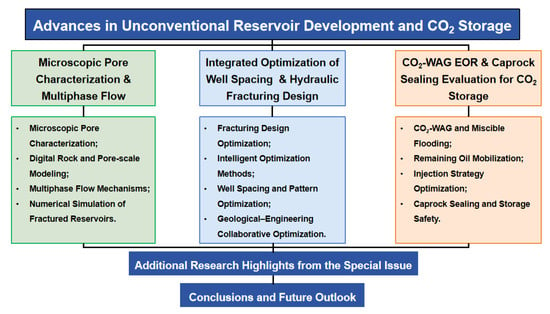
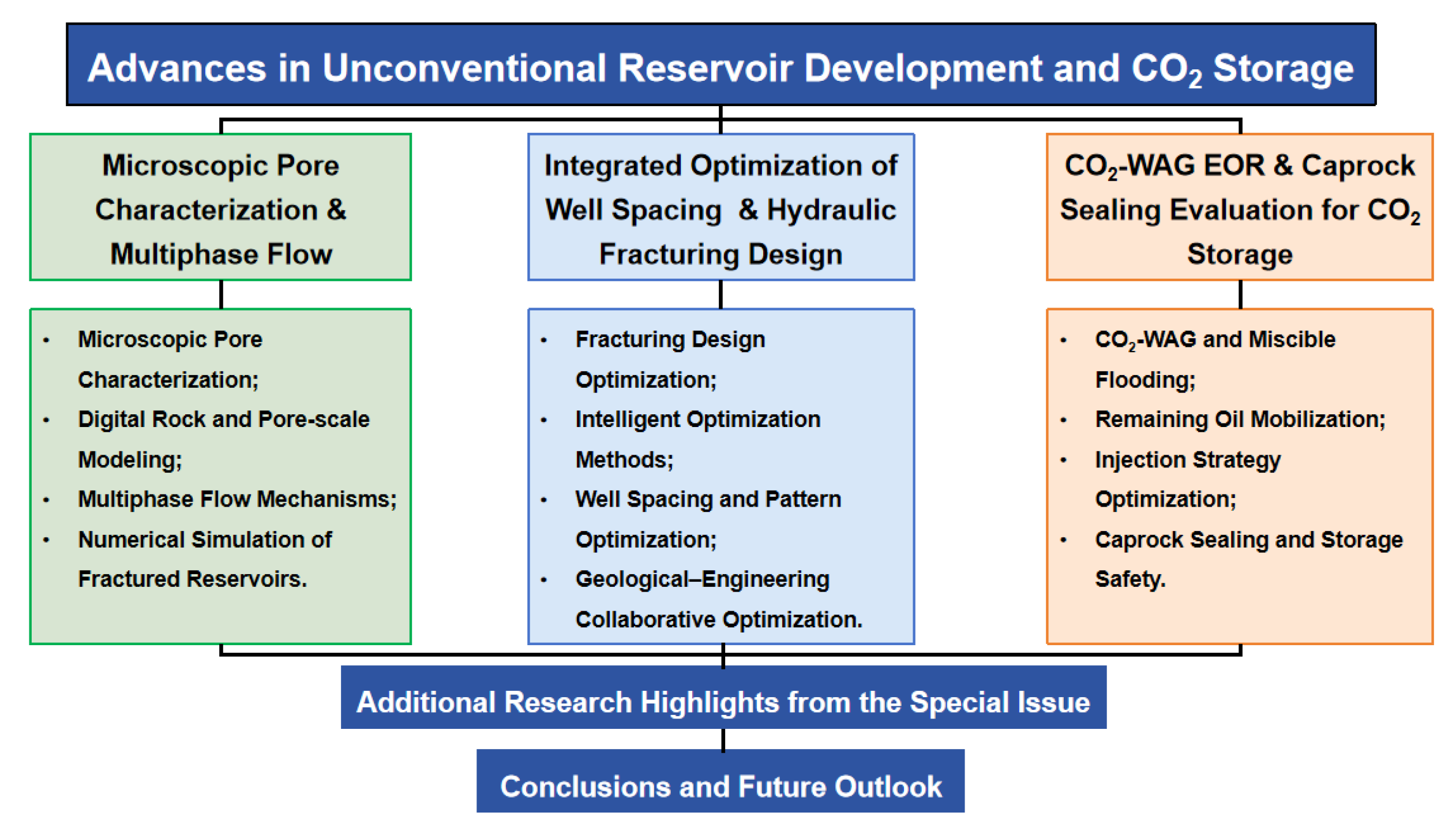
To collect cutting-edge experimental findings, numerical algorithms and field application practices that connect unconventional reservoir stimulation and carbon geological storage, we launched this Special Issue, “Advances in Unconventional Reservoir Development and CO2 Storage,” hosted by the journal Processes. After strict peer review screening, 10 original high-quality papers have been formally accepted and published, covering microscopic pore characterization, hydraulic fracturing parameter optimization, well pattern deployment, CO2 flooding mechanisms and caprock stability evaluation. Together with the authors’ relevant previous research, this editorial systematically summarizes the core findings of the collected manuscripts and outlines prospective research trends for future investigation. Figure 1 provides a schematic overview of the research themes covered in this Special Issue.
Figure 1.
A schematic overview of the research themes covered in this Special Issue.
2. Microscopic Pore Characterization and Multiphase Flow Inside Complex Fractured Unconventional Formations
Accurate microscopic reservoir characterization is necessary to clarify the seepage behaviors of unconventional reservoirs in situ. Multiple contributions to this SI adopt laboratory characterization tools such as SEM, low-temperature nitrogen adsorption and NMR to quantify nanopore geometry and fractal features of shale and tight sandstone samples [1]. Hu et al. further discussed the transformation mechanism between irreducible water and movable water induced by artificial hydraulic fractures, which supplements the microscopic water mobility theory of tight gas sandstone reservoirs [2].
For shale oil multiphase flow affected by complex fracture clusters, Wang et al. established a pore-scale modeling framework based on super-resolution reconstructed digital rocks and found that shale oil production is dominated by pressure-driven viscous flow, whereas spontaneous imbibition plays a secondary role and may reduce oil-phase relative permeability [3]. Liu et al. developed an integrated NMR-based experimental system and demonstrated that soaking stimulation is governed by countercurrent imbibition, oil–water redistribution, and formation pressure enhancement, while severe water blockage may limit its effectiveness [4]. Dong et al. used 1H NMR experiments to evaluate the impact of fractures on hydrocarbon recovery from low-permeability rock pores, revealing that fractures may reduce gas sweeping efficiency during HnP processes [5]. Wang et al. constructed a refined numerical simulator that fully incorporates random natural fracture swarms and the retained injected fracturing fluid inside formation pores, which elaborated the dynamic oil–water migration laws under hydraulic stimulation conditions [6]. This numerical framework effectively explains the abnormal water production and production fluctuation commonly observed in shale oil horizontal wells, providing reliable simulation support for development parameter design of fractured shale oil reservoirs.
3. Integrated Optimization of Well Spacing and Hydraulic Fracturing Design
Hydraulic fracturing and well layout optimization are core engineering technologies for improving unconventional-well deliverability. Several manuscripts in this issue focus on algorithm-based intelligent optimization for fracturing stage division and cluster spacing design of horizontal wells. Lin et al. proposed a pattern-search-based robust optimization workflow for staged fracturing parameters targeting naturally fractured shale oil [7]. Wang et al. proposed a policy-gradient-assisted genetic particle swarm optimization algorithm for hydraulic fracturing parameter optimization [8]. Wu et al. built a full-chain numerical evaluation framework for tight oil well spacing optimization and confirmed the optimal development well spacing for the Fuyu tight oil block via long-term production history matching [9].
Based on single-index separated optimization, Wu and Wang proposed a novel collaborative optimization strategy that synchronously adjusts well spacing and fracturing parameters, which balances reservoir control volume and fracturing construction cost and significantly lifts the EUR of tight oil reservoirs [10]. This coupled geological–engineering optimization method breaks the traditional separated design limitation of well pattern and fracturing and has strong guiding value for field deployment of tight reservoir development.
4. CO2-WAG Enhanced Oil Recovery and Caprock Sealing Evaluation for CO2 Storage
CO2 miscible flooding and water-alternating-gas (WAG) injection are mainstream EOR technologies for low-permeability reservoirs. Using in situ NMR visualization measurement, Wang et al. tracked microscopic remaining-oil spatial distribution during CO2-WAG displacement in conglomerate reservoirs and verified that miscible gas injection effectively activates residual oil trapped in small-scale throats and inhibits severe gas channeling [11]. Another contribution targets fractured–vuggy carbonate reservoirs and clarifies the superiority of multi-well cyclic water–gas alternate injection for tapping attic remaining oil [12]. Liu et al. showed that aqueous barriers formed by invaded fracturing fluid hinder CO2 diffusion and reduce HnP efficiency, whereas prolonged soaking mitigates water blockage and improves oil recovery [13]. Liu et al. further demonstrated that CO2-WAG suppresses gas channeling and enhances oil mobilization in heterogeneous reservoirs, especially under miscible conditions [14]. Gong et al. revealed that surfactants strengthen CO2–oil interfacial mass transfer, improving sweep efficiency and low-permeability oil mobilization [15]. Wu et al. proposed a quantitative classification method for CO2 flooding development stages and constructed an APSO-weighted ensemble model coupled with AHP-Entropy-TOPSIS for CO2-WAG injection parameter optimization [16].
With regard to geological carbon storage safety assessment, Das and Hassanzadeh developed an analytical pressure-diffusion model considering spatially variable and stress-sensitive caprock permeability. Their results show that microfractures alter caprock pressure evolution, while conventional permeability averaging may underestimate leakage risk [17]. Wu et al. analyzed caprock sealing performance evolution under coupled CO2 infiltration and formation stress variation [18]. Their study reveals the controlling function of intrinsic physical properties, including porosity, permeability and elastic modulus, on mudstone caprock integrity, which lays both experimental and theoretical foundations for caprock pre-evaluation before large-scale CO2 injection projects.
5. Additional Research Highlights from the Special Issue
Beyond the above core directions, the collected papers address diverse relevant research fields: Zhu et al. restored hydrocarbon accumulation evolution constrained by multi-period tectonic movement in the Dongying Formation of the Bohai Bay Basin [19], Gao et al. developed a hybrid FZI-K-means clustering classification scheme for offshore tight reservoir fine evaluation [20], and Zhang et al. comprehensively reviewed worldwide research advances in offshore platform well fracturing optimization and summarized the developing route of intelligent high-dimensional optimization for cluster fracturing design [21]. All the above works enrich the research field of unconventional oil and gas development by integrating geological, experimental and engineering-based dimensions.
6. Conclusions and Future Outlook
The papers collected in this Special Issue cover the full research chain, ranging from microscopic pore experimental characterization, numerical flow simulation, and fracturing engineering optimization to CO2-EOR and caprock security evaluation, thus providing systematic research achievements that combine fundamental mechanism exploration and practical field application.
We suggest that future research in this interdisciplinary field will concentrate on four directions:
- (1)
- Developing multi-scale and multi-physics coupled simulation frameworks: Future models should integrate nanopore seepage, fracture propagation, multiphase flow, geochemical reactions, and geomechanical deformation into a unified workflow. In particular, digital-rock models, laboratory core-scale experiments, and field-scale reservoir simulations should be linked to improve prediction accuracy for shale/tight reservoirs and CO2 storage sites.
- (2)
- Establishing data-driven collaborative optimization methods for well layout and fracturing design: Machine learning and intelligent optimization algorithms should be used to jointly optimize well spacing, cluster spacing, fracture stage number, injection volume, proppant dosage, and production schedule. These methods should be validated using field production data and economic indicators rather than only numerical simulation results.
- (3)
- Promoting integrated CO2-EOR and geological storage evaluation under different reservoir conditions: Future studies should compare the performance of CO2 flooding, CO2 huff-n-puff, and CO2-WAG in shale oil, tight sandstone, conglomerate, and carbonate reservoirs. Key evaluation indicators should include oil recovery enhancement, CO2 storage efficiency, gas channeling control, pressure management, and long-term containment safety.
- (4)
- Building whole-life-cycle assessment systems for unconventional development and CCUS projects: Future work should integrate reservoir performance, carbon reduction potential, leakage risk, environmental impact, and techno-economic feasibility. Such assessment systems can provide practical decision-making support for selecting suitable reservoirs, designing injection schemes, and evaluating the commercial deployment of unconventional reservoir development combined with CCUS.
Author Contributions
Conceptualization, X.W.; writing—original draft, X.W.; writing—review and editing, J.L. and K.L.; formal analysis, K.L. and Y.P.; supervision, X.W.; project administration, X.W. All authors have read and agreed to the published version of the manuscript.
Acknowledgments
The Guest Editors sincerely appreciate all contributing authors for submitting outstanding original manuscripts, anonymous peer reviewers for rigorous professional reviewing work, and the editorial team of Processes for consistent administrative support throughout the whole Special Issue compilation. We also expect to launch a second round of this Special Issue to continue collecting emerging innovative research in this fast-growing field.
Conflicts of Interest
The authors declare no conflicts of interest.
References
- Qian, Q.; Lu, M.; Zhong, A.; Yang, F.; He, W.; Li, L. Micro-Pore Structure and Fractal Characteristics of Shale Reservoir in Jiyang Depression. Processes 2025, 13, 1704. [Google Scholar] [CrossRef] [Scilit]
- Hu, A.; Su, L.; Cao, G.; Luo, Z.; Yan, C.; Chen, Q. Experimental Study on the Effect of Fractures on the Irreducible and Movable Water in Water-Bearing Tight Sandstone Gas Reservoirs. Processes 2025, 13, 1685. [Google Scholar] [CrossRef] [Scilit]
- Wang, X.; Wang, S.; Wu, W.; Liang, Y.; Wang, F. Coupled pressure-driven flow and spontaneous imbibition in shale oil reservoirs. Phys. Fluids 2023, 35, 042104. [Google Scholar] [CrossRef] [Scilit]
- Liu, J.; Li, H.; Liu, S.; Xu, J.; Sang, Q. An integrated approach to investigating the stimulation mechanisms of soaking in shale/tight oil reservoirs. Phys. Fluids 2023, 35, 062124. [Google Scholar] [CrossRef] [Scilit]
- Dong, X.; Shen, L.W.; Liu, B.; Cui, L.; Ostadhassan, M.; Pan, Z.; Li, H. Fracture’s impact on the recovery of hydrocarbon from low-permeability rock’s pores: New insights from 1H nuclear magnetic resonance experiment. SPE J. 2022, 27, 2913–2925. [Google Scholar] [CrossRef] [Scilit]
- Wang, X.; Wu, W.; Wang, X.; Song, Z.; Sheng, J. Numerical Investigating Oil-Water Flow in Shale Oil Reservoirs Accounting for Fracture Swarms and Injected Hydraulic Fluids. Geoenergy Sci. Eng. 2025, 247, 213717. [Google Scholar] [CrossRef] [Scilit]
- Lin, Q.; Fang, W.; Zhang, L.; Mu, Q.; Li, H.; Li, L.; Wang, B. Robust Optimization of Hydraulic Fracturing Design for Oil and Gas Scientists to Develop Shale Oil Resources. Processes 2025, 13, 1920. [Google Scholar] [CrossRef] [Scilit]
- Wang, Y.; Zheng, L.; Chen, G.; Kong, M.; Yuan, L.; Wang, B.; Hu, L.; Jiang, T.; Zhou, F. A genetic particle swarm optimization with policy gradient for hydraulic fracturing optimization. SPE J. 2025, 30, 560–572. [Google Scholar]
- Wu, W.; Song, G.; Zhang, H.; Wang, X.; Song, Z. Optimization of Well Spacing with an Integrated Workflow: A Case Study of the Fuyu Tight Oil Reservoir in the Daqing Oil Field, China. Processes 2025, 13, 1008. [Google Scholar] [CrossRef] [Scilit]
- Wu, W.S.; Zhang, B.W.; Tong, S.K.; Wang, X.K. Cooperative optimization of well-spacing and fracturing in tight reservoirs. Pet. Sci. 2026, in press. [Google Scholar] [CrossRef] [Scilit]
- Wang, Y.; Chang, T.; Zhou, J.; Wu, J.; Liu, S. Remaining Oil Distribution Characteristics in Sandy Conglomerate Reservoirs During CO2-WAG Flooding: Insights from Nuclear Magnetic Resonance (NMR) Technology. Processes 2025, 13, 2872. [Google Scholar] [CrossRef] [Scilit]
- Yue, S.; Guo, W.; Ding, M.; Li, A. Improving Recovery Mechanism Through Multi-Well Water and Gas Injection in Underground River Reservoirs. Processes 2025, 13, 2743. [Google Scholar] [CrossRef] [Scilit]
- Liu, J.; Li, H.; Liu, S.; Xu, J.; Wang, X.; Tan, Q. Investigating the impact of aqueous phase on CO2 huff-n-puff in tight oil reservoirs using nuclear magnetic resonance technology: Stimulation measures and mechanisms. SPE J. 2023, 28, 3324–3340. [Google Scholar] [CrossRef] [Scilit]
- Liu, J.R.; Zhang, D.F.; Liu, S.Y.; Gong, R.D.; Wang, L. Multiscale investigation into EOR mechanisms and influencing factors for CO2-WAG injection in heterogeneous sandy conglomerate reservoirs using NMR technology. Pet. Sci. 2025, 22, 2977–2991. [Google Scholar] [CrossRef] [Scilit]
- Gong, R.; Liu, J.; He, K.; Liu, S.; Sun, W. Surfactant-Enhanced interlayer mass transfer during CO2 flooding in heterogeneous Reservoirs: Mechanisms and influencing factors. Fuel 2026, 406, 137199. [Google Scholar] [CrossRef] [Scilit]
- Wu, Z.; Zhong, L.; Cai, X.; Li, R.; Li, H.; Sun, L.; Cui, C. Division of CO2 flooding and storage development stages and optimization of water-alternating-gas injection parameters: A case study of block F in oilfield S. Geoenergy Sci. Eng. 2026, 266, 214606. [Google Scholar] [CrossRef] [Scilit]
- Das, A.K.; Hassanzadeh, H. Diffusive leakage through existing and/or induced microfractures in the caprock of CO2 storage system. SPE J. 2023, 28, 2482–2496. [Google Scholar] [CrossRef] [Scilit]
- Wu, H.; Dai, Q.; Wang, R.; Zhou, Y.; Zhang, Y. Evolution of Caprock Sealing Capacity Under CO2–Mechanical Coupling in Geological Carbon Storage. Processes 2025, 13, 3863. [Google Scholar] [CrossRef] [Scilit]
- Zhu, J.; Li, X.; Pu, L.; Li, X.; Chen, K.; Wang, C.; Zhang, J.; Li, Y.; Li, Y.; Zhao, Y.; et al. Influence of Tectonic Movements on Hydrocarbon Accumulation in the Dongying Formation, Western Bohai Bay Basin, China. Processes 2025, 13, 3744. [Google Scholar] [CrossRef] [Scilit]
- Gao, X.; Wang, L.; Zeng, Z.; Li, Q.; Jin, Y.; Guo, K. Application of a Reservoir Classification Method Based on Core Data from Offshore Tight Reservoirs: A Case Study of the Liushagang Formation in the Beibu Basin. Processes 2024, 12, 2510. [Google Scholar] [CrossRef] [Scilit]
- Zhang, L.; Wang, B.; Hu, M.; Shi, X.; Yang, L.; Zhou, F. Research Progress on Optimization Methods of Platform Well Fracturing in Unconventional Reservoirs. Processes 2025, 13, 1887. [Google Scholar] [CrossRef] [Scilit]
Disclaimer/Publisher’s Note: The statements, opinions and data contained in all publications are solely those of the individual author(s) and contributor(s) and not of MDPI and/or the editor(s). MDPI and/or the editor(s) disclaim responsibility for any injury to people or property resulting from any ideas, methods, instructions or products referred to in the content. |
© 2026 by the authors. Licensee MDPI, Basel, Switzerland. This article is an open access article distributed under the terms and conditions of the Creative Commons Attribution (CC BY) license.