


Abstract
Industrial process systems must reduce energy use and carbon emissions while maintaining productivity under binding constraints. Energy-use rights trading (EURT), also referred to as energy-consuming rights trading, energy quota trading, or energy-consumption permit trading, converts administrative energy-consumption control into tradable entitlements. This narrative and integrative review uses a transparent search-and-screening audit and reframes EURT primarily through the Chinese pilot experience, while using international energy-efficiency certificate and obligation schemes as comparative context. The review examines how quota scarcity, quota prices, monitoring, reporting and verification, trading liquidity and policy coordination may influence process-level energy management, production scheduling, heat integration, waste-heat recovery, equipment renewal, fuel substitution, electrification, digital monitoring and low-carbon retrofit decisions. It compares EURT with carbon-emissions trading, pollution-permit trading, white-certificate or energy-efficiency-obligation schemes, water-rights trading and renewable-energy certificates. Evidence suggests that EURT can support pollution reduction, carbon mitigation, and green productivity improvement when quota scarcity is binding, markets are liquid, monitoring is reliable, and policy coordination is credible, but findings remain heterogeneous and vulnerable to contamination from overlapping policies. A stylized process-system illustration shows how quota prices can alter the ranking of retrofit investments. Future research should integrate transaction records, equipment-level energy data, process simulation and multi-policy identification strategies.
1. Introduction
Industrial process systems face a combined challenge: reducing energy consumption and emissions while preserving production reliability, competitiveness and efficiency. Recent reviews in the journal Processes emphasize that the net-zero transition in chemical and process industries, green energy technologies and integrated energy systems requires not only technological substitution but also systemic coordination among energy flows, process design, governance incentives and market signals [1,2,3]. This creates a practical need to examine policy instruments that change the economic value of energy conservation and thereby influence optimization decisions inside firms.
Energy-use rights trading (EURT) is one such instrument. It converts a binding energy-consumption cap into tradable use rights. Regulated entities that save energy can sell surplus quotas, while entities with higher short-run conservation costs can purchase additional quotas. Unlike carbon-emissions trading, which directly prices emissions, EURT constrains upstream energy use. In fossil-intensive industrial systems, this upstream constraint can affect local air pollutants, carbon dioxide emissions and resource-allocation efficiency at the same time. China’s pilots provide a rich institutional laboratory because they operate at the interface between administrative energy planning and environmental markets, and because quota allocation, compliance, trading, monitoring and policy coordination evolved together [4,5,6].
This review argues that EURT should not be treated merely as an environmental-policy experiment. For process industries, EURT creates a market-based energy-use constraint that can be incorporated into production planning, energy-balance management, equipment renewal and retrofit investment decisions. A credible quota price changes the shadow value of energy conservation and can alter the internal ranking of heat integration, waste-heat recovery, high-efficiency motors, variable-speed drives, digital process control, electrified boilers, combined cooling–heating-power systems and renewable-energy procurement. The bridge between institutional scarcity and process-level response is the core reason why EURT is relevant to a Processes readership.
This article makes four contributions. First, it clarifies the institutional boundary between EURT, carbon trading, pollution-permit trading, water-rights trading, renewable-energy certificate systems and energy-efficiency certificate or obligation schemes. Second, it integrates three outcomes that are often examined separately: pollution reduction, carbon mitigation and green total factor productivity (GTFP). Third, it develops a process-system perspective, arguing that the effectiveness of EURT depends on whether quota scarcity, price signals, MRV systems and policy links are translated into technological and managerial changes inside industrial processes. Fourth, it provides a comparative mechanism table and a stylized process-investment illustration to clarify the link between market scarcity and engineering decision-making.
2. Review Method, Scope and Article Positioning
This article is a narrative and integrative review rather than a PRISMA meta-analysis, because the relevant literature is heterogeneous in terminology, policy scale, methods, and outcome variables. Nevertheless, this review reports the databases, search dates and a PRISMA-style search-and-screening audit to improve reproducibility. Studies use terms such as energy-use rights trading, energy-consuming rights trading, energy quota trading and energy-consumption permit trading; they examine provincial, city, sector and firm-level data; and they employ methods ranging from institutional analysis to difference-in-differences, propensity-score matching, synthetic control, decomposition, data envelopment analysis and dynamic simulation.
The database search for recent empirical, policy and process-system literature was conducted between 1 May and 15 June 2026 and focused on publications from 1 January 2001 to 15 June 2026; 2026 items were therefore limited to studies available by the end of the narrative-review search window. Foundational theoretical and methodological works published before 2001 were additionally retained where necessary to support the discussion of property rights, tradable permits, environmental regulation, productivity measurement and induced innovation. Searches were conducted in Web of Science Core Collection, Scopus, ScienceDirect, Google Scholar and institutional sources including the International Energy Agency, World Bank, IPCC and government or regulator websites relevant to energy-efficiency obligations and certificate schemes. Four query groups were used. The first group covered EURT terminology: energy-use rights trading, energy-consuming rights trading, energy quota trading and energy-consumption permit trading. The second covered process and energy-system terms: industrial energy efficiency, process efficiency, process decarbonization, integrated energy systems, waste-heat recovery, electrification and energy management. The third covered environmental outcomes: pollution reduction, carbon mitigation, carbon intensity, air quality and co-benefits. The fourth covered economic-performance terms: GTFP, green development efficiency, total factor productivity, induced innovation and policy synergy.
The inclusion logic was as follows. Studies were retained when they directly examined EURT, energy quota trading, energy-consumption permit trading, industrial energy efficiency, market-based environmental regulation, process decarbonization or productivity evaluation under environmental constraints. Foundational theoretical works were included when they explained property rights, tradable permits, Pigouvian pricing, the double dividend, the Porter hypothesis or productivity measurement. Studies were excluded when they discussed general energy policy without a connection to quota-based constraints, market-based instruments, process-system response or measurable environmental and productivity outcomes. Table 1 reports the search and screening flow used for this narrative review; it is a transparency device rather than a claim that the article is a statistical meta-analysis.
Table 1.
Narrative-review search and screening summary.
This review covers five bodies of literature and is explicitly China-centered in its empirical evidence. The first body consists of studies on industrial process decarbonization and integrated energy systems [1,2,3]. The second consists of foundational studies on property rights, externalities, tradable permits, environmental taxation, the double-dividend hypothesis and the Porter hypothesis [7,8,9,10,11,12,13,14,15,16,17,18,19,20]. The third consists of efficiency-measurement literature, including green productivity, stochastic frontier analysis, production-function estimation, directional distance functions, slacks-based measures and Malmquist–Luenberger productivity indexes [21,22,23,24,25,26,27,28]. The fourth covers co-benefits, energy–environment interactions, induced innovation and decomposition methods [29,30,31,32,33,34,35,36,37,38]. The fifth consists of recent empirical work on Chinese EURT pilots, carbon markets and overlapping environmental markets [39,40,41,42,43,44,45,46,47,48,49,50,51,52,53,54,55,56,57,58,59,60,61,62]. Because policy instruments formally labeled EURT have been developed most fully in China, evidence claims in this review refer primarily to the Chinese pilot experience; international white-certificate, energy-efficiency-obligation and energy-savings-credit schemes are used as comparative institutional analogues rather than as direct EURT evidence.
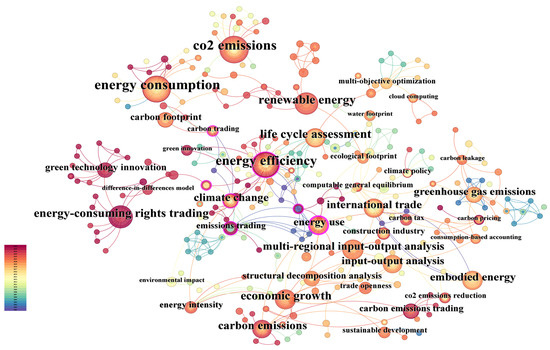
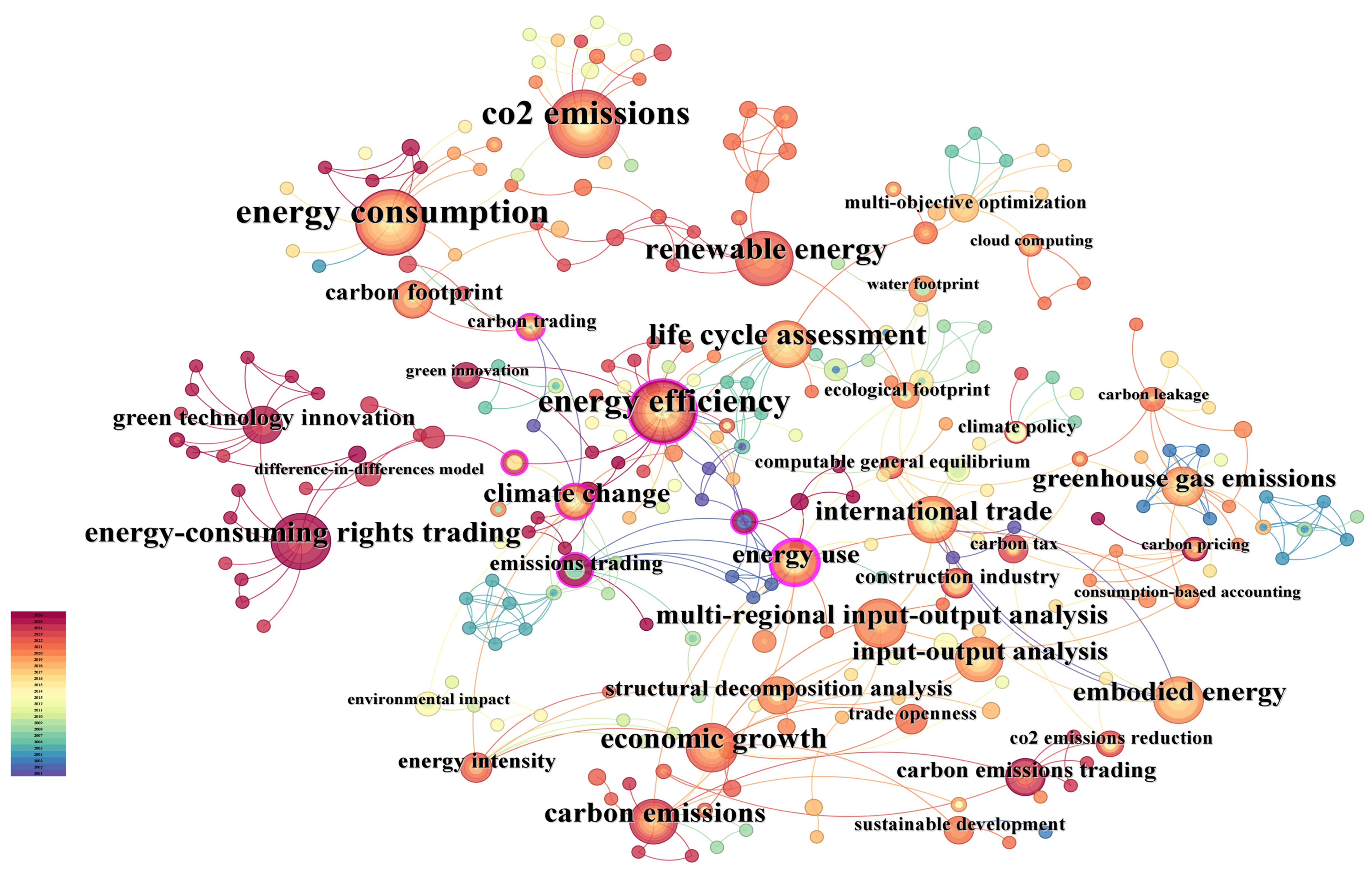
To complement the search-and-screening audit, CiteSpace visualizations were generated from a Web of Science (WoS) bibliometric dataset retrieved on 25 June 2026. The dataset contained 747 WoS records and covered publications dated from 1 January 2001 to 25 June 2026. This 25 June 2026 WoS retrieval was a separate, later bibliometric pull rather than part of the 1 May–15 June narrative-review search. This bibliometric dataset was used to characterize the broader literature landscape and is distinct from the smaller final corpus retained for detailed narrative synthesis. In the keyword co-occurrence map in Figure 1, larger nodes indicate more frequently occurring keywords, links indicate co-occurrence relationships, node colors reflect the temporal distribution of keywords, and purple rings indicate relatively high betweenness centrality. The most prominent terms include energy efficiency, energy consumption, CO2 emissions, carbon emissions, renewable energy, greenhouse gas emissions, economic growth, multi-regional input–output analysis and life cycle assessment, indicating that the literature connects energy-use control with carbon accounting, energy transition, trade and productivity-related outcomes.
Figure 1.
Keyword co-occurrence network of energy-use rights trading and related energy, carbon and efficiency research. Note: Node size is proportional to keyword occurrence frequency; larger nodes indicate more frequently occurring keywords.The upper-left software-information panel and CiteSpace logo were cropped from the displayed figure for readability; the relevant source parameters are reported here. Source settings: CiteSpace v. 6.4.R1; WoS records retrieved on 25 June 2026; publication-date range 1 January 2001 to 25 June 2026; one-year time slices; g-index selection (k = 25), LRF = 2.5, L/N = 10, LBY = 5, e = 1.0; network N = 542, E = 562, density = 0.0038; largest connected component = 269 nodes (49%); nodes labeled = 1.0%; pruning = Pathfinder. N denotes visualization nodes rather than the number of retrieved records.
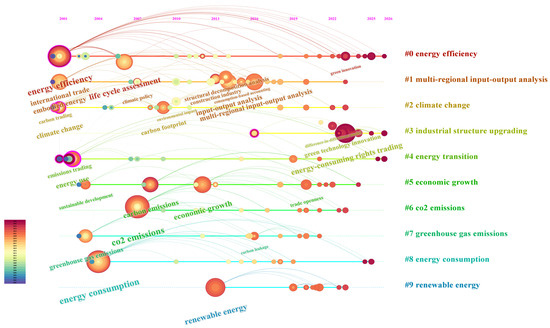
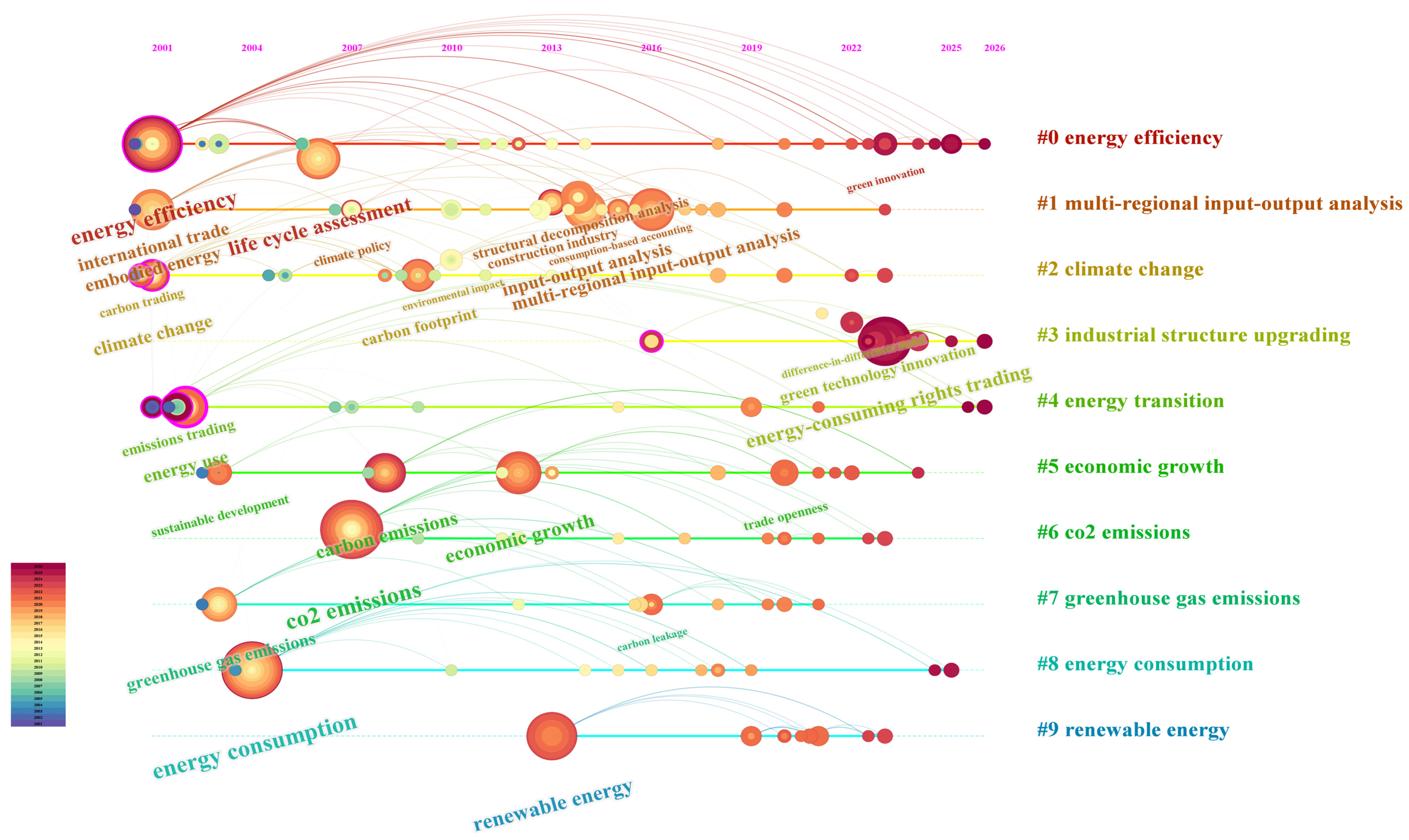
The timeline visualization in Figure 2 adds a temporal perspective to the same WoS-based CiteSpace run. Each horizontal line represents a thematic cluster, node positions indicate the years in which related terms or references appear, and cross-year links indicate continuity between research topics. The ten main clusters are #0 energy efficiency, #1 multi-regional input-output analysis, #2 climate change, #3 industrial structure upgrading, #4 energy transition, #5 economic growth, #6 CO2 emissions, #7 greenhouse gas emissions, #8 energy consumption and #9 renewable energy. Earlier activity is concentrated around energy use, consumption, carbon emissions, CO2 emissions and embodied energy, whereas later clusters show stronger connections to green innovation, energy transition, carbon pricing and trading, climate policy and structural upgrading. This temporal pattern supports organizing the review around policy function, market design and process-system response rather than a purely chronological literature narrative.
Figure 2.
Timeline-view CiteSpace cluster map of energy-use rights trading and related energy, carbon and efficiency research. Note: Node size is proportional to occurrence frequency; larger nodes indicate more prominent terms or references within the corresponding cluster and year. Figure 2 uses the same 747-record WoS dataset and CiteSpace run as Figure 1. The timeline clustering shows high structural clarity, with modularity Q = 0.9007, weighted mean silhouette S = 0.9781 and harmonic mean (Q, S) = 0.9378, indicating well-separated and internally coherent clusters.
Taken together, Figure 1 and Figure 2 show that the literature on energy-use rights trading is embedded in a broader research field linking energy efficiency, energy consumption, carbon emissions, renewable energy, life cycle assessment, multi-regional input–output analysis and economic growth. The co-occurrence network indicates that the topic is not isolated within energy policy, but is connected to carbon accounting, climate governance, trade-related embodied emissions and green innovation. The timeline map further suggests a gradual shift from energy-consumption and emissions-accounting themes toward energy transition, industrial structure upgrading and policy coordination. These patterns support the organization of this review around policy function, market design and process-system response, rather than around a purely chronological summary of studies.
This manuscript is organized around policy function and process-system response rather than a chronological list of studies. Section 3 explains the analytical framework and institutional architecture of EURT. Section 4 develops the process-system interpretation and typical industrial response pathways. Section 5 discusses theoretical foundations. Section 6 synthesizes evidence and mechanisms. Section 7 analyzes policy synergies and governance challenges. Section 8 proposes future research directions. Section 9 concludes.
3. Analytical Framework, Institutional Architecture and Conceptual Boundaries
The traded object in EURT is not a physical unit of coal, electricity, gas, or heat, but an administratively recognized entitlement to consume a specified amount of energy, usually converted into units of standard coal equivalent or a comparable accounting unit. The entitlement has value because a cap and compliance obligation make it scarce. In legal-economic terms, EURT creates a property-like use right under public authorization: it is measurable, excludable and transferable within defined rules, but it remains conditional on public regulatory objectives.
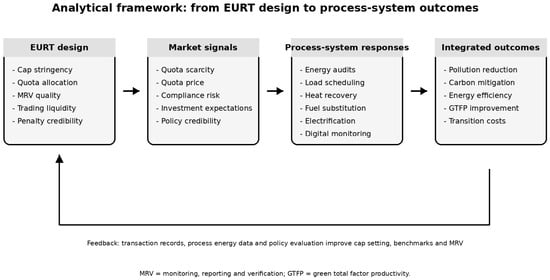
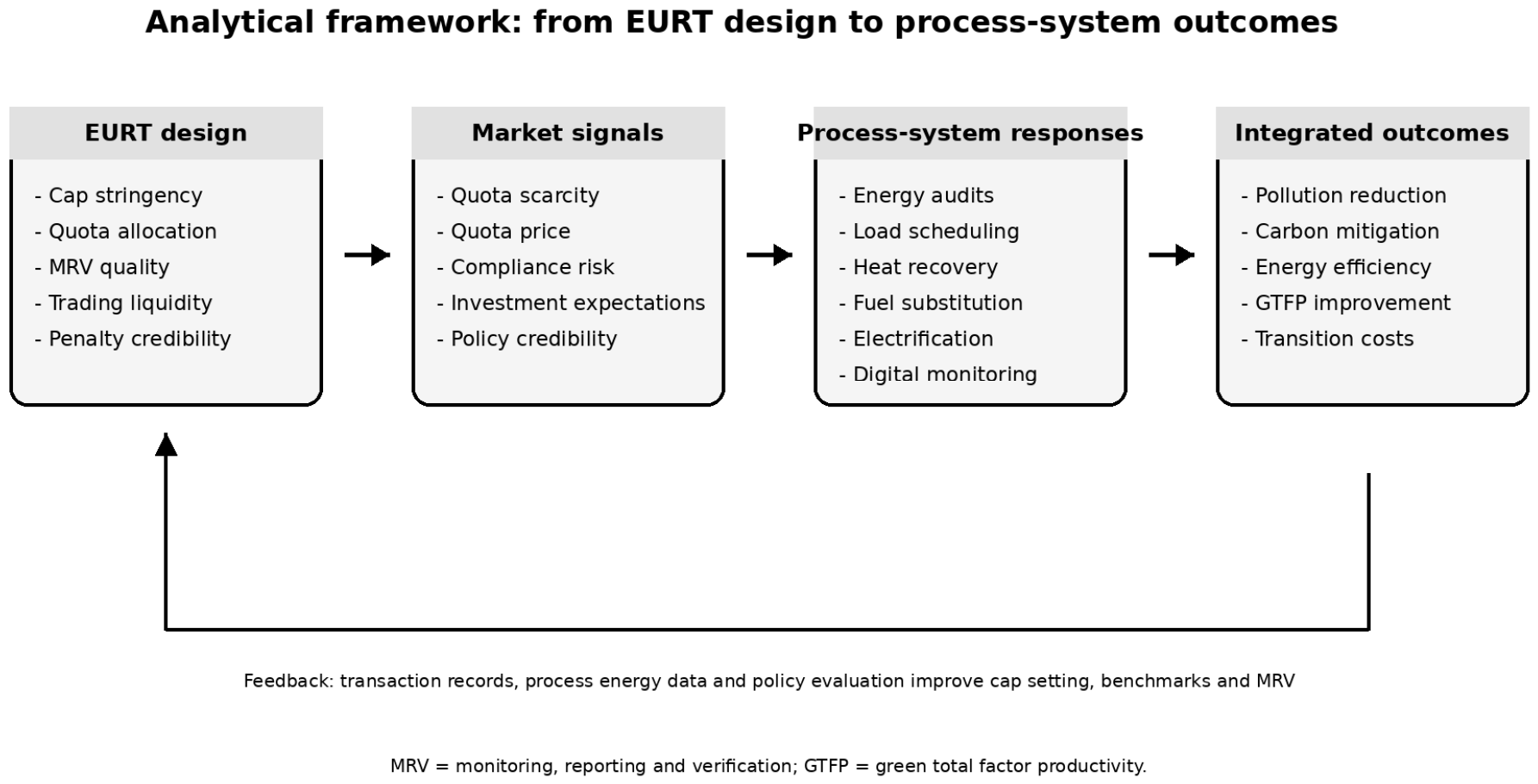
The framework of this review links institutional design to industrial process outcomes. Cap stringency, allocation rules, MRV quality, trading liquidity and penalty credibility first shape market signals such as quota scarcity, quota price and compliance risk. These signals then enter firm-level planning as additional constraints on material balance, energy balance, production scheduling and capital-investment decisions. Firms respond through energy audits, load management, heat integration, waste-heat recovery, equipment replacement, fuel substitution, electrification and digital energy management. Environmental and economic outcomes emerge from the combined effect of these responses on fossil-energy use, pollutant emissions, carbon intensity and productivity.
This design differentiates EURT from voluntary energy-efficiency credits. A voluntary credit rewards an action after it occurs; EURT constrains energy use ex ante and then allows adjustment through exchange. It also differs from carbon-emissions trading. Carbon markets cap emissions, usually measured in tonnes of carbon dioxide equivalent, whereas EURT caps energy input. When energy is fossil-intensive, the two constraints are closely linked, but the relationship is not one-to-one because the same unit of energy may imply different emissions depending on fuel type, conversion efficiency and electricity mix.
A functioning EURT system requires a complete governance chain: cap setting, quota allocation, registry management, trading, monitoring, reporting, verification, compliance surrender and penalties. Weakness in any part of this chain undermines the entire market. If caps are loose, prices collapse and firms have little incentive to innovate. If monitoring is unreliable, trading becomes a paper exercise. If allocation is opaque, firms perceive the market as arbitrary. If penalties are weak, quota deficits become cheaper than compliance.
Table 2 summarizes the boundary between EURT and related market-based instruments and makes the mechanism comparison more explicit. The policy implication is that EURT should not be evaluated as a simple substitute for carbon trading, pollution trading or white-certificate systems. Its comparative advantage lies in upstream control over energy demand and process-level energy management, while carbon and pollution markets operate through emissions accounting and environmental-capacity constraints and energy-efficiency obligation schemes usually reward verified savings after implementation.
Table 2.
Mechanism comparison between EURT and related market-based instruments.
4. EURT as a Market Constraint for Industrial Process Systems
For process industries, EURT can be interpreted as an additional constraint in production planning and process optimization. Firms must minimize total production costs subject not only to material-balance, energy-balance, capacity, and product-quality constraints, but also to a limited stock of energy-use rights. When quota prices are credible, the shadow value of energy conservation becomes explicit, making energy-saving projects easier to compare with other capital investments.
Process-system responses can occur through several channels. First, firms may improve operational energy management by detecting hidden losses, optimizing load scheduling, reducing idling and implementing digital metering. Second, they may undertake process retrofits such as heat integration, waste-heat recovery and replacement of inefficient motors, pumps, compressors and boilers. Third, they may adjust fuel mix, electrify heat where feasible or purchase renewable electricity. Fourth, they may redesign product portfolios and production routes to reduce energy intensity per unit of value added. These responses connect market scarcity with process engineering.
Policy design must also be technologically informed. Some industries have large low-cost opportunities for energy cascading and waste-heat recovery, while others face thermodynamic, product-quality, safety and retrofit-cycle limits that restrict feasible adjustment [1,63,64,65]. Uniform quota stringency may impose very different marginal costs across processes. Benchmark allocation should therefore be informed by best-available technology, process boundaries and realistic retrofit cycles. Otherwise, quotas may be too generous for inefficient facilities or too stringent for facilities already close to technical limits.
Typical industrial scenarios illustrate the logic. In chemical and process industries, a quota price may increase the value of heat integration, steam-network optimization and process-control upgrades. In iron and steel, cement and other energy-intensive material sectors, it can change the relative attractiveness of waste-heat recovery, fuel substitution, electrified auxiliary systems and production scheduling. In industrial parks and integrated energy systems, it can support coordinated energy management, combined cooling–heating-power operation and renewable-energy procurement. These examples show that EURT is not only a policy label; it can become a calculable constraint in process-system design and operation.
Figure 3 presents the analytical framework. Table 3 translates EURT design elements into likely process-system responses, while Table 4 summarizes typical process-industry response pathways. Together, they strengthen the article’s fit with Processes by showing that energy-governance institutions affect concrete process-level decisions rather than only macroeconomic indicators.
Figure 3.
Analytical framework linking EURT design to industrial process-system responses and integrated outcomes. From left to right, the figure shows EURT design elements, market signals, process-system responses and integrated outcomes. The feedback loop indicates that transaction records, process energy data and policy evaluation can support data-informed adjustment of cap setting, benchmarks and MRV. Note: MRV = monitoring, reporting and verification; GTFP = green total factor productivity.
Table 3.
EURT design elements and industrial process-system responses.
Table 4.
Typical process-industry response pathways under EURT.
A stylized example illustrates how a quota price can change process-investment ranking. Consider a representative chemical plant comparing three mutually exclusive retrofit options over eight years with an 8% discount rate. For option j, a simple decision metric is , where is initial investment, is annual non-quota energy-cost saving net of operating cost, is annual quota saving in tonnes of standard-coal equivalent and is the quota price. When is zero, the plant ranks projects mainly by direct energy-cost savings. When rises to CNY 300/tce, avoided quota purchases become an additional benefit and a larger waste-heat recovery option can overtake a smaller heat-integration option. The numbers in Table 5 are illustrative rather than empirical estimates, but they show the calculable bridge between institutional scarcity and process-engineering choice.
Table 5.
Stylized process-system NPV illustration under a quota price (8-year horizon, 8% discount rate).
5. Theoretical Foundations
The most direct theoretical foundation for EURT is the property-rights approach to externalities. Coasean bargaining emphasizes that well-defined rights and lower transaction costs can reallocate scarce rights toward higher-value uses [7]. Pigouvian theory emphasizes that private production costs often fail to internalize social environmental costs [8]. Tradable-permit theory shows how cap-and-trade systems can achieve environmental targets at lower aggregate cost when abatement costs differ across firms [9,10,11,12,13]. EURT follows this efficiency logic by encouraging low-cost conservation options to be used before high-cost ones.
The Porter hypothesis provides a second lens. Properly designed environmental regulation can reveal inefficiencies, trigger innovation and create compensating gains [14,15,16]. EURT is relevant because energy costs are embedded throughout production processes. A binding quota can lead firms to audit energy flows, replace inefficient equipment, optimize heat recovery, improve digital energy management, adopt cleaner fuels and redesign production processes. Future empirical work should distinguish weak Porter effects, meaning more green innovation activity, from strong Porter effects, meaning net productivity gains after compliance costs.
The double-dividend hypothesis offers a third lens. The first dividend is environmental: less fossil-energy consumption can reduce carbon emissions and local pollutants. The second is economic: revenue recycling, innovation incentives and resource reallocation may improve productivity or reduce other distortions [17,18,19,20]. EURT can generate a double dividend even without large fiscal revenue if quota trading shifts energy use toward more efficient firms and encourages conservation investment. However, the strong version is not automatic. Excessive scarcity can crowd out innovation; free allocation can create rents; unstable prices can delay long-term investment.
The efficiency dimension of EURT requires measurement tools that treat environmental pressure as part of production performance. GTFP, directional distance functions, slacks-based measures, Malmquist–Luenberger indexes, stochastic frontier models and production-function approaches provide alternative ways to evaluate whether environmental regulation improves or weakens productive performance [21,22,23,24,25,26,27,28]. Outcome indicators matter because a policy that reduces emissions through output contraction differs fundamentally from a policy that raises process efficiency while maintaining output.
Co-benefits, induced innovation and decomposition studies add further insight. Climate and energy policies can generate air-quality co-benefits [29,30,31,32], while the relationships among growth, trade, environmental pressure and directed technical change shape long-term adjustment paths [33,34,35,36,37,38]. These perspectives suggest that EURT should be evaluated as a dynamic system rather than as a one-period policy shock.
6. Evidence and Mechanisms: Pollution, Carbon and Efficiency Effects
EURT can reduce local pollutants because fossil-energy use is a common source of sulfur dioxide, nitrogen oxides, particulate matter and other pollutants. The broader co-benefits literature shows that climate and energy policies can produce simultaneous air-quality and health gains [29,30,31,32]. Empirical studies on Chinese EURT pilots increasingly find associations with energy savings, emission reduction, environmental performance and air-quality improvement, although the magnitude varies by pollutant, region and industrial structure [4,5,6,43,44,45,46,47,48,49,50,51,52]. These findings should be interpreted as evidence from a China-centered policy setting rather than as a universal estimate for all jurisdictions.
Carbon mitigation is frequently discussed because energy consumption and carbon emissions are tightly coupled in fossil-fuel-based systems. Economy-wide mitigation assessments, carbon-market development and climate-policy reports emphasize the role of energy-system transition and carbon pricing [39,40,41,42]. EURT can operate as an indirect carbon-control instrument when a binding cap on energy consumption reduces fossil-energy demand and when the price of additional energy-use rights strengthens incentives for efficiency improvement. Recent empirical studies find that EURT can reduce carbon intensity, contribute to carbon-neutrality pathways, or improve carbon-emission efficiency [43,46,47,51,57,59,60,61], but these claims require careful separation from carbon-market pilots, low-carbon city policies and other simultaneous interventions.
Efficiency gains are the most demanding test. A policy can reduce energy use and emissions through output contraction, but this would not constitute high-quality development. The relevant question is whether EURT raises energy efficiency, GTFP, green development efficiency or economic potential after accounting for environmental constraints. Recent studies provide encouraging but heterogeneous evidence, including effects on energy saving, urban green development efficiency, green technology innovation, firm environmental performance, total factor productivity and digital-economy-linked GTFP [44,48,49,52,53,54,55,56,58]. A critical distinction is therefore needed between weak Porter effects, such as more green innovation activity, and strong Porter effects, such as net productivity gains after compliance costs.
A major methodological limitation is that many Chinese pilot studies identify EURT through a binary pilot dummy in difference-in-differences designs. This strategy is useful for detecting average policy shocks, but it can be contaminated when low-carbon city pilots, carbon markets, pollution-control campaigns, green-finance pilots, digital-economy policies or energy-intensity targets change at the same time. For this reason, the evidence below is summarized with attention on pilot scope, sample, method, outcome and reported direction, and the claims are treated as conditional rather than definitive causal proof.
The mechanisms can be grouped into allocation, technology and structure. The allocation channel arises when quotas move from low-efficiency to high-efficiency users. The technology channel arises when firms invest in equipment upgrades, energy-management systems and green innovation to reduce quota demand. The structural channel arises when high-energy, low-value-added production shrinks and cleaner or higher-value sectors expand. These channels operate simultaneously but require different supporting conditions: liquid markets for allocation, stable expectations and finance for technology, and industrial-policy coordination for structural change. Empirically, the allocation channel can be identified by linking quota transfers or trading positions to firm efficiency and marginal abatement-cost indicators, while the technology channel can be tested through equipment investment, patenting, energy-audit or retrofit records. The structural channel requires decomposition or multi-treatment designs that separate output reallocation and sectoral upgrading from within-firm efficiency improvement.
Empirical findings diverge for four main reasons. First, policy intensity differs across pilots in cap stringency, coverage thresholds, transaction frequency and penalty credibility. Second, baseline industrial structures differ across coal-intensive, service-oriented, developed and resource-dependent regions. Third, outcome indicators are not interchangeable: total emissions, emissions intensity, GTFP and green innovation capture different mechanisms. Fourth, timing matters because short-term compliance behavior may differ from medium-term retrofit investment and long-term industrial restructuring. Table 6 makes this heterogeneity explicit by recording the scope, method, outcome and reported direction of the main empirical and modeling studies. To avoid implying a pooled meta-analytic estimate, Table 6 now reports the sign or qualitative direction of each study and flags whether magnitudes are directly comparable; exact coefficient sizes are not converted into a common metric because the cited studies use different sample windows, outcome units, identification strategies and modeling structures.
Table 6.
Summary of empirical and modeling evidence on Chinese EURT pilots.
7. Policy Synergies and Governance Challenges
EURT should be understood as one component of a multi-market governance system. Carbon markets price emissions, pollution-permit markets address local environmental capacity, renewable-energy certificates support clean-power deployment, and EURT governs the energy-use side. Synergy arises when these instruments create consistent incentives for firms to reduce fossil-energy demand, adopt cleaner fuels, purchase renewable electricity and improve process efficiency. Conflict arises when instruments cover the same activity without coordinated accounting, causing double counting, excessive compliance costs or diluted price signals [39,40,41,42,62].
A practical coordination strategy is to define each market’s primary regulatory margin. EURT should emphasize energy-demand management and industrial energy efficiency. Carbon trading should emphasize emissions intensity, fuel switching and economy-wide decarbonization. Pollution-permit trading should remain linked to local air-quality and ecological-capacity constraints. Renewable-energy certificates should verify the environmental attributes of renewable electricity consumption. If these functions are clearly distinguished, overlap can be complementary; if not, firms may treat markets as administrative burdens rather than coherent investment signals.
The China-centered evidence base should also be read against international analogues. Italy and France have used white-certificate schemes, the United Kingdom and Denmark have relied on energy-efficiency obligations, India has implemented the Perform, Achieve and Trade scheme, and several U.S. states have used energy-efficiency resource standards or savings-credit approaches [66,67,68]. These instruments do not duplicate EURT because they generally certify savings or impose supplier obligations rather than allocating an ex ante energy-use quota to covered entities. They are nevertheless useful comparators because they show how baseline setting, additionality, monitoring quality and certificate liquidity can determine whether a nominal energy-efficiency market produces real process-level savings.
Market liquidity and price discovery remain central challenges. Thin trading weakens the scarcity signal and prevents firms from observing marginal energy-conservation costs. Potential solutions include expanding coverage, allowing carefully designed banking, improving information disclosure, linking regional registries and using auctions to improve price discovery while preserving fairness. Regional coordination is also important because energy-intensive industries and electricity systems cross administrative boundaries; local reductions may otherwise be offset by relocation or embodied energy transfer.
Monitoring, reporting and verification are the institutional foundation of EURT. The MRV system must define energy boundaries, conversion factors, treatment of purchased electricity and heat, treatment of self-generation, reporting frequency and third-party verification responsibilities. Digital metering, energy-management platforms and cross-checks with tax, electricity and production data can improve accuracy. At the same time, digitalization raises concerns about data confidentiality, interoperability and uneven capacity among firms. For example, equipment-level metering may expose commercially sensitive production schedules, while inconsistent data formats across electricity, heat, tax and production systems can make cross-validation costly. Smaller firms may also lack calibrated meters, digital platforms or staff capable of preparing audit-ready reports, so capacity-building and data-governance protocols are part of MRV design rather than peripheral administration.
Equity and transition issues should not be treated as secondary. Market-based energy constraints can affect small and medium-sized enterprises, resource-dependent regions, workers in energy-intensive sectors and local fiscal revenue. Transitional free allocation may reduce competitiveness concerns but can create rents if benchmarks are weak. Auctioning can improve transparency but may burden financially constrained firms. A balanced design should combine credible scarcity with targeted support for energy-efficiency retrofits, worker training and regional transition.
8. Future Research Agenda
Future research should move beyond the average treatment effect of pilot designation and toward a more granular understanding of market function, process response and policy interaction. The first priority is integrated performance evaluation. Pollution reduction, carbon mitigation and GTFP should be examined jointly rather than as isolated endpoints. Studies should distinguish absolute reductions, intensity reductions, efficiency gains and welfare effects.
The second priority is better treatment of overlapping policies. Low-carbon city pilots, carbon markets, pollution-control campaigns, energy-intensity targets, green finance and digital-economy policies often coincide with EURT. Difference-in-differences models that treat EURT as a single exogenous shock may suffer contamination bias if other policies change simultaneously. Multi-treatment designs, event studies, synthetic control, spatial econometrics and firm-level quasi-experiments can help separate these effects.
The third priority is market microstructure. Many evaluations use pilot dummies because transaction-level data are unavailable. Yet the actual strength of EURT depends on quota prices, trading volume, bid–ask spreads, banking behavior, penalty expectations and firm participation. Access to anonymized registry and trading-platform data would allow scholars to distinguish a nominal pilot from a functioning market.
The fourth priority is process-level energy data. Existing studies often use city- or firm-level outcome variables, but the policy mechanism ultimately operates through production processes. Future research should link quota data with energy audits, equipment-level monitoring, process-control data, retrofit records and production-scheduling information. Such data would allow researchers to test whether firms comply by innovating, purchasing quotas, reducing output, relocating production or changing fuel and technology mixes.
The fifth priority is model integration. Existing empirical studies often estimate policy effects, while process-engineering studies often optimize technical systems without explicit institutional constraints. A promising direction is to combine quota-price scenarios, process simulation, energy-system optimization, firm-level econometrics and transaction-level market analysis. Such integration would allow researchers to test not only whether EURT works, but how a quota price enters process design and investment decisions.
The sixth priority is distributional and transition effects. If EURT raises productivity by reallocating energy-use rights from inefficient to efficient firms, what happens to workers, suppliers and local fiscal revenue in declining sectors? If firms comply by relocating production, where do emissions go? If energy-saving investment is profitable but financing is constrained, which policy instruments unlock it? These questions require linking environmental economics, industrial organization, labor economics and process-system analysis. Table 7 summarizes these priority topics by linking each research area to its core question and possible methods and data.
Table 7.
Priority topics for future EURT research.
9. Conclusions
Energy-use rights trading is a distinctive market-oriented energy-governance instrument that transforms energy-consumption control into a tradable entitlement system. Its policy logic differs from carbon trading and pollution-permit trading because it targets the energy-input side rather than the emissions-output side. This review therefore treats EURT primarily as a China-focused institutional experience with broader implications for jurisdictions considering energy-efficiency certificates, obligations or savings-credit markets.
For Processes, the main contribution is the process-system interpretation: quota scarcity and price discovery can enter production planning, energy-balance management and retrofit investment appraisal. The stylized NPV illustration shows that a credible quota price can alter the ranking of heat integration, waste-heat recovery and electrification options, making the institutional signal calculable for process engineers and plant managers.
The reviewed literature provides generally positive evidence but also warrants caution. EURT can reduce pollutants and carbon emissions, and it can improve energy efficiency or GTFP when institutional conditions are supportive. However, the triple objective of pollution reduction, carbon mitigation and efficiency improvement is not guaranteed. It depends on cap stringency, quota allocation, market liquidity, MRV quality, penalty credibility, firm financing capacity and coordination with other environmental and energy policies. Many existing estimates rely on pilot dummies and should therefore be interpreted with explicit attention to overlapping policies and heterogeneous local implementation.
Future research should integrate environmental, carbon, and productivity outcomes, use richer micro- and transaction-level data, and develop methods capable of identifying mechanisms under overlapping policy regimes. It should also connect policy evaluation with process-system models, equipment-level energy data and transaction-level market indicators. EURT is best understood not as a stand-alone trading scheme but as an institutional experiment in source-side, market-based energy governance. Its future contribution to low-carbon industrial transition will depend on whether it can move from pilot experimentation toward a transparent, liquid and coordinated system that aligns energy conservation, emissions reduction and process efficiency without creating double-counting risks or merely shifting output across regions.
Author Contributions
Conceptualization, R.S. and Z.Z.; methodology, Z.Z. and R.S.; literature search and analysis, Z.Z. and Z.Y.; writing—original draft preparation, Z.Z.; writing—review and editing, R.S. and Z.Y.; validation, Z.Y. and R.S.; supervision, R.S.; funding acquisition, R.S. All authors have read and agreed to the published version of the manuscript.
Funding
This research was supported by the General Program of the National Natural Science Foundation of China (NSFC), “Pathways and Optimization of Green Energy Transition: An Ecological Footprint Perspective” (Grant No. 72273151).
Data Availability Statement
No new data were created or analyzed in this review. Data sharing is not applicable to this article.
Conflicts of Interest
The authors declare no conflicts of interest.
References
- Glavič, P.; Pintarič, Z.N.; Levičnik, H.; Dragojlović, V.; Bogataj, M. Transitioning towards Net-Zero Emissions in Chemical and Process Industries: A Holistic Perspective. Processes 2023, 11, 2647. [Google Scholar] [CrossRef] [Scilit]
- Sharma, V.K.; Monteleone, G.; Braccio, G.; Anyanwu, C.N.; Aneke, N.N. A Comprehensive Review of Green Energy Technologies: Towards Sustainable Clean Energy Transition and Global Net-Zero Carbon Emissions. Processes 2025, 13, 69. [Google Scholar] [CrossRef] [Scilit]
- Yu, A.; Li, Z.; Liu, P. Rural Integrated Energy System Based on Bibliometric Analysis: A Review of Recent Progress. Processes 2024, 12, 176. [Google Scholar] [CrossRef] [Scilit]
- Yang, M.; Yang, F.; Sun, C. Constructing Energy-Consuming Right Trading System for China’s Manufacturing Industry in 2025. Energy Policy 2020, 144, 111602. [Google Scholar] [CrossRef] [Scilit]
- Wang, J.; Fang, D.; Yu, H. Potential Gains from Energy Quota Trading in China: From the Perspective of Comparison with Command-and-Control Policy. J. Clean. Prod. 2021, 315, 128174. [Google Scholar] [CrossRef] [Scilit]
- Qi, X.; Han, Y. Energy Quota Trading Can Achieve Energy Savings and Emission Reduction: Evidence from China’s Pilots. Environ. Sci. Pollut. Res. 2021, 28, 52431–52458. [Google Scholar] [CrossRef] [Scilit] [PubMed]
- Coase, R.H. The Problem of Social Cost. J. Law Econ. 1960, 3, 1–44. [Google Scholar] [CrossRef] [Scilit]
- Pigou, A.C. The Economics of Welfare; Macmillan: London, UK, 1920; Available online: https://oll.libertyfund.org/title/pigou-the-economics-of-welfare (accessed on 1 June 2026).
- Dales, J.H. Pollution, Property and Prices; Edward Elgar Publishing: Cheltenham, UK, 2002. [Google Scholar] [CrossRef] [Scilit]
- Montgomery, W.D. Markets in Licenses and Efficient Pollution Control Programs. J. Econ. Theory 1972, 5, 395–418. [Google Scholar] [CrossRef] [Scilit]
- Tietenberg, T.H. Emissions Trading: An Exercise in Reforming Pollution Policy; Resources for the Future: Washington, DC, USA, 1985. Available online: https://www.osti.gov/biblio/5484242 (accessed on 1 June 2026).
- Stavins, R.N. Transaction Costs and Tradeable Permits. J. Environ. Econ. Manag. 1995, 29, 133–148. [Google Scholar] [CrossRef] [Scilit]
- Stavins, R.N. Experience with Market-Based Environmental Policy Instruments. In Handbook of Environmental Economics; Mäler, K.-G., Vincent, J.R., Eds.; Elsevier: Amsterdam, The Netherlands, 2003; Volume 1, pp. 355–435. [Google Scholar] [CrossRef] [Scilit]
- Porter, M.E.; van der Linde, C. Toward a New Conception of the Environment-Competitiveness Relationship. J. Econ. Perspect. 1995, 9, 97–118. [Google Scholar] [CrossRef] [Scilit]
- Jaffe, A.B.; Palmer, K. Environmental Regulation and Innovation: A Panel Data Study. Rev. Econ. Stat. 1997, 79, 610–619. [Google Scholar] [CrossRef] [Scilit]
- Ambec, S.; Cohen, M.A.; Elgie, S.; Lanoie, P. The Porter Hypothesis at 20: Can Environmental Regulation Enhance Innovation and Competitiveness? Rev. Environ. Econ. Policy 2013, 7, 2–22. [Google Scholar] [CrossRef] [Scilit]
- Pearce, D. The Role of Carbon Taxes in Adjusting to Global Warming. Econ. J. 1991, 101, 938–948. [Google Scholar] [CrossRef] [Scilit]
- Goulder, L.H. Environmental Taxation and the Double Dividend: A Reader’s Guide. Int. Tax Public Financ. 1995, 2, 157–183. [Google Scholar] [CrossRef] [Scilit]
- Bovenberg, A.L.; Goulder, L.H. Optimal Environmental Taxation in the Presence of Other Taxes: General-Equilibrium Analyses. Am. Econ. Rev. 1996, 86, 985–1000. Available online: https://www.jstor.org/stable/2118315 (accessed on 1 June 2026).
- Baumol, W.J.; Oates, W.E. The Theory of Environmental Policy, 2nd ed.; Cambridge University Press: Cambridge, UK, 1988; Available online: https://www.cambridge.org/core/books/theory-of-environmental-policy/E8FE3C8AB6D8D6982E5B65CC95FA1478 (accessed on 1 June 2026).
- Färe, R.; Grosskopf, S.; Norris, M.; Zhang, Z. Productivity Growth, Technical Progress, and Efficiency Change in Industrialized Countries. Am. Econ. Rev. 1994, 84, 66–83. Available online: https://www.jstor.org/stable/2117971 (accessed on 1 June 2026).
- Chung, Y.H.; Färe, R.; Grosskopf, S. Productivity and Undesirable Outputs: A Directional Distance Function Approach. J. Environ. Manag. 1997, 51, 229–240. [Google Scholar] [CrossRef] [Scilit]
- Tone, K. A Slacks-Based Measure of Efficiency in Data Envelopment Analysis. Eur. J. Oper. Res. 2001, 130, 498–509. [Google Scholar] [CrossRef] [Scilit]
- Oh, D.H. A Global Malmquist-Luenberger Productivity Index. J. Product. Anal. 2010, 34, 183–197. [Google Scholar] [CrossRef] [Scilit]
- Olley, G.S.; Pakes, A. The Dynamics of Productivity in the Telecommunications Equipment Industry. Econometrica 1996, 64, 1263–1297. [Google Scholar] [CrossRef] [Scilit]
- Levinsohn, J.; Petrin, A. Estimating Production Functions Using Inputs to Control for Unobservables. Rev. Econ. Stud. 2003, 70, 317–341. [Google Scholar] [CrossRef] [Scilit]
- Aigner, D.; Lovell, C.A.K.; Schmidt, P. Formulation and Estimation of Stochastic Frontier Production Function Models. J. Econom. 1977, 6, 21–37. [Google Scholar] [CrossRef] [Scilit]
- Meeusen, W.; van den Broeck, J. Efficiency Estimation from Cobb-Douglas Production Functions with Composed Error. Int. Econ. Rev. 1977, 18, 435–444. [Google Scholar] [CrossRef] [Scilit]
- Bollen, J.; Guay, B.; Jamet, S.; Corfee-Morlot, J. Co-Benefits of Climate Change Mitigation Policies: Literature Review and New Results; OECD Economics Department Working Papers 2009, No. 693; OECD Publishing: Paris, France, 2009. [Google Scholar] [CrossRef]
- Nemet, G.F.; Holloway, T.; Meier, P. Implications of Incorporating Air-Quality Co-Benefits into Climate Change Policymaking. Environ. Res. Lett. 2010, 5, 014007. [Google Scholar] [CrossRef] [Scilit]
- West, J.J.; Smith, S.J.; Silva, R.A.; Naik, V.; Zhang, Y.; Adelman, Z.; Fry, M.M.; Anenberg, S.; Horowitz, L.W.; Lamarque, J.-F. Co-Benefits of Mitigating Global Greenhouse Gas Emissions for Future Air Quality and Human Health. Nat. Clim. Chang. 2013, 3, 885–889. [Google Scholar] [CrossRef] [Scilit] [PubMed]
- Shindell, D.; Kuylenstierna, J.C.I.; Vignati, E.; van Dingenen, R.; Amann, M.; Klimont, Z.; Anenberg, S.C.; Muller, N.; Janssens-Maenhout, G.; Raes, F.; et al. Simultaneously Mitigating Near-Term Climate Change and Improving Human Health and Food Security. Science 2012, 335, 183–189. [Google Scholar] [CrossRef] [Scilit] [PubMed]
- Grossman, G.M.; Krueger, A.B. Economic Growth and the Environment. Q. J. Econ. 1995, 110, 353–377. [Google Scholar] [CrossRef] [Scilit]
- Copeland, B.R.; Taylor, M.S. Trade, Growth, and the Environment. J. Econ. Lit. 2004, 42, 7–71. [Google Scholar] [CrossRef] [Scilit]
- Popp, D. Induced Innovation and Energy Prices. Am. Econ. Rev. 2002, 92, 160–180. [Google Scholar] [CrossRef] [Scilit]
- Newell, R.G.; Jaffe, A.B.; Stavins, R.N. The Induced Innovation Hypothesis and Energy-Saving Technological Change. Q. J. Econ. 1999, 114, 941–975. [Google Scholar] [CrossRef] [Scilit]
- Acemoglu, D.; Aghion, P.; Bursztyn, L.; Hemous, D. The Environment and Directed Technical Change. Am. Econ. Rev. 2012, 102, 131–166. [Google Scholar] [CrossRef] [Scilit] [PubMed]
- Ang, B.W. The LMDI Approach to Decomposition Analysis: A Practical Guide. Energy Policy 2005, 33, 867–871. [Google Scholar] [CrossRef] [Scilit]
- Zhang, Z.X. Carbon Emissions Trading in China: The Evolution from Pilots to a Nationwide Scheme. Clim. Policy 2015, 15, S104–S126. [Google Scholar] [CrossRef] [Scilit]
- International Energy Agency. China’s Emissions Trading Scheme: Designing Efficient Allowance Allocation; IEA: Paris, France, 2020; Available online: https://www.iea.org/reports/chinas-emissions-trading-scheme (accessed on 1 June 2026).
- World Bank. State and Trends of Carbon Pricing 2024; World Bank: Washington, DC, USA, 2024; Available online: https://openknowledge.worldbank.org/handle/10986/41544 (accessed on 1 June 2026).
- Intergovernmental Panel on Climate Change. Climate Change 2023: Synthesis Report; IPCC: Geneva, Switzerland, 2023; Available online: https://www.ipcc.ch/report/ar6/syr/ (accessed on 1 June 2026).
- Chu, X.; Du, G.; Geng, H.; Liu, X. Can Energy Quota Trading Reduce Carbon Intensity in China? A Study Using a DEA and Decomposition Approach. Sustain. Prod. Consum. 2021, 28, 1275–1285. [Google Scholar] [CrossRef] [Scilit]
- Liao, L.; Huang, C.; Du, M. The Effect of Energy Quota Trading on Energy Saving in China: Insight from a Quasi-Natural Experiment. Energies 2022, 15, 8610. [Google Scholar] [CrossRef] [Scilit]
- Le, D.; Ren, F.; Li, Y. The Effect of Energy Use Rights Trading Policy on Environmental Performance: Evidence from Chinese 262 Cities. Int. J. Environ. Res. Public Health 2023, 20, 3570. [Google Scholar] [CrossRef] [Scilit] [PubMed]
- Wang, K.; Su, X.; Wang, S. How Does the Energy-Consuming Rights Trading Policy Affect China’s Carbon Emission Intensity? Energy 2023, 276, 127579. [Google Scholar] [CrossRef] [Scilit]
- Zhang, Y.; Gao, Q.; Wei, J.; Shi, X.; Zhou, D. Can China’s Energy-Consumption Permit Trading Scheme Achieve the “Porter” Effect? Evidence from an Estimated DSGE Model. Energy Policy 2023, 180, 113671. [Google Scholar] [CrossRef] [Scilit]
- Guo, B.; Hu, P.; Zhang, H.; Weng, X.; Hu, F. The Improvement of Energy-Consuming Right Trading Policy on the Efficiency of Urban Green Development. Front. Environ. Sci. 2023, 11, 1123608. [Google Scholar] [CrossRef] [Scilit]
- Guo, B.; Hu, P.; Zhang, H.; Hu, F.; Wang, J. Can the Energy-Consuming Right Trading Policy Improve Urban Green Technology Innovation Capacity? Evidence from China. Pol. J. Environ. Stud. 2023, 32, 5583–5597. [Google Scholar] [CrossRef] [Scilit]
- Liu, M.; Zhang, Q.; Li, X.; Chen, Y. Can Energy-Consuming Rights Trading Policies Help to Curb Air Pollution? Evidence from China. Energies 2024, 17, 3860. [Google Scholar] [CrossRef] [Scilit]
- Wang, M.; Wang, Y.; Yang, Z.; Guo, B. Does Energy-Consuming Rights Trading Policy Achieve Urban Pollution and Carbon Reduction? A Quasi-Natural Experiment from China. Front. Environ. Sci. 2024, 12, 1430031. [Google Scholar] [CrossRef] [Scilit]
- Shen, H.; Xiong, P.; Zhou, L. The Impact of the Energy-Consuming Right Trading System on Corporate Environmental Performance: Based on Empirical Evidence from Panel Data of Industrial Enterprises Listed in Pilot Regions. Heliyon 2024, 10, e29628. [Google Scholar] [CrossRef] [Scilit] [PubMed]
- Shao, W.; Liu, J. Does the Energy-Consuming Right Trading System Promote Green Technology Innovation of Enterprises? Heliyon 2024, 10, e26458. [Google Scholar] [CrossRef] [Scilit] [PubMed]
- Wei, Y.M.; Du, M.Z.; Huang, Z.X. The Effects of Energy Quota Trading on Total Factor Productivity and Economic Potential in Industrial Sector: Evidence from China. J. Clean. Prod. 2024, 445, 141227. [Google Scholar] [CrossRef] [Scilit]
- Wang, W.; Wang, J.; Wu, H. The Impact of Energy-Consuming Rights Trading on Green Total Factor Productivity in the Context of Digital Economy: Evidence from Listed Firms in China. Energy Econ. 2024, 131, 107342. [Google Scholar] [CrossRef] [Scilit]
- Yang, X.; Long, J.; Lin, H.; Cai, Z.; Jiang, P. Enhancing Efficiency or Optimizing Industrial Structure? A Comprehensive Assessment of China’s Energy Consumption Rights Trading System. Energy Sustain. Dev. 2024, 78, 101380. [Google Scholar] [CrossRef] [Scilit]
- Han, D.; Bi, C.; Wu, H. Energy and Environment: How Could Energy-Consuming Transition Promote the Synergy of Pollution Reduction and Carbon Emission Reduction in China? Urban Clim. 2024, 55, 101931. [Google Scholar] [CrossRef] [Scilit]
- Zhou, C.; Wang, J.; Wu, Z. Impact of China’s Energy-Consuming Right Trading on Urban Land Green Utilization Efficiency. Land 2024, 13, 729. [Google Scholar] [CrossRef] [Scilit]
- Cheng, Z.; Ding, C.J.; Zhao, K. Energy Use Rights Trading and Carbon Emissions. Energy 2025, 315, 134360. [Google Scholar] [CrossRef] [Scilit]
- Zhang, L. Energy Use Rights Trading Policy and Energy Consumption? Econ. Anal. Policy 2025, 87, 665–674. [Google Scholar] [CrossRef] [Scilit]
- Han, F.; Li, X.; Bi, X.; Gao, J.; Cao, Z.; Yang, D.; Shi, F.; Jia, Y. Agent Based Modeling of Energy Consuming Rights Trading for Low Carbon Transformation in China. Sci. Rep. 2025, 15, 24754. [Google Scholar] [CrossRef] [Scilit] [PubMed]
- Yang, T.; Tol, R.S.J. Interactions between Multiple Environmental Markets: Addressing Contamination Bias in Overlapping Policies. Energy Econ. 2026, 153, 109094. [Google Scholar] [CrossRef] [Scilit]
- Smith, R. Chemical Process Design and Integration, 2nd ed.; Wiley: Chichester, UK, 2016. [Google Scholar]
- Kemp, I.C. Pinch Analysis and Process Integration: A User Guide on Process Integration for the Efficient Use of Energy, 2nd ed.; Butterworth-Heinemann: Oxford, UK, 2007. [Google Scholar]
- Klemes, J.J.; Varbanov, P.S.; Wan Alwi, S.R.; Manan, Z.A. Process Integration and Intensification: Saving Energy, Water and Resources; De Gruyter: Berlin, Germany, 2014. [Google Scholar]
- Bertoldi, P.; Rezessy, S.; Lees, E.; Baudry, P.; Jeandel, A.; Labanca, N. Energy Supplier Obligations and White Certificate Schemes: Comparative Analysis of Experiences in the European Union. Energy Policy 2010, 38, 1455–1469. [Google Scholar] [CrossRef] [Scilit]
- International Energy Agency. Energy Efficiency 2024; IEA: Paris, France, 2024; Available online: https://www.iea.org/reports/energy-efficiency-2024 (accessed on 1 June 2026).
- Bureau of Energy Efficiency. Perform, Achieve and Trade (PAT) Scheme. Available online: https://www.beeindia.gov.in/show_content.php?lang=1&level=1&lid=72&ls_id=185 (accessed on 1 June 2026).

Disclaimer/Publisher’s Note: The statements, opinions and data contained in all publications are solely those of the individual author(s) and contributor(s) and not of MDPI and/or the editor(s). MDPI and/or the editor(s) disclaim responsibility for any injury to people or property resulting from any ideas, methods, instructions or products referred to in the content. |
© 2026 by the authors. Licensee MDPI, Basel, Switzerland. This article is an open access article distributed under the terms and conditions of the Creative Commons Attribution (CC BY) license.