


Abstract
Hypersonic air-breathing propulsion via the Oblique Detonation Wave Engine (ODWE) offers superior thermodynamic efficiency compared to conventional scramjets by utilizing a stationary oblique detonation wave (ODW). While fundamental research has predominantly focused on two-dimensional planar wedges, realistic applications feature axisymmetric conical configurations. Over a cone, radial Taylor–Maccoll (TM) compression decelerates the flow and, in the mixed flow regime, establishes a localized subsonic pocket near the cone surface. However, the unsteady structures, triple-point kinetics, and cellular evolution under the competing influences of stabilizing TM compression and destabilizing Prandtl–Meyer (PM) expansions induced by a finite-length cone remain poorly understood. To address this gap, high-resolution numerical simulations of axisymmetric conical ODWs on a finite cone (semi-cone angle θ = 49°) were conducted at an inflow Mach number of Ma0 = 7.5 using OpenFOAM. The methodology solves the reactive Euler equations coupled with a single-step Arrhenius model and three levels of adaptive mesh refinement to resolve fine-scale wave structures. Numerical results reveal that the localized subsonic pocket completely obliterates the smooth ZND-like initiation zone typical of purely supersonic configurations. Within this subsonic channel, acoustic disturbances propagate upstream against the bulk flow at a relative velocity of c − u, bypassing the supersonic wave-blocking effect to continuously impinge upon the detonation front. This acoustic feedback loop disrupts shock–reaction coupling, accelerating wave front bifurcation into single triple-point, dual triple-point, and PM-affected segments. Shock polar analysis validates that upstream-facing triple points exhibit greater shock strength, driving slow upstream migration and causing adjacent triple points to collide and reform into distinct, chaotic cell morphologies. Trajectory tracking confirms that the mixed flow cells are substantially larger and more chaotic than supersonic cases, directly reflecting amplified perturbations from the subsonic pockets. These insights provide crucial design criteria for optimizing cone angles to suppress irregular modes and stabilize conical ODWs.
1. Introduction
Hypersonic air-breathing propulsion is a critical frontier in aerospace engineering, offering revolutionary capabilities for flight at Mach numbers exceeding Ma > 5 [1]. For decades, the supersonic combustion ramjet (scramjet) has been the baseline concept for hypervelocity propulsion [2]. However, at freestream Mach numbers exceeding Ma > 7, conventional scramjets suffer from severe thermodynamic and aerodynamic limitations [3]. Operating via deflagration, scramjets require long combustor paths for fuel–air mixing, which increases engine weight, viscous skin-friction drag, and aerodynamic heating [3,4]. Furthermore, hypervelocity static temperatures induce substantial chemical dissociation, reducing net thrust efficiency [2].
To circumvent these drawbacks, the Oblique Detonation Wave Engine (ODWE) has emerged as a promising alternative [5,6]. Unlike scramjets, an ODWE operates on a pressure-gain thermodynamic cycle, utilizing a stationary oblique detonation wave (ODW) to achieve rapid, shock-induced combustion [7]. By coupling the leading shock wave directly with the chemical reaction zone, the ODW releases chemical energy within a highly localized, thin zone, reducing the required combustor length by orders of magnitude [5,8]. This compact combustion footprint minimizes structural weight, skin-friction drag, and thermal loads while operating at superior thermodynamic efficiency [8,9]. Consequently, stabilizing and characterizing standing ODWs has been a subject of intensive research [1,10]. Most fundamental ODW studies have focused on two-dimensional planar configurations using straight wedges to initiate and stabilize the detonation waves [11,12,13]. These investigations established several canonical initiation regimes, including smooth, multi-zone, and cellular initiation regimes [11,14]. High-resolution simulations by Choi et al. [10] further demonstrated the formation of cell-like structures associated with unstable ODWs, while Teng et al. [15] revealed the important role of triple-point interactions in the evolution of cellular patterns. However, practical hypersonic propulsion systems are inherently three-dimensional or axisymmetric. Unlike planar wedge-induced flows, conical ODWs are governed by Taylor–Maccoll (TM) flow, in which radial compression continuously modifies the post-shock thermodynamic state along streamlines [16,17,18]. Consequently, conical ODWs exhibit pronounced wave-front curvature, modified induction-zone lengths, and altered instability characteristics [18,19]. Recent studies have further highlighted the importance of three-dimensional effects. Abisleiman et al. [19] investigated the structure of conical ODWs and demonstrated substantial deviations from planar wave behavior caused by axisymmetric compression. Similarly, Niu et al. [20] reported complex three-dimensional detonation morphologies and showed that geometric effects can strongly influence instability development. These studies collectively indicate that three-dimensional flow structures play a crucial role in determining ODW morphology and stability.
Depending on the inflow Mach number (Ma0), mixture reactivity, and semi-cone angle (θ), the post-detonation flow field can be classified into purely supersonic, mixed, and purely subsonic regimes [12,21]. Among these regimes, the mixed-flow regime is of particular practical importance because it commonly arises under conditions relevant to hypersonic propulsion systems. Yang et al. [12] demonstrated that strong TM compression near the cone surface can generate localized subsonic pockets while the outer flow remains supersonic. Compared with purely supersonic configurations, this regime exhibits significantly enhanced flow non-uniformity and wave-front instability. Disturbance propagation and acoustic feedback effects have long been recognized as important mechanisms governing detonation instability. In purely supersonic conical flows, downstream disturbances cannot influence the upstream detonation front because information is restricted to downstream-facing characteristics [21]. However, previous studies have suggested that local subsonic regions and geometric expansion effects can fundamentally alter this behavior [15,21,22]. In particular, disturbances generated by wave interactions and expansion processes may propagate upstream through locally subsonic regions, thereby modifying shock–reaction coupling and promoting instability. Despite these observations, the role of acoustic feedback in mixed conical ODWs remains insufficiently understood, especially regarding its interaction with triple-point dynamics and cellular evolution.
Despite significant progress in understanding conical ODWs, several important issues remain unresolved. Previous studies have primarily focused on initiation characteristics, global wave morphology, and regime classification. However, the detailed coupling between localized subsonic pockets, upstream acoustic feedback, triple-point evolution, and cellular structure development in finite-length conical ODWs has not been systematically clarified. In particular, the mechanisms by which acoustic disturbances generated downstream interact with the leading detonation front and influence triple-point trajectories remain poorly understood. To address these questions, the present study performs high-resolution numerical simulations of an axisymmetric conical ODW operating in the mixed-flow regime over a finite-length cone (θ = 49°) at Ma0 = 7.5. The selected operating condition corresponds to a well-developed mixed-flow regime and was intentionally chosen to facilitate a detailed investigation of the instability mechanisms associated with acoustic feedback and triple-point evolution. By combining adaptive mesh refinement, shock-polar analysis, and triple-point trajectory tracking, the present work elucidates the mechanisms governing acoustic feedback, wave-front bifurcation, and cellular evolution in mixed supersonic–subsonic conical detonations.
2. Numerical Methods
The methodology is based on axisymmetric reactive Euler equations, solved using the open-source computational fluid dynamics (CFD) toolbox OpenFOAM v10. The simulations focus on a finite cone with a semi-cone angle of 49° to ensure mixed flow characteristics, where post-wave flow includes supersonic regions away from the wall and subsonic pockets near the cone surface. The governing equations neglect viscosity and thermal conduction, assuming an ideal gas mixture, consistent with high-speed reactive flows [23].
2.1. Governing Equations
The axisymmetric Euler equations for compressible reactive flow in a two-dimensional Cartesian coordinate system are given by:
where the conserved variables U, convective fluxes F, G, W, and source term S are:
Here, u and v are the velocity components in the x (axial) and y (radial) directions, respectively; t is time; ρ and p are the mixture density and pressure; λ is the reaction progress variable (mass fraction of products); e is the total specific energy; and ω is the chemical reaction rate. The chemical kinetics employ a single-step irreversible Arrhenius reaction model [24]:
where γ is the specific heat ratio, k is the pre-exponential factor, Ea is the activation energy, R is the gas constant, q is the heat release, and T = p/(ρR) is the temperature from the ideal gas law. The adopted Arrhenius parameters correspond to a canonical non-dimensional reactive mixture frequently used in ODW studies and are not intended to represent a specific fuel–oxidizer system. The objective is to isolate the dominant gas-dynamic mechanisms governing conical detonation evolution. Although a single-step irreversible Arrhenius model is employed to capture the macroscopic heat release and shock-boundary interaction efficiently—consistent with previous baseline studies—it is worth noting that multi-step kinetic mechanisms could introduce real-gas induction delays and alter the fine-scale triple-point cell regularities. However, the current simplified model successfully isolates the gas-dynamic coupling between TM compression and PM expansion, which governs the structural transition in the mixed regime. The omission of viscosity and thermal conduction is consistent with the standard treatment of high-speed reactive flows in which shock-induced compressive processes dominate the macroscopic flow dynamics [23]. In the present study, the primary objective is to investigate the instability mechanisms associated with mixed-flow conical detonations, including acoustic feedback, triple-point evolution, and cellular structure formation. Employing the reactive Euler equations allows these mechanisms to be isolated from viscous boundary layer effects. In particular, this approach ensures that the localized subsonic pocket identified in the mixed-flow regime originates from inviscid Taylor–Maccoll compression rather than viscous flow separation or wall-induced dissipation.
2.2. Numerical Scheme and Computational Setup
The equations are discretized using the finite volume method in OpenFOAM, with the axisymmetric term handled via wedge-shaped meshes to exploit the cone’s symmetry. Convective fluxes are approximated with the second-order Kurganov–Noelle–Petrova (KNP) central-upwind scheme [25] for shock-capturing. The chemical source term is integrated using the semi-implicit Bulirsch–Stoer method (SIBS algorithm in OpenFOAM) [26], and time advancement employs a third-order total variation diminishing (TVD) Runge–Kutta scheme. The time step is dynamically adjusted throughout the simulation to maintain a CFL number below 0.5. All flow fields presented in Section 3 correspond to fully developed quasi-periodic cellular states after the initial transient evolution has decayed.
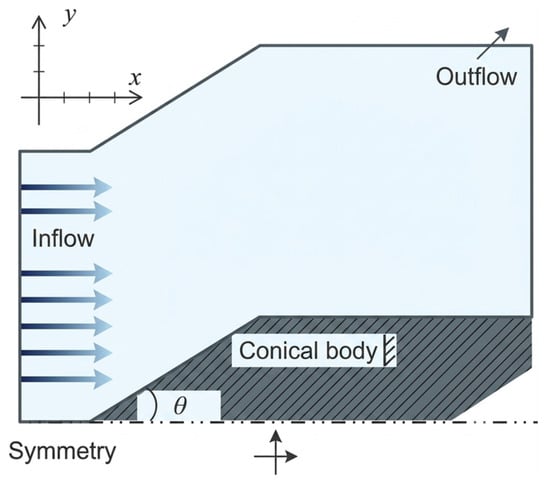
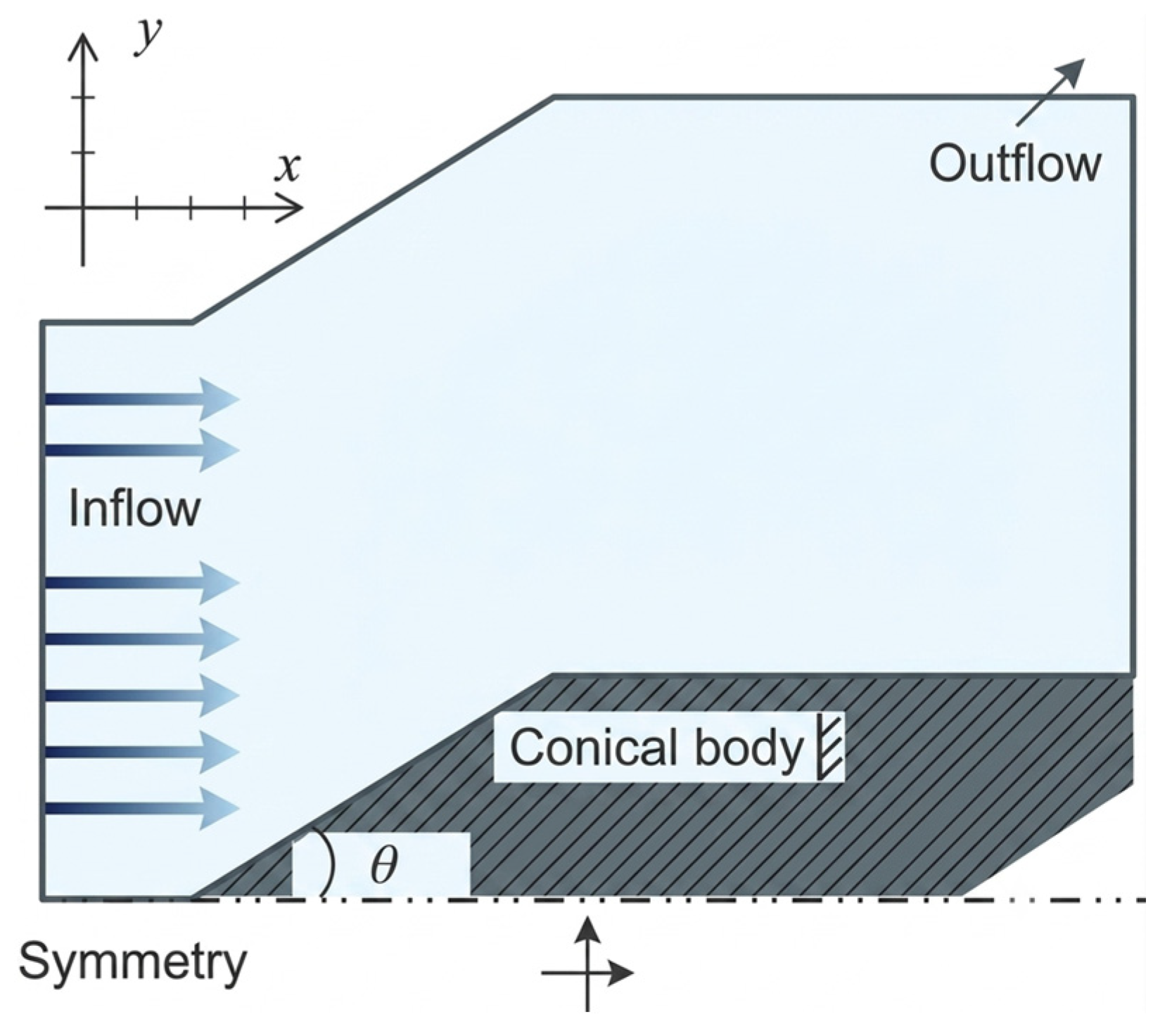
Figure 1 illustrates the computational domain, where x is axial and y is radial, with a semi-cone angle θ = 49°. All quantities are non-dimensionalized using inflow parameters (e.g., temperature, pressure, density) as references, and the cone length as the characteristic length. The domain size is 2.0 × 3.0 (non-dimensional). The numerical framework and chemistry models utilized herein are directly validated against the established conical oblique detonation studies of Han et al. [7]. Under identical freestream conditions, our solver accurately reproduces their verified shock structures and induction lengths, confirming the physical validity of the current grid-independent results prior to investigating finite-length expansion effects. Model parameters match those in [7] for consistency, as listed in Table 1. The inflow is a premixed gas with Mach number Ma0 = 7.5. Boundary conditions include: supersonic inflow on the left (parameters from Table 1); zero-gradient outflow on the right and top; axisymmetry on the bottom, with slip boundary conditions on the cone surface. It should be explicitly noted that the subsonic pocket observed near the wall in this study is driven purely by the gas-dynamic compression governed by the TM conical flow, rather than boundary layer viscous dissipation.
Figure 1.
Schematic of the computational domain.
Table 1.
Unified thermodynamic and chemical kinetic parameters for the pre-mixed inflow (adapted from Han et al. [7]).
2.3. Mesh Convergence Study
To ensure the numerical accuracy of the present simulations, a mesh convergence study was carried out using three initial mesh resolutions of 0.004, 0.002, and 0.0013 (non-dimensional), denoted as Mesh 1, Mesh 2, and Mesh 3, respectively. Adaptive mesh refinement (AMR) with three refinement levels was employed to resolve the detonation front and reaction zone. The corresponding minimum cell sizes after refinement were 5 × 10⁻⁴, 2.5 × 10⁻⁴, and 1.67 × 10⁻⁴, providing approximately 20, 40, and 60 cells across the ZND half-reaction length.
A detailed comparison of the adaptive mesh distribution, density fields under different mesh resolutions, and pressure distributions along the cone surface has been reported in our previous study [27]. Those results demonstrated that Mesh 2 and Mesh 3 produced nearly identical wave structures and pressure distributions, indicating satisfactory grid convergence, whereas Mesh 1 was insufficient to resolve the fine-scale instability structures.
Therefore, Mesh 2 was adopted throughout the present work because it provides an appropriate balance between computational efficiency and numerical accuracy. The present simulations employ the same numerical methodology, refinement strategy, and grid resolution as the validated configuration reported in Ref. [27].
3. Results and Discussion
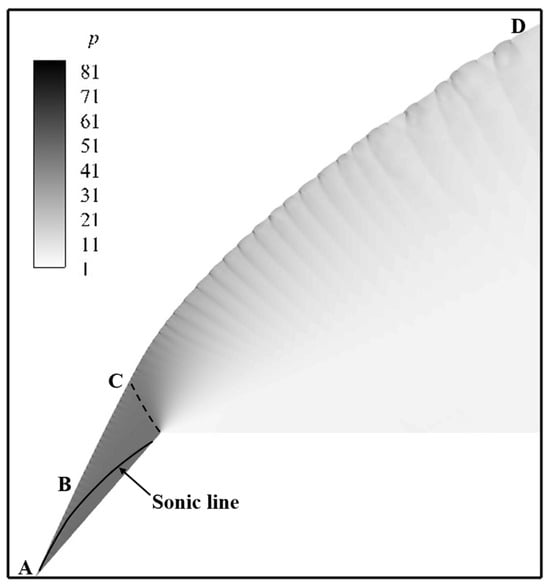
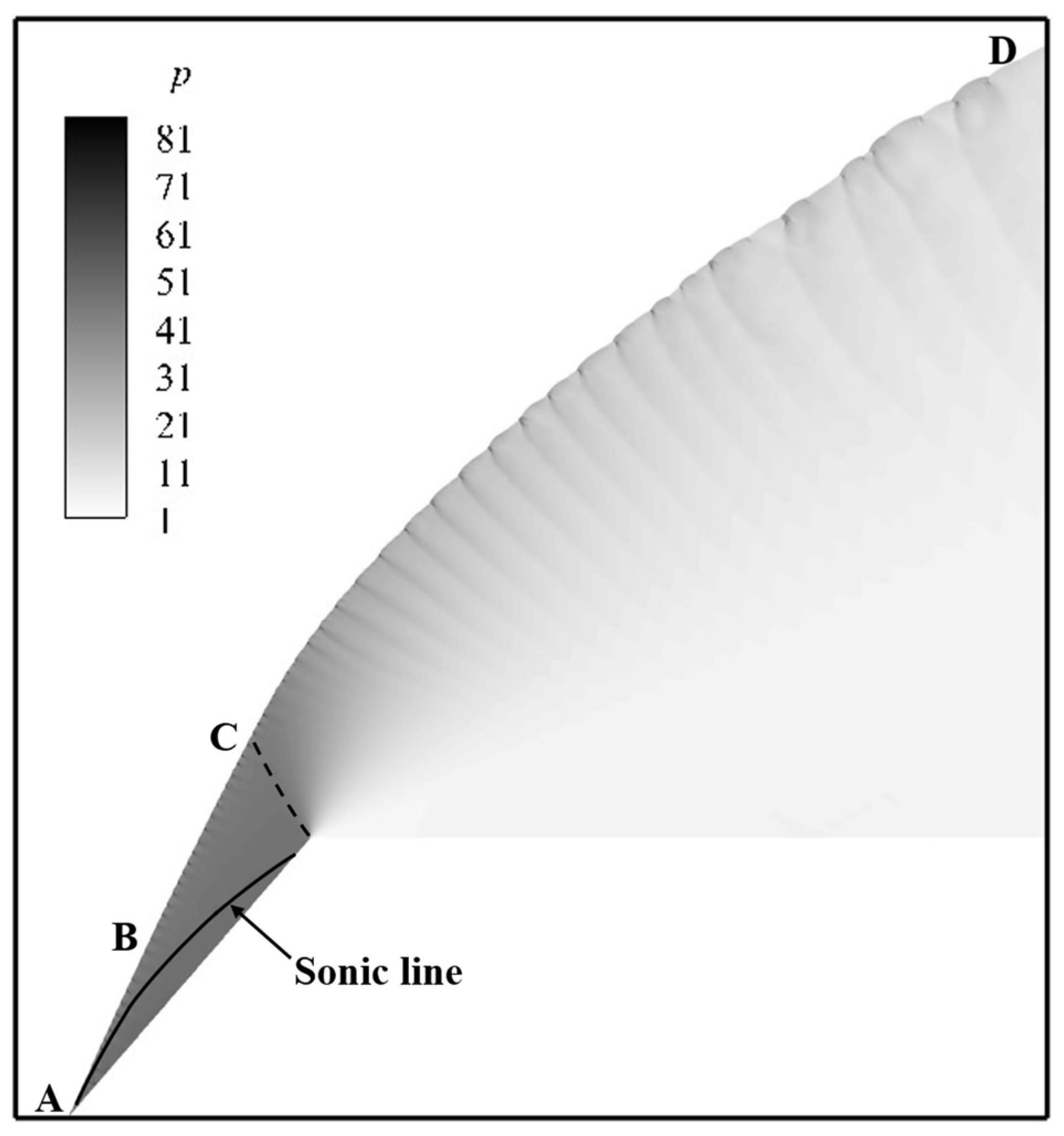
Figure 2 depicts the pressure schlieren field overlaid with the sonic line and the PM boundary. As shown, the sonic line aligns closely with the cone surface, while the upstream-propagating PM waves bend the downstream wave front. This mixed conical flow configuration contains both supersonic and subsonic regions, with the subsonic zone confined primarily to the cone surface due to the large semi-cone angle (49°). This angle enhances radial compression via TM flow, decelerating the local flow below sonic speeds while the bulk flow remains supersonic. Unlike conventional viscous boundary layers, this subsonic pocket originates entirely from the intense gas-dynamic compression of the inviscid conical flow. Therefore, the present mechanism is fundamentally different from the lambda-foot structures observed in shock-wave/boundary layer interactions. No viscous boundary layer, separation bubble, or associated shock-induced separation process exists in the current Euler formulation. Meanwhile, the finite cone length introduces an additional perturbation via PM expansion waves from the shoulder, which further modulates the wave front and downstream parameters. Consequently, the wave front segments into three primary regions: a cell-like single triple-point region, a cellular dual triple-point region, and a PM-affected dual triple-point region. The smooth ZND-like structure typical of supersonic conical flows is notably absent, owing to the increased detonation angle and enhanced instability from the subsonic pockets. To further elucidate these flow characteristics, streamlines traversing different portions of the wave front were also analyzed to assess variations in kinematic (Mach number) and thermodynamic parameters.
Figure 2.
Pressure schlieren image of the conical ODW in mixed conical flow induced by a finite-length cone. The solid line with arrow indicates the sonic line, and the dashed line denotes the PM boundary. Labels A–D represent four representative spatial locations along the cone surface, corresponding to different stages of wave development from upstream to downstream. The color bar represents pressure p.
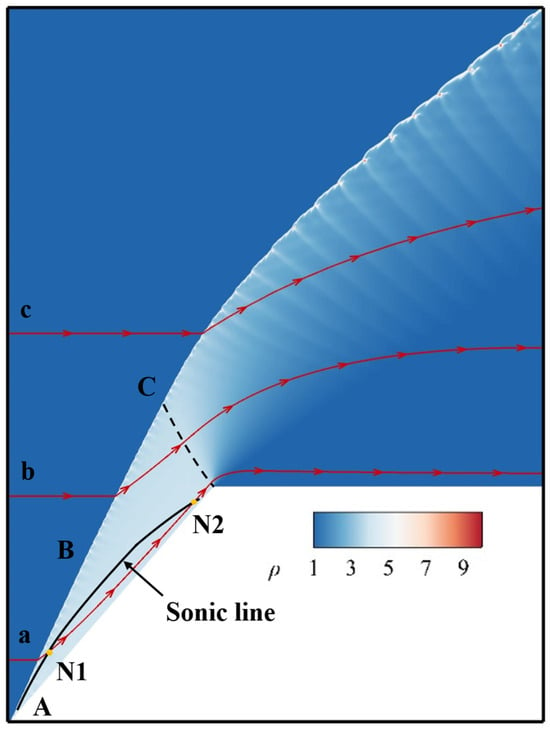
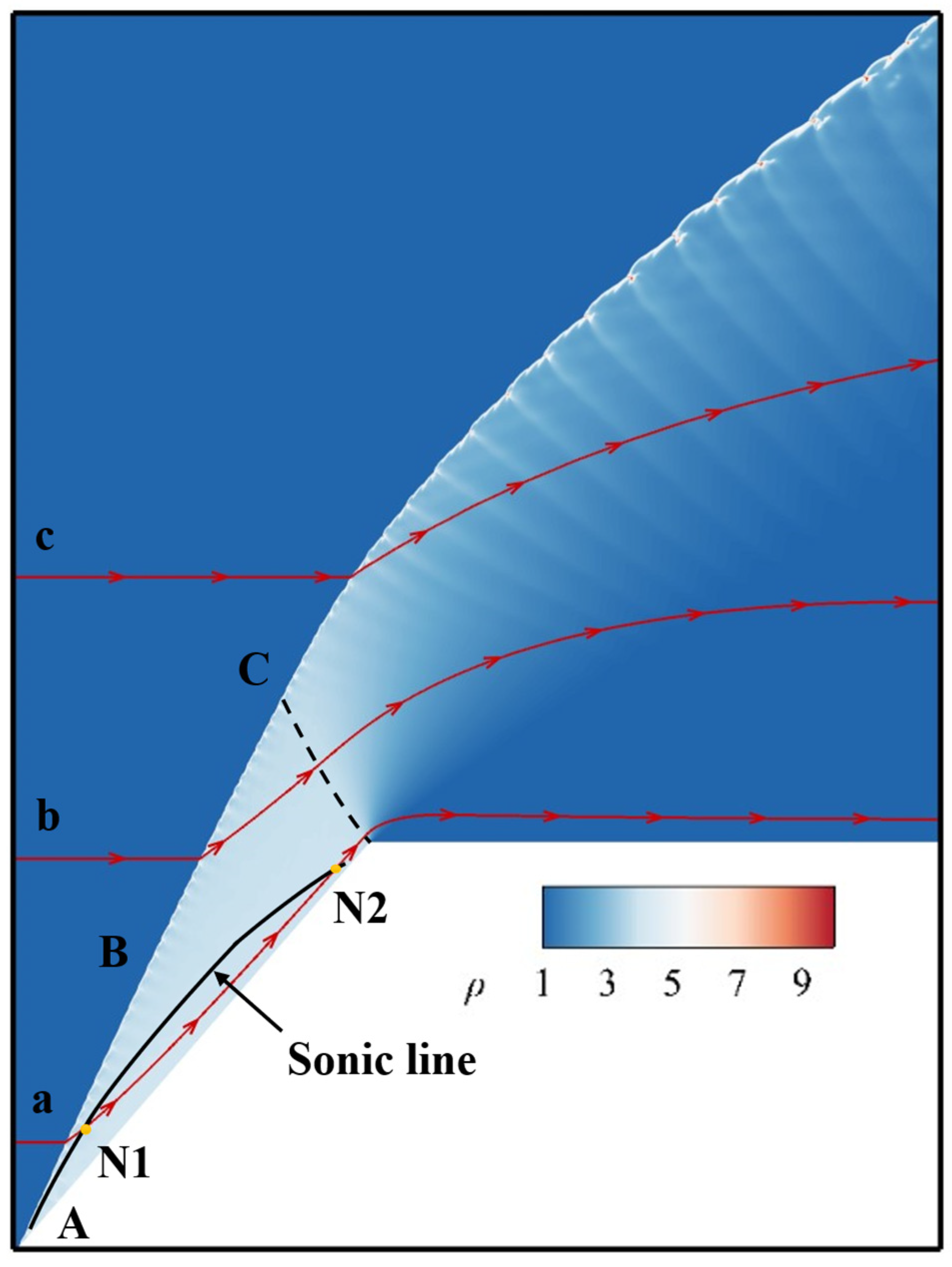
As illustrated in Figure 3, three representative streamlines—labeled a (near-wall), b (mid-field), and c (far-field)—were selected to probe these effects. Streamline a, originating near the cone surface, encounters the detonation front where the post-wave flow is initially subsonic. Here, the Mach number drops sharply post-detonation due to heat release and compression, reaching a minimum within the subsonic pocket (N1). As the flow proceeds along the cone, TM compression accelerates it back to sonic conditions (N2). Subsequently, PM expansion dominates, yielding a supersonic exit. Correspondingly, pressure and density rise during TM compression and decline within the PM region. Temperature follows a similar trend but exhibits less pronounced oscillations because the reaction completes upstream. Streamline b intersects the wave front in a transitional zone. It experiences partial TM compression before being influenced by the PM expansion, which moderates the parameter jumps. The Mach number remains supersonic post-wave, dips slightly during TM compression, and then recovers. Streamline c, located farther from the wall, bypasses significant TM effects and directly enters the PM expansion region. Consequently, it exhibits the smallest perturbations, characterized by a rapid post-detonation Mach reduction followed by swift acceleration.
Figure 3.
Density contour plot of partial flow field regions for the conical ODW in mixed conical flow induced by a finite-length cone.
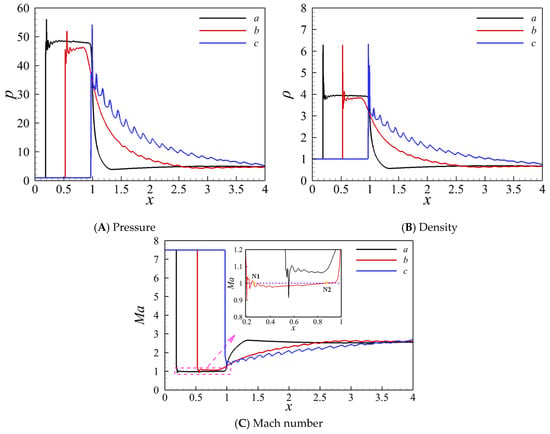
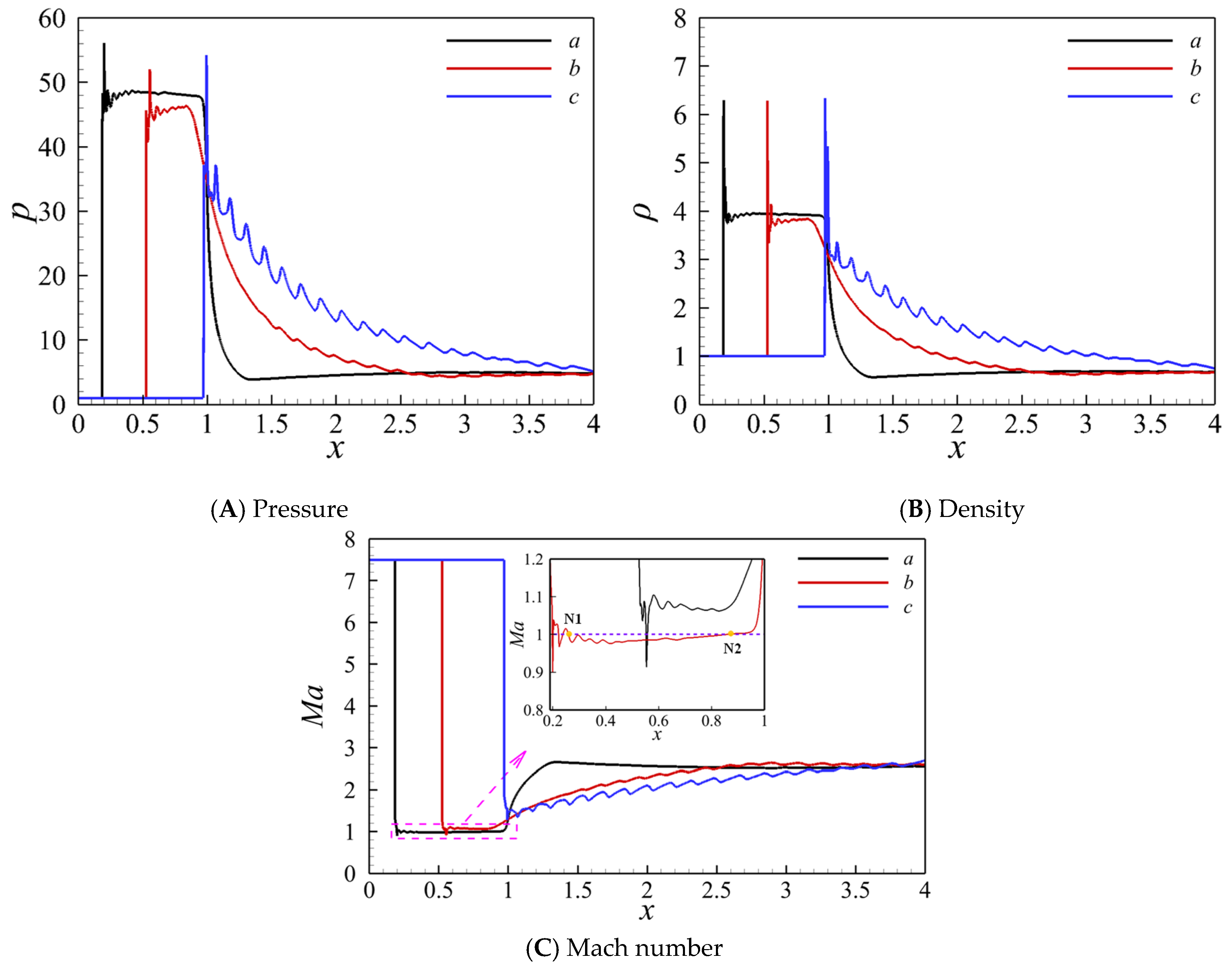
Figure 4A–C plot the quantitative variations along these streamlines, revealing oscillatory behavior modulated by triple-point interactions. Pressure and density exhibit initial spikes at the front, incremental rises during TM compression, and subsequent decays within the PM fan. Conversely, the Mach number shows opposite trends: post-wave deceleration, further slowing induced by TM compression, and PM-driven acceleration. These patterns underscore the critical role of the subsonic layer in amplifying TM effects. This amplification leads to steeper gradients than in purely supersonic cases, where uniform post-wave supersonic flow mitigates such instabilities. This macroscopic insight sets the stage for finer-scale analyses of triple-point dynamics and cellular structures. These findings highlight implications for the stability of oblique detonation engines, where excessive oscillations could compromise thrust efficiency. Compared with the purely supersonic regime reported by Yang et al. [12], the mixed-flow regime exhibits stronger parameter oscillations. The near-wall subsonic pocket amplifies the influence of TM compression, resulting in larger pressure and density gradients and enhanced wave-front instability.
Figure 4.
Variation curves of flow field parameters along streamlines under different wave front structures in the mixed conical ODW.
To elucidate the mechanism underlying the elimination of the smooth ZND-like structure and the enhanced cellular instability in the mixed regime, the acoustic feedback within the subsonic pocket must be scrutinized. In a purely supersonic conical flow, the entirely supersonic post-detonation field restricts the propagation of downstream disturbances to forward-facing characteristic lines (i.e., downstream transport). Consequently, the leading shock front near the cone tip is shielded from downstream perturbations, preserving a stable, smooth ZND-like initiation zone. Conversely, in the mixed flow regime, intense TM compression localizes a deceleration zone near the cone surface, establishing a confined subsonic pocket. Within this subsonic layer, the governing equations transition in nature, enabling acoustic waves to propagate upstream against the bulk flow at a relative velocity of c − u (where c is the local speed of sound and u is the flow velocity). Therefore, downstream perturbations, such as PM expansion waves from the cone shoulder and high-frequency acoustic emissions from downstream triple-point collisions, can bypass the supersonic wave-blocking effect. These upstream-traveling disturbances continuously penetrate the subsonic channel and impinge upon the detonation front. It should be emphasized that the present simulations do not identify the ultimate origin of the initial perturbations. Such disturbances may arise from unavoidable numerical noise, transient startup processes, adaptive mesh interfaces, or finite geometry effects. The role of the subsonic pocket demonstrated here is therefore not to generate the perturbation itself, but to provide an acoustic feedback pathway through which existing disturbances can be amplified and sustained. The accumulation and non-linear amplification of these acoustic perturbations disrupt the coupling between the leading shock and the chemical reaction zone. This acoustic feedback loop obliterates the smooth ZND region, accelerates wave front bifurcation, and culminates in the highly chaotic dual triple-point structures and enlarged cellular patterns observed downstream. Similar disturbance amplification phenomena have been reported in unstable oblique detonations [15,22]. However, the present study shows that the subsonic pocket generated by conical TM compression provides an additional pathway for upstream disturbance propagation, thereby intensifying cellular instability.
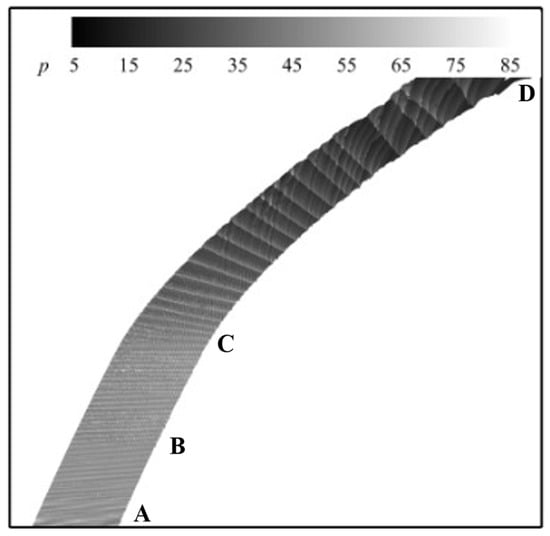
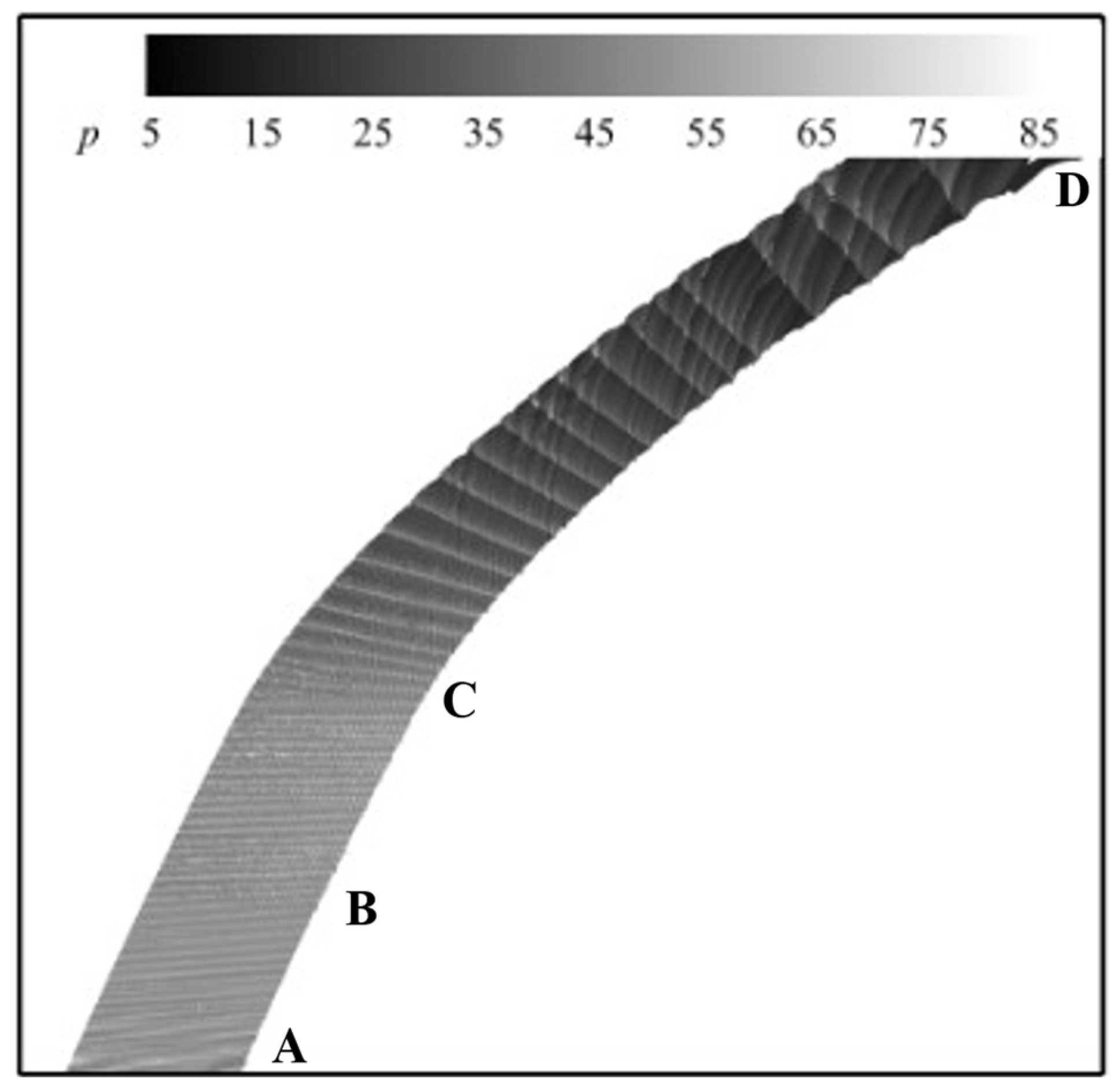
Shock polar theory is employed to investigate the unsteady wave front in mixed conical flow and to dissect local wave configurations around the triple points. This analysis reveals the interplay among incident shock (IS), transverse shock (TS), Mach stem (MS), and chemical reaction. This approach is highly effective for conical ODWs, where radial effects and post-wave subsonic zones introduce asymmetries absent in wedge-induced cases. The analysis focuses on three distinct wave front segments: the single triple-point (AB), dual triple-point (BC), and PM-affected dual triple-point (CD) regions. In each region, the upstream-facing triple point consistently exhibits greater strength, characterized by a higher post-shock Mach number and pressure that drive the overall instability. Meanwhile, motion traces highlight periodic collisions and reformations that underpin cellular evolution.
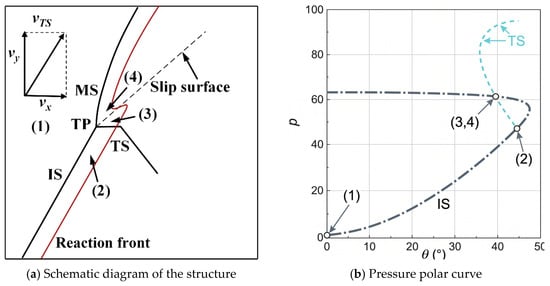
Figure 5a,b illustrate the local wave structures and corresponding shock polars for the AB segment. Figure 5a,b illustrate the local wave structures and corresponding shock polars for the AB segment. Figure 5a provides a schematic diagram labeling the wave elements (IS, TS, MS) and state points (1–4), including flow deflection angles and relative velocities, while Figure 5b displays the shock polar plot. As shown in the schematic, the IS compresses the inflow to state 2, resulting in a deflection angle of approximately 45° and a pressure ratio of 47. Guided by this configuration, the TS with a relative Mach number of 1.37 leads to state 3, whereas the MS achieves state 4. These distinct thermodynamic zones are separated by contact discontinuities. Within the polar plot, the intersection of the TS and MS polars confirms the equilibrium configuration, where the upstream branch dominates owing to its steeper pressure–deflection curve. This polar intersection further validates upstream dominance. Consequently, the triple point exhibits a slow upstream migration, fostering the gradual weakening of the front and the initiation of downstream structures.
Figure 5.
Close-up view of the wave structure and shock polar analysis in the AB segment.
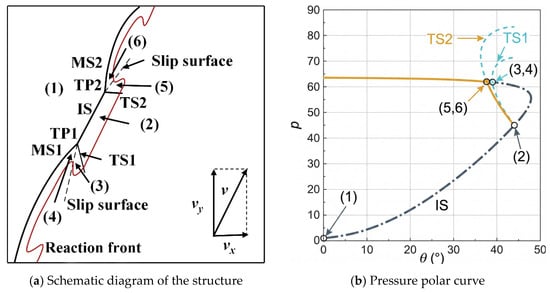
Further downstream, the expanded post-detonation channel continues to render the wave front highly susceptible to deformation. Driven by substantial distortions and frequent collisions, subsidiary shocks form simultaneously in both upstream and downstream directions. This process yields a dual triple-point structure in the BC segment of the detonation front. Figure 6 presents a detailed view of the local flow field within the BC segment. Figure 6a schematically illustrates the wave front, while Figure 6b shows the pressure–deflection polar diagram constructed from flow data near two adjacent triple points. In the polar plot, the black curve represents the post-IS state, and the blue and green curves correspond to states behind the TS1 and TS2. When the incoming unburned gas (state 1) traverses the IS, it transitions to a compressed unburned state (state 2) with a flow deflection of 44.5° and a pressure ratio of 46, signifying intensified shock strength. Of the two adjacent triple points (TP1 and TP2) along the IS, TP1 features a TS with a relative Mach number of 1.23 relative to the unburned gas (state 2). Conversely, TS2 exhibits a higher relative Mach number of 1.32, indicating faster propagation and stronger surrounding waves. In the polar diagram of Figure 6b, the reflected shock polars for TS1 and TS2 are constructed starting from state 2 on the IS polar. These curves intersect the IS polar based on their respective Mach numbers. The intersections of the IS polar with the TS1 polar yield state 3 behind TS1 and state 4 behind the MS1 at TP1. These two states are separated by a contact discontinuity, ensuring equal pressure. Similarly, the intersections with the TS2 polar determine states 5 and 6 at TP2. Owing to the elevated speed of TP2 relative to the unburned gas, its wave system is stronger, resulting in higher pressures at states 5 and 6 than at states 3 and 4.
Figure 6.
Close-up view of the structure in the BC segment of the mixed conical ODW front and polar curve analysis.
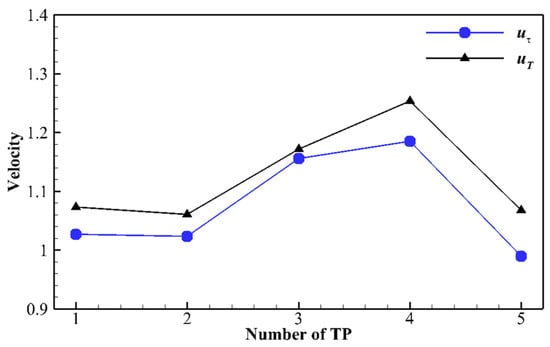
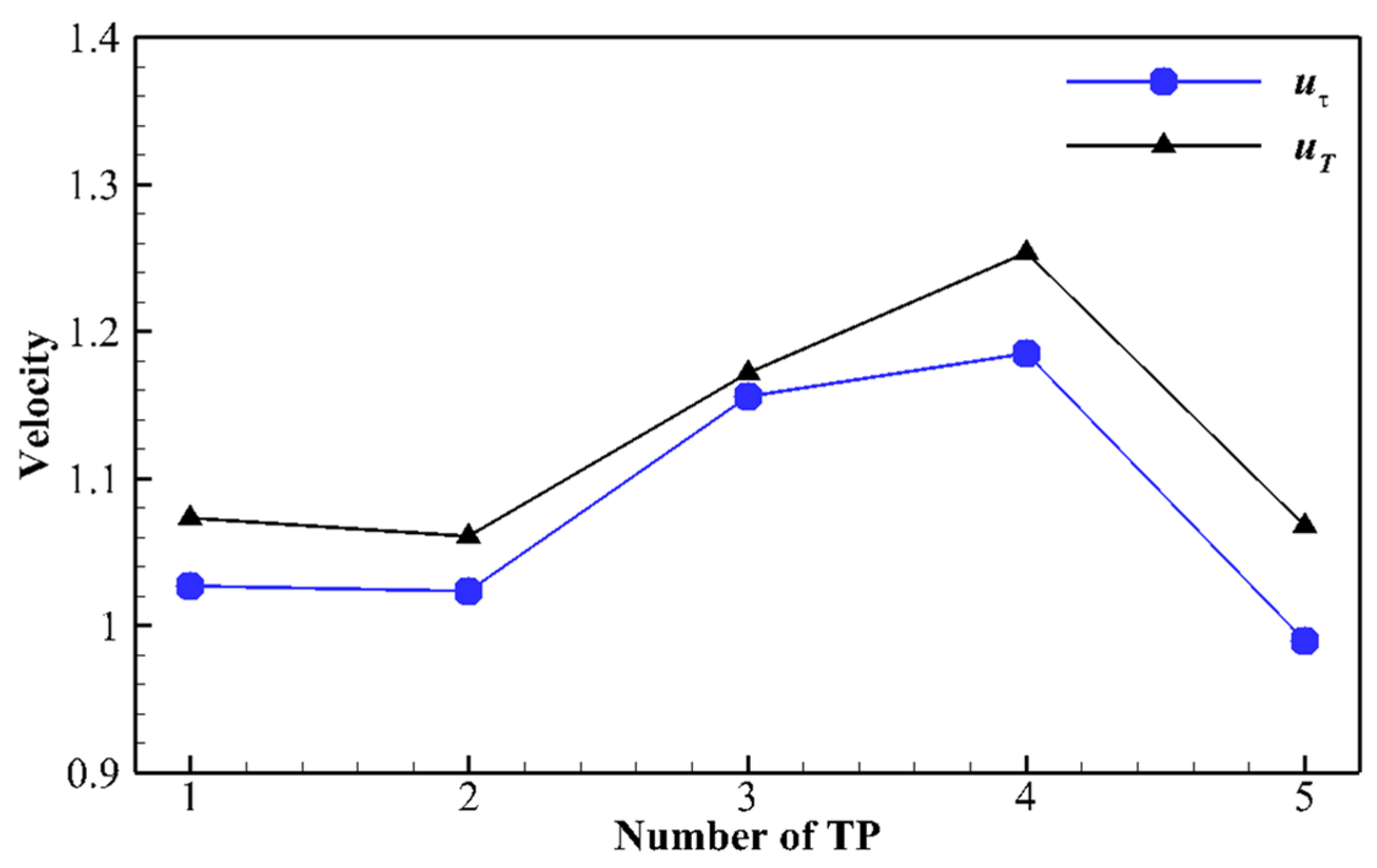
Regarding the propagation of the two triple points within the dual triple-point structure of the conical ODW front, particular attention is given to the downstream triple point TP2. This focus arises because TP1 propagates consistently downstream along the flow direction. Figure 7 presents the calculated normal component of the post-oblique-shock flow velocity uτ and the TS speed uT for TP2. As evident from the figure, the TS speed slightly exceeds the normal flow velocity, causing TP2 to migrate slowly upstream. Meanwhile, the persistent downstream motion of TP1 drives the two triple points to converge until they collide. During this approach, the MS1 and MS2 progressively attenuate into regular oblique shocks. Post-collision, a new TS forms, after which TP1 resumes its original downstream trajectory. Consequently, the two triple points gradually diverge.
Figure 7.
Normal component of post-oblique-shock flow velocity and TS speed at TP2 within the BC segment.
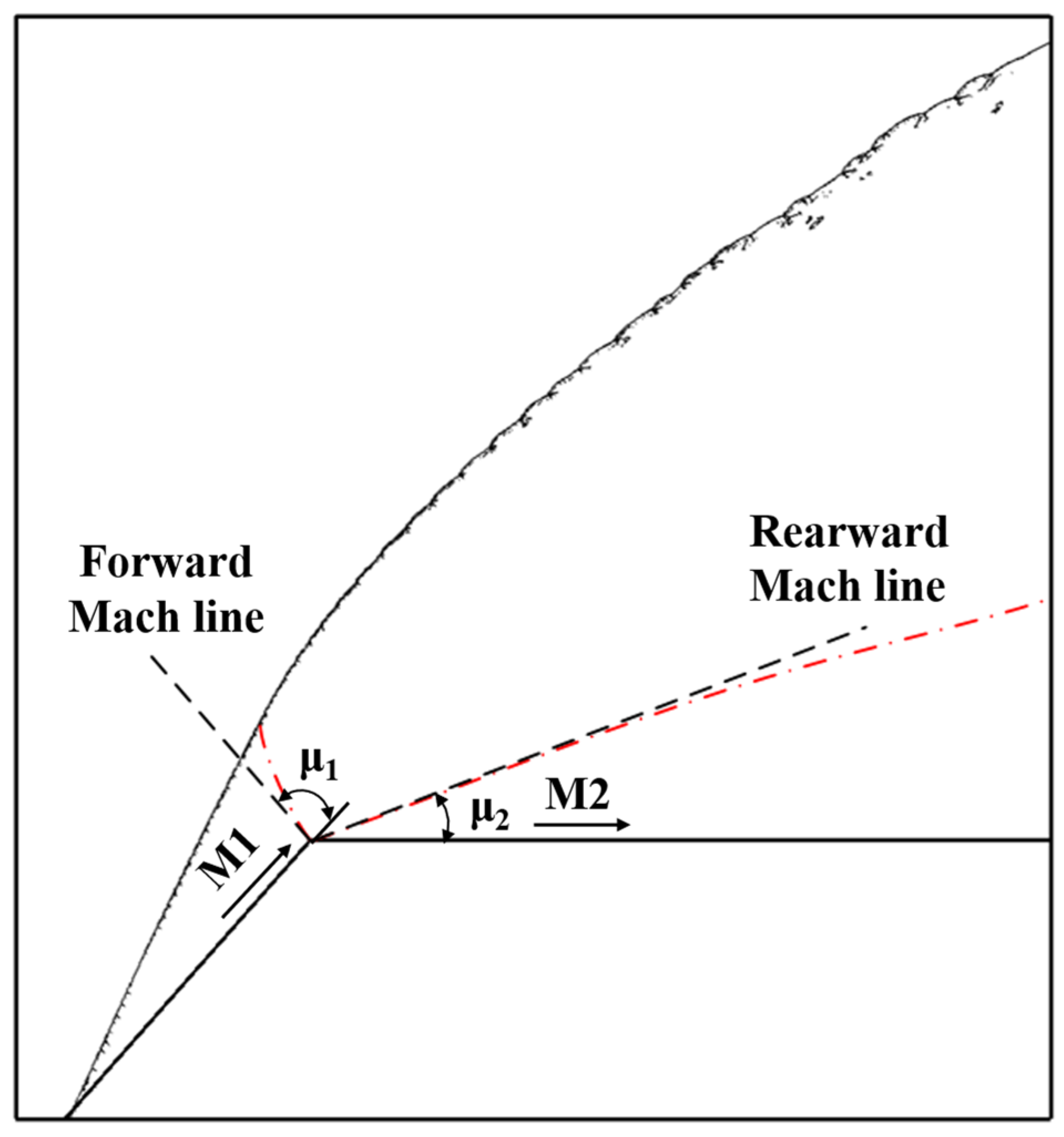
Further downstream, the detonation structure enters the CD segment, which is influenced by PM expansion waves originating from the cone shoulder. In this segment, the post-wave flow field displays a pronounced pressure demarcation caused by expansion effects. Figure 8 schematically illustrates this PM-affected region on the detonation front, where a red dashed line marks the pressure boundary within the expansion zone. This configuration arises because TM dynamics govern the post-conical-detonation flow. Specifically, isentropic compression decelerates the flow, resulting in nonuniform Mach numbers at the shoulder that are lower near the cone surface and higher farther away. Consequently, the pressure boundary assumes a rearward-curving, arcuate profile. According to PM expansion theory, the Mach number immediately upstream of the leading Mach line near the wall is 1.05, which is marginally supersonic and corresponds to a Mach angle of 70°. Behind the trailing Mach line, the Mach number reaches 2.7, and the Mach angle decreases to 22°. The increased detonation angle further reduces the local Mach number. This reduction expands the influence zone of the shoulder-generated expansions, thereby enlarging the PM-affected CD segment.
Figure 8.
Influence region diagram of PM flow on the conical ODW in mixed conical flow.The red dashed line denotes the pressure boundary within the expansion region. The solid line indicates the forward Mach line, while the dashed line represents the rearward Mach line. This configuration reflects the modulation of post-conical-detonation flow by Prandtl–Meyer (PM) expansion effects induced by the cone shoulder.
By tracking triple-point trajectories over time, the cellular patterns of the conical ODW in mixed conical flow are reconstructed. This trajectory-tracking technique was previously used to discern instability modes in wedge- and projectile-induced detonations. In this mixed flow regime, the subsonic near-wall layer intensifies TS interactions, yielding three distinct cell morphologies: parallel lines in the AB segment, oblique rhombi in the BC segment, and irregular oblique rhombi in the CD segment. These morphologies arise from the varying dominance and collision frequencies of upstream and downstream triple points, which are modulated by TM compression and PM expansion. Notably, no smooth planar cells typical of supersonic conical flows are observed, underscoring the heightened instability induced by mixed flow heterogeneity. Figure 9 maps these trajectories to illustrate the cellular evolution. The AB segment exhibits parallel lines due to the upstream-biased slow migration of single triple points, which maintains quasi-uniform spacing. The BC segment shows oblique rhombi formed by opposing motions that lead to regular collisions and reformations. This pattern is akin to classic gaseous detonation cells but skewed by radial effects. Finally, the CD segment displays irregular oblique rhombi, where PM-induced distortions cause erratic traces and variable cell sizes. Compared to purely supersonic cases where four distinct cell types (including smooth ZND-like structures) prevail, the mixed flow cells are larger and more chaotic. This difference reflects amplified perturbations from the subsonic pockets. These insights can inform stabilization strategies for conical ODWs in propulsion applications, such as optimizing the cone angle to suppress irregular cellular modes. Compared with the smoother cellular structures typically observed in purely supersonic conical detonations [12], the enlarged and irregular cells in the mixed regime indicate stronger disturbance accumulation, consistent with the enhanced acoustic feedback mechanism discussed above.
Figure 9.
Numerical smoked foil record of the mixed conical ODW.
4. Conclusions
This study elucidates the intricate unsteady dynamics and instability mechanisms governing axisymmetric conical ODWs operating in the mixed supersonic–subsonic regime. Through high-fidelity simulations resolving fine-scale triple-point interactions and acoustic phenomena, the analysis uncovers how the coupling between TM compression and PM expansion fundamentally reshapes detonation wave behavior in realistic three-dimensional configurations.
A central finding is the establishment of a localized subsonic pocket near the cone surface, which arises purely from inviscid radial flow divergence rather than viscous effects. This subsonic channel provides a sustained acoustic feedback pathway capable of amplifying and maintaining pre-existing disturbances. Downstream disturbances from shoulder expansion waves and triple-point collisions propagate upstream and continuously perturb the leading detonation front. The resulting amplification of disturbances is associated with the suppression of a stable smooth initiation zone and the emergence of highly irregular, segmented wave-front structures characterized by evolving single and dual triple-point configurations. Shock polar analysis and triple-point trajectory tracking further reveal distinct regimes of wave propagation and cellular pattern formation, highlighting the pronounced sensitivity of conical detonations to post-wave flow heterogeneity. These insights extend beyond conventional planar wedge studies by demonstrating how axisymmetric geometry introduces unique radial effects that amplify instability modes. The present work focuses on the disturbance amplification mechanism associated with the subsonic feedback channel. The primary excitation source of the perturbations themselves remains an open question and warrants future investigation through controlled perturbation studies and stability analyses. The observed competition between stabilizing compression and destabilizing expansion provides a mechanistic explanation for the enhanced cellular irregularity and absence of classical ZND-like features in the mixed regime. Such understanding is pivotal for advancing pressure-gain combustion concepts, where maintaining robust shock–reaction zone coupling is essential for achieving high thermodynamic efficiency and minimizing combustor length. The present findings carry direct implications for the design of ODW engines intended for sustained hypersonic flight. They underscore the importance of strategic geometric tailoring—particularly cone angle selection—to modulate the extent of the subsonic pocket and mitigate detrimental acoustic feedback. Moreover, this work highlights the limitations of two-dimensional approximations in predicting real-engine performance, emphasizing the need for three-dimensional considerations in future propulsion system development. Future research should explore the influence of finite-rate chemistry, viscous effects, and more complex inlet geometries to bridge the gap between idealized simulations and practical implementations. Extending these analyses to reacting flows with detailed kinetics and three-dimensional non-axisymmetric configurations will be instrumental in developing stable, high-performance ODWE architectures.
Overall, by revealing the previously under-explored acoustic and structural complexities of conical oblique detonations in the mixed regime, this investigation contributes a critical step toward the realization of next-generation hypersonic air-breathing propulsion systems with superior efficiency and compactness.
Author Contributions
Conceptualization, Z.W. and Z.P.; methodology, Z.W.; software, Z.W.; validation, Z.W.; formal analysis, Z.W.; investigation, Z.W.; resources, Z.P.; data curation, Z.W.; writing—original draft preparation, Z.W.; writing—review and editing, Z.H., M.G. and Z.P.; visualization, Z.W.; supervision, Z.P.; project administration, Z.P.; funding acquisition, Z.P. All authors have read and agreed to the published version of the manuscript.
Funding
This research was funded by the National Natural Science Foundation of China, grant number 12472367.
Data Availability Statement
The data presented in this study are available on request from the corresponding author.
Conflicts of Interest
The authors declare no conflicts of interest.
References
- Pratt, D.T.; Humphrey, J.W.; Glenn, D.E. Morphology of standing oblique detonation waves. J. Propuls. Power 1991, 7, 837–845. [Google Scholar] [CrossRef] [Scilit]
- Kailasanath, K. Review of propulsion applications of detonation waves. AIAA J. 2000, 38, 1698–1708. [Google Scholar] [CrossRef] [Scilit]
- Roy, G.D.; Frolov, S.M.; Borisov, A.A.; Netzer, D.W. Pulse detonation propulsion: Challenges, current status, and future perspective. Prog. Energy Combust. Sci. 2004, 30, 545–672. [Google Scholar] [CrossRef] [Scilit]
- Viguier, C.; Figueira da Silva, L.F.; Desbordes, D.; Deshaies, B. Onset of oblique detonation waves: Comparison between experimental and numerical results for hydrogen-air mixtures. Symp. Combust. 1996, 26, 3023–3031. [Google Scholar] [CrossRef] [Scilit]
- Teng, H.; Jiang, Z. On the transition pattern of the oblique detonation structure. J. Fluid Mech. 2012, 713, 659–669. [Google Scholar] [CrossRef] [Scilit]
- Shepherd, J.E. Detonation in gases. Proc. Combust. Inst. 2009, 32, 83–98. [Google Scholar] [CrossRef] [Scilit]
- Han, W.; Wang, C.; Law, C.K. Three-dimensional simulation of oblique detonation waves attached to cone. Phys. Rev. Fluids 2019, 4, 053201. [Google Scholar] [CrossRef] [Scilit]
- Zhang, Y.; Yang, P.; Teng, H.; Ng, H.D.; Wen, C. Transition between different initiation structures of wedge-induced oblique detonations. AIAA J. 2018, 56, 4016–4023. [Google Scholar] [CrossRef] [Scilit]
- Miller, G.; Davis, A.; Gao, X. Resolving Cellular Structures of an Oblique Detonation Wave Using High-Order Finite Volume Methods with Adaptive Mesh Refinement. In Proceedings of the 2025 Regional Student Conferences; No. 2025-97696; AIAA: Reston, VA, USA, 2025. [Google Scholar]
- Choi, J.Y.; Kim, D.W.; Jeung, I.S.; Ma, F.; Yang, V. Cell-like structure of unstable oblique detonation wave from high-resolution numerical simulation. Proc. Combust. Inst. 2007, 31, 2473–2480. [Google Scholar]
- Fang, Y.; Hu, Z.; Teng, H.; Jiang, Z. Numerical study of the oblique detonation initiation induced by spheres. Chin. J. Theor. Appl. Mech. 2017, 49, 268–273. [Google Scholar]
- Yang, P.; Ng, H.D.; Jiang, Z. Initiation structure of oblique detonation waves behind conical shocks. Phys. Fluids 2017, 29, 086104. [Google Scholar] [CrossRef] [Scilit]
- Qin, J.; Zhu, D. Criticality for Oblique Detonation Waves Induced by a Finite Wedge in a Hydrogen–Air Mixture. Aerospace 2023, 10, 508. [Google Scholar] [CrossRef] [Scilit]
- Shang, J.; Hu, G.; Wang, Q.; Xiang, G.; Zhao, W. Progress of Experimental Studies on Oblique Detonation Waves Induced by Hyper-Velocity Projectiles. Aerospace 2024, 11, 715. [Google Scholar] [CrossRef] [Scilit]
- Teng, H.; Ng, H.D.; Li, K.; Luo, C.; Jiang, Z. Evolution of cellular structures on oblique detonation surfaces. Combust. Flame 2015, 162, 470–477. [Google Scholar] [CrossRef] [Scilit]
- Han, T.; Hu, S.; Jiang, C.; Lee, C.-H. Basic solutions to Taylor–Maccoll equations. J. Fluid Mech. 2024, 999, A48. [Google Scholar] [CrossRef] [Scilit]
- Sugiyama, Y.; Homae, T.; Matsumura, T.; Wakabayashi, K. Numerical investigations on detonations in a condensed-phase explosive and oblique shock waves in surrounding fluids. Combust. Flame 2020, 211, 133–146. [Google Scholar] [CrossRef] [Scilit]
- Yang, P.; Teng, H.; Ng, H.D.; Jiang, Z. A numerical study on the instability of oblique detonation waves with a two-step induction–reaction kinetic model. Proc. Combust. Inst. 2019, 37, 3537–3544. [Google Scholar]
- Abisleiman, S.; Sharma, V.; Bielawski, R.; Raman, V. Structure of three-dimensional conical oblique detonation waves. Combust. Flame 2025, 274, 113971. [Google Scholar] [CrossRef] [Scilit]
- Niu, S.; Yang, P.; Zhang, Z.; Teng, H. Three-dimensional morphology and formation mechanism of tongue-shaped oblique detonation waves in elliptical flow channels. Combust. Flame 2025, 282, 114468. [Google Scholar]
- Zhang, Z.; Liu, Y.; Wen, C. Mechanisms of the destabilized Mach reflection of inviscid oblique detonation waves before an expansion corner. J. Fluid Mech. 2022, 940, A29. [Google Scholar] [CrossRef] [Scilit]
- He, G.; Feng, Z.; Wang, K.; Teng, H. Unsteady wave characteristics of oblique detonation wave in a contraction–expansion channel. Int. J. Hydrogen Energy 2024, 71, 999–1005. [Google Scholar] [CrossRef] [Scilit]
- Li, C.; Kailasanath, K.; Oran, E.S. Detonation structures behind oblique shocks. Phys. Fluids 1994, 6, 1600–1611. [Google Scholar] [CrossRef] [Scilit]
- Bourlioux, A.; Majda, A.J. Theoretical and numerical structure for unstable two-dimensional detonations. Combust. Flame 1992, 90, 211–229. [Google Scholar] [CrossRef] [Scilit]
- Kurganov, A.; Noelle, S.; Petrova, G. Semidiscrete central-upwind schemes for hyperbolic conservation laws and Hamilton-Jacobi equations. SIAM J. Sci. Comput. 2001, 23, 707–740. [Google Scholar]
- Bader, G.; Deuflhard, P. A semi-implicit mid-point rule for stiff systems of ordinary differential equations. Numer. Math. 1983, 41, 373–398. [Google Scholar]
- Liu, J.; Gui, M.; Zhang, D.; Dong, G. Numerical study on unsteady structure of oblique detonation wave induced by a finite cone. Explos. Shock Waves 2025, 45, 092101. (In Chinese) [Google Scholar]

Disclaimer/Publisher’s Note: The statements, opinions and data contained in all publications are solely those of the individual author(s) and contributor(s) and not of MDPI and/or the editor(s). MDPI and/or the editor(s) disclaim responsibility for any injury to people or property resulting from any ideas, methods, instructions or products referred to in the content. |
© 2026 by the authors. Licensee MDPI, Basel, Switzerland. This article is an open access article distributed under the terms and conditions of the Creative Commons Attribution (CC BY) license.