


Abstract
During hydraulic fracturing, the extensive use of slickwater and post-fracturing shut-in (soaking) processes take advantage of spontaneous imbibition to displace crude oil. While nano-flooding agents are known to reduce interfacial tension (IFT) and alter wettability, a critical challenge lies in distinguishing between deep but inefficient displacement and shallow but highly efficient sweep. This study investigates the pore-scale mobilization and penetration depth of a nano-flooding agent in tight conglomerate reservoirs and focuses on the recovery per unit imbibition depth as a novel metric for evaluating the displacement efficiency. The nano-agent demonstrated excellent performance, reducing oil–water IFT to 0.141 mN/m and reversing wettability from oil-wet (148.7°) to water-wet (39.5°). Experiments revealed that the diffusion rate of the nano-agent decreases with pore size, suggesting a limited transport in confined space. Under reservoir conditions (80 °C), spontaneous imbibition in tight cores was highly permeability-dependent. High-permeability cores achieved a recovery rate of up to 44.6%, whereas low-permeability cores reached only about 12%. This work highlights that penetration depth alone does not necessarily indicate high recovery. The medium-permeability core exhibited a lower final penetration depth than the low-permeability core but achieved a much higher total recovery due to superior efficiency per unit depth, suggesting that in tight reservoirs, a shallow but highly efficient displacement mechanism can outperform a deep but inefficient one.
1. Introduction
Pore-scale fluid dynamics in tight rocks is of critical importance particularly for unconventional reservoirs [1,2,3]. Tight rocks, characterized by low permeability and complex pore structures, pose significant challenges for fluid flow and oil extraction [4,5]. Understanding the behavior of fluids at the pore scale is essential for optimizing recovery techniques, as traditional macroscopic approaches often fail to capture the intricate interactions between fluids and the rock matrix [6,7,8]. The heterogeneity of pore networks, coupled with the dominance of capillary forces over viscous forces, necessitates a detailed examination of fluid distribution and mobilization mechanisms. Techniques such as nuclear magnetic resonance (NMR) and imbibition experiments have emerged as powerful tools for probing these phenomena, offering insights into fluid saturation, pore-size distribution, and wettability effects [9,10,11].
Spontaneous imbibition, driven by capillary forces, is a key mechanism for oil recovery in tight rocks [6,12,13]. The process involves the displacement of oil by water, with efficiency varying significantly across pore sizes due to differences in capillary pressure and connectivity [14,15]. Tight reservoirs exhibit complex pore networks, including micropores, mesopores, and macropores, each influencing imbibition efficiency differently [16,17]. Studies have shown that imbibition rates and recovery efficiency are highly sensitive to rock properties such as permeability and porosity, with larger pores often exhibiting faster initial imbibition but lower ultimate recovery compared to smaller pores [14]. Tight sandstones, for instance, exhibit pore radii concentrated in the 0.01–1 m range, with micropores and small mesopores contributing significantly to oil displacement during imbibition [18].
The effectiveness of imbibition is highly dependent on pore size distribution and rock wettability [19]. The addition of surfactants or nanofluids can modify interfacial tension and wettability, enhancing imbibition and oil mobilization [20,21]. Liu et al. reveal that surfactants primarily recover oil from macropores, while micropores, often lined with organic matter or clay, remain less affected due to their resistance to wettability alteration [22]. This heterogeneity underscores the importance of mineral composition, as quartz and feldspar surfaces in macropores are more amenable to surfactant-induced wettability changes compared to organic-rich micropores [22]. Wettability alteration is particularly crucial in oil-wet formations, where surfactants can shift the contact angle from oil-wet to water-wet, transforming capillary forces into a driving mechanism for imbibition [23]. However, the economic optimization of these additives remains a challenge, highlighting the importance of pore-scale studies [16,24,25].
Boundary conditions and scaling models also influence imbibition dynamics [26]. Open-boundary systems, where imbibition occurs across multiple faces, exhibit higher recovery rates and ultimate yields compared to closed-boundary setups [18]. However, conventional scaling equations often fail to account for wettability alteration effects, limiting their applicability in surfactant-enhanced imbibition studies [18]. Sun et al. found that surfactants and nanofluids not only enhance oil mobility but also improve flow capacity in smaller pores, as evidenced by reductions in movable pore throat sizes from 0.363 m to 0.326 m [23].
Nuclear magnetic resonance (NMR) techniques have emerged as a powerful tool for analyzing pore-scale fluid distribution in tight rocks, offering insights into fluid saturation, pore geometry, and wettability [27,28,29]. Unlike macroscopic methods that only measure bulk recovery, NMR provides a detailed understanding of fluid occupancy across different pore systems, making it invaluable for enhanced oil recovery (EOR) applications [9,30]. The interpretation of NMR spectra relies on the transverse relaxation time (T2), which correlates with pore size and fluid mobility. For instance, shorter T2 times indicate smaller pores or bound fluids, while longer T2 times suggest larger pores or mobile fluids. This capability allows classification of fluid distribution models, such as low-saturation, patchy, or uniform distributions, each of which has distinct implications for acoustic properties and oil recovery efficiency [31,32].
The integration of NMR with imbibition experiments has further advanced the understanding of fluid dynamics in tight reservoirs. Studies combining NMR T2 measurements with spontaneous imbibition reveal that water initially enters micropores and small mesopores, driven by capillary forces, before gradually migrating to larger pores [33,34]. This process is particularly evident in gas/water/rock systems, where imbibition rates are higher compared to oil/water/rock systems due to differences in wettability and fluid interactions [31]. NMR also distinguishes between recoverable and residual oil by tracking fluid redistribution during imbibition and displacement, highlighting the dominance of nanopores in controlling imbibition rates and recovery outcomes [33,35]. Such findings underscore the importance of pore-scale heterogeneity in designing effective EOR strategies. Moreover, NMR-derived T1/T2 ratios further refine wettability assessments by capturing rock–fluid interactions, such as the reduction in hydrophilicity observed in CO2-brine systems [36].
Despite significant advancements in understanding pore-scale fluid dynamics and imbibition mechanisms in tight rocks, several critical challenges remain unresolved. The interplay between rock properties and fluid dynamics warrants deeper investigation. Current understanding of how pore size distribution, wettability, and mineral composition influence imbibition efficiency is still incomplete. Advanced imaging techniques such as NMR coupled with real-time monitoring could provide new insights into these relationships. Furthermore, the impact of rock–fluid interactions on long-term recovery rates needs to be explored, particularly in the context of unconventional reservoirs where traditional assumptions may not hold.
The rest of the paper is structured as follows.
Setup for the spontaneous imbibition experiments is introduced, followed by the NMR analysis method, and the results are presented in terms of the pore sized ranges from which the remaining oil is mobilized, the imbibition recovery, and the penetration depth for cores of different permeabilities. Comparisons between the cores are then given before a summary of key findings of this work.
2. Materials and Methods
2.1. Materials
Core Samples: Three tight conglomerate core samples representing the typical range of permeabilities were sourced from the M18 well area and were used for the spontaneous imbibition experiments. The core were drilled into cylindrical plugs, and their fundamental petrophysical properties, including diameter, length, porosity, and permeability are detailed in Table 1.
Table 1.
Petrophysical properties of the experimental core samples.
Crude Oil: The crude oil used in all experiments was also obtained from the M18 well area. To ensure consistency, the oil was centrifuged and filtered to eliminate any produced water and solid particles before use. The viscosity of the treated crude oil was measured to be 8.7 and 2.2 mPas at ambient temperature and 80 °C, respectively.
Synthetic brine: A synthetic brine was prepared to mimic the ionic composition of the formation water in the M18 reservoir. The brine was formulated by dissolving specific salts in distilled water. The composition per 1000 g of solution was: 6.83 g of Sodium Chloride (NaCl), 2.18 g of anhydrous Calcium Chloride (CaCl2), 0.54 g of Magnesium Chloride (MgCl2), and 0.9 g of Sodium Bicarbonate (NaHCO33). This resulted in a total mineralization of 10,450 mg/L. For Nuclear Magnetic Resonance (NMR) experiments, heavy water (D2O, purchased from Aladdin with a purity of 99.9%) was used as the solvent instead of distilled water to suppress the hydrogen signal from the aqueous phase, thereby isolating the signal from the crude oil. Salt concentrations for heavy water were identical with those for the non-NMR experiments.
Nano-flooding Agent Solution: The nano-flooding agent solution was prepared by dissolving the nano-surfactant in the simulated formation water to a mass fraction of 0.2%. This concentration was selected based on preliminary optimization studies and field application standards.
2.2. Equipments
A Spinning Drop Interfacial Tensiometer, model SDT, from KRUSS, Hamberg, Germany was used for measuring the dynamic interfacial tension (IFT) between the crude oil and the aqueous solutions. And a contact Angle Goniometer, model CAT, also from KRUSS, was employed to measure the contact angle of an oil droplet on the rock slice surface submerged in the nano-agent solution, using the captive bubble method. This allowed for the quantitative evaluation of the agent’s ability to alter rock wettability.
To understand the diffusion characteristics of the nano-flooding agent within pores, a custom-designed microfluidic chip setup was used to study the diffusion characteristics of the nano-agent in confined micro-channels of varying sizes (100 m, 50 m, and 20 m). It is acknowledged that this size range does not overlap with that of the core samples, however, extrapolations can be made from the results which can help to rationalize the diffusion of the nano-flooding agent within nanoscale pores.
To characterize the mobilization of crude oil and the recoveries from pores of different size ranges, a high-temperature, high-pressure online displacement NMR imaging system was adopted. The system integrates a core holder, fluid injection pumps, and an SPEC 035 NMR spectrometer from MagTek, Beijing, China. In addition, a core porosity and permeability measurement apparatus, a vacuum saturation device, and high-precision balances were also used for sample preparation and characterization.
2.3. Evaluation of Nano-Flooding Agent Properties
Interfacial Tension (IFT) Measurement: The IFT between the M18 crude oil and the 0.2% nano-flooding agent solution was measured using the SDT spinning drop tensiometer from KRUSS, Hamberg, Germany. The experiment was conducted at a reservoir temperature of 80 °C. A droplet of crude oil was injected into the capillary tube filled with the nano-agent solution, and the system was rotated at 6000 rpm. The shape of the elongated droplet was analyzed by the instrument’s software to calculate the IFT dynamically until a stable value was reached.
Wettability Alteration Test: A chip was cut from a natural core from M18 well area. The chip was first aged in the crude oil at 80 °C for 10 days to establish an oil-wet condition, confirmed by measuring the contact angle of a captive oil droplet on the chip surface submerged in the synthetic brine. Subsequently, the chip was immersed in the 0.2% nano-flooding agent solution. The change in contact angle was monitored over time at 80 °C to assess the agent’s capacity to reverse the wettability from oil-wet to water-wet.
2.4. Investigation of Diffusion Ability of the Nano-Flooding Agent Within Confined Spaces
The diffusion of the nano-flooding agent in porous media was evaluated using microfluidic chips (Dxfluidics, Suzhou, China) with parallel channels of uniform diameters (100 m, 50 m, and 20 m). The experimental setup and detailed procedures can be found elsewhere. As a brief recount, the channels were pre-saturated with a dye that changes color upon contact with the nano-fluid agent. The nano-flooding agent solution was then injected from one end of the channels until the solution was in contact with the dye solution. The progression and concentration distribution of the agent along the channels were recorded at different time intervals using a microscope and camera (AOSVCI, Shenzhen, China). The captured images were processed to convert the color profiles into concentration profiles based on a pre-established calibration curve. The diffusion coefficient (D) was then calculated using the Fick’s first law, which relates the diffusion distance and time.
2.5. Spontaneous Imbibition Experiments with NMR
Spontaneous imbibition experiments were conducted to quantify the imbibition efficiency, rate, pore-scale mobilization, and penetration depth of the nano-flooding agent. The procedure was as follows:
Core Preparation: Each core sample was cleaned, dried, and then fully saturated with synthetic brine (prepared with D2O) under vacuum. An initial NMR T2 spectrum was acquired to characterize the pore structure of the water-saturated core using the procedure adopted by Wang et al. [37].
Initial Saturation Establishment: The core was then placed in a core holder, and crude oil was injected at a slow rate of 0.02 mL/min to displace the water phase until irreducible water saturation (Swi) was reached to established the initial oil saturation. The core was then aged at 80 °C for 10 days before an NMR T2 scan was performed on the oil-saturated core to obtain the baseline signal, representing the total oil in place.
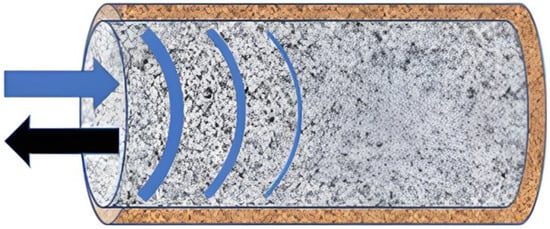
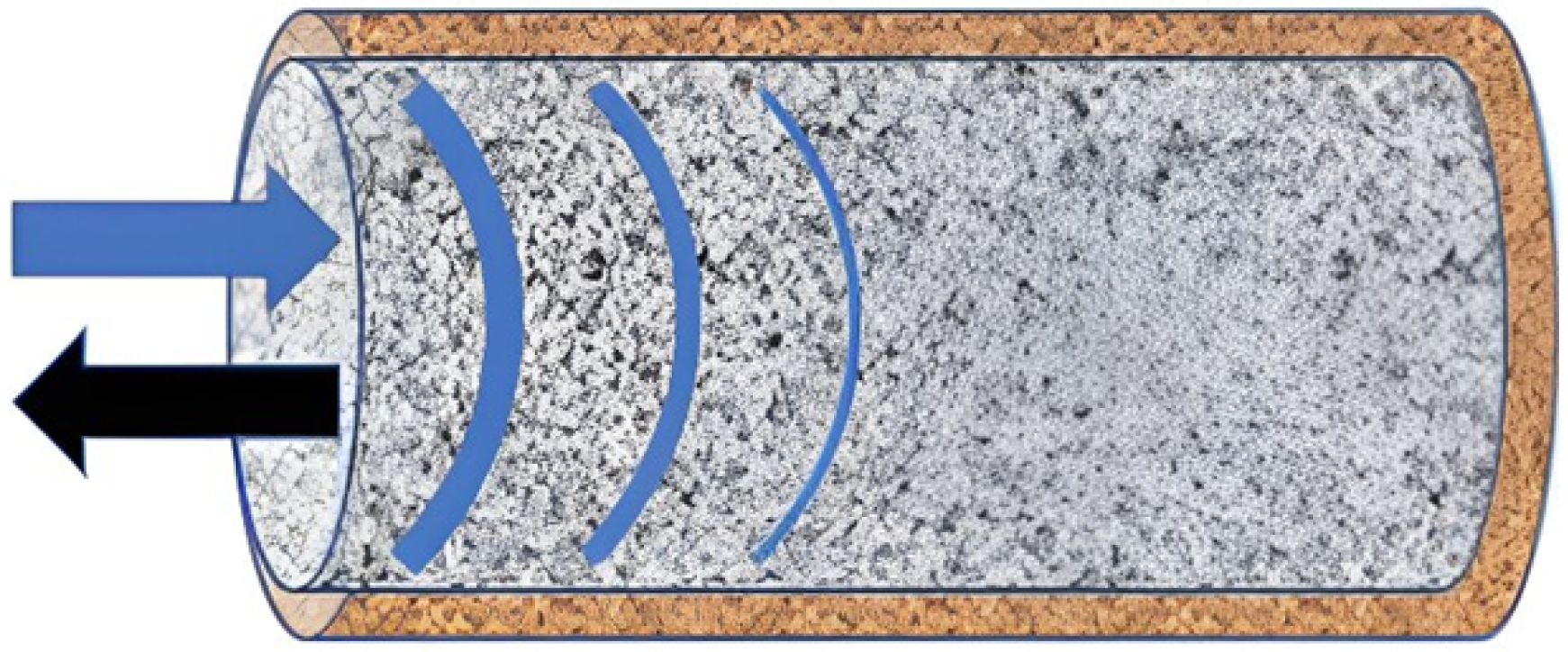
Imbibition Setup: The cylindrical surface and one end-face of the core were sealed with epoxy resin, leaving only one end-face open for contact with the imbibing fluid, as illustrated in Figure 1. This one-dimensional setup ensures that imbibition occurs linearly along the core’s length.
Figure 1.
Schematic representation of the core sealing for one-dimensional spontaneous imbibition.
Spontaneous Imbibition Test: The prepared core was horizontally placed inside the NMR system’s core holder. The open end-face was brought into contact with the 0.2% nano-flooding agent solution (prepared with D2O). The experiment was conducted under atmospheric pressure and at a constant reservoir temperature of 80 °C.
Data Acquisition and Analysis: During the imbibition process, NMR T2 spectra and one-dimensional saturation profiles (projections) along the core’s length were acquired at regular time intervals. The decrease in the T2 signal amplitude over time corresponds to the amount of oil displaced by the imbibing fluid. The experiment was concluded when the T2 spectrum showed no further significant changes. The imbibition efficiency (oil recovery) was calculated as the ratio of the displaced oil volume to the initial oil volume. The T2 spectra were used to analyze the oil mobilization from pores of different sizes, and the one dimensional saturation profiles were used to determine the imbibition penetration depth over time.
3. Results and Discussion
3.1. Performance Evaluation of the Nano-Flooding Agent
Low IFT is crucial for reducing the capillary resistance that traps oil in small pore throats. The IFT between the M18 crude oil and the 0.2% nano-flooding agent solution was measured at the reservoir temperature of 80 °C. The dynamic measurement showed a rapid decrease in IFT upon contact, eventually stabilizing at a low value of 0.141 mN/m, indicating a strong potential to facilitate the displacement of oil from the pore matrix during the imbibition process.
The ability of the nano-flooding agent to reverse the wettability of an oil-wet surface was evaluated. The initial state of the rock chip, when submerged in brine, showed a contact angle of 148.7°, confirming a strongly oil-wet condition where the oil droplet spreads extensively on the surface. After immersing the oil-wet plate in the 0.2% nano-flooding agent solution, the contact angle was observed to decrease dramatically and stabilized at 39.5°, reversing the surface to a strongly water-wet state. The combined effect of a low IFT and wettability reversal ability indicates that the nano-flooding agent has great potential to enhance the recovery from conglomerate reservoirs.
3.2. Microscopic Diffusion Characteristics of the Nano-Flooding Agent
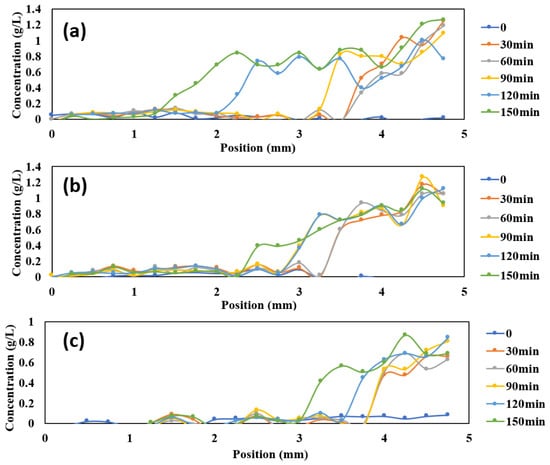
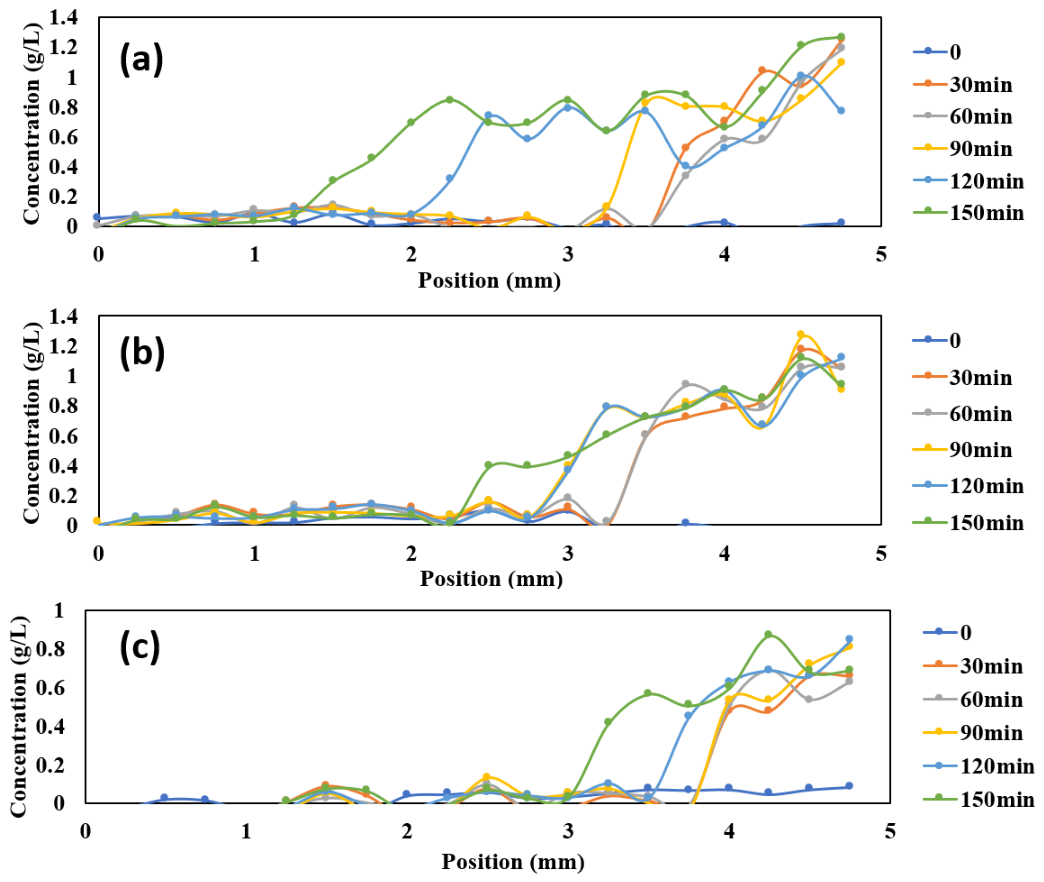
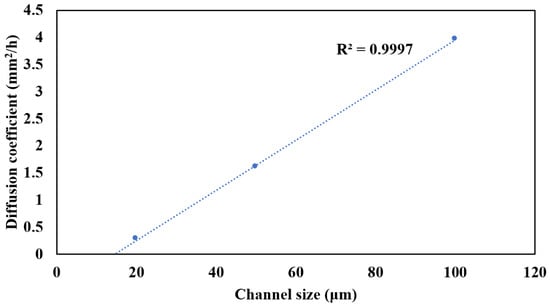
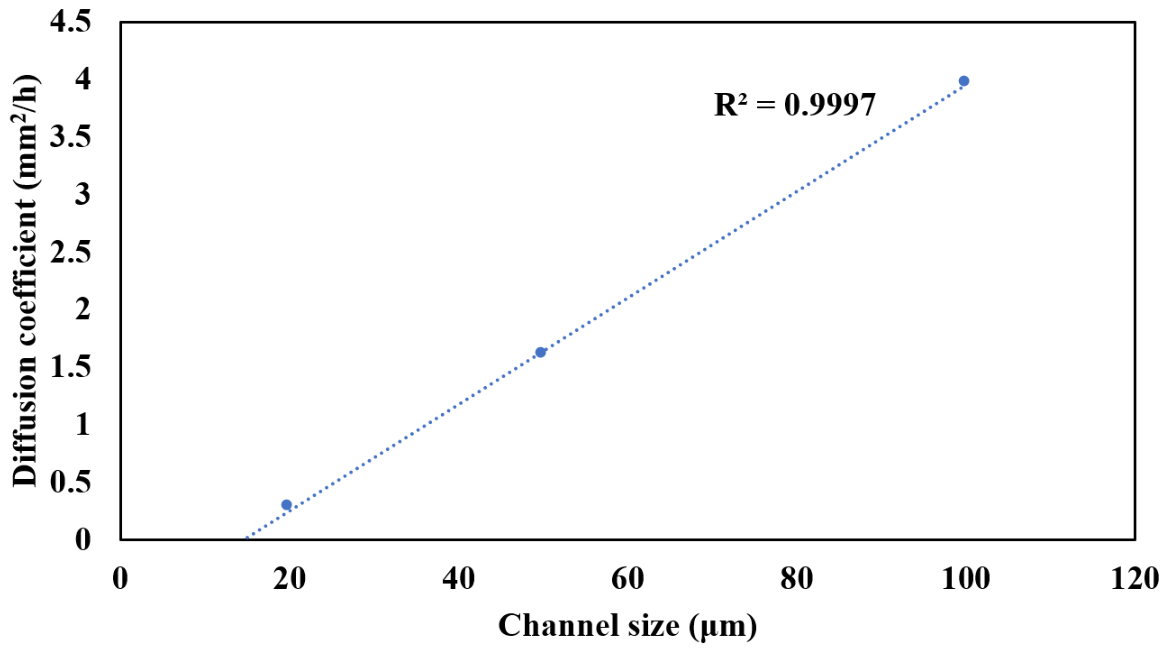
In tight reservoirs, where fluid flow is severely restricted, molecular diffusion can become a significant transport mechanism, especially for chemical agents to reach the oil–water interface deep within the rock matrix. The diffusion capability of the nano-flooding agent was investigated using microfluidic chips with varying pore throat diameters to simulate the confined environment of a tight reservoir. Dispersion distances of the nano-flooding agent after different time durations in 100, 50, 20 m channels are summarized in Figure 2. For the chip with 100 m channels shown in Figure 2a, the agent reached approximately 4 mm into the channel by 150 min, while for channels with 50 (Figure 2b) and 20 m (Figure 2c) in size, the penetration depths were around 2.8 mm and 2 mm, respectively. As shown in Figure 3, a clear trend is that, the penetration depth and rate decreases with reducing pore sizes, indicating intensified diffusion resistance due to interactions between nanoparticles and pore walls in smaller pores. The measurements were conducted only once and therefore no error analysis was conducted, however, the high R value () suggests a high-quality linear fitting.
Figure 2.
Concentration distribution of nano-flooding agent at different time durations with in (a) 100 m, (b) 50 m, and (c) 20 m, respectively. The channels are 5 mm in length and the left and right side of the graphs correspond to the outlet and inlet of the channels, respectively.
Figure 3.
Diffusion coefficients of the nano-flooding agents within channels of different sizes. The linear fitting extrapolates to zero diffusion at approximately 14.74 m of channel size.
Diffusion experiments with channels less than 20 m in size were not conducted due to the challenges in manufacturing microfluidic chips with smaller channel sizes. However, it is found that the diffusion coefficient exhibits an apparent decreasing trend with pore size that, if extrapolated linearly, suggests reduced transport at sub-15 micron scale.
The diffusion result suggests that the concentration of the agent has a distribution gradient and a maximum diffusion distance beyond the original concentration. In an actual reservoir with oil–water two phase imbibition with an imbibition front, the water phase is constantly imbibing into the pore due to capillary pressure and bringing with it new agents. However, the agents will adsorb onto the pore walls due to adsorption loss and as a result the concentration near the front will always be lower. Within larger pores, this loss in concentration will be compensated by the diffusion from the water source, yet in smaller pores, compensation by diffusion is limited and when the concentration at the imbibition front is insufficient to induce wettability reversal to sustain the imbibition, the imbibition will eventually stop. Therefore rocks with pores smaller than the “threshold” pore size can still have imbibition production to some extent.
3.3. Spontaneous Imbibition in Conglomerate Cores of Different Permeabilities
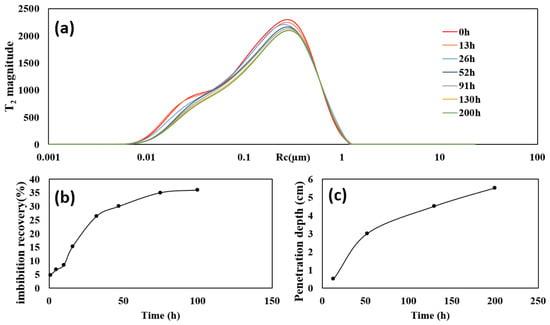
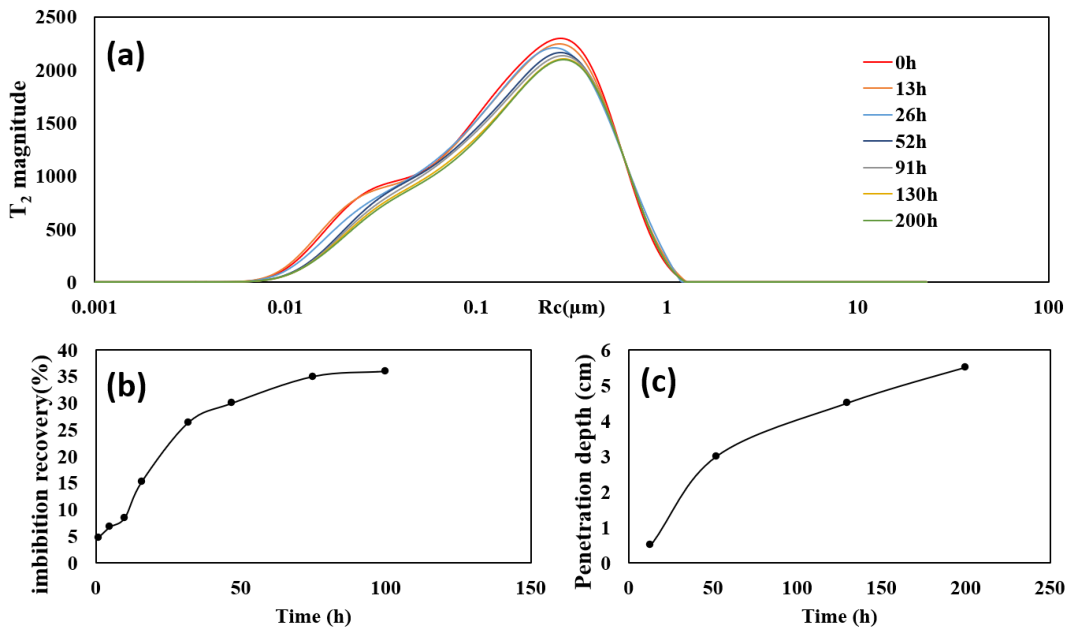
For the low-permeability core, after 200 h of imbibition, the final oil recovery efficiency reached 12.23%. The NMR T2 spectra (Figure 4a) show a decrease in signal amplitude across all relaxation times, indicating that pores of all sizes contributed to oil production to some extent. However, a detailed analysis of the pore size contributions (Table 2) reveals that the majority of the produced oil originated from the smaller pores. The 0.01–0.1 m pore range had the highest contribution to recovery (54.69%), despite making up only 35.20% of the total pore volume. Conversely, the larger pores (0.1–1 m), which constitute the largest portion of the pore volume (63.76%), contributed less (41.06%). This suggests that in this tight rock, the capillary driving forces are strongest in the smaller pores, making them the primary conduits for imbibition, while the larger pores may be less connected or the capillary forces within them are insufficient to overcome viscous forces and displace oil effectively.
Figure 4.
(a) T2 spectrum, (b) incremental oil recoveries, and (c) penetration depth at different time durations of the core sample with 1.23 mD permeability.
Table 2.
Pore size distribution and contribution to imbibition recovery for core with 1.23 mD permeability (Note: pore size ranges for the 1.23 mD core are one magnitude smaller than those for the 2.06 amd 15.60 mD cores due to the differences in pore size distribution).
The imbibition rate analysis (Figure 4b) shows a classic pattern. The process was divided into a high-speed stage (0–52 h), a transition stage (52–130 h), and a low-speed stage (130–200 h) by visual inspection. The initial high-speed stage accounted for 59% of the total oil recovered, highlighting the importance of the initial phase of imbibition.
Result from the analysis of the NMR 1D saturation profiles (Figure 4c) provided insight into the penetration depth. After 200 h, the imbibition front had only advanced to approximately 5.5 cm into the 9.84 cm long core. The progression was slow, consistent with the low permeability and the diffusion limitations observed in the microfluidic studies. This result underscores the challenge of achieving deep matrix stimulation in tight reservoirs via imbibition alone, which fall in line with the literature reports. For example, Liu et al. [24] recorded 0.94 and 1.13 cm for tight sandstone rock samples, and Ju et al. [35] reported a penetration depth of only 0.36 cm for a sandstone core with permeability of 0.41 mD. This finding suggests that for low-permeability formations, combining imbibition with other methods like pressure pulsing or “huff-n-puff” may be necessary to improve the agent’s sweep range.
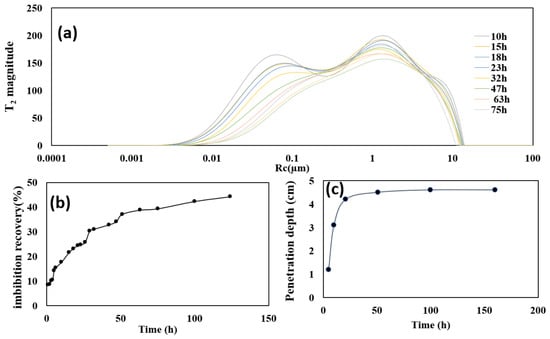
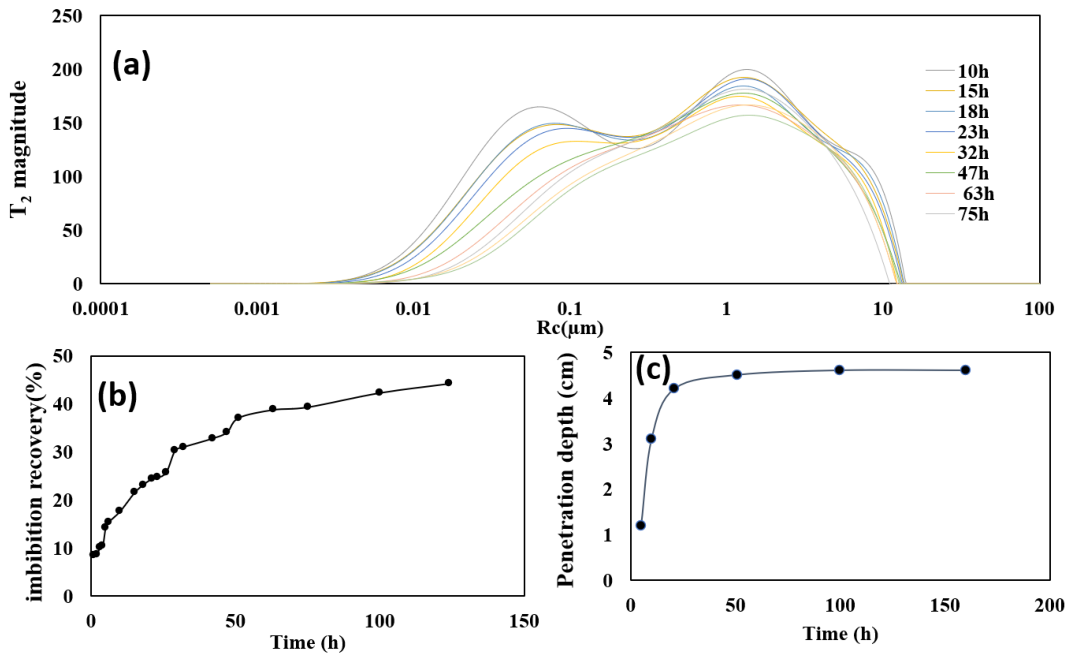
The core with medium permeability (2.06 mD) showed significantly better performance. The final oil recovery after 160 h was 36.24%, nearly three times that of the low-permeability core. The T2 spectra (Figure 5a) again show that all pore sizes were mobilized. However, the contribution analysis (Table 3) revealed a different pattern compared to the low- permeability core. The contribution of a certain pore size range to recovery refers to the percentage of oil recovered from pores within that size range to the total amount of oil recovered. While the smallest pores (<0.1 m) still provided the largest single contribution to recovery (49.05%), the larger pores (1–10 m) also played a substantial role (27.41% contribution), and the recovery efficiency within the largest pores (>10 m) was extremely high (87.9%). This indicates that with slightly better permeability, the imbibing fluid can access and displace oil from a wider range of pore sizes more effectively.
Figure 5.
(a) T2 spectrum, (b) incremental oil recoveries, and (c) penetration depth at different time durations of the core sample with 2.06 mD permeability.
Table 3.
Pore size distribution and contribution to imbibition recovery for core with 2.06 mD permeability.
The imbibition rate for the core with medium permeability was much faster, especially in the initial stage (Figure 5b). The high-speed stage lasted only 23 h but yielded 25.65% recovery (72% of the total) at a rate of 1.12%/h. This was followed by, by visual determination, a transition stage (23–63 h) and a low-speed stage (63–160 h). The rapid initial recovery suggests that the better-connected pore network in this core allowed for a much more efficient capillary-driven displacement process.
The penetration depth analysis (Figure 5c) showed that the imbibition front advanced to about 3 cm within the first 10 h. However, the advancement speed decreased significantly afterward, reaching a final depth of only about 4 cm by 21 h. This suggests that the primary oil displacement occurred in the region near the inlet, and the process stalled as it moved deeper into the core. The agent’s ability to penetrate further may have been limited by the complex pore structure or the accumulation of displaced oil, which could block pathways. This implies that while recovery was high, it was concentrated in a relatively shallow zone.
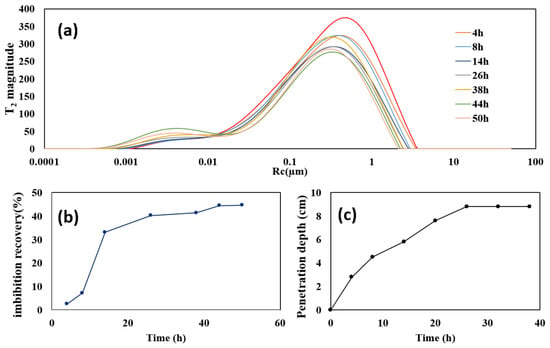
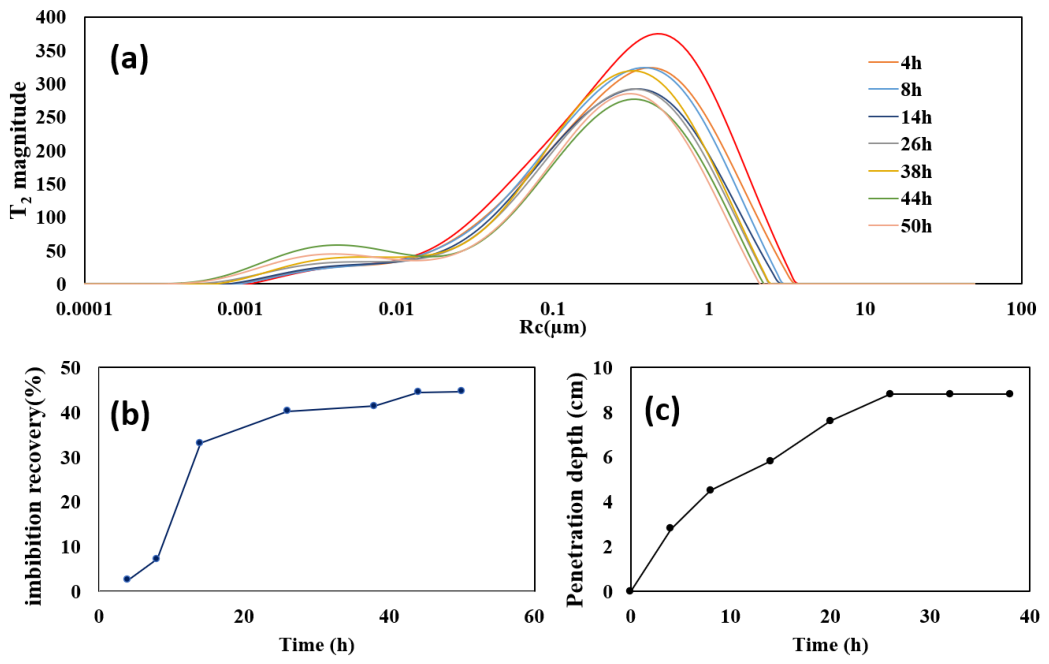
The high-permeability core demonstrated the most favorable results. The final oil recovery reached an excellent 44.6% in just 50 h. The T2 spectra analysis (Figure 6a) and pore contribution data (Table 4) show a distinct shift in the recovery mechanism. In this core, the larger pores were the dominant contributors to production. The 1–10 m pore range contributed 37.35% of the recovery, and the 0.1–1 m range contributed 54.69%. The smallest pores (<0.1 m) contributed only about 8%. This is the opposite of the low-permeability core and indicates that in high-permeability rock, the imbibition process efficiently sweeps the larger, more conductive pore pathways, leading to high overall recovery.
Figure 6.
(a) T2 spectrum, (b) incremental oil recoveries, and (c) penetration depth at different time durations of the core sample with 15.60 mD permeability.
Table 4.
Pore size distribution and contribution to imbibition recovery for core with 15.60 mD permeability.
The imbibition rate was significantly higher (Figure 6b). The high-speed stage lasted only 14 h but achieved 33.16% recovery (74% of the total) at a rate of 2.37%/h. This rapid and efficient displacement is characteristic of a well-connected, high-permeability system where capillary forces can act swiftly throughout the pore network.
The NMR saturation profiles (Figure 6c) showed that the imbibition front advanced rapidly and completely through the core. After just 26 h, the penetration depth reached 8.8 cm, effectively sweeping the entire length of the 8.87 cm core. This demonstrates that in reservoirs with sufficient permeability, spontaneous imbibition with a nano-flooding agent can be a highly effective mechanism for deep matrix stimulation, achieving both high recovery and extensive penetration.
3.4. Comparative Analysis and Discussion
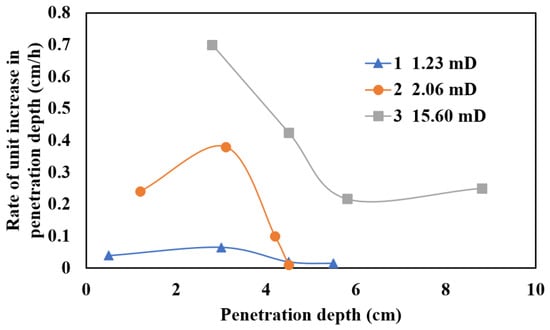
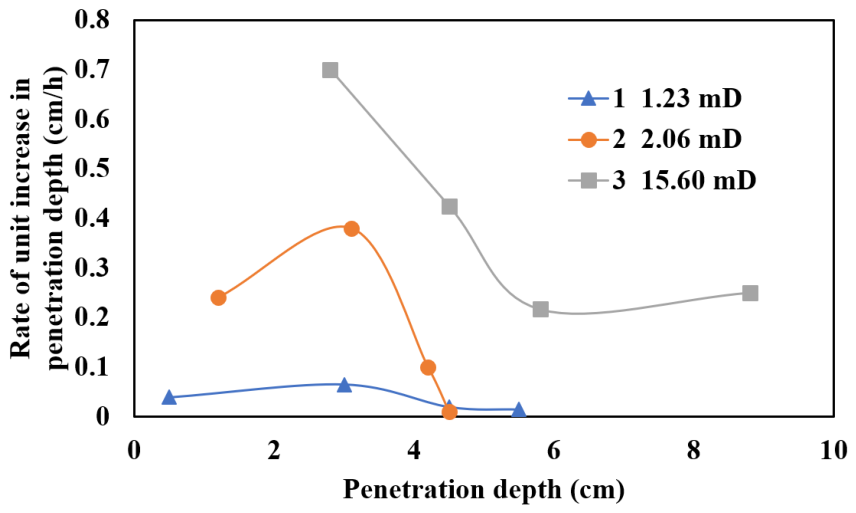
A comparative analysis of the three core experiments reveals the critical role of permeability in governing the dynamics and effectiveness of spontaneous imbibition. As shown in Figure 7, there is a clear trend that higher permeability leads to a faster rate of imbibition front advancement and a greater final penetration depth. The high-permeability core (15.60 mD) showed a penetration speed that was an order of magnitude higher than the low-permeability core (1.23 mD). Interestingly, the relationship is not perfectly linear, and the final penetration depth for the 1.23 mD core (5.5 cm) was greater than that for the 2.06 mD core (4 cm), despite its lower permeability and much slower progression. This anomaly suggests that factors other than permeability, such as pore structure complexity, tortuosity, and pore-throat connectivity, should also play a crucial role, especially in the low-permeability regime. This is in agreement with Ju et al. [35], who proposed that no clear relationship exists between permeability and imbibition recovery, and that pore structures also contribute. However, current analyses based on NMR measurements do not provide such in-depth information, and therefore the hypothesized potential influencing factors are not verifiable from the experimental data and merit more dedicated investigation.
Figure 7.
Comparison of the rate of imbibition depth increase for the three cores, showing a strong correlation with permeability.
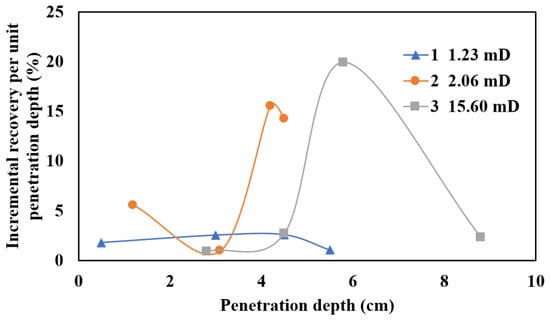
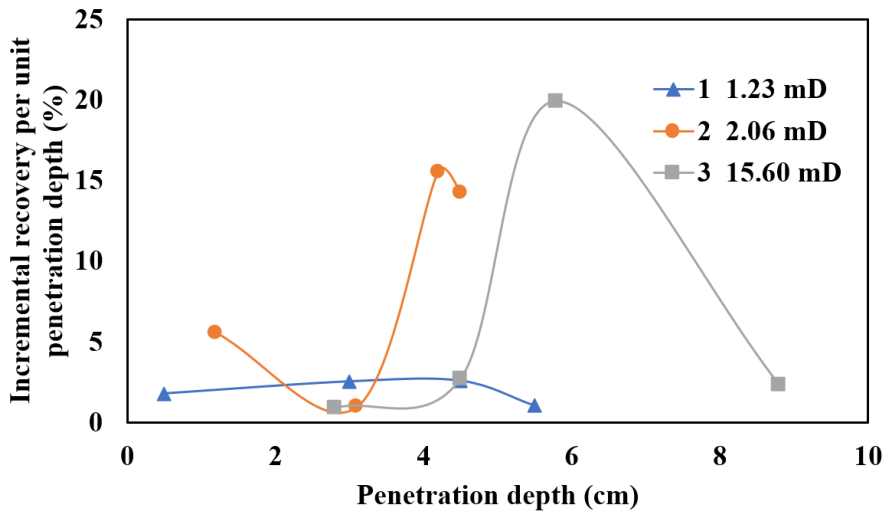
Furthermore, the relationship between penetration depth and oil recovery is not straightforward. Figure 8 plots the incremental oil recovery per unit of imbibition depth. A higher value on this plot indicates a more efficient displacement process within the swept zone. Generally, higher permeability leads to a greater recovery per unit depth. However, the medium-permeability core (2.06 mD) shows a lower final penetration depth than the low-permeability core (1.23 mD) but a much higher total recovery, indicating a very efficient sweep in the shallow region it managed to invade. This analysis leads to a critical conclusion; that is, for tight reservoirs, the scattered data for the three samples measured indicates that penetration depth alone is not a reliable indicator of imbibition performance. A deep but inefficient displacement may yield less oil than a shallow but highly efficient one. Therefore, evaluating imbibition agents and mechanisms in tight rocks should require a comprehensive approach that considers not just the depth of invasion but also the recovery efficiency achieved within that invaded zone.
Figure 8.
Comparison of the oil recovery increase per unit of imbibition depth, highlighting the complex relationship between penetration, permeability, and displacement efficiency.
4. Conclusions
This study systematically investigated the performance of a nano-flooding agent for enhancing oil recovery from tight conglomerate reservoirs through spontaneous imbibition. Based on the comprehensive experimental results from property evaluation, microfluidic diffusion, and core-scale imbibition tests, the following conclusions are drawn:
- Higher permeability leads to faster imbibition front advancement and greater final penetration depth. The high-permeability core (15.60 mD) achieved full penetration (8.8 cm) and 44.6% recovery in 26 h, whereas the low-permeability core (1.23 mD) showed limited penetration (5.5 cm) and only 12.23% recovery after 200 h.
- The mechanism of oil mobilization varies with permeability. In low-permeability cores, recovery is dominated by the displacement from smaller pores (0.01–0.1 m) where capillary forces are strongest. In high-permeability cores, recovery is dominated by the more efficient sweep of larger, more conductive pores.
- The penetration depth is not necessarily correlated with recovery performance. Recovery per unit imbibition depth should instead be used as a key metric. The medium-permeability core, despite having a shallower final penetration depth than the low-permeability core, exhibited superior recovery efficiency per unit depth, resulting in significantly higher overall oil production.
The observed diffusion and imbibition behaviors suggest significant practical implications for tight oil recovery, and will ultimately contribute to optimized design of chemical flooding strategies for unconventional resources.
Author Contributions
Conceptualization, Z.H.; methodology, J.L. and Q.L.; Experiment, J.L., M.N. and K.L.; writing—original draft preparation, review and editing, Z.W. and S.B. All authors have read and agreed to the published version of the manuscript.
Funding
This research was funded by the Natural Science Foundation of the Xinjiang Autonomous Region grant number [No. 2023D01B09] and the Innovation Environment Construction Plan of Karamay [No. 2024hjcxrc0036].
Data Availability Statement
The original contributions presented in this study are included in the article. Further inquiries can be directed to the corresponding author.
Acknowledgments
All measurements, including the interfacial tension and contact angle measurements, the diffusion determination, and the imbibition tests, were performed only once in this study, therefore no error analyses were conducted.
Conflicts of Interest
Authors Zeyou Hui, Jiaxing Liu, Zixiang Wang, Meng Ning, Kai Li, Qiang Luo were employed by Xinjiang Oilfield Company and China National Petroleum Corporation (CNPC). The remaining authors declare that the research was conducted in the absence of any commercial or financial relationships that could be construed as a potential conflict of interest.
Abbreviations
The following abbreviations are used in this manuscript:
| IFT | Interfacial tension |
| NMR | Nuclear magnetic resonance |
| EOR | Enhanced oil recovery |
References
- Blunt, M.J.; Jackson, M.D.; Piri, M.; Valvatne, P.H. Detailed physics, predictive capabilities and macroscopic consequences for pore-network models of multiphase flow. Adv. Water Resour. 2002, 25, 1069–1089. [Google Scholar] [CrossRef] [Scilit]
- Nguyen, D.; Wang, D.; Oladapo, A.; Zhang, J.; Sickorez, J.; Butler, R.; Mueller, B. Evaluation of Surfactants for Oil Recovery Potential in Shale Reservoirs. In SPE Improved Oil Recovery Symposium; SPE: Richardson, TX, USA, 2014; p. SPE–169085–MS. [Google Scholar] [CrossRef] [Scilit]
- Jia, B.; Tsau, J.S.; Barati, R. A review of the current progress of CO2 injection EOR and carbon storage in shale oil reservoirs. Fuel 2019, 236, 404–427. [Google Scholar] [CrossRef] [Scilit]
- Cha, L.M.; Feng, Q.H.; Wang, S.; Xu, S.Q.; Xie, C.Y. Pore-scale Modeling of Immiscible Displacement In Porous Media: The Effects of Dual Wettability. SPE J. 2023, 28, 239–250. [Google Scholar] [CrossRef] [Scilit]
- Li, T.; Ren, D.Z.; Sun, H.P.; Wang, H.; Tian, T.; Li, Q.H.; Yan, Z. Imbibition Characteristics and Influencing Factors of the Fracturing Fluid in a Tight Sandstone Reservoir. ACS Omega 2024, 9, 17204–17216. [Google Scholar] [CrossRef] [Scilit] [PubMed]
- Jiang, W.; Lv, W.; Jia, N.; Lu, X.; Wang, L.; Wang, K.; Mei, Y. Study on the Effects of Wettability and Pressure in Shale Matrix Nanopore Imbibition during Shut-in Process by Molecular Dynamics Simulations. Molecules 2024, 29, 1112. [Google Scholar] [CrossRef] [Scilit] [PubMed]
- Wang, F.; Wang, L.; Jiao, L.; Liu, Z.; Yang, K. Experimental mechanism for enhancing oil recovery by spontaneous imbibition with surfactants in a tight sandstone oil reservoir. Energy Fuels 2023, 37, 8180–8189. [Google Scholar] [CrossRef] [Scilit]
- Jia, B.; Tsau, J.S.; Barati, R. Investigation of Shale-Gas-Production Behavior: Evaluation of the Effects of Multiple Physics on the Matrix. SPE Reserv. Eval. Eng. 2020, 23, 68–80. [Google Scholar] [CrossRef] [Scilit]
- Elsayed, M.; Isah, A.; Hiba, M.; Hassan, A.; Al-Garadi, K.; Mahmoud, M.; El-Husseiny, A.; Radwan, A.E. A Review on the Applications of Nuclear Magnetic Resonance (NMR) in the Oil and Gas Industry: Laboratory and Field-Scale Measurements. J. Pet. Explor. Prod. Technol. 2022, 12, 2747–2784. [Google Scholar] [CrossRef] [Scilit]
- Singh, K.; Jung, M.; Brinkmann, M.; Seemann, R. Capillary-Dominated Fluid Displacement in Porous Media. Annu. Rev. Fluid Mech. 2019, 51, 429–449. [Google Scholar] [CrossRef] [Scilit]
- Zhang, T.; Wang, M.C.; Yuan, L.; Ming, T.; Yang, X.; Li, Y.F.; Xie, Z.Z. Multiphase Flow Coupling Characteristic and Oil Enhancement Mechanism in Fractured Oil-Bearing Tight Sandstone. SPE J. 2025, 30, 6428–6442. [Google Scholar] [CrossRef] [Scilit]
- Liu, Y.F.; Zou, C.W.; Zhou, D.Y.; Li, H.; Gao, M.W.; Zhao, G.; Dai, C.L. Novel Chemical Flooding System Based on Dispersed Particle Gel Coupling In-Depth Profile Control and High Efficient Oil Displacement. Energy Fuels 2019, 33, 3123–3132. [Google Scholar] [CrossRef] [Scilit]
- Wan, T.; Zhang, J.; Dong, Y. Microscopic Oil Mobility in Tight Conglomerate Reservoirs Under Different Development Modes, Mahu Sag. Xinjiang Pet. Geol. 2024, 24, 327–333. [Google Scholar] [CrossRef]
- Wang, C.; Gao, H.; Qi, Y.; Li, X.; Zhang, R.; Fan, H. Investigation on the Mechanisms of Spontaneous Imbibition at High Pressures for Tight Oil Recovery. ACS Omega 2020, 5, 12727–12734. [Google Scholar] [CrossRef] [Scilit] [PubMed]
- Hatiboglu, C.U.; Babadagli, T. Experimental and visual analysis of co-and counter-current spontaneous imbibition for different viscosity ratios, interfacial tensions, and wettabilities. J. Pet. Sci. Eng. 2010, 70, 214–228. [Google Scholar] [CrossRef] [Scilit]
- Yang, K.; Wang, F.; Zhao, J. Experimental Study of Surfactant-Enhanced Spontaneous Imbibition in Fractured Tight Sandstone Reservoirs: The Effect of Fracture Distribution. Pet. Sci. 2022, 20, 370–381. [Google Scholar] [CrossRef] [Scilit]
- Sukee, A.; Nunta, T.; Haruna, M.A.; Kalantariasl, A.; Tangparitkul, S. Influence of sequential changes in the crude oil-water interfacial tension on spontaneous imbibition in oil-wet sandstone. J. Pet. Sci. Eng. 2022, 210, 110032. [Google Scholar] [CrossRef] [Scilit]
- Cheng, Z.; Wang, Q.; Ning, Z.; Li, M.; Lyu, C.; Huang, L.; Wu, X. Experimental Investigation of Countercurrent Spontaneous Imbibition in Tight Sandstone Using Nuclear Magnetic Resonance. Energy Fuels 2018, 32, 6507–6517. [Google Scholar] [CrossRef] [Scilit]
- Massarweh, O.; Abushaikha, A.S. The use of surfactants in enhanced oil recovery: A review of recent advances. Energy Rep. 2020, 6, 3150–3178. [Google Scholar] [CrossRef] [Scilit]
- Dou, H.G.; Yang, Y. Further understanding on fluid flow through multi-porous media in low-permeability reservoirs. Pet. Explor. Dev. 2012, 39, 674–682. [Google Scholar] [CrossRef] [Scilit]
- Liu, X.; Yan, L.; Gao, Q.; Liu, Y.F.; Huang, H.; Liu, S. Effect of Salinity on the Imbibition Recovery Process of Tight Sandstone Reservoirs. Processes 2022, 10, 228. [Google Scholar] [CrossRef] [Scilit]
- Liu, J.; Sheng, J.J.; Huang, W. Experimental Investigation of Microscopic Mechanisms of Surfactant-Enhanced Spontaneous Imbibition in Shale Cores. Energy Fuels 2019, 33, 7188–7199. [Google Scholar] [CrossRef] [Scilit]
- Sun, Y.; Xin, Y.; Lyu, F.; Dai, C. Experimental Study on the Mechanism of Adsorption-Improved Imbibition in Oil-Wet Tight Sandstone by a Nonionic Surfactant for Enhanced Oil Recovery. Pet. Sci. 2021, 18, 1115–1126. [Google Scholar] [CrossRef] [Scilit]
- Liu, J.; Sheng, J.J. Investigation of Countercurrent Imbibition in Oil-Wet Tight Cores Using NMR Technology. SPE J. 2020, 25, 2601–2614. [Google Scholar] [CrossRef] [Scilit]
- Jarvis, N.; Koestel, J.; Larsbo, M. Understanding Preferential Flow in the Vadose Zone: Recent Advances and Future Prospects. Vadose Zone J. 2016, 15, 1–11. [Google Scholar] [CrossRef] [Scilit]
- Yang, Z.B.; Juanes, R. Two sides of a fault: Grain-scale analysis of pore pressure control on fault slip. Phys. Rev. E 2018, 97, 022906. [Google Scholar] [CrossRef] [Scilit] [PubMed]
- Alvarez, J.O.; Schechter, D.S. Altering Wettability in Bakken Shale by Surfactant Additives and Potential of Improving Oil Recovery During Injection of Completion Fluids. In SPE Improved Oil Recovery Conference; SPE: Richardson, TX, USA, 2016. [Google Scholar] [CrossRef] [Scilit]
- Al-Mahrooqi, S.H.; Grattoni, C.A.; Muggeridge, A.H.; Zimmerman, R.W.; Jing, X.D. Pore-scale modelling of NMR relaxation for the characterization of wettability. J. Pet. Sci. Eng. 2006, 52, 172–186. [Google Scholar] [CrossRef] [Scilit]
- Brownstein, K.R.; Tarr, C.E. Importance of classical diffusion in NMR studies of water in biological cells. Phys. Rev. A 1979, 19, 2446. [Google Scholar] [CrossRef] [Scilit]
- Fleury, M.; Deflandre, F. Quantitative evaluation of porous media wettability using NMR relaxometry. Magn. Reson. Imaging 2003, 21, 385–387. [Google Scholar] [CrossRef] [Scilit] [PubMed]
- Lai, F.; Li, Z.; Wei, Q.; Zhang, T.; Zhao, Q. Experimental Investigation of Spontaneous Imbibition in a Tight Reservoir With Nuclear Magnetic Resonance Testing. Energy Fuels 2016, 30, 8932–8940. [Google Scholar] [CrossRef] [Scilit]
- Gao, H.; Wang, Y.L.; Xie, Y.G.; Ni, J.; Li, T.; Wang, C.; Xue, J.J. Imbibition and Oil Recovery Mechanism of Fracturing Fluids in Tight Sandstone Reservoirs. ACS Omega 2021, 6, 1991–2000. [Google Scholar] [CrossRef] [Scilit] [PubMed]
- Ren, X.; Li, A.; Wang, G.; He, B.; Fu, S. Study of the Imbibition Behavior of Hydrophilic Tight Sandstone Reservoirs Based on Nuclear Magnetic Resonance. Energy Fuels 2018, 32, 7762–7772. [Google Scholar] [CrossRef] [Scilit]
- Liang, C.; Xiao, L.; Jia, Z.; Guo, L.; Luo, S.; Wang, Z. Mixed Wettability Modeling and Nuclear Magnetic Resonance Characterization in Tight Sandstone. Energy Fuels 2023, 37, 1962–1974. [Google Scholar] [CrossRef] [Scilit]
- Ju, M.; Wang, X.; Yu, W.; Yang, S.; Ye, W.; Zhang, T. Spontaneous Imbibition of Tight Oil Reservoirs Based on NMR Technology. Xinjiang Pet. Geol. 2019, 40, 334–339. [Google Scholar] [CrossRef]
- Alanazi, A.; Baban, A.; Ali, M.; Keshavarz, A.; Iglauer, S.; Hoteit, H. Residual Trapping of CO2, N2, and a CO2-N2 Mixture in Indiana Limestone Using Robust NMR Coreflooding: Implications for CO2 Geological Storage. Fuel 2023, 353, 129221. [Google Scholar] [CrossRef] [Scilit]
- Wang, B.; Cao, R.; Zheng, X.; Cheng, L.; Hu, J.; Jia, Z.; Duan, W.; Hassanzadeh, H. Real-time NMR experimental study of displacement-imbibition coupling in tight/shale oil reservoirs: Lithological variations, influencing factors, and key insights. Pet. Sci. 2025, 22, 5142–5165. [Google Scholar] [CrossRef] [Scilit]

Disclaimer/Publisher’s Note: The statements, opinions and data contained in all publications are solely those of the individual author(s) and contributor(s) and not of MDPI and/or the editor(s). MDPI and/or the editor(s) disclaim responsibility for any injury to people or property resulting from any ideas, methods, instructions or products referred to in the content. |
© 2026 by the authors. Licensee MDPI, Basel, Switzerland. This article is an open access article distributed under the terms and conditions of the Creative Commons Attribution (CC BY) license.