


Abstract
The integration of online Digital Twin (DT) technologies with industrial control systems represents an important step toward real-time monitoring and synchronization of manufacturing processes within Industry 4.0 environments. However, reproducible approaches for connecting simulation environments with real industrial control hardware using standardized communication protocols remain insufficiently described in the existing literature. This study presents the development of an online Digital Twin for real-time monitoring of manufacturing processes using OPC UA communication and programmable logic controller (PLC) data exchange. The proposed approach combines discrete-event simulation with real-time industrial data acquisition to enable synchronization between a physical manufacturing system and its virtual representation. The implementation was experimentally validated in a laboratory-scale cyber–physical production system using Tecnomatix Plant Simulation, Siemens S7-1200 PLC, and KEPServerEX middleware. The developed architecture enables real-time process state monitoring, event-driven synchronization, and verification of selected control and safety functions within the simulation environment. The results demonstrate stable synchronization between the physical and digital systems with response times ranging from 50 to 200 ms, confirming the feasibility of near-real-time integration. The implemented light barrier scenario further demonstrated the capability of the online DT to reflect safety-related events occurring in the physical system. The main contribution of this study lies in the implementation and experimental verification of an OPC UA-based online Digital Twin architecture for manufacturing process monitoring in a laboratory environment. The presented approach provides a foundation for future extensions toward predictive analytics, scenario-based simulation, and advanced manufacturing optimization applications.
1. Introduction
Industry 4.0, digitalization, and the use of Digital Twins are important factors in achieving higher levels of flexibility and efficiency in manufacturing and logistics processes. These modern approaches enable data exchange, real-time process monitoring, and improved interoperability between industrial systems, leading to increased competitiveness and the ability to respond more effectively to changing production requirements.
The set of analyzed scientific publications reflects key aspects of industrial digital transformation within the context of Industry 4.0 and Industry 5.0, with a focus on strategic management, emerging business models, education, and workplace environments. Ref. [1] provides an empirical perspective on value creation in the digital era, identifying growth opportunities for enterprises in increasingly digitized markets. The authors of study [2] emphasize the necessity of evolving from Industry 4.0 toward Industry 5.0, highlighting broader societal and economic determinants of transformation, with an emphasis on the humanization of technology and sustainable development.
Work [3] explores emerging business models in the Internet of Things (IoT) environment, which form an integral part of digital ecosystems and enable the interconnection between physical and digital domains—constituting a foundation for Digital Twin technology.
Improving manufacturing accuracy and process transparency represents an important objective of modern industrial systems. In this context, technologies such as cyber–physical systems (CPSs), Industrial Internet of Things (IIoT), and Digital Twin (DT) architectures support real-time data acquisition, monitoring, and interaction between physical and virtual manufacturing environments. These technologies contribute to improved production visibility, communication, and operational responsiveness within Industry 4.0 environments. Studies [4,5] have identified major challenges, including implementation barriers and the need for workforce collaboration and development.
Within this context, Digital Twin technology plays an important role by enabling the creation of virtual representations of physical manufacturing systems synchronized with operational data. Depending on the level of integration and functionality, Digital Twins may support applications such as real-time monitoring, simulation, predictive analytics, and virtual commissioning. Therefore, future development should include continuous improvement of DT architectures, along with validation through real-world implementations and case studies. At a global level, Digital Twins contribute not only to increased productivity and reduced operational costs but also to broader sustainability goals, including industrial decarbonization. As this technology continues to evolve, its role in shaping more efficient, sustainable, and competitive manufacturing systems will become increasingly vital [6,7].
Recent research distinguishes between offline and online Digital Twin approaches. Offline Digital Twins are commonly used for scenario-based simulations, process optimization, and predictive analyses without continuous synchronization with the physical system. In contrast, online Digital Twins focus on real-time data exchange and synchronization between physical assets and their virtual representations, enabling continuous monitoring of operational states and event-driven interactions. The approach presented in this study corresponds to an online Digital Twin architecture oriented toward real-time monitoring and synchronization of manufacturing process events.
Although OPC UA communication and Digital Twin technologies are widely discussed in Industry 4.0 research, existing studies predominantly focus on either offline simulation environments or proprietary industrial implementations. Reproducible approaches enabling real-time synchronization between PLC-controlled manufacturing systems and simulation environments using standardized OPC UA communication remain insufficiently described and experimentally verified.
The main aim of this study is to develop and experimentally verify an online Digital Twin architecture for real-time monitoring and synchronization of manufacturing processes using OPC UA communication and PLC-controlled systems. The research focuses on real-time synchronization between a simulation environment and a physical manufacturing system, enabling monitoring of operational states and verification of selected safety-related interactions. This study does not focus on predictive optimization or autonomous control but rather on the implementation and validation of real-time event-driven monitoring within a laboratory-scale cyber–physical production environment.
Based on the identified research gap, the main research question of this study is formulated as follows: “How can an online Digital Twin architecture be developed and experimentally verified for real-time synchronization and monitoring of PLC-controlled manufacturing processes using OPC UA communication?”
The main contributions of this study include the development of an OPC UA-based online Digital Twin architecture for manufacturing process monitoring, the implementation of real-time synchronization between a PLC-controlled physical system and its simulation model, the experimental verification of event-driven monitoring and safety-related interactions in a laboratory-scale cyber–physical production environment, and the evaluation of communication latency and synchronization behavior between physical and digital systems.
2. Literature Review
2.1. Digital Twin Concepts
The concept of the Digital Twin paradigm has evolved significantly within Industry 4.0 research and currently encompasses multiple architectural approaches and application domains. The existing literature presents multiple classifications of Digital Twin applications depending on their functional focus and level of integration within industrial systems. One commonly used classification distinguishes Digital Twin applications according to their focus on product lifecycle representation, manufacturing process modeling, and operational system monitoring.
- Digital Twin of the product: This encompasses the virtual representation of the product throughout its lifecycle, encompassing system-driven engineering, holistic modeling, advanced simulation, and verification procedures. It facilitates the automation of electronic design workflows and eliminates the necessity of manufacturing physical prototypes during early development phases.
- Digital Twin of manufacturing: This refers to the virtual orchestration of manufacturing activities, including digital production planning, process simulation, and performance optimization. It enables automated generation of control programs for programmable logic controllers (PLCs), forming the foundation for virtual commissioning, i.e., the pre-deployment validation of automation systems in a simulated environment.
- Digital Twin of production operation: Through the deployment of embedded automation components, real-time data acquisition is seamlessly integrated from operating equipment. These data streams are fed back into the value creation system, establishing a synchronized framework for monitoring, operational analysis, and production-state evaluation under real-world operational conditions. In manufacturing environments, Digital Twins are increasingly applied for virtual commissioning, process monitoring, simulation-based analysis, and industrial communication integration.
Trends and Emerging Directions
Recent studies broaden the concept of Digital Twins beyond static virtual representations to include capabilities such as prediction, optimization, and autonomous decision-making in real time [8,9,10]. However, the level of implementation of these advanced functionalities varies depending on the specific application domain, system architecture, and availability of real-time operational data. As Digital Twin technology continues to evolve, researchers increasingly emphasize its role not only in monitoring and simulation but also in supporting intelligent decision-making processes throughout the lifecycle of industrial systems.
Current research also proposes layered Digital Twin architectures involving data acquisition, processing, modeling, analysis, and visualization [8]. Such architectures provide a structured framework for integrating physical assets with their virtual counterparts while supporting scalability, modularity, and data-driven decision support. Recent studies further highlight the importance of multi-layer and service-oriented Digital Twin frameworks capable of integrating simulation environments, industrial communication infrastructures, and advanced analytical tools within a unified ecosystem [9,10].
Another important research direction focuses on interoperability and real-time communication between heterogeneous industrial systems. Recent studies increasingly emphasize the role of interoperability, real-time communication, and layered Digital Twin architectures in manufacturing systems [8,9,10]. Particular attention is devoted to the integration of industrial communication standards such as OPC UA and MQTT, which enable standardized and reliable data exchange between physical systems and virtual environments. These communication technologies are considered key enablers for achieving seamless integration between industrial devices, control systems, simulation platforms, and Digital Twin applications, thereby supporting the broader objectives of Industry 4.0 and smart manufacturing [11,12].
Recent research also investigates Digital Twin architectures specifically designed for PLC-controlled industrial automation systems, emphasizing interoperability, OPC UA communication, and real-time synchronization between industrial controllers and virtual environments [13].
Research challenges and future directions include the integration of artificial intelligence and machine learning techniques for fault prediction and process optimization [14]. Recent studies also investigate Digital Twin applications in smart cities, including urban mobility planning, energy management, and public services [15]. At the same time, growing attention is devoted to cybersecurity, data privacy, and governance issues associated with interconnected Digital Twin ecosystems [8]. Another important research direction concerns the modernization of legacy industrial systems through Digital Twin-based retrofitting approaches [16].
Study [17] underlines the importance of innovation in technical education as a prerequisite for the successful implementation of Industry 4.0 technologies, including Digital Twins. A comprehensive review of Industry 4.0 technologies is presented in [18], emphasizing its enabling technologies, reference architectures, and the integration of conventional automation systems with IoT-based solutions to guide the design of modern industrial automation and supervision systems. Work [6] further highlights the importance of experimental assessment of combined risk factors in the work environment, which is essential for the design of cyber–physical systems and secure digital representations in smart industrial systems.
The reviewed body of literature highlights the significance of simulation technologies, digital tools, and advanced modeling approaches as foundational pillars of Industry 4.0, particularly in the context of Digital Twin implementation and smart manufacturing systems.
References [19,20] provides a comprehensive methodological guide for modeling and programming using Tecnomatix Plant Simulation, a software widely recognized for its applicability in digital factory planning. Practical applications of Tecnomatix Plant Simulation in smart manufacturing environments are further demonstrated in [20], emphasizing its role in optimizing complex production systems. Research presented in [21] explores the development and application of Digital Twin models to virtually test and validate manufacturing systems, with a focus on bridging simulation and real-world control through PLC code verification and interoperability across platforms. A case study using a modular Festo manufacturing system in Tecnomatix Process Simulate demonstrates how Digital Twins support virtual commissioning by identifying design flaws, reducing risks, and optimizing system performance.
Simulation methods for homogeneous production processes are discussed in [22], providing analytical frameworks essential for virtual commissioning and performance prediction.
Simulation-based analysis of supply chain resilience under dynamic industrial conditions is investigated in [23], addressing the increasing need for adaptive logistics under dynamic industrial conditions.
Study [24] demonstrates the effectiveness of discrete-event simulation in optimizing recycling-oriented production systems, underscoring its environmental and operational benefits. Study [25] explores the application of simulation in material handling processes, contributing to the design of efficient intralogistics systems in smart factories.
Augmented reality integration within production environments is discussed in [26], particularly in relation to real-time visualization technologies used in cyber–physical systems. Finally, ref. [27] investigates the modeling and simulation of reconfigurable manufacturing systems, which are essential for enabling flexibility and responsiveness in digitalized production environments, which are key enablers of Digital Twin systems.
Although Digital Twins and simulation models are closely related, recent research highlights important distinctions between offline simulation environments and online Digital Twin systems. Traditional simulation models are commonly used for offline scenario evaluation and process optimization without continuous interaction with the physical system. In contrast, online Digital Twins maintain synchronization with physical assets through real-time industrial data acquisition, enabling monitoring of operational states, event-driven interactions, and virtual commissioning activities.
In contrast to predictive or optimization-oriented Digital Twin implementations, the approach presented in this study focuses primarily on real-time synchronization and monitoring of manufacturing process states within an online Digital Twin environment.
2.2. OPC UA and Industrial Communication
This article deals with the issue of processing simulation models and their interconnection via OPC UA (Open Platform Communications Unified Architecture) to create a Digital Twin. It focuses on the integration of simulation software with real-world control systems through standardized industrial communication protocols. The work will be implemented in a specialized TestBed 4.0 laboratory, which provides a controlled environment for testing industrial communication and integration scenarios.
OPC UA has become one of the most widely adopted industrial communication standards for enabling interoperability between heterogeneous industrial devices, control systems, and software platforms within Industry 4.0 environments. Its platform-independent architecture, standardized data modeling capabilities, and support for secure communication make it suitable for connecting physical manufacturing systems with Digital Twin environments. Recent research increasingly investigates OPC UA integration in manufacturing-oriented Digital Twin systems, particularly for real-time monitoring, virtual commissioning, and synchronization between PLC-controlled equipment and simulation platforms.
While OPC UA and Digital Twins are widely studied, the case study specifically demonstrates the connection of Tecnomatix Plant Simulation (ver. 2201) with a real PLC through KEPServerEX, thus closing the digital–physical loop and creating an interactive simulation with live data from the physical machine Unimat in TestBed 4.0. Unlike offline simulation approaches focused primarily on scenario evaluation and optimization, the presented implementation emphasizes online synchronization and event-driven monitoring between the physical system and its virtual representation. In addition to the traditional connection of a physical model with its simulation, the study also tested an active safety component implemented in both the physical and digital environments. Specifically, a light curtain sensor was used to stop the simulation when a person entered the working area. This illustrates a functional example of how human–machine interaction and safety mechanisms can be mirrored and tested within an online Digital Twin environment.
Despite the increasing adoption of OPC UA communication and Digital Twin technologies, experimentally validated implementations integrating PLC-controlled manufacturing systems with real-time simulation environments remain relatively limited in the existing literature. Furthermore, many existing studies focus predominantly on proprietary industrial architectures or offline simulation workflows, while limited attention is devoted to real-time synchronization behavior, event-driven monitoring, and communication latency evaluation. These limitations highlight the need for experimentally verified approaches supporting standardized industrial communication and online Digital Twin synchronization within manufacturing systems.
The following studies represent potential avenues for further research and development in the implementation of Digital Twins in specific areas of manufacturing, technology, and logistics.
2.3. Online Digital Twins and Real-Time Synchronization
Although Digital Twins and simulation models are closely related, recent research highlights important distinctions between offline simulation environments and online Digital Twin systems. Traditional simulation models are commonly used for offline scenario evaluation, process optimization, and predictive analysis without continuous interaction with the physical system. In contrast, online Digital Twins maintain synchronization with physical assets through real-time industrial data acquisition, enabling monitoring of operational states, event-driven interactions, and virtual commissioning activities. Online Digital Twins therefore place strong emphasis on continuous communication between physical and virtual environments, where industrial data streams dynamically influence the behavior of the simulation model in real time.
Recent studies increasingly investigate the use of OPC UA communication for integrating PLC-controlled manufacturing systems with simulation platforms and Digital Twin architectures. The standardization and interoperability provided by OPC UA enable communication between heterogeneous industrial devices and software environments while reducing vendor dependency. This interoperability is particularly important in manufacturing environments where Digital Twin implementations must support communication between PLCs, sensors, simulation software, and supervisory systems operating on different hardware and software platforms.
Several studies demonstrate the application of Digital Twin technologies for virtual commissioning, monitoring, predictive analytics, and safety verification in manufacturing systems. Research presented in [18] demonstrates the use of Digital Twin models for PLC code verification and interoperability between simulation and physical systems. Other studies investigate Digital Twin applications for adaptive manufacturing, intralogistics optimization, and cyber–physical production systems. However, many existing implementations remain focused either on offline simulation workflows or proprietary industrial ecosystems, while experimentally verified online Digital Twin implementations based on standardized OPC UA communication remain comparatively limited.
In addition, the current literature provides limited discussion regarding synchronization latency, event-driven monitoring behavior, and the interaction between physical safety components and their virtual representations in online Digital Twin systems. Particularly in laboratory-scale cyber–physical manufacturing environments, there remains a need for experimentally validated approaches capable of integrating real-time PLC communication, simulation synchronization, and monitoring of safety-related events within a unified Digital Twin environment.
The approach presented in this study addresses these challenges through the implementation of an OPC UA-based online Digital Twin architecture integrating Tecnomatix Plant Simulation, Siemens PLC control, and KEPServerEX middleware within a TestBed 4.0 laboratory environment. The developed implementation focuses primarily on real-time monitoring and synchronization rather than predictive optimization, thereby positioning the presented system as an online monitoring-oriented Digital Twin architecture.
2.4. Research Gap
Despite the growing interest in Digital Twin technologies and OPC UA-based industrial communication, existing research predominantly focuses on either offline simulation approaches or proprietary industrial implementations. Many published studies emphasize simulation-based optimization, predictive analytics, or conceptual Digital Twin architectures without experimentally validating real-time synchronization between physical manufacturing systems and their virtual representations. Furthermore, limited attention is devoted to communication latency, event-driven synchronization behavior, and the interaction between physical safety components and online Digital Twin environments in laboratory-scale cyber–physical production systems.
Although OPC UA is widely recognized as a standardized communication protocol supporting interoperability between heterogeneous industrial systems, relatively few studies provide detailed descriptions of practical OPC UA integration between PLC-controlled manufacturing equipment and simulation platforms operating in real time. Existing implementations are frequently limited to vendor-specific ecosystems or closed industrial solutions, which reduces reproducibility and experimental transparency. In addition, many current studies describe Digital Twin applications at a conceptual level without providing experimentally verified communication architectures or synchronization evaluation under real operating conditions.
The reviewed literature therefore indicates a need for experimentally validated approaches capable of integrating PLC-controlled manufacturing systems, OPC UA communication, and simulation environments into online Digital Twin architectures supporting real-time monitoring and event-driven synchronization. This study addresses the identified gap through the implementation and experimental verification of an OPC UA-based online Digital Twin architecture developed within a TestBed 4.0 laboratory environment using Tecnomatix Plant Simulation, Siemens S7-1200 PLC control, and KEPServerEX middleware (Tecnomatix Plant Simulation (TX Plant Simulation), Version 2302; Siemens Industry Software Inc., Plano, TX, USA, 2023).
3. Materials and Methods
Current research in digital manufacturing increasingly focuses on the integration of industrial communication technologies, simulation environments, and cyber–physical production systems to support real-time monitoring and synchronization of manufacturing processes. In this context, online Digital Twin architectures enable continuous interaction between physical manufacturing equipment and their virtual representations through standardized industrial communication protocols.
Industrial communication infrastructures increasingly integrate simulation software, PLC-controlled systems, supervisory platforms, and Manufacturing Execution Systems (MESs) into unified industrial environments. However, the presented implementation focuses primarily on direct OPC UA communication between the PLC-controlled manufacturing system and the simulation environment in order to achieve low-latency real-time synchronization. MES-level integration is considered a potential direction for future system expansion.
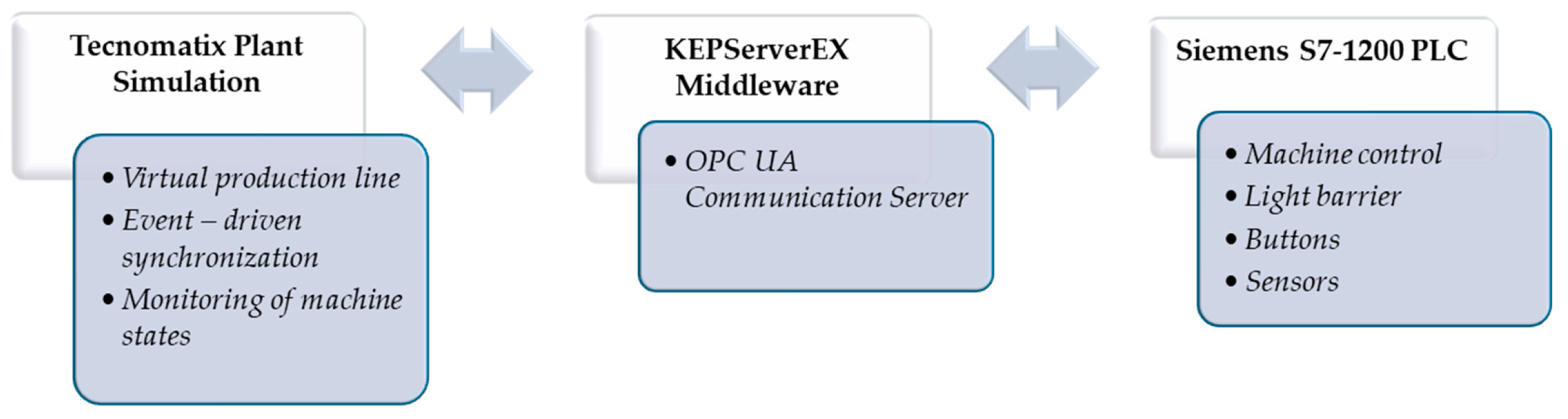
The connection between the physical production system and the Digital Twin is implemented through an OPC UA communication architecture using KEPServerEX middleware. Real-time operational data acquired from the Siemens S7-1200 PLC are transmitted via OPC UA to the Tecnomatix Plant Simulation environment, where the received signals dynamically update the state of the simulation model. The architecture enables event-driven synchronization between selected physical system states and their corresponding virtual representations.
Given its modularity, interoperability, and secure architecture, OPC UA aligns closely with the strategic objectives of Industry 4.0. Its implementation supports the development of intelligent, flexible, and interconnected manufacturing systems by enabling reliable and standardized communication across various layers of industrial processes. As such, OPC UA serves as a foundational enabler for the digital transformation of manufacturing and logistics systems in the context of cyber–physical production environments.
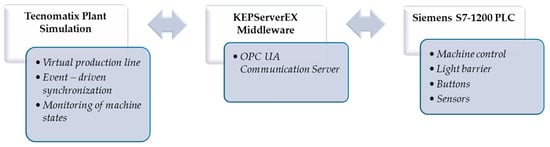
The methodology for connecting the simulation with the PLC via OPC UA is based on a three-layer communication architecture, as illustrated in Figure 1. At the physical level, there is a Siemens S7-1200 programmable logic controller and connected peripherals, including a light barrier, buttons, and production equipment. The communication layer is implemented through KEPServerEX, which acts as middleware and provides data via an OPC UA server. At the digital level, there is a simulation model in Tecnomatix Plant Simulation, which is synchronized with the physical system through OPC UA communication.
Figure 1.
Online Digital Twin architecture.
Within the presented implementation, sensor states and operational signals acquired from the physical manufacturing system are continuously transmitted to the simulation environment, where they dynamically influence the state of the online Digital Twin. The implemented synchronization mechanism primarily supports physical-to-virtual data exchange for monitoring and event-driven simulation updates. Selected control interactions were experimentally verified within the laboratory environment; however, the developed implementation is primarily oriented toward real-time monitoring rather than autonomous bidirectional production control.
The synchronization between the physical system and the simulation environment was implemented using event-driven OPC UA communication. PLC variables representing sensor states, machine status, and safety-related events were periodically updated within the OPC UA server environment and subsequently synchronized with the Tecnomatix Plant Simulation model. The communication refresh interval was configured to support near-real-time synchronization while avoiding excessive communication overhead. The measured synchronization latency during experimental verification ranged between 50 and 200 ms depending on communication and processing conditions. Table 1 illustrates the proposed architecture and communication structure used for synchronization between the physical manufacturing system and the online Digital Twin environment.
Table 1.
Experimental hardware and software configuration.
As part of the presented work, a case study was developed focusing on the integration of a simulation model with components of a real production environment within a specialized TestBed laboratory. This represents a fundamental step towards the creation of a fully functional Digital Twin. The aim of the study was to analyze and experimentally verify the possibilities of connecting a simulation system with real control hardware through industry-proven communication protocols.
The case study focuses on the integration of a simulation environment with a control system via the OPC UA communication protocol, utilizing Kepserver as middleware in connection with Tecnomatix Plant Simulation and a physical model. This architecture forms the foundation for implementing the Digital Twin concept. Although the presented implementation utilizes Siemens PLC hardware, the proposed OPC UA communication architecture remains transferable to other industrial control platforms supporting standardized OPC UA interfaces, thereby improving interoperability across heterogeneous industrial environments. The results indicate significant potential for broader deployment in real industrial settings, particularly in systems characterized by a high degree of heterogeneity.
4. Results
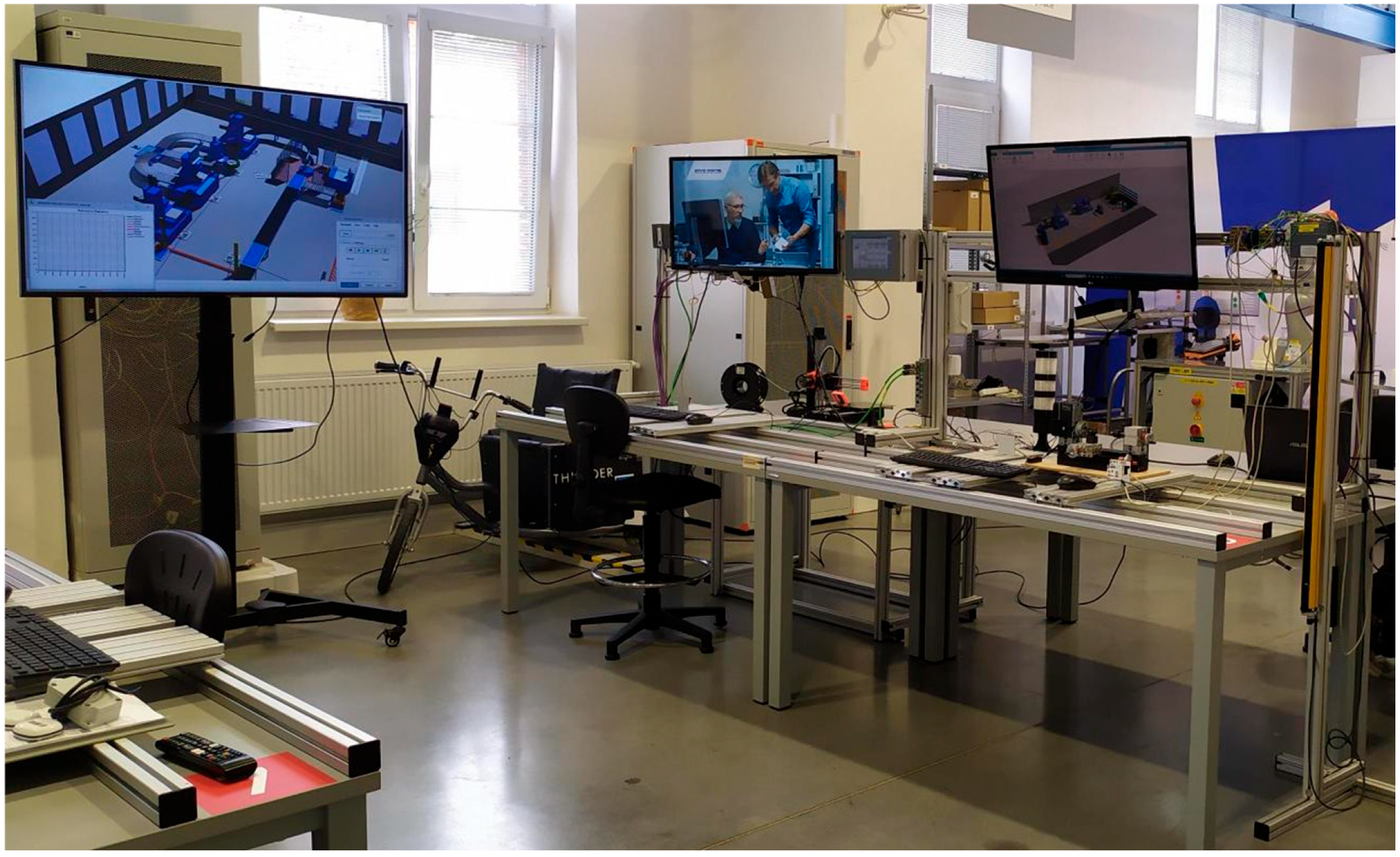
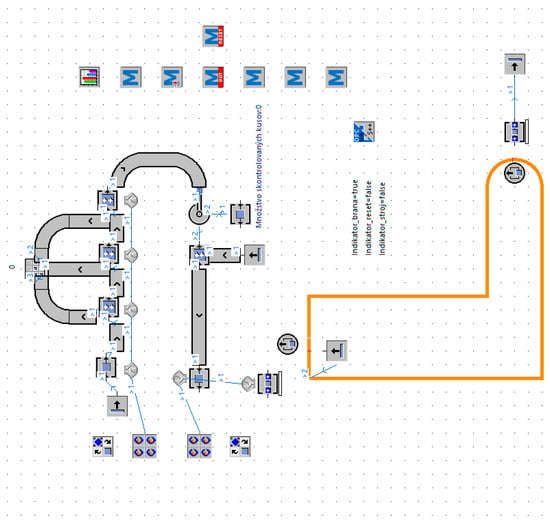
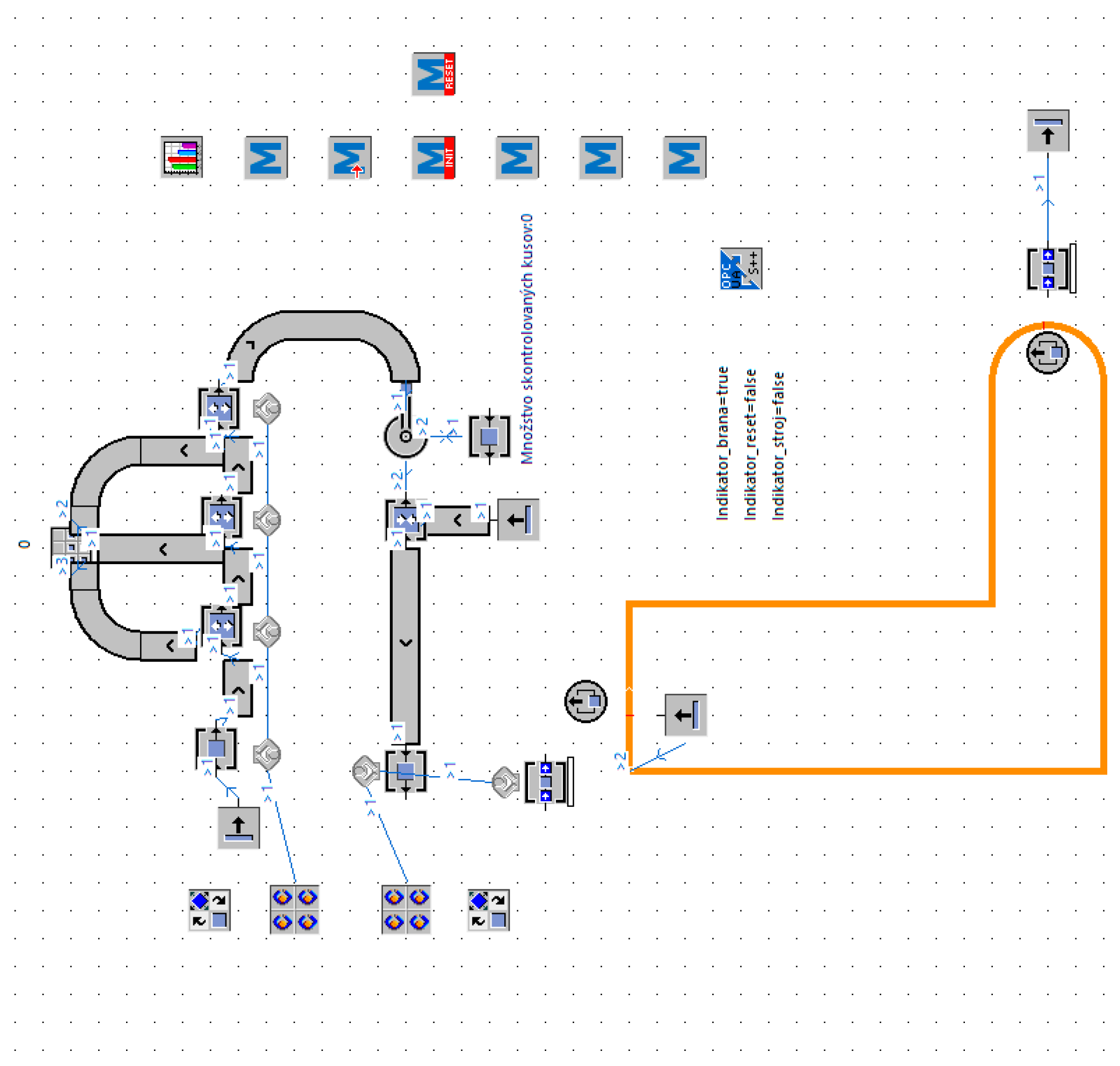
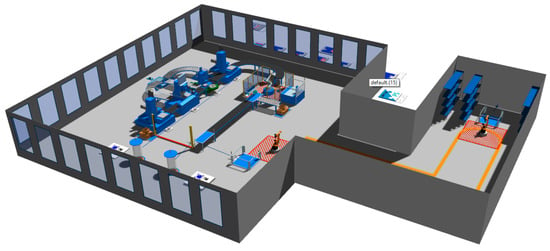
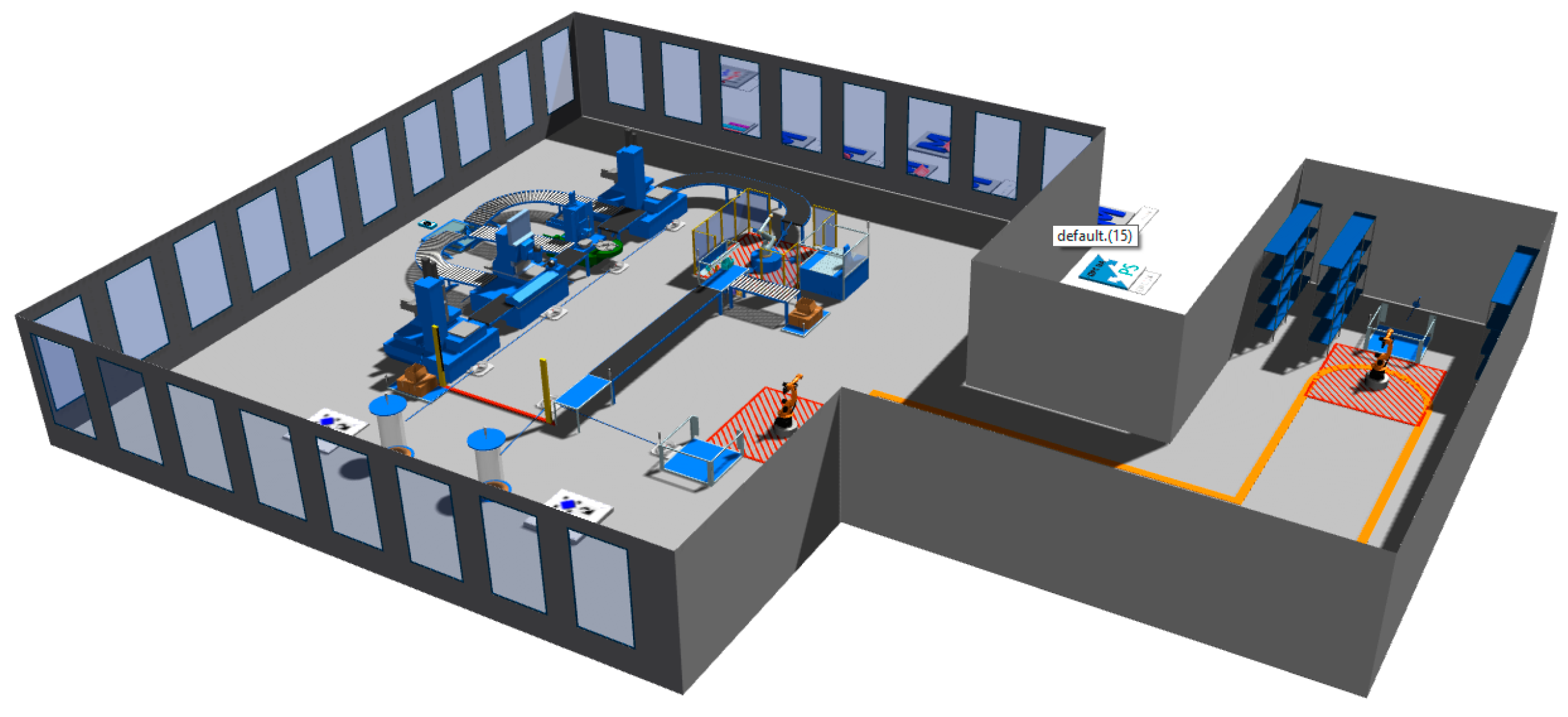
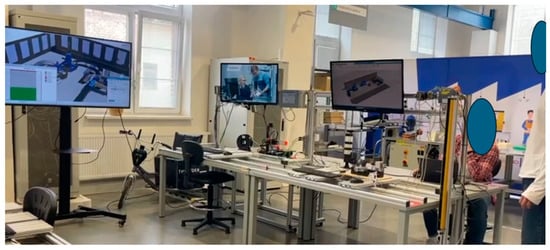
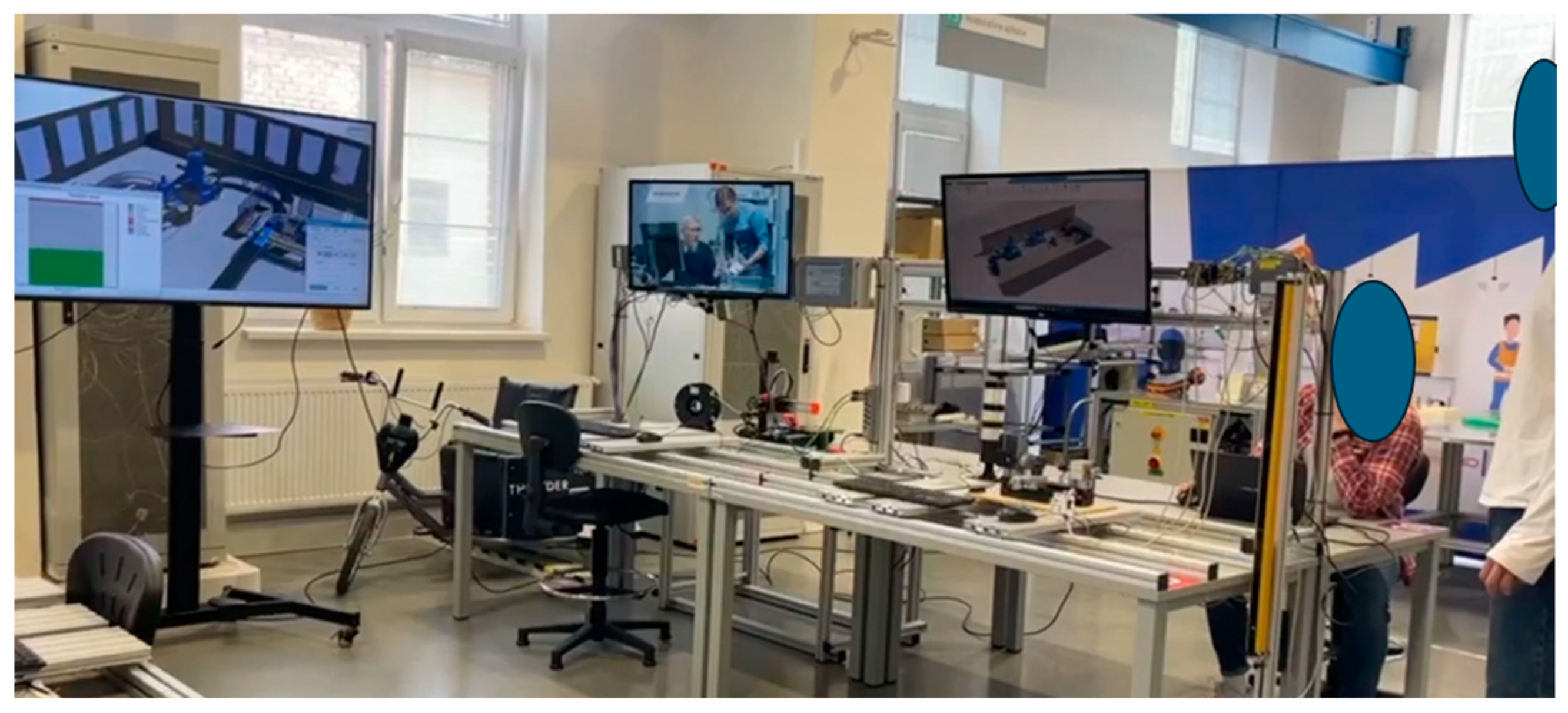
In the first step, a simulation model was created in Tecnomatix Plant Simulation as a 2D/3D “U”-shaped model, replicating the laboratory setup in TestBed 4.0; see Figure 2, Figure 3 and Figure 4. The developed simulation model served as the virtual representation of the physical manufacturing system within the proposed online Digital Twin architecture. The simulation environment was designed to support real-time synchronization, monitoring of operational states, and event-driven interaction with physical manufacturing components connected through OPC UA communication.
Figure 2.
TestBed—special laboratory for development and testing of Digital Twin technology.
Figure 3.
Simulation model of process line in TestBed using Tecnomatix Plant Simulation software—2D.
Figure 4.
Simulation model of process line in TestBed using Tecnomatix Plant Simulation software—3D.
Figure 3 illustrates a two-dimensional representation of the production line developed in Tecnomatix Plant Simulation. The model serves as the basis for real-time synchronization with the physical manufacturing system and enables visualization of operational states within the Digital Twin environment.
Figure 4 presents the three-dimensional visualization of the production system. The 3D model improves the interpretability of manufacturing processes and supports intuitive monitoring of synchronized events occurring in the physical system.
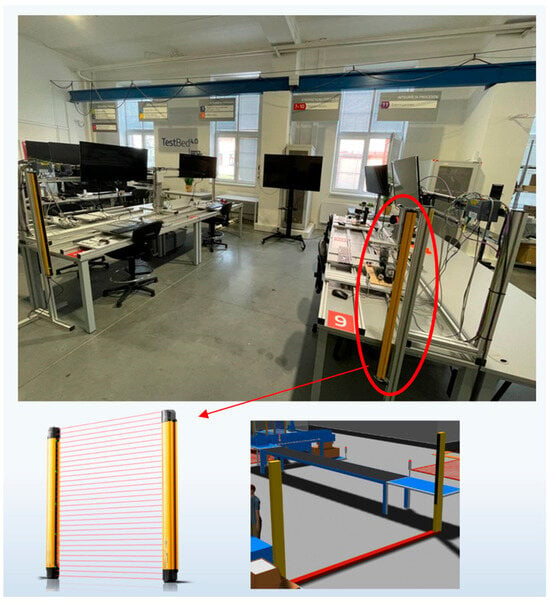
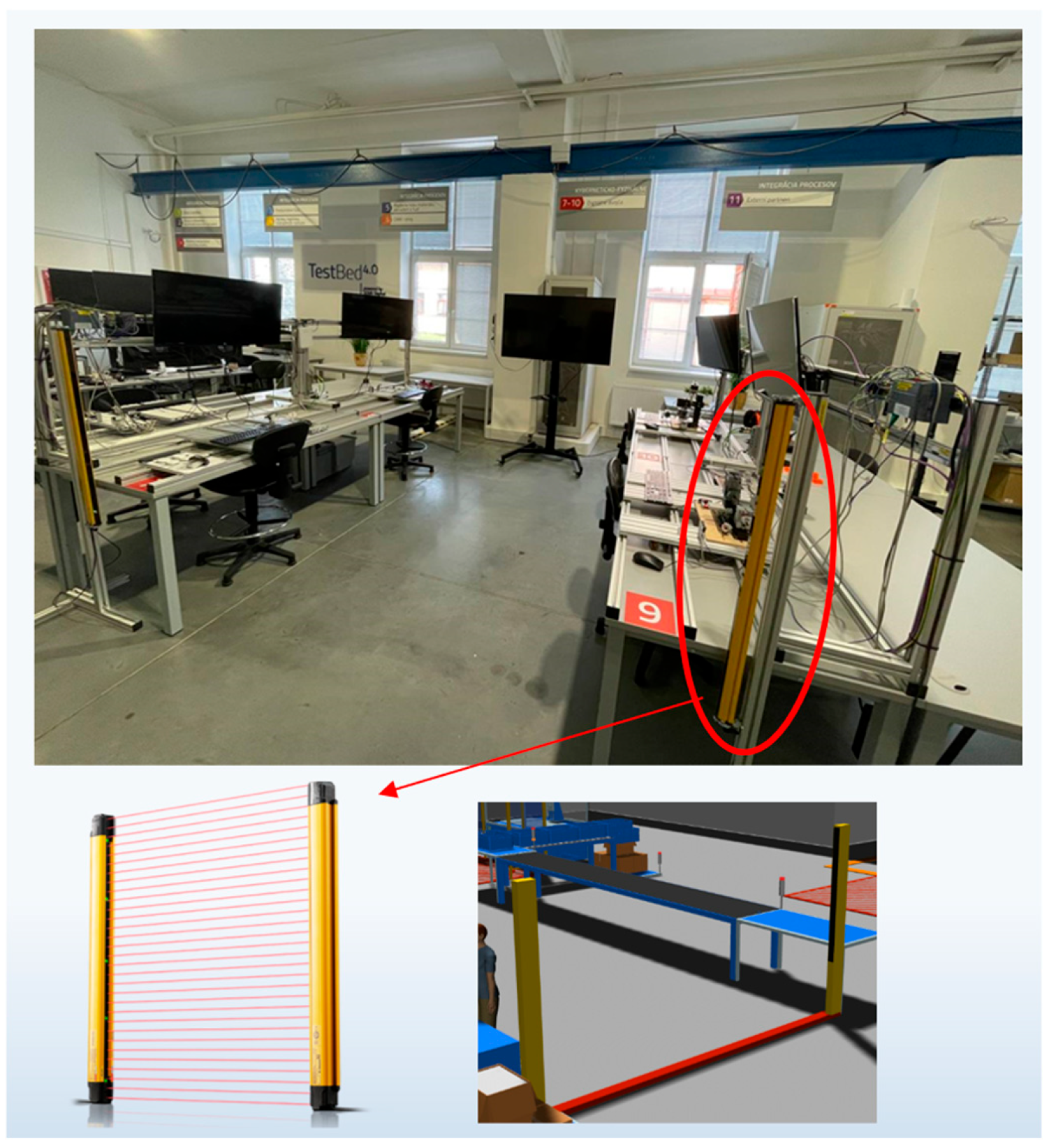
The physical model incorporates a light barrier, shown in Figure 5, which is also represented in the simulation model as an active control element. Within the online Digital Twin environment, the light barrier functions as a safety-related event source enabling real-time synchronization between the physical manufacturing system and its virtual representation. In the virtual environment, it serves as a trigger mechanism for starting and stopping the simulation, thereby ensuring synchronization between physical and digital processes. Activation of the physical light barrier generates an OPC UA signal that dynamically updates the simulation state and interrupts the running production process within the virtual environment. This functionality demonstrates how safety-related events can be represented and monitored within the online Digital Twin architecture.
Figure 5.
Integrating light barriers with Tecnomatix Plant Simulation improves stopping and checking processes for people passing through.
4.1. Configuration of the Simulation Model in the Tecnomatix Plant Simulation and KEPServer Software Environment
The next phase involved the configuration of the simulation model representing the production line process in the TestBed environment using Tecnomatix Plant Simulation. This phase focused primarily on the integration of the simulation environment with physical manufacturing components, including light barriers and a selected production machine controlled through the Siemens PLC system. The objective of this integration was to establish real-time synchronization and event-driven interaction between the physical manufacturing system and its virtual representation within the online Digital Twin environment. The implemented architecture enabled visualization of selected operational and safety-related events detected in the physical system directly within the simulation environment. Such connectivity enhances the capability of the online Digital Twin to support real-time monitoring and synchronization of manufacturing process states.
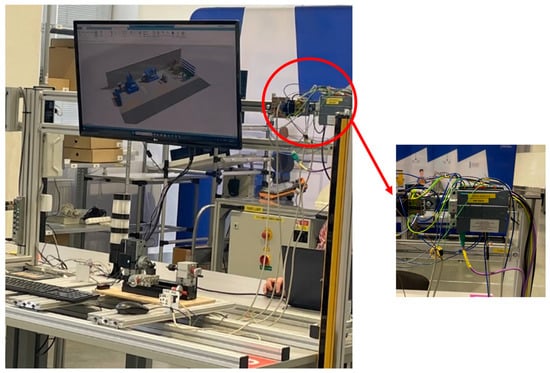
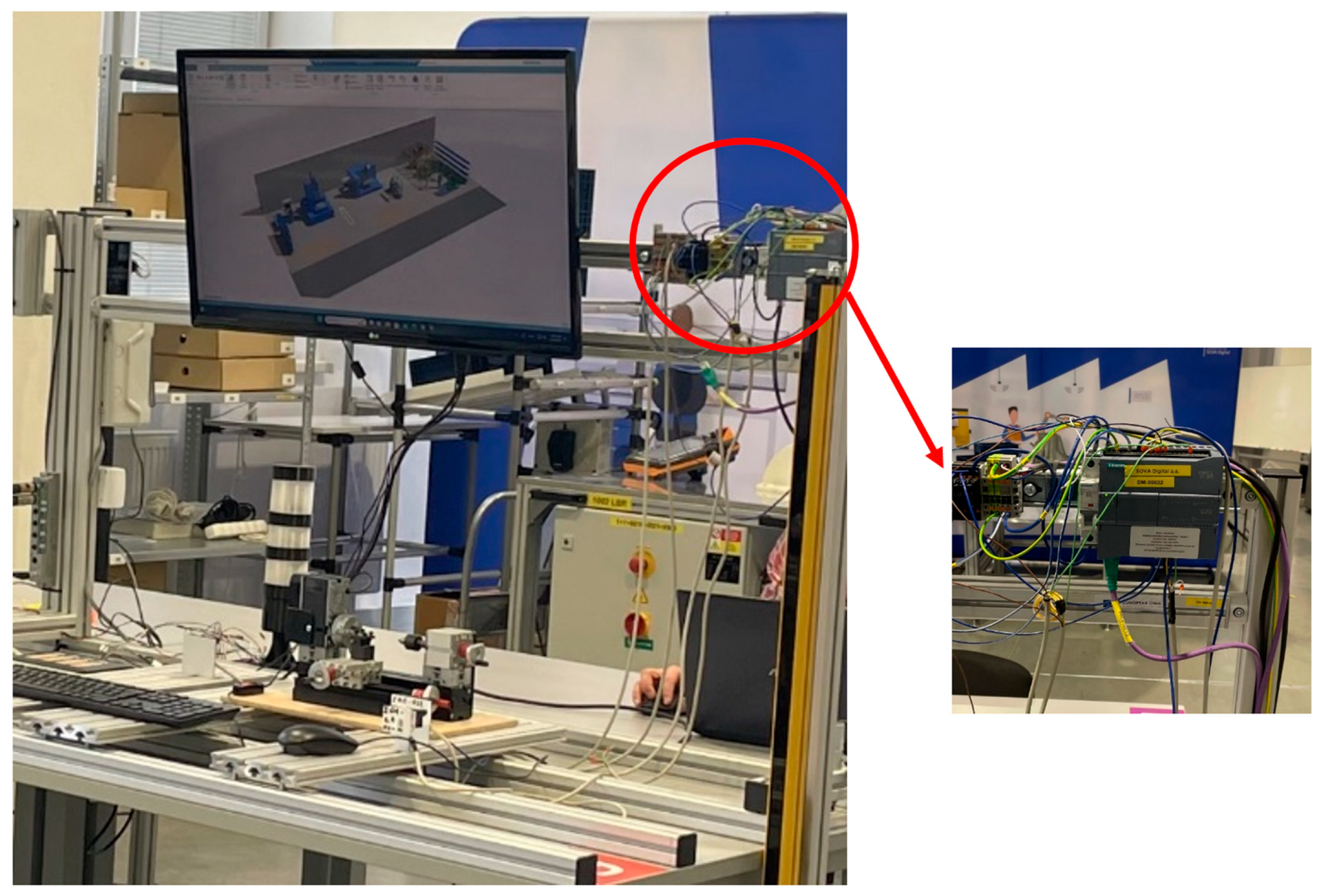
For the integration of the light barrier, the production machine, and the control button initiating the production process, the KEPServerEX Version 6.13 software environment was used as OPC UA middleware for communication between the Siemens PLC and the simulation environment. The OPC UA server enabled standardized real-time exchange of operational signals representing machine states, sensor activity, and selected safety-related events. Within the presented implementation, the PLC operated as the central control unit coordinating communication between the physical manufacturing components and the online Digital Twin environment. Operational states were represented through binary control variables synchronized between the physical system and the simulation model via OPC UA communication. This integration enabled continuous monitoring of operational changes and experimental verification of synchronization behavior between the physical and virtual environments, as illustrated in Figure 6. Figure 6 illustrates the configuration of digital elements within the KEPServerEX environment and demonstrates how physical devices are mapped to OPC UA variables used for synchronization with the simulation model.
Figure 6.
Digital automated workplace—Cell 2, KEPServerEX Home Area, and creation of digital elements.
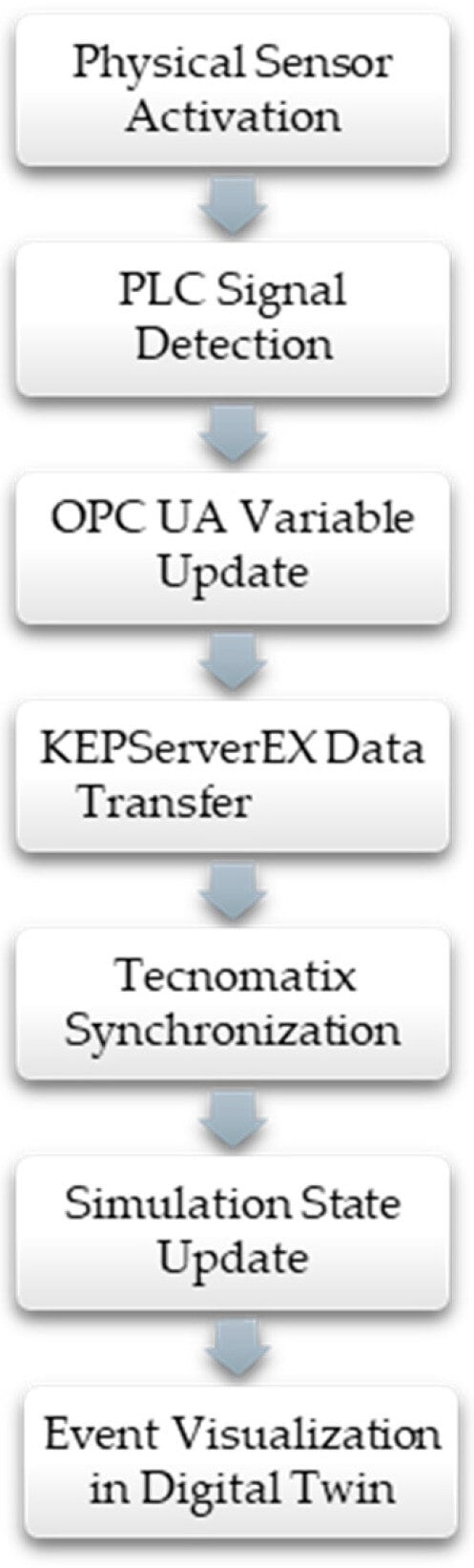
The integration process commenced with the configuration of communication channels in the KEPServerEX software. Within the user interface, the ‘Connectivity’ section was used to define the communication links. The communication architecture was configured to establish standardized OPC UA-based data exchange between the Siemens S7-1200 PLC and the Tecnomatix Plant Simulation environment. A new communication channel was created in the KEPServerEX environment, representing the initial step in establishing a connection with the connected devices. The connection was configured using a communication protocol appropriate for the hardware interface, thereby ensuring standardized data exchange (Figure 6). The implemented communication structure enabled real-time synchronization of operational variables, sensor states, and selected safety-related events between the physical manufacturing system and its virtual representation within the online Digital Twin environment. This process initiated the establishment of a connection with the programmable logic controller (PLC). The first step involved selecting the appropriate PLC type based on the system architecture and communication interface. In this configuration, the “Siemens TCP/IP Ethernet” communication type was selected to ensure compatibility with the control system used. The overall communication and synchronization architecture of the proposed online Digital Twin environment is illustrated in Figure 7. Although the presented implementation utilized Siemens-specific communication settings, the proposed OPC UA-based architecture remains transferable to other industrial control platforms supporting OPC UA communication standards, thereby improving interoperability across heterogeneous manufacturing environments.
Figure 7.
OPC UA communication workflow.
Figure 7 summarizes the complete communication workflow between the physical manufacturing system, the OPC UA middleware, and the Digital Twin environment. The architecture forms the core of the proposed online synchronization framework.
Once the settings were completed, a summary table was displayed to verify the selected parameters. The configuration process was finalized through confirmation of the selected parameters. Subsequently, dedicated OPC UA variables and digital elements representing the light barrier, the production machine, and the control button were defined within the communication environment. The configuration required selecting the appropriate PLC type corresponding to the device model used in the production setup, assigning the PLC identifier, and maintaining the default settings for the remaining parameters. These digital elements enabled synchronization of operational states between the physical manufacturing system and the online Digital Twin environment through standardized OPC UA communication.
The final step in creating the digital elements involved the definition of new OPC UA tags within the previously configured device. The configured tags represented operational variables associated with the light barrier, machine operation, and control signals exchanged between the PLC-controlled manufacturing system and the simulation model. For the experimental setup, the addresses were assigned as ‘I1.4’ for the light barrier and ‘I1.3’ for the button. In the case of the machine, the address was manually assigned to correspond with the machine configuration (“DB20.DBX0.0”). The implemented OPC UA tags enabled continuous acquisition and synchronization of real-time operational states within the online Digital Twin environment. The functionality of the digital elements was verified using the KEPServerEX monitoring interface, which displayed real-time changes in variable values during testing. Observed changes in OPC UA variable states confirmed successful synchronization between the physical manufacturing components and their corresponding virtual representations within the simulation environment.
4.2. Connecting and Adapting Digital Elements to the Simulation Model in the Tecnomatix Plant Simulation Application Using OPC UA Configuration
This step addressed the connection of the digital elements to the previously created production line model in the Tecnomatix Plant Simulation environment. The integration was implemented through OPC UA using the ‘Method’ function, which enabled code-based synchronization and communication between the simulation model and the physical manufacturing system.
After adding OPC UA to the list of items, it is necessary to enter the home IP address in order to pair KEPServerEX with the device. Next, it is necessary to add indicators for each digital element. For this purpose, we will add three “Variable” indicators, the first of which will be called “Indicator_door”, which, as is clear from the name, will track the change in the light gate indicators. By double-clicking on it, we complete the “ Data type” and “Value” lines. For the light gate, we chose the value “true” in the “Value” item, because after connecting this digital element, this variable will change to the value “false” by default. This means that the light gate is functional, and no one is standing in it, and if someone passes through it, this indicator will be remembered as “true” until there is no longer a person.
Two additional indicators, designated as ‘Indicator_reset’ and ‘Indicator_stroj’, were created to represent the reset button and the machine. We will select “Data type” for them as in the previous point, but change “Value” to “false”. Once the necessary indicators were created, the process continued in the OPC UA settings, where the relevant group parameters were defined and the data of the digital elements were entered. The configured OPC UA variables enabled synchronization of operational states between the physical manufacturing system and the simulation environment. To create a preparation for a Digital Twin, it is necessary to connect the digital elements created in the Tecnomatix Plant Simulation software directly to the simulation itself, via the Section 3, in which we will write commands for “Stop”, “Start” and “Machine operation”. At this stage, the environment was prepared for real-time event-driven interaction between the physical manufacturing components and their virtual representations within the online Digital Twin architecture. It was necessary to add a code designed to stop all processes if a person or object was detected between the light barriers.
The result is a final simulation that runs in parallel with the digital components to the maximum extent possible. The simulation automatically pauses upon passing through the light gate and resumes operation when the reset button is pressed. A visual indicator in the form of an LED is also integrated into the 3D simulation environment, changing its color depending on the current state of the machine. A red light indicates that the machine is blocked, a yellow light signals that the machine is waiting for a component to arrive, and a green light indicates that the machine is in active operation, as shown in Figure 8.
Figure 8.
Machine connected with digital elements in Tecnomatix Plant Simulation.
Figure 8 demonstrates the integration of machine status indicators into the simulation model and illustrates how operational conditions are visualized in real time within the Digital Twin environment.
4.3. Evaluation of the Processed Application Options
This research discusses the implementation and evaluation of an online Digital Twin environment for manufacturing systems. The presented experimental application demonstrates selected monitoring and analysis functions available within the Tecnomatix Plant Simulation environment integrated with real-time OPC UA communication and digital manufacturing elements.
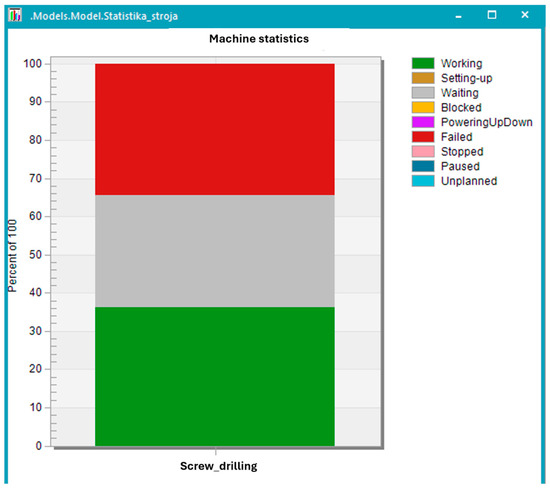
The first aspect analyzed was the possibility of monitoring the complete operation of selected machines using graphical outputs. This was achieved by employing the ‘Chart’ function, to which one or more machines were assigned in order to generate a graphical representation of their operational states. The resulting graph displayed the percentage distribution of machine states (operation, idle, waiting, blocked). The recorded machine-state transitions confirmed successful synchronization between the physical light barrier activation and the corresponding response within the online Digital Twin environment. The results indicated that the machine was blocked when the light gate was activated and resumed operation following the reset command (Figure 9).
Figure 9.
Graph showing machine operation.
To verify synchronization consistency between the physical manufacturing system and the online Digital Twin environment, selected operational and safety-related events were experimentally monitored through OPC UA communication. The measured delays (Table 2) represent the time difference between the physical event occurrence and its visualization within the Tecnomatix Plant Simulation environment.
Table 2.
Synchronization validation between physical and digital systems.
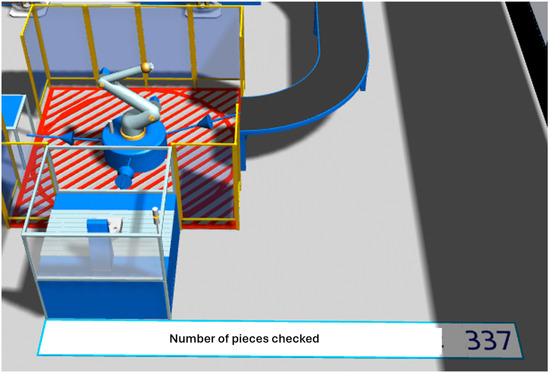
Another option for analyzing and checking production efficiency is the possibility of using the “Display” function, thanks to which the number of parts processed at a selected workstation can be monitored. This functionality enabled basic monitoring of production throughput within the synchronized simulation environment. In the experimental run, 337 parts were produced and inspected during an eight-hour shift (Figure 10). The obtained results demonstrate the capability of the developed online Digital Twin environment to continuously visualize selected operational indicators acquired during the manufacturing process.
Figure 10.
Display analysis in Tecnomatix Plant Simulation software.
The last function of the analysis is usually an integrated and more general function that is displayed at the end of the time period that we have defined for the simulation. In it we can see the main static data after an eight-hour shift (see Figure 11). The generated statistical outputs provided an overview of selected operational parameters within the monitored production process and enabled basic evaluation of machine utilization and production flow behavior.
Figure 11.
Final statistics in Tecnomatix Plant Simulation software.
It should be noted that the simulation model developed in this study was not designed for predictive optimization or autonomous production control; rather, its primary purpose was to demonstrate the capabilities of Tecnomatix Plant Simulation for reconstructing production processes integrated with digital elements within an online Digital Twin monitoring environment.
Figure 11 presents the final operational statistics generated by the Tecnomatix Plant Simulation model. The statistics were calculated using the predefined simulation parameters and process logic. While machine states and events were synchronized online through OPC UA communication, the reported values do not represent service times directly acquired from the physical manufacturing system.
The obtained statistics provide a summary of machine utilization and operational states within the synchronized Digital Twin environment and confirm the correct execution of the simulation model during the experimental validation.
This model allows us to visually evaluate the efficiency of the production process and all its components without having to repeat real production. This approach considerably reduces the time and resources required for experimentation and testing. Thanks to the capabilities of Tecnomatix Plant Simulation software, we can accurately reconstruct the flow of materials in production. Support for 2D-3D conversion and the ability to insert our own 3D objects allow us to create more realistic models of production processes. The implemented online Digital Twin architecture therefore provides a suitable experimental environment for future extensions focused on predictive analytics, advanced synchronization analysis, and scenario-based simulation experiments.
5. Discussion
The connection between OPC UA and Tecnomatix Plant Simulation has highly diverse applications in the field of process modeling and object control. Tecnomatix Plant Simulation is software specifically tailored for modeling and simulation production lines and manufacturing systems. By employing OPC UA communication, it becomes possible to establish real-time synchronization and monitoring between physical manufacturing components and their virtual representations within an online Digital Twin environment.
In the presented case study, the system was tested in a controlled environment without simulating extreme network or PLC load. The basic system response (e.g., reaction to input from the light curtain and button press) was nearly instantaneous—on the order of tens to hundreds of milliseconds. A load test has not yet been conducted; however, TestBed 4.0 provides a platform where future scenarios with variable communication and computational load will be tested in order to identify system response thresholds. When using OPC UA via KEPserverEX under normal operating conditions (without heavy network traffic), latency ranged between 50 and 200 ms, which is in line with the requirements for standard monitoring and control of discrete manufacturing processes (e.g., visualization and basic human–machine interaction). However, for time-critical applications (such as motion control or real-time safety shutdown), it would be necessary to consider implementing the OPC UA PubSub model or a hybrid industrial communication protocol.
Statistical validation of the simulation against the physical manufacturing system was not performed within the scope of this study, which represents one of the main limitations of the presented implementation. The primary objective of the research was focused on demonstrating the feasibility of OPC UA-based integration and real-time synchronization between the PLC-controlled manufacturing system and the simulation environment. Nevertheless, the experimentally observed functional behavior of the simulation model corresponded to expected reactions of the physical system, particularly in the case of light barrier activation, simulation interruption, and machine-state synchronization. Future research should therefore include quantitative comparison between logged PLC operational data and simulation outputs in order to evaluate synchronization accuracy and Digital Twin fidelity under different operating conditions.
One of the main tasks of integrating OPC UA with Tecnomatix Plant Simulation is the exchange of standardized data on machine or production status, production parameters, and other performance indicators. This enables preliminary analysis and monitoring of manufacturing processes before their physical implementation.
To support communication and synchronization between the virtual and physical environments, the OPC UA standard was employed, guaranteeing platform independence, security, and interoperability among heterogeneous systems. Communication was facilitated via the KEPServerEX interface, which serves as a gateway for unifying data flows between PLC devices and the simulation software.
Such integration is of critical importance for implementing the concept of the Digital Twin within the Industry 4.0 framework, as it enables real-time monitoring, synchronization, and experimental verification of manufacturing process behavior based on simulations reflecting the current state of the system. The resulting benefits include improved visibility of manufacturing operations, enhanced monitoring capabilities, and the establishment of a foundational framework for future extensions toward predictive analytics, advanced synchronization analysis, and scenario-based simulation experiments.
Potential and Opportunities
- Process Optimization: Through simulations and Digital Twins, various scenarios can be tested without interrupting real operations.
- Increased Flexibility: Multi-agent systems (MASs) enable decentralized decision-making, leading to better adaptability to changes.
- Real-Time Data Collection and Analysis: Thanks to OPC UA and KEPServerEX, efficient monitoring and control are made possible.
Disadvantages and Challenges
- Implementation Complexity: Integrating MASs, simulations, and real devices requires expertise across multiple domains.
- Security: While OPC UA provides encryption and authentication, risks remain when connecting to public or hybrid networks.
- Latency: In complex simulations, delays may occur that affect synchronization with real devices.
The approach in this study leverages the OPC UA standard, which inherently supports scalable, secure, and interoperable communication across diverse industrial devices and platforms. While the current case study focused on a Siemens PLC and KEPServerEX setup in a controlled environment, the architecture can be extended to larger systems with multiple PLCs and parallel processes. Future work includes comprehensive stress testing in the TestBed 4.0 environment to evaluate scalability and latency under complex loads.
Security in laboratory settings was ensured via OPC UA’s built-in encryption and authentication mechanisms. However, deploying this solution in real-world industrial environments requires additional safeguards such as network segmentation, firewall protection, regular software updates, and physical security measures. Addressing these vulnerabilities is essential to maintain robust cybersecurity.
Finally, since OPC UA is a vendor-neutral protocol, our methodology can be adapted to various industries and machines beyond the Siemens/KEPServerEX ecosystem. Using protocol gateways and custom data modeling, integration with other protocols and devices is feasible, supporting broad applicability across heterogeneous industrial environments.
The proposed approach was also designed with application in a specialized TestBed 4.0 laboratory, which enables realistic testing of industrial operations without interfering with live production environments. Within this controlled environment, it is possible to create alternative simulation scenarios, test system behavior under different conditions, and identify corrective measures already in the design or reconfiguration phase. This significantly reduces risk, supports faster decision-making, and shortens the time from concept to implementation.
The results of the case study demonstrated a functional integration between the simulation model and the real PLC via OPC UA. The system exhibited a near-instantaneous response to basic inputs, such as signals from the light barrier or button presses, with response times ranging from 50 to 200 ms. This performance is adequate for visualization and basic control tasks; however, for time-critical applications, such as motion control or emergency shutdown procedures, faster communication protocols, e.g., OPC UA PubSub or hybrid solutions, would be required.
While the simulation behavior closely matched that of the physical system, no statistical validation was conducted to quantitatively compare simulation outputs with actual PLC data. Such validation is essential for rigorously assessing the accuracy and reliability of the Digital Twin. Additionally, the implementation was tested on a limited number of devices, and its scalability under higher network loads remains to be evaluated.
Compared to existing studies, a key contribution of this work is the integration of safety elements within the real-time synchronization framework, enhancing the methodology’s applicability for validating human–machine interaction and safety mechanisms in production processes.
6. Conclusions
The essence of digitalization lies in creating a research system capable of collecting and analyzing all relevant data generated in real manufacturing and logistics processes. A key tool in this context is the online Digital Twin, a comprehensive simulation model that enables real-time monitoring and synchronization of manufacturing processes through rapid data processing and evaluation. To achieve this goal, it is essential to eliminate the barriers separating the physical and digital worlds and to develop effective methods for data analysis and interpretation. In this regard, the OPC UA (Open Platform Communications Unified Architecture) standard plays a crucial role as a universal communication protocol, ensuring interoperability and secure data exchange among heterogeneous systems and devices.
The Digital Twin facilitates various analyses and assessments of production states, which can support monitoring and evaluation of manufacturing processes at multiple management levels, from generating solution proposals for arising situations—implemented by operators, planners, managers, or owners—to the possibility of future automated feedback application of these proposals in the real production process. The integration of the Digital Twin with the OPC UA protocol ensures consistent and secure real-time data transmission, significantly enhancing monitoring and synchronization capabilities within manufacturing environments.
The development of advanced algorithms that enable the Digital Twin to autonomously propose sophisticated solutions for current production situations represents a promising secondary research direction. While the primary objective remains to ensure efficient system interaction and data integration, the secondary objective focuses on in-depth analysis, evaluation and the exploration of causal relationships between proposed solutions and production outcomes, which can be realized within an OPC UA communication framework. The principles of Digital Twins and the Industry 4.0 concept can be tested and validated in laboratory environments such as TestBed 4.0. Such environments allow the analysis, monitoring and 2D/3D visualization of critical manufacturing processes without interfering with real operations, while the OPC UA standard guarantees secure and reliable data transfer between simulation and physical systems.
Current digitalization trends focus on utilizing transmitted data for production system control, with fundamental requirements including universal connectivity, local intelligence, security, self-organization, flexibility, large-volume data monitoring, and overall efficiency. A key success factor is reliable and efficient communication, especially in heterogeneous systems where interoperability between diverse technologies and platforms is necessary, precisely ensured by the OPC UA standard. Therefore, the foundation of effective digitalization is robust data exchange and sharing among systems, requiring the implementation of standards and proven methodologies. The main challenge remains the optimized use of advanced communication and information technologies that enable integration across various production system levels and support the realization of intelligent manufacturing in line with Industry 4.0 principles.
The proposed methodology confirmed that the integration of a simulation model in Tecnomatix Plant Simulation with a real PLC via OPC UA is technically feasible and beneficial for both academic and industrial applications. The main contribution lies in the implementation and experimental verification of an OPC UA-based online Digital Twin architecture supporting real-time synchronization and monitoring of manufacturing process states within a laboratory-scale cyber–physical production environment. An important aspect is the inclusion of a safety element, demonstrating practical possibilities for testing human–machine interaction.
At the same time, it should be acknowledged that statistical validation comparing long-term simulation outputs with operational PLC data was not performed within the scope of this study. Therefore, the presented implementation should currently be interpreted primarily as a monitoring-oriented online Digital Twin environment.
Future research should focus on quantitative validation by comparing simulation outputs with real PLC data, testing robustness under a higher number of devices and network loads, and evaluating alternative communication protocols. An interesting direction is also the extension of the methodology to predictive maintenance, scenario-based simulation experiments, and advanced synchronization analysis of manufacturing processes, which would further broaden the applicability of Digital Twins within smart manufacturing environments.
Author Contributions
Conceptualization, M.K., J.K., M.P., P.T.; methodology, M.K., J.K., M.P., P.T.; software, M.K.; validation, M.K., J.K., M.P., P.T.; formal analysis, J.K., M.K.; investigation, M.K., J.K., M.P., P.T.; resources, M.P. and J.K.; data curation, M.K., J.K., M.P., P.T.; writing—original draft preparation, M.K., J.K., M.P., P.T.; writing—review and editing, M.K., J.K., P.T.; project administration, M.K. All authors have read and agreed to the published version of the manuscript.
Funding
This article was created through the implementation of the grant project APVV-19-0418 “Intelligent solutions to enhance business innovation capability in the process of transforming them into smart businesses”, VEGA 1/0383/25 “Optimizing the activities of manufacturing enterprises and their digitization using advanced virtual means and tools”, Kega 003TUKE-4/2024 “Innovation of the profile of industrial engineering graduates in the context of required knowledge and specific capabilities for research and implementation of intelligent systems of the future”, VEGA 1/0160/26 “Integration of Digital Technologies into Business Processes in the Context of Industry 4.0/5.0”, and KEGA 037TUKE-4/2026 “EduSmart 5.0: Innovative Education for Competence Development in the Era of Industry 4.0 and 5.0.”.
Data Availability Statement
The data presented in this study are available on request from the corresponding author. The data are not publicly available due to confidentiality agreements and data protection requirements.
Conflicts of Interest
The authors declare no conflicts of interest.
References
- Balzer, R.; Užík, M.; Glova, J. Managing Growth Opportunities in The Digital Era—An Empiric Perspective of Value Creation. Pol. J. Manag. Stud. 2020, 21, 87–100. [Google Scholar] [CrossRef] [Scilit]
- Saniuk, S.; Grabowska, S.; Straka, M. Identification of Social and Economic Expectations: Contextual Reasons for the Transformation Process of Industry 4.0 into the Industry 5.0 Concept. Sustainability 2022, 14, 1391. [Google Scholar] [CrossRef] [Scilit]
- Glova, J.; Sabol, T.; Vajda, V. Business Models for the Internet of Things Environment: Emerging Markets Queries in Finance and Business (Emq 2013). Procedia Econ. Financ. 2014, 15, 1122–1129. [Google Scholar] [CrossRef] [Scilit]
- Kantaros, A.; Piromalis, D.; Tsaramirsis, G.; Papageorgas, P.; Tamimi, H. 3D Printing and Implementation of Digital Twins: Current Trends and Limitations. Appl. Syst. Innov. 2022, 5, 7. [Google Scholar] [CrossRef] [Scilit]
- Kantaros, A.; Ganetsos, T. Integration of Cyber-Physical Systems, Digital Twins and 3D Printing in Advanced Manufacturing: A Synergistic Approach. Am. J. Eng. Appl. Sci. 2024, 17, 1–22. [Google Scholar] [CrossRef] [Scilit]
- Kantaros, A.; Piromalis, D. Setting up a Digital Twin Assisted Greenhouse Architecture. Am. J. Eng. Appl. Sci. 2022, 15, 230.238. [Google Scholar] [CrossRef] [Scilit]
- Ba, L.; Tangour, F.; El Abbassi, I.; Absi, R. Analysis of Digital Twin Applications in Energy Efficiency: A Systematic Review. Sustainability 2025, 17, 3560. [Google Scholar] [CrossRef] [Scilit]
- Alnowaiser, K.K.; Ahmed, M.A. Digital Twin: Current Research Trends and Future Directions. Arab. J. Sci. Eng. 2023, 48, 1075–1095. [Google Scholar]
- Jones, D.; Snider, C.; Nassehi, A.; Yon, J.; Hicks, B. Characterising the Digital Twin: A Systematic Literature Review. CIRP J. Manuf. Sci. Technol. 2020, 29, 36–52. [Google Scholar] [CrossRef] [Scilit]
- Fuller, A.; Fan, Z.; Day, C.; Barlow, C. Digital Twin: Enabling Technologies, Challenges and Open Research. IEEE Access 2020, 8, 108952–108971. [Google Scholar] [CrossRef] [Scilit]
- Renard, D.; Coppens, D.; Agostinho, C.; Jardim-Goncalves, R. From Sensors to Digital Twins toward an Iterative Approach for Scalable Manufacturing Systems. Sensors 2024, 24, 1434. [Google Scholar] [CrossRef] [Scilit] [PubMed]
- Velesaca, H.O.; Holgado Terriza, J.A.; Gutiérrez Guerrero, J.M. Industrial Process Automation Through Machine Learning and OPC UA Integration in Industry 4.0 Environments. Electronics 2025, 14, 3749. [Google Scholar] [CrossRef] [Scilit]
- Reuther, A.; Plesker, C.; Bassauer, D.; Schleich, B. A Digital Twin Framework for Programmable Logic Controllers in Industrial Automation Systems. Procedia CIRP 2026, 139, 446–452. [Google Scholar] [CrossRef] [Scilit]
- Advances in Digital Twin Technology. Available online: https://innovate.ieee.org/innovation-spotlight/digital-twin-technology/ (accessed on 28 February 2023).
- Hossain, S.M.M.; Saha, S.K.; Banik, S.; Banik, T. A New Era of Mobility: Exploring Digital Twin Applications in Autonomous Vehicular Systems. In Proceedings of the 2023 IEEE World AI IoT Congress (AIIoT), Seattle, WA, USA, 7–10 June 2023. [Google Scholar]
- da Silva Mendonça, R.; de Oliveira Lins, S.; de Bessa, I.V.; de Carvalho Ayres, F.A., Jr.; de Medeiros, R.L.P.; de Lucena, V.F., Jr. Digital Twin Applications: A Survey of Recent Advances and Challenges. Processes 2022, 10, 744. [Google Scholar] [CrossRef] [Scilit]
- Zatrochova, M.; Kuperova, M.; Janakova, H. Innovative education of graduates of technical schools as a factor for competitiveness. In Proceedings of the 11th Annual International Conference of Education, Research and Innovation, ICERI2018 Proceedings, Seville, Spain, 12–14 November 2018. [Google Scholar]
- Folgado, F.J.; Calderón, D.; González, I.; Calderón, A.J. Review of Industry 4.0 from the Perspective of Automation and Supervision Systems: Definitions, Architectures and Recent Trends. Electronics 2024, 13, 782. [Google Scholar] [CrossRef] [Scilit]
- Hnilica, R.; Jankovsky, M.; Dado, M.; Messingerova, V. Experimental evaluation of combined effects of risk factors in work environment. In Proceedings of the 12th International Scientific Conference Engineering for Rural Development, Jelgava, Latvia, 23–24 May 2013. [Google Scholar]
- Bangsow, S. Tecnomatix Plant Simulation—Modeling and Programming by Means of Examples, 2nd ed.; Springer: Cham, Switzerland, 2020. [Google Scholar]
- Siemens. Digital Industries Software. Tecnomatix Plant Simulation Software Featured in SMART Manufacturing Magazine. Available online: https://blogs.sw.siemens.com/Tecnomatix/Tecnomatix-plant-simulation-software-featured-in-smart-manufacturing-magazine/ (accessed on 24 June 2024).
- Ruzarovsky, R.; Horak, T.; Zelník, R.; Skypala, R.; Csekei, M.; Šido, J.; Nemlaha, E.; Kopcek, M. Development and Validation of Digital Twin Behavioural Model for Virtual Commissioning of Cyber-Physical System. Appl. Sci. 2025, 15, 2859. [Google Scholar] [CrossRef] [Scilit]
- Straka, M.; Sofranko, M.; Glova, J.; Vegsoova, O.; Kovalcik, J. Simulation of homogeneous production processes. Int. J. Simul. Model. 2022, 21, 214–225. [Google Scholar] [CrossRef] [Scilit]
- Wicher, P.; Stas, D.; Karkula, M.; Lenort, R.; Besta, P. A Computer Simulation-Based Analysis of Supply Chains Resilience in Industrial Environment. Metalurgija 2015, 54, 703–706. [Google Scholar]
- Knapcikova, L.; Behunova, A.; Behun, M. Using a discrete event simulation as an effective method applied in the production of recycled material. Adv. Prod. Eng. Manag. 2020, 15, 431–440. [Google Scholar] [CrossRef] [Scilit]
- Marasova, D.; Saderova, J.; Ambrisko, L. Simulation of the Use of the Material Handling Equipment in the Operation Process. Open Eng. 2020, 10, 216–223. [Google Scholar] [CrossRef] [Scilit]
- Szajna, A.; Szajna, J.; Stryjski, R.; Sąsiadek, M.; Woźniak, W. The Application of Augmented Reality Technology in the Production Processes. Adv. Intell. Syst. Comput. 2019, 835, 316–324. [Google Scholar]



Disclaimer/Publisher’s Note: The statements, opinions and data contained in all publications are solely those of the individual author(s) and contributor(s) and not of MDPI and/or the editor(s). MDPI and/or the editor(s) disclaim responsibility for any injury to people or property resulting from any ideas, methods, instructions or products referred to in the content. |
© 2026 by the authors. Licensee MDPI, Basel, Switzerland. This article is an open access article distributed under the terms and conditions of the Creative Commons Attribution (CC BY) license.