


Abstract
This study targets biochar utilization in seasonally frozen Northeast China and addresses the insufficient research on aging characteristics and mechanisms of low-temperature wheat straw biochar under long-term freeze–thaw stress. A 60-day simulated freeze–thaw test with 12 h −20 °C freezing and 12 h 0 °C thawing per daily cycle was carried out on 300 °C wheat straw biochar (B300). We tracked dynamic shifts in pH and water absorption during aging, and comprehensively characterized particle size, micromorphology, pore structure, elemental composition and surface functional groups for fresh (CK-B300) and fully aged (FC-B300) biochar. Freeze–thaw cycling caused drastic aging: the average particle size dropped by 33.09%, specific surface area increased by 13.86%, while total pore volume and average pore size fell by 31.47% and 54.9%, respectively. Freeze–thaw oxidation raised the O/C ratio and enriched -OH, C=O functional groups; biochar pH declined by 12.94% alongside improved water absorption. This study confirms that biochar aging is jointly controlled by ice-crystal physical fragmentation and water-temperature oxidation, providing basic data and theoretical support for evaluating and applying biochar in cold freeze–thaw zones.
1. Introduction
With the advancement of environmental science and technology, sustainable environmental management has become a core global development concept. Biochar, a carbon-rich solid product produced from biomass pyrolysis under oxygen-limited conditions [1,2], has been widely recognized as a novel functional environmental material. It plays a notable role in soil remediation and carbon sequestration [3,4,5] and has thus received extensive attention and application in environmental fields.
Biochar features a developed porous structure, high cation exchange capacity (CEC) and favorable chemical stability [6,7]. Due to these properties, biochar has been widely applied in agricultural soil improvement and contaminated soil remediation, and its effects on soil physicochemical properties, contaminant behavior and microbial activities have been extensively documented [8,9,10,11]. These application scenarios also highlight the need to clarify the property evolution of biochar under complex natural environments.
Seasonal soil freeze–thaw is a common natural process in high-latitude regions, especially in Northeast China [12], which significantly alters the soil structure and restricts agricultural productivity [13]. When biochar is applied in freeze–thaw-affected areas, it will inevitably undergo long-term freeze–thaw aging, leading to changes in its own physicochemical properties such as pH, water absorption capacity and surface functional groups [14].
Existing studies have confirmed that freeze–thaw cycles can modify the hydraulic properties and pore structure of biochar [15], and the adsorption, ion exchange and functional group activity of biochar at low temperatures differ from those at room temperature [16]. Yang et al. [17] reported that freeze–thaw aging enhanced the heavy metal immobilization capacity of biochar via enriched surface oxygen-containing functional groups. Wang et al. [18] found that 30 freeze–thaw cycles increased the abundance of oxygen-containing functional groups and improved the adsorption capacity of corn straw biochar pyrolyzed at 500 °C. Cui et al. [19] indicated that freeze–thaw cycling could cause pore structure damage and impair the structural integrity of corn straw biochar prepared at 550 °C. Freeze–thaw cycles also remarkably change the chemical properties as well as surface structure of biochar, affecting its hydrophilic, hydrophobic, acid–base, and alkaline characteristics [20]. Hence, it is essential to study the physicochemical variations and performance of biochar following aging in freeze–thaw environments.
This study hypothesizes that long-term seasonal freeze–thaw cycles will alter the basic physicochemical properties of low-temperature wheat straw biochar by affecting its physical structure and surface chemical characteristics. The study aims to (1) examine the dynamic changes in the pH and water absorption capacity of B300 (wheat straw biochar pyrolyzed at 300 °C) during the whole 60-day freeze–thaw aging process, (2) compare the differences in particle size, surface morphology, pore structure, elemental composition and surface functional groups of biochar before and after complete freeze–thaw aging, and (3) analyze the main reasons for the property changes of biochar under freeze–thaw conditions. The results are expected to provide basic data and reference for performance evaluation and rational application of biochar materials in seasonal freeze–thaw regions.
2. Materials and Methods
2.1. Experimental Materials
The wheat straw biochar (B300) used in the experiment was prepared via pyrolysis under an oxygen-free anoxic atmosphere at 300 °C, supplied by Henan Lize Environmental Protection Technology Co., Ltd., Zhengzhou, China. The basic physicochemical indexes of raw B300 are as follows: pH = 9.43, ash content = 17.23%.
2.2. Biochar Freezing and Thawing Experiment
In this experiment, we simulated natural seasonal freeze–thaw processes of farmland in Shenyang, Liaoning Province, Northeast China, and the freeze–thaw aging procedure was modified based on the artificial aging method reported by Yang et al. [17]. Wheat straw biochar B300 was sieved through a 2 mm mesh; then, 5 g of sieved B300 was weighed and transferred into PET plastic bottles, which was then mixed with ultrapure water at a solid–liquid mass ratio of 1:4 before tightly sealing the bottle caps.
First, all prepared samples were equilibrated at room temperature (25 ± 2 °C) for 12 h to guarantee uniform distribution and full diffusion of water inside the biochar particles. Subsequently, the samples were moved to a −20 °C environment and frozen for 12 h to simulate severe winter cold conditions, followed by a 12 h thawing treatment at 0 °C to mimic spring thawing phenomena in Northeast China; the above three steps constituted one complete freeze–thaw cycle. The whole aging experiment was conducted with one cycle per day and lasted for around 60 days in total.
Three biological parallel replicates were set for each treatment. Seven sampling stages were arranged to continuously monitor the dynamic variations in pH and water absorption capacity, including the untreated control CK-B300, five intermediate aging time points during the 60-day freeze–thaw process, and the fully aged final sample FC-B300 after successive cyclic treatment. The freeze–thaw temperature scheme was formulated referring to the field monitoring data of Northeast cold farmland [21] to artificially mimic real cold-region environmental conditions, and the designed cycle duration guaranteed sufficient and complete aging of biochar.
2.3. Determination of Physico-Chemical Properties of Biochar
Biochar pH: Here, 1.0 g of air-dried biochar sample was mixed with ultrapure water at a solid–liquid ratio of 1:20, shaken for 30 min and left to stand for stratification. The supernatant pH was determined with a PHS-3C pH meter (GB/T 12496.7-1999) [22].
Biochar ash content: Samples were combusted in a muffle furnace at 550 °C for 4 h, following the test procedure specified in ASTM D1762-84 (2021) [23].
Biochar water absorption capacity: Here, 1.0 g of dried biochar sample was mixed with ultrapure water at a solid–liquid ratio of 1:20 and placed in an ultrasonic bath for 24 h to reach water absorption equilibrium. After draining free excess water, the mass of water-saturated biochar was weighed. The water absorption capacity was calculated by the mass difference: Water absorption capacity (g·g−1) = (mass of water-saturated biochar − mass of dry biochar)/mass of dry biochar [17].
Specific Surface Area (SSA) and Porosity of Biochar: The SSA and porosity of B300 sampled at various freeze–thaw intervals were measured using an automated surface and porosity analyzer (Micromeritics ASAP 2460, Norcross, GA, USA). Prior to analysis, the samples were degassed at 300 °C for 6 h under nitrogen atmosphere. Adsorption–desorption isotherms were collected under liquid nitrogen cooling at 77 K, which refers to 77 Kelvin, the boiling point of liquid nitrogen at atmospheric pressure and the standard testing temperature for BET nitrogen adsorption measurements. The nitrogen adsorption–desorption isotherms were analyzed; the BET model was adopted to calculate SSA, and the BJH model was used to acquire pore size distribution. Microporosity was defined as the volume ratio of micropores to total pore volume, following the standard testing protocol described by Ju et al. [24].
Elemental composition of biochar: Biochar was air-dried, crushed, and weighed at 30.00 mg. An organic element analyzer (Elementar Unicube, Langenselbold, Germany) was applied to determine the elemental content of B300 after freezing and thawing using the high temperature combustion method [25].
FTIR Spectroscopy of Biochar Functional Groups: The functional groups in biochar were analyzed via FTIR spectroscopy (Thermo Scientific Nicolet iS20, Waltham, MA, USA). In a dry setting, a visible biochar sample was mixed with an appropriate amount of dry potassium bromide powder in a mortar and pestle. The mixture was thoroughly ground several times and then pressed into a transparent pellet using a tablet press. Infrared spectra were collected after recording the background, with a resolution of 4 cm−1 and 32 scans, over a wavenumber range of 400–4000 cm−1 [24].
Particle size distribution: The volumetric particle size distribution of biochar was determined by a laser particle size analyzer (Bettersize 3000, Dandong, China) with water as the dispersion medium [26].
Biochar characterization structure: Biochar was characterized to assess its physicochemical properties before and after aging, in order to gain insights into how environmental factors influence its functionality. A scanning electron microscope (Zeiss Merlin Compact, Oberkochen, Germany) was used to examine the biochar’s structure and porosity [26].
2.4. Data Analysis
SPSS 27.0 software was applied for all statistical analyses, including one-way analysis of variance (ANOVA) and independent sample t-test to evaluate significant differences between treatments. Origin 2024 software was used for data fitting, curve processing and graphical plotting. All significance levels were set at p < 0.05.
3. Results and Discussion
3.1. Effect of Freeze–Thaw Cycles on pH and Water Absorption Capacity of Wheat Straw Biochar
The physicochemical characteristics of B300 wheat straw biochar were determined to reveal the dynamic variations in pH and water absorption capacity across successive freeze–thaw aging stages (CK-B300, S1–S5, FC-B300).
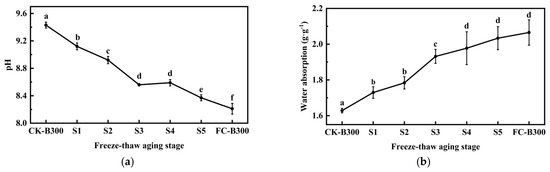
As illustrated in Figure 1a, the pH of B300 biochar exhibited a continuous declining trend with prolonged freeze–thaw aging. The initial pH of the untreated control CK-B300 reached 9.43, and this value gradually decreased to the minimum of 8.21 at the final aging stage FC-B300, representing a 12.94% reduction relative to CK-B300. One-way ANOVA demonstrated that freeze–thaw aging induced highly significant differences in pH among all experimental groups (p < 0.001). This result is consistent with the findings of Wang et al. [18]. The alkalinity of biochar remained relatively stable, with only a modest variation. The decrease in pH of CK-B300 can be due to the increased oxidation and the formation of acidic functional groups as the freeze–thaw cycles progressed [27]. Repeated freeze–thaw stress partially breaks down the aromatic skeleton of biochar, and the degraded carbon fractions are released as low-molecular-weight organic acids, which further neutralize the inherent alkalinity of biochar and lower bulk pH [17].
Figure 1.
Changes in pH and water absorption capacity of B300 biochar under freeze–thaw aging: (a) pH changes in B300 biochar along freeze–thaw stages; (b) Changes in water absorption capacity of B300 biochar along freeze-thaw stages. Data are presented as mean ± SD (n = 3). Different lowercase letters above data points denote significant differences between treatments (p < 0.05).
The hydraulic adsorption performance of biochar is jointly governed by surface texture, skeleton structure and pore porosity. The water absorption capacity of B300 biochar rose steadily, as freeze–thaw aging proceeded (Figure 1b). The water absorption of CK-B300 was only 1.628 g·g−1, and this indicator climbed continuously to 2.065 g·g−1 at FC-B300. Significant growth was observed from CK-B300 to S3, followed by a milder slow incremental increase across S4–FC-B300. Statistical analysis confirmed an overall extremely significant effect of freeze–thaw aging on the water absorption capacity (p < 0.001). This suggests that the structural integrity of biochar was compromised in the freeze–thaw environment, leading to a rise in the specific surface area as well as the pore volume, which in turn enhanced the water absorption. These changes are closely linked to alterations in both the structure and surface chemistry of biochar.
3.2. Particle Size and SEM Surface Morphology of Wheat Straw Biochar Under Freeze–Thaw Cycles
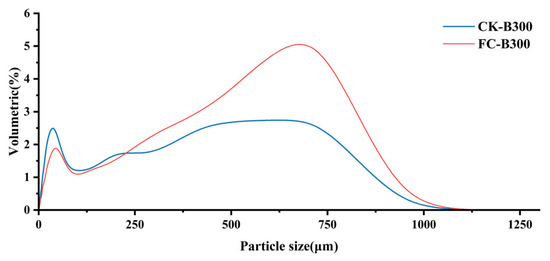
Biochar has the ability to modify the soil porosity, density, and water-holding capacity, with the functions being closely related to the particle size distribution of biochar [28]. As shown in Figure 2, freeze–thaw cycling reduced the volume proportion of fine particle fractions, while the volume share of 650–1100 μm fractions increased slightly, due to partial fragment aggregation. Meanwhile, massive fine micro-debris generated by particle fragmentation reduced the overall volume-weighted average particle size of biochar from 316.1 μm to 211.5 μm. Notably, abundant fine micro-fragments were simultaneously produced during fragmentation, which ultimately reduced the overall average particle size of biochar. This change is related to the fact that ice crystals growing in a −20 °C environment exert more force on the pore walls than the liquid phase at 0 °C. The expansion of B300 pores by ice crystals allows more water molecules to enter, and the repeated expansion and contraction during freeze–thaw cycles causes the fragmentation of biochar particles, as well as a decrease in the average pore size of B300 [26]. Large biochar particles deform after freeze–thaw aging, and the fragmentation of biochar material alters the physical properties of its surface.
Figure 2.
Volumetric particle size distribution of wheat straw biochar before and after complete freeze–thaw aging. Blue line represents the untreated control (CK-B300), and red line represents biochar after full freeze–thaw aging (FC-B300). The Y-axis indicates volumetric percentage of each particle fraction.
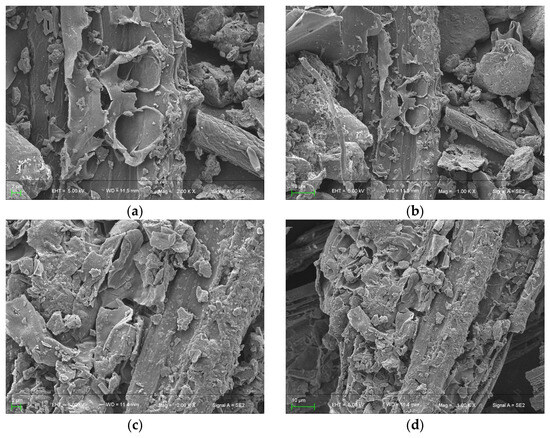
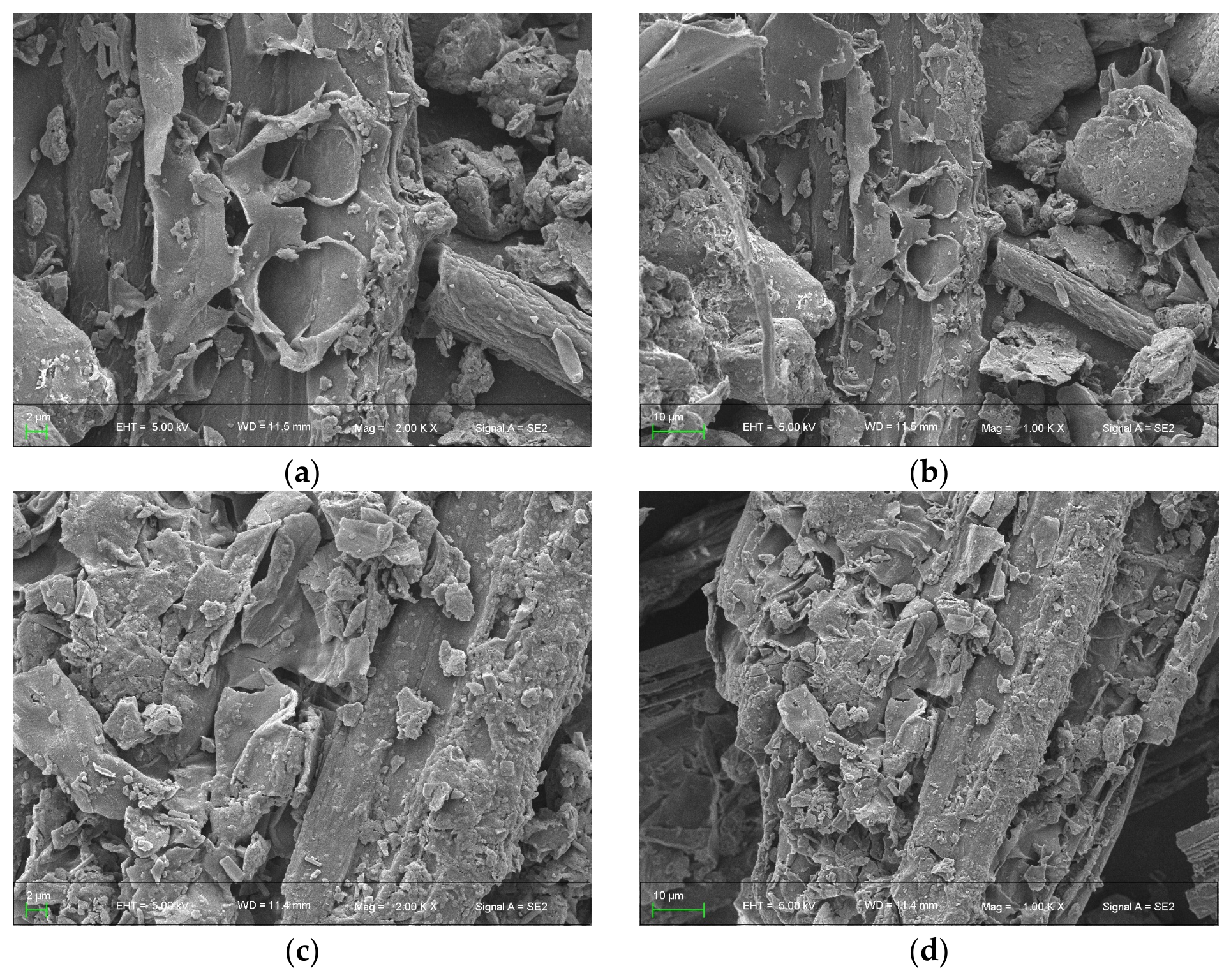
Figure 3 presents the SEM images of biochar B300, showing the surface morphology before and after freeze–thaw aging. The untreated CK-B300 exhibits smooth intact tubular structures with abundant well-developed pores; such intact pore architecture is favorable for adsorption and provides a habitat for microorganisms. In contrast, the microstructure of FC-B300 underwent drastic structural damage after repeated freeze–thaw treatment, featuring extensive surface cracks, fragmented tubular frameworks, and collapsed pore walls. These structural damages jointly caused pore blockage, reduced the average pore diameter, and weakened the adsorption capacity of B300. Although freeze–thaw aging generates a larger number of micropores, which partially improves the adsorption performance, the widespread rupture of pore walls severely disrupts the overall structural integrity of biochar and leaves abundant fragmented particulate debris attached to its surface. These findings indicate that the structural stability of biochar should be fully considered when applied in long-term freeze–thaw environments. Increasing the pyrolysis temperature or introducing stabilizers can be regarded as potential optimization directions for follow-up studies [12,29].
Figure 3.
Scanning electron micrographs of wheat straw biochar before and after complete freeze–thaw aging. Note: (a,b) untreated CK-B300 without freeze–thaw cycles; (c,d) FC-B300 after successive freeze–thaw aging. (a,c) Scale bar = 2 μm; (b,d) scale bar = 10 μm.
3.3. Effect of Freeze–Thaw Cycles on the Pore Volume and Specific Surface Area of Wheat Straw Biochar
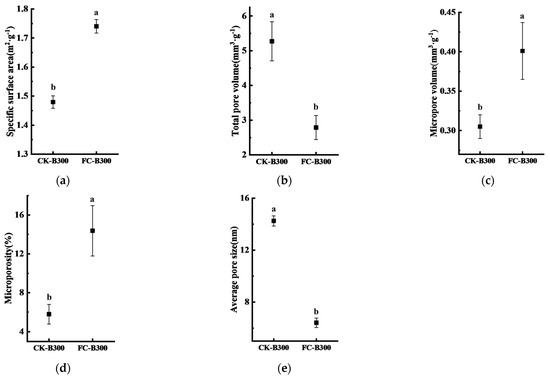
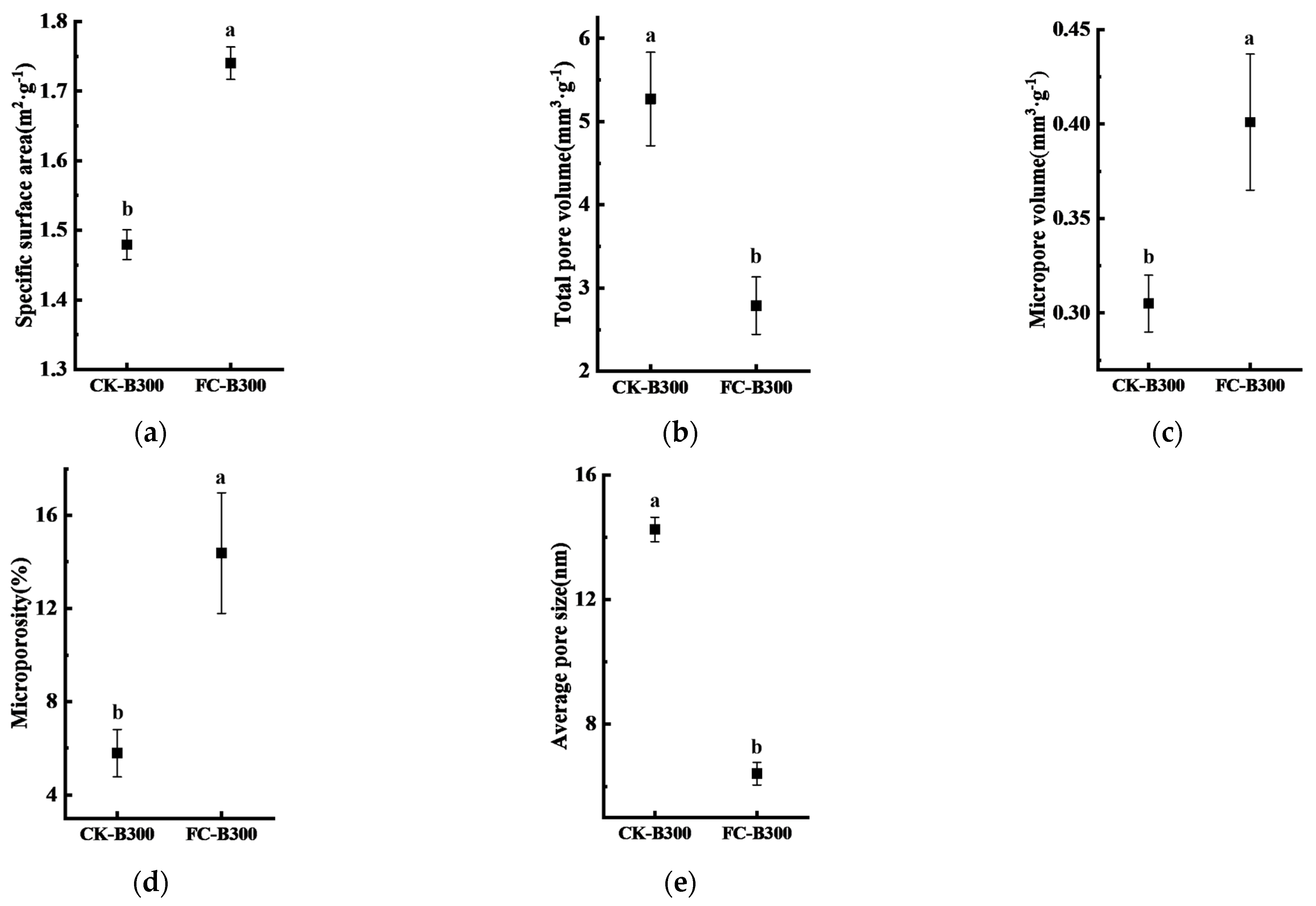
The specific surface area (SSA) and pore architecture determine the inherent adsorption performance of biochar carbon materials. Table 1 summarizes the full set of pore structural parameters for CK-B300 and freeze–thaw-aged FC-B300, and Figure 4 intuitively presents the variation trends of each index.
Table 1.
Pore structural parameters of wheat straw biochar before and after freeze–thaw aging.
Figure 4.
Changes in pore structure characteristics of B300 biochar before and after complete freeze–thaw aging: (a) specific surface area; (b) total pore volume; (c) micropore volume; (d) microporosity; (e) average pore size. Data are presented as mean ± SD (n = 3). Different lowercase letters in the same column indicate significant differences between CK-B300 and FC-B300 at p < 0.05.
Freeze–thaw aging produced significant bidirectional alterations to the pore structure of B300 (Table 1, p < 0.05). The SSA and micropore-related indicators of FC-B300 increased remarkably, with the SSA rising by 13.86% and the microporosity increasing by 148.4%; conversely, the total pore volume and average pore size dropped substantially by 31.47% and 54.9%, respectively. Such shifts stem from ice crystal expansion stress inside biochar pores, which fractures thick pore walls and fragments large pores into numerous tiny micropores, thereby elevating the SSA. This observation accords with Su et al. [30], who reported that the SSA of ramie pomace biochar rose from 3.903 m2·g−1 to 42.906 m2·g−1 after aging, while the average pore size decreased by 5.16 nm.
In contrast, freeze–thaw aging led to obvious declines in both the total pore volume and average pore size of B300. Under freeze–thaw stress, original meso- and macropore frameworks collapse, and fine fragments peeled from fractured pore walls partially block internal voids, jointly reducing the total pore volume. The shrinkage of the average pore size indicates that broken large pores are converted into tiny micropores, shifting the overall pore size distribution toward smaller fractions, which simultaneously raises the microporosity of aged biochar. The above pore structure evolution is consistent with the SEM observations (Figure 3) of pore wall collapse, macropore fragmentation and fine debris deposition.
3.4. Effect of Freeze–Thaw Cycle on Elemental Distribution of Wheat Straw Biochar
Freeze–thaw aging significantly alters the surface elemental contents and atomic ratios of wheat straw-derived biochar. As shown in Table 2, after complete freeze–thaw cyclic treatment, the mass fractions of oxygen and hydrogen on the material surface increased markedly, while the contents of carbon, nitrogen and sulfur decreased substantially.
Table 2.
Effect of freeze–thaw cycles on the elemental distribution of wheat straw biochar.
The carbon mass fraction dropped from 44.10% to 19.58%, which is mainly attributed to structural fragmentation induced by repeated ice crystal expansion. Ice crystal expansion compresses and destroys the macroporous framework of biochar, rupturing the stable carbon skeleton and releasing low-molecular-weight carbonaceous fragments; considerable carbon is lost under alternating low-temperature and moisture conditions. Meanwhile, continuous surface oxidation generates abundant oxygen-containing functional groups on the fractured carbon skeleton, directly raising the oxygen mass fraction from 16.07% to 19.00%. Correspondingly, the O/C atomic ratio rises significantly from 0.36 to 0.97, indicating severe surface oxidation of the biochar carbon skeleton and an elevated abundance of oxygen-containing functional groups. This observation is consistent with the findings reported by Xu et al. [31]. Consistent with the findings of Hao et al. [25], aging increased the polarity of B300 and introduced more oxygen-containing functional groups. Atomic C/H and O/C ratios are classic indicators for evaluating the aromaticity and oxidation degree of biochar. Carbon skeleton damage of B300 and nitrogen loss during freeze–thaw cycles are the primary drivers behind the declined C/H ratio and elevated C/N ratio. The reduction in the sulfur mass fraction from 0.31% to 0.16% further verifies that freeze–thaw stress triggers leaching of labile light elemental fractions from biochar particle surfaces.
3.5. Effect of Freeze–Thaw Cycles on the Surface Functional Groups of Wheat Straw Biochar
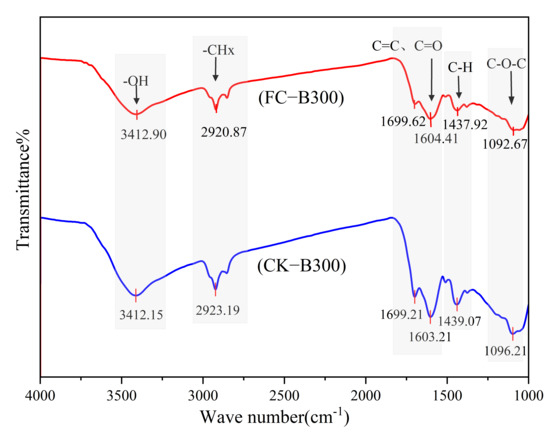
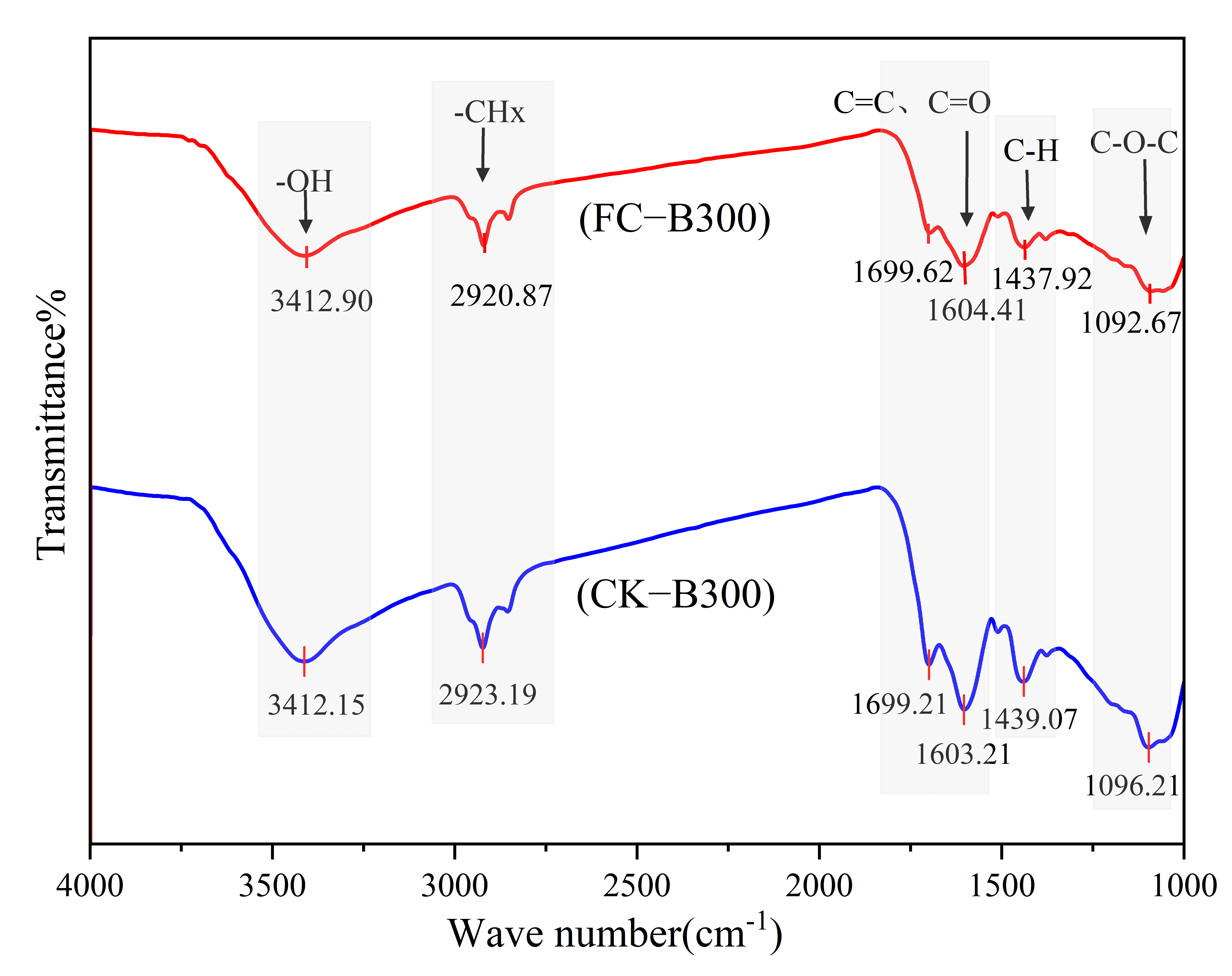
Freeze–thaw aging of biochar induces changes in its functional groups. The Fourier transform infrared (FTIR) spectra of B300 before and after aging (Figure 5) reveal the presence of hydroxyl (-OH), carboxyl (C=O), and alkyl (-CHX) groups, regardless of aging treatment. Variations in these functional groups reflect chemical modifications on the biochar surface [16]. The enhanced -OH absorption peak near 3400 cm−1 in FC-B300 indicates an increase in the oxidative capacity of B300, promoting the formation of oxygen-containing functional groups. Such an increase improves the adsorption performance of biochar toward polar contaminants like heavy metal ions. Conversely, the intensity of the C-H stretching vibration absorption peak at 2920 cm−1 in FC-B300 weakened, suggesting that the alkyl chains may have been oxidized to form oxygen-containing functional groups. The aromatic C=C vibration peak retained a higher intensity after freeze–thaw cycles, likely because the conjugation system of the aromatic ring is more stable. Oxidation of a small number of edge groups in the aromatic structure may have slightly enhanced the peak intensity.
Figure 5.
FTIR spectra of wheat straw biochar before and after complete freeze–thaw aging. Blue line represents the untreated control (CK-B300), and red line represents biochar after full freeze–thaw aging (FC-B300). The X-axis denotes wavenumber (cm−1), and the Y-axis denotes transmittance percentage.
4. Conclusions
This study systematically investigated the physicochemical property evolution of 300 °C wheat straw biochar under 60-day seasonal freeze–thaw aging.
Throughout the aging process, the biochar pH decreased continuously by 12.94%, while the water absorption capacity increased steadily from 1.628 g·g−1 to 2.065 g·g−1. Compared with the untreated control CK-B300, fully aged FC-B300 exhibited a 33.09% reduction in average particle size and a 13.86% increase in specific surface area, accompanied by a 31.47% lower total pore volume and a 54.9% smaller average pore size. Chemically, freeze–thaw treatment raised the surface O/C ratio and enhanced oxygen-containing functional groups such as -OH and C=O, indicating significant surface oxidation.
The freeze–thaw aging of low-temperature straw biochar is dominated by the combined effects of ice crystal expansion-induced physical fragmentation and water-temperature alternation-induced surface oxidation. This study supplements basic aging data for low-temperature wheat straw biochar under long-term seasonal freeze–thaw conditions and provides experimental support for performance evaluation and the rational application of biochar materials in cold regions.
Author Contributions
Conceptualization, H.Z., R.S. and Y.L.; methodology, H.Z. and R.S.; software, H.Z.; validation, H.Z. and R.S.; formal analysis, H.Z.; investigation, H.Z., R.S. and Y.L.; resources, H.Z.; data curation, R.S. and Y.L.; writing—original draft preparation, H.Z., R.S. and Y.L.; writing—review and editing, H.Z., R.S. and Y.L.; visualization, H.Z., R.S. and Y.L.; supervision, H.Z. and R.S.; project administration, R.S. and Y.L.; funding acquisition, H.Z. All authors have read and agreed to the published version of the manuscript.
Funding
This study was funded by the 2024 Liaoning Provincial Department of Education General Project (No. LJ112410148011), the general program of the National Natural Science Foundation of China (No. 52170163), the Support Program for Young and Middle aged Scientific and Technological Innovation Talents (Grant No. RC220064), and the Shenyang Science and Technology Program (No. 22-322-3-14).
Data Availability Statement
The original contributions presented in this study are included in the article. Further inquiries can be directed to the corresponding author.
Acknowledgments
During the preparation of this manuscript, the authors used ChatGPT 5.2 in order to improve language. After using this tool, the authors reviewed and edited the content as needed and take full responsibility for the content of the publication.
Conflicts of Interest
The authors declare no conflicts of interest.
References
- Leng, L.; Xiong, Q.; Yang, L.; Li, H.; Zhou, Y.; Zhang, W.; Jiang, S.; Li, H.; Huang, H. An overview on engineering the surface area and porosity of biochar. Sci. Total Environ. 2021, 763, 144204. [Google Scholar] [CrossRef] [Scilit] [PubMed]
- Singh, S.K.; Singh, R.K. An overview on remediation technologies for polycyclic aromatic hydrocarbons in contaminated lands: A critical approach. Environ. Dev. Sustain. 2025, 27, 2753–2787. [Google Scholar] [CrossRef] [Scilit]
- Ke, Y.; Zhang, X.; Ren, Y.; Zhu, X.; Si, S.; Kou, B.; Zhang, Z.; Wang, J.; Shen, B. Remediation of polycyclic aromatic hydrocarbons polluted soil by biochar loaded humic acid activating persulfate: Performance, process and mechanisms. Bioresour. Technol. 2024, 399, 130633. [Google Scholar] [CrossRef] [Scilit] [PubMed]
- Nguyen, T.-B.; Sherpa, K.; Bui, X.-T.; Nguyen, V.-T.; Vo, T.-D.-H.; Ho, H.-T.-T.; Chen, C.-W.; Dong, C.-D. Biochar for soil remediation: A comprehensive review of current research on pollutant removal. Environ. Pollut. 2023, 337, 122571. [Google Scholar] [CrossRef] [Scilit] [PubMed]
- Wang, L.; Chen, D.; Zhu, L. Biochar carbon sequestration potential rectification in soils: Synthesis effects of biochar on soil CO2, CH4 and N2O emissions. Sci. Total Environ. 2023, 904, 167047. [Google Scholar] [CrossRef] [Scilit] [PubMed]
- O’Laughlin, J.; McElligott, K. Biochar for Environmental Management: Science and Technology, Johannes Lehmann, Stephen M. Joseph (Eds.), Earthscan, London UK (2009), 448 p. For. Policy Econ. 2009, 11, 535–536. [Google Scholar] [CrossRef]
- Yuan, P.; Wang, J.; Pan, Y.; Shen, B.; Wu, C. Review of biochar for the management of contaminated soil: Preparation, application and prospect. Sci. Total Environ. 2019, 659, 473–490. [Google Scholar] [CrossRef] [Scilit] [PubMed]
- McKenna, A.M.; Chacón-Patiño, M.L.; Roth, H.K.; Bahureksa, W.; Young, R.B.; Ippolito, J.A.; Xin, Y.; Borch, T.; Williams, A.J.; Chen, H. Effects of pyrolysis temperature on the photooxidation of water-soluble fraction of wheat straw biochar based on 21 T FT-ICR mass spectrometry. Soil Environ. Health 2024, 2, 100114. [Google Scholar] [CrossRef] [Scilit]
- Villagra-Mendoza, K.; Horn, R. Effect of biochar addition on hydraulic functions of two textural soils. Geoderma 2018, 326, 88–95. [Google Scholar] [CrossRef] [Scilit]
- Fu, Q.; Zhao, H.; Li, H.; Li, T.; Hou, R.; Liu, D.; Ji, Y.; Gao, Y.; Yu, P. Effects of biochar application during different periods on soil structures and water retention in seasonally frozen soil areas. Sci. Total Environ. 2019, 694, 133732. [Google Scholar] [CrossRef] [Scilit] [PubMed]
- Smetanová, A.; Dotterweich, M.; Diehl, D.; Ulrich, U.; Fohrer, N. Influence of biochar and terra preta substrates on wettability and erodibility of soils. Z. Für Geomorphol. Suppl. Issues 2013, 57, 111–134. [Google Scholar] [CrossRef] [Scilit]
- Wang, J.; Wang, S. Preparation, modification and environmental application of biochar: A review. J. Clean. Prod. 2019, 227, 1002–1022. [Google Scholar] [CrossRef] [Scilit]
- Sun, L.; Chang, X.; Yu, X.; Jia, G.; Chen, L.; Wang, Y.; Liu, Z. Effect of freeze-thaw processes on soil water transport of farmland in a semi-arid area. Agric. Water Manag. 2021, 252, 106876. [Google Scholar] [CrossRef] [Scilit]
- Chen, X.; Jiang, S.-F.; Hu, Z.-Y.; Chen, S.; Jiang, H. Biotoxicity attenuation and the underlying physicochemical mechanism of biochar aged under simulated natural environmental conditions. Chemosphere 2024, 350, 141029. [Google Scholar] [CrossRef] [Scilit] [PubMed]
- Li, H.; Lu, X.; Xu, Y.; Liu, H. How close is artificial biochar aging to natural biochar aging in fields? A meta-analysis. Geoderma 2019, 352, 96–103. [Google Scholar] [CrossRef] [Scilit]
- Shen, J.; Huang, G.; Yao, Y.; Zhang, P.; Yin, J. Challenges and opportunities for the production, utilization and effects of biochar in cold-region agriculture. Sci. Total Environ. 2024, 906, 167623. [Google Scholar] [CrossRef] [Scilit] [PubMed]
- Yang, K.; Wang, X.; Cheng, H.; Tao, S. Effect of aging on stabilization of Cd and Ni by biochars and enzyme activities in a historically contaminated alkaline agricultural soil simulated with wet–dry and freeze–thaw cycling. Environ. Pollut. 2021, 268, 115846. [Google Scholar] [CrossRef] [Scilit] [PubMed]
- Wang, Z.; Li, T.; Liu, D.; Fu, Q.; Hou, R.; Li, Q.; Cui, S.; Li, M. Research on the adsorption mechanism of Cu and Zn by biochar under freeze-thaw conditions. Sci. Total Environ. 2021, 774, 145194. [Google Scholar] [CrossRef] [Scilit] [PubMed]
- Cui, Z.; Wang, Y.; Wang, N.; Ma, F.; Yuan, Y. Effects of Ageing on Surface Properties of Biochar and Bioavailability of Heavy Metals in Soil. Agriculture 2024, 14, 1631. [Google Scholar] [CrossRef] [Scilit]
- Seow, Y.X.; Tan, Y.H.; Mubarak, N.M.; Kansedo, J.; Khalid, M.; Ibrahim, M.L.; Ghasemi, M. A review on biochar production from different biomass wastes by recent carbonization technologies and its sustainable applications. J. Environ. Chem. Eng. 2022, 10, 107017. [Google Scholar] [CrossRef] [Scilit]
- Wang, L.; Li, T.; Liu, H.; Zhang, Z.; Yang, A.; Li, H. Combined Effect of Freeze–Thaw Cycles and Biochar Addition on Soil Nitrogen Leaching Characteristics in Seasonally Frozen Farmland in Northeast China. Agronomy 2024, 14, 153. [Google Scholar] [CrossRef] [Scilit]
- GB/T 12496.7-1999Test Methods of Wooden Activated Carbon—Determination of pH; Standards Press of China: Beijing, China, 1999. Available online: https://openstd.samr.gov.cn/bzgk/std/newGbInfo?hcno=C4CC5618D4F4DC07E445575DEE938E85.
- ASTM D1762-84; Standard Test Method for Chemical Analysis of Wood Charcoal. ASTM International: West Conshohocken, PA, USA, 2021. Available online: https://www.ndls.org.cn/standard/detail/3e4fbcb085bf6979beed8d6035c3bf1e.
- Wenliang, J.U.; Yande, J. Effect of aging treatment on physicochemical characteristics of cotton straw biochar. Acta Sci. Circumstantiae 2017, 37, 3853–3861. [Google Scholar]
- Hao, H.; Jing, Y.-D.; Ju, W.-L.; Shen, L.; Cao, Y.-Q. Different types of biochar: Effect of aging on the Cu(II) adsorption behavior. Desalin. Water Treat. 2017, 95, 227–233. [Google Scholar] [CrossRef] [Scilit]
- Spokas, K.A.; Novak, J.M.; Masiello, C.A.; Johnson, M.G.; Colosky, E.C.; Ippolito, J.A.; Trigo, C. Physical Disintegration of Biochar: An Overlooked Process. Environ. Sci. Technol. Lett. 2014, 1, 326–332. [Google Scholar] [CrossRef] [Scilit]
- Hale, S.E.; Hanley, K.; Lehmann, J.; Zimmerman, A.R.; Cornelissen, G. Effects of Chemical, Biological, and Physical Aging As Well As Soil Addition on the Sorption of Pyrene to Activated Carbon and Biochar. Environ. Sci. Technol. 2012, 46, 2479–2480. [Google Scholar] [CrossRef] [Scilit]
- Liu, Z.; Dugan, B.; Masiello, C.A.; Wahab, L.M.; Gonnermann, H.M.; Nittrouer, J.A. Effect of freeze-thaw cycling on grain size of biochar. PLoS ONE 2018, 13, e0191246. [Google Scholar] [CrossRef] [Scilit] [PubMed]
- Yang, Y.; Sun, K.; Han, L.; Chen, Y.; Liu, J.; Xing, B. Biochar stability and impact on soil organic carbon mineralization depend on biochar processing, aging and soil clay content. Soil Biol. Biochem. 2022, 169, 108657. [Google Scholar] [CrossRef] [Scilit]
- Su, Y.; Wen, Y.; Yang, W.; Zhang, X.; Xia, M.; Zhou, N.; Xiong, Y.; Zhou, Z. The mechanism transformation of ramie biochar’s cadmium adsorption by aging. Bioresour. Technol. 2021, 330, 124947. [Google Scholar] [CrossRef] [Scilit] [PubMed]
- Xu, Z.; Xu, X.; Tsang, D.C.W.; Cao, X. Contrasting impacts of pre- and post-application aging of biochar on the immobilization of Cd in contaminated soils. Environ. Pollut. 2018, 242, 1362–1370. [Google Scholar] [CrossRef] [Scilit] [PubMed]

Disclaimer/Publisher’s Note: The statements, opinions and data contained in all publications are solely those of the individual author(s) and contributor(s) and not of MDPI and/or the editor(s). MDPI and/or the editor(s) disclaim responsibility for any injury to people or property resulting from any ideas, methods, instructions or products referred to in the content. |
© 2026 by the authors. Licensee MDPI, Basel, Switzerland. This article is an open access article distributed under the terms and conditions of the Creative Commons Attribution (CC BY) license.