


Abstract
The production of biodegradable plastics is considered one of the best alternatives to combat plastic waste and global pollution. Polyhydroxybutyrate (PHB) stands out as the most studied bioplastic, but its introduction into global industries and markets still presents challenges due to the high final cost. Understanding the entire synthesis process of this biopolymer becomes a more effective way to address this problem. This review describes the four main natural metabolic pathways related to PHB biosynthesis, associated with stages involving sugars, fatty acid metabolism, de novo fatty acid synthesis, and the butyric acid pathway, while also addressing the role of acetyl-CoA as the central precursor molecule. Approaches regarding physicochemical conditions and the selection of ideal substrates were also conducted, aiming at the production of PHB that is both economically viable and environmentally sustainable. Thus, this review distinguishes itself by bringing an updated and comprehensive overview of PHB biosynthesis, whereas other reviews tend to address specific aspects of PHA production. Furthermore, some knowledge gaps were identified, and different genetic engineering strategies were discussed, such as gene overexpression, deletion of competitive pathways, application of the CRISPRi technique, and two-stage fermentation, which have shown promise in optimizing PHB synthesis and reducing production costs.
1. Introduction
Humanity heavily relies on synthetic plastics due to their diverse attributes, enhancing convenience across various industries. Plastics’ widespread production and consumption globally are driven by their exceptional physical-chemical and morphological characteristics, making them favored for durability, resistance, moldability, and ability to withstand biodegradation [1].
While the use and production of plastics offer benefits, it also poses significant challenges, contributing to environmental impacts and waste management issues. Plastics’ resistance to degradation and ease of disposal lead to consequences such as animal deaths, sewage system accumulation causing flood risks, and the emergence of bioaccumulative and toxic effects, fostering conditions conducive to the spread of zoonotic diseases [2,3].
To address the plastic waste problem, alternatives must be considered. The overproduction and disposal of conventional plastics lead to environmental changes, as they contain chemical additives that can cause impacts on the environment, potentially affecting both the ecosystem and living organisms [4]. However, although conventional waste management methods are widely used, they still have limitations regarding their capacity to cope with the increasing accumulation of this waste in the environment [4]. The substitution of synthetic plastics with biodegradable alternatives has gained attention in the last two decades, driven by concerns over the inadequacy of recycling and incineration as viable solutions and the significant carbon dioxide emissions associated with incineration [5,6].
Biodegradable plastics, like polyhydroxyalkanoate (PHA), aim to mimic key properties of traditional synthetic plastics while ensuring complete degradation without generating toxic waste upon disposal [7]. PHA, particularly polyhydroxybutyrate (PHB), stands out as a promising alternative among the various types of biodegradable polymers due to its high biodegradation capacity [8]. PHAs, featuring phospholipids and proteins in their surface layer, are sensitive to physical and chemical stress, enabling easy degradation by microorganism enzymes mediated by PHA depolymerases (PhaZ). Furthermore, environmental factors such as temperature, pH, and humidity can influence the performance of these enzymes, thereby affecting the degradation rate [9]. PHB, the most widely studied type of PHA, is produced by bacteria and can account for up to 90% of the bacterial cell’s dry mass weight, demonstrating significant potential for biodegradation in various environments [10]. To unlock the commercial potential of microbial PHB production and compete with conventional polymers such as polyethylene or polypropylene [11], understanding metabolic pathways for biodegradable plastic biosynthesis is essential. This review highlights current advances associated with the four natural metabolic pathways for PHB biosynthesis, and their integration with genetic engineering, as opposed to existing reviews that address specific aspects of PHA production. In this sense, this study aims to identify knowledge gaps and offer perspectives for future research focused on optimizing synthesis and reducing production costs.
2. Structure and Properties of PHB
Polyhydroxybutyrate (PHB) is a short-chain biopolymer characterized by being synthesized within bacterial cells through metabolic pathways that utilize natural resources in microorganisms. Research in this field aims to employ renewable, cheap, and biodegradable sources for processing [11]. PHAs, particularly aliphatic polyesters of hydroxyalkanoates, stand out among various biopolymers due to their similarities to synthetic plastics [12,13] (Table 1).
Table 1.
Properties of different types of PHAs (P(3HB), P(3HB-3HV) containing 20% of 3HV, P(3HB-4HB) containing 16% of 4HB, and P(3HO-3HH)) containing 11% of 3HH compared to PP and HDPE [14,15,16,17,18,19,20,21,22].
Discovered in 1925 by Maurice Lemoigne, PHAs are thermoplastic materials produced by a wide diversity of bacterial genera [23]. Microbial cells store PHAs as energy reserves, accumulating up to 80% of the dry cell weight under specific conditions [24]. Essel and Carus (2012) [25] highlighted PHAs as an effective, sustainable alternative, saving CO2 emissions and fossil fuel consumption. However, challenges exist in adjusting properties and achieving cost-effectiveness [26].
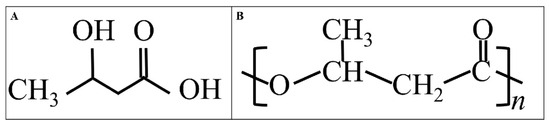
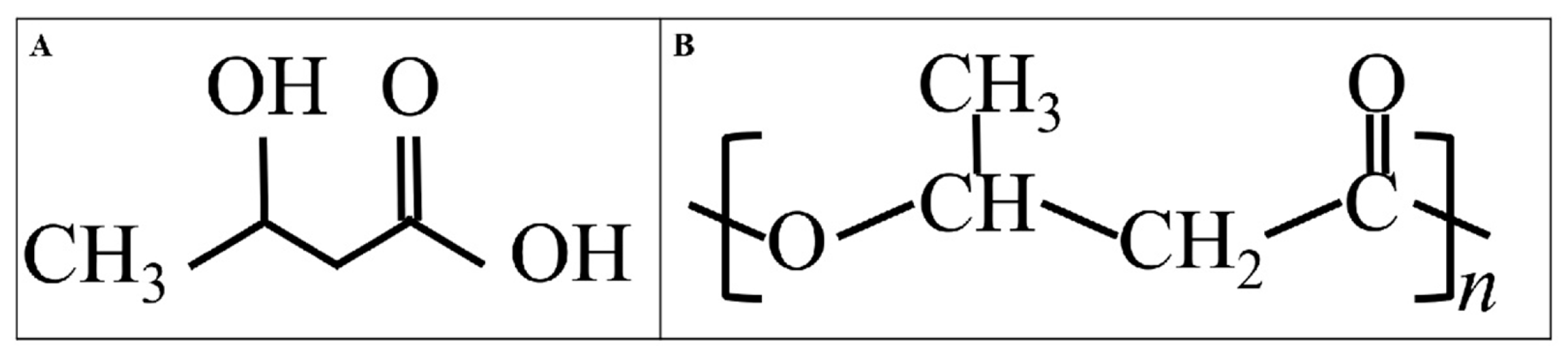
PHAs and their derivatives exhibit variations influenced by factors like bacterial species, culture conditions, and carbon source quantities. The uniqueness of PHAs lies in differences in side chain lengths and monomer substitutions [24]. P(3HB) or PHB, a short-chain homopolymer (Figure 1), is extensively studied for its facile production and potential as an alternative to synthetic plastics like polypropylene (PP) and polyethylene (HDPE) [27].
Figure 1.
Chemical structure of beta-hydroxybutyric acid (A). Chemical structure of polyhydrooxybutyrate (P3HB) polymer (B).
Thus, PHAs are classified according to the number of carbon atoms present in their structures. Short-chain-length PHA (scl-PHA) contains about 3 to 5 carbon atoms in its structure, medium-chain-length PHA (mcl-PHA) is composed of 6 to 14 carbon atoms, and long-chain-length PHA (lcl-PHA) contains around 15 or more carbon atoms. This structural variability ensures distinct physicochemical properties for each polymer; scl-PHAs are characterized by high crystallinity and stiffness, whereas mcl-PHAs and lcl-PHAs exhibit greater flexibility and low crystallinity [22].
Copolymerization between these different monomers allows for the formation of the main copolymers studied, such as poly(3-hydroxybutyrate-co-3-hydroxyvalerate) [P(3HB-co-3HV)], poly(3-hydroxybutyrate-co-4-hydroxybutyrate) [P(3HB-co-4HB)], and poly(3-hydroxybutyrate-co-3-hydroxyhexanoate) [P(3HB-co-3HHx)]. These, in turn, are characterized by lower crystallinity and greater biodegradability compared to the PHB homopolymer, in addition to allowing the regulation of the melting temperature. Due to these physicochemical properties, these copolymers are important for the industrial sector, which has been significantly expanding their applications [22].
PHB, a semicrystalline linear polyester derived from β-hydroxybutyric acid, is found in a fluid, amorphous state within cellular environments [28]. Despite brittleness post-solvent extraction, PHBs demonstrate high melting temperatures (around 177 °C), ensuring excellent heat resistance and resistance to decomposition for industrial applications [14].
The commercialization of PHB faces challenges related to carbon sources, fermentation, and polymer processing, leading to elevated production costs, with approximately 45% attributed to carbon sources [27,29]. Consequently, efforts are now focused on unraveling metabolic pathways in PHB synthesis to address current cost challenges.
3. PHB Biosynthesis
The biosynthesis of PHB was first described in 1959 by Doudoroff and colleagues [30]. The formation occurred from the photosynthetic bacterium Rhodospirillum rubrum, which used acetate as a carbon source. From Doudoroff’s description, it was suggested that biosynthesis by bacteria can be influenced by multiple factors, such as the limitation of some essential nutrients and the influence of aeration [31].
PHBs are neutral osmotic carbon and energy reserves, and their synthesis occurs when there are more carbons than the bacterium can consume [13]. The carbon source linked to synthesis originates from sugars, fatty acids, and other compounds present in substrates with limitations in nitrogen, phosphorus, sulfur, iron, or glucose, and from the metabolism of microorganisms [32]. The PHB is then accumulated and mobilized by the bacterium during its starvation period [33].
The efficient construction and integration of metabolic pathways for PHB production rely on substrate accumulation and PHB synthesis activities. Approximately 14 metabolic pathways associated with PHA biosynthesis have been identified in various microorganisms. However, only 4 pathways are closely related to the natural pathways associated with PHB biosynthesis and acetyl-CoA production [34]. Furthermore, substrate availability and the overexpression of key genes are crucial for short-chain biopolymer production, including PHB. These key genes encode fundamental enzymes such as b-Ketoacyl CoA thiolase (phbA), acetoacetyl CoA reductase (phbB), and P(3HB) polymerase (phbC) [14,35].
There are four main natural pathways that lead to the formation of PHB. All of them are linked to conditions that trigger the formation of acetyl-CoA, the main precursor molecule for the synthesis of various biomaterials [31]. For this reason, current studies are focused on improving the metabolism of fatty acids and sugars for the conversion of acetyl-CoA and ultimately achieving high-level production of PHB [36] (Table 2).
Table 2.
Previous review on PHB production with different sources.
4. Acetyl-CoA for PHB Production
Biotechnology has significantly advanced our understanding of microbial activities, providing discoveries and control over their products. The potential of these microbiological bioproducts to replace petrochemical-derived materials and contribute to sustainability is evident. However, their slow market introduction is particularly due to high production costs associated with the carbon sources used in the process. Aiming to overcome these challenges, different strategies have been used to reverse this scenario and reduce costs, such as the utilization of alternative carbon sources combined with the genetic engineering of producing microorganisms, such as bacteria. These advances are crucial, as they improve sustainable technologies and ensure the expansion of PHA applications in the industrial sector [44].
To enhance bioproduct production, it is crucial to comprehend cellular metabolic pathways of microorganisms and develop alternatives that facilitate processing. Bioproducts, stemming from microbial activities, involve the production and reactions of enzymes and metabolites. The initial focus of biotechnology was on producing biodegradable plastic, targeting molecules like acetyl-CoA as a precursor for synthesis [45,46].
Acetyl-CoA plays a key role in cellular metabolism, derived from the catabolism of glucose, fatty acids, and amino acids. Apart from contributing to energy production through the citric acid cycle (Krebs cycle), it serves as a fundamental molecule in the synthesis of various compounds by microorganisms, such as terpenoids, isopropanol, polyketides, and fatty acids. It is essential to point out that the availability of acetyl-CoA is also of utmost importance for the PHB synthesis process, as it acts in controlling the intracellular carbon flux. Furthermore, metabolic engineering strategies are widely used to optimize the acetyl-CoA available for biopolymer synthesis, since under conditions of metabolic imbalance, this synthesis process can be affected [47,48,49].
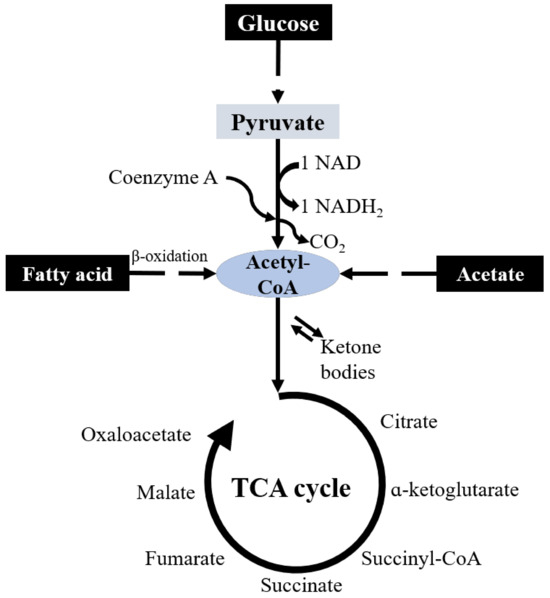
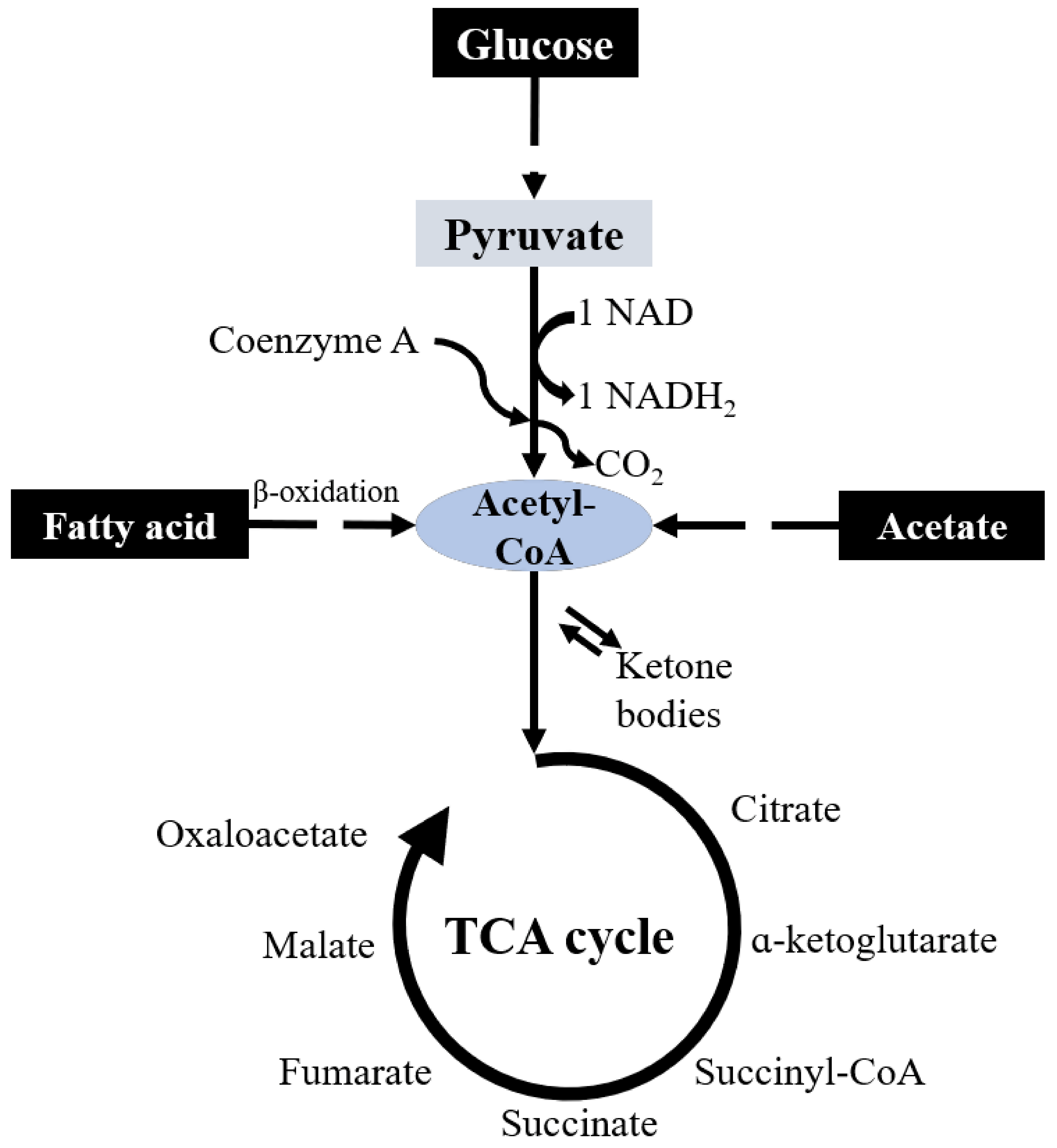
Researchers have explored diverse pathways for acetyl-CoA synthesis from sugars, fatty acids, or salts, depending on the organism’s substrate source. These pathways involve glycolysis, pyruvate dehydrogenase, pyruvate-formate lyase, acetate kinase-phosphate acetyltransferase, and acetyl-CoA synthetase. Fatty acid oxidation, especially in the presence of abundant fatty acids, can also contribute to NADH production for acetyl-CoA formation [50] (Figure 2).
Figure 2.
Overview of Acetyl-CoA synthesis and its participation in the TCA cycle.
Acetyl-CoA’s role in the production of PHB occurs during periods of bacterial starvation. Bacterial cells transition from a growth mode to a survival mode, utilizing acetyl-CoA to synthesize ketone bodies (acetoacetate and β-hydroxybutyrate) as an alternative energy source. In response to environmental stress, microorganisms direct acetyl-CoA towards ketone body synthesis [51]. However, an imbalance in the acetyl-CoA flux compromises PHB production by reducing its availability, since the accumulation of this metabolite can be diverted to other pathways. Therefore, adopting metabolic strategies becomes essential to increase PHB synthesis, as they exert tight control over this flux [47,48,49].
During starvation, acetyl-CoA is directed to generate ketone bodies like acetoacetate (AcAc) and β-hydroxybutyrate (β-OHB). Bacteria employ the strategy of β-OHB polymerization to form PHB, serving as an alternative source of cellular fuel. However, complex metabolic pathways are required for the production of biopolymers, necessitating further investigation into the specific molecules or substances responsible for monomer formation and PHB polymerization [52].
5. Metabolic Pathways
Microorganisms can store carboxysomes, which may be inorganic or organic. Inorganic carboxysomes have an iron oxide core, while organic ones contain phospholipids or proteins like PHAs [27]. PHB granules accumulate in these inclusions during nutrient limitation stress, preventing excess coenzyme A from inhibiting PHB synthesis enzymes. This stress redirects acetyl-CoA toward the Krebs cycle, allowing limited coenzyme A production to avoid PhaA inhibition [52,53].
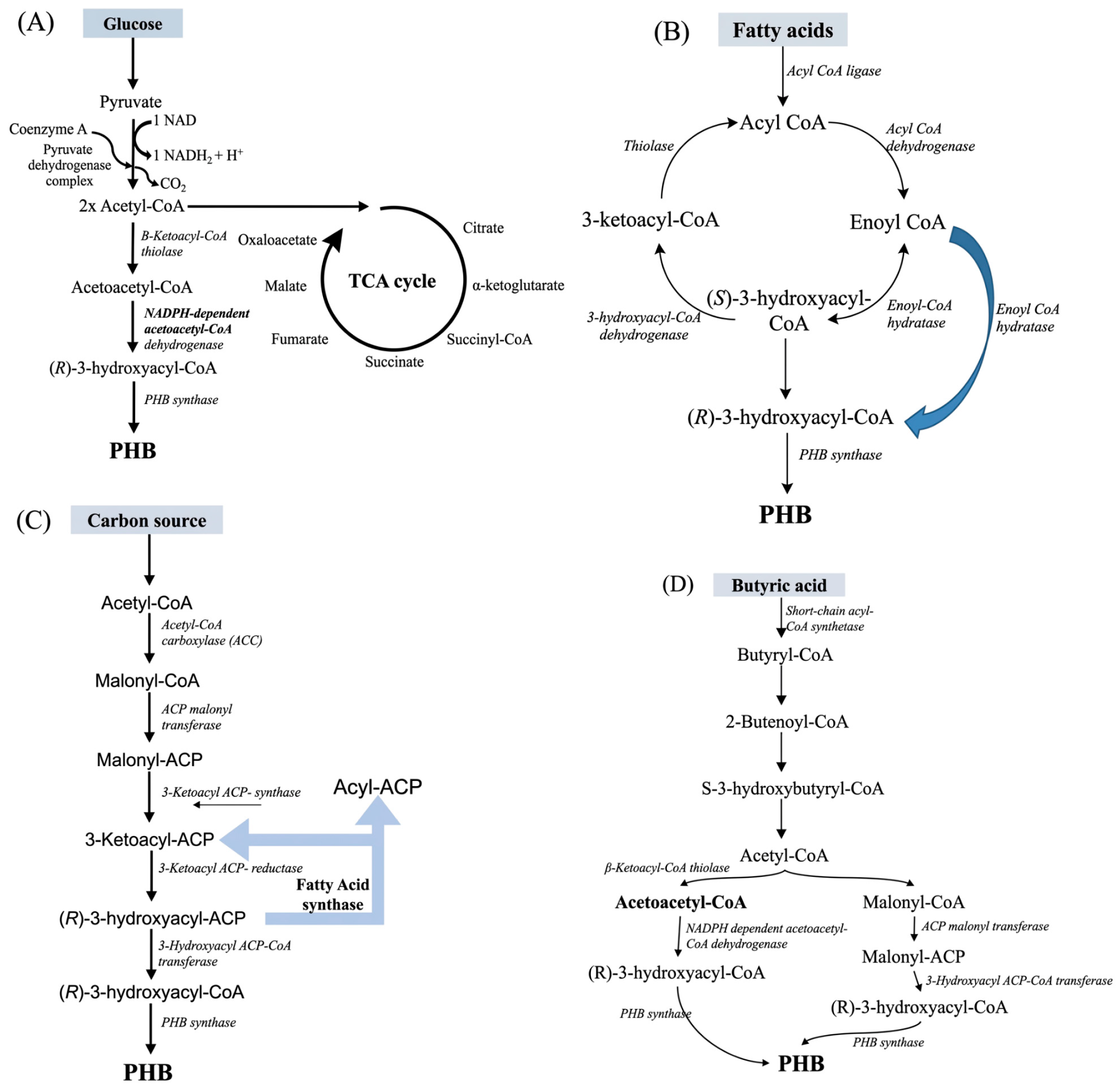
PHB, a polymer of β-OHB, is synthesized in three stages by three main enzymes: β-ketothiolase (PhbA), acetoacetyl-CoA reductase (PhbB), and PHB synthase (PhbC). Cellular respiration produces two acetyl-CoA molecules, and beta-ketothiolase, through a condensation reaction, converts these molecules into acetoacetyl-CoA, initiating the first step of the reaction. Subsequently, acetoacetyl-CoA reductase uses NADPH as a cofactor and reduces acetoacetyl-CoA to (R)-3-hydroxybutyryl-CoA. Phasins, in turn, prevent granule accumulation, ensuring synthesis efficiency. Thus, this PHB production process is characterized by using two molecules of acetyl-CoA and one of NADPH, which releases CoA at the end of each polymerization [15,54,55].
The final step involves PHB synthase (PhbC) polymerizing (R)-3-hydroxybutyryl-CoA into poly(3-hydroxybutyrate). The enzyme associates with the granule membrane, requiring high (R)-3-hydroxybutyryl-CoA concentrations. Griebel and Merrick proposed a two-stage mechanism for this reaction [34,56].
Pathways for biosynthesis vary based on substrate composition. Different substrates like sugars, fatty acids, or conjugate bases from acids are used in PHB synthesis. The following topic will detail the four main natural metabolic pathways, highlighting enzymes and functionalities leading to short-chain polymer formation.
5.1. Metabolic Pathway I
The primary pathway for bacterial polyhydroxybutyrate (PHB) synthesis is initiated by the availability of sugars in the substrate, such as glucose, gluconate, xylose, sucrose, and fructose. This process involves the production of pyruvate, a key precursor for acetyl-CoA molecules. Pyruvate can be generated through different mechanisms, including the Entner–Doudoroff (ED), pentose phosphate (PP), and Embden–Meyerhof–Parnas (EMP) routes [57].
The pathways described by Entner–Doudoroff (ED) and Embden–Meyerhof–Parnas (EMP) are similar, both utilizing sugar metabolism to produce pyruvate for biosynthetic processes. While both pathways break down 6-carbon glucose into smaller 3-carbon molecules, they differ in the substrates used for cleavage. The EMP pathway uses fructose 1,6-bisphosphate, whereas the Entner–Doudoroff pathway uses 2-keto-3-deoxy-6-phosphogluconate. In this sense, the EMP pathway becomes more energetically efficient because it yields more ATP, whereas the ED pathway favors PHB synthesis since it produces NADPH, an extremely important cofactor for acetoacetyl-CoA reductase activity [58,59].
The pentose phosphate pathway runs parallel to glycolysis and plays a crucial role in reducing NADP+ to NADPH during its oxidative phase. Research by Centeno-Leija et al. (2014) [60] demonstrated the significance of the pentose phosphate pathway in enhancing PHB production. Notably, this pathway conserves the oxidation energy of sugar exclusively as NADPH, prioritizing PHB production over ATP generation. Thus, since NADPH is an essential cofactor in the PHB synthesis process, its limitation can interfere with PHB accumulation. In this sense, NADPH-generating pathways are fundamental for metabolic engineering, as they assist in achieving a higher yield of this biopolymer.
At the end of the metabolic pathways, pyruvic acid is converted into acetyl-CoA through the action of pyruvate formate-lyase (PFL). Subsequently, two molecules of acetyl-CoA condense through the action of β-ketothiolase to form acetoacetyl-CoA. This compound is then reduced by NADPH-dependent acetoacetyl-CoA reductase, forming (R)-3-hydroxybutyryl-CoA, leading to polymerization and subsequent PHB formation [54,61].
5.2. Metabolic Pathway II
Fatty acid metabolism byproducts are valuable for biotechnology due to their applications in renewable alternatives to petrochemicals [62]. The chemical composition of fatty acids allows for their conversion into various chemical compounds, such as alcohols, alkanes, ketones, and esters, making them crucial for the synthesis of polyhydroxyalkanoates (PHA) [63].
Fatty acids play a vital role in determining PHA constituents, particularly in Pseudomonas putida, where a well-established association between fatty acids and PHA biosynthesis exists [64]. The pathway involves synthesizing 3-hydroxyacyl coenzyme A thiosters, acting as substrates for material synthesis, yielding a higher concentration of medium-chain-length PHA (mcl-PHA) over short-chain-length PHA (scl-PHA) [65]. However, although this pathway is associated with medium-chain-length PHAs, it is important to understand it, as it shows how carbon sources and metabolic precursors affect the composition of PHAs produced by microorganisms. Furthermore, recent research suggests promising routes for PHB production using acetic acid as a carbon source [66].
Fatty acid catabolism involves two routes based on enzymatic availability, carbon source, and microorganism: (i) the β-oxidation cycle, converting fatty acids into a carbon source, and (ii) de novo biosynthesis influenced by sources like gluconate, acetate, or ethanol [67]. The latter route is limited to the production of medium-chain PHAs. The β-oxidation cycle, utilized for biosynthesis using fatty acids like acetate, involves breakdown and conversion into acyl-CoA, leading to the formation of (R)-3-hydroxyacyl-CoA, the primary substrate for PHB synthesis [68].
In the β-oxidation cycle, fatty acids undergo breakdown catalyzed by acyl-CoA ligase, regulated by acyl-CoA dehydrogenase to address cellular stress. This process produces enoyl-CoA, initiating the hydration process by enoyl-CoA hydratase, resulting in the primary substrate for PHB synthesis, (R)-3-hydroxyacyl-CoA. PHB synthase then polymerizes these molecules to form PHB [68].
5.3. Metabolic Pathway III
The third pathway for PHB biosynthesis involves directing acetyl-CoA towards malonyl-CoA, a key molecule driving biopolymer formation. Malonyl-CoA, derived from malonic acid, plays a crucial role in fatty acid biosynthesis, elongating the chain and inhibiting β-oxidation [69].
Taguchi et al. (1999) [70] connected the malonyl-CoA enzyme to the biosynthesis of short-chain polymers like PHB. This process is not strictly dependent on a specific carbon source but varies with bacterial species, including Escherichia coli, Pseudomonas aeruginosa, and Saccharomyces cerevisiae. The acetyl-CoA carboxylase (ACC) enzyme in these bacteria transforms acetyl-CoA into malonyl-CoA, and genes fabH and fabD are involved in fatty acid synthesis [70]. This pathway remains relevant today, as a more recent study on metabolic engineering reinforced the role of ACC as a limiting factor in obtaining malonyl-CoA in distinct microbial hosts, since these factors vary according to the bacterial species and cultivation conditions [71].
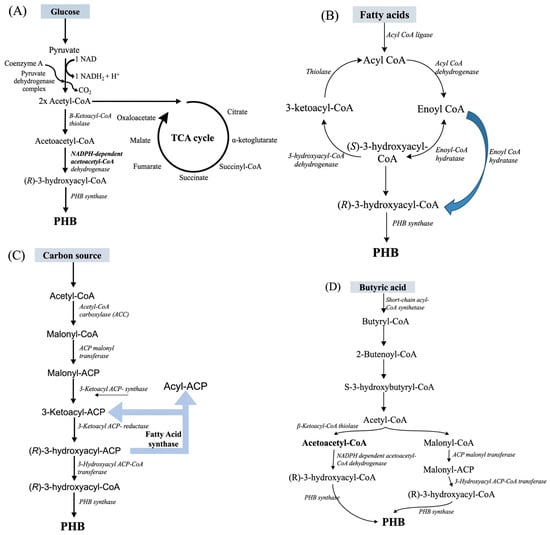
The fabH and fabD genes encode proteins that convert acetyl-CoA to acetyl-ACP and malonyl-CoA to malonyl-ACP, respectively. Malonyl-ACP undergoes conversion into 3-ketoacyl-ACP, followed by reduction to (R)-3-hydroxyacyl-ACP facilitated by β-ketoacyl-ACP reductase [72] (see Figure 3).
Figure 3.
Biosynthesis of PHB from sugars (A), fatty acids (B), malonyl-CoA (C) and butyric acid (D).
The proposed pathway using malonyl-CoA influences PHB formation, somewhat linked to de novo fatty acid synthesis. The methodology concludes with the enzymatic action of 3-hydroxyacyl (ACP to CoA) transferase. This enzyme ultimately generates (R)-3-hydroxyacyl-CoA, which, through PHB synthase, forms polyhydroxybutyrate [73] (Figure 3).
5.4. Metabolic Pathway IV
Butyric acid finds diverse applications across various industrial sectors, including pharmaceuticals, hospitals, and the chemical industry. It is recognized for its potential to replace petrochemical-based products. The anaerobic production of butyric acid is commonly associated with the metabolism of various bacteria [74,75].
The metabolic pathway involving butyric acid is typically conducted in fed-batch processes with glucose limitation. Excess glucose can result in osmotic dehydration of cells. However, the enzymatic reactions governing this pathway have been only partially elucidated, and the observed toxicity of butyric acid to cells under unsuitable conditions remains a limiting factor that restricts interest in this pathway [74,76].
The butyric acid process deviates from the β-oxidation cycle, producing S-3-hydroxybutyryl-CoA. Initiated by short-chain acyl-CoA synthetase, fatty acid synthesis begins, ultimately forming butyryl-CoA. The subsequent conversion of 2-butenoyl CoA leads to the synthesis of S-3-hydroxybutyryl-CoA [75]. 3-hydroxyacyl-CoA dehydrogenase catalyzes the oxidation of hydroxyl groups to keto groups using NAD+, resulting in acetyl-CoA—the precursor for PHB biosynthesis [77,78] (Figure 3).
6. Improving Genetic Approaches
Recent studies in genetic engineering have successfully improved polyhydroxybutyrate (PHB) production efficiency and cost reduction [79]. The focus is on enhancing fermentation by incorporating genes from bacteria with high intracellular PHB accumulation and efficient substrate utilization [80].
Three main genetic engineering approaches for PHB development are utilized. The first involves using biosynthesis genes in a non-producing bacterium with high substrate utilization. The second approach includes inserting genes for efficient substrate absorption into PHB-producing bacteria. The third approach focuses on specific PHA derivatives or desired characteristics through gene exchange between PHA-producing bacteria [81].
Gene overexpression is one of the most researched methods to optimize the PHB synthesis process in microbial organisms. In this context, some bacterial species have proven to be highly effective regarding the application of this method, such as Cupriavidus necator. This bacterium, through the overexpression of transcriptional regulators like RpoN and UspA, can modulate responses to environmental stress, prioritizing its metabolic conditions in favor of PHB biosynthesis in scenarios without environmental stress, resulting in an increase in this biopolymer. Escherichia coli has also shown great promise in the application of this technique, since the overexpression of the phaCAB operon gene, responsible for the three steps of PHB synthesis, can increase the production of the biopolymer in recombinant strains when associated with a greater availability of acetyl-CoA [82].
Another well-established approach in the field of genetic engineering geared toward PHB production is the deletion of competitive metabolic pathways. In this sense, some pathways have been targeted by strategies for this process, such as those encoded by the ldhA, poxB, and pta genes, which divert acetyl-CoA away from PHB biosynthesis, thereby increasing acetyl-CoA availability for the production of this biopolymer. Combined with this strategy, the CRISPRi technique has been gaining visibility since it efficiently promotes the silencing of competitive genes, contributing to the biopolymer synthesis process. Furthermore, the gene recombination process allows for the removal of competitive genes and inserts non-native metabolic pathways into non-producing organisms, directing a greater flux of metabolic resources toward the accumulation of this biopolymer [83,84].
The two-stage fermentation technique is widely applied nowadays to increase PHB production. The first stage, in turn, is responsible for increasing biomass production, and it is only in the second stage that PHB synthesis is stimulated, as a stress condition is created through appropriate nutritional limitation. This division between stages contributes to better yield and production control, and it has been applied to various wild-type and recombinant strains. In this sense, this technique has demonstrated efficiency and versatility for PHB production [85,86].
Optimizing PHB production cost-effectively is crucial. Escherichia coli is a preferred choice for its high accumulation potential and easy extraction, while Cupriavidus necator excels in substrate absorption. Matsusaki et al. (2000) [87] enhanced accumulation by inserting Ralstonia eutropha genes into Pseudomonas sp., using gluconate and alkanate as carbon sources. McGregor et al. (2021) [88] explored using C. necator as the host for Chromobacterium sp. genes, offering promising alternatives for cost-effective biodegradable plastic processing.
One promising technique involves using recombinant DNA in bacteria with high PHA storage capacity. This method clones genes from the metabolic pathways of PHA-storing bacteria to express them in other microorganisms, enhancing production. Escherichia coli has emerged as a strong candidate for genetic engineering due to its non-native synthesis pathway, making it the second-largest PHA producer [89].
PHA shows great potential, but its industrial-scale production requires further optimization. In addition to E. coli, green algae and yeasts have demonstrated effective PHA storage [90]. Molecular tools have enabled the cloning of Cupriavidus necator genes for PHB production in Saccharomyces cerevisiae, which successfully expresses PHB. Other yeast species, particularly those involved in fatty acid biosynthesis, also hold promise for PHB production and storage [89].
7. Conclusion and Future Prospects
PHB, a potential alternative to petroleum-based plastics, faces high production costs. Understanding its metabolic pathways can enhance enzymatic reactions for cost-effective production. Evaluating and constructing metabolic pathways in bacteria, along with advanced enzymatic expression tools, is essential. Genetic engineering, particularly in optimizing gene combinations for PHB formation, can increase productivity without elevating synthesis costs, since these novel strategies provide an increase in the biopolymer production. Furthermore, the use of alternative carbon sources contributes to lowering costs, aiding in its adoption [82].
Petrochemical plastics pose significant environmental and health challenges due to their stable, long-chain polymers that are difficult to degrade. Following the discovery of biodegradable plastics, alternatives have been explored to address this issue, but high production costs remain a barrier [89]. Recent studies have focused on the genetic engineering of microorganisms to improve PHA storage and ensure optimal production for market integration [79]. Despite PHA’s broad industrial applications, it is not widely available globally, as conventional plastics are cheaper [89]. To lower production costs, both PHA and PHB are produced through fermentation using alternative carbon sources such as sugar cane, sugar beet, bananas, and corn, which are closely related to metabolic pathway I, whereas sources rich in fatty acids are associated with metabolic pathway II, as previously mentioned. Additional carbon sources have been explored to enhance production using recombinant DNA technology. Bacteria, particularly Cupriavidus necator, excel in PHA and PHB storage. Other microorganisms, such as green algae and certain wild yeasts, also show promise [89].
In this sense, from this review, it was possible to observe several advancements associated with PHB biosynthesis; however, some gaps still need to be explored in future research. Reducing production costs remains a major challenge, given that carbon sources account for about 45% of total costs; thus, implementing strategies that facilitate the use of lower-cost alternative substrates becomes fundamental. Regarding the metabolic pathways addressed, the enzymatic reactions of pathway IV, related to butyric acid, are still poorly elucidated, and the mechanisms regulating the observed toxicity of butyric acid to cells under unsuitable conditions require further research. In this way, although some studies address the existence of several metabolic pathways associated with PHA biosynthesis in various microorganisms, only 4 pathways are well-described to date and are closely related to the natural pathways associated with PHB biosynthesis and acetyl-CoA production. Therefore, investigations into other pathways with potential for PHB synthesis look highly promising for future research. In summary, the application of different genetic engineering techniques, combined with optimized fermentation processes, proves to be highly promising for boosting large-scale PHB production, contributing to a sustainable environment.
Author Contributions
Conceptualization, E.B.P. and M.V.d.A.B.; Investigation, E.B.P. and A.R.S.S.; Writing—Original draft preparation, E.B.P., A.R.S.S. and M.V.d.A.B.; Visualization, E.B.P., A.R.S.S. and M.V.d.A.B.; Resources, M.V.d.A.B.; Supervision, M.V.d.A.B.; Project administration, M.V.d.A.B.; Funding acquisition, M.V.d.A.B. All authors have read and agreed to the published version of the manuscript.
Funding
This work was supported by Conselho Nacional de Desenvolvimento Científico e Tecnológico [grant number 307128/2022-9]; Fundação de Apoio à Pesquisa e à Inovação Tecnológica do Estado de Sergipe; Coordenação de Aperfeiçoamento de Pessoal de Nível Superior [grant number Finance Code 001].
Institutional Review Board Statement
Not applicable.
Informed Consent Statement
Not applicable.
Data Availability Statement
The original contributions presented in this study are included in the article. Further inquiries can be directed to the corresponding author.
Conflicts of Interest
The authors declare no conflicts of interest.
References
- Ramadas, N.V.; Singh, S.K.; Soccol, C.R.; Pandey, A. Polyhydroxybutyrate Production Using Agro-Industrial Residue as Substrate by Bacillus sphaericus NCIM 5149. Braz. Arch. Biol. Technol. 2009, 52, 17–23. [Google Scholar] [CrossRef] [Scilit]
- Bucci, K.; Tulio, M.; Rochman, C.M. What Is Known and Unknown about the Effects of Plastic Pollution: A Meta-analysis and Systematic Review. Ecol. Appl. 2020, 30, e02044. [Google Scholar] [CrossRef] [Scilit]
- Patrício Silva, A.L.; Prata, J.C.; Walker, T.R.; Campos, D.; Duarte, A.C.; Soares, A.M.V.M.; Barcelò, D.; Rocha-Santos, T. Rethinking and Optimising Plastic Waste Management under COVID-19 Pandemic: Policy Solutions Based on Redesign and Reduction of Single-Use Plastics and Personal Protective Equipment. Sci. Total Environ. 2020, 742, 140565. [Google Scholar] [CrossRef] [Scilit]
- Hahladakis, J.N.; Velis, C.A.; Weber, R.; Iacovidou, E.; Purnell, P. An Overview of Chemical Additives Present in Plastics: Migration, Release, Fate and Environmental Impact during Their Use, Disposal and Recycling. J. Hazard. Mater. 2018, 344, 179–199. [Google Scholar] [CrossRef] [Scilit] [PubMed]
- Geyer, R.; Jambeck, J.R.; Law, K.L. Production, Use, and Fate of All Plastics Ever Made. Sci. Adv. 2017, 3, e1700782. [Google Scholar] [CrossRef] [Scilit] [PubMed]
- Zheng, J.; Suh, S. Strategies to Reduce the Global Carbon Footprint of Plastics. Nat. Clim. Change 2019, 9, 374–378. [Google Scholar] [CrossRef] [Scilit]
- Dwivedi, R.; Pandey, R.; Kumar, S.; Mehrotra, D. Poly Hydroxyalkanoates (PHA): Role in Bone Scaffolds. J. Oral Biol. Craniofac. Res. 2020, 10, 389–392. [Google Scholar] [CrossRef] [Scilit]
- Getachew, A.; Woldesenbet, F. Production of Biodegradable Plastic by Polyhydroxybutyrate (PHB) Accumulating Bacteria Using Low Cost Agricultural Waste Material. BMC Res. Notes 2016, 9, 509. [Google Scholar] [CrossRef] [Scilit] [PubMed]
- Roohi; Zaheer, M.R.; Kuddus, M. PHB (Poly-β-hydroxybutyrate) and Its Enzymatic Degradation. Polym. Adv. Technol. 2018, 29, 30–40. [Google Scholar] [CrossRef] [Scilit]
- Thapa, C.; Shakya, P.; Shrestha, R.; Pal, S.; Manandhar, P. Isolation of Polyhydroxybutyrate (PHB) Producing Bacteria, Optimization of Culture Conditions for PHB Production, Extraction and Characterization of PHB. Nepal J. Biotechnol. 2019, 6, 62–68. [Google Scholar] [CrossRef] [Scilit]
- Chandani Devi, N.; Mazumder, P.B.; Bhattacharjee, A. Statistical Optimization of Polyhydroxybutyrate Production by Bacillus pumilus H9 Using Cow Dung as a Cheap Carbon Source by Response Surface Methodology. J. Polym. Environ. 2018, 26, 3159–3167. [Google Scholar] [CrossRef] [Scilit]
- Haddadi, M.H.; Asadolahi, R.; Negahdari, B. The Bioextraction of Bioplastics with Focus on Polyhydroxybutyrate: A Review. Int. J. Environ. Sci. Technol. 2019, 16, 3935–3948. [Google Scholar] [CrossRef] [Scilit]
- Valdez-Calderón, A.; Barraza-Salas, M.; Quezada-Cruz, M.; Islas-Ponce, M.A.; Angeles-Padilla, A.F.; Carrillo-Ibarra, S.; Rodríguez, M.; Rojas-Avelizapa, N.G.; Garrido-Hernández, A.; Rivas-Castillo, A.M. Production of Polyhydroxybutyrate (PHB) by a Novel Klebsiella pneumoniae Strain Using Low-Cost Media from Fruit Peel Residues. Biomass Convers. Biorefin. 2022, 12, 4925–4938. [Google Scholar] [CrossRef] [Scilit]
- Madison, L.L.; Huisman, G.W. Metabolic Engineering of Poly(3-Hydroxyalkanoates): From DNA to Plastic. Microbiol. Mol. Biol. Rev. 1999, 63, 21–53. [Google Scholar] [CrossRef] [Scilit]
- McAdam, B.; Brennan Fournet, M.; McDonald, P.; Mojicevic, M. Production of Polyhydroxybutyrate (PHB) and Factors Impacting Its Chemical and Mechanical Characteristics. Polymers 2020, 12, 2908. [Google Scholar] [CrossRef] [Scilit] [PubMed]
- Saito, Y.; Doi, Y. Microbial Synthesis and Properties of Poly(3-Hydroxybutyrate-Co-4-Hydroxybutyrate) in Comamonas acidovorans. Int. J. Biol. Macromol. 1994, 16, 99–104. [Google Scholar] [CrossRef] [Scilit] [PubMed]
- Zhao, K.; Deng, Y.; Chun Chen, J.; Chen, G.-Q. Polyhydroxyalkanoate (PHA) Scaffolds with Good Mechanical Properties and Biocompatibility. Biomaterials 2003, 24, 1041–1045. [Google Scholar] [CrossRef] [Scilit] [PubMed]
- Coutinho, F.M.B.; Mello, I.L.; de Santa Maria, L.C. Polietileno: Principais Tipos, Propriedades e Aplicações. Polímeros 2003, 13, 1–13. [Google Scholar] [CrossRef] [Scilit]
- Harding, K.; Dennis, J.; Vonblottnitz, H.; Harrison, S. Environmental Analysis of Plastic Production Processes: Comparing Petroleum-Based Polypropylene and Polyethylene with Biologically-Based Poly-β-Hydroxybutyric Acid Using Life Cycle Analysis. J. Biotechnol. 2007, 130, 57–66. [Google Scholar] [CrossRef] [Scilit]
- Lu, J.; Tappel, R.C.; Nomura, C.T. Mini-Review: Biosynthesis of Poly(Hydroxyalkanoates). Polym. Rev. 2009, 49, 226–248. [Google Scholar] [CrossRef] [Scilit]
- Lopes, B.L.S. Uma Revisão Para o Ensino Da Extrusão Do Polietileno de Alta Densidade (Pead). Rev. Iberoam. Polímeros Mater. 2018, 19, 156–165. [Google Scholar]
- Koller, M.; Heeney, D.; Mukherjee, A. Biodegradability of Polyhydroxyalkanoate (PHA) Biopolyesters in Nature: A Review. Biodegradation 2025, 36, 76. [Google Scholar] [CrossRef] [Scilit]
- Raza, Z.A.; Abid, S.; Banat, I.M. Polyhydroxyalkanoates: Characteristics, Production, Recent Developments and Applications. Int. Biodeterior. Biodegrad. 2018, 126, 45–56. [Google Scholar] [CrossRef] [Scilit]
- Tarrahi, R.; Fathi, Z.; Seydibeyoğlu, M.Ö.; Doustkhah, E.; Khataee, A. Polyhydroxyalkanoates (PHA): From Production to Nanoarchitecture. Int. J. Biol. Macromol. 2020, 146, 596–619. [Google Scholar] [CrossRef] [Scilit]
- Essel, R.; Carus, M. Meata-Analysis of 30 LCAs. Bioplastics Mag. 2012, 7, 46–49. [Google Scholar]
- Mitra, R.; Xu, T.; Xiang, H.; Han, J. Current Developments on Polyhydroxyalkanoates Synthesis by Using Halophiles as a Promising Cell Factory. Microb. Cell Fact. 2020, 19, 86. [Google Scholar] [CrossRef] [Scilit] [PubMed]
- Lee, J.; Park, H.J.; Moon, M.; Lee, J.-S.; Min, K. Recent Progress and Challenges in Microbial Polyhydroxybutyrate (PHB) Production from CO2 as a Sustainable Feedstock: A State-of-the-Art Review. Bioresour. Technol. 2021, 339, 125616. [Google Scholar] [CrossRef] [Scilit] [PubMed]
- Bugnicourt, E.; Cinelli, P.; Lazzeri, A.; Alvarez, V. Polyhydroxyalkanoate (PHA): Review of Synthesis, Characteristics, Processing and Potential Applications in Packaging. Express Polym. Lett. 2014, 8, 791–808. [Google Scholar] [CrossRef] [Scilit]
- Prabisha, T.P.; Sindhu, R.; Binod, P.; Sankar, V.; Raghu, K.G.; Pandey, A. Production and Characterization of PHB from a Novel Isolate Comamonas sp. from a Dairy Effluent Sample and Its Application in Cell Culture. Biochem. Eng. J. 2015, 101, 150–159. [Google Scholar] [CrossRef] [Scilit]
- Doudoroff, M.; Stanier, R.Y. Role of Poly-β-Hydroxybutyric Acid in the Assimilation of Organic Carbon by Bacteria. Nature 1959, 183, 1440–1442. [Google Scholar] [CrossRef] [Scilit]
- Palmeiro-Sánchez, T.; O’Flaherty, V.; Lens, P.N.L. Polyhydroxyalkanoate Bio-Production and Its Rise as Biomaterial of the Future. J. Biotechnol. 2022, 348, 10–25. [Google Scholar] [CrossRef] [Scilit]
- Chen, J.; Li, W.; Zhang, Z.-Z.; Tan, T.-W.; Li, Z.-J. Metabolic Engineering of Escherichia coli for the Synthesis of Polyhydroxyalkanoates Using Acetate as a Main Carbon Source. Microb. Cell Fact. 2018, 17, 102. [Google Scholar] [CrossRef] [Scilit] [PubMed]
- Uchino, K.; Saito, T.; Gebauer, B.; Jendrossek, D. Isolated Poly(3-Hydroxybutyrate) (PHB) Granules Are Complex Bacterial Organelles Catalyzing Formation of PHB from Acetyl Coenzyme A (CoA) and Degradation of PHB to Acetyl-CoA. J. Bacteriol. 2007, 189, 8250–8256. [Google Scholar] [CrossRef] [Scilit] [PubMed]
- Sagong, H.-Y.; Son, H.F.; Choi, S.Y.; Lee, S.Y.; Kim, K.-J. Structural Insights into Polyhydroxyalkanoates Biosynthesis. Trends Biochem. Sci. 2018, 43, 790–805. [Google Scholar] [CrossRef] [Scilit] [PubMed]
- Wang, J.; Liu, S.; Huang, J.; Cui, R.; Xu, Y.; Song, Z. Genetic Engineering Strategies for Sustainable Polyhydroxyalkanoate (PHA) Production from Carbon-Rich Wastes. Environ. Technol. Innov. 2023, 30, 103069. [Google Scholar] [CrossRef] [Scilit]
- Yuan, J.; Ching, C.-B. Mitochondrial Acetyl-CoA Utilization Pathway for Terpenoid Productions. Metab. Eng. 2016, 38, 303–309. [Google Scholar] [CrossRef] [Scilit]
- Drusilla Wendy, Y.B.; Nor Fauziah, M.Z.; Siti Baidurah, Y.; Tong, W.Y.; Lee, C.K. Production and Characterization of Polyhydroxybutyrate (PHB) BY Burkholderia Cepacia BPT1213 Using Waste Glycerol as Carbon Source. Biocatal. Agric. Biotechnol. 2022, 41, 102310. [Google Scholar] [CrossRef] [Scilit]
- Dietrich, K.; Oliveira-Filho, E.R.; Dumont, M.J.; Gomez, J.G.C.; Taciro, M.K.; da Silva, L.F.; Orsat, V.; Rio, L.F.D. Increasing PHB Production with an Industrially Scalable Hardwood Hydrolysate as a Carbon Source. Ind. Crops Prod. 2020, 154, 112703. [Google Scholar] [CrossRef] [Scilit]
- Siripurapu, A.; KVN, V.; Shivshetty, N.; Poosarla, V.G. Production and Characterization of Biodegradable Polymer-Polyhydroxybutyrate from Agricultural Waste-Sugarcane Bagasse by the Novel Marine Bacterium Klebsiella pneumoniae G1. Bioresour. Technol. Rep. 2022, 20, 101268. [Google Scholar] [CrossRef] [Scilit]
- Yang, S.; Li, S.; Jia, X. Production of Medium Chain Length Polyhydroxyalkanoate from Acetate by Engineered Pseudomonas Putida KT2440. J. Ind. Microbiol. Biotechnol. 2019, 46, 793–800. [Google Scholar] [CrossRef] [Scilit]
- Dalsasso, R.R.; Pavan, F.A.; Bordignon, S.E.; de Aragão, G.M.F.; Poletto, P. Polyhydroxybutyrate (PHB) Production by Cupriavidus necator from Sugarcane Vinasse and Molasses as Mixed Substrate. Process Biochem. 2019, 85, 12–18. [Google Scholar] [CrossRef] [Scilit]
- Janasch, M.; Crang, N.; Asplund-Samuelsson, J.; Sporre, E.; Bruch, M.; Gynnå, A.; Jahn, M.; Hudson, E.P. Thermodynamic Limitations of PHB Production from Formate and Fructose in Cupriavidus necator. Metab. Eng. 2022, 73, 256–269. [Google Scholar] [CrossRef] [Scilit]
- Vlaeminck, E.; Quataert, K.; Uitterhaegen, E.; De Winter, K.; Soetaert, W.K. Advanced PHB Fermentation Strategies with CO2-Derived Organic Acids. J. Biotechnol. 2022, 343, 102–109. [Google Scholar] [CrossRef] [Scilit]
- Kordi, M.; Salami, R.; Bolouri, P.; Delangiz, N.; Asgari Lajayer, B.; van Hullebusch, E.D. White Biotechnology and the Production of Bio-Products. Syst. Microbiol. Biomanuf. 2022, 2, 413–429. [Google Scholar] [CrossRef] [Scilit]
- Theodoulou, F.L.; Sibon, O.C.M.; Jackowski, S.; Gout, I. Coenzyme A and Its Derivatives: Renaissance of a Textbook Classic. Biochem. Soc. Trans. 2014, 42, 1025–1032. [Google Scholar] [CrossRef] [Scilit] [PubMed]
- Singh, R.; Kumar, M.; Mittal, A.; Mehta, P.K. Microbial Enzymes: Industrial Progress in 21st Century. 3 Biotech. 2016, 6, 174. [Google Scholar] [CrossRef] [Scilit] [PubMed]
- Yu, H.; Rao, X.; Zhang, K. Nucleoside Diphosphate Kinase (Ndk): A Pleiotropic Effector Manipulating Bacterial Virulence and Adaptive Responses. Microbiol. Res. 2017, 205, 125–134. [Google Scholar] [CrossRef] [Scilit]
- Choi, Y.-N.; Lee, J.W.; Kim, J.W.; Park, J.M. Acetyl-CoA-Derived Biofuel and Biochemical Production in Cyanobacteria: A Mini Review. J. Appl. Phycol. 2020, 32, 1643–1653. [Google Scholar] [CrossRef] [Scilit]
- Zhu, L.; Zhang, J.; Yang, J.; Jiang, Y.; Yang, S. Strategies for Optimizing Acetyl-CoA Formation from Glucose in Bacteria. Trends Biotechnol. 2022, 40, 149–165. [Google Scholar] [CrossRef] [Scilit]
- Zhang, S.; Yang, W.; Chen, H.; Liu, B.; Lin, B.; Tao, Y. Metabolic Engineering for Efficient Supply of Acetyl-CoA from Different Carbon Sources in Escherichia coli. Microb. Cell Fact. 2019, 18, 130. [Google Scholar] [CrossRef] [Scilit]
- Shi, L.; Tu, B.P. Acetyl-CoA and the Regulation of Metabolism: Mechanisms and Consequences. Curr. Opin. Cell Biol. 2015, 33, 125–131. [Google Scholar] [CrossRef] [Scilit]
- Dedkova, E.N.; Blatter, L.A. Role of Î2-Hydroxybutyrate, Its Polymer Poly-Î2-Hydroxybutyrate and Inorganic Polyphosphate in Mammalian Health and Disease. Front. Physiol. 2014, 5, 260. [Google Scholar] [CrossRef] [Scilit]
- Rigouin, C.; Lajus, S.; Ocando, C.; Borsenberger, V.; Nicaud, J.M.; Marty, A.; Avérous, L.; Bordes, F. Production and Characterization of Two Medium-Chain-Length Polydroxyalkanoates by Engineered Strains of Yarrowia lipolytica. Microb. Cell Fact. 2019, 18, 99. [Google Scholar] [CrossRef] [Scilit]
- Naik, S.; Venu Gopal, S.K.; Somal, P. Bioproduction of Polyhydroxyalkanoates from Bacteria: A Metabolic Approach. World J. Microbiol. Biotechnol. 2008, 24, 2307–2314. [Google Scholar] [CrossRef] [Scilit]
- Ienczak, J.L.; de Aragão, G.M.F. Biotechnologically Produced Biodegradable Polyesters. In Handbook of Biodegradable Polymers; Wiley: Hoboken, NJ, USA, 2011; pp. 23–44. [Google Scholar]
- Griebel, R.J.; Merrick, J.M. Metabolism of Poly-β-Hydroxybutyrate: Effect of Mild Alkaline Extraction on Native Poly-β-Hydroxybutyrate Granules. J. Bacteriol. 1971, 108, 782–789. [Google Scholar] [CrossRef] [Scilit]
- Ming, Y.; Li, G.; Shi, Z.; Zhao, X.; Zhao, Y.; Gao, G.; Ma, T.; Wu, M. Co-Utilization of Glucose and Xylose for the Production of Poly-β-Hydroxybutyrate (PHB) by Sphingomonas sanxanigenens NX02. Microb. Cell Fact. 2023, 22, 162. [Google Scholar] [CrossRef] [Scilit]
- Peretó, J. Out of Fuzzy Chemistry: From Prebiotic Chemistry to Metabolic Networks. Chem. Soc. Rev. 2012, 41, 5394. [Google Scholar] [CrossRef] [Scilit]
- Zhang, Y.; Lin, Z.; Liu, Q.; Li, Y.; Wang, Z.; Ma, H.; Chen, T.; Zhao, X. Engineering of Serine-Deamination Pathway, Entner-Doudoroff Pathway and Pyruvate Dehydrogenase Complex to Improve Poly(3-Hydroxybutyrate) Production in Escherichia coli. Microb. Cell Fact. 2014, 13, 172. [Google Scholar] [CrossRef] [Scilit]
- Centeno-Leija, S.; Huerta-Beristain, G.; Giles-Gómez, M.; Bolivar, F.; Gosset, G.; Martinez, A. Improving Poly-3-Hydroxybutyrate Production in Escherichia coli by Combining the Increase in the NADPH Pool and Acetyl-CoA Availability. Antonie Leeuwenhoek 2014, 105, 687–696. [Google Scholar] [CrossRef] [Scilit]
- Knappe, J.; Sawers, G. A Radical-Chemical Route to Acetyl-CoA: The Anaerobically Induced Pyruvate Formate-Lyase System of Escherichia coli. FEMS Microbiol. Lett. 1990, 75, 383–398. [Google Scholar] [CrossRef]
- Zhila, N.; Kalacheva, G.; Volova, T. Fatty Acid Composition and Polyhydroxyalkanoates Production by Cupriavidus Eutrophus B-10646 Cells Grown on Different Carbon Sources. Process Biochem. 2015, 50, 69–78. [Google Scholar] [CrossRef] [Scilit]
- Rehm, B.H.A.; Krüger, N.; Steinbüchel, A. A New Metabolic Link between Fatty Acid de NovoSynthesis and Polyhydroxyalkanoic Acid Synthesis. J. Biol. Chem. 1998, 273, 24044–24051. [Google Scholar] [CrossRef] [Scilit]
- Szacherska, K.; Oleskowicz-Popiel, P.; Ciesielski, S.; Mozejko-Ciesielska, J. Volatile Fatty Acids as Carbon Sources for Polyhydroxyalkanoates Production. Polymers 2021, 13, 321. [Google Scholar] [CrossRef] [Scilit]
- Langenbach, S.; Rehm, B.; Steinbuchel, A. Functional Expression of the PHA Synthase Gene C1 from in Results in Poly(3-Hydroxyalkanoate) Synthesis. FEMS Microbiol. Lett. 1997, 150, 303–309. [Google Scholar] [CrossRef] [Scilit]
- Rueda, E.; Altamira-Algarra, B.; García, J. Process Optimization of the Polyhydroxybutyrate Production in the Cyanobacteria synechocystis sp. and Synechococcus sp. Bioresour. Technol. 2022, 356, 127330. [Google Scholar] [CrossRef] [Scilit]
- Magdouli, S.; Brar, S.K.; Blais, J.F.; Tyagi, R.D. How to Direct the Fatty Acid Biosynthesis towards Polyhydroxyalkanoates Production? Biomass Bioenergy 2015, 74, 268–279. [Google Scholar] [CrossRef] [Scilit]
- Anderson, A.J.; Dawes, E.A. Occurrence, Metabolism, Metabolic Role, and Industrial Uses of Bacterial Polyhydroxyalkanoates. Microbiol. Rev. 1990, 54, 450–472. [Google Scholar] [CrossRef]
- Verwoert, I.I.; Verbree, E.C.; van der Linden, K.H.; Nijkamp, H.J.; Stuitje, A.R. Cloning, Nucleotide Sequence, and Expression of the Escherichia coli FabD Gene, Encoding Malonyl Coenzyme A-Acyl Carrier Protein Transacylase. J. Bacteriol. 1992, 174, 2851–2857. [Google Scholar] [CrossRef] [Scilit]
- Taguchi, K.; Aoyagi, Y.; Matsusaki, H.; Fukui, T.; Doi, Y. Over-Expression of 3-Ketoacyl-ACP Synthase III or Malonyl-CoA-ACP Transacylase Gene Induces Monomer Supply for Polyhydroxybutyrate Production in Escherichia coli HB101. Biotechnol. Lett. 1999, 21, 579–584. [Google Scholar] [CrossRef] [Scilit]
- Milke, L.; Marienhagen, J. Engineering Intracellular Malonyl-CoA Availability in Microbial Hosts and Its Impact on Polyketide and Fatty Acid Synthesis. Appl. Microbiol. Biotechnol. 2020, 104, 6057–6065. [Google Scholar] [CrossRef] [Scilit]
- Song, H.M.; Jo, S.Y.; Lee, H.; Jeon, S.; Yun, D.; Kim, C.; Son, J.; Sohn, Y.J.; Choi, J.-I.; Park, S.J. Recent Advances on the Systems Metabolically Engineered Pseudomonas Species as Versatile Biosynthetic Platforms for the Production of Polyhydroxyalkanoates. Syst. Microbiol. Biomanuf. 2024, 4, 473–499. [Google Scholar] [CrossRef] [Scilit]
- Aduhene, A.G.; Cui, H.; Yang, H.; Liu, C.; Sui, G.; Liu, C. Poly(3-Hydroxypropionate): Biosynthesis Pathways and Malonyl-CoA Biosensor Material Properties. Front. Bioeng. Biotechnol. 2021, 9, 646995. [Google Scholar] [CrossRef] [Scilit]
- Shimizu, H.; Tamura, S.; Shioya, S.; Suga, K. Kinetic Study of Poly-d(−)-3-Hydroxybutyric Acid (PHB) Production and Its Molecular Weight Distribution Control in a Fed-Batch Culture of Alcaligenes Eutrophus. J. Ferment. Bioeng. 1993, 76, 465–469. [Google Scholar] [CrossRef] [Scilit]
- Meng, D.-C.; Shen, R.; Yao, H.; Chen, J.-C.; Wu, Q.; Chen, G.-Q. Engineering the Diversity of Polyesters. Curr. Opin. Biotechnol. 2014, 29, 24–33. [Google Scholar] [CrossRef] [Scilit]
- Zeng, A.-P.; Ross, A.; Biebl, H.; Tag, C.; Günzel, B.; Deckwer, W.-D. Multiple Product Inhibition and Growth Modeling of Clostridium butyricum and Klebsiella pneumoniae in Glycerol Fermentation. Biotechnol. Bioeng. 1994, 44, 902–911. [Google Scholar] [CrossRef] [Scilit]
- Volodina, E.; Steinbüchel, A. (S)-3-Hydroxyacyl-CoA Dehydrogenase/Enoyl-CoA Hydratase (FadB’) from Fatty Acid Degradation Operon of Ralstonia eutropha H16. AMB Express 2014, 4, 69. [Google Scholar] [CrossRef] [Scilit]
- Zhu, Z.; Han, Z.; Halabelian, L.; Yang, X.; Ding, J.; Zhang, N.; Ngo, L.; Song, J.; Zeng, H.; He, M.; et al. Identification of Lysine Isobutyrylation as a New Histone Modification Mark. Nucleic Acids Res. 2021, 49, 177–189. [Google Scholar] [CrossRef] [Scilit]
- Chacón, M.; Wongsirichot, P.; Winterburn, J.; Dixon, N. Genetic and Process Engineering for Polyhydroxyalkanoate Production from Pre- and Post-Consumer Food Waste. Curr. Opin. Biotechnol. 2024, 85, 103024. [Google Scholar] [CrossRef] [Scilit]
- Liu, H.; Chen, Y.; Zhang, Y.; Zhao, W.; Guo, H.; Wang, S.; Xia, W.; Wang, S.; Liu, R.; Yang, C. Enhanced Production of Polyhydroxyalkanoates in Pseudomonas Putida KT2440 by a Combination of Genome Streamlining and Promoter Engineering. Int. J. Biol. Macromol. 2022, 209, 117–124. [Google Scholar] [CrossRef] [Scilit]
- Reddy, M.V.; Watanabe, A.; Onodera, R.; Mawatari, Y.; Tsukiori, Y.; Watanabe, A.; Kudou, M.; Chang, Y.-C. Polyhydroxyalkanoates (PHA) Production Using Single or Mixture of Fatty Acids with Bacillus sp. CYR1: Identification of PHA Synthesis Genes. Bioresour. Technol. Rep. 2020, 11, 100483. [Google Scholar] [CrossRef] [Scilit]
- Hectors, W.; Delmulle, T.; Soetaert, W.K. Metabolic Engineering Strategies for Enhanced Polyhydroxyalkanoate (PHA) Production in Cupriavidus necator. Polymers 2025, 17, 2104. [Google Scholar] [CrossRef] [Scilit]
- Lin, Y.-C.; Diankristanti, P.A.; Chen, P.-Y.; Yi, Y.-C.; Ng, I.-S. Sustainable Polyhydroxybutyrate Production via Metabolic Flux Redirection Using Clustered Regularly Interspaced Short Palindromic Repeats Interference in Escherichia coli and Carbon Capture with Microalgae. ACS Sustain. Chem. Eng. 2025, 13, 4418–4426. [Google Scholar] [CrossRef] [Scilit]
- Paduvari, R.; Somashekara, D.M. Advancements in Genetic Engineering for Enhanced Polyhydroxyalkanoates (PHA) Production: A Comprehensive Review of Metabolic Pathway Manipulation and Gene Deletion Strategies. Bioengineered 2025, 16, 2458363. [Google Scholar] [CrossRef] [Scilit]
- Ronďošová, S.; Legerská, B.; Chmelová, D.; Ondrejovič, M.; Miertuš, S. Optimization of Growth Conditions to Enhance PHA Production by Cupriavidus necator. Fermentation 2022, 8, 451. [Google Scholar] [CrossRef] [Scilit]
- Santolin, L.; Waldburger, S.; Neubauer, P.; Riedel, S.L. Substrate-Flexible Two-Stage Fed-Batch Cultivations for the Production of the PHA Copolymer P(HB-Co-HHx) with Cupriavidus necator Re2058/PCB113. Front. Bioeng. Biotechnol. 2021, 9, 623890. [Google Scholar] [CrossRef] [Scilit]
- Matsusaki, H.; Abe, H.; Doi, Y. Biosynthesis and Properties of Poly(3-Hydroxybutyrate- Co -3-Hydroxyalkanoates) by Recombinant Strains of Pseudomonas sp. 61-3. Biomacromolecules 2000, 1, 17–22. [Google Scholar] [CrossRef] [Scilit]
- McGregor, C.; Minton, N.P.; Kovács, K. Biosynthesis of Poly(3HB-Co-3HP) with Variable Monomer Composition in Recombinant Cupriavidus necator H16. ACS Synth. Biol. 2021, 10, 3343–3352. [Google Scholar] [CrossRef] [Scilit]
- Nagarajan, D.; Aristya, G.R.; Lin, Y.-J.; Chang, J.-J.; Yen, H.-W.; Chang, J.-S. Microbial Cell Factories for the Production of Polyhydroxyalkanoates. Essays Biochem. 2021, 65, 337–353. [Google Scholar] [CrossRef] [Scilit]
- Rueda, E.; Gonzalez-Flo, E.; Mondal, S.; Forchhammer, K.; Arias, D.M.; Ludwig, K.; Drosg, B.; Fritz, I.; Gonzalez-Esquer, C.R.; Pacheco, S.; et al. Challenges, Progress, and Future Perspectives for Cyanobacterial Polyhydroxyalkanoate Production. Rev. Environ. Sci. Biotechnol. 2024, 23, 321–350. [Google Scholar] [CrossRef] [Scilit]

Disclaimer/Publisher’s Note: The statements, opinions and data contained in all publications are solely those of the individual author(s) and contributor(s) and not of MDPI and/or the editor(s). MDPI and/or the editor(s) disclaim responsibility for any injury to people or property resulting from any ideas, methods, instructions or products referred to in the content. |
© 2026 by the authors. Licensee MDPI, Basel, Switzerland. This article is an open access article distributed under the terms and conditions of the Creative Commons Attribution (CC BY) license.