Design Procedure Optimization and Pavement Performance Evaluation of SRX-Stabilized Graded Crushed Stone


Abstract
1. Introduction
2. Materials and Methodology
2.1. Raw Materials
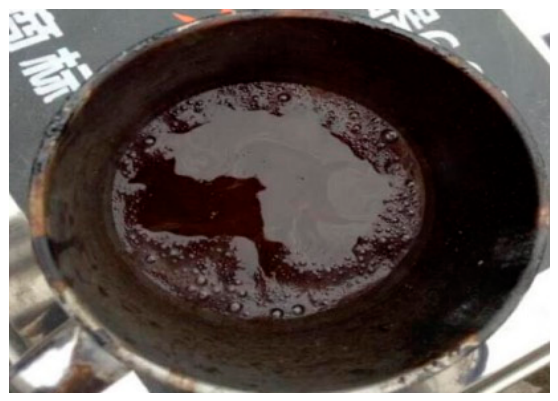
2.1.1. SRX Polymer
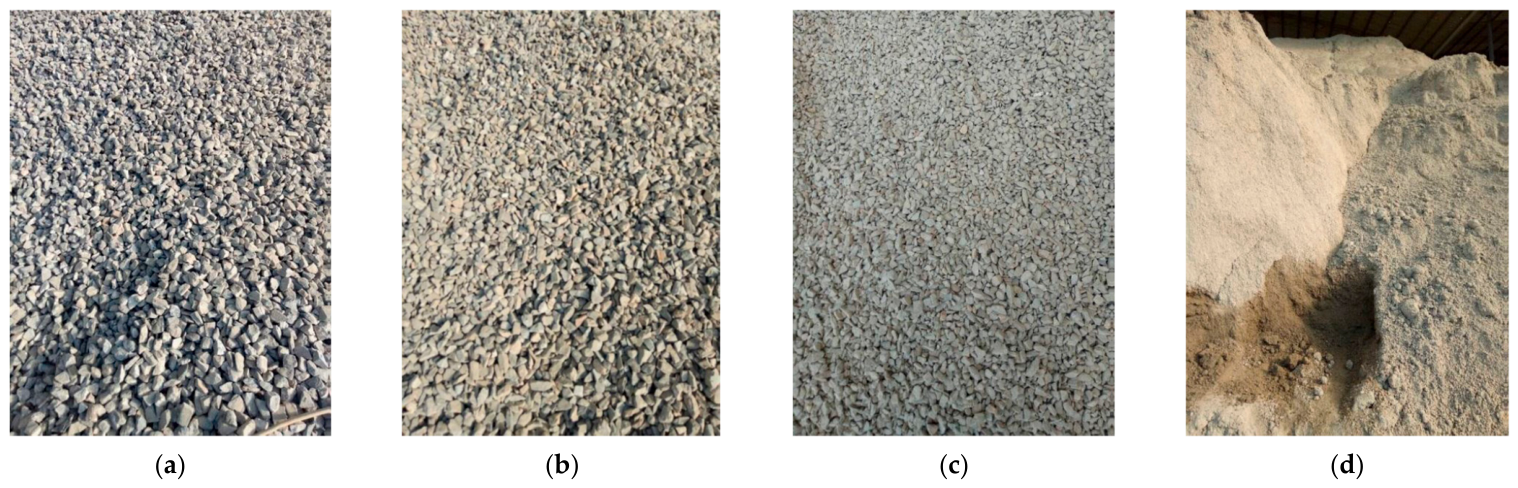
2.1.2. Aggregate
2.2. Design Procedure Optimization for SRX-Stabilized Graded Crushed Stone
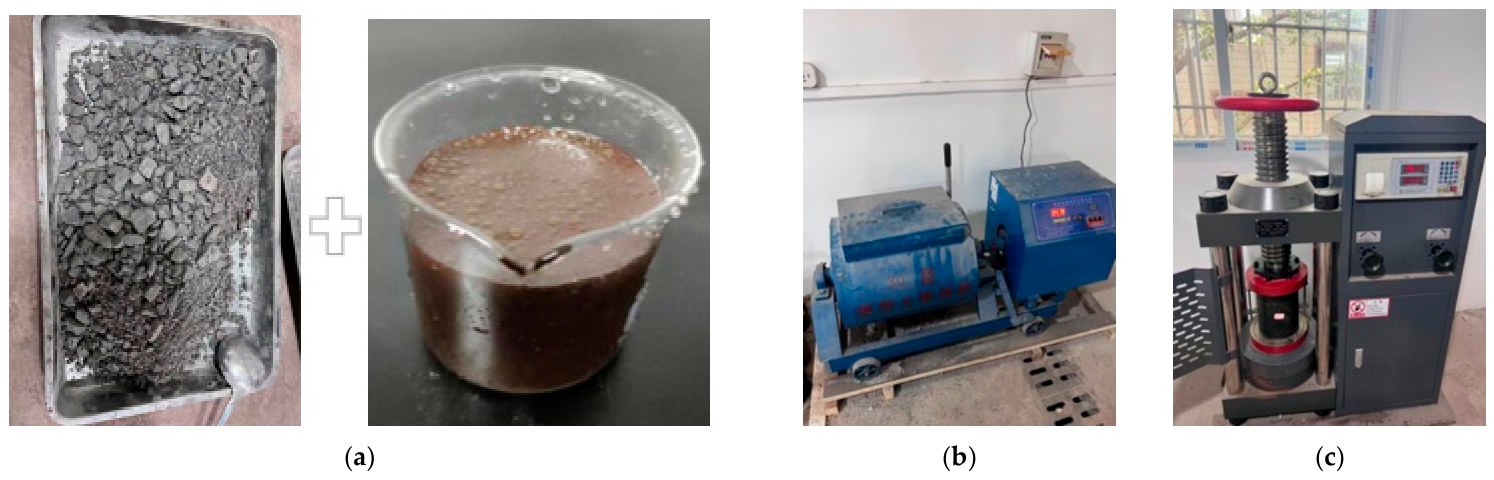
2.2.1. Specimen Preparation
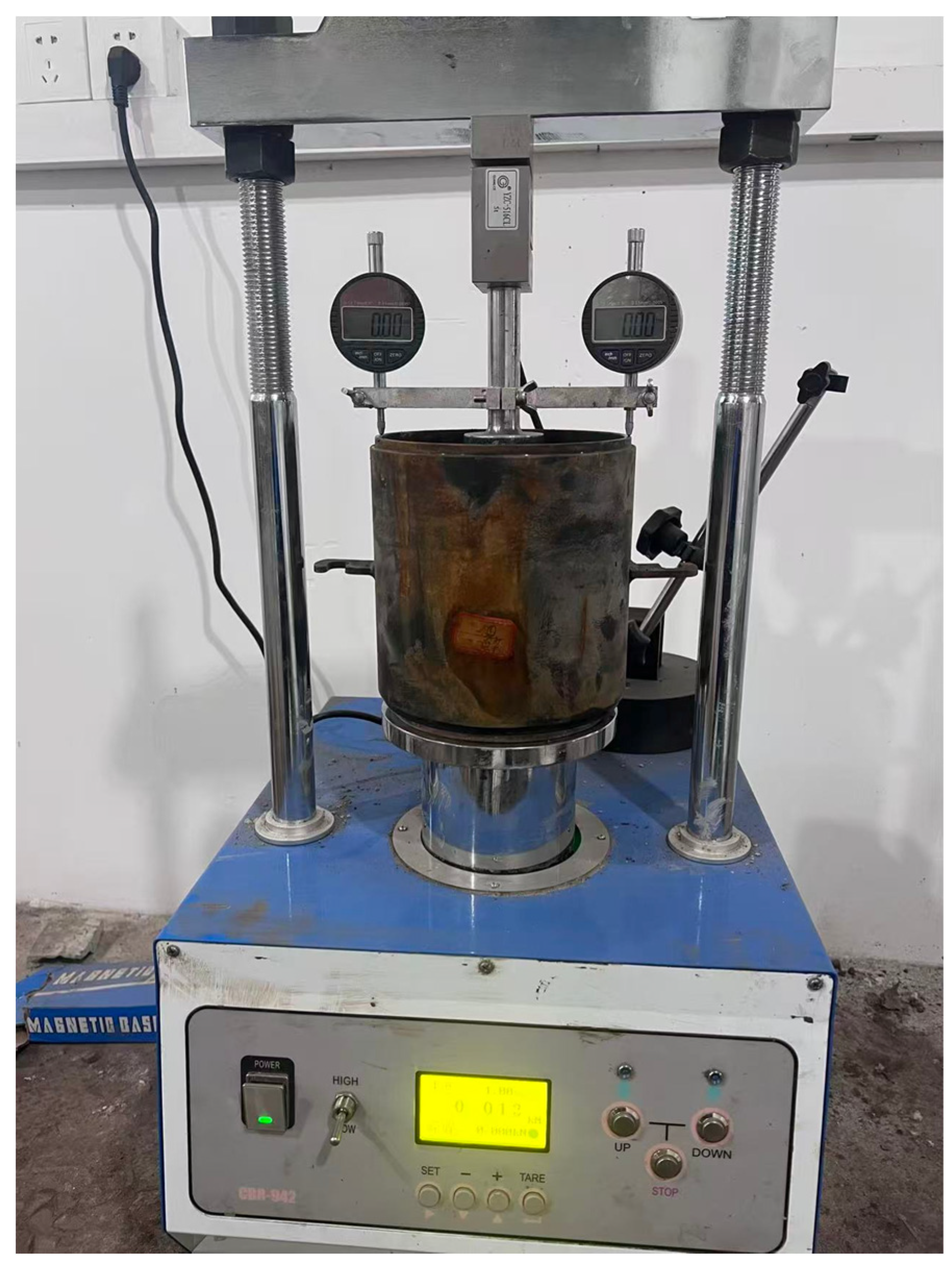
2.2.2. Load-Bearing Capacity Evaluation
2.2.3. Optimization Design of SRX-Stabilized Graded Crushed Stone
SRX Dosage
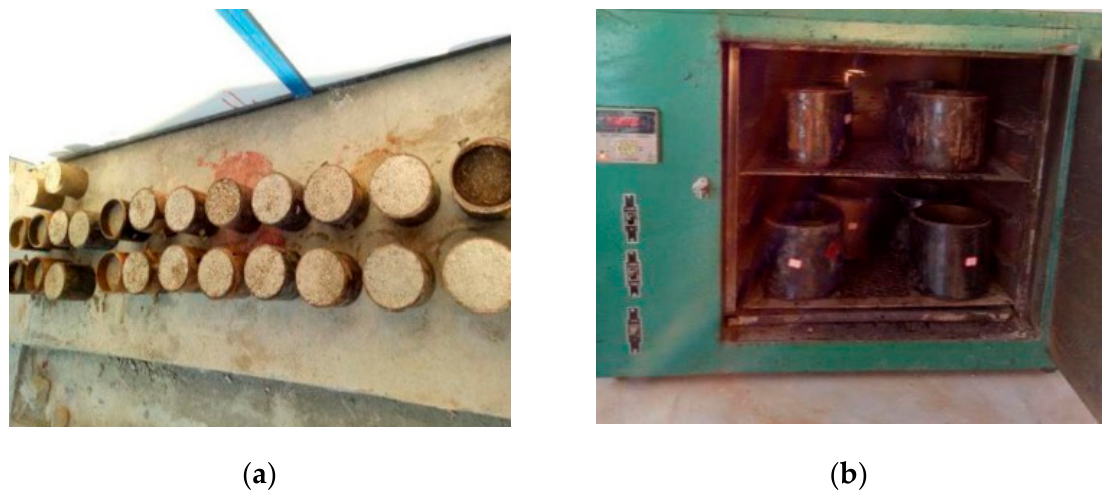
Curing Condition
Compaction Degree
2.3. Pavement Performance Evaluation of SRX-Stabilized Graded Crushed Stone
2.3.1. Water Stability
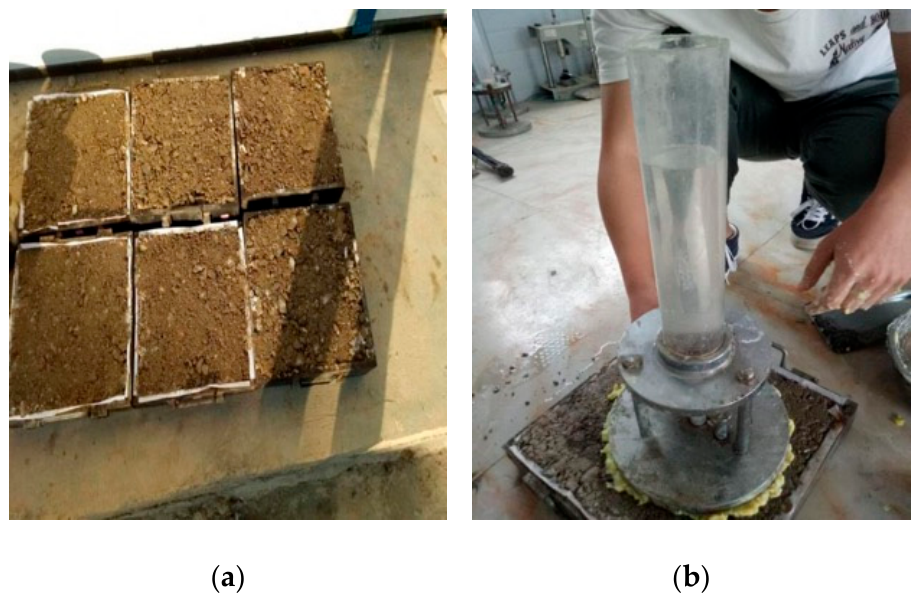
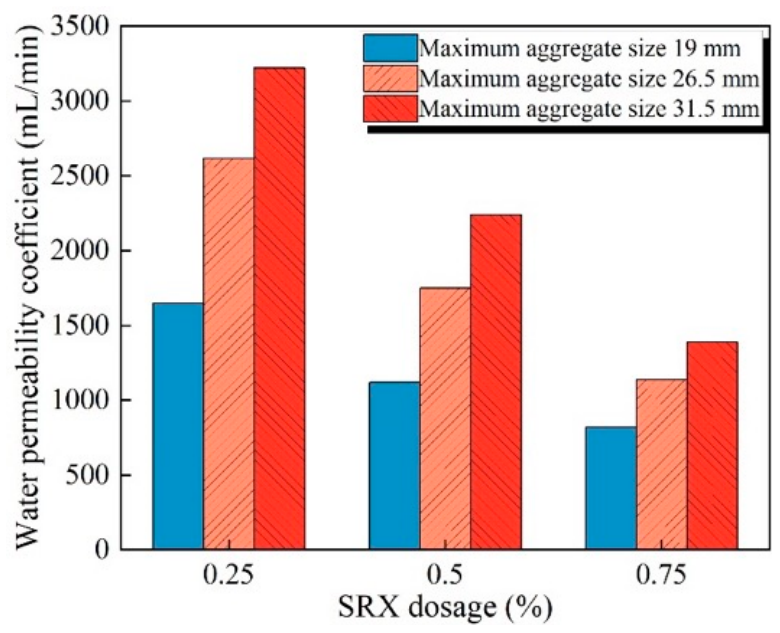
2.3.2. Water Permeability
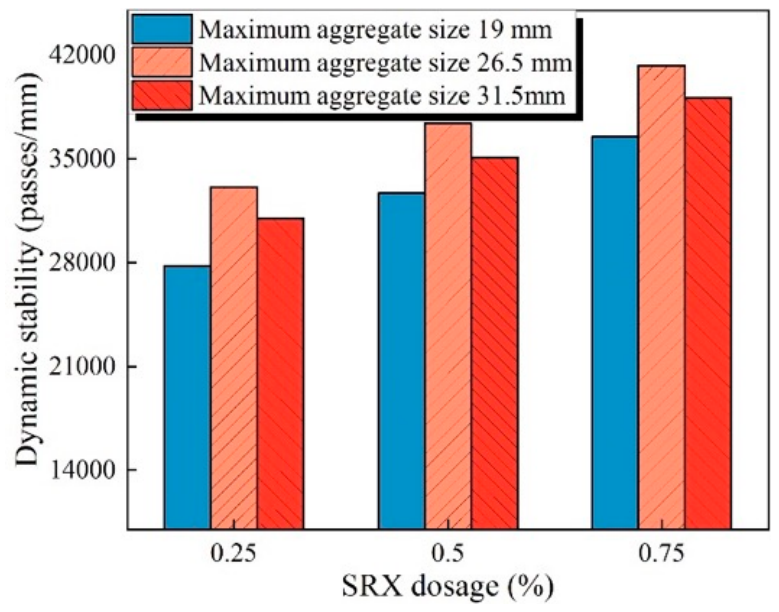
2.3.3. Permanent Deformation Resistance
3. Results and Discussion
3.1. Design Optimization Based on Load-Bearing Capacity
3.1.1. Optimization of SRX Dosage
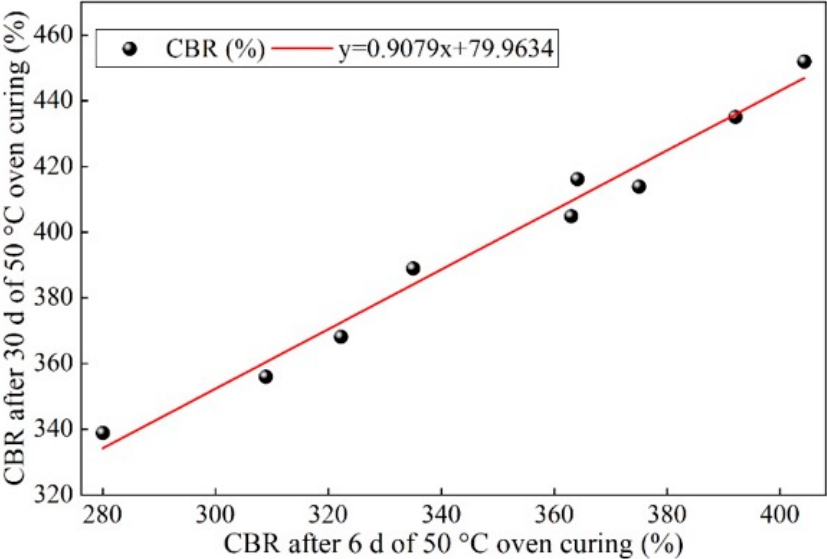
3.1.2. Optimization of Curing Condition
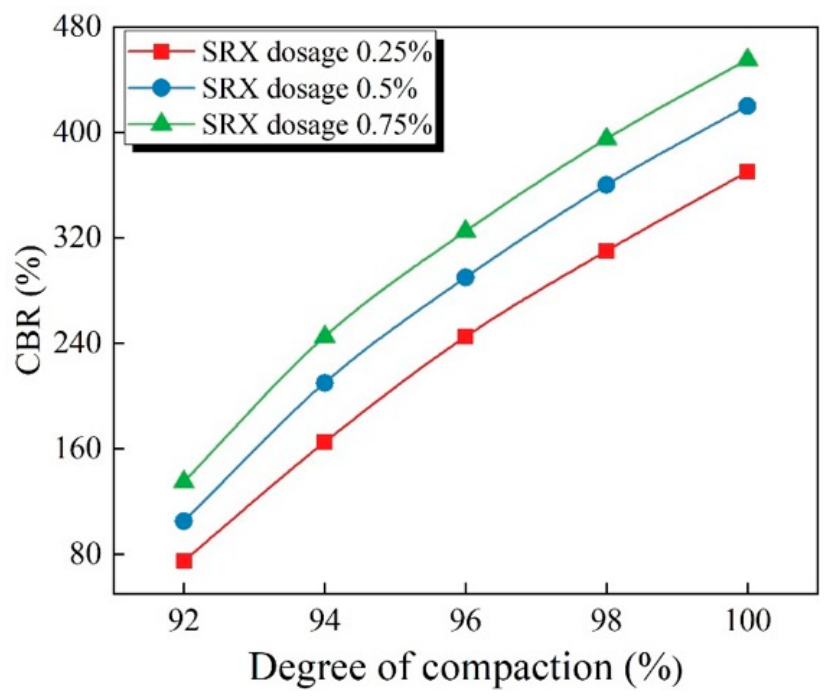
3.1.3. Optimization of Compaction Degree
3.2. Pavement Performance Verification
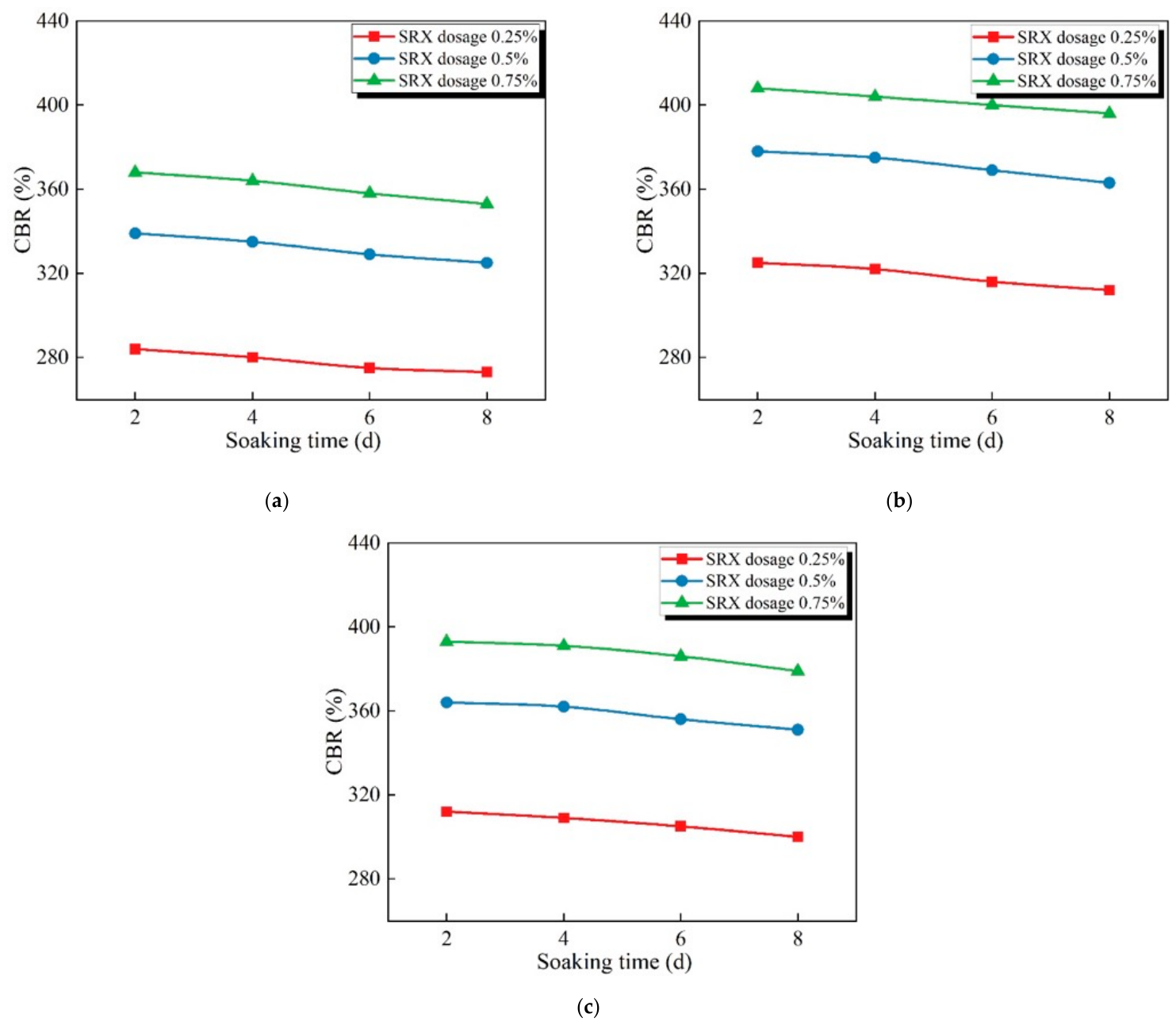
3.2.1. Water Stability
3.2.2. Water Permeability
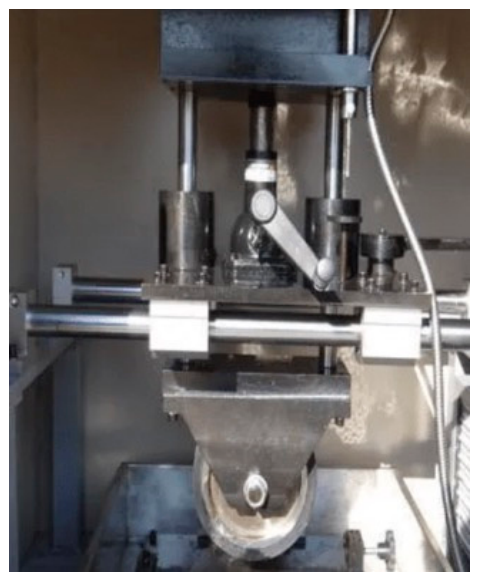
3.2.3. Permanent Deformation Resistance
3.3. Optimization of Design Parameters and Pavement Performance
4. Conclusions
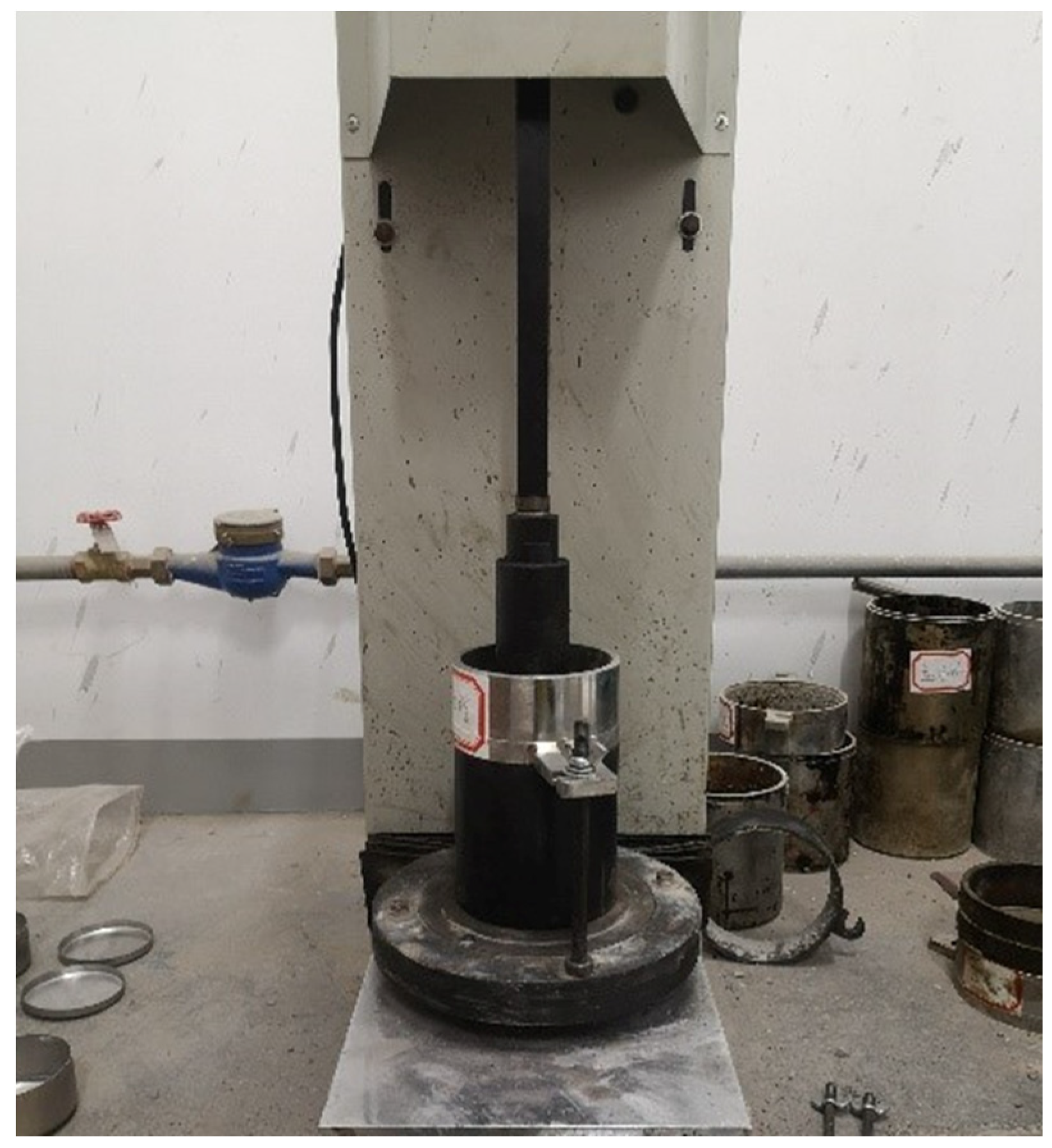
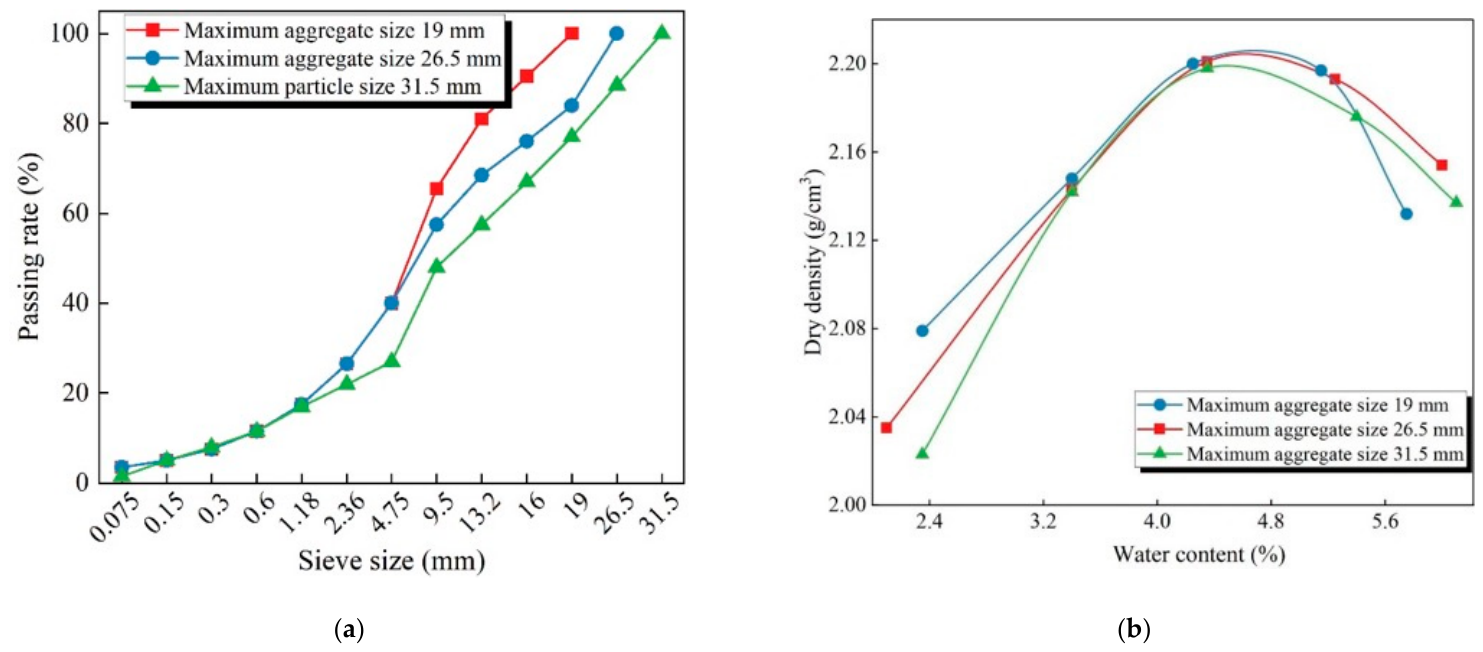
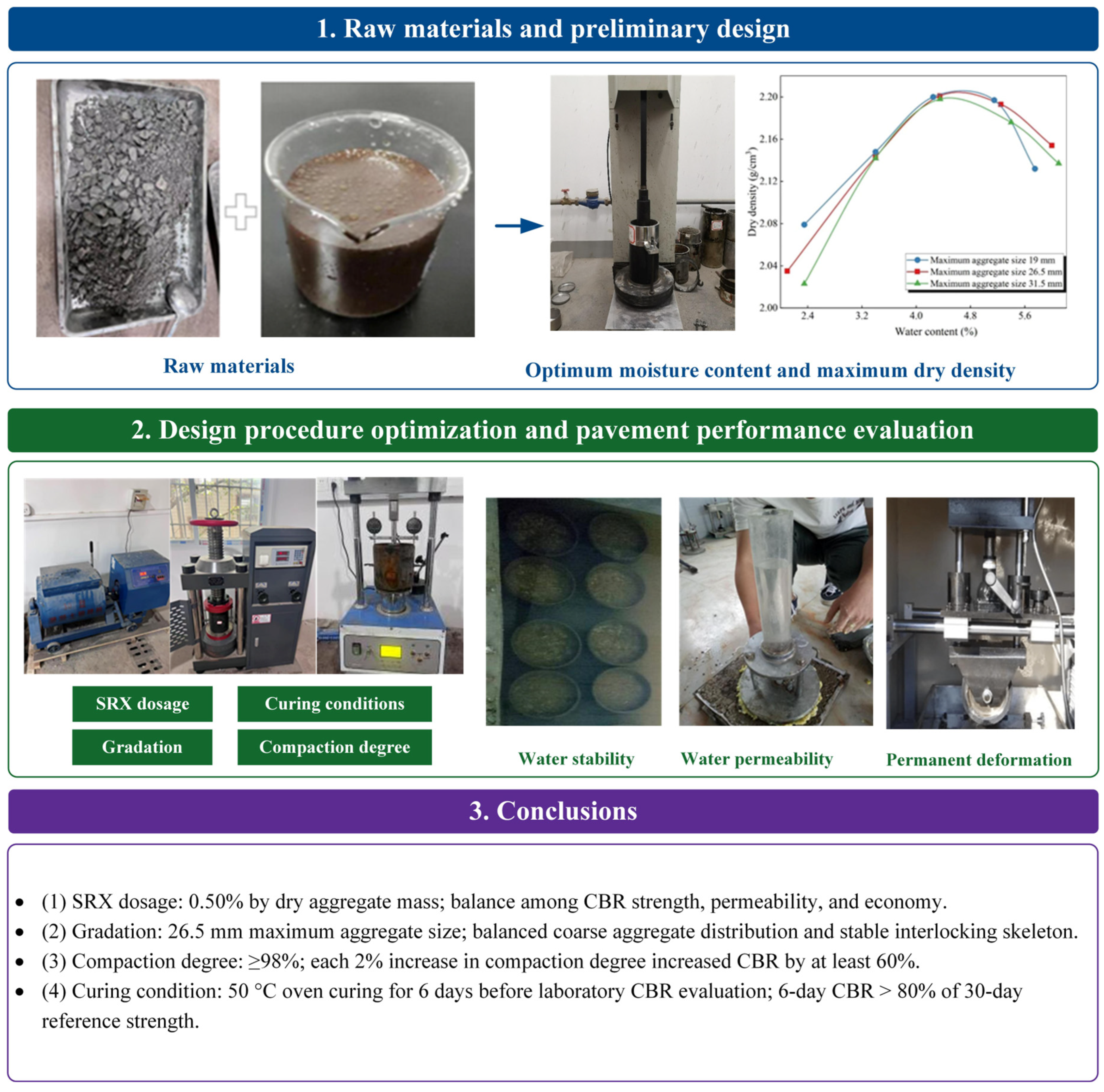
- The optimum moisture content and maximum dry density of SRX-stabilized graded crushed stone were determined by heavy compaction. Since SRX is a water-based polymer with a density close to that of water, it was incorporated by replacing part of the mixing water with an equal mass of SRX. This method maintained the designed optimum moisture content and promoted uniform SRX distribution, providing a suitable molding approach for SRX-stabilized graded crushed stone.
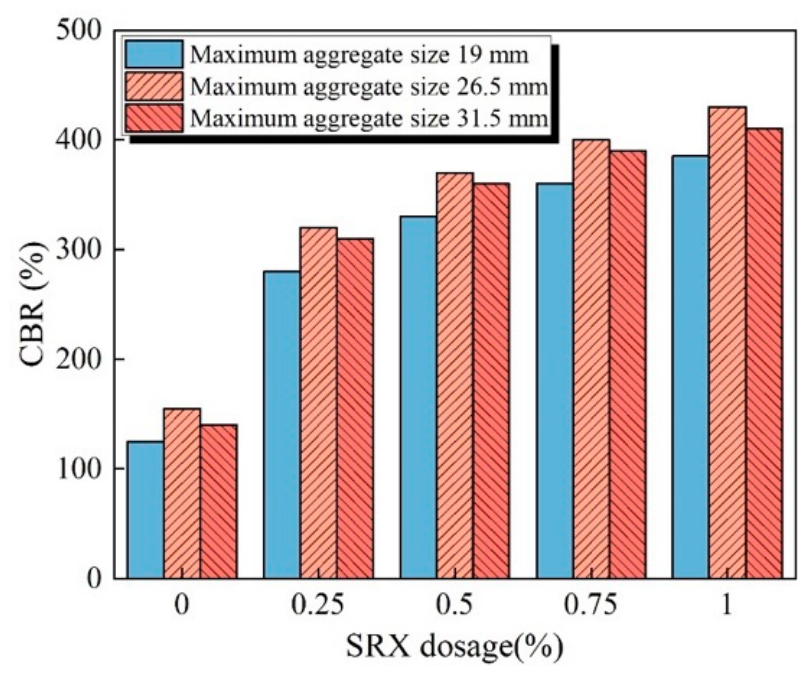
- SRX dosage and aggregate gradation significantly affected CBR strength and pavement performance. Increasing the SRX dosage enhanced CBR strength, water stability, and resistance to permanent deformation, but excessive dosage reduced permeability and increased material cost. The 26.5 mm gradation provided the best overall performance owing to its balanced coarse aggregate distribution and stable interlocking skeleton. Therefore, 0.50% SRX by dry aggregate mass and a 26.5 mm maximum aggregate size are recommended.
- Compaction degree was an important factor controlling the bearing capacity of SRX-stabilized graded crushed stone. Higher compaction improved particle contact, strengthened the aggregate skeleton, and enhanced CBR strength. Each 2% increase in compaction degree increased the CBR value by at least 60%, indicating that the material is highly sensitive to compaction quality. Considering the difficulty of achieving full compaction in field construction, the compaction degree is recommended to be controlled at 98% or above.
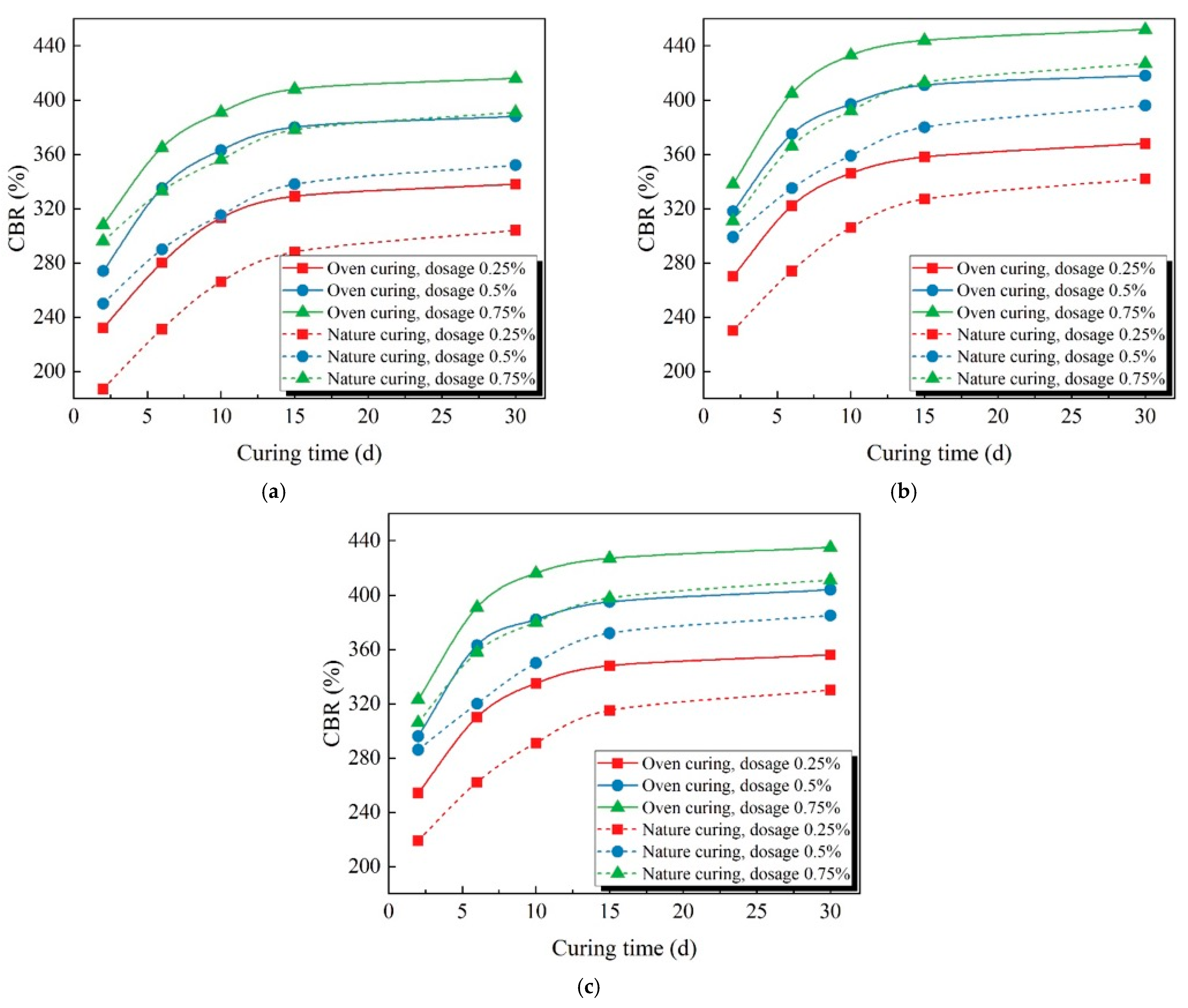
- Curing condition directly affected strength development. Oven curing at 50 °C accelerated moisture evaporation and SRX film formation, leading to faster strength development than natural curing. Since the 6-day CBR value reached more than 80% of the 30-day reference strength and showed a good correlation with long-term strength, 50 °C oven curing for 6 days is recommended for laboratory CBR evaluation.
- The optimized SRX-stabilized graded crushed stone exhibited favorable pavement performance. The CBR reduction after soaking was limited, most permeability coefficients remained above 1000 mL/min, and the material showed high dynamic stability in the wheel-tracking test. Overall, the recommended design parameters are 0.50% SRX dosage, 26.5 mm maximum aggregate size, compaction degree ≥ 98%, and 50 °C oven curing for 6 days before laboratory CBR testing.
Author Contributions
Funding
Data Availability Statement
Conflicts of Interest
References
- Lv, S.T.; Yuan, J.; Peng, X.H.; Zhang, N.T.; Liu, H.F.; Luo, X.Z. A structural design for semi-rigid base asphalt pavement based on modulus optimization. Constr. Build. Mater. 2021, 302, 124216. [Google Scholar] [CrossRef]
- Zhao, M.H.; Xu, X.N.; Liu, Y.; Wu, C.F.; Sun, Q.C.; Pei, Y.H. Microcracking treatment mechanism of semi-rigid base asphalt pavement with discrete-continuous coupling simulation. Case Stud. Constr. Mater. 2024, 20, e02850. [Google Scholar] [CrossRef]
- Wang, X.Y.; Zhong, Y. Influence of tack coat on reflective cracking propagation in semi-rigid base asphalt pavement. Eng. Fract. Mech. 2019, 213, 172–181. [Google Scholar] [CrossRef]
- Tang, D.; Ran, J.; Gao, F.C.; Zhang, N.T.; Zhao, Y.L. Study on the formation mechanism of reflective cracks in semi-rigid base asphalt pavement based on energy evolution mechanism. Constr. Build. Mater. 2025, 491, 142652. [Google Scholar] [CrossRef]
- Guo, L.; Yue, J.C.; Guo, P.; Wang, X.F. Multiple Reflective Cracks in Semirigid Base Asphalt Pavement under Traffic Load Using XFEM. Adv. Civ. Eng. 2022, 2022, 9405338. [Google Scholar] [CrossRef]
- Shi, Z.C.; Yue, J.C.; Xu, L.L.; Wang, X.F. Peridynamics for Fracture Analysis of Reflective Cracks in Semi-Rigid Base Asphalt Pavement. Appl. Sci. 2022, 12, 3486. [Google Scholar] [CrossRef]
- Chen, L.B.; Yan, E.H.; Xu, J.; Ma, T.; Zeng, J.C.; Gong, Y. Research on Design Indicators for Graded Crushed Stone Mixture Based on Vibration Molding Method. Adv. Mater. Sci. Eng. 2020, 2020, 5179563. [Google Scholar] [CrossRef]
- Xu, G.; Chen, Z.D.; Li, X.D.; Lu, G.H.; Dong, D.M.; Liu, Z.X. Establishment of control standard for plastic deformation performance of graded crushed stone. Constr. Build. Mater. 2019, 211, 383–394. [Google Scholar] [CrossRef]
- Xu, G.; Chen, Z.D.; Li, X.D.; Lu, G.H.; Dong, D.M.; Liu, Z.X. Simple prediction model for plastic deformation of graded crushed stone base for flexible pavement. Mater. Struct. 2020, 53, 36. [Google Scholar] [CrossRef]
- Mota, B.C.; Ubaldo, M.D.; de Lima, C.D.A.; Nascimento, L.A.H.D.; Aragao, F.T.S. Optimized characterization of the permanent deformation of unbound soils and granular materials considering the master curve concept. Transp. Geotech. 2024, 47, 101291. [Google Scholar] [CrossRef]
- Wei, Z.Y.; Jia, Y.S.; Li, Y.S.; Chen, Z.Q.; Zhou, Z.Y.; Gao, Y. Impact of aggregate gradation and asphalt-aggregate ratio on pavement performance during construction using back propagation neural network. Autom. Constr. 2024, 165, 105569. [Google Scholar] [CrossRef]
- Li, X.L.; Xu, J.; Xiong, K.Y.; Lv, X.C.; Diab, A. Low-dose cement stabilized large particle size graded crushed stone: Laboratory and field investigations. Constr. Build. Mater. 2024, 451, 138825. [Google Scholar] [CrossRef]
- Tamrakar, P.; Nazarian, S. Moisture effects on moduli of pavement bases. Int. J. Pavement Eng. 2021, 22, 1410–1422. [Google Scholar] [CrossRef]
- Gu, F.; Zhang, Y.Q.; Luo, X.; Sahin, H.; Lytton, R.L. Characterization and prediction of permanent deformation properties of unbound granular materials for Pavement ME Design. Constr. Build. Mater. 2017, 155, 584–592. [Google Scholar] [CrossRef]
- Tan, E.H.; Zahran, E.M.M.; Tan, S.J. Testing the Strengths of Sandstone Aggregates Stabilized with Cement and Styrene-Butadiene Latex Copolymer for Road Subbase Applications. J. Mater. Civ. Eng. 2022, 34, 13. [Google Scholar] [CrossRef]
- Tian, T.; Jiang, Y.J.; Zhang, Y.; Deng, C.Q.; Yi, Y.; Fan, J.T. Strong interlocking skeleton gradation design and performance evaluation of cement-stabilised crushed gravel via vertical vibration test method. Int. J. Pavement Eng. 2023, 24, 2021404. [Google Scholar] [CrossRef]
- Yi, Y.; Jiang, Y.J.; Tian, T.; Fan, J.T.; Deng, C.Q.; Xue, J.S. Mechanical-strength-growth law and predictive model for ultra-large size cement-stabilized macadam based on the vertical vibration compaction method. Constr. Build. Mater. 2022, 324, 126691. [Google Scholar] [CrossRef]
- Zhao, C.W.; Huang, T.; Gao, X.L.; Li, Y.H.; Lu, L. Investigation of Mechanical and Shrinkage Performance for Large-Size Cement-Stabilized Aggregates. Materials 2024, 17, 1027. [Google Scholar] [CrossRef] [PubMed]
- Deng, C.Q.; Jiang, Y.J.; Yuan, K.J.; Tian, T.; Yi, Y. Mechanical properties of vertical vibration compacted lime-fly ash-stabilized macadam material. Constr. Build. Mater. 2020, 251, 119089. [Google Scholar] [CrossRef]
- Wang, C.H.; Liu, S.T.; Liu, L.Q.; Chen, F.; Zhou, X.L. Deformation properties improvement of cement stabilized gravel using rubber: Laboratory and field study. Constr. Build. Mater. 2023, 393, 131975. [Google Scholar] [CrossRef]
- Costa, W.G.S.; Izzo, R.L.D.; Almeida, M.S.D.; Achy, A.R.A.; Santos, I.D.; Ramos, R.S. Investigation of cement and polymer stabilization in gravel soil-RAP mixtures for full-depth reclamation applications. Constr. Build. Mater. 2025, 482, 141548. [Google Scholar] [CrossRef]
- Yaowarat, T.; Sudsaynate, W.; Horpibulsuk, S.; Chinkulkijniwat, A.; Arulrajah, A.; Horpibulsuk, J. Mechanical Properties of Fly Ash-Asphalt Emulsion Geopolymer Stabilized Crushed Rock for Sustainable Pavement Base. J. Mater. Civ. Eng. 2021, 33, 12. [Google Scholar] [CrossRef]
- Cabalar, A.F.; Akbulut, N.; Demir, S.; Yildiz, O. Use of a Biopolymer for Road Pavement Subgrade. Sustainability 2023, 15, 17. [Google Scholar] [CrossRef]
- Li, Z.X.; Guo, T.T.; Fang, C.Z.; Chen, Y.Z.; Nie, J.X. Research on the properties of polymer stabilized coal gangue materials in rubber powder slag base. Sci. Rep. 2025, 15, 32. [Google Scholar] [CrossRef] [PubMed]
- Tan, E.H.; Zahran, E.M.M.; Tan, S.J. A comparative experimental investigation into the chemical stabilisation of sandstone aggregates using cement and styrene-butadiene copolymer latex for road sub-base construction. Transp. Geotech. 2022, 37, 14. [Google Scholar] [CrossRef]
- Huang, J.X.; Kogbara, R.B.; Hariharan, N.; Masad, E.A.; Little, D.N. A state-of-the-art review of polymers used in soil stabilization. Constr. Build. Mater. 2021, 305, 124685. [Google Scholar] [CrossRef]
- Iyengar, S.R.; Masad, E.; Rodriguez, A.K.; Bazzi, H.S.; Little, D.; Hanley, H.J.M. Pavement Subgrade Stabilization Using Polymers: Characterization and Performance. J. Mater. Civ. Eng. 2013, 25, 472–483. [Google Scholar] [CrossRef]
- Mousavi, F.; Abdi, E.; Rahimi, H. Effect of Polymer Stabilizer on Swelling Potential and CBR of Forest Road Material. KSCE J. Civ. Eng. 2014, 18, 2064–2071. [Google Scholar] [CrossRef]
- Georgees, R.N.; Hassan, R.A.; Evans, R.P.; Jegatheesan, P. An evaluation of performance-related properties for granular pavement materials using a polyacrylamide additive. Int. J. Pavement Eng. 2018, 19, 153–163. [Google Scholar] [CrossRef]
- Georgees, R.N.; Hassan, R.A.; Evans, R.P. Permanent Deformation Response of Polymer-Treated Pavement Foundation Material under Transmitted Stress Pulses. J. Mater. Civ. Eng. 2018, 30, 04018229. [Google Scholar] [CrossRef]
- Georgees, R.N.; Hassan, R.A.; Evans, R.P.; Jegatheesan, P. Resilient Response Characterization of Pavement Foundation Materials Using a Polyacrylamide-Based Stabilizer. J. Mater. Civ. Eng. 2018, 30, 04017252. [Google Scholar] [CrossRef]
- Hamza, M.; Nie, Z.H.; Aziz, M.; Ijaz, N.; Ijaz, Z.; Rehman, Z.U. Strengthening potential of xanthan gum biopolymer in stabilizing weak subgrade soil. Clean Technol. Environ. Policy 2022, 24, 2719–2738. [Google Scholar] [CrossRef]
- Kumar, P.; Puppala, A.J.; Tingle, J.S.; Chakraborty, S.; Congress, S.S.C. Resilient Characteristics of Polymer Emulsion-Treated Sandy Soil. Transp. Res. Rec. 2022, 2676, 526–538. [Google Scholar] [CrossRef]
- Hopkins, C.; Cameron, D.; Rahman, M.M. On Site Improvement of Fines-Rich Unbound Granular Materials with Hydrophobic Polymer and Lime. Sustainability 2021, 13, 13479. [Google Scholar] [CrossRef]
- Boaventura, N.F.; Sousa, T.F.D.; Casagrande, M.D. The Application of an Eco-Friendly Synthetic Polymer as a Sandy Soil Stabilizer. Polymers 2023, 15, 4626. [Google Scholar] [CrossRef] [PubMed]
- Chang, I.; Lee, M.; Tran, A.T.P.; Lee, S.; Kwon, Y.M.; Im, J.; Cho, G.C. Review on biopolymer-based soil treatment (BPST) technology in geotechnical engineering practices. Transp. Geotech. 2020, 24, 100385. [Google Scholar] [CrossRef]
- Xu, N.; Chen, Z.D.; Gao, H.J.; Dong, D.M.; Wu, Y.J.; Lu, G.H.; Chen, Z.F. Experimental Investigation of the Technical Performances of SRX-Stabilized Graded Macadam. Adv. Mater. Sci. Eng. 2021, 2021, 9959834. [Google Scholar] [CrossRef]
- Liu, J.; Liu, Q.L.; Pu, C.; Wu, B.; Wang, X.; Zhu, S.Y. Strength and Microstructural Evolution of SRX-Stabilized Aeolian Sand-Gravel Flexible Base for Desert Road Construction. Materials 2025, 18, 3982. [Google Scholar] [CrossRef] [PubMed]
- Almajed, A.; Lemboye, K.; Moghal, A.A.B. A Critical Review on the Feasibility of Synthetic Polymers Inclusion in Enhancing the Geotechnical Behavior of Soils. Polymers 2022, 14, 5004. [Google Scholar] [CrossRef] [PubMed]
- Jiang, Y.J.; Xue, J.S. Investigation into physical and mechanical properties of SRX-stabilised crushed rock using different compaction methods. Int. J. Pavement Eng. 2019, 20, 866–873. [Google Scholar] [CrossRef]
- Jiang, Y.J.; Han, Z.C.; Xue, J.S.; Deng, C.Q.; Ji, X.P. Laboratory Fatigue Performance of Vertical Vibration Compacted SRX-Stabilized Crushed Rock Material. J. Mater. Civ. Eng. 2019, 31, 04019298. [Google Scholar] [CrossRef]
- Hu, Y.W.; Zhu, H.Z.; Li, J.; Yu, M.; Yao, Y.S. Effect of solution road RomixSoilfix on deformation performance of granular base material: A laboratory and field investigation. Constr. Build. Mater. 2023, 393, 131894. [Google Scholar] [CrossRef]
- Ministry of Transport of the People’s Republic of China. Test Methods of Aggregate for Highway Engineering (JTG 3432-2024); China Communications Press Co., Ltd.: Beijing, China, 2024. [Google Scholar]
- Ministry of Transport of the People’s Republic of China. Specifications for Design of Highway Asphalt Pavement (JTG D50—2017); China Communications Press Co., Ltd.: Beijing, China, 2017. [Google Scholar]
- Ministry of Transport of the People’s Republic of China. Test Methods of Soils for Highway Engineering (JTG 3430—2020); China Communications Press Co., Ltd.: Beijing, China, 2020. [Google Scholar]






| Properties | Unit | Test Result |
|---|---|---|
| pH value | 1 | 9 |
| Solid content | % | 30.75 |
| Viscosity | cP | 70 |
| Boiling point | °C | 98 |
| Flammability | - | Non-flammable |
| Specific gravity | 1 | 1.02 |
| Water solubility | - | Completely soluble |
| Technical Property | Unit | Specification Requirement | Test Result |
|---|---|---|---|
| Crushing value | % | ≤26 | 19 |
| Flaky and elongated particle content | % | ≤18 | 10.6 |
| Apparent relative density | g/cm3 | ≥2.6 | 2.669 |
| Water absorption | % | ≤2.0 | 0.93 |
| Soundness | % | <12 | 5 |
Disclaimer/Publisher’s Note: The statements, opinions and data contained in all publications are solely those of the individual author(s) and contributor(s) and not of MDPI and/or the editor(s). MDPI and/or the editor(s) disclaim responsibility for any injury to people or property resulting from any ideas, methods, instructions or products referred to in the content. |
© 2026 by the authors. Licensee MDPI, Basel, Switzerland. This article is an open access article distributed under the terms and conditions of the Creative Commons Attribution (CC BY) license.
Share and Cite
Fu, J.; Han, D.; Yin, F.; Zhu, H. Design Procedure Optimization and Pavement Performance Evaluation of SRX-Stabilized Graded Crushed Stone. Processes 2026, 14, 1967. https://doi.org/10.3390/pr14121967
Fu J, Han D, Yin F, Zhu H. Design Procedure Optimization and Pavement Performance Evaluation of SRX-Stabilized Graded Crushed Stone. Processes. 2026; 14(12):1967. https://doi.org/10.3390/pr14121967
Chicago/Turabian StyleFu, Jianwei, Dongdong Han, Fei Yin, and Hongzhou Zhu. 2026. "Design Procedure Optimization and Pavement Performance Evaluation of SRX-Stabilized Graded Crushed Stone" Processes 14, no. 12: 1967. https://doi.org/10.3390/pr14121967
APA StyleFu, J., Han, D., Yin, F., & Zhu, H. (2026). Design Procedure Optimization and Pavement Performance Evaluation of SRX-Stabilized Graded Crushed Stone. Processes, 14(12), 1967. https://doi.org/10.3390/pr14121967