


Abstract
Caprock sealing capacity is paramount for the safety and efficacy of geological carbon storage. This study investigates the evolution of mudstone caprock sealing capacity under CO2–mechanical coupling, integrating experimental rock mechanics with fluid–solid coupling numerical simulations. Laboratory experiments reveal that caprock permeability exhibits strong stress sensitivity, decreasing exponentially with increasing effective stress. The stress sensitivity coefficient is highly dependent on initial pore pressure and porosity, being greatest under low-pore-pressure and high-porosity conditions. Furthermore, permeability loss during loading is partially irreversible due to plastic deformation. Numerical simulations, conducted using an integrated Petrel + Visage + Eclipse workflow, quantify the influence of caprock physical and mechanical properties on sealing capacity during CO2 injection. The results demonstrate that vertical total stress increases with increasing porosity, Young’s modulus, and permeability, with permeability exerting the most significant control. Conversely, vertical effective stress decreases with increases in these parameters, with porosity causing the largest variation. We conclude that lower caprock permeability and porosity are most critical for enhancing sealing integrity, while a higher Young’s modulus improves mechanical stability. These findings provide a theoretical basis and practical methodology for evaluating caprock sealing capacity and ensuring the secure storage of CO2.
1. Introduction
Currently, Carbon Capture, Utilization, and Storage (CCUS) has emerged as a pivotal technology for achieving carbon neutrality, garnering significant attention across various sectors worldwide [1,2,3,4,5]. CO2 geological utilization and storage, a core component of the CCUS framework, possesses substantial emission reduction potential [2,3,4,5,6], driving the rapid advancement of numerous large-scale CCUS demonstration projects globally. Crucially, any leakage of stored CO2 could not only harm the local ecosystem but also pose direct risks to human health in surrounding areas. Consequently, the sealing integrity of the caprock is a primary and essential criterion in the selection of CO2 storage sites.
The CO2 injection phase represents a critical period for assessing caprock sealing integrity. The rapid pore pressure buildup during this short-term phase can significantly compromise the mechanical integrity of the caprock [5,6,7,8,9,10], underscoring the dominant influence of stress on early-stage sealing capacity. For the caprock, its permeability directly governs the extent of CO2 intrusion. Therefore, under coupled CO2–mechanical conditions, the evolution of caprock permeability constitutes the fundamental intrinsic mechanism determining whether the caprock can “seal effectively” and “seal reliably over the long term”. Investigating caprock permeability thus serves as a key starting point for studying the early-stage sealing integrity of CO2 geological storage [9,10,11,12,13,14].
Currently, in the field of microscopic sealing mechanisms and dynamic evolution, research focus has shifted from single capillary effects to multi-field coupling interactions. Experimental studies have revealed that mudstone caprocks rich in clay minerals can undergo significant illitization in CO2-water environments, leading to alterations in pore structure and reductions in permeability, thereby highlighting the positive contribution of chemical precipitation to fracture self-healing [1,5,14]. Meanwhile, the application of digital rock physics has enabled the reconstruction of three-dimensional pore structures in salt rock caprocks [1,2,4,5,8,12,13,14]. Through hydrodynamic simulations, this approach visually demonstrates the dynamic balance between the initiation and closure of micro-fractures under stress disturbances, emphasizing the critical role of thermal–hydro-mechanical–chemical (THMC) coupling effects [1,2,4,8,10,11,12,13,14].
Furthermore, field cases and inversion analyses provide crucial validation for theoretical research. Long-term monitoring data inversion from large-scale CCS projects such as Sleipner and Quest indicates that the caprock’s response to injection-induced pressure perturbations exhibits significant heterogeneity [1,3,4,11,12,13,14]. These field observations challenge the direct extrapolation of laboratory-derived parameters to the field scale and underscore that assessing caprock integrity under real geological conditions must account for macroscopic structures (e.g., faults, lateral sealing) and their synergistic response with the reservoir [1,2,4,5,11,12,13,14].
Accordingly, this study focuses on typical mudstone caprocks. We employ rock mechanics experiments to reveal the dynamic evolution of mudstone permeability under CO2–mechanical coupling. Integrated with fluid–solid coupled numerical simulations, we aim to identify the main controlling factors governing mudstone caprock sealing integrity under this mechanism. This work seeks to provide a theoretical foundation and methodological support for the safe geological storage of CO2.
2. Samples and Methods
2.1. Samples
Six core samples from the study area were analyzed for mineral composition using a Germany Bruker D8 Advance X-ray diffractometer. The results, detailed in Table 1, identify the caprock lithology as mudstone. Minerals are dominated by chlorite (38.0–50.7%), quartz (11.2–25.0%), and calcite (8.2–15.6%), with lesser amounts of illite (1.4–3.2%). The presence of quartz and calcite provides a rigid framework, while the abundance of chlorite, a key clay mineral, can significantly influence the caprock’s geomechanical properties and sealing capacity.
Table 1.
Characteristics of mineral composition content of caprock.
2.2. Experiment
Rock permeability directly influences fluid migration and accumulation. For caprocks, permeability is thus a key indicator for evaluating sealing capacity. In this study, the steady-state method was utilized to determine the permeability of caprock samples [15,16]. The principle of the steady-state permeability measurement is as follows: First, confining pressure is applied to the core sample. After the confining pressure stabilizes at the target value, CO2 is injected into the sample at a constant rate. The readings from the differential pressure gauge are monitored and recorded. Once both the fluid flow rate and the differential pressure gauge readings stabilize, the data from the gauge is recorded. Assuming that the flow of gas or liquid phase in the rock follows Darcy’s law, the permeability () for incompressible fluids is
For compressible fluids, the effective permeability () is
where and are the flow rates of water and gas at the outlet, respectively; and are the dynamic viscosities of water and gas, respectively; and are the pressures at the outlet and inlet, respectively; is the cross-sectional area of the core sample; and is the length of the core sample.
The steady-state method yields stable and reliable relative permeability data over a wide range of saturations. However, the permeability of low-permeability rocks like mudstone is typically very low, requiring several hours or even days to reach equilibrium during testing. Furthermore, altering the gas–liquid flow rate ratio necessitates re-determining the water saturation of the mudstone, complicating the procedure. To mitigate hysteresis effects, the direction of saturation change should be controlled to be unidirectional, i.e., either consistently increasing or decreasing [15,16].
2.3. Numerical Simulation
This study employed the integrated software platform (2020) Petrel + Visage + Eclipse to construct a 3D geological model for simulating the coupled seepage and stress fields within the caprock during CO2 injection. The coupled simulation workflow encompassed 3D grid generation, assignment of mechanical property models, pore pressure initialization, boundary condition definition, finite element computation, and result analysis. The geomechanical simulator VISAGE is designed for coupled calculations with the reservoir simulator ECLIPSE. After configuring the iteration step size and numerical scheme, Petrel’s two-way coupling procedure automatically executes ECLIPSE and VISAGE in sequence. This ensures seamless integration between the two sets of computational grids, maintaining high efficiency and precision throughout the reservoir-geomechanics coupling process. Within this two-way coupling mechanism, ECLIPSE first computes the temperature and pressure fields and transmits them to VISAGE. VISAGE then calculates the current stress field, updates the permeability and pore volume accordingly, and feeds these modified properties back to ECLIPSE for the subsequent time step’s temperature and pressure calculations. This two-way data exchange occurs at every step [17].
The model used in this study is idealized, featuring a 50 m thick caprock, a 100 m thick reservoir, a top depth of 2500 m, and lateral dimensions of 510 m by 510 m. The dimensions of the mechanical model are 1.5 times those of the property model in all directions. The injection well is located at the model center, with a CO2 injection rate of 25,000 sm3/d and a bottom-hole pressure limit of 500 bar. The Poisson’s ratios for the caprock and reservoir are set to 0.4 and 0.2, respectively, with compressive strengths of 700 bar and 1000 bar, respectively. The simulation period spans 20 years.
This study established a benchmark numerical model to systematically investigate the impact of caprock physico-mechanical properties on sealing efficiency following CO2 injection. The model’s caprock was parameterized with a porosity of 7%, anisotropic permeabilities (0.0001 mD in I- and J-directions, and 0.00001 mD in K-direction), and a Young’s modulus of 5 GPa. These values (denoted as P2, K2, E2) constitute the baseline configuration. The porosity and permeability values in this study were determined from a systematic experimental analysis of core samples from the target formation, with the average values adopted as representative parameters. The mechanical parameters were based on data from reference [18] and were slightly adjusted according to the specific geomechanical characteristics of the study area. This calibration ensures that the model better conforms to the actual geological conditions, thereby guaranteeing the reliability of the simulation results.
Holding reservoir properties constant, six additional numerical simulation scenarios were designed by varying one of the caprock’s key parameters (porosity, permeability, or Young’s modulus) at a time while keeping all others unchanged (Table 2). This approach allows for the calculation of parameter variations at the reservoir-caprock interface (the bottom grid layer of the caprock).
Table 2.
Mechanical and physical parameters characteristics of numerical simulation models (The petrophysical and mechanical data were derived from experiments and literature review, respectively.).
It is important to note that this study is based on an idealized model, which treats the reservoir as a homogeneous medium and only accounts for the vertical and horizontal variations in permeability regarding caprock heterogeneity. Moreover, the model assumes a single central injection well and does not incorporate complex geological structures such as faults. Due to these simplifications of actual geological conditions, the conclusions drawn may have limitations in their general applicability.
3. Results and Discussion
3.1. Stress Sensitivity Characteristics of Caprock Permeability
Caprock, a porous medium composed of various minerals, undergoes differential deformation under stress due to the varying compressibility of mineral particles, clay materials, and cements [18,19,20]. The stress sensitivity of caprock permeability was analyzed through high-pressure, high-temperature displacement experiments on six mudstone samples with differing physical properties. Generally, a larger permeability stress sensitivity coefficient indicates greater susceptibility of caprock permeability to pressure changes, whereas a smaller coefficient suggests weaker sensitivity and a gentler permeability decline with increasing pressure [19,20,21,22,23].
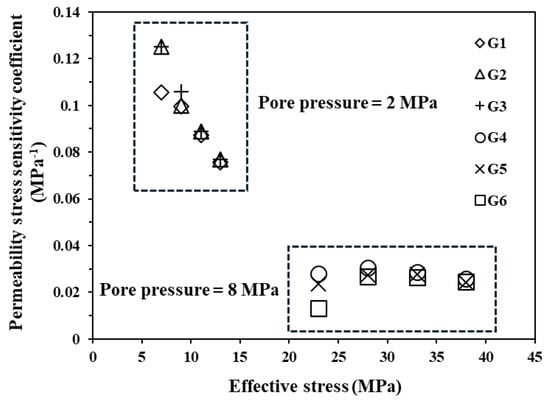
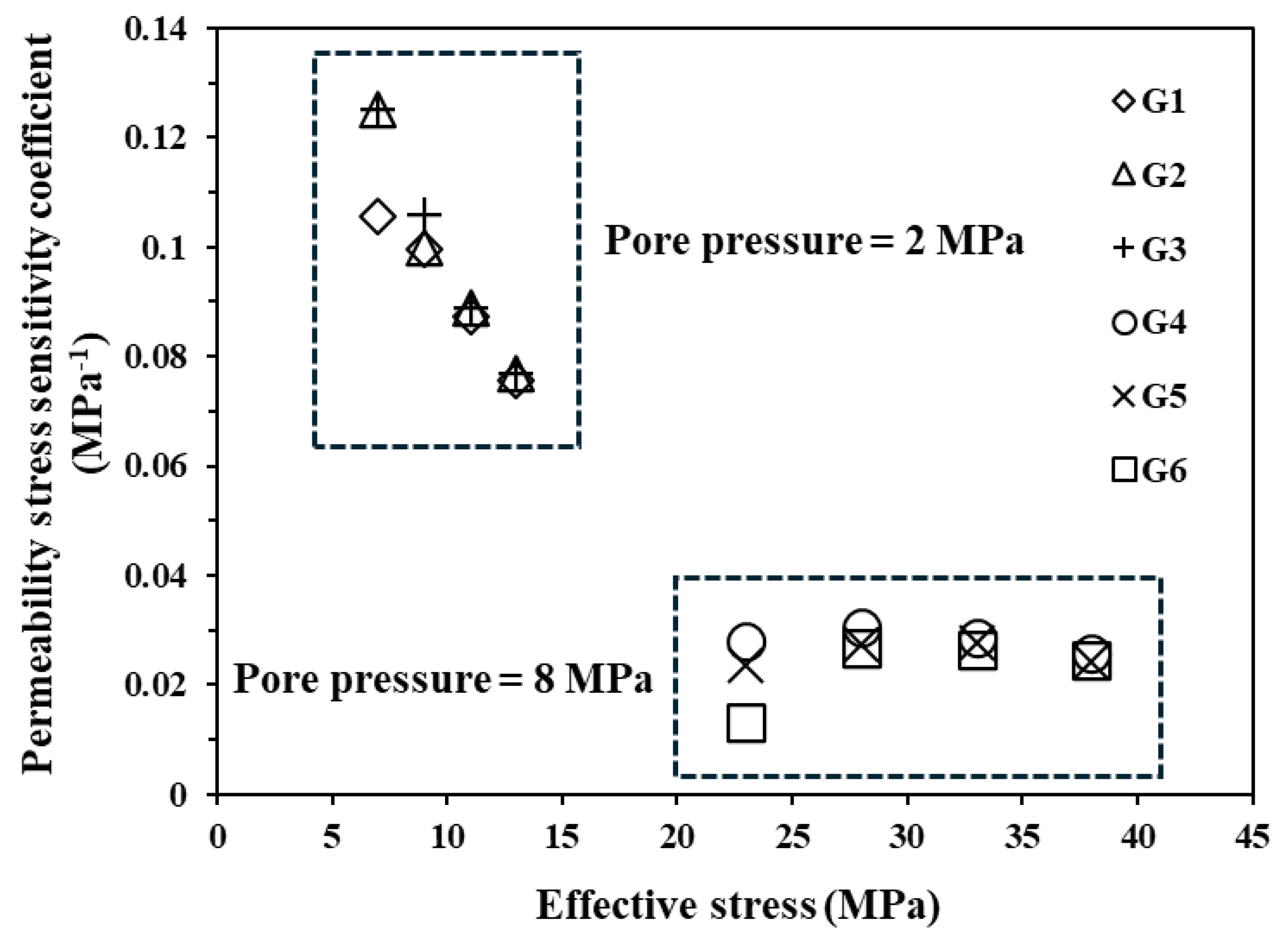
At a constant pore pressure of 2 MPa, the permeability stress sensitivity coefficient decreases markedly with increasing effective stress. In contrast, at a higher pore pressure of 8 MPa, the rate of decrease in the coefficient slows overall and exhibits a wavy pattern (Figure 1). The change in caprock permeability under effective stress fundamentally reflects the evolution of pore-throat geometry. Consequently, at low pore pressures, caprock pore-throat size demonstrates very strong stress sensitivity. At high pore pressures, this sensitivity weakens and displays fluctuating behavior.
Figure 1.
Relationship between the permeability stress sensitivity coefficient of caprock and effective stress (G1–G6 are core sample numbers).
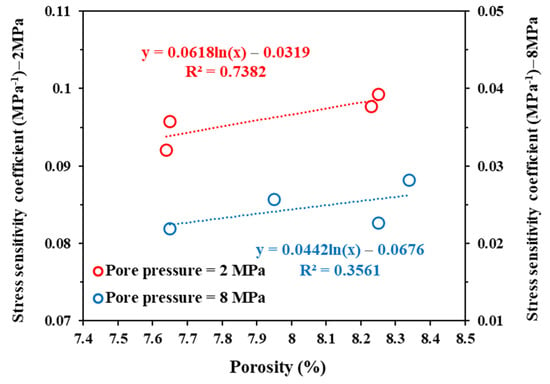
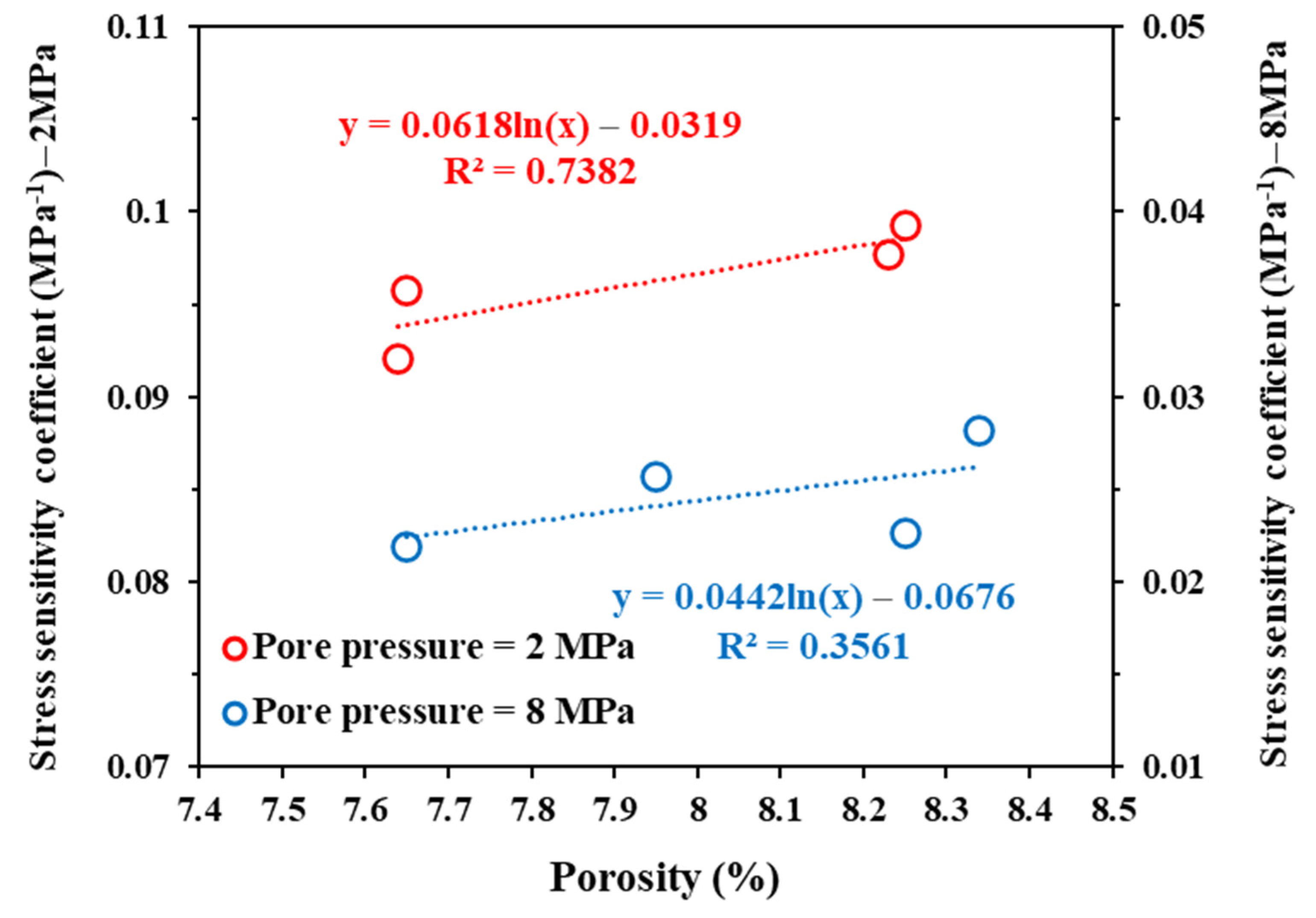
The permeability stress sensitivity coefficient increases with decreasing pore pressure or increasing porosity (Figure 2). Under stress, numerous pores and micro-fractures may form within the caprock, while the rock skeleton compacts, reducing some pore spaces. If the initial porosity is higher or the pore pressure is lower, the pore-throat system is more susceptible to alteration under stress, leading to a higher stress sensitivity coefficient. Therefore, the inherent porosity and pore pressure of the caprock directly govern the intensity of pore-throat changes under stress, and a sufficient burial depth forms the basis for adequate caprock sealing capacity [21,22,23,24].
Figure 2.
Relationship between the stress sensitivity coefficient of caprock vs. pore pressure and porosity.
3.2. Evolution of Caprock Permeability Under Stress
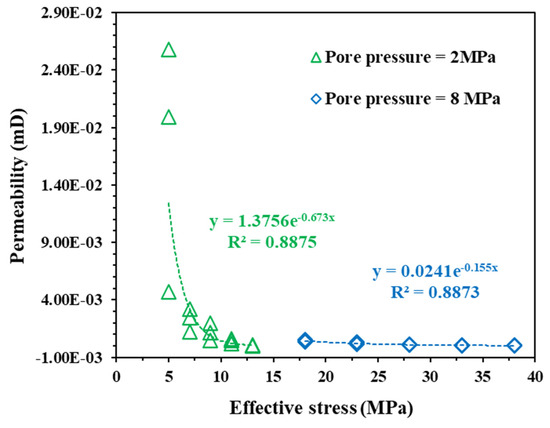
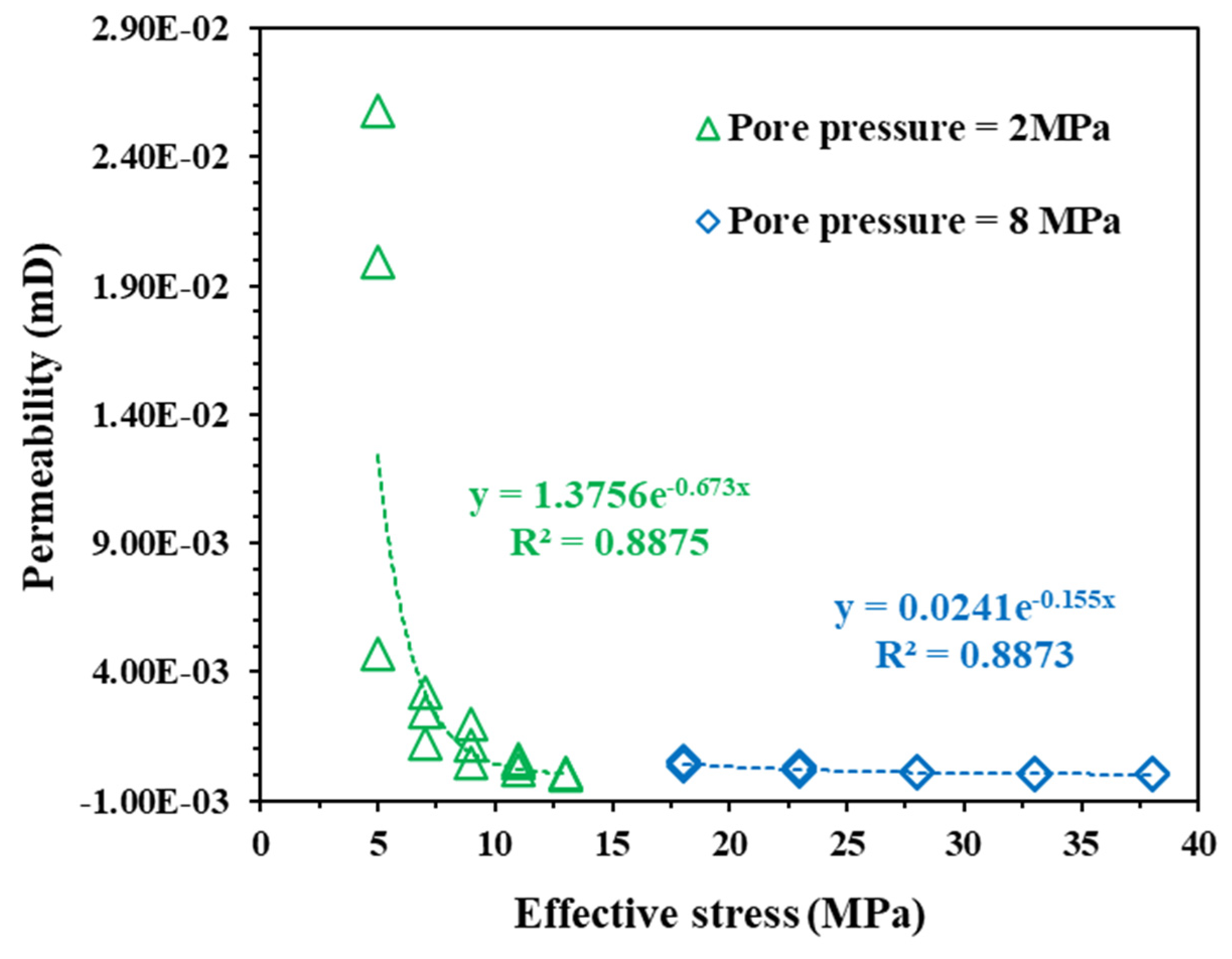
As shown in Figure 3, caprock permeability decreases exponentially with increasing effective stress. This indicates that pore-throat connectivity varies relatively little beyond a certain effective stress threshold. Therefore, from an economic standpoint, deeper caprocks are not necessarily optimal for CO2 storage. Higher caprock pore pressure corresponds to a smaller permeability stress sensitivity coefficient and a slower rate of permeability reduction, suggesting that a higher initial pore pressure is more favorable for CO2 storage (Figure 3). This implies that the controlling effect of pore pressure on permeability is significantly stronger than that of confining pressure, and sufficient pore pressure can potentially compensate for shallower caprock depths.
Figure 3.
Relationship between permeability of caprock and effective stress.
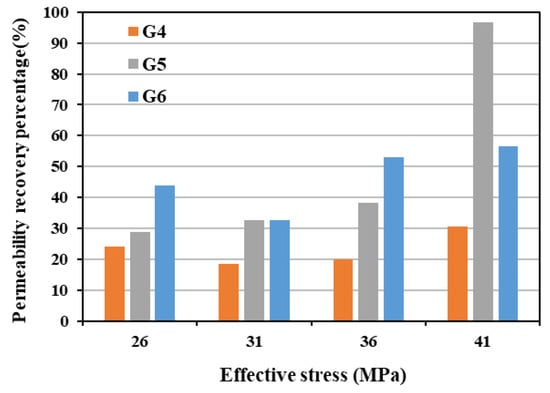
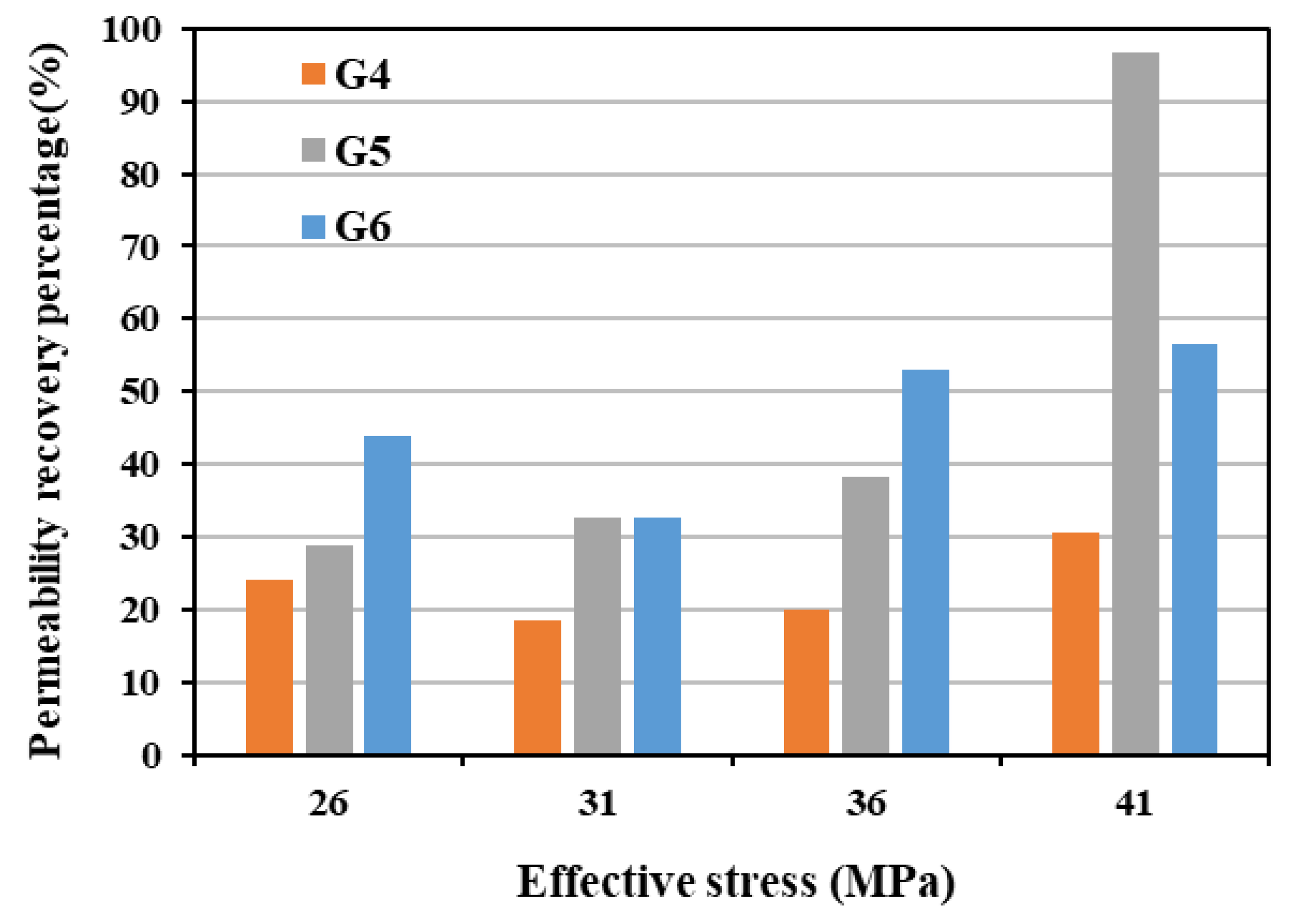
The observed permeability reduction under effective stress loading and its incomplete recovery during unloading (Figure 4) are direct consequences of the caprock’s specific mineral assemblage. The mechanical response is governed by the pervasive, platy clay matrix, predominantly composed of chlorite with minor illite (Table 1). These clay minerals facilitate irreversible plastic deformation through pore compaction and the permanent closure of microcracks, which are initially induced by the stress relief during coring. The platy morphology of the clays is responsible for a pronounced stress hysteresis effect, which hinders elastic rebound. Furthermore, the presence of rigid quartz and calcite minerals creates significant stiffness contrasts within the rock fabric. This heterogeneity localizes strain during loading, intensifying irreversible damage within the more compliant clay matrix. Consequently, this unique mineralogy fundamentally dictates that a portion of the permeability loss is permanent [23,24,25].
Figure 4.
Permeability recovery percentage of caprock under different effective stresses.
The irreversible permeability loss revealed in Figure 4 should be unequivocally attributed to plastic deformation induced by compaction. Under high pressure, irreversible changes such as grain rearrangement, crushing, or pore collapse occur within the rock skeleton, permanently clogging the critical flow pathways, the throats, resulting in irreversible permeability reduction. This mechanism has a dual impact on the long-term sealing capacity of the caprock: From a short-term perspective, it creates a “self-healing” effect, whereby the caprock exhibits a lower baseline permeability after enduring the initial high-pressure test, thereby enhancing its ability to withstand subsequent pressure fluctuations. However, from a long-term perspective, plastic damage may accumulate over multiple injection-production cycles, ultimately triggering the propagation of microcrack networks, which instead degrades its integrity and potentially forms dominant flow pathways. Therefore, accurately evaluating this compaction effect is crucial for scientifically establishing safe injection pressure limits, predicting the long-term evolution of the caprock, and ensuring the lifelong safety of the storage project.
3.3. Influence of Physical Properties on Caprock Sealing Capacity
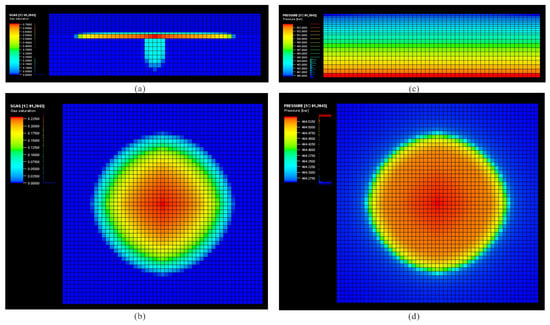
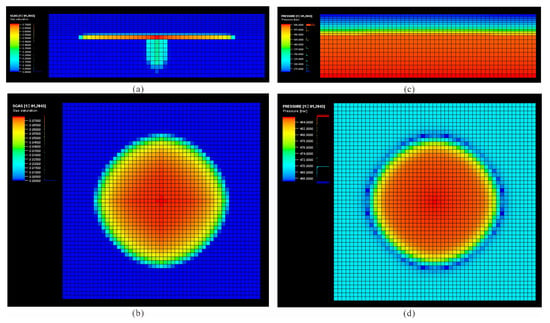
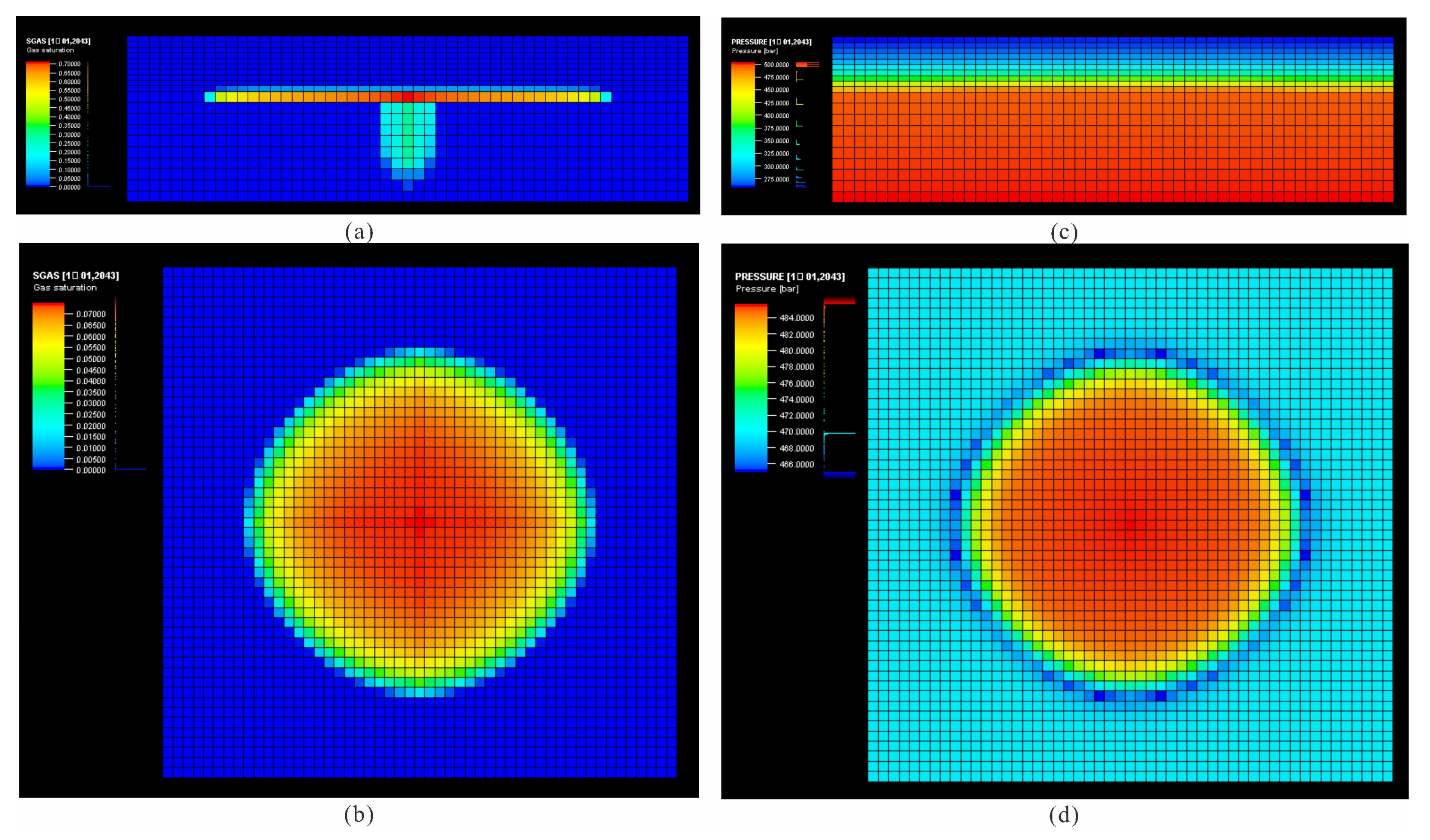
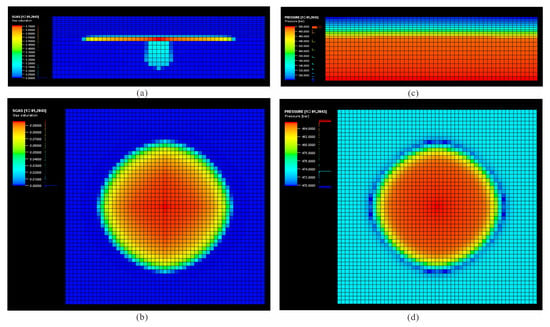
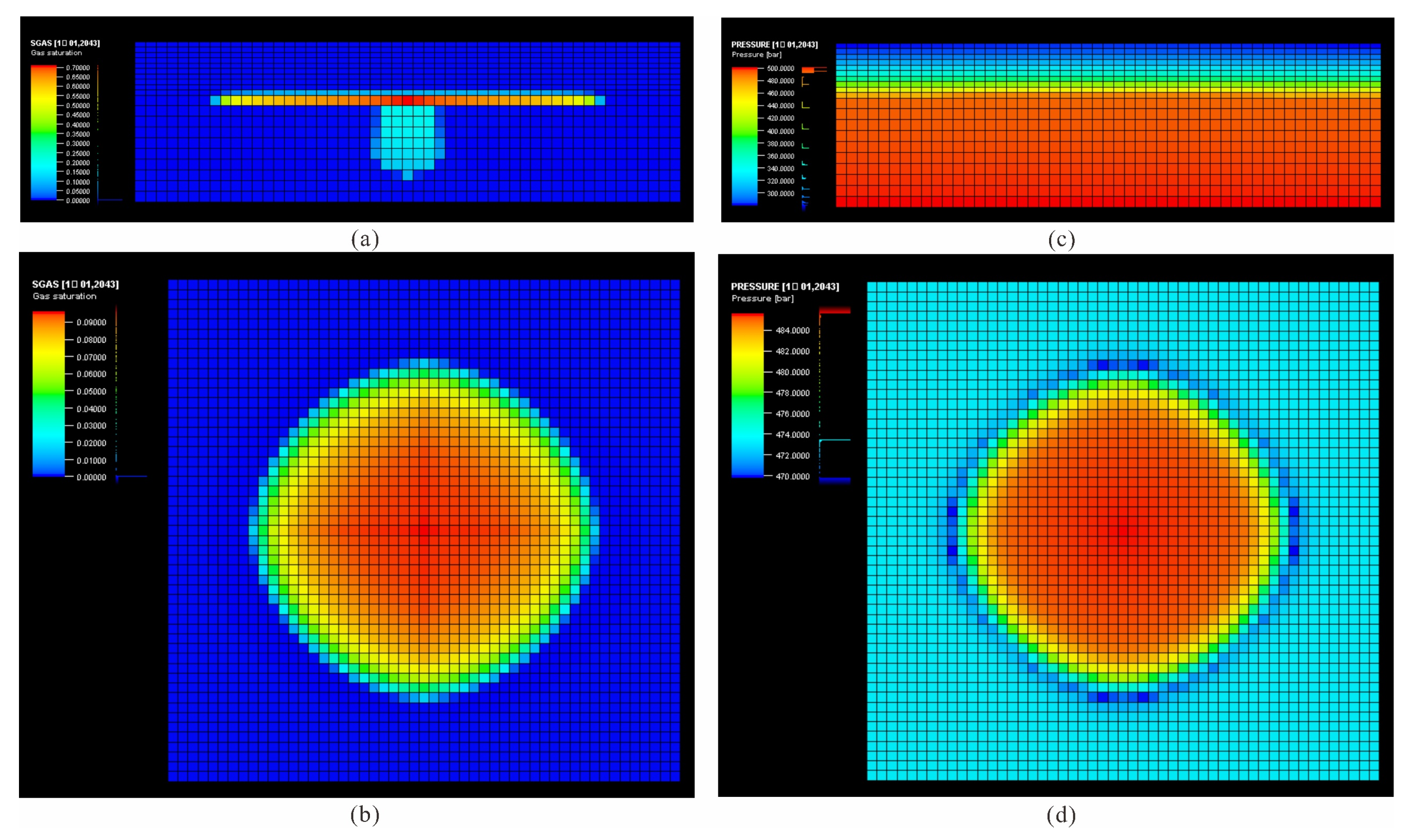
Within CO2 storage sites, the injection of large volumes of CO2 alters the in situ stress field of both the reservoir and caprock. These stress field changes cause variations in the regional Coulomb failure stress, potentially reducing caprock strength and inducing instability. Therefore, examining the impact of different physical properties on caprock sealing integrity is crucial. Figure 5a,b show the distribution of the CO2 plume within the reservoir-caprock system of the benchmark model after 20 years of injection, while Figure 5c,d show the corresponding pore pressure distribution. Overall, in the benchmark model by year 2043, pore pressure ranges from 257.6 to 485.7 bar, with significantly higher pressures in the reservoir than in the caprock. The maximum gas saturation in the reservoir reaches 71.3%, whereas only the lower portion of the caprock is invaded by CO2, with a maximum gas saturation of merely 7.49%.
Figure 5.
(a) Vertical gas saturation distribution at the reservoir-caprock interface after 20 years of CO2 injection in the baseline model; (b) horizontal gas saturation distribution at the reservoir-caprock interface after 20 years of CO2 injection in the baseline model; (c) vertical pore pressure distribution at the reservoir-caprock interface after 20 years of CO2 injection in the baseline model; (d) horizontal pore pressure distribution at the reservoir-caprock interface after 20 years of CO2 injection in the baseline model.
As shown in Figure 5, upon reaching the caprock, the upward-migrating CO2 plume is effectively confined vertically, leading to pronounced lateral spreading. This process results in a characteristic conical-shaped dispersal pattern beneath the seal, which is narrow at the base and widens upward, with its maximum lateral extent observed at the bottom of the caprock. This spatial configuration clearly illustrates the dominant migration pathways and accumulation behavior of CO2 during and after injection.
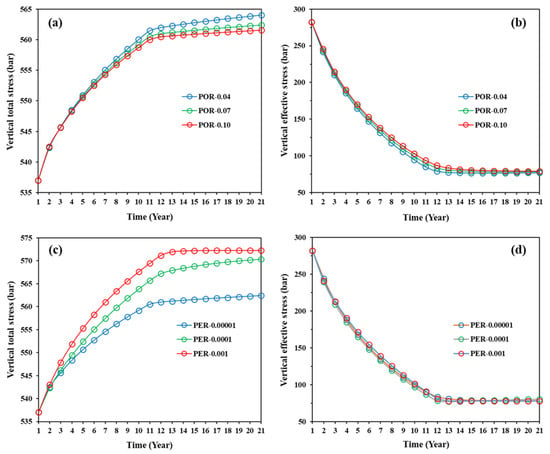
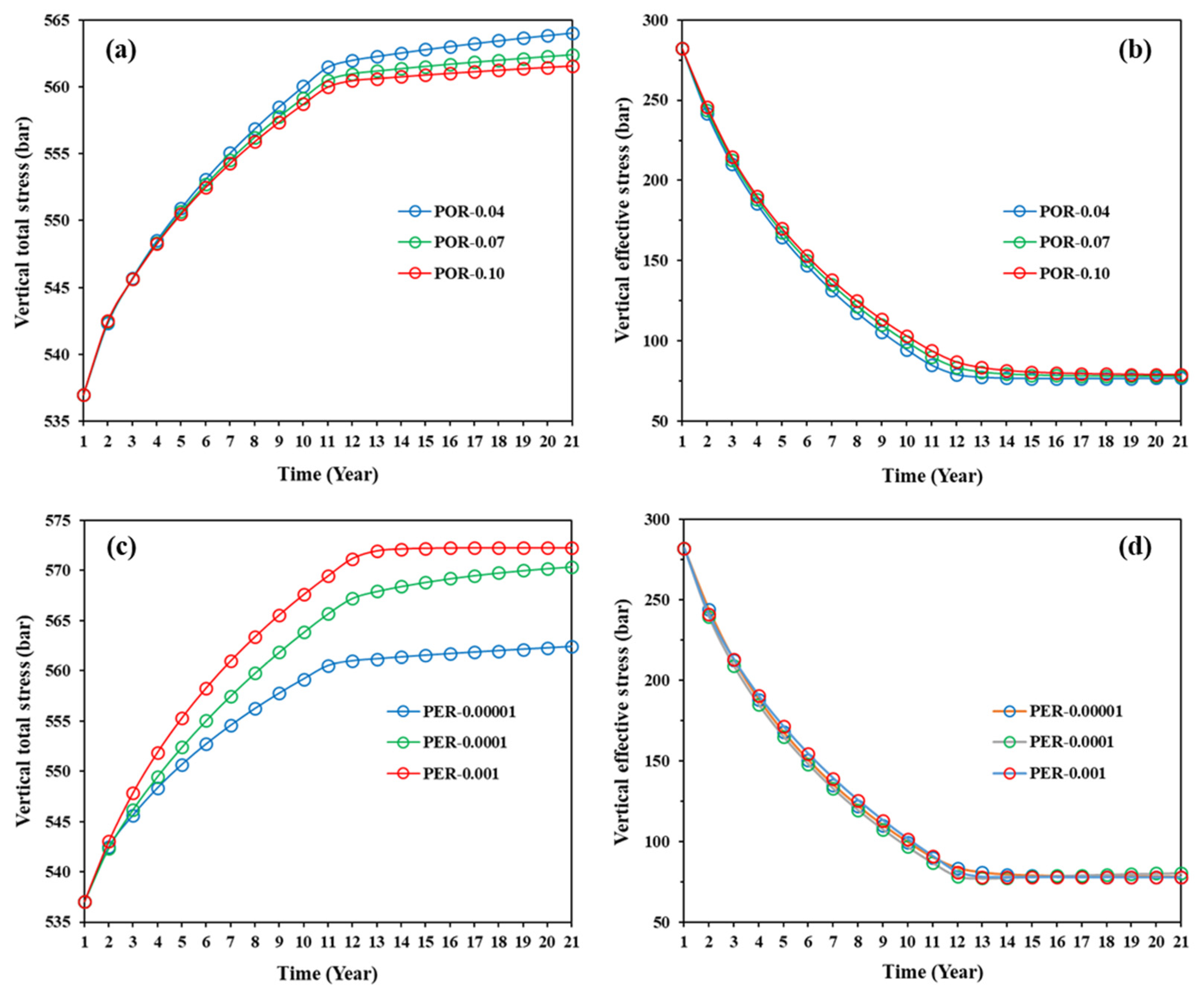
Figure 6a shows the influence of different caprock porosities (4%, 7%, and 10%) on sealing capacity. Generally, the vertical total stress at the reservoir-caprock interface increases as porosity decreases. At any given time, the vertical total stress follows the relationship: P-0.04 < P-0.07 < P-0.10. The vertical total stress rises rapidly during early injection, with this effect diminishing over time, correlating with the reduced injection rate and the gradual dispersion of the CO2 plume later on. Lower porosity has a more pronounced effect on increasing vertical total stress at the interface, indicating that reduced porosity significantly elevates pore pressure, thereby enhancing the vertical total stress within the caprock.
Figure 6.
Stress response at the reservoir-caprock interface post CO2 injection (POR0.04 to P1, POR0.07 to P2, POR0.10 to P3, PER0.001 to K3, PER0.0001 to K1, PER0.00001 to K2 in Table 2): (a) vertical total stress vs. porosity; (b) vertical effective stress vs. porosity; (c) vertical total stress vs. permeability; (d) vertical effective stress vs. permeability.
Figure 6b shows the effect of porosity on the vertical effective stress at the interface. During the 20-year injection period, the vertical effective stress gradually stabilizes, suggesting that porosity variations have minimal influence on the overall distribution of the CO2 plume. Higher caprock porosity corresponds to lower pore pressure, resulting in greater vertical effective stress. The rapid decrease in vertical effective stress during early injection reflects the significant pore pressure buildup due to CO2 accumulation at the interface, an effect that weakens as the plume disperses over time.
With CO2 injection, the vertical total stress in caprocks with different permeabilities increases, following the relationship: K-0.00001 < K-0.0001 < K-0.001 (Figure 6c). This indicates that higher permeability facilitates greater CO2 intrusion, leading to increased vertical total stress. Permeability exerts a more significant influence on vertical total stress than porosity, with distinct differences observed between caprocks of varying permeability, especially during early injection. As injection proceeds and the CO2 plume disperses, pore pressure decreases, causing the vertical total stress for different permeability cases to converge and stabilize.
Regarding vertical effective stress, it decreases as pore pressure at the interface increases with CO2 injection (Figure 6d), a trend similar to the porosity effect. The rapid initial drop in vertical effective stress again signifies substantial early pore pressure buildup, weakening over time. However, the influence of permeability on vertical effective stress exhibits distinct temporal characteristics: during early injection, higher permeability corresponds to higher vertical effective stress; during middle and late stages, higher permeability results in lower vertical effective stress. This is because, initially, higher permeability allows CO2 to enter more readily, reducing stress concentration at the caprock base. Later, higher permeability promotes broader CO2 migration and pressure dissipation within the caprock, lowering the internal pore pressure and thus the effective stress.
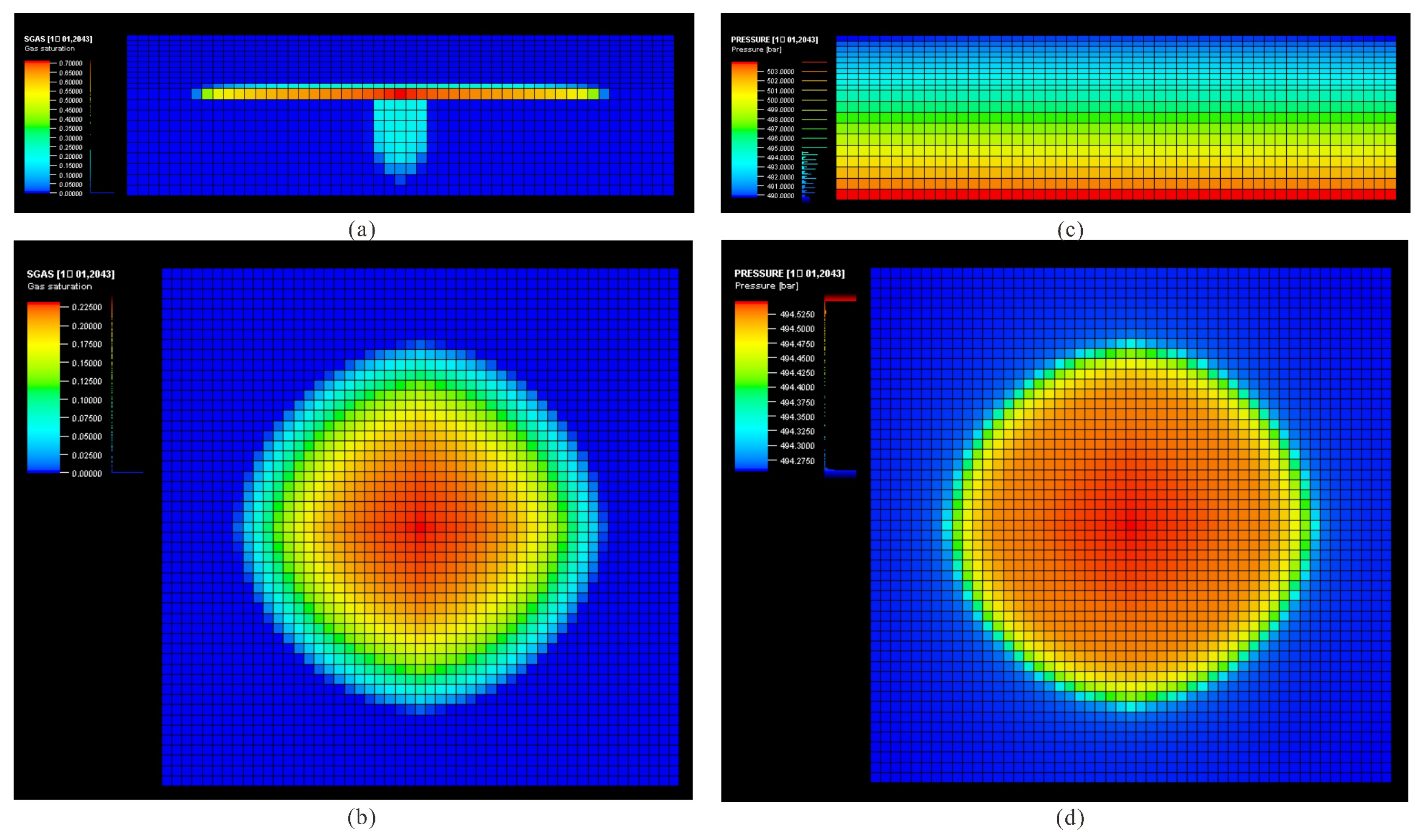
Taking model K-3 as an example (Figure 7), CO2 saturation in the caprock ranges from 0 to 0.3, while the pressure field shows minimal variation (493–494 bar). This indicates that lower permeability heterogeneity leads to a more uniform pressure distribution. This can be explained as follows: in early stages, higher permeability facilitates CO2 entry, reducing localized stress and increasing effective stress; in later stages, it promotes pressure dissipation, lowering the overall pore pressure and thus the effective stress.
Figure 7.
Gas saturation and pore pressure characteristics in the reservoir-caprock system of the K-3 model after CO2 injection: (a) vertical distribution of gas saturation; (b) horizontal distribution of gas saturation; (c) vertical distribution of pore pressure; (d) horizontal distribution of pore pressure.
3.4. Influence of Mechanical Properties on Caprock Sealing Capacity
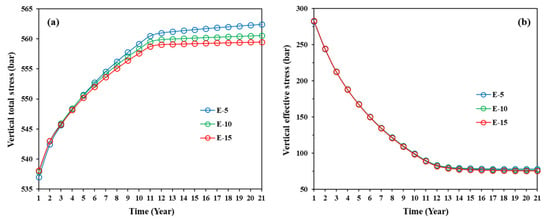
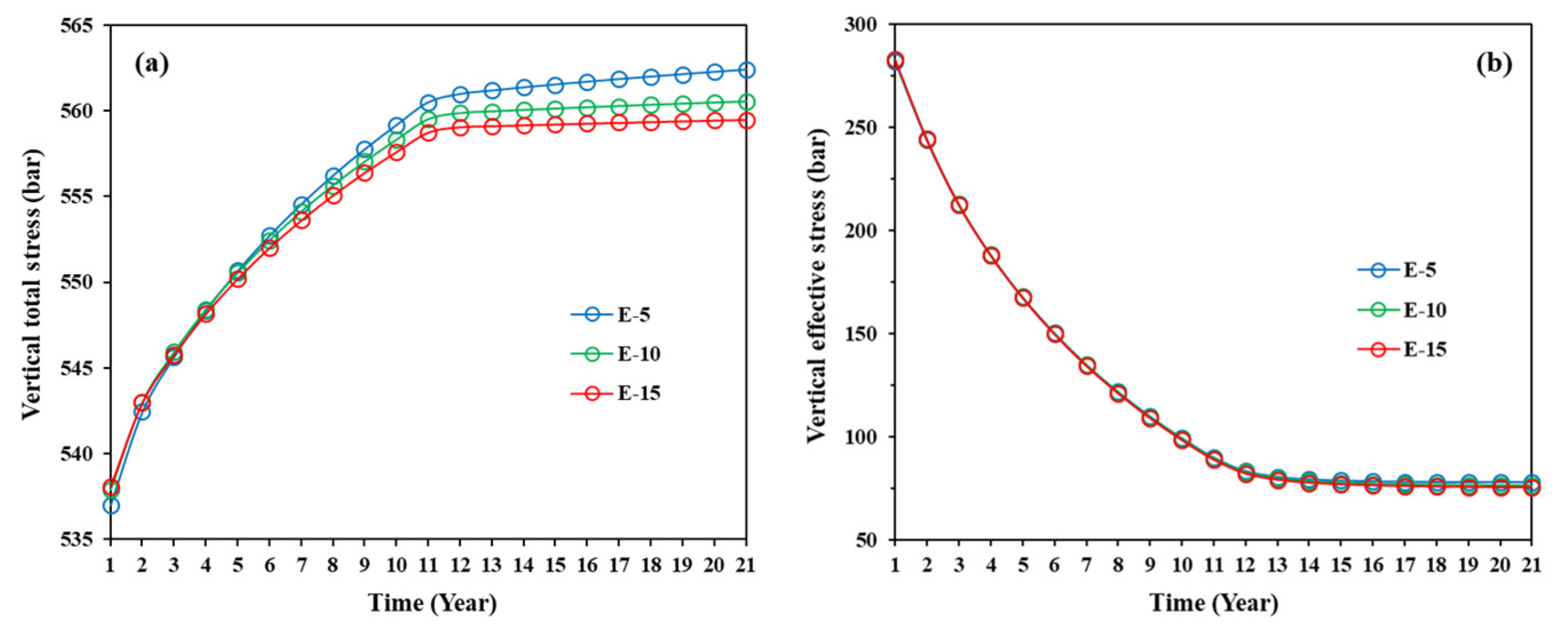
The intrinsic mechanical properties of the caprock are also critical for its stability after CO2 injection. To investigate this, numerical simulations were conducted by varying the caprock’s Young’s modulus while keeping other parameters constant. As shown in Figure 8a, with CO2 injection, the vertical total stress increases for caprocks with different Young’s moduli, following the relationship: E-15 < E-10 < E-5. This suggests that a lower Young’s modulus leads to higher plastic deformation intensity upon pore pressure increase, resulting in the caprock bearing greater stress. Differences in vertical total stress between caprocks with different moduli are small initially but become more pronounced during middle and late injection stages as the CO2 injection rate decreases and the plume disperses. Caprocks with lower moduli show a more continuous increase in vertical total stress, whereas those with higher moduli stabilize more readily.
Figure 8.
Stress response at the reservoir-caprock interface after CO2 injection (E5 to E2, E10 to E1, E15 to E3 in Table 2): (a) vertical total stress under different Young’s moduli; (b) vertical effective stress under different Young’s moduli.
Vertical effective stress decreases with increasing pore pressure at the interface, consistent with the trends observed for porosity and permeability. The rapid early decrease reflects significant pore pressure buildup from CO2 accumulation. Unlike vertical total stress, the caprock’s Young’s modulus has a relatively minor impact on vertical effective stress (Figure 8b). In early stages, vertical effective stress is similar across different moduli; in later stages, caprocks with higher Young’s moduli exhibit slightly lower vertical effective stress.
In the E-1 model (lower Young’s modulus), the CO2 saturation in the caprock ranges from 0 to 0.2, but the pressure field exhibits the strongest heterogeneity (485–490 bar, Figure 9). This indicates that a smaller Young’s modulus leads to stronger deformation heterogeneity and more uneven pore pressure distribution within the caprock. This is primarily because a lower modulus makes the caprock more susceptible to deformation. While deformation may locally relieve pore pressure, the resultant deformation and squeezing of other pore spaces can ultimately lead to an increase in vertical effective stress in those areas.
Figure 9.
Gas saturation and pore pressure characteristics in the reservoir-caprock system of the E-2 model after CO2 injection: (a) Vertical distribution of gas saturation; (b) Horizontal distribution of gas saturation; (c) Vertical distribution of pore pressure; (d) Horizontal distribution of pore pressure.
During CO2 injection, vertical effective stress decreases with increasing porosity and permeability over time, with porosity variation causing the largest difference in this stress component. Concurrently, vertical total stress increases with increasing porosity and permeability, with permeability exerting a stronger influence than porosity. Therefore, caprock permeability significantly affects both the pore pressure and the Coulomb failure stress within the caprock, thereby controlling its mechanical stability.
4. Conclusions
- (1)
- Mudstone caprocks show strong stress-sensitive permeability at low pore pressures. Once effective stress exceeds about 20 MPa, the permeability stress sensitivity drops markedly. The degree of permeability change is controlled by the caprock’s inherent porosity and pore pressure: higher porosity or lower pore pressure increases stress sensitivity and alters pore-throat connectivity more significantly.
- (2)
- For mudstone caprocks, vertical total stress increases with porosity, permeability, and Young’s modulus, with permeability being the most influential factor. In contrast, vertical effective stress decreases as these parameters increase, but is most affected by porosity, then permeability, and lastly Young’s modulus.
- (3)
- Lower permeability and porosity generally enhance the sealing performance of the caprock. Simultaneously, during CO2 injection, a higher Young’s modulus contributes to greater mechanical stability of the caprock.
Author Contributions
H.W.: Conceptualization, Validation, Investigation, Writing—original draft preparation, Writing—review and editing; Q.D.: Conceptualization, Methodology, Formal analysis, Writing—original draft preparation, Writing—review and editing; R.W.: Formal analysis, Writing—review and editing; Y.Z. (Yinbang Zhou): Writing—review and editing; Y.Z. (Yunzhao Zhang): Conceptualization, Writing—review and editing, Supervision. All authors have read and agreed to the published version of the manuscript.
Funding
This work is mainly supported by the National Science and Technology Major Project of China (Grant No. 2024ZD1004300), the Project of Science and Technology Department of SINOPEC (Grant No. P25143), the Open Foundation of SINOPEC Key Laboratory of Carbon Capture, Utilization and Storage (33550000-22-ZC0613-0326), the National Natural Science Foundation of China (Grant No. 42202135), and the Fundamental Research Funds for the Central Universities (Grant No. lzujbky-2023-02).
Data Availability Statement
The original contributions presented in this study are included in the article. Further inquiries can be directed to the corresponding author.
Conflicts of Interest
Authors Hao Wu, Quanqi Dai, Rui Wang and Yinbang Zhou were employed by the SINOPEC. The remaining author declares that the research was conducted in the absence of any commercial or financial relationships that could be construed as a potential conflict of interest. The SINOPEC had no role in the design of the study; in the collection, analyses, or interpretation of data; in the writing of the manuscript, or in the decision to publish the results.
References
- Gholami, R.; Raza, A.; Iglauer, S. Leakage risk assessment of a CO2 storage site: A review. Earth-Sci. Rev. 2021, 223, 103849. [Google Scholar] [CrossRef] [Scilit]
- Kearns, J.; Teletzke, G.; Palmer, J.; Thomann, H.; Kheshgi, H.; Chen, Y.H.; Paltsev, S.; Herzog, H. Developing a consistent database for regional geologic CO2 storage capacity worldwide. Energy Procedia 2017, 114, 4697–4709. [Google Scholar] [CrossRef] [Scilit]
- Fan, J.; Xu, M.; Wei, S.; Shen, S.; Zhang, X. Carbon reduction potential of China’s coal-fired power plants based on a CCUS source-sink matching model. Resour. Conserv. Recycl. 2021, 168, 105320. [Google Scholar] [CrossRef] [Scilit]
- Ringrose, P. CO2 Storage Project Design, How to Store CO2 Underground: Insights from Early-Mover CCS Projects; Springer: Berlin/Heidelberg, Germany, 2020; pp. 85–126. [Google Scholar]
- Department for Business, Energy and Industrial Strategy (UK). Carbon Capture Usage and Storage: A Government Response on Potential Business Models for Carbon Capture, Usage, and Storage; Department for Business, Energy and Industrial Strategy (UK): London, UK, 2020. [Google Scholar]
- Xie, J.; Wei, N.; Wu, L.; Zhang, N.; Xu, M. Progress in leakage study of geological CO2 storage. Rock Soil Mech. 2017, 38, 181–188. [Google Scholar]
- Green, C.; Ennis-King, J.; Pruess, K. Effect of vertical heterogeneity on long-term migration of CO2 in Saline Formations. Energy Procedia 2009, 1, 1823–1830. [Google Scholar] [CrossRef] [Scilit]
- Espinoza, D.N.; Santamarina, J.C. CO2 breakthrough-Caprock sealing efficiency and integrity for carbon geological storage. Int. J. Greenh. Gas Control 2017, 66, 218–229. [Google Scholar] [CrossRef] [Scilit]
- Gheibi, S.; Holt, R.M.; Vilarrasa, V. Effect of faults on stress path evolution during reservoir pressurization. Int. J. Greenh. Gas Control 2017, 63, 412–430. [Google Scholar] [CrossRef] [Scilit]
- Al-Khdheeawi, E.A.; Vialle, S.; Barifcani, A.; Sarmadivaleh, M.; Iglauer, S. Impact of reservoir wettability and heterogeneity on CO2-plume migration and trapping capacity. Int. J. Greenh. Gas Control 2017, 58, 142–158. [Google Scholar] [CrossRef] [Scilit]
- Pasquo, B.D.; de Montleau, P.; Daniel, J.M.; Codreanu, D.B. Qualification of a CO2 storage site using an integrated reservoir study. Energy Procedia 2014, 51, 289–298. [Google Scholar] [CrossRef] [Scilit]
- Renard, F.; Mair, K.; Gundersen, O. Surface roughness evolution on experimentally simulated faults. J. Struct. Geol. 2012, 45, 101–112. [Google Scholar] [CrossRef] [Scilit]
- Ali, M.; Jha, N.K.; Pal, N.; Keshavarz, A.; Hoteit, H.; Sarmadivaleh, M. Recent advances in carbon dioxide geological storage, experimental procedures, influencing parameters, and future outlook. Earth-Sci. Rev. 2022, 225, 103895. [Google Scholar] [CrossRef] [Scilit]
- Zhang, Y.Z.; Dai, Q.Q.; Zeng, L.B.; Li, R.Q.; Zhang, R.J.; Qu, L.; Zhu, Y.W.; Liao, H.Y.; Wu, H. Effects of natural fractures in cap rock on CO2 geological storage: Sanduo Formation and Dainan Formation of the early Eocene epoch in the Gaoyou Sag of the Subei Basin. Pet. Sci. 2025, 8, 002. [Google Scholar] [CrossRef] [Scilit]
- Yu, X.; Ahmadinia, M.; Shariatipour, S.M.; Lawton, D.; Osadetz, K.; Saeedfar, A. Impact of reservoir permeability, permeability anisotropy and designed injection iate on CO2 gas behavior in the shallow saline aquifer at the CaMI Field Research Station, Brooks, Alberta. Nat. Resour. Res. 2020, 29, 2735–2752. [Google Scholar] [CrossRef] [Scilit]
- Dai, Q.; Wang, G.; Zhao, X.; Han, Z.; Lu, K.; Lai, J.; Wang, S.; Li, D.; Li, Y.; Wu, K. Fractal model for permeability estimation in low-permeable porous media with variable pore sizes and unevenly adsorbed water lay. Mar. Pet. Geol. 2021, 130, 105135. [Google Scholar] [CrossRef] [Scilit]
- Saadatnia, N.; Sharghi, Y.; Moghadasi, J.; Ezati, M. Coupled hydro--mechanical simulation in the carbonate reservoir of a giant oil field in southwest Iran. J. Pet. Explor. Prod. Technol. 2024, 14, 59–83. [Google Scholar] [CrossRef] [Scilit]
- Zhang, X.; Jia, S.P.; Xu, M.; Zhang, P.J.; Li, J.; Zhang, L.G. Coupled seepage-stress analysis of fault instability induced by CO2 injection. J. Northeast Pet. Univ. 2023, 47, 69–78. [Google Scholar]
- Hu, W.; Lu, X.; Fan, M.; Zhang, D.; Cao, J. Advances in the research of shale caprocks: Type, micropore characteristics and sealing mechanisms. Bull. Mineral. Petrol. Geochem. 2019, 38, 885–896+869. [Google Scholar]
- Singh, H.; Islam, A. Enhanced safety of geologic CO2 storage with nanoparticles. Int. J. Heat Mass Transf. 2018, 121, 463–476. [Google Scholar] [CrossRef] [Scilit]
- Loucks, R.L.; Reed, R.M.; Ruppel, S.; Jarvie, D.M. Morphology, genesis, and distribution of nanometer-scale pores in siliceous mudstones of the Mississippian Barnett shale. J. Sediment. Res. 2009, 79, 848–861. [Google Scholar] [CrossRef] [Scilit]
- Dai, Q.; Luo, Q.; Zhang, C.; Lu, C.; Zhang, Y.; Lu, S.; Zhao, Y. Pore structure characteristics of tight-oil sandstone reservoir based on a new parameter measured by NMR experiment: A case study of seventh Member in Yanchang Formation, Ordos Basin. Acta Pet. Sin. 2016, 37, 887–897. [Google Scholar]
- Agrawal, P.; Mascini, A.; Bultreys, T.; Aslannejad, H.; Wolthers, M.; Cnudde, V.; Butler, I.B.; Raoof, A. The impact of pore-throat shape evolution during dissolution on carbonate rock permeability: Pore network modeling and experiments. Adv. Water Resour. 2021, 155, 103991. [Google Scholar] [CrossRef] [Scilit]
- Ko, L.T.; Loucks, R.G.; Zhang, T.; Ruppel, S.C.; Shao, D. Pore and pore network evolution of Upper Cretaceous Boquillas (Eagle Ford–equivalent) mudrocks: Results from gold tube pyrolysis experiments. AAPG Bull. 2016, 100, 1693–1722. [Google Scholar] [CrossRef] [Scilit]
- Wu, S.; Zhao, Q.; Yang, H.; Ge, H.K. Combining acoustic emission and unsupervised machine learning to investigate microscopic fracturing in tight reservoir rock. Eng. Geol. 2025, 107939. [Google Scholar] [CrossRef] [Scilit]

Disclaimer/Publisher’s Note: The statements, opinions and data contained in all publications are solely those of the individual author(s) and contributor(s) and not of MDPI and/or the editor(s). MDPI and/or the editor(s) disclaim responsibility for any injury to people or property resulting from any ideas, methods, instructions or products referred to in the content. |
© 2025 by the authors. Licensee MDPI, Basel, Switzerland. This article is an open access article distributed under the terms and conditions of the Creative Commons Attribution (CC BY) license (https://creativecommons.org/licenses/by/4.0/).