


Abstract
Introduction: Artificial intelligence (AI) is becoming part of everyday knowledge work through generative AI, decision-support systems, algorithmic management, and AI-enabled organizational information systems. This development raises a central question: when does AI support employees, and when does it become a source of technostress, surveillance, uncertainty, and reduced autonomy? Objectives: This PRISMA-ScR scoping review mapped evidence on human-centered AI adoption in knowledge-intensive work and examined links with technostress, trust, autonomy, and employee well-being. Methods: Using a population–concept–context approach, we included peer-reviewed journal articles and conference papers addressing AI adoption in knowledge-work settings and at least one human-centered or employee-related outcome. Publicly accessible databases and public metadata records were searched across Scopus, Web of Science Core Collection, IEEE Xplore, ACM Digital Library, ScienceDirect, PubMed/MEDLINE, Business Source Complete, and APA PsycINFO. Searches were conducted in March 2026 and verified between 1 and 15 April 2026. Results: Twenty-six sources were included, comprising 17 journal articles and 9 peer-reviewed conference/proceedings sources. Five evidence clusters were identified: AI as a resource-demand system, information-system properties, generative AI work redesign, organizational implementation conditions, and short- versus long-term employee outcomes. Conclusions: Human-centered AI adoption in knowledge work requires transparent system design, organizational governance, employee participation, and long-term monitoring. The review contributes a business informatics implementation framework for trustworthy, ethically governed, and well-being-oriented AI use.
1. Introduction
Artificial intelligence (AI) has become increasingly embedded in the everyday routines of knowledge work. In this review, knowledge work is operationally defined as information-intensive, decision-oriented, and digitally mediated work in which employees create, interpret, communicate, and apply knowledge in professional or organizational contexts. In such settings, AI increasingly mediates how information is searched, synthesized, transformed into decisions, and translated into work outputs. This makes AI adoption not only a matter of technical deployment, but also a question of how information systems change judgment, accountability, task boundaries, and professional control [1,2,3,4,5,6,7,8].
Business informatics is central to this issue because knowledge work depends on the interaction between information systems, organizational rules, and human judgment. Established information-systems research shows that technology use is shaped by perceived usefulness, ease of use, organizational embedding, social structures, user expectations, and the fit between system features and work practices [9,10,11,12]. With AI, these relationships become more consequential: systems can automate, augment, or reconfigure knowledge tasks while also redistributing control over information, output verification, and accountability [3,4,5,6,7,13,14,15].
In this review, human-centered AI is defined as the design, implementation, and governance of AI systems that preserve meaningful human control and user agency through transparent, explainable, fair, participatory, accountable, and appropriately supervised use of AI. This lens is useful because it connects technical system design with the conditions under which employees can understand, challenge, rely on, or correct AI-supported outputs. Human–AI interaction guidelines similarly stress that systems should communicate their capabilities, limitations, uncertainty, and opportunities for user correction [7]. Research on automation and trust further shows that overreliance, underreliance, and distrust may all emerge when automation is opaque, unreliable, or poorly aligned with user tasks [8,16,17]. In this review, opaque AI or automation refers to systems whose underlying mechanisms, decision logic, or basis for outputs are not clear to users.
The central tension is that the same AI system can be experienced either as an enabling resource or as a digital demand. When system capabilities are well matched to tasks, AI may reduce repetitive cognitive work, accelerate information retrieval, strengthen decision support, and improve productivity [18,19,20,21]. When implementation is poorly governed, or when system capabilities are misunderstood, AI may instead create technostress, output-verification burden, monitoring pressure, ambiguity, dependence on opaque outputs, deskilling concerns, and pressure for continuous reskilling [13,14,15,19,20,21,22,23,24,25]. In this review, technostress refers to stress and strain arising from technology-related demands, including overload, complexity, uncertainty, monitoring pressure, and the need for continuous adaptation.
This resource-demand tension has become more visible with the diffusion of generative AI. Experimental and field evidence suggests that generative AI can improve productivity and quality in selected knowledge-work tasks [20,21,22]. These benefits, however, are not automatic. AI support may help some workers and tasks more than others, and it may reduce performance when employees use AI beyond the system’s effective capability frontier [20,21,22]. The more important question is therefore not whether AI is useful in general, but how task type, system design, user expertise, organizational rules, and verification practices shape its consequences.
Existing reviews show that workplace AI is a broad and rapidly developing field. They have addressed AI in organizations, human resource management, productivity, automation, augmentation, decision-making, and employee outcomes [23,24,25]. A recent systematic review of workplace AI also emphasizes that AI creates both opportunities and risks for employees and that resource, stress, cognitive, and motivational mechanisms are central to understanding these consequences [24]. What remains less developed is a focused synthesis of human-centered AI adoption in knowledge work from a business informatics perspective, especially where information-system properties are linked with technostress, trust, autonomy, and employee well-being.
The central unresolved issue is therefore not simply whether AI is useful in knowledge work. The more precise issue is under which technological, organizational, and human conditions AI serves as a source of support, productivity, and employee relief, and under which conditions it becomes a source of technostress, control, uncertainty, loss of autonomy, and poorer well-being. This gap is particularly relevant for business informatics because it links the design and governance of AI-enabled information systems with the psychosocial outcomes experienced by employees.
This review is guided by five connected gaps in the literature. The first concerns the focus of existing reviews, which often examine AI in organizations or workplace outcomes broadly rather than knowledge work specifically. The second concerns the limited integration of business informatics with psychosocial employee outcomes: many studies consider technical or organizational effects of AI, but fewer explain how system properties such as usability, explainability, transparency, automation, monitoring, data privacy, and user control shape technostress, trust, autonomy, and well-being [1,2,3,4,5,6,7,8,9,10,11,12,13,14,15,16,17,18,23,24,25].
The remaining gaps concern the changing nature of AI-enabled work. Since 2022, tools such as ChatGPT, Copilot, and other generative AI assistants have entered writing, programming, analysis, search, synthesis, communication, and decision-support tasks, which means that earlier reviews cannot fully capture the new wave of generative AI in organizational settings [20,21,22,23]. At the same time, the literature still offers limited synthesis of the organizational conditions that may reduce negative AI effects, such as training, digital literacy, participation, ethical rules, communication, privacy protection, limits on surveillance, leadership support, and governance mechanisms [1,2,3,4,5,6,9,10,11,12,16,17,23,24,25]. Finally, much of the available evidence still examines short-term perceptions, while longer-term effects on career development, professional identity, autonomy, quality of working life, and sustainable employability remain insufficiently understood [13,14,15,18,19,20,21,22,23,24,25].
The aim of this scoping review is to map the extent, range and nature of evidence on human-centered AI adoption in knowledge work and to identify research gaps relevant to business informatics. The review focuses on 26 included sources and is guided by five research questions:
RQ1.
How is AI adoption in knowledge work conceptualized as a resource, a demand, or both in the current evidence?
RQ2.
Which business informatics system properties are associated with technostress, trust, autonomy, and employee well-being?
RQ3.
How do generative AI tools in knowledge work reshape tasks, output verification, productivity, and psychosocial outcomes compared with broader AI-enabled work systems?
RQ4.
Which organizational implementation conditions support well-being-oriented AI adoption?
RQ5.
Which short- and long-term employee outcomes are reported, and which longitudinal evidence gaps remain?
2. Materials and Methods
2.1. Review Design, Protocol, and Reporting Standard
This scoping review was conducted and reported in accordance with the PRISMA extension for Scoping Reviews (PRISMA-ScR) [26], supported by the PRISMA 2020 flow diagram logic for reporting study selection [27] and Joanna Briggs Institute (JBI) methodological guidance for scoping reviews [28]. The purpose was to map concepts, evidence types, research contexts, and knowledge gaps rather than to estimate an overall intervention effect. The protocol was developed a priori by two reviewers in March 2026, before data charting began. It specified the population-concept-context (PCC) framework, eligibility criteria, information sources, search strategy, screening process, data-charting variables, and synthesis approach. The protocol was not formally registered; any deviations were documented in the Supplementary screening log.
The PCC framework defined the scope of the review. The Population comprised workers and employees engaged in information-intensive, decision-oriented, or digitally mediated work. The Concept was human-centered AI adoption, implementation, or use. The Context was organizational and professional knowledge-work settings, including digital and hybrid workplaces.
2.2. Eligibility Criteria
Studies were included if they examined AI adoption, implementation, or use in knowledge-intensive work settings and addressed at least one human-centered or employee-related outcome. Eligible sources included peer-reviewed journal articles and peer-reviewed conference papers, including empirical, conceptual, theoretical, and design-oriented sources when they directly addressed human-centered AI adoption in knowledge work. The time frame was 2021 to April 2026. This period was selected because it captures the contemporary transition from post-pandemic digital and hybrid work to the rapid diffusion of generative AI and AI-enabled decision-support systems in everyday knowledge work. Including substantially older studies would risk combining evidence from a different technological and organizational era with the current AI-driven transformation of knowledge work. The criteria were applied consistently during title/abstract screening and full-text eligibility assessment. The operational definitions of human-centered AI and knowledge work provided in the Introduction were used to apply these criteria consistently and to delimit the scope of Table 1. The operational definition of knowledge work was used during screening to distinguish knowledge-intensive, digitally mediated work from purely technical, consumer-only, learner-only, or physical automation contexts.
Table 1.
Inclusion criteria for the PRISMA-ScR scoping review.
Studies were excluded if they lacked a clear AI component, focused only on technical model development, did not address knowledge work or employee-related outcomes, or were non-peer-reviewed sources. The exclusion criteria are summarized in Table 2. Previous reviews were excluded from the main synthesis but were used to support background, gap justification, and reference checking.
Table 2.
Exclusion criteria for the PRISMA-ScR scoping review.
2.3. Information Sources and Search Dates
The information sources were Scopus, Web of Science Core Collection, IEEE Xplore, ACM Digital Library, ScienceDirect, PubMed/MEDLINE, Business Source Complete, and APA PsycINFO. Because direct institutional exports from all subscription databases were not available, this review was conducted as a publicly accessible database/public metadata scoping review. The search was therefore limited to publicly accessible database pages, public metadata records, publisher pages, DOI pages, and openly accessible full-text or abstract records that could be linked to the listed databases. This limitation means that the review should not be interpreted as a conventional subscription-database export review. Google Scholar was not used as an information source.
The 2021 to April 2026 window was selected not as an arbitrary restriction, but to capture the period in which AI adoption in knowledge work became shaped by post-pandemic digital and hybrid work, accelerated organizational AI implementation, and the rapid public diffusion of generative AI tools. This focus was intended to keep the review conceptually coherent and directly applicable to contemporary AI-enabled knowledge work, while avoiding the conflation of current generative-AI evidence with earlier pre-generative-AI information-systems literature.
The search process followed a staged approach comparable to recent scoping reviews published in Informatics. Search-string calibration and pilot searches were conducted from 5 to 9 March 2026. Main database/public metadata searches were conducted from 10 to 24 March 2026. Backward reference checking and public full-text retrieval were conducted from 25 to 30 March 2026. A verification and update search was conducted from 1 to 15 April 2026. The final screening log was locked on 18 April 2026.
2.4. Search Strategy
Search terms were organized into three concept blocks: (1) artificial intelligence, generative AI, algorithmic management, intelligent automation, AI adoption and AI implementation; (2) knowledge work, employees, professionals, workplace and digital workplace; and (3) technostress, trust, autonomy, well-being, job insecurity, perceived surveillance, algorithmic fairness, and related human-centered outcomes. The full database-specific search strategy is provided in Supplementary File S1.
2.5. Screening and Selection Process
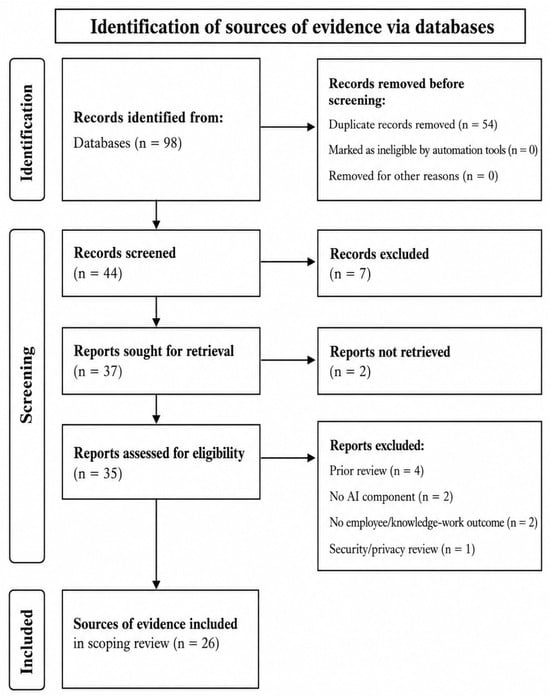
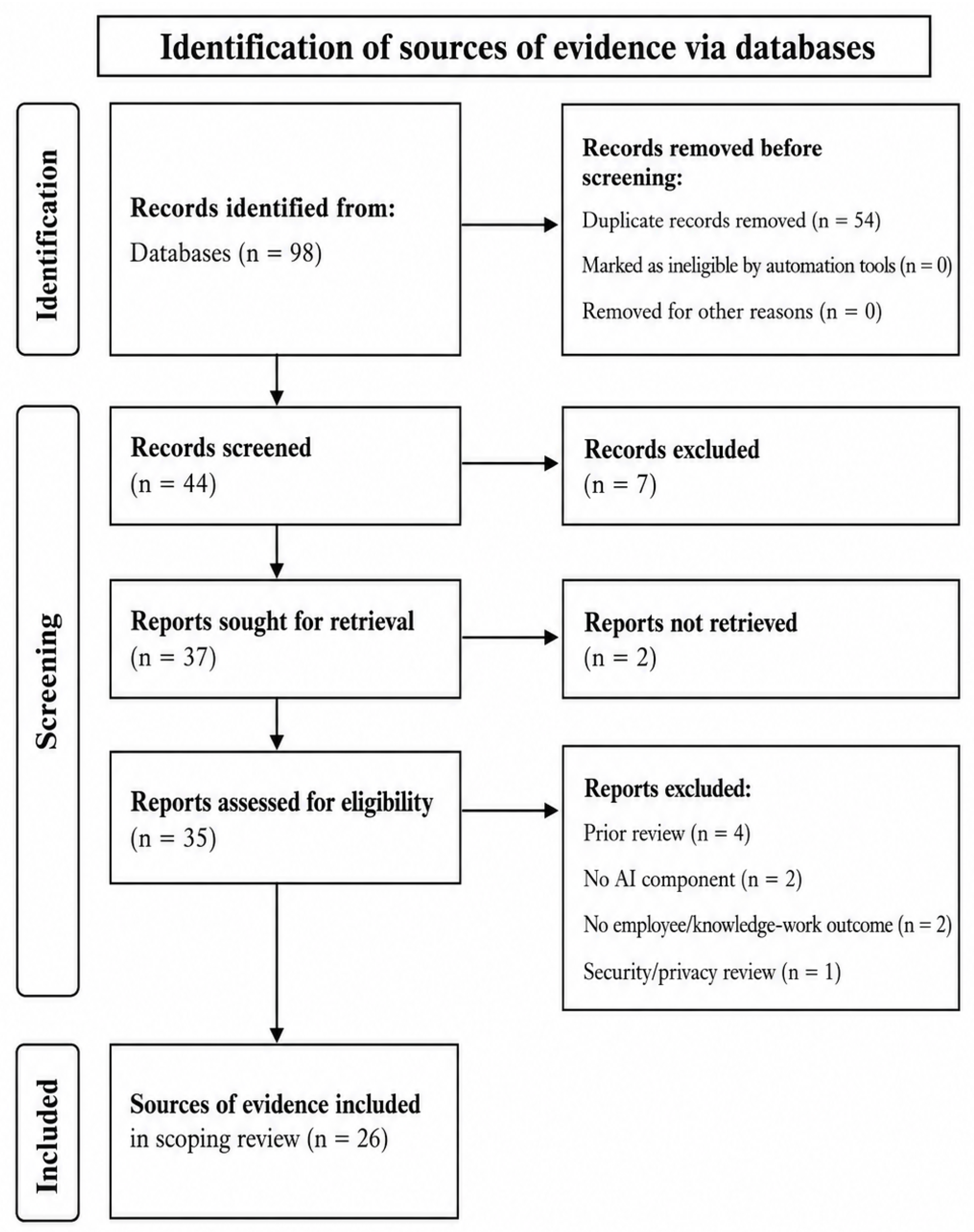
Two reviewers independently screened titles and abstracts/public metadata against the eligibility criteria. Potentially relevant records were retrieved in full text where available. The same reviewers then independently assessed full-text eligibility. Disagreements were resolved through discussion and consensus. Duplicate records were identified by DOI, title, author, and year. The selection process is reported using a PRISMA-ScR flow diagram in Figure 1 and a screening log in Supplementary File S2.
Figure 1.
PRISMA-ScR flow diagram of source identification, screening, eligibility assessment, and inclusion.
2.6. Data Charting and Data Items
A standardized data-charting form was developed by the two reviewers and piloted on five included sources. The form was then refined to capture bibliographic information, database/source evidence, source type, study design or evidence type, AI application, work context, population, human-centered dimensions, employee outcomes, key findings, reported risks, reported benefits, organizational factors, and research gaps. Data charting was performed by one reviewer and verified by the second reviewer. The data-charting form is provided in Supplementary File S3, and the characteristics of included sources are provided in Supplementary File S4.
2.7. Critical Appraisal and Synthesis of Results
Formal critical appraisal was not used as an exclusion criterion because the aim of a scoping review is to map the extent and nature of evidence rather than to assess intervention effectiveness. Nevertheless, the type of evidence and the main methodological limitations of included sources were recorded descriptively. The synthesis combined descriptive numerical mapping and thematic synthesis. Themes were derived deductively from the research questions and inductively from the charted source characteristics. Because the evidence base included empirical, conceptual and design-oriented sources, findings are reported as mapped evidence, reported associations, and conceptual implications rather than as causal estimates.
3. Results
3.1. Selection of Sources of Evidence
The database/public metadata search identified 98 source records. After removal of 54 duplicates, 44 unique records were screened. Seven records were excluded during title/abstract screening. Thirty-seven reports were sought for retrieval, of which two were not retrieved. Thirty-five reports were assessed for eligibility, and nine were excluded with reasons. The final synthesis included 26 sources of evidence (Figure 1). In a scoping review, the adequacy of the included corpus depends on the fit between the sources and the PCC criteria, the transparency of the search and screening process, and the relevance of the evidence to the review concept rather than on the absolute number of included sources. The corpus was therefore treated as sufficient for mapping a focused and recent evidence field, while its size and heterogeneity were reported transparently. To avoid duplicating the information already shown in the PRISMA-ScR flow diagram, the detailed source-identification numbers are retained in Supplementary File S2 rather than repeated in a separate results table.
3.2. Characteristics of Included Sources
The included sources covered empirical, conceptual, and design-oriented evidence. The corpus comprised 17 journal articles and 9 peer-reviewed conference/proceedings sources. To keep this distinction explicit, sources were classified by publication type, evidence type, AI application, knowledge-work context, employee outcome domain, and human-centered implementation factor. This classification strategy was used to organize the results and to distinguish mapped empirical associations from conceptual or design-oriented implications. The evidence was distributed across information systems, human–computer interaction (HCI), management, occupational well-being, healthcare, and behavioral science. The included sources were concentrated in 2021–2026, with the strongest growth after the diffusion of generative AI. This distribution supports the scoping review approach because the sources differ in design, population, AI application, and outcome measurement, and would not support a defensible meta-analysis at this stage. Table 3 summarizes the source characteristics, and Supplementary File S4 provides the source-level evidence classification. Supplementary File S4 now also maps the result subsections to the corresponding source IDs and evidence clusters used in Section 3.3, Section 3.4 and Section 3.5.
Table 3.
Characteristics of included sources and evidence patterns.
Because the thematic categories were not mutually exclusive, the numerical mapping should be read as an indication of evidence concentration rather than as a distribution of independent study types. The densest areas of the corpus were employee well-being and related outcomes (11/26), technostress or stress-related outcomes (9/26), and trust, transparency, explainability, or control (8/26). Fewer sources directly addressed autonomy, consent, or surveillance (6/26), organizational governance and implementation conditions (6/26), and generative AI work redesign (4/26). This pattern supports the need for a scoping review: the evidence is sufficiently developed to map the field, but not yet sufficiently homogeneous for causal synthesis or meta-analysis.
3.3. AI Applications and Knowledge-Work Contexts
The included sources examined AI applications across several knowledge-work contexts. Generative AI was discussed in relation to writing, decision-making, data navigation, workplace meetings, IT work, and professional support [29,30,31,32,33,34]. Algorithmic management and AI-mediated feedback were linked to autonomy, competence, surveillance, consent, and workplace dignity [35,36], while software-development and workplace-tool studies further addressed autonomy, competence, relatedness, and well-being in knowledge-work settings [37]. Healthcare-related sources examined AI technostress among physicians and radiologists [38,39,40], while organizational studies addressed AI adoption, job satisfaction, job insecurity, career sustainability, and employee well-being [41,42,43,44,45,46,47,48,49]. The numerical mapping indicates that the field is already strongest around well-being, technostress, and trust-related outcomes, whereas generative AI work redesign and long-term governance remain less densely represented. Supplementary File S4 provides the source-level mapping for this subsection.
3.4. Employee-Related Outcomes
Technostress was the most visible employee-related construct, appearing in nine sources and often linked with AI adoption intention, job insecurity, affective reactions, self-efficacy, and quality of life [34,38,39,40,42,47,48,50,51]. Trust, transparency, explainability, or perceived control appeared in eight sources and functioned both as prerequisites for AI acceptance and as outcomes of system design [35,37,48,52,53,54]. Autonomy, consent, or surveillance appeared in six sources, mainly in studies of algorithmic management, AI-mediated work, software-development tools, and human-centered AI design [33,35,36,37,52,53]. Employee well-being and related outcomes, including job satisfaction, physical health, work–life balance, quality of life, and career sustainability, appeared in eleven sources [36,41,42,43,44,45,46,47,48,49,51]. These patterns show that the evidence base is substantively relevant despite the focused corpus size, but that the outcome domains are too varied for quantitative pooling. Supplementary File S4 maps these counts to source IDs and result sections.
3.5. Human-Centered and Organizational Design Factors
Taken together, the synthesis indicates that AI adoption in knowledge work should be understood as a socio-technical process. Technological features such as explainability, usability, transparency, reliability, and data quality interact with organizational factors such as leadership, training, policy, participation, governance, and communication [31,32,33,43,45,46,48,52,53,54]. These conditions shape whether AI is experienced as a resource that supports knowledge work or as a demand that intensifies control, uncertainty, and cognitive burden [34,35,36,37,38,39,40,50,51]. Supplementary File S4 identifies the sources contributing to this human-centered and organizational design synthesis.
4. Discussion
Before addressing each research question separately, the five evidence clusters should be read as an integrated structure rather than as independent categories. Together, AI as a resource-demand system, information-system properties, generative AI work redesign, organizational implementation conditions, and short- versus long-term employee outcomes capture the main ways in which the current literature connects AI-enabled systems with knowledge-work practices and employee experience. This clustering shows that human-centered AI adoption is shaped simultaneously by what the technology does, how it is designed, how work is reorganized, how implementation is governed, and how employee outcomes are monitored over time.
4.1. AI Adoption as Both a Resource and a Demand in Knowledge Work
RQ1 examined how AI adoption in knowledge work is conceptualized as a resource, a demand, or both. Across the 26 included sources, the evidence supports a dual interpretation. On the resource side, AI is framed as a tool for augmenting information processing, decision-making, data navigation, meeting feedback, professional support, and employee performance. Generative AI and work-design sources indicate that AI can support productivity, task execution, and decision-oriented workflows when it is designed as an assistive rather than purely substitutive technology [29,30,31,32]. Studies of employee well-being, job satisfaction, work–life outcomes, and worker well-being similarly report that AI may become a resource when it improves work effectiveness, supports learning, or reduces specific work demands [41,42,44,45,49].
On the demand side, the same body of evidence shows that AI can intensify technostress, job insecurity, uncertainty, monitoring, and perceived loss of control. AI-driven technostress is associated with adoption intention, affective reactions, self-efficacy, job insecurity, performance, and quality of life [34,38,39,40,50,51]. Generative AI may also create new verification burdens, ambiguity about responsibility, and pressure for continuous reskilling [34]. Studies of algorithmic management and AI-mediated work, complemented by work on autonomy, competence, and relatedness in software-development tools, show that autonomy, competence, relatedness, consent, and surveillance are central to how employees experience AI-enabled and digitally mediated control [35,36,37]. In response to RQ1, AI in knowledge work is therefore best understood as neither inherently beneficial nor inherently harmful. It becomes a resource or a demand depending on the interaction between system design, task context, organizational governance, and employee capacities [29,34,35,36,37,38,39,40,41,42,44,45,46,47,48,49,50,51,52,53].
4.2. Information-System Properties and Employee Experience
For RQ2, the review examined which business informatics system properties are associated with technostress, trust, autonomy, and employee well-being. The included sources show that employee experience is shaped by system-level properties such as transparency, explainability, user control, responsible AI signals, human-in-the-loop design, feedback design, and the degree of algorithmic control [31,32,33,35,36,37,52,53,54]. Human-centered AI and responsible AI studies emphasize that trust, transparency, and fairness are practical design conditions that influence whether employees perceive AI as understandable, contestable, and aligned with professional judgment [52,53].
The evidence further suggests that opacity, automation pressure, and unclear accountability can contribute to AI-specific technostress. In technostress studies, AI-related stress is connected with acceptance, affective reactions, self-efficacy, job insecurity, and performance, which means that technical system properties are translated into psychosocial outcomes through employee appraisal processes [34,38,39,40,50,51]. HCI and workplace-technology studies extend this logic by showing that AI-mediated and digitally mediated work can also affect autonomy, consent, dignity, and surveillance concerns [33,35,36,37]. In response to RQ2, information-system properties influence employee outcomes through trust, perceived control, transparency, explainability, and fairness. These dimensions should be treated as core business informatics variables, not as peripheral ethical additions [31,32,33,34,35,36,37,38,39,40,50,51,52,53,54].
4.3. Generative AI and the Reshaping of Knowledge Work
RQ3 focused on generative AI tools and the ways in which they reshape knowledge work. The included sources show that generative AI differs from broader AI-enabled work systems because it enters the cognitive core of knowledge work: writing, summarizing, programming, data navigation, decision support, communication, feedback interpretation, and the production of work outputs [29,30,31,32,34]. This shifts the role of employees from direct producers of information to evaluators, editors, validators, and accountable users of AI-generated outputs. Generative AI can reduce some routine cognitive tasks, but it can also increase the burden of checking accuracy, bias, appropriateness, and professional responsibility [29,34].
The generative AI evidence also shows that productivity gains and psychosocial risks are closely connected. IT employees may experience performance-related benefits from generative AI, while young professionals report technostress linked with AI literacy, uncertainty and governance conditions [30,34]. Design-oriented studies further show that tools for the future of work, AI feedback systems, and AI-enabled workplace environments require careful attention to interaction design, user agency, and ethical implementation [31,32,33]. In response to RQ3, generative AI reshapes knowledge work by expanding the scope of AI from decision support to content generation and work-output mediation. This makes output verification, professional accountability, and psychosocial safety central topics for future business informatics research [29,30,31,32,33,34].
4.4. Organizational Conditions for Well-Being-Oriented AI Adoption
RQ4 addressed the organizational implementation conditions that may mitigate negative outcomes and support well-being-oriented AI adoption. The included sources indicate that human-centered implementation cannot be achieved through technical deployment alone. Organizational conditions such as leadership support, transparent communication, participation, AI literacy, training, psychological safety, consent, governance, and limits on surveillance shape whether employees experience AI as legitimate and manageable [31,36,43,45,46,48,53]. Coaching leadership has been linked to buffering job stress and protecting employee physical health during AI transitions [43]. AI literacy is associated with work–life balance and job-related outcomes, which suggests that employee capability development is a central implementation condition [45].
The studies also show that implementation must address both skills and power relations. Job skill demands under AI affect employee outcomes, while psychological safety and trust influence AI acceptance and use intensity [46,48]. Studies of workplace well-being technologies and algorithmic management show that consent, surveillance, and autonomy cannot be reduced to individual attitudes because they are embedded in organizational rules and governance structures [35,36]. In response to RQ4, well-being-oriented AI adoption requires a socio-technical implementation model. Transparent governance, employee participation, AI literacy, leadership support, contestability mechanisms, and explicit limits on monitoring are needed to reduce technostress and protect autonomy [35,36,43,45,46,48,53].
4.5. Short- and Long-Term Employee Outcomes
RQ5 considered which short- and long-term effects are reported for career development, professional identity, autonomy, quality of working life, and sustainable employability. The included sources provide stronger evidence on short-term perceptions and proximal outcomes than on long-term trajectories. Short-term outcomes include technostress, adoption intention, affective reactions, job insecurity, job satisfaction, work–life balance, perceived performance, physical health, quality of life, and general worker well-being [34,38,39,40,41,42,43,44,45,49,50,51]. These outcomes show that AI adoption is already being studied as a psychosocial workplace issue, not only as a technological innovation.
Evidence on longer-term outcomes is more limited but important. Career sustainability, professional development pressures, skill demands, and sustainable employability emerge as early concerns, particularly where AI creates reskilling pressure or perceived replaceability [46,47]. Autonomy and professional identity are indirectly addressed in studies of algorithmic management, AI-mediated work, and software-development tools, where employees negotiate control, competence, and responsibility in digitally and algorithmically shaped work systems [35,37]. In response to RQ5, the current evidence mainly documents short-term and cross-sectional outcomes. Long-term effects on career development, professional identity, autonomy, quality of working life, and sustainable employability remain insufficiently studied, and longitudinal and occupation-specific designs are needed to examine how AI-related resources and demands evolve over time [35,37,41,42,46,47,49].
4.6. Limitations
This review has limitations. First, the search relied on publicly accessible database pages, public metadata records, publisher pages, DOI pages, and openly accessible full-text or abstract records rather than direct institutional exports from all subscription databases. This limitation was reported transparently and may affect completeness and reproducibility compared with conventional database-export reviews. Second, only English-language sources were included. Third, the field is expanding rapidly, especially after the diffusion of generative AI, so the evidence base may change quickly. Fourth, formal critical appraisal was not used as an exclusion criterion, which is consistent with the mapping purpose of the scoping review but limits conclusions about the strength of evidence. Fifth, the included sources were heterogeneous in design, terminology, population, and outcome measurement, which supports the scoping review approach but prevents causal conclusions or meta-analytic synthesis.
4.7. Research Gaps and Future Research Directions
Viewed across the five research questions, the central research gap is not simply whether AI is beneficial or harmful for knowledge workers. The more precise gap is to determine under which technological, organizational, and human conditions AI functions as a resource and under which conditions it becomes a demand or stressor. To make the classification of results explicit, Table 4 links each research question to the corresponding research gap, the evidence-based answer, and the specific contribution to addressing and narrowing that gap.
Table 4.
Schematic synthesis of research-question answers and contribution to addressing the five research gaps.
The schematic synthesis in Table 4 clarifies the contribution of the review. RQ1 establishes the central duality of AI as both a resource and a demand. RQ2 specifies the information-system properties through which this duality is experienced by employees. RQ3 shows that generative AI intensifies the issue because it enters the production and verification of knowledge-work outputs. RQ4 identifies organizational conditions that can shift AI adoption toward a resource rather than a stressor. RQ5 shows that current evidence is stronger for immediate perceptions and short-term outcomes than for career, identity, and sustainable employability trajectories. Together, these findings do not close the gaps in a definitive empirical sense, but they address and narrow them by linking knowledge-work context, system design, generative AI use, organizational implementation and employee outcomes into a coherent business informatics interpretation.
4.8. Business Informatics Implementation Framework and Practical Implementation Implications
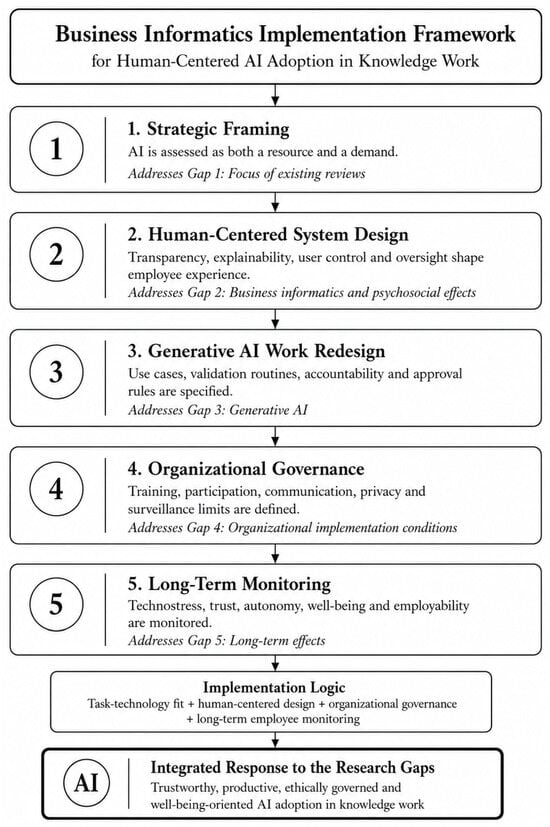
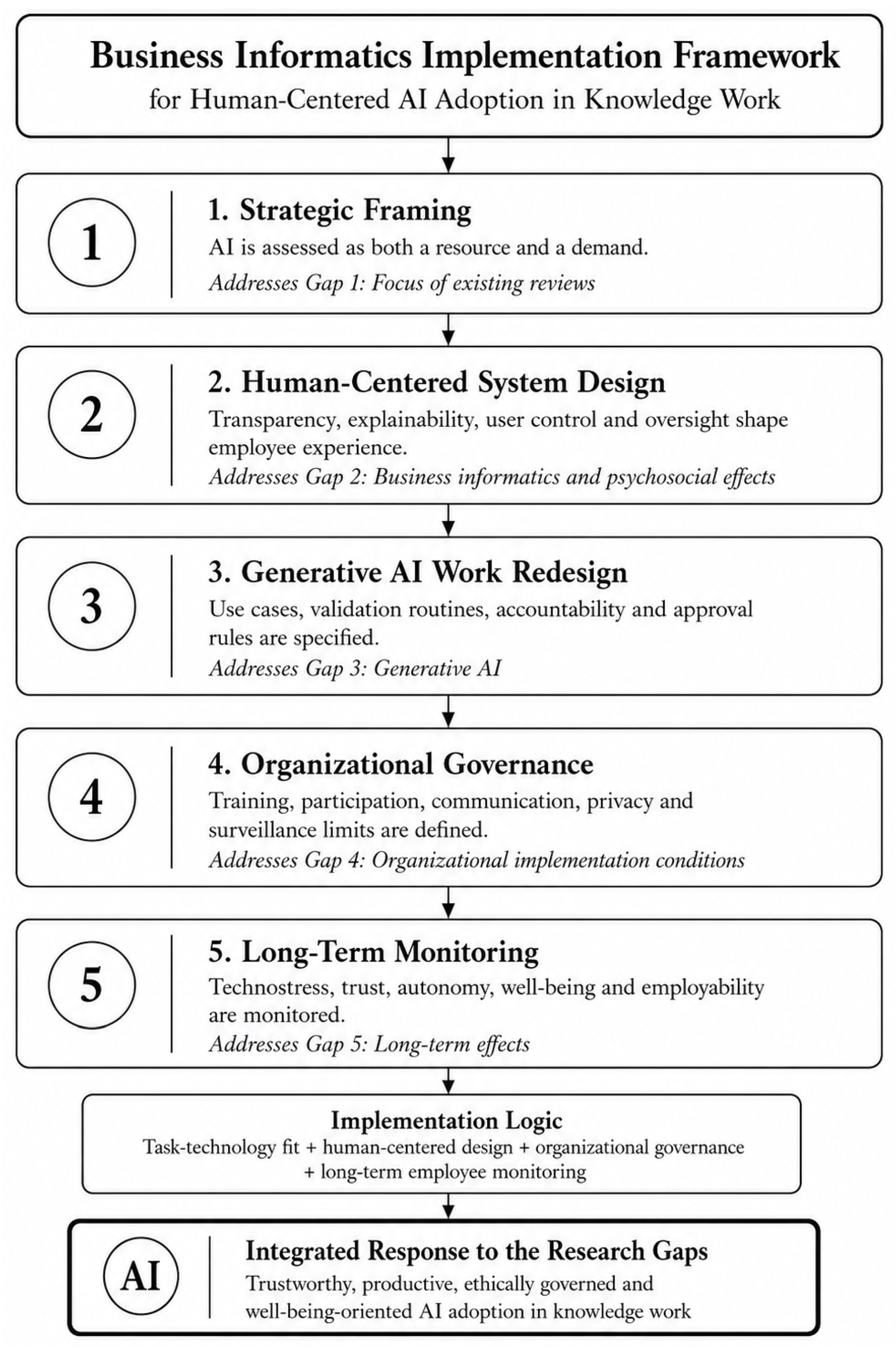
The synthesis of the 26 included sources indicates that the practical value of this review lies not only in mapping research gaps, but also in translating them into implementable organizational action. The evidence suggests that human-centered AI adoption in knowledge work should be operationalized as a staged socio-technical business informatics implementation framework in which system design, task redesign, governance arrangements, and long-term employee outcomes are addressed together rather than in isolation [29,30,31,32,33,34,35,36,37,38,39,40,41,42,43,44,45,46,47,48,49,50,51,52,53,54]. Figure 2 summarizes this practical implementation logic and shows how the five research gaps can be translated into an integrated response for practice, without implying that the gaps are fully resolved by the present evidence base.
Figure 2.
Business informatics implementation framework for human-centered AI adoption in knowledge work.
The first step is to identify resource and demand areas. AI in knowledge work should not be treated as inherently beneficial or inherently harmful; rather, the included evidence supports a dual interpretation in which AI may act both as a resource and as a demand. In practice, organizations should map where AI reduces workload, supports information processing, or improves decision support, and where it may introduce technostress, uncertainty, job insecurity, surveillance concerns, or reduced autonomy [29,30,34,35,36,37,38,39,40,41,42,44,45,46,47,48,49,50,51]. This step turns the first research gap into a practical diagnostic task for managers and system designers.
The second step is to define human-centered design requirements. Employee outcomes are strongly shaped by information-system properties, including transparency, explainability, responsible AI signals, human-in-the-loop design, feedback mechanisms, user control, and contestability. These are not peripheral ethical additions, but core implementation variables that influence trust, perceived fairness, autonomy, and technostress [31,32,33,34,35,36,37,38,39,40,50,51,52,53,54]. From a practice perspective, AI systems should therefore specify capabilities and limitations, responsibility boundaries, correction options, and human oversight before implementation.
The third step is to specify generative AI use and validation rules. The reviewed studies show that generative AI enters the cognitive core of knowledge work by shaping writing, programming, meetings, data navigation, communication, and decision support [29,30,31,32,33,34]. This creates productivity opportunities, but it also introduces output-verification burden and new accountability challenges. Implementation should therefore define acceptable use cases, validation rules, review responsibilities, approval procedures, and professional standards for AI-generated outputs.
The fourth step is to establish organizational governance safeguards. Responsible AI adoption depends on more than the technology itself. AI literacy, training, skill development, coaching leadership, psychological safety, participatory implementation, transparent communication, privacy protection, and explicit limits on surveillance are all linked to more favorable employee responses to AI [31,35,36,43,45,46,48,53]. Organizations should therefore prepare employees for AI adoption through structured capability development and governance rather than through simple top-down deployment.
The fifth step is to monitor employee outcomes over time. The current literature is still stronger on short-term perceptions and proximal outcomes than on longer-term trajectories. For this reason, AI implementation should be evaluated not only through immediate productivity gains or acceptance indicators, but also through technostress, trust, job satisfaction, autonomy, professional identity, and sustainable employability over time [35,37,41,42,46,47,49]. Repeated assessments and periodic governance adjustments are needed to turn this research gap into an actionable monitoring agenda.
Taken together, Figure 2 provides a practical synthesis of the review by translating the evidence clusters into action-oriented implementation steps. The five research gaps are not separate issues but interconnected implementation domains. In this business informatics implementation framework, productive and well-being-oriented AI adoption emerges when organizations align task–technology fit, human-centered system design, context-specific generative AI governance, participatory implementation, and long-term employee monitoring. The framework should be read as an implementation-oriented synthesis of the mapped evidence, not as proof of intervention effectiveness.
For implementation, the review therefore suggests five practical directions for managers and organizations:
- Conduct an AI implementation assessment that identifies both expected productivity gains and likely psychosocial risks before deployment;
- Require explainability, user control, feedback options, and human oversight for AI systems used in knowledge-intensive tasks;
- Define formal rules for generative AI use, including verification routines, approval procedures, and accountability for final outputs;
- Provide AI literacy training and participatory implementation processes supported by transparent governance and surveillance limits;
- Monitor employee outcomes over time using indicators such as technostress, trust, autonomy, job satisfaction, well-being, and career sustainability.
5. Conclusions
This scoping review positions human-centered AI adoption in knowledge work as a business informatics issue rather than only as a technological or managerial trend. Although the corpus is focused, it is methodologically appropriate for a scoping review because the 26 sources were selected through transparent PCC criteria and mapped across evidence type, AI application, knowledge-work context, and employee outcome domain. Across these sources, AI appears as both a potential resource and a potential demand: it can support information processing, decision support, productivity, and selected aspects of employee well-being, but it can also create technostress, verification burden, surveillance concerns, job insecurity, reduced autonomy, and uncertainty about accountability. The central conclusion is therefore not that AI is inherently beneficial or harmful, but that its consequences depend on the alignment between system properties, task context, organizational implementation, and employee capabilities.
The five research questions show how the five research gaps can be addressed and narrowed. The review narrows broad workplace-AI debates to knowledge work; connects information-system properties with psychosocial employee outcomes; distinguishes generative AI from broader AI-enabled work systems; identifies organizational conditions for well-being-oriented implementation; and separates well-documented short-term outcomes from underdeveloped longitudinal questions. The proposed business informatics implementation framework translates these findings into five practical domains: strategic framing, human-centered system design, generative AI work redesign, organizational governance, and long-term monitoring.
For practice, AI should not be implemented only as an efficiency or productivity tool. Responsible implementation requires socio-technical governance that combines system quality with worker participation, transparent communication, contestability mechanisms, privacy protection, AI literacy, and support for employee learning. From a business informatics perspective, human-centered AI adoption should therefore be evaluated through both technical performance and employee-centered outcomes.
Future research should examine when, how, and for whom AI becomes a resource or a stressor in knowledge work. Longitudinal, diary-based, and occupation-specific studies are needed to distinguish short-term adaptation from durable effects on well-being, autonomy, professional identity, and employability. Because the present evidence base is heterogeneous, the conclusions should be interpreted as a structured scoping synthesis with an implementation-oriented agenda, rather than as causal or meta-analytic evidence.
Supplementary Materials
The following supporting information can be downloaded at: https://www.mdpi.com/article/10.3390/informatics13080130/s1, Supplementary File S1: Full search strategy; Supplementary File S2: Screening and eligibility log; Supplementary File S3: Data charting form; Supplementary File S4: Included Sources and Characteristics; Supplementary File S5: PRISMA-ScR checklist.
Author Contributions
Conceptualization, B.B. and J.S.; methodology, B.B. and J.S.; validation, B.B. and J.S.; formal analysis, B.B. and J.S.; investigation, B.B. and J.S.; resources, B.B. and J.S.; data curation, B.B. and J.S.; writing—original draft preparation, B.B. and J.S.; writing—review and editing, J.S. and B.B.; visualization, B.B. and J.S.; supervision, J.S.; project administration, J.S. All authors have read and agreed to the published version of the manuscript.
Funding
This research was funded by the University of Novo Mesto.
Institutional Review Board Statement
Not applicable.
Informed Consent Statement
Not applicable.
Data Availability Statement
All data charted for this scoping review are reported in the article and Supplementary Files S1–S5.
Acknowledgments
Conflicts of Interest
The authors declare no conflicts of interest.
References
- Rai, A.; Constantinides, P.; Sarker, S. Editor’s Comments: Next-Generation Digital Platforms: Toward Human-AI Hybrids. MIS Q. 2019, 43, iii–ix. [Google Scholar] [CrossRef] [Scilit]
- Benbya, H.; Pachidi, S.; Jarvenpaa, S.L. Special Issue Editorial: Artificial Intelligence in Organizations: Implications for Information Systems Research. J. Assoc. Inf. Syst. 2021, 22, 281–303. [Google Scholar] [CrossRef] [Scilit]
- Jarrahi, M.H. Artificial Intelligence and the Future of Work: Human-AI Symbiosis in Organizational Decision Making. Bus. Horiz. 2018, 61, 577–586. [Google Scholar] [CrossRef] [Scilit]
- Raisch, S.; Krakowski, S. Artificial Intelligence and Management: The Automation-Augmentation Paradox. Acad. Manag. Rev. 2021, 46, 192–210. [Google Scholar] [CrossRef] [Scilit]
- Faraj, S.; Pachidi, S.; Sayegh, K. Working and Organizing in the Age of the Learning Algorithm. Inf. Organ. 2018, 28, 62–70. [Google Scholar] [CrossRef] [Scilit]
- Parker, S.K.; Grote, G. Automation, Algorithms, and Beyond: Why Work Design Matters More Than Ever in a Digital World. Appl. Psychol. 2022, 71, 1171–1204. [Google Scholar] [CrossRef] [Scilit]
- Amershi, S.; Weld, D.; Vorvoreanu, M.; Fourney, A.; Nushi, B.; Collisson, P.; Suh, J.; Iqbal, S.; Bennett, P.N.; Inkpen, K.; et al. Guidelines for Human-AI Interaction. In Proceedings of the 2019 CHI Conference on Human Factors in Computing Systems, Glasgow, UK, 4–9 May 2019; pp. 1–13. [Google Scholar] [CrossRef] [Scilit]
- Parasuraman, R.; Sheridan, T.B.; Wickens, C.D. A Model for Types and Levels of Human Interaction with Automation. IEEE Trans. Syst. Man Cybern. A 2000, 30, 286–297. [Google Scholar] [CrossRef] [Scilit] [PubMed]
- Orlikowski, W.J. The Duality of Technology: Rethinking the Concept of Technology in Organizations. Organ. Sci. 1992, 3, 398–427. [Google Scholar] [CrossRef] [Scilit]
- Markus, M.L.; Silver, M.S. A Foundation for the Study of IT Effects: A New Look at DeSanctis and Poole’s Concepts of Structural Features and Spirit. J. Assoc. Inf. Syst. 2008, 9, 609–632. [Google Scholar] [CrossRef] [Scilit]
- Davis, F.D. Perceived Usefulness, Perceived Ease of Use, and User Acceptance of Information Technology. MIS Q. 1989, 13, 319–340. [Google Scholar] [CrossRef] [Scilit] [PubMed]
- Venkatesh, V.; Morris, M.G.; Davis, G.B.; Davis, F.D. User Acceptance of Information Technology: Toward a Unified View. MIS Q. 2003, 27, 425–478. [Google Scholar] [CrossRef] [Scilit]
- Ayyagari, R.; Grover, V.; Purvis, R. Technostress: Technological Antecedents and Implications. MIS Q. 2011, 35, 831–858. [Google Scholar] [CrossRef] [Scilit]
- Tarafdar, M.; Tu, Q.; Ragu-Nathan, B.S.; Ragu-Nathan, T.S. The Impact of Technostress on Role Stress and Productivity. J. Manag. Inf. Syst. 2007, 24, 301–328. [Google Scholar] [CrossRef] [Scilit]
- Ragu-Nathan, T.S.; Tarafdar, M.; Ragu-Nathan, B.S.; Tu, Q. The Consequences of Technostress for End Users in Organizations: Conceptual Development and Empirical Validation. Inf. Syst. Res. 2008, 19, 417–433. [Google Scholar] [CrossRef] [Scilit]
- Lee, J.D.; See, K.A. Trust in Automation: Designing for Appropriate Reliance. Hum. Factors 2004, 46, 50–80. [Google Scholar] [CrossRef] [Scilit] [PubMed]
- Glikson, E.; Woolley, A.W. Human Trust in Artificial Intelligence: Review of Empirical Research. Acad. Manag. Ann. 2020, 14, 627–660. [Google Scholar] [CrossRef] [Scilit]
- Tarafdar, M.; Cooper, C.L.; Stich, J.F. The Technostress Trifecta: Techno Eustress, Techno Distress and Design. Inf. Syst. J. 2019, 29, 6–42. [Google Scholar] [CrossRef] [Scilit]
- Kellogg, K.C.; Valentine, M.A.; Christin, A. Algorithms at Work: The New Contested Terrain of Control. Acad. Manag. Ann. 2020, 14, 366–410. [Google Scholar] [CrossRef] [Scilit]
- Brynjolfsson, E.; Li, D.; Raymond, L.R. Generative AI at Work. Q. J. Econ. 2025, 140, 889–942. [Google Scholar] [CrossRef] [Scilit]
- Noy, S.; Zhang, W. Experimental Evidence on the Productivity Effects of Generative Artificial Intelligence. Science 2023, 381, 187–192. [Google Scholar] [CrossRef] [Scilit] [PubMed]
- Dell’Acqua, F.; McFowland, E.; Mollick, E.R.; Lifshitz-Assaf, H.; Kellogg, K.; Rajendran, S.; Krayer, L.; Candelon, F.; Lakhani, K.R. Navigating the Jagged Technological Frontier: Field Experimental Evidence of the Effects of AI on Knowledge Worker Productivity and Quality. Organ. Sci. 2026, 37, 403–423. [Google Scholar] [CrossRef] [Scilit]
- Dwivedi, Y.K.; Kshetri, N.; Hughes, L.; Slade, E.L.; Jeyaraj, A.; Kar, A.K.; Baabdullah, A.M.; Koohang, A.; Raghavan, V.; Ahuja, M.; et al. “So What If ChatGPT Wrote It?” Multidisciplinary Perspectives on Opportunities, Challenges and Implications of Generative Conversational AI for Research, Practice and Policy. Int. J. Inf. Manag. 2023, 71, 102642. [Google Scholar] [CrossRef] [Scilit]
- Jia, J.; Ning, X.; Liu, W. The Consequences and Theoretical Explanation of Workplace AI on Employees: A Systematic Literature Review. J. Digit. Manag. 2025, 1, 14. [Google Scholar] [CrossRef] [Scilit]
- Pereira, V.; Hadjielias, E.; Christofi, M.; Vrontis, D. A Systematic Literature Review on the Impact of Artificial Intelligence on Workplace Outcomes: A Multi-Process Perspective. Hum. Resour. Manag. Rev. 2023, 33, 100857. [Google Scholar] [CrossRef] [Scilit]
- Tricco, A.C.; Lillie, E.; Zarin, W.; O’Brien, K.K.; Colquhoun, H.; Levac, D.; Moher, D.; Peters, M.D.J.; Horsley, T.; Weeks, L.; et al. PRISMA Extension for Scoping Reviews (PRISMA-ScR): Checklist and Explanation. Ann. Intern. Med. 2018, 169, 467–473. [Google Scholar] [CrossRef] [Scilit] [PubMed]
- Page, M.J.; McKenzie, J.E.; Bossuyt, P.M.; Boutron, I.; Hoffmann, T.C.; Mulrow, C.D.; Shamseer, L.; Tetzlaff, J.M.; Akl, E.A.; Brennan, S.E.; et al. The PRISMA 2020 Statement: An Updated Guideline for Reporting Systematic Reviews. BMJ 2021, 372, n71. [Google Scholar] [CrossRef] [Scilit] [PubMed]
- Peters, M.D.J.; Marnie, C.; Tricco, A.C.; Pollock, D.; Munn, Z.; Alexander, L.; McInerney, P.; Godfrey, C.M.; Khalil, H. Updated Methodological Guidance for the Conduct of Scoping Reviews. JBI Evid. Synth. 2020, 18, 2119–2126. [Google Scholar] [CrossRef] [Scilit] [PubMed]
- Yun, B.; Feng, S.; Chen, A.S.; Nikzad, A.; Salehi, N. Generative AI in Knowledge Work: Design Implications for Data Navigation and Decision-Making. In Proceedings of the CHI Conference on Human Factors in Computing Systems, Yokohama, Japan, 26 April–1 May 2025. [Google Scholar] [CrossRef] [Scilit]
- Rafi, M.; Aitken, J.M.; Fatah, T.D.; Mailangkay, A. Analyzing the Impact of Generative AI on IT Employee Performance. In 2024 3rd International Conference on Creative Communication and Innovative Technology (ICCIT); IEEE: New York, NY, USA, 2024. [Google Scholar] [CrossRef] [Scilit]
- Sadeghian, S.; Bareikytė, D.; Burkhardt, M.; Hassenzahl, M. WorkAI: A Toolkit for the Design of AI-Driven Future of Work. Proc. ACM Hum.-Comput. Interact. 2025, 9, CSCW344. [Google Scholar] [CrossRef] [Scilit]
- Houtti, M.; Zhou, M.; Runningen, D.; Sunil, S.; Porat, L.; Kaur, H.; Terveen, L.; Chancellor, S. Opportunities and Barriers for AI Feedback on Meeting Inclusion in Socioorganizational Teams. In Proceedings of the CHI Conference on Human Factors in Computing Systems; ACM Digital Library: New York, NY, USA, 2026. [Google Scholar] [CrossRef] [Scilit]
- Park, H.; Ahn, D.; Kim, J.E.; Huang, Y. Envisioning an Ethical and Sustainable Metaverse Workplace: Beyond AI-Driven Surveillance. In Proceedings of the CHI Conference on Human Factors in Computing Systems, Barcelona, Spain, 13–17 April 2026; Association for Computing Machinery: New York, NY, USA, 2026; pp. 1–24. [Google Scholar] [CrossRef] [Scilit]
- Högemann, M.; Hein, L.; Britsche, J.-O.; Thomas, O. Technostress and Generative AI in the Workplace: A Qualitative Analysis of Young Professionals. Front. Artif. Intell. 2025, 8, 1728881. [Google Scholar] [CrossRef] [Scilit] [PubMed]
- Unruh, C.F.; Haid, C.; Fottner, J.; Büthe, T. Human Autonomy in Algorithmic Management. In Proceedings of the 2022 AAAI/ACM Conference on AI, Ethics, and Society, Oxford, UK, 19–21 May 2022; pp. 753–762. [Google Scholar] [CrossRef] [Scilit]
- Chowdhary, S.; Kawakami, A.; Gray, M.L.; Suh, J.; Olteanu, A.; Saha, K. Can Workers Meaningfully Consent to Workplace Wellbeing Technologies? In Proceedings of the ACM Conference on Fairness, Accountability, and Transparency (FAccT 2023), Chicago, IL, USA, 12–15 June 2023. [Google Scholar] [CrossRef] [Scilit]
- Wong, N.; Cheng, N.-Y.; Oewel, B.; Genuario, K.E.; Stoeckl, S.E.; Schueller, S.M.; Ahmed, I.; van der Hoek, A.; Reddy, M. “It’s a Spectrum”: Exploring Autonomy, Competence, and Relatedness in Software Development Processes and Tools. In Proceedings of the 2025 CHI Conference on Human Factors in Computing Systems, Yokohama, Japan, 26 April–1 May 2025; Association for Computing Machinery: New York, NY, USA, 2025; pp. 1–19. [Google Scholar] [CrossRef] [Scilit]
- Chang, P.-C.; Zhang, W.; Cai, Q.; Guo, H. Does AI-Driven Technostress Promote or Hinder Employees’ Artificial Intelligence Adoption Intention? A Moderated Mediation Model of Affective Reactions and Technical Self-Efficacy. Psychol. Res. Behav. Manag. 2024, 17, 413–427. [Google Scholar] [CrossRef] [Scilit] [PubMed]
- Di Stefano, G.; Salerno, S.; Matranga, D.; Lodico, M.; Monzani, D.; Seidita, V.; Cannella, R.; Maniscalco, L.; Miceli, S. Artificial Intelligence Perceptions and Technostress in Staff Radiologists: The Mediating Role of Artificial Intelligence Acceptance and the Moderating Role of Self-Efficacy. Behav. Sci. 2025, 15, 1276. [Google Scholar] [CrossRef] [Scilit] [PubMed]
- Liu, C.-F.; Lin, T.-C.; Ko, Y.-L. Exploring the Impact of AI Technostress on Physicians’ Job Insecurity and Performance from an Empirical Multi-Hospital Study. iScience 2025, 28, 114394. [Google Scholar] [CrossRef] [Scilit] [PubMed]
- Valtonen, A.; Saunila, M.; Ukko, J.; Treves, L.; Ritala, P. AI and Employee Wellbeing in the Workplace: An Empirical Study. J. Bus. Res. 2025, 199, 115584. [Google Scholar] [CrossRef] [Scilit]
- Chuang, Y.-T.; Chiang, H.-L.; Lin, A.-P. Insights from the Job Demands-Resources Model: AI’s Dual Impact on Employees’ Work and Life Well-Being. Int. J. Inf. Manag. 2025, 82, 102887. [Google Scholar] [CrossRef] [Scilit]
- Jeong, J.; Kim, B.-J.; Lee, J. Navigating AI Transitions: How Coaching Leadership Buffers against Job Stress and Protects Employee Physical Health. Front. Public Health 2024, 12, 1343932. [Google Scholar] [CrossRef] [Scilit] [PubMed]
- Liu, Q.; Tian, Q.; Li, X.; Tan, H. How Does Organizational AI Adoption Affect Employees’ Job Satisfaction? Front. Psychol. 2025, 16, 1690238. [Google Scholar] [CrossRef] [Scilit] [PubMed]
- Huang, L.; Zhao, Y. The Impact of AI Literacy on Work–Life Balance and Job Satisfaction among University Faculty: A Self-Determination Theory Perspective. Front. Psychol. 2025, 16, 1669247. [Google Scholar] [CrossRef] [Scilit] [PubMed]
- Chen, N.; Zhao, X.-N.; Wang, L. The Effect of Job Skill Demands under Artificial Intelligence Embeddedness on Employees’ Job Performance: A Moderated Double-Edged Sword Model. Behav. Sci. 2024, 14, 974. [Google Scholar] [CrossRef] [Scilit] [PubMed]
- Jin, T.; Yang, X.; Zhang, L. Understanding AI Technostress and Employee Career Growth from a Socio-Technical Systems Perspective: A Dual-Path Model. Systems 2026, 14, 58. [Google Scholar] [CrossRef] [Scilit]
- Țuclea, C.-E.; Poenaru, L.F. Generation Z Employees’ Acceptance and AI Use Intensity: A Moderated Mediation Model of Psychological Safety, Technostress and Trust. Merits 2026, 6, 7. [Google Scholar] [CrossRef] [Scilit]
- Giuntella, O.; König, J.; Stella, L. Artificial Intelligence and the Wellbeing of Workers. Sci. Rep. 2025, 15, 98241. [Google Scholar] [CrossRef] [Scilit] [PubMed]
- Lițan, D.-E. The Impact of Technostress Generated by Artificial Intelligence on the Quality of Life: The Mediating Role of Positive and Negative Affect. Behav. Sci. 2025, 15, 552. [Google Scholar] [CrossRef] [Scilit] [PubMed]
- Sharif, M.N.; Zhang, L.; Asif, M.; Alshdaifat, S.M.; Hanaysha, J.R. Artificial Intelligence and Employee Outcomes: Investigating the Role of Job Insecurity and Technostress in the Hospitality Industry. Acta Psychol. 2025, 253, 104733. [Google Scholar] [CrossRef] [Scilit] [PubMed]
- Xu, W.; Dainoff, M.J.; Ge, L.; Gao, Z. Transitioning to Human Interaction with AI Systems: New Challenges and Opportunities for HCI Professionals to Enable Human-Centered AI. Int. J. Hum.-Comput. Interact. 2023, 39, 494–518. [Google Scholar] [CrossRef] [Scilit]
- Wang, W.; Chen, L.; Xiong, M.; Wang, Y. Accelerating AI Adoption with Responsible AI Signals and Employee Engagement Mechanisms in Health Care. Inf. Syst. Front. 2023, 25, 471–490. [Google Scholar] [CrossRef] [Scilit]
- Tsiakas, K.; Murray-Rust, D. Using Human-in-the-Loop and Explainable AI to Envisage New Future Work Practices. In Proceedings of the 15th International Conference on PErvasive Technologies Related to Assistive Environments (PETRA 2022), Corfu, Greece, 29 June–1 July 2022. [Google Scholar] [CrossRef] [Scilit]

Disclaimer/Publisher’s Note: The statements, opinions and data contained in all publications are solely those of the individual author(s) and contributor(s) and not of MDPI and/or the editor(s). MDPI and/or the editor(s) disclaim responsibility for any injury to people or property resulting from any ideas, methods, instructions or products referred to in the content. |
© 2026 by the authors. Licensee MDPI, Basel, Switzerland. This article is an open access article distributed under the terms and conditions of the Creative Commons Attribution (CC BY) license.