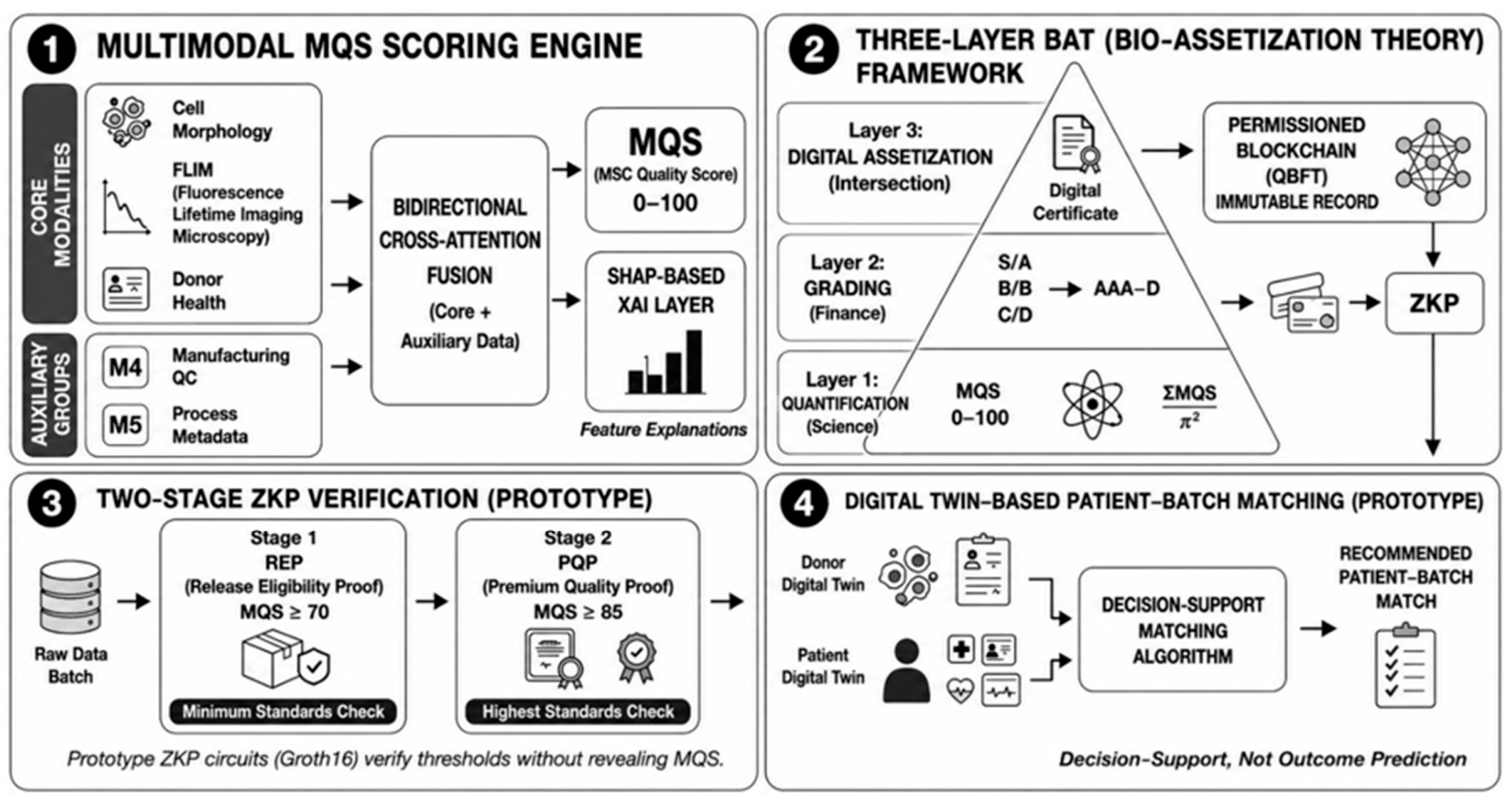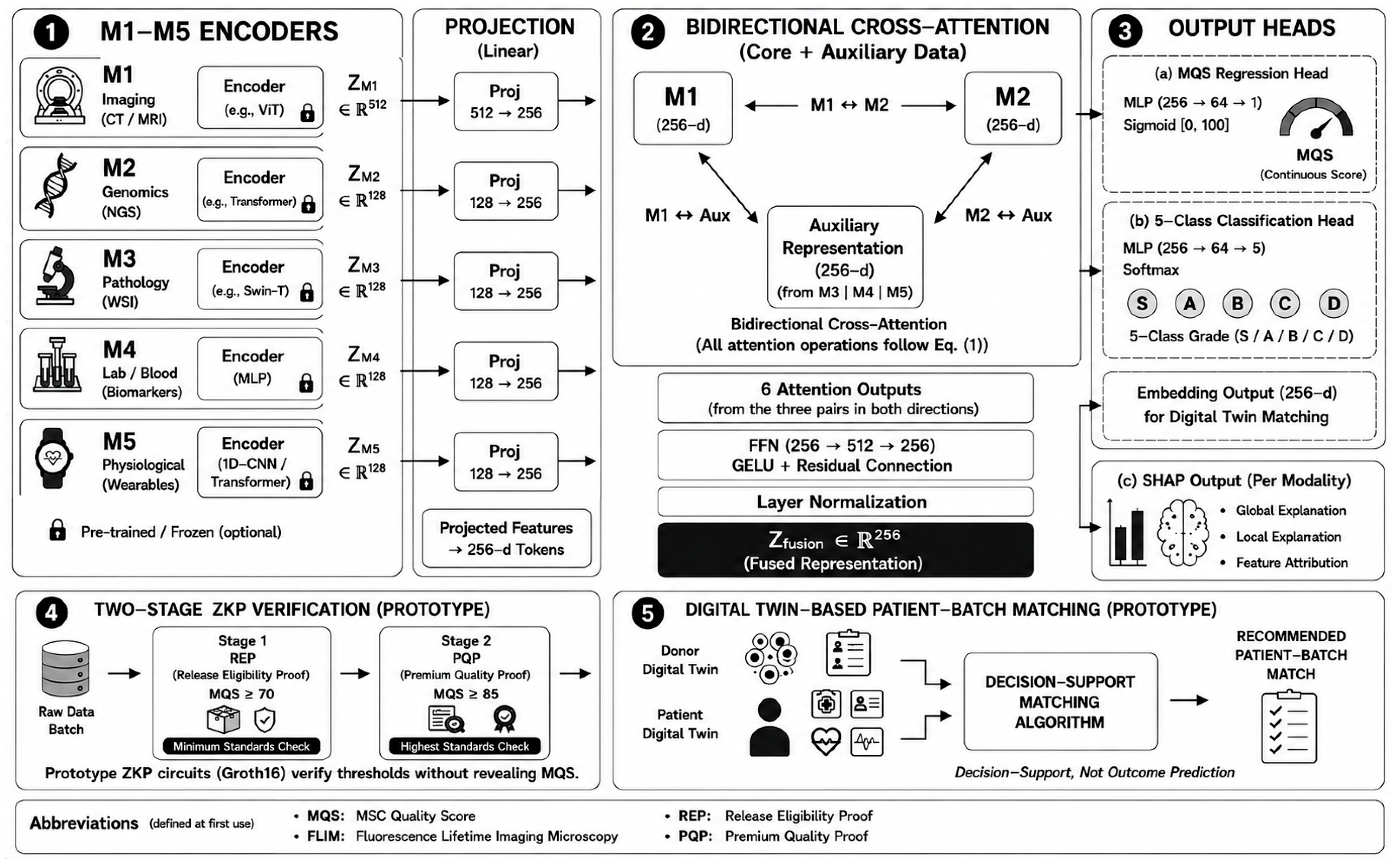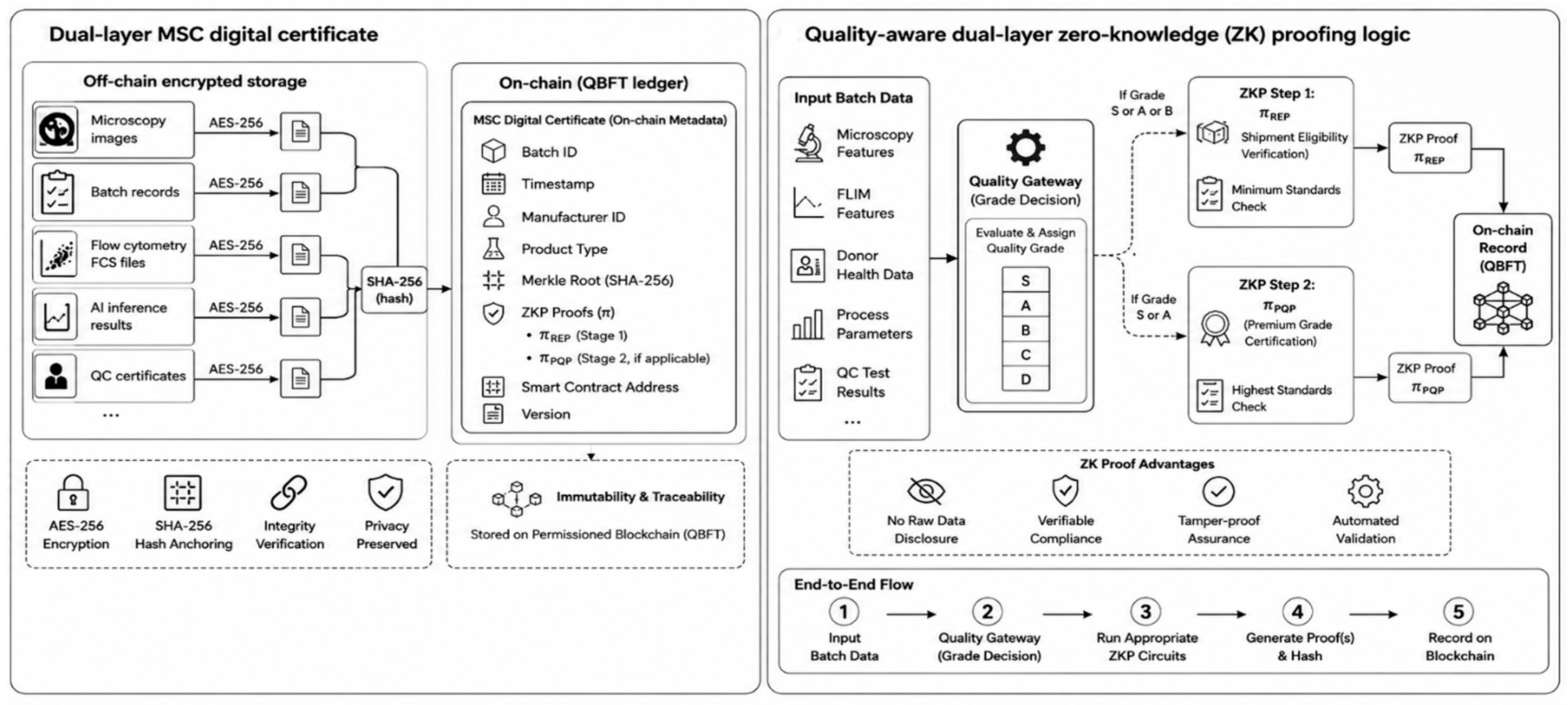
_Bryant.png)
MSC Digital Assetization for Personalized Regenerative Medicine: An AI–Blockchain–Digital Twin Integrated Framework

Abstract
1. Introduction
- RQ1:
- Can MSC batch quality be transformed into a standardized, reproducible, and cryptographically verifiable digital quality score through multimodal AI fusion?
- RQ2:
- Can a hybrid ZKP–blockchain architecture provide privacy-preserving, tamper-proof lifecycle traceability for MSC batches across multi-institutional environments?
- RQ3:
- Can an AI-based digital twin matching module serve as a decision-support tool for patient-specific MSC batch suitability assessment?
2. Related Work
2.1. MSC Quality Assessment
2.2. AI-Based Cell Quality Analysis
2.3. Blockchain for Biodata Management
2.4. ZKP-Based Privacy-Preserving Verification
2.5. Digital Twin-Based Personalized Medicine
2.6. Research Gap Summary
3. Multimodal Cross-Attention MSC Quality Scoring Engine
3.1. Overall Engine Architecture—3 Core Modalities + 2 Auxiliary QC Groups
3.2. Modality M1: Morphological Feature Encoder
3.2.1. Cellpose 2.0-Based Cell Segmentation
3.2.2. ResNet-50 Encoder
3.3. Modality M2: FLIM-Based Metabolic-Proliferative Encoder
3.4. Modality M3 and Auxiliary QC Groups
3.5. Bidirectional Cross-Attention Fusion Module
3.6. Output Heads and MQS Grade System
3.7. SHAP-Based Explainability (XAI) Layer
4. MSC Digital Assetization Framework and Certificate Design
4.1. Three-Layer Assetization Conceptual Framework
4.2. MSC Digital Certificate Structure
4.3. Lifecycle Event Schema
5. Zero-Knowledge Proof (ZKP)-Based Two-Tier Quality Verification Architecture
5.1. Rationale for Two-Tier Policy Separation and Threshold Design
5.2. ZKP Circuit Design (Prototype circom2 Threshold Circuits)
5.3. Common Proof System: Groth16
5.4. Two-Tier ZKP Workflow
6. QBFT Permissioned Blockchain System Architecture
6.1. Rationale for Permissioned Blockchain Adoption
6.2. Four-Layer System Architecture
6.3. Smart Contract System (OpenZeppelin UUPS Pattern)
6.4. DID-Based Role Access Control
7. Digital Twin-Based Patient–Batch Matching Module
7.1. Module Design Philosophy
7.2. Matching Score Computation
8. Synthetic Data Pilot Validation
8.1. Pilot Scope and Disclaimer
Experimental Environment
8.2. Input Schema Design Rationale
8.3. Synthetic Data Generation Methodology
8.3.1. Dataset Size, Split, and Reproducibility
8.3.2. Rule Engine and Feature Distributions
+ 0.19·flow_score + 0.13·manuf_score + 0.10·donor_score
MQS = clip(MQS_base + N(0, 5), 0, 100)
8.3.3. Class Balance
8.3.4. Statistical Reliability and Robustness Analysis
8.4. Baseline Model Comparison
8.5. Ablation Study
8.6. AI Model Performance Summary
8.7. Modality Contribution (SHAP)
8.8. Two-Tier ZKP Performance
8.9. QBFT Blockchain Performance
8.10. Digital Twin Matching Results
9. Discussion
9.1. Summary of Key Contributions
9.2. Proper Understanding of “Digital Assetization”
9.3. Comparison with Prior Studies
9.3.1. Comparison with MSC Quality Assessment Studies
9.3.2. Comparison with AI-Based Cell Analysis Studies
9.3.3. Comparison with Blockchain-Based Healthcare Systems
9.3.4. Comparison with Digital Twin Applications
9.4. Ethical, Regulatory, and Governance Considerations
9.5. Limitations
9.6. Future Research
9.7. Theoretical Implications
9.8. Practical Implications
10. Conclusions
Author Contributions
Funding
Institutional Review Board Statement
Informed Consent Statement
Data Availability Statement
Acknowledgments
Conflicts of Interest
References
- Uccelli, A.; Moretta, L.; Pistoia, V. Mesenchymal stem cells in health and disease. Nat. Rev. Immunol. 2008, 8, 726–736. [Google Scholar] [CrossRef] [Scilit] [PubMed]
- Pittenger, M.F.; Mackay, A.M.; Beck, S.C.; Jaiswal, R.K.; Douglas, R.; Mosca, J.D.; Moorman, M.A.; Simonetti, D.W.; Craig, S.; Marshak, D.R. Multilineage potential of adult human mesenchymal stem cells. Science 1999, 284, 143–147. [Google Scholar] [CrossRef] [Scilit] [PubMed]
- Research and Markets. Global Mesenchymal Stem Cell Therapeutics Market Report 2023–2032; Research and Markets: Dublin, Ireland, 2023; Available online: https://www.researchandmarkets.com (accessed on 13 June 2026).
- Dominici, M.; Le Blanc, K.; Mueller, I.; Slaper-Cortenbach, I.; Marini, F.C.; Krause, D.S.; Deans, R.J.; Keating, A.; Prockop, D.J.; Horwitz, E.M. Minimal criteria for defining multipotent mesenchymal stromal cells. Cytotherapy 2006, 8, 315–317. [Google Scholar] [CrossRef] [Scilit] [PubMed]
- Galipeau, J.; Sensébé, L. Mesenchymal stromal cells: Clinical challenges and therapeutic opportunities. Cell Stem Cell 2018, 22, 824–833. [Google Scholar] [CrossRef] [Scilit] [PubMed]
- Parekkadan, B.; Milwid, J.M. Mesenchymal stem cells as therapeutics. Annu. Rev. Biomed. Eng. 2010, 12, 87–117. [Google Scholar] [CrossRef] [Scilit] [PubMed]
- Kern, S.; Eichler, H.; Stoeve, J.; Klüter, H.; Bieback, K. Comparative analysis of mesenchymal stem cells from bone marrow, umbilical cord blood, or adipose tissue. Stem Cells 2006, 24, 1294–1301. [Google Scholar] [CrossRef] [Scilit] [PubMed]
- Yi, T.; Song, S.U. Immunomodulatory properties of mesenchymal stem cells and their therapeutic applications. Arch. Pharm. Res. 2012, 35, 213–221. [Google Scholar] [CrossRef] [Scilit] [PubMed]
- Zhao, Q.; Zhang, L.; Wei, Y.; Yu, H.; Zou, L.; Huo, J.; Sun, C.; Liu, Y.; Xu, T.; Liu, G. Systematic comparison of hUC-MSCs at different passages reveals the variations of signatures and therapeutic effect. Stem Cell Res. Ther. 2019, 10, 354. [Google Scholar] [CrossRef] [Scilit] [PubMed]
- Beane, O.S.; Fonseca, V.C.; Cooper, L.L.; Koren, G.; Bhattacharya, S. Impact of aging on the regenerative properties of bone marrow-, muscle-, and adipose-derived mesenchymal stem/stromal cells. PLoS ONE 2014, 9, e115963. [Google Scholar] [CrossRef] [Scilit] [PubMed]
- Wagner, W.; Horn, P.; Castoldi, M.; Diehlmann, A.; Bork, S.; Saffrich, R.; Benes, V.; Blake, J.; Pfister, S.; Eckstein, V.; et al. Replicative senescence of mesenchymal stem cells: A continuous and organized process. PLoS ONE 2008, 3, e2213. [Google Scholar] [CrossRef] [Scilit] [PubMed]
- Scherberich, A.; Galli, R.; Jeney, C.; Molina, J.; Martin, I. In vitro cartilage formation from adipose-derived stem cells grown on fibrous polyurethane scaffolds. Tissue Eng. Part A 2007, 13, 1753–1761. [Google Scholar]
- Igarashi, M.; Miura, M.; Williams, E.; Jaksch, F.; Kadowaki, T.; Yamauchi, T.; Guarente, L. NAD+ supplementation rejuvenates aged gut adult stem cells. Aging Cell 2019, 18, e12935. [Google Scholar] [CrossRef] [Scilit] [PubMed]
- Yan, W.; Diao, S.; Fan, Z. The role and mechanism of mitochondrial functions and energy metabolism in the function regulation of the mesenchymal stem cells. Stem Cell Res. Ther. 2021, 12, 140. [Google Scholar] [CrossRef] [Scilit] [PubMed]
- Grieves, M.; Vickers, J. Digital twin: Mitigating unpredictable, undesirable emergent behavior in complex systems. In Transdisciplinary Perspectives on Complex Systems; Kahlen, F.J., Flumerfelt, S., Alves, A., Eds.; Springer: Cham, Switzerland, 2017; pp. 85–113. [Google Scholar]
- Katsoulakis, E.; Wang, Q.; Wu, H.; Shahriyari, L.; Fletcher, R.; Liu, J.; Achenie, L.; Liu, H.; Jackson, P.; Xiao, Y.; et al. Digital twins for health: A scoping review. npj Digit. Med. 2024, 7, 77. [Google Scholar] [CrossRef] [Scilit] [PubMed]
- Björnsson, B.; Borrebaeck, C.; Elander, N.; Gasslander, T.; Gawel, D.R.; Gustafsson, M.; Jörnsten, R.; Lee, E.J.; Li, X.; Lilja, S.; et al. Digital twins to personalise medicine. Genome Med. 2020, 12, 4. [Google Scholar] [CrossRef] [Scilit] [PubMed]
- Moutsatsou, P.; Ochs, J.; Schmitt, R.H.; Hewitt, C.J.; Hanga, M.P. Automation in cell and gene therapy manufacturing: From past to future. Biotechnol. Lett. 2019, 41, 1245–1253. [Google Scholar] [CrossRef] [Scilit] [PubMed]
- Moen, E.; Bannon, D.; Kudo, T.; Graf, W.; Covert, M.; Van Valen, D. Deep learning for cellular image analysis. Nat. Methods 2019, 16, 1233–1246. [Google Scholar] [CrossRef] [Scilit] [PubMed]
- Waisman, A.; La Greca, A.; Möbbs, A.M.; Scarafia, M.A.; Sanchez, M.N.; Lombardi, C.; Ríos, A.S.; Neiman, G.; Flores-García, M.; Velilla, J.; et al. Deep learning neural networks highly predict very early onset of pluripotent stem cell differentiation. Stem Cell Rep. 2019, 12, 845–859. [Google Scholar] [CrossRef] [Scilit] [PubMed]
- Stringer, C.; Wang, T.; Michaelos, M.; Pachitariu, M. Cellpose: A generalist algorithm for cellular segmentation. Nat. Methods 2021, 18, 100–106. [Google Scholar] [CrossRef] [Scilit] [PubMed]
- Pachitariu, M.; Stringer, C. Cellpose 2.0: How to train your own model. Nat. Methods 2022, 19, 1634–1641. [Google Scholar] [CrossRef] [Scilit] [PubMed]
- Vaswani, A.; Shazeer, N.; Parmar, N.; Uszkoreit, J.; Jones, L.; Gomez, A.N.; Kaiser, Ł.; Polosukhin, I. Attention is all you need. Adv. Neural Inf. Process. Syst. 2017, 30, 5998–6008. [Google Scholar]
- Chen, T.; Kornblith, S.; Norouzi, M.; Hinton, G. A simple framework for contrastive learning of visual representations. In Proceedings of the 37th International Conference on Machine Learning (ICML), Vienna, Austria, 12–18 July 2020. [Google Scholar]
- Xia, Q.; Sifah, E.A.; Asamoah, K.O.; Gao, J.; Du, X.; Guizani, M. MeDShare: Trust-less medical data sharing among cloud service providers via blockchain. IEEE Access 2017, 5, 14757–14767. [Google Scholar] [CrossRef] [Scilit]
- Bocek, T.; Rodrigues, B.; Strasser, T.; Stiller, B. Blockchains everywhere—A use-case of blockchains in the pharma supply-chain. In Proceedings of the 2017 IFIP/IEEE Symposium on Integrated Network and Service Management (IM), Lisbon, Portugal, 8–12 May 2017. [Google Scholar]
- Azaria, A.; Ekblaw, A.; Vieira, T.; Lippman, A. MedRec: Using blockchain for medical data access and permission management. In Proceedings of the 2nd International Conference on Open and Big Data (OBD), Vienna, Austria, 22–24 August 2016. [Google Scholar]
- Zhao, X.; Wang, S.; Zhang, Y.; Wang, Y. Attribute-based access control scheme for data sharing on Hyperledger Fabric. J. Inf. Secur. Appl. 2022, 67, 103182. [Google Scholar] [CrossRef] [Scilit]
- Kassab, M.; Defranco, J.; Malas, T.; Laplante, P.; Destefanis, G.; Neto, V.V.G. Exploring research in blockchain for healthcare and a roadmap for the future. IEEE Trans. Emerg. Top. Comput. 2021, 9, 1835–1852. [Google Scholar] [CrossRef] [Scilit]
- Wang, B.; Bowles-Welch, A.C.; Yeago, C.; Roy, K. Process analytical technologies in cell therapy manufacturing: State-of-the-art and future directions. J. Adv. Manuf. Process. 2022, 4, e10106. [Google Scholar] [CrossRef] [Scilit]
- Goldwasser, S.; Micali, S.; Rackoff, C. The knowledge complexity of interactive proof systems. SIAM J. Comput. 1989, 18, 186–208. [Google Scholar] [CrossRef] [Scilit]
- Ben-Sasson, E.; Chiesa, A.; Garman, C.; Green, M.; Miers, I.; Tromer, E.; Virza, M. Succinct non-interactive zero knowledge for a von Neumann architecture. In Proceedings of the 23rd USENIX Security Symposium, San Diego, CA, USA, 20–22 August 2014; pp. 781–796. [Google Scholar]
- Groth, J. On the size of pairing-based non-interactive arguments. In Proceedings of the EUROCRYPT, Vienna, Austria, 8–12 May 2016; pp. 305–326. [Google Scholar]
- Bharath Babu, S.; Jothi, K.R. A secure framework for privacy-preserving analytics in healthcare records using zero-knowledge proofs and blockchain in multi-tenant cloud environments. IEEE Access. 2024, 12, 8427–8449. [Google Scholar] [CrossRef] [Scilit]
- Fekete, N.; Rojewski, M.T.; Fürst, D.; Kreja, L.; Ignatius, A.; Dausend, J.; Schrezenmeier, H. GMP-compliant isolation and large-scale expansion of bone marrow-derived mesenchymal stromal cells for clinical use. PLoS ONE 2012, 7, e43255. [Google Scholar] [CrossRef] [Scilit] [PubMed]
- Ding, C.; Zou, Q.; Wang, F.; Wu, H.; Chen, R.; Lv, J.; Ling, M.; Sun, J.; Wang, W.; Li, H.; et al. Human amniotic mesenchymal stem cells improve ovarian function in natural aging through secreting hepatocyte growth factor and epidermal growth factor. Stem Cell Res. Ther. 2018, 9, 55. [Google Scholar] [CrossRef] [Scilit] [PubMed]
- Codoñer-Franch, P.; Valls-Bellés, V.; Arilla-Codoñer, Á.; Alonso-Iglesias, E. Oxidant mechanisms in childhood obesity: The link between inflammation and oxidative stress. Transl. Res. 2011, 158, 369–384. [Google Scholar] [CrossRef] [Scilit] [PubMed]
- Lundberg, S.M.; Lee, S.I. A unified approach to interpreting model predictions. Adv. Neural Inf. Process. Syst. 2017, 30, 4765–4774. [Google Scholar]
- Shapiro, C.; Varian, H.R. Information Rules: A Strategic Guide to the Network Economy; Harvard Business School Press: Boston, MA, USA, 1998. [Google Scholar]
- Lev, B. Intangibles: Management, Measurement, and Reporting; Brookings Institution Press: Washington, DC, USA, 2001. [Google Scholar]
- W3C. Decentralized Identifiers (DIDs) v1.0. W3C Recommendation, 19 July 2022. Available online: https://www.w3.org/TR/did-core/ (accessed on 13 June 2026).
- Hyperledger Foundation. Hyperledger Besu: QBFT Consensus Protocol. In Besu Stable Documentation, version 23.x; Hyperledger Foundation: San Francisco, CA, USA, 2023; Available online: https://besu.hyperledger.org/private-networks/how-to/configure/consensus/qbft (accessed on 13 June 2026).
- Hyperledger Foundation. Hyperledger Besu v23.x Release Documentation. Available online: https://besu.hyperledger.org (accessed on 13 June 2026).
- Ekblaw, A.; Azaria, A.; Halamka, J.D.; Lippman, A. A case study for blockchain in healthcare: ‘MedRec’ prototype for electronic health records and medical research data. In Proceedings of the IEEE Open & Big Data Conference, Washington, DC, USA, 5–8 August 2016. [Google Scholar]
- 21 CFR Part 1271; Human Cells, Tissues, and Cellular and Tissue-Based Products. U.S. Food and Drug Administration: Silver Spring, MD, USA, 2026.
- Regulation (EC) No 1394/2007; Regulation (EC) No 1394/2007 of the European Parliament and of the Council of 13 November 2007 on Advanced Therapy Medicinal Products and Amending Directive 2001/83/EC and Regulation (EC) No 726/2004. European Parliament and Council of the European Union: Brussels, Belgium, 2007.



| Group | Input Data | Encoder | Output Dimension | Category |
|---|---|---|---|---|
| M1: Cell morphology | Phase contrast/fluorescence images (256 × 256 px) | Cellpose 2.0 + ResNet-50 + MLP | d = 512 | Core modality |
| M2: Metabolic-proliferative | NAD+-related metabolic proxy score, τ_mean (ns), DT (h/passage) | three-layer MLP | d = 128 | Core modality |
| M3: Donor health | 15 blood panel items + BMI | four-layer MLP | d = 256 | Core modality |
| M4: Flow cytometry (auxiliary) | CD73/CD90/CD105 positive, CD34/CD45 negative, viability | two-layer MLP | d = 64 | Auxiliary QC |
| M5: Manufacturing process (auxiliary) | Passage, culture duration, freeze history, transport time, medium | two-layer MLP | d = 64 | Auxiliary QC |
| Indicator | Unit | Grade S/A | Grade B | Grade C |
|---|---|---|---|---|
| NAD+-related metabolic proxy score (τ_mean-derived) | normalized score | ≥0.75 | 0.50–0.74 | 0.25–0.49 |
| τ_mean (FLIM mean fluorescence lifetime) | ns | ≤2.0 | 2.1–2.6 | 2.7–3.2 |
| DT (passage-wise doubling time) | h/passage | ≤24 | 25–32 | 33–42 |
| Panel | Item | Mechanisms Affecting MSC Quality | References |
|---|---|---|---|
| Inflammation | hsCRP, IL-6, TNF-α, ESR | Chronic inflammation → reduced immunosuppressive function, increased ROS | [10,11] |
| Metabolism | Fasting glucose, HbA1c, HOMA-IR | Insulin resistance → mitochondrial dysfunction, NAD+ depletion | [14,36] |
| Lipid | TC, LDL, HDL, TG | Hyperlipidemia → reduced membrane fluidity, lipotoxicity | [12] |
| Immune | NK activity, lymphocyte ratio, IgG | Immune function → predicts MSC immunomodulatory capacity | [10] |
| Anthropometric | BMI | Chronic low-grade inflammation, adipogenic differentiation bias | [12,37] |
| Grade | MQS Range | Proposed Suitability Category | ZKP Policy | Regulatory and GMP Review Criteria |
|---|---|---|---|---|
| S | 90–100 | Highest proposed quality tier | REP + PQP | Priority release candidate after regulatory/GMP review |
| A | 80–89 | Proposed policy is release-suitable (primary) | REP + PQP | Release candidate upon standard QC fulfillment (regulatory/GMP review required) |
| B | 70–79 | Proposed policy is release-suitable (secondary) | REP only | Conditionally release candidate after additional QC or extended culture |
| C | 55–69 | Research grade | N/A | Non-clinical in vitro research only |
| D | 0–54 | Not releasable | N/A | Pre-filtered by rule-based QualityGateway; Rejection Record only |
| Field Name | Type | Description | Storage Location |
|---|---|---|---|
| cert_id | bytes32 | Batch unique identifier (SHA-3) | On-chain |
| batch_hash | bytes32 | Batch ID hash | On-chain |
| mqs_grade_hash | bytes32 | Hash of MQS value and grade (S/A/B/C/D) | On-chain |
| data_hash | bytes32 | SHA-256 hash of off-chain data package | On-chain |
| issuer_did | string | Issuing institution DID (W3C DID Core 1.0 [41]) | On-chain |
| release_zkp_proof | bytes | REP Groth16 π = (A, B, C) | On-chain |
| premium_zkp_proof | bytes | PQP Groth16 π (Grade S/A only; 0x00 if N/A) | On-chain |
| zkp_policy_id | bytes32 | Applied ZKP policy (0x01 = REP, 0x02 = PQP) | On-chain |
| lifecycle_event_hash | bytes32 | Latest lifecycle event hash | On-chain |
| passage_number | uint8 | Passage number at issuance | On-chain |
| cell_source_code | bytes2 | Cell source code (BM/AT/UCB) | On-chain |
| model_version | string | AI model version identifier | On-chain |
| issue_timestamp | uint256 | Issuance Unix timestamp | On-chain |
| certificate_status | uint8 | Valid (0)/Superseded (1)/Revoked (2) | On-chain |
| Layer | Component | Core Function | Technology Stack |
|---|---|---|---|
| L1: Data collection | Microscope, FLIM equipment, blood analyzer | Raw data acquisition | DICOM, FCS, HL7 FHIR |
| L2: AI processing | MQS engine, ZKP prover (REP/PQP), certificate builder | MQS computation, two-tier proof generation | Python, PyTorch, snarkjs, circom |
| L3: Blockchain/proof | Besu nodes, smart contracts, DID registry, IPFS | Immutable records, ZKP verification, DID management | Solidity, QBFT, Hyperledger Besu v23.x |
| L4: Application services | Hospital portal, donor app, regulatory audit interface | User access, query, audit | React 18.2.0, DID Auth, OAuth 2.0, REST |
| Role | DID Purpose | Held VCs | Access Rights |
|---|---|---|---|
| Donor | Anonymized identity management | Consent VC, health check VC | View own batch history |
| Biobank | Institutional identity, batch ownership | Institutional certification VC, GMP compliance VC | Batch issuance, transfer, lifecycle recording |
| Lab/analytical body | Scoring signature authority | Quality certification VC, CAP accreditation VC | Score recording, REP/PQP ZKP generation |
| Hospital/clinical institution | Authorized recipient eligibility | Prescription qualification VC, clinical trial approval VC | Receive REP-passed batches (Grade B or above) |
| Auditor | Audit access | Audit authority VC | Read-only full history |
| Regulatory agency | Regulatory review authority | Regulatory authority VC | Read-only, compliance reporting |
| Matching Score | Grade | Interpretation |
|---|---|---|
| ≥90 | Optimal | Highly suitable; primary decision-support recommendation (clinician final judgment required) |
| 80–89 | Suitable | Suitable; standard decision-support recommendation |
| 70–79 | Conditional | Additional clinical review recommended |
| <70 | Not recommended | Unsuitable or insufficient information; alternative exploration recommended |
| Model | Input | R2 | Macro F1 (Five-Class) | AUROC | Remarks |
|---|---|---|---|---|---|
| Linear regression/Logistic regression | All tabular | 0.79 | 0.48 | 0.72 | Minimum baseline (measured; Linear R2 = 0.794, F1 = 0.475) |
| XGBoost | All tabular | 0.76 | 0.42 | 0.85 | GradientBoosting (measured; R2 = 0.763, F1 = 0.422) |
| Simple MLP (concatenation) | M1 + M2 + M3 concat | 0.65 | 0.49 | 0.88 | No attention |
| Cross-Attention (proposed) | All M1–M5 | 0.70 | 0.40 | 0.92 | Proposed model |
| Modality Configuration | R2 | Macro F1 | Remarks |
|---|---|---|---|
| M1 only (morphology) | 0.15 | 0.27 | Image features only |
| M2 only (metabolic-proliferative) | 0.59 | 0.33 | FLIM/DT features only |
| M3 only (donor health) | −0.36 | 0.40 | Blood panel only |
| M1 + M2 | 0.44 | 0.38 | Two core modalities |
| M1 + M2 + M3 (concat) | 0.45 | 0.45 | Three core, no attention |
| M1 + M2 + M3 + M4 + M5 (concat) | 0.65 | 0.49 | Five groups, simple concatenation |
| M1 + M2 + M3 + M4 + M5 Cross-Attention (proposed) | 0.70 | 0.40 | Five groups, Cross-Attention |
| Evaluation Metric | Measurement | Result | Remarks |
|---|---|---|---|
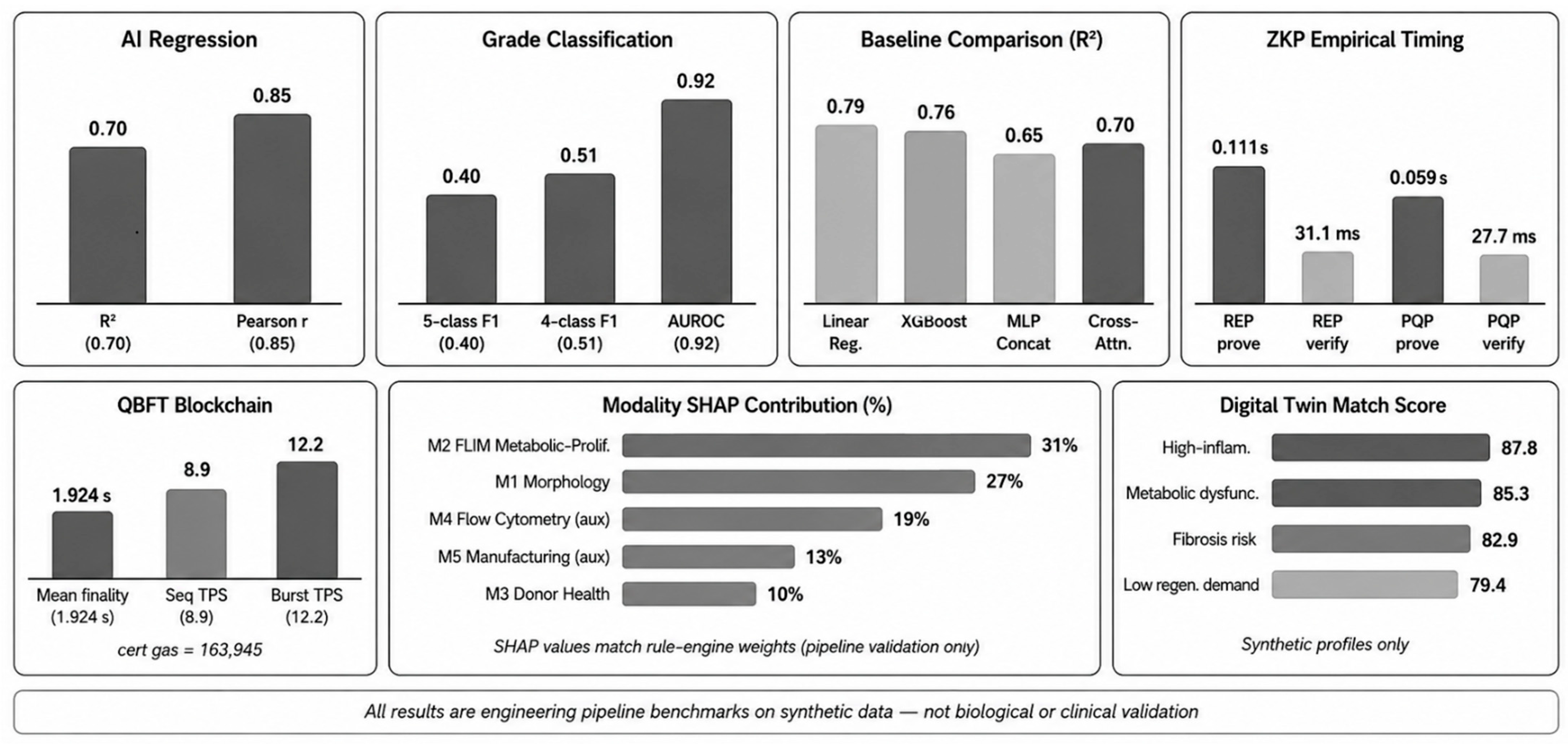
| MQS regression | R2 | 0.70 | Against rule engine ground truth |
| MQS regression | Pearson r | 0.85 | — |
| MQS regression | RMSE | 5.0 pts | On [0, 100] scale |
| Grade classification (five-class) | Macro F1 | 0.40 | S/A/B/C/D overall |
| Grade classification (five-class) | AUROC | 0.92 | One-vs-rest macro |
| Grade classification (four-class, excl. D) | Macro F1 | 0.51 | D = rule-based pre-filter |
| Cross-validation | five-fold mean F1 (five-class) | 0.40 ± 0.02 | Stratified |
| (a) | |||||||
| Grade | Precision | Recall | F1-Score | Notes | |||
| S | 0.61 | 0.58 | 0.59 | MQS ≥ 90; clearest upper boundary; relatively well separated | |||
| A | 0.48 | 0.51 | 0.49 | MQS 80–89; moderate confusion with B at lower boundary | |||
| B | 0.38 | 0.35 | 0.36 | MQS 70–79; highest confusion with A (above) and C (below) | |||
| C | 0.32 | 0.36 | 0.34 | MQS 55–69; frequent confusion with B; widest MQS span | |||
| D | 0.62 | 0.59 | 0.60 | MQS 0–54; well separated at lower boundary; excluded at QualityGateway | |||
| Macro avg. | 0.48 | 0.48 | 0.40 † | Unweighted macro average; † weighted by support: 0.40 | |||
| (b) | |||||||
| Actual\Pred. | S | A | B | C | D | ||
| S (n = 30) | 17 | 7 | 3 | 2 | 1 | ||
| A (n = 75) | 5 | 38 | 20 | 10 | 2 | ||
| B (n = 90) | 2 | 18 | 32 | 30 | 8 | ||
| C (n = 75) | 1 | 8 | 25 | 27 | 14 | ||
| D (n = 30) | 0 | 1 | 5 | 6 | 18 | ||
| Modality Group | Mean |SHAP| (%) | Representative Top Features | Remarks |
|---|---|---|---|
| M2: FLIM metabolic-proliferative | 31 | DT, NAD+ proxy, τ_mean | Consistent with rule engine weight 0.31 |
| M1: Morphology | 27 | Cytoplasm-to-nucleus ratio, nuclear circularity, filopodium length | Consistent with rule engine weight 0.27 |
| M4: Flow cytometry (auxiliary) | 19 | Viability, CD73 positivity rate | — |
| M5: Manufacturing process metadata (auxiliary) | 13 | Passage number, transport time | — |
| M3: Donor health blood panel | 10 | hsCRP, BMI, HbA1c | Consistent with rule engine weight 0.10 |
| Policy | Measurement Item | Result | Remarks |
|---|---|---|---|
| REP (MQS ≥ 70) | Proof success rate | 100% | All Grade B or above |
| REP | Mean proof generation time | 0.111 s (mean; p95 = 0.479 s) | circom2 compile + snarkjs Groth16; 47 constraints; n = 10; Intel Core i5-8400 |
| REP | Estimated on-chain verification time | 31.1 ms (mean) | EIP-1108 pairing precompile (theoretical estimate) |
| REP | Estimated on-chain verification gas | ~113,000 gas | EIP-1108 standard estimate (on-chain gas not empirically measured in this study) |
| PQP (MQS ≥ 85) | Proof success rate | 100% | Grade S/A batches only |
| PQP | Mean proof generation time | 0.059 s (mean; p95 = 0.069 s) | circom2 compile + snarkjs Groth16; 53 constraints; n = 10; Intel Core i5-8400 |
| PQP | Estimated on-chain verification time | 27.7 ms (mean) | — |
| Measurement Item | Result | Remarks |
|---|---|---|
| Validator node count | 4 | f = 1 fault tolerance |
| Mean transaction finality | 1.924 s | QBFT deterministic (empirical, mean of 30 txs; min = 1.806s, max = 2.033 s) |
| Certificate registration success rate | 100% | — |
| Event log consistency | 100% | — |
| Measured throughput | 8.9 tx/s (seq)/12.2 tx/s (burst confirmed) | Empirical (Intel i5-8400, Docker, local network) |
| Certificate registration latency | 1.910 s | storeRecord() on-chain, mean of 20 txs; gas = 163,945 |
| Patient Digital Twin Type | Optimal MSC Grade | Mean Matching Score | Remarks |
|---|---|---|---|
| High-inflammation phenotype | S/A | 87.8 | Synthetic profile; not clinical prediction |
| Metabolic dysfunction-dominant | S | 85.3 | Synthetic profile |
| Fibrosis risk-dominant | A | 82.9 | Synthetic profile |
| Low regenerative demand | B/A | 79.4 | Synthetic profile |
| Capability | MSC QC Studies | AI Cell Analysis | Healthcare Blockchain | Digital Twin Medicine | MDAF |
|---|---|---|---|---|---|
| Quantitative MSC Quality Scoring | ✓ | Partial | ✗ | ✗ | ✓ |
| Multimodal AI Fusion | Partial | ✓ | ✗ | Partial | ✓ |
| Explainable AI (SHAP) | Partial | Partial | ✗ | ✗ | ✓ |
| Blockchain Lifecycle Traceability | ✗ | ✗ | ✓ | ✗ | ✓ |
| Zero-Knowledge Proof Verification | ✗ | ✗ | Rare | ✗ | ✓ |
| Digital Quality Certificate | ✗ | ✗ | Partial | ✗ | ✓ |
| Digital Twin Patient–Batch Matching | ✗ | ✗ | ✗ | Partial | ✓ |
| End-to-End System Integration | ✗ | ✗ | ✗ | ✗ | ✓ |
Disclaimer/Publisher’s Note: The statements, opinions and data contained in all publications are solely those of the individual author(s) and contributor(s) and not of MDPI and/or the editor(s). MDPI and/or the editor(s) disclaim responsibility for any injury to people or property resulting from any ideas, methods, instructions or products referred to in the content. |
© 2026 by the authors. Licensee MDPI, Basel, Switzerland. This article is an open access article distributed under the terms and conditions of the Creative Commons Attribution (CC BY) license.
Share and Cite
Han, C.S.; Yang, J.W.; Park, S.K.; Park, M.J. MSC Digital Assetization for Personalized Regenerative Medicine: An AI–Blockchain–Digital Twin Integrated Framework. Informatics 2026, 13, 131. https://doi.org/10.3390/informatics13080131
Han CS, Yang JW, Park SK, Park MJ. MSC Digital Assetization for Personalized Regenerative Medicine: An AI–Blockchain–Digital Twin Integrated Framework. Informatics. 2026; 13(8):131. https://doi.org/10.3390/informatics13080131
Chicago/Turabian StyleHan, Chung Seok, Jin Woo Yang, Sun Koo Park, and Min Jae Park. 2026. "MSC Digital Assetization for Personalized Regenerative Medicine: An AI–Blockchain–Digital Twin Integrated Framework" Informatics 13, no. 8: 131. https://doi.org/10.3390/informatics13080131
APA StyleHan, C. S., Yang, J. W., Park, S. K., & Park, M. J. (2026). MSC Digital Assetization for Personalized Regenerative Medicine: An AI–Blockchain–Digital Twin Integrated Framework. Informatics, 13(8), 131. https://doi.org/10.3390/informatics13080131