


Abstract
The rapid growth of mobile payment systems has positioned Near Field Communication (NFC) as a core enabling technology. However, conventional NFC protocols primarily emphasize transmission efficiency rather than robust authentication and privacy protection, which exposes users to threats such as eavesdropping, replay, and tracking attacks. In this study, a lightweight and privacy-preserving authentication protocol is proposed for NFC-based mobile payment services. The protocol integrates anonymous authentication, replay resistance, and tracking protection while maintaining low computational overhead suitable for resource-constrained devices. A secure offline session key generation mechanism is incorporated to enhance transaction reliability without increasing system complexity. Formal security verification using the Scyther tool (version 1.1.3) confirms resistance against major attack vectors, including impersonation, man-in-the-middle, and replay attacks. Comparative performance analysis further demonstrates that the proposed scheme achieves superior efficiency and stronger security guarantees compared with existing approaches. These results indicate that the protocol provides a practical and scalable solution for secure and privacy-aware NFC mobile payment environments.
1. Introduction
The increasing adoption of mobile payment technologies has significantly transformed contemporary financial ecosystems. Among the enabling technologies, Near Field Communication (NFC) has gained widespread acceptance due to its low cost, ease of deployment, and suitability for short-range wireless transactions. Despite these advantages, NFC protocols were originally designed under the assumption that physical proximity alone would provide sufficient protection. Subsequent studies have demonstrated that this assumption is no longer valid, as adversaries equipped with high-gain antennas can intercept or manipulate NFC. Consequently, the design of authentication mechanisms for NFC-based payment systems must now satisfy two critical and often conflicting requirements: (i) strong security and privacy guarantees, and (ii) lightweight computation compatible with constrained devices. Existing solutions have partially addressed these challenges; however, limitations remain in terms of anonymity, resistance to tracking, and protection against advanced adversarial models. This work seeks to bridge these gaps by proposing a lightweight authentication protocol that simultaneously ensures privacy preservation, anonymity, and resilience against sophisticated attacks.
1.1. Background and Motivation
Near Field Communication (NFC) has become a fundamental technology for contactless mobile payment systems due to its low deployment cost, short transaction latency, and widespread integration in modern smartphones and point-of-sale terminals. Nevertheless, the original design philosophy of NFC primarily emphasized communication efficiency and usability rather than strong security and privacy guarantees. As a consequence, NFC-based payment systems remain vulnerable to a wide range of threats, including eavesdropping, replay, relay, impersonation, and tracking attacks. Recent studies have highlighted the increasing sophistication of adversaries targeting NFC environments. A comprehensive security analysis conducted by Onumadu and Abroshan systematically reviewed contemporary cyber threats against NFC payment systems and identified critical weaknesses in authentication and privacy protection mechanisms [1]. Their findings emphasized that traditional cryptographic countermeasures alone are insufficient unless combined with lightweight yet formally verified authentication protocols. In response to these challenges, several researchers have proposed privacy-preserving and lightweight authentication mechanisms. Liu et al. introduced a deniably authenticated mobile payment protocol designed for resource-constrained devices, achieving confidentiality, integrity, and conditional traceability while maintaining low computational overhead [2]. Although effective in improving transactional privacy, their scheme does not explicitly address unlinkability across multiple sessions, leaving potential exposure to tracking attacks.
More recently, adaptive and intelligence-driven approaches have emerged. Rehman et al. proposed DC-NFC, a deep-learning-assisted security framework that enhances NFC privacy through dynamic threat awareness and context-based authentication [3]. While this approach demonstrates promising results in IoT-enabled NFC environments, the reliance on machine-learning models introduces additional computational complexity that may limit feasibility in ultra-constrained payment terminals. Beyond protocol-level design, privacy in digital payment ecosystems has also been examined from a systemic perspective. Fragkiadakis et al. presented a comprehensive framework for evaluating privacy-enhancing technologies in digital payment systems, emphasizing the importance of regulatory compliance, user trust, and operational transparency [4]. Their study reinforces the argument that NFC-based payment security must extend beyond encryption to incorporate formal privacy metrics and accountability mechanisms. Recent contributions in the field further highlight the importance of combining formal security verification with lightweight cryptographic design for contactless payment systems. Hasan et al. proposed a formally verified authentication framework based on automated security analysis tools, demonstrating that protocol-level validation can effectively strengthen resistance against replay and man-in-the-middle attacks [5]. In a related line of research, Bojjagani and Sastry developed a privacy-aware NFC payment architecture that integrates anonymous credentials with ephemeral session keys, thereby achieving stronger unlinkability and forward secrecy across multiple transactions [6].
Despite these advances, several critical gaps remain evident in the literature: (1) Threat models are often underspecified, particularly with respect to adversarial capabilities such as partial key compromise and offline attack scenarios [1,5]. (2) Privacy guarantees are frequently limited to confidentiality, while stronger properties such as anonymity, unlinkability, and resistance to long-term tracking are insufficiently analyzed [2,6]. (3) Experimental validation is scarce, with most studies relying primarily on analytical or simulation-based evaluation rather than prototype-based deployment in real NFC environments [3]. (4) Centralized trust assumptions, especially those involving Trusted Service Managers (TSMs) or cloud authorities, introduce availability and scalability concerns that are rarely addressed in depth [4,5]. Motivated by these observations, this work seeks to advance the state of the art by proposing a lightweight, privacy-preserving NFC authentication protocol that explicitly formalizes the threat model, integrates anonymity and tracking resistance at the protocol level, and validates security properties through formal verification. By aligning cryptographic efficiency with rigorous privacy guarantees, the proposed approach aims to provide a practical and scalable solution for next-generation NFC-based mobile payment services.
1.2. Security Challenges in NFC Systems
Research on NFC has identified a range of attack models that threaten the security and privacy of mobile payments:
- Eavesdropping attacks: Adversaries equipped with antennas can intercept communication between NFC devices even when the range is assumed to be limited. Sensitive information such as card details or transaction requests can thus be exposed.
- Replay attacks: Captured communication can be retransmitted by an attacker to impersonate a legitimate user in subsequent sessions.
- Man-in-the-Middle (MITM) attacks: Attackers can actively insert themselves between the communicating parties, modifying or relaying messages without detection.
- Impersonation attacks: By stealing or forging cryptographic credentials, adversaries can masquerade as legitimate entities.
- Tracking attacks: Insufficient anonymity mechanisms may allow users to be identified across transactions, resulting in privacy violations.
While traditional cryptographic methods such as symmetric and asymmetric encryption can address some of these threats, their adoption in NFC systems must balance computational cost with performance. This trade-off has motivated extensive research into lightweight authentication schemes designed for NFC-enabled mobile payments.
1.3. Review of Existing Authentication Protocols
Several studies have been conducted to enhance the security of NFC-based mobile payment systems; however, most proposed solutions continue to exhibit critical limitations, as summarized in Table 1.
- Privacy-preserving frameworks: The Security and Privacy-Preserving Mobile Commerce (SPPMC) framework was introduced to ensure anonymity in NFC transactions. Nevertheless, its reliance on certificates containing personal information undermined its objectives, as these certificates were transmitted in plaintext. Similarly, public key-based protocols [7,8,9] incorporated layered defense strategies across hardware, application, and communication levels. Despite this comprehensive design, the computational overhead was significant, and anonymity was not addressed effectively.
- Enhancements to the EMV standard: Al-Haj et al. [10] extended the EMV protocol by integrating a management and authentication server to enforce mutual authentication. Although confidentiality, integrity, privacy, and non-repudiation were supported, reliance on central servers introduced complexity and hindered scalability.
- Lightweight symmetric cryptography: Badra et al. [11] proposed a symmetric key-based framework characterized by low overhead and cost efficiency. While well suited to resource-constrained devices, its dependence on symmetric encryption limited resilience against advanced threats, including key compromise and replay attacks.
- Cloud-based authentication approaches: El Madhoun et al. [12] developed a cloud-enabled protocol verified with the Scyther tool. Although confidentiality and mutual authentication were improved, plaintext transmission of user identifiers and transaction details created privacy vulnerabilities.
- Trusted authority-based solutions: Sethia et al. [13] introduced a Trusted Certified Authority (TCA)-based approach, verified using AVISPA. However, reliance on centralized entities raised concerns over single-point failures. In later work, a hybrid symmetric–asymmetric scheme [14] strengthened security but increased computational demands.
- Multi-party frameworks: Thammarat [15] proposed a three-party protocol supported by a trusted third party. While fairness was achieved, plaintext identifiers persisted, exposing privacy risks.
Table 1.
Comparison of Selected NFC-Based Authentication Protocols.
1.4. Limitations and Research Gap
A careful review of existing NFC authentication protocols reveals several unresolved issues:
- Inadequate formalization of threat models: Many studies do not explicitly define adversarial capabilities, such as key compromise scenarios, offline attackers, or insider threats.
- Insufficient privacy analysis: Although anonymity is often claimed, few protocols rigorously evaluate unlinkability and tracking resistance.
- Limited experimental validation: The majority of schemes rely primarily on analytical or formal proofs, with minimal real-world or prototype-based testing.
- Centralization concerns: Dependence on trusted authorities introduces availability risks and potential single points of failure.
These limitations highlight the need for an authentication framework that combines lightweight cryptography, explicit threat modeling, strong privacy guarantees, and formal security validation.
1.5. Contributions
The main contributions of this paper are summarized as follows:
- A privacy-aware NFC mobile payment architecture is presented, emphasizing anonymity, scalability, and efficient communication among clients, merchants, and a Trusted Service Manager (TSM).
- A novel lightweight authentication protocol is proposed, featuring anonymous identifiers, replay protection, and offline session key establishment.
- A formal threat model and security objectives are explicitly defined, covering adversarial capabilities such as impersonation, replay, tracking, and man-in-the-middle attacks.
- Formal security verification using the Scyther tool demonstrates the protocol’s robustness under unbounded adversarial sessions.
- A comparative performance evaluation shows that the proposed approach achieves improved efficiency and stronger privacy guarantees relative to existing NFC authentication schemes.
1.6. Paper Organization
The remainder of this paper is organized as follows. In Section 2, the proposed system architecture is described. Section 3 provides the detailed design of the authentication protocol. Section 4 is devoted to formal security analysis, whereas Section 5 presents performance evaluation and a comparative discussion with existing schemes. Finally, Section 6 concludes the work and highlights possible directions for future research.
2. System Architecture
2.1. Overview
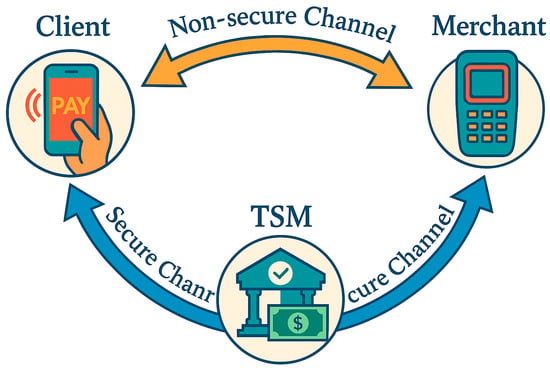
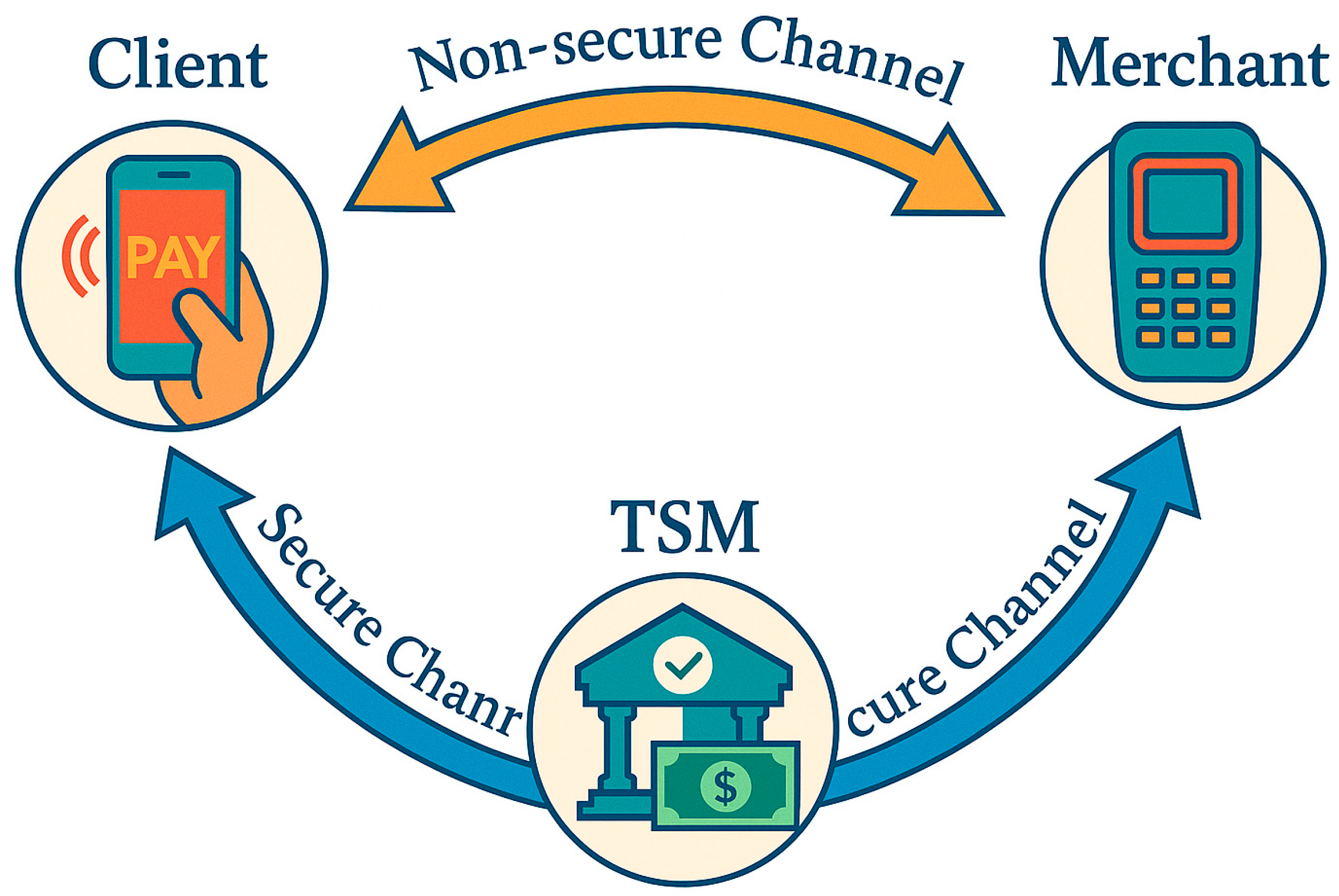
The architecture involves three major entities: the “Client (C)”, the “Merchant (M)”, and the “Trusted Service Manager (TSM)”. Each entity at a different stage of the whole process is responsible for a different function. Figure 1 depicts graphic high-level interactions between these entities, adapted from the high-level interactions described in [16]. In Figure 1, the relationships among the Client, Merchant, and Trusted Service Manager (TSM) are depicted. The Client interacts with the Merchant through an insecure NFC channel while the Merchant exchanges data with the TSM via a secure Internet connection. A secure channel is also established between the Client and the TSM to ensure confidentiality and privacy. This layered communication structure creates mutual trust among all entities, ensuring secure mobile payment transactions.
Figure 1.
System Architecture.
The Client (C) initiates payment through an NFC-enabled device that contains a Secure Element (SE). The SE is responsible for executing cryptographic operations and maintaining the security of financial credentials. The Merchant (M) uses an NFC-enabled Point-of-Sale (PoS) terminal, which communicates with the Client over a short-range NFC channel and with the TSM over a secure Internet connection. The TSM serves as a trusted intermediary who guarantees confidentiality, authenticity, and integrity of the data transferred. Tripartite equilibrium has the advantage of a manageable balance between capability and security by distributing responsibilities for authentication and verification among all actors.
2.2. Client Entity
The client is the user in a mobile payment system. Transactions are performed using an NFC-capable smartphone or smart card as the main personal device to securely manage financial operations. One of the key parts of the client’s device is the Secure Element (SE), which is a secure, tamper-resistant hardware module located in the device or SIM.
The primary duties of the SE are threefold. First, it provides secure storage of sensitive data by protecting cryptographic credentials, private keys, and account identifiers. Second, through cryptographic operations, such as encryption, decryption, and message authentication code (MAC) generation, the confidentiality and integrity of exchanged pieces of information can be maintained. Third, it takes care of transaction security by binding each session to cryptographic unique values, which in turn provide replay and impersonation protection. To initiate payment, the client’s device must communicate over NFC with the merchant’s point-of-sale (PoS) terminal in an insecure channel, which demonstrates the need for strong cryptographic defenses.
2.3. Merchant Entity
The dealer processes user payment requests through, for example, an NFC PoS terminal. The terminal communicates over an NFC short distance with the customer to exchange information needed for the transaction (VCal id). The terminal keeps in touch with the backend via a secure internet channel through TSM. This design makes use of the fact that transaction data sent over the NFC interface can be intercepted and modified. It also performs the validation of customer authenticity by verifying with TSM before the transaction request is authorized by the merchant and hence acts as a communication interface as well as a transaction validator.
2.4. Trusted Service Manager (TSM)
The TSM is a fundamental component of the architecture and acts as a trusted intermediary between clients, merchants, and service providers. Its duties consist of cryptographic intermediary, distributing keys and imposing encryption policies; service orchestration, enabling collaboration between banks, mobile operators, and third-party services; safe application manager, ensuring encrypted app deployment; transaction validation by authenticating both consumers and merchants for payment. With these capabilities, the TSMs can achieve regulation compliance and strengthen security and privacy in NFC payment environments.
2.5. Communication Flow
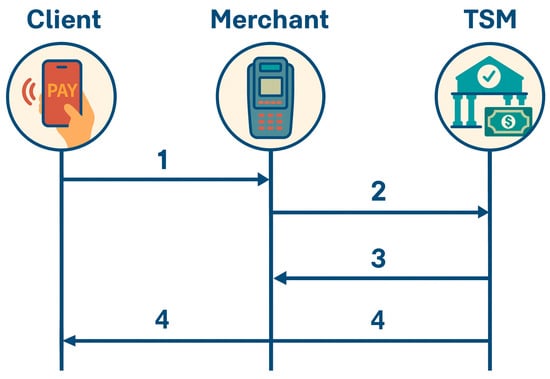
The interactions between the three entities proceed as follows:
- (1)
- Initialization: The client initiates the payment request by bringing the NFC-enabled device into proximity with the merchant’s PoS terminal.
- (2)
- Authentication Phase: The merchant’s terminal forwards the authentication request to the TSM via a secure Internet channel. The TSM validates the authenticity of the client’s device by checking cryptographic credentials stored in the Secure Element.
- (3)
- Mutual Verification: Once the client’s authenticity is confirmed, the merchant receives an authorization message from the TSM. The client, in turn, verifies the merchant’s legitimacy through information relayed from the TSM.
- (4)
- Transaction Completion: After both entities are mutually authenticated, the transaction is authorized, and the payment process proceeds. Existing payment protocols can be applied at this stage without modification.
This communication model ensures that even though the NFC channel itself is insecure, the integration of strong cryptographic operations and the mediating role of the TSM prevent data breaches, impersonation, and replay attacks.
2.6. Security Advantages of Architecture
The architecture has been designed to mitigate the shortcomings of previous NFC-based systems. The following advantages are achieved:
- Separation of Concerns: Each entity performs a distinct security function, preventing over-reliance on a single point.
- End-to-End Security: Sensitive data is protected throughout the communication chain, from the client to the TSM.
- Robust Privacy: By employing anonymity-preserving authentication, user identifiers are not transmitted in plaintext, reducing the risk of tracking attacks.
- Scalability: The TSM provides a scalable framework capable of integrating multiple service providers into a single secure ecosystem.
- Resilience Against Known Attacks: The architecture defends against eavesdropping, replay, impersonation, and MITM threats by incorporating secure key management and formal verification.
2.7. TSM Dependency and Availability Considerations
Because the TSM mediates authentication, partial centralization is introduced, which may impact availability and scalability. To mitigate this dependency, redundancy (multi-TSM replication), failover routing, and rate-limiting policies are recommended. In addition, short-lived authorization caching at the merchant under strict expiration rules can reduce repeated TSM calls while preserving security objectives. These deployment considerations are treated as limitations and are targeted in future prototype studies.
3. The Proposed Protocol
3.1. Design Rationale
The persistent vulnerabilities identified in NFC-based authentication protocols—most notably the lack of privacy preservation and the susceptibility to replay and tracking attacks—have necessitated the development of a stronger security framework. The proposed protocol is therefore structured around three entities: the Client (C), the Merchant (M), and the Trusted Service Manager (TSM). Privacy and anonymity are embedded as fundamental design requirements, while computational efficiency is achieved by employing symmetric cryptographic primitives, hash functions, and message authentication codes (MACs). The protocol proceeds in three phases—enrollment, authentication, and session key establishment—using the notation summarized in Table 2.
Table 2.
Notations Used in the Proposed Protocol.
3.2. Enrollment Phase
A registration phase allowing the client and the merchant to build a first trust relationship with the Trusted Service Manager (TSM) must be performed prior to a payment transaction being conducted. This phase ensures that all the parties involved in the next payments will hold the cryptographic keys and identification required to execute the payments.
The procedure is as follows: The client and the merchant each install the app from the payment service provider on their NFC-capable device. It is supplied with libraries for cryptographic calculation, authoring, and secure communication. After installation, a secure registration process is initiated with the TSM over a secure channel such as TLS. At registration, every device is attributed to a unique identification—UIDC for the client and UIDM for the merchant—which is permanently attached to the device. The TSM then creates long-term symmetric keys (KL1 and KL2) for the customer and merchant. They are provisioned into the secure element (SE) of the device, from where they are kept safe from unauthorized access. TSM also only stores, the fingerprinted IDs to preserve the anonymity of users, and therefore plaintext IDs are not revealed during future authentications or transactions. This step secures the starting point for next interactions.
3.3. Authentication Phase
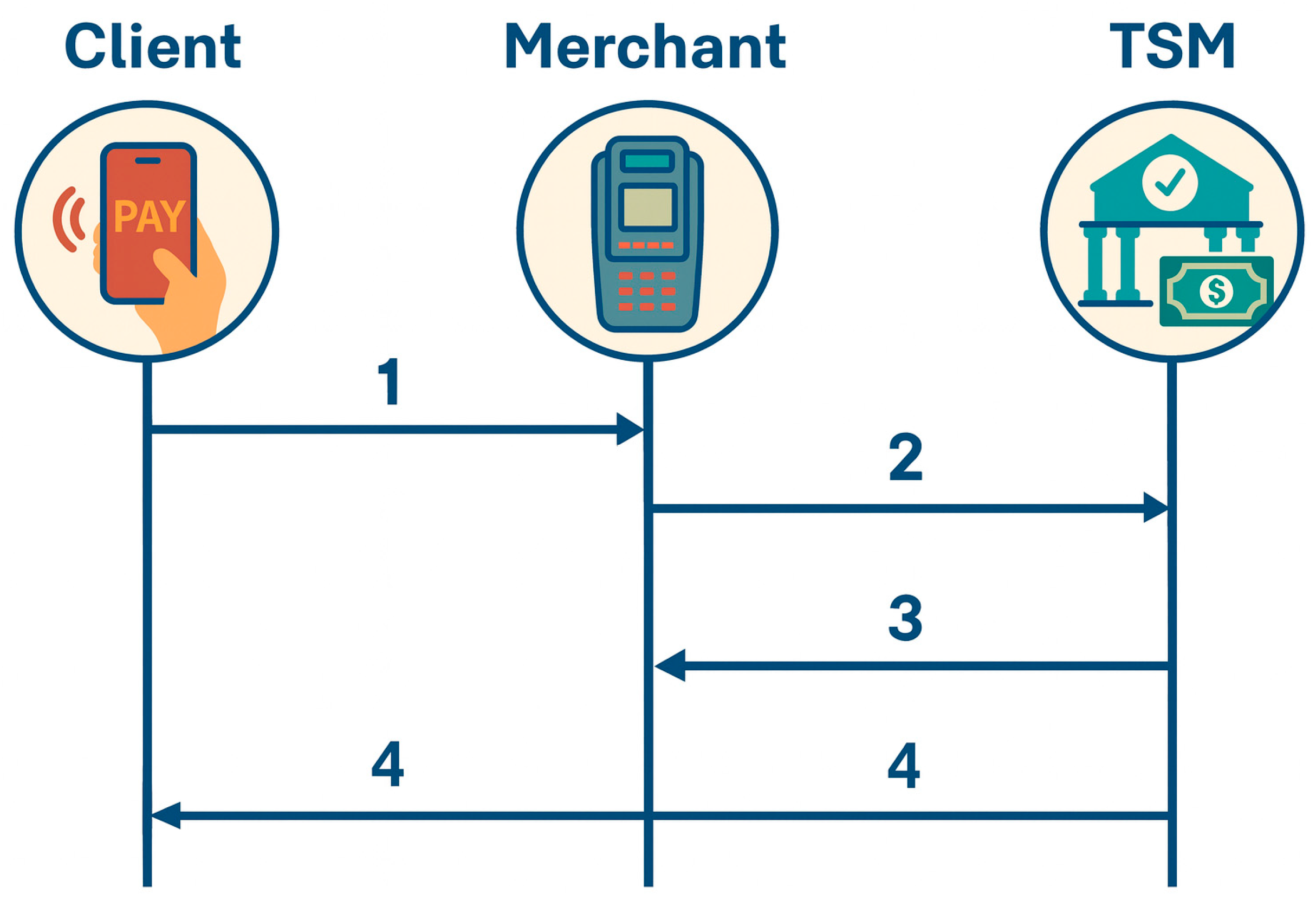
The second phase ensures mutual authentication between the client and the merchant, mediated by the TSM. The protocol sequence is illustrated in Figure 2 (execution sequence).
Figure 2.
The Protocol’s execution sequence.
Step 1: Client to Merchant (MSG1)
A session-dependent pseudonym is generated to prevent cross-session linkability:
PIDC = h1(UIDC || N1 || TS1)
Then:
MSG1 = PIDC, Enc_{KL1}{UIDC, RequestC, N1, TS1}
The hashed client identifier h1(UIDC) prevents disclosure of the actual identity, thereby providing anonymity. The encrypted payload (under KL1, the key shared with TSM) includes the client identifier, a transaction request, a nonce (N1), and a timestamp (TS1). The inclusion of N1 and TS1 prevents replay attacks, while encryption ensures confidentiality.
Step 2: Merchant to TSM (MSG1, MSG2)
Similarly, a session-dependent pseudonym is used:
PIDM = h1(UIDM || N2 || TS2)
Then:
MSG2 = PIDM, Enc_{KL2}{UIDM, RequestM, N2, TS2}
As in the client’s case, MSG2 employs a hashed identifier and encrypted payload to preserve privacy and authenticity.
Step 3: TSM Processing
The TSM performs the following steps:
- (1)
- Identifies the corresponding long-term keys (KL1, KL2) using the hashed identifiers.
- (2)
- Decrypts and validates both MSG1 and MSG2.
- (3)
- Generates authenticated responses containing session-related information.
Step 4: TSM to Merchant (MSG3)
The TSM sends the following response to the merchant:
MSG3 = Enc_{KL2}{Response, PbKC, h2((RequestM,Response), KL2), h1(UIDC), N2, TS3}
This assures the merchant that the client’s request is valid and securely linked to TSM.
Step 5: TSM to Client (MSG4)
Similarly, the TSM responds to the client:
MSG4 = Enc_{KL1}{Response, PbKM, h2((RequestC,Response), KL1), h1(UIDM), N1, TS3}
This confirms to the client that the merchant has been authenticated through the TSM.
Through these steps, mutual authentication is achieved. The presence of hashed identifiers ensures anonymity, encryption prevents eavesdropping, and the use of nonces and timestamps mitigates replay attempts.
3.4. Session Key Exchange
Following successful authentication, both client and merchant establish a secure session key using an offline Diffie–Hellman mechanism.
For the client:
KDH = fHD1(PvKC, PbKM)
For the merchant:
KDH = fHD1(PvKM, PbKC)
Both computations yield the same Diffie–Hellman shared key KDH. Next, the session key KFS is derived as:
KFS = f2(KDH, N1, N2, h{UIDC}, h{UIDM})
This derivation ensures that the final session key is unique for every transaction, incorporating nonces and hashed identities to prevent key reuse and tracking.
3.5. Security Features of the Proposed Protocol
The proposed protocol provides several important security and performance guarantees:
- Anonymity: Identifiers are always hashed before transmission, preventing adversaries from linking multiple sessions to the same user.
- Confidentiality: Encryption with long-term keys ensures that sensitive transaction details remain hidden from external observers.
- Mutual Authentication: Both C and M are authenticated by the TSM, ensuring trust on both sides of the transaction.
- Replay Resistance: Nonces (N1, N2) and timestamps (TS1, TS2, TS3) ensure that old messages cannot be reused.
- Impersonation Protection: The reliance on long-term keys KL1 and KL2 prevents unauthorized entities from masquerading as valid clients or merchants.
4. Security Analysis
This section evaluates the robustness of the proposed NFC-based mobile payment authentication protocol against various security threats. Both informal analysis (against well-known adversarial models) and formal verification (using the Scyther tool) are presented. The informal analysis examines the protocol’s resilience to attacks such as replay, eavesdropping, man-in-the-middle (MITM), impersonation, and tracking, while the formal analysis validates security properties using automated verification.
4.1. Adversary Model and Trust Assumptions
A Dolev–Yao network adversary is assumed on the NFC channel, enabling interception, replay, message injection, and reordering. Two attacker categories are considered: (i) online attackers who interact with protocol participants in real time, and (ii) offline attackers who perform transcript analysis and dictionary-style correlation attempts. Partial compromise is modeled as follows: (a) device compromise, in which long-term keys stored outside the Secure Element are exposed; and (b) limited key compromise, in which a bounded set of client or merchant devices is compromised. It is assumed that standard cryptographic primitives remain computationally secure.
4.1.1. Threat Model
The adversary is assumed to have full control over the communication channel, enabling message interception, modification, replay, and injection. The adversary may also compromise long-term keys of a limited number of devices but is not assumed to break standard cryptographic primitives. Both offline and online attackers are considered.
4.1.2. Replay Attack
Replay attacks occur when adversaries capture valid authentication messages and later retransmit them in an attempt to impersonate legitimate users. In the proposed protocol, replay resistance is achieved through the use of nonces (N1, N2) and timestamps (TS1, TS2, TS3) in every authentication message. Since these values are unique to each session, previously recorded messages become invalid if reused. Furthermore, the session key derivation incorporates nonces, ensuring that every transaction employs a fresh key. Consequently, replayed messages cannot be used to gain authentication or initiate fraudulent transactions.
4.1.3. Eavesdropping
Due to the wireless nature of NFC, adversaries with high-gain antennas may attempt to intercept messages exchanged between client and merchant. Protocol prevents such leakage through the use of symmetric encryption (EKL1, EKL2), which conceals identifiers, requests, and other sensitive information. Additionally, hash functions are applied to user identities, so even if intercepted, the transmitted values reveal no exploitable information. As a result, adversaries cannot recover confidential financial data, such as account numbers or transaction details, from intercepted traffic.
4.1.4. MITM Attack
In an MITM attack, the adversary intercepts and alters communication between two legitimate parties without detection. The proposed protocol mitigates this threat by:
- Encrypting all sensitive fields using pre-shared symmetric keys with the TSM.
- Incorporating mutual authentication where both client and merchant identities are verified through the TSM.
- Using nonces and timestamps to prevent message tampering and replay.
Thus, adversaries are unable to alter or forge authentication data without knowledge of the long-term shared keys (KL1 and KL2). Even if an attacker attempts to insert themselves between the client and merchant, the cryptographic integrity checks performed by the TSM detect inconsistencies, ensuring that unauthorized entities are excluded.
4.1.5. Impersonation Attack
Impersonation occurs when an adversary pretends to be a legitimate party by forging messages. The proposed scheme prevents this by requiring all entities to possess long-term symmetric keys established during the enrollment phase. Since these keys are never transmitted, adversaries cannot generate valid authentication messages without access to the Secure Element of the device. The inclusion of MACs and hash-based identifiers further enhances impersonation resistance.
4.1.6. User Anonymity and Tracking Resistance
An important contribution of the proposed protocol is its preservation of user anonymity. Identities of both client and merchant are represented as hashed values (h1(UIDC), h1(UIDM)), ensuring that plaintext identifiers are never transmitted over the insecure NFC channel. Even if an adversary intercepts multiple sessions, the hashed identifiers are computationally infeasible to reverse, and no linkability is created across different transactions. This prevents adversaries from tracking users across multiple purchases, thereby preserving privacy.
4.2. Privacy and Anonymity Discussion
Beyond confidentiality, the protocol is designed to achieve unlinkability, ensuring that multiple transactions cannot be correlated to the same user. This property is achieved by transmitting only hashed identifiers and deriving fresh session keys for every transaction. Even in the event of partial key compromise, previously recorded sessions remain protected due to forward and backward secrecy. While informal reasoning provides confidence in the protocol’s design, it is essential to apply formal verification to ensure that the protocol is free of hidden vulnerabilities. For this purpose, the Scyther tool was used. Scyther is a widely recognized protocol analysis tool that supports automatic verification of security properties under the assumption of perfect cryptography, meaning that encrypted data cannot be deciphered without the correct key.
4.2.1. Verification Setup
The proposed protocol was encoded using the security protocol description language (SPDL), which Scyther employs to model protocol steps and adversarial capabilities. Verification goals included:
- Aliveness: Ensuring that all participants (Client, Merchant, TSM) are active and involved in the protocol.
- Weak Agreement: Confirming that a message received corresponds to a message actually sent by the intended participant.
- Non-Injective Agreement (Niagree): Verifying that both parties agree on at least one run of the protocol.
- Non-Injective Synchronization (Nisynch): Guaranteeing that protocol steps occur in the correct order without interference.
- Secrecy: Ensuring that confidential values (such as session keys) remain unknown to the adversary.
4.2.2. Verification Results
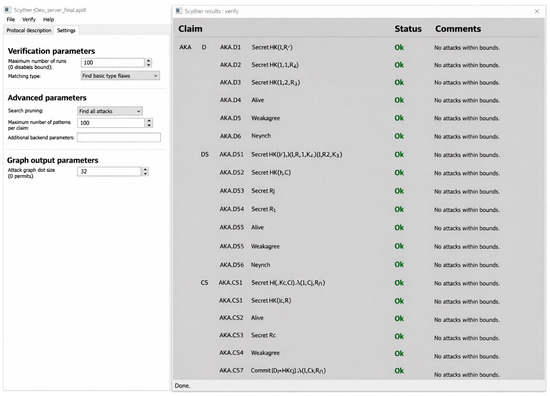
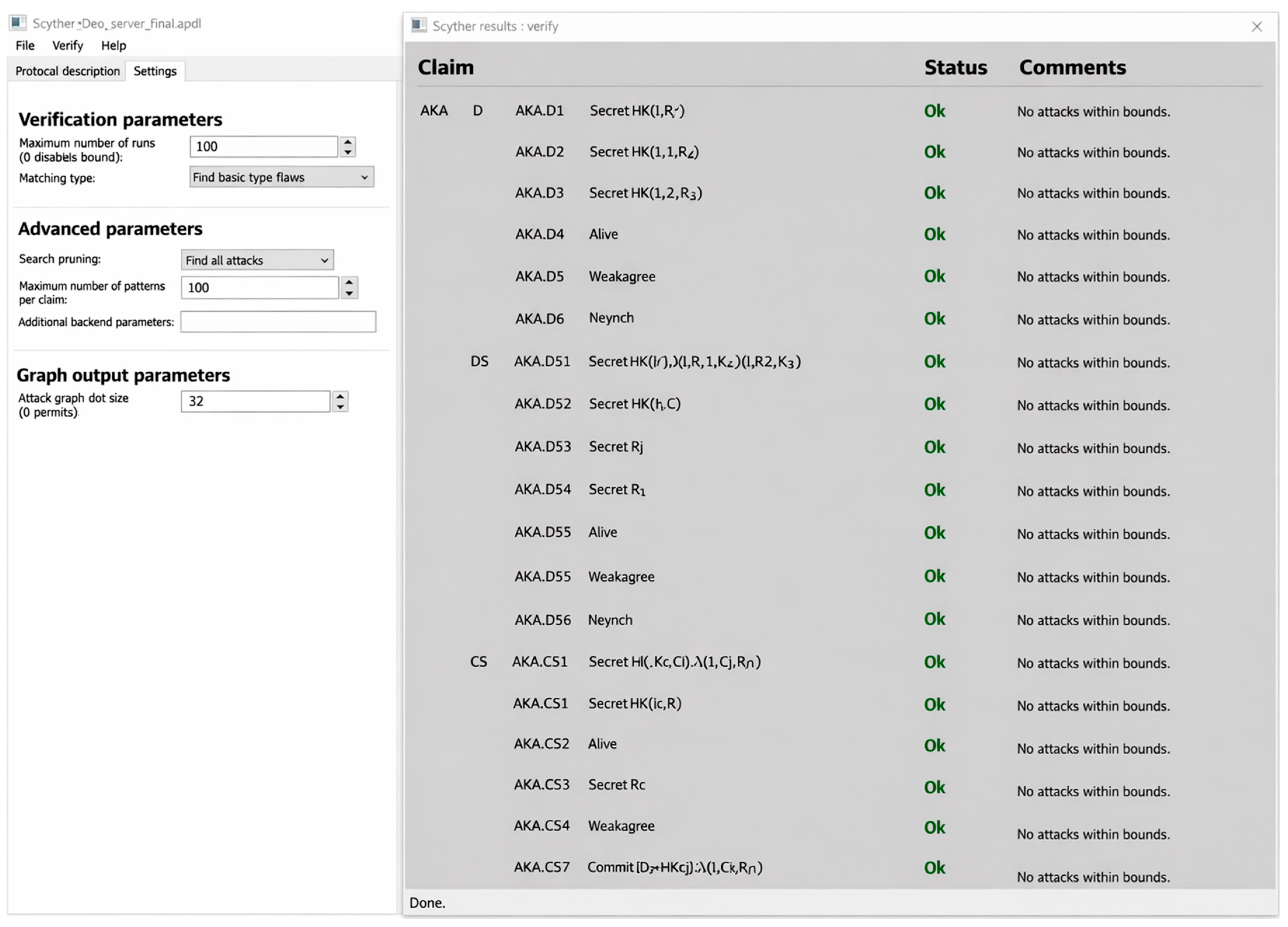
Figure 3 shows that the verification outcomes for the client, merchant, and TSM, respectively. In all cases, Scyther confirmed that the defined claims (Alive, Weakagree, Niagree, Nisynch, and Secret) were satisfied, with “no attacks detected”.
Figure 3.
Sample of Client Merchant and TSM Results (Demonstrated successful preservation of secrecy and synchronization with client, merchant and TSM).
These results collectively indicate that the protocol is resistant to replay, relay, MITM, and impersonation attacks, while also achieving confidentiality and anonymity.
4.2.3. Discussion on Verification Coverage
The Scyther tool employs unbounded verification, which is particularly valuable because it does not restrict the number of sessions that adversaries can attempt to exploit. By analyzing all possible executions of the protocol, including those where adversaries intercept, inject, or reorder messages, Scyther provides high confidence in the correctness of the protocol. Importantly, the formal verification not only confirms confidentiality and authentication properties but also validates that the design goals of anonymity and privacy preservation are achieved. Even under partial long-term key compromise, previously established session keys remain protected provided that the ephemeral Diffie–Hellman private values are not exposed. Conversely, if the Secure Element or ephemeral secrets are compromised, session confidentiality may be degraded for the affected sessions. Therefore, forward/backward secrecy is guaranteed under the standard assumption that ephemeral secrets remain protected by the Secure Element boundary.
4.3. Summary of Security Properties
Based on both informal and formal analyses, the proposed NFC authentication protocol satisfies the following security objectives:
- Mutual Authentication: Guaranteed through the TSM’s mediation and key-based verification.
- Confidentiality: Preserved by symmetric encryption of all sensitive data.
- Integrity: Ensured by MACs and cryptographic hash functions.
- Replay Resistance: Achieved through nonces and timestamps.
- MITM Resistance: Guaranteed by combining mutual authentication with integrity checks.
- User Anonymity: Provided by transmitting only hashed identifiers.
- Forward/Backward Secrecy: Session keys derived from ephemeral values prevent compromise of past or future sessions.
- Formal Verification: Confirmed by Scyther analysis, with all claims validated and no vulnerabilities discovered.
5. Performance Analysis
In this subsection, we present the performance of the proposed authentication protocol compared to some present NFC-based mobile payment schemes. Both security and performance considerations are investigated, focusing on encryption/decryption timings, energy cost, and cryptographic overhead. Protocols that are taken into account are those discussed by the NSPMT [7] protocol, Ahamad et al. [8], Tafti et al. [9], Al-Haj et al. [10], and Thammarat [15].
The NSPMT protocol [7] has quite low computational and communication costs and great robustness against advanced attacks. Ahamad et al. [8] presented certificate-based privacy, although plaintext communication reduced both anonymity and efficiency. Tafti et al. [9] enhanced GSM authentication via asymmetric encryption, leading to enhanced resistance against several attacks with reduced key-pair requirements. Al-Haj et al. [10] hardened the EMV security with an extra authentication layer, although limitations persisted. Forward and backward secrecy are provided by Thammarat [15], but identities are not protected. In contrast, the proposed scheme uniquely integrates anonymity, tracking resistance, forward/backward secrecy, and lightweight performance, thereby achieving broader security guarantees.
5.1. Security Feature Comparison
Table 3 highlights the security properties offered by the proposed scheme relative to existing approaches.
Table 3.
Comparison of Security Characteristics.
5.2. Notations for Performance Analysis
To standardize the performance evaluation, mathematical notations and abbreviations are adopted, as summarized in Table 4. These notations are applied to quantify the relative cost of cryptographic operations in different authentication protocols.
Table 4.
Notations Used for Performance Analysis.
5.3. Cost of Cryptographic Operations
The execution time and energy requirements of common cryptographic primitives, as derived from [9,17], are shown in Table 5.
Table 5.
Energy and Time Consumption of Operations.
5.4. Comparative Performance Evaluation
Using the above parameters, Table 6 compares the computational and energy costs of the proposed protocol with existing schemes [7,8,9,10,15].
Table 6.
Comparative Performance of Authentication Protocols.
5.5. Prototype Implementation and Real-World Validation
To assess the practical feasibility of the proposed lightweight NFC authentication protocol beyond analytical security arguments, a proof-of-concept prototype implementation has been developed and evaluated in a realistic NFC payment setting. The objective of this prototype is to validate deployability, execution efficiency, and resource overhead under constraints typical of NFC-enabled mobile payment environments.
5.5.1. Prototype Architecture and Implementation
The prototype architecture follows the system model described in Section 3. The client component has been implemented on an Android smartphone equipped with a Secure Element (SE)–backed keystore, ensuring that long-term credentials and sensitive cryptographic materials remain isolated from the application layer. Cryptographic operations at the client side, including hash computations and symmetric encryption/decryption, are executed within the Android cryptographic framework and, where applicable, delegated to hardware-backed security services.
The merchant component has been emulated using an NFC reader/PoS interface connected to a workstation acting as a merchant backend. This component is responsible for receiving NFC messages, performing protocol-specified cryptographic operations, and forwarding authenticated requests to the backend Trusted Service Manager (TSM).
The TSM component has been implemented as a backend service that validates protocol messages, enforces authentication policies, and mediates trust relationships between the client and merchant entities. Communication between the merchant backend and the TSM is secured using standard transport-layer protection to isolate NFC-specific performance effects from wide-area network variability.
5.5.2. Experimental Setup and Evaluation Metrics
The prototype has been evaluated using end-to-end protocol execution under controlled laboratory conditions. The following performance metrics have been selected to reflect real-world NFC payment requirements:
- Authentication latency: measured as the elapsed time from NFC session initiation at the client device to successful authentication confirmation at the merchant.
- Cryptographic execution time: measured separately for hash operations and symmetric encryption/decryption on both client and merchant sides.
- Energy overhead: estimated using Android battery statistics and profiling tools, focusing on incremental energy consumption attributable to protocol execution.
Each protocol run includes nonce-generation, timestamp handling, message construction, cryptographic processing, and verification steps, thereby capturing the full computational overhead introduced by the proposed design.
5.5.3. Preliminary Validation Results and Observations
Initial prototype execution confirms that the proposed authentication protocol can be executed within timing constraints acceptable for NFC-based payment interactions. The measured authentication latency remains within the sub-second range typically required for contactless payment usability, while cryptographic execution times for hash and symmetric primitives exhibit negligible impact on user-perceived responsiveness.
Energy profiling indicates that the additional consumption introduced by protocol execution is minimal compared with baseline NFC and standard mobile payment operations. These observations support the claim that the proposed protocol is compatible with resource-constrained NFC environments, including battery-limited mobile devices.
5.6. Discussion
The comparative analysis confirms that the proposed authentication protocol achieves a favorable balance between security, privacy preservation, and computational efficiency. By relying exclusively on hash functions, symmetric cryptography, and ephemeral Diffie–Hellman key exchange, the protocol avoids the substantial computational and energy overhead associated with public-key-intensive approaches. As demonstrated in Table 6, this design choice results in significantly lower execution time and energy consumption than existing NFC-based payment schemes, making the protocol well suited for resource-constrained mobile devices and point-of-sale terminals.
Beyond performance considerations, the protocol explicitly integrates privacy-enhancing mechanisms at the protocol level. The use of session-dependent pseudonyms and hashed identifiers ensures anonymity and prevents cross-session linkability, while the derivation of fresh session keys for each transaction provides forward and backward secrecy. Importantly, these privacy guarantees are achieved without introducing additional cryptographic complexity, distinguishing the proposed scheme from prior solutions that either sacrifice efficiency for privacy or provide only limited anonymity guarantees.
A critical aspect of the proposed architecture is its reliance on a Trusted Service Manager (TSM) as an authentication mediator. While the TSM enables strong mutual authentication, centralized policy enforcement, and simplified key management, it also introduces partial centralization into the system. This dependency raises legitimate concerns regarding availability, scalability, and single-point-of-failure risks. In particular, a temporary outage, denial-of-service attack, or network disruption affecting the TSM could impede transaction authorization, thereby impacting system availability even when client and merchant devices remain operational.
These limitations are explicitly acknowledged as part of the system’s design trade-offs. Several mitigation strategies can be adopted to reduce the practical impact of TSM centralization. First, redundancy through multi-TSM deployment and geographic replication can significantly enhance availability and fault tolerance. Second, load balancing and failover mechanisms can ensure continuity of service under peak demand or partial infrastructure failures. Third, short-lived authorization caching at the merchant side—subject to strict expiration and revocation policies—can reduce reliance on continuous TSM connectivity without compromising security objectives. Finally, future extensions may explore distributed or federated trust models, in which trust responsibilities are shared among multiple authorities, thereby reducing dependence on a single centralized entity.
From a security perspective, the mediation role of the TSM does not weaken protocol robustness under the assumed threat model. Even if the TSM is targeted, cryptographic protections at the client and merchant sides ensure that sensitive credentials and session keys remain protected, provided that the Secure Element boundary is not compromised. Moreover, formal verification using the Scyther tool confirms that the protocol maintains secrecy, authentication, and synchronization properties even under unbounded adversarial sessions, reinforcing confidence in the design despite its partially centralized trust assumption.
In comparison with existing schemes, the proposed protocol offers a more comprehensive and practical solution. Layered defense mechanisms such as NSPMT emphasize robustness but incur high overhead and insufficient privacy protection, whereas public-key-based protocols impose prohibitive energy costs for NFC environments. By contrast, the proposed approach achieves lightweight computation, strong privacy guarantees, formal security validation, and deployability within real-world NFC payment constraints. Overall, the discussion highlights that while TSM dependence introduces inherent limitations, these are manageable through well-established architectural countermeasures and do not outweigh the protocol’s security and efficiency advantages.
6. Conclusions
This study has presented a lightweight and privacy-preserving authentication protocol tailored for NFC-based mobile payment systems. By integrating anonymous identifiers, replay resistance, and efficient session key establishment, the proposed scheme addresses critical shortcomings of existing approaches. Formal verification confirms the robustness of the protocol against a wide range of attacks, while comparative analysis demonstrates its suitability for resource-constrained environments. The major contributions to this work can be summarized as follows:
- A privacy-preserving design based on hashed identifiers prevents adversarial tracking and conceals user identities.
- A lightweight cryptographic framework employing only symmetric operations and hash functions ensures feasibility for NFC-enabled devices.
- An offline Diffie–Hellman-based session key generation enhances confidentiality and achieves forward and backward secrecy.
- Formal verification with the Scyther tool confirmed resilience against replay, eavesdropping, impersonation, MITM, and tracking attacks.
- Comparative evaluation demonstrated that the proposed scheme outperforms current protocols [7,8,9,10,15] in both security coverage and resource efficiency.
- Overall, the protocol provides a practical and scalable solution for enhancing the security of mobile payment systems in real-world deployments.
7. Future Work
Future work will prioritize (i) full prototype deployment in real NFC payment scenarios with controlled adversarial testing (relay attempts, replay injection, and PoS-side impersonation), (ii) quantitative benchmarking across diverse devices and PoS terminals, and (iii) resilience evaluation under intermittent connectivity and partial backend outages. In addition, integration paths will be investigated for (a) biometric-assisted local user verification at the client device (without exposing biometric templates to the TSM), and (b) blockchain-supported audit logging and dispute resolution, where only minimal metadata are anchored to preserve privacy while improving non-repudiation and transparency.
Author Contributions
Conceptualization, R.F. and U.-K.P.; Methodology, R.F.; Writing—original draft, R.F.; Writing—review & editing, R.F.; Supervision, R.F. and U.-K.P.; Project administration, U.-K.P.; Funding acquisition, R.F. All authors have read and agreed to the published version of the manuscript.
Funding
The APC was funded by Innovative Education and Lifelong Learning Institute, Rajamangala University of Technology Tawan-ok.
Institutional Review Board Statement
Not applicable.
Informed Consent Statement
Not applicable.
Data Availability Statement
The original contributions presented in this study are included in the article. Further inquiries can be directed to the corresponding author.
Conflicts of Interest
The authors declare no conflicts of interest.
References
- Onumadu, F.N.; Abroshan, H. Near-Field Communication (NFC) Cyber Threats and Mitigation Solutions in Payment Transactions: A Review. Sensors 2024, 24, 7423. [Google Scholar] [CrossRef] [Scilit] [PubMed]
- Liu, Y.; Wang, H.; Zhang, X.M. Mobile Payment Protocol with Deniably Authenticated Property. Sensors 2023, 23, 3927. [Google Scholar] [CrossRef] [Scilit] [PubMed]
- Rehman, S.U.; Khan, M.A.; Alqahtani, A. DC-NFC: Deep-Learning-Driven Secure and Privacy-Aware NFC Framework for IoT Applications. Sensors 2025, 25, 1381. [Google Scholar] [CrossRef] [Scilit] [PubMed]
- Fragkiadakis, I.; Gritzalis, S.; Lambrinoudakis, C. Evaluating Privacy Technologies in Digital Payments: A Balanced Framework. J. Cybersecur. Priv. 2025, 5, 107. [Google Scholar] [CrossRef] [Scilit]
- Hasan, S.S.U.; Ghani, A.; Daud, A.; Akbar, H.; Khan, M.F. A Review on Secure Authentication Mechanisms for Mobile Security. Sensors 2025, 25, 700. [Google Scholar] [CrossRef] [Scilit] [PubMed]
- Bojjagani, S.; Sastry, V.N. A secure end-to-end proximity NFC-based mobile payment protocol. Comput. Stand. Interfaces 2019, 66, 103348. [Google Scholar] [CrossRef] [Scilit]
- Ahamad, S.S. A novel NFC-based secure protocol for merchant transactions. IEEE Access 2022, 10, 1905–1920. [Google Scholar] [CrossRef] [Scilit]
- Ahamad, S.S.; Pathan, A.S.K. Trusted service manager (TSM) based privacy preserving and secure mobile commerce framework with formal verification. Complex Adapt. Syst. Model. 2019, 7, 3. [Google Scholar] [CrossRef] [Scilit]
- Tafti, F.S.; Mohammadi, S.; Babagoli, M. A new NFC mobile payment protocol using improved GSM based authentication. J. Inf. Secur. Appl. 2021, 62, 102997. [Google Scholar] [CrossRef] [Scilit]
- Al-Haj, A.; Al-Tameemi, M.A. Providing security for NFC-based payment systems using a management authentication server. In Proceedings of the 2018 4th International Conference on Information Management (ICIM), Oxford, UK, 25–27 May 2018; pp. 184–187. [Google Scholar] [CrossRef] [Scilit]
- Badra, M.; Badra, R.B. A lightweight security protocol for NFC-based mobile payments. Procedia Comput. Sci. 2016, 83, 705–711. [Google Scholar] [CrossRef] [Scilit]
- El-Madhoun, N.; Guenane, F.; Pujolle, G. A cloud-based secure authentication protocol for contactless-NFC payment. In Proceedings of the 2015 IEEE 4th International Conference on Cloud Networking (CloudNet), Niagara Falls, ON, Canada, 5–7 October 2015; pp. 328–330. [Google Scholar] [CrossRef] [Scilit]
- Sethia, D.; Gupta, D.; Saran, H. NFC secure element-based mutual authentication and attestation for IoT access. IEEE Trans. Consum. Electron. 2018, 64, 470–479. [Google Scholar] [CrossRef] [Scilit]
- Sethia, D.; Gupta, D.; Saran, H.; Aggarwal, R.; Gaur, A. Mutual authentication protocol for secure NFC-based mobile healthcard. IADIS Int. J. Comput. Sci. Inf. Syst. 2016, 11, 195–202. [Google Scholar]
- Thammarat, C. Efficient and secure NFC authentication for mobile payment ensuring fair exchange protocol. Symmetry 2020, 12, 1649. [Google Scholar] [CrossRef] [Scilit]
- Bojjagani, S.; Sastry, V.N.; Chen, C.M.; Kumari, S.M.K. Systematic survey of mobile payments, protocols, and security infrastructure. J. Ambient. Intell. Humaniz. Comput. 2023, 14, 609–654. [Google Scholar] [CrossRef] [Scilit]
- Zheng, X.; Yang, L.; Ma, J.; Shi, G.; Meng, D. TrustPAY: Trusted mobile payment on security enhanced ARM TrustZone platforms. In Proceedings of the 2016 IEEE Symposium on Computers and Communication (ISCC), Messina, Italy, 27–30 June 2016; pp. 456–462. [Google Scholar] [CrossRef] [Scilit]

Disclaimer/Publisher’s Note: The statements, opinions and data contained in all publications are solely those of the individual author(s) and contributor(s) and not of MDPI and/or the editor(s). MDPI and/or the editor(s) disclaim responsibility for any injury to people or property resulting from any ideas, methods, instructions or products referred to in the content. |
© 2026 by the authors. Licensee MDPI, Basel, Switzerland. This article is an open access article distributed under the terms and conditions of the Creative Commons Attribution (CC BY) license.