
Generative AI in Developing Countries: Adoption Dynamics in Vietnamese Local Government

 , and
, and 
Abstract
1. Introduction
2. Literature Review
2.1. Generative AI and Traditional AI: Conceptual Distinctions
2.2. Empirical Evidence on AI and GenAI Adoption in the Public Sector
2.2.1. Drivers and Enablers of Adoption
2.2.2. Barriers: Ethical, Political, and Sociological Considerations
2.2.3. Developed vs. Developing Countries: Divergent Adoption Patterns
2.2.4. Gaps in Research on GenAI Adoption in Local Government
2.3. Technology–Organization–Environment (TOE) Framework
3. Methods
3.1. Research Design
3.2. Study Area
3.3. Data Collection and Participants
3.4. Data Analysis
4. Results
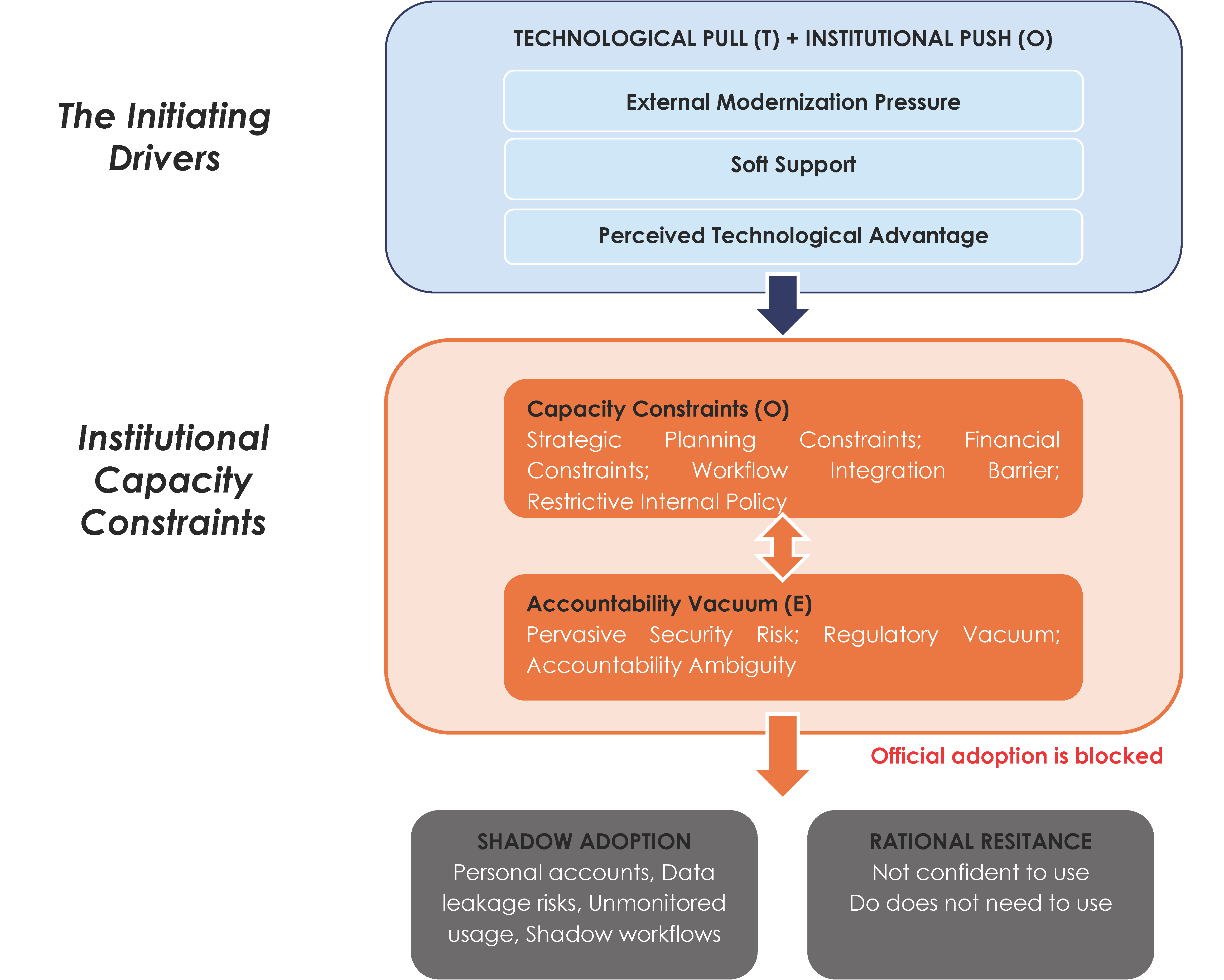
4.1. The Initiating Drivers
4.1.1. Technological Pull
4.1.2. Institutional Push
4.2. Institutional Capacity Constraints
4.2.1. Absence of Clear Implementation Plans
4.2.2. Insufficient and Unequal Funding
4.2.3. Lack of Integration into Government Systems
4.2.4. Basic and Insufficient Training Provision
4.3. Barriers to Formal Adoption
4.3.1. The AI Accountability Vacuum
Security Risks
Regulatory Void
Accountability Ambiguity
4.3.2. Shadow Workflows and the Emergence of Hidden Practices
4.3.3. The Rise of Double-Check Behavior
4.3.4. Fears of Deskilling and Replacement
5. Discussion
6. Conclusions
6.1. Theoretical and Practical Implications
6.2. Limitations and Future Research
Author Contributions
Funding
Institutional Review Board Statement
Informed Consent Statement
Data Availability Statement
Conflicts of Interest
References
- Nguyen, T.T.; Pham, T.A.T.; Tram, H.T.X. Role of Information and Communication Technologies and Innovation in Driving Carbon Emissions and Economic Growth in Selected G-20 Countries. J. Environ. Manag. 2020, 261, 110162. [Google Scholar] [CrossRef] [Scilit] [PubMed]
- Budai, B.B.; Csuhai, S.; Tózsa, I. Digital Competence Development in Public Administration Higher Education. Sustainability 2023, 15, 12462. [Google Scholar] [CrossRef] [Scilit]
- Chen, B.; Wu, Z.; Zhao, R. From Fiction to Fact: The Growing Role of Generative AI in Business and Finance. J. Chin. Econ. Bus. Stud. 2023, 21, 471–496. [Google Scholar] [CrossRef] [Scilit]
- Liu, Y.; Huang, J.; Wang, H. Who on Earth Is Using Generative AI? Global Trends and Shifts in 2025; Policy Research Working Paper; World Bank Group: Washington, DC, USA, 2025; Available online: http://documents.worldbank.org/curated/en/099856110152535288 (accessed on 20 November 2025).
- Bick, A.; Blandin, A.; Deming, D.J. The Rapid Adoption of Generative AI; NBER Working Paper No. 32966; National Bureau of Economic Research: Cambridge, MA, USA, 2024. [Google Scholar] [CrossRef] [Scilit]
- Mergel, I.; Dickinson, H.; Stenvall, J.; Gasco, M. Implementing AI in the Public Sector. Public Manag. Rev. 2023, 1–14. [Google Scholar] [CrossRef] [Scilit]
- van Noordt, C.; Misuraca, G. Artificial Intelligence for the Public Sector: Results of Landscaping the Use of AI in Government across the European Union. Gov. Inf. Q. 2022, 39, 101714. [Google Scholar] [CrossRef] [Scilit]
- Desouza, K.C. Artificial Intelligence in the Public Sector: A Maturity Model; IBM Center for The Business of Government: Washington, DC, USA, 2021. [Google Scholar]
- Barrow, O. AI in Local Government: Emerging Applications, Risks, and Challenges. Available online: https://fiscalnote.com/blog/artificial-intelligence-local-government (accessed on 25 October 2025).
- Carrasco, M.; Habib, C.; Felden, F.; Sargeant, R.; Mills, S.; Shenton, S.; Dando, G. Generative AI for the Public Sector: From Opportunities to Value; Boston Consulting Group: Boston, MA, USA, 2023. [Google Scholar]
- Kempeneer, S.; Heylen, F. Virtual State, Where Are You? A Literature Review, Framework and Agenda for Failed Digital Transformation. Big Data Soc. 2023, 10, 20539517231160528. [Google Scholar] [CrossRef] [Scilit]
- Mikalef, P.; Lemmer, K.; Schaefer, C.; Ylinen, M.; Fjørtoft, S.O.; Torvatn, H.Y.; Gupta, M.; Niehaves, B. Enabling AI Capabilities in Government Agencies: A Study of Determinants for European Municipalities. Gov. Inf. Q. 2022, 39, 101596. [Google Scholar] [CrossRef] [Scilit]
- Selten, F.; Klievink, B. Organizing Public Sector AI Adoption: Navigating between Separation and Integration. Gov. Inf. Q. 2024, 41, 101885. [Google Scholar] [CrossRef] [Scilit]
- Nhi, A. Digital Economy Contributes 14.02% to Vietnam’s GDP. VnEconomy. 2026. Available online: https://en.vneconomy.vn/digital-economy-contributes-1402-to-vietnams-gdp.htm (accessed on 15 January 2026).
- Vietnam Briefing. Vietnam’s Digital Infrastructure Master Plan to 2030: Roadmap to a High-Tech Future. 15 February 2024. Available online: https://www.vietnam-briefing.com/news/vietnams-digital-infrastructure-master-plan-2030-roadmap-to-a-high-tech-future.html (accessed on 15 January 2026).
- Government of Vietnam. National Digital Transformation Program to 2025, Orientation to 2030; Ministry of Information and Communications: Hanoi, Vietnam, 2020. [Google Scholar]
- Vietstock. Vietnam Ranks 38th in Global AI Adoption. 2026. Available online: https://en.vietstock.vn/2026/01/vietnam-ranks-38th-in-global-ai-adoption-974-628099.htm (accessed on 15 January 2026).
- Government of Vietnam. National Strategy on Research, Development and Application of Artificial Intelligence Until the Year 2030; Government of Vietnam: Hanoi, Vietnam, 2021. [Google Scholar]
- VietNamNet News. Vietnam Sets 5G Infrastructure Target at 50% of 4G Base Stations by 2025. 2025. Available online: https://vietnamnet.vn/en/vietnam-sets-5g-infrastructure-target-at-50-of-4g-base-stations-by-2025-2421536.html (accessed on 15 January 2026).
- FPT Corporation. FPT Inaugurates Vietnam’s Largest Data Center: Empowering National Digital Sovereignty and Paving the Way for the AI Era. Tập Đoàn FPT. 2025. Available online: https://fpt.com/en/news/fpt-news/fpt-khanh-thanh-trung-tam-du-lieu-quy-mo-lon-nhat-viet-nam (accessed on 15 January 2026).
- Government of Vietnam. Decree No. 13/2023/ND-CP on Personal Data Protection; Government of Vietnam: Hanoi, Vietnam, 2023. [Google Scholar]
- Ministry of Information and Communications. Draft Law on Digital Technology Industry; Ministry of Information and Communications: Hanoi, Vietnam, 2025. [Google Scholar]
- VnExpress. VinBigdata ra mắt ứng dụng ViGPT [VinBigdata Launches ViGPT Application]. 2023. Available online: https://vnexpress.net/vinbigdata-ra-mat-ung-dung-vigpt-4693202.html (accessed on 15 January 2026).
- VnExpress. VinAI ra mắt mô hình ngôn ngữ lớn tên PhởGPT [VinAI Launches Large Language Model Named PhoGPT]. 2023. Available online: https://vnexpress.net/vinai-ra-mat-mo-hinh-ngon-ngu-lon-ten-phogpt-4685065.html (accessed on 15 January 2026).
- UNDP Vietnam; IPS. Quick Assessment of Application of Artificial Intelligence (AI) in Vietnam Public Sector: Policy Recommendations. 2025. Available online: https://www.undp.org/vi/vietnam/publications/danh-gia-nhanh-ve-ung-dung-tri-tue-nhan-tao-ai-trong-co-quan-nha-nuoc-tai-viet-nam-khuyen-nghi-chinh-sach (accessed on 27 June 2025).
- Fontana, S.; Errico, B.; Bisogni, F.; Renwick, R. AI and GenAI Adoption by Local and Regional Administrations; Publications Office of the European Union: Luxembourg, 2025. [Google Scholar] [CrossRef]
- Dwivedi, Y.K.; Kshetri, N.; Hughes, L.; Slade, E.L.; Jeyaraj, A.; Kar, A.K.; Baabdullah, A.M.; Koohang, A.; Raghavan, V.; Ahuja, M.; et al. Opinion Paper: “So What If ChatGPT Wrote It?” Multidisciplinary Perspectives on Opportunities, Challenges and Implications of Generative Conversational AI for Research, Practice and Policy. Int. J. Inf. Manag. 2023, 71, 102642. [Google Scholar] [CrossRef] [Scilit]
- Moon, J.; Choi, J.W.; Kim, K.H. Regional Disparities in Safe and Clean Environments in Uzbekistan: Analysis of 2021–2022 Uzbekistan Multiple Indicator Cluster Survey Data. Sustainbility 2024, 16, 1580. [Google Scholar] [CrossRef] [Scilit]
- Sun, T.Q.; Medaglia, R. Mapping the Challenges of Artificial Intelligence in the Public Sector: Evidence from Public Healthcare. Gov. Inf. Q. 2019, 36, 368–383. [Google Scholar] [CrossRef] [Scilit]
- Hughes, L.; Davies, F.; Li, K.; Gunaratnege, S.M.; Malik, T.; Dwivedi, Y.K. Beyond the Hype: Organisational Adoption of Generative AI through the Lens of the TOE Framework–A Mixed Methods Perspective. Int. J. Inf. Manag. 2026, 86, 102982. [Google Scholar] [CrossRef] [Scilit]
- Tornatzky, L.G.; Fleischer, M.; Tansik, A.D. The Processes of Technological Innovation; Lexington Books: Lexington, MA, USA, 1990. [Google Scholar]
- Chatterjee, S.; Rana, N.P.; Dwivedi, Y.K.; Baabdullah, A.M. Understanding AI Adoption in Manufacturing and Production Firms Using an Integrated TAM-TOE Model. Technol. Forecast. Soc. Change 2021, 170, 120880. [Google Scholar] [CrossRef] [Scilit]
- Braun, V.; Clarke, V. Using Thematic Analysis in Psychology. Qual. Res. Psychol. 2006, 3, 77–101. [Google Scholar] [CrossRef] [Scilit]
- GeeksforGeeks. Generative AI vs. Traditional AI. Available online: https://www.geeksforgeeks.org/blogs/difference-between-generative-ai-and-traditional-ai/ (accessed on 23 August 2025).
- Carolus, A.; Augustin, Y.; Markus, A.; Wienrich, C. Digital Interaction Literacy Model—Conceptualizing Competencies for Literate Interactions with Voice-Based AI Systems. Comput. Educ. Artif. Intell. 2023, 4, 100114. [Google Scholar] [CrossRef] [Scilit]
- Shin, S.-C.; Ho, J.-W.; Pak, V.Y. Digital Transformation through e-Government Innovation in Uzbekistan. In Proceedings of the 2020 22nd International Conference on Advanced Communication Technology (ICACT), Phoenix Park, Republic of Korea, 16–19 February 2020; pp. 632–639. [Google Scholar] [CrossRef] [Scilit]
- Pulkkinen, J.; Huttu, K.; Suhonen, M. Systemic Challenges in AI Adoption in Public Social and Health Organizations in Finland: A Technology-Organisation-Environment Perspective. J. Health Organ. Manag. 2025, 39, 435–456. [Google Scholar] [CrossRef] [Scilit]
- Tangi, L.; Rodriguez Müller, A.P.; Janssen, M. AI-Augmented Government Transformation: Organisational Transformation and the Sociotechnical Implications of Artificial Intelligence in Public Administrations. Gov. Inf. Q. 2025, 42, 102055. [Google Scholar] [CrossRef] [Scilit]
- Alamäki, A. Expanding AI Adoption in Public Sector Organizations: Perspectives on Management Practices. Transform. Gov. People Process Policy 2025. ahead-of-print. [Google Scholar] [CrossRef] [Scilit]
- Haesevoets, T.; Verschuere, B.; Roets, A. AI Adoption in Public Administration: Perspectives of Public Sector Managers and Public Sector Non-Managerial Employees. Gov. Inf. Q. 2025, 42, 102029. [Google Scholar] [CrossRef] [Scilit]
- Ribeiro, M.M.; Segatto, C.I. Artificial Intelligence in Brazilian Public Organizations: Heterogeneities and Capacity in Information Technology. Rev. Adm. Pública 2025, 59, e2024-0066. [Google Scholar] [CrossRef] [Scilit]
- Cantens, T. How Will the State Think with ChatGPT? The Challenges of Generative Artificial Intelligence for Public Administrations. AI Soc. 2025, 40, 133–144. [Google Scholar] [CrossRef] [Scilit]
- Dorhetso, S.N.; Quarshie, B.D. Ratings of Driving Factors for the Adoption and Implementation of Artificial Intelligence in the Public Sector. Open Access Libr. J. 2023, 10, 1–20. [Google Scholar] [CrossRef]
- Omonov, M.S.; Ahn, Y. Towards Smart Public Administration: A TOE-Based Empirical Study of AI Chatbot Adoption in a Transitioning Government Context. Adm. Sci. 2025, 15, 324. [Google Scholar] [CrossRef] [Scilit]
- Setthasuravich, P.; Sirikhan, K.; Kato, H. Spatial Econometric Analysis of the Digital Divide in Thailand at the Sub-District Level: Patterns and Determinants. Telecomm. Policy 2024, 48, 102818. [Google Scholar] [CrossRef] [Scilit]
- Prachumrasee, K.; Kamnuansilpa, P.; Setthasuravich, P. Digital Public Service Ecosystems in Local Governance: Insights from Northeastern Thailand’s Local Administrative Organizations. FWU J. Soc. Sci. 2025, 19, 111–135. [Google Scholar] [CrossRef] [Scilit] [PubMed]
- Rice, R.E.; Wu, M.-Y. Difference in and Influences on Public Opinion About Artificial Intelligence in 20 Economies: Reducing Uncertainty Through Awareness, Knowledge, and Trust. Int. J. Commun. 2025, 19, 20–42. [Google Scholar]
- Henk, A.; Henk, O. From Antecedents to Outcomes: A Structured Literature Review on AI Implementation in Public Sector Organizations. In Proceedings of the 58th Hawaii International Conference on System Sciences (HICSS), Waikoloa, HI, USA, 7–10 January 2025; pp. 1878–1887. [Google Scholar] [CrossRef] [Scilit]
- Hradecky, D.; Kennell, J.; Cai, W.; Davidson, R. Organizational Readiness to Adopt Artificial Intelligence in the Exhibition Sector in Western Europe. Int. J. Inf. Manag. 2022, 65, 102497. [Google Scholar] [CrossRef] [Scilit]
- Salah, O.H.; Ayyash, M.M. E-Commerce Adoption by SMEs and Its Effect on Marketing Performance: An Extended of TOE Framework with Ai Integration, Innovation Culture, and Customer Tech-Savviness. J. Open Innov. Technol. Mark. Complex. 2024, 10, 100183. [Google Scholar] [CrossRef] [Scilit]
- Adade, D.; de Vries, W.T. An Extended TOE Framework for Local Government Technology Adoption for Citizen Participation: Insights for City Digital Twins for Collaborative Planning. Transform. Gov. People Process Policy 2024, 19, 53–73. [Google Scholar] [CrossRef] [Scilit]
- Maragno, G.; Tangi, L.; Gastaldi, L.; Benedetti, M. Exploring the Factors, Affordances and Constraints Outlining the Implementation of Artificial Intelligence in Public Sector Organizations. Int. J. Inf. Manag. 2023, 73, 102686. [Google Scholar] [CrossRef] [Scilit]
- Rana, N.P.; Pillai, R.; Sivathanu, B.; Malik, N. Assessing the Nexus of Generative AI Adoption, Ethical Considerations and Organizational Performance. Technovation 2024, 135, 103064. [Google Scholar] [CrossRef] [Scilit]
- Malhotra, M.K.; Grover, V. An Assessment of Survey Research in POM: From Constructs to Theory. J. Oper. Manag. 1998, 16, 407–425. [Google Scholar] [CrossRef] [Scilit]
- Fosso Wamba, S.; Queiroz, M.M.; Trinchera, L. The Role of Artificial Intelligence-Enabled Dynamic Capability on Environmental Performance: The Mediation Effect of a Data-Driven Culture in France and the USA. Int. J. Prod. Econ. 2024, 268, 109131. [Google Scholar] [CrossRef] [Scilit]
- Stubbs, A. Digital Participatory Democracy: A Normative Framework for the Democratic Governance of the Digital Commons. J. Soc. Philos. 2023, 54, 385–403. [Google Scholar] [CrossRef] [Scilit]
- Cohen, L.; Manion, L.; Morrison, K. Research Methods in Education; Routledge: London, UK, 2007. [Google Scholar]
- Holloway, I.; Wheeler, S. Qualitative Research in Nursing and Healthcare, 3rd ed.; Wiley Blackwell: Oxford, UK, 2010. [Google Scholar]
- World Trade Centers Association. Binh Duong Ranked 2nd Nationwide in FDI Attraction. Available online: https://www.wtca.org/news/binh-duong-ranked-2nd-nationwide-in-fdi-attraction (accessed on 13 December 2024).
- Intelligent Community Forum. ICF Announces VIP Delegation to Binh Duong Smart City for 2025 Global Summit. Available online: https://www.intelligentcommunity.org/ (accessed on 27 August 2025).
- Ministry of Information and Communications. Report on Digital Transformation Assessment Index (DTI) of Ministries and Provinces in 2023. Available online: https://www.vietnam.vn/en/ (accessed on 20 November 2025).
- Bryman, A.; Bell, E. Business Research Methods, 3rd ed.; Oxford University Press: Oxford, UK, 2011. [Google Scholar]
- Malterud, K.; Siersma, V.D.; Guassora, A.D. Sample size in qualitative interview studies: Guided by information power. Qual. Health Res. 2016, 26, 1753–1760. [Google Scholar] [CrossRef] [Scilit]
- Lincoln, Y.S. Naturalistic Inquiry; Sage: Newbury Park, CA, USA, 1985. [Google Scholar]
- Silverman, D. Doing Qualitative Research: A Comprehensive Guide; Sage: Los Angeles, CA, USA, 2008. [Google Scholar]
- Yin, R.K. Qualitative Research from Start to Finish; Guilford Publications: New York, NY, USA, 2015. [Google Scholar]
- Ahn, M.J.; Chen, Y.C. Digital Transformation toward AI-Augmented Public Administration: The Perception of Government Employees and the Willingness to Use AI in Government. Gov. Inf. Q. 2022, 39, 101664. [Google Scholar] [CrossRef] [Scilit]
- Mikalef, P.; Lemmer, K.; Schaefer, C.; Ylinen, M.; Fjørtoft, S.O.; Torvatn, H.Y.; Gupta, M.; Niehaves, B. Examining How AI Capabilities Can Foster Organizational Performance in Public Organizations. Gov. Inf. Q. 2023, 40, 101797. [Google Scholar] [CrossRef] [Scilit]
- Federiakin, D.; Molerov, D.; Zlatkin-Troitschanskaia, O.; Maur, A. Prompt Engineering as a New 21st Century Skill. Front. Educ. 2024, 9, 1366434. [Google Scholar] [CrossRef] [Scilit]
- Floridi, L. AI as Agency Without Intelligence: On ChatGPT, Large Language Models, and Other Generative Models. Philos. Technol. 2023, 36, 15. [Google Scholar] [CrossRef] [Scilit]
- Smrke, U.; Špes, T.; Mlakar, I.; Musil, B.; Plohl, N. Technophobia Mediates the Associations Between Age, Education Level, and Readiness to Adopt New (Health) Technology Among Aging Adults. J. Appl. Gerontol. 2025, 44, 497–507. [Google Scholar] [CrossRef] [Scilit]
- Davis, F.; Davis, F. Perceived Usefulness, Perceived Ease of Use, and User Acceptance of Information Technology. MIS Q. 1989, 13, 319. [Google Scholar] [CrossRef] [Scilit]


| ID | Position | Broad Functional Categories | Experience in Public Organization |
|---|---|---|---|
| ID01 | Unit Manager | Technology, Data and Information | 23 years |
| ID02 | Staff | Technology, Data and Information | 2 years |
| ID03 | Staff | Technology, Data and Information | 2 years |
| ID04 | Staff | Technology, Data and Information | 2 years |
| ID05 | Manager | Infrastructure | 20 years |
| ID06 | Staff | Agriculture, Environment & Resource | 2 years |
| ID07 | Staff | Administration | 3.5 years |
| ID08 | Staff | Agriculture, Environment & Resource | 2 years |
| ID09 | Staff | Administration | 6 years |
| ID10 | Staff | Legal | 11 years |
| ID11 | Unit Manager | Project management | 20 years |
| ID12 | Staff | Agriculture, Environment & Resource | 25 years |
| ID13 | Staff | Agriculture, Environment & Resource | 15 years |
| ID14 | Staff | Agriculture, Environment & Resource | 13 years |
| ID15 | Staff | Administration | 13 years |
| ID16 | Staff | Technology, Data and Information | 17 years |
| ID17 | Staff | Technology, Data and Information | 17 years |
| ID18 | Staff | Healthcare | 15 years |
| ID19 | Staff | Tax | 2 years |
| ID20 | Manager | Administration | 17 years |
| ID21 | Staff | Administration | 15 years |
| ID22 | Staff | Technology, Data and Information | 15 years |
| ID23 | Staff | Administration | 17 years |
| ID24 | Manager | Agriculture, Environment & Resource | 13 years |
| ID25 | Staff | Culture | 8 years |
| TOE Dimension | Subtheme | Code | Example Keywords/Interview Excerpts |
|---|---|---|---|
| Technology | Perceived Technological Advantage | Efficiency Gains | “saves about 50% of our time”; “reduce 30–40% working time” |
| Perceived Usability | “easier to use”; “does not require high expertise” | ||
| Specialized Tool Value | “Court AI … highly accurate” | ||
| Perceived Performance Risk | Mistrust in Output | “accuracy about 85%”; “not absolute”; “unnatural output” | |
| Tool Performance Issues | “information is not the latest”; “misinformation” | ||
| Organization | Soft Support | Leadership Endorsement | “leaders support and encourage use”; “leaders as pioneers” |
| Innovative Culture | Open Innovation Culture | “open culture” | |
| Rational Resistance | User Resistance | “not confident to use”; “not necessary” | |
| Age-Related Gaps | “officials over 45 rarely use”; “afraid to change” | ||
| Prompt Literacy Gap | Inadequate Training | “only basic training”; “lack of manuals”; “not been trained” | |
| Double-Check Governance | Mandatory Review Behavior | “need to review results carefully” | |
| Institutional Capacity Constraint | Strategic Planning Constraints | “no specific plan/orientation for adoption” | |
| Financial Constraints | “no specific budget”; “pay for premium tools themselves” | ||
| Workflow Integration Barrier | “not integrated into workflows”; “independent application” | ||
| Restrictive Internal Policy | “not allowed to use” | ||
| Environment | External Modernization Pressure | External Innovation Pressure | “not to be left behind”; “pressures from digital transformation” |
| National Agenda | “national and provincial leaders are involved” | ||
| AI Accountability Vacuum | Pervasive Security Risk | “fear of information leakage”; “national secrets” | |
| Regulatory Vacuum | “no specific regulations”; “lack of rules and oversight” | ||
| Accountability Ambiguity | “who is responsible if mistakes occur?” | ||
| Workforce Deskilling & Replacement Fear | Job Replacement Fear | “positions may be replaced” | |
| Deskilling Risk | “dependency reduces critical thinking and creativity” |
Disclaimer/Publisher’s Note: The statements, opinions and data contained in all publications are solely those of the individual author(s) and contributor(s) and not of MDPI and/or the editor(s). MDPI and/or the editor(s) disclaim responsibility for any injury to people or property resulting from any ideas, methods, instructions or products referred to in the content. |
© 2026 by the authors. Licensee MDPI, Basel, Switzerland. This article is an open access article distributed under the terms and conditions of the Creative Commons Attribution (CC BY) license.
Share and Cite
Nguyen Duy, P.; Ruangthamsing, C.; Kamnuansilpa, P.; Lowatcharin, G.; Setthasuravich, P. Generative AI in Developing Countries: Adoption Dynamics in Vietnamese Local Government. Informatics 2026, 13, 22. https://doi.org/10.3390/informatics13020022
Nguyen Duy P, Ruangthamsing C, Kamnuansilpa P, Lowatcharin G, Setthasuravich P. Generative AI in Developing Countries: Adoption Dynamics in Vietnamese Local Government. Informatics. 2026; 13(2):22. https://doi.org/10.3390/informatics13020022
Chicago/Turabian StyleNguyen Duy, Phu, Charles Ruangthamsing, Peerasit Kamnuansilpa, Grichawat Lowatcharin, and Prasongchai Setthasuravich. 2026. "Generative AI in Developing Countries: Adoption Dynamics in Vietnamese Local Government" Informatics 13, no. 2: 22. https://doi.org/10.3390/informatics13020022
APA StyleNguyen Duy, P., Ruangthamsing, C., Kamnuansilpa, P., Lowatcharin, G., & Setthasuravich, P. (2026). Generative AI in Developing Countries: Adoption Dynamics in Vietnamese Local Government. Informatics, 13(2), 22. https://doi.org/10.3390/informatics13020022