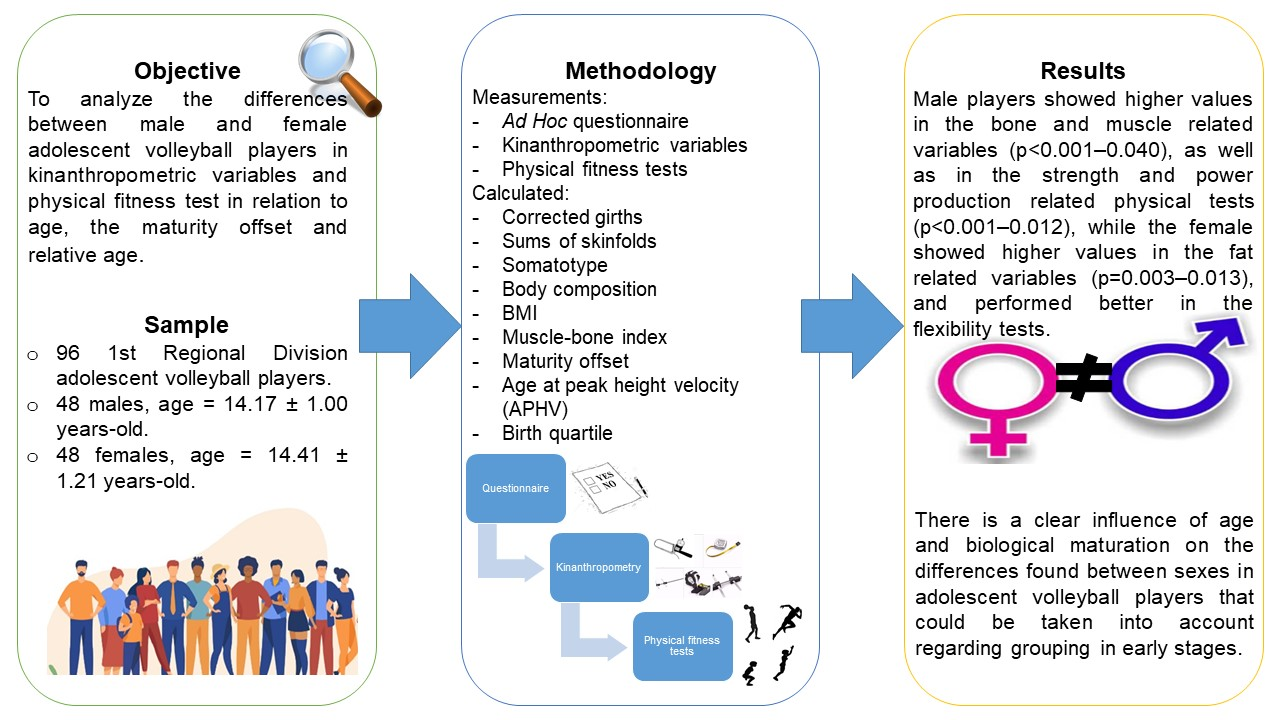
The Effect of Age, Biological Maturation and Birth Quartile in the Kinanthropometric and Physical Fitness Differences between Male and Female Adolescent Volleyball Players

 ,
,  ,
,  and
and Abstract
Share and Cite
Albaladejo-Saura, M.; Vaquero-Cristóbal, R.; García-Roca, J.A.; Esparza-Ros, F. The Effect of Age, Biological Maturation and Birth Quartile in the Kinanthropometric and Physical Fitness Differences between Male and Female Adolescent Volleyball Players. Children 2022, 9, 58. https://doi.org/10.3390/children9010058
Albaladejo-Saura M, Vaquero-Cristóbal R, García-Roca JA, Esparza-Ros F. The Effect of Age, Biological Maturation and Birth Quartile in the Kinanthropometric and Physical Fitness Differences between Male and Female Adolescent Volleyball Players. Children. 2022; 9(1):58. https://doi.org/10.3390/children9010058
Chicago/Turabian StyleAlbaladejo-Saura, Mario, Raquel Vaquero-Cristóbal, Juan Alfonso García-Roca, and Francisco Esparza-Ros. 2022. "The Effect of Age, Biological Maturation and Birth Quartile in the Kinanthropometric and Physical Fitness Differences between Male and Female Adolescent Volleyball Players" Children 9, no. 1: 58. https://doi.org/10.3390/children9010058
APA StyleAlbaladejo-Saura, M., Vaquero-Cristóbal, R., García-Roca, J. A., & Esparza-Ros, F. (2022). The Effect of Age, Biological Maturation and Birth Quartile in the Kinanthropometric and Physical Fitness Differences between Male and Female Adolescent Volleyball Players. Children, 9(1), 58. https://doi.org/10.3390/children9010058